โ–ท The world of Pets: Dogs, cats, birds, reptiles, amphibians

Clippercat
Registration: CATZ

Content

What are Clippercats?

They are a recently recognized breed, which is being developed under strict guidelines.

In a nutshell, the Clippercat is the New Zealand shorthair cat and / or the Australian longhair cat. with polydactyl feet. Poly– means "many" and Dactulos – means "fingers".

Cats usually have 5 claws on its front legs.. (4 plus a snail claw) and 4 on each hind leg. Cats with the polydactyl mutation can have between 5 and 7 fingers on the front legs and between 4 and 7 in the rear.

History

In New Zealand and Australia, between the years 1850 and 1900, a large number of immigrants arrived on the Clipper ships that sailed the seas between England and the Antipodes.

Many of these ships docked in Auckland and the Hauraki Gulf, where today we find the highest concentrations of polydactyl cats.

Following the CATZ Inc policy of inclusion and establishment of rules for the responsible registration of cats, these cats, which are a natural mutation, and an expression of an incomplete autosomal dominant gene, They can now be registered with CATZ Inc under the breed name "Clippercats", formerly called Antipodean cat, with the addition of the polydactyl mutation..

Unlike the United States.UU., the Clippercats (Polydactyls of Domestic / Antipodean origin) cannot be raised with others Clippercats, and there are strict guidelines set by the Registry for their breeding to ensure that all Clippercats recorded are the Heterozygous form of this mutation.

Right now, if you have a polydactyl cat, you can register it in the open registry as Clippercat, if you meet very specific guidelines.

Breeding conventions include recording the number of toes on each foot and the breed standard includes both a limit on the number of toes allowed and restricts the structure of the feet to three accepted structural formats..

The Clippercats they can only be bred with short hairs / New Zealander longs and the breed standard calls for the New Zealand SH / LH type with the addition of the polydactyl mutation.

The Clippercats cannot be crossed with any other currently recognized championship breed.

Where do polydactyls come from??

The polydactyl cats they have a long and interesting history. For many centuries they have roamed south-west Britain and there is evidence of polydactyl cats in countries as far away as Norway, although reports in Europe are few and far between, due mostly to the perceived relationship between cats and witchcraft.

The polydactyly is a trait allowed in the breed of Pixie Bob cat, which is classified as a natural breed, and that competes in the TICA championship, the International Cat Association. (USA)

It was also a dominant trait in many of the early Maine Coons, and it was considered that it helped those cats to overcome the heavy snows of the winters of the State of Maine. Breeders, However, selected to remove the trait from that specific breed.

There are several reports of a folklore in southern England, which states that when people found cats with too many fingers, They offered them to the captains of the ships, who apparently considered them "lucky cats" and very suitable for a sailor's life. They were also considered gifted buzzards and, thanks to your extra fingers, more fit for life on mobile covers.

Large populations of cats with this mutation were seen in and around the Boston area, where they were commonly called "Boston thumb cats". An article published in the magazine ยซCat Watchยป from Cornell University in 1998 analyzed the studies carried out on polydactyl cats between 1940 and 1970 and tentatively concluded that the trait probably occurred in cats that came from England to the Boston area with the Puritans in the mid-17th century. These studies focused on the unusually high concentration of polydactyls in that area., and in other east coast ports with strong shipping links to the British Isles, like Halifax and Yarmouth, and in Nova Scotia, where there were also higher concentrations of polydactyl cats.

The author Ernest Hemingway is also recorded as a gift from a ship captain polydactyl cat of the race Maine Coon cat, and this cat is believed to be the progenitor of the many polydactyl cats now cared for in the trust established for them on the author's home island in the Florida Keys. Apparently, This led to the polydactyl cats They were sometimes called "Hemingway cats.".

There are currently three separate private registries in the United States where polydactyl breeders can register their specimens.. These cats are often called "American Polydactyl Catยซ.

But, it would be very conceited to consider them solely native to the United States, when its story is rather associated with the many boat cats that traveled with immigrants from England and Europe to the United States and other parts of the world between 1620 and 1900. Even the famous "Mayflower" was a merchant ship before its well-known voyage to the United States.. and in those days he made several trips between England and Norway before being chartered by the pilgrims.

Source: catzinc.org
โ–ท The world of Pets: Dogs, cats, birds, reptiles, amphibians

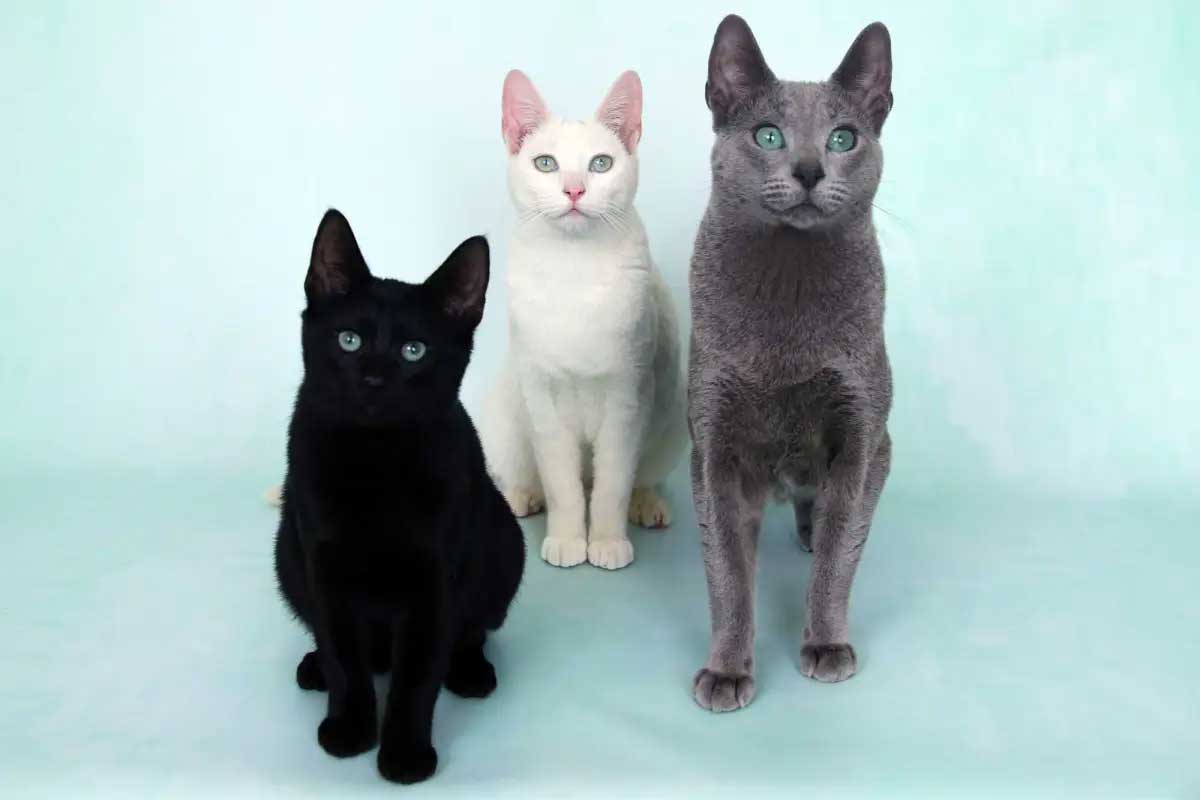
Russian black and white cats
Federations: GCCF, ACFA

Today, the Russian white cat is fully recognized in Australia, New Zealand and South Africa and exists in various stages of recognition in the UK, many continental European countries and the United States.
russian white cats, black and tabby
White russian cats, black and blue – capalabacatcottage.com

Content

History

White cats, Russian blacks and tabbies are the result of an Australian breeding program that began with a female cat Siberian white and a Russian Blue Cat. The Siberian white cat had no pedigree, However, when she was paired with a russian blue, produced two white offspring. Breeders, Dick and Mavis Jones, from the kennel Myemgay, they kept a white kitten and called her White Rose. When he reached adulthood, looked like a pure white version of a Russian Blue Cat.

"Russian black and white cats"

Gato ruso tabby
Russian tabby cat – worldlifeexpectancy.com

White Rose she was paired with her father Russian Blue, Myemgay Yuri. She gave birth to two more white Russian kittens, who were eventually paired with stallions Russian Blue. The best white kittens were continually crossed with russian blues until the breed was fully established. The Royal Agricultural Society (RAS) from New South Wales (Australia) granted champion status in 1975, but only to Russian White Cat.

The Russian black cat and ruso Tabby can occur when two cats Russian Blue they mate with each other, and sometimes they occur when one of the parents is a White Russian cat.

Not all registries recognize all cat colors ยซrussiansยป or put them all in the same category. These may include, the Cat Fanciers Association (CFA) y la Federation International Feline (FIFe) they only recognize the Russian Blue Cat. The Governing Council of the Cat Fancy (GCCF) recognize white russian and black russian cats, and American Cat Fanciers Association (ACFA) has distinct breed standards that separate him Russian Blue Cat of the russian shorthair cats in blue colors, black and white.

Physical characteristics

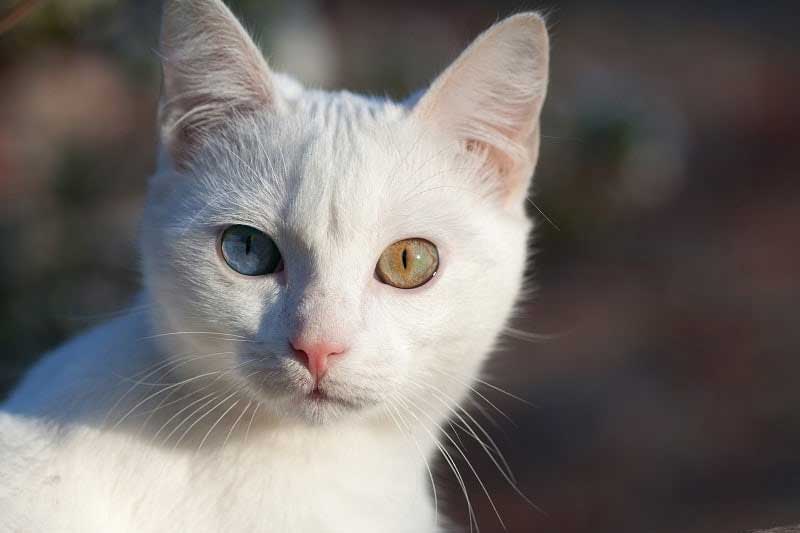
Russian white cat
Russian white cat – istockphoto.com / Mironmax Studio

BODY
White russian cats, black and tabby are medium size, with fine bones and a finely muscled, athletic appearance.

HEAD
The head should have a medium wedge shape. The muzzle should be blunt, continuing the wedge-shaped profile of the head. The nose should not be visible and the whisker pads should not be too prominent.

EARS
White russian cats, black and tabby have comparatively large ears with broad bases, pointed tips, and little or no furnishing.

COAT
White russian cats, black and tabby have a double coat with a dense, fine texture and a superbly soft touch.

COLOR
Solid white colors, solid black and brindle are allowed by various breed registries. White Russian cats can be born with a darker hair color "cap" on their head, that disappears upon reaching adulthood.

EYES
The eyes should be round and wide apart. The bright green color of the eyes is present in all the colors of the russian shorthair cats, including white; kittens may have yellow eyes that turn green in adulthood.

LEGS & PAWS
The legs should be long and fine-boned., and the legs should be small with a slightly rounded profile.

TAIL
White russian cats, blacks and blues should have long, shapely tails that taper from base to tip.

Character and skills

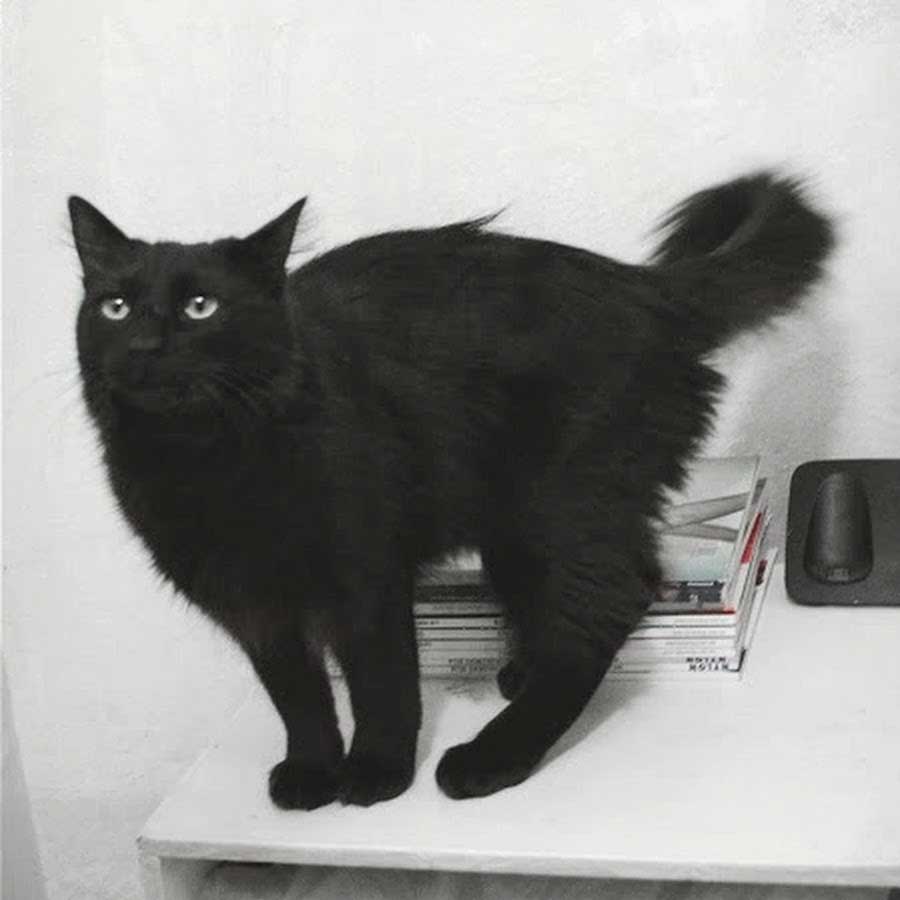
Russian black cat
Russian black cat

The russian black cats, White and tabby they are playful and friendly, but not terribly naughty. Happy to keep their families entertained, these kittens are fun companions thanks to their great intelligence. Like their blue haired cousins, These cats quickly learn what behaviors earn pats and praise from their human relatives and what behaviors are best to avoid. They share the sensitive nature of Russian Blue Cat; a strong reprimand is likely to hurt this individual's feelings and cause him to hide.

Friendly and sociable with family members, including other domestic animals such as dogs, white russian cats, blacks and brindle have a decidedly shy streak. They do not like strangers at all and hide in a safe place when new people come to visit.. This trait means that they are not good candidates for leash training.; Instead, better to provide plenty of indoor exercise opportunities that allow for safe enjoyment on cat terms.

Those who spend long hours away from home will be glad to know that russian white cats, black and tabby they are perfectly fine with the idea of รขโ‚ฌโ€นรขโ‚ฌโ€นkeeping themselves entertained (or asleep) while your human friends are at work or school. You will likely be greeted with a series of cheery meows and tail wagging when you return..

Talking about meows, these kittens are somewhat talkative, but much less than their ancestors Siamese. They have a reputation for snapping back when spoken to and spreading the word when they want attention.. Some "sing" to themselves while playing with their favorite toy, and others become quite picky when they feel that mealtime is approaching.

Curiosities

All โ€œRussianโ€ cat colors share similarities in coat texture. This exceptionally thick and lustrous coat has often been compared to that of a seal or a castor, with very fine internal hairs and protective hairs that stick out from the body instead of being completely flat.

Videos "Russian black and white cats"

Russian white cat snowy

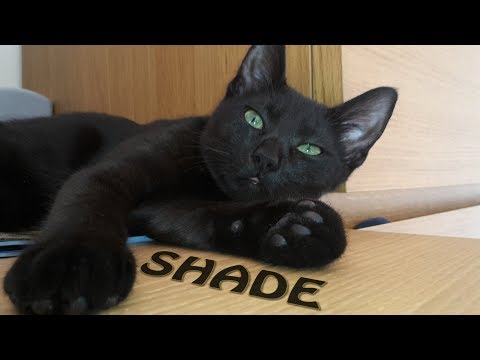
Meet Shade the russian black

โ–ท The world of Pets: Dogs, cats, birds, reptiles, amphibians

The Echidna's short snout

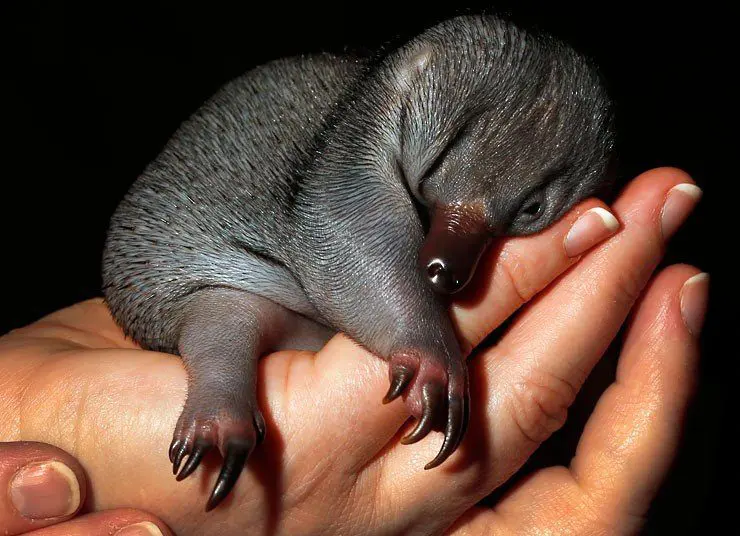
The short snout Echidna is the only species of echidna Australia. It is easy to recognize by their sharp spines, short legs and long snout.

Measured between 30 and 45 cm.. and weigh between 2 and 5 kg. Found on Australia, including Tasmania. While found in all Australia, not as common in sydney as it used to be. The body, with the exception of the bottom, the face and the legs, It is covered with cream-coloured spines. These thorns, that it reach 50 length mm, they are actually modified hairs.

It lives in forests and woodlands, grasslands, heathland and arid environments.

The Echidna he is shy and moves slowly. Is solitary most of the year, but in time of mating several males may follow a female. Their activity patterns differ based on location and temperature – in the warmer areas of Australia is completely nocturnal, spending the rest of the day resting from the heat. It usually took refuge in rotten logs, stumps or Burrows, either under bushes. In more temperate areas activity occurs at sunset, while in South Australia echidnas are often active during the day, especially during the winter.

Read more

โ–ท The world of Pets: Dogs, cats, birds, reptiles, amphibians

Aussie
Australia FCI 8 . Small sized Terrier

Terrier Australiano

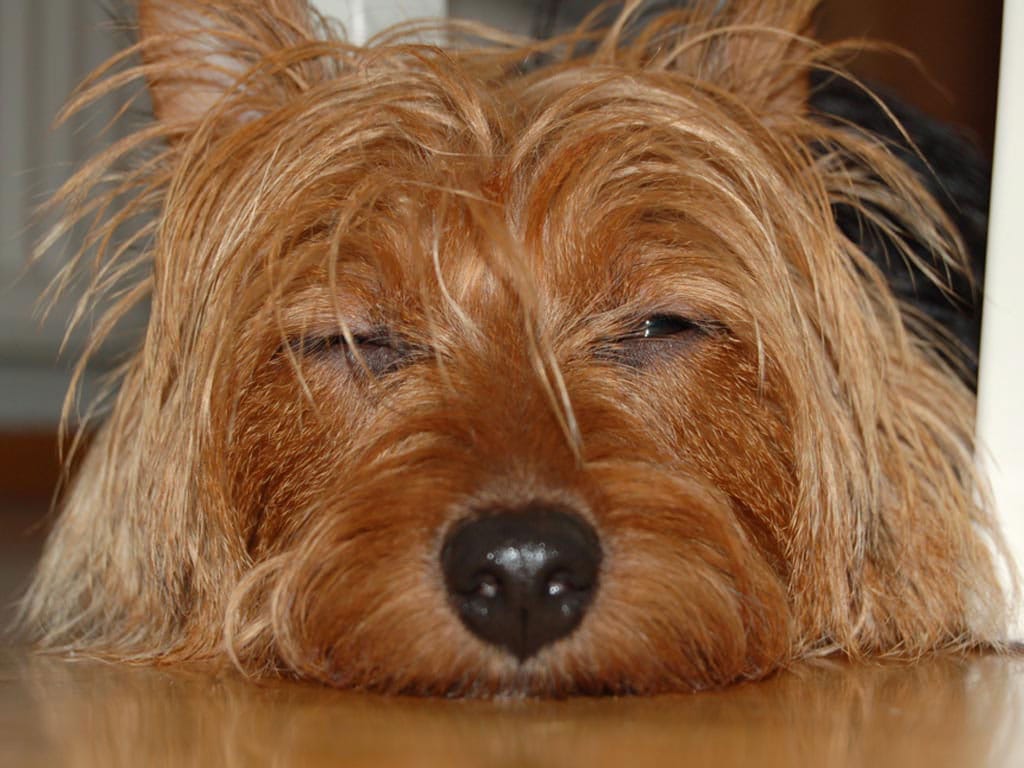
The Aussie (Australian Terrier) It is a breed of dog in the Terrier family, classified in the section 2.
It is a lively dog, attentive, with a facial expression that denotes intelligence, loyalty and faithfulness.

Sometimes it can become dominant, so a good training from an early age would be appropriate..

Read all the information in the race by clicking on: Australian Terrier.

Dogs breeds: Aussie


โ–ท The world of Pets: Dogs, cats, birds, reptiles, amphibians

Cattle dog
Cattle Dogs according to the FCI

Boyero

Content

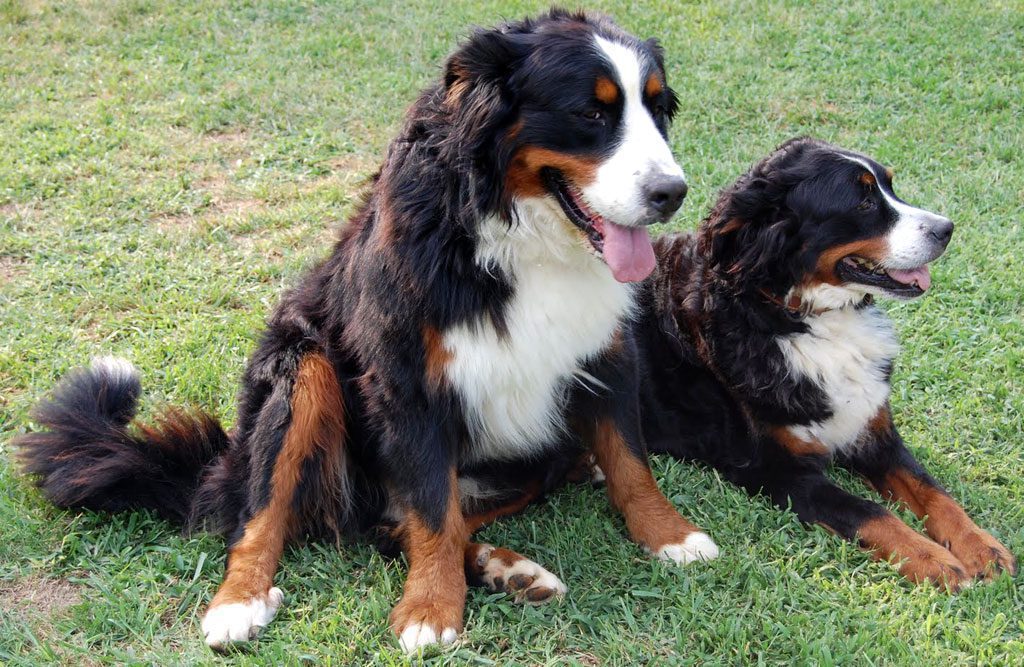
Known by the name of Sennenhund dog a number of breeds of dog traditionally have been used for the management and conduct of cattle.

The FCI classifies the breeds of cattle dogs into two different groups based on their physiognomy.
In Group I, Section 2, He placed Sennenhund dogs Lupoid appearance (similar to a Wolf) and in Group II, Section 3, to the trotting of mountain.

Read more