โ–ท The world of Pets: Dogs, cats, birds, reptiles, amphibians

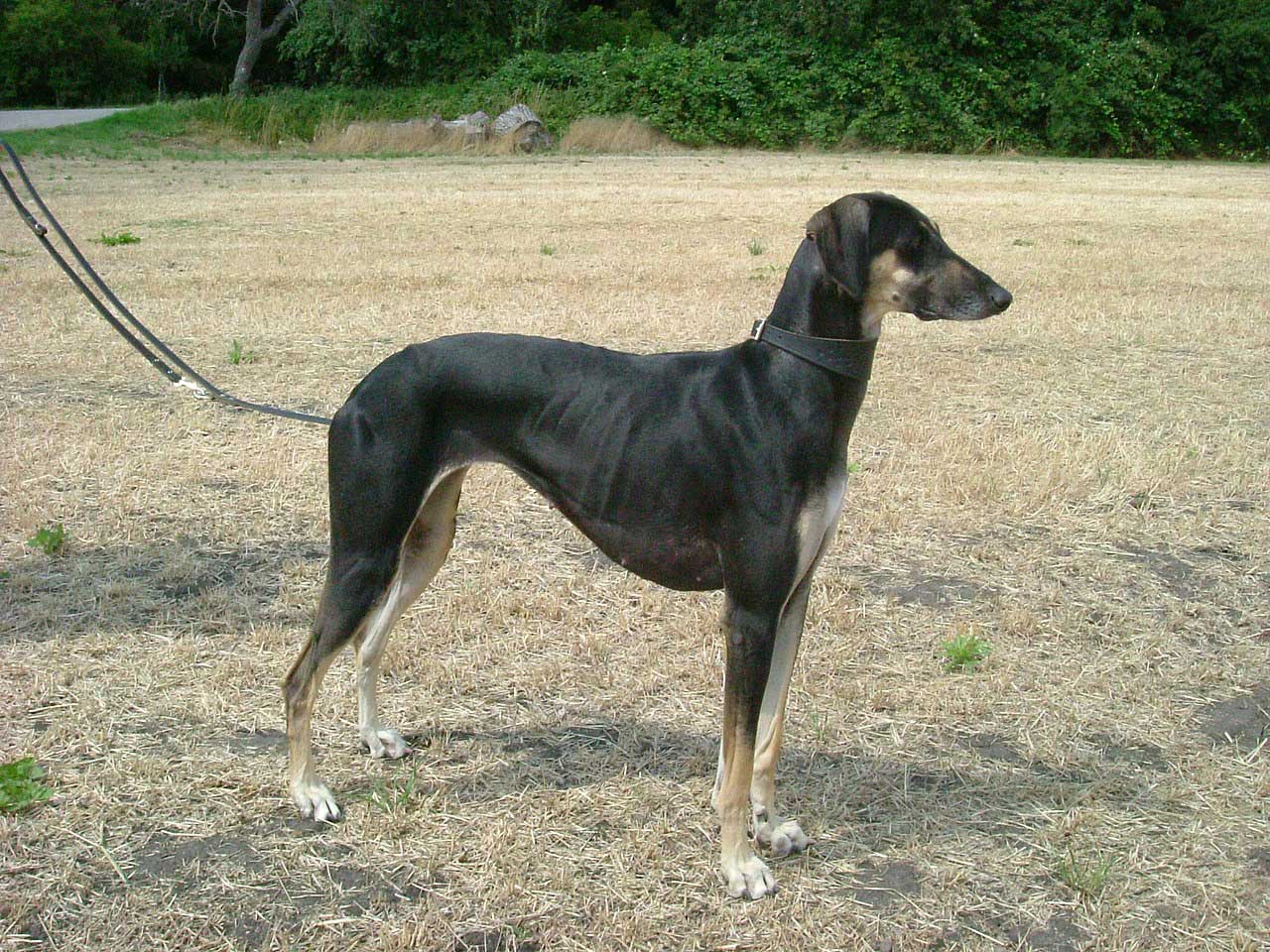
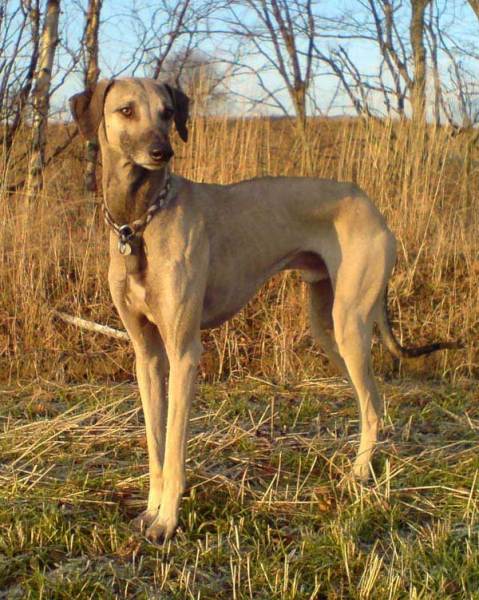
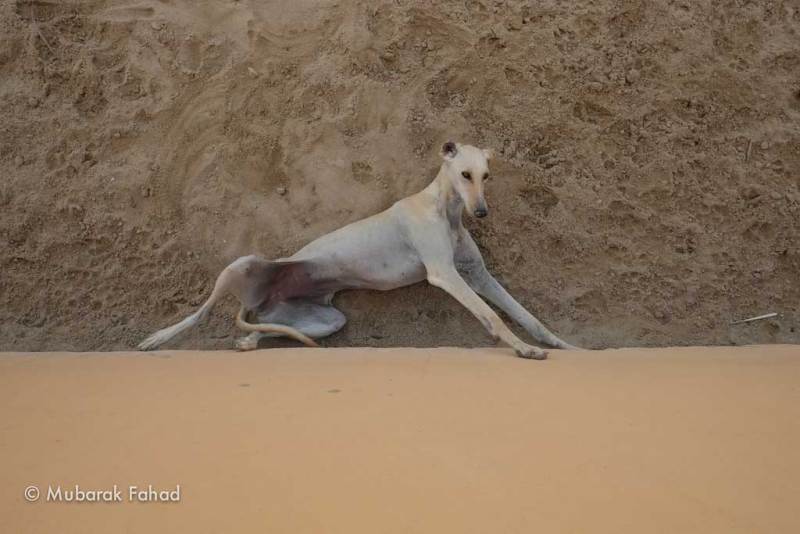
Azawakh (Tuareg Sloughi)
Mali FCI 307 . Short-haired Sighthounds

The Azawakh they are excellent companions for runners and are almost impervious to heat.

Azawakh

Content

Characteristics "Azawakh (Tuareg Sloughi)"

Coexistence is important that you have with your new friend. Before considering the acquisition of a dog of the breed "Azawakh (Tuareg Sloughi)" you know certain factors. Not all breeds of dogs are apt to live in an apartment, you must take into account his character, their need for exercise, their interaction with other pets, their care and if you have small children, their level of tolerance towards them.

Adaptation โ“˜

3,0 of 5 stars (based on 1 review)

friendly dog โ€‹โ€‹โ“˜

2,0 of 5 stars (based on 1 review)

hair loss โ“˜

2,0 of 5 stars (based on 1 review)

Affection level โ“˜

4,0 of 5 stars (based on 1 review)

Need for exercise โ“˜

4,0 of 5 stars (based on 1 review)

Social need โ“˜

2,0 of 5 stars (based on 1 review)

Home โ“˜

3,0 of 5 stars (based on 1 review)

Toilet โ“˜

1,0 of 5 stars (based on 1 review)

Friendly with strangers โ“˜

2,0 of 5 stars (based on 1 review)

barking โ“˜

2,0 of 5 stars (based on 1 review)

Health โ“˜

3,0 of 5 stars (based on 1 review)

Territorial โ“˜

4,0 of 5 stars (based on 1 review)

Cat friendly โ“˜

2,0 of 5 stars (based on 1 review)

Intelligence โ“˜

3,0 of 5 stars (based on 1 review)

Versatility โ“˜

3,0 of 5 stars (based on 1 review)

Child friendly โ“˜

2,0 of 5 stars (based on 1 review)

Surveillance โ“˜

3,0 of 5 stars (based on 1 review)

joy โ“˜

3,0 of 5 stars (based on 1 review)

History

The Azawakh (Tuareg Sloughi), It is a breed of dog of the type "Short-haired sighthounds", native to africa. It is also known by other names: Hanshee, Oska, Rawondu, Bareeru, Wulo, Tuareg Sloughi.

This breed could be defined as a Sighthound African Afroasiatic model which appeared in Europe in the year 1970, from the middle basin of the Niger (Mali) and in particular of the Valley of the Azawakh. For centuries it has been the inseparable companion of sub-Saharan nomads.

Something curious is that the Azawakh possesses a rare allele of glucose isomerase (GPIB) It is produced only in foxes, jackals, Italian wolves, dogs Sloughi and other rare breed dogs not related to him Azawakh, and they are, mainly, in Japan.

Recent scientific studies of a genetic protein and the blood of Azawakh, added to archaeological studies and direct observation of packs, have thrown some ideas about the origin of the breed Azawakh contemporary. One of them says that, come from the stray dog โ€‹โ€‹population of sub-Saharan Africa, and, also among her ancestors is the Basenji and the Sloughi from the Maghreb. Despite the morphological similarities, mitochondrial DNA tests show that only very distantly, is related to other dogs.

As a whole, this evidence suggests that the dog population Azawakh count with one unique gene pool What, It has been kept pure, perhaps by having been largely isolated from the populations of other dog breeds, for thousands of years.

Physical characteristics

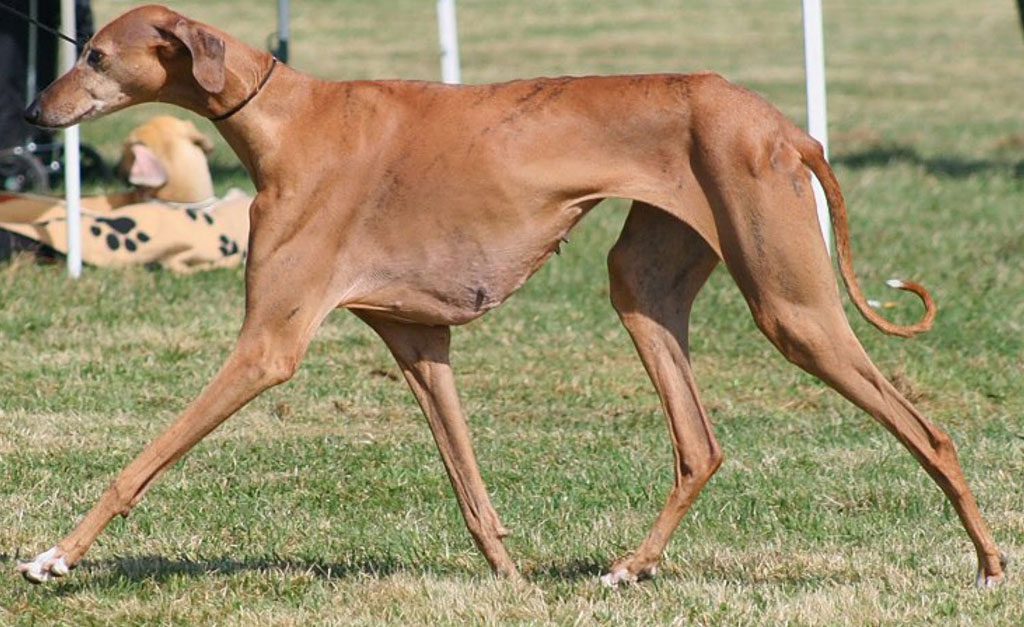
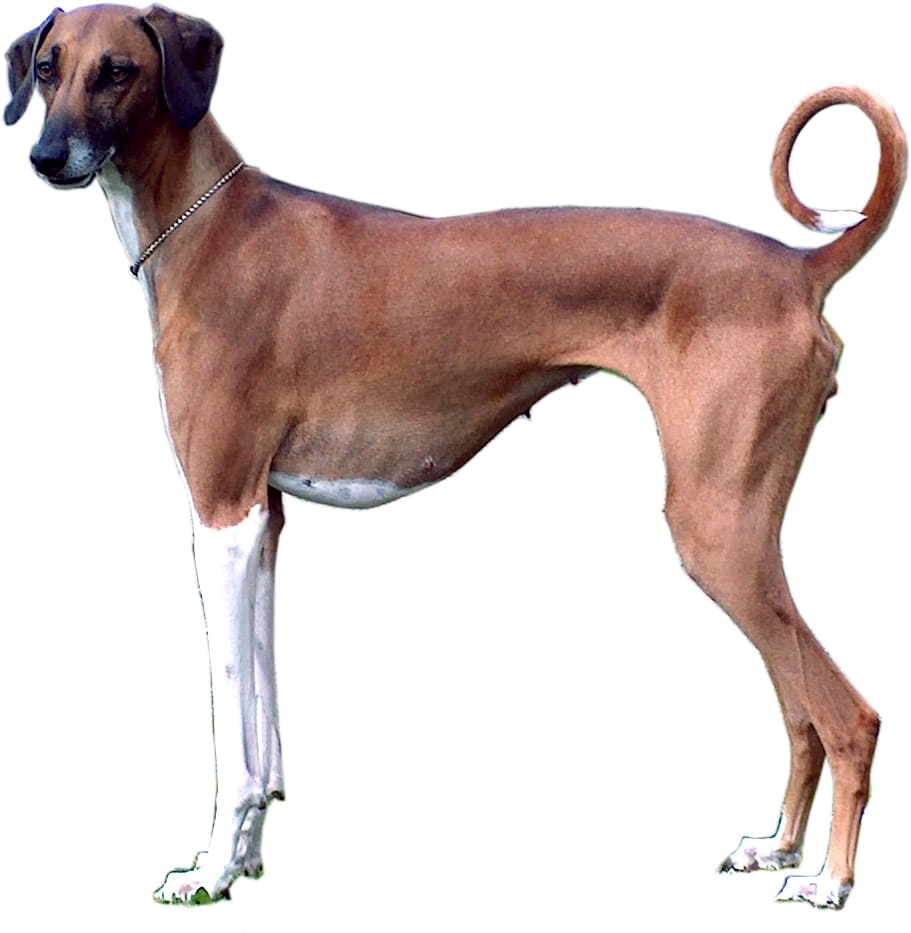
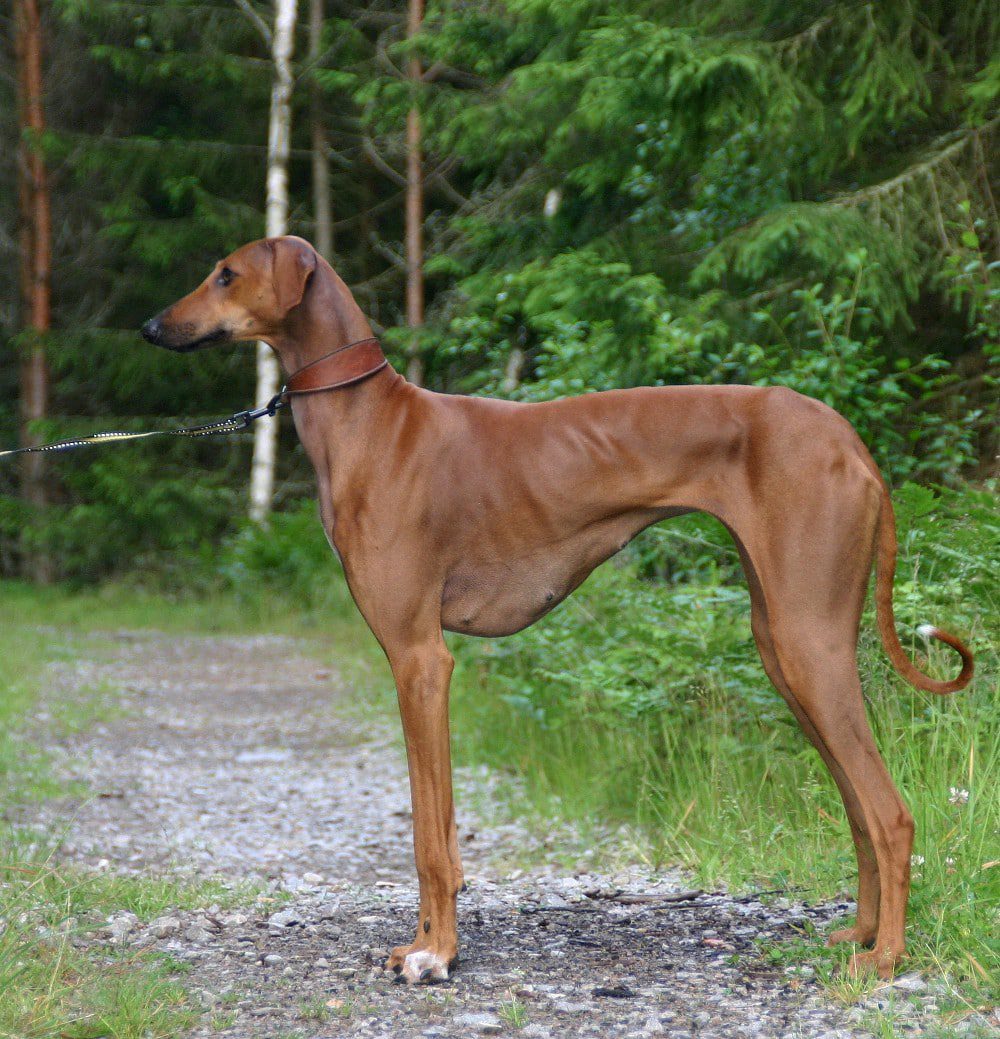
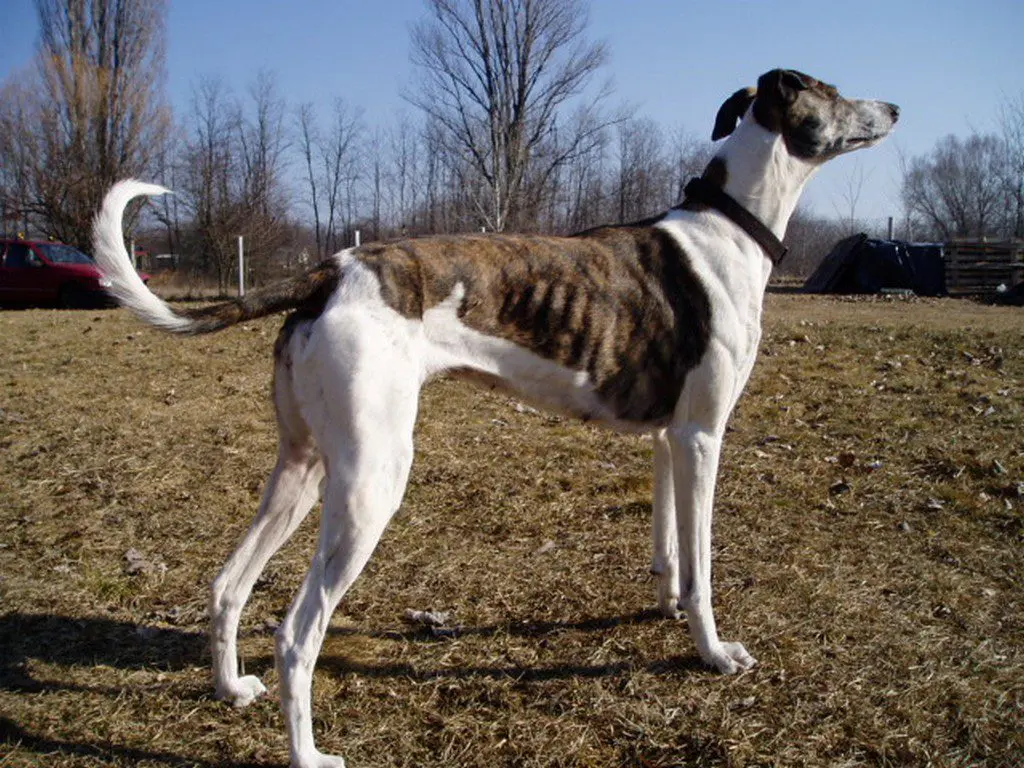
Its morphology is very similar to that of the Middle Eastern greyhound and some Indian hounds., Although there are several obvious differences. As for example, a very short and smooth mantle, nearly absent in the womb; and hind legs longer than the height with the front to the cross. Moves with a walk, clearly, feline and can be found in a wide variety of colors, in degraded, striped, Although the format is, basically, a solid color.

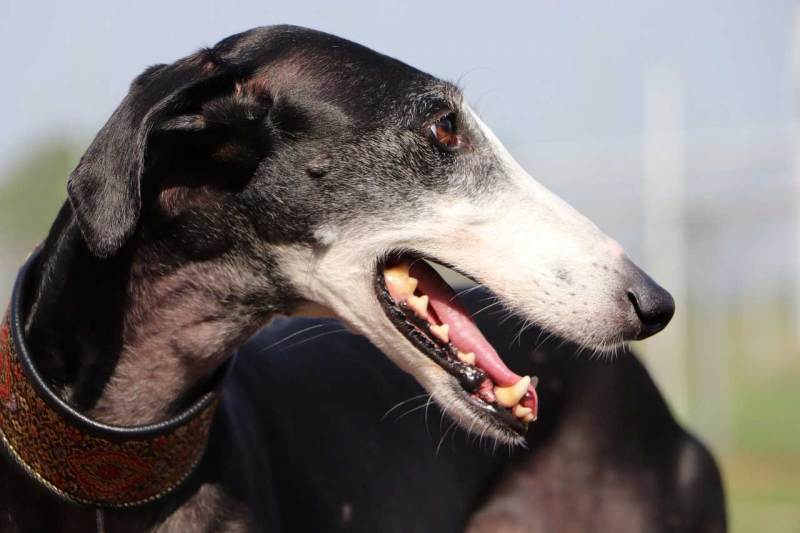
The Azawakh, is a slim dog, elegant and his eyes the color of almonds, give fair air of sweetness to your eyes.
The standard rules, they require a dog from 15 to 25 kg, and with a height of 61 to 74 cm.. Her bone structure is, clearly, through the skin and like your muscles. His muscles are usually said, they are "dry", which means that they are very flat, Unlike in the Greyhound and the Whippet (they have showy, rounded muscle). In this sense (muscle), is more similar to the Saluki.

"Azawakh (Tuareg Sloughi)"

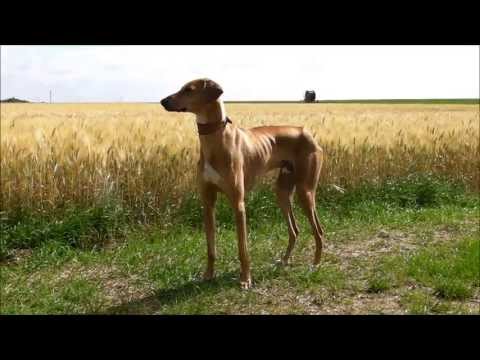
In Africa, a variety of colors are found in dogs Azawakh, How to be red, beige, blue, grey, and, black and blue rarely. As well, White machitas can be found in different colours (not many). Due to this color variation in the entire native population of Azawakh, the American standard used by the AKC and UKC allows for any combination of the colors found in Africa.

In United States, the standard of FCI It has been modified to have no restrictions on color. The colors allowed in the breed standard according to the FCI, These are sand or light to dark beige; brown, Red and striped (with or without, dark mask), with pechera whitetip, the tail and white on the legs (It can be on the tip of the toes or middle high). In the news, white stockings that go above the elbow joint is considered a disqualifying characteristic in France, as well as a white or half collar collar (the strong Irish).

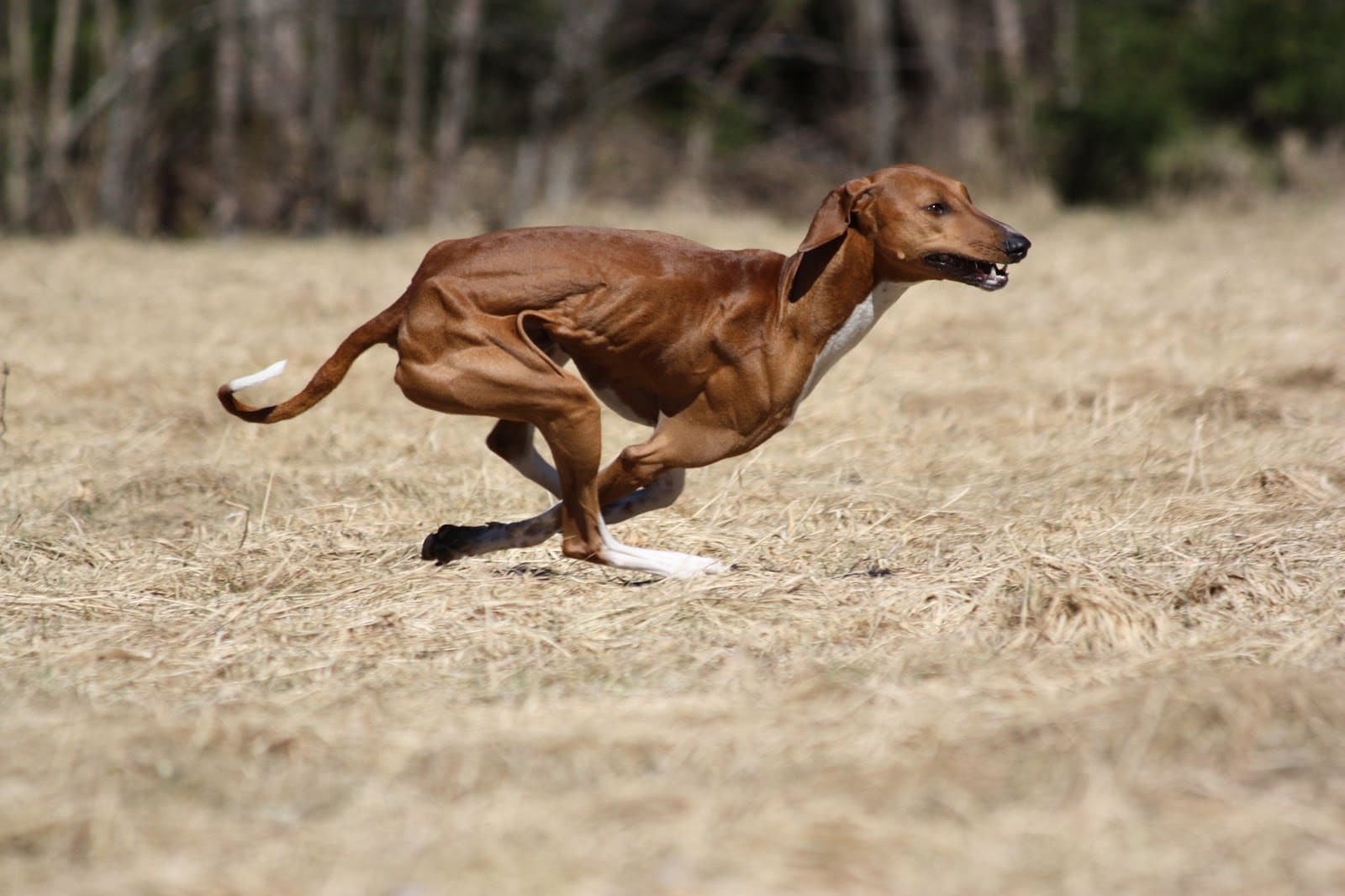
The Azawakh It is a very good dog for hunting. They are very agile, and despite pretend fragility, they are very hardy dogs and are usually very fast curing injuries caused by their vigorous careers.

Similar to the Tibetan Mastiff (Do-Khy) and the Basenji, the dog Azawakh usually a zeal to the year. Y, so the puppies born healthy, the norm says that the animal should not be assisted in childbirth. The size of the litters tend to be of 4 to 6 Puppies, but it can have litters as small as a puppy and as large as eight.

Character and skills

The Azawakh, you need a fairly high level of exercise and be able to do regular runs in large indoor enclosures to expend energyโ€ฆ They often dig holes in the garden, if you feel bored or overflowing with energy.

They are excellent training companions for runners and they are nearly impervious to heat. They withstand very high temperatures (typical of desert areas), temperatures that would kill any other greyhound...

The Azawakh that live in packs live and orient themselves in social forms of complex hierarchies. They have tremendous memories and are able to recognize each other after long periods of separation.. They are often found sleeping snuggled up to each other for warmth and company..

the Azawakh is lively, attentive, reserved and little sociable with strangers, with whom you can be aggressive if it feels threatened its integrity or that of his master. He is very affectionate with those to what he considers his friends. They need a master which will give them a firm but fair leadership education.

Unlike other Sighthounds, the main function of the Azawakh in his homeland is that of Protector and guardian of cattle (and people). They tend to develop an intense bond with their owner., Although they are very independent dog, Although very attached to their masters for all corporate.

to most of the Azawakh, they don't like rain and cold at all.

With the known and accepted by the family, the Azawakh they are very kind and loving, show reserved with strangers, suspicious and prefer not to bring, not to be touched, but they are not aggressive, as we said, unless they see or feel threatened.

Observations

Initially, It was considered a variety of the Arabian Greyhound..

Education

The Azawakhs they are proud and independent. They respond well to positive reinforcement techniques, But heavy-handed methods or punishments will make them shut down, resist or even be aggressive. But, with the right teacher who gives them the right motivation, learn quickly and easily.

On the other hand, may show adaptation difficulties (for example, when changing ownership, move to another house, etc.). Thus, puppies need extensive socialization with people, new places and situations. This process must continue throughout your life, even after becoming adults.

Health

The Azawakh it is a resistant dog that does not have a special predisposition to certain diseases.

But, due to its short coat and extreme thinness, not the best choice for people who live in humid or cold climates. In general, covering him with a dog coat or fleece can help maintain his body temperature when he is out in winter. Inside, you need a padded pad to rest your bony body.

Life expectancy

12 years

Grooming

The short coat of the Azawakh requires little maintenance. A weekly brushing is enough.

It also, the Azawakh he is not known for losing a lot of hair.

It also, it is not necessary to bathe the dog: not only does it not develop a doggy odor, but even when it gets dirty in the mud, you just have to wait for it to dry and then remove the residue with a vigorous brushing.

Food

In Africa, the Azawakh share his masters' ration and get his share of the hunt after the hunt.

Historically, have been used to a low-protein, rice-based diet, millet and goat's milk. Thus, you are prone to digestive problems if you eat a large amount of protein-rich foods, as with many dog รขโ‚ฌโ€นรขโ‚ฌโ€นfoods.

The breeders of Azawakh recommend a diet with a 9% fat and a 22% protein. They also recommend 3-4 small meals a day, since the dog becomes gluttonous if he only eats once a day.

It also, this dog appreciates occasional servings of starchy food, like pasta and brown rice, as well as fruit and vegetables (bananas, carrots, etc.).

Last, critics who point to his thinness as a sign of malnutrition must understand that this dog is built for speed and cannot be fat. Standards call for thin skin stretched over a bony, muscular frame.

Use

The Azawakh has long been used by Sahelian tribes as a hare hunting dog, antelopes and wild boars.

It is also used as a watchdog and companion..

It also, in the western world, stand out in the canirun, a leisure run consisting of chasing a mechanically controlled artificial lure.

Last, these skinny dogs, muscular and resistant they are excellent companions for runners and globetrotters.

ยซAzawakhยป images

Azawakh Videos

L'Azawakh Fahim Kel Az'Amour, Azawak, They are, Greyhound

Type and recognitions:

  • FCI CLASSIFICATION:
  • Group :
  • Section : . .

Federations:

  • FCI – Group 10: Section 3: Short-haired Sighthounds โ“˜
  • El American Kennel Club (AKC) – Hounds โ“˜
  • Standard KC (The Kennel Club) – Hound โ“˜
  • Standard UKC (United Kennel Club) – Sighthound and Pariah โ“˜

FCI breed standard "Azawakh (Tuareg Sloughi)"

Origin:
Mali

Date of publication of the valid original standard:
04/09/2019

Use:

Greyhound hunting by sight (Gazelles, hares, ostrich) and for the fight against predators (jackal hyenas, Lions). Nomads consider him an important companion in their domestic life and in camp life.


General appearance:

Particularly slim and elegant, the Azawakh greyhound gives the overall impression of great finesse. Its bone conformation and musculature are perceived under its thin and dry skin. The body of this greyhound is inscribed within a rectangle whose long side is vertical..


IMPORTANT PROPORTIONS:

  • Height to the cross / scapulo-ischial length: 10-9 (this ratio may be slightly lower in females).
  • Height to the cross / chest depth: 10-4.
  • Head length / nose length: 10-5.
  • Head length / skull width: 10-4.


Behavior / temperament:

Quick, attentive, distant; can be reserved with strangers, but he knows how to be loving and affectionate in a family environment and with the people he is willing to accept.

Head:

Long, fine, dry and chiseled, Quite thin, without excess.

Cranial region:
  • Skull: Almost flat, rather elongated with a width clearly less than half the length of the head. The directions of the craniofacial axes (forehead and muzzle line) are sometimes somewhat divergent. The superciliary arches and the frontal sulcus are little marked. The external occipital protrusion is clearly marked.
  • Stop (naso-frontal depression) : Very slightly marked

facial region:

  • Truffle: Black or dark brown, nostrils wide open.
  • Snout: Long, rectilinear, tuned forward without excess.
  • Lips: Thin and tight, black or dark brown; lips are not hanging.
  • Jaws / teeth: Long and strong jaws. Scissor bite. Complete denture.
  • Cheeks: Flat.
  • Eyes: Almond biscuits, quite large, slightly oblique lid opening, dark in color or, times, amber, but never blue; the edge of the eyelids well pigmented black or dark brown.
  • Ears: Very high implanted. They are thin, always droopy and flat, broad at the base, glued to the cheeks, never "in the form of a rose". Its shape is that of a triangle with a slightly rounded tip. The base rises when the greyhound is attentive.

Neck:

Protruding clearly from the shoulders, long, thin and muscular, with slightly arched top profile. The skin is thin, not forming double chin.

Body:

  • top line: Straight, almost horizontal or rising slightly from the withers to the ends of the hips. Hips clearly protruding and at a height similar to or greater than that of the withers.
  • Cross: Clearly prominent.
  • Pork loin: Short and dry.
  • Rump: Oblique (ideal angle: 45ยฐ).
  • Breast : High, its length descends almost to the level of the elbows, with slightly narrowed sternum region. Quite narrow windowsill. Long ribs, slightly apparent, soft and
    regularly arched
  • Bottom line and belly: The sternal arch is accentuated. The lower line gently retracts towards the belly which is very high.

Tail:

Implemented low, long, thin, dry and sharp. Covered with the same hair as the body and, frequently, with a white spot (brush) on its limb. It falls with the tip slightly raised, but when the animal is in attention, can rise above the horizontal line.

Tips

PREVIOUS MEMBERS: Long, fine, vertical. Perfect legs.

  • Shoulder: Long scapula, with dry muscles; viewed in profile only slightly oblique.
  • Arm: The scapulo-humeral angle is very open (130ยฐ more or less).
  • Metacarpus: : Slightly oblique.
  • Previous feet: Rounded, with thin and compact fingers, well arched. The pads are pigmented.

LATER MEMBERS: Long and dry, viewed from behind perfectly parallel.

  • Thighs: : Long with a dry and marked musculature. The coxofemoral angle is very open (130ยฐ more or less).
  • Knee: The femoro-tibial angle is very open (145ยฐ more or less).
  • Metatarsus: Dry tarsus and metatarsal, No Spurs.
  • Hind feet: Rounded with well arched toes and pigmented pads.

Movement:

Always very flexible and particularly high when trotting and walking. The gallop is elastic. The Azawakh gives a sublime impression of lightness and elasticity. Their movement is an essential characteristic of the breed.

Mantle

  • SKIN: Thin and adherent to the body.
  • HAIR: Short, fine, reduced to absence under the belly.
  • COLOR: Tawny, with or without brindle markings, with white markings limited to the extremities. All nuances are admitted, from light sand to dark tawny (Mahogany). Brands
    brindles must be only black and any other shade is excluded. The muzzle may have a black mask.
  • White markings: The white mark on the face is very fickle. In the sill, the white color can appear in the form of more or less scattered white spots and limited to the base of the neck. In any case, a narrow white stripe is allowed on the front of the neck., on the chest and lower chest.
    This mottling of the pectoral area should not exceed the tips of the shoulders or rise on either side of the neck. A small white spot on the nape is tolerated.
    As a continuation of the white markings on the sill, white spots may appear under the chest., but never in the rib area.
    Each of its four limbs necessarily has a white spot, at least in the form of a white mark on the feet.
    In the case of a subject with excellent structure, a lack of white color in one of the limbs is usually tolerated. The white markings present on the forelimbs, which in most cases are irregular, In no case should they rise above the elbows or shoulders. On the other hand, the white markings present on the hindlimbs, which tend to be much more regular and less invasive, should not appear in the thigh area. But, if they appear on the inner thighs, should not be considered as a fault.


Size and weight:

HEIGHT AT THE WITHERS

  • Ideal height for males: 64 - 74 cm..
  • Ideal height for females: 60 - 70 cm..
  • tolerance +/- 2 cm..

WEIGHT:

  • Males: 20 - 25 kg
  • females: 15 โ€“ 20 kg


Fouls:

Any deviation from the aforementioned criteria is considered as a fault and the severity of this is considered to the degree of the deviation to the standard and its consequences on the health and well-being of the dog..


SERIOUS FAULTS:

  • Head heavy and lacking in elegance.
  • Thick, hairy tail, very curved.
  • Body too long.
  • Pincer bite.


  • FALTAS DESCALIFICANTES:

  • Aggressiveness or extreme shyness.
  • Any dog โ€‹โ€‹showing clear signs of physical or behavioral abnormalities.
  • Lack of type.
  • Reduced rib cage and, in general, extreme thinness.
  • Upper or lower prognathism.
  • Truffle, edge of the eyelids and edge of the lips that are not black or dark brown.
  • Light or blue eyes.
  • Rose shaped ears.
  • Level of the hips lower than that of the withers.
  • Strong non-accidental anatomical deformation (for example, asymmetric union of the ribs at the level of the sternum).
  • Dewclaws or dewclaw extraction marks on hindlimbs.
  • Hard or semi wide.
  • Coat colors not in accordance with standard colors (excess white color, white neck area and tabby markings other than black).
  • Special attention should be paid to diluted prohibited colors: blue, lilac.
  • Any dog รขโ‚ฌโ€นรขโ‚ฌโ€นthat presents scars after having undergone an intervention in order to correct an aesthetic or morphological imperfection will be excluded..
  • Size moving away more than 3 cm of standard norms.


  • N.B.:
  • Males should have two normal-appearing testicles fully descended into the scrotum..
  • Only functionally and clinically healthy dogs, with the typical conformation of the breed, should be used for parenting.
  • The latest changes are in bold.

    Source: F.C.I - International Cynological Federation

    Alternative names:

    1. Idi, Hanshee, Oska, Rawondu, Bareeru, Wulo,(formerly) Tuareg Sloughi (English).
    2. Sighthound, Oska (French).
    3. Idi, Osca, Tuareg-Windhund (German).
    4. Tuareg Sloughi (Portuguese).
    5. Tuareg Sloughi (espaรฑol).

    โ–ท The world of Pets: Dogs, cats, birds, reptiles, amphibians

    Alaskan Husky
    Estados UnidosNot recognized by the FCI . Nordic Sledge Dogs
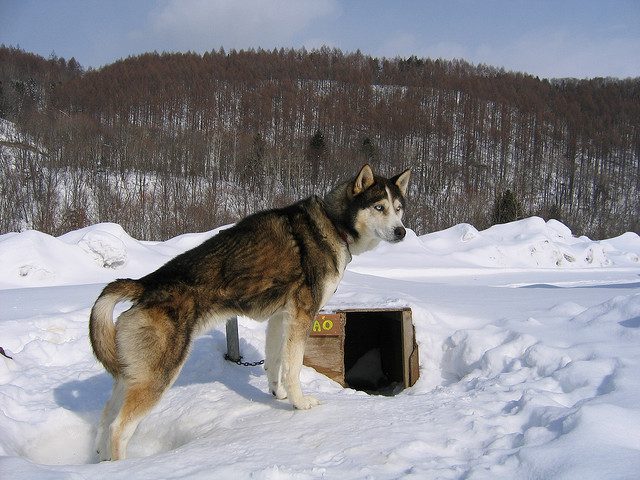
    Alaskan Husky

    Alaskan - Autor de la foto: siva_lovehorses (flickr).

    The Alaskan Husky is an athletic and generally healthy dog., specializes in sledding.

    Content

    Characteristics "Alaskan Husky"

    Coexistence is important that you have with your new friend. Before considering the acquisition of a dog of the breed "Alaskan Husky" you know certain factors. Not all breeds of dogs are apt to live in an apartment, you must take into account his character, their need for exercise, their interaction with other pets, their care and if you have small children, their level of tolerance towards them.

    Adaptation โ“˜

    5,0 of 5 stars (based on 1 review)

    friendly dog โ€‹โ€‹โ“˜

    5,0 of 5 stars (based on 1 review)

    hair loss โ“˜

    4,0 of 5 stars (based on 1 review)

    Affection level โ“˜

    5,0 of 5 stars (based on 1 review)

    Need for exercise โ“˜

    2,0 of 5 stars (based on 1 review)

    Social need โ“˜

    3,0 of 5 stars (based on 1 review)

    Home โ“˜

    1,0 of 5 stars (based on 1 review)

    Toilet โ“˜

    3,0 of 5 stars (based on 1 review)

    Friendly with strangers โ“˜

    5,0 of 5 stars (based on 1 review)

    barking โ“˜

    4,0 of 5 stars (based on 1 review)

    Health โ“˜

    2,0 of 5 stars (based on 1 review)

    Territorial โ“˜

    3,0 of 5 stars (based on 1 review)

    Cat friendly โ“˜

    1,0 of 5 stars (based on 1 review)

    Intelligence โ“˜

    3,0 of 5 stars (based on 1 review)

    Versatility โ“˜

    3,0 of 5 stars (based on 1 review)

    Child friendly โ“˜

    3,0 of 5 stars (based on 1 review)

    Surveillance โ“˜

    5,0 of 5 stars (based on 1 review)

    joy โ“˜

    3,0 of 5 stars (based on 1 review)

    Alaskan Husky history

    Listed not so much as a breed of dog as a type or category of dog. There are no fixed pedigree characteristics, but rather for the purpose, it is to be a very efficient sled dog.

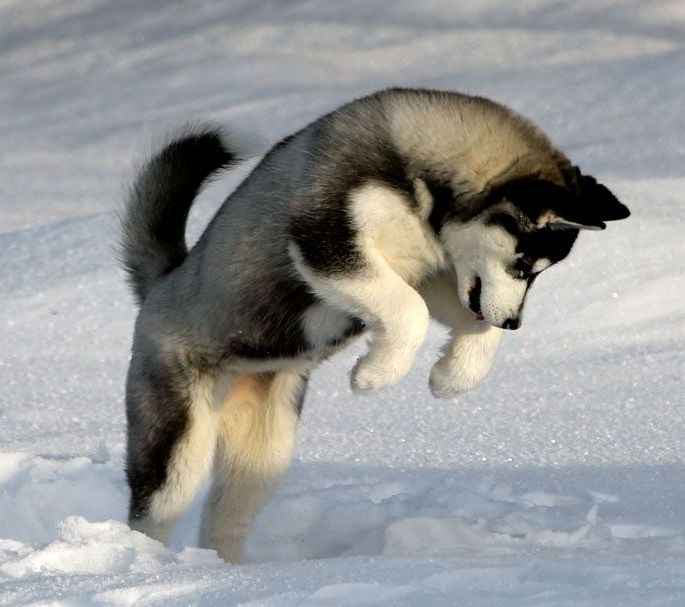
    The origin of this dog is Alaska and Canada. These fully domesticated dogs came thousands of years ago. Today, the Alaskan sled dogs They can be crossed, type Husky, or a combination of several. They also vary in size and build depending on the use of the dog., to compete or work.

    Sled drivers usually distinguish between Alaskan Husky and crossbreeding, in an informal way, so it is possible that this type of dog has a degree of northern dog appearance.

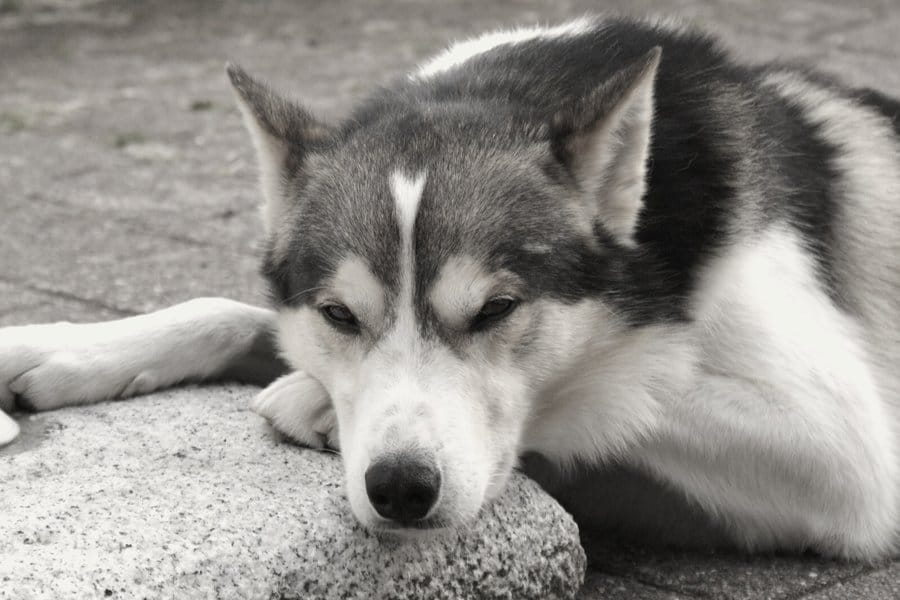
    Most of the Alaskan Husky have pointed ears, qualifying, in fact, as spitz type dogs.

    There are some specializations within this type, as the Mackenzie River Husky or the MALAMUTE, the Alaskan of Sprint as the Eurohound, or distance.

    It must be borne in mind that in sledge racing championships, These dogs can come with loaded sledges to the 30 km/h and that runs for three days at a rate of between 30 to 50 km daily.

    The Alaskan They are valued for their toughness and resistance. They earn an average speed of 31 km/h.

    Alaskan Husky Physical Characteristics

    This type of dogs, at least those that are used to speed racing, are of moderate size, with an average 21 to 25 kg for the males and 17 to 19 kg for the females.

    The eyes They can be any color, many are blue. The eyes blues are not considered an essential feature of this race. The fur It has two layers, short hair and of medium length, Although not much, and usually less dense than pure breed of the North, the length of the shortest layer is governed by the need for an effective heat dissipation during races.

    Athletic and generally, healthy. Its Life expectancy is usually between 10 to 15 years.

    Character and skills

    They tend to vary greatly in personality both in colour and appearance. But, in general terms, They are very affectionate dogs, to live with other dogs and humans.

    These dogs they are not suited to a lifestyle of urban apartments, that they need a constant source of exercise, and due to its incredible resistance, It seems that they never tire. It is an adventurous and tends to be very quiet in the car rides. These dogs are happy to live outside or inside the home of its owners, But if he leaves out, It is not recommended if you have a perfect lawnโ€ฆ, are amateur digging wellsโ€ฆ

    His hair tends to be self-cleaned just like a Mally or a Siberian Husky, which is why they need less frequent baths, In addition, they do not usually smell. They have a season of hair shedding in the spring and, Unlike in the Siberians, Malamutes or German shepherds, they may not leave large quantities of hair around the House all year round.

    Nothing is impossible obstacles to this type of dogs, that they tend to go up to almost two metres away the sitting position. Although swimming is not his forte, they tend to show any resistance or fear of the water and you can train and motivate them to make them good swimmers. Usually very good vision and sense of smell, which it makes them very good hunters.

    Alaskan Husky Pictures

    Vรญdeos Alaskan Husky

    Siberian Husky runs with Bike! Springer Bike with your Dog
    Type and recognitions:

    • Nordic Sledge Dogs
    • They are not recognized by the AKC, nor by the FCI

    Alternative names

    1. Alaskan Husky (English).
    2. Alaskan Husky, Alaskan (French).
    3. Alaskan Husky (German).
    4. Alaskan Husky (Portuguese).
    5. Alaskan Husky (espaรฑol).

    โ–ท The world of Pets: Dogs, cats, birds, reptiles, amphibians

    Sloughi (Arabian Greyhound)
    MarruecosArgeliaTunezLibia FCI 188 . Short-haired Sighthounds

    Sloughi

    It is said that the Sloughi (Arabian Greyhound), is the most intelligent hound.

    Content

    History

    Native to North Africa and probably descended from the ancient "Egyptian Greyhound", it is said that the Sloughi took its name from the town of Sloughito in Tunisia. Its exact origins are unclear., but it is known that it was used for centuries by the Berber people and the Bedouin tribes to hunt gazelles, jackals, foxes and hares. In fact, thanks to its speed and resistance, could chase game across vast expanses of wilderness, which explains why it was the favorite dog of nomads. His sense of observation and his highly developed instinct also made him - and make him- an excellent herding dog. Last, it was also a domestic animal for them, since he was allowed to sleep with them in the tent at night. They even covered him with a blanket to protect him from the cold..

    The first Sloughis arrived in Europe in the mid-nineteenth century, after the conquest of Algeria by France. The breed was recognized by the Federation Cynologique Internationale (FCI) in 1934. World War II halted its development, since many breeders had to euthanize their animals due to lack of food or export them to countries that were saved from the conflict. The Sloughi it then became extremely rare until the end of the Algerian war (1954-1962), when the French soldiers brought to their country some specimens of the breed, which relaunched its expansion into European territory.

    Tagiurie el Sian it was the first Sloughi that arrived in the United States in 1973. Originally from Tunisia, crossed the Atlantic with his owners Kaethe y Carl Rodarty. Unfortunately, due to his age and lack of females, could not have offspring. In fact, the breed was not really established in the country until 1979, When Carole Cioce imported two Sloughis from Germany to California.

    Most representatives of the breed in North America today are descended from individuals imported from European countries. (France, Netherlands, Germany, etc.), although some come directly from North Africa, especially from Algeria, Libya and Tunisia.

    The breed was recognized by the United Kennel Club (UKC) in 1995, and the other reference body of the country, the American Kennel Club (AKC), did the same in 2016. El Canadian Kennel Club (CKC), on the other hand, has not yet taken the step.
    The popularity of the CKC in the neighboring country is certainly not a reason for it to do so.. The Sloughi It is one of the rarest dog breeds in the United States, being last in 2018 in the ranking established by the AKC based on the number of annual births registered in the organization.

    In fact, the Sloughi It is now one of the rarest breeds of sighthounds in the world. In France, occur between 30 and 50 registrations per year in the Livre des Origines Franรงais (LOF). The figure has been relatively stable since the middle of the years 80, while at the beginning of that decade it was rather twice. Compared, every year they are born around 1.400 hounds Whippet. In Great Britain, race is even confidential, since some years no birth is registered in the prestigious Kennel Club, the canine body of reference in the country.

    The Sloughi it is also in danger of extinction in the Maghreb countries. Their number continues to decrease., mainly due to the scarcity and protection of certain species it hunts and the sedentarization of the Bedouin tribes, who need your help less and less to protect their herds.

    In the news, Morocco has the largest number of Sloughis of the world. It's hard to know the exact number, but specialists estimate that the population is about 600 individuals.

    Photo: by Benutzer:Claggi, CC BY-SA 3.0, via Wikimedia Commons

    Physical characteristics

    The Sloughi it is one of the largest dog breeds. Like the other races of Sighthounds, looks slim and athletic. This is due to their thin and tight skin, to his short coat, fine and closed, to his lean musculature and his very pronounced bone structure. Its general appearance is that of a noble dog, very elegant and stylish, but specially built for speed.

    His chest is wide, encased by flat ribs, long and slightly curved on the back third of the chest. The belly is tight and the back is short, almost horizontal between the withers and the hips. Straight legs, Bony and muscular are an important part of the dog's formidable speed.

    Profile, the head is long and thin. Seen from above, the skull is wide. Tapers to the end formed by the nose, reminiscent of the shape of a valley. The nose is black and slightly descending, and the nostrils are wide open.

    The eyes are large and dark, with a soft and melancholy look. The edge of the eyelids is pigmented. The ears are droopy, triangular in shape and slightly rounded at the tips. The jaw is strong and regular.

    Coat colors vary from light sandy to reddish, with or without black mask or cape. The most common are the black sand mask and the brindle sand.

    Last, sexual dimorphism is not very pronounced, since the males are usually not more than 10 cm taller than females, which is modest compared to the size of the animal.

    Size and weight

    ▷ Male size: 66 to 72 cm.
    ▷ female size: 64 to 69 cm.
    ▷ Male weight: 20-25 kg
    ▷ female weight: 19-22 kg

    Character and skills

    Although it is not very demonstrative, the Sloughi he is devoted and loyal, and tends to be a single owner dog. When they join their owner, is for all the life, so it is very difficult for them to join another family if their owner is abandoned or dies.

    They get along well with children, but it is better if they are of a certain age and have learned to interact with an animal. In fact, given its size, could unintentionally push a smaller one, or forcefully push away an older one who disrespects you. In any case, whatever the race and the degree of proximity, a small child should never be left alone with a dog.

    Their sociability with humans is often limited to family members. With strangers, they are much more reserved, and will bravely defend their own if they feel threatened in any way.

    In more general terms, can easily become anxious when faced with new situations. Thus, it is essential to socialize him as soon as possible to prevent him from becoming a fearful and / or unnecessarily aggressive dog.

    You can also live with animals of other species (cats, rodents, etc.), as long as they grew up together and you consider them part of your family. On the other hand, as his hunting instinct is highly developed, the subsequent introduction of another animal into the home where you live can be problematic.

    As for living under the same roof as a partner, this coexistence does not usually pose problems if you have grown up with him. Otherwise, it all depends on the size of the newcomer. Yes it's small, is likely to be regarded as prey. From his past as a hunter and rancher, preserves the need for space and exercise. So, you need at least one hour of physical exercise a day to get rid of your excess energy and stay balanced. So, they are ideal candidates for dog sports, starting, of course, for the tests intended for sighthounds (racing in cinodromes, decoy chase…). It is also an ideal breed of dog for an athlete, who likes to accompany on their outings; canicross and cani-VTT are activities perfectly adapted to it, and certainly more recommendable than sighthound races. On the other hand, having a strong hunting instinct, he can chase any small animals he meets at any time, especially cats. So, it is essential that you obey the call, and in any case it is better to carry him on a leash during walks, to avoid any risk of leakage. In fact, once a Sloughi olido has a hold, no longer really responsive to his master's instructions, so it is extremely difficult to make him return.

    This is all the more true since, even with a lot of training, is often far from being the most obedient dog in the world. It also, cannot be trusted to keep a low profile if reprimanded: given his strong character, it would be the opposite. So, it is up to the owner to be firm from an early age, so as not to be dominated by his imposing companion.

    The great need for exercise of the Arabian Greyhound and its size make, although I rarely bark (even in the presence of strangers), not really adapted to living in a flat. But, can live in an apartment, as long as he is taken out several times a day and can satisfy his need for exercise. A house is still preferable. But, it is important to ensure that the garden is well fenced, since the Sloughi is naturally elusive. Using an underground electric fence would not be a viable solution with such a dog., since the annoyance of the electrical impulses would be less strong than his determination to flee and follow who knows what trail. On the other hand, although I tolerate loneliness relatively well, it is not convenient that I live outside. In fact, its short and fine fur makes it very sensitive to cold, and he needs to bond with his humans anyway, to whom he is more attached than sometimes is thought.

    Education

    The Sloughi He is a shy dog โ€‹โ€‹and is easily frightened by what he does not know. So, their socialization should take place from a very young age, when it is most malleable, so that you face the maximum number of people and situations and learn to adopt the appropriate behaviors in all circumstances, to become a perfectly balanced adult.

    You should also put him in contact with other animals, especially with cats, rodents and other small animals, to try to prevent him from seeing them as prey when he later crosses paths with them.

    With his great intelligence and keen sense of observation, learns quickly… if you want. In fact, obedience is not his strong point: It is not a dog that strives to satisfy or even anticipate the requests of its master. So, you need to be firm in your education, but also show patience, to respect his character. Trying to break in could only be detrimental to the future, since it is a proud and sensitive animal, who does not appreciate reprimands. His temperament makes him an ideal client for the positive reinforcement dog training method, and sweets are usually the key to success.

    Last, teaching your dog to remember is especially important to be able to enjoy walks outdoors with peace of mind, since the Sloughi retains a strong predatory instinct and, therefore, can launch itself at any time in pursuit of an animal that it considers prey. This is even more true because, given its maximum speed, it is very difficult to reach it.

    Health

    The Sloughi it is a healthy breed of dog. Has a low risk of inherited diseases and a longer life expectancy than other dogs of the same size.

    But, are prone to injury while running and are more prone to certain ailments.

    This is the case, in particular, of the progressive retinal atrophy of APR-RCD type (rod and cone dysplasia), an inherited disease that causes a malformation of the retina: the puppy's eyesight deteriorates from 6 months old and, usually, goes completely blind before the year. There is a blood test that can determine whether or not an individual is a carrier of the gene responsible for this disease. So, before adopting a representative of this breed, it is recommended to do the test, to avoid any risk at this level. Of course, knowing that it is a hereditary disease, a good breeder does not breed an individual carrying the gene.

    Like all large dog breeds, it is also more prone to stomach dilation-torsion syndrome. This condition is an absolute emergency, as it is likely to die if not treated by a vet very quickly.

    It also, like most breeds of "Sighthounds", the Sloughi is especially sensitive to anesthesia and medications. Thus, it is advisable to turn to a veterinarian who knows the specificities of these dogs in this regard.

    Another peculiarity of this dog is its very high pain tolerance., so sometimes it is difficult to detect that you are suffering. So, be especially attentive to any change in behavior that may betray a health problem.

    Last, due to its origins and its fur, the Sloughi not a cold weather breed. Thus, when temperatures are low, it is important to avoid spending too much time outside and to cover it with a suitable coat for dogs.

    Life expectancy

    12 years

    Grooming

    The Sloughi is the archetype of easy-care dog.

    Brushing his short coat once or twice a week with a soft brush or brushing glove is perfectly sufficient to remove dead hairs and keep his coat clean.. Their molt is even more limited since, unlike many other breeds, does not suffer seasonal molts.

    It also, the coat is self-cleaning, so it does not give off bad odors and it is not necessary to wash it regularly. Under normal circumstances, two or three times a year is more than enough, but, of course, you should not hesitate to bathe your dog if he has become very dirty and / or if harmful substances have spread through his coat.

    As in any race, oral hygiene is very important and should not be neglected. The toothbrush is the most effective accessory to prevent the accumulation of tartar, strengthen gums and prevent bad breath.

    It also, although your dog is not at particular risk of ear infections, despite the dangling shape of his ears, it is necessary to inspect and clean your ears at least once a week. This weekly session is also an opportunity to review - and if necessary clean- the eyes.

    Last, natural wear and tear is usually enough to trim your claws. But, when you get older and / or less active, they can be too long, and then they can annoy or even hurt you. In this case, it is advisable to trim them with a special file or with a claw trimmer.

    As in the case of any dog, the sooner you get used to the different manipulations that your care entails, the less likely you are to have problems later.

    Food

    The diet of the Sloughi should consist primarily of lean meat, rice and vegetables. It is preferable to choose a quality food, either in the form of industrial croquettes, pate or homemade food. The amount to be given varies according to the size, the age and physical activity of the animal. By the way, don't be fooled by its slim look and slightly visible ribs: this is part of his physical characteristics and is not at all a sign that he is malnourished. No need to worry about it, but the abnormal would be the opposite.

    In general, the more effort and activity your dog makes, more food will be needed to make up for the loss of energy. It is advisable to divide it into at least two meals, one in the morning and one at night, to reduce the likelihood of digestive problems such as stomach bloating or distention.

    To avoid the latter, meals should be taken in a quiet place and one hour away from walks or any strenuous physical activity.

    Last, as in the case of all dogs, it is essential to guarantee the availability of fresh water throughout the day.

    Use

    Known as the "lord of the dogs" in Moroccan culture, the Sloughi has long been appreciated for its hunting skills, agility, endurance and speed. It can reach a speed of up to 55 km / h along 300 m, to the point that there is an Arabic saying that says that "when a Sloughi see a gazelle pluck a blade of grass, "It will be at his level before he finishes chewing it.".

    In the north of Africa, where is he from, It was mainly used as a guard dog to protect herds, as well as to hunt hares, foxes, jackals or gazelles.

    But, in 1844, a French law prohibited hunting with Sighthounds and it was applied in the Maghreb territories that became part of France in the 19th century.

    Since 2004, hunting with greyhounds is again allowed in some Maghreb countries, but under certain conditions. But, is still banned in Europe, except for Spain.

    In United States, has sometimes been used to hunt coyotes.

    In their homelands, the Sloughi It is still used by nomads as a guard dog for their herds, although this practice tends to disappear as tribes settle.

    Their loyalty and unwavering devotion to their master also make them very good companion dogs., as long as their families are able to meet their great need for exercise.

    Last, his lean and athletic nature makes him a good competitor in racing and sight pursuit events, although it is not as fast as an "English Greyhound".

    Precio ยซSloughi (Arabian Greyhound)ยป

    The price of a puppy Sloughi ranges between 900 and 1300 EUR. The price of a copy depends on its conformity with the standard, of the reputation of his lineage, of the prestige of the kennel and also of its sex: females are considerably more expensive than males.

    It is also possible to import a Arabian Greyhound straight from north africa. The purchase price is more affordable (between 500 and 750 EUR), but you must respect the regulations regarding the importation of a dog from abroad, and transport costs and administrative fees are added to the purchase price.

    Adopting a Sloughi It can also be done through specialized retired greyhound associations. Many owners decide to part with their Sloughi when they can no longer compete. Sometimes they are also abandoned by owners who are not sufficiently informed of their needs. (especially in terms of physical activity) and they are not able to take proper care of them. Thus, these associations try to offer a second life to the greyhounds they host, allowing them to find a new family.

    Characteristics "Sloughi (Arabian Greyhound)"

    Coexistence is important that you have with your new friend. Before considering the acquisition of a dog of the breed "Sloughi (Arabian Greyhound)" you know certain factors. Not all breeds of dogs are apt to live in an apartment, you must take into account his character, their need for exercise, their interaction with other pets, their care and if you have small children, their level of tolerance towards them.

    Adaptation โ“˜

    3,0 of 5 stars (based on 1 review)

    friendly dog โ€‹โ€‹โ“˜

    2,0 of 5 stars (based on 1 review)

    hair loss โ“˜

    2,0 of 5 stars (based on 1 review)

    Affection level โ“˜

    3,0 of 5 stars (based on 1 review)

    Need for exercise โ“˜

    5,0 of 5 stars (based on 1 review)

    Social need โ“˜

    2,0 of 5 stars (based on 1 review)

    Home โ“˜

    3,0 of 5 stars (based on 1 review)

    Toilet โ“˜

    1,0 of 5 stars (based on 1 review)

    Friendly with strangers โ“˜

    2,0 of 5 stars (based on 1 review)

    barking โ“˜

    1,0 of 5 stars (based on 1 review)

    Health โ“˜

    4,0 of 5 stars (based on 1 review)

    Territorial โ“˜

    4,0 of 5 stars (based on 1 review)

    Cat friendly โ“˜

    2,0 of 5 stars (based on 1 review)

    Intelligence โ“˜

    4,0 of 5 stars (based on 1 review)

    Versatility โ“˜

    3,0 of 5 stars (based on 1 review)

    Child friendly โ“˜

    4,0 of 5 stars (based on 1 review)

    Surveillance โ“˜

    4,0 of 5 stars (based on 1 review)

    joy โ“˜

    3,0 of 5 stars (based on 1 review)

    Images "Sloughi (Arabian Greyhound)"

    Photos:

    1 – Sloughi male in the sunset by Denhulde, CC BY-SA 3.0, via Wikimedia Commons
    2 – Sloughi by Tomยดs photo gallery
    3 – Sloughi 2013 Helsinki by Thomas, CC BY-SA 3.0, via Wikimedia Commons
    4 – Sloughi by Mubarak Fahad
    5 – Sloughi by http://www.sloughi-balkan.com/characteristics-2/
    6 – Sloughi by https://www.akc.org/dog-breeds/sloughi/

    Videos "Sloughi (Arabian Greyhound)"


    Type and recognitions:

    • FCI CLASSIFICATION:
    • Group :
    • Section : . .

    Federations:

    • FCI – Group 10: Section 3: Short-haired Sighthounds โ“˜
    • Standard KC (The Kennel Club) – Hound โ“˜
    • El American Kennel Club (AKC) – Hounds โ“˜

    FCI breed standard "Sloughi (Arabian Greyhound)"

    Origin:
    Morocco, Algeria, Tunisia, Libya

    Date of publication of the valid original standard:
    08.01.1998

    Use:

    Hunting in sight.


    General appearance:

    For its size, Due to the fineness of its tissues and its thin musculature, its general appearance is that of a distinguished and graceful dog.


    IMPORTANT PROPORTIONS:

    • For a male of ideal height of 70 cm., the long scapulo-ischidia of the body should measure 67-68 cm..
    • For a female of ideal height at the withers of 65 cm., the long scapuloischidiaco of the body should measure 62-63 cm..
    • The relationship between the scapular-ischiadic length of the body and the height at the withers is 9,6 : 10 (0,96).
    • The relationship between the depth of the chest and the height at the withers is 4:10 (0,4).
    • The relationship between the length of the muzzle and the length of the head is 1:2 (0,5).


    Behavior / temperament:

    Though noble and proud, He is very attached to his owner and defends him in case of need. Has a hunting instinct and is capable of any sustained effort; he also likes the sweet comfort of a home.

    Head:

    Profile view, the head is elongated, elegant and fine, but quite important. From above, looks like a very elongated wedge, the skull forming the widest part, which progressively decreases as it approaches the tip of the nose.

    Cranial region:
    • Skull: Seen in profile it is quite flat, the length between the ears measures 12 to 14 cm.. It is well rounded on the back forming a harmonious curve to the sides.. Supraorbital arches are barely visible. The frontal sulcus is barely marked. Occipital ridge and protuberance are barely visible.
    • Stop (naso-frontal depression) : Slightly marked.

    facial region:

    • Truffle: Black, important enough to not seem pinched. Windows wide open. Not being supported by a bony structure, descends very slightly
    • Snout: Cuneiform, elongated without exaggeration, sensibly the same length as the skull. The muzzle is straight from its junction with the skull.
    • Lips : Thin and flexible, just cover the lower lip; the commissure should be visible as little as possible.
    • Jaws / teeth: Normal teeth; strong jaws and
      regular; scissor bite.
    • Eyes: big and dark, well lodged in orbital cavities, sometimes a little covered due to a slight skew of the eyelids. Sweet and a little sad expression, with a look like nostalgic. In light-coated dogs, eyes may be amber. The edges of the eyes are pigmented.
    • Ears: High insertion, slightly above the eye line. They fall well attached to the sides of the head, Not very large, form triangular, slightly rounded at the tip.

    Neck:

    Long, well delineated, with its slightly arched upper profile. Its length is sensibly equal to that of the head. The skin is thin, tight, without jowl. The hair is short.

    Body:

    • top line: Gently and harmoniously bent with well protruding haunches that are at the same height or slightly higher than that of the withers.
    • Cross: Well outgoing.
    • Back: Short, almost horizontal
    • Pork loin: Short, clean, wide and slightly arched.
    • Rump: Huesuda, wide inclined without falling.
    • Breast : Not too wide, drops just down to elbow level. Well developed in length. Flat ribs.
    • Bottom line and belly: Long, elevated sternum. Belly and flanks well retracted. The bottom line draws a regular curve, neither interrupted nor very arched.

    Tail:

    Thin, skinny, inserted in the extension of the rump and carried below the line of the back. In its length, must reach at least the tip of the hock. At rest, the tip has a marked upward curvature

    Tips

    PREVIOUS MEMBERS: Perfect legs.

    • Shoulder: Long and oblique.
    • Arm: Strong.
    • Forearm: Bony and muscular.
    • Carpus and metacarpus: Flexible and strong.
    • Previous feet: Thin, oval and elongated; featured in many light Sloughi the hare's foot shape. The two middle fingers are clearly longer than the others. Nails are black or colored.

    LATER MEMBERS: Seen from behind, perfect poise; flat muscles; protruding tendons.

    • Thigh: Flat and muscular.
    • Leg: Long and muscular.
    • Warm-foot joint (Hock): Strong and well angled.
    • Metatarsus: Strong, No Spurs.
    • Hind feet: Thin, oval and elongated; featured in many light Sloughi the hare's foot shape. The two middle fingers are clearly longer than the others. Nails are black or colored.

    Movement:

    Paso, trot, gallop. Agile and light ride with good reach in movements. Must cover a lot of ground.

    Mantle

    • SKIN: Very fine, attached to the body, no wrinkles or double chin.
    • HAIR: Very short, thick and fine.
    • COLOR: All shades from light sand to red sand; with or without black mask, with or without black cloak; tabby or not; shaded or not.


    Size and weight:

    HEIGHT AT THE WITHERS

    • For males: 66 - 72 cm.
    • For females: 61 - 68 cm.


    Fouls:

    Any deviation from the aforementioned criteria is considered as a fault and the severity of this is considered to the degree of the deviation to the standard and its consequences on the health and well-being of the dog..

  • Poor relationship between height at the withers and scapuloischiadic length.
  • Head and body a bit heavy.
  • Stop too much or too little marked.
  • light eyes.
  • Non-horizontal back line.
  • Narrow rump, too much or too little inclined.
  • Little retracted belly.
  • Rounded ribs
  • Chest not long enough, seen in profile interrupted lower line.
  • Very short tail, too hairy or badly worn.
  • Round and protruding muscles.
  • Hard and thick hair.
  • Small spot on the chest.


  • FALTAS DESCALIFICANTES:

  • Aggressiveness or extreme shyness.
  • Any dog โ€‹โ€‹showing clear signs of physical or behavioral abnormalities.
  • Body clearly longer than tall, haunches lower than the withers
  • Depigmentation of the mucous membranes in the form of small white spots.
  • Upper or lower prognathism.
  • Ears erect or semi-erect with the tip pointing forward, ears too long, ears thrown back (ear in pink).
  • Semi-long hair.
  • Fringed limbs and tail.
  • White metacarpals or metatarsals (jumps), widespread white spots on the coat
  • Color not conforming to standard.


  • N.B.:
  • Males should have two normal-appearing testicles fully descended into the scrotum..
  • Only functionally and clinically healthy dogs, with the typical conformation of the breed, should be used for parenting.
  • Source: F.C.I - International Cynological Federation

    Alternative names:

    1. Uskay (Oska), Arabian Greyhound, Sloughi Moghrebi (English).
    2. Lรฉvrier arabe, Lรฉvrier berbรจre (French).
    3. Arabischer, Nordafrikanischer, Berber Windhund (German).
    4. Galgo รกrabe (Portuguese).
    5. Lebrel bereber, Lebrel รกrabe (espaรฑol).

    โ–ท The world of Pets: Dogs, cats, birds, reptiles, amphibians

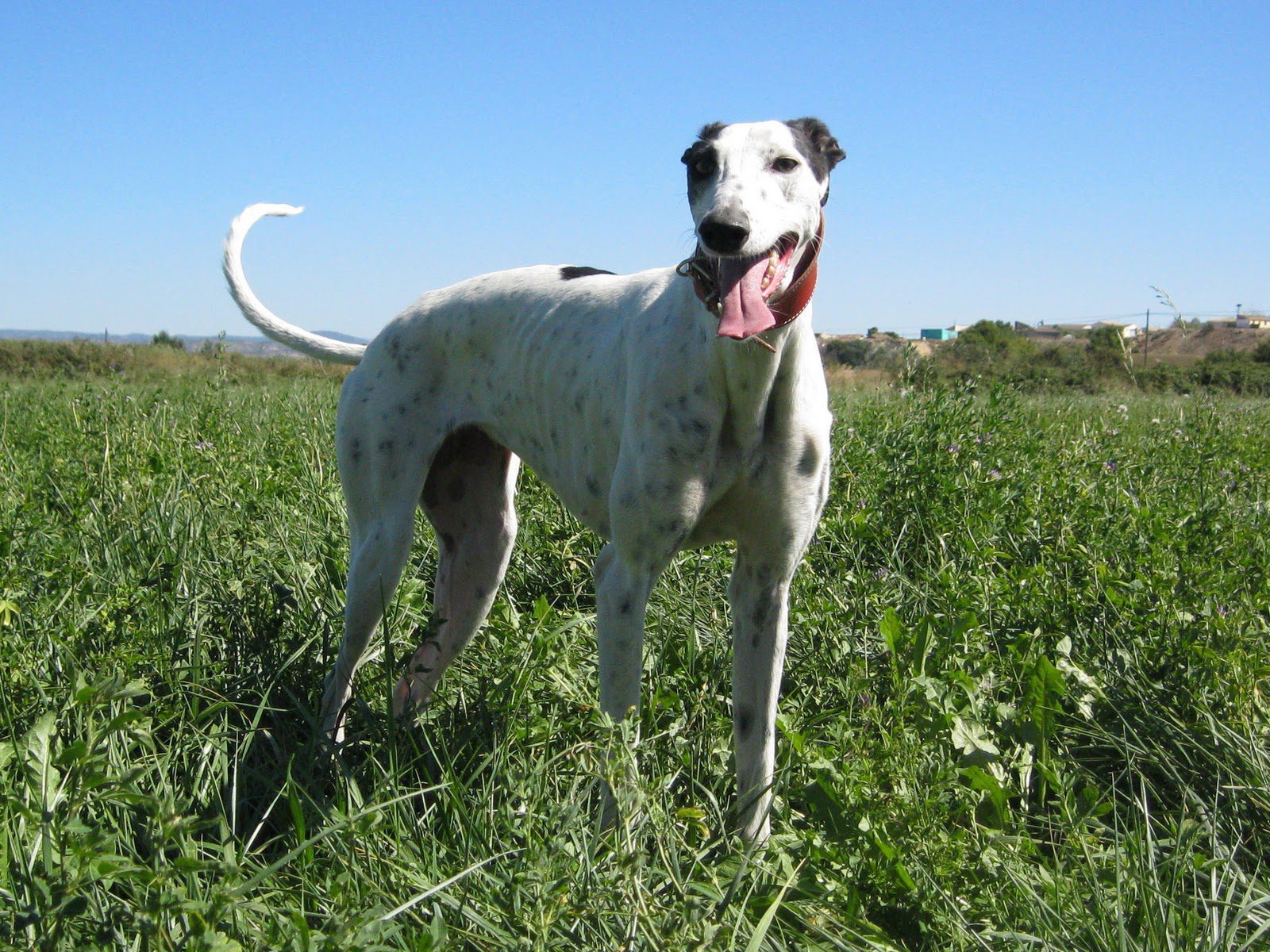
    Spanish greyhound
    Espaรฑa FCI 285 . Short-haired Sighthounds

    Galgo espanol

    The Spanish greyhound is highly appreciated for your discretion and sincere affection, never inordinate, that he professes for his owner.

    Content

    History

    The Spanish greyhound it is an ancient breed of hunting dog. His specialty is hunting hares and other small game in difficult terrain.. The Spanish greyhound They are persistent and fast sight hunters. Type dogs Greyhound already described in the first reports of antiquity. They represent one of the oldest types of dog and have not changed their basic design for thousands of years. Its resemblance to the ancient Egyptian hunting dog Tesem, one of the oldest and also fairly well documented dog breeds of all, it's amazing.

    Of 1930 to 1935, the wealthy landowners of southern Spain imported Greyhounds from England and raised here with the Greyhounds original. As the races of Greyhounds had become popular on English racecourses, saw an advantage in the crossing of the fast racing greyhounds. But, It was overlooked that these extremely high speeds of a greyhound occurred on flat tracks. In the changing, uneven and stony hunting grounds of a Spanish greyhound they are rather a disadvantage. Like a sports car off the road. But, This wave of imports meant that the real Spanish greyhound in the sense of purity and original function. It also, in his homeland little attention was traditionally paid to purity in the modern upbringing sense. Mixtures with Warren hound, for example, are standard. Plus, a large part of the population lives relatively self-determined anyway. All this is not a disadvantage for the quality and well-being of the dogs, not even for the race. And rather it favors the old Greyhound almost finds himself again and the influences of the Greyhound.

    In the past, most dogs were bred according to this almost classical principle of selection for suitability, around the world. Mainly performance for the purpose counted. So, the breed can also be considered healthy in essence, healthier than many of the "high breeders" of pure race. The FCI, the world dog breeding association, officially recognized the breed Spanish greyhound in 1971. In 1982 a revised standard was written. It describes an anatomy that does justice to the special use of a hunting whippet in sight for persistent hare hunting in the field.

    Popular mixes

    There are many more mixes of Spanish greyhound which pure breeds according to the specifications of the dog breeding. Many of the stray dogs in the Iberian Peninsula descend from the Spanish greyhound, that -like the Warren hound– they are simply abandoned after being used by hunters. These dogs have developed a marked aptitude and cunning, that they used especially in their constant search for food.

    Physical characteristics

    The Spanish greyhounds show the typical appearance of a European greyhound. In Spain they are ubiquitous, but above all as street dogs and according to the pedigree breeding criteria above all mixes. This does not have to be a disadvantage with these dogs.. Along the centuries, have established themselves very well and have developed their type. But, the greyhounds they also have an official standard as purebred dogs for a long time 50 years. The official standard describes them like this:

    The Spanish greyhound is of considerable size, medium format, slightly convex profile, elongated, with elongated skull. compact skeleton, long narrow head, spacious chest, belly very tucked up and very long tail. Clearly vertical and muscular hindquarters.

    He wears thin and short hair or -very rarely- semi-long and rough. The Spanish greyhound they do not have undercoat, what can be a problem in the harsh winters of northern Europe. All colors are permitted. The ears should form a wide, triangular-shaped base. When you are alert, the ears are half prick in the first third with the folded ends pointing to the sides. When they are at rest (relaxed) form a rose ear near the head.

    What is the size of a "Spanish greyhound"?

    No weight is prescribed, but yes the desired size. The Spanish greyhound must have a height at the cross of 62 to 70 centimeters for males and 60 to 68 centimeters for females.

    How old is a "Spanish greyhound"?

    There are no exact figures on the life expectancy of Spanish greyhounds. But, life expectancy can be considered very high, specifically of 12 to 15 years or more, provided there is no inbreeding.

    Character and skills

    The Spanish greyhound they are hunting dogs and greyhounds at the same time. They are very agile and alert. Almost nothing escapes your keen senses. Especially when they are young dogs, nervously yearn for exercise and experiences, ideally of a hunting nature and above all with the option of being able to run freely. As they tend to have a strong hunting instinct, this need so ingrained in the dogs of our latitudes can rarely be satisfied in nature.

    It is an experience to see the greyhounds run in freedom. They can sprint quickly, even on difficult terrain, and they can make amazing hooks.

    The Spanish greyhound they are very intelligent and docile. They quickly know what is allowed and what is taboo. They are kind and open with people. They have a good-natured character and can be charmingly cuddly.. They seek a close bond with their owners and are loyal to them. But they also go their own ways. Due to the harsh performance-oriented selection in their home country, they are very hard and resistant. In the specimens that were socialized as street dogs and then taken to other countries, a drive for freedom is often observed that should not be underestimated. The belt, which on the other hand gives the dogs a feeling of security, perceived as a threat and a constriction.

    Many of these dogs find life in densely populated cities stressful., more than the usual struggle for survival in their home country. This also applies to restrictions on dogs. They can become so fearful and shy, who are under constant stress. They are challenges for the dog, and the owners, but in many cases they can be solved well with canine sense and a little affection. But, we cannot recommend them as a beginner dog.

    What care does a "Spanish greyhound" need?

    The Spanish greyhound he is extremely frugal. It is enough to brush the coat with a spiked glove from time to time.

    Are there typical diseases of the "Spanish greyhound" race?

    Against the background of performance-oriented selection in its country of origin and fluid genetic boundaries there with corresponding unknown inbreeding, his health is extremely robust and exemplary. This can be different sometimes with show dogs bred in other countries. The Spanish greyhound they do not have undercoat. They need professional clothing when it is very cold.

    What food is better for a "Spanish greyhound"?

    The Spanish greyhound has no special dietary requirements. It is a true omnivore. Of course, high quality food is good for your health and you like it too. The Spanish greyhound It is also suitable for "professional barfing".

    Activities with the "Spanish greyhound"

    How much exercise does a Spanish Greyhound need??

    The Spanish greyhound it is a real hunting dog and sighthound. The Sighthound Association offers the opportunity to participate in sighthound races or coursing events with Spanish greyhound to keep the dog busy and physically active. Other dog sports, like agility, are also suitable. Due to his strong motivation for hunting, training requires a lot of patience and empathy.

    Considerations before adopting a "Spanish greyhound"

    Where can a "Spanish greyhound" be adopted?

    If you want to share your life with a Spanish greyhound, you should look up a breeder or local animal shelters well before you buy one and make contacts here. The breeder must be trusted. Please, do not buy a Greyhound online, as there is a high risk that the puppy comes from a dog vendor disguised as an animal welfare organization. You can easily find greyhound-type dogs at a trusted animal shelter near you..

    Characteristics "Spanish greyhound"

    Coexistence is important that you have with your new friend. Before considering the acquisition of a dog of the breed "Spanish greyhound" you know certain factors. Not all breeds of dogs are apt to live in an apartment, you must take into account his character, their need for exercise, their interaction with other pets, their care and if you have small children, their level of tolerance towards them.

    Adaptation โ“˜

    3,0 of 5 stars (based on 1 review)

    friendly dog โ€‹โ€‹โ“˜

    2,0 of 5 stars (based on 1 review)

    hair loss โ“˜

    3,0 of 5 stars (based on 1 review)

    Affection level โ“˜

    5,0 of 5 stars (based on 1 review)

    Need for exercise โ“˜

    5,0 of 5 stars (based on 1 review)

    Social need โ“˜

    3,0 of 5 stars (based on 1 review)

    Home โ“˜

    2,0 of 5 stars (based on 1 review)

    Toilet โ“˜

    1,0 of 5 stars (based on 1 review)

    Friendly with strangers โ“˜

    2,0 of 5 stars (based on 1 review)

    barking โ“˜

    1,0 of 5 stars (based on 1 review)

    Health โ“˜

    4,0 of 5 stars (based on 1 review)

    Territorial โ“˜

    2,0 of 5 stars (based on 1 review)

    Cat friendly โ“˜

    2,0 of 5 stars (based on 1 review)

    Intelligence โ“˜

    3,0 of 5 stars (based on 1 review)

    Versatility โ“˜

    3,0 of 5 stars (based on 1 review)

    Child friendly โ“˜

    4,0 of 5 stars (based on 1 review)

    Surveillance โ“˜

    2,0 of 5 stars (based on 1 review)

    joy โ“˜

    3,0 of 5 stars (based on 1 review)

    Images "Spanish greyhound"

    Photos:

    1 – "Spanish greyhound" by https://pixabay.com/es/photos/galgo-espaรฑol-rรกpido-perros-3799630/
    2 – "Spanish greyhound" by https://pixabay.com/es/photos/perros-jugando-galgo-espaรฑol-saluki-3799600/
    3 – ยซSpanish greyhoundยป by Netspy, CC BY-SA 3.0, via Wikimedia Commons
    4 – "Spanish greyhound" by https://pixabay.com/es/photos/greyhound-galgos-4890924/
    5 – ยซSpanish greyhoundยป by https://www.pxfuel.com/es/free-photo-xeivz
    6 – "Spanish greyhound" by https://pixabay.com/es/photos/perro-galgo-mascotas-3765523/

    Videos "Spanish greyhound"


    Type and recognitions:

    • FCI CLASSIFICATION:
    • Group :
    • Section : . .

    Federations:

    • FCI – Group 10: Section 3: Short-haired Sighthounds โ“˜
    • RSCFRCE โ“˜

    FCI breed standard "Spanish greyhound"

    Origin:
    Spain

    Date of publication of the valid original standard:
    26.05.1982

    Use:

    Hare hunting dog on the run, in quick pursuit and guiding into sight. It has also been used and can harass other hair pieces such as rabbits, foxes and even wild boars; but the main use of the breed has been and is hunting hares on the run.


    General appearance:

    Good-sized Greyhound, eumรฉtrico, subconvexo, sublonguilรญneo and dolicocรฉfalo. Compact skeleton, long narrow head, large capacity thorax, Very retracted belly, and very long tail. Well poised and muscular rear train. Fine and short or hard and semi-long hair.

      IMPORTANT PROPORTIONS : Sublonguilinear structure; longitudinal diameter slightly greater than elevation at the withers. Proportionality and functional harmony should be sought, both in static and in motion.


    Behavior / temperament:

    Serious and withdrawn; Sometimes although in hunting a great energy and vivacity.

    Head:

    Provided with the rest of the body, long, lean and dry. The skull-muzzle relationship is 5/6 : skull length 5, muzzle length 6. Divergent skull-facial lines. The skull-muzzle assembly seen from above must be very elongated and uniform; with long snout, Strait.

    Cranial region:
    • Skull: Small width and sub-convex profile. The width of the skull will not reach the measurement of its length. The skull is crossed by a well-marked central groove in its first two thirds; the frontal sinuses and occipital crest are simply marked.
    • Depression links (Stop): Soft, very little accentuated.

    facial region:

    • Truffle: Small, Wet and black mucous membranes.
    • Snout: Long, sub-convex profile, with slight brushing of the upper edge towards the nose. Narrow muzzle.
    • Lips: Very lean. The upper one will just cover the lower one. The lower one will not present a marked lip corner. Fine, tense and dark mucous membranes.
    • Jaws/Teeth: Strong teeth, white and healthy. Scissor bite. Highly developed canines. All premolars exist.
    • Eyes: Small, oblique, macaroons; preferably dark, Hazelnut coloured. Quietly, sweet and reserved.
    • Eyelids: Thin-skinned and dark mucous membranes. Very attached to the eyeball.
    • Ears: Wide base, triangular, fleshy in its first third and thinner and finer towards the end that will be in a round tip. High implementation. At attention semi erect in the first third with the tips bent to the sides. At rest in pink, glued to the skull. By exerting traction, they will reach very close to the corner of both lips.
    • Palate: The color of the mucous membranes with very marked ridges.

    Neck:

    Long, oval section, plane, slender, strong and flexible. Narrow in the head part, continuing with slight widening towards the trunk. Slightly concave top edge. Nearly straight lower edge with slight central convexity.

    Body:

    • Seen as a whole: Rectangular, strong and flexible, giving a feeling of strength, agility and endurance. Widely developed chest, belly very collected.
    • top line: With slight concavity on the back and convexity on the spine. No sudden interruptions and no oscillations during movement, giving a feeling of great elasticity.
    • Cross: Simply marked.
    • Back: Straight, long and well defined.
    • Pork loin: Long, strong, not very wide and arched upper edge with compact and long musculature, giving a feeling of elasticity and strength. The height of the spine in its central part may exceed the height at the withers.
    • Rump: Long, powerful and on a desk. Its inclination is greater than 45 ยฐ with respect to the horizontal line.
    • Breast : Powerful, although not very wide; deep without reaching the elbow and very long to the floating ribs. Tip of the sternum marked.
    • Ribs: Ribs with wide and flattened intercostal spaces. The ribs must be well visible and marked. The chest perimeter will be slightly superior to the lodging to the cross.
    • Belly and flanks: Belly sharply drawn from the sternum; whippety. Short and dry sides; well developed flanks.

    Tail:

    Strong-born and low-set, It runs glued between the legs, gradually refining until it ends in a very fine point. Flexible and very long; far beyond the hock joint. At rest in the form of a hoz with a very accused and laterally inclined final hook. Tucked between legs with final hook that almost brushes the ground in front of the hindquarters; it is one of the postures that confer more typicality to the breed.

    Tips

    PREVIOUS MEMBERS

    • Seen as a whole: Perfectly Plumb, fine, straight and parallel; short and thin pasterns; hare feet.
    • Back: Dry, cut and slanted. The scapula must be significantly shorter than the arm.
    • Arm: Long, longer than the scapula, very muscled, with free elbows but close to the trunk.
    • Forearm: Very long; straight and parallel, well defined bones, with well marked tendons. Highly developed carpal pads.
    • Metacarpus: Slightly inclined, thin and short.
    • Previous feet: Of hare. High and tight fingers. Strong and long phalanges. Well-developed, hard tubers and pads. Moderate webbing and well developed nails.
    • Angles: Scapulo-Humeral angle : 110ยฐ. Humer-radial angle : 130ยฐ.

    LATER MEMBERS

    • Seen as a whole: Powerful, well defined bones, muscular with long and well developed muscles. Perfectly plumb and with correct angulations. Well marked hocks; metatarsals short and perpendicular to the ground; hare feet with high toes.
    • The rear members give a sensation of power and agility in the impulse.
    • Thighs: Very strong, long, muscular and tense. The femur as perpendicular as possible. Seen from behind they will present a very marked musculature to the naked eye; long, flat and powerful, its length is 3/4 of the leg.
    • Leg: Very long, of marked and fine bone. Muscled on your part
    • top; less in the lower zone, with clear appreciation of veins and tendons.
    • Hocks: Well marked with clear appreciation of the tendon that will be very developed.
    • Metatarsus: Up, short and perpendicular to the ground.
    • Hind feet: Of hare, as in the previous members.
    • Angles: Lame-femoral angle : 110ยฐ. Femoral-tibial angle : 130ยฐ. Hock angle : higher than 140 ยฐ

    Movement:

    The typical movement is naturally gallop. The trot must be long, flush to ground, elastic and powerful. Without tendency to laterality and without ambling.

    Mantle

    SKIN: Very close to the body in all its areas, strong and flexible; Pink. The mucous membranes must be dark.

    HAIR: Bushy, very delicate, short, smooth; distributed throughout the body to the interdigital spaces. Slightly longer at the back of the thighs. The semi-long wire-haired variety has greater roughness and hair length, which can be variable; although always evenly distributed throughout the body, it comes to present a beard and mustaches on the face, over eyebrows and toupee on the head.

    COLOR: Indeterminate. The following are considered as typical and in order of preference:

    • Barcinos and brindle more or less dark and with good pigmentation.
    • Blacks.
    • Dark and light wafers.
    • Toasted.
    • Canelas.
    • Yellow.
    • Red.
    • Whites.
    • Pronghorn and pios.


    Size and weight:

    Height at the withers :

    • Males of 62 to 70 cm.
    • females of 60 to 68 cm.

    A margin of 2 cm for specimens of excellent proportions.


    Fouls:

    Any deviation from the Any deviation from the aforementioned criteria is considered as faulty and the seriousness of it is considered to the degree of the deviation to the standard and its consequences on the health and well-being of the dog..

    MINOR FAULTS:

    • Slightly broad or slightly chiseled head.
    • Straight muzzle profile, pointed snout.
    • Accused parietals.
    • Absence of some premolar.
    • Bitefork clamp.
    • Slightly short tail, poorly overhanging the hock.
    • Scars, wounds and decorations during hunting season.

    SERIOUS FAULTS:

    • Big head.
    • Excessively broad skull and pointed muzzle.
    • Very marked nasal-frontal depression.
    • Parallel craniofacial axes.
    • Belfos and marked dewlap.
    • Moderate upper prognathism.
    • Absence of canines not due to trauma.
    • light eyes, round, prominent heels.
    • Ectropiรณn, entropion.
    • Short ears, Oh raised pequeรฑas.
    • Short round neck.
    • Saddled dorso-lumbar line.
    • Kidney lift lower than withers lift.
    • Short croup, round or slightly sloping.
    • Scarce chest perimeter.
    • Barrel ribs.
    • Short flanks.
    • Very globular muscles, round and slightly elongated.
    • Wrong limbs, fingers apart, cow hocks.
    • Weak pads.
    • Tail and ears docked.
    • Strong line appearance, heavy or inflexible.
    • Unbalanced character.

    MISS PLAYOFFS:

    • Aggressive or fearful dog
    • Lack of typicality.
    • Split nose.
    • Pronounced upper prognathism or lower prognathism.
    • Very wide back-lumbar line, flat and straight.
    • Chest that widely exceeds the elbow.
    • Any other typicity sign that you remember or indicate
    • miscegenation.
    • albinism

    Any dog โ€‹โ€‹showing clear signs of physical or behavior abnormalities must be disqualified.

    The aforementioned criteria is considered as a fault and its severity is considered to the degree of the deviation to the standard and its consequences on the health and well-being of the dog.


    N.B.:

    Males should have two normal-appearing testicles fully descended into the scrotum..

    Source: F.C.I - International Cynological Federation

    Alternative names:

    1. Spanish Galgo, Galgo (English).
    2. Galgo espagnol (French).
    3. Galgo, Galgo espaรฑol (German).
    4. Galgo espaรฑol (Portuguese).
    5. Lebrel espaรฑol, Galgo (espaรฑol).

    โ–ท The world of Pets: Dogs, cats, birds, reptiles, amphibians

    hungarian hound (Magyar Agรกr)
    Hungrรญa FCI 240 . Short-haired Sighthounds
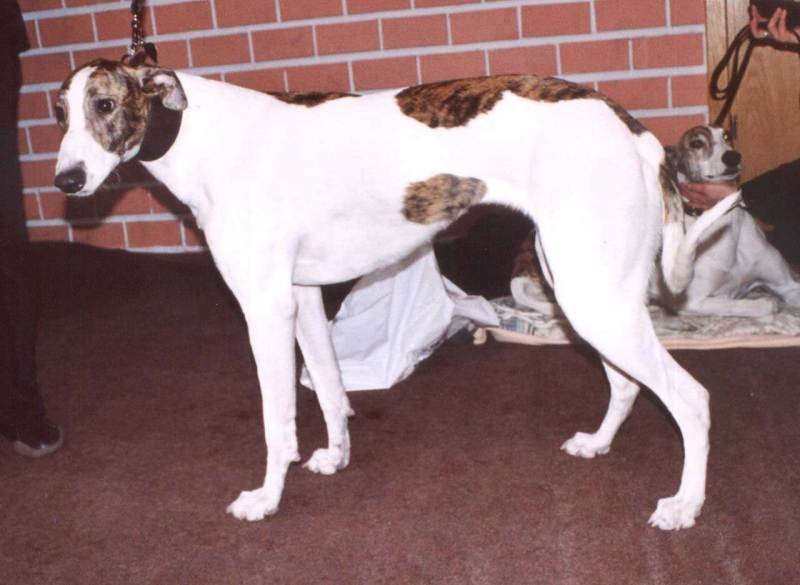
    Lebrel Hรบngaro

    The nature of hungarian hound, like its appearance, It is elegant. Extremely sensitive and smart, friendly sweetie, but never nosy.

    Content

    History

    The hungarian hound is a real specialty among Hungarian dog breeds. But, it is perhaps the least known four-legged Hungarian. It has been threatened with extinction several times throughout its history, although he is a very valuable and lovable companion with an impressive talent for hunting. Due to its rarity, has crossed with other dogs over the years, reason why many people nowadays do not consider that the Greyhound non-hunter kept for hobby purposes is a hungarian hound pure breed.

    Its origin

    Like all Greyhounds, the ancestor of this Hungarian breed also comes from Egypt. They first appeared around the third millennium BC, the first finds come from that time. Several theories were born about its formation, but the only thing certain is that they reached the Carpathian Basin with the Hungarian conquerors, who used them for hunting. The first memories of hungarian hound go back to the time of San Esteban. At that moment, This Sighthound it was very popular, just like it was a fashionable pastime in the days of Matthias Hunyadi. The king himself often spent his time hunting with them on horseback.. After his death, with the country divided into three parts, the breeding of hungarian hound started to decline.

    During Turkish rule, the hungarian greyhound was crossed with oriental type greyhounds. Hunting went from being a real hobby to poaching, since it was the best way to hunt without attracting attention.

    The reformist count Istvรกn Szรฉchenyi popularized greyhound racing and the hungarian hound became the national dog. At that time, Greyhound races were considered special and prestigious social events. Almost constantly, associations were formed to deal with the breed and hunting with it. Horse and greyhound racing also attracted foreigners. This is how English thoroughbreds and the โ€œEnglish Greyhoundโ€ were introduced into Hungary.. The resistance of the indigenous race was a rare treasure, but it did not correspond to the speed of the English Greyhound. Thus, the two dogs crossed often and the hungarian hound lost its original character. Thus, many people continue to question the Hungarian character of the greyhound, some say the old character has completely disappeared from current dogs.

    After World War II, the breed almost disappeared. In 1963 a movie was made about King Matthias, for which they were needed hungarian sighthounds. But, this dog was so rare that it was almost impossible to find one in the country. For the movie, nature filmmaker and hunter Kรกlmรกn Szigethy found some specimens, bought them and started raising them. Thanks to Szigethy, the hungarian hound revived and in 1966 was officially recognized by the FCI. Since then, it has slowly but inexorably spread throughout Europe and is not in danger of extinction. In 2004, all breeds of domestic dogs, including hungarian hound, were declared a national treasure by the Hungarian Parliament, and in 2017 it was even named hungarian heritage dog.

    Physical characteristics

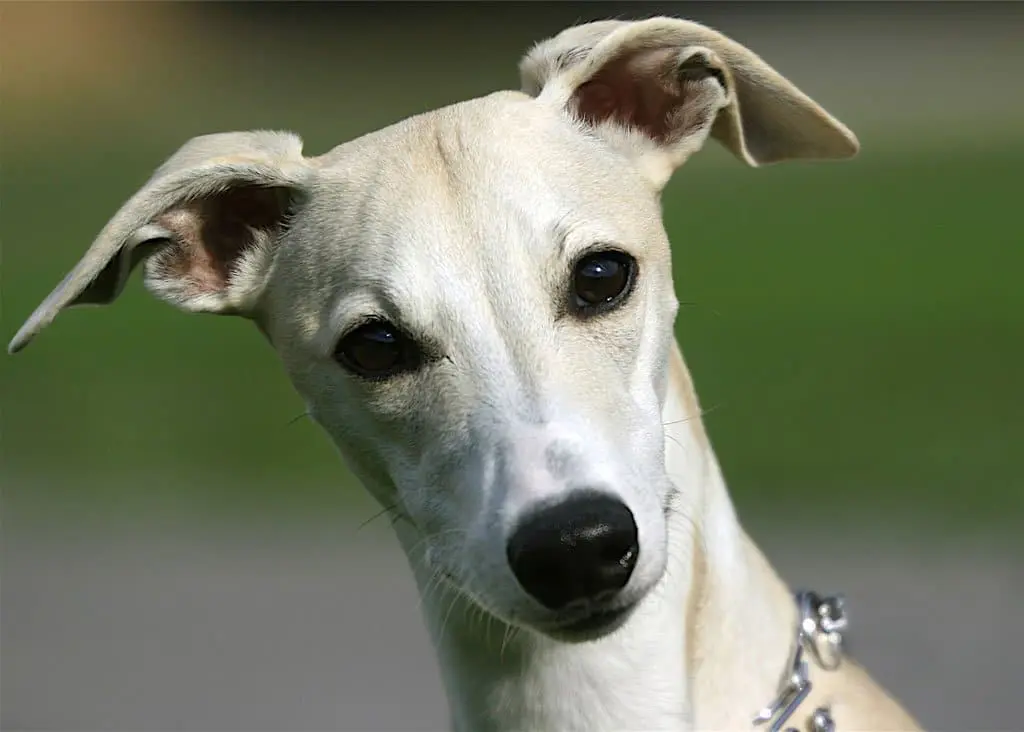
    The hungarian hound it is a thin hunting dog, his joints are dry and his musculature is prominent. The chest is flat and deep. The trunk is rectangular. The coat is short and of varied colors, and is bred in most greyhound colors.

    Body weight of 22-31 kg, according to sex, and height at the cross of 62-70 cm.. It has a strong bone structure and a long head with character.. Almond-shaped eyes, dark brown. Black nose. The ears are called rose ears, that are small and bent back. Long tail, fine, regularly screwed. Its movement is flexible, elegant and graceful.

    When run, can reach speeds of up to 60 km/h.

    Life expectancy is 12-14 years.

    Video of the Hungarian Greyhound
    Magyar Agรกr - Agรกrfesztivรกl - Osagรกrd 2008

    Character and skills

    The hungarian hound has a very persistent and determined character. This is why he is so successful in greyhound racing. Compared to other dogs, can keep fast speed for a long time and, in case of stumbling, will continue on his way with the same vigor. He has a big heart in his deep chest, that helps you gallop with persistence. Radiates strength, elegance and great presence of mind. Although he loves to run, he is not hyperactive. typical of greyhounds, rests relatively frequently but requires a lot of exercise. So, regular daily exercise is important.

    Your nature - like your appearance- It is elegant. He's extremely smart and sharp, loving but never intrusive. It is also recommended with children, they love them and a well socialized dog is not aggressive towards them. He is protective of his family but is not a biter and never barks unnecessarily. It is reserved with strangers. Has a balanced temperament, which makes it an ideal family pet. Early socialization and frequent exercise are important, otherwise you may develop behavior problems. This will most likely manifest itself in the flight. It is also excellent for various dog sports, especially greyhound racing, hunting or agility. Its calm nature also makes it ideal as a therapy dog..

    Ideal environment

    Greyhounds can stay indoors if they get adequate exercise every day. Get plenty of rest and can sleep up to 18 hours a day. Consequently, is very fond of comfort and soft beds. In a garden shed, it is necessary to ensure that a high enough fence is erected around it, since it will easily skip the lowest. He gets along very well with children, if they are treated well. It does not require a particularly active owner and is perfect for a family with an average lifestyle. A great hiking companion.

    Grooming

    The hungarian hound does not require any special care. You need to bathe him a couple of times a year and clean his eyes and ears at appropriate intervals. Brushing with a brushing glove is recommended once a week. More frequent brushing is recommended during the shedding season.

    Health

    The hungarian hound it is a healthy breed, does not have any specific disease.

    Characteristics "hungarian hound (Magyar Agรกr)"

    Coexistence is important that you have with your new friend. Before considering the acquisition of a dog of the breed "hungarian hound (Magyar Agรกr)" you know certain factors. Not all breeds of dogs are apt to live in an apartment, you must take into account his character, their need for exercise, their interaction with other pets, their care and if you have small children, their level of tolerance towards them.

    Adaptation โ“˜

    4,0 of 5 stars (based on 1 review)

    friendly dog โ€‹โ€‹โ“˜

    3,0 of 5 stars (based on 1 review)

    hair loss โ“˜

    2,0 of 5 stars (based on 1 review)

    Affection level โ“˜

    4,0 of 5 stars (based on 1 review)

    Need for exercise โ“˜

    4,0 of 5 stars (based on 1 review)

    Social need โ“˜

    3,0 of 5 stars (based on 1 review)

    Home โ“˜

    3,0 of 5 stars (based on 1 review)

    Toilet โ“˜

    2,0 of 5 stars (based on 1 review)

    Friendly with strangers โ“˜

    2,0 of 5 stars (based on 1 review)

    barking โ“˜

    1,0 of 5 stars (based on 1 review)

    Health โ“˜

    5,0 of 5 stars (based on 1 review)

    Territorial โ“˜

    4,0 of 5 stars (based on 1 review)

    Cat friendly โ“˜

    2,0 of 5 stars (based on 1 review)

    Intelligence โ“˜

    4,0 of 5 stars (based on 1 review)

    Versatility โ“˜

    3,0 of 5 stars (based on 1 review)

    Child friendly โ“˜

    5,0 of 5 stars (based on 1 review)

    Surveillance โ“˜

    2,0 of 5 stars (based on 1 review)

    joy โ“˜

    3,0 of 5 stars (based on 1 review)

    Images "hungarian hound (Magyar Agรกr)"

    Photos:

    1 – hungarian hound Color: of course by Canarian, CC BY-SA 4.0, via Wikimedia Commons
    2 – hungarian hound by https://pixabay.com/es/photos/magyar-agar-perro-animal-galgo-5016524/
    3 – hungarian hound by Magpie (vitalap / edits), CC BY-SA 3.0, via Wikimedia Commons
    4 – hungarian hound at the Katowice dog show (2005) by Pleple2000, CC BY-SA 3.0, via Wikimedia Commons
    5 – hungarian hound by Hachieko, CC BY-SA 4.0, via Wikimedia Commons
    6 – hungarian hound by http://www.magyaragar.eu/blog/tag/ungarischer-windhund/page/24/

    Videos "hungarian hound (Magyar Agรกr)"


    Type and recognitions:

    • FCI CLASSIFICATION:
    • Group :
    • Section : . .

    Federations:

    • FCI – Group 10: Section 3: Short-haired Sighthounds โ“˜
    • Standard CCC (Canadian Kennel Club / Canadian Kennel Club)
    • Standard KC (The Kennel Club) – Hound โ“˜
    • Standard UKC (United Kennel Club) – Sighthound and Pariah โ“˜

    FCI breed standard "hungarian hound (Magyar Agรกr)"

    Origin:
    Hungary

    Date of publication of the valid original standard:
    06.04.2000.

    Use:

    It is a hunting and racing dog that hunts on sight. But, his nose is also remarkable. It is especially suitable for racing and decoy hunting. (coursings) where it is considered by all as highly accredited in long sections. He is a very good companion dog and a faithful guardian..


    General appearance:

    His appearance radiates strength; bone structure and muscles are well developed. It is elegant.


    IMPORTANT PROPORTIONS:

    • The length of the body is slightly greater than the height at the withers.
    • The length of the muzzle corresponds to half the length of the head.


    Behavior / temperament:

    Tireless, persistent, fast, hardened and resistant. Excellent for racing.
    In some distances it is faster than the Greyhound.
    He is reserved by nature but not shy, it's sensible, smart and faithful. Is vigilant; your instinct to protect people, houses or farms is highly developed but with no hint of aggressiveness or sharpness.

    Head:

    Viewed from above and in profile, it is wedge-shaped with a fairly wide base.

    Cranial region:
    • Skull: Moderately strong, broad. The forehead is relatively broad.
    • Stop (naso-frontal depression) : Well marked.

    facial region:

    • Truffle: relatively large, well pigmented with large wide windows.
    • Snout: Strong, elongated, although as a whole it is not too pointed.
    • Belfos : Closing well, adherents, well pigmented.
    • Jaws / teeth: Strong jaws, powerful. Scissor bite, complete, well developed and according to the dog's dental formula.
    • Cheeks: Strong, muscular.
    • Eyes: Medium size, dark, neither deeply placed in the sockets nor bulging. Lively and intelligent look.
    • Ears: They are quite large and their weave is thick. Inserted at mid-height, they fold back over the neck in the shape of a perfectly worn rose. In attention they get up. Heavy ears are preferred over light ones. Always erect ears are wrong.

    Neck:

    Medium length but elegant, dry, muscular, without wrinkles.

    Body:

    • Cross: Well developed, muscular, long.
    • Back: Wide, straight, firm, very well muscled.
    • Pork loin: Very wide, straight, heavily muscled.
    • Rump: Wide, slightly descending, with strong muscles.
    • Breast : The rib cage is deep and strongly arched to allow enough room for the heart and powerful lungs.. Well sprung ribs well extended back.
    • Belly: Moderately collected.

    Tail:

    Strong tail insertion, thick and slightly curved is moderately high. It is moderately thinned and reaches the hock. Its underside is covered by wire hair. At rest it falls vertically to the ground; in action it can be raised to the height of the top line

    Tips

    PREVIOUS MEMBERS: The forelimbs are strong and tendinous. Seen both from the front and the back, they are straight and parallel.

    • Shoulder: Moderately oblique, Mobile, muscular and long.
    • Arm: Long and somewhat oblique, muscular.
    • Elbows: Elastically conform to the rib cage. They are mobile and must not be turned either inwards or outwards.
    • Forearm: Long, straight, strong bone structure and dry muscles.
    • Carpo: Wide and strong.
    • Metacarpus: Short and vertical to the ground.
    • Front feet: Relatively large, elongated. Strong pads, nails kept short.

    LATER MEMBERS: The hindquarters are well angulated but not over angulated., strongly muscled and with good bone strength. Seen from behind are parallel.

    • Thigh: powerfully muscled, with rather elongated muscles.
    • Knee: Moderately angled, strong, not turned neither in nor out.
    • Leg: Long, with dry muscles.
    • Hock: Powerful, strong, low placement.
    • Metatarsals: Seen from behind, both standing and moving are parallel.
    • Rear feet: Relatively large, somewhat elongated with strong pads and nails.

    Movement:

    Good ground coverage, elastic trot, seen from front and back, limbs move in parallel planes.

    Mantle

    • SKIN: Relatively thick, well adjusted all over the body, no creases or double chin.
    • HAIR: Short, thick, rough, smooth and well glued. In winter it can present a dense internal fluff in considerable quantity.
    • COLOR: All known colors and color combinations in sighthounds, with the exception of those colors and combinations of colors mentioned as elimination fouls.


    Size and weight:

    HEIGHT AT THE WITHERS

    • Ideal height for males: 65 until 70 cm..
    • Ideal height for females: 62 until 67 cm..

    The height measured in centimeters is not as important as the harmony of the proportions..


    Fouls:

    Any deviation from the aforementioned criteria is considered as a fault and the severity of this is considered to the degree of the deviation to the standard and its consequences on the health and well-being of the dog..


    MISS PLAYOFFS

  • Aggressive or fearful dog.
  • Atypical head shape.
  • Upper or lower prognathism, incisor arcade deviated.
  • Missing one tooth or more than one tooth on the incisors, of the fangs, of the premolars 2-4, and molar 1-2; of more than 2 x PM1; go M 3 will not be taken into consideration .
  • Entropion, ectropion.
  • Colors: blue; blue spotted white white; brown; wolf gray as well as black and tan; tricolor dogs.
  • Any dog โ€‹โ€‹showing clear signs of physical or behavioral abnormalities must be disqualified..


    N.B.:

    Males should have two normal-appearing testicles fully descended into the scrotum..

    Source: F.C.I - International Cynological Federation

    Alternative names:

    1. Magyar agรกr, Hungarian agar (English).
    2. Magyar Agรกr (French).
    3. Magyar Agรกr (German).
    4. Magyar Agรกr, Lรฉbrel hรบngaro (Portuguese).
    5. Galgo hรบngaro, Magyar Agรกr (espaรฑol).

    โ–ท The world of Pets: Dogs, cats, birds, reptiles, amphibians

    Whippet
    Gran Bretaรฑaa FCI 162 . Short-haired Sighthounds

    Whippet

    The Whippet, like all sighthounds, is quite reserved. Don't play too much. His passion is hunting.

    Content

    History

    The Greyhounds have ancient origins, since their ancestors appear in frescoes of ancient Egypt. But, the Whippet didn't show up until much later, in the 18th century or shortly before. Although everyone agrees that the Whippet is originally from Great Britain, its exact origins are the subject of debate.

    Some believe it is descended from Greyhound. The smallest members of the breed were deemed insufficient for hunting and were given to farmers, and that's how the race developed, which is also known as Hound dwarf.

    Others claim that their ancestors is a Italian Greyhound large, that were used for hunting. Others also believe that Italian Greyhound is related to him Whippet, but only due to the crosses made at the end of the 19th century to perfect the breed.

    Last, some people who have assumed success also mention crosses with certain Spaniels.

    But, The most widespread theory is that the Whippet is the result of crosses between the Greyhound and various Terriers, in particular the Manchester Terrier. Nicknamed the "poor man's greyhound", it was used to hunt small animals, whether they were rats or rabbits.

    But, appears in 18th century paintings of Jean-Baptiste Oudry (1686-1755), but mostly in a box Edward Haytley (1713-1764) titled "The Hunter with a Whippetยซ. The word Whippet had many different meanings between the 16th and 19th centuries, but it is commonly accepted that the name of the breed comes from the verb ยซto whipยซ, which in the 17th century meant "to move quickly".

    Very popular in the 19th century with the working classes of northern England, the Whippet Greyhound was used in gambling trials in which they had to eliminate a large number of rats or rabbits as quickly as possible.. This activity ended up being prohibited, and the rodents were replaced by rag decoys that the dogs had to run after. Racing became a true sport that conquered England and then the United States. At the same time, competitors continued to use their skills on a daily basis hunting vermin and small game.

    Already in 1888, the breed was recognized by the American Kennel Club (AKC), and then by him British Kennel Club (KC) in 1890. Present both at races and at dog shows, developed rapidly, gradually making its way into homes as a companion dog.

    The Whippet is recognized by the main canine associations in the world. The International Cynological Federation (FCI) He did so in 1955, thus promoting its international dissemination, and almost all the large national organizations followed suit, as the United Kennel Club (UKC) American and the Canadian Kennel Club (CKC).

    Today, although the races of Greyhounds have become very rare and hunting with Greyhounds is prohibited in many territories, the Whippet is still very present around the world. This is because the Whippet has been able to move away from its original role and win over the general public as a mascot.

    In United States, for example, AKC registration statistics place the Whippet around the post 60 (of something less than 200) in the breed popularity ranking of the AKC.

    in your country of origin, Great Britain, is even more widespread, with between 3.000 and 3.500 births reported to the KC each year.

    Also in France its success is undeniable, although it is still less than on the other side of the Canal. From the age 80, Entries in the French Book of Origins (LOF) they have been around 1.000 a year, quite exceptional stability. Since the beginning of the decade 2010, this figure has not stopped increasing, approaching the 1.500 at the end of it.

    Physical characteristics

    Elegance blend, power and delicacy, the Whippet it's made for speed, like all races of Sighthounds. They look like Greyhound, but they are much smaller.

    Her slender body is elegant, with a pronounced arch on the back, a broad, muscular back and a well-tucked belly. The legs are long, with moderate bone and fine but marked muscles. The legs are long, moderately boned, with fine but pronounced muscles, ending in oval legs with widely spread toes and strong nails. The tail is long and thin, carried up when the dog is active, but never higher than the level of the back.

    Worn on a long, muscular neck, the head is thin and elongated. The stop is slightly marked, snout continues to narrow into continuation of skull. The nose is usually black, but blue tones are allowed in blue dogs, and pink in cream-colored ones. Oval eyes have a vivid expression. The ears, which are said to be in the shape of a rose, they are thin and are carried backwards or semi-erect.

    The coat of the Whippet consists only of a short, thin top layer, but very closed: this dog has no undercoat. The coat can be any color or combination of colors, except the blackbird.

    Last, sexual dimorphism is well marked in this breed: the male is significantly larger than the female.

    Size and weight

    ▷ Male size: 47 – 51 cm.
    ▷ female size: 44 – 47 cm.
    ▷ Male weight: 13 kg.
    ▷ female weight: 12 kg

    Character and skills

    The Whippet he is extremely sociable and devoted to his family, with which you need to spend a lot of time – it's not a question of living outside, isolated from his family: its place is in the heart of the house, comfortably installed on a cozy cushion. Can easily suffer from separation anxiety and does not adapt to a master who is absent often.

    This problem can be alleviated if he is allowed to live with one or more other dogs.. In effect, whether it is a simple meeting or living together under the same roof, the Whippet gets along very well with other dogs and, usually, is perfectly comfortable in a home where several representatives of the canine species coexist. This allows you to continue to feel part of the pack, even when their owners are working.

    Their relationships with other animals are far from being so peaceful.. In fact, his hunting instinct is well anchored in him, which leads him to chase and kill cats, rabbits and other rodents. Even the ones he would have grown up with are likely to end up in his fangs one day., so that coexistence must simply be excluded.

    Active, cheerful and playful, the Whippet it is an ideal companion for children, whose presence you love. But, it is better if the children are already a certain age and have learned to behave in a respectful way with a dog, as they are much less tolerant of abuse than many of their peers. In any case, as with any breed, It is not advisable to leave a small child with him without the supervision of an adult.

    Active and energetic, this dog is especially so when he is young, to the point that it can be destructive. They also like to test the limits, so it is better that their family is available to take care of them and redirect them when necessary. Once they become adults, which is usually around 18 months of age, they are still very active, but they have a much calmer temperament. You need to exercise for an hour a day, but then you can sit quietly on the couch and watch TV.

    In other words, whether you can exercise comfortably and spend most of your time with your family, the Whippet he is a calm and cheerful companion. But, if any of these conditions are not met, you are likely to develop various behavior problems, like chewing on anything on hand or digging.

    As long as you get enough exercise, can live in a flat. But, ideally you have access to a garden where you can run and play. Yes indeed, must be perfectly closed and at a minimum height of 1,5 m, so that it does not chase the neighborhood cats or other small animals that pass by. In any case, an electronic fence installed underground would be useless, since the discharge felt would not be enough to stop it.

    His hunter instinct causes him to chase any small animal he comes across, so you should always go on a leash when you go out for a walk. But, care must be taken to place the dog with a collar adapted to its morphology (greyhounds have their necks wider than their heads) or a harness, to prevent it from escaping. The risk of the dog running away is especially high in this breed, and it is absolutely impossible to catch him if he escapes, since it is capable of running at more than 50 km/h.

    It is possible to allow him to stretch his legs by taking him for a run or a bike ride. But, is primarily a sprinter, not a long distance runner: find it hard to keep up over long distances.

    It should be noted that the Whippet not only is he an athlete, but he also has an above-average intelligence that allows him to learn many tricks. Dog sports such as agility, obedience, the flyball or, of course, el lure coursing, they are a great way for you to show all your physical and mental qualities.

    Last, he is very respectful to his neighbors, barking very little. This explains why he cannot be counted on as a guard dog., not even as a warning dog. It also, He is not one of those who complicate the life of strangers: can be a bit shy at first, but it tends to open up quickly and make them benefit from its friendly nature.

    Education

    Like all "Sighthound" dogs, the Whippet benefits from socialization from an early age. By meeting all kinds of people and other dogs, but also when getting used to various everyday situations (noises, smells, city รขโ‚ฌโ€นรขโ‚ฌโ€นwalks, car trips…), gains in serenity and becomes a calm and balanced adult.

    On the other hand, even when surrounded by small animals in his youth, never lose his hunting instinct. It would be useless to hope to change anything fundamentally in this regard.

    It is this instinct that makes it absolutely essential to get your dog used to walking on a leash upon arrival home.. In fact, a Whippet should never be set free, except in a perfectly closed and safe environment, like a garden or a dog park. If you start chasing an animal, even perfectly integrated withdrawal orders are ignored, and nothing can distract you from your goal.

    The puppy of Whippet is a bit rambunctious and likes to test limits, showing a certain stubborn streak. So, needs a firm handler who commands respect and is seen as the leader of the pack. Once the master has established his dominant position, the education of Whippet it's relatively easy. He is smart and likes to learn new tricks, so working with him is a pleasure. Of course, this is even more true if you find it interesting, because he is not obsessed with pleasing his master. So, using treats and other rewards can work wonders.

    Do not forget that it is a sensitive dog, that may not respond well to traditional training methods. It is better to base your training on positive reinforcement, that reinforces his self-esteem and consolidates the relationship with his master. It is also advisable not to make the sessions last too long, so that they continue to be fun and interesting for him.

    Health

    The Whippet it is quite robust, with a fairly normal life expectancy for its size.

    But, its short coat and lack of body fat mean that it does not tolerate cold or bad weather well. It is recommended to equip it with a dog sweater as soon as the mercury drops, and he with a raincoat in rainy weather., fits much better when you turn up the thermometer.

    Among the diseases most likely to affect this breed, the most commons are:

    • the waterfall, which can be hereditary and occurs when an opaque film forms in the eye. It causes a more or less rapid degradation of sight, up to total blindness., a surgical operation can treat it;
    • corneal dystrophy, a clouding of the cornea that causes vision problems and is suspected of having a hereditary origin;
    • the progressive retinal atrophy, an incurable inherited disease that causes progressive degeneration of the eye tissues, to complete blindness;
    • the von Willebrand disease, an inherited blood clotting problem, milder forms can be controlled with medication, while the most serious cause unstoppable bleeding that requires surgery and transfusion at the slightest injury, to prevent the dog from dying from blood loss;
    • the epilepsy, which is at the origin of more or less frequent and intense seizures It can be kept under control with the help of drug treatment, which generally enables affected people to lead near-normal lives;
    • skin allergies, which may be signaled by redness and itching;
    • small wounds and skin infections, which is fine and is covered by a rather short hair;
    • of cancers;
    • heart problems, that can be congenital and increase in size, to cardiac arrest resulting in death.

    It also, individuals used on the racetrack are also at risk of injury in the context of this particularly intense activity: sprain, dislocation, fracture, etc.

    It also, like other breeds of Greyhounds as the Greyhound, the Whippet is sensitive to anesthetics, that can cause allergies. So, surgical operations may require a specific protocol to avoid this risk.

    While the list of diseases the breed is predisposed to can seem overwhelming, a study of 2004 jointly conducted by the British Kennel Club and the British Small Animal Veterinary Association over several hundred deaths of dogs of this breed found that about a quarter of them were simply caused by the advanced age of the animal.

    Then there are heart problems and cancer, which together represent another quarter., half of the reported deaths are attributable to one of these three reasons.

    Knowing that this breed is predisposed to various inherited diseases, adopting a serious breeder of Whippet greatly increases the chances of getting a healthy puppy and keeping it that way. In addition to a certificate of good health signed by a veterinarian and the animal's health or vaccination record, certifying that you have received all the necessary vaccinations, the professional must be able to present the results of the genetic tests carried out to the parents or the baby, to avoid the risk of inherited diseases.

    It also, once the puppy has come home, you need to limit your physical activity (both in intensity and duration) throughout its growth period, which normally lasts between 12 and 18 months, so as not to risk damaging your joints or bones.

    It is then recommended to check him regularly for cuts or scratches, as his skin is barely protected by his coat, is particularly prone to it.

    It also, regardless of your age and even if you appear to be in excellent health, any dog รขโ‚ฌโ€นรขโ‚ฌโ€นshould be examined in detail by a veterinarian at least once a year as part of a full medical check-up, this allows a possible problem to be detected as soon as possible, of which sometimes symptoms are not yet appreciated. In addition, this is an opportunity to make sure you are up to date on your vaccinations and to carry out any necessary reminders.

    At the same time, the owner must make sure to renew the different antiparasitic treatments of his dog throughout his life, so you are never unprotected., this must be done every 1 to 3 months.

    Life expectancy

    Of 13 to 14 years

    Grooming

    The Whippet Greyhound is an easy-care breed of dog.

    First of all, the maintenance of its coat is very simple, since it is short and has no undercoat. A quick brushing every week is more than enough to keep it in good condition, especially since this dog sheds very little. They also do not have annual shedding periods., unlike most dogs.

    In any case, brushing sessions offer a good opportunity to check the condition of your skin. In effect, its thinness and the fact that it is only covered by a thin layer of hair make it especially exposed to cuts and scratches.

    If you take care of yourself regularly, the coat is usually clean and odorless, so it is seldom necessary to bathe him. Unless it gets dirty, for example, on a particularly muddy ride, bathing him once or twice a year is more than enough. Just be sure to use a shampoo specifically designed for dogs each time., as this can damage your skin.

    On the other hand, weekly coat maintenance is also an opportunity to wipe their ears with a clean cloth, to prevent the buildup of wax and debris that could be a source of infection (ear infections, etc.).

    You should also take the opportunity to inspect the eyes and rub the corners with a damp cloth to remove dirt..

    Last, good oral hygiene requires brushing the dog's teeth at least once a week, always with a toothpaste specially designed for dogs. This prevents tartar buildup, that can cause not only bad breath, but also diseases, some of which can be serious. Ideally, do it every day..

    As for the claws of the Whippet, they often tend to grow faster than they wear out, even if you spend time outside and get enough exercise. So, it is recommended to cut them every fifteen days approximately, before they are too long and risk disturbing you, but also from breaking, and even injuring you.

    Although a Whippet it is relatively easy to care, it is highly recommended to learn how to do it in the presence of a professional, either a groomer or a vet. This is the best way to know the correct way to take care of your dog and avoid mishandling that can hurt or even injure it..

    Food

    The Whippet adapts very well to commercial dog food. The choice of products and the amount that is given each day must be done in such a way that it perfectly covers their nutritional needs and, Therefore, suits your age, size and activity level. It also, like all dogs, it is better to divide the daily ration into at least two meals.

    It also, dogs used for dog competitions must follow a specific feeding program, like any athlete worth his salt.

    In any case, this dog is little eaten and this, coupled with its high energy expenditure, generally protects you from the risk of obesity. But, if obesity occurred, would have serious consequences for this dog whose body is not at all made to support excess weight.

    So, it is advisable to weigh your dog regularly, At least once a month, to detect any weight gain as soon as possible. If weight gain is confirmed from one measurement to another, or even increases, it is essential to consult the vet. Only a veterinarian can reliably determine the cause of the problem (diet, disease, side effects of medication, etc.) and propose a solution.

    Last, like any other dog, the Whippet must have permanent access to a bowl of fresh water to quench his thirst.

    Utility

    Originally, the Whippet it was used to chase and kill small rodents, eliminating the rats that threatened the food supply and putting rabbit meat on the family menu. Although the Whippet has retained its hunting instincts, this is a function that it has not fulfilled for almost two centuries.

    In the 19th century, the speed of more than 50 dog km / h, his blazing acceleration and his ability to change direction made him a specialist in dog racing, and crowds flocked to see representatives of the breed chase cloth lures and bet on the results, as it was done with the horses. But, the popularity of this activity decreased considerably over the years 80, to the point that today they are very scarce. The fact that gambling is now banned in most countries (including Belgium, Canada, France and Switzerland) is not, of course, A coincidence.

    But, the Whippet Sighthound was also able to seduce dog show fans with its elegance in the late 19th century., and her runway success continues today. It is rare not to see one or more representatives of the breed at these events.

    But, it is mainly as a companion dog that the Whippet Sighthound has made a name for itself among the general public. dedicated and smart, they delight everyone who is looking for an active companion and are sufficiently available for him.

    But, should not be relied on as a watchdog or even a watchdog. Although it is always on the prowl, He is not very suspicious and he is not one of those who barks loudly.

    His sociable and playful nature makes him a sought-after therapy dog, capable of brightening the daily life of people suffering from a disease, a disability or just old age.

    Last, beyond the races on the track, his intelligence and athletic qualities allow him to excel in many dog รขโ‚ฌโ€นรขโ‚ฌโ€นsports. This is the case, in particular, of decoy hunting (PVL), but also agility, flyball and obedience.

    Price

    The price of a puppy Whippet round the 950 EUR, but it can vary greatly from one individual to another, oscillating between 500 euros and 1200.

    Regardless of location, the reputation of the kennel and the prestige of your bulls and ancestors have a great influence on the price of a Whippet. A puppy born in a reputable kennel and from a line of champions is, of course, more expensive. Of course, the individual characteristics of the puppy are also a factor, especially the closeness to the standard. This explains why there can be quite significant price differences within the same litter.

    Characteristics "Whippet"

    Coexistence is important that you have with your new friend. Before considering the acquisition of a dog of the breed "Whippet" you know certain factors. Not all breeds of dogs are apt to live in an apartment, you must take into account his character, their need for exercise, their interaction with other pets, their care and if you have small children, their level of tolerance towards them.

    Adaptation โ“˜

    2,0 of 5 stars (based on 1 review)

    friendly dog โ€‹โ€‹โ“˜

    2,0 of 5 stars (based on 1 review)

    hair loss โ“˜

    2,0 of 5 stars (based on 1 review)

    Affection level โ“˜

    4,0 of 5 stars (based on 1 review)

    Need for exercise โ“˜

    4,0 of 5 stars (based on 1 review)

    Social need โ“˜

    3,0 of 5 stars (based on 1 review)

    Home โ“˜

    3,0 of 5 stars (based on 1 review)

    Toilet โ“˜

    1,0 of 5 stars (based on 1 review)

    Friendly with strangers โ“˜

    2,0 of 5 stars (based on 1 review)

    barking โ“˜

    1,0 of 5 stars (based on 1 review)

    Health โ“˜

    4,0 of 5 stars (based on 1 review)

    Territorial โ“˜

    3,0 of 5 stars (based on 1 review)

    Cat friendly โ“˜

    2,0 of 5 stars (based on 1 review)

    Intelligence โ“˜

    3,0 of 5 stars (based on 1 review)

    Versatility โ“˜

    3,0 of 5 stars (based on 1 review)

    Child friendly โ“˜

    5,0 of 5 stars (based on 1 review)

    Surveillance โ“˜

    2,0 of 5 stars (based on 1 review)

    joy โ“˜

    3,0 of 5 stars (based on 1 review)

    Images "Whippet"

    Photos:

    1 – Whippet by https://www.pxfuel.com/es/search?q=Whippet
    2 – Puppy Whippet by andy carter, CC BY 2.0, via Wikimedia Commons
    3 – Whippet by Winky, CC BY 2.0, via Wikimedia Commons
    4 – Whippet by https://www.flickr.com/photos/llimaorosa/2261441243/
    5 – Whippet called "Bean" by madaise, CC BY 2.0, via Wikimedia Commons
    6 – Whippet by https://pixabay.com/es/photos/lebrel-sabueso-perro-canino-164118/

    Videos "Whippet"


    Type and recognitions:

    • FCI CLASSIFICATION:
    • Group :
    • Section : . .

    Federations:

    • FCI – Group 10: Section 3: Short-haired Sighthounds โ“˜
    • – AKC – Hounds Toy โ“˜
    • – ANKC – (Hounds) โ“˜
    • – CKC – Hounds โ“˜
    • – โ€‹KC – Hounds โ“˜
    • – NZKC – Hounds Toy โ“˜
    • – UKC – Hounds โ“˜

    FCI breed standard "Whippet"

    Origin:
    United Kingdom

    Date of publication of the valid original standard:
    04.09.2019

    Use:

    Breed originally used for hunting, either by trail or by sight.


    General appearance:

    It is a balanced combination of power and muscular strength with elegance and graceful lines.. Its structure is appropriate to develop speed and work. Any exaggerated form should be avoided.


    Behavior / temperament:

    It is an ideal companion. It fits very well in domestic and sporting environment. Is gentle, affectionate and with a balanced disposition.

    Head:

    --

    Cranial region:
    • Skull: Long and thin, flattened in its upper region, rather wide between the eyes, thinning towards the muzzle.
    • Depression links (Stop): Light.

    facial region:

    • Truffle: black. In blue dogs, a bluish color is allowed.
      Liver truffle in dogs color cream and other diluted colors, in white or split dogs a partially depigmented nose is allowed.
    • Mandible / Teeth: Strong jaws, powerful and well outlined with a perfect scissor bite, regular and complete, that is to say, that the upper incisors closely overlap the lower ones and are implanted vertically in the maxillae.
    • Eyes: Oval, bright, very lively expression.
    • Ears: Shaped like a rose, small, texture fine.

    Neck:

    Long, muscular, elegantly arched.

    Body:

    • top line: Showing a funny bow on the back but without the dog being hump.
    • Back: Wide, well muscled, firm, somewhat long.
    • Pork loin: Gives the impression of strength and power.
    • Breast : Very deep, with ample room for the heart.; low, well-defined sill. Arched and muscular ribs at their dorsal insertion.
    • Bottom line and belly: Definitely withdrawn

    Tail:

    No feathers. Long, sharpened; during the movement takes it up, forming a delicate curve, but never over the back.

    Tips

    PREVIOUS MEMBERS:

    • ApGeneral experience:  They are straight and vertical with bone moderately sharp. The front is not too much width. 
    • Shoulder (Blades): Well oblique scapulae with flat musculature. The space between the scapulae at the withers is moderate.
    • Brazo(Humerus):  About the same length as scapulae.
    • Cskin: The elbows fall directly below the cross seen from perfil.
    • Metacarpus: Sturdy and slightly elastic.
    • Pinis earlier:   Oval,   well divided between the fingers; thick pads and strong nails.

    LATER MEMBERS:

    • Apgeneral arience: Strong. The dog must be able to stand onturally on abundant ground.
    • Thigh: Width.
    • Rodilla: Well angled without exaggeration. Leg: Well developed.
    • Atibio-tarsal articulation: Placed well down.
    • Pinis later:   Oval,   well divided between the fingers; thick pads and strong nails.

    Movement:

    Must have great freedom of movement. Seen in profile, it should move with a long and easy step, maintaining the upper line. The forelimbs should be brought well forward and low close to the ground, the hind limbs should come well under the body giving a great and powerful push. The movement in general should not be pompous, nor high steps, short or affected. Effective back and forth movement.

    Mantle

    • Fur: Up, short, tight.
    • Color: All colors and their combinations, except merle.


    Size and weight:

    Desired height at the withers:

    • Males: 47 - 51 cm. (18,5 to 20 inches).
    • females: 44 - 47 cm. (17,5 to 18,5 inches).


    Fouls:

    Any deviation from the aforementioned criteria is considered as a fault and the severity of this is considered to the degree of the deviation to the standard and its consequences on the health and well-being of the dog..


    FALTAS DESCALIFICANTES:

    • Aggressiveness or extreme shyness.
    • Any dog โ€‹โ€‹showing clear signs of physical or behavioral abnormalities.


    N.B.:
    • Males should have two normal-appearing testicles fully descended into the scrotum..
    • Only functionally and clinically healthy dogs, with the typical conformation of the breed, should be used for breeding.

    The latest changes are in bold.

    Source: F.C.I - International Cynological Federation

    Alternative names:

    1. English Whippet, Snap dog (English).
    2. Lรฉvrier nain (French).
    3. Kleiner Englischer Windhund (German).
    4. Whippet (Portuguese).
    5. Whippet inglรฉs (espaรฑol).

    โ–ท The world of Pets: Dogs, cats, birds, reptiles, amphibians

    Boston Terrier
    Estados Unidos FCI 140 . Small Molossian type Dogs

    Annie the Boston Terrier

    The Boston Terrier they are ready and friendly, mainly used as companion dogs.

    Content

    History of the "Boston Terrier"

    Unlike many ancient races, history Boston Terrier is well known and can be accurately tracked. In 19th century England, the popularity of bloodthirsty activities involving attack dogs led to the trend of crossing breeds Terrier and Bull to develop individuals who could excel in dogfighting and other rat bait contests (the activity consisting of placing rats in an enclosed area and betting on the time it takes for a dog to kill them all). At the end of the decade 1860, and Liverpool, a cross between a Bulldog and White English Terrier (an extinct breed of dog) spawned a strong, muscular dog named Judge.

    The owner of Judge sold it to an American named William Oโ€™Brien, that brought him home to Boston. In 1870, O'Brien sold Judge to another bostonian, Robert C. Hooper. Judge, now known in the breed's pedigrees as "Hooperโ€™s Judgeยซ, became the patriarch of the race Boston Terrier and in the common ancestor of almost all its representatives.

    Judge had a good build and good posture, and weighed about 14 kg. He had dark brown fur, a square, stocky head and a white stripe on the muzzle. Surprisingly, only raised once, with a white bitch of 9 kg called ยซBurnettโ€™s Gypยป (o Kate). Kate belonged to Edward Burnett, which was based in Southboro, Massachusetts. From this union was born a male cub named Wellโ€™s Eph. According to what they say, it was not particularly attractive, but had other features Hooper and his friends admired. This prompted them to start a breeding program with him at the center..

    Wellโ€™s Eph he mated with a female named Tobinโ€™s Kate, that weighed only 6 kilos and had a rather short head. It was golden tabby in color and had a straight, three-quarters docked tail.. Their offspring are believed to have bred with one or more French Bulldogs to create the base of the Boston Terrier what we know today.

    But, this name did not yet exist at that time. Thus, the many offspring of Eph they received different names, as Bullet Dogs, Bull-and-Terriers, American Terriers y Boston Bull Terriers.

    In 1889, about thirty owners of these dogs formed the American Bull Terrier Club, deciding to use the term Bull Terrier to name your favorite dog, simply adding an adjective indicating its geographical origin. As expected, the lovers and owners of the Bull Terrier they strongly opposed this choice. Given the influence they had at the time with the American Kennel Club (AKC), enthusiasts Boston Bull Terrier they had no choice but to change the name of their association to Boston Terrier Club, in honor of the breed's birthplace.

    Four years later, in 1893, the Boston Terrier became the first American-born dog breed to be recognized by the AKC. At the same time, was the first dog added by the organization to the group of non-sporting breeds.

    In the early days, the color and markings of the dog's coat Boston Terrier they were not considered very important. The standard set by the club was very flexible regarding the appearance of the coats, so there was a wide variety of apparitions. After years of careful breeding to define a specific coat type, developed and standardized the Boston Terrier as we know it today. The characteristic marks, similar to the tuxedo, have become a hallmark of the breed, which has earned him the nickname "American Knight".

    In the early 20th century, the Boston Terrier achieved great popularity in the United States: was officially recognized by the United Kennel Club (UKC) in 1914, and in 1915 it was the most popular dog breed in the country. It remained between 10 favorite dog breeds of Americans up to the decade of 1960. Today, although he has lost part of his pride, we keep finding it around the post 20 of the ranking established by the AKC based on the number of registrations in the organization.

    Its international diffusion was greatly facilitated by its official recognition by the prestigious and influential Kennel Club. (KC) british in 1937 y por the Fรฉdรฉration Cynologique Internationale (FCI) in 1955. Today, is recognized by leading national organizations around the world, including, of course, the Canadian Kennel Club (CKC).

    Did you know??

    The Bill was exhibited at the Boston State Parliament and approved by the Assembly in 1979. The Boston Terrier was proclaimed mascot of the state by Edward King (the Governor, at that time that in his youth, had had a Boston Terrier).

    Photo: Fickr – marada

    Boston terrier physical characteristics

    The Boston Terrier presents a certain diversity in terms of size. Without actually talking about varieties in their own right, organizations that recognize race generally distinguish between 3 weight categories:

    โ–ท less than 6,80 kg ;
    โ–ท of 6,80 kg less than 9 kg ;
    โ–ท of 9 kg to 11,35 kg.

    Whatever its size, they have a beautiful stature and a very proud appearance. In effect, is well proportioned and has a complexion muscular and robust, built around a broad chest and a short muscular back. The rump curved gives the body a boxy look without looking chunky. The tail it's short and short. Can be worn straight or with corkscrew.

    The neck, slightly arched, it is elegant and leads to reasonably broad, sloping back shoulders. The Paws they are straight and muscular, with straight elbows. The hind legs they are solid and well muscled, ending in small and compact feet.

    The head it is structured by a square skull and has a flat forehead. The facial skin It should be free of wrinkles. The ears they are big, pointed and erect. In the territories where it is allowed, they are sometimes surgically trimmed to help them stand upright or give them a defined shape. This practice, named otectomy, is prohibited in an increasing number of jurisdictions (for example, France, Belgium, Switzerland and Quebec), unless there are medical reasons for it.

    The eyes they are dark, large, round and very expressive, which gives this dog a particularly intelligent and friendly look. Some dogs have light blue eyes, with a single blue eye, and others even have both blue eyes. But, this particularity is usually accompanied by one or more health problems: glaucoma, uveitis (inflammation of the uvea), deafness in one or both ears… Consequently, they are not recognized by the breed standard and are excluded from breeding.

    The snout is short, square and wide, and ends in a flat black snout that dominates a toothless jaw. The Boston Terrier It is one of the so-called breeds of dogs brachycephalic. Like all other brachycephalic dogs, the lower jaw is proportional to the rest of the body, but the upper one is much shorter, which gives the head a sunken look.

    The fur of the Boston Terrier is short, bright and smooth. It has no undercoat, which partly explains its low molt and its low resistance to extreme temperatures. The distinctive white markings on the muzzle, between the eyes and on the chest they form a pattern similar to that of the tuxedo, hence the nickname "American Gentleman". Although black and white fur is the best known and most common, the breed standards established by the most important organizations in the world also recognize the combination of brindle and white, as well as the seal and white (the seal is a color that looks black, but actually has a reddish glow visible only in sunlight or strong light). In addition to these official colors, specimens with smooth white fur can also be found, plain black, fawn and white, Blue and white, lilac and white, sand and white or brown and white.

    Last, the sexual dimorphism not very pronounced in this breed, although females are usually slightly thinner than males.

    Size and weight

    โ–ท Male size: 25 – 40 cm.
    โ–ท Female size: 25 – 40 cm.
    โ–ท Male weight 7 – 11 Kg.
    โ–ท Female weight 7 – 10 kg

    Varieties

    The question of the possible varieties of Boston Terrier it is still a topic that is sometimes highly debated. Some breeders insist that there are Boston Terriers "standard", on the one hand, and Boston Terriers "miniature" of less than 6 kg, the minimum weight recognized by world organizations, for another. Others go further and say that there are also Boston Terriers "dwarves".

    But, most professionals, as well as the different reference organizations that recognize the breed, consider that there are no varieties within it. But, take into account the great diversity of the breed in terms of size, and classify their representatives in three weight categories:

    โ–ท less than 6,80 kg ;
    โ–ท of 6,80 kg less than 9 kg ;
    โ–ท of 9 kg to 11,35 kg.

    This does not prevent some breeders from intentionally crossing Boston Terriers smaller and smaller to get miniature or even tiny dogs. The latter are still purebred, but cannot be entered in a stud book and have a pedigree, because its size is smaller than that established by the breed standards. In fact, the Boston Terrier it's like any other race: dwarfism is synonymous with greater frailty and health problems.

    Boston Terrier character and skills

    The Boston Terrier combines the enthusiasm of their ancestors Terrier with the sweetness and good sense of their ancestors Bulldog. More of a rascal, has a certain sense of humor and likes to clown around. Loving, he likes to receive a lot of attention and be with his family, especially if that means being able to sit on your lap or share the bed or sofa. He gets very excited at first when he receives visitors, but he calms down quickly once he has been able to give them an enthusiastic welcome.

    Has a special affinity with children, and their physical characteristics (small but robust) complete the image of a dog recommended for children. Having said that, just because you can let them play with him without fear of harm doesn't mean you should allow them to do anything and everything, especially since he may not stand being manipulated. So, you have to teach them as soon as possible to treat it with respect. On the other hand, he may also unintentionally push younger children, carried away by his enthusiasm. In any case, regardless of race, a dog should never be left alone with a small child.

    Although it may bark when someone knocks on the door, the Boston not a good protector. In fact, they tend to be so kind to humans that they warmly greet anyone who enters the house, friends or strangers. In fact, although it is territorial, usually does not pose a problem with strangers; unless provoked, not aggressive at all.

    It also, although some representatives of the breed are especially active, it is by no means the general case. In general, the Boston Terrier need moderate exercise: the medium length walks, possibly supplemented with some play sessions (for example, with a ball) and that represent a cumulative duration of one hour per day, are more suitable than long sessions of vigorous exercise. Its small size, your need for moderate activity, its adaptability and low propensity to bark make it perfectly suited to living in an apartment. On the other hand, if you live in a house with a garden, it is necessary that the latter is properly insured and fenced to prevent his curious nature from pushing him to become interested in other animals or sources of distraction located outside. This will also protect him from other animals or people with bad intentions towards him..

    On the other hand, when i come out, It must be worn with a leash and harness and not with a collar around the neck, because wearing a collar increases the risk of respiratory problems that your flattened face already predisposes to.

    These morphological peculiarities also make, in periods of high temperatures, feel free to shorten your walks, but above all to avoid giving them in hot hours. In effect, its short snout considerably limits its cooling capacity and, Therefore, makes it especially sensitive to heat. On the other hand, his short fur makes him bear less the cold. In other words, even if I live in a temperate climate, not made to spend most of the time outside: your place is at home, and this is all the more true since you need to be in contact with your family to be in a good head.

    If you can have fun alone, especially if they leave him his favorite toys, he far prefers to do it with his family. In any case, a Boston Terrier well raised and socialized he is certainly sociable and is always willing to play if the opportunity presents itself, needing a family that appreciates and seeks your company, but that does not require excessive attention or time. Easily adapts to its owner's schedules, although this does not mean that he likes to be alone for many hours. In fact, if your family is out most of the day, having him share your home with another little playmate is a great way to keep him from feeling lonely and developing behavior problems.

    This is all the more true since their sociability does not only extend to human beings, but also other animals, starting with their congeners and cats, especially if you have gotten used to seeing them from a very young age, as part of their socialization. But, can quickly regain its hunting instincts when faced with a small rodent such as a rat or mouse: a possible coexistence with an animal of this type would have a great chance of going wrong.

    On the other hand, when he meets strange dogs, can be a lot less friendly, if not directly territorial and protective. The best way to avoid these types of problems is also to allow you to meet all kinds of colleagues from the first time you go out.

    Last, It should be noted that the Boston Terrier it's quite noisy. In fact, his short snout makes him sniff, drooling and snoring loudly. Some adopters may find this endearing., but for others it is reason enough to change their race.

    Education

    The Boston Terrier it's pretty smart, but sometimes he's stubborn. Some specimens are very willing to please and are easily and quickly trained, which explains the popularity of the breed in certain dog sports. Other, However, they are a little more difficult and take a little longer to train. This is true as soon as the dog learns to be tamed., what can lead up to 6 months with some dogs. In this context, it is highly recommended to use the dog cage indoors.

    In any case, his sensitive temperament means that he does not take well harsh tones of voice and punishments. Both can be counterproductive to your education., since they can lead you to withdraw into yourself. On the other hand, thrives on gentle and continuous training through positive reinforcement.

    Thus, if you are stubborn and not really willing to pursue the education we are trying to give you, it is important to try to understand what can motivate you, enlisting the help of a dog trainer if necessary. Treats are usually the trick, But the use of praise and abuse or the use of a favorite toy can also be the trigger for the success of the training..

    As with all dogs, socialization and education of the Boston Terrier must start at an early age. Meet lots of people (family, friends, neighbors, delivery man, veterinary…) and accustom him to crossing with all kinds of other dogs, as well as with representatives of other species, allows you to become a sociable and balanced adult. This reduces the risk of aggressive behavior or subsequent conflicts.

    Health

    Despite a life expectancy of about 13 years, the Boston Terrier is prone to many health problems, some of which are related to subrachycephaly, that is to say, with the fact that his mouth is crushed.

    This morphological peculiarity also implies that it is much more sensitive to heat than many of its congeners., like any dog รขโ‚ฌโ€นรขโ‚ฌโ€นwith a short muzzle, is not able to inhale and exhale large volumes of air, limiting its ability to cool down when the mercury rises The dog's risk of heat stroke, among others, is particularly pronounced and, therefore, it is important to avoid excessively intense or prolonged efforts in these periods.

    On the other hand, his short fur also makes him afraid of the cold.

    Apart from this pronounced sensitivity to extreme temperatures, the main risks to your health are:

    • respiratory problems caused by the shape of their mouth. Some are mild, such as loud snoring or sobbing, but others can have serious consequences, and even fatal, such as airway obstruction or cardiac fatigue. Should also be kept on a leash using a harness and not a collar around the neck, because wearing a collar increases the risk of respiratory problems, due to the pressure exerted;
    • eye problems like cataracts,corneal ulcers and glaucoma, again due to its flat face.In the case of juvenile cataracts, a genetic test allows breeders to identify dogs that carry the gene and exclude them from breeding;
    • heart murmur, a symptom often associated with partial obstruction of the heart tubes or valves;
    • the mega esophagus, a defect of the esophagus that prompts the dog to regurgitate its food;
    • the patellar dislocation, a problem that may be congenital or occur later in life, and is common to many small dogs. In milder cases, can be replaced by itself or with the help of the vet, but the most serious cases require surgery;
    • skin allergies, including demodicosis (demodectic scabies), which can lead to hair loss with itchy or crusty lesions;
    • the deafness: 4 to 6% of the puppies Boston Terriers they are deaf in one ear from birth, and some are completely deaf. This particularly affects people with blue eyes and / or whose fur contains a lot of white It is important to discover this affection when the dog is as young as possible, because it affects the education and socialization that should be provided;
    • hemivertebra, what is a failure in the development of the bones of the spine, it is more common in dogs with corkscrew tails. Some dogs with hemivertebra remain asymptomatic throughout their lives, while in others the disease usually manifests itself as soon as they are small, for example, through impaired movement and lack of coordination in the hind legs. Sometimes, the disease progresses very quickly, to the point that the animal can become paralyzed in a few days, and surgery is often the only treatment;
    • reverse sneezing, which can occur when the dog is overly excited or swallows his food too quickly Corresponds to a strange noise, snarling and snoring, usually not dangerous for the dog, but if the attacks become frequent, can be a symptom of airway inflammation, presence of parasites in your nostrils or, more rarely, nasal polyps or a tumor.

    It also, the birth of bitches is often problematic in the Boston Terrier.Puppies' broad heads sometimes get stuck in the mother's narrow pelvis: cesarean section is often necessary Litters have an average of 3 or 4 Puppies.

    On a completely different note, you should know that this dog is particularly prone to excess gas, even if it depends a lot on your diet.

    He is also very gluttonous, so its owner must be careful not only to choose the food he gives him and the size of his portions, but also to allow you to push yourself hard enough. Obesity is not a disease in itself, but it can cause the appearance or worsen various health problems, starting with joint problems or related to poor breathing capacity. Keeping your dog at a suitable weight is one of the best ways to provide good living conditions..

    Life expectancy

    13 years

    Grooming

    The short, soft coat of the Boston Terrier it is easy to care. Molts very little, so a weekly brushing is sufficient. But, when the fur sheds during the spring and fall seasons, the amount of dead hair is much higher, so you need to brush at least two more times.

    On the other hand, its short fur does not get dirty and, Therefore, does not tend to emit bad odors. So, it is seldom necessary to bathe your dog: unless it's especially dirty, once or twice a year is more than enough. Unless your dog is especially dirty, once or twice a year is enough. Bathing your dog too often will only dry out his coat and skin, causing them to lose their protective properties and can cause itching and even injuries. In any case, it is essential to use a shampoo specially designed for dogs, as it can cause these problems.

    On the other hand, their eyes need regular care, as their size and prominence make them especially fragile. It is best to check daily for any discharge and clean it if necessary, but also make sure there are no signs of redness or irritation.

    It may also be the occasion to brush your teeth, to prevent tartar buildup and the problems it can cause (bad dog breath, diseases…). If it is difficult to maintain a daily frequency, two or three times a week is usually enough.

    Regarding their ears, they must be checked every week to see if they are red or smell bad, what could be a sign of infection. You should take the opportunity to clean them to prevent infection.

    In most cases, the nails should be cut once or twice a month, since natural wear and tear is usually not enough. The first time, do not hesitate to ask a veterinarian or a groomer for help to know how to do it right.

    Last, it is important to take advantage of the grooming sessions to look for sores, rashes or signs of infection such as redness, tenderness or inflammation of the skin, in the nose, mouth and eyes, and on the feet. A thorough weekly review helps to identify potential health problems early. This is true of all dogs, but it is especially true for dogs like the Boston Terrier who are particularly prone to skin allergies.

    Food

    Since the Boston Terrier they can be gluttonous, it is especially important to be attentive when feeding them with products and quantities appropriate to their age, size and activity level.

    Since you can be prone to excessive flatulence related to your diet, Choosing high-quality products and trying to identify how your body reacts to different foods can be especially helpful in avoiding or reducing this problem..

    In all cases, do not hesitate to use the experience of a veterinarian to make the right decisions in order to feed him in the best way.

    This does not exempt you from weighing him regularly to make sure he is not overweight.. If required, reviewing your rations and activity level often remedies the problem. If that is not the case, it is necessary to go to the vet to rule out a possible disease and develop a more appropriate diet.

    As with most dogs, it is better to divide your daily ration into two meals.

    Last, like all dogs, must have permanent access to fresh water.

    Use

    When the Boston Terrier, at the end of the 19th century, it was used mostly in rat bait competitions (which consist of placing rats in an enclosed space and betting on the time it takes a dog to kill them all), but he was also very popular in dogfighting.

    As blood sports were gradually banned in most countries, was able to become and became smaller and much friendlier for decades. In fact, today it brings together many of the qualities of an ideal companion and house dog.

    Thanks to their intelligence and strong desire to please their owners, they can also excel in certain dog sports, like agility, the flyball, obedience and rally-obedience.

    Their friendly nature and desire to be close to people make them ideal therapy dogs..

    How much can a cost "Boston Terrier"?

    The price of a Boston Terrier puppy is between 1500 and 2000 EUR.

    whatever the country, the price depends in particular on the lineage from which the dog descends (and the possible distinctions received by their ancestors), the prestige of the kennel and, above all, its intrinsic characteristics, that is to say, of its greater or lesser conformity with the standard, what it means, In addition, that within the same litter there may be quite significant price differences. On the other hand, there is no significant price difference between males and females.

    Characteristics "Boston Terrier"

    Coexistence is important that you have with your new friend. Before considering the acquisition of a dog of the breed "Boston Terrier" you know certain factors. Not all breeds of dogs are apt to live in an apartment, you must take into account his character, their need for exercise, their interaction with other pets, their care and if you have small children, their level of tolerance towards them.

    Adaptation โ“˜

    5,0 of 5 stars (based on 1 review)

    friendly dog โ€‹โ€‹โ“˜

    5,0 of 5 stars (based on 1 review)

    hair loss โ“˜

    2,0 of 5 stars (based on 1 review)

    Affection level โ“˜

    5,0 of 5 stars (based on 1 review)

    Need for exercise โ“˜

    3,0 of 5 stars (based on 1 review)

    Social need โ“˜

    4,0 of 5 stars (based on 1 review)

    Home โ“˜

    5,0 of 5 stars (based on 1 review)

    Toilet โ“˜

    1,0 of 5 stars (based on 1 review)

    Friendly with strangers โ“˜

    4,0 of 5 stars (based on 1 review)

    barking โ“˜

    2,0 of 5 stars (based on 1 review)

    Health โ“˜

    3,0 of 5 stars (based on 1 review)

    Territorial โ“˜

    3,0 of 5 stars (based on 1 review)

    Cat friendly โ“˜

    5,0 of 5 stars (based on 1 review)

    Intelligence โ“˜

    3,0 of 5 stars (based on 1 review)

    Versatility โ“˜

    3,0 of 5 stars (based on 1 review)

    Child friendly โ“˜

    5,0 of 5 stars (based on 1 review)

    Surveillance โ“˜

    3,0 of 5 stars (based on 1 review)

    joy โ“˜

    3,0 of 5 stars (based on 1 review)

    Boston Terrier pictures

    boston terrier videos

    Type and recognitions:

    • FCI CLASSIFICATION:
    • Group :
    • Section : . .

    Federations:

    FCI โ“˜, AKC โ“˜, ANKC โ“˜, CKC โ“˜, โ€‹KC โ“˜, NZKC โ“˜, UKC โ“˜

    FCI breed standard Boston Terrier

    FCIFCI - Boston Terrier
    Boston

    Alternative names:

    1. Boston Bull, Boston Bull Terrier, Boxwood, American Gentlemen (English).
    2. Terrier de Boston, Boston Terrier (French).
    3. Boston Terrier (German).
    4. Boston Terrier (Portuguese).
    5. Boston Bull Terrier (espaรฑol).

    โ–ท The world of Pets: Dogs, cats, birds, reptiles, amphibians

    Pug
    China Gran Bretaรฑa FCI 253 . Small Molossian type Dogs

    The Pug It is a friendly and affectionate dog with other dogs and with people.

    Pug

    Content

    Characteristics "Pug"

    Coexistence is important that you have with your new friend. Before considering the acquisition of a dog of the breed "Pug" you know certain factors. Not all breeds of dogs are apt to live in an apartment, you must take into account his character, their need for exercise, their interaction with other pets, their care and if you have small children, their level of tolerance towards them.

    Adaptation โ“˜

    5,0 of 5 stars (based on 1 review)

    friendly dog โ€‹โ€‹โ“˜

    5,0 of 5 stars (based on 1 review)

    hair loss โ“˜

    4,0 of 5 stars (based on 1 review)

    Affection level โ“˜

    5,0 of 5 stars (based on 1 review)

    Need for exercise โ“˜

    1,0 of 5 stars (based on 1 review)

    Social need โ“˜

    5,0 of 5 stars (based on 1 review)

    Home โ“˜

    5,0 of 5 stars (based on 1 review)

    Toilet โ“˜

    1,0 of 5 stars (based on 1 review)

    Friendly with strangers โ“˜

    5,0 of 5 stars (based on 1 review)

    barking โ“˜

    3,0 of 5 stars (based on 1 review)

    Health โ“˜

    5,0 of 5 stars (based on 1 review)

    Territorial โ“˜

    4,0 of 5 stars (based on 1 review)

    Cat friendly โ“˜

    5,0 of 5 stars (based on 1 review)

    Intelligence โ“˜

    3,0 of 5 stars (based on 1 review)

    Versatility โ“˜

    3,0 of 5 stars (based on 1 review)

    Child friendly โ“˜

    4,0 of 5 stars (based on 1 review)

    Surveillance โ“˜

    3,0 of 5 stars (based on 1 review)

    joy โ“˜

    4,0 of 5 stars (based on 1 review)

    History

    The Pug or Dutch bulldog (also known as Chinese Pug, Mops, Puggu) is a breed of dog miniature with wrinkled face and a body of small to medium-sized, originating in China.

    This breed is often summed up as โ€œmultum en parvoโ€ (much in little), describing the personality of the Pug related to its small size.

    The word "Pug" may come from the Old English Pugg, it is an affectionate adjective it would be something like a little playful demon or monkey. Pug puppies are called Puglets.

    The breed of dog Pug, has very ancient origins. It was raised and selected in China, country where he was the favorite dog of officials, It is also a very popular in Holland and England breed of dog.

    In fact, England claimed the patronage of la raza, since they had carried out excellent selection work for years. Finally, part of the patronage of the race was awarded to Great Britain.

    This wrinkled and funny puppy, He was a faithful companion of the ladies of the 19th century in Italy.

    As almost all dog breeds, it knew how to have its difficult moments, especially when the world wars took place, but it has not been on the verge of extinction like others.

    Today the breed Pug it is highly appreciated in almost every corner of the world.

    Did you know??

    Among the rich and famous are admirers of the Pug King Louis XIV, Josefina, Empress of Napoleon, Queen Victoria, the Duke and Duchess of Windsor and fashion designer Valentino.

    Physical characteristics

    It is a dog under, solid square and compact appearance, well proportioned and muscular; the head, large, rounded and solid appearance, is covered with folds; the muzzle is square and flat; the eyes, large, bulging, they are dark; It has straight legs and looped collector queue. The hair is tight, smooth and shiny.

    The Pug or Dutch bulldog can be silver or soft apricot with a black mask, in both cases it presents a black stripe that goes from head to tail; It can also be pure black or white which is the more scarce and expensive of all.

    It measures each 30 cm to cross and weighs between 6 and 8 kg. His confident nature, docile and friendly makes the Pug an appreciated companion animal. The Pug is particularly a dog "with a sense of humor", exhibiting very human facial expressions given its bone structure. Due to its striking appearance, some people tend to think that the characteristics of the Pug are the result of genetic manipulation or inbreeding.. But, the characteristics of the Pug are similar in the last five hundred years, period in which Europeans began it importing from China.

    The Pug's tail has a characteristic spiral or letter "Q" shape.. This variation in the way of the tail is due to the vertebrae in this portion of the column are actually hemivertebra. In some few puppies, This alteration of the shape can be extended to the rest of the column and the animal presents spina bifida.. The spine of the animal must feel before purchasing to avoid choosing a sick puppy. An animal that suffers from this malformation should not be reproduced in order to not pass this problem to their offspring.

    Given the shape of the skull, the eyes of the Pug have a bouncy and lively appearance. To find the eyes located above, they are more exposed to friction with plants and objects to the eyes of other animals, and it is advisable to take them to the vet as soon as possible if they have an injury. It is recommended that the owners of the Pug clean the eyes of the animal once a week with a clean cotton moistened with cold boiled water or cold tea, in order to remove secretions or dirt.
    The characteristic wrinkles of the face can also accumulate secretions and dirt. It is recommended at least once a week clean gently between wrinkles using the same method. It is not necessary to apply SOAP, creams or other substances. Simple toilet is enough and to spare.

    The Pug is a short hair dog, tends to constantly pelechar, so his tenure is not recommended for persons allergic or asthmatic. They have a characteristic pungent odor that may bother some people, but that decreases a bath every couple of weeks.

    The biggest health problem presented by the Pug is one that is completely preventable and treatable, and that depends entirely of the OWNER. This disease is the OBESITY. A Pug it receives proper care can live more than fourteen years, Although on average they tend to live around ten.

    One 1% Puppy can reach presenting a degenerative neurological disease called Pug encephalitis (or tap for its acronym in English). This disease is lethal and has no known cure. For this reason dogs must not be reproduced within the two years, in order to not transmit the gene to their offspring. Last year of life it is very unlikely that the Pug will have this disease.

    Character and skills

    The Pug aren't aggressive animals. Like any dog, they can bite, but it is very rare that this happens without the animal mistreatment. Pugs live up to their motto "multum in parvo" and are not intimidated by larger breed dogs, which you can get into trouble.

    Before humans, the Pug tend to be playful and seek interaction. However can be apprehensive to strangers, and with their barking to announce the presence of unknown people. Although its size are not guard dogs, If they are good "alert dogs".

    The Pug show a moderate level of intelligence, being able to use their short snouts and front paws to obtain objects out of reach. They sometimes tend to stubbornness, and do not necessarily come when you are called, but rather when crave it. Despite this, they do not go far from their owners and prefer their company to that of other dogs..

    During the first years of life Pug may occasionally be hyperactive (run, jumping and barking constantly) but this characteristic tends to disappear over the years. The Pug 5 and older tend to be calmer and enjoy the chairs more than the street.

    There is a tendency to believe that Pug They are "sick" animals, which is very far from reality. One Pug healthy will be energetic and playful, and even a bit hyperactive in its first years of life. Its solid structure makes they tolerate well the game with children and adults, and its particularly hard head can cause bumps and falls in young children and older adults.

    The Pug It's a small animal, and although strong, requires very little food. But, being a pet, owners tend to supercharge them and share their food with them. This must not be. The Pug can perfectly feed on a cup of dry food in the morning and a cup at night, and you won't go hungry or require any extra supplements.

    An obese Pug is not a "beautiful" Pug, on the contrary, It is an animal that sick because you can not breathe well, be it exhausted easily and will begin to suffer from problems in the spine and joints. A Pug fed healthy is, on the other hand, a robust animal, with his sharp and clearly visible muscles under the skin. A healthy Pug can run as fast as any other dog, and you can skip two or three times its own height. Although the animal enjoys eating extra foods and receiving "treats" occasionally, is task of the owner to ensure that the quantity and quality of food that consumes is adequate.

    Images of the ยซPugยป

    ยซPugยป Videos

    Type and recognitions:

    • FCI CLASSIFICATION:
    • Group :
    • Section : . .

    Federations:

  • Federations: FCI โ“˜, AKC โ“˜, ANKC โ“˜, CKC โ“˜, โ€‹KC โ“˜, NZKC โ“˜, UKC โ“˜

  • FCI breed standard "Pug"

    Origin:
    China, United Kingdom

    Date of publication of the valid original standard:
    13.10.2010

    Use:

    Companion dog


    General appearance:

    It is undoubtedly a square and plump dog, "Multum in parvo" (a lot of substance in a small space) showing it in its compact structure, his well-built proportions and the hardness of his muscles, but it should never seem short-limbed, neither lean nor โ€œlargeโ€.

    IMPORTANT PROPORTIONS:

    Definitely square and compact.


    Behavior / temperament:

    Great charm, dignity and intelligence. Balanced, cheerful and lively.

    Head:

    Relatively large and provided with the body, round, You must not have Apple shape.

    Cranial region:
    • Skull: Without Groove. Wrinkles on the antecara should be clearly defined without exaggeration.

    facial region:

    • Truffle: Black with nostrils large and wide open. Narrow nostrils and heavy on the nose folds are unacceptable and must be severely penalized.
    • Snout: Relatively short, obtuse, square, not drooping upwards. Eyes and nose should never be adversely affected or be hidden by excessive folds on the nose.
    • Jaws / Teeth: With a slight lower prognathism. The lower jaw is wide with the incisors placed almost in a straight line. It is highly undesirable Wry mouth, teeth and tongue look and should be severely penalized.

    Eyes: dark, relatively large, round, sweet and concerned expression, very bright, and when it is excited ardor full. Never protruding, exaggerated or showing white when they look forward. Free eye problems.

    Ears: Thin, small and soft black velvet. There are two types: โ€œEar in pinkโ€, It is a small hanging ear that bends backwards to show the ear canal. โ€œButton earโ€, It is an ear that folds by bending forward, Tip adheres to the skull to cover the opening. The latter are preferred.

    Neck:

    Slightly arched it resembles a crest, strong, thick, with long enough to take the head proudly.

    Body:

    Short and compact.

    • top line: Level; It must be neither concave nor inclined.
    • Breast : Large. Ribs well arched back.

    Tail:

    High insertion, tightly coiled on the hip. The dual threading is highly desirable.

    Tips

    PREVIOUS MEMBERS:

    • Shoulder: Well inclined backwards.
    • forearms: Very strong limbs, straight, long moderate and positioned low in the body.
    • Previous feet: As long as the foot of the Hare nor so round as the foot of the cat; with separate fingers; the nails must be black.

    LATER MEMBERS:

    • General appearance: Very strong limbs, of moderate length, well positioned under body, straight and parallel when you look at them from the back.
    • Knee: Good angulation of stifle warm joints rotulianas (knees).
    • Hind feet: As long as the foot of the Hare nor so round as the foot of the cat; with separate fingers; the nails must be black.

    Movement:

    Viewed from the front you must lift the forelimbs and drop well straight below shoulders, keeping the feet directly forward, unoffset in or out. From behind, the action must be equally correct. The forelimbs uses them with force bringing them well forward and the rear moving freely and bending your knees well. Light balancing the quarterfinals later characterized the journey. Capable of performing a resolved and safe movement.

    Mantle

    Fur: Texture fine, smooth, soft, short and bright. Neither rough nor woolly.

    COLOR: Silver, apricot, Griffon clear or black. Each of these colors must be clearly defined, to emphasize the contrast between the color, the stretch mark (a black line extending from the occiput to the tail) and the mask. The marks must be well defined. The muzzle or mask, the ears, moles on the cheeks, the thumb mark or the forehead rhombus and the striation should be as black as possible.


    Size and weight:

    The ideal weight is between 6,3 and 8,1 kg. You must have strong muscles, but the substance should not be confused with an overweight.


    Fouls:

    Any deviation from the aforementioned criteria is considered a fault and the severity of this is considered to the degree of the deviation from the standard and its consequences on the health and well-being of the dog..

    FALTAS DESCALIFICANTES

    • Aggressive or fearful dog.
    • Any dog โ€‹โ€‹showing clear signs of physical or behavioral abnormalities must be disqualified..


    N.B.:

    โ€ข Males must have two normal-appearing testicles fully descended into the scrotum..
    โ€ข Only functionally and clinically healthy dogs, with the typical conformation of the breed, should be used for parenting.

    TRANSLATION: Brรญgida Nestler / Original version: (IN).

    Source: F.C.I - International Cynological Federation

    Alternative names:

    1. Chinese pug, Dutch mastiff (English).
    2. Pug (French).
    3. Pug (German).
    4. Carlin, Mops (Portuguese).
    5. Pug chino, Mops, Pug carlino, Doguillo (espaรฑol).