โ–ท The world of Pets: Dogs, cats, birds, reptiles, amphibians

Common musk turtle
- Sternotherus odoratus

The Common musk turtle owes its name musk (colloquially stinky) to their musk glands, with whose help it can secrete a strongly scented secretion to scare away predators.
Common musk turtle
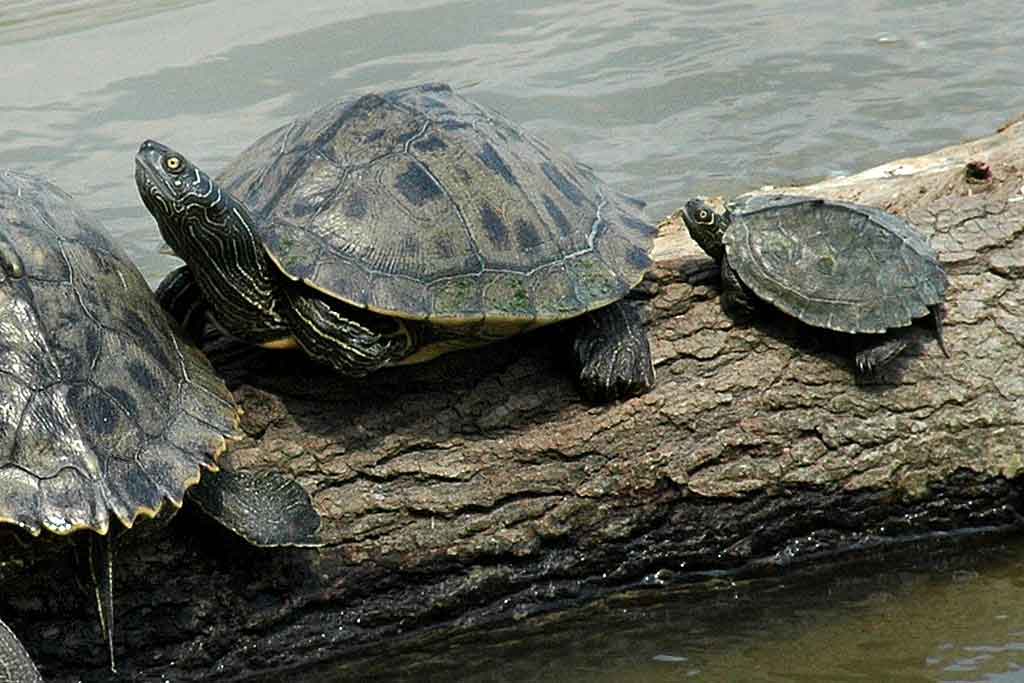
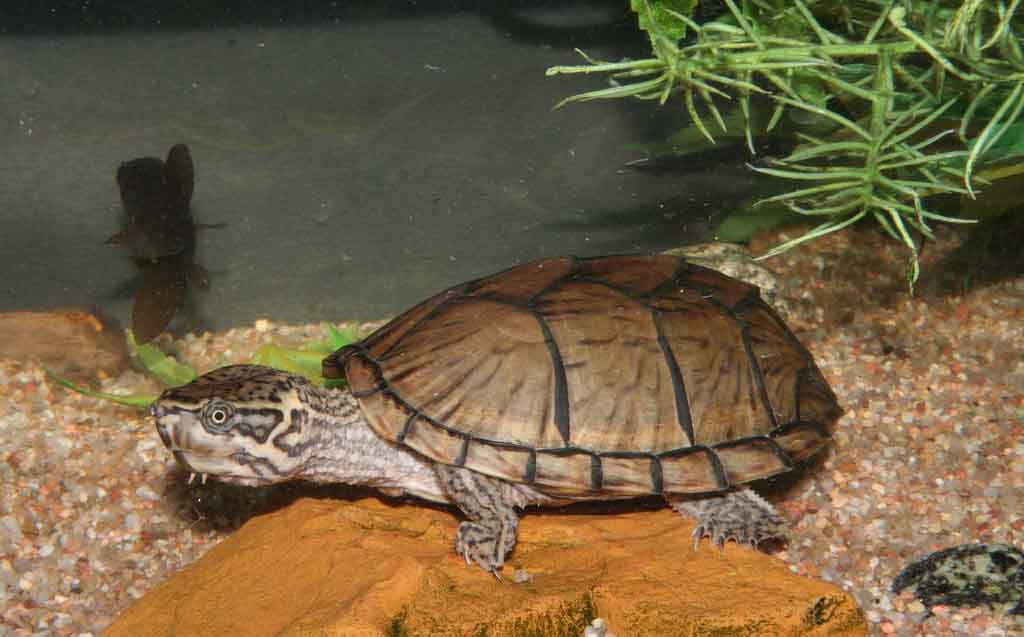
Sternotherus odoratus ร— Sternotherus carinatus hybrid – Laurent Lebois, CC BY 2.0, via Wikimedia Commons

Content

Origin / Distribution

The Common musk turtle (Sternotherus odoratus), It has a fairly wide distribution area., extending north into the eastern half of the US. (Illinois, Wisconsin, hasta Maine) and south into southern Canada (Quebec, Ontario) to Florida and west to central Texas.

Characteristics / Appearance

The carapace of adults is dark brown., dark gray to black and has no markings. It is evenly curved, narrow and elongated. In juveniles a pattern of dark spots is visible. Juveniles also have three characteristic keels, that disappear with age.

The plastron is small and cross-shaped. (bikini shell), and the color can range from light beige to full black. In this species, connective tissue sutures are especially prominent.

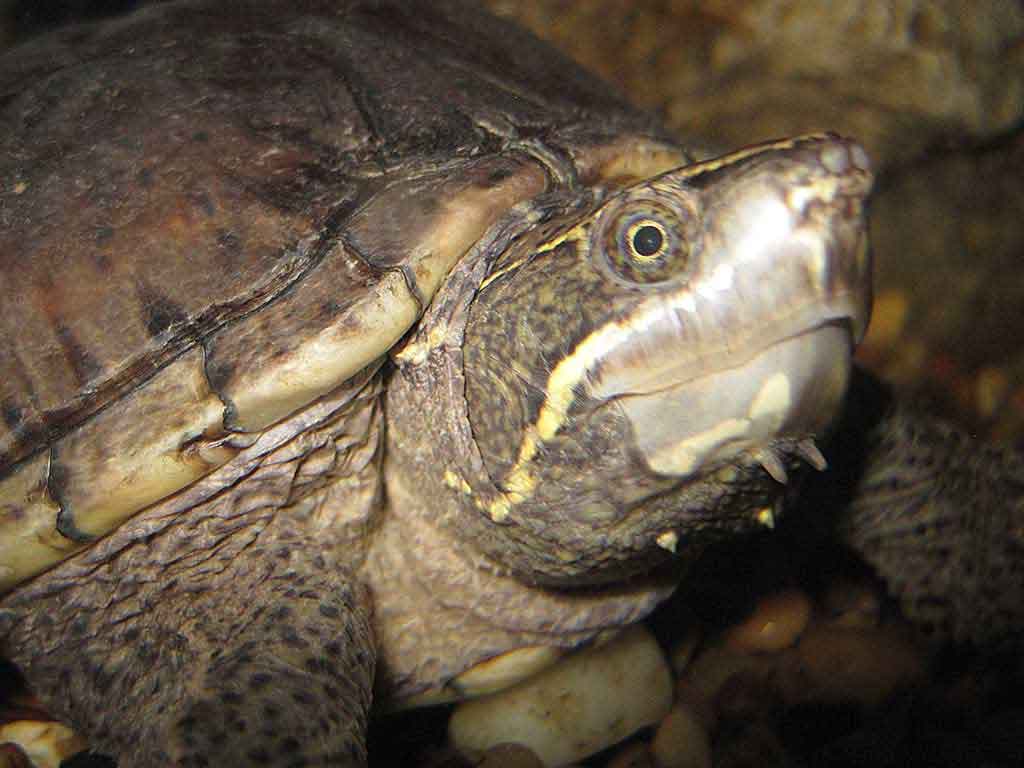
The head, legs and other soft tissue are light gray to black, although coloration changes with age. On the sides of the head there are two yellow stripes that vary depending on the specimen., one above and one below the eye from the tip of the nose to the neck (sometimes with a connection behind the eye). These stripes can fade or disappear completely with age.. There is a pair of barbels on the chin, sometimes there may be a second pair.

The Common musk turtle can reach a size of 13,7 cm., but in most cases it only measures between 7,5 and 10 cm., and both sexes are about the same size.

Habitat

Inhabits all types of fresh water, like lakes, ponds, rivers, swamps and canals, and prefers slow-moving waters with sandy bottoms. The species prefers shallow water areas. Despite its undemanding character, does not tolerate brackish water.

Behavior

The Common musk turtle belongs to the genus Sternotherus and it looks a lot like Striped mud turtle of the gender Kinosternon at first sight. unlike the turtles Kinosternon, that they can close their abdominal shell with the help of two hinges, the Common musk turtle has a retracted abdominal shell and is not hinged. This makes them more mobile and they compensate for the lack of protection by being more aggressive.. when they are threatened, give off a strong, unpleasant odor, what gives them their name.

The Common musk turtle is active in the morning and at night. Land rides are popular at night. Other species of Sternotherus are more active during the day.

Threats to the species

State of conservation โ“˜


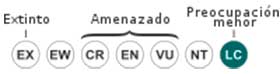
minor concern Minor Concern โ“˜ (UICN)โ“˜

Although the Common musk turtle does not have federal conservation status in the US. and is fairly common throughout most of its range, has decreased markedly in some areas, and appears to be more sensitive than some native species to human degradation of wetlands. It is listed as a threatened species in the state of Iowa.. It is listed as an endangered species in Canada., and is protected by the federal Species at Risk Act (SARA). It is also protected under the Ontario Endangered Species Act.. In this part of its range, only wetlands with minimal human impact have robust populations. The mortality of reproductive females on roads can be one of the problems associated with human development.

The "Common musk turtle" in captivity

Aquaterrarium

Depending on the size or age of the Common musk turtle, the aquarium should measure between 80 x 40 cm. and 100 x 50 cm., more space never hurts. The water level should initially be about 5 cm for small pups, the Common musk turtle adult prefers some 30 cm.. Animals like to run through the sandy substrate, but also climb to the surface of the water in the indoor furniture or swim freely in the water. Consequently, exuberant planting and good structuring with root wood or non-slip stones up to the surface must be carried out. Occasionally, turtles use furniture that protrudes from the water to sunbathe, although much less frequently than, for example, the ornamental turtles. Furniture also creates important hiding and resting places..

Females should be offered a sandy, partially planted area of โ€‹โ€‹land for egg laying.

Lighting and temperature of the aquaterrarium

A lamp, for example HQI, should hang above to heat the area to 35-40ยฐC. The species also likes to use the area to rest. This species also likes to use the area for nocturnal terrestrial excursions..

During the period of activity, The water needs to reach a temperature of 22 a 26ยฐC, which is why, depending on ambient temperature, a heating rod must be used. A rest phase in winter of about 3 months at about 10ยฐC is suitable for the species and is necessary to keep it healthy in the long term. This value is only indicative due to the large distribution area. Animals from the north of the distribution area have to enter torpor at a water temperature of 4ยฐC – 5ยฐC, animals in southernmost areas hibernate mostly at 10ยฐC – 15ยฐC.

A sufficiently sized filter ensures clear water and serves the health of the turtles..

In the middle of summer, the Common musk turtle can also be kept in secure outdoor enclosures if provided with gently sloping edges and plenty of greenery. But, in these conditions, animals cannot be observed regularly and, Therefore, are difficult to control.

Maintenance of the "Common musk turtle"
Common musk turtle
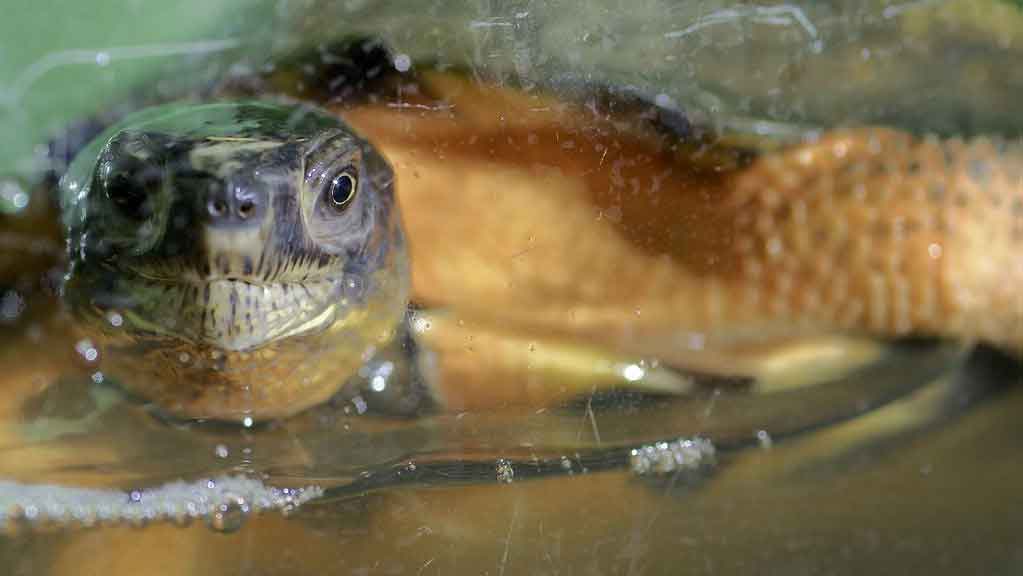
Common musk turtle, Reid Park Zoo, Tucson. Underwater, in aquarium. This turtle curiously uses its tongue to breathe underwater – David Bygott – Flickr

The Common musk turtle is a solitary animal, so adult males should generally be kept solitary. It is also recommended to keep females individually.. If two or more females are kept together, aggression and stress among lower animals are very likely, Therefore, close observation is necessary. Then, it may be necessary to separate the animals and set up another tank.

To keep the Common musk turtle as appropriate as possible to the species, we recommend the following conditions.

  • air temperature: 25ยฐ a 26ยฐC
  • Minimum size of the terrarium: 200 litres

Outside maintenance

The Common musk turtle can be kept in a garden pond from May to October. The pond should have a shallow shore and be sunny, as this particular species likes to bask in shallow water. It also, Don't rule out a large, powerful aquarium heater in the event of bad weather and the temperature drops below 10 degrees Celsius for a long period of time. The enclosure must be relatively high, Since the Common musk turtle it is a very good climber; concrete blocks and palisades can be used for this. It is essential that crystals or the like are not used, since of the turtles they will try to cross the transparent barrier constantly.

Food

The Common musk turtle feeds mainly on animal feed, consisting of dry food for turtles, worms, meat and fish strips. But, fruit and salad should also be offered occasionally.

Reproduction

The breeding season is mainly from April to May and from September to October.. Like this, can be put from 2 to 4 clutches of eggs by season. The stalls are usually 1 to 5 eggs, Although they can reach 10 eggs. under natural conditions, The incubation period lasts between 65 and 86 days, but can also reach 107 days in unfavorable cases.

Buy one "Common musk turtle"

The Common musk turtle, by breeding in large numbers on US breeding farms., is frequently and cheaply available commercially. This encourages ill-considered impulse purchases, which means that the number of unwanted animals that are given away is very high.

The price of the "Common musk turtle" in the exotic animal trade ranges from 40 – 70 EUR.

Videos "Common musk turtle"

First Pasto Sternotherus odoratus CB2016

Alternative names:

1. Common musk turtle, Eastern musk turtle (English).
2. Tortue musquรฉe, tortue musquรฉe commune (French).
3. Gewรถhnliche Moschusschildkrรถte, Moschusschildkrรถte (German).
4. Tartaruga Almiscarada Comum, Tartaruga do musgo (Portuguese).
5. "Tortuga almizclada", Tortuga almizclera comรบn (espaรฑol).

โ–ท The world of Pets: Dogs, cats, birds, reptiles, amphibians

Spot-legged wood turtle
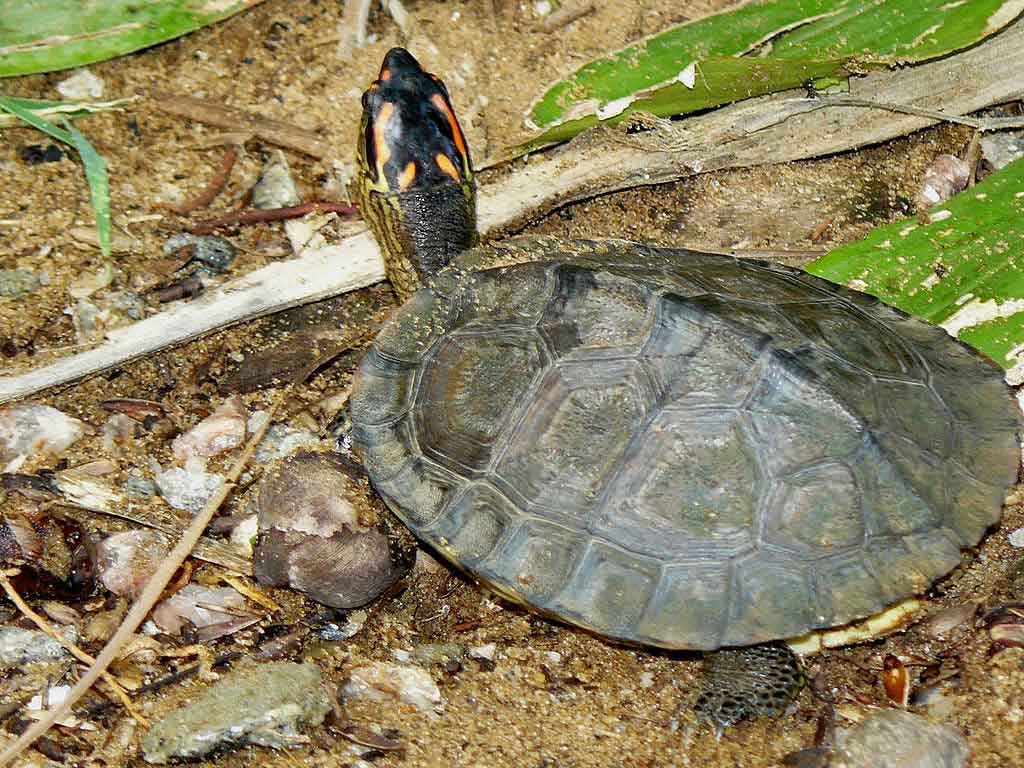
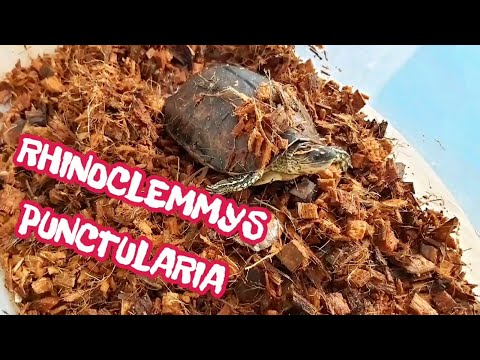
- Rhinoclemmys punctularia

The Spot-legged wood turtle it is a semi-aquatic species. Lives most of the time in swamps, coastal streams and marshes.
spotted footed tortoise
Rhinoclemmys punctularia photographed in the surroundings of Kourou (French Guiana) – Hervรฉbreton, CC BY-SA 3.0, via Wikimedia Commons

Content

Origin / Distribution

The name Rhinoclemmys is derived from the Greek words rhinos (nose, snout, bill, bill) and klemmys (Turtle, Turtle). The name alludes to the protruding snout that some individuals of the type species have..

The Spot-legged wood turtle (Rhinoclemmys punctularia) It is distributed in eastern Colombia., Venezuela, Trinidad, Tobago, Guyana, French Guiana, Suriname, NE of Brazil (Tocantins, For, amazon, Bay, maranhรฃo, to the lower course of the Tapajรณs River, Rio de Janeiro)

Characteristics / Appearance

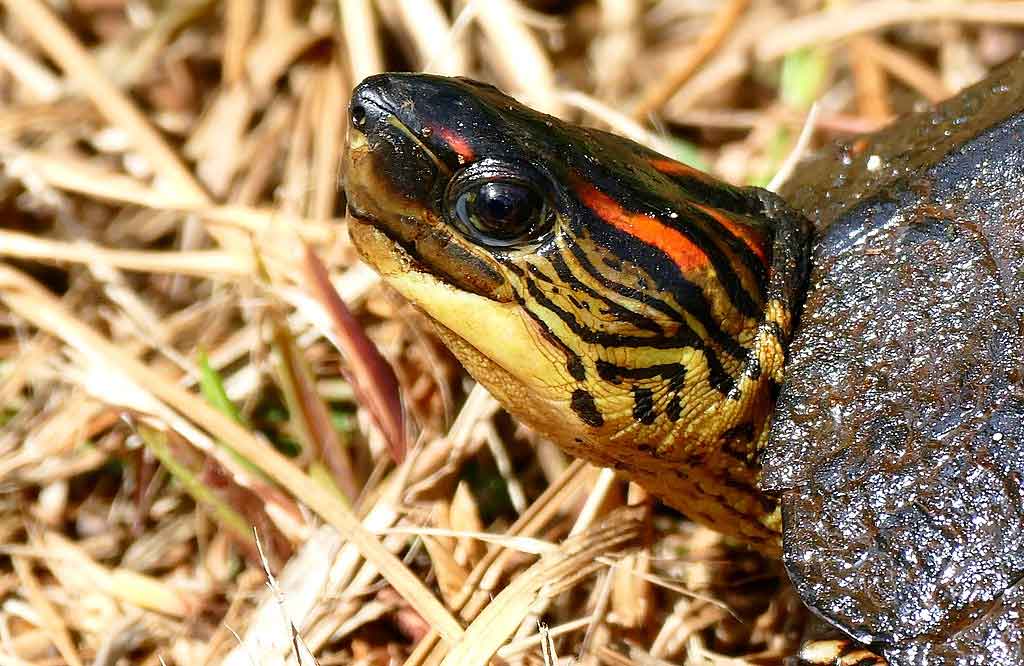
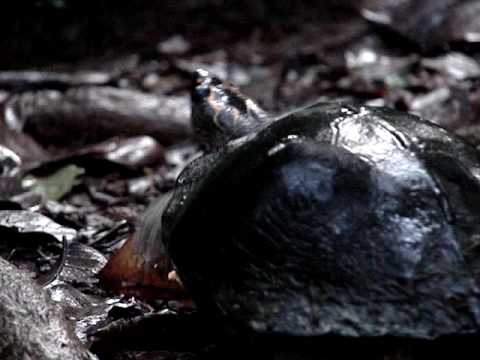
The shell is dark brown to black.. Limbs are orange-yellow with scattered black spots. The male is slightly smaller than the female and has a longer, slightly concave plastron and thicker tail.. Middle dorsal keel. red head pattern, yellow or green formed by two longitudinal or horseshoe-shaped stripes. Heavily webbed feet.

Habitat

Spot-legged wood turtle
"Spot-footed tortoise" (Rhinoclemmys punctularia) – Bernard DUPONT from FRANCE, CC BY-SA 2.0, via Wikimedia Commons

It is a semi-aquatic species. Lives most of the time in swamps, coastal streams and marshes. In Brazil it lives along the coast of Parรก and in open areas along the Amazon River to the lower Tapajรณs.. Avoid high salinity and strong currents.

Food

Omnivores, seek both animal and plant foods. Foraging and feeding can occur both in water and on dry land.

while they feed, they bite into their food using their front limbs not only to pull and break larger amounts of food, but also to maneuver the food in their mouths.

Reproduction

They lay an average of two very large brittle-shelled elongated eggs. They make several layings in a season. The incubation period can last up to three months.. Sex is determined by temperature. The eggs are covered with leaf litter or hidden among vegetation and roots..

Behavior

Mainly active at night, but is known to bask and be active during the day.

Threats to the species

This species is consumed only locally, but there is evidence that it is widely consumed or kept as a pet and sold on the black market.

It was classified in 2012 like least concern in the new Scientific Assessment of the Risk of Extinction of the Brazilian Fauna. To date, it has not been necessary to create any conservation program for this species.

The "Spot-legged wood turtle" in captivity

It is a rarely imported species., so there is not much information about their care in captivity.

Aquaterrarium

For proper maintenance and care of the Spot-legged wood turtle, an aquarium with an integrated terrestrial part or an aquaterrarium is recommended. The aquarium must have a rim length of at least 150 cm.. The substrate of the aquatic part must be designed as a tropical forest. The lush plantation, foliage and humus can serve you.

The Spot-legged wood turtle It is native to tropical regions.. So, it is mandatory to have a heated aquarium. Reptiles prefer a water temperature between 25 and 30 degrees centigrade with a pH value between 6,0 and 8,0. It is advisable to install a UV lamp so that the turtles sunbathe.

Under no circumstances will we let these turtles hibernate. If temperatures drop below 20ยบC, may start to show symptoms of breathing problems.

Buy one "Spot-legged wood turtle"

The price of a "Spot-legged wood turtle" at the exotic animal market, ranges between 90 – 120 EUR.
Imported animals must be kept in quarantine, and be dewormed.

Videos "Spot-legged wood turtle"

Spot-legged wood turtle ,Rhinoclemmys Punctularia

Tortue Rhinoclemmys punctularia

Alternative names:

1. Spot-legged wood turtle, Painted wood turtle (English).
2. Tortue spot-jambes, Tortue ponctulaire (French).
3. Guyana-Erdschildkrรถte (German).
4. Aperema, Tartaruga-de-patas-malhadas (Portuguese).
5. "Tortuga de patas moteadas", Tortuga Cabeza pintada Guayana, Tortuga de Patas Punteadas, Morrocoy negro (espaรฑol).

โ–ท The world of Pets: Dogs, cats, birds, reptiles, amphibians

False map turtle
- Graptemys pseudogeographica

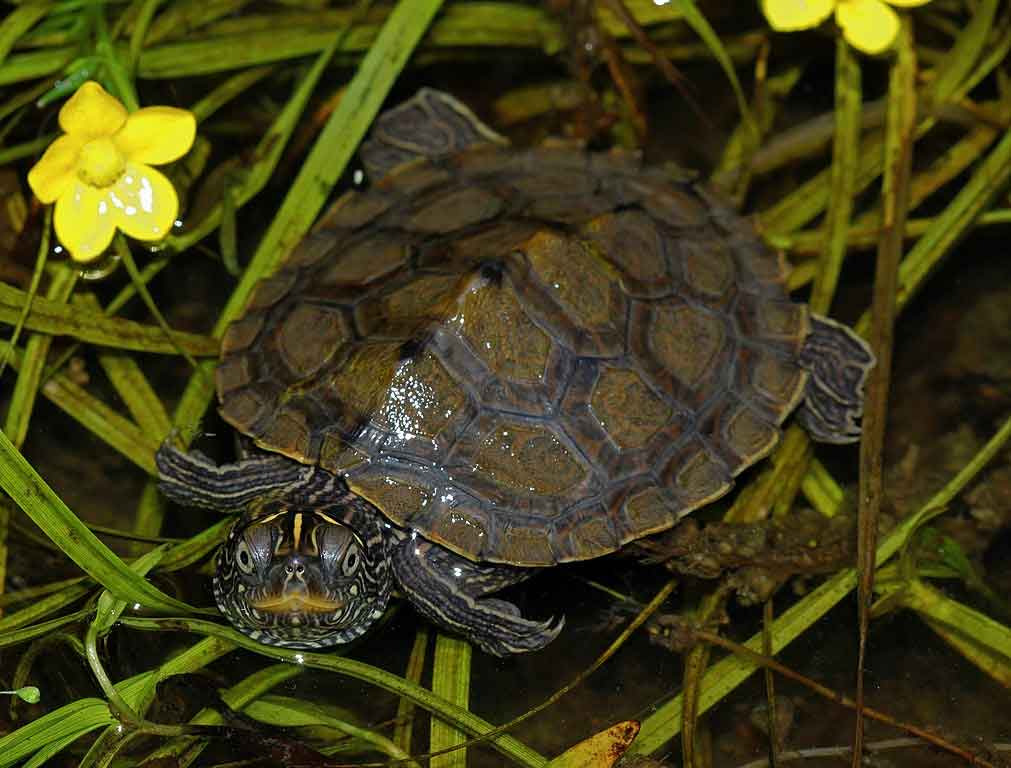
The False map turtle is a strong swimmer and prefers rivers and large streams with moderate currents.
False map turtle
False map turtle (Graptemys pseudogeographica) – Peter Paplanus, CC BY 2.0, via Wikimedia Commons

Content

Origin / Distribution

The False map turtle and Mississippi map turtle belong to the same species, but they are different subspecies.

Gender: Graptemys (Map turtles)
Species: Graptemys pseudogeographica (False map turtle)

  • Subspecies: Graptemys pseudogeographica pseudogeographica (False map turtle)
  • Subspecies: Graptemys pseudogeographica kohnii (Mississippi map turtle)

The subspecies with which the species was originally described is called nominal form. In the case of the named form, the species name is used twice. In this case it is Graptemys pseudogeographica pseudogeographica, the False map turtle. The second subspecies is Graptemys pseudogeographica kohnii., the Mississippi map turtle.
The Map turtles they are sun worshipers

The False map turtle (Graptemys pseudogeographica), lives in large streams of the Missouri and Mississippi river systems, ranging from ohio, Indiana, Illinois, Wisconsin, Minnesota, through the Dakotas south to southwestern Alabama, southern and western Mississippi and Louisiana. The False map turtle also lives in various other river systems of southwestern Louisiana and eastern Texas.

Characteristics / Appearance

Unfortunately, the Map turtles not offered in pet stores neatly separated by species. They are mostly a mixture of Graptemys p. pseudogeographica, Graptemys p. kohnii and Graptemys ouachitensis. Estas Map turtles they are distinguished by the markings on their head. in the three, head markings consist of yellowish to ivory lines on a dark gray background.
The typical mix of Map turtles from the pet store

In the False map turtle (Graptemys pseudogeographica pseudogeographica) there are two slightly thicker stripes on the head behind the eyes, coming out of the nape and bending to the side behind the eye. Under the eyes and around the mouth there are many spots, but they are barely thicker than the stripes. A few stripes come out of the neck and reach the eye. The iris of the eye is light brown to beige in color and is cut horizontally by a black line. The beak is light to dark yellow.. Leg and neck lines are slightly finer in this subspecies than in the other two.

In the Mississippi map turtle (Graptemys pseudogeographica kohnii), two prominent lines also run from the neck towards the eye and bend there, but then they go much further and enclose the eye in the shape of a crescent or a sickle. The circular markings on the head are relatively small and occur almost exclusively on the chin. Neck stripes do not touch the eye, because there is already the drawing in the shape of a sickle around. The iris is white and only rarely has a dark line. The beak is colorless to whitish.. Leg and neck lines are evenly thick, with lighter and darker lines.

False map turtle
False map turtle – Peter Paplanus from St. Louis, Missouri, CC BY 2.0, via Wikimedia Commons

In the Ouachita map turtle (Graptemys ouachitensis) there are two yellow-orange spots on the head, behind the eyes, which are between oval and square. These spots have a dark border. From these points there are no lines towards the neck. under the eyes, under the corners of the mouth and on the chin, under the tip of the beak, there are circular marks, which are clearly larger than in the first two Map turtles. The diameter is clearly greater than the thickness of the neck lines. Starting from the neck, one to three lines reach the eye. The iris is white and usually has a thin black line that crosses it horizontally.. The beak is colorless to whitish.. In the Ouachita map turtle adults the lines are usually reddish, instead of yellowish, but not always. In the lines of the legs and neck, light and dark lines are of different thickness.

Size and weight of the โ€œMap Turtleโ€

Females can reach up to 27 cm of shell length. The males are still pleasantly small, with a maximum of 15 cm.. Adult females usually measure between 21 and 25 cm and weigh between 1,1 and 1,8 kg. The adult males of Graptemys pseudogeographica they are smaller, of 11 to 15 cm., and also weigh only 140-370 g.
Males are still much smaller than females.

The Ouachita map turtle (Graptemys pseudogeographica kohnii) must remain minimally smaller than the False map turtle (Graptemys pseudogeographica pseudogeographica)

Habitat

The Map turtles are typical inhabitants of large rivers, but they also live in lakes and ponds. They prefer waters with abundant underwater plants, lots of sunbathing spots and shallow streams.

Behavior

The False map turtle is a strong swimmer and prefers rivers and large streams with moderate currents, containing aquatic vegetation, as well as floating logs. It is also comfortable in deep and fast water. Turtles are present in the elbow lakes and in the swamps, but they are absent from the lakes, ponds or small streams. Rest is important for these turtles, and can even be found on steep and slippery logs.

Food

Food components of the females of Map turtles in the nature (according to LINDEMAN 2013):

  • Molluscs 22 %
  • Fish 6 %
  • Caddisfly larvae 2 %.
  • May flies 11 %
  • Dragonflies 0,4%.
  • Plants 55 %
  • Other 4 %

According to VOGT (1981), the 42 % of the diet of adult females Graptemys pseudogeographica consists of plants (Vallisneria, Potamogeton, Lemna and algae), followed by molluscs and flies. While the males feed mainly on insects and do not eat plants.

Sex determination

In the Map turtles, the claws on the front feet are not a reliable feature to distinguish between the sexes. To distinguish males from females, the Map turtles must have a carapace length of at least 10 cm.. Prior to that, all look like females.

In the Map turtles male, the tail is much longer and also somewhat thicker. They are said to have a "fifth leg". The cloaca is situated well outside the shell when the tail is extended.. In females the tail is relatively short.. The cloaca is approximately level with the edge of the carapace when the tail is extended..

Reproduction

Mississippi map turtle
Mississippi map turtle (Graptemys pseudogeographica kohni), adult female left, adult male right, photographed on site, Trinity River, Liberty Co., Texas (20 in April of 2007)

Males reach sexual maturity at 7-9 carapace length cm. Females reach sexual maturity much later, to the 18 carapace length cm. Mating can take place in the fall or spring.. After a single mating, females lay one to four clutches per season. Each nest consists of 2 to 22 eggs. The number of eggs per clutch in the Graptemys p. pseudogeographica is usually greater than Graptemys p. kohnii.

The higher the incubation temperature, more shell abnormalities hatchlings will have.

The incubation temperature can be between 25 and 32 ยฐC. If you want more male offspring, hatching temperature of 25 ยฐC. But, to 30 ยฐC, more females are born. The warmer the incubation, the quicker the little turtles will be born. It usually takes between 50 and 80 days.

Threats to the species

State of conservation โ“˜


minor concern Minor Concern โ“˜ (UICN)โ“˜

This species faces several threats, such as destruction of egg nests by animals and insects, falling into gillnets and shooting. The False map turtle, like the Red-eared slider (Trachemys scripta elegans), have also been collected for the pet trade.

All Map turtles are included in CITES Appendix III and in Appendix C of the EU Species Protection Regulation. But, they do not need any documents when trading within the EU and are not subject to declaration.

The "False map turtle" in captivity

Aquaterrarium

The Map turtles It is native to large rivers and lives in areas of slow flow.. Thus, they need an aquarium with plenty of room to swim. For one or three adult females, should have 160 x 60 x 60 cm and a water level of 40-50 cm.. Of course, can also be higher. The Map turtles male is still much smaller, can be kept very well in an aquarium of dimensions 100 x 40 x 50 cm., that is to say, a standard aquarium of 200 litres. for the pups, the aquarium can be smaller at first. If you buy pups from a pet store or breeder, I would start with an aquarium of at least 80 cm to avoid having to buy new aquariums.

Aquaterrarium decoration

The assembly of aquaterrarium can be simple, because the Map turtles they mostly need space to swim. A thin layer of sand or other substrate can be placed on the bottom. You can create some structure with a few roots or pretty stones. A cave is also popular with Map turtles, for example, halved clay pots or a wall-mounted terracotta pot are suitable.

Planting in the aquarium is difficult. females eat plants. Males eat fewer aquatic plants, so you can try. But the males also burrow into the substrate, so it is not worth planting them. But, you can try plants that float freely in the water, as the Anthocerotophyta and Elodea. Basically, all aquatic plants that occur as food plants are suitable for planting.

Clean water is immensely important to the Map turtles. So, good filters are recommended. The water should also be changed regularly.

Terrestrial part

The Map turtles they have sensitive shells. So, the land part should not be made of stones. Wood in any form is much more suitable. For young turtles and males, just an area of โ€‹โ€‹land made with a willow or cork bridge.

Sexually mature females need the opportunity to lay eggs.. Females that have never had contact with a male can also form eggs and should be given the opportunity to lay them on land.. Otherwise, there is a risk that eggs will be laid. Turtles do not lay their eggs in the water., but they bury them in the ground. The egg-laying area for Map turtles must have a minimum area of 50 x 30 cm and a substrate height of 30 cm..

Illumination

The Map turtles they are hungry for light. They need high-quality lighting. A Map turtles will not be happy with cheap lamps and a fluorescent tube. The only sensible lighting for these tortoises is a metal halide lamp with a UV component. (also abbreviated as hqi). These lamps are not only very bright, they also provide the vital UV-B light that is necessary for the formation of vitamin D. They also get very hot, so it can be achieved 40-45 ยฐC required on land if the distance is adequate.

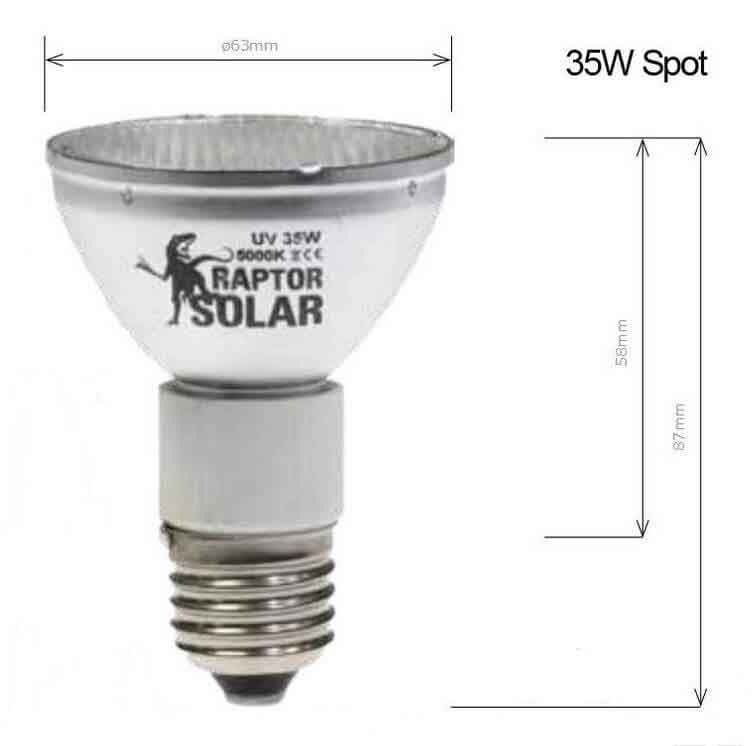
for the juniors, is enough a hqi of 35 watts, for example the SolarRaptor HID Lamp Set incl. ECG + ClampLamp* or the Exo Terra Sun Ray Lighting Complete Set*. For females it should be a lamp 70 watts, I recommend the following complete set: Lucky Reptile Bright Sun Set Turtle*.

Food

If the diet in the wild is known, food is actually quite simple. The Map turtles they can also eat all this in the aquarium. Use brown shrimp and other dry foods such as water fleas and mosquito larvae as a staple. It also, the Map turtles they are happy to eat frozen food, like red mosquito larvae and mussels. Mussels belong to the molluscs and are also widely eaten in the wild. the living food, like earthworms and isopods, should also be on the menu regularly.

The Map turtles they eat in the water, just throw the food in the water!

The proportion of vegetable food must be at least 40 % for the females of Map turtles. algae and aquatic plants (for example, duckweed) are particularly suitable for it. If you don't have enough aquatic plants, dandelions and other wild herbs are a good alternative. Otherwise, it is also possible to feed them with lettuce. Males and youngsters should also be offered plants regularly. The young also eat plants. The adult males of the Map turtles they barely eat them.

Yes the Map turtles do not accept plants well (especially the males), you can also occasionally use the pellets Sera’s Turtle Adult Nature* to provide crude fiber. These duckweed pellets contain more crude fiber than other terrapin sticks.

The Map turtles are very prone to vitamin A deficiency. To avoid this, you have to give them grated carrot once a week.

While young animals can be fed once a day during their first year of life, the Map turtles Older animals should only be fed pet food or pellets three to four times a week.. Otherwise, turtles will grow too fast. The amount of food should be such that it is finished after 10 minutes. Plants must always be available, a tortoise can eat whatever it wants.

For calcium supply, a piece of cuttlefish must always be floating in the water.

Temperature and hibernation

False map turtle
False Map Turtle (Graptemys pseudogeographica) – Josh More – Flickr

The two subspecies of Graptemys pseudogeographica have a wide distribution area. The False map turtle (Graptemys p. pseudogeographica) is further north, so it must hibernate a 4-8 ยฐC for five months. The Mississippi map turtle (Graptemys p. kohnii) inhabits southern part of range. Thus, only hibernates for three months 10-15 ยฐC.

Aquaterrarium with several turtles

The Map turtles, like all aquatic turtles, they are actually solitary animals. So, keep one Map turtles is appropriate for the species and recommended. But, if you want to keep several turtles together, all must be female. females get along better. Groups of three or more animals work very well.

When keeping a group, it should always be possible to remove a turtle from the group in case of stress or bite.

The Map turtles male should be kept separate from females. Otherwise, their constant mating attempts will make the females too nervous. The males of the Map turtles are often surprisingly compatible with each other, and it is often possible to keep several males together.

keep at Map turtles in a pond

The Map turtles not usually suitable for keeping in a garden pond. It's just too cold for them and the sunshine period is too short.. This leads first to shell necrosis and then to liver and kidney problems.. if you want to have Map turtles in a pond, the northernmost subspecies in particular is reasonably possible. It's about the False map turtle (Graptemys p. pseudogeographica).

Buy one "False map turtle"

The price of a "False map turtle" at the exotic animal market, ranges between 30 – 70 EUR

Videos "False map turtle"

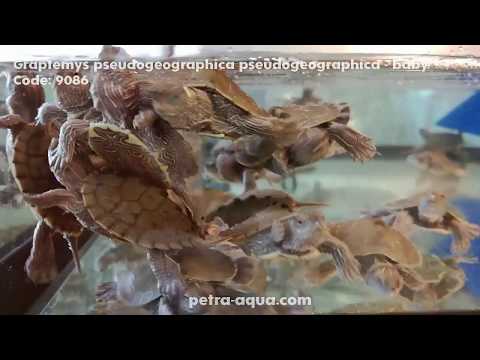
9086 Graptemys pseudogeographica pseudogeographica

Alternative names:

1. False map turtle, Sawback (English).
2. Fausse tortue gรฉographique (French).
3. Falsche Landkarten-Hรถckerschildkrรถte, Falsche Landkartenschildkrรถte (German).
4. Falsa Tartaruga Corcunda (Portuguese).
5. "Tortuga falso mapa", Falsa Tortuga Mapa (espaรฑol).

Sources:

Ernst, C. H. & J. E. Lovich (2009): Turtles of the United States and Canada – Second Edition. – The John Hopkins University Press (Baltimore): 827 pp.

Gibbons, J. W. & J. E. Lovich (1990): Sexual dimorphism in turtles with emphasis on the slider turtle (Trachemys scripta). – Herpetol. Monogr. (4): S. 1-29.

Lindeman, P. V. (2013): Map Turtle and Sawback Atlas – Ecology, evolution, distribution and conservation. – University of Oklahoma Press (Norman), 460 p.*.

Vogt, R. C. (1981): Food partitioning in three sympatric species of map turtles, genus Graptemys (Testudinata, Emydidae). – American Midland Naturalist (105): pp. 102-111.

โ–ท The world of Pets: Dogs, cats, birds, reptiles, amphibians

Mississippi map turtle
- Graptemys pseudogeographica kohni

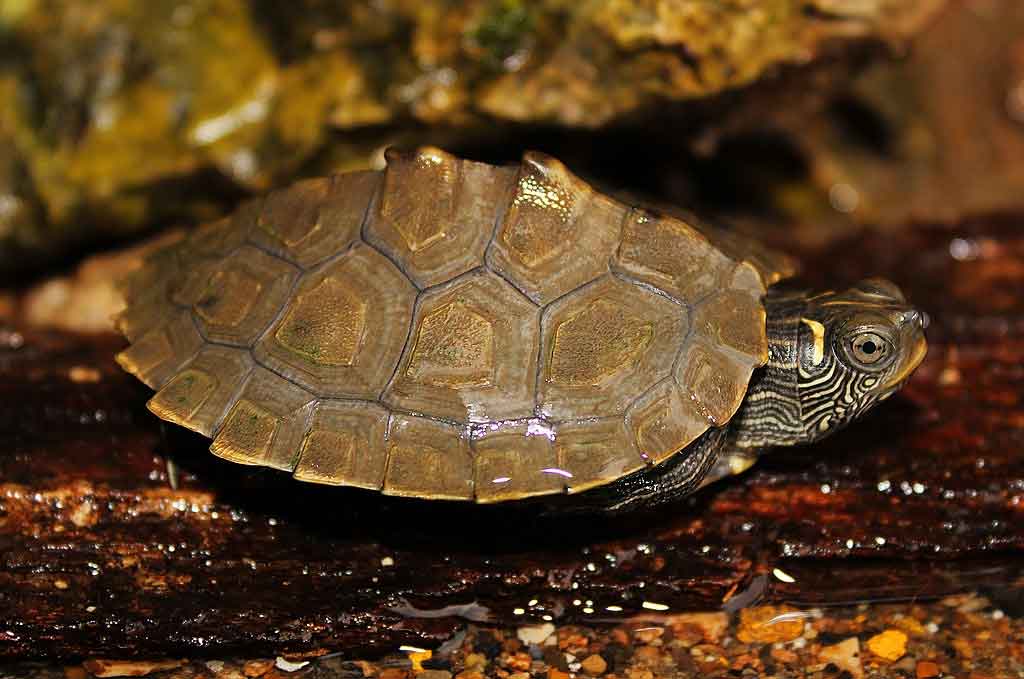
The Mississippi map turtle it is a popular pet among aquarists and is very pleasant to watch.
Mississippi map turtle
Mississippi map turtle (Graptemys pseudogeographica kohni) – Peter Paplanus – Flickr

Content

Origin / Distribution

The Mississippi map turtle (Graptemys pseudogeographica kohni) found along the Mississippi River and its tributaries, from Illinois and Missouri south.

Characteristics / Appearance

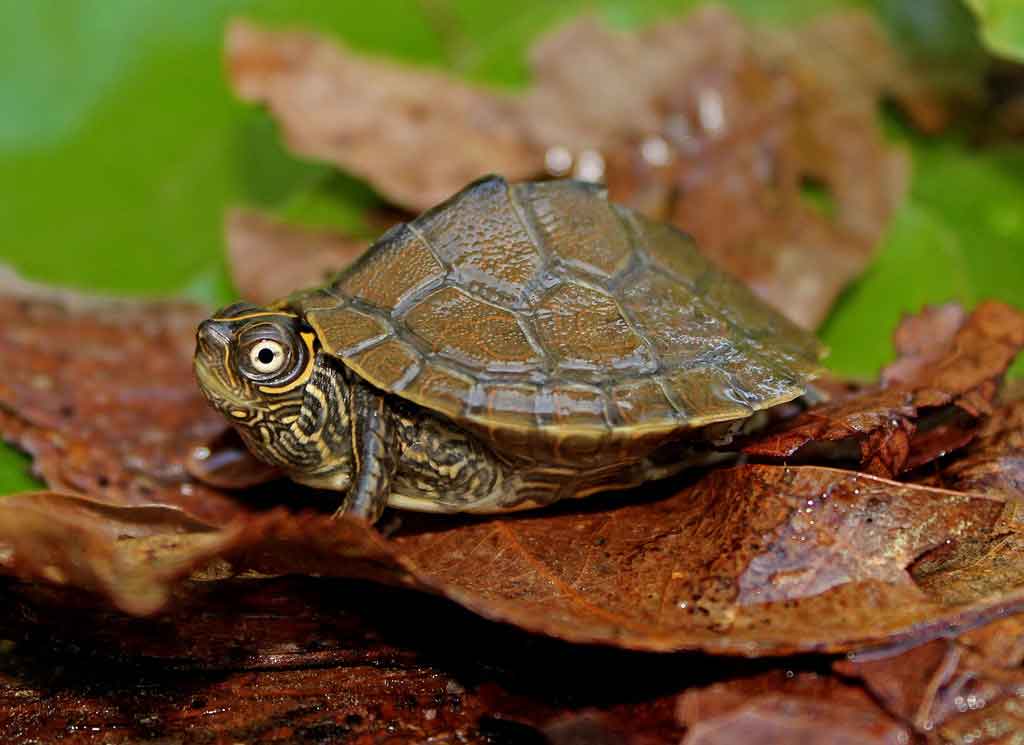
In the Mississippi map turtle (Graptemys pseudogeographica kohnii), two prominent lines also run from the neck towards the eye and bend there, but then they go much further and enclose the eye in the shape of a crescent or a sickle. The circular markings on the head are relatively small and occur almost exclusively on the chin. Neck stripes do not touch the eye, because there is already the drawing in the shape of a sickle around. The iris is white and only rarely has a dark line. The beak is colorless to whitish.. Leg and neck lines are evenly thick, with lighter and darker lines.

Threats to the species

State of conservation โ“˜


minor concern Minor Concern โ“˜ (UICN)โ“˜

This species faces several threats, such as destruction of egg nests by animals and insects, falling into gillnets and shooting. The Mississippi map turtle, like the Red-eared slider (Trachemys scripta elegans), have also been collected for the pet trade.

All Map turtles are included in CITES Appendix III and in Appendix C of the EU Species Protection Regulation. But, they do not need any documents when trading within the EU and are not subject to declaration.

The "Mississippi map turtle" in captivity

Aquaterrarium

The Mississippi map turtle can reach a maximum size of about 20 cm in the aquarium. Females grow considerably larger than males. For the maintenance and care of aquatic turtles, A tank with a minimum length of 150 cm.. It is important that the water level is very high. In this way, your turtles will be able to swim wonderfully in it. In addition to the water level, a part of soil must also be integrated into the aquarium. can be plastic, stone or cork. Your turtles can sit on it and sunbathe. It is recommended to use sand or fine gravel as a substrate in the aquarium. It also, must offer your Mississippi map turtle roots or stone structures. These decorations provide good structure in the tank and create a natural habitat..

The Mississippi map turtle is a solitary animal. This will not change in the aquarium. Animals should ideally be kept individually.

The Mississippi map turtle optimally adapts to the values โ€‹โ€‹of the water in the tank. They feel comfortable in waters with temperatures between 25 and 28 degrees centigrade and a pH value between 6,0 and 8,0. During the winter months, the water turtle hibernates. During this time, the water temperature should be reduced to 4 – 12 Celsius degrees. "On land, the temperature should be about 40 degrees Celsius. A metal halide lamp can be very useful in this case.

Food

Mississippi Humpback Turtles Prefer a Varied Diet. It can be live food, frozen, dry the vegetable.

Reproduction of the Mississippi map turtle in the aquarium

The Mississippi map turtle (Graptemys pseudogeographica kohni) has already been successfully bred in the aquarium. Plastic boxes are recommended as egg laying sites.

Buy one "Mississippi map turtle"

The price of a "Mississippi map turtle" at the exotic animal market, ranges between 30 – 70 EUR

Videos "Mississippi map turtle"

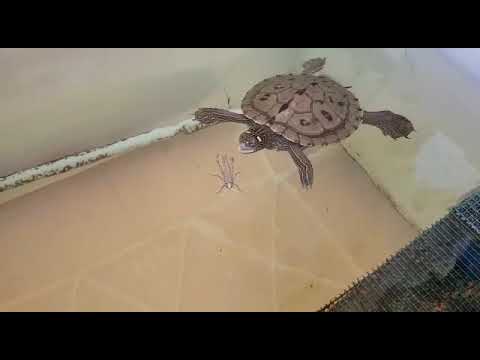
Mississippi map turtle (Graptemys pseudogeographica kohni ) having a lobster for lunch

Turtle Shack Unboxing: Mississippi Map Turtle

Alternative names:

1. Mississippi map turtle (English).
2. Tortue gรฉographique du Mississippi (French).
3. Mississippi-Hรถckerschildkrรถte (German).
4. Tartaruga do mapa do Mississippi (Portuguese).
5. "Tortuga Mapa del Mississipi" (espaรฑol).