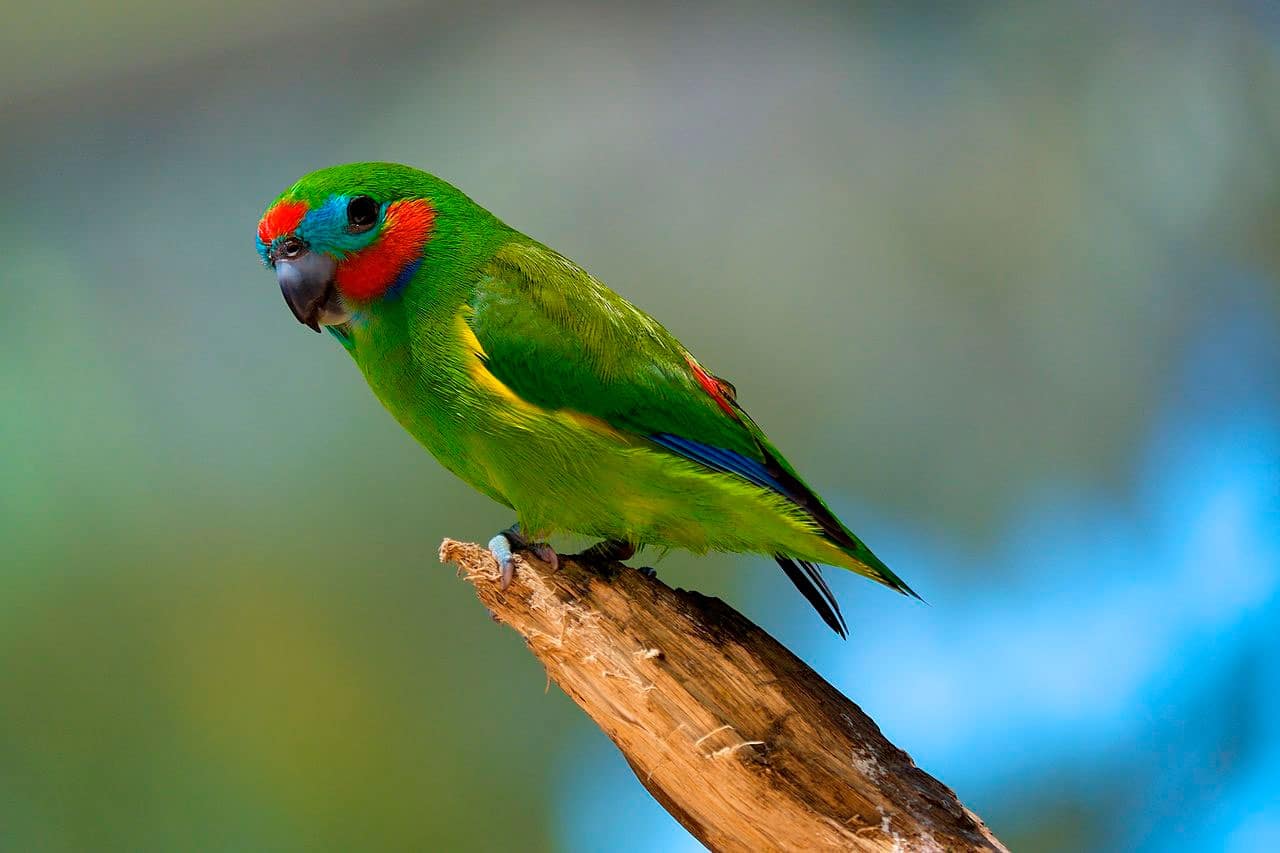
13 to 16 cm.. length and a weight between 25 and 56 g..
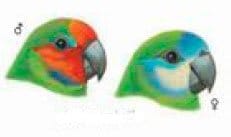
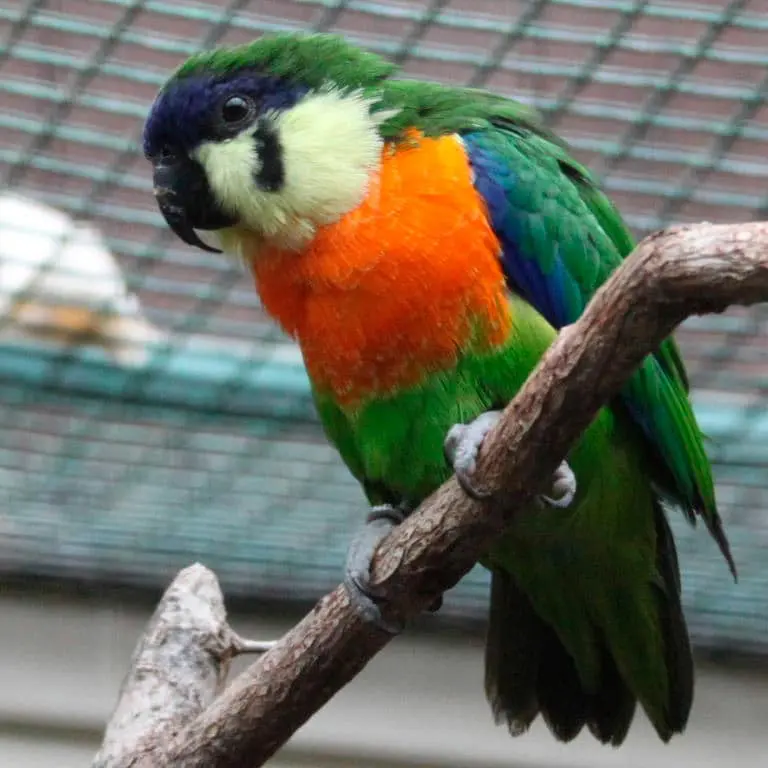
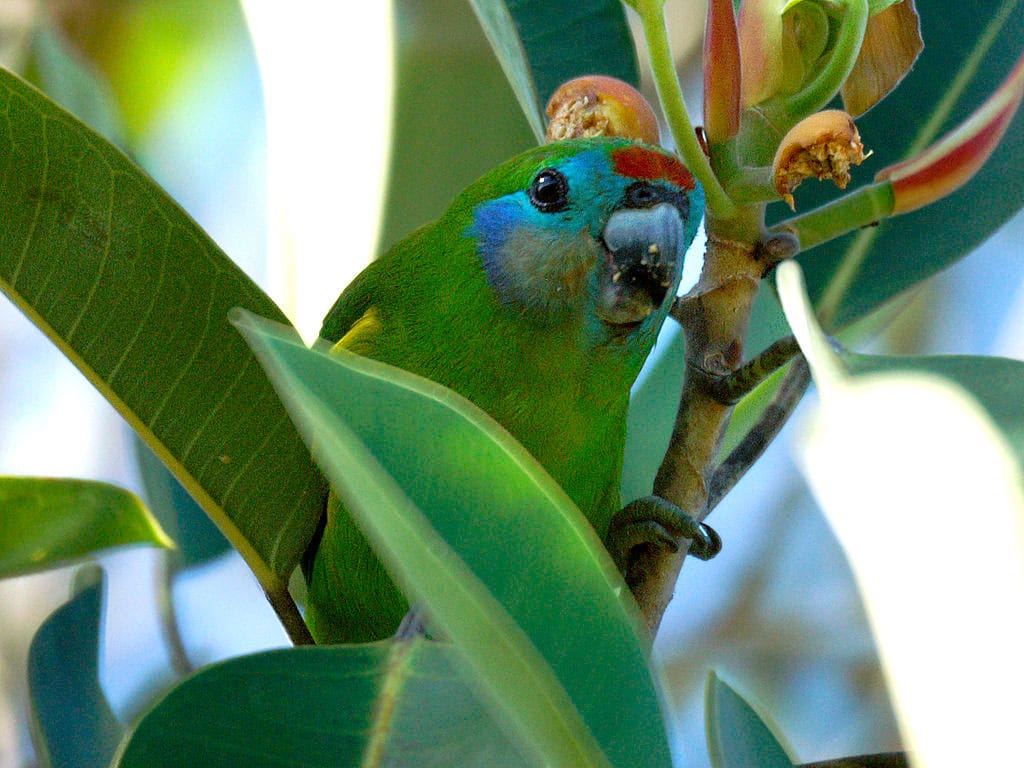
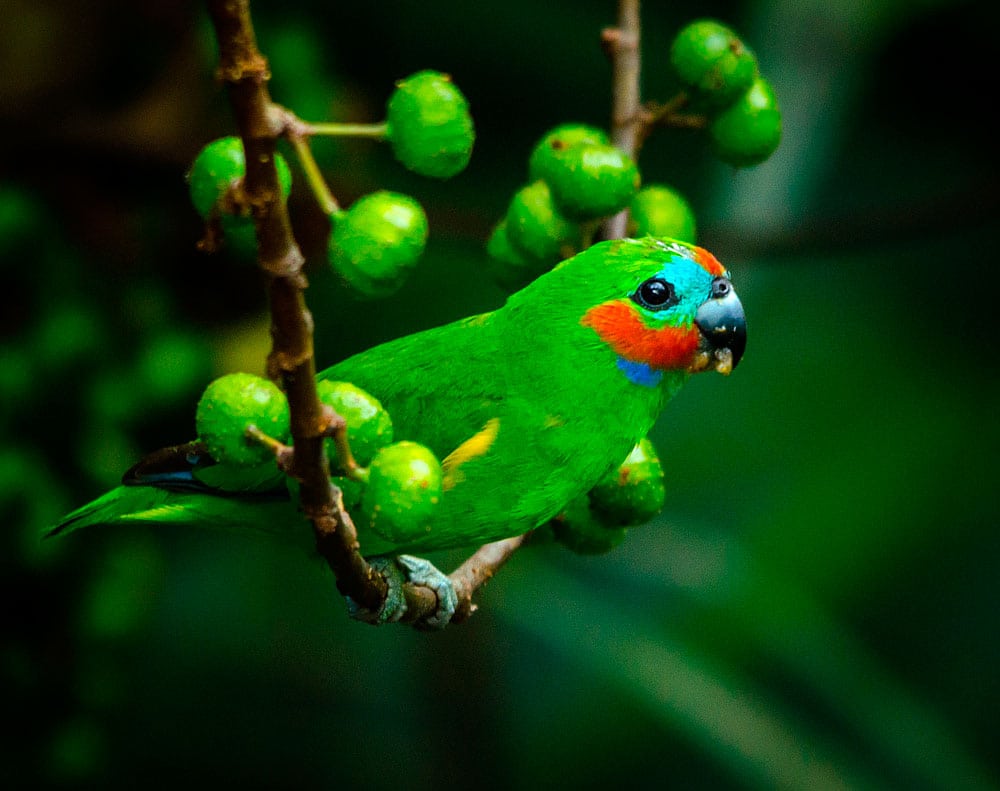
The Double-eyed Fig-Parrot (Cyclopsitta Diophthalma) half of the crown, lores, cheeks and headphones feathers bright Scarlet color with some slightly elongated feathers; bright turquoise brand above and in front of the eyes, that it extends slightly backwards above and below; green line above and behind the eyes; brand violet-blue light under the red on the back of the headphones feathers that extends to the throat; narrow yellowish Orange behind the red band of the crown, Fusion to the green in the part back from the crown.
Upperparts with indistinct diffusion of color bright green olive on the the mantle. Wing coverts, bright green; primary coverts blue; primaries with vane external of color blue turquoise pale and vane blackish internals; flight feather (except the primary outer) with band of yellowish white color visible from below; inner coverts marked in red, wing feathers bordered with yellow green.
The underparts paler; Green over yellow that the upperparts, with a strong Flash of yellow along the flank, about the bend of wing. Upper, the tail green; grey below.
Robust bill, notched grey lead and a blackish tip; cere dark grey; irises dark brown; legs Green grey.
The female has the cheeks brown, not red.
Immature as the females. The young male acquire the plumage adult in 14 months.
Subspecies description
-
Cyclopsitta diophthalma diophthalma
: (Hombron and Jacquinot, 1841) – The nominal

-
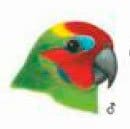
Cyclopsitta diophthalma aruensis
: (Schlegel, 1874) – Of 14 cm.. length. The plumage is greenish-yellow, the blue area on the eyes has greenish hue , Blue cheeks are lined with mauve colouration and extends to the bottom of the peak.
Female similar to the male but all the red marks are replaced by a pale blue.
-
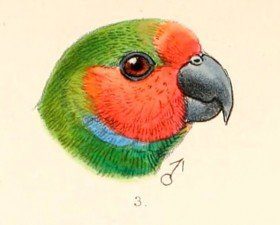
Cyclopsitta diophthalma coccineifrons
: (Sharpe, 1882) – Of 14 cm.. length.
It is usually something more dark. The Crown is red bordered with a broad yellow band.
The female has less yellowish white.
-
Cyclopsitta diophthalma virago
: (ECTION Hartert, 1895) – Of 14 cm.. length.
Green is more pale, the red zones of the face are less extensive and more pale.
Yellow edge of the very weak Crown.
Juveniles as adult females

-
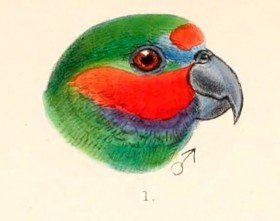
Cyclopsitta diophthalma inseparabilis
: (ECTION Hartert, 1898) – Of 14 cm.. length.
The Red coloration is reduced to a small spot on the forehead, the rest of the forehead is bluish.
Similar to males females.
Juveniles as adult females.
-
Cyclopsitta diophthalma macleayana
: (EP Ramsay, 1874) – Of 14 cm.. length.
The Red is reduced to a red spot in the front area and lower cheeks. The yellow border in the area of the Crown is absent, sides of the forehead and eyes blue with green. The azul-violaceos edges of the cheek extends to below the peak.
Females more yellowish and the bottom of the cheeks is white Brown.
Equal to the adult female juveniles.
-
Cyclopsitta diophthalma marshalli
: (Iredale, 1946) – Of 14 cm.. length.
Green is more beige and the azul-malva coloration extends to the area under the peak.
Females have pale blue color where the male has red and blackish brown cheek bottom area.
Juveniles as adult females.

-
Cyclopsitta diophthalma coxeni
: (Gould, 1867) – It's a bit more large, of about 15 cm.. approximately, No red forehead and face with some reddish feathers, the cheeks and orange headphones feathers. Blue front clear and without yellow stripe. The area of the eyes is absent blue. Blue edges of the bottom of the cheeks is variable.
The females are more yellowish with less or absent red in the face.
Equal to the adult female juveniles.
The Double-eyed Fig-Parrot are sedentary, with some dispersion after the breeding season. It is in a range of habitats from low to medium altitude, including jungle, secondary vegetation, on the edge of the Woods, riparian forest and occasionally dry forests and open forests of eucalyptus.
In Australia There are also birds in parks, Gardens, scrub, cultivated areas and mangroves; the Diophthalma diophthalma coxeni, probably, concentrated in the alluvial forest, but it was also visible in the forests of dry lowlands and hills of rainforest.
The species is highly dependent of the Ficus figs in all habitats.
The birds are usually found in pairs or in small groups, calling the attention with their constant calls acute while flying above the canopy.
They feed in silence, moving quietly through the foliage, often giving away their presence only by falling debris, Since break the shell of the fruit to reach its seeds.
outside the breeding season, groups of up to 200 birds can be nested together, dissolving into smaller groups to feed themselves during the morning and afternoon.
When alarmed, they move their wings in an agitated manner.
during the rains, the bath is carried out with wet foliage, and mutual grooming is common.
The breeding season of the Double-eyed Fig-Parrot, probably begins in New Guinea during the month of March, in Australia the main season runs from August to November.
When the birds are played are divided into pairs, territorial around their food trees. The nest It is a cavity that is expanded in a trunk at a height between 8 and 20 meters above the ground. Most of the nest preparation is carried out by the female., that takes refuge in the hole and spends a large part of the day there during its excavation. She can experiment with more than one nest.
Courtship feeding is common. The entrance hole is about 4 cm in diameter, and putting two white eggs are deposited, at intervals of 48 hours, in one camera, some 20 centimetres below the entry hole.
The incubation hard 18 days and the young will leave the nest in 7-8 weeks, After having been fed during the first 3 to 4 weeks, only for the female. They return to settle in the hollow for a short period of time after having left the nest.
The fig seeds they are their main food, birds often return to the same ripe fruits ending all their seeds. The diet also includes whole fruits small, nectar, insect larvae and fungi or lichens collected from the barks. Birds may feed in groups with others Fig parrots and, in Australia, with Rosella parakeets and other species of parrots.
The Double-eyed Fig-Parrot is distributed throughout much of New Guinea and parts of the northeast of Australia. At the West end is located in Waigeo, Salawati, Misool and Rafiau in the West Papua islands, Indonesian.
Is widespread but distributed unevenly through the continental part of New Guinea, absent only in the center of the Doberai Peninsula and the central belt of mountains above the 1.600 m, Although there have previously been to 1.800 meters at the local level.
You can see in the islas Aru and Fergusson, in the Islands Goodenough in the D'Entrecasteaux Group, and in Tagula in the Louisiade group.
In Australia, the most northerly of the three isolated populations, is the tip of the Cape York Peninsula, from Jardine River in the northwest of the country, to the South, around East of Lockhart River, sometimes in the South to the extreme north of the Princess Charlotte Bay; the population Centre occupies the coastal district of everything Cooktown in the North through Cairns and the District Atherton, about South of Townsville; the southern-most population, now very reduced, with less than 50 records in the last century, formerly extended from Gympie, Queensland, to the South, about Richmond River, New South Wales, arriving inland up to the Bunya mountains (in 1976 two birds were about the Koreelah National Park, in February and two close Lamington National Park in December).
The estimate of the world population is above the 100.000 individuals and stable, but the State two of its subspecies is less secure:
– Cyclopsitta Diophthalma macleayana: has a population of 5.000 individuals and may be in decline, Although multiply in parks and gardens around Cairns.
– Cyclopsitta Diophthalma coxeni: just left 200 birds, After having reduced its population as a result of the destruction of the forests of lowlands along its limited distribution area.
– The third Australian subspecies, Cyclopsitta Diophthalma marshalli it's still pretty common.
In New Guinea, the species dispersed, and is considered to be rare in the Doberai Peninsula and absent from many parts of the lowlands of the South, is mainly distributed in the Highlands of the South basin. The Orange-breasted Fig-Parrot It probably replaces this species in much of this area. It is likely that the species has not been recorded accurately due to its small size and discreet habits. Protected by law in Australia. The Diophthalma diophthalma coxeni appears in the Appendix I of the CITES
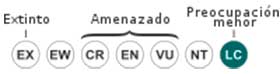
• Current IUCN Red List category: Least concern
• Population trend: Stable
The size of the world population Double-eyed Fig-Parrot It has not been quantified, Although it is estimated at more than 100,000 specimens. But, the Diophthalma diophthalma coxeni is in critical hazard, with a population between 50 and 200 individuals; the Diophthalma diophthalma macleayana with a population of some 5.000 individuals and the Diophthalma diophthalma marshalli generally uncommon
The population, of the nominal species, is suspected to be stable in the absence of evidence of any reduction or substantial threats.
"Double-eyed Fig-Parrot" in captivity:
Rare in captivity.
Not social with people. Welcome in the distance.
– Double-eyed Fig-Parrot, Double eyed Fig Parrot, Double-eyed Fig Parrot, Two-eyed Fig Parrot (ingles).
– Psittacule double-oeil (French).
– Rotwangen-Zwergpapagei (German).
– Papagaio-do-figo-de-cara-azul (Portuguese).
– Lorito de Cuatro Ojos, Lorito Dobleojo, Lorito de la higuera de doble ojo (español).
scientific classification:
– Order: Psittaciformes
– Family: Psittaculidae
– Scientific name: Cyclopsitta Diophthalma
– Genus: Cyclopsitta
– Citation: (Hombron & Jacquinot, 1841)
– Protonimo: Psittacula diophthalma
Videos "Double-eyed Fig-Parrot"
————————————————————————————————
«Lorito Doublerojo» (Cyclopsitta Diophthalma)
Sources:
– Avibase
– Parrots of the World – Forshaw Joseph M
– Parrots A Guide to the Parrots of the World – Tony Juniper & Mike Parr
– Loromania
– Photos:
(1) – «Cyclopsitta diophthalma-Birdworld Kuranda, Queensland, Australia-male-8a» by Shotophoto – Double Eyed Fig ParrotUploaded by snowmanradio. Licensed under CC BY-SA 2.0 via Wikimedia Commons.
(2) – John Gerrard Keulemans [Public domain], via Wikimedia Commons
(3) – «Cyclopsitta diophthalma-Mossman Gorge, Daintree National Park, Queensland, Australia-male-8» by James Island from Brisbane, Australia – Double-Eyed Fig-ParrotUploaded by snowmanradio. Licensed under CC BY 2.0 via Wikimedia Commons.
(4) – «Cyclopsitta Diophthalma (female) -Cairns-8» by David Cook Wildlife Photography – originally posted to Flickr as Double-eyed Fig-Parrot (Cyclopsitta Diophthalma). Licensed under CC BY-SA 2.0 via Wikimedia Commons.
(5) – Birds-pet-wallpapers
(6) – By tamandua – PBase
– Sounds: Andrew Spencer (Xeno-canto)














_-Cairns-8.jpg#mediaviewer/File:Cyclopsitta_diophthalma_(female)_-Cairns-8.jpg)