โ–ท The world of Pets: Dogs, cats, birds, reptiles, amphibians

Green Rosella
Platycercus caledonicus


Green Rosella

Content


Anatomy-parrots

Description

37 cm.. length between 127 and 142 g. of weight.

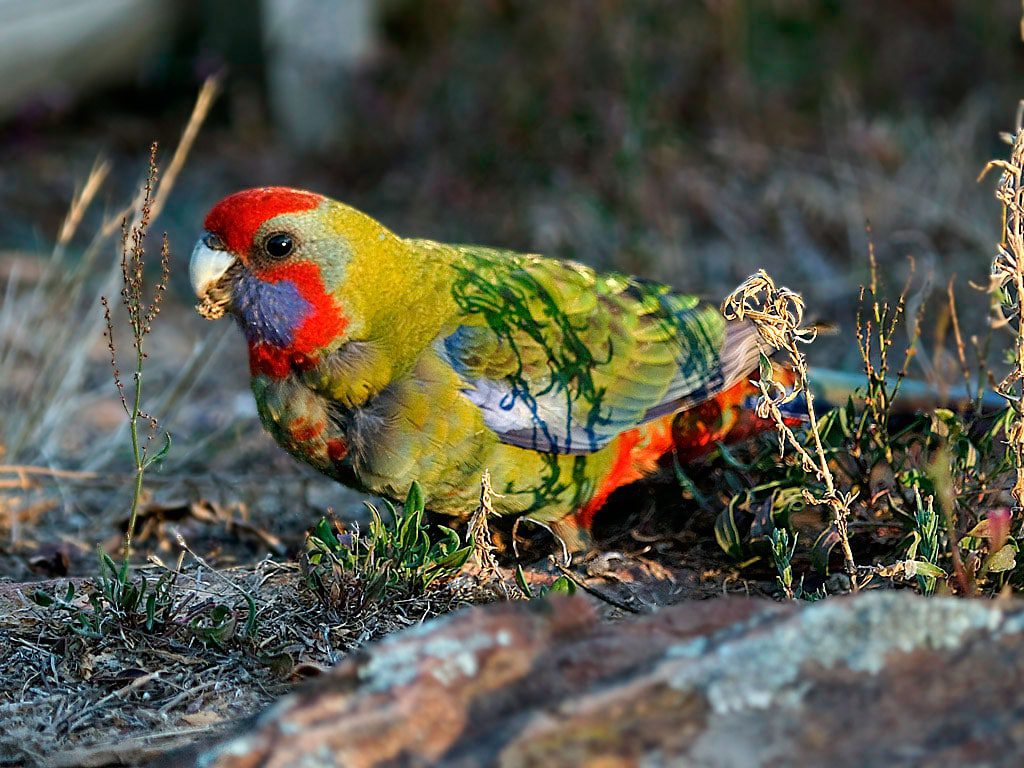
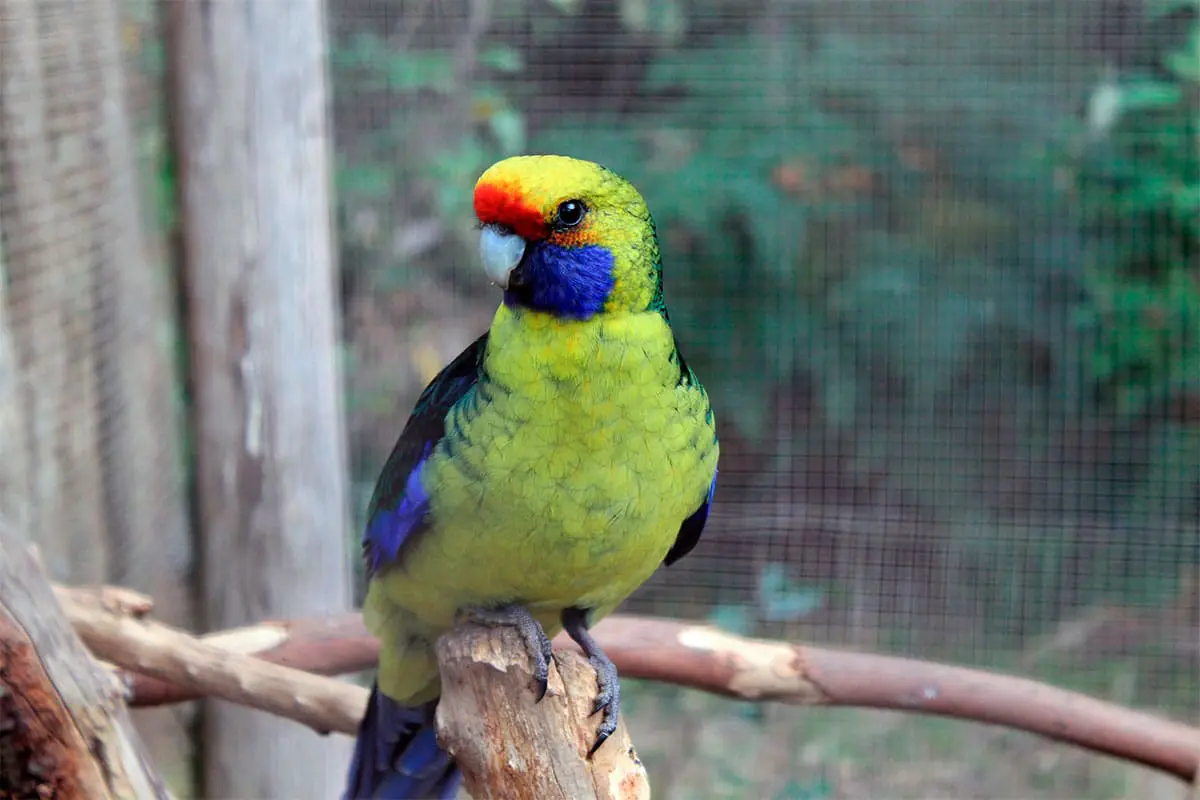
The Green Rosella (Platycercus caledonicus) has the forecrown and lores bright red; a crown of a showy color yellow, marked in red and dotted with of Brown olive dark towards the part rear; area low of them cheeks and throat of color blue cake; ear-coverts a bright yellow, with the edges more dark. Strong contrast between the yellow and the dark area of the crown; Brown olive uniform in the the mantle, with fine dark green stripes on their feathers; feathers of the rump and uppertail-coverts have a diffusion of color yellow orange.

Curve of the wing blue; lesser coverts black; corbeteras internal Middle, black, lined in green dark, the light blue external; greater coverts Blue with feathers Interior black finished off with edges of color green; secondaries Blackish with vane blue externals (innermost with green edge); primaries Brown dark with vane external and dark blue margins; tertiary Brown dark with stripes Green.
Under, the wings blackish, with coverts and axillary blue.

The underparts is of color yellow with a tone clear of Orange and with small spots of color orange on the periphery of the area anal. Upper, the tail olive-green tipped off blue, lateral feathers of color blue pale with them tips white; undertail, the tail of color blue pale with them tips white.

Bill White grey; irises dark brown; legs grey.

The female It is smaller than the male and has the bill smaller; also shows more often a wash of orange-red in the upper part of the chest.

The immature they are more muted than adults, show more green in wing-coverts and have them upperparts of color grey olive and yellow olive in them underparts. Plumage adult is reached after the first comprehensive molt, in a few 15 months.

Subspecies description:

  • Platycercus caledonicus caledonicus

    (Gmelin, JF, 1788) – The species nominal


  • Platycercus caledonicus brownii

    (Kuhl, 1820) – Too little differentiated with the species nominal, according to some experts, to justify the recognition as subspecies.

Habitat:

The Green Rosella they are in all types of forest habitats in the territory in which they reside. But, more and more often, they come in orchards and gardens in urban areas, finding favorable conditions in those places to nest and feed themselves. But, its main habitat are still sclerophyllous forests and thickets. Apparently, on Hunter island, they have a strong preference for small ravines filled with piles of rocks.

Like most of the island birds that live in a small area, to the Green Rosella It is cataloged as sedentary. But, the specimens that live in altitudes of up to 1500 meters in the Alpine regions, they make altitudinal movements and approaching at low altitude towards the coastal regions in winter season. At the end of the nesting season, young birds roam in small flocks which do not exceed more of 4 or 5 individuals. The Green Rosella be associated at times with them Eastern Rosella (Platycercus eximius). Although they are not shy, These parrots take precautions and are very cautious When venturing to Earth to find their food. They prefer to stay in the foliage for this activity. Like most of the parrots, the female is attached to your partner by strong ties conjugal it last for many years. They maintain and strengthen these links practicing processions which are very similar to the one of other parrots.

Reproduction:

The Green Rosella nest during the period from September to February. The nest It is usually placed in a cavity of any branch or hollow tree trunk, normally a eucalyptus. They also occupy, exceptionally, the walls of old buildings. They use abandoned nests of sparrows into disuse.

The spawning usually contains between 4 and 6 eggs and your incubation takes a few 19 days. The chicks are altricial and leave the nest only after 3 weeks after hatching. No additional information on the care and development of the offspring.

Food:

The Green Rosella they eat mainly eucalyptus seeds, Mirto, acacia, ragwort large aromatic flowers, canaigre, Solanaceae (Solanum) and pimelea. Most flowers are toxic to pets.

These parakeets also eat many types of seeds of grasses and shrubs, some of which are at higher altitudes.

Do not disdain the berries of coprosma and the Hawthorn, they represent an important part of their diet in winter. The menu is sometimes supplemented with psyllids they are small homoptera and insect larvae .

Distribution:

Size of the area of distribution (reproduction / resident): 68.100 km2

The Green Rosella they are endemic in Tasmania. Also found in the larger islands of the Bass Strait, that is to say, on isla King and Flinders island. Has also been recorded in the Maatsuyker island, front South of Tasmania.

Birds coming from leaks can be found around Sydney.

The species is common and widespread within its range, with a stable world population of more than 50.000 specimens.

One small number in captivity.

The Green Rosella is protected, but it can be killed with a permit when they cause damage to crops.

The population living in the North of Tasmania It is sometimes differentiated under the name brownii, but this so-called subspecies differences are not as marked enough to consider it as such.

Destribuciรณn subespecies:

  • Platycercus caledonicus caledonicus

    (Gmelin, JF, 1788) – The nominal species

  • Platycercus caledonicus brownii

    (Kuhl, 1820) – isla King.

Conservation:


minor concern


โ€ข Current category of the Red List of the UICN: Least concern

โ€ข Population Trend: Decreasing

The size of the world population It has not been quantified, Although estimated at more of 50.000 specimens. The species according to sources, it is common throughout its small range (pit et to the. 1997).

The population is suspected that it may be declining due to the habitat destruction in course of King Island (pit et to the. 1997).

The Green Rosella It may cause damage to the apple orchards and, Although protected, It can be controlled under a system of licensing.

"Green Rosella" in captivity:

It is not a popular Aviary bird, possibly due to its lack of color and its aggressive reputation.

Alternative names:

Green Rosella, Caledonia Parrot, Green Parrot, Mountain Parrot, Tasmanian Rosella, Yellow-bellied Parakeet, Yellow-bellied Parrot, Yellow-breasted Parakeet, Yellow-breasted Parrot (ingles).
Perruche ร  ventre jaune (French).
Gelbbauchsittich (German).
Rosela-da-caledรดnia (Portuguese).
Perico de Tasmania, Rosela Verde (espaรฑol).

scientific classification:

Order: Psittaciformes
Family: Psittaculidae
Genus: Platycercus
Scientific name: Platycercus caledonicus
Citation: (Gmelin, JF, 1788)
Protonimo: Psittacus caledonicus

ยซTasmanian parakeetยป images:

Videos "Green Rosella"

————————————————————————————————

"Tasmanian parakeet" (Platycercus caledonicus)


Sources:

Avibase
– Parrots of the World โ€“ Forshaw Joseph M
– Parrots A Guide to the Parrots of the World – Tony Juniper & Mike Parr
– Birdlife

Photos:

(1) – A Green Rosella at Tasmanian Devil Conservation Park, Tarana, Tasmania By rockmasterp (Beautiful ParrotUploaded by snowmanradio) [CC BY-SA 2.0], via Wikimedia Commons
(2) – Green Rosella (also known as Tasmanian Rosella) in Tasmania, Australia By Sammy Sam (Picasa Web Albums) [CC BY-SA 3.0], via Wikimedia Commons
(3) – Green Rosella (also known as Tasmanian Rosella) in Tasmania, Australia By Sammy Sam (Picasa Web Albums) [CC BY-SA 3.0], via Wikimedia Commons
(4) – Green Rosella (Platycercus caledonicus), Collinsvale, Tasmania, Australia By JJ Harrison (jjharrison89@facebook.com) (Own work) [CC BY-SA 3.0], via Wikimedia Commons
(5) – Green Rosella (also known as Tasmanian Rosella) in Tasmania, Australia By Sammy Sam (Picasa Web Albums) [CC BY-SA 3.0], via Wikimedia Commons

Sounds: Marc Anderson (Xeno-canto)
โ–ท The world of Pets: Dogs, cats, birds, reptiles, amphibians

Crimson Rosella
Platycercus elegans

Crimson Rosella

Content


Anatomy-parrots

Description

Among 30 and 37 cm.. length and a weight between 99 and 170 g..

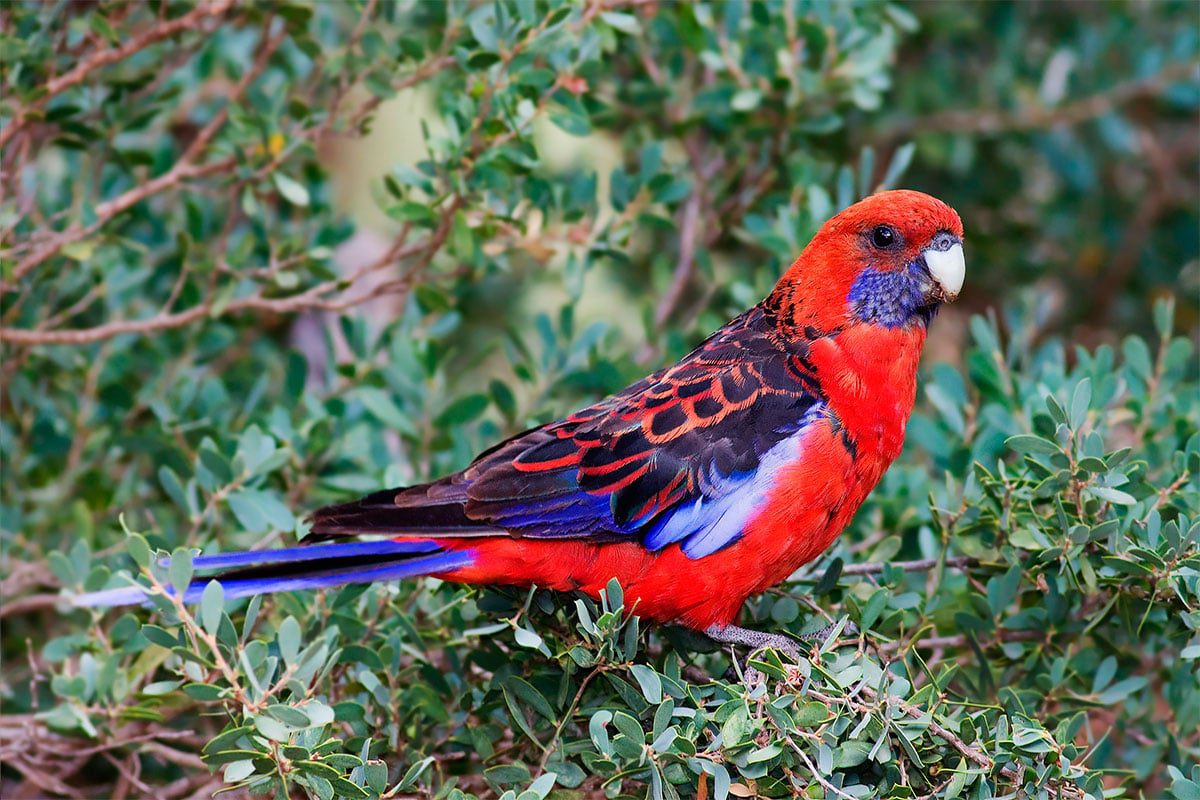
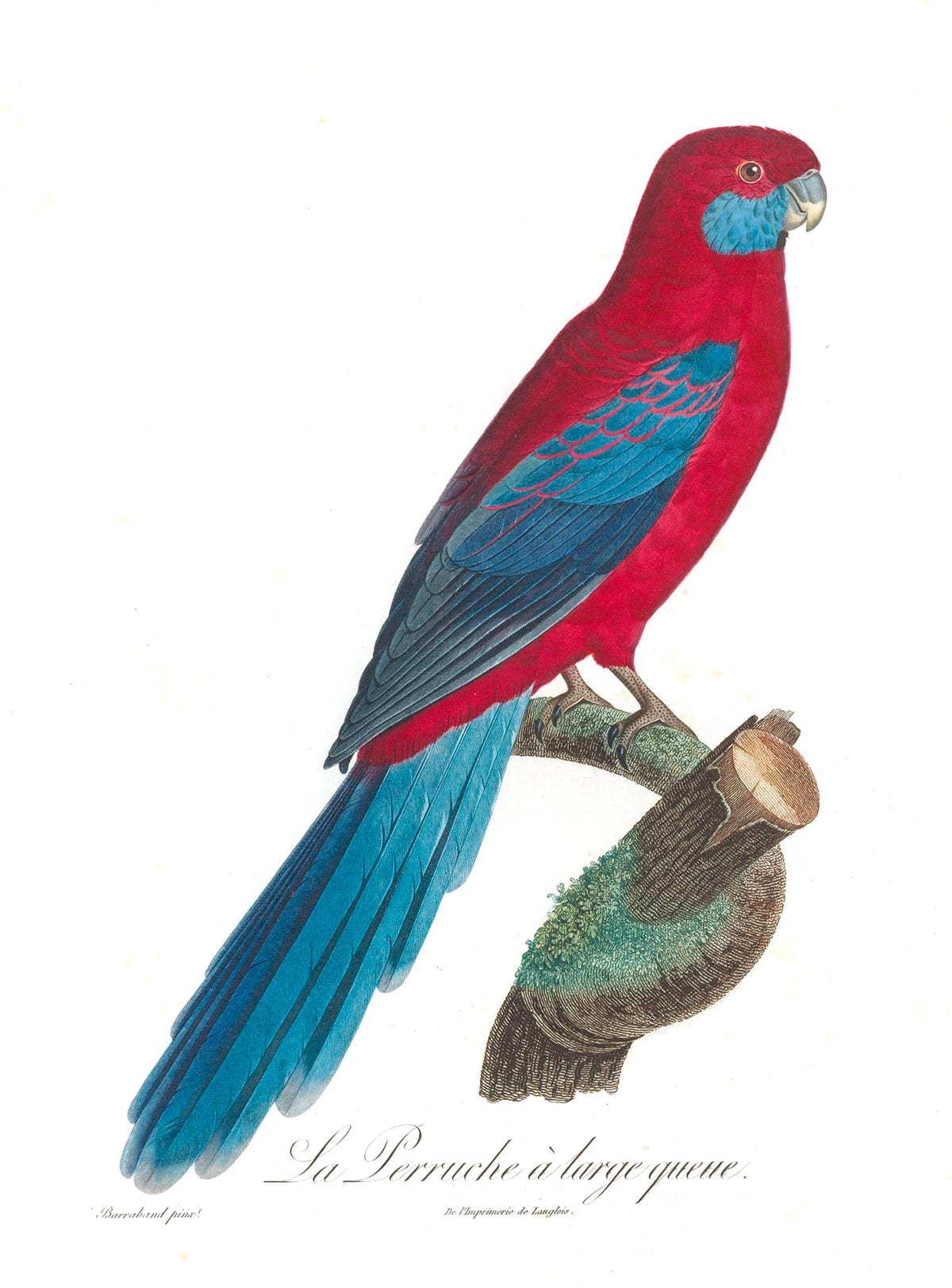
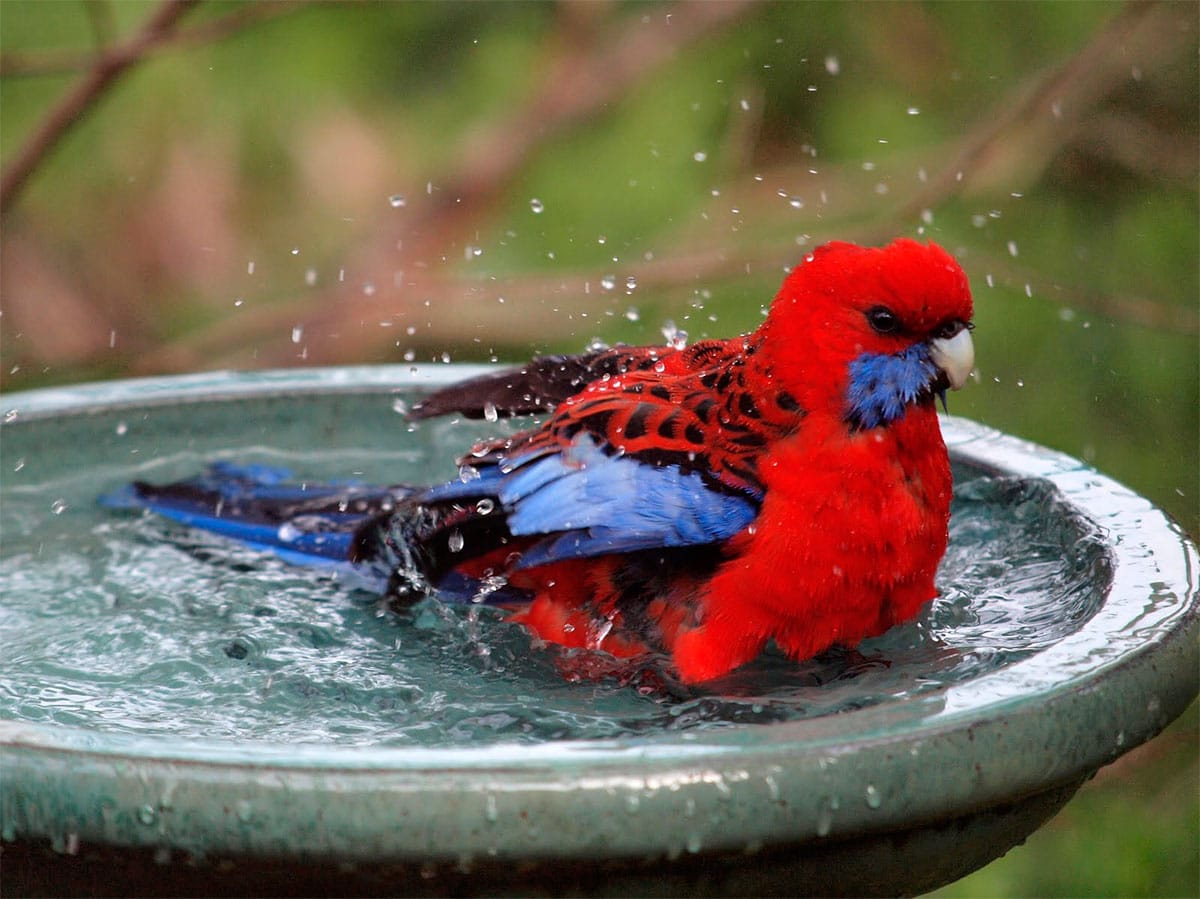
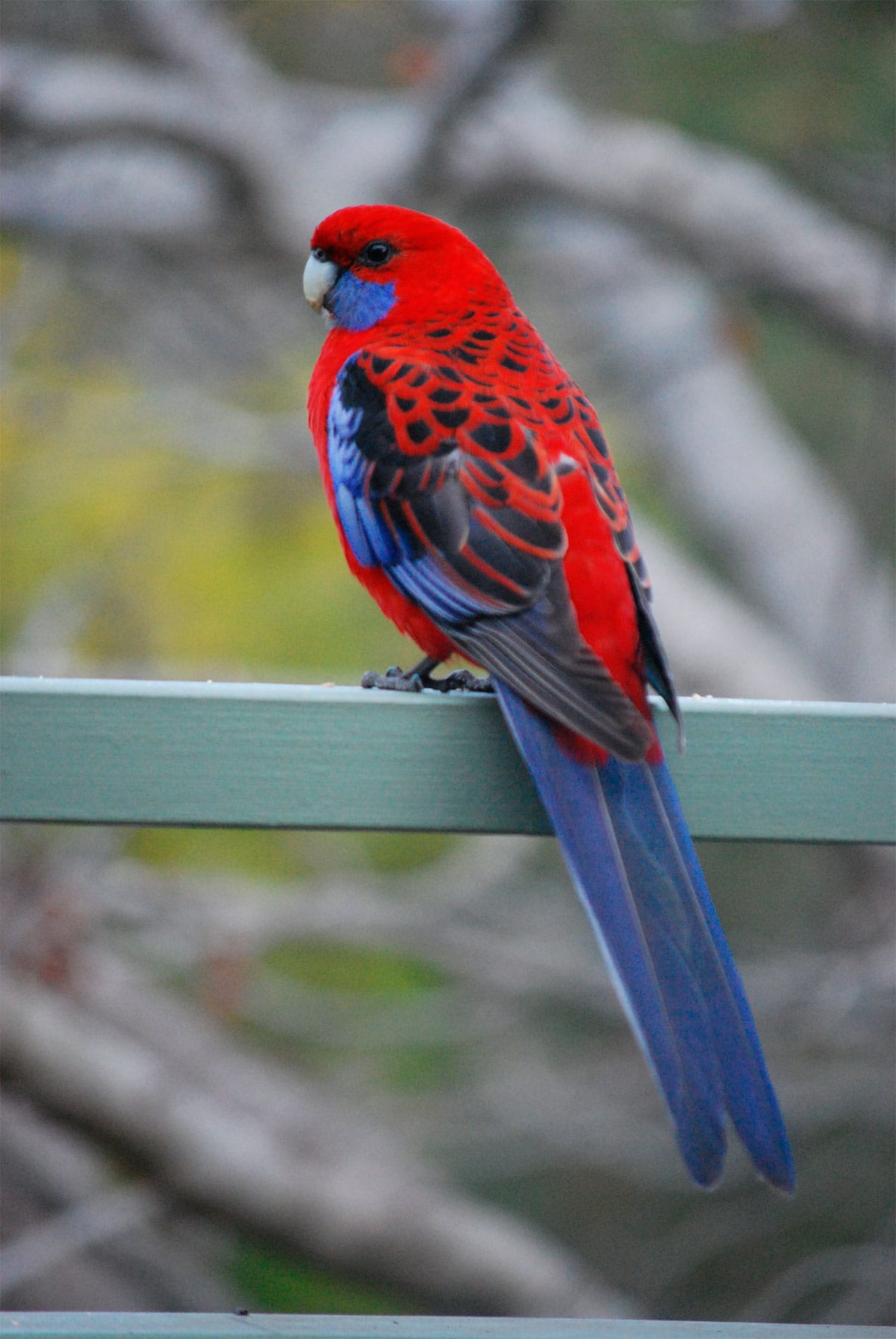
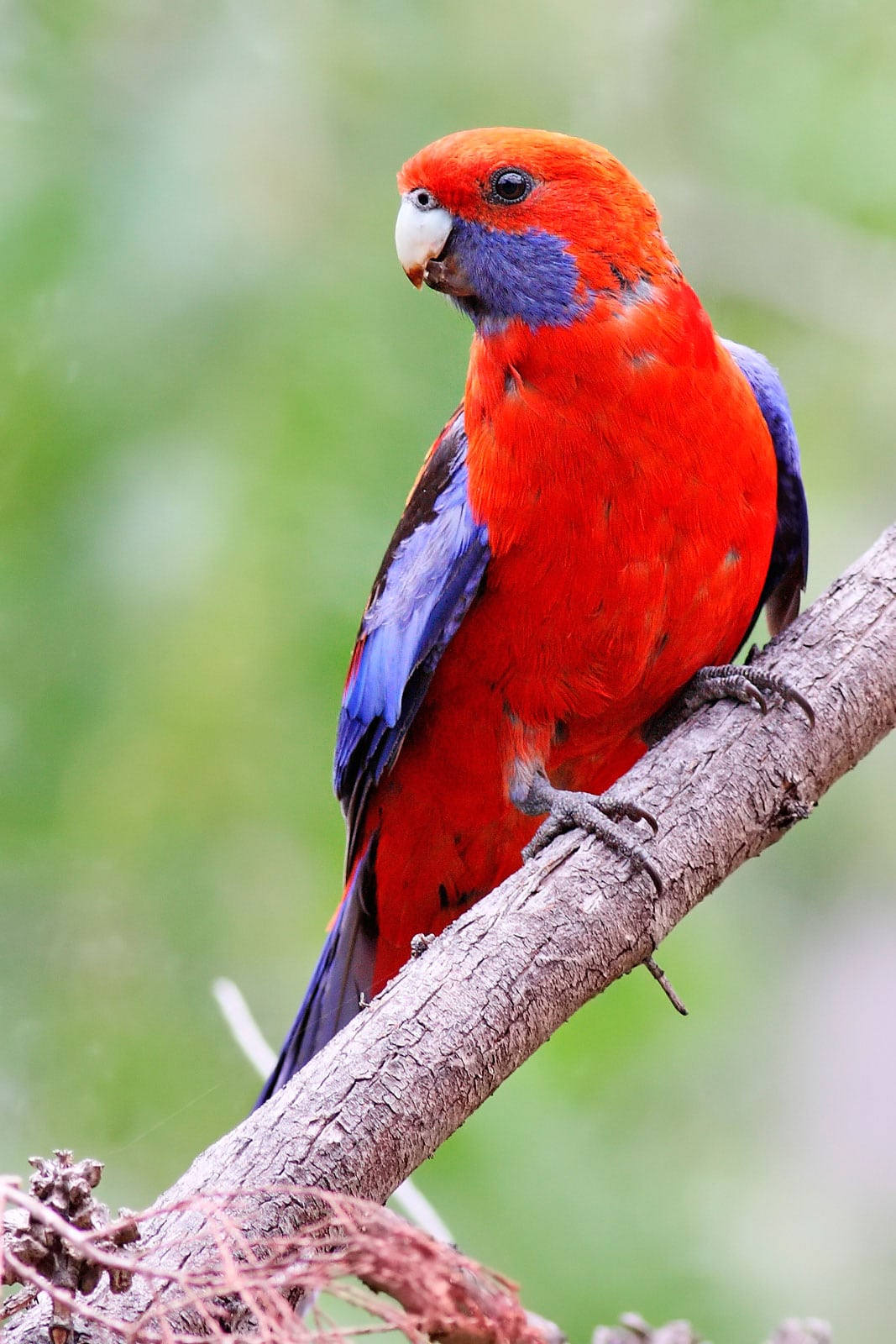
The Crimson Rosella (Platycercus elegans) has a predominantly red plumage.

Its head is bright crimson in color with the lower part of the cheeks and the throat of blue color.. Mantle feathers are black with broad crimson margins of variable intensity.; rump and uppertail coverts crimson.

Medium and lower inner wing coverts black; bend of wing, lesser coverts and medium blue color external; external greater coverts bright blue, Black Interior with red edges giving a scaly appearance to this area; primary coverts blue violet; feathers of flying blackish with thin margin foreign white in them more external and blue violet in vane outer; secondary black with vane external blue violet; tertiary black with red borders.

Under, Blackish wings with blue coats. Underparts showy crimson.

Upper, the tail is blue, the center of green-washed, Foreign feathers with vane Blackish internal and vane Violet Blue outer with pale at both ends; undertail, the tail of pale blue edged blackish when closed.

The peak of grayish-white; dark brown irises; greyish Brown legs.

The female It is smaller with narrower peak. It has no stripe under the wings..

The immature is very different, with upper parts olive green (including the tail at the top), and green underparts greyish.
The centers to the mantle feathers are dark brown, and the black markings of the wings of the adult are replaced by green. Very young birds rump is green Orange. There is a pale stripe on the bottom of the wings (formed by stains pale in vane inner). It shows red feathers on the head, chest, buttocks and subcaudales coverts and move through the first fall.

Adult plumage is reached in a few 15 months. Immatures of the population in the North are mainly red, and there are less green unripe in Norfolk Island than mainland populations.

Subspecies

Description subspecies Platycercus elegans
  • Platycercus elegans elegans

    (Gmelin, 1788) – The nominal species


  • Platycercus elegans flaveolus

    (Gould, 1837) – With 33 cm.. length, approximately, It is but little that the nominal species, Yellow has no orange hue and there is orange in the neck, chest and abdomen.


  • Platycercus elegans fleurieuensis

    (Ashby, 1917) – IMG – It differs from the species rated as having an intense orange color, Red plumage, the mantle and black gray back, with pale orange-red spots; pale blue medium and secondary wing coverts.


  • Platycercus elegans melanopterus

    (North, 1906) – Of 36 cm.. length, approximately. The bordered red are more narrow, with which the back looks more black. Female as the nominal.


  • Platycercus elegans nigrescens

    (Ramsay,EP, 1888) – With 34 cm.. length, It is smaller than the nominal value and the color red is much more dark. Red feathers are more narrow. Female as the nominal.


  • Platycercus elegans subadelaidae

    (Mathews, 1912) – Approximately from 36 cm.. length. Instead of Red Blend Red, Orange and yellow. Orange red forehead, the Crown and face, they turned to brighter red frontal band. Yellow olive from the low back to the supracaudales coverts

Habitat:

Crimson Rosella

The Crimson Rosella they frequent tropical and humid subtropical forests near the coast and the surroundings of montane forests at altitudes up to 1.900 m.

They are mainly on the edges of jungle, in the secondary zones and in the dense forests of eucalyptus they arrive at a good stage of maturity.

To the South of the hunter river in New South Wales, they are distributed at all altitudes.

The nominal species has a preference for thick wooded areas, but often goes into open areas and farmland where it is mixed with the Perico conr (Platycercus eximius).

It also tends to visit plots of pine trees.

In the Kangaroo Island, where is the only parakeet present, He lives in all types of forest habitats, they are also adapting to farmland.

The subspecies subadelaidae and fleurieuensis, sometimes grouped under the term Adelaide parakeet, frequent valleys forest, arboreal galleries that border the rivers or trees on the edge of the roads. They are also present in the orchards and farmland.

The Flaveolus subspecies attends the same types of habitat, that is to say, curtains of trees dominated by red rubber trees along the river.

To feed, move away from rivers and raid agricultural land, flooded Plains, or thickets ยซMalleeยซ.

Adults are sedentary. Usually, they live in pairs or in small groups. On the other hand, juveniles and subadults form noisy groups and many roam locally when leaving dormitory at sunrise.

Its main activity is carried out in the morning and in the evening. in the middle of the day, they rest in the shady foliage. But, If the sky is overcast and the weather is cool, these birds are active during the day.

The Crimson Rosella they seek food on Earth, in trees and shrubs. They often feed in the company of the Eastern Rosella (Platycercus eximius), But if the joint working group is altered during its activity, the two species are separated in flight and taken opposite directions, each seeking refuge by his side.

The Crimson Rosella they are not very shy and can be approached at a very short distance.
In urban areas, they are particularly friendly.

Reproduction:

The breeding season covers the months of August to February and, sometimes even later.

The elegant parakeet build their nests on a branch or in the cavity of a tree trunk. Usually, Choose a healthy or dead eucalyptus, but sometimes they install their nests in a place as strange as the metal beam of a construction crane.

In all cases, the nest is located high above the ground. Spawning usually includes 4 to 7 white eggs, rarely 8, which are incubated during approximately 19 days.

The female incubates the eggs alone, but the chicks receive equal attention from both parents.

The nesting cycle is quite long and it takes around 5 weeks

Food:

The Crimson Rosella they have a mainly vegetarian mixed diet. Consume the seeds of black Cypress of Australia (Callitris endlicheri), figs, seeds of acacia and eucalyptus.

The vegetable part of its menu is complemented by a wide variety of imported plants such as Rosa rubiginosa, clover or chickweed (Stellaria media).

In the South of its range, they eat the fruits or flowers trees of Melaleuca, banksia and casuarina.

Insects are not forgotten in your menu: Hemiptera, psyllids, termites, aphids and larvae of beetles.

These parrots times behave as true pests in orchards, eating apples, Plums, pears and quinces.

Distribution:

Confined to the coastal area of Eastern Australia where are widely distributed in the wooded areas along and East of the Great dividing range.

There is an isolated population in the North between the surrounding of Atherton, Northeast of Queensland, to the South of the mountain range of Clarke and Eungella (the population in Eungella It can also be isolated).

The main population is distributed around Gympie, Southeast of Queensland, in the North, across the border with New South Wales, coming up to the Warrumbungle National Park, Bathurst and Wagga Wagga, where are approaching the eastern end where the Yellow Rosella.

In Victoria extends from the East to the Grampian and the Edenhope district, where spills into the Southeast end of Australia, coming to Kingston at its western end.

There is also an isolated population in the Kangaroo Island.

The species is found in the wild around Sydney, Brisbane and Melbourne, and leaks from birds have been around Perth. There are records in the North of Tasmania and the islands of the bass strait, probably, also refer to birds Getaways.

It is common in the Norfolk Island where it was introduced in the century 19, but is absent in the vicinity of Nepean and Philip Island; an attempt to introduce the species in Lord Howe Island failed.

Was also introduced in New Zealand, showing in the West suburbs of Wellington, and some birds can also persist in the District of Dunedin of South Island where can hybridize with the introduced Perico conr.

The world's population is above 200.000. Moderate numbers in captivity.
The birds can be eradicated with a permit in States where the destruction of crops occurs.

Subspecies

Distribution subspecies Platycercus elegans

Conservation:


minor concern


โ€ข Current category of the Red List of the UICN: Least concern

โ€ข Population Trend: Decreasing

The size of the world's population has not been quantified, Although it is estimated above 200.000 specimens.

The Crimson Rosella they are infrequent at both ends of its distribution area, but in other places, they are locally abundant and common.
In the North, they are slightly less numerous. In the past recent, they have colonized successfully parks and urban gardens, so now are very widespread in the suburbs of Canberra and Adelaide.
In the Norfolk Island, the import is so successful that they now represent a competition and a significant danger to the Red-crowned parakeet (Cyanoramphus novaezelandiae).

"Crimson Rosella" in captivity:

Moderately loud, very active, they are acclimatized to the owner. It is not usually compatible with other birds.
A sample of the subspecies subadelaidae lived 26,8 years in captivity
Rare in captivity.

Alternative names:

Crimson Rosella, Adelaide Parakeet, Beautiful Lory, Blue-cheeked Rosella, Campbell Parakeet, Crimson Rosella (Crimson), Mountain Lowry, Murray Rosella, Murray Smoker, Murrumbidgee Lowry, Murrumbidgee Rosella, Pennant’s Parakeet, Pennant’s Rosella, Red Lory, Red Lowry, Red Parrot, Swamp Lory, Yellow Parakeet, Yellow Parrot (ingles).
Perruche de Pennant (French).
Pennantsittich, Adelaidesittich, Pennant-Sittich (German).
Rosela-Pennant (Portuguese).
Perico Elegante, Rosela Roja, Periquito Pennant, Rosella Carmesรญ (espaรฑol).

scientific classification:

Order: Psittaciformes
Family: Psittaculidae
Genus: Platycercus
Scientific name: Platycercus elegans
Citation: (Gmelin, JF, 1788)
Protonimo: Psittacus elegans

"Elegant Perico" images:

Videos "Crimson Rosella"

Crimson Rosella (Platycercus elegans)

Sources:

  • Avibase
  • Parrots of the World โ€“ Forshaw Joseph M
  • Parrots A Guide to the Parrots of the World – Tony Juniper & Mike Parr
  • Wikipedia
  • Loromania
  • Birdlife
  • AnAge: The Animal Ageing and Longevity Database – Anagรฉ Database

  • Photos:

(1) – An adult Crimson Rosella (Platycercus elegans), Wilsons Promontory National Park, Victoria, Australia By JJ Harrison (jjharrison89@facebook.com) (Own work) [CC BY-SA 3.0], via Wikimedia Commons
(2) – A Crimson Rosella photographed though a window in the Blue Mountains, Australia By John Poulakis from Australia (Crimson RosellaUploaded by Snowmanradio) [CC BY 2.0], via Wikimedia Commons
(3) – Crimson Rosella (Platycercus elegans) photographed taken in Swifts Creek, Victoria, Australia Fir0002 [GFDL, CC-BY-SA-3.0 or GFDL 1.2], via Wikimedia Commons
(4) – A Crimson Rosella in a bird bath Canberra, Australia By Duncan McCaskill (Picasa Web Albums) [CC BY 3.0], via Wikimedia Commons
(5) – Juvenile Crimson Rosella (Platycercus elegans) by David CookFlickr
(6) – An adult Crimson Rosella (Platycercus elegans) Jacques Barraband [Public domain], via Wikimedia Commons

โ–ท The world of Pets: Dogs, cats, birds, reptiles, amphibians

Eastern Rosella
Platycercus eximius


Eastern Rosella

Content


Anatomy-parrots

Description

30 cm.. length between 95 and 120 g. of weight.

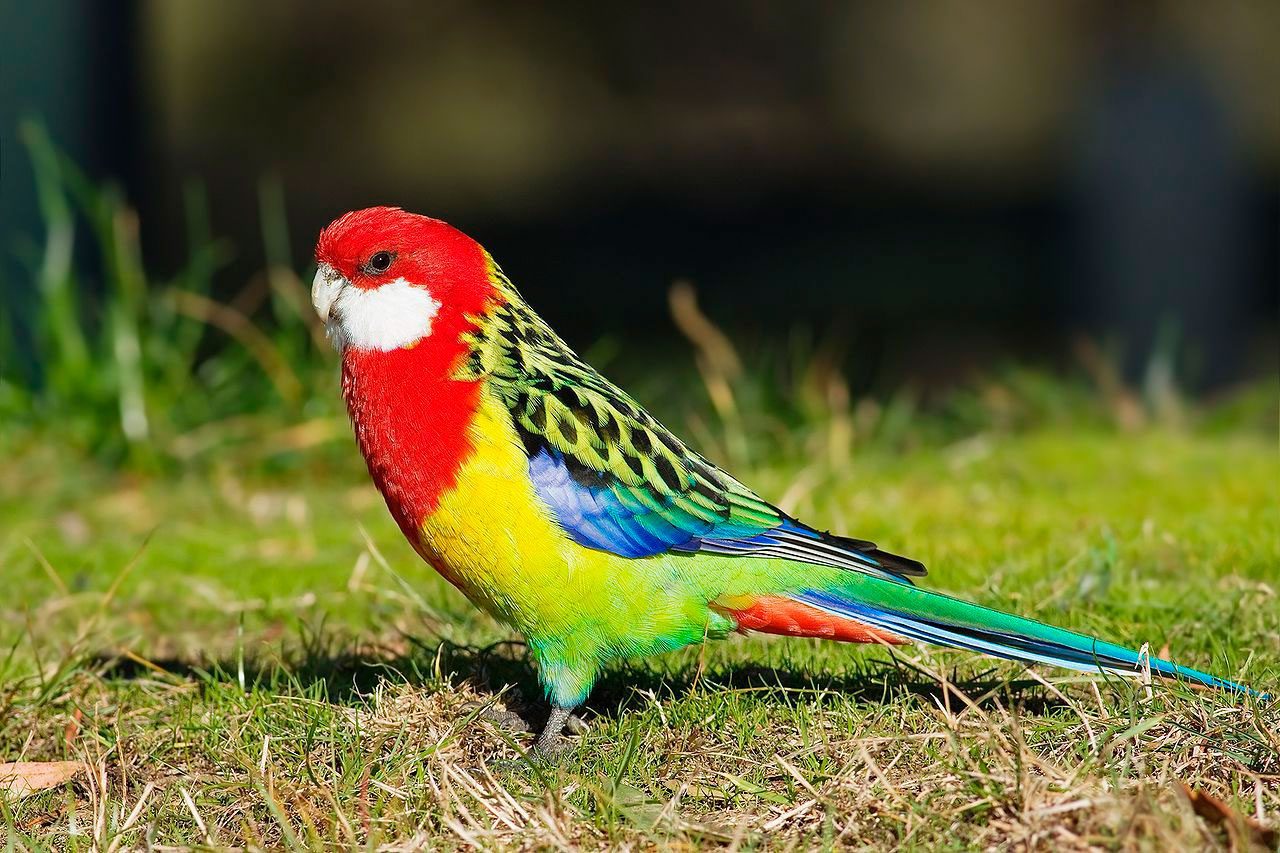
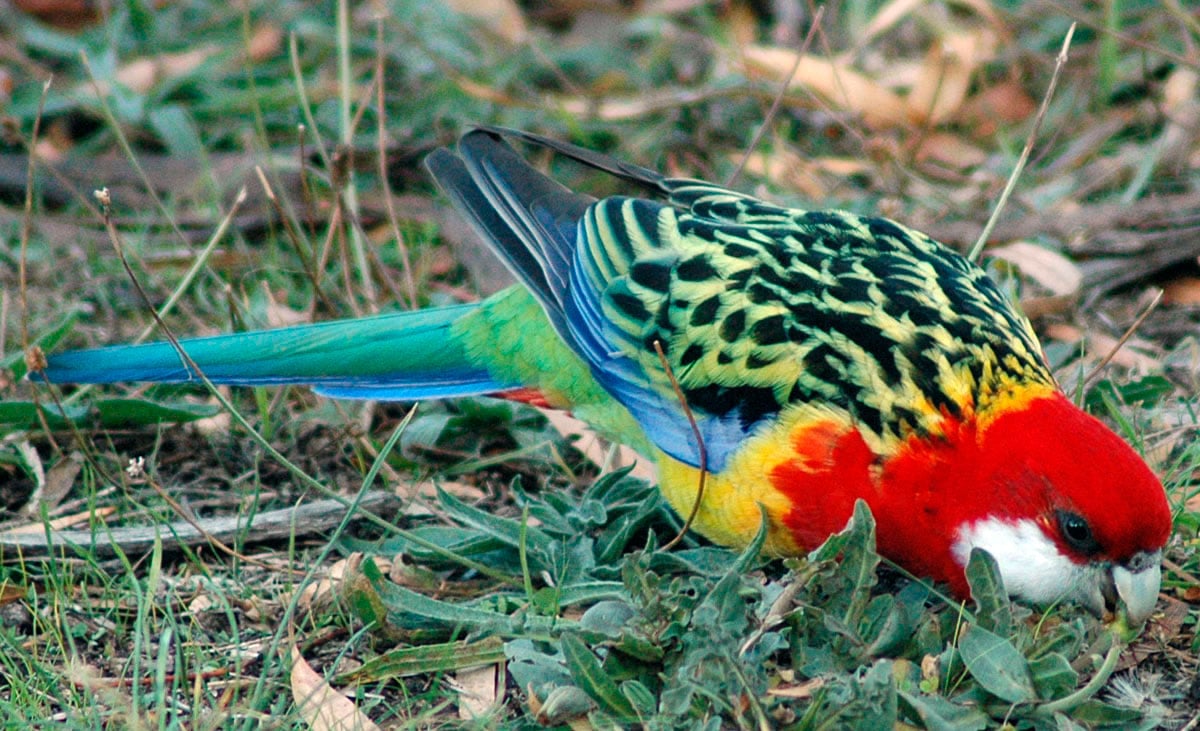
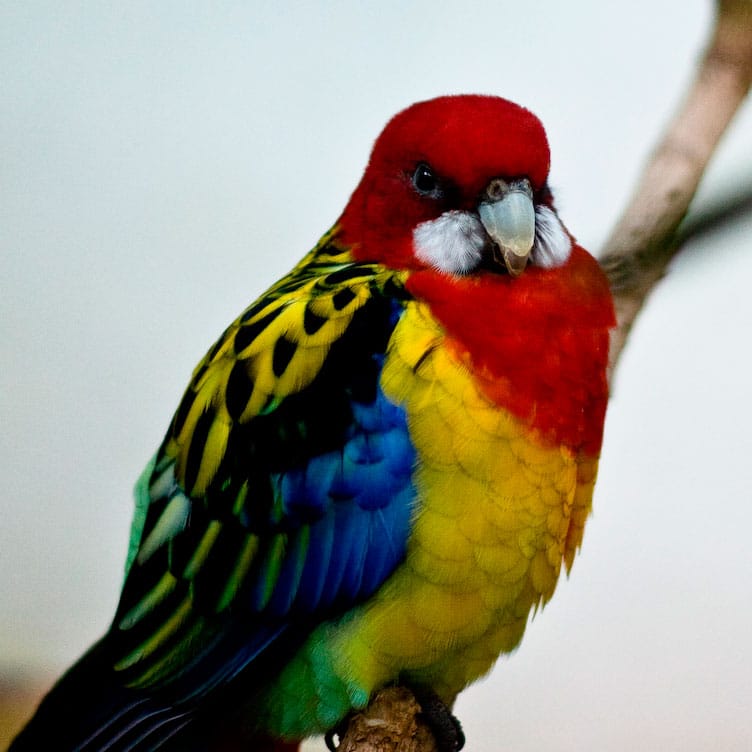
The males of the Eastern Rosella (Platycercus eximius), has bill white. The lower area of the cheeks and chin are white, that contrasts sharply with the rest of the head and the chest that are of color red glossy. Upper abdomen shows a beautiful color yellow that is again gradually of color green pale in its part lower. The coats are of color red. The the mantle feathers, the back and scapulars are of color black with a broad edge yellow, giving these regions a highly scaled appearance. The median are black. The blankets, out of them coverts secondary and flight feather are bluish grey. The rump is bright green. The central feathers of the tail are green bottle, While the outer feathers of the tail are bluish grey with white tips.

The irises They are brown, legs grey.

The female looks like your partner, but the Red of the head and the chest is less bright.

The underparts has a thin white stripe.

The youth they are a copy in Pale tones of the female. They have a little bit of green on the back of the head.

Subspecies description:

  • Platycercus eximius diemenensis

    (North 1911) – Of 30 cm.. length. Head and chest color much more dark and white cheek much more large. Female as the nominal species.


  • Platycercus eximius elecica

    (Schodde & Short 1989) – Of 33 cm.. length. It is something more than the nominal species, the red and the chest and the head is slightly more dark, the black feathers of the neck, back and shoulders have a very broad bright yellow bordered. Area of the rump and coverts bluish-green supracaduales. Female with back and neck with hints. Your obispillo is bluish green


  • Platycercus eximius eximius

    (Shaw 1792) – The nominal.

Habitat:

The Eastern Rosella they tend to be fairly common in all habitats of open forests, including agricultural land, urban parks and gardens. They are usually in little populated wooded areas, rows of trees along streams, shrub and scrub savannahs ยซMalleeยซ.

They are common in cultivated areas and can invade orchards where you can cause severe damage.

In many areas, It is the most widespread species of parrot, You can even nest in the trees lining the streets of towns and cities. Wherever possible, they avoid dense forests and mountainous areas, where is replaced by the Crimson Rosella. The habitat of the Eastern Rosella usually less to 1.250 m above sea level.

Breeding pairs are sedentary in their territories, While young and immature form bands of up to 25 birds that roam the area. very commonly, the multicolored parrot can be seen perched on power lines or poles lining the sides of the roads in the outskirts of cities.

On the floor were fed more frequently than other types of rosella Parrot. In flight, they are quite noisy and therefore very easy to detect. But, When they are on the ground, they are not always easy to observe.

They feed on, sometimes, in the company of Red-rumped Parrot (Psephotus haematonotus) but never be with them organized mixed flocks.

Reproduction:

The Eastern Rosella They nest in the months from August to February, but also from time to time in April and may.

Pairs mate for life and is the female which chooses the nest site, usually in a hole or cavity of a eucalyptus branch. Sometimes the place to start may be an old stump, an any fence post, a fallen log, a rabbit hole, the nest of a Rainbow Bee-eater. Optionally, the Eastern Rosella also used the abandoned nest of the Blue-winged Kookaburra, some termite mound, ferns in facades of houses, rock walls, old buildings and an old nest of pomatostome.

The bottom of the nest is filled with sawdust or small wood shavings..

Spawning includes 4-9 eggs (generally 5) which are incubated during 19 days. The female is solely in charge of incubation and her partner is responsible for supplying. The chicks stay lasts a few 35 days.

Food:

The Eastern Rosella has a mainly vegetarian diet. Consumed mainly eucalyptus and acacia seeds, Although also seeds of a variety of greenery bushes. Berries, leaves and sprouts are also part of its menu.

During the summer, eats some insects and their larvae. Take the seeds that are dispersed in fields and roads. It penetrates into the orchards where causes some damage.

Distribution:

The Eastern Rosella lives confined to the southeast of Australia where is spread around Gympie, Bribie Island and the Darling Downs district in the extreme southeast of Queensland, in the South through New South Wales, coming towards the inside of Moree, Parkes, Griffith and There is a, and reaching Victoria where is it absent only in the Northwest region, and West up to Edenhope.

In the southeast of South Australia the species is largely limited to the area between Bordertown and Salt Creek, but a population caused by birds in captivity is also distributed by the Lofty Mountains.

In Tasmania, the species is widespread, Although barely wide and sparsely distributed, and have been faced with the King Island in the bass strait.

There are small introduced populations in the South Island of New Zealand, concentrated around Dunedin (includes some Crimson Rosella mixed with oriental hybrids) and in the Banks Peninsula, and a larger population in the North Island, that extends from the northern end of the island, along the West Coast through Raglan, New Plymouth and the interior of Pirongia and Taupo. They can also be found Eastern Rosella in the districts of Wellington and Lower Hutt, in the Tararua mountains, about Gisborne and along the Coromandel Peninsula, but are rare in the South of Auckland.

The world population is more of 500.000 birds, and stable or increasing.

There is some competition with nesting places with the Common Starling (Sturnus vulgaris) in Tasmania.

Moderate multicolored parrot in captivity.

The species has benefited before the spread of agriculture, and although protected by law, they can be killed under license.

Subspecies distribution:

  • Platycercus eximius diemenensis

    (North 1911) – Own East of Tasmania.


  • Platycercus eximius elecica

    (Schodde & Short 1989) – Present in the northeast of New South Wales and the southeast of Queensland.


  • Platycercus eximius eximius

    (Shaw 1792) – The nominal.

Conservation:


minor concern


โ€ข Current category of the Red List of the UICN: Least concern

โ€ข Population Trend: Growing

The size of the world's population has not been quantified, Although it is estimated above 500.000 birds.

Throughout its distribution area, except Tasmania, the Eastern Rosella East are very common birds. Unlike in the Crimson Rosella, that like dense forests, the Eastern Rosella they have benefited from deforestation that took place for the establishment of new pastures or areas of cereals.

"Eastern Rosella" in captivity:

Very common in captivity, It is probably the most popular of the Rosellas.

The Eastern Rosella they are coveted because of the beautiful colors of plumage.

They are intelligent birds and can be trained to whistle a large repertoire of melodies., and you can even learn how to pronounce some words.

These parakeets can make good pet birds but require a great deal of care and attention., In addition to devices and toys to keep them mentally stimulated. They are wild birds which are not always adapted to live as a family pet, and even the hand reared parrots are never fully domesticated. They generally do not tolerate caresses or cuddling and tend to react by stinging when you try to handle them like this.. Many breeders believe that the best way to keep this type of bird is in great aviaries where can fly freely, in pairs to meet their social needs and with minimal human interaction. Although they tend to be aggressive with other species Bird by should not be treated so integrate them to mixed aviaries.

Its diet poultry includes seeds, fruits like Apple, PEAR and grape, and vegetables such as lettuce, grass, and silver beet.

A sample of Eastern Rosella lived 27,4 years in captivity. In captivity, these animals have been able to play, approximately, to the 2 years of age..

Alternative names:

Eastern Rosella, White-cheeked Rosella (ingles).
Perruche omnicolore (French).
Rosella, Buntsittich (German).
Rosela-multicolorida (Portuguese).
Perico Multicolor, Rosela Comรบn (espaรฑol).

scientific classification:

Order: Psittaciformes
Family: Psittaculidae
Genus: Platycercus
Scientific name: Platycercus eximius
Citation: (Shaw, 1792)
Protonimo: Psittacus eximius

Images ยซMulticolored Parakeetยป:

Videos "Eastern Rosella"

————————————————————————————————

ยซMulticolored Parakeetยป (Platycercus eximius)


Sources:

Avibase
– Parrots of the World โ€“ Forshaw Joseph M
– Parrots A Guide to the Parrots of the World – Tony Juniper & Mike Parr
Wikipedia
– AnAge: The Animal Ageing and Longevity Database – Anagรฉ entry for Platycercus eximius
– Birdlife

Photos:

(1) – Eastern Rosella (Platycercus eximius), male, Queenโ€™s Domain, Hobart, Tasmania, Australia By JJ Harrison (jjharrison89@facebook.com) (Own work) [CC BY-SA 3.0], via Wikimedia Commons
(2) – Eastern Rosella (Platycercus eximius), female, Queenโ€™s Domain, Hobart, Tasmania, Australia By JJ Harrison (jjharrison89@facebook.com) (Own work) [CC BY-SA 3.0], via Wikimedia Commons
(3) – Eastern Rosella (Platycercus eximius) at Woodland Park Zoo, Seattle, USA By Platycercus_eximius_-Woodland_Park_Zoo-6. jpg: Nickderivative work: Snowmanradio [CC BY 2.0], via Wikimedia Commons
(4) – Eastern Rosella at Hobart Domain, Tasmania (grazing) By KeresH (Own work) [GFDL, CC-BY-SA-3.0 or CC BY-SA 2.5], via Wikimedia Commons
(5) – Eastern Rosella (Platycercus eximius diemenensis), The Queenโ€™s Domain, Hobart, Tasmania, Australia By JJ Harrison (jjharrison89@facebook.com) (Own work) [GFDL 1.2 or CC BY-SA 3.0], via Wikimedia Commons

Sounds: Peter Woodall (Xeno-canto)

โ–ท The world of Pets: Dogs, cats, birds, reptiles, amphibians

Pale-headed Rosella
Platycercus adscitus

Perico pale

Content


Anatomy-parrots

Description

30 cm.. length and a weight between 100 and 175 g..

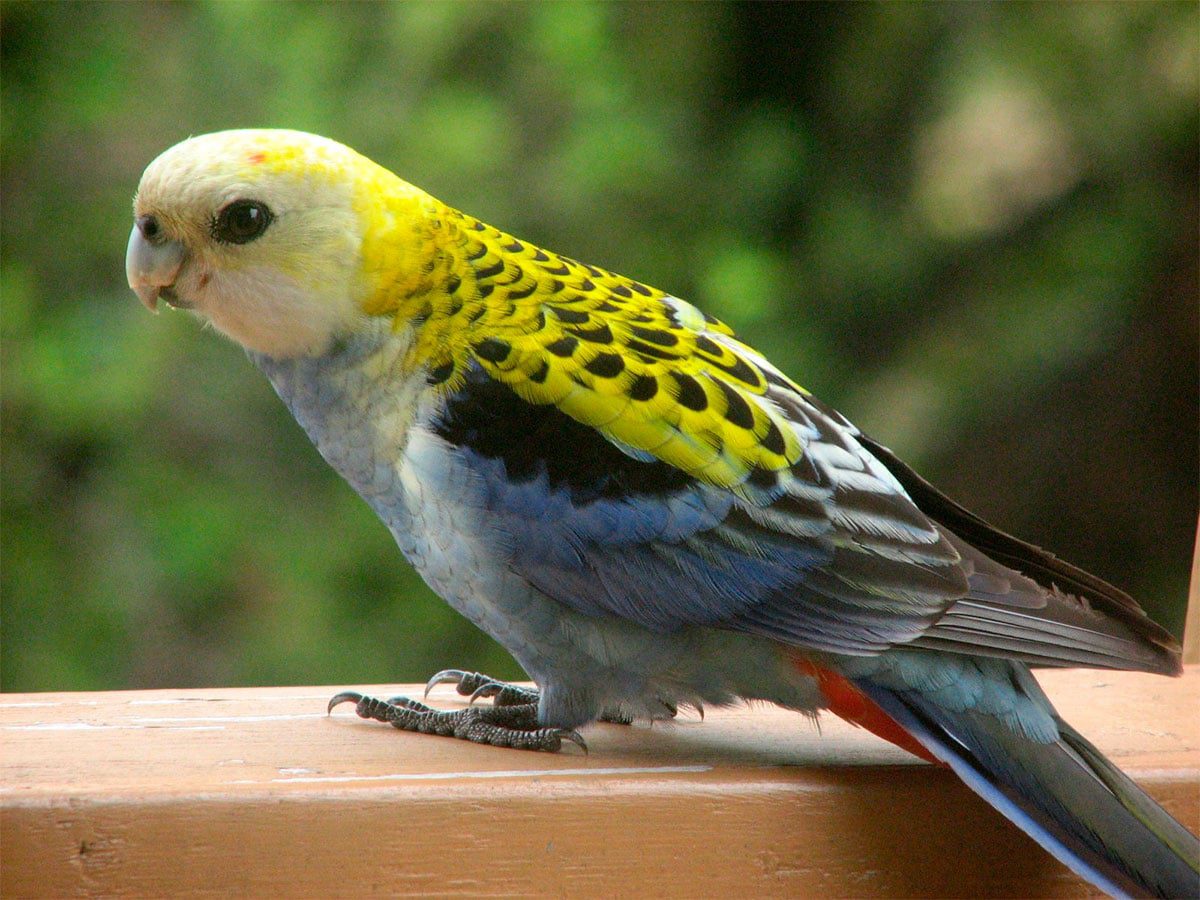
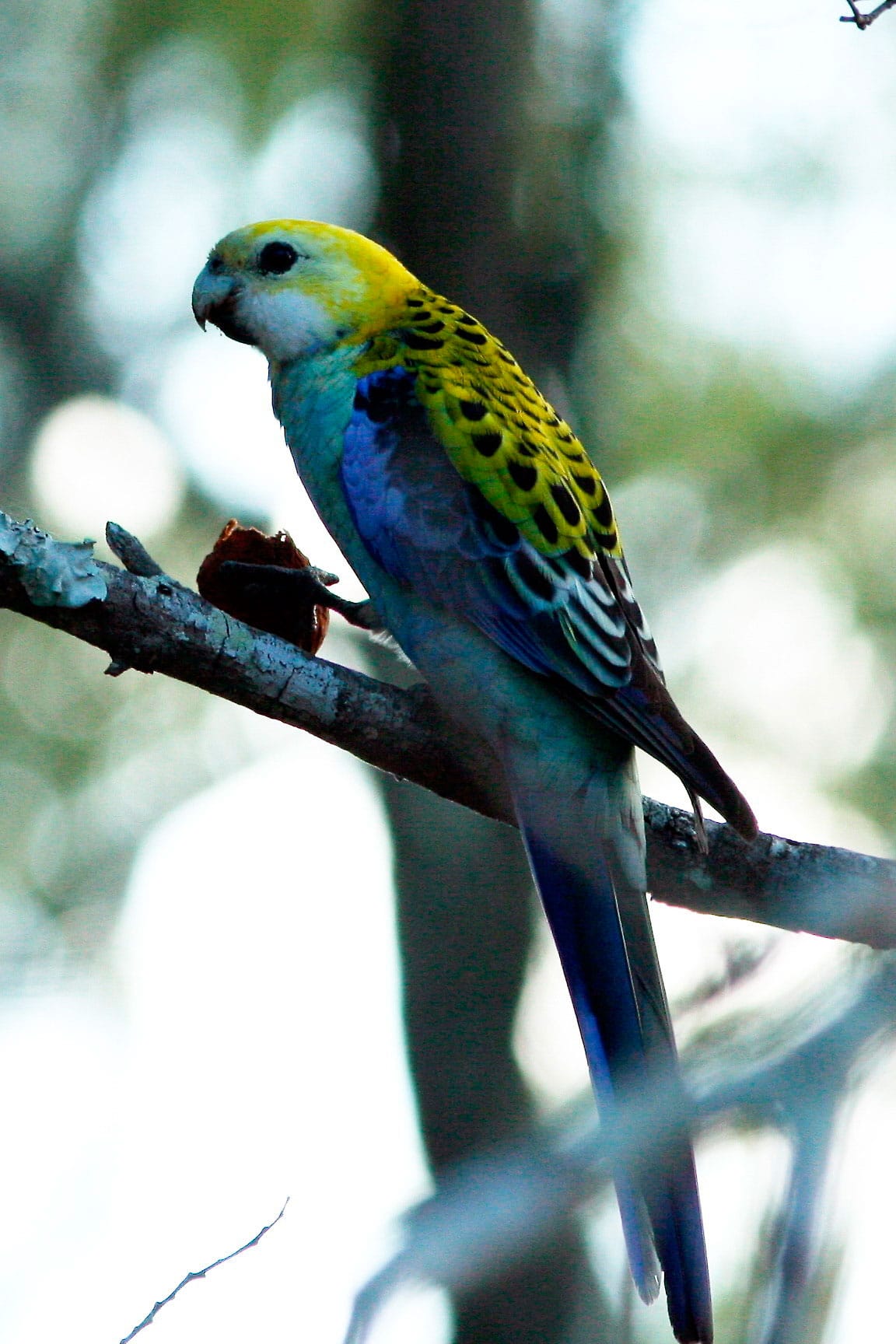
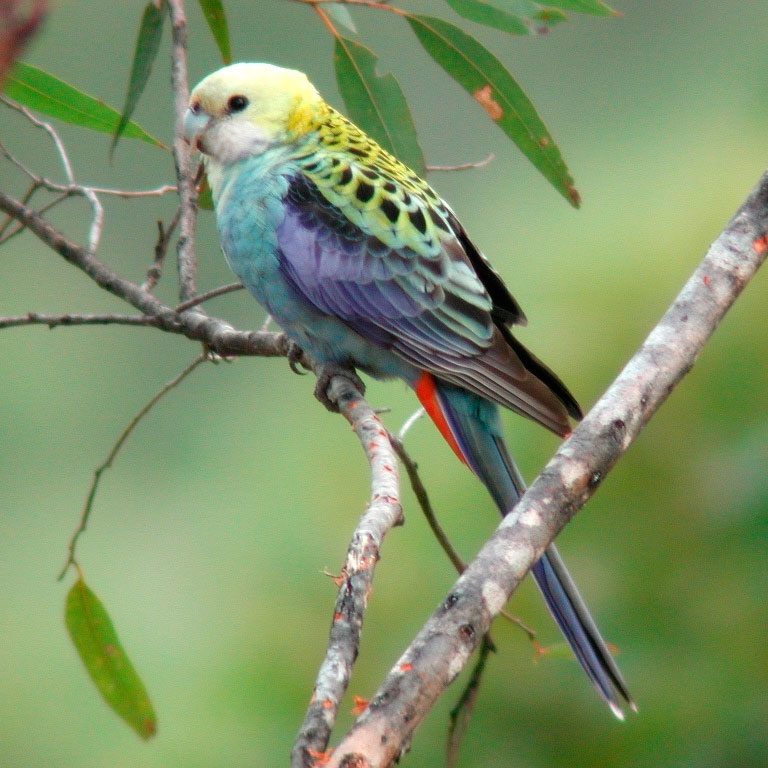
The adult male of the Pale-headed Rosella (Platycercus adscitus), It has a pale yellow "head". The part superior of the cheeks is whitish in contrast with the part below that is of color blue light. Upper chest is yellow, the lower part of the chest and the abdomen are blue. The coverts They show a beautiful red hue. The the mantle, the back and scapulars are black with broad yellow edges, these areas giving a scaly appearance.

The tail is of color yellow uniform. The external coverts are dark blue. The central feathers of the tail are dark blue, but the outer feathers are more pale with thin white edges. The bottom has no stripe.

The bill is white. The irises They are brown, legs grey.

The female is different from the male, its color is more off and has a strip at the bottom of the wings.

The immature they have grayish feathers ending in yellow or orange-red at the top of the crown and the neck. The red feathers lose them about three months. The bottom of the wings is scratched. They acquire adult plumage in about 16 months.

Description 2 subspecies:

  • Platycercus adscitus adscitus

    (Latham 1790) – The nominal


  • Platycercus adscitus palliceps

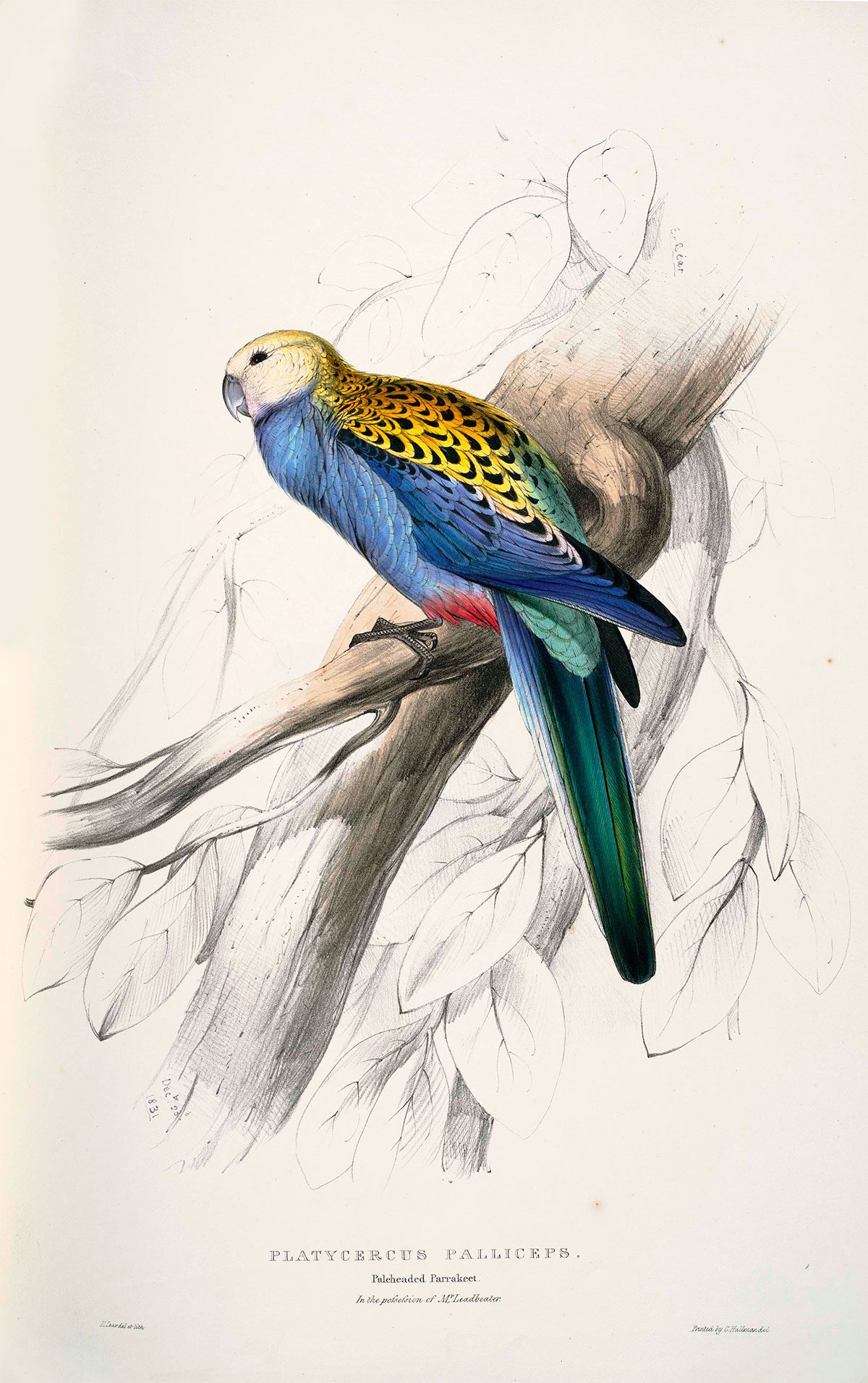
    (Lear 1832) – 32 cm.. length. It is something most large that the nominal species. The white color of the face is more extensive, coming up to the neck. Crown, nape and ear-coverts are pale yellow. The blue of the chest presents tonalities yellowishwhite and the feathers of the chest they have a thin lined black. The shoulders with wide verdosa-amarilla blue staining. bottom of the flight feather white.

Habitat:

Pale-headed Rosella

The Pale-headed Rosella they are common in all types of habitats of open forests, either scrub, scattered forests with logging, the rows of trees along rivers or swamps. They are also found in the wooded heaths which surround the coast and which are dominated by trees of the genus Banksia.

Avoid plunging into the thick forests, giving preference to the clear, meadows at the edges or directly border the plots. They also penetrate the surrounding farmland to feed.

They are birds of the lower regions, rarely rising above 700 meters and voluntarily leaving altitudes to the Crimson Rosella in dense forests and semi-montanosas areas.

Reproduction:

In the North, the Pale-headed Rosella They nest in the months of February to June, with some variations depending on the frequency of rains.

In the South, the breeding season are produced starting from September until the month of December.

These birds build their nests in deep a sick or healthy tree cavity, preferably a eucalyptus located near a river.
Other places that tend to choose are: a hole in a stump or a hole in a fence post.

The spawning generally includes between 3 and 5 eggs. The female incubates alone during 19 days, but as soon as the eggs are incubated, It receives assistance from the male that helps feed the young.

The chicks leave the nest after 5 weeks.

Food:

The Pale-headed Rosella they are mostly vegetarian. They consume a lot of plants, We have identified about 50 plant species. Similar to the Eastern Rosella, the Pale-headed Rosella It feeds mainly in the trees. The seeds of eucalyptus, acacias, Melaleuca, Black Cypress of Australia, acanthus and spiny Thistles, they are your favorite foods. The flowers and fruits some species also form part of their diet.

The Pale-headed Rosella they are often real pests for gardens and cornfields.

Distribution:

Size of the area of distribution (reproduction / resident): 1.470.000 km2

Confined to the East of Australia, where is dispersed through of the Cape York Peninsula, coming to the South up to the Gilbert River in the West, and extending to the South along the coast East of Queensland to the North of New South Wales.

In Queensland its inner boundary runs approximately through Croydon, Richmond, Lomgreach, Charleville and Bingara.

Are also distributed by the Fraser Island and around Brisbane, as well as in other coastal districts.

In New South Wales, the population is limited to the Northeast, extending toward the interior of Bourke and to the South up to around Coffs Harbour, on the coast.

Escapes have been recorded in Sydney and Melbourne, and there was an introduction without success in Hawaii at the beginning of this century.

The species coexists in the same altitude with the Eastern Rosella in the southeast of Queensland.

Common in suitable habitat within its range.

The world's population is above the 100.000 specimens.

Moderate numbers in captivity.

Fully protected.

Distribution 2 subspecies:

Conservation:


minor concern


โ€ข Current category of the Red List of the UICN: Least concern

โ€ข Population Trend: Growing

The size of the world population It has not been quantified, It is estimated at around 100,000 specimens.

The species according to reports, It is abundant in much of their range (pit et to the. 1997).

They have benefited from the clearing of the forests and the development of fruit tree crops and agricultural fields.. But, an important limitation is that of its acquisition as a popular pet bird, marketed as Blue cheek parakeet. Each year, hundreds of birds are illegally captured in the wild.

"Pale-headed Rosella" in captivity:

common in Europe, not so much in the United States.

Active and moderately loud. Aggressive with other birds. A little susceptible to stress and disease.

Alternative names:

Pale-headed Rosella, Blue Rosella, Blue-cheeked Parakeet, Blue-cheeked Rosella, Mealy Parakeet, Mealy Rosella, Moreton Bay Parakeet, Moreton Bay Rosella, Pale headed Rosella, White-cheeked Rosella, White-headed Rosella (ingles).
Perruche ร  tรชte pรขle, Perruche palliceps (French).
Blasskopfrosella (German).
Rosela-pรกlida (Portuguese).
Perico Pรกlido, Rosela de Cabeza Pรกlida (espaรฑol).

scientific classification:

Order: Psittaciformes
Family: Psittaculidae
Genus: Platycercus
Scientific name: Platycercus adscitus
Citation: (Latham, 1790)
Protonimo: Trained parrot

ยซPale Parakeetยป Images:

Videos "Pale-headed Rosella"

————————————————————————————————

ยซPale Parakeetยป (Platycercus adscitus)


Sources:

Avibase
– Parrots of the World โ€“ Forshaw Joseph M
– Parrots A Guide to the Parrots of the World – Tony Juniper & Mike Parr
– Loromania
– Birdlife

Photos:

(1) – A Pale-headed Rosella in Brisbane, Queensland, Australia By Paul Gear (Picasa Web Albums) [CC BY-SA 3.0], via Wikimedia Commons
(2) – Pale-headed Rosella (Platycercus adscitus) Kobble Creek, SE Queensland, Australia By Pale-headed_Rosella_kob02. JPG: Avicedaderivative work: Snowmanradio [CC BY-SA 3.0], via Wikimedia Commons
(3) – A Pale-headed Rosella in Herberton, Far North Queensland, Australia By Peter Shanks (originally posted to Flickr as pale headed rosella) [CC BY 2.0], via Wikimedia Commons
(4) – A Pale-headed Rosella in Brisbane, Queensland, Australia By Paul Gear (Picasa Web Albums) [CC BY-SA 3.0], via Wikimedia Commons
(5) – Pale-headed Rosella, Platycercus adscitus By Glen Fergus (Own work, Brisbane, Australia) [CC BY-SA 2.5], via Wikimedia Commons
(6) – A painting of a Pale-headed Rosella(originally captioned ยซPlatycercus palliceps. Paleheaded Parakeet. In the pofsefsion of Mr. Leadbeater.ยป) by Edward Lear 1812-1888 Edward Lear [Public domain], via Wikimedia Commons

Sounds: Judith Lattaway (Xeno-canto)

โ–ท The world of Pets: Dogs, cats, birds, reptiles, amphibians

Western Rosella
Platycercus icterotis

Western Rosella

Content


Anatomy-parrots

Description

25 to 26 cm. length and a weight between 52 and 80 g..

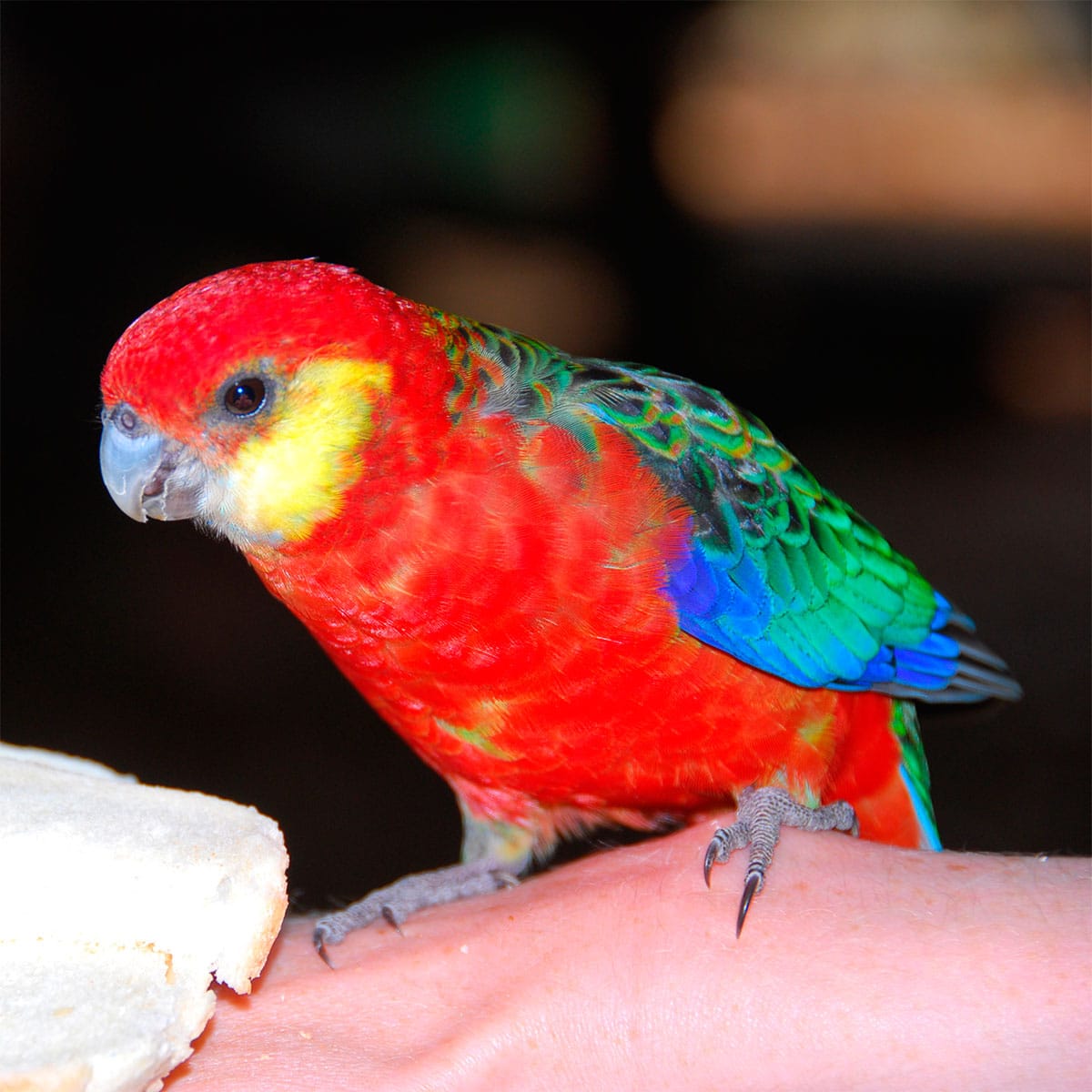
The Western Rosella (Platycercus icterotis) is the smallest of the Platycercus and the only one with big cheeks Yellow.

Adults have a clear dimorphism. The adult male has head and underparts bright red. The the mantle feathers, the back and scapulars They are black with large green edges forming a scalloped effect. The green edges sometimes infiltrated with red. The inner coverts They are dull green, While the external are dark blue. In the Middle, you can see some black on median. The primaries son negruzcas. The rump is dark green. The central tail feathers are dark green, the exteriors are blue with white tips. The underparts It has no stripe.
The bill grey; irises dark brown; legs greyish brown.

The adult female has the forecrown dark red. The crown and the sides of the neck are green. The cheeks are yellow, but duller and less developed than in the male. The underparts They are green with red infiltrations. The under wing wearing a light streak.

The immature are similar to the females. They have head green with a strip of orange red on the front of the forecrown. The cheeks Yellow absent. The underparts is pale green with slight red orange infiltration in young men.
The adult plumage It is reached after a quick complete change to 14 months.

Description 2 subspecies

  • Platycercus icterotis icterotis

    (Temminck & Kuhl 1820) – The nominal.


  • Platycercus icterotis xanthogenys

    (Salvadori 1891) – The cheeks They are paler; black feathers nape; back and shoulders lined with large red brown. Area of the rump and uppertail-coverts, Olive Drab. Female much paler than the nominal.

Habitat and habits:

Western Rosella

The Western Rosella they are not very common. Found in variable densities in stands of eucalyptus and in many types of open forest habitats. They also attend camps with little trees, partly cleared agricultural fields and residual trees lining grain fields or roadsides. They tend to visit the gardens and freshly harvested fields. They occasionally enter the parks, gardens and golf courses.

In areas close to the coast, the Western Rosella, without a doubt, have benefited from the transformation of dense forests into agricultural land. On the other hand, they were driven from the hinterlands by large-scale deforestation programs.

The Western Rosella they suffer the aggressive competition Australian Ringneck (Platycercus zonarius) that shares the same habitat type.

They are birds sedentary. Usually, they live in pairs or in small groups, and it is very rare to find them in flocks. Son quiet and discrete, so very often go unnoticed when they feed in Earth or when they seek refuge in the trees.

Around the houses, the Western Rosella they are very confident, coming into barns and corrals to feed on grain. Unlike other parrots, have a stable flight composed of multiple hits. Move over short distances, preferring to fly from one tree to another, instead of crossing open spaces.

Reproduction:

The nesting season running from August to December.

The nest It is found in the hole of a branch or in the cavity of a tree trunk.. The couple often choose a eucalyptus wandoo the genus eucalyptus salmonophloia. The cavity must be deep enough and the bottom must be lined with a layer of sawdust..

Before mating, the male courts to your partner. It leans forward on its perch uttering very specific cries.. If the female agrees, responds in the same way.

The laying, generally, comprises of 3 to 7 eggs which are incubated during 19 days. The female is responsible for one incubation, but she pauses in the morning and in the afternoon to be resupplied by the male.

The Young people are altricial and do not fly away before reaching the age of 5 weeks.

Food:

They mainly eat seeds of grasses and other plants found in stubble fields.. They also feed on fruits, berries, Jarrah flowers (Eucalyptus marginata) and seeds of the Zamia Palm.

Often in orchards where cause some damage.

Distribution:

Size of its range (reproduction / resident): 308.000 km2

Endemic to Western Australia, where its population is distributed between the vicinity of Dongara, in the North and Israelite Bay, on the South Coast, and reaching the interior in a line that goes more or less through the Lake Dundas, Southern Cross and Moora. Sometimes found in parks in Perth.

The species is common and seems to have benefited from forest clearing and agriculture.. The world's population is of more than 100,000 specimens. A small number of captivity. The birds can be pursued under a permit.

Distribution 2 subspecies

  • Platycercus icterotis icterotis

    (Temminck & Kuhl 1820) – The nominal. Coast and Southwest podrebere Australia.


  • Platycercus icterotis xanthogenys

    (Salvadori 1891) – Southwest Interior Australia.

Conservation:


minor concern


โ€ข Current category of the Red List of the UICN: Least concern

โ€ข Population Trend: Decreasing

The species is relatively common, like most birds that live in open areas, the Western Rosella It has benefited, to some extent, the slimming of the wooded areas. But, its numbers have declined in areas where it faces competition from the aggressive Australian Ringneck. It also, the difficulty to find holes for the construction of nests is a concern in the long run.

The Western Rosella is one protected species, However in some counties, a period was opened to try to regulate or stop the damage caused by this bird in crops.

"Western Rosella" in captivity:

Pretty common in captivity.

Una muestra viviรณ 13,2 years in captivity. Taking into account the longevity of the similar species, the maximum longevity in these birds could be underestimated. In fact it has been reported that these birds can live up to 31,6 years in captivity, data that can be, but it has not been verified; the same study reported that these animals can reproduce, approximately, to the 2 years of age in captivity.

Alternative names:

Western Rosella, Earl of Derby’s Parrot, Stanley Parakeet, Stanley Rosella, West Australian Rosella, Yellow-cheeked Parakeet, Yellow-cheeked Parrot, Yellow-cheeked Rosella (ingles).
Perruche ร  oreilles jaunes, Perruche de Stanley (French).
Gelbwangenrosella (German).
Rosela-do-leste (Portuguese).
Perico Carigualdo, Rosela Oriental (espaรฑol).

scientific classification:

Order: Psittaciformes
Family: Psittaculidae
Genus: Platycercus
Scientific name: Platycercus icterotis
Citation: (Temminck & Kuhl, 1820)
Protonimo: Psittacus icterotis

Images ยซPerico Carigualdoยป:

Videos "Western Rosella"

————————————————————————————————

ยซPerico Carigualdoยป (Platycercus icterotis)


Sources:

Avibase
– Parrots of the World โ€“ Forshaw Joseph M
– Parrots A Guide to the Parrots of the World – Tony Juniper & Mike Parr
– AnAge: The Animal Ageing and Longevity Database – Anagรฉ entry for Platycercus icterotis
– Birdlife

Photos:

(1) – By derivative work: Snowmanradio (talk)Western_Rosella_(Platycercus icterotis)-5.jpg: Robert Young [CC BY 2.0], via Wikimedia Commons
(2) – By Luke Durkin (IMG_0526Uploaded by snowmanradio) [CC BY 2.0], via Wikimedia Commons
(3) – By Hervรฉ (zoo_090912_518.jpgUploaded by snowmanradio) [CC BY-SA 2.0], via Wikimedia Commons
(4) – ยซPlatycercus icterotis1ยซ. Licensed under CC BY 2.0 via Wikimedia Commons.
(5) – By Robert Young (originally posted to Flickr as Mmmm, wet bread) [CC BY 2.0], via Wikimedia Commons
(6) – John Gould [Public domain], via Wikimedia Commons

Sounds: John Graff (Xeno-canto)
โ–ท The world of Pets: Dogs, cats, birds, reptiles, amphibians

Northern Rosella
Platycercus venustus

Northern Rosella

Content


Anatomy-parrots

Description

28 cm.. length between 85 and 100 g. of weight.

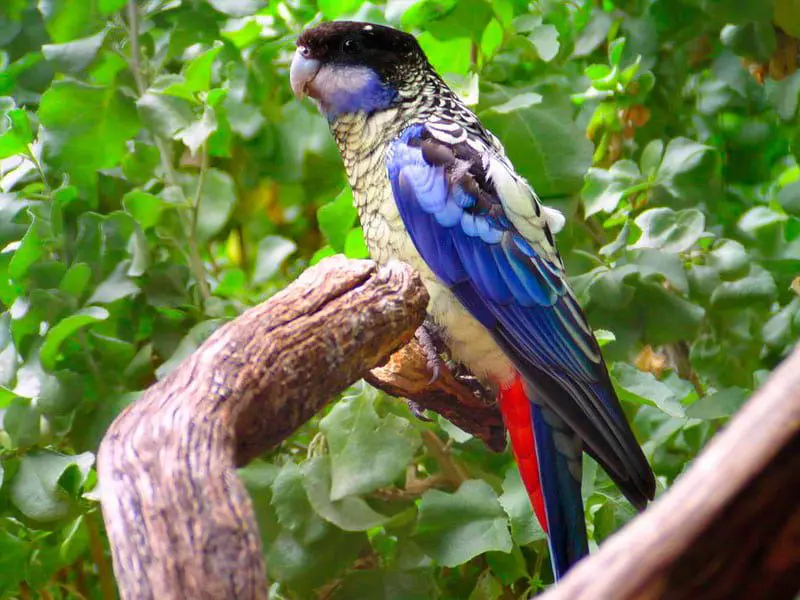
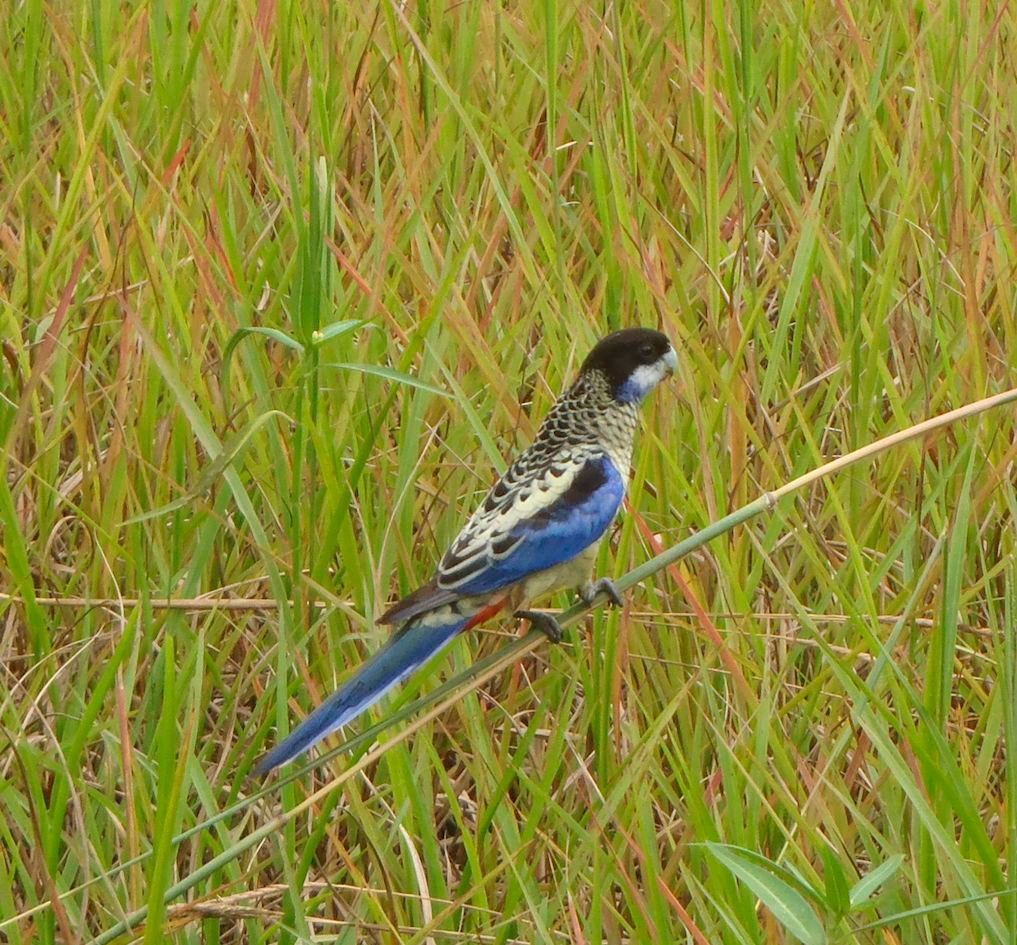
The Northern Rosella (Platycercus venustus) they have a whitish beaks, black head, except the bottom of the cheeks and Chin that show a cream color. Their underparts feathers, lower back and rump, are pale yellow with black trim, giving these areas a look slightly flaky.

The curves of the wings are blue.

The subcaudales coverts are bright red. Nape, mantle and scapulars are black with broad yellow edges, forming an effect of shoulder straps. Blankets are black. The medium-sized coverts are bluish grey. The rest of the wing coverts are black with edges of yellow or blue grey. Deployed primaries are black. The Central tail feathers are verde-bronce while the outer feathers are dark blue with clear or white edges.

The females they are slightly smaller than the male, with the narrower peak.

The youth they are more turned off, with red markings on the head, and with more green and short tail feathers. Reaches it adult plumage in 12 months.

Subspecies description

  • Platycercus venustus hilli

    (Mathews 1910) – Adults are similar to the nominal species but with bottoms scalloped with a sweeping black and the bottom of the cheeks of violet blue colour.

  • Platycercus venustus venustus

    (Kuhl 1820) – The nominal.

Habitat:

Northern Rosella

The Northern Rosella they are unusual or are irregularly distributed in the mixed forests of eucalyptus and Melaleuca. They are generally found in open areas along rivers but are absent in floodplains along major rivers.. They are also present in the monsoon forests bordering open forests. From time to time, the Northern Rosella visit mangroves, parks and gardens in the vicinity of Darwin.

The Northern Rosella they live in pairs or in small groups ranging between 6 and 8 specimens. You rarely see them in flocks. They are usually very cautious and discreet, except in national parks where they are accustomed to human presence. They are more arboreal than other parrots of the genus habits Rosella. Funny Parrots are difficult to observe, whether on land or hidden in the foliage in the trees. They are most active in the morning and at the end of the afternoon. They show great caution when they come to drink at water points. When moving, their flight is fast, but unpredictable and less undulating than most parakeets.

Reproduction:

The nesting season extends from June to September, Sometimes a little earlier. The Northern Rosella install their nests in hole of a branch or the trunk of a tree cavity, generally in eucalyptus trees located a short distance from a stream. Implementation usually includes between 2 and 4 eggs that are incubated during 19 days. The female is solely in charge of incubation and is fed in the nest by her partner.. The chicks stay is relatively long and may last up to 7 weeks.

Food:

The Northern Rosella feed mainly on seeds of eucalyptus, acacia and Melaleuca Although they despise the of the blue cypress (Callitris intratropica). The seeds of green areas and nectar are also on their menu. The birds that live in the forests near the coast sometimes feed on the coast and along the banks of small streams.

Distribution:

Size of the area of distribution (reproduction / resident): 785.000 km2

Scattered through the coastal areas of the region of Kimberley, Western Australia, stretches of the North of the Northern Territory, and spreading over the border of Queensland at its eastern end.

The species is distributed from around Napier Ranges, in the Western region of Kimberley, to the East across the plateau of Kimberley and reaching the inside of Springvale. Next, crosses the border of the Northern Territory, extending with its southern limit along the victory river, inside, about Katherine, and along the McArthur river. It is also found throughout the nicholson river at the border of Queensland, and are distributed by a series of Islands on the coast including Koolan, Augusto, Coronation, Bathurst and Melville. Is occasionally in the suburbs of Darwin.

The species is generally rare throughout its range. The world's population is less of 50.000, and may that declining. A small number of captivity.

Fully protected by law.

Subspecies distribution

Conservation:


minor concern


โ€ข Current category of the Red List of the UICN: Least concern

โ€ข Population Trend: Stable

The Northern Rosella they have a very unequal distribution. At most, they can be considered locally common, but in any part of their range they are evaluated as abundant.

Despite the studies that have been carried out since the 19th century, it is not possible to discern if the numbers are increasing or decreasing. It is possible that its population has always been limited, given the difficulty of finding refuge during the dry season.

Its population, according to some sources, It is estimated at around 50.000 specimens.

"Northern Rosella" in captivity:

Quite calm and shy. Incompatible con otras aves.

Not common in captivity, incluso en la avicultura de Australia

In terms of their longevity, una muestra, according to sources, lived 19,1 years in captivity

Alternative names:

Northern Rosella, Brown’s Parakeet, Brown’s Rosella, Smutty Parakeet, Smutty Parrot, Smutty Rosella, White-cheeked Rosella (ingles).
Perruche gracieuse, Perruche de Brown (French).
Brownsittich, Brown Sittich, Brown-Sittich, Schwarzkopfsittich (German).
Rosela-do-norte (Portuguese).
Perico Gracioso, Rosela del Norte (espaรฑol).

scientific classification:

Order: Psittaciformes
Family: Psittaculidae
Genus: Platycercus
Scientific name: Platycercus venustus
Citation: (Kuhl, 1820)
Protonimo: parrot charming

ยซFunny Parakeetยป Images:

Videos "Northern Rosella"

————————————————————————————————

ยซFunny Parakeetยป (Platycercus venustus)


Sources:

Avibase
– Parrots of the World โ€“ Forshaw Joseph M
– Parrots A Guide to the Parrots of the World – Tony Juniper & Mike Parr
– Birdlife
– AnAge: The Animal Ageing and Longevity Database – An Age entry for Platycercus venustus

Photos:

(1) – Platycercus – loros tipo Rosella – popugaychiki
(2) – Northern rosella taken in Litchfield National Park – A BRIEF DIGRESSION ON PARROTS
(3) – Alan Marshallโ€™s Pictures of Northern Rosella (Platycercus venustus) in the NT (Northern Territory) of Australia
(4) – Alan Marshallโ€™s Pictures of Northern Rosella (Platycercus venustus) in the NT (Northern Territory) of Australia
(5) – By TJ Lin from Taiwan (DSCN8954Uploaded by Snowmanradio) [CC BY-SA 2.0], via Wikimedia Commons
(6) – Rosellas, Northern – Princenton University Press