โ–ท The world of Pets: Dogs, cats, birds, reptiles, amphibians

Cardinal Lory
Pseudeos cardinalis


Lori Cardenal

Content

Description

31 cm.. height and weight of 175 to 215 gr.

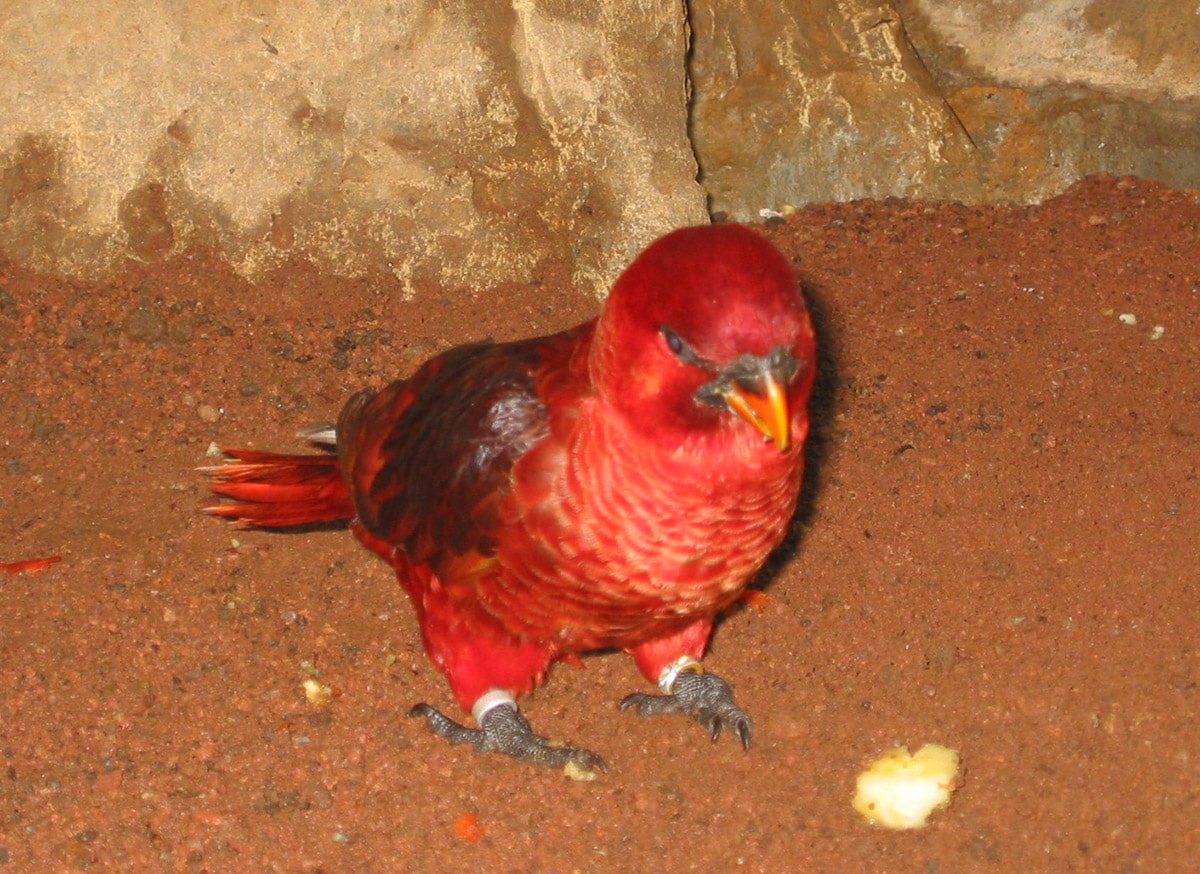
The Cardinal Lory (Pseudeos cardinalis) has a characteristic shape due to its relatively long tail.

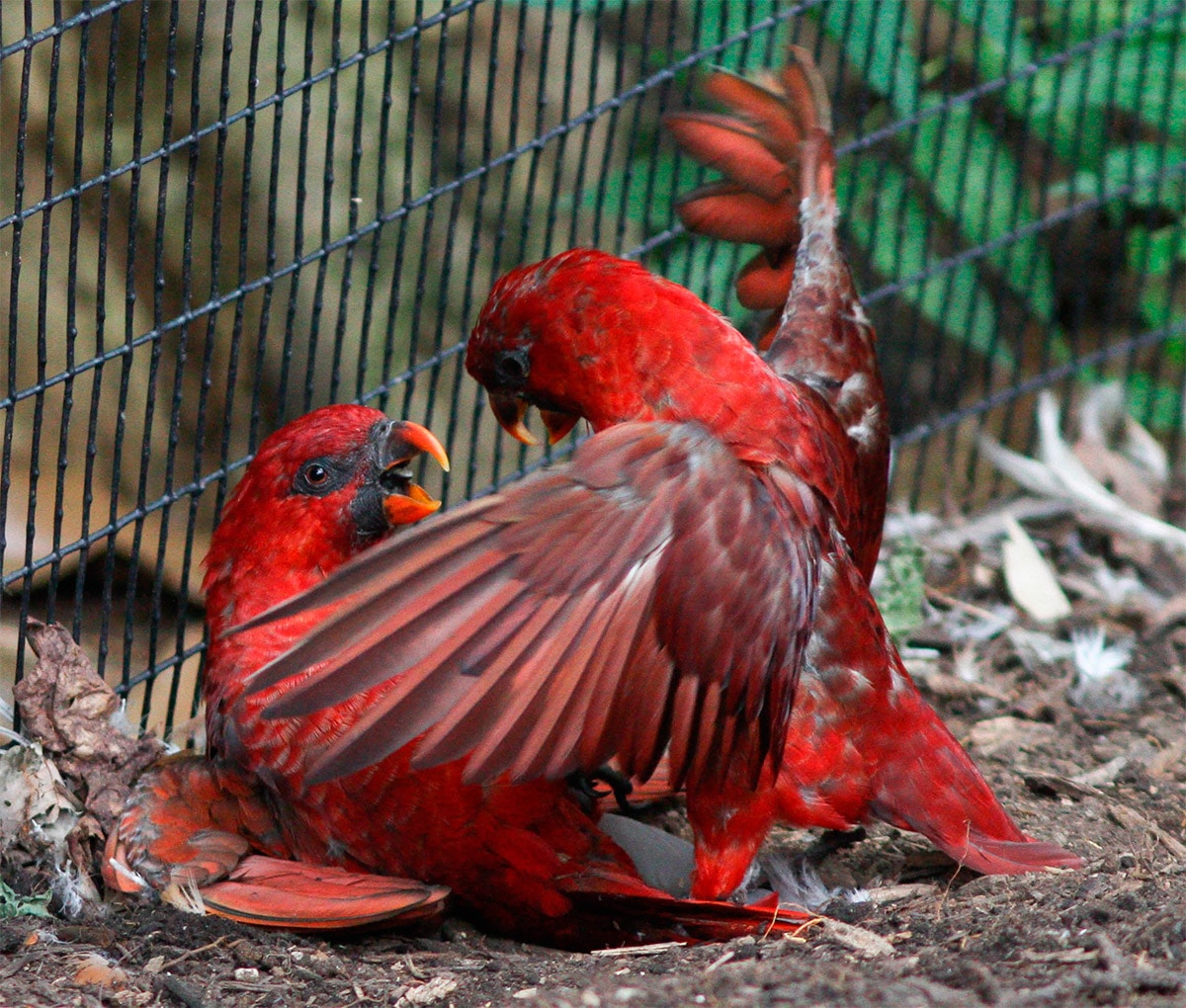
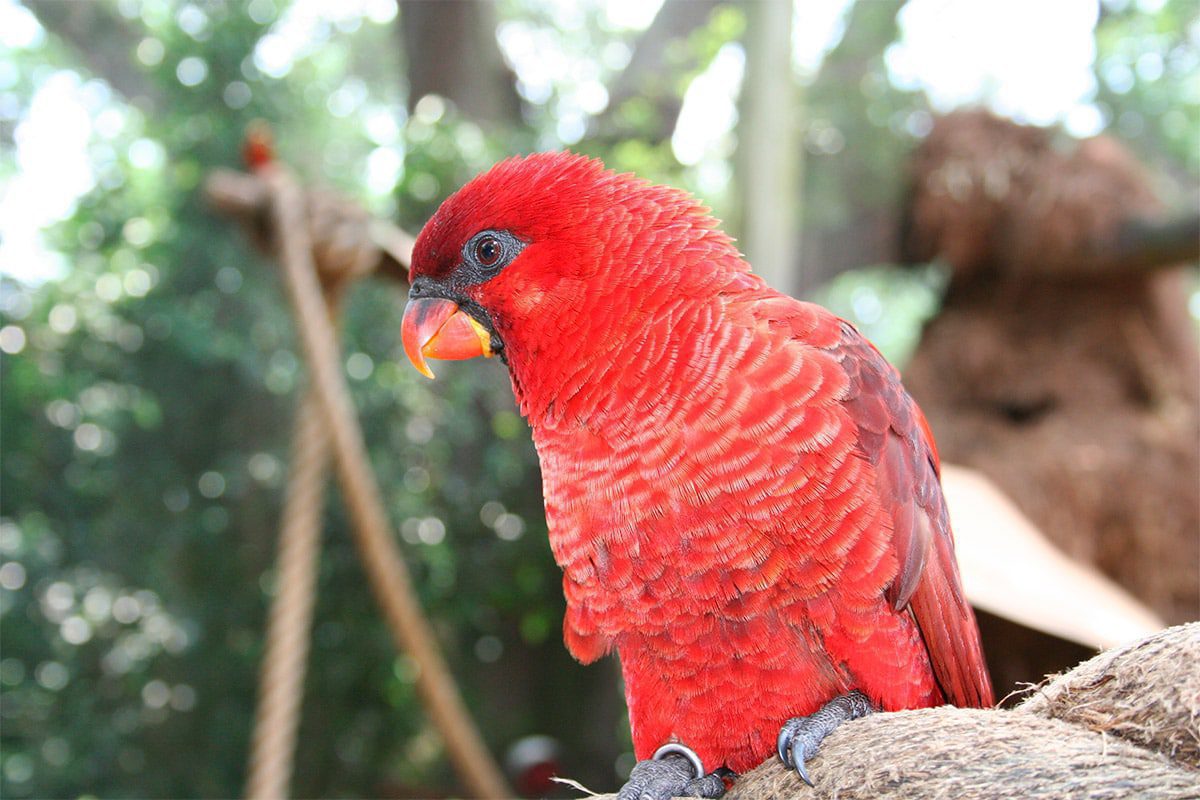
Among adults, There is no sexual dimorphism, the plumage is completely brilliant red, but the upperparts and wings They seem to be darker.

The bill is orange-red with a black color in the base area.
The bare orbital skin is black.

The feathers the lower parts have small yellowish features, What gives a vaguely scaly appearance.
The legs are grey.

The irises is red-orange.

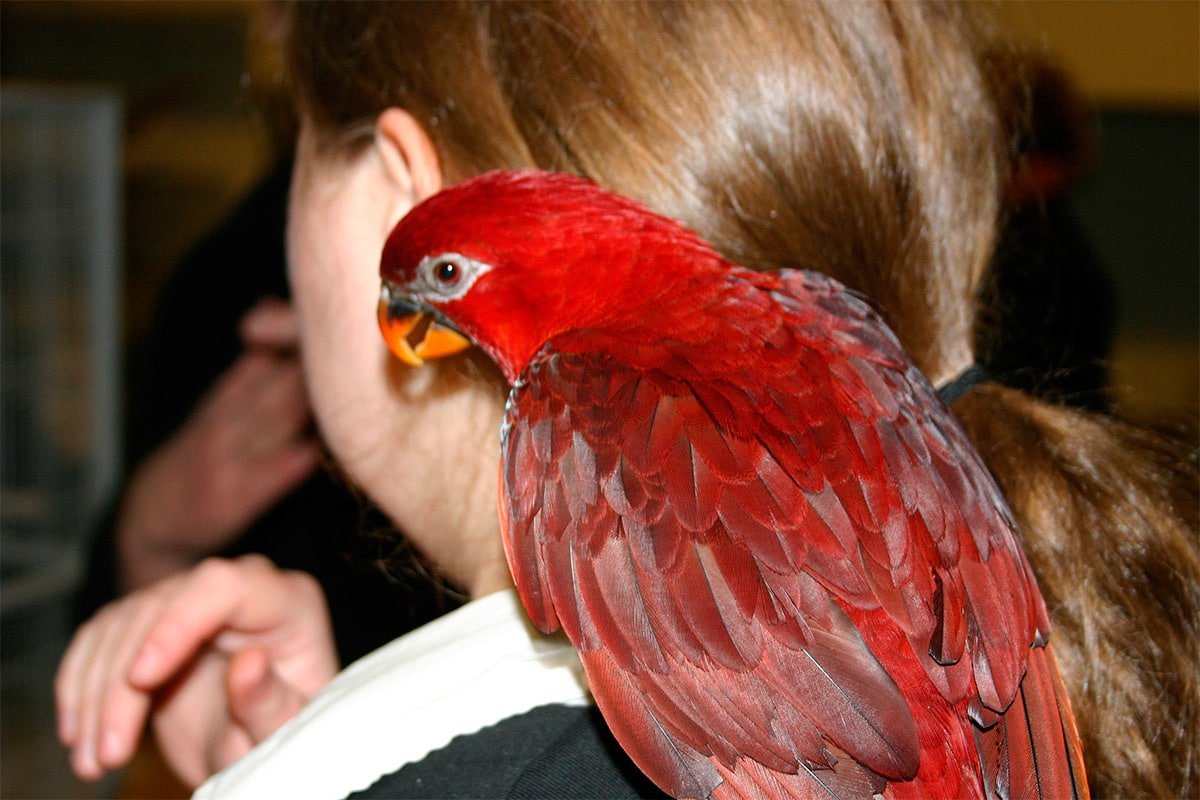
The immature has the back and blankets of Red Wings clear. Its bill It is pale orange with small black marks. Its orbital skin is whitish grey. Their irises are pale yellow.

Habitat:

It is a kind forest. It is very widespread and is locally abundant in primary and secondary forests. It is also in the forests in regeneration in coconut plantations and mangroves where there are trees in flower.

Can rise to 1.200 m above sea level, Although in the Bougainville Island (Papua New Guinea), does not exceed of the 800 m.

It is a bird loud that does not happen easily unnoticed.

It is usually in small flocks of up to 20 birds flying high above the canopy. Also gets into branches higher trees in flower which is notable for its continuous shrieks and its beautiful bright colors.

It is often found in the company of the Coconut Lorikeet (Trichoglossus haematodus) and they particularly appreciate red flowers.

This bird moves constantly in the day, flying from one island to another.

Reproduction:

The breeding season probably starts in June. There are reports of links in August and stops extending to September.

To date, We have found a nest in a high tree cavity, at low altitude above the ground. This is the only information we have about the natural environment.

In captivity, the Cardinal Lory puts two white eggs. Both parents incubate and care for young people.
The incubation period is 24 days.

When out of the shell, chicks weigh in 6 to 7 g.. They are covered with a white quilt, long and dense.

As with all the Loris type Chalcopsitta y Pseudeos the nest is especially long and hard between 65 and 80 days.

Food:

The Cardinal Lory is exclusively vegetarian. Feeds in the canopy and fruit Palms, small berries, flowers, outbreaks, also pollen and nectar.

This Parrot seems to mark a clear preference for the flowers and red fruits.

Distribution:
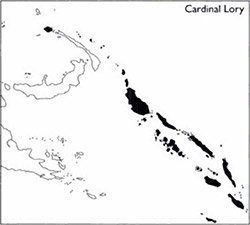
Distribucion Chalcopsitta cardinalis

The Cardinal Lory It is endemic to the Islands to the East of New Guinea. Its area of distribution covers New Hanover and the islands surrounding (Tabar, Lihir, Thong, FeNi and Nissan). Extends to Buka and Bougainville. In the Solomon Islands occupies a territory that extends to the South of San Cristรณbal.

Conservation:


minor concern

– Current IUCN Red List category: Least concern

– The population trend: Stable

The world population It has not been quantified, but the species is described as abundant (pit et to the. 1997). Sources estimate that the total population in nature exceeds the 100 thousand copies.
The population is suspected to be stable in the absence of evidence of any reduction or substantial threats.

But, is classified by the UICN as a species "in restricted area", which means that it has a territory whose surface is less to 50 000 km, therefore, potential danger.

"Cardinal Lory" in captivity:

Very rare.

In 1989, the Solomon Island allowed that a few Cardinal Lory were exported to the EE.UU.. But, because of the Law on the conservation of wild birds in 1992 The export of the Lori of Solomon Islands to the United States. UU. they banned except that is for authorized reproduction.

Alternative names:

– Cardinal Lory (ingles).
– Lori cardinal (French).
– Kardinallori (German).
– Lรณris-cardinal (Portuguese).
– Lori Cardenal (espaรฑol).

scientific classification:

– Order: Psittaciformes
– Family: Psittaculidae
– Scientific name: Pseudeos cardinalis
– Genus: Dusky
– Citation: (Gray,GR, 1849)
– Protonimo: cardinal lorius

ยซLori Cardenalยป images:

Videos "Cardinal Lory"


ยซLori Cardenalยป (Pseudeos cardinalis)


Sources:

Avibase, BirdLife.org, Oiseaux.NET

Photos: Wikipedia, Chalcopsitta cardinalis - Cincinnati Zoo (Wikipedia), Ethan Ograngy (IBC.lynxeds.com), Minppu (IBC.lynxeds.com)

Sounds: Niels Krabbe (Xeno-canto)

โ–ท The world of Pets: Dogs, cats, birds, reptiles, amphibians

Dusky lory
Pseudeos fuscata

Lori Sombrรญo

Content

Description

23-28 cm.. height and a weight between 140 and 190 gr.

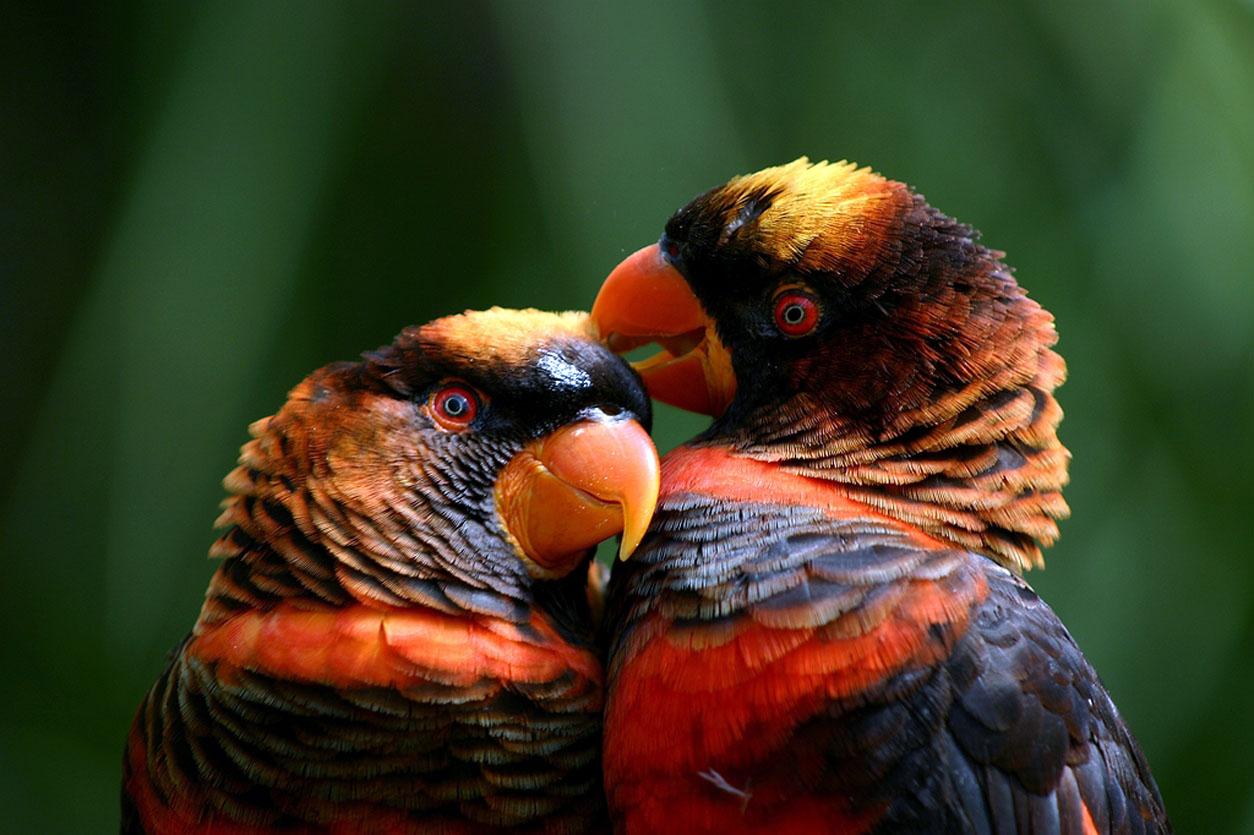
The plumage of the Dusky lory (Pseudeos fuscata) It is difficult to describe since there are many differences in tonality between one and the other specimens.. Some are of a very dark brown color, almost black and others have a much lighter shade. In addition the same happens with the two bands that cross you the chest Since the species goes through three phases: red, Orange and yellow, according to age, gender and the place of origin.

Characteristic of this species is the area of โ€‹โ€‹bare skin under the lower jaw until the birth of the throat. The lower wing coverts are orange and the lower flows dark blue. The obispillo is a silvery-white the bill is bright orange. The irises is orange and the legs dark.

There is no sexual dimorphism and the only way to differentiate male and female will be through DNA, Although some authors (Tomas Arndt) they are running that adult females lack the white feathers of the obispillo.

Habitat:

The Dusky lory they are quite widespread and locally common in primary forests , that is to say, those who have not undergone any transformation. But they are also found in wooded areas, up to an altitude of 2.400 m, During regeneration, especially those with large mature trees.

They are also distributed among residual tree beds during their flowering period., including those located in the parks and gardens in cities.

They are occasionally present in the lightly wooded Savannah or plantations of teak and coconut trees.

They normally reside in the landscape of hills or slopes steep slightly from low and middle mountain.

Itร‚ยดs gregarious and when flies or are fed in the cup of them trees full of flowers it makes in groups of 20 to 100 individuals or more.

Reproduction:

The nesting season It is very different depending on the region: It extends from November to April in the mountainous areas of East, While in Irian Jaya, the Indonesian part, they do in July.

The Dusky lory they prefer to nest in tall trees in the mountain area, the choice of a hole at high altitude on Earth probably do to protect itself against potential predators.

If the site is of your liking, reuse it for many years consecutively. Male and female participate in the work, the enlargement of the entrance or the cavity itself. Even if the nest has been used in the past, There are always minor changes to be carried out.

Although this species is quite common, We really know very little about its reproduction in the wild. In captivity, the female lays two eggs which are incubated for approximately 24 days. As in most New Guinea lories, the reproductive cycle is very long, about 70 days.

Food:

Consumes mainly nectar and perhaps the pollen it accumulates in plants of the genus schleffera or tree Rudraksha (Elaeocarpus sphaericus). Also consume flowers and fruits. It can be seen in large flocks in mango plantations and other cultivated trees. Feeds, occasionally, teak moth (Hyblaea puera).

Distribution:

The Dusky lory It has its area of distribution largely of New Guinea, except the mountains more high of the interior and the peaks more high of the mountains of Parotia.

They are present in Salawati on the Western Islands of papua and further to the East in the Yapen island on Cenderawasih Bay.

Conservation:


minor concern


– Current IUCN Red List category: Least concern

– The population trend: Stable

The species are not threatened. Common and very sociable, It often forms bedrooms that can reach thousand of birds.

A wild population estimated above 100.000 individuals.

In some parts of the southeast of New Guinea, its density may be superior to 30 birds per square kilometer.

"Dusky lory" in captivity:

Are birds enough prolific and sociable you adapt easily to captivity.

Contrary to other parrots that eat mainly seeds and nuts; The loris require a greater percentage of fruits, outbreaks, nectar and pollen in your diet. In fact, in the nature, they can feed a maximum of 640 flowers in a day. They also feed on seeds.

It is usually aggressive with other species of lory. Easy to startle with strangers.

Alternative names:

– Dusky Lory, Dusk-orange Lory, Dusky-Orange Lory, White-rumped Lory (ingles).
– Lori sombre, Lori ร  dos blanc (French).
– WeiรŸbรผrzellori (German).
– Lรณris-dusky (Portuguese).
– Lori Sombrรญo, Lorito crepuscular (espaรฑol).

scientific classification:

– Order: Psittaciformes
– Family: Psittaculidae
– Scientific name: Pseudeos fuscata
– Genus: Dusky
– Citation: (Blyth, 1858)
– Protonimo: those darkened

Images "Lori Mson":


"Lori bleak" (Pseudeos fuscata)


Sources:

Avibase, mundoexotics, Oiseaux.NET

Photos: Wikimedia, birdsville.NET.au, Dick Daniels – Tampaโ€™s Lowry Park Zoo, Dusky Lory – Woburn Safari Park (Wikimedia),

Sounds: BAS van Balen (Xeno-canto)