▷ The world of Pets: Dogs, cats, birds, reptiles, amphibians
Von Höhnel's chameleon
- Trioceros hoehnelii
Origin: Kenya, Uganda
Gender: Trioceros
Life expectancy: 4 - 6 years
Length: Head - torso, until 10 cm.
The Von Höhnel's chameleon (Trioceros hoehnelii) is a high-altitude species that ascends to more than 3.000 m on Mount Elgon.
Von Höhnel's chameleon – Wikipedia
Content
Origin / Distribution
The Von Höhnel's chameleon (Trioceros hoehnelii) found mainly in Kenya, but is represented by a wide range of local variations. The form found on Mount Elgon, in Uganda, is called Trioceros hoehnelii «altaeelgonis«. Whether there are subspecies within this species is disputed.. But, regardless of official status, the breeder and caretaker community has adopted the term "altaeelgonis» for varieties from Uganda.
Characteristics / Appearance
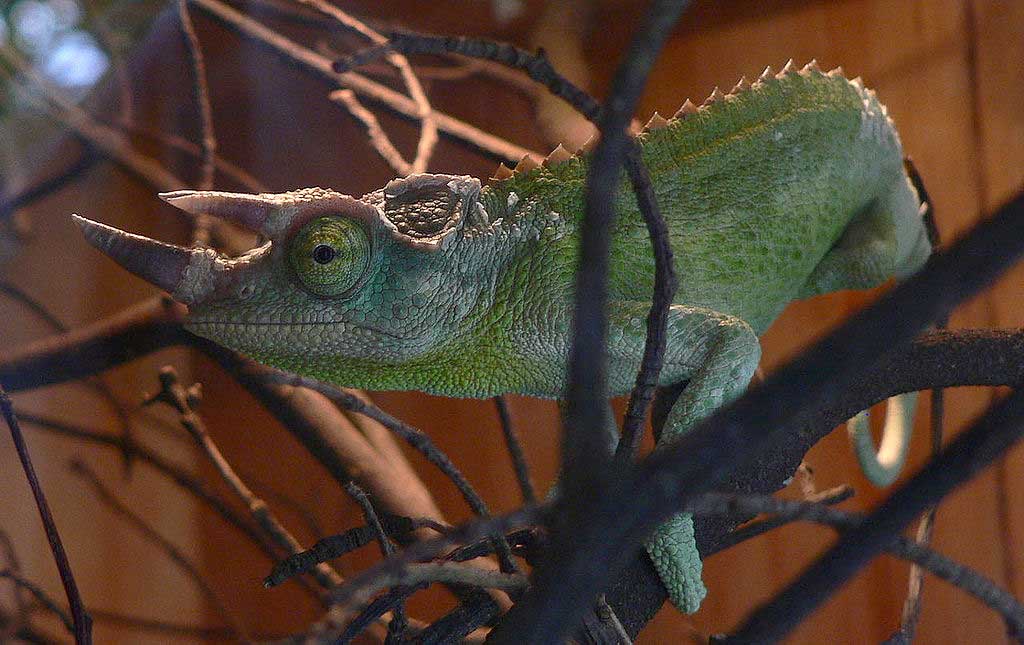
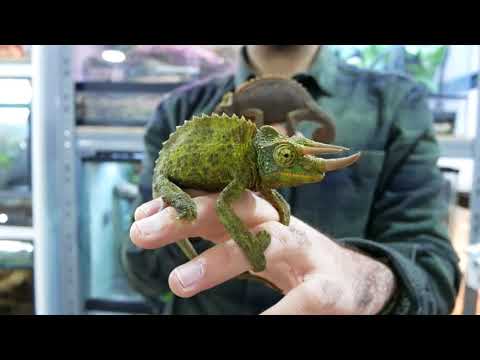
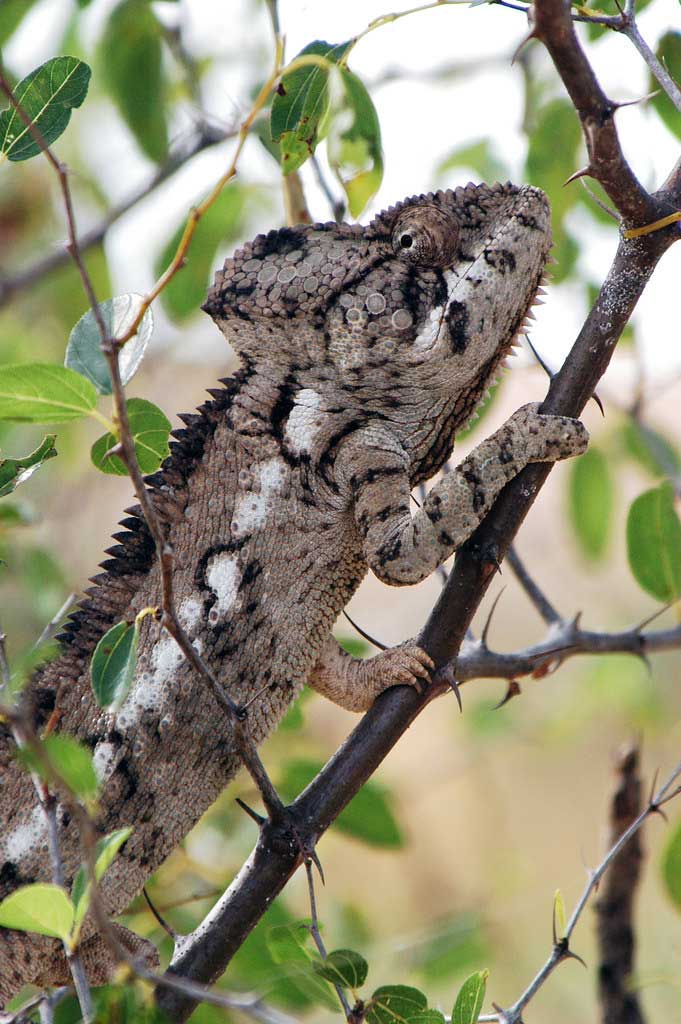
The Von Höhnel's chameleon has a very pronounced helmet, which is much more marked in males than in females. Also noteworthy is a small nasal process, which is also higher in males. There are a large number of local and location variations. Especially the helmet and the nasal process are quite different. The species has a coarsely spiny dorsal crest that extends the entire length of the body and tapers towards the end of the tail.. The throat and ventral crest are formed by large spiny scales.. Both sides of the body usually have 2 greatly enlarged plate-like scale rows. Scale and body coloration are highly variable, consisting mainly of shades of brown and green with partially light transverse bands.. There are reddish or brown animals, as well as a well-known color form with a yellow head and green body.
Male hemipenis pouches are clearly developed by the time they reach sexual maturity. Females show a much more homogeneous scaling, secondary sexual characteristics are less pronounced in them. Males grow to a maximum length of 25 centimeters, females reach a maximum length of 20 centimeters. The life expectancy is of 2 to 4 years.
Habitat
The Von Höhnel's chameleon is a high-altitude species that ascends to more than 3.000 m on Mount Elgon. They have developed the ability to regulate their body temperature through sunlight to take into account low ambient temperatures.
Behavior
The Von Höhnel's chameleon shows very interesting defensive behavior in the wild. The greatest danger for this species of chameleon is the snakes that live in the trees, as the green mamba. If the chameleon sees a snake, immediately turns deep black, he rolls up his body and drops to the ground, where the snake does not usually follow. Next, the animal remains motionless on the ground until the danger has passed.
Threats to the species
State of conservation ⓘ
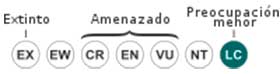
Minor Concern ⓘ(UICN)ⓘ
This species has a wide distribution and seems to have the ability to adapt to a degradation of its natural habitat., since it also occurs in agricultural and semi-urban areas. It has therefore been classified as a "species of least concern" by the UICN.How is it being captured for the wildlife trade?,The species has been included in Appendix II of CITES to limit its effects.
The "Von Höhnel's chameleon" in captivity
"The Ugandan Variation of the Trioceros hoehnelii rarely seen, since Africa's exports come from Kenya, having different varieties of color. There are several populations at different heights, each with a different color scheme.
Care is very similar to Montane side-striped chameleon (Trioceros ellioti). Thrives in a well planted terrarium. They have been kept in groups from one male to multiple females, but the females can have two litters a year and, therefore, are almost always at some stage of pregnancy and must be separated. So, despite reports that they are not aggressive, the saying is still valid: One chameleon per cage and not to worry.
They seem to be enjoying their morning sunbath. Taking into account the drastic drop in nighttime temperature in your home environment, they are experts in absorbing all the sun's rays they can. And the decrease in night temperature is important for health. Special care must be taken with the young and the heat.
Hydration is through a standard chameleon protocol of around three hours of night misting in the early morning with 15 minutes of fogging in the morning and 15 minutes in the afternoon.
Breeding is not difficult. The gestation is 4 to 6 months. Young females can produce 6 offspring while a mature female can produce 20. They can have two litters of pups a year and become receptive again 40-50 days after delivery. The young are sexually mature after one year..
The terrarium
the bigger, best!. Minimum (45 x 45 x 90 cm.).
Full or hybrid mesh (combination of mesh and glass or panel).
UVB source (inside or outside).
natural light source (inside or outside).
Heat source (exterior).
Nebulizer at night.
Manual fogging in the morning and at night.
full mesh.
Small fans when using a hybrid cage and/or the air is stagnant.
live plants (not fake)
natural branches (no fake vines, no strings, or bleached wood).
No substrate or bioactives
Food
In captivity, animals eat crickets, domestic crickets, all kinds of flying insects and small cockroaches. It also, get vitamins and minerals (pollinating insects). Animals can cover their water needs by lapping up the sprayed water.
Reproduction
The Helmeted Chameleon is viviparous in the egg., and there is also fertilization by storage; can get pregnant again right away. In courtship, the male approaches the female, nodding and flattening to one side. When the female is ready to mate, he remains seated and mating occurs, this process can be repeated for several days. Gravid females repel males willing to mate.. If the stress is too great for a pregnant female, must be separated. During pregnancy, females have a greater need to drink and feed. After a gestation period of 150 to 180 days, females give birth between 4 and 22 pups. Before this, the female becomes restless and egg laying takes place in the early morning hours, preferably on thick bark or rough branches. The young are released from the egg case and are immediately independent.. Sexual maturity is reached around 8 months. But, should not be mated before one year.
For sale "Von Höhnel's chameleon"
The price of a "Von Höhnel's chameleon" at the exotic animal market, ranges between 50 – 150 EUR.
Videos "Von Höhnel's chameleon"
MOUNTAIN CHAMELEONS 🦎 Trioceros hoehnelii ⛰ Care, information...
1. Von Höhnel's chameleon, Helmeted chameleon, High-casqued chameleon, Kenyan high-casqued chameleon (English).
2. Caméléon à casque élevé (French).
3. Helmchamäleon (German).
4. Chamaeleo hoehnelii (Portuguese).
5. "Camaleón de casco" (español).
▷ The world of Pets: Dogs, cats, birds, reptiles, amphibians
Jackson's chameleon
- Trioceros jacksonii
Origin: Kenya, Tanzania, United States
Gender: Trioceros
Life expectancy: Until 10 years
Length: Head-torso: until 16 cm.
The Jackson's chameleon is diurnal and shows a foraging behavior with few movements per minute and a very slow locomotion rate.
Jackson's chameleon (Chamaeleo jacksonii) b. 27-01-2005 1 year Wellington Zoo 22-01-2006, Wellington, New Zealand – Photo credit: Peter Halasz. (User:Pengo)
Content
Origin / Distribution
The Jackson's chameleon (Trioceros jacksonii) is native to Kenya and Tanzania.
It has been introduced in the US. USA, in California, Hawaii and Florida.
Subspecies of Trioceros Jacksonii
Currently there 3 subspecies of "Jackson's chameleon" described:
The Machakos Hills Jackson’s Chameleon is originally from Kenya, and it is the rarest type of chameleon. It measures an average of 20-25 cm long. Males have 3 horns, and the females have 1 or 3 little horns, which can sometimes make sex determination difficult. Females are lighter green in color than males., although sometimes they are red. Males are dark green., sometimes with aquamarine blue head and bright yellow patch on flanks. Individuals with this coloration may soon be described as a separate subspecies.
Mount Meru / Dwarf Jackson’s Chameleon (Trioceros jacksonii merumontanus)
The Dwarf Jackson’s Chameleon comes from Tanzania and is very difficult to find in captivity. Wild-caught specimens are no longer available, as all export of wildlife from Tanzania is prohibited. it is extremely rare, although there are some breeders of the Mount Meru in Europe.
These chameleons are the smallest of the species, with 17-20 cm length. Males have 3 long narrow horns, while the females only have a diminished horn on the nose. Both sexes have a dark green or blue-green body with much yellow on the face and at the base of the horns.. The eyelids are bluish-green.
The Yellow-Crested Jackson’s Chameleon is originally from Kenya, specifically from a limited range in the foothills of Mount Kenya and Nyambeni. It is the most common type of Jackson's chameleon. As the largest member of the species, individuals can grow to 36 cm long, and males are known to far outnumber 40 cm.. Males have 3 horns and females do not have horns.
Invasive populations of the Trioceros jacksonii xantholophus are present in the Hawaiian Islands because a well-meaning pet store owner released some in O'ahu in 1972 in an attempt to restore the health of a wild-caught cargo from Africa. They have since spread to Maui., Hawaii and Kauai.
Characteristics / Appearance
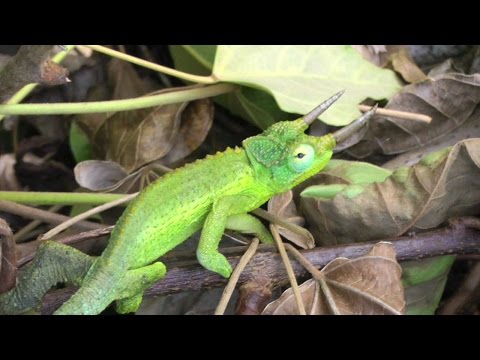
Most measure approximately between 15 and 35 cm length. They usually have several shades of green, but they can become as dark as black when they are very distressed.. Are sexually dimorphic. Males have three long, pointed horns protruding from the head. These horns are absent or underdeveloped in females. The back of the head has a small crest. There are small spines along the vertebral line. Like other chameleons, the Jackson's chameleon has zygodactyl feet (divided so that two fingers point inward and three point outward) that are specialized for life in trees, and a prehensile tail that is also used for grasping.
But, the most recognizable feature of all chameleons are their eyes. The pupil is the only visible part from its skin covering. Each eye rotates 180 degrees and is independent of the other. Chameleons have unusually strong control over the curvature of their lenses, and can enlarge an image.
They are considered a long-lived chameleon (until 10 years).
Habitat
The Jackson's chameleon prefers to live in thickets and mountain forests. They need to hide and prefer to live in trees. They rarely venture on the ground, except for laying eggs or mating.
Behavior
Males are territorial and fight with their horns, which they can also use to attract females. When two males meet, they stand on their side, flatten their bodies, curl their tails and push their heads forward. They inflate with air to appear larger and become brightly colored. Next, open their mouths to show the varied colors of their interior, while swaying and wiggling with the occasional soft hiss. The submissive male will normally try to hide, freeze on the spot or try to escape the area. Fade into muted colors. When males fight, they hit each other with their horns and try to push themselves from the branches. These fights can cause physical harm to chameleons.
They use stillness and dull natural coloration to protect themselves from bird predation, Snakes, shrews and lizards.
Reproduction
The Jackson's chameleon has a mating ritual that mimics its threat ritual. The male initiates the display of threat to the female, including color changes, inflating of the throat and elevation of the front legs towards the opponent. The female then has two options. May make threatening gestures, in which case you do not want to mate. If you want to mate, make weak threatening gestures or make no gestures at all, in which case the male recognizes his will. Then the male surrounds the female, grabs your neck with your mouth, is placed on your back and inserts the hemipene into the cloacal orifice. This whole process usually takes a few 13 minutes. The female will continue to mate during 11 days, but not with the same male twice in a day. Gestation lasts approximately 190 days. The young are usually born in the morning. The female opens the cloaca and the young are born one at a time on a branch.. They are still surrounded by a gelatinous egg sac and remain asleep until the egg touches the substrate.. The young then wake up and stretch and break the egg sac.. At birth, the offspring measure some 5,5 cm long and weigh some 0,6 Gm. After 20 days females copulate again. The young will reach sexual maturity at the age of 9 or 10 months.
Food
The diet of this chameleon consists mainly of insects and spiders. Using your eyes independently, sit completely still and watch if an element of prey crosses your path. When you locate it, both eyes converge and it swings a bit to improve its vision and confirm the distance at which the prey is located.. The prey is captured by projecting the tongue, which has a fleshy tip covered in sticky saliva. The prey is brought back to the mouth, chewed and swallowed. Language, one and a half times the length of the lizard, can reach its full length in a sixteenth of a second.
They get water by licking the drops from the leaves.
In the morning, sunbathe, bending one side towards the light and flattening the body and stretching the neck to increase its surface. Once heated, are able to hunt.
Threats to the species
State of conservation ⓘ
Minor Concern ⓘ(UICN)ⓘ
The Convention on International Trade in Endangered Species (CITES) classifies all chameleons as threatened. Two reasons for its decline are habitat destruction and the exotic pet trade.. Demand for chameleons encourages pet suppliers to pull them out of the wild and ship them over long distances; the survival rate may be approximately 1 of each 10, and those who survive arrive malnourished and stressed. Proper care methods for these lizards are not well understood, so they can be mistreated without knowing it. Captive breeding has not been very successful, with the exception of the San Diego Zoo and some private breeders.
The "Jackson's chameleon" in captivity
The terrarium
Size: The bigger, best, minimal 60 x 45 x 90cm.
Type of cage: Full or hybrid mesh (combination of mesh and glass or panel)
Lights: UVB source (inside or outside), natural light source (window or LED) (inside or outside), Heat source (exterior)
Hydration: Nebulizer at night, manual misting in the morning and afternoon
Ventilation: full mesh, Small fans when using a hybrid cage and/or the air is stagnant
Interior: live plants (not fake), natural branches (no fake vines, non-strings, non-bleached wood), non-substrate.
Care
UVB light source: T5 HO 12 hours a day, 5-12% according to the height of the cage Visible light: Full spectrum or natural light, 12 hours a day Resting point: 26-28°C, 1 time maximum 2 times a day Temperature during the day: 21-23°C. Temperature at night: Max. 15-17°C, Ideal temperature below 15°C. Humidity during the day: 50-70%. Humidity at night: 100%, fog Hydration: Nebulizer at night, Manual nebulization, Dropper Type of feeding: Crickets, Soldier flies, Cockroaches, No vegetables, Fruit-free Volume of food: Youth without limit, Adults maximum 1 daily cricket Supplement – Every meal: Simple calcium, Bee pollen Supplementation – Once every two weeks: Calcium with D3
Buy one "Jackson's chameleon"
The price of a "Jackson's chameleon" at the exotic animal market, ranges between 150 – 250 EUR.
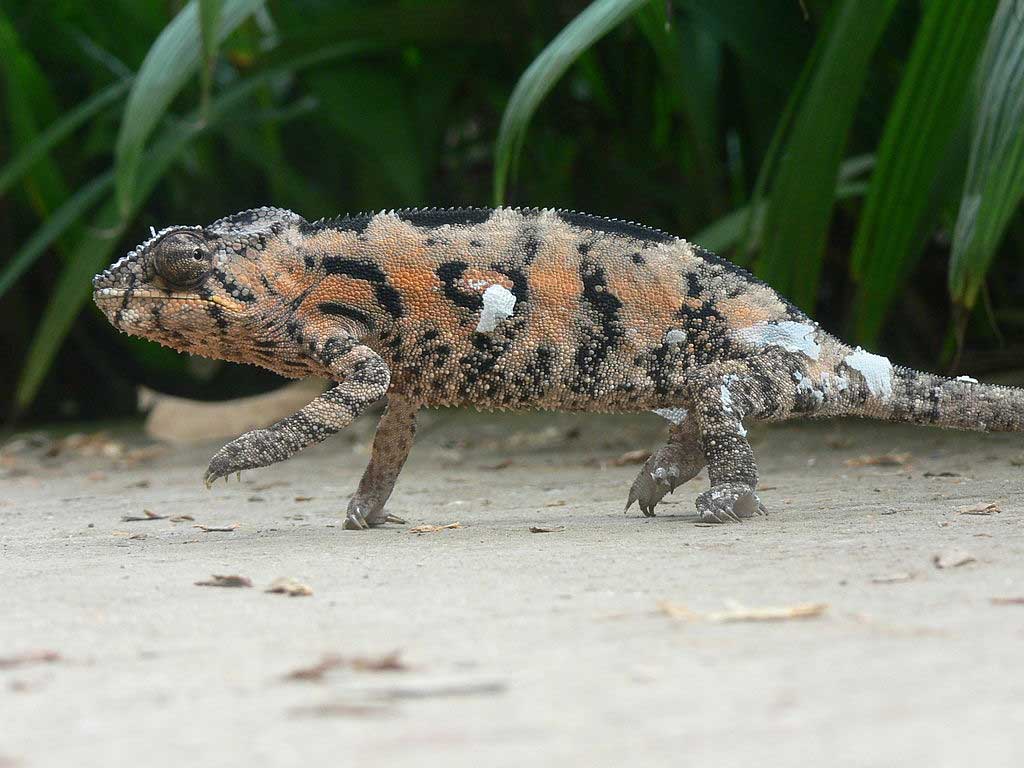
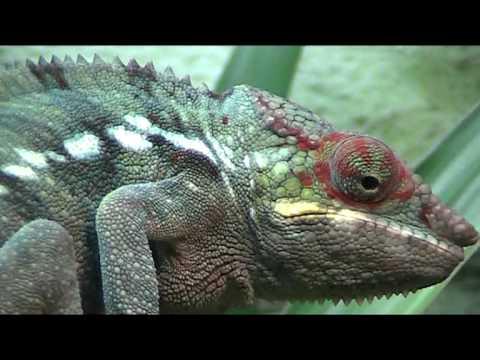
The Furcifer pardalis, also known as Panther chameleon, are native to the island of Madagascar. They are distributed throughout the island, but they are locally abundant on the coasts of the center-east, northeast, north and northwest. The Furcifer pardalis they have also been introduced in areas such as Reunion and Mauritius.
Characteristics / Appearance
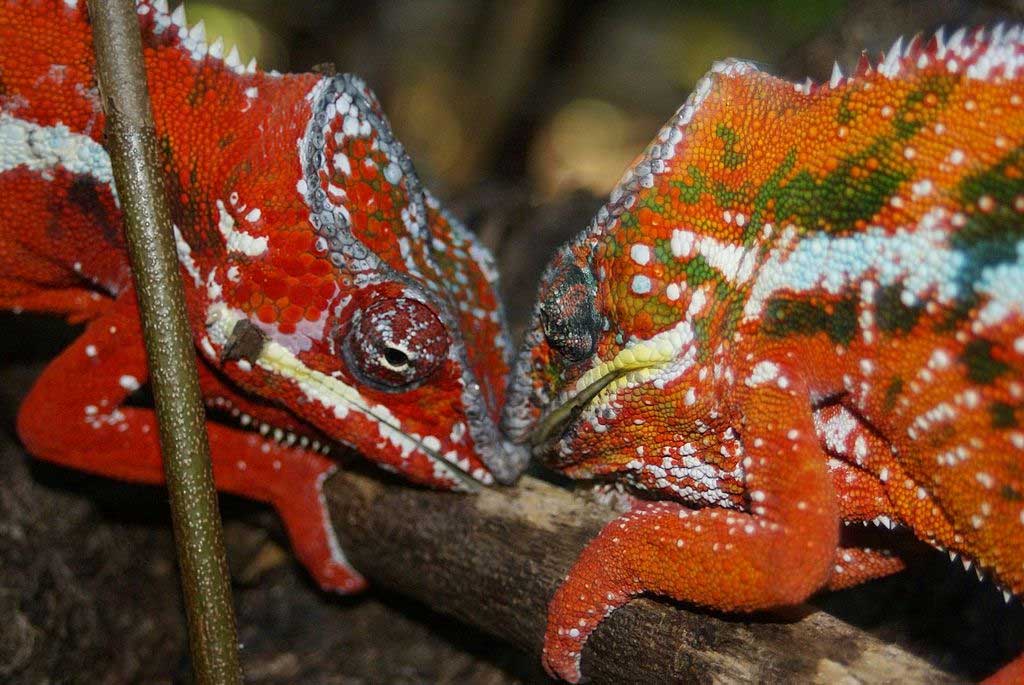
The most fascinating feature that has the Panther chameleon is its extraordinarily vibrant coloration. Adult chameleons are sexually dimorphic and males are recognized by their larger size, the swollen base of the tail indicating the presence of hemipenes, and have a wide range of coloration and patterns. Females are identified by being more uniformly pale green or pink in color, smaller, with a thinner tail base and sometimes with eggs detectable through the walls of the body. Adults can reach a length of 23 cm.. It is much more difficult to distinguish the sex of juvenile chameleons of less than 6 months of age due to their smaller size, its dull coloration and lack of hemipenial protrusion in males.
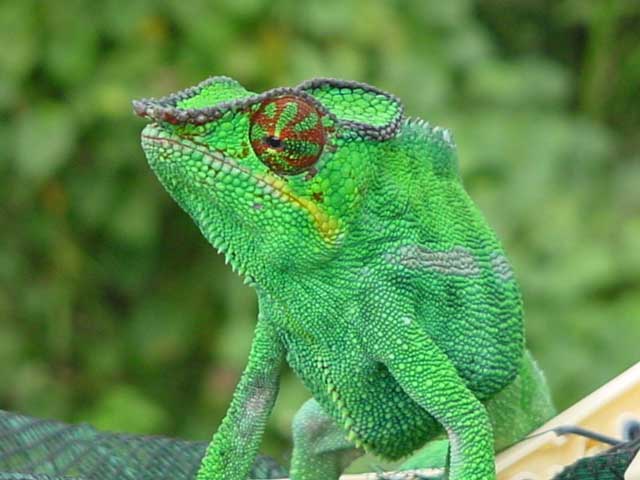
The coloration and pattern of the Panther chameleon varies significantly depending on its origin or location. Normally, the Panther chameleon of the Malagasy island Nosy Be are bluish green, emerald green or have a turquoise body. Northwest coast males are usually bright pink, with a yellowish-white stripe along the sides; this is commonly referred to as "the pink panthers". Males may also be orange, red and dark green, with a large variation of spots, streaks and/or bands around the head and eyes.
The Panther chameleon lack a vomeronasal organ, an auxiliary olfactory sensory organ found in many animals. They also have no outer or middle ear, suggesting chameleons might be deaf. Chameleons have specialized tongue-like feet called zygodactyls.. On each foot, all five fingers are merged into a two-digit group and a three-digit group. On the front feet, the group of three toes is on the inside of the foot, and the group of two fingers is on the outside. This is reversed in the back foot, which gives them a secure and strong grip and allows them to maneuver horizontally or vertically in a wide variety of vegetation or structures. These specialized feet allow chameleons to hold on tightly to narrow branches.. The sharp claws on each finger help them climb and grip surfaces they can't hold on to tightly., like tree trunks.
Habitat
The Panther chameleon it inhabits mainly dry deciduous lowland forests, near belts of thin trees that line rivers and roads. This particular species seems to prefer open habitats that are not excessively shaded.. Scientists believe this is due to the need to colonize open spaces where they can sunbathe and males can use visual cues aimed at females. (during courtship) or for males to establish territories. Male panther chameleons also have a greater elevation range than females, most likely for territorial reasons.
Behavior
In general, the social structure of the Panther chameleon It is little known. It is known that the Furcifer pardalis, like most chameleons, is solitary and territorial, regardless of age or gender. Males tend to have larger distribution areas than females. Males often do not tolerate other males invading their shrub or tree of residence and will defend their territory by participating in an exhibition., chasing and possibly seriously injuring an intruding male. Hostility increases during the breeding season. It is not known whether females of Panther chameleon are intolerant of other females in general or only at nesting sites.
Chameleon eyes do not contain the melanin rods and pigments needed for night vision, which is why Furcifer pardalis is diurnal.
Reproduction
The females of Panther chameleon gestate fertilized eggs during 2 or 3 weeks. The young usually take between 6 months and a year to come out of the eggs. From that moment on, the offspring take others 6 months until they are sexually mature and have developed the coloration and size of an adult.
Courtship usually begins with displays by males. This usually includes the display of bright colors and a series of head movements that shake as they move towards the female.. Some males move slowly, with a choppy or spasmodic step, but others move very quickly and can be aggressive with females. Females that are not receptive or are gravid may run away or face the male chasing them with their mouths open while theirs., they stand on the hind legs and swing to discourage the male's advances. If the female seems interested, the male will mount it by grabbing its flanks and it will be placed to the right or left of its body.. Copulation takes place when the male everteja the closest of his two hemipens and introduces it into the cloaca of the female. Some species copulate for a few minutes and others for several hours, after which they usually follow different paths.
There is little information on the mating systems of the Panther chameleon, but some researchers have observed mating behavior consistent with serial polygyny. Studies in captivity of the Furcifer pardalis have shown that males have wider ranges than females. Females usually stay in a small area and are visited by males during the breeding season. This species has a slight pair bond, which consists of the males deciding to remain in the territory of the female for a period after breeding and probably defend this female from other males. Females that have already mated have shown aggressive behaviors towards successive males that walk through the territory. The successful male stays with the female for a brief period after mating and then continues to roam, probably looking for another partner.
Polygynous mating system
In most places, reproduction occurs between January and May, but this may vary geographically. Females in some areas can breed several times a year. After mating, the period of hard gestation of 3 to 6 weeks. Females dig burrows by digging with their front legs and then backing up on them to deposit 10 to 46 eggs. When they finish, bury eggs, fill in the tunnel and trample the earth to hide the location of the nest. Some females drag leaves and twigs over the place. This is the last act of motherhood of a chameleon, and their offspring shall be independent at birth. The young come out by opening a star-shaped opening at the end of the eggshell with the egg tooth., a sharp, calcified bump at the tip of the upper jaw that then comes off. The young weigh between 0,25 and 0,75 g at birth. Juveniles reach reproductive maturity at 6 months of age.
Females and males of the Furcifer pardalis show no more parental investment than creating and depositing eggs. The mother will try to protect the buried eggs from predators by hiding the location of the nest with twigs and leaves., but that is their last participation and the offspring will be independent immediately after hatching.
The females of Panther chameleon invest a lot of time and energy in making sure their young develop fully. The success of chameleon pups depends largely on the adequate amount of vitamin D from the mother during gestation. Ultraviolet light is known to (UV) the sun produces vitamin D in the skin of many vertebrates, like panther chameleons. UV-induced vitamin D serves as a signal in the body to help adjust the calcium-phosphorus balance in the body. Its main function is to stimulate calcium uptake from the intestine and reduce calcium reabsorption from bone. Eggs do not hatch if the mother does not have an adequate amount of vitamin D, either by exposure to UV rays or by food intake, because you can't supply enough vitamin D to your eggs to make it easier for developing embryos to form their skeleton. An important discovery made in recent years was that females seem to be able to perceive their internal vitamin D status., recognize an external source of UV rays and voluntarily expose themselves to that source when they have a vitamin D deficiency. On the other hand, choose to avoid elevated UV sources when they have enough vitamin D.
Food
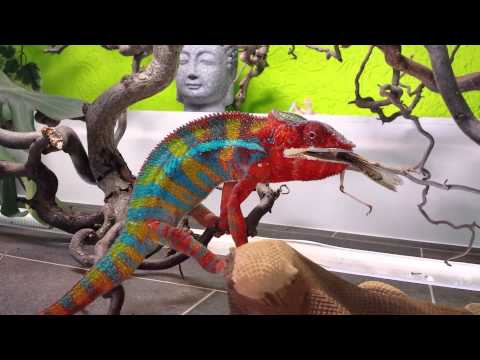
The Furcifer pardalis they are considered opportunistic hunters because they wait for prey to pass within reach of their long tongues. They feed mainly on terrestrial invertebrates and, very rarely, of plant material. They have the ability to turn and focus their eyes separately to observe two different objects simultaneously.. This allows them to have an arc of vision 360 degrees around their body while remaining completely still and camouflaged. When the prey is in sight, both eyes can focus in the same direction, providing acute stereoscopic vision and depth perception.
Chameleons have very unique languages specialized in capturing their prey.. An extensive study carried out in the year 2000 revealed the complexities of chameleon language functioning. Prey capture was often attributed only to adherence to the lingual pad., but now scientists believe that the speed and shape of the tongue also create a suction device.. The hyoid bone is a piece of cartilage that extends into the mouth from the throat bones. (called hyaline apparatus) and is attached to the long tongue of the chameleon. This is where the tongue rests when not in use. The tongue is thrown from the hyoid bone with the use of ringed muscles on the tongue. This complex structure is made up of cartilage, muscles, nerves, glands and tissues that work together to create an incredibly fast and effective tongue to grab your food.
Life expectancy
Although males can exceed five years of age in captivity, most Panther chameleon wilderness only survives one or two years after maturity. Females have a shorter half-life in the wild and in captivity due to the stress of reproduction and oviposition..
Threats to the species
The Panther chameleon is one of the most sought-after chameleon species in the international pet trade due to its beautiful coloration and the success of its captive breeding..
Tighter trade quotas have been applied and recent export levels are within a sustainable range. There is currently little risk to this chameleon species, apart from the threat of continued habitat loss and modification.
The local population uses relatively little of the Furcifer pardalis within its range. Chameleons are not used very often in the local kitchen. But, Furcifer pardalis is caught and sold in the international trade of live animals. United States, Europe and Asia are the main participants in this traffic.
The "Panther chameleon" in captivity
The terrarium
The Panther chameleon is kept in a tall terrarium, but does not require as much ventilation as other chameleon species. These animals must be kept individually. The terrarium must have at least 100 x 60 x 150cm. Higher would be better.
Food
The diet of the Panther chameleon consists mainly of insects such as crickets, crickets, grasshopper, flies, fruit flies, cockroaches, rarely wax moth caterpillars… but be careful when feeding him!! These animals gain weight easily and can develop gout. It also, feeds with leaves, colorful flowers, or possibly some fruit.
no lettuce, iceberg lettuce or similar, since its calcium-phosphorus content is unfavorable. And cabbage or spinach should rarely be fed oxalic acid….
Additional vitamin and mineral supplements are recommended.
Lighting and temperature
The temperature in the terrarium of the Panther chameleon should be 22-28°C (locally 35-40°C) during the day and between 16-22°C at night. The humidity should be 60-80% and around the 100% At night.
In the terrarium of a Panther chameleon there must be numerous possibilities to climb, preferably a tree (Ficus benjamina), remained, other plants, cork tubes and bark, which also offer hiding places.
Good lighting and ultraviolet light (30% of UVA rays and 5-10% UVB) are necessary for your well-being, as well as a place to sunbathe. UV radiation is very important and necessary. In the case of females, it is necessary to provide a suitable place for laying eggs or several possibilities.
A spray system can be installed in the terrarium, that sprays water repeatedly (about three to four times a day), or a nebulizer can be installed in the terrarium. For fluid intake, a dropper must be installed that is always cleaned.
Hibernation
The Panther chameleon it is usually more inactive in winter and here you can simulate a kind of hibernation by lighting. Reduce daily lighting time by two to three hours over a period of about two months. Hibernation is very important for animals to regulate body functions and stay healthy. But here you have to observe the animals well to see if they are prepared for rest.. This can be noticed in the behavior when the animal calms down on its own in autumn..
Reproduction
The Panther chameleon puts up to 46 eggs. They are quite aggressive animals, so you have to be careful when mating. Raising young animals individually in small terrariums.
It is essential to provide enough calcium and vitamins in breeding.
Housing conditions
To keep the Furcifer pardalis (Panther chameleon) we recommend creating the following conditions. Especially regarding the minimum size, we ask you to keep in mind that optimal conditions can only be achieved in much larger terrariums.
temperatures during the day: 22° to 28 °C (locally 35-40°C)
Night temperatures: 16-22°C
Humidity: 60-80% during the day and approx. 100% At night)
Minimum size of the terrarium: from 120x60x150cm for an animal (better higher)
Buy one "Panther chameleon"
The price of a "Panther chameleon" at the exotic animal market, ranges between 300 – 500 EUR.
The Fischer's chameleon (Kinyongia fischeri) split into several species 2008. Most of them are potentially or critically endangered. They are medium-sized chameleons that are characterized by having two nasal horns., and which are popular with private carers, especially in the United States, but rarely seen in European zoos. Usually, not a real Fischer's chameleon, but representatives of other species of the complex Kinyongia fischeri.
Characteristics / Appearance
The Fischer's chameleon reaches a total length of 26 – 33,5 cm., the females being much smaller than the males. The queue occupies between 15 and 20 cm.. The most prominent feature is the strongly laterally compressed and warty snout processes., that can measure up to 20 mm in males. In females they reach 8 mm is missing completely. A helmet is only vaguely present. The first third of the back bears a crest formed by a loose row of spiny scales..
Habitat
The Fischer's chameleon It inhabits the edges of humid mountain forests and, possibly, in neighboring plantations and gardens, at an altitude of 800-1.700 m, with an annual rainfall of 800-2.000 mm, and with a dry season of 2-3 months.
Behavior
The Fischer's chameleon prefers to eat beetles and grasshoppers, but also takes other invertebrates and small vertebrates. Mating females are light green with a red head.. 47-55 days after mating, the female lays between 10 and 21 eggs in a hole 15-20 depth cm. The young grow rapidly and can reach sexual maturity at 6 months. The most important predator of the fishing chameleon is the hummingbird (Dispholidus typus).
Threats to the species
State of conservation ⓘ
Near Threatened ⓘ(UICN)ⓘ
The Fischer's chameleon (Kinyongia fischeri) is listed as potentially threatened on the IUCN Red List since 2014 because the area of the species is small and the habitat is fragmented. The habitat is gradually disappearing due to conversion of forests to farmland, logging and underuse of crops. The same goes for the Kinyongia boehmei, Kinyongia tavetana, Kinyongia matschiei, Kinyongia multituberculata and Kinyongia vosseleri, are classified as critically endangered. Kinyongia uluguruensis It is not considered in danger of extinction.
International trade is regulated by CITES Appendix II.
Among 2001 and 2015, Tanzania exported an annual average of about 3.700 animals. The main buyers were the United States, with a 53%, Germany, with a 13% (a few 470 animals per year) and japan, with a 10%. But, It was rarely the Kinyongia fischeri Properly said, but mainly from Kinyongia multituberculata, Kinyongia matschiei, Kinyongia vosseleri and possibly Kinyongia tavetana and Kinyongia boehmei. Exports of hatchlings from Europe and North America are insignificant
The "Fischer's chameleon" in captivity
The terrarium
The Fischer's chameleon should normally be kept alone. To support an adult individual, A well-ventilated and humid terrarium is recommended. 4 x 3 x 6 times (length x widht x hight) the length of the head and torso, that is to say, a few 60 x 45 x 90 cm for a large male. If they stay in pairs, you have to add a 20% of the ground surface.
The terrarium should be equipped with spotlights and UV lamps and have plenty of climbing branches and a water trough. It is recommended to plant the back and side walls with, for example, Ficus benjamina. A mixture of sand and peat is suitable as a substrate that should always be kept slightly moist..
The substrate for the terrarium Fischer's chameleon should be loose and absorbent. These may include, a mixture of sand and peat is suitable. If you have a female, it is important that the substrate is filled to a sufficient height. In this case, the substrate must have at least 20 centimeters high so that the chameleon can bury its eggs.
Air temperature should vary between 24-28°C during the day, locally up to more than 30°C and drop about 10°C at night. Relative humidity should be 50-70% during the day, with slightly higher night values.
Buy one "Fischer's chameleon"
If a «Fischer's chameleon» in a pet store or elsewhere, it is not uncommon for it to be another species of two-horned chameleon in the same genus. The gender Kinyongia includes now 18 species; Kinyongia fischeri It is one of the species that is least kept in captivity.. Often an apparent Fischer's chameleon hides close relatives like Kinyongia multituberculata, Kinyongia matschiei or Kinyongia boehmei.
The prices of Fischer's chameleon are usually correspondingly high due to this rarity. It is difficult to give a general amount because it depends on the seller, but you probably won't get a Fischer's chameleon for less than 100 EUR.
The fact that the real Fischer's chameleon is rarely offered is also due to its comparatively small area of origin.
1. Fischer's chameleon, Fischer’s two-horned chameleon, Nguru blade-horned chameleon (English).
2. Caméléon nain de Fischer (French).
3. Fischer's Zweihornchamäleon (German).
4. Camaleão de Fischer (Portuguese).
5. "Camaleón de Fischer" (español).
▷ The world of Pets: Dogs, cats, birds, reptiles, amphibians
Brygoo's chameleon
- Brookesia brygooi
Origin: Madagascar
Gender: Brookesia
Life expectancy: 4 - 6 years
Length: Head-torso: until 10 cm.
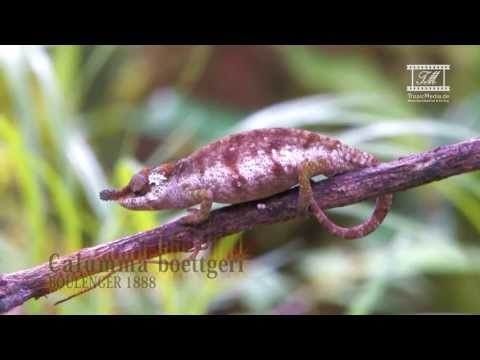
The Brygoo's chameleon it is a small to medium sized chameleon, earthy brown to blend in with leaf litter.
leaf chameleon (Brookesia brygooi), South Center of Madagascar – GRID-Arendal – Flickr
Content
Origin / Distribution
The Brygoo's chameleon (Brookesia brygooi) it is endemic to southwestern Madagascar, where its type locality is Analavelona, in the province of Fianarantsoa, in south-central Madagascar.
Characteristics / Appearance
The Brookesia Chameleons they are some of the smallest reptiles in the world: one of the species reaches a maximum length of just over an inch (30 mm). These tiny creatures are found in the leaf litter of tropical rainforests and dry deciduous forests across much of Madagascar..
The Brygoo's chameleon it is a small to medium sized chameleon, earthy brown to blend in with leaf litter.
Habitat
It is located at an altitude between 20 and 571 m above mean sea level, and in an area of 147.782 square kilometers. Details about the true population of the Brygoo's chameleon, although it is known to be very widespread.
Behavior
The Brookesia they feed on small insects and respond with their camouflage to hide from predators. When resent, these chameleons play dead in an effort to look like a fallen leaf.
Brookesias are easier to find at night, when they sleep on the leaves of small bushes.
Threats to the species
Because it is widespread and commonly found in protected areas, was listed as Least concern by the International Union for Conservation of Nature.
The "Brygoo's chameleon" in captivity
The terrarium
Minimum measurements are 60 x 31 x 46 cm..
Behavior
Males can become territorial and separate from other males. It is usually meek, but frequent handling stresses the animal. It is usually quite docile and shy. The species is diurnal.
captive environment
Use full spectrum lighting 12 to 14 hours a day. Provide multiple climbing areas on branches, trunks and plants. This species likes dense foliage to hide when climbing.
Temperature
The daytime temperature should be between 23 – 27 degrees C. Maintain night temperature between 20 – 2 degrees C.
Humidity
This species requires moderate to high humidity levels.
Water requirements
Provide a large, shallow container for drinking and soaking. Provide a constant running or trickling water supply. The enclosure must be well ventilated.
Nutritional requirements
This species is carnivorous (like meat). eat small insects, flies, mosquitoes and insect larvae. Always offer variety for proper nutrition. Sprinkle food with calcium and vitamins.
Buy one "Brygoo's chameleon"
It's probably the leaf chameleon What is most legally exported from Madagascar. Specimens of this species can be found relatively easily in specialized stores.. Its price in the exotic animal market ranges from 120 – 150 EUR.

 Minor Concern ⓘ
(UICN)ⓘ
Minor Concern ⓘ
(UICN)ⓘ














.jpg)

.jpg)