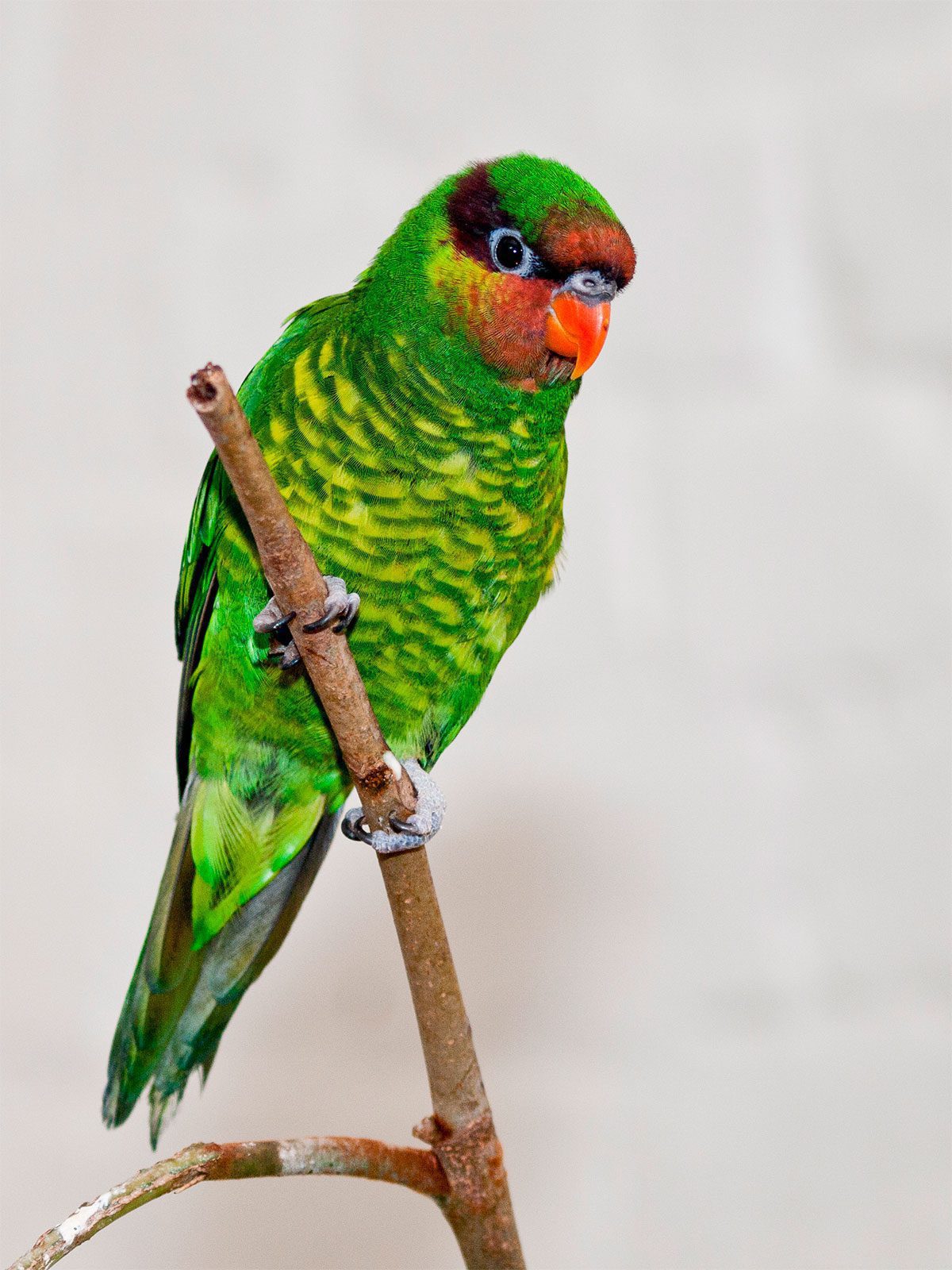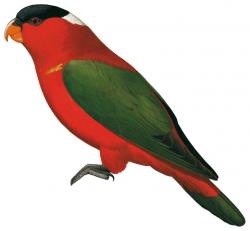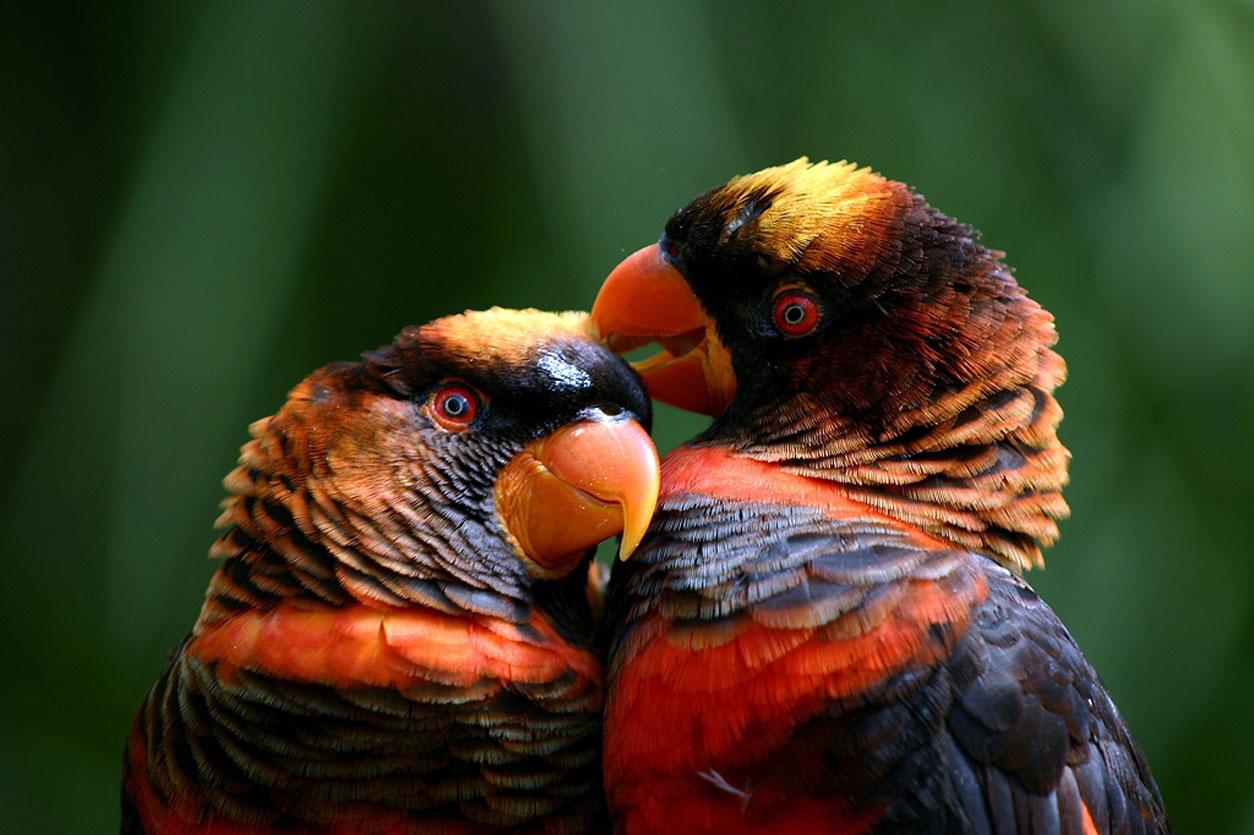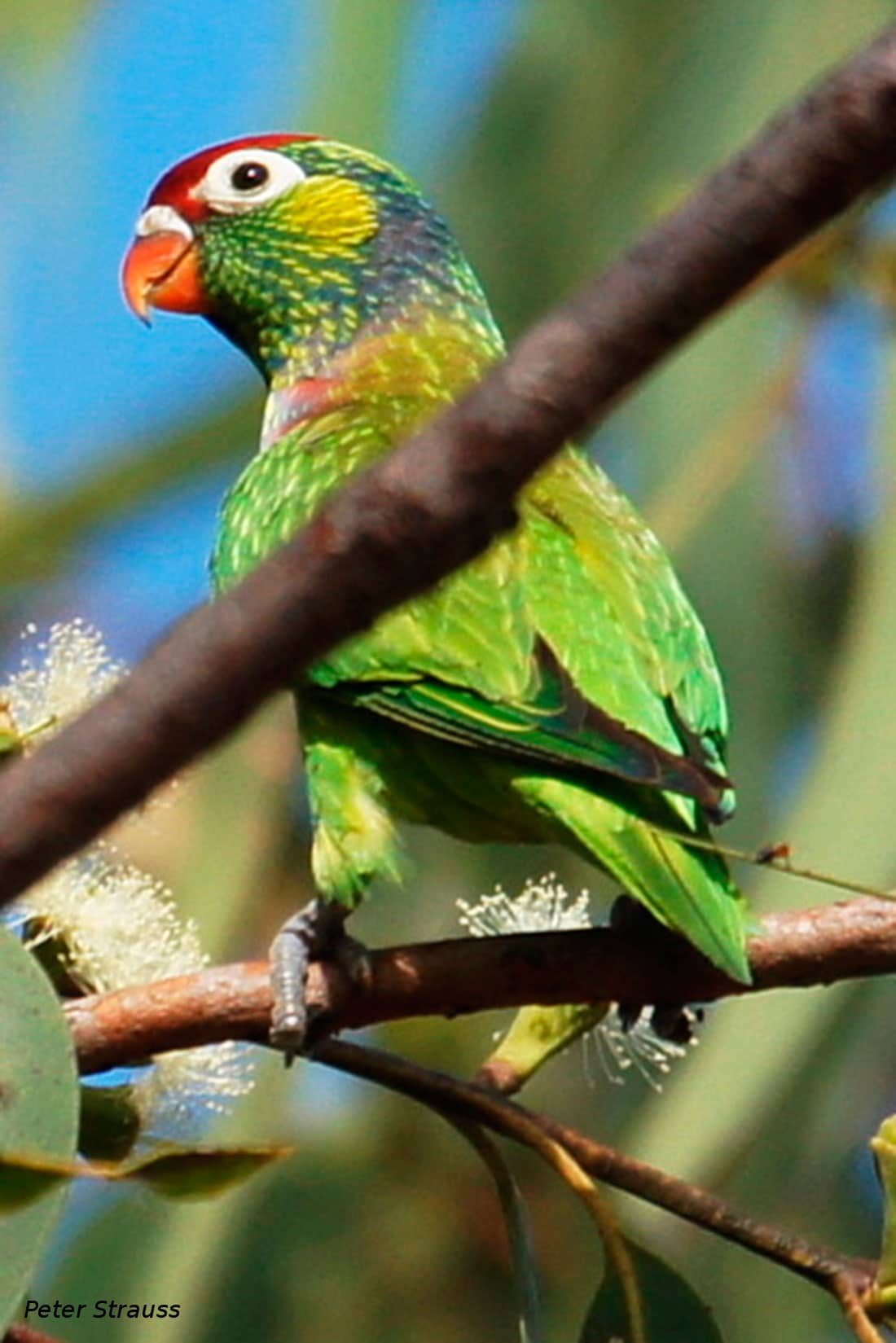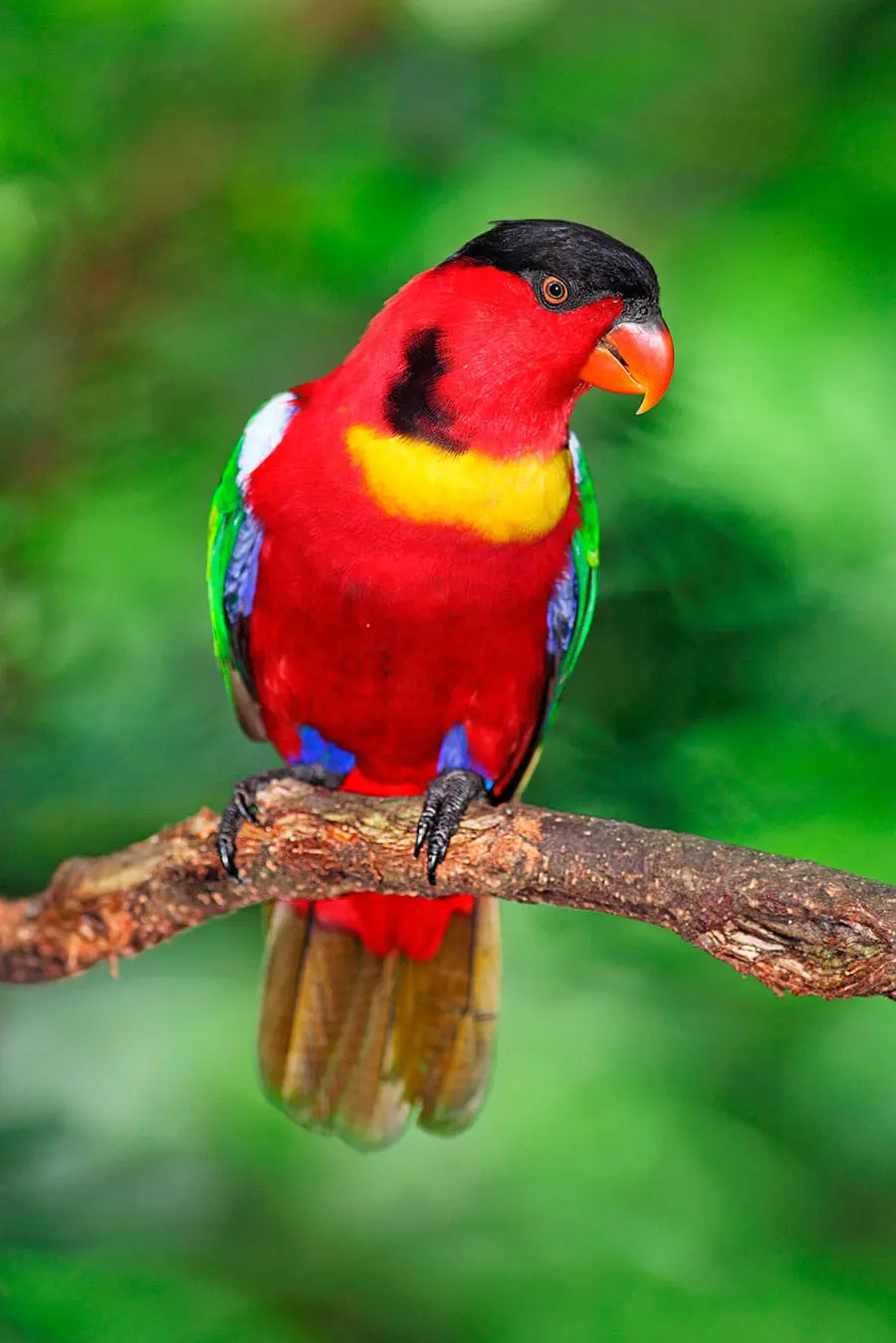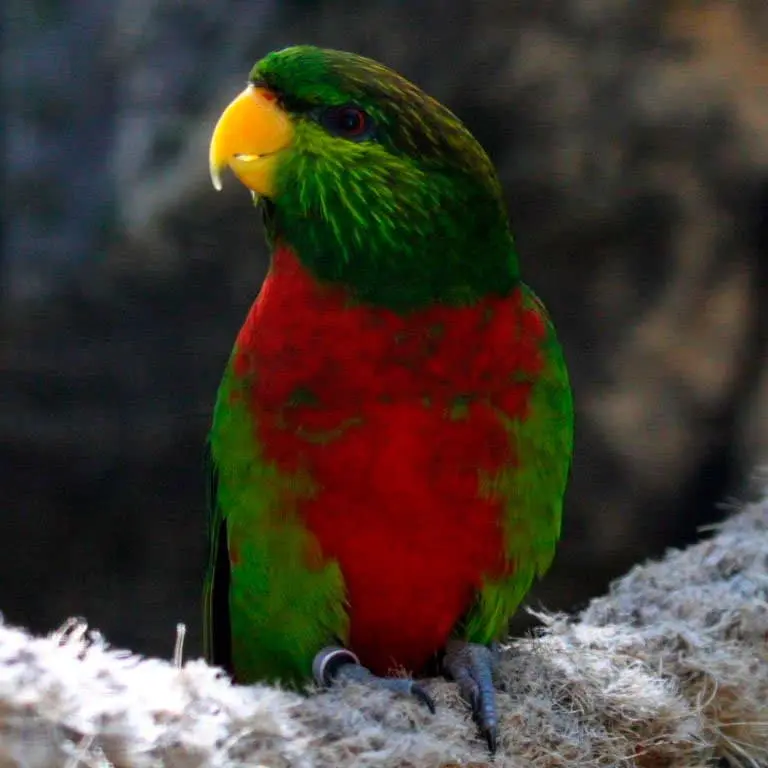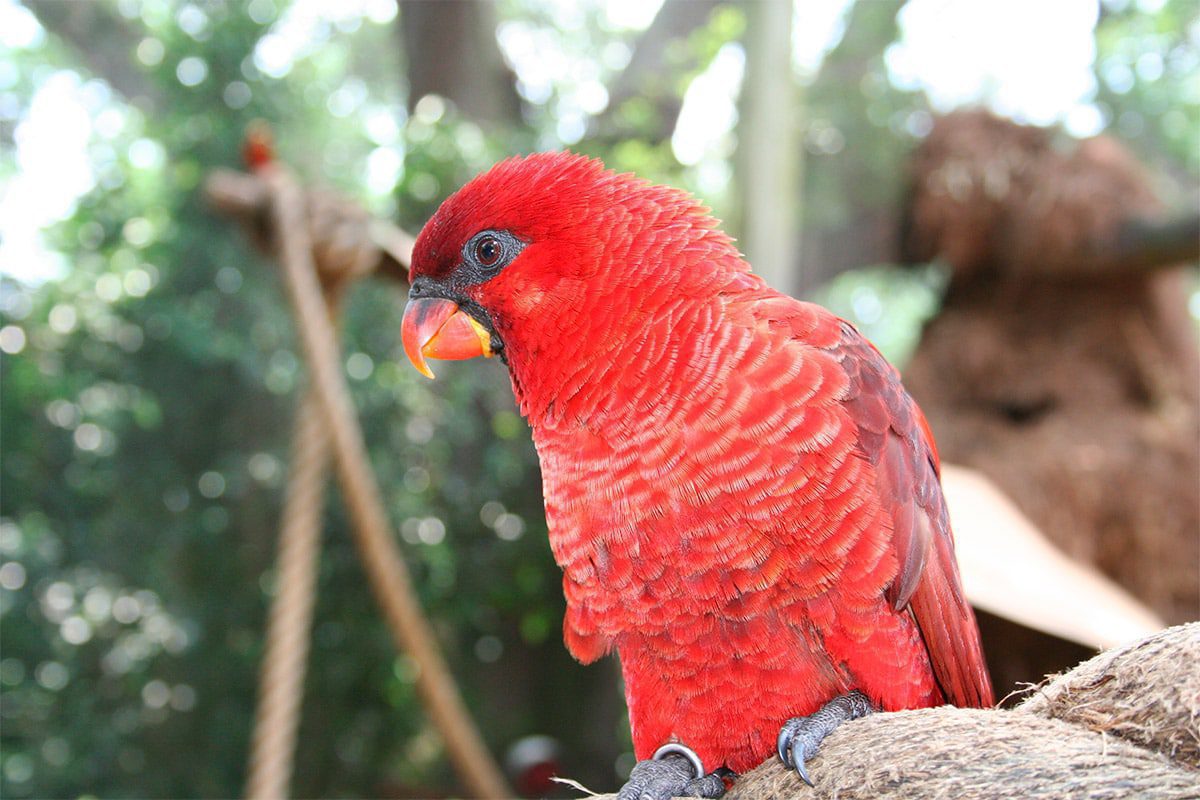
Is the more small of the gender Eos, with only 24 cm.. length and an approximate weight of 170 gr.
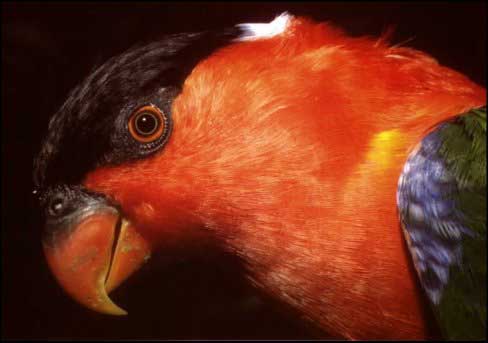
The plumage of the Blue-eared Lory x(Psittacus erithacus) is bright red.
The upperparts of the cheeks and ear-coverts form a band blue violet.
The feathers of abdomen and under the tail are blue, the primaries are black and red color on the inside, the secondaries has black spots, the feathers largest of the shoulder are blue, the back is red-brown, the underparts bright red, their irises are reddish brown, the legs grey and orange red the bill.
The plumage of the youth usually appears paler and duller Red. The mask boils down to a simple pale blue dot under the eye and the mumps. The scapulars are brownish grey with light blue striped uniform. The feathers of abdomen are red with some blue touches. The irises reddish color.
The Blue-eared Lory EOS can be mistaken for other species of the genus, but in its area of distribution, only the Red Lory (Eos Bornea) shows similarity of characters. But, does not display a blue stain in the face or at the bottom of the abdomen.
Frequently not only in primary forests, but also in the Highlands bordering the bare mountain peaks.
This bird usually lives above the 1.200 meters above sea level, area to which the Red Lory (Eos Bornea) fails. But, from time to time is reduced to 800 m, so sometimes they interfere in the same area two species.
The Blue-eared Lory they live alone, in pairs or small family groups.
They feed in the foreign branches of trees in flower.
They are noisy birds in flight, but they are relatively quiet and discrete When feed. When they move they tend to fly at low altitude.
Reproduction:
There is not much information of their reproduction habits in the natural environment. But, It can be assumed that the Red Lory It takes a form of very similar to that of other nesting Loris. These are cavemen, that is to say, you install their nests in tree cavities.
The season of spawning It estimated that the months of September to March.
Usually, they lay two eggs per clutch and its incubation lasts a few 26 days.
Young people are often taken up to 10 weeks before you fly.
Food:
They feed mainly on nectar in the trees in flower in lower altitudes and Heath (Heather, gorse, broom) at higher altitudes.
Distribution:
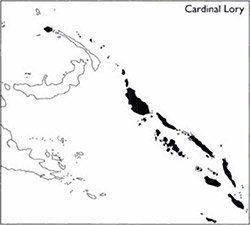
The Blue-eared Lory is endemic of the Seram island in the Moluccas (Indonesian).
Conservation:
– Current IUCN Red List category: Least concern
– The population trend: Decreasing
The world population It has not been quantified, but the species is estimated that it can range from common to abundant at the local level (pit et to the. 1997). However, justified the population trend, It is suspected to be in decline due to unsustainable levels of exploitation.
The population range is between 5,000 and 50,000 birds released.
Probably the Blue-eared Lory It will always remain a rare specimen in the world of birds.
In March of 1995 the Government of Indonesian stopped the export of these birds.
Its hunting for local trade has become especially intense.. Fortunately, There is no reason to keep to the Blue-eared Lory as a pet on the part of the indigenous population.
"Blue-eared Lory" in captivity:
Since its population is decreasing, any specimen that can not be returned to their natural habitat (natural range) should preferably be placed in a well-managed breeding program to ensure the survival of the species.
Alternative names:
– Blue-eared Lory, Ceram Lory, Blue eared Lory, Seram Lory (ingles).
– Lori masquรฉ, Lori ร oreilles bleues (French).
– Halbmaskenlori (German).
– Loris Semilarvata (Portuguese).
– Lori de Orejas Azul, Lori de Seram (espaรฑol).
scientific classification:
– Order: Psittaciformes
– Family: Psittaculidae
– Genus: Eos
– Scientific name: Eos semilarvata
– Citation: Bonaparte, 1850
– Protonimo: Eos semilarvata
– Blue-eared Lory in the Walsrode Bird Park, Germany by Quartl – Wikimedia
– papageien.org
– Blue-eared Lory (Eos semilarvata) at the San Diego Zoo by Leon Mitchell – Wikipedia
– free-pet-wallpapers.com
– kanaria1898tuttlingen.de
The Blue-crowned Lorikeet(Vini australis) has a plumage mostly green. The upper part of the head is dark blue with light blue streaks. The region of the windows of the nose, the cheeks, the ear-coverts, the neck and the abdomen They are red. the lower part of abdomen and the thighs they are purple blue. The back is green, the interior of the tail is yellowish-green. The irises is reddish brown. The legs are of color red and the bill is orange.
The youth are equal to adults, but with less red in the face and throat, little or none abdominal patch, stripes blue shorter in the crown, no purpura on the thighs, brown the eyes.
It is found in forests, coconut palms or any habitat where flowering trees; coastal mountains, gardens and agricultural areas. Nomad, sometimes traveling between the Islands.
Daily movements in search of food. Aggressive but gregarious, they often move in flocks of up to 12 individuals, except during the breeding season they live with their partners.
In Samoa it is common around villages and plantations and less common in moist forests, higher elevations in the rain forest and secondary growth.
Reproduction:
Nests in holes or hollows of trees, It has also been reported that they dig burrows in the banks of Earth, Although it has not confirmed. The laying is one or two white eggs. Breeding registered in June and August. In captivity the incubation It has been calculated in 23 days.
Food:
It feeds on nectar, pollen and red fruits. It particularly prefers Erythrina, Wild hibiscus and coconut.
Distribution:
Extends over the archipelagos of Samoa, Tonga and LAU, distributed by Islands: Love, Futuha'a, Fulago, Futuna, Ha'afeva, You're young, Moce, Niue, Ofu, Olosega, Samoa, Salt, Tafahi, Say, Tofua, Tungua, Fire, It's cool, Varoa, I'm sorry and Voleva. In the past was also in ‘USA, Tongatapu and Mata-Utu but there it is extinct.
Conservation:
– Current IUCN Red List category: Least concern.
– The population trend: Decreasing.
The world population It has not been quantified, but the species is informed that it is common in much of its restricted area of distribution.
The population is suspected to be in decline due to the predation by species invasive.
Still fairly common throughout its range, but it has become extinct on many islands and it is decreasing in Tonga (probably because of the rats).
"Blue-crowned Lorikeet" in captivity:
Like the others Vini lories, the Blue-crowned Lorikeet still quite rare in poultry farming, probably as a result of the protection they receive in their native South Pacific countries.
Alternative names:
– Blue-crowned Lorikeet, Blue crowned Lorikeet, Blue-crowned Lory (ingles).
– Lori fringillaire (French).
– Blaukรคppchen (German).
– Loris Vini Australis (Portuguese).
– Lori de Samoa (espaรฑol).
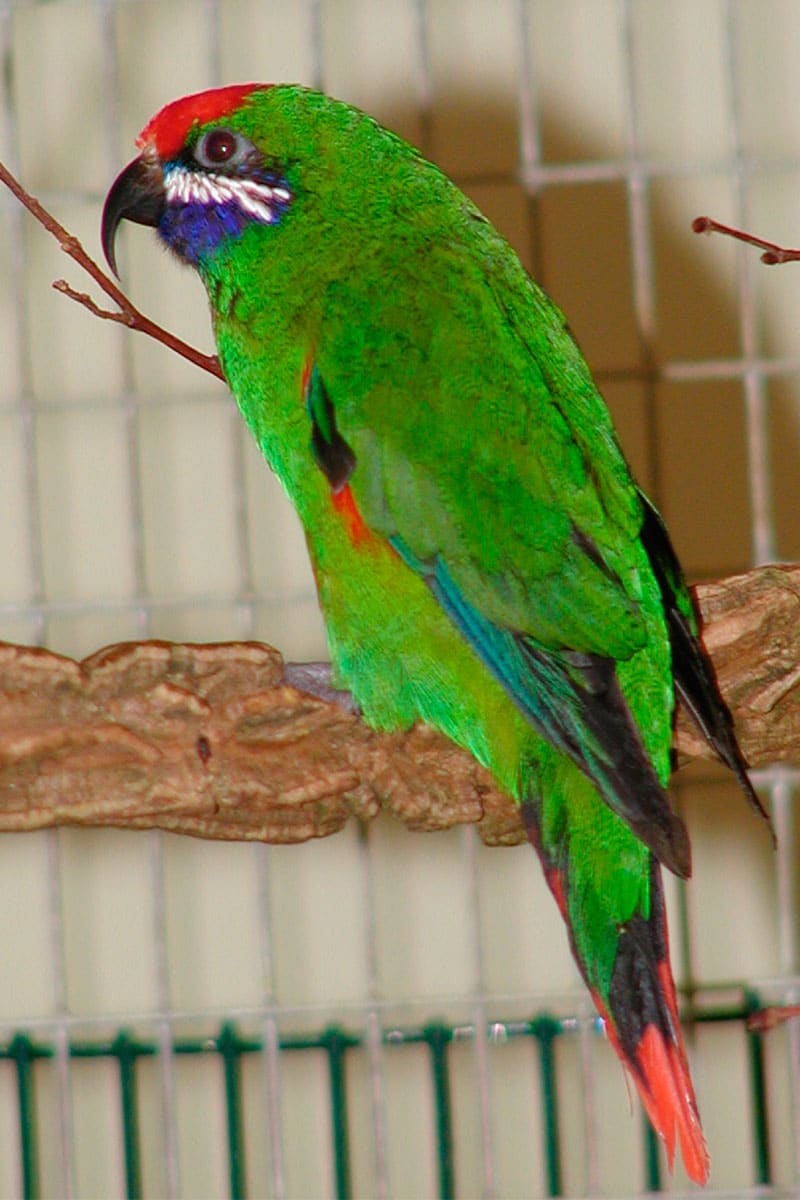
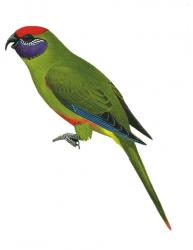
The forecrown of the Blue-fronted Lorikeet(Charmosyna toxopei) is bright green, the front of the crown, above the eyes is bright blue; rest of the head green. Upperparts green, bright in the rump. Wings Green with blackish inner feathers. The underwing-coverts green; flight feather Blackish with yellow band in the whole lower part of the secondaries. The underparts brighter yellowish green. Tail green, with red bases and blackish stain. The bill orange; the irises yellow orange; legs orange-red.
Habitat:
If recent observations were in fact of the Blue-fronted Lorikeet, species can be nomadic, moving from high to low altitude on the basis of the availability of food (like some other small parrots). This could explain the paucity of records, especially for a species already by itself it is distributed sparsely. The other possibility is that the birds are distributed only in the forested hills.
Interviews with local residents suggest that the species moved to the lowlands during the two annual seasons of heat, in March-April and August-November.
Reproduction:
There is no data.
Food:
The locals who live in the plateau frog They reported that the bird feeds on nectar and pollen from the trees in flower.
Distribution:
Endemic to Buru, Indonesian. Obviously, is a rare species, and virtually nothing is known of its State. The original specimens were collected in the wooded hills between 850 m and 1.000 m.
In 1980 the species was reported to be quite common in plantations, secondary and primary forest, but this record has been suggested as a reference to the Red-flanked Lorikeet(Charmosyna placentis) (the record of this species from Buru It is in fact wrong). In 1989 two flocks of five to six birds, supposedly this species, they were seen during a selective felling of forests to 600 meters on the Teluk Bara. There is also a report of 1993 of four small unidentified parakeets seen in the same area as the observations of 1.980. The species are now considered endangered by Birdlife International, although a thorough search must be carried out before its status can be fully determined. VULNERABLE.
Conservation:
โข Current IUCN Red List category: Critical Hazard
โข Population trend: Decreasing
โข Population size: 50-249 mature individuals
Although there are few records (confirmed or unconfirmed) of the species, It is suspected that it is declining due to loss of forests in the lowlands.
Most of the forests in the coastal lowlands of Buru have they been clarified, and much of the forest in the northern part of the island has been connected shape selective or degraded and fragmented by migratory agriculture, in such a way that only a few small patches of lowland primary forest remain. But, the island's gardens still contain many indigenous tree species. In 2010, There was at least one search operation on a large scale above Buru, located in the lowlands. But, extensive forests of mountain of the island remain largely without being scanned. The topography of the mountain range Kaplamandan is the hope that almost all of the montane forest is inaccessible to loggers (A. Gray in litt. 2010).
All of the original specimens were captured alive using lime, However, the species is not kept as a pet, does not seem to be listed. Have a distribution of mountain which is close to the maximum altitude within its distribution area, does this species is potentially susceptible to climate change (BirdLife International data not publ.).
"Blue-fronted Lorikeet" in captivity:
Not found in captivity.
Alternative names:
– Blue-fronted Lorikeet, Blue fronted Lorikeet, Buru Lorikeet (ingles).
– Lori de Buru (French).
– Burolori, Burulori (German).
– Lori de Buru (espaรฑol).
The Marigold Lorikeet(Trichoglossus capistratus) has the forecrown, the cheeks and chin, dark blue; and the rest of the head It is green with a broadband yellow-green in nape (part posterior of the neck). The upper breast is yellow with green narrow edges feathers. Underwing-coverts are yellow with scattered orange marks. Males may have some red on their edges. The abdomen is dark green. Their peaks They are hooked.
The males and females and players seem to depend on DNA or endoscopic sexing to determine gender.
Taxonomic status:
This taxon is considered a subspecies of Trichoglossus [haematodus, rosenbergii, moluccana, forsteni, capistratus, weberi] (sensu lato) by some authors.
Sound of the Marigold Lorikeet (1).
(1) Some species are under extreme pressure because of traps and harassment. So, the open availability of high-quality recordings of these species may further worsen the problems, this being the reason why downloading these recordings is off. In conclusion, recorders themselves are free to share these files on xeno-canto, but they will have to approve access to these recordings.
We do not take this action lightly, and we wish it wasn't necessary, but we are convinced that the negative impacts of offering easy access to these recordings outweigh the benefits. To access these recordings, You can contact directly with the recorder.
(Hellmayr, 1914) – Head green with purple/blue veins on the forecrown up to the cheeks; variability of yellow to deep orange in chest; neck wide and yellow; abdomen dark green to green / black; underwing-coverts yellow with orange markings variables.
Trichoglossus capistratus fortis
(Hartert, 1898) – Head black/brown with purple/blue veins on the forecrown up to the cheeks; lores , throat, line from top to back of the eyes and occiput, green; chest bright yellow with orange but not barred / red marks; abdomen dark green, with occasional shades blue / black; underwing-coverts yellow.
Habitat โBridled Loryโ:
The Marigold Lorikeet They are in mixed flocks with other parrots; small and noisy groups. Nomads, since they depend on flowering trees. It perches communally in groups of hundreds of birds.
It is more common in lowlands, but it is up to altitudes of 2400 m. Wide variety of areas including settlements, forests, coconut plantations, Savanna, eucalyptus forests and mangroves, including dry forest Roti.
Reproduction ยซBridled Loryยป:
Total of 21 nests found in Sumba between late August and early October 1992, all cavities in large trees (principalmente deciduous).
Feeding ยซFlanged loryยป:
Few specific dietary data, but presumably similar to Trichoglossus haematodus and it is known to take nectar and pollen from native trees, as well as figs and insects.
Distribution ยซFlanged loryยป:
Extension of the distribution (breeding/resident): 171.000 km2
The Marigold Lorikeet It is a species of parrot endemic to the islands of Southeast Asia Sumba, Roti, Wetar and Blend(Indonesian) and Timor(Indonesia and East Timor).
1. Current red list category of the UICN: Least concern.
2. The population trend: Decreasing.
3. Population size : —.
Rationale for the Red List category
Although this species may have a restricted range, It not believed to approach the thresholds Vulnerable under the criterion of size range (Scope of the presence <20.000 km2 combined with a decreasing area size or fluctuating distribution, extension / habitat quality, or population size and a small number of places or severe fragmentation).
While the trend of the population seems to be decreasing, the decline is not believed to be rapid enough to approach the Vulnerable thresholds according to the population trend criterion (decrease of more than 30% in ten years or three generations).
The population size has not been quantified, but it is not believed to approach the thresholds Vulnerable under the criterion of population size (<10.000 mature individuals with an estimated continuous decrease in> 10% in ten years or three generations, or with a specific population structure). For these reasons, the species is assessed as Least concern.
Justification of the population
Global population size has not been quantified, but the species is described as common in Timor(pit et to the. 1997).
Justification trend
They suspected that the population is declining due to unsustainable levels of exploitation.
Threats
The species has been the subject of a intense trade: from 1981, When it was included in the Appendix II of the CITES, they have been 100.388 individuals captured in international trade (UNEP-WCMC CITES Trade Database, January 2005).
In captivity:
It's one of the lori rainbow less noisy although uncommon in captivity except for Dili (Capital of Timor Oriental), where it is quite common. Its longevity It 20 years en libertad, 15-25 years in captivity.
1. Avibase
2. Parrots of the World โ Forshaw Joseph M
3. Parrots A Guide to the Parrots of the World – Tony Juniper & Mike Parr
4. Birdlife
Photos:
(1) – Trichoglossus (haematodus) capistratus group by Matthew Hoelscher from Doral, FL, USA [CC BY-SA 2.0], via Wikimedia Commons
(2) – A Marigold Lorikeet at Denver Zoo, Colorado, USA by William Andrus from Greeley, CO, USA [CC BY 2.0], via Wikimedia Commons
(3) – A Marigold Lorikeet at the Aquarium of the Pacific, Long Beach, California, USA by Greg Goebel from Loveland CO, USA [CC BY-SA 2.0], via Wikimedia Commons
(4) – Photo by David J. pole [CC BY-SA 4.0], via Wikimedia Commons
(5) – Edwardโs Lorikeet (Trichoglossus haematodus capistratus) by coracii – Flickr
The general plumage of the Ornate Lory (Trichoglossus ornatus) is green. The front, the head and feathers that cover the ears are blue. It has a small red stripe that goes from the upper right corner of the eye to the nape of the neck, It also has a yellow stripe on the sides of the neck. The throat and chest are orange-red and in each pen has a bluish-black wide table. Underwing feathers are yellow.
The rest of the bottom is green with yellowish scales.
Belly pale green with dark green bars. Green-yellow under the tail is bright green ends. The upper part of the tail is dark green with yellow edges in outer feathers. The base of the outer tail feathers is pink.
The circle around the eyes is narrow and dark gray. The iris is red, the legs are grey and orange beaks.
The Ornate Lory they usually visit the swamps and marshy woodlands where there is fresh water. They are also found in the forest, the plots during the regeneration near the edges, scattered shrubs in cropland, including coconut plantations.
Usually, They appreciate the open areas and do not venture far from the primary forests.
In the North and center of the main island, These birds live from sea level up to the 1.000 meters above the sea level, While in the South, You can climb up to the 1.500 m. Its preferred habitat is between 300 and 500 m.
The Ornate Lory They mainly live in pairs or in small groups. Sometimes, when feeding in fruit trees or at the edges of the forest, are associated with the Yellow-and-green Lorikeet (Trichoglossus flavoviridis).
Benefiting from stable climate, These birds are probably sedentary.
Reproduction:
We really know very little about the reproductive habits of this species in the wild.
Most of the birds are able to breed in the months of September and October. There is no information on the construction and composition of the nest.
Spawning usually consists of 3 eggs that are incubated during 27 days. The chicks are nidicolous and depend on their parents during 80 days after hatching.
Food:
The Ornate Lory they are vegetarian birds, most of its menu is made up of nectar, pollen and fruit. When feed, these birds may concentrate in large numbers on flowering trees. The seeds of the trees of the genus Tectona and Casuarina they are also part of their diet.
Distribution:
This species is endemic to Indonesia , where is widespread in Sulawesi and surrounds the coast islands including Togian, Peleng, Banggai and the archipelago Tukang Besi. It has been reported that it is no longer common in parts of northern and central Sulawesi, but still seems to be common on the islands Togian and in the lowland forest in Torout (Bogani Nani NP) and to a lesser extent in Tangkoko.
Conservation:
– Current IUCN Red List category: Least concern
– The population trend: Decreasing
It has been described as common and locally very common., with a total population of over of 50.000 specimens.
The trend has not been quantified, but slow descents can be seen due to some pressure from capture, and although it does not require primary forest it is more common in the lowlands and therefore may be affected by habitat loss.
It seems that the Ornate Lory is trapped in national parks as Tangkoko and Lore Lindu, and they are commonly seen in bird markets.
"Ornate Lory" in captivity:
Due to its state of decline in its population, any specimen that can not be returned to their natural habitat (natural range) should preferably be placed in a well-managed breeding program to ensure the survival of the species.
– Ornate Lorikeet at San Antonio Zoo, Texas, USA. by George Coller – Wikimedia
– by ยฉ 2004 Jeff Whitlock – Jacksonville Zoo
– by iggino – IBC.lynxeds.com
– Trichoglossus ornatus parrot eating banana – free-pet-wallpapers.com
– Sounds: Mike Nelson (Xeno-canto)
โท The world of Pets: Dogs, cats, birds, reptiles, amphibians
Males and females of the Kuhl's Lorikeet(Vini kuhlii) they are identical in appearance. Adult birds have cheeks, the chest and the part forward of the belly bright red.
The upperparts the body has different shades of green with the exception of a few Feather erection of color blue dark in the neck.
Its tail is multicolored, the Central feathers are red and purple sides, with the Green terminal part.
A zone blue-violet in the belly around the the thighs. The bill and legs are orange, the tail is short.
The birds youth they have the underparts opaque red.
The natural habitat of the Kuhl's Lorikeet are the tropical humid forests. On the Islands desforestadas also is in coconut plantations. It is a nectarivorous that feeds sucking nectar with his rough tongue.
Reproduction:
Observed in the month of March, April and August. Nest in the trunks of coconut trees or FARA (Pandanus tectorius) dead or in cavities of hotu. Sometimes one or two rectangular holes mark the entrance of these nests. Only a litter has been found with two chicks.
Food:
Nectar and pollen from banana flowers (Musa sp.), Kapok (Ceiba pentandra), pacayers (Inga edulis), Mango (Mangifera indica), avocado (It persea americana), the coconut (Cocoa nuts), the Cordyline (fructicosa Cordyline) , the NASE (Barringtonia asiatica), the tafano (Guettarda speciosa), the Pomeroy (Syzygium jambos) and ATAE (Erythrina variegata).
The small seeds of purau (Hibiscus tiliaceus) and Aito (Casuarina equisetifolia). Axillary buds and young shoots of hotu, purau and falcata (Paraserianthes falcataria).
They lick the surface of the leaves of banana. Make sudden movements in the leaves of certain trees without flowers or fruit (including dead Palm trees), also tends to dig small holes – clearly too superficial to serve as a nest -, This we do think that also can be insectivores.
Distribution:
Size of the area of distribution (reproduction / resident) 510 km2
endemic to Rimatara in the Tubuai Islands, south-central Pacific (France), where the population is estimated at 905 birds. It has also been introduced in Kiribati including Teraina (Washington Island) and Tabueran (Fanning island), both before 1798, and Kiritimati (Isla Christmas), where six specimens were transferred in 1957.
Occasional appearances in the Thbuai island about Rimatara they are probably elopements pets.
Although the species is relatively common in Rimatara. the recent introduction of rats is cause for concern.
The population of Tabueran (c. 200 birds) It is also vulnerable because of predation of nests by rats.
In Teraina There are a few 1.000 birds and with no confirmed threat. It is possible that one or two individuals may still survive in Kiritimati. IN DANGER OF EXTINCTION.
Conservation:
โข Current IUCN Red List category: Danger
โข Population trend Decreasing
Although populations are believed to be stable in Rimatara and Teraina and grow in Atiu where it was recently introduced, invading predators are probably causing a decrease in Tabuaeran and Kiritimati, Therefore, the general trend is suspected to be a moderate and continuous descent is its population.
Excessive exploitation of its red feathers is the most likely reason for the extinction of the Kuhl's Lorikeet in the Islas Cook.
A serious threat to all hatchlings in the Pacific islands, It is the depredation caused by rats in the nests, especially on the part of the Black Rat (Rattus rattus). In Rimatara, There was a wide shot of black rats (Rattus rattus), to leave the island away from them in the year 2000. However the rats of the Pacific (R. exulans) they were still very abundant.
In Teraina, There is no evidence of the presence of the (R. Rattus), although the Pacific rat (R. exulans) is abundant, While in Tabuaeran and Mitiaro, still having black rats (R. Rattus). Cats can be a threat in Kiritimati. The common mine (Acridotheres tristis) It is a threat to the introduced population in Atiu, Since it competes for nesting sites and usually attacking young people Kuhl's Lorikeet.
Ongoing conservation actions:
Appendix II of CITES.
– In Kiribati, the species is fully protected.
– In the french polynesia the species is protected by national laws and regulations from 1996.
– In Rimatara It has been protected by a traditional tapu (taboo) from 1900.
– 27 birds were reintroduced in Atiu from Rimatara in May of the 2007, after which organized a community contest to find the first young birds, with a reward given to the winner.
– Monthly count of birds in Atiu carried out to evaluate the success of the effort of introduction.
– A control program of the common mine started in Atiu in May of 2009, including harassment and capture, with a bounty for each dead bird.
– For October of the 2009, the population of the birds Mine had been reduced by 60% and this program is permanent.
– In Rimatara, 21 bait stations were established in the main Pier in September of 2009 to prevent black rats invading the island and raising awareness is taking place among children about the importance of protecting the avifauna of the island.
"Kuhl's Lorikeet" in captivity:
It is not in captivity.
Due to its State, in danger of extinction, any specimen that can not be returned to their natural habitat (natural range) should preferably be placed in a well-managed breeding program to ensure the survival of the species.
Alternative names:
– Kuhl’s Lorikeet, Kuhl’s Lory, Kรผhl’s lory, Rimatara Lorikeet, Rimitara Lorikeet, Ruby Lorikeet, Scarlet-breasted Lorikeet (ingles).
– Lori de Kuhl (French).
– Rubinlori (German).
– Lรณris-de-kuhl (Portuguese).
– Lori de Rimatara (espaรฑol).
The Pygmy Lorikeet(Charmosyna wilhelminae) has an approximate length of 13 cm.. and a weight of 20 g..
The head is green; the forecrown brighter yellowish green; crown dark purple, with broadcast Blue in them tips and color turquoise bright in the feathers of the nape; rear of the nape with wash of olive. Mantle green; low back and tail reddish color; at the top, the tail purple blue. The wings, by up green with parts internal of the flight feather Blackish and blackish the primary coverts. The wings below rosa-salmon; Tips from the flight feather blackish. The underparts Green yellowish with prominent veins on the chest. Upper, the tail green, Red at the base (normally hidden in the field); olive brown below with red and yellow tips on the base. The bill reddish orange-tipped yellow; cere color red pink; Grey the ringperioftalmico; irises yellow to orange-red; legs light grey.
Female lack of red on it rump and in the wings view in flight. Immature generally more muted and upperparts slightly more Brown. Lacks blue at the tips of the feathers of the nape. Yellow stripes on the top of the chest less distinct or absent. The bill and the irises brown.
Habitat:
Mainly inhabits in humid forests and on the edge of forests, but also by forest savanna and established secondary vegetation. It is usually between the 1.000 meters of altitude and the 2.200 m, but in the South and around Port Moresby It is occasionally much closer to sea level, in the forests of lowlands. It forages in couples and small flocks of up to 20 birds in the trees in flower, often in the company of Goldie's Lorikeet and Fairy Lorikeet. Very Active When it feeds and, often difficult to identify due to its size and predominantly green plumage. It is not uncommon, but easily overlooked. and has been found in groups of up to 200 individuals. It has often been seen flying in mixed flocks above the canopy, where they can hardly be identified due to their small size.
Reproduction:
Breeding and nesting habits unknown.
Food:
Feeds of nectar and pollen.
Distribution:
Size of the area of distribution (reproduction / resident): 290.000 km2
North of New Guinea in Irian Java (Indonesian) and Papua New Guinea. The range of the Mountains Parotia on doberai peninsula, in the West of the island of New Guinea, through the cordillera central, the Huon Peninsula, and South-East of the mountain range of Owen Stanley. In the immediate vicinity of Port Moresby (for example, area Sogeri) There is little (but possibly regular between May and November).
The population world will think that is of less than 50.000 specimens and is considered to be stable. There are few in captivity.
Conservation:
โข Current IUCN Red List category: Least concern.
โข Population trend: Stable.
The size of the world population It has not been quantified, but the species according to sources is generally very rare.
The population suspected to be stable in the absence of evidence of any reduction or substantial threats.
"Pygmy Lorikeet" in captivity:
Rare.
Alternative names:
– Pygmy Lorikeet, Pygmy Streaked Lorikeet, Pygmy Streaked Lory, Wilhelmina’s Lorikeet, Wilhemina’s Lorikeet (ingles).
– Lori de Wilhelmina (French).
– Elfenlori (German).
– Lori Pigmeo (espaรฑol).
Of 25-30 cm. length; 70-169 grams and a wingspan of 46 cm..
The plumage of the Rainbow Lorikeet(Trichoglossus moluccanus) is very bright. The head is deep blue with a neck greenish-yellow and the rest of the upperparts (wings, back and tail) are deep green. The chest is red with blue-black barring.. The belly is deep green, and the thighs and rump are yellow with deep green barring.. In flight, a yellow wing-bar contrasts clearly with the red underwing-coverts.
There is little to visually distinguish between the sexes; However, for an acute observer, their dimorphism is readily apparent.
The youth has bill black, which gradually brightens to orange in the adults..
The markings of Trichoglossus moluccanus resemble of the Coconut Lorikeet(Trichoglossus haematodus), but with a belly blue and breast with little or no blue-black barring..
Rainbow Lorikeet taxonomy
With one exception, the species have been treated so far as a group of subspecies within the extended group Coconut Lorikeet(Trichoglossus haematodus), but they differ from the Trichoglossus haematodus her pale red breast without bars ; its blue belly against green or blackish; its pale blue hood without black edge and its larger size.
The subspecies Trichoglossus moluccanus eyrei (South of Australia) It is included within the species nominal. Small hybrid population of present species paired with the Musk Lorikeet(Glossopsitta concinna) in SE Southern Australia (Yorke Peninsula).
Sound of the Rainbow Lorikeet. (1)
(1) Some species are under extreme pressure because of traps and harassment. So, the open availability of high-quality recordings of these species may further worsen the problems, this being the reason why downloading these recordings is off. In conclusion, recorders themselves are free to share these files on xeno-canto, but they will have to approve access to these recordings.
We do not take this action lightly, and we wish it wasn't necessary, but we are convinced that the negative impacts of offering easy access to these recordings outweigh the benefits. To access these recordings, You can contact directly with the recorder.
(Robinson, 1900) – As the species nominal but with brighter purple/blue stripes on the head and tail shorter.
Habitat:
The Rainbow Lorikeet often they travel together in pairs and occasionally respond to calls to fly like a flock, then they disperse again in pairs. Couples aggressively defend their feeding and nesting against other lstallion arcoiris and other bird species. Not only they scare off smaller birds, as the Noisy Miner(Manorina melanocephala) and the Brush Wattlebird(Anthochaera chrysoptera), but also to larger, as the Australian Magpie(Gymnorhina tibicen).
Reproduction:
In Australia, Reproduction usually takes place during spring (from September to December), but it may vary from one region to another with changes in food availability and climate. Sites nesting They are variable and may include gaps as tall trees eucalyptus, trunks of palm trees or overhanging rocks.
Couples sometimes nest in the same tree with other couples Rainbow Lorikeet or other species of birds. The clutch size is between one and three eggs, which are incubated for about 25 days. Incubation tasks are performed by the female alone.
The Rainbow Lorikeet are mostly monogamous and remain paired for long periods, if not for life.
Extension of the distribution (breeding/resident): 3,810,000 km2
Endemic East and Southeast Australia (of Cape York to the Eyre Peninsula, South of Australia)
They were recorded for the first time in Perth in 1968 and the population is believed to have come from fewer than ten birds that were deliberately released or had escaped from aviaries.
Since the beginning of the decade 1960, the population has grown exponentially and has spread rapidly throughout 174 km2 metropolitan area. The current population is estimated at 8.400 birds and their range is expanding at a rate of 0,7 km per year.
(Robinson, 1900) – North of Queensland (Cape York Peninsula), in northwestern Australia; also the Torres Strait Islands (Boigu and Saibai except, at the north end) and it was introduced in the district of Perth, in southwest Australia..
Conservation "Rainbow Lorikeet":
1. Current red list category of the UICN: Least concern.
2. The population trend: Decreasing.
3. Population size : Unknown.
Rationale for the Red List category
This species has a extremely large distribution area, and therefore does not approach the thresholds for Vulnerable under the criteria of size range (Extent of Occurrence <20,000 km2 combined with a decreasing area size or fluctuating distribution, extension / habitat quality, or population size and a small number of places or severe fragmentation). While the trend of the population seems to be decreasing, the decline is not believed to be rapid enough to approach the Vulnerable thresholds according to the population trend criterion (decrease of more than 30% in ten years or three generations).
The population size has not been quantified, but it is not believed to approach the thresholds for Vulnerable under the criterion of population size (<10.000 mature individuals with an estimated continuous decrease in> 10% in ten years or three generations, or with a specific population structure). For these reasons, the species is assessed as Least concern.
Justification of the population
Global population size has not been quantified, but the species is described as abundant in northern Australia and rare Tasmania(pit et to the. 1997).
Justification trend
They suspected that the population is declining due to unsustainable levels of exploitation.
Rainbow Lori Threats
The species has been the subject of a intense trade: from 1981, When it was included in the Appendix II of the CITES, they have been 100.388 individuals caught in international trade (UNEP-WCMC CITES Trade Database, January 2005).
In captivity:
Not very common. Its longevity It 20 years en libertad, 15-25 years in captivity and its market price is around wild birds 250 EUR.
Alternative names:
– Rainbow Lorikeet, Rainbow Lorikeet (Rainbow) (English).
– Loriquet ร tรชte bleue (de Swainson), Loriquet ร tรชte bleue (moluccanus), Loriquet arc-en-ciel, Loriquet de Swainson (French).
– Regenbogenlori (German).
– Lรณris-molucano, Periquito-arco-รญris (moluccanus) (Portuguese).
– Lori arcoiris, Lori de Arco Iris (espaรฑol).
(1) – A Rainbow Lorikeet Trichoglossus moluccanus in Melbourne, Australia by Alfred Sin [CC BY-SA 2.0], via Wikimedia Commons
(2) – Rainbow Lorikeet Trichoglossus moluccanus on a garden bird feeder, Sydney, Australia by Tim Douglas from Sydney, Australia [CC BY-SA 2.0], via Wikimedia Commons
(3) – Rainbow Lorikeets (Trichoglossus moluccanus) feeding frenzy South Molle Island, Airlie Beach, Central Queensland, AUSTRALIA by Bernard DUPONT – Flickr
(4) – Rainbow Lorikeet (Trichoglossus moluccanus) Kangaroo Flat, Vic by patrickkavanagh – Flickr
(5) – Rainbow Lorikeet Trichoglossus moluccanus, Daintree Village, Queensland, Australia by JJ Harrison (jjharrison89@facebook.com) [GFDL or CC BY 3.0], from Wikimedia Commons
(6) – Rainbow Lorikeets Trichoglossus moluccanus in Broulee, New South Wales, Australia by Steve Shattuck from Canberra, Australia [CC BY 2.0], via Wikimedia Commons
(7) – Trichoglossus moluccanus by Skitterphoto [CC0], via Wikimedia Commons
(8) – Rainbow lorikeet, Trichoglossus moluccanus, Royal Botanic Gardens, Melbourne, Australia by Derek Keats from Johannesburg, South Africa [CC BY 2.0], via Wikimedia Commons
(9) – Rainbow Lorikeets Trichoglossus moluccanus at a bird feeder in Narooma, New South Wales, Australia by Robyn Jay [CC BY-SA 2.0], via Wikimedia Commons
(10) – A digital image of Trichoglossus moluccanus, by the esteemed scientific illustrator Ferdinand Bauer [Public domain], via Wikimedia Commons