โ–ท The world of Pets: Dogs, cats, birds, reptiles, amphibians

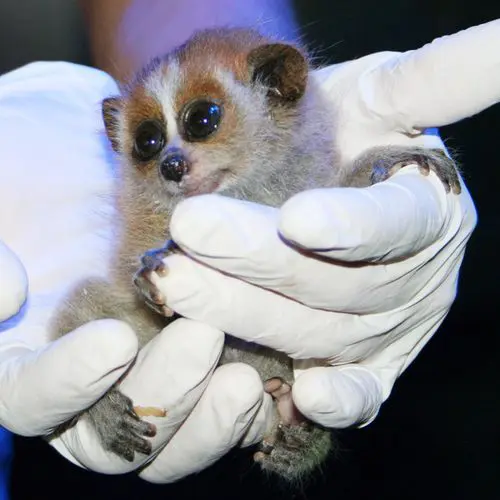
The rare loris of probe, Slow Loris or loris Pygmy sloth
Slow Loris

loris de Sonda

Primitive primates called prosimians that are in the tropical forests of Laos, Viet Nam, China and Cambodia. These arboreal primates become extinct almost during the Viet Nam war. Much of the forest where lorises lived was destroyed. After the war, deforestation remains a threat. Due to numerous environmental hazards, The species is classified as "vulnerable" by the Programme of the United Nations to the Centre global environmental monitoring of conservation

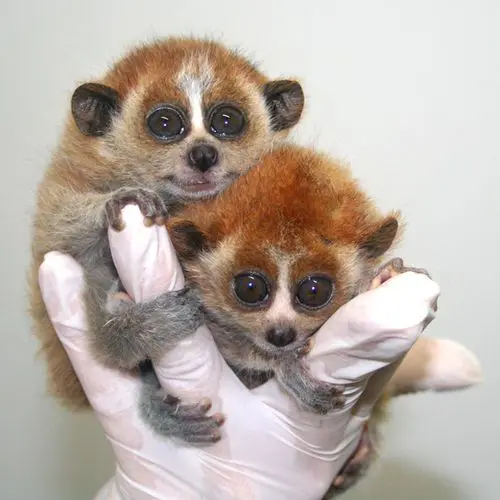
To help the repopulation of the species, Moody Gardens, an accredited member of the Association of zoos and aquariums (AZA), teamed with the AZA to participate in a Plan of survival of species (PS3). The birth at Moody Gardens was a great success for this cooperative breeding and conservation program., to help ensure the survival of the species, both in the natural environment such as captivity.

Icarus parents and Luyen have 11 and 15 years old and have been an integral part of Moody Gardens Animal Breeding for the past seven years.

ยซThe twins are very young, so they spend the day next to Luyen for breastfeeding.", said Kolvig.
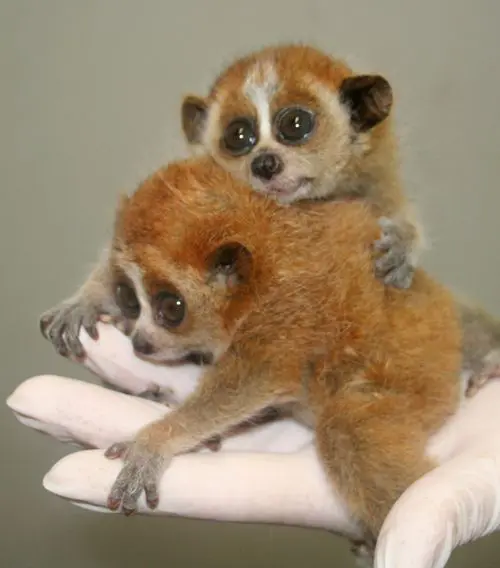
loris de Sonda

loris de Sonda

Via: zooborns

Photo credits: Moody Gardens

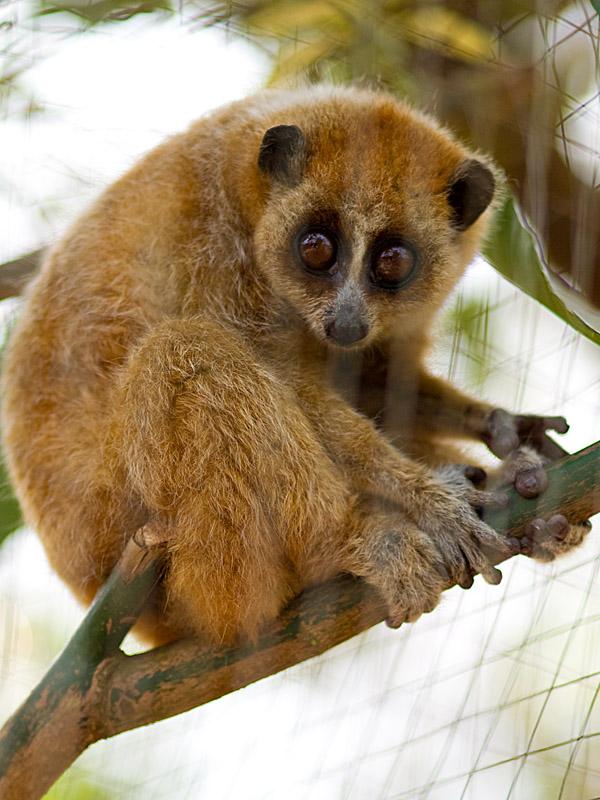
The probe loris

It measures 30 to 38 cm long and weighs 1 to 2 kg. The hair is dense, woolly, short and smooth, tawny colour with tones ranging from greyish or yellowish brown to reddish brown, and in the ventral area is white to yellowish or grayish. Along the back, the nape of the neck and up to the forehead has a narrow black band. The snout is short. Between the forehead and the nose it presents whitish hair around the eyes, you are surrounded by dark brown rings.

There is a tendency of the dorsal band to grew as it goes from North to South of the area of dispersion of the species, so close to the ears and becomes confused with facial mask.

The toes are short and the second finger of the hand is very low, but in the hind limbs, the second toe presents a long fingernail specialized for mutual grooming.

Of nocturnal and arboreal habits. Mark territory with urine to avoid conflicts with other individuals of their own species. Live alone or in small family units. During the day, sleeps inside a cavity in a trunk or simply on the branches. Night moves slowly through the trees, step by step, and only hurry with your hand to catch a prey. If you perceive any danger, lies completely still and can stay that way for hours.

As a rare case among mammals, can you give a poisonous bite: the toxin, a polypeptide of inflammatory effects, It is produced by a brachial gland located in the center of the elbow and the loris is responsible for bring it to your mouth. If it is threatened, inoculates the toxin with a bite, by means of the characteristic dental comb of strepsirrhines. With poisonous saliva, the female spread your puppy to repel predators.
Has numerous vertebrae dorsals, which allows you to rotate the trunk with respect to the abdomen.

Consumes mainly insects, but in addition it eats small vertebrates, leaves and fruit. Unlike the funny loris, I plucked not captured birds but is limited to pass the lip on the feathers before eating the prey.

The female has two periods of estrus per year.. Gestation lasts from 5 to 6 months, after which a calf is born, that breastfeeding with 4 nipples, until the 8 or 9 months of age, although it is rare that he abandons it before the year, When it reaches sexual maturity. In captivity live up to 26 years.

Source: Wikipedia

  • Probe Loris images

โ–ท The world of Pets: Dogs, cats, birds, reptiles, amphibians

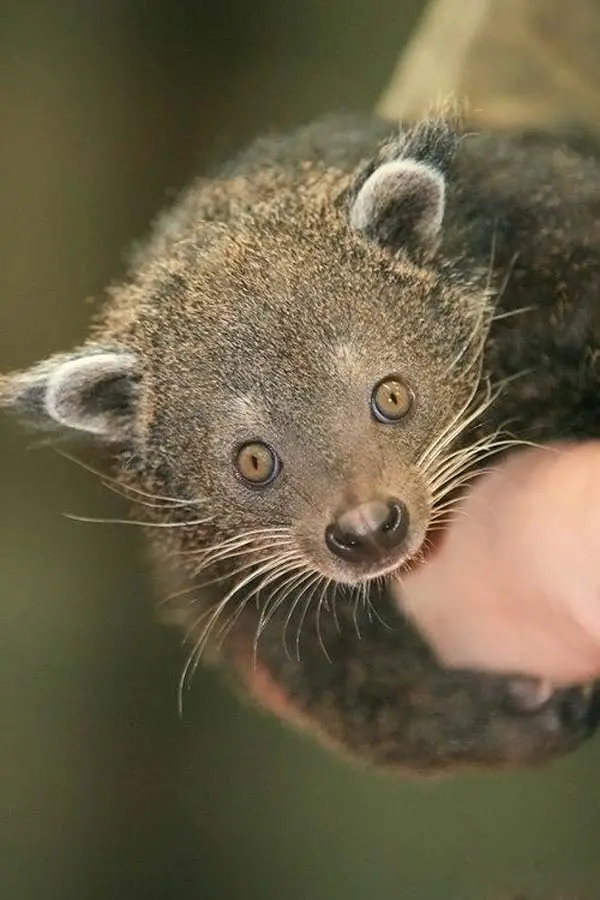
The ears, also known as the Binturong or Bearcat Asian.
Arctictis binturong

manturon

Content

The Manturรณn (Arctictis binturong), also known as Binturong, the Asian bearcat, the Bearcat Palawan, or simply Bearcat, is a species in the family Eupleridae, which includes Civets and to the ginetas.

It is the only member of its genus. The binturong It is neither a bear nor a cat, and the true meaning of the original name has been lost, as well as the local language that gave it that name.

The binturong It is nocturnal and sleeps on branches. Itร‚ยดs omnivorous feeding mainly on fruits, Although also has been known to eat alligators, mice, Rats, spiders, insects and beetles. They can live more than 20 years in captivity, knowing cases have come to the 26 years.

The deforestation has considerably reduced their number.

You can make sounds laughing between teeth when she feels happy and an annoying sharp groan when he feels cornered.

Being burly and aggressive against any threat, to the binturong sometimes compared with a bear, Although it is considerably smaller than, being no bigger than a small dog. Itร‚ยดs, However, the largest living species of the family Eupleridae, matched only by the African civet.

Its length ranges between 60 and 97 cm., weighing between the 9 and 20 kg.
Its body is covered with coarse and thick black hair. The hairs are often white silver tip, giving the animal a somewhat hoary appearance. It has a clear or silvery Mane in the contour of your face to give the appearance of greater size. The tail, hairy and fully prehensile, It can act as a fifth hand and can measure between 50 and 84 cm.. The binturong it is one of only two carnivores with a prehensile tail (the other is the kinkajou). The ears of the ears are small and rounded, small eyes. Females are a 20% larger than males.

  • Habitat

Its natural habitat is the forest canopy, in the dense tropical jungle primary or secondary, from sea level to the 400 meters above sea level.
While sometimes there may be small groups in logged forest, This species does not seem to adapt well to spaces modified with great human activity. Widely distributed in not very numerous groups, this species can be found in the Bangladesh, Bhutan, Burma, Cambodia, China, India, Indonesian, Laos, Malaysia, Nepal, Philippines, Sri Lanka, Thailand, Borneo and Viet Nam.

  • Reproduction

Females give birth to 2 or 3 pups after a gestation period of 90 days. It seems that there is no defined breeding season during the year, but there are calvings more frequently between February and April. The females are breeding from the 30 months. It is believed that the female binturong It is one of the few female mammals that can delay implantation of the egg in the womb. (phenomenon known as embryonic diapause or delayed implantation), looking for the most propitious moment for the breeding season.

  • Behavior

The binturong It is solitary and nocturnal. It climbs trees and leaps from branch to branch, using its tail and claws to hold on to while foraging for food. It can turn its hind legs back so that its claws still have a grip when moving between branches.. It sometimes moves through the forest floor, either to cross to other trees or to feed on fallen fruits.

The binturong also it uses its tail to communicate through the scent glands. The females also have pairs of glands of odor on both sides of the vulva. Musk perfume binturong is often compared to hot butter on popcorn and cornbread. Rozan its tail against trees and howl to announce its presence to other manturones.

The manturones They have stable territories, but they are not very territorial and often overlap in range with their peers. In Thailand, the estimated range of average territory for a female is of 4 km square and 4,7 to 20,5 km square for males.
Although they are sympatric with several potential predators, including leopards, and reticulated pythons, predation on manturones adults is very rare. It is believed that it is due in part to its arboreal and nocturnal habits. It also, although he is usually quite shy, It can be notoriously aggressive when he is harassed. It is known that it uses urine and feces initially faced a threat to then emit a grunt showing teeth, If the stalker is not dissuaded, it will use its powerful jaws in self-defense.. The binturong It is believed to be one of the animals with more character of nature.

Ecologically it is considered an important seed disperser due to its frugivorous diet..

The female has a pseudopene similar to that of hyenas. They have been domesticated and are common as pets, as they are very protective with children.