Content
|
|---|
Description
23 cm.. length and a weight between 43 and 55 g..
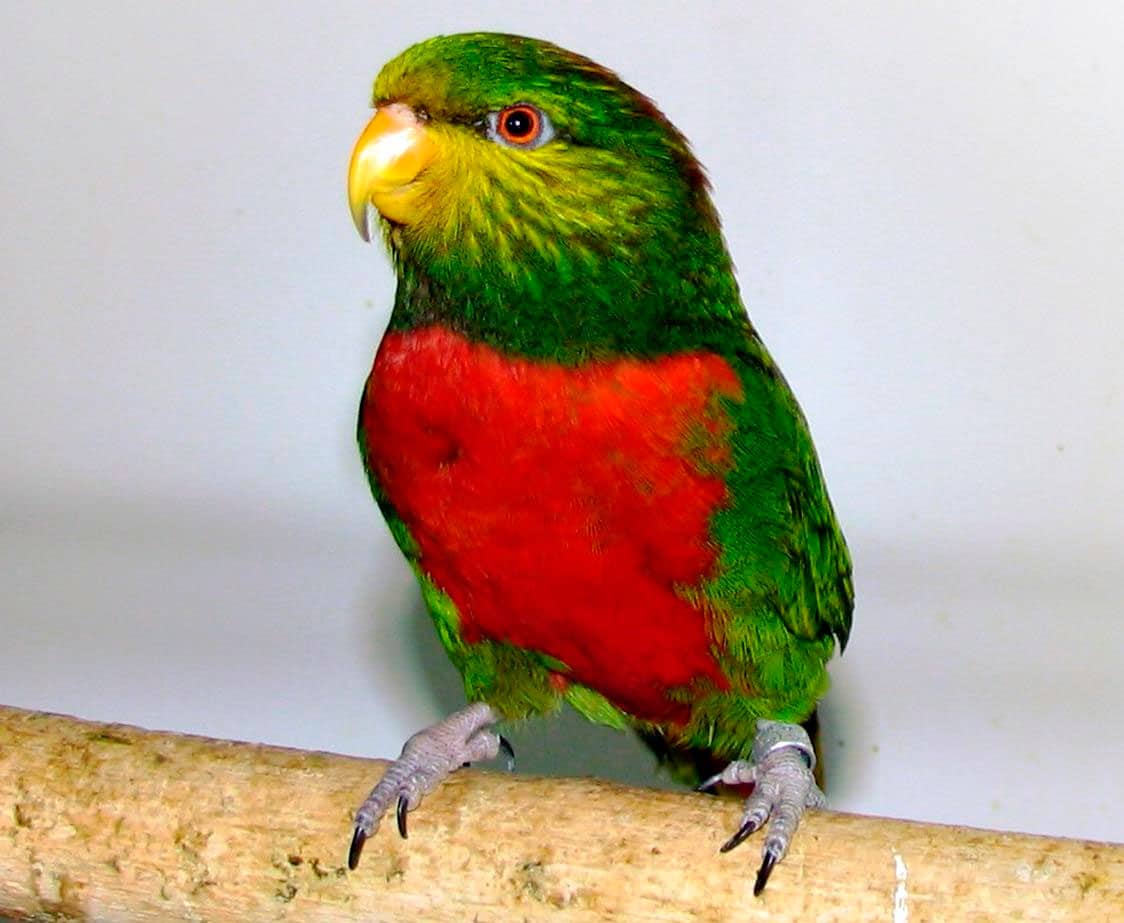
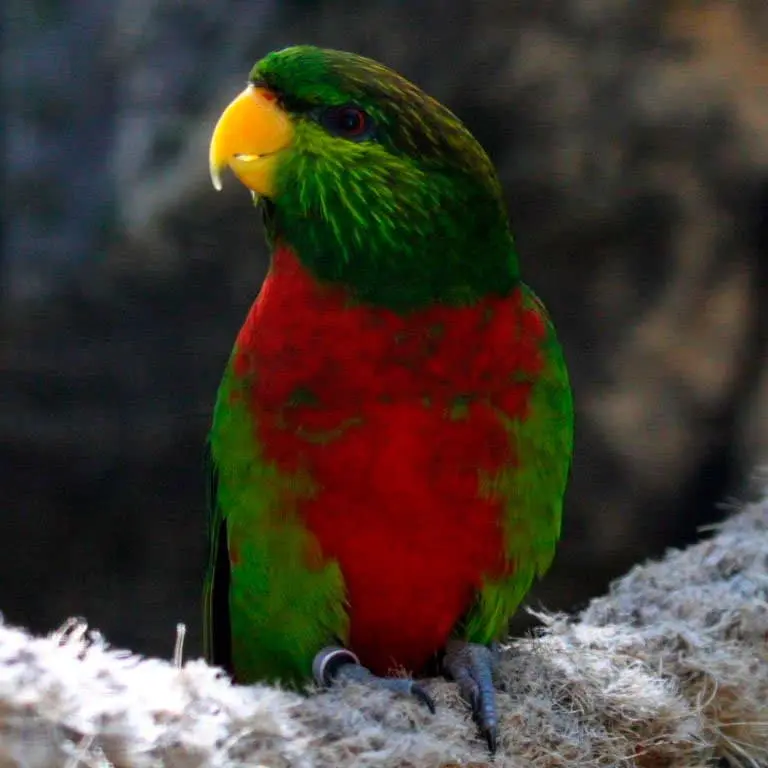
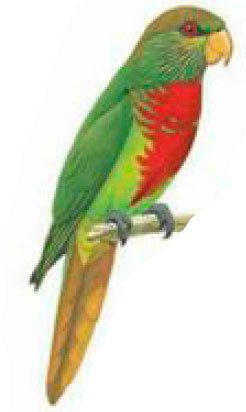
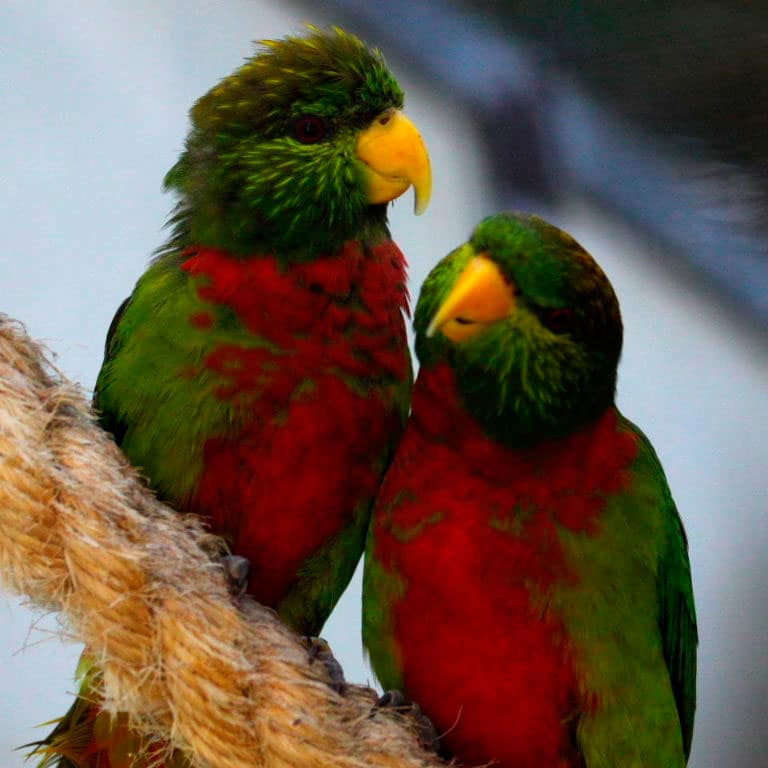
The head of the Yellow-billed Lorikeet (Neopsittacus musschenbroekii) is green, strongly impregnated with olive brown, veined in ear-coverts and showing a shaft of yellow stripes on the crown; darker line in the lores, above the bill; forecrown green.
Upperparts green intermediate. The wings green above with vane blackish internal to the coverts and black on the tips of the flight feather. Rojas the Underwing coverts. Flight feathers blackish with wide red central band. Throat greenish yellow yielding to red chest to the top of the the thighs. Flanks yellowish green to the sides of chest, with a central area in the bottom area chest and belly, red; coverts more yellowish than the rest of the underparts.
Cover top of queue, green, yellow tips, Brown shafts with red bases on the side of the feathers; undertail yellow-orange, showing red bases in lateral feathers when they deployed.
Bill pale yellow; irises red; gray of the legs.
Sexes alike.
Immature duller than adults with brands head less clear and red on the underparts restricted to spots in the center of belly and in the chest. Bill brownish-orange, irises yellow brown or orange. Young birds also show feathers tail pointy, which they are rounded as adults.
- Sound of the Yellow-billed Lorikeet.
Description 2 subspecies
-
Neopsittacus musschenbroekii musschmbrorkii
(Schlegel, 1871) – The nominal.
-
Neopsittacus musschenbroekii mayor
(Neumann, 1924) – Slightly larger than the nominal and paler in upperparts.
Habitat:
It inhabits in montane forests, edges of forests, partially cleared areas of secondary growth, mainly between 1.400 and 2.500 m, even if you are also registered at altitudes as low as 1.100 meters and as high as 3,000 m. It is also common in altered areas or in groves of Casuarina or eucalyptus in garden areas.
It seems that they have adapted well to the impacts of the man. But it is absent from the places where the forest has been removed completely over large areas.
Visible and noisy, they are in pairs, small flocks and in larger congregations of up to 50 birds in flowering trees. Over most of New Guinea, This species is replaced at higher altitudes by the smaller Orange-billed Lorikeet, commonly found in the company with the latter in the upper band of its altitudinal range (except Vogelkop).
Most frequently found in flowering trees, often in the company of other species such as the Papuan Lorikeet, also in the fructification of the Schefflera and feeding is sometimes lower levels even on the weeds at ground level.
Reproduction:
Observed to be moving like a rodent along branches. The laying It is two eggs in a hole in the trunk of a tree. Period unknown but an immature nesting was observed in the Province of West Papua in late August and a fledgling in the same area in the middle of November.
Food:
Feeds of pollen, nectar, small fruits and berries. It is also thought that feed on seeds as part regular your diet, while the Orange-billed Lorikeet is limited to nectar only. As other parrots can eat insects and their larvae, deliberately or accidentally.
Distribution:
Size of its range (reproduction / resident): 587.000 km2
New Guinea in Irian Java (Indonesian) and Papua New Guineto. Is distributed from East of Vogelkop up to the Huon Peninsula and scattered areas in the Southeast. In Vogelkop, Despite the absence of the Orange-billed Lorikeet, the population of the Yellow-billed Lorikeet is relatively low. A small amount in captivity.
Distribution 2 subspecies
-
Neopsittacus musschenbroekii musschmbrorkii
(Schlegel, 1871) – The nominal.
-
Neopsittacus musschenbroekii mayor
(Neumann, 1924) – Live from the East of the region of Sepik to the Huon Peninsula and areas southeast.
Conservation:
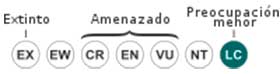
• Current IUCN Red List category: Least concern.
• Population trend: Growing.
The world population It has not been quantified, Although it is probably superior to the 300.000 specimens.
The species according to information is usually common.
The population is suspected can be increased. As the degradation of the habitat is permanent, new suitable habitat areas are being created.
"Yellow-billed Lorikeet" in captivity:
Rare in aviculture.
More distant other parrots. Average noise level. Shy.
Alternative names:
– Yellow-billed Lorikeet, Musschenbroek’s Lorikeet, Yellow billed Lorikeet, Yellow-billed Mountain Lory (ingles).
– Lori de Musschenbroek (French).
– Gelbschnabel-Berglori, Gelbschnabelberglori (German).
– Lori Montano Grande, Lori Moteado Grande (español).

scientific classification:
– Order: Psittaciformes
– Family: Psittaculidae
– Scientific name: Neopsittacus musschenbroekii
– Genus: Neopsittacus
– Citation: (Schlegel, 1871)
– Protonimo: Nanodes Musschenbroekii
“Lori Montano Grande” images:



Video
————————————————————————————————
«Lori Montano Grande» (Neopsittacus musschenbroekii)
Sources:
– Avibase
– Parrots of the World – Forshaw Joseph M
– Parrots A Guide to the Parrots of the World – Tony Juniper & Mike Parr
– Birdlife
– Photos:
(1) – Animal Photos – link
(2) – «Neopsittacus musschenbroekii-two captive-8a» by TJ Lin – originally posted to Flickr as Dscn8852. Licensed under CC BY-SA 2.0 via Wikimedia Commons.
(3) – papageien.org – link
(4) – Animal Photos – link
(5) – neopsittacus musschenbroekii, male By iggino – lynx
(6) – Illustration
– Sounds: Frank Lambert (Xeno-canto)