Content |
|---|
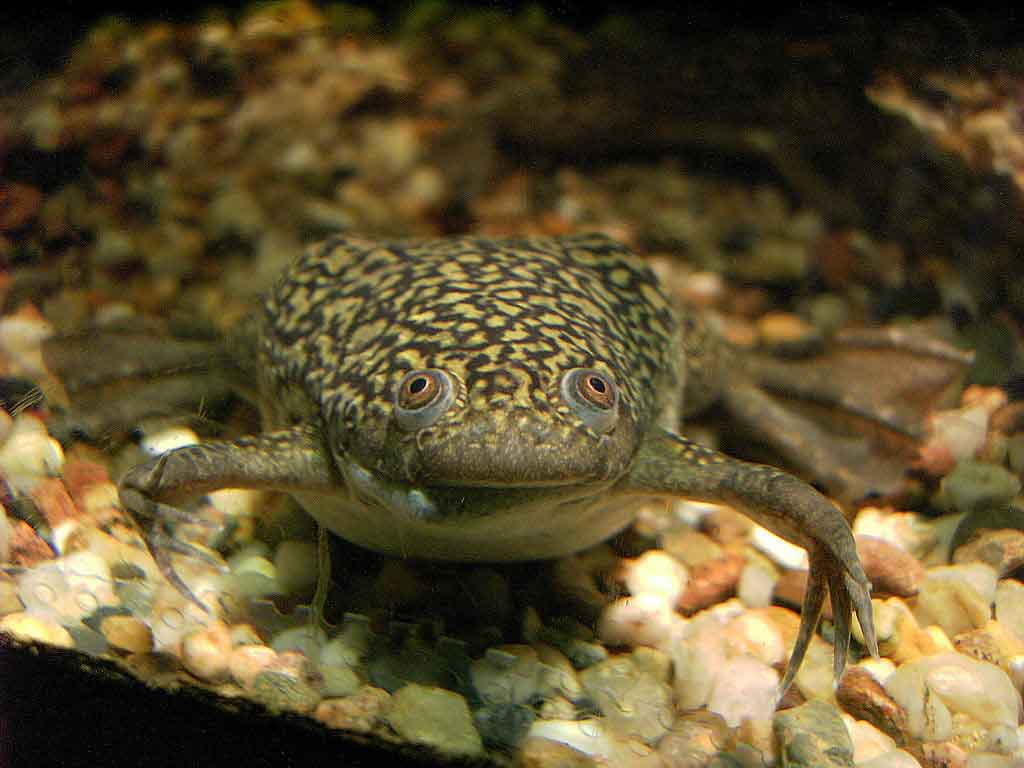
The African clawed frog (Xenopus laevis) and the Common Surinam toad (Pipa pipa) belong to the family of tongueless frogs (Pipidae) and they do not come out of the water even as adults.
The African clawed frog reaches about 13 cm and is often used in research, as well as the popular African dwarf frog of the gender Hymenochirus.
The South American counterpart is the Common Surinam toad (Pipa pipa) that gets to measure 17 cm., and the Sabana Surinam toad (Pipa parva), which is still small. In addition to many babies, there are also specimens captured in the wild (especially Hymenochirus and Pipa pipa). Wherever possible, specimens bred in captivity should be used. The African clawed frog and Common Surinam toad are not subject to species protection legislation.
Sex differences
Distinguishing between the sexes is difficult and, if anything, only possible in sexually mature animals. The males of the Sabana Surinam toad have enlarged glands under the armpits during mating season; the males of the African clawed frog develop heat calluses on the inside of the arms. In the Common Surinam toad, females can be safely identified by carrying the eggs on their back, which is swollen like a backpack.
Behavior
The African clawed frog and Common Surinam toad do not show a defined territorial behavior. Animals are peaceful with each other and can keep to themselves, in pairs or groups, although you have to be careful that its size is uniform, since much smaller animals could be considered as food.
The African clawed frog and Common Surinam toad are mainly twilight or nocturnal.
Aquarium
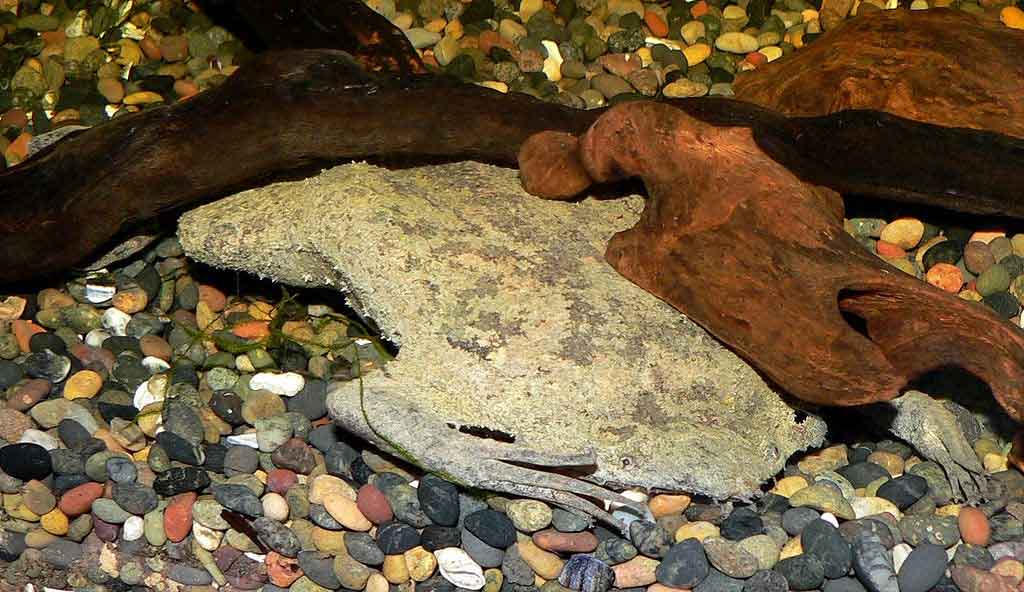
As the mentioned species live almost exclusively in water, an aquarium is suitable to keep them. For the African dwarf frog and the Sabana Surinam toad should measure at least 60 x 40 x 30 cm and for larger species 100 x 50 x 50 cm. (length x widht x hight) for up to 4 adult animals.
Water values ​​for African clawed frog: temperature 18 – 28 °C, pH 6,0 – 8,0, total hardness up to 30 °dGH. For the Common Surinam toad, the temperature must be at least 24 °C, pH value less than 7,0 and hardness less than 15 °dGH. Water temperature can be controlled by aquarium heating rod or external thermal filter. The heating rod must be installed so that it cannot burn the frogs. An accurate thermometer is needed to measure temperature.
The aquarium must be covered without gaps (otherwise the animals can get out, what his certain death means) and equipped with an aquarium filter. Especially for the smaller species, make sure the current is not too strong. The water level must be at least 25 cm..
In addition to breathing through the skin, animals occasionally rise to the surface of the water to breathe; therefore, care must be taken to ensure a sufficient distance between the water surface and the deck. Floating plants, pieces of cork or roots that reach above the waterline are important in providing animals with structures on the surface of the water. The facility must offer sufficient shelter possibilities; for this they are suitable, for example, the roots of wood, the cave-shaped hiding places, as well as dense vegetable masses. It is recommended to use fine sand as a substrate, as gravel can cause injury to sensitive mucous membranes. A floating green roof provides the necessary shade. The African clawed frog and Common Surinam toad they should not live with fish or crustaceans (for example, prawns, River Crabs), that could hurt amphibians.
Diet
The African clawed frog and Common Surinam toad they eat exclusively food of animal origin. Live food is preferred, for example, earthworms of various sizes or red gnat larvae. Frozen foods are also eaten with pleasure. The African clawed frog in growth they also eat fish. Pet stores also offer pellets specially adapted to the needs of the African clawed frog and Common Surinam toad, that are well accepted once you get used to them.
Caution: These species are not particularly active and often tend to become obese.. In the case of adult animals, it is enough to feed them every two or three days.
Care
For the operation of an aquarium, a filter of sufficient dimensions is always necessary. The filter should be checked regularly and cleaned if necessary. Animals sometimes react sensitively to increased germ contamination of the water. A regular and weekly partial water change of (at least) the 25 % removes pollutants and increases the welfare of frogs. Regular padding of the substrate also helps reduce water contamination. Warm and stagnant water should be used for water changes; However, water treatment agents should not be used for amphibians.
The most important water parameters for the well-being of frogs -such as temperature, the pH, ammonium / ammonia, nitrite, nitrate and carbonate and total hardness- should be checked regularly.
Animal health must be monitored daily. The most common health problems are skin changes and wasting or fat degeneration.. In case of anomalies, an amphibian vet should be consulted.
Acclimatization and handling
When i get home, the first thing to do is turn off the aquarium lighting. Next, The carry bag can be placed on the surface of the water during 10 – 15 minutes to adjust temperature. Next, open the bag and carefully add as much aquarium water as there is transport water in the bag. Next, animals can be introduced carefully. For a gentle acclimatization, the light should be turned off until the next morning.
Amphibians are animals of pure observation and should NOT be petted. In the first days in his new home, animals need adequate rest to get used to their new environment. Fine mesh and slightly deeper nets are suitable for capturing animals. Catching them by hand carries a high risk of injury to the animals.
Special features
The African clawed frog was bred for decades to perform pregnancy tests and thus spread throughout the world. All clawed frogs are considered carriers of the dangerous chytrid fungus, partly responsible for global amphibian mortality. So, the animals themselves, as well as the objects and water in your aquarium, should not come into contact with other amphibian populations.


.jpg)