โท The world of Pets: Dogs, cats, birds, reptiles, amphibians
Checkered garter snake
- Thamnophis marcianus
Origin: United States, Mexico, Guatemala, Belice, El Salvador, Honduras, Nicaragua and Costa Rica
Gender: Thamnophis
Life expectancy: 15 years
Length: 45 - 90 cm.
This species has a calm character. When the Checkered garter snake feels threatened, usually flees.
(Thamnophis marcianus marcianus) from Hidalgo County, New Mexico, USA. – Andrew DuBois – Flickr
Content
Origin / Distribution
The Checkered garter snake (Thamnophis marcianus) is commonly found in the United States, Mexico and some parts of Central America. In United States, are found in Southwestern California, southwestern Arizona and southern New Mexico. In Mexico, have been found as disjoint populations along the Rio Grande, Veracruz, Juchitรกn de Zaragoza, Tabasco and the center of the Yucatan Peninsula. In Central America, have been found in Tegucigalpa, Honduras; Lake Nicaragua and Managua, Nicaragua; northeastern Costa Rica; The Estrus, Guatemala and Orange Walk, Belice.
Characteristics / Appearance
The Checkered garter snake it gets its common name from the checkered pattern of light black and gray spots along its body.. Both females and males have the same pattern. They have pale yellow stripes along their spines and sides, while its ventral sides are cream-colored. Their heads are olive green with a single thick black line on the neck.. Your body may be gray, brown, oliva, tanned or albino. They have 21 rows of keel-shaped dorsal scales.
Adults weigh an average of 60 g, but they can come to weigh between 31 and 122 g. Adults, can measure between 45 and 106 cm., but the average for adults is 55 cm. (including the queue). The average length of the tail is 16 cm.. The tip of the tongue is black and the rest is a deep red. On the head they have a pale yellow crescent in front of the neck. The females of the Checkered garter snake are bulkier and longer than males, that are thinner and shorter. Females measure an average of 82 cm and weigh 81 g, while males measure 51 cm and weigh 51 g.
The Checkered garter snake measured between 15 and 20 cm. (including the queue) at birth. Juveniles have the same checkerboard patterns as adults.
Habitat
The Checkered garter snake it inhabits areas ranging from sea level to elevations of 2.200 m. It can be found in a variety of habitats ranging from wetlands. (for example, humid tropical forests) to the drylands (deserts and dry forests). They are located in or near water sources such as rivers, ponds, Springs, ditches and lakes. When they are in the grasslands, tend to dig under rocks, logs and thick vegetation. They can also be found in courtyards and gardens. Their populations are shifting westward, traveling along irrigation canals.
From November to the end of February, hibernates at a temperature between 10 and 15ยฐ C.
Mating takes place between March and April. From June to August you can give birth to more than 30 live offspring.
Behavior
This species has a calm character. When the Checkered garter snake feels threatened, usually flees. If escape is not possible, defend themselves by threatening and, if that doesn't work, Biting. A last defensive technique that can be used by the Checkered garter snake is emptying your glands and often defecating at the same time. This releases a very unpleasant smell.
Reproduction
The Checkered garter snake begins mating in spring โ as soon as it comes out of hibernation at the end of March- until the beginning of April. When it's time to mate, females stop eating and groups of males emit strong pheromones so that females can find them. Once a female has mated, her partner goes to find another female to inseminate her. Females also have the ability to store sperm.
In the North, mating occurs in burrows, where temperatures are warmer; temperatures below 10 ยฐC may cause death or neurological disorders. In the South, when temperatures are 15 at 30ยฐC, reproduction is usually more successful. When they finish mating, females can store sperm or fertilize immediately after mating. Its gestation period is normally 80 to 105 days. Females give birth to a clutch from between 6 and 35 offspring between the months of July and September. Ford and Karges (1987) studied cage snakes in south Texas and northeastern Mexico, and hypothesized that some females may have two clutches a year.. Although they do not support it directly, his anecdotal evidence was the discovery of "fully developed" offspring at two points in the season.: April and September.
Males reach sexual maturity at 1,5 years, while females do it to the 2 years. As soon as they are born they are already independent. At birth, the Checkered garter snake weighs an average of 13 g.
The males of the Checkered garter snake have no parental involvement beyond the act of insemination. Females carry and protect their young in their body until they are born. Once born mothers do not provide more parental care.
Food
Diet Checkered garter snake consists of a wide variety of animals, like worms, mice, fish, lizards, slugs, amphibians and eggs. Types of amphibians they eat include tadpoles, adult frogs and salamanders. They hunt small prey in ditches and streams using smell and sight. When kept in captivity, eat thawed mice or other snakes.
Threats to the species
State of conservation โ
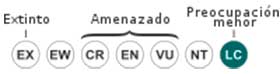
Minor Concern โ(UICN)โ
The Checkered garter snake is classified as a species of "Least Concern" on the IUCN Red List. They do not have special status on the U.S. federal list, in CITES or on the State of Michigan's list.
Most of the populations of the Checkered garter snake throughout their range are stable, but a few disjoint populations in Mexico could be threatened. Several emerging threats include excessive use of pesticides (that can eliminate prey species or bioaccumulate in snakes), the loss of amphibious prey in Mexico and habitat loss.
In some cases, the Checkered garter snake already inhabits protected land (for example, national parks) and there are captive breeding colonies in Mexico. They are also somewhat common in the pet trade., because they are easy to keep in captivity and quite docile. It is believed that the Checkered garter snake is increasing its range following irrigation ditches (in correlation with the expansion of agricultural practices).
The Checkered garter snake is active throughout the day. This species is usually more active than most domestic snakes.. During the coolest hours of the day they travel their territory in search of food.
The terrarium
Minimum enclosure size for a couple: 80 x 50 x 50 cm..
Surface: 0,5 m2
Daytime temperature: 24-28ยบ
Night temperature: 18-22ยบ
Daylight hours: 12 hours
Humidity: 40% -60%
Land cover: newsprint, humus or sand
Diet
You can choose between offering live or dead prey. It is advisable to offer dead food. This is more practical and prevents the animal that serves as your food from harming your snake.. It also, it is recommended to offer the food with a clamp and do it outside the enclosure. This ensures that her hand is not exposed as food and prevents it from clinging to your hand while you feed it.. If you choose to feed it with live food, you should watch while feeding it. This is because two snakes that have the same prey can injure each other and, sometimes, even eating each other. The ideal prey is as wide as the widest part of the snake.
Cleaning
A hygienic living environment is important to maintain the health of your Checkered garter snake. As such, it is necessary to clean the enclosure regularly. Cleaning once a week is enough. To prevent the accumulation of bacteria, you have to clean and disinfect the entire terrarium a couple of times a year.
Management
This variety has a calm character and is usually easy to handle. But, you have to take into account some things when handling it. Never squeeze the Checkered garter snake when handling it, as the rotating links are fragile and can break easily. It is best to let the snake rest comfortably in the hand. Also make sure your hands are washed and don't smell like food..
Buy one "Checkered garter snake"
When buying, preferably choose young offspring. Animals caught in the wild are usually infected with parasites (internal and/or external), are habitual carriers of diseases and are very sensitive to stress.
Its price in the exotic animal market ranges from 50 – 100 EUR.
โท The world of Pets: Dogs, cats, birds, reptiles, amphibians
Eastern kingsnake
- Lampropeltis getula
Origin: United States, Mexico
Gender: Lampropeltis
Life expectancy: 25 years
Length: 100 - 140 cm.
Primary habitat varies by subspecies. The Eastern kingsnake can be found in forests, Meadows, deserts and urban areas.
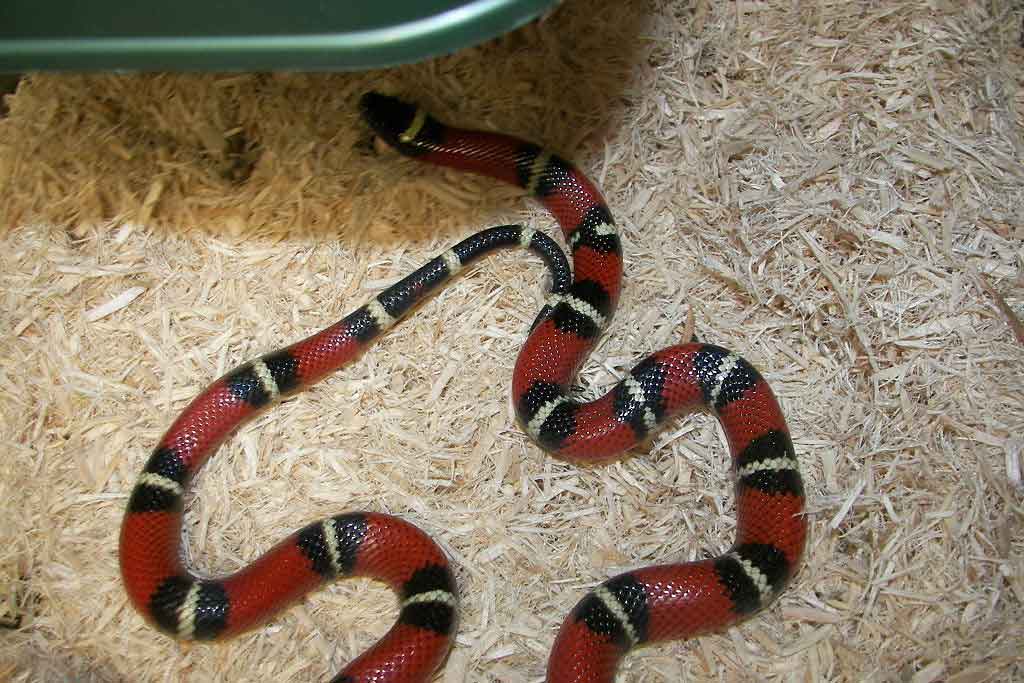
oven ยซCalifornia king snakeยป (Lampropeltis getula californiae) taken at Coyote Hills Regional Park in the San Francisco Bay – Calibas, CC BY-SA 3.0, via Wikimedia Commons
Content
Origin / Distribution
The Eastern kingsnake (Lampropeltis getula) it is one of the only species of king snakes found in most of North America.
There are seven subspecies of Lampropeltis getula in North America.
The Lampropeltis getula getula (Eastern kingsnake) found on the east coast of North America, from southern New Jersey and southeastern Pennsylvania to eastern parts of West Virginia, southwest to Mobile Bay, Alabama, and east to northern Florida.
The Lampropeltis getula floridana (Florida kingsnake) is located on the Florida panhandle south of Dade County.
Lampropeltis getula californiae (California kingsnake) is restricted to southwestern California and Baja California. in the Canary Islands (Spain), is considered an invasive species, being the native lizard of Gran Canaria, prey of that species.
Lampropeltis getula holbrooki (Speckled kingsnake) is located in southwestern Illinois, eastern Iowa and south-central Alabama.
The Lampropeltis getula nigra (Black kingsnake) lies west of the Appalachian Mountains and east of the Mississippi River; this includes the region from West Virginia to southern Ohio, southeastern Illinois and northern Alabama.
The Lampropeltis getula splendida (Desert kingsnake) would originate from Texas, Arizona and New Mexico, United States.
The Lampropeltis getula nigrita (Mexican black kingsnake) found in southern Arizona and northwestern Mexico.
Subspecies overlap and interbreed in several different regions of North America.
Subespecies Lampropeltis getula
Lampropeltis getula getula (Eastern kingsnake)
Lampropeltis getula floridana (Florida kingsnake)
Lampropeltis getula californiae (California kingsnake)
Lampropeltis getula nigrita (Mexican black kingsnake
Characteristics / Appearance
Since the physical description of Lampropeltis getula varies greatly between subspecies, Each of them will be described separately.. One measurement they all share is the length of the pups.: of 20 to 28 cm al nacer. The adults of the Eastern kingsnake (L. g. getula) They can reach a length of 61 to 153 cm.. They are big snakes, solid and shiny black with yellow crossbars (sometimes white) stretching along the snake. The head is solid black with several yellow or white spots decorating the scales on the head..
The Speckled kingsnake (L. g. holbrooki) can reach a length of 51 to 132 cm in adulthood. They are black with yellow "flecks" on their scales and along them. The underside is pale yellow to white with some of the black scales curling on the sides..
The California kingsnake (L. g. california) can reach a length of 91 to 106 cm.. They have white crossbars that intersect with black spots along the back.. The head is normally white with a black upper part and some black scales on the side..
The Florida kingsnake adult (L. g. floridana) can measure between 106 and 138 cm.. The only major difference between Florida and Eastern garter snakes is that they have 60 transverse bands, while the eastern ones only have 30. The belly is pale yellow with alternating "zigzag" patterns of black scales..
The Black kingsnake (L. g. nigra). Adult specimens reach an average size of 90 to 122 centimeters in total length, with some reaching maximum total lengths of 147 to 183 centimeters. It is generally similar to L. getula getula, although it can be distinguished by its geography and appearance. Has a black body interspersed with widely spaced yellow or cream-colored specks, larger and more numerous along sides. the back, in some cases, it has no drawings and in others it has crossed bands. The belly shows a black and yellow checkered pattern (or cream). The ventral scales range from 197 and 222 in both sexes, and the subflows between 45 and 59 in males and 37 and 51 in females.
The Desert kingsnake (L. g. splendida) can reach from 123 to 153 cm.. The shiny back of the snake is black or very dark brown., finely mottled blanco or amarillo. These pale specks form vaguely defined narrow vertebral crossbands, between which the intervening rectangular areas are black. Pale yellow scales may predominate along lower sides. The abdomen of adult and young snakes is mostly black, with white or pale yellow spots marking outer ends of ventral plates. The smooth dorsal scales are arranged in 23 to 25 rows in the middle of the body and the anal plate is not divided.
The Mexican black kingsnake (L. g. nigrita) can reach a length of 106 to 132 cm.. They are black and shiny, with approximately 75 thin yellow crossbars. This subspecies also has yellow spots on the black scales that run down the sides of the snake..
Life expectancy
Little information is available on the longevity of Eastern kingsnake in its natural environment. Most of the available information comes from captive snakes. The Eastern kingsnake older wild had 9 years (reported in 1937). The Eastern kingsnake longest in captivity had 33,3 years.
Habitat
Primary habitat varies by subspecies. The Eastern kingsnake can be found in forests, Meadows, deserts and urban areas. The microhabitats of most subspecies include: under the wood, in rubbish heaps, barns, along stone walls, on sunny embankments, in stump holes or sunny clearings.
The coastal subspecies, as the Florida kingsnake and some Eastern king snakes, can be found along the edges of swamps, marshes and levees. Other subspecies, as the California kingsnake and Mexican black kingsnake, limited to arid areas. Elevation also varies by subspecies. These may include, the California kingsnake has the widest lifting range, from the Pacific coast to the 915 m. The Eastern kingsnake (123 to 305 m) and Black kingsnake (153 to 305 m) share similar limited elevation ranges. The Speckled kingsnake can be found at elevations up to 610 m.
The Eastern kingsnake it is diurnal. Its annual activity period is between the end of March or the beginning of April and October and the beginning of November.. They hibernate during the winter in caves., cracks in the rocks, mammal burrows, hollow logs and on old stumps. During the cooler days of spring and fall they can be found outside during the day basking in the sun.. They spend most of the day under leaf litter and other debris and spend the rest of the time traveling, sunbathe and hunt. The Eastern kingsnake not limited to the ground, but can climb trees and swim quite well. Fights between males are common (during mating season).
Developing
Snake eggs have a large amount of yolk that contains the fats and carbohydrates necessary for the development of the embryo.. Towards the final stages of development, the snake fetus absorbs the yolk. It also, the embryo extracts part of the calcium for the egg shell and uses it to form its skeleton. Once the skeleton is formed, the shell becomes thinner and more flexible. Oxygen exchange decreases over time, which in turn drives the hatchling out of the egg, using the "tooth" of the deciduous egg in the nose.
after hatching, the young remain in the nest until they shed their skin for the first time. This usually lasts about a week. Next, the hatchlings scatter. Information on the period after hatching is scarce.. The Eastern kingsnake reaches sexual maturity at about half its maximum potential size, between 60 and 92 cm.. In captivity, can reach sexual maturity much earlier due to abundant food source and limited parasites and disease.
Reproduction
The males of the Eastern kingsnake compete for females. If two males are in the same area, both raise their heads, the neck and the front of the body and intertwine them. The males then try to press each other to the ground.. The losing male will withdraw and curl up in a prone position with his head resting on the ground.. The victorious male will return to the female waiting nearby and copulate.. Males are able to find females through pheromone trails.. when they mate, males lie on top of females and bite their necks. Next, males curl their tails under females until their vents line up. The male uses his hemipenis to enter the female's cloaca.. Copulation can last from several minutes to several hours.
The Eastern kingsnake appears in spring, allowing females to lay their eggs when the weather is still warm enough for proper incubation. Its gestation period is about 60 days. In the hottest climates (for example, Florida), courtship can start as early as March. In the northern parts of the range, courtship is delayed until April or May.
A female can produce a single clutch of multiple pairs.. Females can also produce more than one clutch per season as a result of more than one mating.. The female chooses the nesting site., which can include rotten logs and stumps, as well as piles of sawdust. The Eastern kingsnake breeds annually and has been known to produce more than one clutch per season. The breeding season is between March and August. The average number of offspring is 10 eggs per clutch (between 3 and 24). The average gestation period for females is 60 to 62 days (range of 50 to 80 days). The young can weigh between 9 and 14 g.. Females reach sexual maturity between the 2 and 4 years. Males reach sexual maturity between 1 and 4 years.
after intercourse, male will leave female and not return to help with parental care. After the female lays her eggs, will disperse and will not return to the nest.
Food
The diet of adults Eastern kingsnake varies between subspecies and is very wide, but published reports are available on some representative subspecies. The Eastern kingsnake and of Florida they feed mainly on other snakes, including poisonous (coral vipers, copper heads, massasaugas and rattles), the Eastern garter snakes (Thamnophis sirtalis), the Northern water snakes (Nerodia sipedon), the Ring-neck snakes (Diadophis punctatus), the Smooth earth snakes (Virginia valeriae) and Worm snakes (Carphasphis amonenus). They also feed on Five-lined skinks (Plestiodon fasciatus), the White-footed mice (Peromyscus leucopus) and the eggs of the Northern bobwhite quail (Colinus virginianus).
The Eastern kingsnake listed as a "species of concern" on the US federal list. This may be because the Florida kingsnake, L. g. floridana, is in decline. Among the reasons for the decline are anthropogenic causes due to the extensive pet trade, road deaths and habitat loss.
The fire ants invasive (Solenopsis invicta) are also harming the populations of L. g. floridana by competing for food sources such as turtle eggs.
Benefits for the human being
The Eastern kingsnake it is one of the most popular snakes to keep as a pet, Next to the Boa constrictor. They play an important role in controlling poisonous snake populations, that can pose a threat to humans.
The Eastern kingsnake or lampropeltis getula is one of the most common snakes in the United States, at least for a good reason: it is relatively easy to maintain.
Due to its presence throughout North America, he has no problem living in captivity and is used to humans.
It was one of the first captive-bred snakes.
The terrarium
First of all, these snakes eat other snakes, so ONLY ONE snake per Terrarium
For one Eastern kingsnake baby, you can choose a terrarium of dimensions 60 x 40 x 40 cm.. For one Eastern kingsnake adult, choose at least one vivarium of dimensions 80 x 40 x 40 cm.. Make sure it has a secure, leak-proof opening. If there is a weak point, the Eastern kingsnake will find it and escape.
Caveat: Do not keep together Eastern kingsnake juveniles or adults, since they could eat each other.
In the case of females, cohabitation can be considered once they have reached a medium size (90 cm.).
But, separate them to feed them.
What to put in your terrarium?
Place a hiding place in your nursery, a container of water (see humidity section below) and non-toxic plant ornaments (synthetic soles in case of doubt).
Temperature and lighting
The Eastern kingsnake does not need special lighting if the cage is in a room with natural light. Otherwise, use a light bulb, that will mimic natural sunlight.
Be careful not to place the cage in or near a window where it is getting direct sunlight., otherwise it could get too hot and be fatal to your Eastern kingsnake.
What temperature is ideal for a Eastern kingsnake?
The temperature for a Lampropeltis getula during the day is 27 at 30ยฐC at hot spot, and 24ยฐC at the cold point. At night, the temperature is 24ยฐC in the hot spot and 22-23ยฐC in the cold spot.
The Eastern kingsnake thermoregulates in nature. They move to find and hold (when they can) a preferred temperature. being cold blooded, get the temperature of their environment. In captivity, options are limited to what is offered. So, must have a hot and a cold end of his cage.
There are many heaters, pads, cables and tapes available to do it. Some people use lamps for warmth, but this is not an efficient use of energy and has its drawbacks.
What substrate do I use for a Eastern kingsnake?
The ideal substrates for Eastern kingsnake are : reptile mat, and natural bark.
Feed them in another box to prevent them from swallowing the substrate, o leave food on newspaper or paper towels.
Avoid, at all costs, cedar-based sand or chips, since sand favors the growth of bacteria and cedar is toxic to reptiles and could cause your snake serious respiratory problems.
what does one eat Eastern kingsnake?
In the wild, the Eastern kingsnake eats almost any animal or bird small enough to swallow whole, including other snakes.
In captivity, ofrรฉceles rodents like little mice (they are the most affordable and easy to get). Usually, snakes are given freshly thawed or "freshly" dead mice. Live mice can do a lot of damage to your snake, or even kill her!
Feed her twice a week when she is growing, and once a week when it reaches adult size.
Regarding the size, it is better not to exceed the diameter of the snake's body. You should also not handle your snake until it has finished completely digesting its food..
What type of humidity is ideal for Eastern kingsnake?
Place a container of water deep enough for your snake to bathe half of its body, and without the water overflowing in the cage.
This will help to get the necessary humidity (higrometrรญa) for your snake: 60%. Calculate it with a hygrometer.
Management and temperament Eastern kingsnake
Although it is bred in captivity, the Eastern kingsnake can be aloof and fearful of humans. May defecate or urinate on you when you pick it up. This is a natural behavior to deter you (as a potential predator) to eat it. If you see that it is in โSโ, don't get too close, is in attack mode (like an abo in pokemon).
With regular and gentle treatment, your lampropeltis will feel more and more safe with you. Caress, moving away from his face, with a bit of friction to slow down their shaking, is the best way to start handling it.
molt of the Eastern kingsnake
The Lampropeltis Getulus if changes each 2-3 months approximately. It's easy enough to see when this is the case: your eyes will have a white or bluish "glassy" appearance. Your snake will take a few days to completely shed its skin., so it is likely that he will do it in his hiding place. Check that everything is going well and that he is still eating/pooping during this period. Do not handle your snake when it is about to shed.
If you see that it is difficult for it to detach from the skin and dry pieces stick to the scales, consider giving him a quick bath at room temperature to help him shed any remaining skin.
Buy one "Eastern kingsnake"
The California kingsnake it is the most popular subspecies among fans of terrarium animals. Its price in the exotic animal market ranges from 150 – 200 EUR.
Videos "Eastern kingsnake"
๐ California Kingsnake (Lampropeltis california) - Information, care..etc ๐
1. Eastern kingsnake, Common kingsnake, Chain kingsnake (English).
2. Serpent roi (French).
3. Kettennatter, Ketten-Kรถnigsnatter (German).
4. Cobra-real oriental, Cobra-real comum, Cobra-real de cadeia (Portuguese).
5. "Serpiente real comรบn", Serpiente rey del este, Serpiente rey de la cadena, Serpiente rey oriental (espaรฑol).