โ–ท The world of Pets: Dogs, cats, birds, reptiles, amphibians

Painted bronzeback
- Dendrelaphis pictus

The Painted bronzeback It is the most common type of snakes of the genus Dendrelaphis. Active during the day, usually wanders in trees, plants or bushes.
Painted bronzeback
Bogor Painted bronzeback, West Java, Indonesian – W.A. Djatmiko (Wie146), CC BY-SA 3.0, via Wikimedia Commons

Content

Origin / Distribution

The Painted bronzeback (Dendrelaphis pictus) is present in Bangladesh, Borneo, Cambodia, China, India, Indonesian, Laos, Malaysia, Philippines, Singapore, Thailand and Vietnam.

Their presence is uncertain in Burma.

Characteristics / Appearance

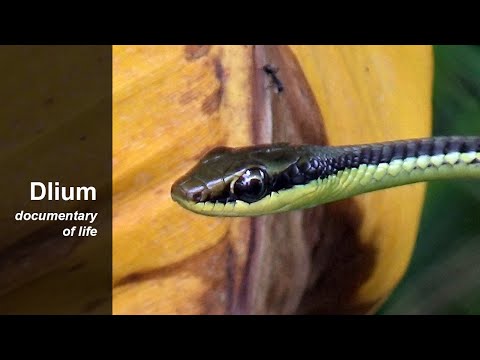
The coloration of the Painted bronzeback it is olive or brown above with a yellow lateral stripe, bordered below by a dark line between outer and ventral scales. A black stripe on each side of the head passes through the eye, widens or splits into spots, separated by bluish-green bands on nape. The upper lip is yellow and the lower surface is yellowish or greenish.. Head and body length is approx. 740 mm and the tail of 440 mm.

Habitat

The habitats of the Painted bronzeback range from tropical rainforests to plantations and agriculture. This snake is also often found near human settlements..

Behavior

The Painted bronzeback It is the most common type of snakes of the genus Dendrelaphis. Active during the day, usually wanders in trees, plants or bushes. This snake sometimes also roams on the ground or in the grass. Like other species of snakes of the genus Dendrelaphis, this snake is not poisonous and has fangs type Aglypha, which is a uniform arrangement of teeth without fangs. feeling threatened, this snake will flatten its neck, so that on both sides of his neck the edges of bluish scales will be seen.

The main food of Painted bronzeback are the types of lizards, geckos and little frogs / toads.

This species reproduces by laying eggs. (oviparous). The number of eggs produced is 2 to 10 eggs. Each newly hatched young snake measures about 25 cm length.

Threats to the species

State of conservation โ“˜


minor concern Minor Concern โ“˜ (UICN)โ“˜

The Painted bronzeback has recently been assessed on the IUCN Red List of Threatened Species in 2019.

This species is listed as Least Concern in view of its wide distribution., its presumed large global population and because it is found in several protected areas, has tolerance to a degree of habitat modification and appears to exist as a stable population.

The "Painted bronzeback" in captivity

This beautiful creature is highly adaptable to a wide range of habitats., making it a popular item for the pet trade. Their abundance in Southeast Asia has also made them vulnerable to poachers.. They can be easily found in online stores and are often sold out..

The terrarium

Temperature: 25 – 30C. Illumination: 10 – 12 hours. They do not need UVB. Humidity: 50 – 70%. Recommended terrarium dimensions: 120 x 60 x 40 cm.. captive feeding: basically rodents. Due to lack of natural food resources, many keepers have to change their snakes diet from frogs and lizards to rodents and worms. Snakes that don't prefer their new diet have to be force-fed, which can be dangerous and easily cause injury to snakes.

Behavior

Son hibernantes, varying the time of hibernation according to the terrestrial latitude, being longer at high latitudes of its distribution than at low latitudes. Their defense mechanism against predators is based on a strong bite and the expulsion of feces when they are caught.. Temperament in front of their peers: They are usually ophiophagous. Temperament in front of the human being: Passive.

Buy one "Painted bronzeback"

The price of a "Painted bronzeback" at the exotic animal market, ranges between 50 – 100 EUR.

Videos "Painted bronzeback"

Painted bronzeback (Dendrelaphis pictus)

Dendrelaphis pictus jump 1

Alternative names:

1. Painted bronzeback, Common bronzeback, Indonesian bronzeback, Painted Bronzeback Tree Snake
(English).
2. Coluber decorus, Ahaetulla boig, Ahaetulla bellii, Ahaetulla fasciata, Dendrophis proarchos, Serpent darbre bronze dorรฉ (French).
3. Gefleckte Bronzenatter, Gemeine Bronzenatter (German).
4. Cobra bronzeback pintada (Portuguese).
5. "Culebra de dorso de bronce pintado" (espaรฑol).

โ–ท The world of Pets: Dogs, cats, birds, reptiles, amphibians

Striped house snake
- Boaedon lineatus

the care of the Striped house snake in a terrarium it is quite simple, since it does not pose special demands in terms of humidity levels or temperature.
Striped house snake
Photo of a captive Lamprophis lineatus – Erikpaterson, CC BY-SA 3.0, via Wikimedia Commons

Content

Origin / Distribution

The Striped house snake (Boaedon lineatus) it is a small harmless snake that is found in almost all of Africa, except in the desert sand.
The English name refers to the fact that they are very often found in the vicinity of human dwellings., and even within them.

Characteristics / Appearance

The females reach approximately one meter in length and are more robust than the males.. The latter are usually half as thick and reach 60-80 cm.. Background color ranges from dark brown to light brown, and the lighter colored specimens usually present a pattern of spots on the anterior third of the body. A characteristic feature is the presence of a light colored stripe on both sides of the head. This stripe can continue almost halfway down the body in some specimens..

Habitat

The Striped house snake inhabits pastures, savannah and cultivated land, sinanthrope, under fallen leaves or rocks, in holes or termite mounds, not in dense forests

Behavior

The Striped house snake It is nocturnal, but sometimes she is also seen sunbathing during the day. They are placid snakes that only attack rarely. If you take it easy, they will not try to attack, but the exceptions confirm the rule also in this case. The Striped house snake feeds on mice, Therefore, it is very easy to care for.

Threats to the species

As many people fear snakes, many of them are killed on sight. Those who know them as harmless appreciate that they feed on mice and tolerate their presence. Fortunately, in many African regions there are initiatives to educate the population about the usefulness of snakes. Teams of tutors travel through their countries and do not just show photos, they show people that live specimens have nothing to fear.

The "Striped house snake" in captivity

Fairly quiet, nocturnal, easy to handle. Good species for beginners.

The terrarium

the care of the Striped house snake in a terrarium it is quite simple, since it does not pose special demands in terms of humidity levels or temperature. Your terrarium should not be less than 80 x 40 x 40 cm. , but larger terrariums are advantageous, maybe of 100 x 40 x 50 cm. . Although the Striped house snake not exactly known for her climbing skills, this does not mean that climbing branches are not needed to equip a terrarium for her. From time to time, you will find them wandering around the top of their terrariums, as this is where the overhead lamps create the warmest zone. Temperatures should not drop below 18-20ยฐC at night and hover around 25-28ยฐC during the day. A localized hot spot offering about 35ยฐC under a spotlight is a useful adjunct. A cork tube and a water container complete the terrarium equipment. For aesthetic reasons and to maintain the humidity level, a climbing plant should also be placed (for example, a philodendron) in the tank.

Reproduction

From copulation to egg laying no more than two months pass. It can be made up of 7 and 13 eggs. Placed in an incubator at 25-28ยฐC, after a while quite considerable offspring emerge. They already look like their parents and are up to 15 cm length. This size makes it easy to rear in most cases., because they are already able to feed on mouse pups. Individuals that refuse to feed are rare, but they happen from time to time. Baby snakes should always be fed individually, since they are very voracious. If they are allowed to feed in a group without supervision, it can happen that a snake consumes a brother along with a pink mouse. This is often referred to as an "accident", but it is actually a consequence of poor husbandry practices for the young. Apart from that, create offspring of Striped house snake It is easy.

Buy one "Striped house snake"

The price of a "Striped house snake" at the exotic animal market, ranges between 80 – 140 EUR.

Videos "Striped house snake"

๐Ÿ Striped African house snake (Boaedon lineatus - Lamprophis lineatus) Information :)๐Ÿ

Boaedon lineatus female (striped house snake)

Alternative names:

1. Striped house snake (English).
2. Serpent des maisons (French).
3. Gestreifte Hausschlange (German).
4. Cobra listrada (Portuguese).
5. "Serpiente de casa rayada", Culebra ratonera lineatus (espaรฑol).

โ–ท The world of Pets: Dogs, cats, birds, reptiles, amphibians

Keeled slug-eating snake
- Pareas carinatus

The Keeled slug-eating snake is a predominantly lowland resident. Rarely found near human settlements and farming areas.
Keeled slug-eating snake
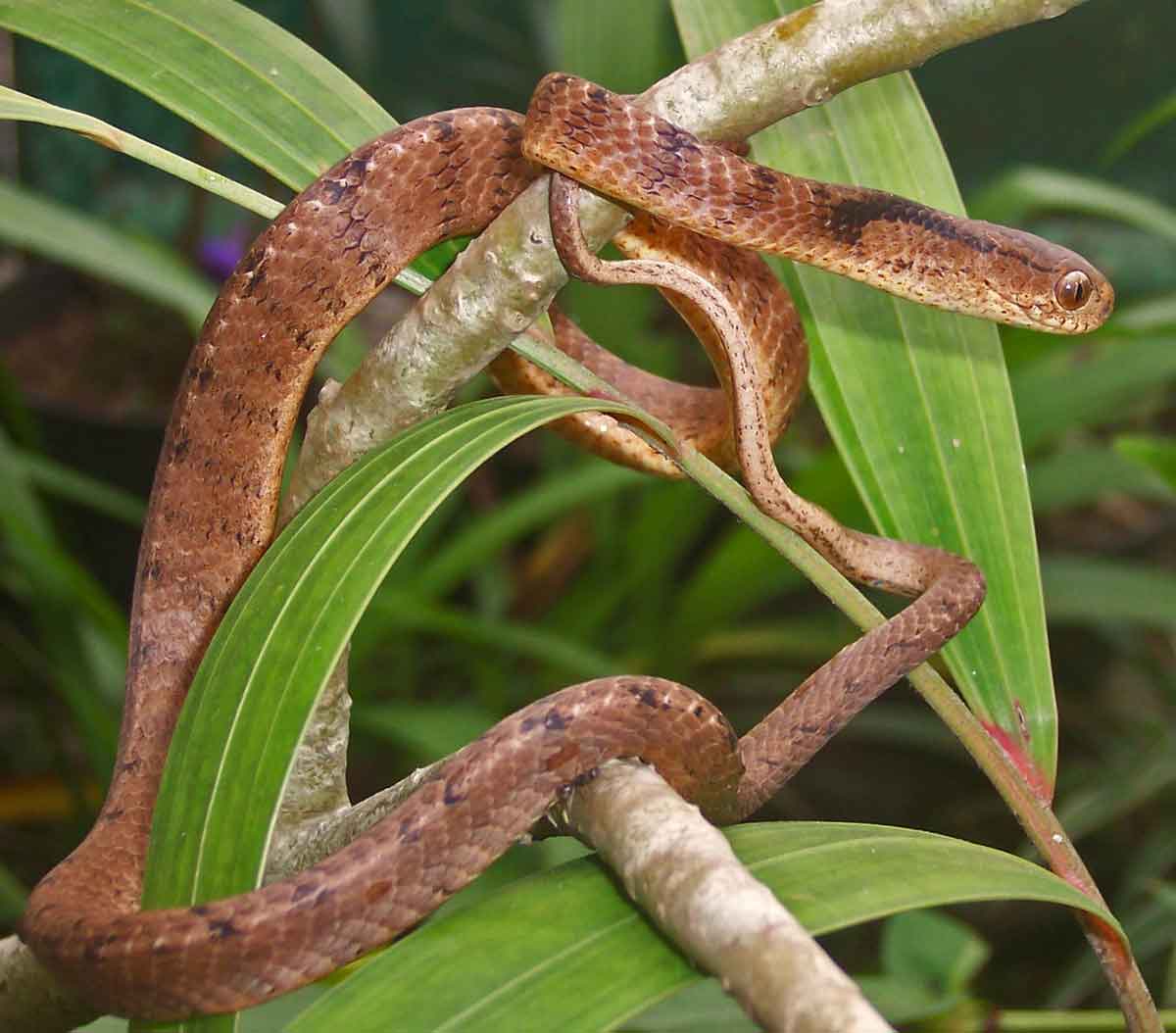
Pareas carinatus, from Bogor, West Java, Indonesian – W.A. Djatmiko (Wie146), CC BY-SA 4.0, via Wikimedia Commons

Content

Origin / Distribution

The Keeled slug-eating snake (Pareas carinatus) is present in parts of southern China, Myanmar, Thailand, Laos, Cambodia, Viet Nam, Peninsular Malaysia (only in northern states), Sumatra, Borneo, Java and Bali. No records from Singapore.

Characteristics / Appearance

It has a remarkably sharp snout and relatively large eyes.. Its body is relatively thin and laterally compressed.. Its color is typically medium brown, with a pattern of darker spots and numerous narrow, broken bars. On the top of the head there are dark markings, that can form a clear cross shape, or they can be somewhat less defined. Its underside is pale yellow..

Habitat

This Keeled slug-eating snake broad-spectrum inhabits lowland and low-mountain forests up to the 1300 meters above sea level. It is nocturnal and has mainly arboreal habits..

Behavior

The Keeled slug-eating snake is a predominantly lowland resident. Rarely found near human settlements and farming areas. Its predominant habitat is forests.. Here the snake feeds at dusk and at night close to the ground. Snakes move very slowly. Their diet consists of nudibranchs and slugs..

When disturbed, sometimes curls into an S shape, raises the front body off the ground and pushes the "adversary", but usually without biting.

This species lays eggs. Females can lay between 3 and 6 eggs throughout the year. The pups measure between 15 and 18 cm when hatched.

Threats to the species

The Keeled slug-eating snake (Pareas carinatus) has recently been assessed by the IUCN Red List of Threatened Species in 2011. It is classified as Least concern.

The "Keeled slug-eating snake" in captivity

Video of the "Keeled slug-eating snake"

PAREAS CARINATUS, the snail snake! the snail eater....

The terrarium

Some measures of 40 x 35 x 60 cm. (width x depth x height) for the terrarium, illuminated and heated with a fluorescent tube and a parabolic radiator of 60 W. The terrarium may have peat plates on the bottom, as well as at the rear and on a side wall. A thick layer of soda clay under the peat plates serves as drainage and water storage to keep the peat moist at all times and thus ensure higher humidity. The Ficus benjamina and the Ficus pumila they take root in the peat and grow forming a tangled web in the terrarium. A few pieces of cork bark add more structure.

Drinking water can be an ornamental birdbath, and animals can be sprayed at least every three days. Depending on the season of the year (warmer in summer, cooler in winter), The temperature in the terrarium ranges from 22 and 32 ยฐC during the day and 18 and 24 ยฐC at night.

Food

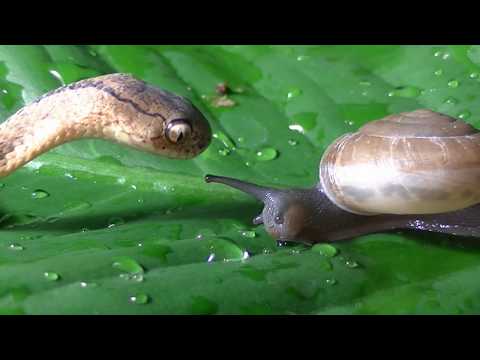
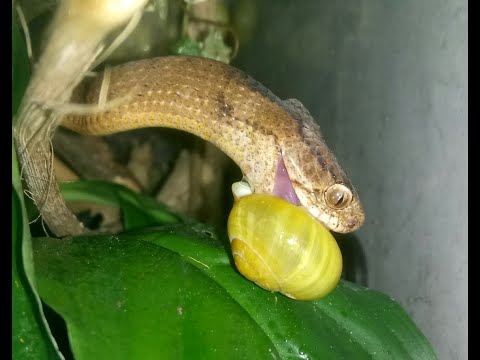
The Keeled slug-eating snake is specialized in feeding on shelled snails. With their enlarged fork-shaped jaws they try to hold the prey by the soft body and lever it out of the shell by alternately retracting the two jaws..

Nudibranchs offered sporadically have so far only been accepted with great hesitation and only when very hungry. The snails that feed are the bright band snails or (Cepaea spp.), that can be found in almost all the field and have an adequate size. for the juniors, look for smaller snails. Bernstein the snail (Succinea putris), that can be found in wet meadows, offers a good alternative to the not always frequent juveniles of Cepaea due to its smaller size. The collection of young vineyard snails (Helix pomatia) is prohibited for reasons of conservation of the species.

Water snails have never been accepted as prey. Feeding the previously frozen snails or their bodies or soft parts proved to be extremely difficult.. It seems that, in addition to the olfactory stimulus, visual stimulation due to the slow movement of the live prey animal and the round shape of the snail shell also plays an important role in prey recognition.

Normally, the animals eat about eight snails once or twice a week. Feeding always takes place at night. If snails are introduced into the terrarium, snakes immediately begin to lick intensely. They then appear to follow the odor gradient in the air until they have the snails directly in front of them..

Buy one "Keeled slug-eating snake"

The price of a "Keeled slug-eating snake" at the exotic animal market, ranges between 200 – 300 EUR.

Videos "Keeled slug-eating snake"

Keeled Slug Snake eats snail

Pareas carinatus feeding

Alternative names:

1. Keeled slug-eating snake (English).
2. Serpent mangeur d'escargot (French).
3. Gekielte Schneckennatter (German).
4. Serpente-comedora de lesmas (Portuguese).
5. "Serpiente comedora de babosas", Serpiente caracolera (espaรฑol).