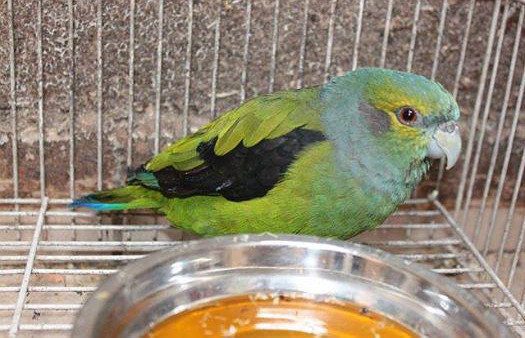
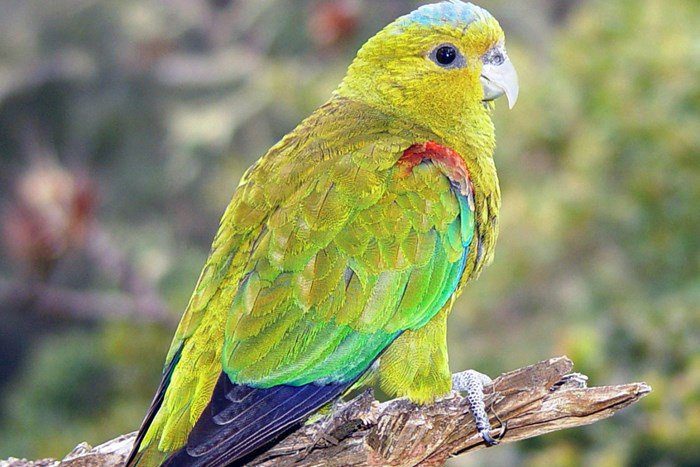
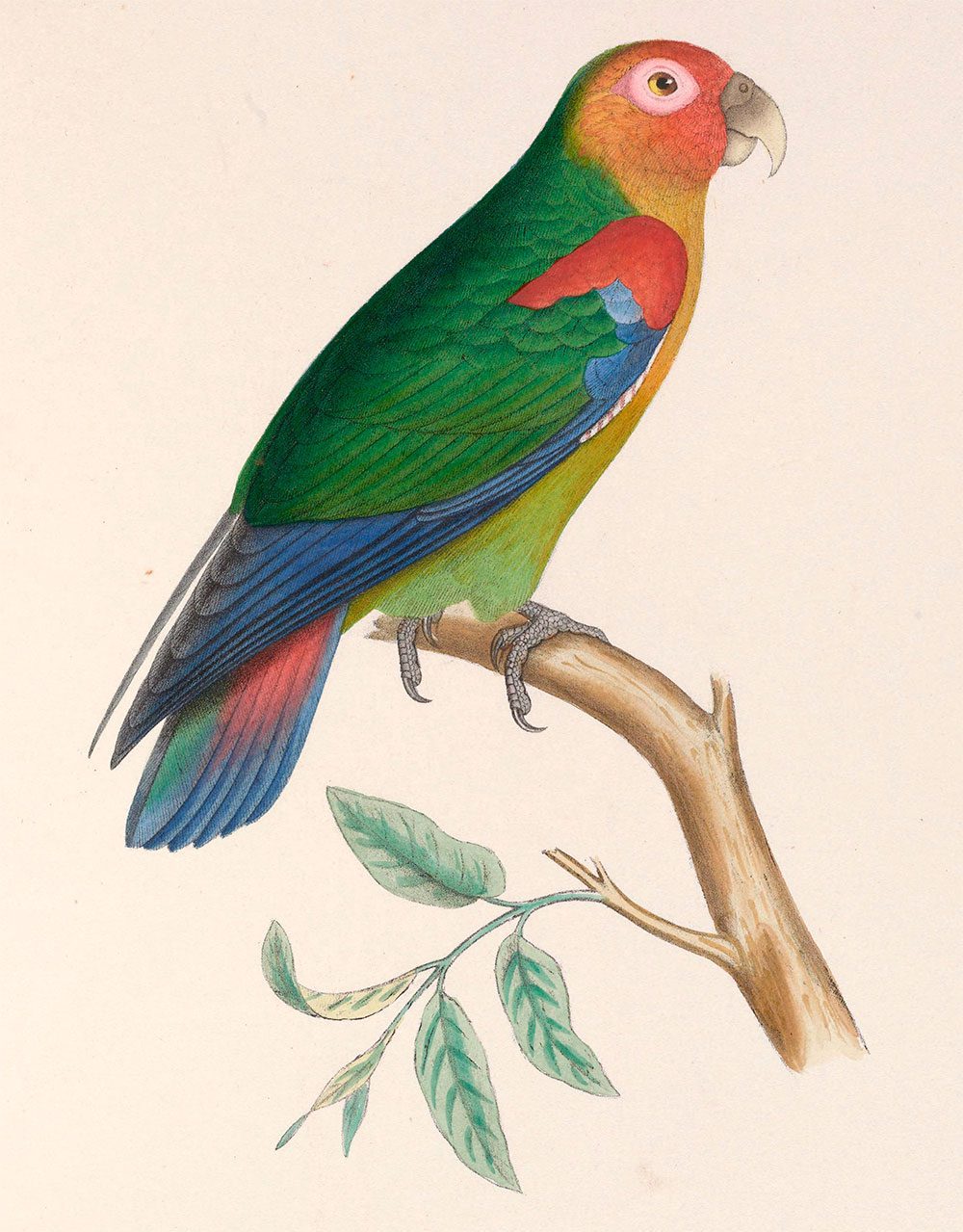
The Black-winged Parrot(Hapalopsittaca melanotis) is distinguishable by the head almost all greyish blue, with blue-billed, ochre around the eye and back of the same black spot defined. Wings with large black patch and purple-blue ends; the tip of the tail blue. The subspecies Hapalopsittaca melanotis peruvianahead green, with the spot towards the back of the eye dark orange.
Habitat
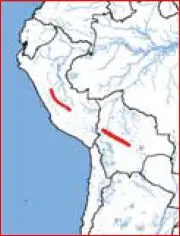
Rare, Although most abundant in Bolivia. It lives in temperate inter-Andean valleys and humid montane forests., between 1500 to 2500 m.. (Occasionally a 3450 m.. in Peru). Usually in pairs or small groups. Seen mostly in pairs or in small groups of 3 to 25 birds. From time to time they gather in groups of up to 50 birds around their favored roosting.
Conservation
Not considered in any of the threat categories, It is very rare in captivity.
They have recorded for this species altitudinal migration, Depending perhaps on the fruiting, Since the fruit is their main source of food.
With reproduced in cavities of trees or places of nesting woodpeckers.
Inhabits intermittently to the East of the Andes, in the center of Peru and in the yunga of Bolivia.
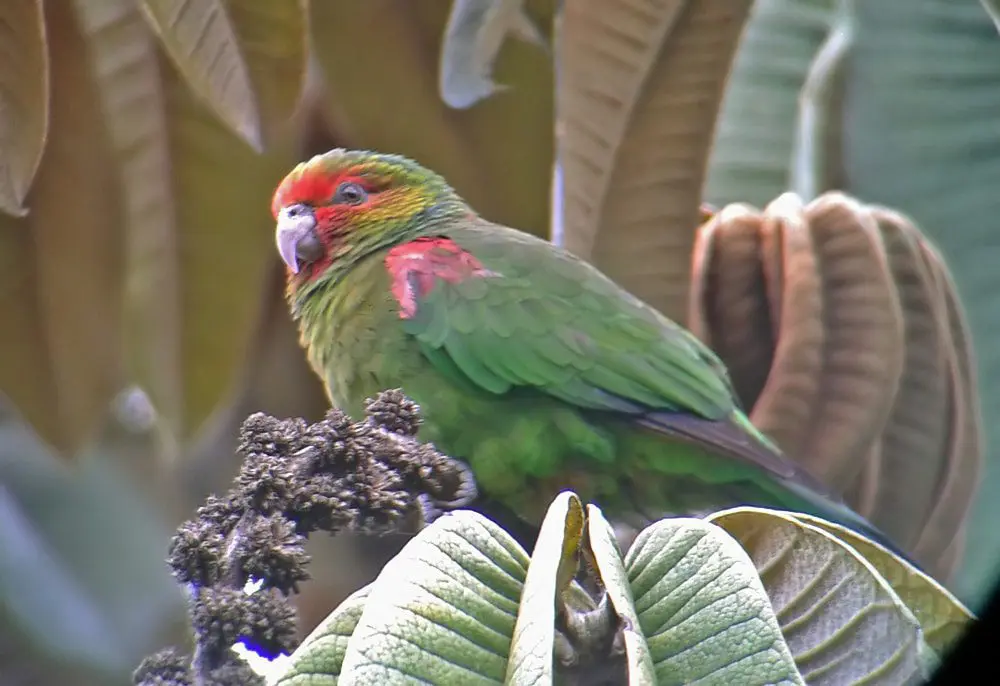
The Red-faced Parrot(Hapalopsittaca pyrrhops) It is distinguishable by the intense red in face and pink magenta in shoulder.
Of bill Of course, yellow feathers on the sides of the neck, crown Green with more bluish back.
Dorsally, wing
with blue stain and end blackish; tail with blue border.
In flight, wing with armpit red, Blue-Green rest, tail Red with blue tip. Youth with the face less red.
Rare. It inhabits in the Woods high Andean, near fells, edges and secondary forests, from the 2400 to 3500 m. They are gregarious, usually in pairs or small flocks of 4 to 6 individuals, rarely more.
They are mostly sedentary. But, can arise some movements seasonal altitudinal.
Reproduction:
Nest in the cavities of trees in October-January; the laying of eggs in late November; the chicks are born in early December, and they leave the nest in late January.
Food:
They feed in the canopy of the forest.
Its diet includes outbreaks, flowers, berries and seeds.
Distribution:
Size of the area of distribution (reproduction / resident): 33.800 km2
Inhabits the southern Andes Ecuador and North end of Peru.
Conservation:
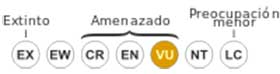
• Current category of the Red List of the UICN: Vulnerable.
• Population trend: Decreasing.
The population is estimated to be a number of 2.500-9.999 mature individuals.
Threats
Its decline is attributed to the destruction and fragmentation of habitat, largely through the conversion of burning forests to small farms (Jacobs and Walker, 1999).
Severe loss of this species can be expected due to deforestation and degradation of forests, by burning and grazing, on Cordillera de Chilla, Loja of Ecuador, although 1995 there were still extensive forest areas (Toyne and Flanagan 1997, Jacobs and Walker 1999).
"Red-faced Parrot" in captivity:
Unknown in the poultry.
Alternative names:
– Red-faced Parrot, Ecuadorian Parrot, Red faced Parrot (English).
– Caïque de Salvin, Caïque à face rouge (French).
– Salvinpapagei, Salvins Zwergpapagei (German).
– Red-faced Parrot (Portuguese).
– Lorito Ecuatoriano (español).
– Loro de Cara Roja (Peru).
In 2002 It was the rediscovery of the the Indigo-winged Parrot(Hapalopsittaca fuertesi), an enigmatic parrot that had been lost to the world for more than 90 years and continues being one of the birds more rare of the Earth. It has a plumage mainly yellowish-green and is highlighted by the blue of the crown and olive yellow tone of the forecrown (except a strip), cheeks and sides of the eyes, narrow strip in the forecrown, under abdomen and shoulders red. End of the wing
blue violet dark, tail Blue with red base.
The bill Horn colored with blue color, Grey at the base of the upper jaw. Iris Green-yellow.
The immature It has less yellow streaks and more off face.
Is a kind of range restricted, very rare and difficult to observe. It inhabits high Andean forests and frequent cloud subparamos, between 2600 and 3800 m on the level of the sea, being the majority of the records between 2.900 and 3.150 m. With guavas, encenillo and laurels where he eats fruits of thematapalo”, and with Oak (Quercus humboldtii).
Observed in fairly open forests, and possibly disturbed, with small Palm trees and tree ferns.
Fly in flocks of 6 to 25 individuals.
Reproduction:
It believes that the nests they make them in cavities of tall, mature trees.
The nesting period takes place from January to may. The average size clutch is three eggs. The incubation is performed only by the female, Although the attention back to the hatching is biparental (Díaz 2006).
Food:
The ecology of breeding and feeding of the Indigo-winged Parrot is practically unknown, but it has been observed the birds feeding of berries, and is likely to show a preference for the berries of mistletoe.
Distribution:
Size distribution (reproduction / resident): 100 km2
Restricted to a small strip on the western slope of the Andes Central of Colombia, near the border of the Quindio, Risaralda and Tolima.
Conservation:
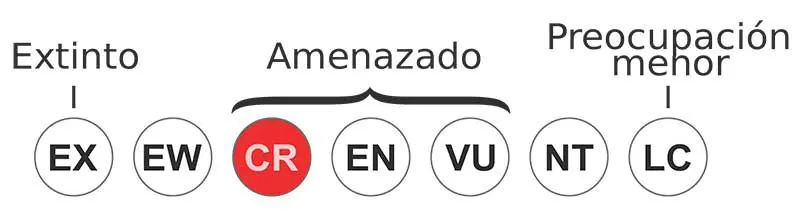
• Current category of the Red List of the UICN: critically endangered.
• Population trend: Decreasing.
According to the categories of UICN is considered in Critical Hazard (CR), due to the accelerated process of deforestation in the Andean forests.
Since ago 90 years it was thought that the bird was extinct until it was rediscovered in 2002, When a few biologists of the ProAves Foundation in the montane forest of the municipality of Genoa, department of Quindío, where the group more large observed consisted of 25 birds and the total population was of approximately 60 individuals.
Currently there are some 300 mature free individuals.
Thanks to the efforts made by different project is have retrieved data of them fluctuations in the abundances of them individuals during the year associated to its reproduction. Is very likely that the offer of the artificial nests This already having a positive impact that the length of the project It has observed an increase in the size population.
– Avibase
– Parrots of the World – Forshaw Joseph M
– Parrots A Guide to the Parrots of the World – Tony Juniper & Mike Parr
– Birdlife
– proaves.org
– Parrot Book, Parrots and macaws Neotropical
The Rusty-faced Parrot or Parrot mountain(Hapalopsittaca amazonina) It is distinguishable by the dirty red of his face and crown. Its bill is pale with to the base of the lower jaw and the chin of color red orange. Headphones coverts reddish brown with yellow lines that extend behind the nape and the neck. The rest of upperparts they are green. Its chest This is olive green, with red spots in the shoulders similar to their Wing coverts internal minors. The rest of your wing-coverts they are blue-green and the remiges bluish-black. Its tail It is mainly dull red with wide blue apexes.
It has no sexual dimorphism. The youth are green-yellow color, with the face pale red and the secondaries grey.
(Hellmayr, 1915) – The plumage with more olive tones and the face dark red.
Hapalopsittaca amazonina velezi
(Serious,GR & Restrepo, 1989) – With part of the crown and nape, brighter yellowish green; forecrown red; list fine near to the ear; below and behind the eye, green. More information.
Habitat:
It inhabits in mountains with semi-humid and cloud forests, between the 2000 to 3600 m, with the presence of Oak (Quercus humboldtii) and Alder (Alnus acuminata).
Fly high in the forest canopy, in groups of 5-30 individuals. Presents aggregation behaviors for the night, establishing communal bedrooms in groups of between 2-35 individuals.
Reproduction:
Many aspects of the reproductive biology of the Rusty-faced Parrot. Probably nests in tree hollows of Oak dead.
Food:
Consumes fruits of the "matapalo«, flowers and seeds, including the of Clusia sp. and some GUIs of which is fed with high frequency.
Distribution:
Size of the breeding range / resident): 234.000 km2
• Current category of the Red List of the UICN: Vulnerable.
• Population trend: Decreasing.
From makes several years appears in the book red of species threatened by fault of the destruction of their habitat, including, the Palm of wax (Ceroxylon quindiuense).
Rationale for the Red List category
This species is classified as Vulnerable Since its small population consists of subpopulations very small and scattered that probably will be experiencing declines continuous due to the loss widespread of habitat.
Justification of the population
Renjifo et to the. (2002) estimated that in Colombia the population can count 2,500-10,000 individuals, based on a hypothetical C.1 density of individuals / km2, and the 25% occupation of the approximately 13.890 km2 of habitat suitable. This may be an overestimate and the population could be right around the few thousand mark in Colombia (P. Salaman in litt., 2005). There are also much smaller populations in Venezuela. Its location in the Ecuador is uncertain. Be placed better in the band 2.500-9.999 mature in general individuals, which is equivalent to 3.750-14.999 individuals, rounded here to 3.500-15.000 individuals.
Justification of trend
Se sospecha una lenta y continua disminución de la población del Rusty-faced Parrot sobre la base de la continua destrucción y fragmentación del hábitat.
"Rusty-faced Parrot" in captivity:
No encontrado en avicultura.
Alternative names:
– Rusty-faced Parrot, Bogota Parrot, Little Amazonian Parrot, Rusty faced Parrot (English).
– Caïque à face rousse, Caïque à face rouge (French).
– Caïque à face rousse (German).
– Rusty-faced Parrot (Portuguese).
– Cotorra Montañera, Lorito Amazonino, Lorito Multicolor, Loro fantasma (español).
– Cotorra Montañera, Lora montañera (Colombia).
– Perico Multicolor (Venezuela).
Daniel has been chasing birds since he was 9-years old, growing on a farm in the Central Andes of Colombia, with his bedroom walls covered with colorful prints of John James Audubon’s birds. Daniel graduated in Veterinary Medicine and Animal Science and has pursued bird and nature photography as his main passions in life.
He is co-founder of the Caldas Ornithological Society (SCO) based in Manizales. Dedicated mainly to conservation and sustainable development projects, Daniel has consulted for many of the most prominent environmental organizations in Colombia and currently assists private nature reserves in Colombia in the establishment of agritourism and ecotourism services.