โ–ท The world of Pets: Dogs, cats, birds, reptiles, amphibians

Colasisi
Loriculus philippensis


Loriculo Filipino

Content


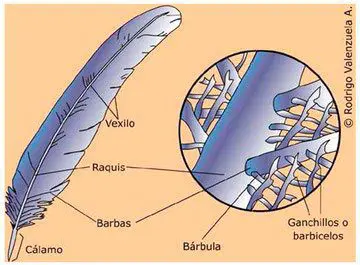
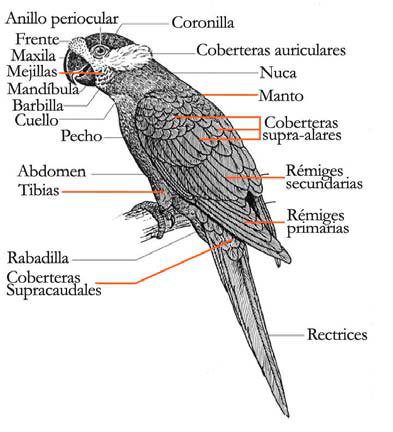
Anatomy-parrots

Description

14 cm.. length and a weight between 31 and 40 g..

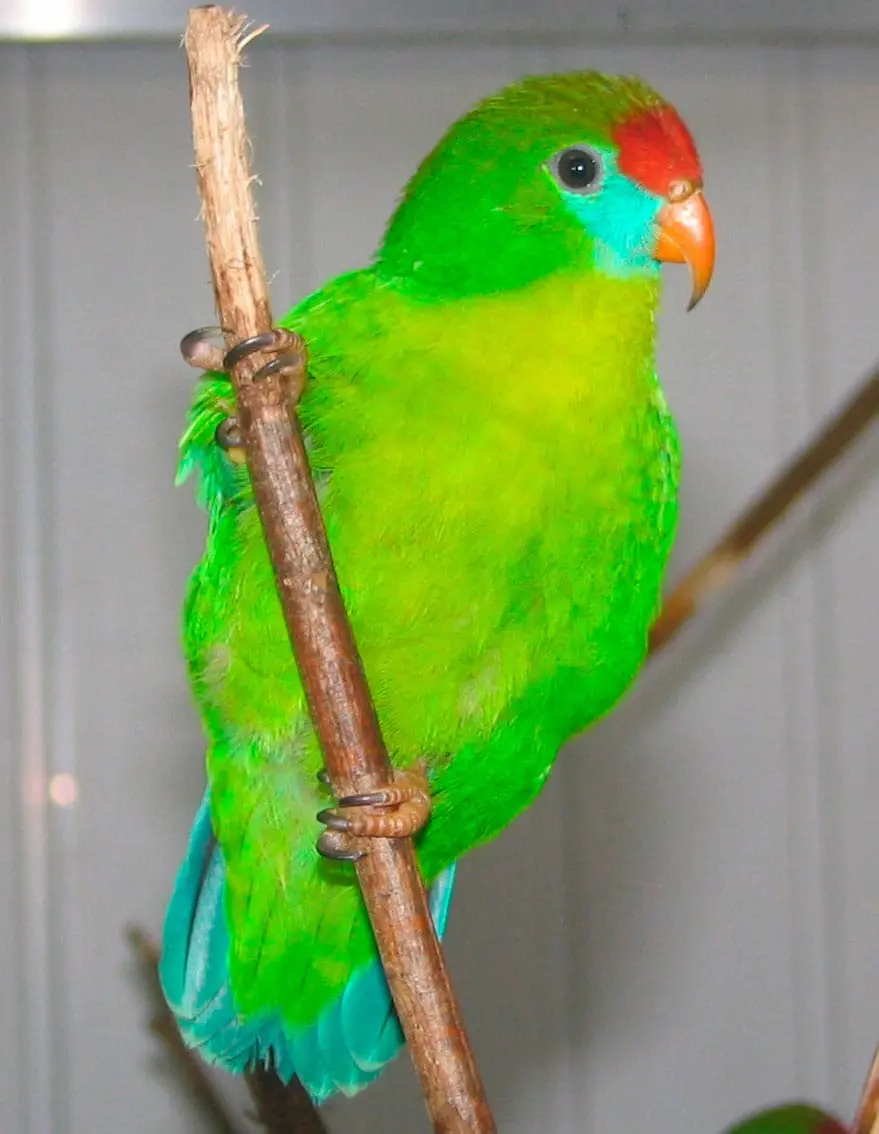
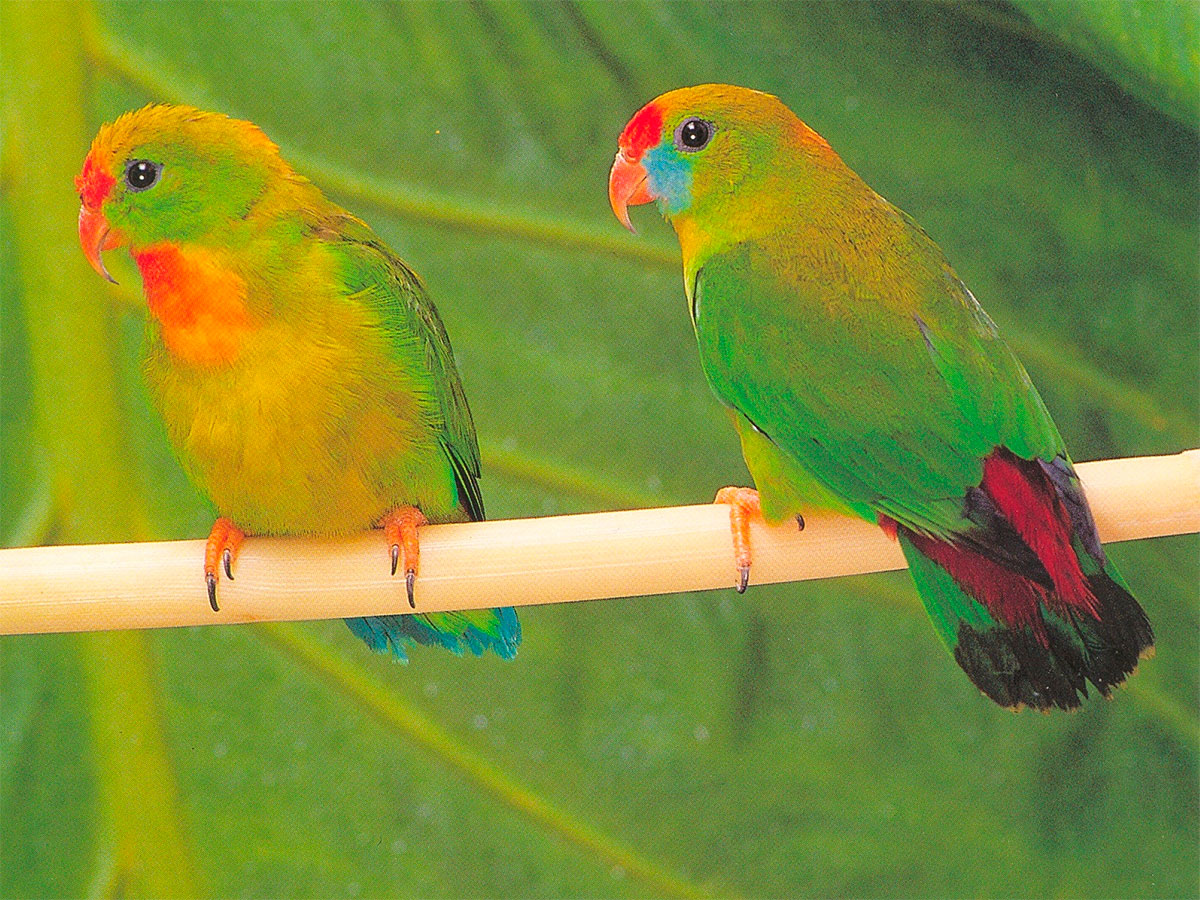
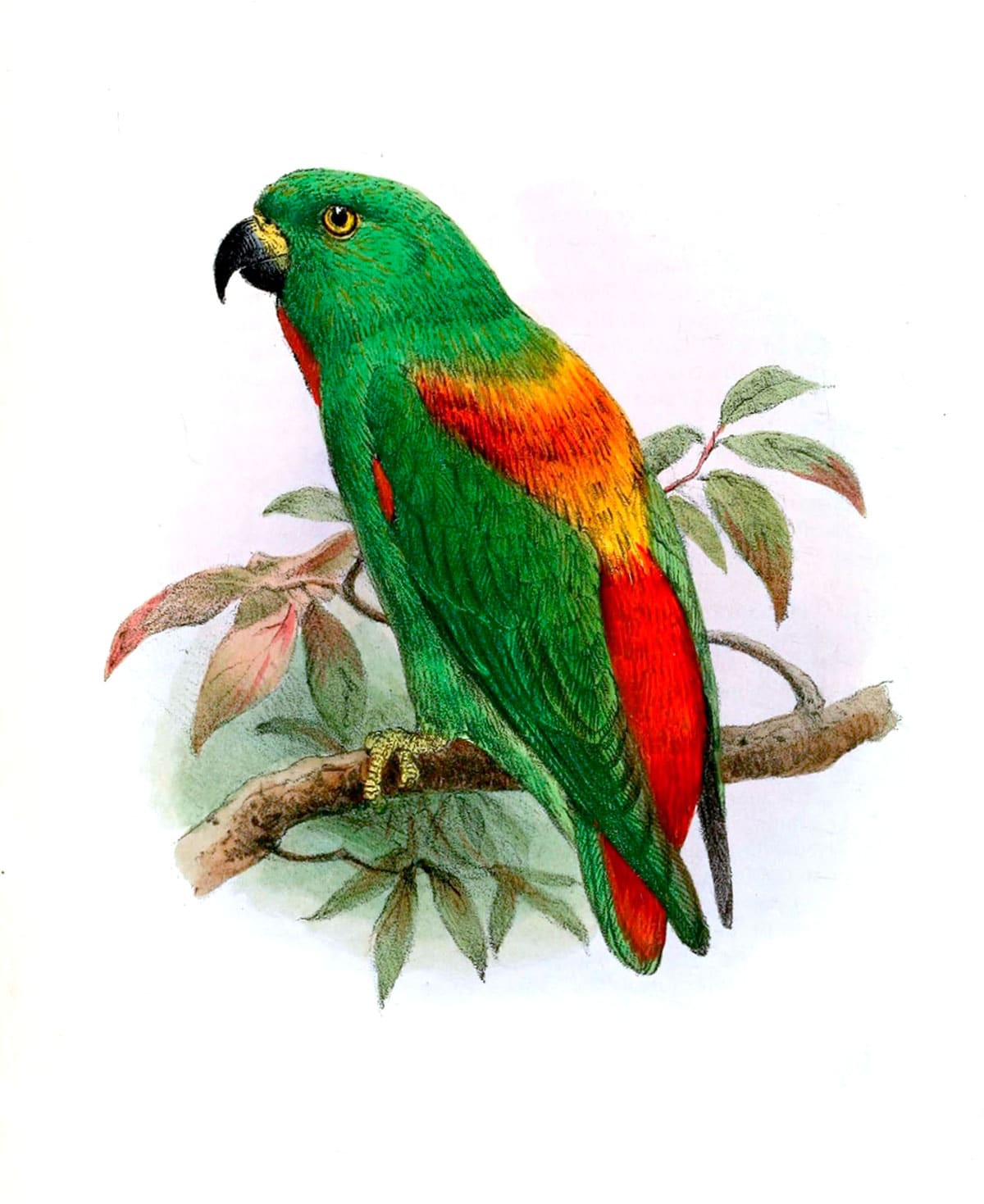
The head of the Colasisi (Loriculus philippensis) is bright green with a patch of narrow Scarlet color on the front of the Crown, bordered orange-red color on the back edge; yellowish-green Chin: narrow collar on the back of the Orange and red neck, with a wash light yellowish in the neck.

Bright green upperparts with dark crimson rump and uppertail coverts (lower sides of light blue). Bright green wings with vane internal to the darker flight feathers. Under, the wings of turquoise-blue with the exception of the outermost coverts which are green. Bright red throat Center, merging to red-orange in the center of the chest (yellow on the bases of feathers); rest of the lower region of bright green, lighter and more yellow than the upper region. Upper, the green tail; Blue below.

Coral red beak; dark brown irises; dark orange legs.

The female has a face marked in blue and does not have the Red bib, that is replaced by a greenish yellow colour wash. The female Crown is washed in yellow-orange (stronger than in the male).

Young birds have a more off Crown and paler beak.

Subspecies description
Subspecies
  • Loriculus philippensis apicalis

    (Souance 1856): Two aberrant samples previously attributed to theLoriculus salvadorii. They are larger, with less red on the Crown, more blue on the tail, and darker green colour. All the Crown of this subspecies is Scarlet, merging in Orange on the back of the neck and orange on the mantle in both sexes (duller in females). Bright red in the hip and more orange on the top.

  • Loriculus (philippensis) bonapartei

    (Souance 18563): You have the back of the head with pronunciation orange hue, Pico black and grey legs.

  • Loriculus philippensis bournsi

    (McGregor 1905): The male with red only in the front and light yellow area in the center of the Crown (female much less yellow on the Crown), upper part of the Crown of the male less yellow shows that the L. p. Regulus. Orange line on the nape of the male is less clear in the female. Female with less blue in the face that the nominal species.

  • Loriculus philippensis chrysonotus

    (Sclater, PL 1872): Frontal area and rest of the crown bright red that extends in golden yellow color on the mantle, and showing a fine reddish collar on the back of the neck. Male with more orange in the lower part of the throat patch. The female Crown similar but less marked.

  • Loriculus philippensis dohertyi

    (Hartert 1906): Maybe more orange in the mantle, but hardly different to the L. p. apicalis.

  • Loriculus philippensis mindorensis

    (Steere 1890): Orange-yellow on the neck line. Crown Green. More extensive turquoise patch on both sides of the rump.

  • Loriculus philippensis philippensis

    (Statius Mรผller 1776): Nominal

  • Loriculus philippensis regulus

    (Souance 1856): Similar to the L. p. bournsi but male with much more yellow on the Crown (female shows a more subdued yellow broadcast, but more than in the previous race). Nape line weaker than in the bournsi. Male with more Scarlet patch.

  • Loriculus philippensis siquijorensis

    (Steere 1890): Male with less red bib and the red spot of the largest Crown than in the nominal species. Back of the Green Crown. Falata neck mark. Female with more blue in the face.

  • Loriculus philippensis worcesteri

    (Steere 1890): Male Scarlet throat patch smaller than that in the L. p. chrysonotus. Both sexes show a more extensive Crown of orange-red in the rear margin. There is a small patch on the back of the neck of orange color and a light reddish color in the mantle of diffusion.

  • Loriculus (philippensis) camiguinensis

    (Tello, JG 2006): has mainly green plumage, with throat, front side of the face and thighs of azure-blue; the front, the pileus, the obispillo and the top of the red tail, While the rest of the tail is blue. Males and females are identical in appearance, What is unusual in others Philippine parrots, Since only males of other species have red forehead.

Habitat:

The species is found along the edges of the forest, secondary growth, Bamboo forests, areas cultivated near villages, orchards and plantations of coconut. The birds are alone, in pairs or in family groups, sometimes in small flocks, sometimes with other birds.

Reproduction:

The breeding season has been recorded from April to August.. Three eggs are deposited and incubated by the female during 20 days, the young leave the nest in five weeks.

Food:

They feed in the upper levels of flowering plants or fruit trees, sometimes at lower levels, flower, nectar, fruit (including figs) and seeds, sometimes intoxicated by consumption of fermented coconut nectar (coconuts).

Distribution:

Limited to the Philippines (less the Sulu archipelago), where are widespread and resident except in Palawan. Its abundance varies according to the subspecies.. In general, the species is locally common up to 1000 meters above sea level, but have been recorded at altitudes of up to 2.500 m (Mount Apo, Mindanao).

Subspecies distribution
Subspecies

Conservation:


minor concern


– Current IUCN Red List category: Least concern

– The population trend: Decreasing

The world population is considered to be above the 20,000 exemplary but decreasing due to loss of habitat. The subspecies Mindoro is considered as threatened, and both subspecies of Cebu as Siquijor, are nearly extinct the loss of habitat (as these birds are commonly caged and traded between islands, contemporary records of birds from Siquijor they require confirmation to determine whether they refer to the breeds).

The combined population of Mindoro, Sibuyan, Blacks, Surigao del Sur, Tables, Romblon, Masbate, Ticao, Cuimaras and Basilan (subspecies L. p. mindorensis, L. p. bournsi, L. p. Regulus and L. p. dohertyi) probably add in total not more than 5.000 birds.

"Colasisi" in captivity:

Very rare.

Alternative names:

Colasisi, Philippine Hanging-parrot (ingles).
Coryllis des Philippines (French).
Philippinenpapageichen (German).
Loriculus philippensis (Portuguese).
Lorรญculo Filipino (espaรฑol).

scientific classification:

Order: Psittaciformes
Family: Psittaculidae
Scientific name: Loriculus philippensis
Genus: Loriculus
Citation: (Statius Mรผller, 1776)
Protonimo: Psittacus philippensis

Images ยซFilipino Loriculusยป:

Videos "Colasisi"

————————————————————————————————

ยซPhilippine Lorikeetยป (Loriculus philippensis)


Sources:

Avibase
– Parrots of the World โ€“ Forshaw Joseph M
– Parrots A Guide to the Parrots of the World – Tony Juniper & Mike Parr
– Birdlife

Photos:

(1) – a female perched. by iggino – lynx
(2) – Birds-pet-wallpapers – link
(3) – Loriculus philippensis camiguinensis (Author AlexKant) – Crocolandia Foundation – ZooChat
(4) – Loriculus p. apicalis, male, By iggino – lynx
(5) – tapety-papousci

Sounds: David Edwards (Xeno-canto)

โ–ท The world of Pets: Dogs, cats, birds, reptiles, amphibians

Ceylon Hanging-Parrot
Loriculus beryllinus


Ceylon hanging

Content

Description

13 cm.. length.

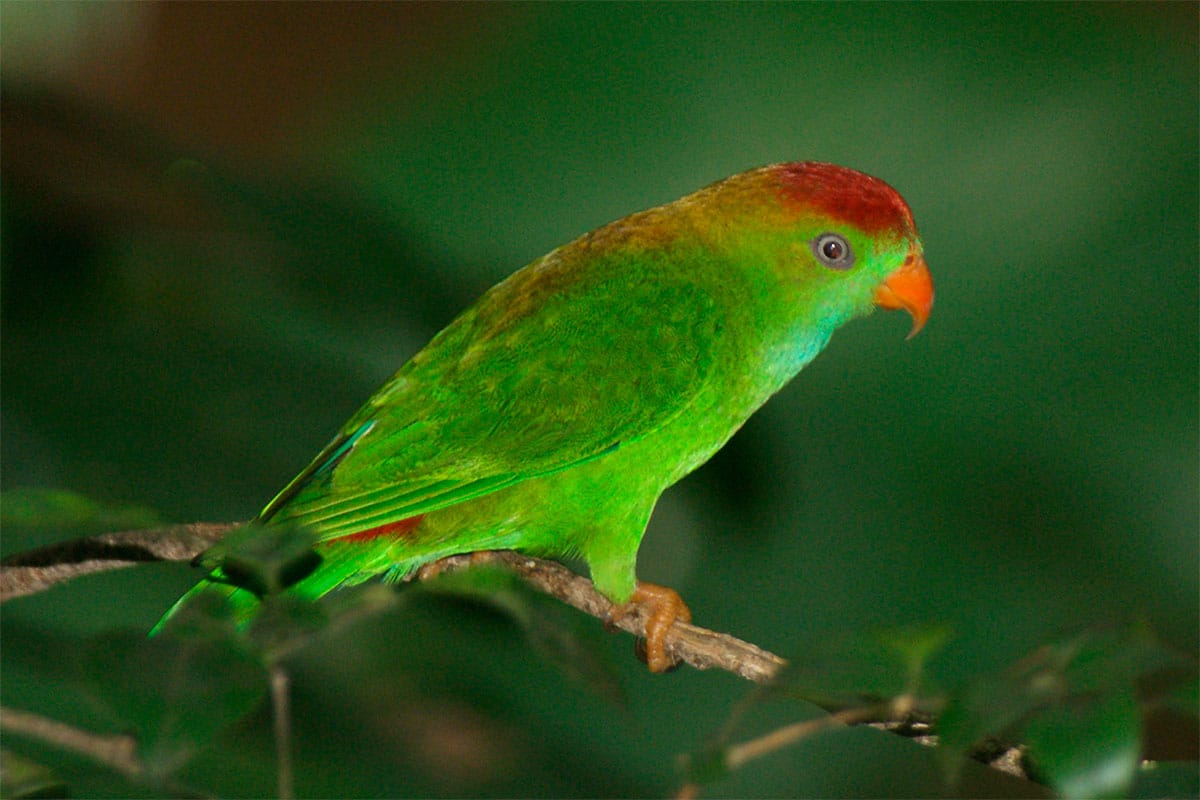
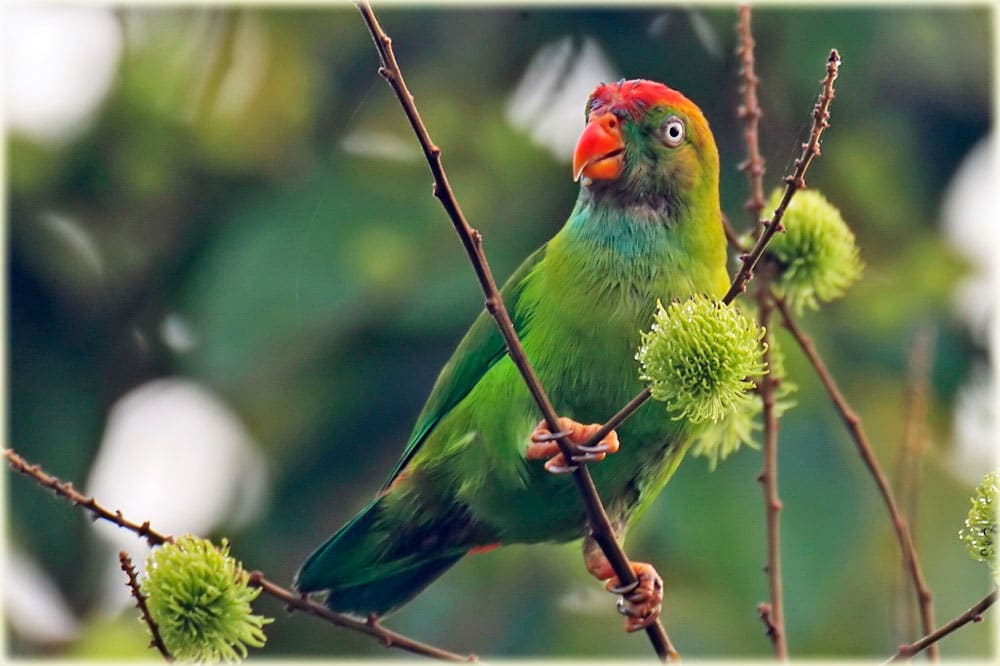
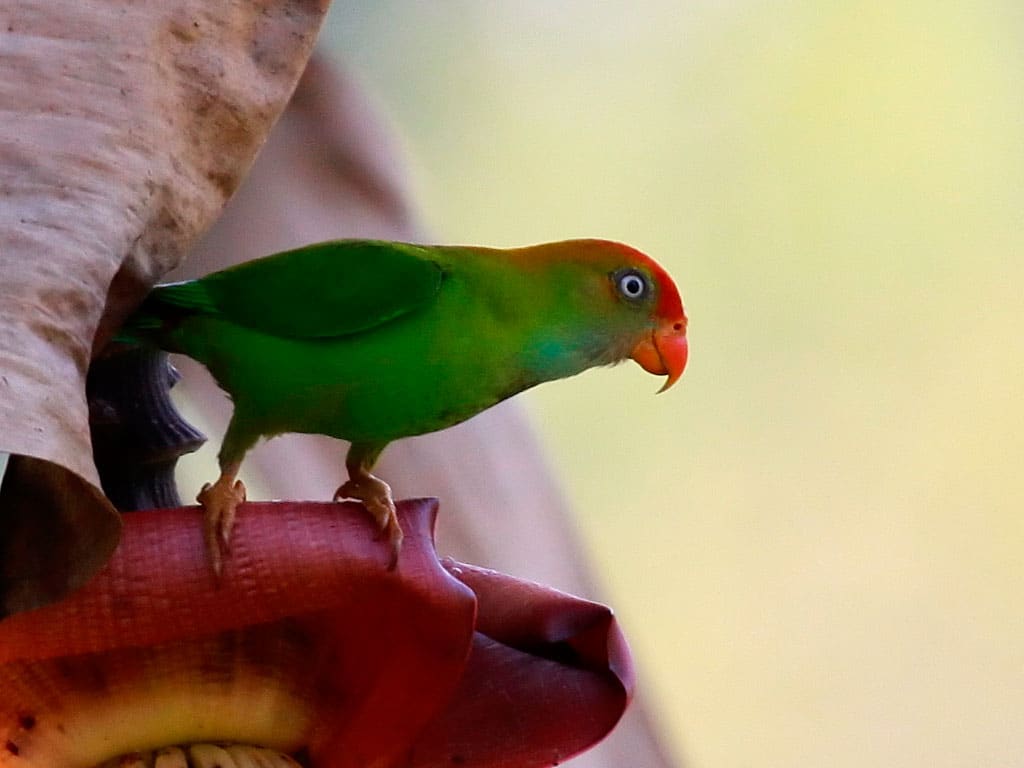
The Ceylon Hanging-Parrot (Loriculus beryllinus) has the crown red, merging into orange-yellow in the area of the nape; eyebrows, lores and the area in front of the eyes light green (lightly bathed in pale blue); sides of the front of the crown red. Mantle green, Baรฑado de slightly reddish and yellowish orange color in the Center; back green; rump and uppertail-coverts, red. Wings green up, with the exception of vane inner of the blackish flight feathers ; undertail, the wings bright turquoise color with the exception of coats and axillary green. The underparts bright green, paler and more yellowish which the upperparts and light blue marking in the throat. above the tail green color; Turquoise below.

Bill orange red, paler at the tip; irises off-white; legs dark yellow.

Female as the male, but most off and only a trace of blue in the throat.

The young birds they are even duller, the crown reddish-tinged, the patch blue of the throat absent, the rump with some green feathers, the bill paler, the iris and the legs brown; the face nude in the fledglings.

Habitat:

Seen in a range of habitats, from sea level to 1.600 m, reaching the highest areas according to seasonal conditions. The species is found in forests of coconut trees, Evergreen and deciduous forests, semicultivadas areas, open woodland and around the dwellings.

birds are not shy, and is usually found in pairs or family groups, although outside the breeding season larger flocks congregate high up in flowering trees. They are active and acrobatic feeding.

Reproduction:

Observations, they have registered the male approaching his partner upright, with the high peak, swollen throat, extended tail and rump feathers erect, while emitting a screeching chirp. Wiggles head in courtship period have also been observed.

The breeding begins in January and although the main nesting period is between March and May, a second litter is, sometimes, until September. The nest is located in a hollow branch filled with fragments of vegetation that the female carefully cuts with her beak and carries to the nesting sites tucked between her rump feathers.. Only two to four white eggs she incubates, sitting firmly, screeching and creating a 'thumping' sound’ Yes is the annoying. The young Chick has the face exposed, presumably to avoid getting dirty by liquid food.

Food:

Feed on fruits such as Ficus figs and guava (Psidium guajava); berries; flowers, including Erythrina, Salmalia and eucalyptus; seeds, including Casuarina. Poisonings have been reported after drinking Palm wine collected pots attached to the trunks of the trees.

Distribution:

Endemic to Sri Lanka, where most records come from the South, Although there have been North of Trincomalee and should be observed in suitable habitats throughout the country. Records include proximities of Colombo, around Kandy, Yala and National parks Gal Oya, the district Welimada, and to the South of Galle and Hambantota, on the coast.

Conservation:


minor concern


โ€ข Current IUCN Red List category: Least concern

โ€ข Population trend: Stable

The size of the world's population has not been quantified, Although it is estimated at 10.000 specimens. The species is qualified as widespread and abundant in the South-West and almost absent in the North of its distribution area (pit et to the. 1997).

The population is suspected to be stable in the absence of evidence of any reduction or substantial threats, However, the bird trade is judged as a potential threat.

"Ceylon Hanging-Parrot" in captivity:

Rare.

Alternative names:

Ceylon Hanging-Parrot, Ceylon Hanging Parrot, Ceylon Lorikeet, Sri Lanka Hanging Parrot, Sri Lanka Hanging-Parrot, Sri Lankan Hanging Parrot (ingles).
Coryllis de Ceylan, Coryllis du Sri Lanka (French).
Ceylonpapageichen, Ceylon Papageichen (German).
Loriculus beryllinus (Portuguese).
Lorรญculo de Ceilรกn, Lorรญculode Ceilรกn (espaรฑol).

scientific classification:

Order: Psittaciformes
Family: Psittaculidae
Scientific name: Loriculus beryllinus
Genus: Loriculus
Citation: (Forster,JR, 1781)
Protonimo: Psittacus beryllinus

ยซCeylon loricleยป images:

Video of the "Ceylon Hanging-Parrot"

————————————————————————————————

ยซCeylon loricleยป (Loriculus beryllinus)


Sources:

Avibase
– Parrots of the World โ€“ Forshaw Joseph M
– Parrots A Guide to the Parrots of the World – Tony Juniper & Mike Parr
– Birdlife

Photos:

(1) – ยซLoriculus beryllinus-Sri Lanka-adult-8ยป by Hafiz Issadeen – originally posted to Flickr as Sri Lanka Hanging Parrot. Licensed under CC BY 2.0 via Wikimedia Commons.
(2) – ยซThimindu 2010 03 06 Sinharaja Sri Lanka Hangling Parrot 1ยป by ThiminduOwn work. Licensed under CC BY-SA 3.0 via Wikimedia Commons.
(3) – Perched in a tree by John A Thompson – lynx
(4) – Birds-pet-wallpapers/Parrot-birds – link
(5) – A fight by Guy Poisson – lynx

Sounds: Tero Linjama (Xeno-canto)

โ–ท The world of Pets: Dogs, cats, birds, reptiles, amphibians

Blue-crowned hanging parrot
Loriculus galgulus


Hanging Coroniazul

Content

Description

Of 13 cm.. length and 28 g. of weight.

The head of the Blue-crowned hanging parrot (Loriculus galgulus) is bright green with a patch dark blue in the center of the back of the crown. Upperparts Greens with patch orange-brown in the Centre of the the mantle, yellow band at the bottom of the rump and tail coverts scarlet. Wings Greens with vane inner to flight feather darker. Under the wing coats green, with the underside of the flight feather blue. Throat and top of the chest with a patch bright Scarlet, the rest of the underparts slightly of a green pale that the upperparts (and more yellowish on the flanks). Upper, the tail green; Blue below.

Bill black; irises dark brown, legs yellowish brown.

The females lack of the bib red, with the underparts yellowish green. The patch of the crown is much more off, and the the mantle Orange is less marked than in the male.

The young birds lack of the crown blue, they have only an orange wash on the the mantle and bill yellowish. Maturation takes from two to four years in young men, showing the throat Red as the first sign of plumage adult.

Habitat:

Birds have been observed spending the night on the Hill of Fraserโ€™s Hill (Malaysia), which indicates that there is a certain night dispersion. Extralimitales records have also reached coastal islands. The species occurs from the lowlands up to around 1.300 m, lies in the Woods, river banks growing, mangroves, secondary growth, lightly wooded areas, bamboo clumps, orchards, inhabited areas and coconut trees. The birds frequent the canopy and medium height plants, travelling alone, in pairs or. outside the breeding season, in groups of up to 150 birds that invade fruit orchards.

The birds are moving forward with steps balanced through the vegetation with a comical air, using the peak to help upload, and tail as support. Like other hanging parrots, This species sleeping upside down and also uses rain water for bathing in the same position.

Reproduction:

Video "Loricle Coroniazul"

Blue-crowned hanging parrotBlue-crowned hanging parrot

The reproductive behavior you have registered between the months of January and August. When the courtship takes place, the male is shaking his head, cupping their red feathers, extending the tail, with the body upright, and making calls with a soft Twitter.

The nest It is built into the natural cavity in a tree, enlarged by birds, at a height between 5 and 12 meters above the ground.

The Nesting material It is cut by the female and taken to the nest in the contour feathers. The laying is three to four white eggs often dyed Brown. The female incubates the eggs for 20 days and the chicks leave the nest about 33 days after hatching.

Food:

It feeds on flowers, outbreaks, fruit, various seeds and nuts.

Distribution:

Ranges to South, about 10 ยฐ Norte, on the peninsula of Thailand, through Malaysia and Singapore, distributed also in some surrounding islands, including the Anambas Islands, the archipelago of Riau and Batam. The species is widespread through Sumatra and can be seen in the islands of the coast including Tuangku, Nias, Pini, Batu, Siberut, Sipura, Enggano, and to the North of Bangka, Mendanau and Belitung. Is present in a habitat along of Borneo, and the coastal islands Labuan and Maratua. His presence at the end of Java Western, in the area Labuhan, It can be the result of leaks of birds; the population around Jakarta is certainly wild.

Conservation:


minor concern


โ€ข Current IUCN Red List category: Least concern

โ€ข Population trend: Stable

The size of the world's population has not been quantified, but it is thought that it may be superior to 100.000 specimens without registration of captive birds. The species according to information, it is common and widespread in most of its range (pit et to the. 1997).

The population is suspected to be stable in the absence of evidence of any reduction or substantial threats.

"Blue-crowned hanging parrot" in captivity:

These birds are kept in poultry, both in United States as in all Europe. Your dietary needs predispose them to a series of infections if failure to observe stringent hygiene practices, which makes them difficult to keep in captivity. This is the main reason that this species is rare in poultry farming., and even rarer as a pet.

More information at loromania

Alternative names:

Blue-crowned Hanging Parrot, Blue crowned Hanging Parrot, Blue-crowned Hanging-Parrot, Blue-topped Hanging-parrot, Malay Hanging Parrot, Malay Lorikeet, Malaysian Hanging-Parrot (ingles).
Coryllis ร  tรชte bleue, Coryllis ร  calotte bleue, Coryllis de Malacca, Coryllis malais, Loricule ร  tรชte bleue, Loricule de Malacca, Loricule malais (French).
Blaukrรถnchen (German).
Loriculus galgulus (Portuguese).
Lorรญculo Azul, Lorรญculo Coroniazul (espaรฑol).

scientific classification:

Order: Psittaciformes
Family: Psittaculidae
Genus: Loriculus
Scientific name: Loriculus galgulus
Citation: (Linnaeus, 1758)
Protonimo: Psittacus Galgulus

Images ยซLoricle Coroniazulยป:

Videos "Blue-crowned hanging parrot"

————————————————————————————————

"Lorรญculo coroniazulยป (Loriculus galgulus)


Sources:

Avibase
– Parrots of the World โ€“ Forshaw Joseph M
– Parrots A Guide to the Parrots of the World – Tony Juniper & Mike Parr
– Birdlife

Photos:

(1) – By Lip Kee Yap from Singapore, Republic of Singapore [CC BY-SA 2.0], via Wikimedia Commons
(2) – By Quartl (Own work) [CC BY-SA 3.0], via Wikimedia Commons
(3) – By Art Bromage [CC BY-SA 2.0], via Wikimedia Commons
(4) – By Lip Kee Yap from Singapore, Republic of Singapore [CC BY-SA 2.0], via Wikimedia Commons
(5) – By Lip Kee Yap from Singapore, Republic of Singapore [CC BY-SA 2.0], via Wikimedia Commons

Sounds: Marc Anderson (Xeno-canto)