â–· The world of Pets: Dogs, cats, birds, reptiles, amphibians

Canary
Serinus Canaria

Canary. Popular cage bird.

Welcome to our blog about the fascinating world of canaries! On this occasion, We will delve into the life and characteristics of these popular cage birds. Canaries are known for their beauty, Melodious song and lovely personality. If you are bird lover or are you thinking of having a feathered partner at home, You can't miss this article! Discover everything about the Canaries: From its vibrant colors to its different alternative names. Keep reading to immerse yourself in the wonderful universe of the Canary. Let's start!

The Canarian: A winged charm in our homes

The Canaries, those small birds of vibrant colors and melodic songs, They have been appreciated in homes around the world for centuries. You are charming creatures, belonging to the Fingílidos family, They have gained popularity as cage birds thanks to their fascinating characteristics and captivating behavior.

Characteristics of the Canary:

Canaries are known for their compact size, with a length that usually ranges between 10 and 25 centimeters. His plumage is extremely varied, presenting colors ranging from bright yellow to more turned off tones, and even color combinations that can include orange, black and white. These birds are also recognized by their striking peaks and expressive eyes.

Natural distribution and habitat:

Native of the Canary Islands, Located in the Northwest Atlantic, Canaries thrive in warm and subtropical climates. Although their natural habitats include forested areas and scrubbers, Their adaptability has allowed them to acclimatize to various conditions, From forests to urban areas.

Reproduction:

The reproduction of the canaries is a fascinating process. The female usually puts eggs, that incubate for approximately two weeks. Parents actively participate in chick care, feeding them and providing them with protection. It is essential to provide a safe and comfortable environment in the cage to promote a successful reproductive process.

Melodic song:

One of the most appreciated attributes of the Canaries is their talent for song. Males, in particular, They are known for their melodious vocalizations. These birds can learn various notes and singing patterns, creating a unique symphony that loves those who have the pleasure of listening to it. Regular practice and interaction with other canaries stimulate their ability to develop a more elaborate and harmonious song.

Price and popularity as pets:

Due to its friendly beauty and personality, Canaries are a popular option as pets. The price of a canary can vary according to factors such as color, Age and singing ability. Canaries with more unusual colors or with exceptional song skills can have a higher price.

Common diseases:

When raising Canaries in captivity, It is essential to be aware of possible diseases. Obesity, Respiratory infections and mites are common problems that can affect these birds. Provide a balanced diet, A clean environment and perform regular veterinary reviews will contribute to maintaining the health of these delicate winged companions.

Colors and varieties:

Canaries have raised selectively over the years, What has resulted in a wide variety of colors and patterns. From the yellow classic to white, black, red and even more exotic tones, The canary's color palette is as diverse as beautiful.

In summary, Canaries not only provide an explosion of color and melody to our homes, but also connect to nature in a unique way. As charming and entertaining fellow, These little singers have conquered the hearts of those who seek joy and beauty in their daily lives.
â–· The world of Pets: Dogs, cats, birds, reptiles, amphibians

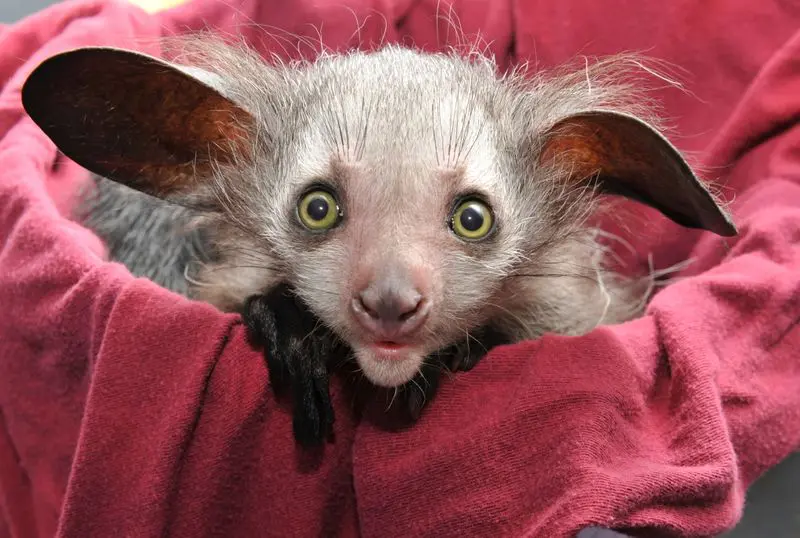
Aye-Aye Aye!

aye-aye

The aye-aye is the only living member of the Daubentoniidae family., and is considered to be the most unusual of all primates.

Key data

Conservation status: Near-threatened

MORPHOLOGY

Aye-ayes have a unique method of feeding: A large percentage of its diet consists of insect larvae that live in dead wood inside. They find the larvae by tapping in the branches and listening to the echo. When is a cavity in the wood (that may contain insect larvae), the aye - aye bites through the outer layers of bark to then get a long finger at the bottom of the hole to remove the dam. He also often uses this third finger to drink liquids quickly and to wash himself..

Read more

â–· The world of Pets: Dogs, cats, birds, reptiles, amphibians

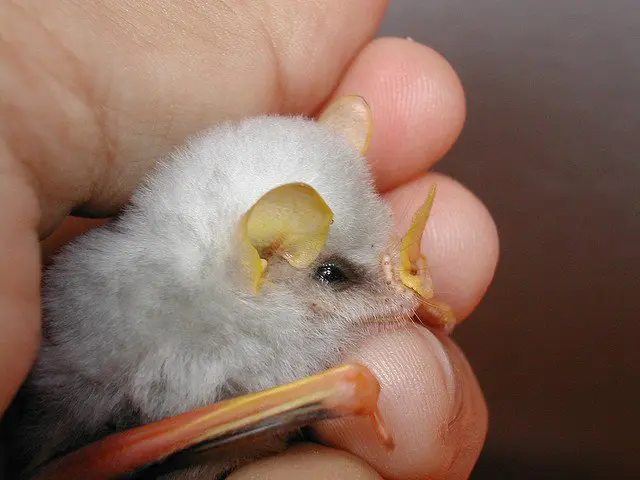
Honduran white bat

murcielago blanco

The Honduran white bat found only in a few Central American countries. With luck you can find in Nicaragua, Costa Rica and, of course, in the country from which it is named, Honduras. But, is extremely rare and, otherwise, it is minuscule – the largest examined have never exceeded the 5 cm length. Not only that, but his white skin has been developed for a reason: camouflage.

This species lives in primary and secondary forests, in groups of 4-8 individuals, they live in leaves of Heliconias, that builds a kind of shops, where they sleep and protect themselves during the day. When resting, is hanging together upside down in the center of the blade.

White pelage serves to reflect the green light that is filtered through the platanilla sheet. So they hide grouped, between the sheets, and is protecting predators that can attack from the ground.

Read more

â–· The world of Pets: Dogs, cats, birds, reptiles, amphibians

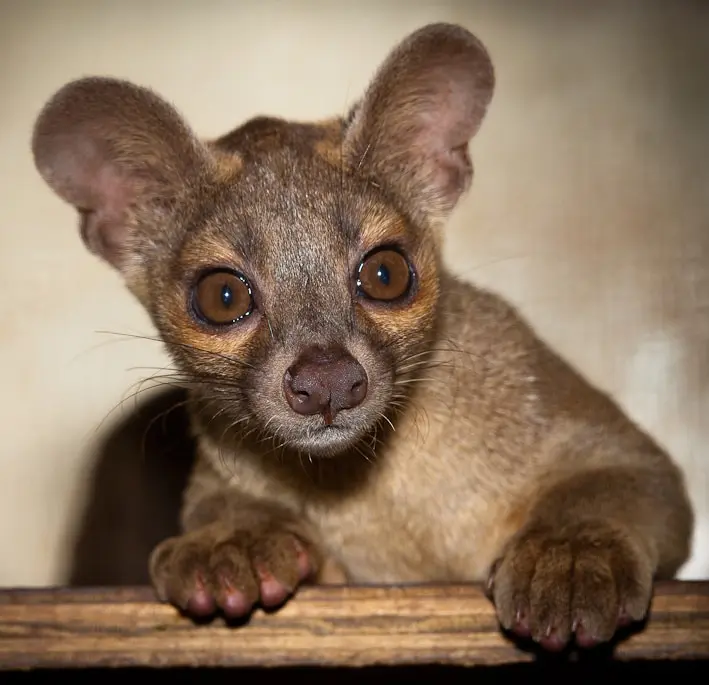
The Fossa

The Fossa, a rare carnivore native to Madagascar, It is the largest predator of the island. With only 2500 surviving individuals, It is considered one of the most endangered species in the world.

The fossa is an animal of the family of the Mongoose, with a length of almost 2 meters from snout to the tip of the tail and a weight of up to 12 kg.

Reserved, like a cat, they are expert climbers and well-equipped to pursue the lemurs in the forest, hunting down even the largest of the lemur species.

On the island of Madagascar, the fossa is the largest carnivore and is in fact the largest predator on the entire island. As predator eats practically everything, from lemurs to wild pigs and poultry. Unlike its cousin the Mongoose, this species has many characteristics that make it look like a cat, such as retractable claws and sharp teeth. It has a reddish brown layer and its snout is similar to that of a dog.

Read more

â–· The world of Pets: Dogs, cats, birds, reptiles, amphibians

The Echidna's short snout

The short snout Echidna is the only species of echidna Australia. It is easy to recognize by their sharp spines, short legs and long snout.

Measured between 30 and 45 cm.. and weigh between 2 and 5 kg. Found on Australia, including Tasmania. While found in all Australia, not as common in sydney as it used to be. The body, with the exception of the bottom, the face and the legs, It is covered with cream-coloured spines. These thorns, that it reach 50 length mm, they are actually modified hairs.

It lives in forests and woodlands, grasslands, heathland and arid environments.

The Echidna he is shy and moves slowly. Is solitary most of the year, but in time of mating several males may follow a female. Their activity patterns differ based on location and temperature – in the warmer areas of Australia is completely nocturnal, spending the rest of the day resting from the heat. It usually took refuge in rotten logs, stumps or Burrows, either under bushes. In more temperate areas activity occurs at sunset, while in South Australia echidnas are often active during the day, especially during the winter.

Read more

â–· The world of Pets: Dogs, cats, birds, reptiles, amphibians

The tenrec

The tenrec They are from the mammal family and are found in Madagascar and parts of Africa. They resemble hedgehogs, shrews, weasels, mice and even, otters, as a result of convergent evolution.

The smallest species are the size of the shrews, with a body length of around of 4,5 centimeters and a weight of only 5 g., While the largest, the common or tenrec tailless, is of 25 to 39 centimeters in length, and you can weigh more than one kilogram. While they may resemble shrews, sea urchins, or otters, they are not closely related to any of these groups, its closest relatives are other insectivorous African mammals such as golden moles and elephant shrews.

Most species they are nocturnal and they have vision problems. Their other senses, However, they are well developed, they have especially sensitive whiskers. As with many of its other functions, the dental arrangement of tenrecs varies greatly between species, they may have of 32 to 42 teeth in total. unusual for mammals, the permanent dentition in the tenrecs is unlikely to erupt fully until long after that his adult body size has been reached. This is one of the anatomical features common to, hyraxes, sengis y Golden moles (but apparently not the aardvarks), consistent with their descent from a common ancestor.

Read more

â–· The world of Pets: Dogs, cats, birds, reptiles, amphibians

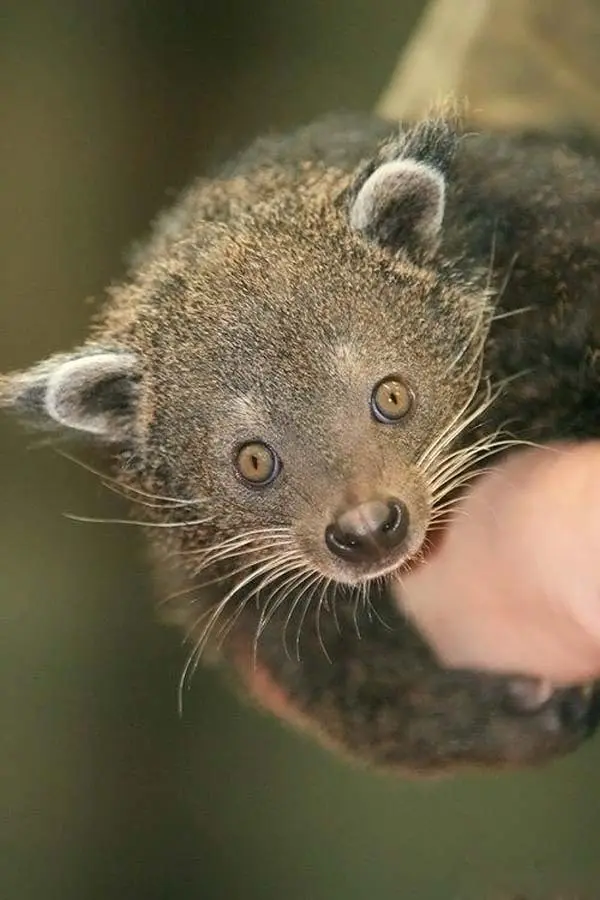
The ears, also known as the Binturong or Bearcat Asian.
Arctictis binturong

manturon

Content

The Manturón (Arctictis binturong), also known as Binturong, the Asian bearcat, the Bearcat Palawan, or simply Bearcat, is a species in the family Eupleridae, which includes Civets and to the ginetas.

It is the only member of its genus. The binturong It is neither a bear nor a cat, and the true meaning of the original name has been lost, as well as the local language that gave it that name.

The binturong It is nocturnal and sleeps on branches. It´s omnivorous feeding mainly on fruits, Although also has been known to eat alligators, mice, Rats, spiders, insects and beetles. They can live more than 20 years in captivity, knowing cases have come to the 26 years.

The deforestation has considerably reduced their number.

You can make sounds laughing between teeth when she feels happy and an annoying sharp groan when he feels cornered.

Being burly and aggressive against any threat, to the binturong sometimes compared with a bear, Although it is considerably smaller than, being no bigger than a small dog. It´s, However, the largest living species of the family Eupleridae, matched only by the African civet.

Its length ranges between 60 and 97 cm., weighing between the 9 and 20 kg.
Its body is covered with coarse and thick black hair. The hairs are often white silver tip, giving the animal a somewhat hoary appearance. It has a clear or silvery Mane in the contour of your face to give the appearance of greater size. The tail, hairy and fully prehensile, It can act as a fifth hand and can measure between 50 and 84 cm.. The binturong it is one of only two carnivores with a prehensile tail (the other is the kinkajou). The ears of the ears are small and rounded, small eyes. Females are a 20% larger than males.

  • Habitat

Its natural habitat is the forest canopy, in the dense tropical jungle primary or secondary, from sea level to the 400 meters above sea level.
While sometimes there may be small groups in logged forest, This species does not seem to adapt well to spaces modified with great human activity. Widely distributed in not very numerous groups, this species can be found in the Bangladesh, Bhutan, Burma, Cambodia, China, India, Indonesian, Laos, Malaysia, Nepal, Philippines, Sri Lanka, Thailand, Borneo and Viet Nam.

  • Reproduction

Females give birth to 2 or 3 pups after a gestation period of 90 days. It seems that there is no defined breeding season during the year, but there are calvings more frequently between February and April. The females are breeding from the 30 months. It is believed that the female binturong It is one of the few female mammals that can delay implantation of the egg in the womb. (phenomenon known as embryonic diapause or delayed implantation), looking for the most propitious moment for the breeding season.

  • Behavior

The binturong It is solitary and nocturnal. It climbs trees and leaps from branch to branch, using its tail and claws to hold on to while foraging for food. It can turn its hind legs back so that its claws still have a grip when moving between branches.. It sometimes moves through the forest floor, either to cross to other trees or to feed on fallen fruits.

The binturong also it uses its tail to communicate through the scent glands. The females also have pairs of glands of odor on both sides of the vulva. Musk perfume binturong is often compared to hot butter on popcorn and cornbread. Rozan its tail against trees and howl to announce its presence to other manturones.

The manturones They have stable territories, but they are not very territorial and often overlap in range with their peers. In Thailand, the estimated range of average territory for a female is of 4 km square and 4,7 to 20,5 km square for males.
Although they are sympatric with several potential predators, including leopards, and reticulated pythons, predation on manturones adults is very rare. It is believed that it is due in part to its arboreal and nocturnal habits. It also, although he is usually quite shy, It can be notoriously aggressive when he is harassed. It is known that it uses urine and feces initially faced a threat to then emit a grunt showing teeth, If the stalker is not dissuaded, it will use its powerful jaws in self-defense.. The binturong It is believed to be one of the animals with more character of nature.

Ecologically it is considered an important seed disperser due to its frugivorous diet..

The female has a pseudopene similar to that of hyenas. They have been domesticated and are common as pets, as they are very protective with children.

â–· The world of Pets: Dogs, cats, birds, reptiles, amphibians

The strange fish drop
Psychrolutes marcidus

Pez Gota

Content

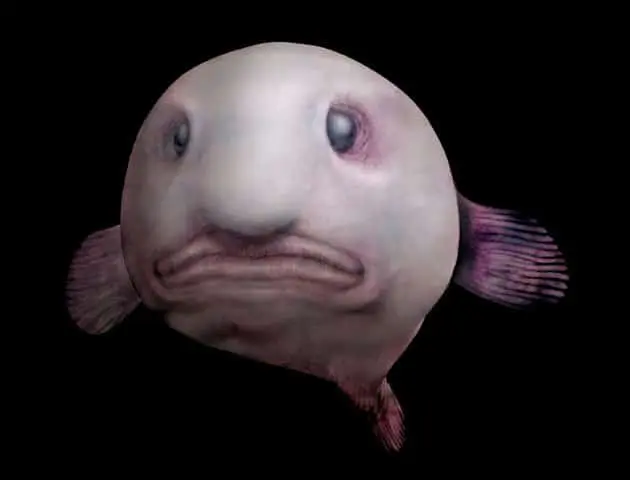
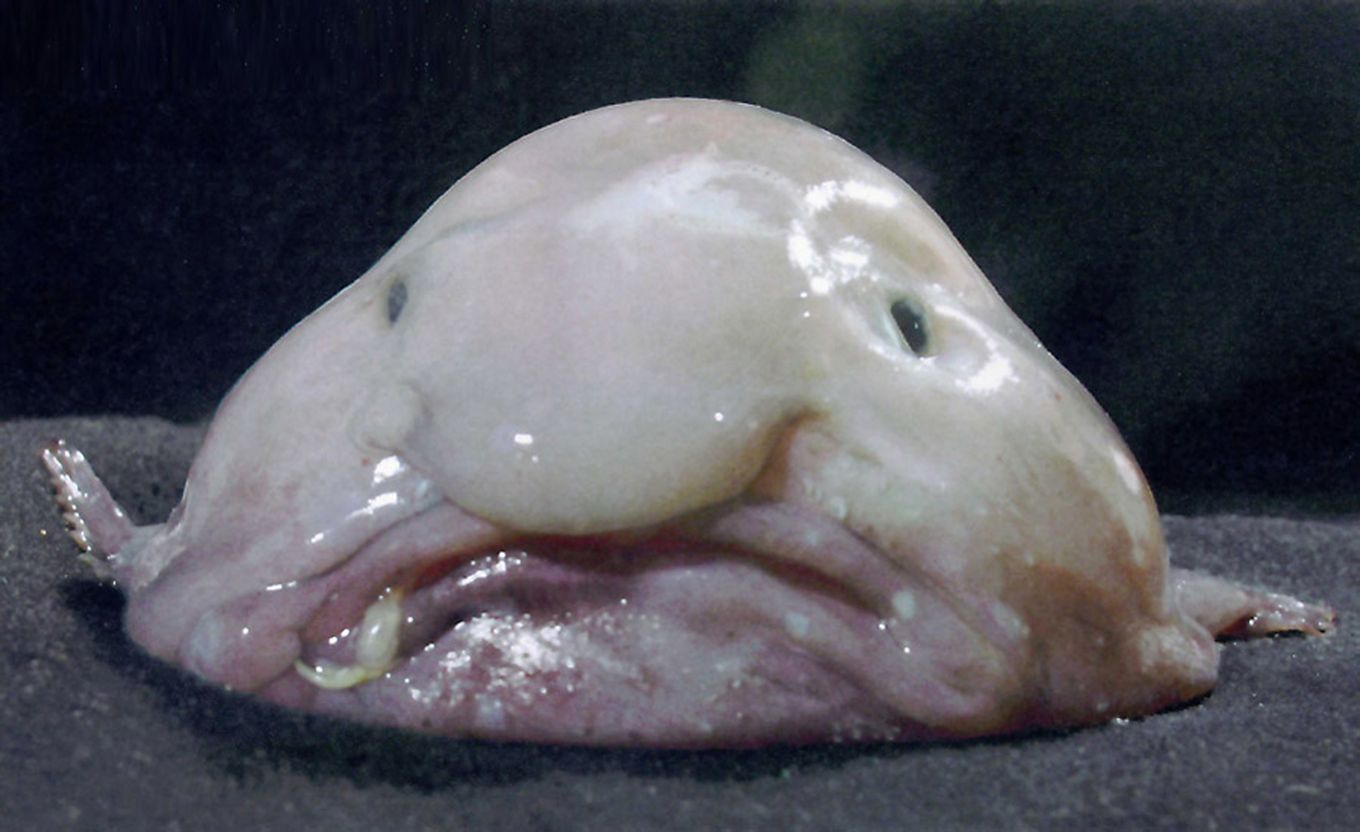
The species Psychrolutes marcidus, best known for fish drop, smear fish, Pez sapo or Janira, It is without a doubt one of the fish more ugly from the ocean. These saltwater fish have what resembles a large nose and appear to be frowning. Its length is about 30 cms. Found at extreme depths off the coast of Tasmania and Australia. For this reason the drop fish is very difficult to see in its natural state..

Fish drop has the ability to withstand the high pressure of these depths because your body is actually a gelatinous mass with a density slightly less than the water of the sea. This gives him the ability to float and swim on the seabed without spending much energy..

They are not very active. In fact, most of the food, sea urchins, molluscs and crustaceans, simply floats next to them. This deep-water fish, simply pick and choose what to eat. Drop fish are often caught in trawl nets, What makes it an endangered species and is currently in danger of extinction.

A strange in the drop fish fact is that playing sit on their eggs until they hatch.

Characteristics of the Drop Fish

  • gelatinous body
  • Ability to inflate like a balloon
  • Habitat: deep ocean water
  • Food: plankton and other small organisms

Curiosities about the Drop Fish

Here we present some curiosities about the Drop Fish:

  1. It is capable of inflating to a size that is more than 100 times its normal size.
  2. The Pez Gota is considered a vulnerable species due to excessive fishing and the destruction of its natural habitat..
  3. It is an animal that has been discovered relatively recently, in 2003.