▷ The world of Pets: Dogs, cats, birds, reptiles, amphibians

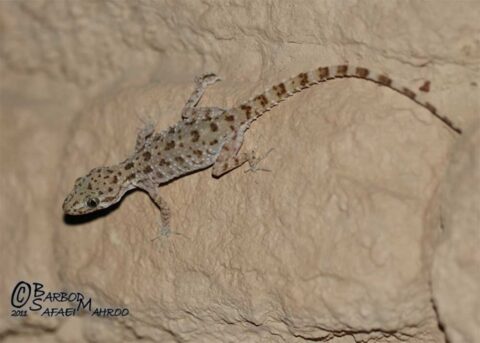
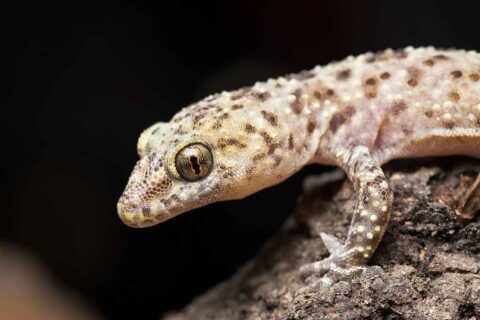
Mediterranean house gecko
- Hemidactylus turcicus

The Mediterranean house gecko is active at sunset and at night. It only activates sporadically during the day, especially when it's sunny on the warmest days of winter.
Mediterranean house gecko
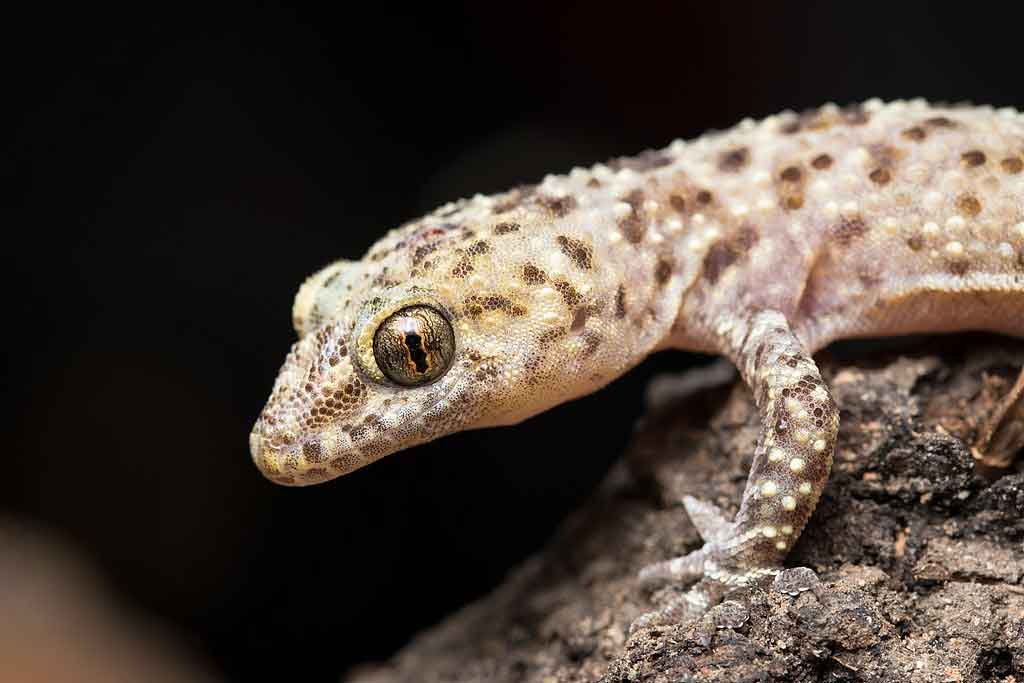
Konstantinos Kalaentzis – Hemidactylus turcicus (Rhode, Greece) – Konstantinos Kalaentzis, CC BY-SA 4.0, via Wikimedia Commons

Content

Characteristics

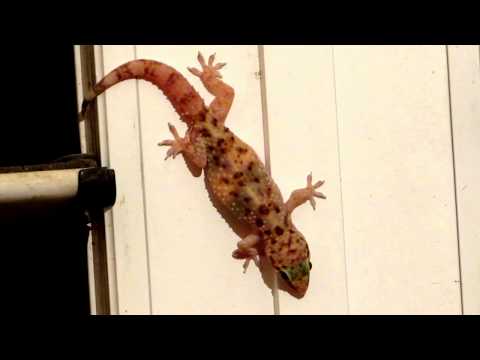
The Mediterranean house gecko is a small reptile (until 12 cm of total head length), thin and with a depressed body and a narrow, short head, but well differentiated from the rest of the body. The back of the animal is covered with small granules that give it a rough appearance. It has a pink color with pale or sandy ocher tones and an almost translucent appearance.. The spots on the tail give it a ringed appearance by alternating light and dark bands. The fingers are widened at the base and have a row of sheets below, divided in the center (hence the Latin name: middle -finger hemi -dactyl-). Has claws on all toes.

Habitat

Species that prefer warm places, as rocky places, tree trunks, stones, abandoned and dilapidated houses. It is found less in cities than the common gecko (Tarentola mauritanica). Common in small rural areas, as irrigation systems, wells and wells.

Behavior

The Mediterranean house gecko is active at sunset and at night. It only activates sporadically during the day, especially when it's sunny on the warmest days of winter. Climb slightly vertical surfaces with great agility. The accession mechanism is similar to that of the common gecko: the inner laminae of their fingers have hairs that exert a chemical and electrostatic attraction on the attachment surface (Van der Waals forces). It is active almost all year round, although it is more difficult to observe between November and February, when it falls into a semi-targo that can be interrupted during some sunny days. Essentially, feeds on small insects and nocturnal arachnids. Take advantage of the fact that they are attracted to artificial light.

Reproduction

The breeding season runs from March to July. Right now, males show aggressive behavior, defend their territory and emit vocal noises, something unusual among reptiles. Females can put 1 to 2 eggs two or three times a year and are buried under stones, in cracks in the trunk or on the ground. The pups of the Mediterranean house gecko are born between one and three months after laying eggs.

Degree of protection

It doesn't seem to have major conservation issues, which is related to the fact that it can live both in human habitat and in unspoiled nature.

The "Mediterranean house gecko" in captivity

Adaptable in nature, makes them resistant to many environments. They also have a sweet and docile temperament that makes them friendly with beginners..

They often live in human homes and adapt well to man-made habitats..

Pros

  • They are very resistant and do not suffer from many health problems.
  • This species is tiny and pretty.
  • They are very easy to care for and cost between 5 and 20 EUR.

Contras

  • They are agile and move very fast so they can easily escape.
  • Your droppings can stain fabrics.
  • They get stressed very easily, so they require careful handling.

Food

The Mediterranean house gecko it is insectivorous. They eat a wide variety of insects.

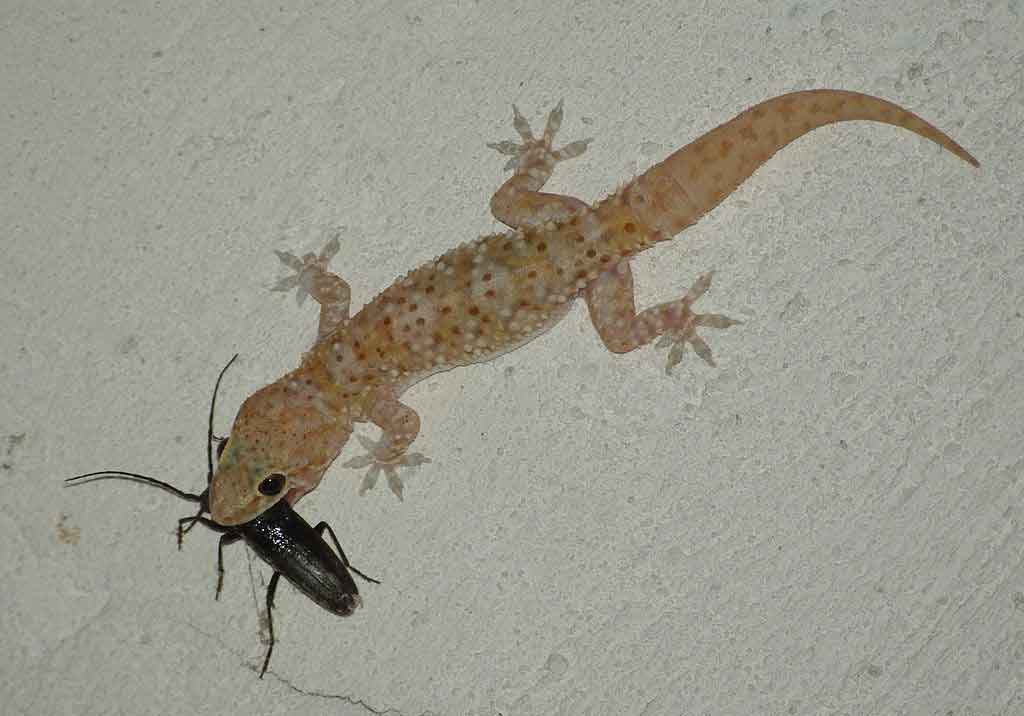
In the wild, this reptile hunts by slowly crawling towards its prey before pounced and threw its head forward to catch the insect.. They most often hunt around porch lights or man-made light structures..
Mediterranean house gecko
Mediterranean house gecko with prey on a wall: (Hemidactylus turcicus) in Messenia, Greece – Koppi2, GFDL 1.2, via Wikimedia Commons

Your Gecko can eat crickets, cockroaches and worms.

feed your Gecko three to four times a week. In each feeding session, provide it from four to five crickets.

Be sure to feed insects that are no larger than the size of your dog's head. Gecko. Whether the insects are the right size, can maintain a consistent feeding schedule almost daily.

Sprinkle insects with a vitamin and mineral supplement before feeding them. In the case of adults, do it once a week and in the case of growing geckos, do it three times a week. Use a supplement that includes calcium but not phosphorus.

You can also load the insect guts a few days before feeding for extra nutrients.

Leave the food out for a couple of hours before taking it out of the cage.

Provide a bowl of water to your Mediterranean house gecko, although this species normally prefers to drink from water drops. Mist his cage daily to keep humidity high and provide drops of water to drink..

Care & Health

The Mediterranean house gecko lives between three and nine years.

They are very resistant reptiles, but they can suffer from some health problems if their breeding and care routine is not followed:

Problems can occur when they eat something they can't digest. The most common source is the substrate. It can be fatal if left untreated, but it is easy to avoid if you feed on a diet only of insects and use the correct substrate (for example, paper or newspaper towels).

Parasites can infect your Mediterranean house gecko through contact with spoiled food. Your Gecko will appear lethargic or vomit frequently.

Sometimes respiratory infections can occur due to incorrect temperature or humidity in your enclosure. This is characterized by lethargy, loss of appetite or breathing with your mouth open.

Molting problems can be caused by low humidity levels. If the excess skin seems to be stuck to your Gecko, you must increase the humidity in your cage.

Metabolic bone disease can cause curved limbs, instability and difficulty standing up. Be sure to feed your lizard a healthy amount of supplements to keep its bones strong.

Frequently asked questions

Is the "Pink Gecko" poisonous??

This Gecko it is not poisonous and is completely harmless to humans. Unlike some reptiles, are completely harmless and rarely bite.

Do the tails of the "Pink Gecko" grow back??

Yes, grows back. The Mediterranean house gecko drop your tail if you feel threatened. But, its tail contains significant fat reserves, so try not to stress your gecko. If your pet drops its tail, make sure she has plenty of food and is comfortable while she grows back.

Signs that you are healthy

  • Uniform skin and consistent texture.
  • Regular feeding and defecation.
  • Full and rounded body.
  • light eyes.

disease symptoms

  • Head or mouth dropped.
  • Lumps or swelling.
  • Discharge from the nose, the eyes or mouth.
  • Weakness, loss of appetite and lethargy.

Terrarium

This species of Gecko usually lives next to humans. They live on, inside and under houses. They can often be found hiding under roof tiles, behind refrigerators and climbing walls.

They are resistant, so they can live in tropical and subtropical environments from the Mediterranean to India.

Type of terrarium: Glass aquarium.
Aquarium size: 40 litres.
Illumination: UVB.
Substrate: kitchen paper or newspapers.

Terrarium Configuration

These Geckos are small but like to live in large spaces.

One terrarium glass 40 liters with a mesh cap will work, but a "high" enclosure of 80 liters is much better. The terrariums for juveniles and hatchlings may be slightly smaller, of 20 litres.

Add 20 additional liters per each Gecko female if she harbors more than three, a tank of 80 liters is appropriate. It is not recommended to accommodate other reptiles apart from the common gecko (Tarentola mauritanica) with this species.

Place branches and foliage in your tank. Also make sure there are at least two hiding places per Gecko.

A UVB bulb is recommended. No need for full-spectrum lighting, but make sure they have a cycle 12 hours of day and night.

Installing a designated sunbathing point will help create a heat gradient and provide a warm place for the sleeping gecko.. The Geckos are thermoregulated, so it is essential to have a hot and a cold side in the aquarium.

To heat your enclosure use a heating pad or an incandescent bulb. The temperature inside the tank should be 24° to 32°C in the morning and 18° to 24°C at night.. Place the heating elements only in one of the halves of the tank, which will help create a heat gradient.

The humidity should be between 60 and the 75% at all times.

To keep humidity high, mist the cage with a spray bottle every day; point to walls, not to your lizard. You can also introduce live plants to increase humidity or bring your water dish closer to the sunny spot..

Reptile carpet can be used as a substrate, but it will need to be changed frequently because it may harbor bacteria. The best option is paper towels or newspapers.

Paper substrates should be changed three times a week.

Terrarium cleaning

Your tank should be cleaned once a month with soap (or a bleach solution 10%) and water.

When cleaning the terrarium, be sure to observe the droppings of your Gecko.

Their droppings should be long and light brown with white tips. They must maintain their shape. Droppings that leak or crumble are usually a sign of illness.

Behavior in captivity

The Mediterranean house gecko communicate primarily through visual cues. This is similar to what happens with the African fat-tailed gecko (Hemitheconyx caudicinctus), who usually greets.

One Gecko submissive will be removed or frozen, while an aggressor will snap his mouth, lash out or bite. In domain demos, two Geckos they will face and squeal – this is common in males.

  • In captivity, this lizard has a docile temperament.
  • Females can cohabit, but males can be territorial.
  • Common behaviors in captivity include sticking out the tongue and hitting the substrate with the nose to perceive its surroundings..
  • They are usually found in their hiding places during the day and are more active at night.
  • This Gecko mist in the colder months, but not necessary in captivity.
  • Brumation can be dangerous and is not recommended for first-time owners or Geckos youth.

Handling tips

This reptile tolerates handling, but it is very fast and can escape in the blink of an eye.

You should only handle adults when they have had a chance to get used to you..

When you handle it, do not hold or grab it by the tail or lower belly. This can cause them to release their tail in a panic or cause them stress.. Instead,, hold it tightly on top and gently support it on the lower belly.

Always wash your hands before and after handling your reptile.

Courtship

Males court females through aggressive behaviors and vocalizations.

He will approach the female and touch her with his muzzle or bite her neck. It will also vocalize before and after mating. The courtship is very brief and the female will leave shortly after to build a nest in an excavated substrate. Most of the eggs hatch within 45 to 60 days.

The breeding season occurs between April and August.

Females have small clutches of one to three eggs twice a season.

Incubation temperature can affect the sex of the hatchlings., females are more likely to be born at higher temperatures.

Price

The Mediterranean house gecko it's very affordable. They usually cost between 5 and 20 EUR, depending on size and age.

The cage, light and substrate should cost 50 EUR.

Recurring costs (for example, food and vitamins) will be around the 150 euros per year.

Despite being widely available in nature, it is much better to buy it bred in captivity from a breeder or a pet store.

When you buy a Mediterranean house gecko, make sure you have clear eyes and a healthy appetite.

Avoid pups with dry patches on their skin, no toes or tail drooping. If the tail is disproportionate to your body size, it's a sign that they've dropped it recently.

Treat the hatchlings the same as adults and make sure they receive nutrients from the insects they carry in their intestines.

Videos "Mediterranean house gecko"

Mediterranean house gecko - Hemidactylus turcicus - Miserable - Samiamidi - Cyprus

Turkish house gecko (Hemidactylus turcicus)

Alternative names:

1. Mediterranean Gecko, Turkish gecko, Moon lizard (English).
2. (French).
3. Türkischer Halbfingergecko, Hausgecko (German).
4. Lagartixa doméstica (Portuguese).
5. Gecko Casero del Mediterráneo, Cuija, Gecko pinto, Salamanquesa costera (español).
▷ The world of Pets: Dogs, cats, birds, reptiles, amphibians

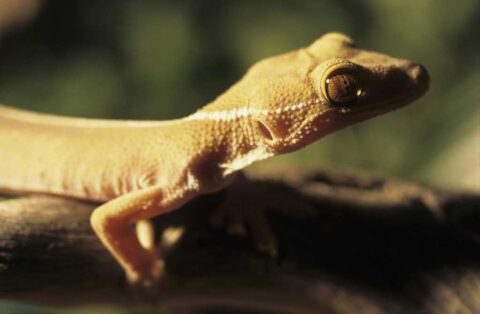
Lined gecko
- Gekko vittatus

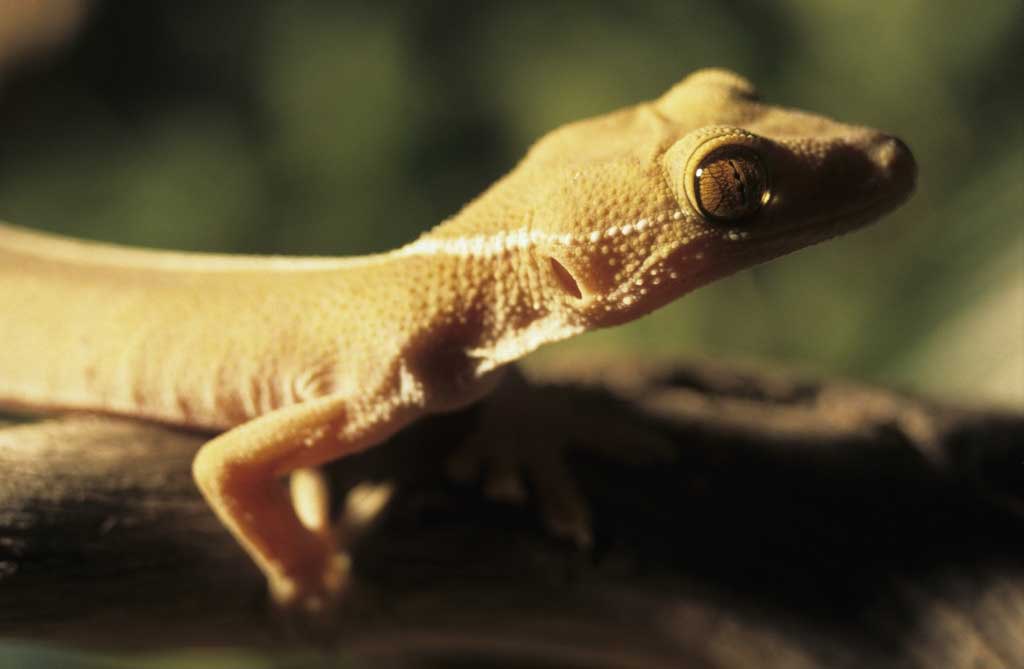
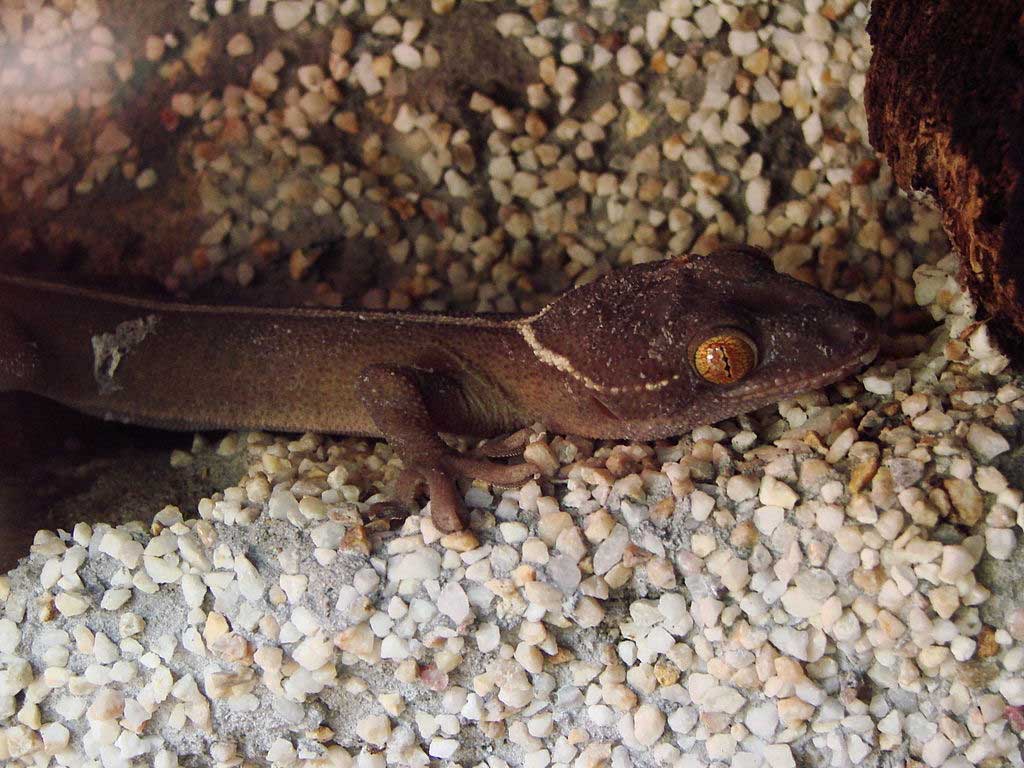
Gecko arborícola big size and nice design. This type of gecko also has the advantage of being totally docile when handling it.
Lined gecko
An adult Gecko vittatus, close-up of the head – Pekka Veikkolainen, Hannes Vartiainen, CC BY-SA 3.0, via Wikimedia Commons

Content

Description

The Lined gecko is a slender representative of the genus Gekko, which can reach a length of up to 30 cm.. The tail represents just over half. But, numerous individuals are fully developed with a length of about 25 cm..

Due to the slender body and narrow head, the extremities, and especially the fingers and toes, appear larger. The white stripe that runs from the base of the tail to the back of the head, where it divides and reaches the sides of the eyes, It is characteristic and very striking. This strip is responsible for its trivial name. The original queue, on the other hand, has white transverse bands. A regenerated tail no longer shows this transverse band.

Dorsal coloration is usually yellowish-brown, but there are also individuals of slightly greenish yellow or reddish and dark brown color. Specimens with two longitudinal stripes are also known., just a very faint stripe and also without any streaks.

Distribution and habitat

Indonesian, east of Java through numerous islands such as Halmahera, in New Guinea to Oceania.
Way of life

The Lined gecko, of night activity, prefers to live in trees, Palm trees, pandanus and banana plants in his native country, but in many regions it can also be found as a cultural follower in houses and cabins.

The Lined gecko in captivity

The Lined gecko is easy to preserve, provided that one or two important points are taken into account.

Terrarium

Lined gecko
An adult Gecko vittatus, close-up of the head – Pekka Veikkolainen, Hannes Vartiainen, CC BY-SA 3.0, via Wikimedia Commons

The terrarium must be taller than it is wide, since it is an arboreal species. 80 x 50 x 100 cm. (width x depth x height) is enough for a couple of Lined gecko. Walls must be coated, for example, of natural cork. Some cork tubes provide the necessary hiding places. The necessary increase in humidity is achieved by spraying several times a day. One plant (for example, Scindapsus) complete the assembly.

There should also be a large bowl of water, or better a small part of water or a waterfall in the terrarium.

Substrate:

Use a white peat mixture (without fertilizer) and plantation land, of about 10 height cm. To avoid stagnation of water at the bottom of the terrarium, use a layer of clay balls.

Illumination

It is debatable whether ultraviolet light is necessary for the Lined gecko, but it won't do you any harm. Temperatures should be 24-28°C during the day, with sunny spots up to 35°C, and drop to 20-22°C at night. Humidity should oscillate between 70-90% during the day, which can be easily achieved with a daily spray (morning and evening) and through the water section. To check these parameters, use a thermometer and hygrometer.

Diet

The diet of the Lined gecko is based on insects. Easily accepts all kinds of insects: crickets, cockroaches, lobsters, worms, … It is important to vary your diet. This prevents your Gecko get bored, but above all it provides you with all the necessary nutrients.
You should always make sure to give to your Gecko a prey adapted to its size.
Last, from time to time, it is advisable to supplement your diet with calcium and vitamins, to avoid any shortcomings. This is especially important for the growth of Geckos juveniles.

Breeding and reproduction

with a good brood, the reproduction of animals does itself. the female may lay one or two eggs several times a year, that can be left in the terrarium. The pups are born after about 100 to 120 days and can stay in the terrarium up to a size of some 15 cm..

The pups usually look the same as the parents., in some populations they show white spots on the head. Only the tail is slightly darker, so that the transverse white bands appear brighter and thus have a signaling effect. When parents approach, wag their tail to avoid being accidentally eaten by them. Keeping them in a group is only possible with young animals until they reach sexual maturity.. As soon as they are adults, you have to take them out of the terrarium, otherwise they can be attacked by parents.

For sale Lined gecko

The price of a Lined gecko in the exotic animal market ranges from 40 and 50 EUR.

Alternative names:

1. Skunk Gecko (English).
2. Streifen Gecko (French).
3. Gefütterte Gecko, Skunk-Gecko (German).
4. Lagartixa Skunk (Portuguese).
5. Gecko de Java (español).

▷ The world of Pets: Dogs, cats, birds, reptiles, amphibians

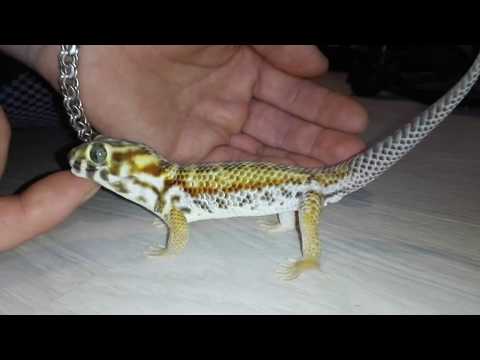
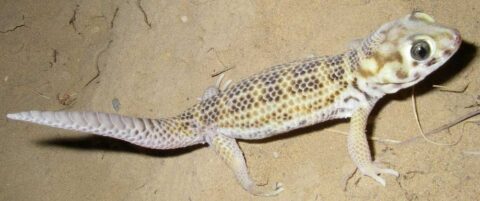
Common wonder gecko
- Teratoscincus scincus

The Common wonder gecko it inhabits the ground in deserts and semi-deserts with sparse vegetation. High daytime and low nighttime temperatures.
Common wonder gecko
«Common wonder gecko» Qyzylorda Province – Kvak, Public domain, via Wikimedia Commons

Content

Origin

The geographical range of the Common wonder gecko includes Middle East, Central Asia and the westernmost part of East Asia. It spans central and western Iran, Western Afghanistan, Northern Balochistan and Pakistan, through the area east of the Caspian Sea, western China and the Arabian Peninsula, where there are populations in Kuwait, Qatar, United Arab Emirates, Oman, Kazakhstan, Turkmenistan, Uzbekistan and Tajikistan.

Two subspecies have been recognized: Teratoscincus scincus rustamowi, of the Ferganskaya Valley, in Uzbekistan, and the nominotypical subspecies Teratoscincus scincus scincus, of the rest of the distribution area. The old Teratoscincus scincus rustamowi has been elevated to full species status as Teratoscincus rustamowi.

Characteristics

In 2009 this ancient subspecies of Teratoscincus scincus to the category of species. It is named after Alexander Conde de Keyserling (1815-1891), Estonian geologist and paleontologist.

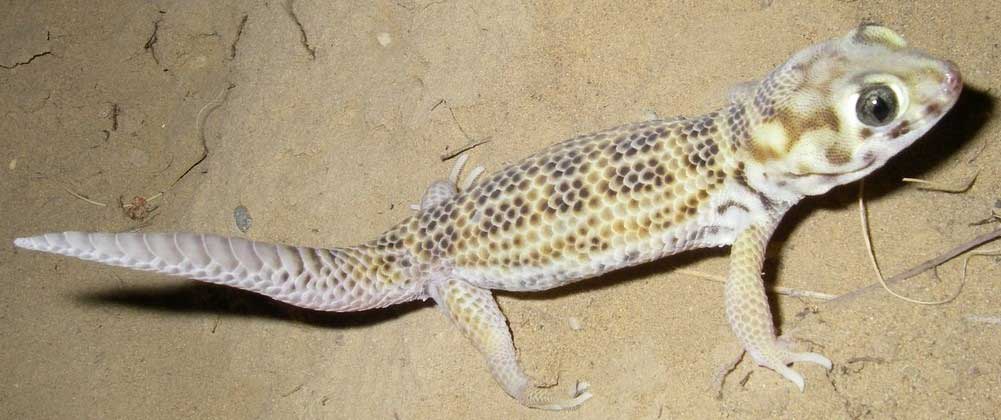
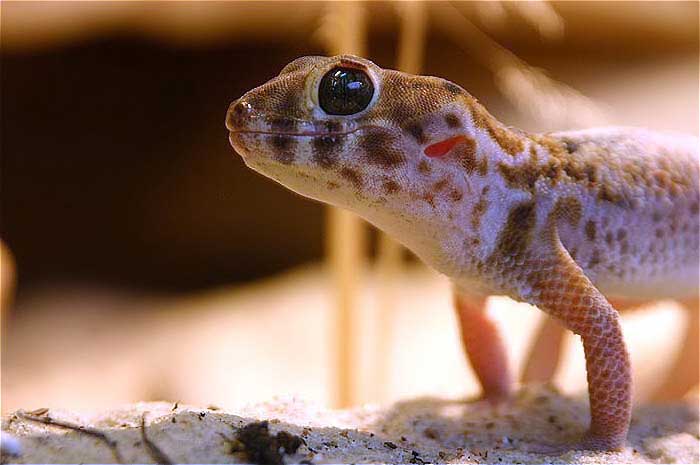
It is the largest of all the wonderful geckos. The Common wonder gecko can reach a total length of 18 to 20 centimeters, but usually smaller. The coloration Basic is a camouflage color that usually varies between light yellow and yellow. In the backhas dark drawings, while the tail is grayish and has large scales. Draws attention to the head relatively large and the big ones eyes. This is because the Common wonder gecko has adapted to its nocturnal activity. If he feels threatened or there is a real danger to him, quickly detaches from the tail, but it grows again. The same goes for your skin scales, that come off very easily.

Unfortunately, most of their breeding lines dried up in the last two decades, which is why hardly any animals available.

Habitat

It inhabits the ground in deserts and semi-deserts with sparse vegetation. High daytime and low nighttime temperatures, which will be balanced by the Geckos by retreating to holes dug by themselves.

The "Common wonder gecko" in captivity

Gecko common wonder
Tetratoscincus scincus keyserlingii – Rheinberger Terra-Zoo – Petra Karstedt / www.Tiermotive.de, CC BY-SA 2.0 OF, via Wikimedia Commons

Terrarium

The terrarium must have a minimum size of 100 x 60 x 60 cm for a group of two to five Common wonder gecko. As terrarium accessories, provide animals with sufficient shelter, like caves and tree roots. It is also important to note that this species of Gecko you need a desert terrarium with silty terrarium sand in which you can dig and bury yourself enough.

Temperature

When it comes to the temperature of the terrarium, you have to allow a basic temperature of about 27°C for your young – use thermal mats for this. Local warming of about 33°C can be achieved with suitable bulbs. At night, the temperature of the terrarium will drop back to room temperature.

Illumination

As the Common wonder gecko is twilight or nocturnal, no need to use UV light. Design the terrarium with fluorescent daylight tubes suitable for the species. Make sure that the humidity of the terrarium is always 50-60%.

Food

The Common wonder gecko prefers to eat live insects, like crickets, grasshoppers or cockroaches. As an alternative, you can offer prepared food that has been mixed with enough minerals and vitamins. Either in animal food or as a supplement, in general it is important that you regularly feed your Common wonder gecko with minerals and vitamins.

Reproduction

Possibility of making couples or groups. It takes a period of 2 cold months (17 °C). Females put up 5 clutches with 2 eggs each in dry sand. Important: Incubate only in dry substrate, otherwise the embryos will die. Incubation at 28 °C for about 100 – 110 days.

For sale "Common wonder gecko"

The price of a Common wonder gecko at the exotic animal market, bred in captivity, ranges between 60 – 70 EUR.

Videos "Common wonder gecko"

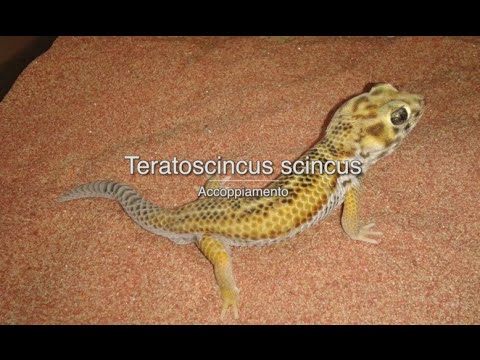
Teratoscincus scincus - Accoppiamento

Skink gecko Teratoscincus scincus

Alternative names:

1. Common wonder gecko, Frog-eyed gecko (English).
2. Gecko aux yeux de grenouille, Teratoscincus scincus (French).
3. Wundergecko, Teratoscincus scincus (German).
4. Lagartixa-comum, Lagartixa-de-sapo (Portuguese).
5. Gecko de ojos de rana (español).

▷ The world of Pets: Dogs, cats, birds, reptiles, amphibians

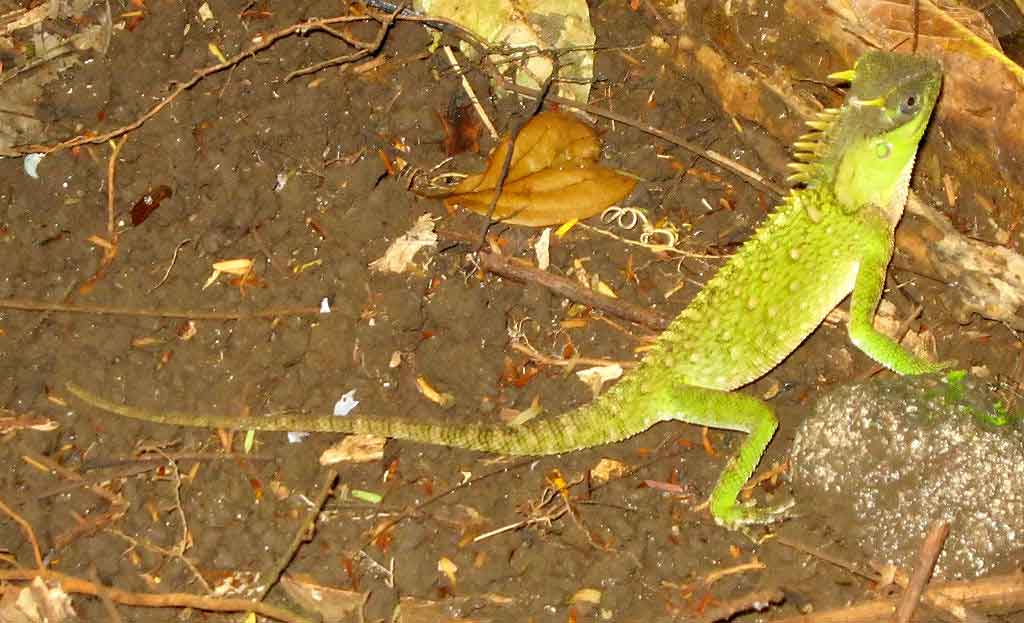
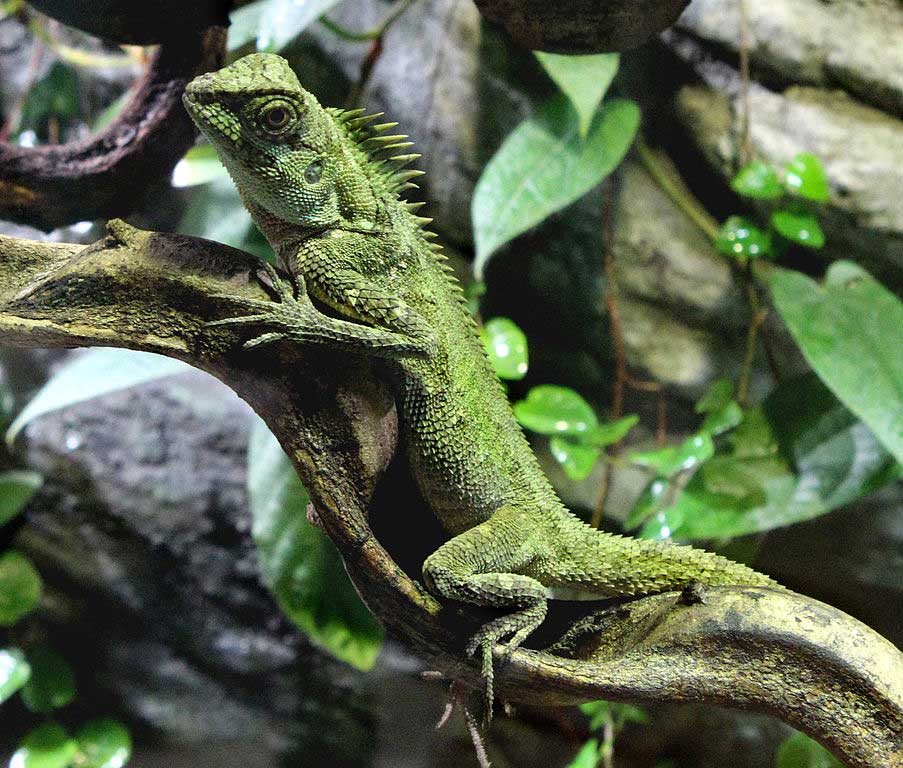
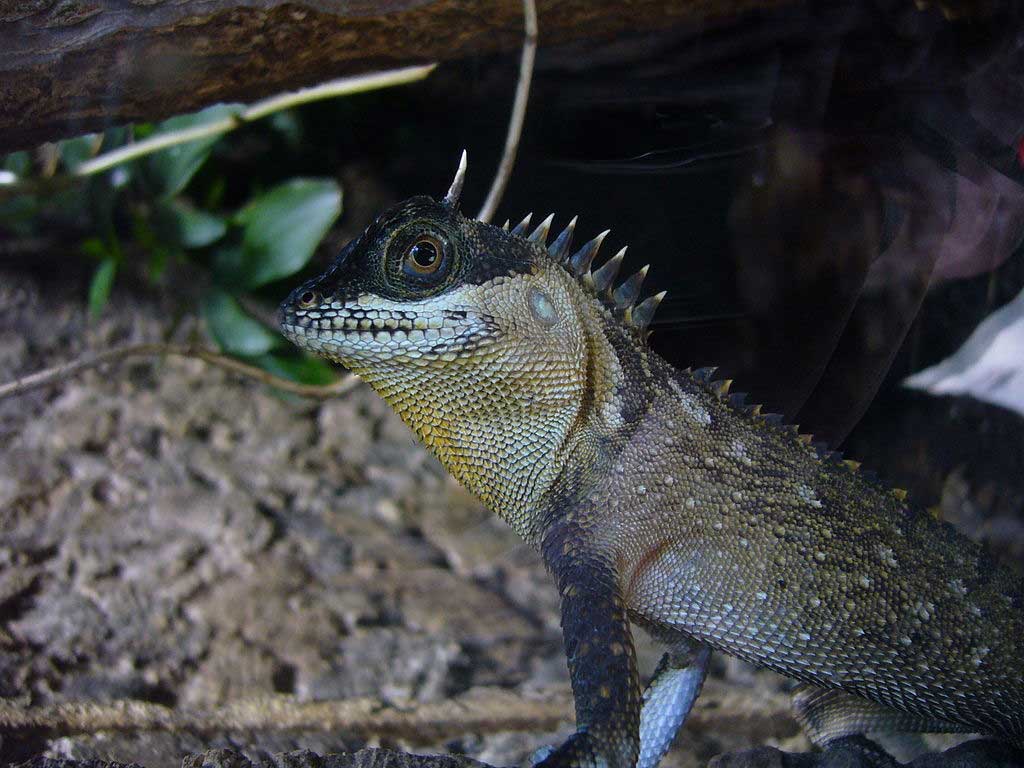
Mountain horned dragon
- Acanthosaura capra

The Mountain horned dragon is a beautiful lizard that is also called asian chameleon, due to its color changes and its arboreal habits.
Acanthosaura capra
Acanthosaura capra, Cat Tien National Park – Roy Bateman, CC BY-SA 3.0, via Wikimedia Commons

Content

Distribution and habitat

The range of the species is Cambodia, Laos and Vietnam.

The Mountain horned dragon lives in dense forests on top of tall tree trunks. These lizards prefer the shady area under the treetops, and they rarely look for sunny places.

Like many other arboreal lizards, only flowing water is seen and they would even like a lake.

It is a kind of calm lizard that prefers to remain motionless rather than run away.

Description

The Mountain horned dragon has a thorn above each arch of the brow. They can lose this column, which does not regenerate. Otherwise, this spiny lizard has no thorn on the back of its head, although all other species show it..

The nuchal ridge is quite high and clearly separates from it in a uniformly flattened dorsal ridge.. The eardrum is clearly visible. Body markings are a brown web on an olive background. When they are stressed, these animals only show dull brown colors.

The eyes are surrounded by a light green ring followed by a dark green ring.

Strong toes correspond to being in trees.

The tail is slightly flattened.

Size

Males reach a total length of 30,5 cm.. Females appear larger, 32 cm..

Sex differences

The species has a sexual dichromatism. The male has a large throat pouch, yellowish with a green stripe. The head is also yellowish with a green band under the eye ring.
Females appear more robust in body structure.

Behavior

Mountain horned dragon
Mountain horned dragon (Acanthosaura capra) at the Prague zoo, Czech Republic – Pavel Hrdlička (Czech Wikipedia user Packa), CC BY-SA 3.0, via Wikimedia Commons

The species is shy in nature and tends to run away.

The terrarium should be thickly covered and deep enough to provide security. Vertically anchored branches are especially important, since animals do not like to stay horizontal.

Otherwise, they are a calm species that does not change position for many hours. Animals are not sun worshipers at all, rather they avoid bright light and remain under the treetops.

Although they are native to the rainforests, I can describe an aversion to direct irrigation. They like running water and prefer swimming pools.

Courtship and mating

The male woos with a beautiful tilt of the head. He also shows his yellow throat bag. Here a tall trunk is important for the female to recognize this beautiful presentation. Neck bite is immediately followed by mating.

Clutches and incubation

Clutches mature in a few 4 weeks and are carried out by the female in a sufficiently high and moist substrate. Dig a hole of about 10 depth cm, put there between 12 and 15 eggs and compacts the substrate with strong head blows.

At 21-25°C the embryo develops in 190 days to hatch.

Hibernation

Simply turn off the power and reduce lighting to a minimum for a few 8 weeks.

Nutrition and supplements

Mountain horned dragon
Mountain horned dragon (Acanthosaura capra) photographed at Chester Zoo – Nabokov at English Wikipedia, CC BY-SA 3.0, via Wikimedia Commons

The Mountain horned dragon has a very diverse nutritional spectrum, in which he does not disdain the lizards.

Earthworms and other worms are preferred. Fish are active prey, young rodents from the nest are also on the menu. Of course, all insects can be offered. Meadowsweet plankton should be preferred, as well as various species of crickets, grasshoppers and cockroaches, and even waxworms and black beetle larvae.

It is essential to guarantee a moderate feeding of the animals according to their calm way of life. How they live in a rather cool climate, tend to become obese quickly if fed too much.

As an example, just to illustrate the amount, they can feed 2 common earthworm (Lumbricus terrestris) big and one Dubia roach (Blaptica dubia) average size per week. If the lizard also actively catches a fish, this is enough.

Supplementation

Insects must be well fed and, of course, continue to be dusted with a multivitamin and mineral supplement. Range is recommended Herpetal or Korvimin ZVT with a mixture of calcium.

Keep in mind that neither fish nor earthworms can complement each other, but they have a very good nutritional value. Earthworms, in particular, they are rich in calcium, and that's why they are so important.

Terrarium

The Mountain horned dragon can be kept in a paludario ⓘ.

Paludarium already indicates that it is a terrarium with a large basin of water and a waterfall.

Dimensions must not be less than 140 cm x 70 cm x 170 cm. (length x widht x hight). Height is especially important because animals live under a canopy of leaves. But, above the dense vegetation there must be lighting, that animals largely avoid.

The distance to the substrate must also be maintained, since to him Mountain horned dragon he likes to stay on tree trunks.

Installation

Presentation terrarium of Sin, mon Acanthosaura capra

The habitat is the subtropical jungle and must be recreated in a terrarium. You should focus on the essentials, that is to say, a basin with fish, a great waterfall, plants and soil.

The back walls are designed so that many plants can thrive there. Can be designed using Xaxim or humus, as this material also retains moisture well. The substrate is filled high enough and moist. Plants and many branches offer the freedom of movement of a tree.

The sunny areas are rather secondary, since the Mountain horned dragon prefers cooler and shady places. Lighting is mainly for plants.

Plants

Plants not only regulate the climate in the terrarium, they also serve as protection, residence and welfare for animals.

Planting with ficus species, like the "oakleaf ficus" Ficus quericifolia and Ficus scandens, is the most sensible option. It also, a variety of other plants can be chosen, all of which must tolerate high humidity and be small-leaved. These may include, the Chirita Tamiana, the Pellionia daveauana, the Hemigraphis repanda, and the Parthenocissus inserta they are suitable, but it is also enough to choose the ivy Epipremnum pinnatum.

Substrate

The choice of substrate is important because it must retain a lot of moisture, must not become moldy and must have good egg-laying properties. An unfertilized soil is recommended, preferably from deciduous forests.

The substrate must have 15 cm in height so that the female has optimal conditions for laying eggs. If the female feels insecure, if the substrate is too poor or not moist enough, this can lead to an egg-laying drought.

Illumination

Lighting in a forest terrarium plays a subordinate role for animals, not for plants. The Mountain horned dragon they are not usually sun worshipers, rather they avoid a light level. It is important to avoid excess heat through good lighting. Fluorescent tubes have been successful.

Example: for a terrarium of 140 x 60 x 170, 6 BioVital full spectrum tubes, T5, with 54 high output watts, have proven their effectiveness. It also, UV lamp can be offered for a few hours.

Temperatures

In the terrarium a basic temperature of 23-25°C should be offered. A spotlight can also be used to provide a temperature of 30°C, but this should not raise the base values. It is important to keep the temperature at 18°C ​​at night.

Humidity

Relative humidity should be 50-60% during the day and increase to about 90% At night. Due to the cold night, to the plants, to the moist substrate and to the walls, plus a water basin, humidity inevitably increases at night.

For sale "Mountain horned dragon"

The price of a "Mountain horned dragon" ranges between 35 – 45 EUR.

Alternative names:

1. Indo-Chinese spiny lizard, Green pricklenape (English).
2. Dragon cornu des montagnes, Lézard cornu des montagnes, Dragon de montagnes (French).
3. Berg gehörnten Drachen (German).
4. Dragão com chifres da montanha, Lagarto espinhoso indo-chinês, Pinheiro verde (Portuguese).
5. Acantosaurio, Dragon cornudo de Vietnam, Camaleón asiático, Lagarto Jesucristo (español).

Sources:

DREWS, Olive (2009): Kompaktwissen Agamen, VIVARIA Verlag, Meckenheim, 29-31 S.

HALLERMANN, Jacob (2000): The taxonomic status of Acanthosaura fruhstorferi Werner, 1904 and Calotes brevipes Werner, 1904 (Squamata: Agamidae). Mitt. Mus. Natural. Berl., Sole. row, 76 (1): 143 150
HALLERMANN, Jakob (2005): With horns, Combing and gliding - the bizarre tree agamas. reptile 10 (1), NTV publishing house, Münster; 18-25 S.
HARBIG, P. & U. MARONDE (-01/1983): The genus Acathosaurus: Acanthosaura armate, A. capra, A. crucigera und A. lepidogaster. SAURIA publishing house, Berlin, page 31-33
ASK, Werner & H. Hermann SCHLEICH (2000): Quote in: JACOB HALLERMANN (2005) With horns, Combing and gliding - the bizarre tree agamas. Reptilia10(1) NTV publishing house, Münster, 18-25 S.
MANTHEY, U. & N. Schuster (1992): agamem. Herpetological specialist publisher 120 S.
MANTHEY, U. & W. GROSSMANN (1997): amphibians & Reptiles of Southeast Asia. Nature and Animal Publishing House (Münster), 512 pp.
MANTHEY, Ulrich & Norbert SCHUSTER (1999): agamem. NTV publishing house, Münster
MANTHEY, Ulrich (2008): Agamid lizards of Southern Asia, Draconinae 1. Terralog 7, 160 pp.
MANTHEY, Ulrich (2010): Agamas of southern Asia / Agamid Lizards of southern Asia: Draconinae 2 – Leiolepidinae – Frankfurt am Main, Edition Chimaira

▷ The world of Pets: Dogs, cats, birds, reptiles, amphibians

Crested gecko
- Correlophus ciliatus

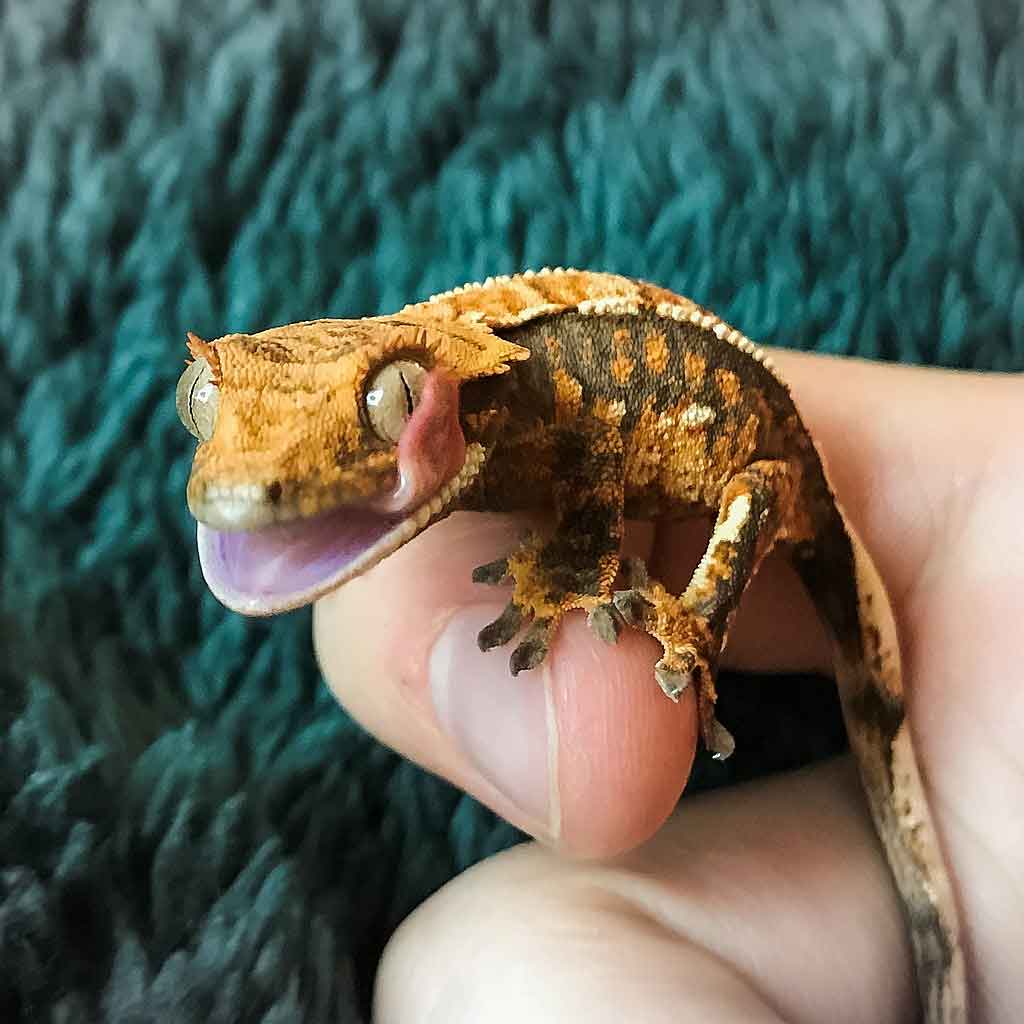
Crested gecko
The "Crested Gecko" in captivity is docile and tolerates regular handling – Jazium, CC BY-SA 4.0, via Wikimedia Commons

Content

Origin

The Crested gecko (Correlophus ciliatus) is located at the southern end of Grande Terre, the main island of New Caledonia, and on the island of Pins, what makes it endemic.

Although the natural habitat of the Crested gecko continues to decline due to permanent environmental degradation, unfortunately not subject to any international protection status. It is being considered in protected status by the Convention on International Trade in Endangered Species of Wild Fauna and Flora (CITES).

Description

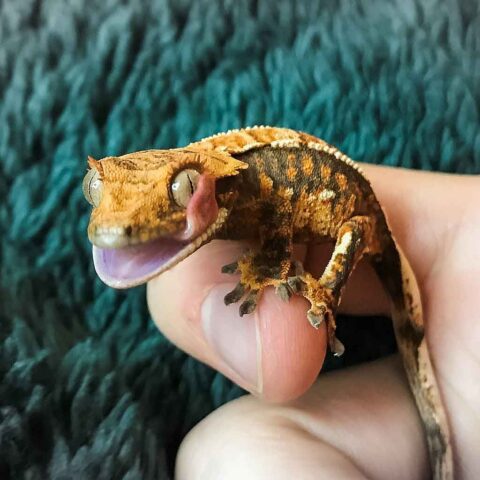
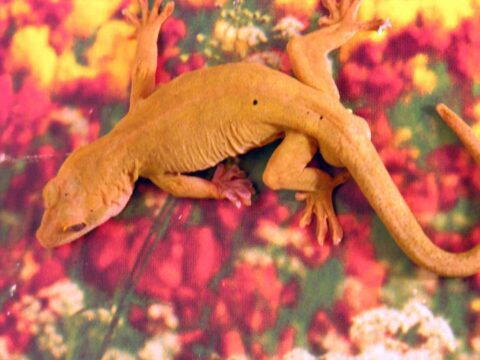
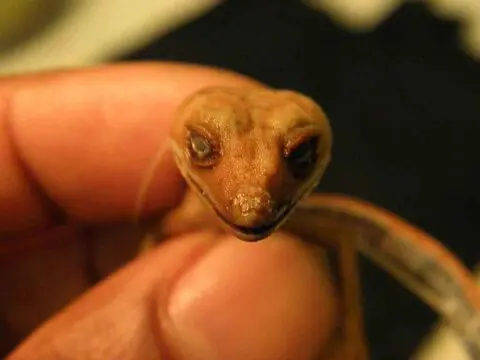
The Crested gecko usually measures between 15-25 cm length, including between 10-15 cm of tail. Among the most distinctive features of these geckos are the hair-like projections above the eyes., that look a lot like tabs. These projections continue in the form of two rows of spines that run from the eyes to the sides of its wedge-shaped head and continue to the base of its tail..

The Crested gecko no eyelids. In its place, a transparent scale, or glasses, keeps each eye moist, using the tongue to clean up waste.

These geckos have a semi-prehensile tail that they use to climb. Tail can be dropped (via caudal autotomy) to distract predators. The Crested gecko do not regenerate their tail once they have lost it; most adults in the wild lack a tail.

The toes and the tip of the semi-prehensile tail are covered with small hairs called setae. Each mushroom is divided into hundreds of smaller hairs (of about 200 nanometers in diameter) called spatulas. These structures are thought to take advantage of the weak van der Waals force to help the gecko climb most solid surfaces., easier in the flatter and smoothest, like glass or wood. The fingers have small claws that help them climb over surfaces that their fingers can't hold onto..

Habitat

It is arboreal in nature and lives in the treetops of humid forests., hot and dense lowland vegetation.

The Crested gecko perches on tree branches, but also in the holes of the branches that serve as a hiding place. Its period of activity begins at dusk and ends in the early hours of the morning.

Characteristics

The Crested gecko it is a crepuscular and nocturnal gecko and less shy than the species of the genus Rhacodactylus.

She is a skilled climber. For this it has the help of its adhesive sheets and its claws, as well as his tail, which serves as an additional gripping organ and to maintain balance. Like most Geckos, the Crested gecko is able to release the tail in case of danger (autotomy). But, does not form a full regenerate, so there is only a short stump left.

The growth of the Geckos in general it has no comparison with that of many other reptile species.
Its nature is slow growing. While many species of Geckos of the warm regions of the world grow completely in 1 or 2 years maximum, all the Gecko of New Caledonia need more time for their development.

In the case of Crested gecko need 3 years until they have grown at all.
But, in general, each animal must be considered individually.
Even siblings born on the same day and raised the same way can grow up totally different.

There is a wide range of colors on the market, the following types have demonstrated their heritage over time.

  • No pattern | Exists 1 color Orange, Yellow, White, Negro…
  • Bicolor | 2 colors with mostly light reverses
  • Tricolor | The animal is completely stamped or superimposed with 3 colors.
  • Tiger / Striped | Patterns very rich in contrast, mostly single basic color.
  • Design harlequin interlaced with dark background tone
  • Rear stripe mostly white and the rest very dark
  • Morphs There are many of these on the market, but only the years will show if the inheritance is guaranteed.

  • The "Crested gecko" in captivity

    Terrarium

    The terrarium for him Crested gecko must be high enough, as they are inhabitants of trees and are almost never found on the ground. As a key to the size of the terrarium we recommend calculating with the head-torso length of the animal. The size of the terrarium is calculated as follows for non-adult animals:

    Terrarium floor space: 4 x 3 times the head-torso length of the animal.
    Height of the terrarium: Four times the head-torso length of the animal.
    Observe the growth of the animal in the coming months (fast-growing animal/slow-growing animal).

    Terrarium decoration

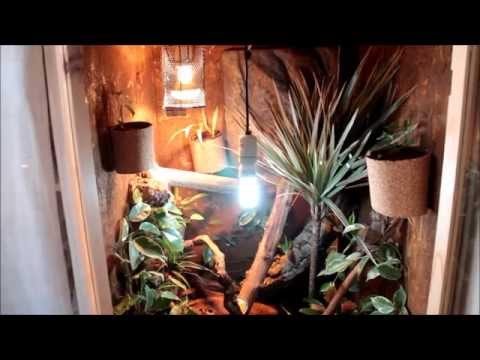
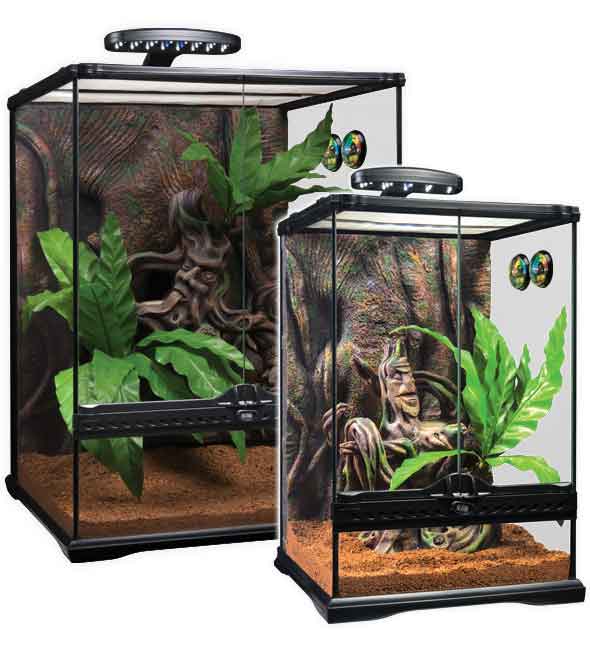
    Terrarium Crested Gecko
    TERRARIUM «GECKO EXOTERER

    The Crested gecko it is an excellent climber and needs several cork branches and cork tubes. The bamboo poles also have a decorative aspect and provide the animal with a space to walk, including the coveted heat point under a spotlight. As such, place a branch or root at the right distance from the light source so that the right temperature is created in it. Some vertical climbing possibilities should not be missing.

    It also, the terrarium must be well decorated with plants. Artificial plants are a practical option, as they can be easily cleaned of feces.

    The substrate suitable is the bark bed (Also called "crust") and the land of the terrarium. Moss cushions are decorative and regulate humidity. Droppings and food scraps should be removed daily.

    Temperature and lighting of the terrarium

    Although they are twilight and nocturnal, the Crested gecko sometimes sunbathe and will gladly accept a spot of ultraviolet light. It also, only an optimal supply of UV-B light provides enough vitamin D3 for young animals to grow optimally and adults to also be in top shape and display their bright colors.. We recommend the JBL L-U-W Light, which is available in various powers and in the version «Jungle«. This type of lighting provides light, heat and UVA/UVB rays.

    As a caregiver, can get an especially good climate (and easy to control) using a heating mat under part of the floor of your terrarium. Although the Crested gecko almost never goes to the ground to warm up there, yes it heats the basic temperature of the high terrarium -which by design is similar to a fireplace- from below. These terrariums usually have too low temperatures in the lower half of the terrarium outside of summer., so the fry have a hot back and a cold belly. The heating mat must be accompanied by a thermostat. In this way, always get the right climate, as the heating mat turns on automatically when needed.

    A plus point is the more favorable energy consumption in terms of the environment, since terrariums operated in this way not only require lower power for point lamps, but also, usually, fix themselves with less energy. For one uniform lighting of your terrarium as decoration of your living space, we recommend the LED lighting across the entire terrarium. Light and heating sources are always turned on and off at a daily rate by means of a timer, 14h on, 10h off.

    Food

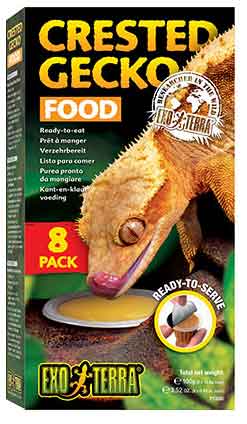
    Food-Crested gecko
    Food-Crested gecko – ExoTerra

    The Crested gecko seems very quiet, but he is a good hunter. Feeding insects (crickets, domestic crickets, grasshopper, etc.) they are always sprinkled with mixtures of vitamins and minerals. This is the only way to avoid irreversible deficiencies, which can often lead to serious illness or even death in young animals and pregnant females, for example.

    Feeding animals must always be adapted to the size of the Gecko. Feed only insects that will be eaten directly. Otherwise, feeding animals would disperse in the terrarium, they would hide away and get rid of the attached vitamins/minerals – the result is malnutrition and malnutrition despite food supplies. They also like to eat fruit pulp, for example, food for the Crested gecko from Exoterra.

    Social behavior and reproduction

    The Crested gecko can be held individually or in a group. Males are territorial and incompatible with each other. They can be very demanding with females, so it is not recommended to keep them as a "couple.".
    Females put 2 eggs several times a year, that burrow into the moist substrate. After 60-120 days at 21°C to 28°C the young hatch.

    For sale "Crested gecko"

    The price of a "Crested gecko" at the exotic animal market, bred in captivity, ranges between 60 – 80 EUR.

    Videos"Crested gecko"

    My Correlophus ciliatus and the aquaterrarium bombinas orientalis | dadenReptilera

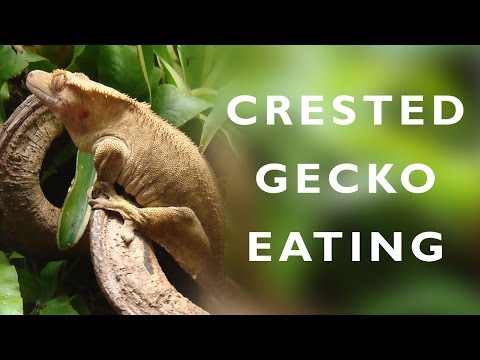
    CUTE! Crested Gecko Correlophus ciliatus Eating

    Alternative names:

    1. Eyelash gecko (English).
    2. Gecko à cils, Gecko à frange (French).
    3. Neukaledonischer Kronengecko (German).
    4. Crested gecko (Portuguese).
    5. Gecko de pestañas (español).

    ▷ The world of Pets: Dogs, cats, birds, reptiles, amphibians

    Geckos – A fascinating lizard
    - Gekkonidae

    Gekko gecko
    Gekko gecko – Robert Michniewicz, CC BY-SA 3.0, via Wikimedia Commons

    Content

    Geckos – a brief profile

    The Geckos are, without a doubt, fascinating animals. Although they are becoming more popular as pets, the Geckos they continue to enjoy a kind of exotic status. The following brief profile aims to introduce a little to these interesting reptiles.

    Origin

    The Geckos have an impressive adaptability. That is why there is no region of the world in which they are exclusively located.. The Geckos can be found both in temperate climate regions such as in the desert or in the tropics.

    Social behaviour

    In the wild, most species of Geckos live in loose associations. But, some species are also strictly solitary, and males and females only come together to mate. In pet ownership, the Geckos they are usually kept in groups of two or more per terrarium.

    But, if you keep several Geckos in different terrariums, you will be able to observe very well the communication between the animals. If there are others Geckos in the same territory, greeting each other, will threaten or make courtship sounds.

    Geckos for maintenance in captivity

    Family
    - Lygodactylus williamsi
    Electric blue gecko

    Electric blue gecko

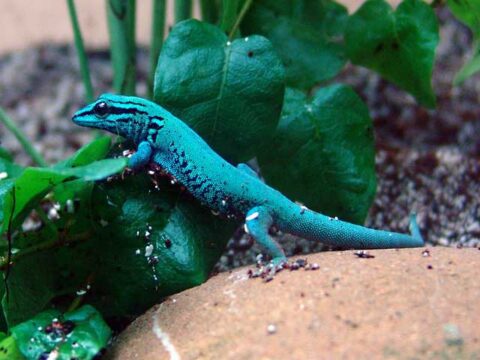
    Trade in the electric blue Gecko is now banned in the EU. They cannot be maintained or sold in the ...
    Family
    - Correlophus ciliatus
    Crested gecko

    Crested gecko

    Source Content The Crested Gecko (Correlophus ciliatus) is located at the southern end of Grande Terre, the main island of ...
    Family
    - Cyrtopodion scabrum
    Rough-tailed gecko

    Rough-tailed gecko

    The Rough-tailed Gecko needs a dry, sandy terrarium with shelter and a small log to climb on or climb into. ...
    Family
    - Underwoodisaurus milii
    Thick-tailed gecko

    Thick-tailed gecko

    Thick-tailed Gecko have the nickname of "Barking Gecko" because they can make the corresponding sounds. If they sit ...
    Family
    - Phelsuma madagascariensis
    Madagascar day gecko

    Madagascar day gecko

    Thanks to the special adhesive foils on your fingers, the daytime Gecko of Madagascar does not only move through the ...
    Family
    - Phelsuma laticauda
    Gold dust day gecko

    Gold dust day gecko

    The Golden Day Gecko is commonly known as the GEICO Insurance mascot, and also the main character of the ...
    Family
    - Gekko badenii
    Golden gecko

    Golden gecko

    The golden yellow Gecko is a splendid terrarium host, as they are very easy to maintain ...
    Family
    - Lygodactylus luteopicturatus
    Dwarf yellow-headed gecko

    Dwarf yellow-headed gecko

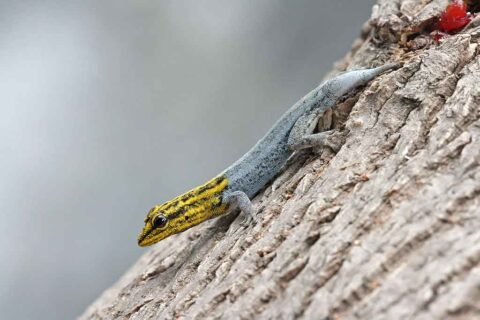
    The Dwarf yellow-headed gecko is widely traded in the exotic animal trade. Content Origin and habitat The ...
    Family
    - Lygodactylus conraui
    Cameroon dwarf gecko

    Cameroon dwarf gecko

    Extraordinary arboreal dwarf lizard that will soon replace the rarely seen Gecko in terrariums. ...
    Family
    - Aeluroscalabotes felinus
    Gecko cat arboricola

    Cat gecko

    The Tree Cat Gecko is a graceful gecko highly sought after by gecko collectors.. It's relatively easy to create, ...
    Family
    - Eublepharis macularius
    Leopard gecko

    Leopard gecko

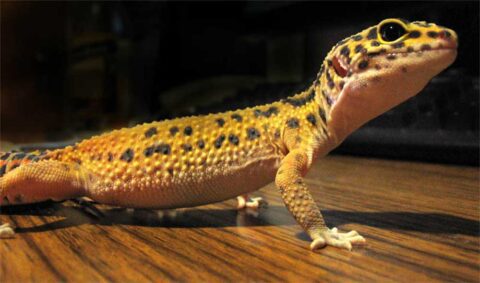
    Leopard Geckos are peaceful and friendly creatures.. They can be kept individually, as a couple or in a group without any problem. Content ...
    Family
    - Teratoscincus scincus
    Common wonder gecko

    Common wonder gecko

    The Common Wonder Gecko inhabits the ground in deserts and semi-deserts with sparse vegetation.. High daytime and low temperatures ...
    Family
    - Gekko vittatus
    Lined gecko

    Lined gecko

    Large and beautifully designed tree gecko. This type of gecko also has the advantage of being totally ...
    Family
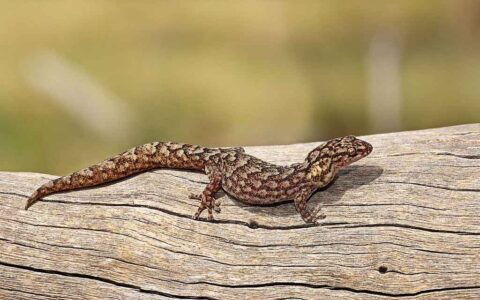
    - Christinus marmoratus
    Marbled gecko

    Marbled gecko

    Very nice Asian gecko, with a splendid contrast of colors in its range of grays, black and white. It is a ...
    Family
    - Hemidactylus turcicus
    Mediterranean house gecko

    Mediterranean house gecko

    The Pink Salamander is active at sunset and at night. It only activates sporadically during the day, especially when ...

    Characteristics

    As there are different species of Gecko, the physique of animals is sometimes very different. In total, the respective species reach a length of about 4 to 60 cm.. But, the species of Geckos smaller ones are especially suitable for keeping as pets, as they require less space.

    A special feature of the Geckos are its legs, since many species have adhesive sheets with which they can cling to very smooth objects or walk and climb them. Other species, However, have intermediate skins on their fingers and can walk on sand.

    Life expectancy

    As a rule, the Geckos they live between 8 and 15 years, but there are exceptions. The Leopard gecko, for example, can live 25 years. In principle, you can already tell by the size of the species of Gecko whether the animal can reach a longer life. The smaller a Gecko, the lower your life expectancy will be.

    If the Geckos are kept as pets, their life expectancy depends mainly on the conditions in which they are maintained. Keep the Geckos in conditions that are not appropriate for the species usually causes premature death.

    Sexual maturity

    Sexual maturity in Geckos usually begins at 12-18 months, although there may be differences from one species to another. If the Geckos find abundance of food, females may reach sexual maturity before their physical development is complete. This fact can have fatal consequences for the Gecko.

    Gestation period

    As for the gestation period, also varies from species to species. In general, However, it can be said that the Geckos have a gestation period of about 45 to 60 days. Depending on the ambient temperature, can pass up to 80 days until hatching. But, in ideal conditions, it only takes a few 50 days.

    Food

    To maintain the health of the Geckos, depend on a varied and nutritious diet. Between the Geckos there are carnivores, herbivores, omnivores and scavengers. So, the diet can include both insects and snails, green foods and even smaller mammals.

    Minimum space required

    Before deciding on the terrarium size, you should know what kind of Gecko is and how many animals you want to have together. Basically, the necessary space depends on the body size of adult animals.

    So, the species of Geckos smaller require less space than larger ones. If two are maintained Geckos in a terrarium, it is assumed that a minimum space of about 100 cm x 75 cm x 50 cm.. With each additional animal, the need for space increases a 50% more.

    Frequently Asked Questions about Geckos

    There are questions about the Geckos that are often done. We would like to answer some of them here.

    Because the Geckos they can stick to smooth surfaces and thus climb walls?

    The secret of the climbing ability of many species of Geckos resides on its special legs. The Geckos have millions of fine hairs on the soles of their feet. These hairs are so fine that even a human hair is hundreds of times thicker.. With the help of these hairs, unique in nature, the Gecko find a foothold even on the smoothest surfaces. This is because a weak electrostatic force acts at the molecular level between each of the tiny hairs and the surface.. For a single hair, this attraction is almost insignificant, but the large number of combined hairs ensures that the Geckos can adhere to almost anywhere.

    How do geckos communicate?? do they make sounds?

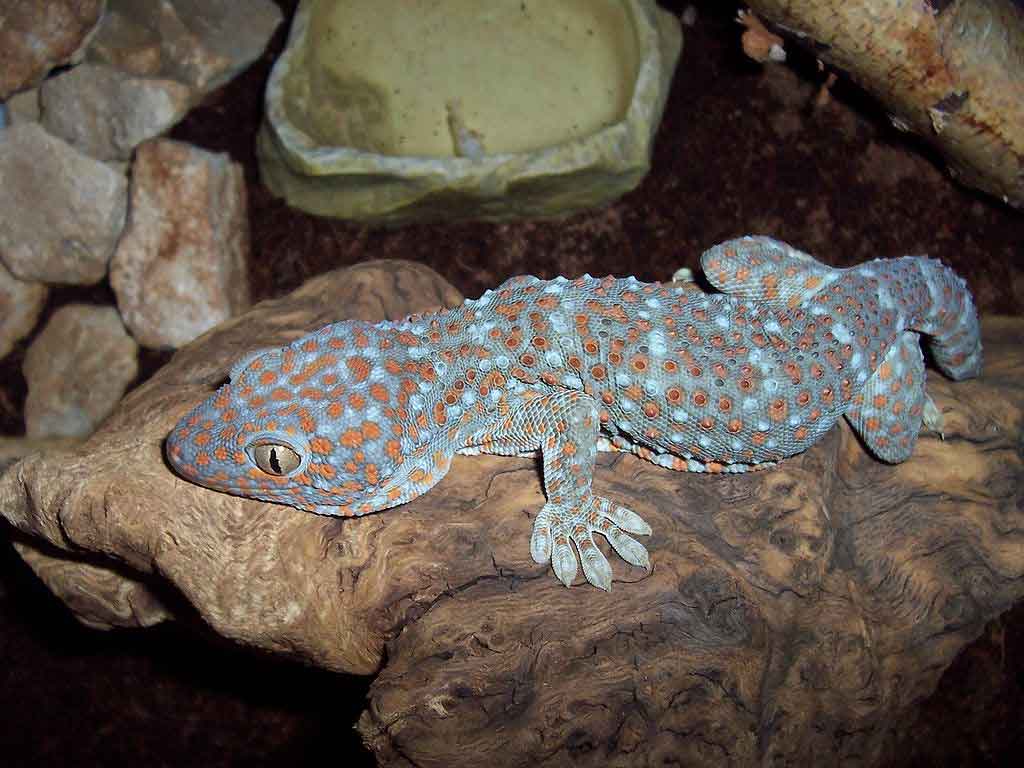
    In fact, most species of Geckos they also communicate with each other using their own vocal language. So that, there are typical calls that can be used to clearly identify certain species of geckos (for example, the Tokay gecko (Gekko gecko)). The frequency and volume of the calls differ according to the species. And even within the same species there are individual differences from one animal to another..

    Questions before buying a Gecko

    Before buying Geckos, there are some basic questions you should ask yourself. It's important to know what you're getting into, because once you have them at home, you have to be prepared to take care of them for several years. During this time, not only will the costs of keeping the animals occur. Of course, the owner also has to invest a lot of work and time in maintaining the Geckos in a way appropriate to the species.

    If you are not familiar with the Geckos as pets, first you should thoroughly inform yourself about the requirements for keeping these reptiles before buying them. Once the purchase decision has been made, the question of where you can buy geckos.

    But before you do it, you should check if the Geckos are the right pet for you. And if it is suitable for keeping geckos at all. To avoid impulse purchases, you should take a little time and answer the following questions honestly:

    • I know what breeding is like Geckos appropriate to the species?
    • Work only starts with purchase. Am I willing to sacrifice time, money and space for animals?
    • The costs of breeding Geckos are easily underestimated due to their small size. can i afford to buy a Gecko?
    • The Geckos they can also get sick. Am I willing to pay for any veterinary treatment and medication and can I?
    • One terrarium needs space and special weather conditions. Do I have a suitable room to accommodate the animals?
    • The Geckos they are not stuffed animals. the characteristics of the Geckos fit my ideas about a pet?
    • The Geckos eat live animals. Am I prepared to buy and feed them myself?, and even to raise them?

    What are the purchase and maintenance costs that I have to reckon with??

    As already mentioned, many people underestimate the costs of maintaining Geckos of appropriate shape to the species due to its small size. But, the costs of keeping pets do not necessarily depend on their size, but of the demands they pose for their maintenance.

    Basically, It can be said that the most "exotic" pets, including reptiles such as Geckos, tend to be more expensive to maintain. This is due to the fact that these exotic animals live in nature in completely different climatic conditions than those that prevail here.. The "simulation" of the natural habitat is correspondingly more complex and, Therefore, also more expensive.

    Basically, you can distinguish between one-off costs (or rare) and regular to maintain the Geckos.

    One-off costs

    • Acquisition costs of animals
    • Terrarium
    • Furnish
    • Illumination
    • Heating systems or thermal carpets
    • Humidifiers or irrigation systems
    • Thermometer
    • Hygrometer

    Ordinary costs

    • Food
    • Minerals
    • Detergent
    • Soils
    • Illuminators
    • Electricity for heating and lighting

    One-time or infrequent costs amount to approximately several hundred euros, because terrariums and the necessary technology are usually not exactly cheap. It also, there are the costs of buying the animals, in which you have to have some 30 to 100 euros per Gecko.

    The usual costs of raising Geckos are somewhat minor, although they should not be underestimated. Food and electricity also cost money. And finally, but not less important, do not forget the veterinary expenses. Regular costs should be at least 20 to 50 euros per animal per month.

    Are geckos suitable for children?

    And again, parents make the mistake of buying their children a Gecko as a pet. They think that a Gecko It is something completely different and that your child will have a "special" pet. But not even the Gecko nor will the child enjoy this decision, because geckos are definitely not pets for children.

    Like the Geckos require a lot of attention, knowledge and care, children would quickly be overwhelmed by them. It also, you must be able to ensure that you are aware of the requirements of the Gecko. And the Geckos they are not stuffed animals, although this claim is often used as a sales strategy in the pet trade.

    Of course, there is nothing wrong with buying a Gecko and let the children have a part of the new cohabitant. But, children should not be left to take care of the Gecko solos.

    Buy a gecko

    The Geckos can be purchased in pet stores, to breeders or at reptile fairs. But, the best and safest option is to buy directly from the breeder. The breeder can often give you advice on breeding Geckos or offer help with any questions or problems. You can also ask the breeder to show you where the Geckos and thus decide for yourself whether the breeder is trustworthy and experienced in breeding Geckos.

    At the time of buying Geckos, you must first observe the behavior of animals. Only if the Gecko seems to be healthy and alert you should take it home. In the breeder, you can usually take your time to look and then decide which gecko you like best.. You can also make an appointment with the breeder beforehand and see how the animal is fed..

    Unfortunately, there are always black sheep among breeders who only take into account the economic aspect and do not care about animals. It is better to avoid this type of breeders, because each purchase guarantees the continuity of the system.

    At the time of buying, pay special attention to whether the terrariums are clean, if the Geckos behave fearfully, if they have enough space and fresh water, and what is the feeding of the Geckos. As you already know what a gecko needs, now it's easy to find out if geckos go well where you want to buy them.

    Once you have decided on a Gecko, notice the following:

    • light eyes
    • No wounds or scars
    • No deformities in the toes
    • Age and size
    • Properly fed

    Acclimatization period after purchase

    After taking the Gecko at home, you need time to get used to your new environment. It is important that you place the animal in the terrarium ready for use immediately after transport and then only observe or talk to you.. In no case should it be removed Gecko to play the first day. New animals must first settle in their unfamiliar environment and this is already stressful enough for the Geckos. If you start too early with pressure or even coercion, there is a risk that animals will react with fear and shyness.

    So that the Gecko feel comfortable, the terrarium must be arranged appropriately to the species. If he Gecko has enough hiding places, will be installed faster. after a few days, you should try to attract the Gecko with food and, when sufficiently domesticated, you can try to get it out. If you're lucky, the Gecko it will come to your hand later on its own, but it's also possible that he's still shy. Both must be accepted, because in the end each animal is its own individual.

    Alternative names:

    1. Gekkota, gekko (English).
    2. Gekkonidae (French).
    3. Gekkonidae (German).
    4. lagartixas, taruíras, osgas, gecos, catongas, bribas, bibas, sardaniscas ou sardanitas (Portuguese).
    5. Gecko, Gekko, Geco, Geko, Salamanquina, Salamanquesa (español).

    ▷ The world of Pets: Dogs, cats, birds, reptiles, amphibians

    Saharan spiny-tailed lizard
    - Uromastyx geyri

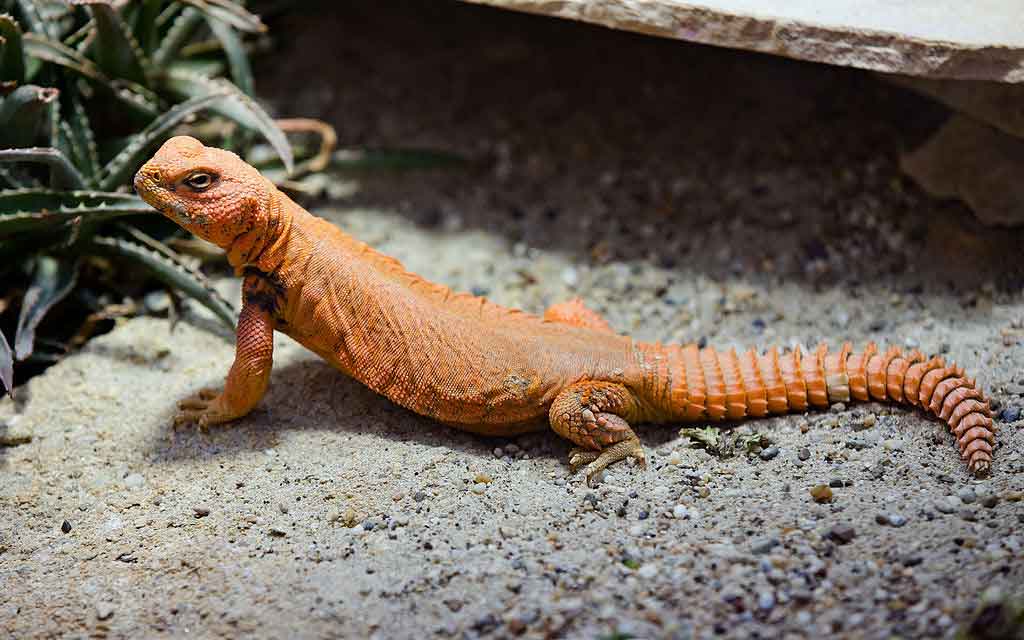
    The Saharan spiny-tailed lizard it is a relatively small and slender species for the genus, with an average total length (including the queue) of about 34 cm..
    Saharan spiny-tailed lizard
    Saharan spiny-tailed lizard, Flower Gardens Hirschstetten in Vienna, Austria.

    Content

    Origin

    The Saharan spiny-tailed lizard (Uromastyx geyri) is a lizard native to the north of Mali, southern Algeria and northern Niger. Two different color shapes are known (red or yellow).

    Characteristics

    The Saharan spiny-tailed lizard it is a relatively small and slender species for the genus, with an average total length (including the queue) of about 34 cm.. This lizard is usually beige or orange with lighter spots.

    It is one of the brightest colored species in the genus. Uromastyx. There are two colors of the Uromastyx geyri, the "red" and "yellow" variety, being the color its only difference.

    The variety red it is often reddish in color almost solid to orange neon pumpkin, and the yellow phase is in or near a neon range. Females are a paler color than males, showing more variations of tan coloration and much less coloration in the belly, as well as less vivid patterns, most females have a simple "freckle" on their back.

    The Saharan spiny-tailed lizard are medium-sized lizards, many of them with an average of 28-36 cm of total length and a weight of 250 grams or more as adults.

    The "Saharan spiny-tailed lizard" in captivity

    Terrarium

    The Saharan spiny-tailed lizard they are very territorial in nature and keeping one male and several females is only possible in a large terrarium. It is best to keep them in pairs..

    • temperatures during the day: from 28° to 35°C (locally approx. 45°C)
    • Night temperatures: 18-22°C
    • Humidity: 40-60
    • Minimum size of the terrarium: starting at 140 x 100 x 120 cm for a couple

    The terrarium must be furnished with numerous stones, some climbing possibilities such as thick branches, cork or bark tubes, which also offer many hiding places. To maintain this species properly, the terrarium needs a substrate of at least 20-30 height cm. Spray a little several times a week.

    Illumination

    For your well-being, good lighting and ultraviolet light are necessary (30% of UVA rays and 10-12% UVB), as well as a place to sunbathe. UV radiation is extremely important and absolutely necessary. In the case of females, it is absolutely necessary to have a suitable place for laying eggs or with several possibilities.

    A lighting period of up to 14 hours a day (except during hibernation).

    Hibernation

    You have to let the animals hibernate for three or four months. As such, the Saharan spiny-tailed lizard they need between 12 y 18°C. Hibernation is very important for animals to regulate their bodily functions and stay healthy. It's also a good way to prevent obesity.

    Food

    The diet of the Saharan spiny-tailed lizard includes banana, vine leaves, dandelion, margaritas, clover, pamplinas, sometimes kitchen herbs and grains like corn, rice, millet, sunflower seeds and others. Young animals feed up to a 75% of animals. These may include, crickets, grasshopper, cockroaches, sometimes zophobas and other live food. Adults should be fed little or no animal food to prevent fatty degeneration..

    no lettuce, iceberg lettuce or similar, since its calcium-phosphorus content is unfavorable. And cabbage or spinach should only be provided rarely because of oxalic acid.…

    Fruit should also be provided only in moderation., if it is accepted.

    Additional vitamin and mineral supplements are recommended.

    For liquid intake, you can place a bowl of water that is cleaned daily.

    Reproduction

    Winter rest is very important for the young. The "Saharan spiny-tailed lizard" lay eggs. These should not be incubated too wet, otherwise they will easily turn into fungi. Young Uromastyx geyri can be raised together in a group for up to two years, provided they are compatible. It is absolutely necessary to take enough calcium and vitamin supplements.

    For sale "Saharan spiny-tailed lizard"

    The price of a Saharan spiny-tailed lizard, captive bred, at the exotic animal market, ranges between 100 – 120 EUR.

    Video "Saharan spiny-tailed lizard"

    Uromastyx Geyri oranges eating flowers 03 2014

    Alternative names:

    1. Geyr’s dabb lizard, Geyr’s spiny-tailed lizard, Sahara mastigure, Saharan spiny-tailed lizard, Yellow Niger Uromastyx, Saharan yellow uromastyx. (English).
    2. Lézard de Geyr, Lézard à queue épineuse de Geyr, Mastigure du Sahara, Lézard à queue épineuse du Sahara, Uromastyx jaune du Niger, Uromastyx jaune du Sahara. (French).
    3. Geyr-Krusteneidechse, Geyr-Stacheleidechse, Sahara-Mastigure, Sahara-Stacheleidechse, Gelber Niger-Uromastyx, Sahara-Gelb-Uromastyx (German).
    4. Lagarto do Geyr, lagarto de cauda espinhosa do Geyr, mastigure do Sara, lagarto de cauda espinhosa do Sara, Uromastyx amarelo do Níger, uromastyx amarelo do Sara (Portuguese).
    5. Lagarto de cola espinosa de Geyr, Lagarto de cola espinosa de Geyr, Mastigure del Sahara, Lagarto de cola espinosa del Sahara, Uromastyx amarillo del Níger, Uromastyx amarillo del Sahara (español).
    ▷ The world of Pets: Dogs, cats, birds, reptiles, amphibians

    Ocellated spinytail
    - Uromastyx ocellata

    The Ocellated spinytail is native to northeastern Africa, where it can be found in southern Egypt, Sudan, Eritrea, Djibouti, Ethiopia (near the border with Somalia) and north-western Somalia.
    Tail hawthorn ocellated
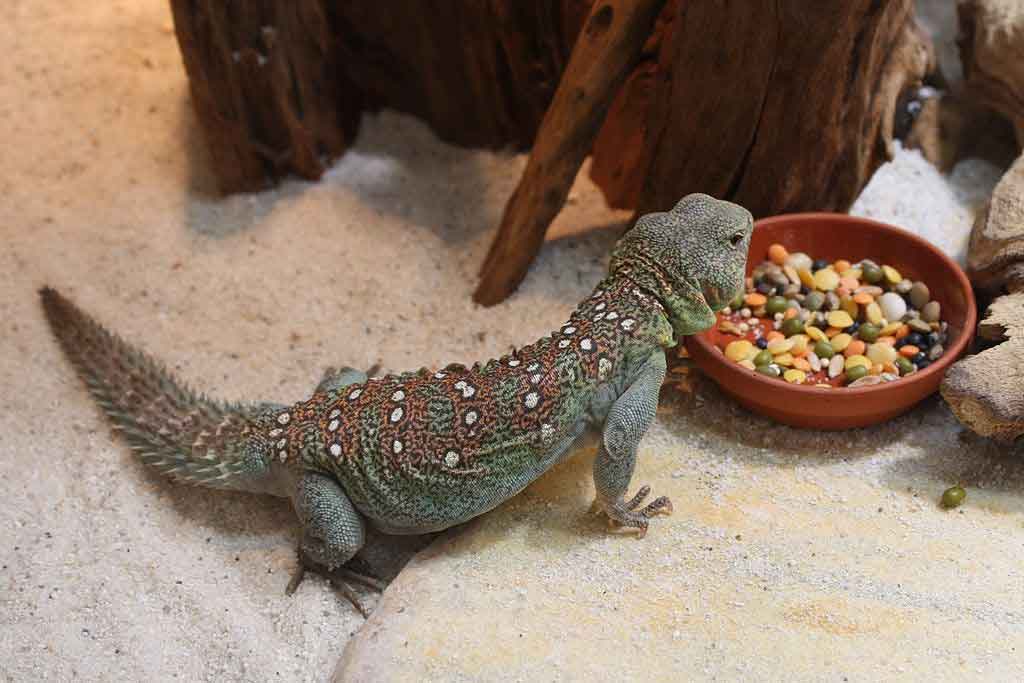
    Uromastyx ocellata (male) 3-4 years in terrarium – RaSaX, CC BY 3.0, via Wikimedia Commons

    Content

    Characteristics:

    The Ocellated spinytail reaches a total length of 30 cm., with a head-torso length of some 16,5 cm and a tail length of 13,5 cm.. So, is one of the smallest species in the genus of Spiny-tailed lizards. It is, because, of one of the smallest species in the genus of Spiny-tailed lizards.

    A characteristic feature of this species is the back decorated with white spots on the eyes on a reddish background.. Males tend to be more colorful. Its head and rump are reddish or greenish in color. The belly usually remains white or yellowish, especially in females. Coloration may vary, depending on heat and light exposure. The claws of the Ocellated spinytail they are especially pronounced for digging underground burrows in which it remains overnight as a diurnal animal.. The tail is endowed with pointed scales. Serves as a defense against predators.

    The Ocellated spinytail lives both alone and in smaller groups. They do not hibernate but, during the winter months, if they do it.

    Terrarium:

    Savannah terrarium (dry terrarium subtype) with excavable substrate of 15-30 height cm. Sturdy stone climbing structures and caves below. The recommended terrarium size to keep the Ocellated spinytail (Uromastyx ocellata) adult in pairs is about 100 x 70 x 50 cm..

    • Pulverize 2-3 times a week in the terrarium.
    • Temperature 27-30°C, at night 16-20°C, sunny islands 40-45°C.
    • Humidity 50-60%.
    • Up to lighting 14 hours. UV irradiation required.

    Maintenance:

    It is recommended to keep the Ocellated spinytailto (Uromastyx ocellata) in pairs. High temperatures are important for digestion, moderate feeding against fat degeneration of the organs. Hibernate during 3 meses a 10-15°C.

    Diet:

    Vine and banana leaves, sunflower seeds, cereal grains, corn, rice, millet. Rarely animal feed.

    Behavior:

    To the Ocellated spinytail (Uromastyx ocellata) likes to dig and climb well. This species defends themselves with tail blows. Like all species of Uromastyx, excrete excess salts through the nasal glands.

    Reproduction:

    The Ocellated spinytail (Uromastyx ocellata) puts between 10 and 23 eggs.

    Buy a "oversized spiny tail"

    The price of a Ocellated spinytail bred in captivity in the exotic animal market ranges from 250 – 300 EUR.

    Alternative names:

    1. Ocellated spinytail (English).
    2. Fouette-queue ocellé (French).
    3. Geschmückte Dornschwanzagame (German).
    4. Cauda espinhosa ocelada (Portuguese).
    5. Cola espinosa ocelada (español).