โ–ท The world of Pets: Dogs, cats, birds, reptiles, amphibians

Rusty-faced Parrot
Hapalopsittaca amazonina

Rusty-faced Parrot

Content


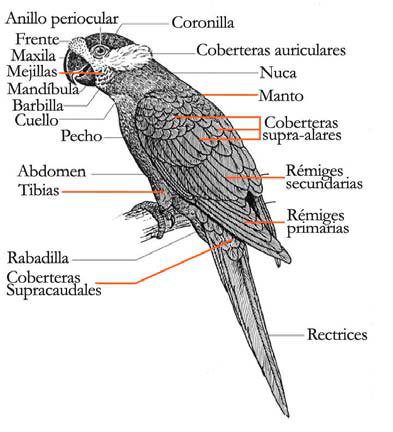
Anatomy-parrots

Description:

23 cm.. height and a weight between 97 and 115g.

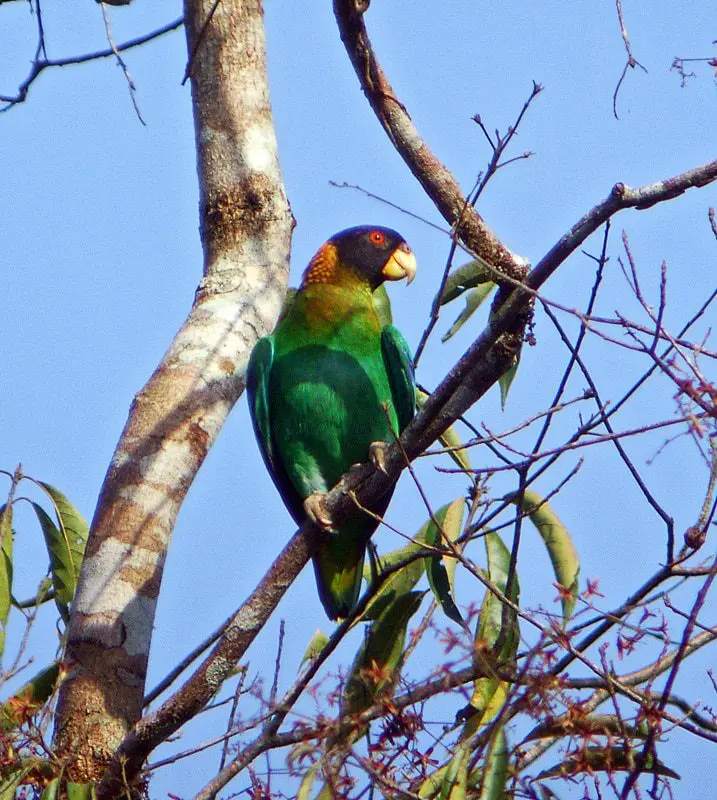
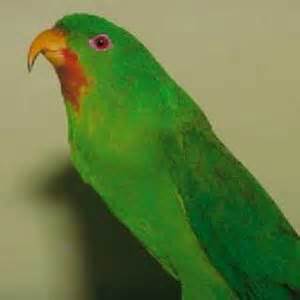
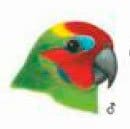
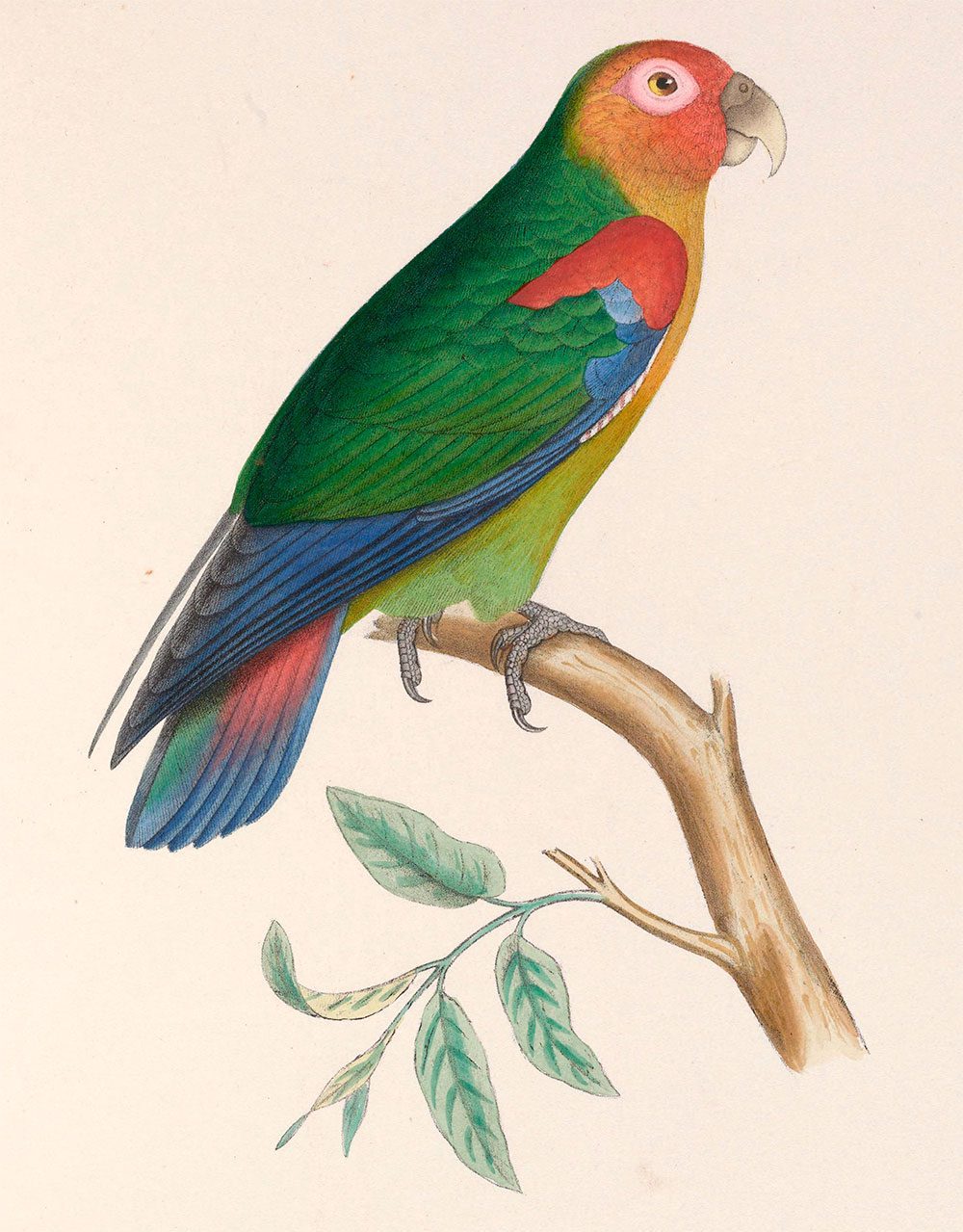
The Rusty-faced Parrot or Parrot mountain (Hapalopsittaca amazonina) It is distinguishable by the dirty red of his face and crown. Its bill is pale with to the base of the lower jaw and the chin of color red orange. Headphones coverts reddish brown with yellow lines that extend behind the nape and the neck. The rest of upperparts they are green. Its chest This is olive green, with red spots in the shoulders similar to their Wing coverts internal minors. The rest of your wing-coverts they are blue-green and the remiges bluish-black. Its tail It is mainly dull red with wide blue apexes.

It has no sexual dimorphism. The youth are green-yellow color, with the face pale red and the secondaries grey.

Description 3 subspecies:

  • Hapalopsittaca amazonina amazonina

    (Des Murs, 1845) – Nominal.


  • Hapalopsittaca amazonina theresae

    (Hellmayr, 1915) – The plumage with more olive tones and the face dark red.


  • Hapalopsittaca amazonina velezi

    (Serious,GR & Restrepo, 1989) – With part of the crown and nape, brighter yellowish green; forecrown red; list fine near to the ear; below and behind the eye, green. More information.

Habitat:

It inhabits in mountains with semi-humid and cloud forests, between the 2000 to 3600 m, with the presence of Oak (Quercus humboldtii) and Alder (Alnus acuminata).
Fly high in the forest canopy, in groups of 5-30 individuals. Presents aggregation behaviors for the night, establishing communal bedrooms in groups of between 2-35 individuals.

Reproduction:

Many aspects of the reproductive biology of the Rusty-faced Parrot. Probably nests in tree hollows of Oak dead.

Food:

Consumes fruits of the "matapaloยซ, flowers and seeds, including the of Clusia sp. and some GUIs of which is fed with high frequency.

Distribution:

Size of the breeding range / resident): 234.000 km2

Is located in Colombia and Venezuela and Peru. In Colombia lives between 2000 and 2700 m above the sea level in the Cordillera Oriental and in the The upper Magdalena valley (South of the Department of the Huila). Among 3100 and 3600 m of height in the cordillera Central in Caldas (where it is considered Bird emblem), in the basin of the White River in the municipality of Manizales. In the Cordillera Oriental is known only in Norte de Santander and the southwest of Bogotรก. Has also been recorded in the departments of Risaralda, Tolima, Huila (Cave of the Guacharos, Meremberg nature reserve) and Cauca (Puracรฉ National Park).

Distribution 3 subspecies:

  • Hapalopsittaca amazonina amazonina

    (Des Murs, 1845) – Nominal. East of the Colombian Andes.


  • Hapalopsittaca amazonina theresae

    (Hellmayr, 1915) – Eastern edge of the Andes of Colombia and Northwest of Venezuela.


  • Hapalopsittaca amazonina velezi

    (Serious,GR & Restrepo, 1989) – Center of the Colombian Andes. More information.

Conservation:
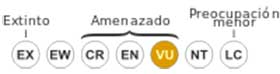

Vulnerable


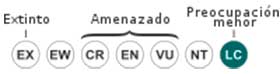
โ€ข Current category of the Red List of the UICN: Vulnerable.

โ€ข Population trend: Decreasing.

From makes several years appears in the book red of species threatened by fault of the destruction of their habitat, including, the Palm of wax (Ceroxylon quindiuense).

Rationale for the Red List category

This species is classified as Vulnerable Since its small population consists of subpopulations very small and scattered that probably will be experiencing declines continuous due to the loss widespread of habitat.

Justification of the population

Renjifo et to the. (2002) estimated that in Colombia the population can count 2,500-10,000 individuals, based on a hypothetical C.1 density of individuals / km2, and the 25% occupation of the approximately 13.890 km2 of habitat suitable. This may be an overestimate and the population could be right around the few thousand mark in Colombia (P. Salaman in litt., 2005). There are also much smaller populations in Venezuela. Its location in the Ecuador is uncertain. Be placed better in the band 2.500-9.999 mature in general individuals, which is equivalent to 3.750-14.999 individuals, rounded here to 3.500-15.000 individuals.

Justification of trend

Se sospecha una lenta y continua disminuciรณn de la poblaciรณn del Rusty-faced Parrot sobre la base de la continua destrucciรณn y fragmentaciรณn del hรกbitat.

"Rusty-faced Parrot" in captivity:

No encontrado en avicultura.

Alternative names:

Rusty-faced Parrot, Bogota Parrot, Little Amazonian Parrot, Rusty faced Parrot (English).
Caรฏque ร  face rousse, Caรฏque ร  face rouge (French).
Caรฏque ร  face rousse (German).
Rusty-faced Parrot (Portuguese).
Cotorra Montaรฑera, Lorito Amazonino, Lorito Multicolor, Loro fantasma (espaรฑol).
Cotorra Montaรฑera, Lora montaรฑera (Colombia).
Perico Multicolor (Venezuela).


scientific classification:
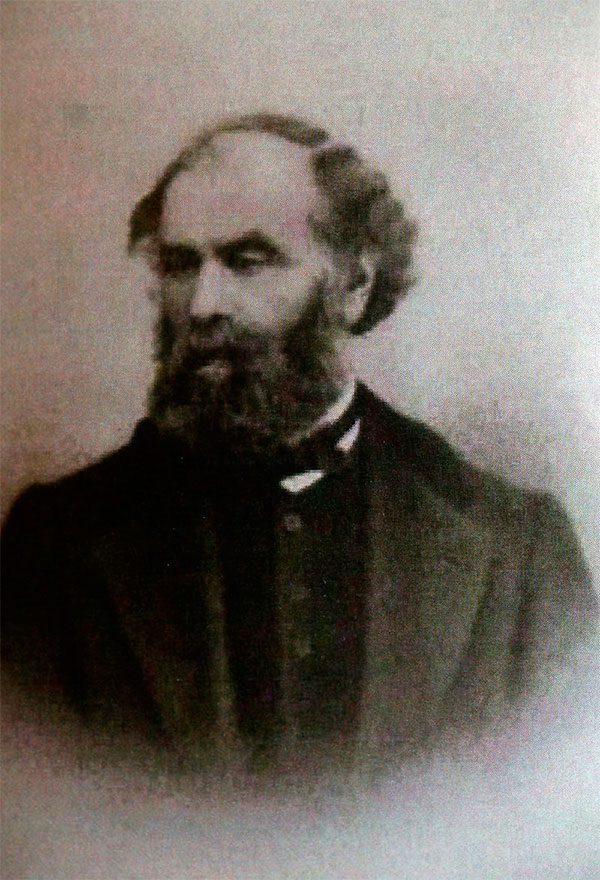
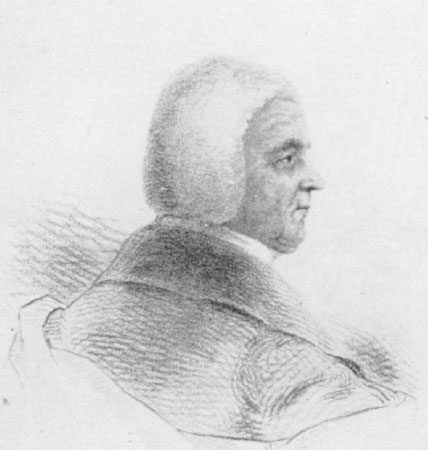
Marc Athanase Parfait Oeillet Des Murs

Order: Psittaciformes
Family: Psittacidae
Genus: Hapalopsittaca
Scientific name: Hapalopsittaca amazonina
Citation: (Des Murs, 1845)
Protonimo: Psittacus amazoninus


Images ยซLorito Amazoninoยป:

Videos ยซLrito Amazoninoยป:


ยซAmazonino Blondoยป (Hapalopsittaca amazonina)


Sources:

Avibase
Parrots of the World โ€“ Forshaw Joseph M
Parrots A Guide to the Parrots of the World – Tony Juniper & Mike Parr
Birdlife

Photos:

(1) – Iconographie ornithologique By Marc Athanase Perfect Carnation Walls (1804-1878) (Iconographie ornithologique) [Public domain], via Wikimedia Commons

Sounds:

Restrepo, Daniel Uribe

* – Restrepo, Daniel Uribe

Daniel has been chasing birds since he was 9-years old, growing on a farm in the Central Andes of Colombia, with his bedroom walls covered with colorful prints of John James Audubonโ€™s birds. Daniel graduated in Veterinary Medicine and Animal Science and has pursued bird and nature photography as his main passions in life.

He is co-founder of the Caldas Ornithological Society (SCO) based in Manizales. Dedicated mainly to conservation and sustainable development projects, Daniel has consulted for many of the most prominent environmental organizations in Colombia and currently assists private nature reserves in Colombia in the establishment of agritourism and ecotourism services.

โ–ท The world of Pets: Dogs, cats, birds, reptiles, amphibians

Mindoro Racquet-tail
Prioniturus mindorensis

Mindoro Racquet-tail

Content

Mindoro Racquet-tail

Description:

27 cms length.

The Mindoro Racquet-tail (Prioniturus mindorensis) They are closely related to the Blue-crowned Racquet-tail but it is distinguished by the patch crown in the mindorensis it is blue with a slight violet tinge and stands out sharply against the forecrown green; the bill is larger and the rackets are never as long as in adult specimens of the discurus.

-similar female to female Blue-crowned Racquet-tail, but often with violet traces in the patch crown.

Formerly considered conspecific (belonging to the same species) with the Blue-crowned Racquet-tail (Prioniturus discurus).

Habitat:

They can be found in humid lowland forests, most recently being observed records, in groups of birds visiting the IBA Siburan.

Reproduction:

No information about their reproductive behavior.

Food:

Surely it feeds their congeners fruits, berries, nuts and seeds.

Distribution:

Extending its range (breeding/resident): 12.100 km2

endemic to the Mindoro Island in Philippines.

Conservation:


Vulnerable


Rationale for the Red List category: Vulnerable.

Population size: 2500-9999 specimens.

The population trend: In decline.

Rationale for the Red List category

This newly divided species is listed as Vulnerable it is believed to have a small town, which infers that is in decline due to the continuous pressure of capture and loss of habitat.

Justification of the population

The population size of this species has not been formally quantified, but it is estimated preliminarily that has less than 10.000 mature individuals. So, placed in the band 2.500-9.999 mature individuals, which it is supposed equivalent to a total population of 3.750-14.999 individuals, rounded here to 3.500-15.000 approximately. It is presumed that all mature individuals form a single subpopulation.

Justification trend

It is inferred that the population of the species is continuous decrease due to the constant pressure capture and habitat loss (Juniper and Parr 1998).

Threats

Little information is available about threats to this species, but it is believed that the continuous capture for pet trade and the continuous loss of habitat through agricultural expansion, timber harvesting and development are causing a negative population trend.

conservation actions

Conservation actions underway

No specific conservation actions are known for this species., although suitable habitat is officially protected.

Conservation Actions Proposed

Surveys to quantify the population.
Study the habitat needs of the species.
Assess the level of threat of capture pressure.
Using remote sensing techniques to track the change in land use in Mindoro.
Carry out awareness activities to reduce trapping activities.

"Mindoro Racquet-tail" in captivity:

Not found in captivity.

Alternative names:

Blue-crowned Racquet-tail (mindorensis), Mindoro Racket-tail, Mindoro Racquet-tail (English).
Palette ร  couronne bleue (mindorensis), Palette de Mindoro (French).
Mindoro-Spatelschwanzpapagei (German).
Prioniturus mindorensis (Portuguese).
Lorito momoto de Mindoro (espaรฑol).


scientific classification:

Joseph Beal Steere
Joseph Beal Steere

Order: Psittaciformes
Family: Psittaculidae
Genus: Prioniturus
Scientific name: Prioniturus mindorensis
Citation: Steere, 1890
Protonimo: Prioniturus mindorensis

Images "Mindoro Racquet-tail"

ยซLorito Momoto de Mindoroยป (Prioniturus mindorensis)

Sources:

Avibase
Parrots of the World โ€“ Forshaw Joseph M
Parrots A Guide to the Parrots of the World – Tony Juniper & Mike Parr
Birdlife

Photos:

(1) – Mindoro Racquet-tail Prioniturus mindorensis (Young bird with no racquets) in Mounts Iglit-Baco National Park, Mindoro, Philippines by Djop Tabaranza Accessible at hbw.com/ibc/1405853.
(2) – Mindoro Racquet-tail (Prioniturus mindorensis) – https://www.hbw.com/species/mindoro-racquet-tail-prioniturus-mindorensis

Sounds: Desmond Allen, XC79225. accessible www.xeno-canto.org/79225.

โ–ท The world of Pets: Dogs, cats, birds, reptiles, amphibians

Caica Parrot
Pyrilia caica


Lorito Caica

Content

Description:

23 cm.. height.

The head of the Caica Parrot (Pyrilia caica) totally black is it more distinguishable from this species, together with a collar Golden cafesoso that extends up to the chest.

The rest of the body usually Green, more clear in the belly and the inside of the tail; wing with blue stain and dark ends, Tip of the tail black.

Bill color bone; ring eyepiece bare of color grey pale; Orange irises.

The youth with crown green, face Dark greenish yellow, and collar not very notorious gold in neck and almost absent in chest.

  • Sound of the Caica Parrot.

Habitat:

Inhabits little disturbed humid forests, firm ground, in Tepuis, from the 50 to the 1100 m.
gregarious, They walk in small groups. They feed in the canopy of the forest.

Reproduction:

Currently with little information about the reproduction.

Food:

In the wild, It believes that its diet consists mainly of eucalyptus flowers, fruit, nectar and pollen.

Distribution:

Can be observed in the South-East of Venezuela, Guyanas and northeast of the brazilian amazon.

Conservation:


Near-threatened


โ€ข Red List category of the UICN current: Near-threatened

โ€ข Population trend: Stable

Justification of the population:

The size of the world population Caica Parrot It has not been quantified, although this species is described as 'rare’ (Stotz et to the., 1996).

Justification trend :

This species is suspected that it may lose 13,6-17,2% of habitat within its distribution over three generations (21 years) based on a model of deforestation of the Amazonia (Soares-Filho et to the., 2006, Bird et to the. 2011).

Given the susceptibility of this species to the hunting and/or entrapment, It is suspected that its population will decrease at a rate close to the 30% in three generations.

"Caica Parrot" in captivity:

They adult acclimatised quite easily to a new environment and are very resistant … Conversational skills (in comparison with other species).
They are very quiet in an Aviary, with a personality friendly and Gentile. They are very sociable and it should be with a partner or in a group environment. In any way, It is not easy to see to the Caica Parrot in captivity.

Alternative names:

Caica Parrot, Hooded Parrot (English).
Caรฏque ร  tรชte noire (French).
Kappenpapagei, Kappen-Papagei (German).
curica-caica, curica, papagainho, periquito-de-pescoรงo-marrom (Portuguese).
Lorito Caica, Lorito de Cabeza Negra (espaรฑol).
Perico Cabecinegro (Venezuela).


scientific classification:

John Latham
John Latham

Order: Psittaciformes
Family: Psittacidae
Genus: Pyrilia
Scientific name: Pyrilia caica
Citation: (Latham, 1790)
Protonimo: Caรฏca parrot


Images "Caica Parrot"

Videos "Caica Parrot"

————————————————————————————————

ยซLorito Caicaยป (Pyrilia caica)


Sources:

Avibase
– Parrots of the World โ€“ Forshaw Joseph M
– Parrots A Guide to the Parrots of the World – Tony Juniper & Mike Parr
– Birdlife

Photos:

(1) – lynxeds

Sounds: controles-canto.org

โ–ท The world of Pets: Dogs, cats, birds, reptiles, amphibians

Violet-necked Lory
Eos squamata

Lori Escamoso

Content

Description

27 cm.. height and an approximate weight of 110 gr.

Along with the Red Lory (Eos Bornea) the "Scaly Lory" (Eos squamata) it is the only lory of the genus Eos it does not have blue marks on the ear-coverts.

Its plumage It has a scarlet general appearance. The neck It is surrounded by a violet blue collar which is well developed in some individuals, but nearly absent in others. The area from the abdomen up to the subcaudales it is dark purple. The scapulars they are dull purple with black tips. The feathers of the greater coverts and flight feather They are red with black tips.
The bottom of the wings and of remiges from below they are red with black spots at the primary level. The tail is purple red.

The irises is orange, the legs grey.

In the immature the feathers of the lower parts, have broad dull blackish purple borders. The irises They are brown.

Description 3 subspecies

  • Eos squamata squamata

    : (Boddaert, 1783) – Something smaller and feathers in the nominal species They are blue violet, in this subspecies are blackish blue.


  • Eos squamata riciniata

    : (Bechstein, 1811) – Smaller and band chest and neck is violet gray.


  • Eos squamata obiensis

    : (Rothschild, 1899) – It is somewhat smaller and with shoulders blacks. the band of neck It is variable and greyish violet. The area of the nape is red.

Habitat:

The Violet-necked Lory they are relatively common in the primeval forests or secondary forests that have large mature trees. Also found in the mountain forests and also, but with lower density in the coconut plantations bordering the coast, in the bushes during regeneration, in the abandoned gardens and mangroves.

Populations that inhabit small islands tend to stay near the coast.
On the larger islands, These birds can run in the forests of the mountains up to a height of 1.220 meters above the sea level.

The Violet-necked Lory they are particularly noisy and easily identifiable when they are in flocks, but they are a much more secretive behavior when in isolated pairs.

They usually gather in large flocks when they find abundant food sources.. This habit makes appearing more or less abundant in different regions. These flocks of birds are usually just above the tops of the trees.

Every day, they make short trips between the different islands. To do this they use a flight quick and direct, It consists of shallow wing beats. When they beat their wings produce a very audible hum.

Reproduction:

There is almost no information on the reproduction in the wild. In captivity, the implementation is of 2 eggs that are incubated during 27 days. As with all loris, the reproductive cycle is particularly long and hard about 80 days.

Food:

Exclusively vegetarian. They feed on sago palm in bloom and consume figs when they are still firm. Also eat nectar from big red flowers of Erythrina family Fabaceae.

Distribution:

Size of its range (reproduction / resident): 189.000 km2

The Violet-necked Lory They are endemic to the islands or archipelagos which are among New Guinea and Las Celebes.

They are mostly found in West Papua and of the Moluccan Islands.

Distribution 3 subspecies

  • Eos squamata squamata

    : (Boddaert, 1783) – Islands West Papua, that is to say Stupid, Waigeo, Batanta and Misool and islas Turtle (Indonesian)


  • Eos squamata riciniata

    : (Bechstein, 1811) – North of Moluccas, from Morotai to Bacan and Damar, also in islas Widi and Mayu islands in the sea of Moluccas (Indonesian).


  • Eos squamata obiensis

    : (Rothschild, 1899) – Only in the Obi Islands in the northern Moluccas.

Conservation:


minor concern


โ€ข Current IUCN Red List category: Least concern

โ€ข Population trend: Stable

The population size is very large, and therefore not approaching the threshold of Vulnerable under the criterion of population size.
The world population is estimated between 100,000 and 500,000 individuals.

About 3.000 specimens are caught every year for the trade aviaries. The pressure on the species is estimated to be quite reasonable, but it is recommended, by many associations, the establishment of catch quotas for the year.

"Violet-necked Lory" in captivity:

Son loving, curious, extroverts and show some unique behaviors. Some like to wrap yourself in a blanket to sleep. Sometimes, they can even be sleeping on your back. They can learn to mimic sounds and words.

They are capable of aggressive behavior if their territories and possessions is disregarded.

They are demanding in the requirements should be for their care, requiring much attention. Baths or showers daily should be part of your daily habit.

Alternative names:

Violet-necked Lory, Moluccan Red Lory, Violet necked Lory (ingles).
Lori รฉcaillรฉ, Lori ร  nuque violette, Lori de Wallace (French).
Kapuzenlori (German).
Lรณris-de-colar-violeta (Portuguese).
Lori de Collar Violeta, Lori Escamosa, Lori Escamoso (espaรฑol).

scientific classification:

Order: Psittaciformes
Family: Psittaculidae
Scientific name: Eos squamata
Genus: Eos
Citation: (Boddaert, 1783)
Protonimo: Psittacus Squamatus

โ€œScaly Loryโ€ Images:

Videos "Violet-necked Lory"

————————————————————————————————–

"Scaly Lory" (Eos squamata)


Sources:
Avibase, BirdLife.org, Oiseaux.NET
– Photos: SALIS- (Flickr), Bernard DUPONT (Flickr), Wikimedia, IBC.lynxeds.com
– Sounds: Frank Lambert (Xeno-canto)

โ–ท The world of Pets: Dogs, cats, birds, reptiles, amphibians

Goldie's Lorikeet
Psitteuteles goldiei

Goldie's Lorikeet

Content

Description

19 cm.. long and weighing between 45 and 60 g..

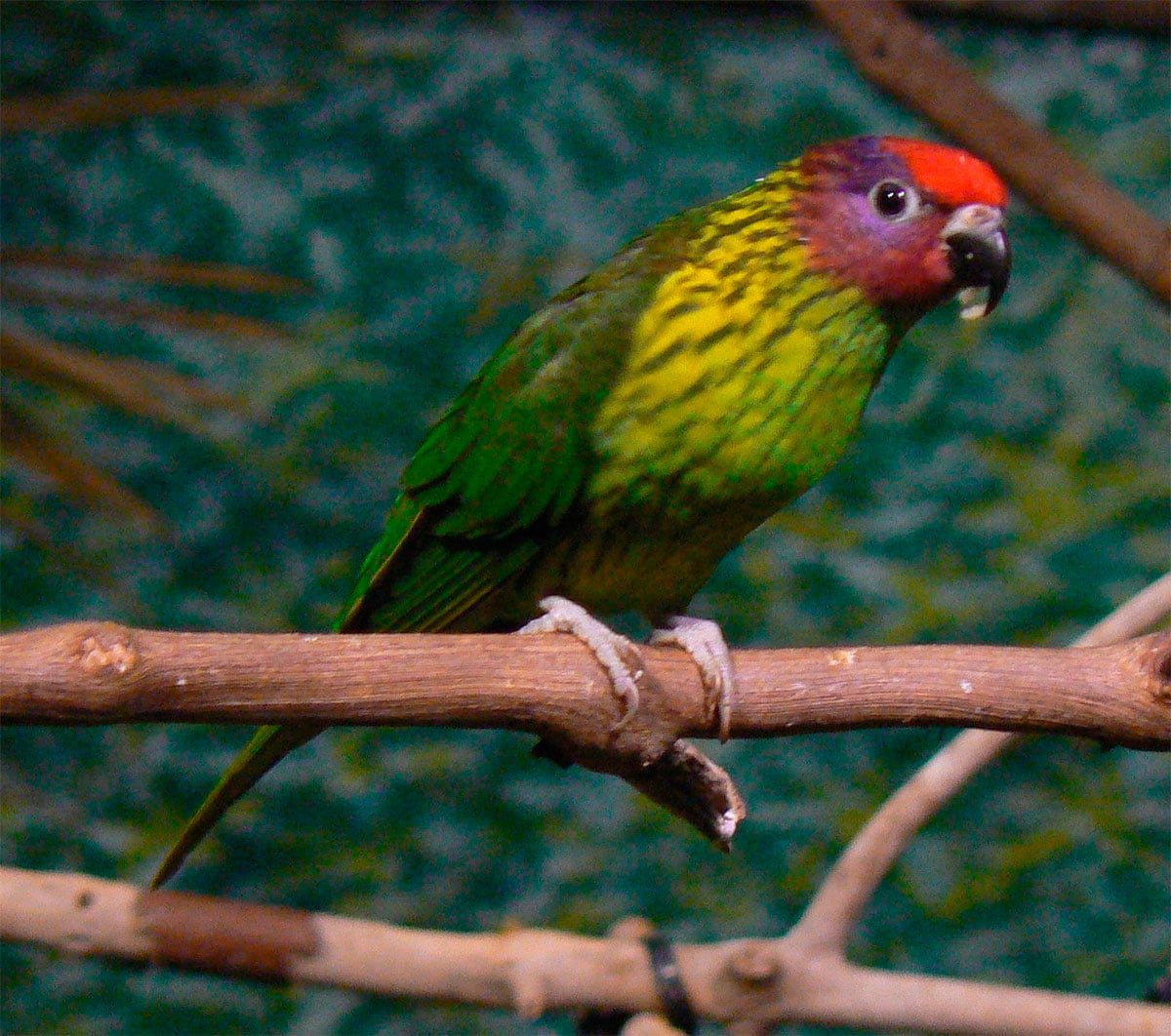
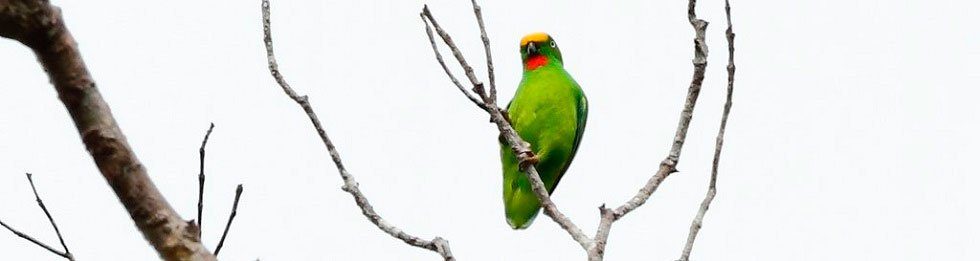
The Goldie's Lorikeet (Psitteuteles goldiei) has the top red. Its neck is surrounded by a strip blue opaque that it extends to the edge of the eye.

The mumps and their cheeks They are pink with multiple dark blue veins.. The upperparts of color green dark streaked of black in the part inferior of the neck and of color yellow greenish mottling on the sides of the layer.
The feathers that cover the wing are dark green, as well as the top of the tail.
The feathers they have a green color with black internal wires and a fine yellow edge.

The underparts are yellowish green with many streaks of dark green, more concentrated in the area of the chest. The bottom of the tail is of color yellow grey.

The bill is black, brown the iris. The legs son grises.

The females adult, they have the top more opaque and less developed.

In the immature, the top is reddish with dark blue spots. The upper mantle is spotted of yellow.

There are no geographic variations. The species is considered monotype.

Habitat:

The Goldie's Lorikeet It is distributed mainly by primary forests, mountain forests and eucalyptus between 1.000 and 2.200 meters above sea level. But, These birds are very Mobile and their habitat may vary from sea level to the 2.800 m.

At higher altitudes, sometimes be parked in the forests of beech and false Podocarpus. They are also set fairly regularly in the areas where the trees are in bloom and around small mountain villages. They have been , occasionally, in small groups of trees isolated in the middle of open spaces.

The Goldie's Lorikeet they are very sociebles. They are often associated with other Charmosyna type Loris: Fairy Lorikeet (Charmosyna pulchella) and Lori Flanquirrojo (Charmosyna placentis).

Most of the time they live in large groups of 30 or more individuals. These birds make long flights daily, often in the company of Pygmy Lorikeet (Charmosyna wilhelminae). Move from their places of rest to its feeding sites found at the middle level, or at the top of the tall trees in flower.
They probably make seasonal migrations to meet their specific feeding needs.. Between mid June and early January, the Goldie's Lorikeet they are common in the forests of the lowlands around Port Moresby.

Reproduction:

We really know very little about free-range breeding.. Apparently, the nest is well hidden inside a tree in thick foliage dry, mostly big pandanus. The female lays two white eggs.

In captivity, the incubation period ranges between 23 and 24 days. Young are altricial, and leave the nest after 8 to 9 weeks.

Food:

The Goldie's Lorikeet they have a scheme rather similar to all the lori, that is to say, they are almost exclusively vegetarian. Its menu consists mainly of pollen, nectar, flowers and fruits than that found in the trees of the genus Casuarina in shrubs of the genus honey Grevillea and of the eucalyptus.

Distribution:

Size of the area of distribution (reproduction / resident): 307.000 km2

This species is endemic of New Guinea. Lives exclusively in the mountains in the center of the island and stretches to the mountains of the Huon Peninsula and Owen Stanley.

Conservation:


minor concern

– Current IUCN Red List category: Least concern

– The population trend: Stable

The population suspected to be stable in the absence of evidence of any reduction or substantial threats.

The world population It has not been quantified, It is estimated above 100.000 specimens, but the species is reported to be locally common depending on food availability.

"Goldie's Lorikeet" in captivity:

The Goldie's Lorikeet is a bird prized as a pet. His character is not aggressive, or destructive and is quite silent for a parrot. They can be taken in pairs or in large communities. Some of them come to imitate the human voice.

Alternative names:

Goldie’s Lorikeet, Red-capped Streaked Lorikeet, Red-capped Streaked Lory (ingles).
Loriquet de Goldie (French).
Veilchenlori (German).
Lรณris-de-goldie (Portuguese).
Lori de Goldie, Tricogloso de Goldie (espaรฑol).

scientific classification:

Order: Psittaciformes
Family: Psittaculidae
Genus: Psitteuteles
Scientific name: Psitteuteles goldiei
Citation: (Sharpe, 1882)
Protonimo: Trichoglossus Goldiei

"Goldie's Lory" Images:

————————————————————————————————

"Lori de Goldie" (Psitteuteles goldiei)


Sources:

Avibase
– Parrots of the World โ€“ Forshaw Joseph M
– Parrots A Guide to the Parrots of the World – Tony Juniper & Mike Parr
– BirdLife.org
Wikipedia

Photos:

1 – ยซPsitteuteles goldiei - Pittsburgh National Aviary-8-3 cยป by derivative work: Snowmanradio (talk)Psitteuteles_goldiei_-Pittsburgh_National_Aviary-8.jpg: Benny Mazur – originally posted to Flickr as Goldieโ€™s Lorikeet and uploaded to commons as Psitteuteles_goldiei_-Pittsburgh_National_Aviary-8.jpg. Licensed under CC BY 2.0 via Wikimedia Commons.
2 – animalhouse.Re.it
3 – ยซGoldies Lorikeetยป by LtshearsOwn work. Licensed under CC BY-SA 3.0 via Wikimedia Commons.
4 โ€“ Jackson Zoological Park – Jackson, MS, USA ยฉ 2004 Jeff Whitlock
5- Bird feeding on fruit in a tree. by David Cook Wildlife Photography – IBC.lynxeds.com

Sounds: Michiel de Boer (Xeno-canto)

โ–ท The world of Pets: Dogs, cats, birds, reptiles, amphibians

Palm Lorikeet
Charmosyna palmarum

Content

Description

17 cm.. length and an approximate weight of 35 g..
Palm Lorikeet

The head of the Palm Lorikeet (Charmosyna palmarum) is bright green, showing some red markings around the base of the bill, lores and the chin. The upperparts are bright green with a light washed olive brown through the mantle.

The wings are green. Under the greenish-gray wing coverts. The lower parts are bright green, more yellowish in the chin, the throat and the center of the belly (males sometimes also with some feathers red in the abdomen and the thighs). Tail Green with yellow in the Center and by the side of the feathers; below the tail is yellow.
Bill orange; cere orange; irises yellow; legs yellowish-orange.

In the females, Red in the face is reduced or absent. Immature similar to the female, but in general most off. Iris ochre-coloured. Bill yellowish brown.

Habitat:

The Palm Lorikeet It is distributed in the forests and wooded lands, more common in the foothills than in the lowlands, and mostly uninhabited cloud forests of the larger islands above 1.000 m. He travels a lot between feeding sites and is found in pairs or flocks in the tops of the trees, where its Green plumage blends with the surroundings when it feeds among the flowers.
In flocks, couples have been observed grooming are, indicating that the pair bond is maintained when the birds are in larger groups.

A constant chatter deals the presence of these parrots in their search for food.

Reproduction:

Breeding habits they are little known, but a nest with two chicks in Holy (Vanuatu), It was found, in December of 1961, in a branch of a hollow tree to 6 meters above the ground in the cloud to 1,600 m forests. altitude.
They appear in the lowlands of sporadically, especially when the Erythnna and sago palm they are in flower.

Food:

Feeds in the Palms, lianas, fig trees and shrubs, taking nectar, pollen, fruits and berries, and particularly fond with the sago palm (Cycas circinalis).

Distribution:

Size of the area of distribution (reproduction / resident): 11.300 km2

Distributed by Southwest of Polynesia in Vanuatu, the Duff Islands, Santa Cruz Islands and Banks Islands.
Range seems to expand and contract, and it has been speculated that this may be related to the effect of cyclones, or sporadic colonies as a result of blooms. These may include, in Vanuatu It was noted from fate in 1879 for the first time in 30 years, and was still present there in the decade of 1930, but by the Decade of 1960 had disappeared.

Has also been recorded in Vanuatu from Holy Spirit, Aoba, Maewo, Pentecost, Malakula, Ambrym, Paama, Lopรฉvi, Tongoa, EMAE, Nguna, Eromanga, Tanna and Futuna; in Banks group in Santa Maria. Ureparapara, Vanua Lava Lava and Mere; and in the Group of Tinakula Santa Cruz, Utupua and Vanikoro.

Conservation:


Vulnerable


โ€ข Current IUCN Red List category: Vulnerable

โ€ข Population trend: Decreasing

The total size of the population It is estimated that it will fall within the band of 1,000-2,499 mature individuals.

Avian malaria, the cyclones and the natural cycles are suggested causes of the fluctuating range. Lowland forests, especially in small islands with high populations human, It is clearing for agriculture, domestic demand for timber and commercial logging, avoiding this kind of habitat can be regularly used by this species.

"Palm Lorikeet" in captivity:

Very rare poultry.

Alternative names:

Palm Lorikeet, Green Palm Lorikeet (ingles).
Lori des palmiers (French).
Palmenlori (German).
Lori Palmero (espaรฑol).

scientific classification:

Order: Psittaciformes
Family: Psittaculidae
Genus: Charmosyna
Scientific name: Charmosyna palmarum
Citation: (Gmelin, 1788)
Protonimo: parrot trees

Images "Palm Lorikeet"

————————————————————————————————

"Lori Palmer" (Charmosyna palmarum)


Sources:

Avibase
– Parrots of the World โ€“ Forshaw Joseph M
– Parrots A Guide to the Parrots of the World – Tony Juniper & Mike Parr
– Birdlife

Photos:

1 – taenos

โ–ท The world of Pets: Dogs, cats, birds, reptiles, amphibians

Orange-fronted hanging parrot
Loriculus aurantiifrons

Loriculo Bean

Content


Anatomy-parrots

Description

It measures each 11 cm.. length and a weight between 13 and 16 g..

Hanging-Papu

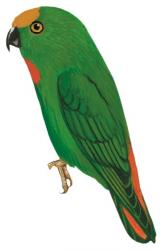
The head of the Orange-fronted hanging parrot (Loriculus aurantiifrons) is green, with the front of the crown yellow (sharp demarcation of the green in the crown rear). Upperparts green, with rump and uppertail-coverts bright red; sides rump with yellow marks. Wings Greens with vane internal to the flight feather blackish. Blue with green Underwing coverts. Chin red, rest of the underparts are slightly more yellowish than upperparts (especially coverts). Timoneras pens Green with tips yellow; undertail bluish.

Bill black; Iris whitish; legs brownish black.

Female has the face and the part front of it crown Green with red and pale blue feathers. Spada Red more small that it's the male. Iris brown.

The young birds lack of the crown and throat red. Bill brown.

Description 3 subspecies

  • Loriculus aurantiifrons aurantiifrons

    (Schlegel, 1871) – Nominal


  • Loriculus aurantiifrons batavorum

    (Stresemann, 1913) – Male with less yellow in forecrown. Female similar to nominal.


  • Loriculus aurantiifrons meeki

    (Hartert, 1895) – The male as of the subspecies batavorum but slightly larger. Female also similar to nominal but larger and bases of feathers on the front of the crown, yellow-brown color.

Habitat:

The Orange-fronted hanging parrot they are distributed in the low jungle to a altitude approximate of 1.200 m (from time to time to 1.000 m), along the edges of forests, in palm plantations, areas of secondary growth, casuarinas, pines, gardens and partially cleared areas.

The species is inconspicuous and usually difficult to detect, except when they are called among them, Since it flies above the canopy. It is usually found in groups of two to four members, foraging at various levels in the forest.

Birds perch on occasions in a branch and sing (possibly part of their courtship behavior).

Reproduction:

Guidelines of nesting you have registered between July and October, and it is said that on one occasion a bird was found incubating four eggs in a hole to 12 meters above the ground. The birds have also been observed visiting holes in arboreal termite, perhaps to rest.

Food:

Is them has observed entering their peak next to the needles of casuarinas, probably in search of Lerp insects. The diet also includes outbreaks, fruits and flowers.

Distribution:

Size of the area of distribution (reproduction / resident): 576.000 km2

Widely distributed, Although not particularly continuously, through much of the lowlands of New Guinea, in both Irian Java, Indonesian, and Papua New Guinea, Although it can be absent from most of the Center-South of the big island.

Its small size, coloration and habits make difficult his observation. Field work are running that the species is continuing in the North and South of New Guinea with the clinal variation in size. The range includes the following islands of the coast: Misool, Waigeo, Karkar, Fergusson and Goodenough.

Distribution 3 subspecies:

  • Loriculus aurantiifrons aurantiifrons

    Nominal.


  • Loriculus aurantiifrons batavorum

    Waigeu, West of the papua islands, and Northwest of New Guinea, East Coast region North of Sepik River, North of Papua New Guinea, and the South coast of Setekwa River, Irian Jaya.


  • Loriculus aurantiifrons meeki

    Fergusson, Goodenough, Karkar Islands (Papua New Guinea), and this from New Guinea, from the coast north to the West of the region of Sepik River, and in the South West area of lowland up to the region of Fly River, and possibly in the vicinity of Irian Jaya.

Conservation:


minor concern


โ€ข Current IUCN Red List category: Least concern.

โ€ข Population trend: Stable.

The world population of the Orange-fronted hanging parrot It has not been quantified, Although it is suspected that it may be most of 100.000 specimens and are considered stable and locally common (pit et to the. 1997).

The population is suspected to be stable in the absence of evidence of any reduction or substantial threats.


"Orange-fronted hanging parrot" in captivity:

extremely rare.

Alternative names:

Orange-fronted Hanging-Parrot, Bat Lorikeet, Golden-fronted Hanging-Parrot, Misool Hanging-Parrot, Orange fronted Hanging Parrot, Orange-fronted Hanging Parrot, Papuan Hanging Parrot, Papuan Hanging-Parrot (ingles).
Coryllis ร  front orange (French).
Goldstirnpapageichen, Grรผnstirnpapag (German).
Lorรญculo Papรบ (espaรฑol).


scientific classification:

Hermann Schlegel
Hermann Schlegel

Order: Psittaciformes
Family: Psittaculidae
Genus: Loriculus
Scientific name: Loriculus aurantiifrons
Citation: Schlegel, 1871
Protonimo: Loriculus aurantiifrons

Images "Orange-fronted hanging parrot"

ยซPapรบ Loricleยป (Loriculus aurantiifrons)


Sources:

Avibase
Parrots of the World โ€“ Forshaw Joseph M
Parrots A Guide to the Parrots of the World – Tony Juniper & Mike Parr
Birdlife

Photos:

(1) – Rockjumper
(2) – hbw

โ–ท The world of Pets: Dogs, cats, birds, reptiles, amphibians

Double-eyed Fig-Parrot
Cyclopsitta Diophthalma


Double-eyed Fig-Parrot

Content

Description

13 to 16 cm.. length and a weight between 25 and 56 g..

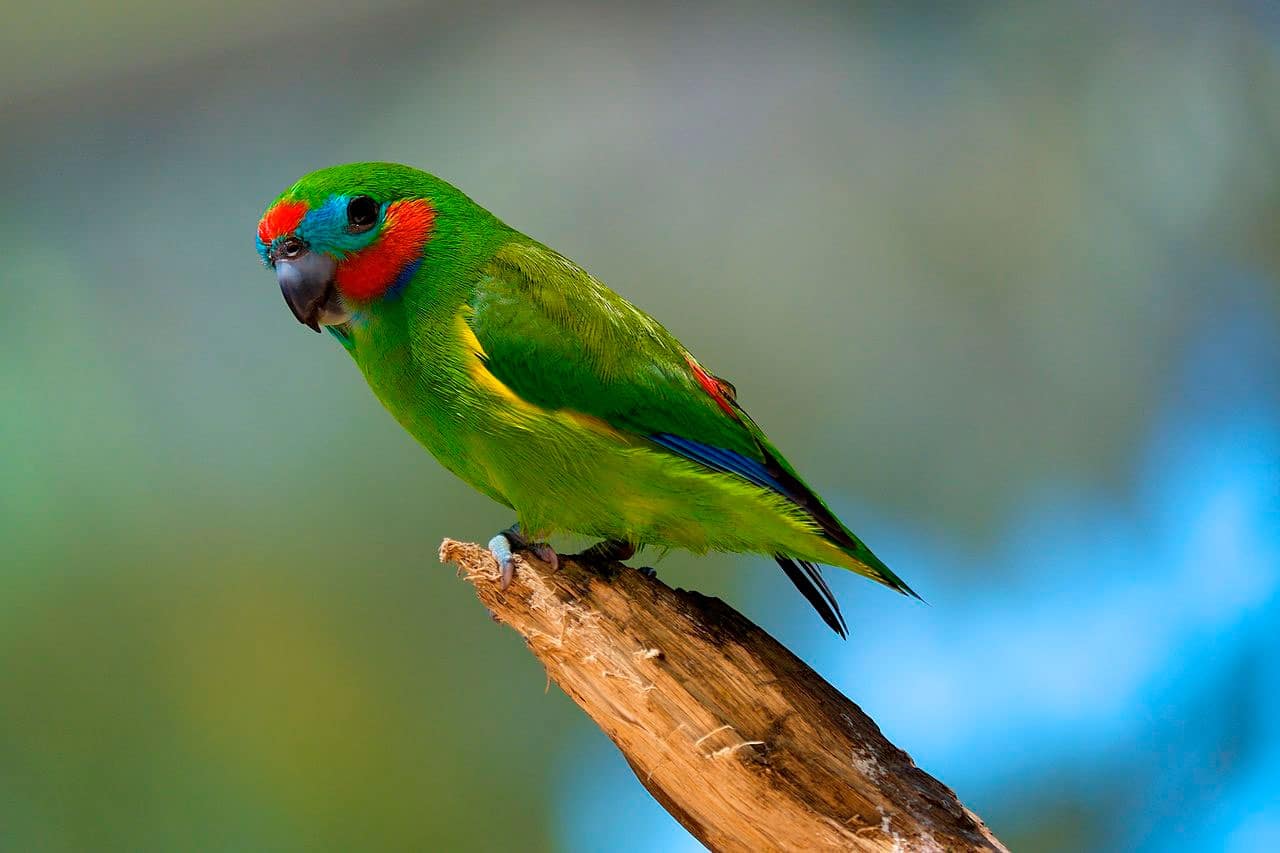
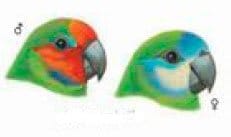
The Double-eyed Fig-Parrot (Cyclopsitta Diophthalma) half of the crown, lores, cheeks and headphones feathers bright Scarlet color with some slightly elongated feathers; bright turquoise brand above and in front of the eyes, that it extends slightly backwards above and below; green line above and behind the eyes; brand violet-blue light under the red on the back of the headphones feathers that extends to the throat; narrow yellowish Orange behind the red band of the crown, Fusion to the green in the part back from the crown.

Upperparts with indistinct diffusion of color bright green olive on the the mantle. Wing coverts, bright green; primary coverts blue; primaries with vane external of color blue turquoise pale and vane blackish internals; flight feather (except the primary outer) with band of yellowish white color visible from below; inner coverts marked in red, wing feathers bordered with yellow green.

The underparts paler; Green over yellow that the upperparts, with a strong Flash of yellow along the flank, about the bend of wing. Upper, the tail green; grey below.

Robust bill, notched grey lead and a blackish tip; cere dark grey; irises dark brown; legs Green grey.

The female has the cheeks brown, not red.

Immature as the females. The young male acquire the plumage adult in 14 months.

Subspecies description

Subspecies description
  • Cyclopsitta diophthalma diophthalma

    : (Hombron and Jacquinot, 1841) – The nominal

  • Diophthalma diophthalma aruensis - male

  • Cyclopsitta diophthalma aruensis

    : (Schlegel, 1874) – Of 14 cm.. length. The plumage is greenish-yellow, the blue area on the eyes has greenish hue , Blue cheeks are lined with mauve colouration and extends to the bottom of the peak.

    Female similar to the male but all the red marks are replaced by a pale blue.

  • Diophthalma diophthalma coccineifrons

  • Cyclopsitta diophthalma coccineifrons

    : (Sharpe, 1882) – Of 14 cm.. length.

    It is usually something more dark. The Crown is red bordered with a broad yellow band.

    The female has less yellowish white.

  • Diophthalma diophthalma virago - male

  • Cyclopsitta diophthalma virago

    : (ECTION Hartert, 1895) – Of 14 cm.. length.

    Green is more pale, the red zones of the face are less extensive and more pale.
    Yellow edge of the very weak Crown.

    Juveniles as adult females

  • Diophthalma diophthalma inseparabilis

  • Cyclopsitta diophthalma inseparabilis

    : (ECTION Hartert, 1898) – Of 14 cm.. length.

    The Red coloration is reduced to a small spot on the forehead, the rest of the forehead is bluish.

    Similar to males females.

    Juveniles as adult females.

  • Diophthalma diophthalma macleayana

  • Cyclopsitta diophthalma macleayana

    : (EP Ramsay, 1874) – Of 14 cm.. length.

    The Red is reduced to a red spot in the front area and lower cheeks. The yellow border in the area of the Crown is absent, sides of the forehead and eyes blue with green. The azul-violaceos edges of the cheek extends to below the peak.

    Females more yellowish and the bottom of the cheeks is white Brown.

    Equal to the adult female juveniles.

  • Diophthalma diophthalma marshalli

  • Cyclopsitta diophthalma marshalli

    : (Iredale, 1946) – Of 14 cm.. length.

    Green is more beige and the azul-malva coloration extends to the area under the peak.

    Females have pale blue color where the male has red and blackish brown cheek bottom area.

    Juveniles as adult females.

  • Diophthalma diophthalma coxeni

  • Cyclopsitta diophthalma coxeni

    : (Gould, 1867) – It's a bit more large, of about 15 cm.. approximately, No red forehead and face with some reddish feathers, the cheeks and orange headphones feathers. Blue front clear and without yellow stripe. The area of the eyes is absent blue. Blue edges of the bottom of the cheeks is variable.

    The females are more yellowish with less or absent red in the face.

    Equal to the adult female juveniles.

Habitat:

The Double-eyed Fig-Parrot are sedentary, with some dispersion after the breeding season. It is in a range of habitats from low to medium altitude, including jungle, secondary vegetation, on the edge of the Woods, riparian forest and occasionally dry forests and open forests of eucalyptus.

In Australia There are also birds in parks, Gardens, scrub, cultivated areas and mangroves; the Diophthalma diophthalma coxeni, probably, concentrated in the alluvial forest, but it was also visible in the forests of dry lowlands and hills of rainforest.

The species is highly dependent of the Ficus figs in all habitats.

The birds are usually found in pairs or in small groups, calling the attention with their constant calls acute while flying above the canopy.

They feed in silence, moving quietly through the foliage, often giving away their presence only by falling debris, Since break the shell of the fruit to reach its seeds.
outside the breeding season, groups of up to 200 birds can be nested together, dissolving into smaller groups to feed themselves during the morning and afternoon.

When alarmed, they move their wings in an agitated manner.

during the rains, the bath is carried out with wet foliage, and mutual grooming is common.

Reproduction:

The breeding season of the Double-eyed Fig-Parrot, probably begins in New Guinea during the month of March, in Australia the main season runs from August to November.

When the birds are played are divided into pairs, territorial around their food trees. The nest It is a cavity that is expanded in a trunk at a height between 8 and 20 meters above the ground. Most of the nest preparation is carried out by the female., that takes refuge in the hole and spends a large part of the day there during its excavation. She can experiment with more than one nest.

Courtship feeding is common. The entrance hole is about 4 cm in diameter, and putting two white eggs are deposited, at intervals of 48 hours, in one camera, some 20 centimetres below the entry hole.

The incubation hard 18 days and the young will leave the nest in 7-8 weeks, After having been fed during the first 3 to 4 weeks, only for the female. They return to settle in the hollow for a short period of time after having left the nest.

Food:

The fig seeds they are their main food, birds often return to the same ripe fruits ending all their seeds. The diet also includes whole fruits small, nectar, insect larvae and fungi or lichens collected from the barks. Birds may feed in groups with others Fig parrots and, in Australia, with Rosella parakeets and other species of parrots.

Distribution:

The Double-eyed Fig-Parrot is distributed throughout much of New Guinea and parts of the northeast of Australia. At the West end is located in Waigeo, Salawati, Misool and Rafiau in the West Papua islands, Indonesian.

Is widespread but distributed unevenly through the continental part of New Guinea, absent only in the center of the Doberai Peninsula and the central belt of mountains above the 1.600 m, Although there have previously been to 1.800 meters at the local level.

You can see in the islas Aru and Fergusson, in the Islands Goodenough in the D'Entrecasteaux Group, and in Tagula in the Louisiade group.

In Australia, the most northerly of the three isolated populations, is the tip of the Cape York Peninsula, from Jardine River in the northwest of the country, to the South, around East of Lockhart River, sometimes in the South to the extreme north of the Princess Charlotte Bay; the population Centre occupies the coastal district of everything Cooktown in the North through Cairns and the District Atherton, about South of Townsville; the southern-most population, now very reduced, with less than 50 records in the last century, formerly extended from Gympie, Queensland, to the South, about Richmond River, New South Wales, arriving inland up to the Bunya mountains (in 1976 two birds were about the Koreelah National Park, in February and two close Lamington National Park in December).

The estimate of the world population is above the 100.000 individuals and stable, but the State two of its subspecies is less secure:

– Cyclopsitta Diophthalma macleayana: has a population of 5.000 individuals and may be in decline, Although multiply in parks and gardens around Cairns.
– Cyclopsitta Diophthalma coxeni: just left 200 birds, After having reduced its population as a result of the destruction of the forests of lowlands along its limited distribution area.
– The third Australian subspecies, Cyclopsitta Diophthalma marshalli it's still pretty common.

In New Guinea, the species dispersed, and is considered to be rare in the Doberai Peninsula and absent from many parts of the lowlands of the South, is mainly distributed in the Highlands of the South basin. The Orange-breasted Fig-Parrot It probably replaces this species in much of this area. It is likely that the species has not been recorded accurately due to its small size and discreet habits. Protected by law in Australia. The Diophthalma diophthalma coxeni appears in the Appendix I of the CITES

Subspecies distribution

Subspecies distribution

Conservation:


minor concern


โ€ข Current IUCN Red List category: Least concern

โ€ข Population trend: Stable

The size of the world population Double-eyed Fig-Parrot It has not been quantified, Although it is estimated at more than 100,000 specimens. But, the Diophthalma diophthalma coxeni is in critical hazard, with a population between 50 and 200 individuals; the Diophthalma diophthalma macleayana with a population of some 5.000 individuals and the Diophthalma diophthalma marshalli generally uncommon

The population, of the nominal species, is suspected to be stable in the absence of evidence of any reduction or substantial threats.

"Double-eyed Fig-Parrot" in captivity:

Rare in captivity.
Not social with people. Welcome in the distance.

Alternative names:

Double-eyed Fig-Parrot, Double eyed Fig Parrot, Double-eyed Fig Parrot, Two-eyed Fig Parrot (ingles).
Psittacule double-oeil (French).
Rotwangen-Zwergpapagei (German).
Papagaio-do-figo-de-cara-azul (Portuguese).
Lorito de Cuatro Ojos, Lorito Dobleojo, Lorito de la higuera de doble ojo (espaรฑol).

scientific classification:

Order: Psittaciformes
Family: Psittaculidae
Scientific name: Cyclopsitta Diophthalma
Genus: Cyclopsitta
Citation: (Hombron & Jacquinot, 1841)
Protonimo: Psittacula diophthalma

Images "Lorito double":

Videos "Double-eyed Fig-Parrot"

————————————————————————————————

ยซLorito Doublerojoยป (Cyclopsitta Diophthalma)


Sources:

– Avibase
– Parrots of the World โ€“ Forshaw Joseph M
– Parrots A Guide to the Parrots of the World – Tony Juniper & Mike Parr
– Loromania

Photos:

(1) – ยซCyclopsitta diophthalma-Birdworld Kuranda, Queensland, Australia-male-8aยป by ShotophotoDouble Eyed Fig ParrotUploaded by snowmanradio. Licensed under CC BY-SA 2.0 via Wikimedia Commons.
(2) – John Gerrard Keulemans [Public domain], via Wikimedia Commons
(3) – ยซCyclopsitta diophthalma-Mossman Gorge, Daintree National Park, Queensland, Australia-male-8ยป by James Island from Brisbane, Australia – Double-Eyed Fig-ParrotUploaded by snowmanradio. Licensed under CC BY 2.0 via Wikimedia Commons.
(4) – ยซCyclopsitta Diophthalma (female) -Cairns-8ยป by David Cook Wildlife Photography – originally posted to Flickr as Double-eyed Fig-Parrot (Cyclopsitta Diophthalma). Licensed under CC BY-SA 2.0 via Wikimedia Commons.
(5) – Birds-pet-wallpapers
(6) – By tamandua – PBase

Sounds: Andrew Spencer (Xeno-canto)