โ–ท The world of Pets: Dogs, cats, birds, reptiles, amphibians

Fairy Lorikeet
Charmosyna pulchella


Fairy Lorikeet

Content

Description

18 cm.. length and a weight between 24 and 34 g..

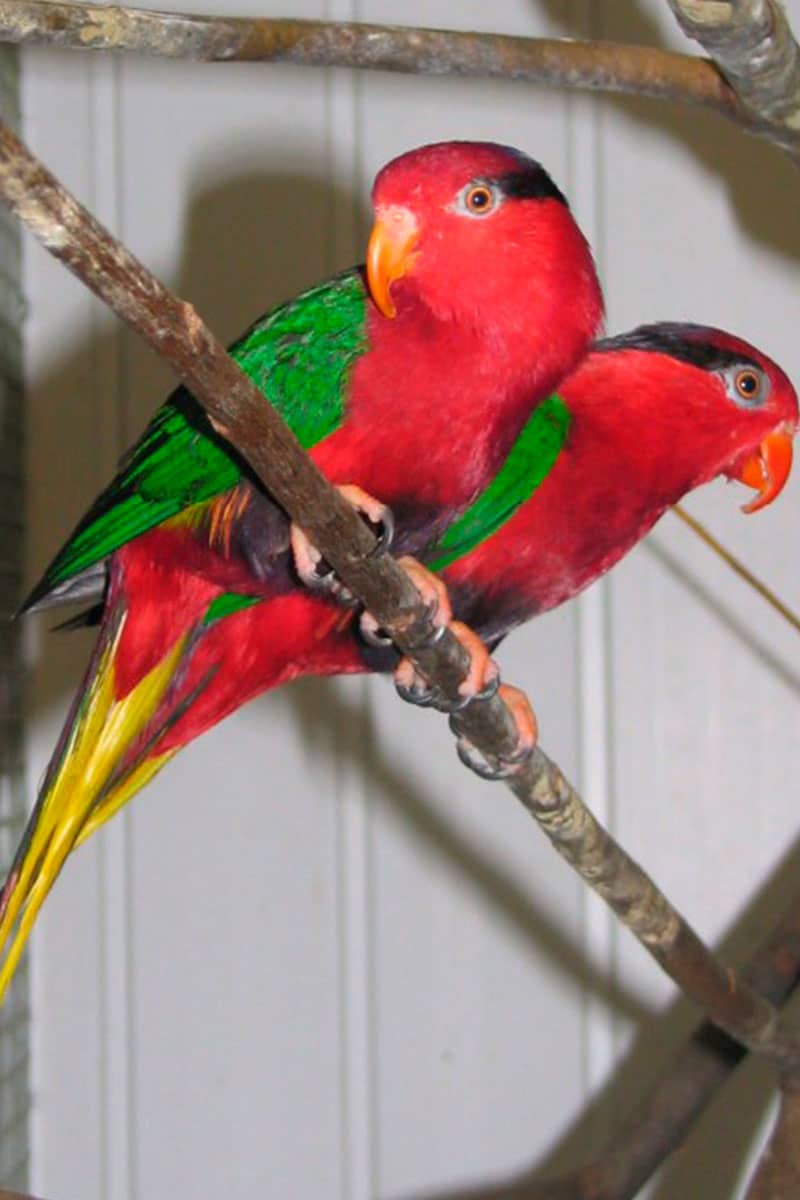
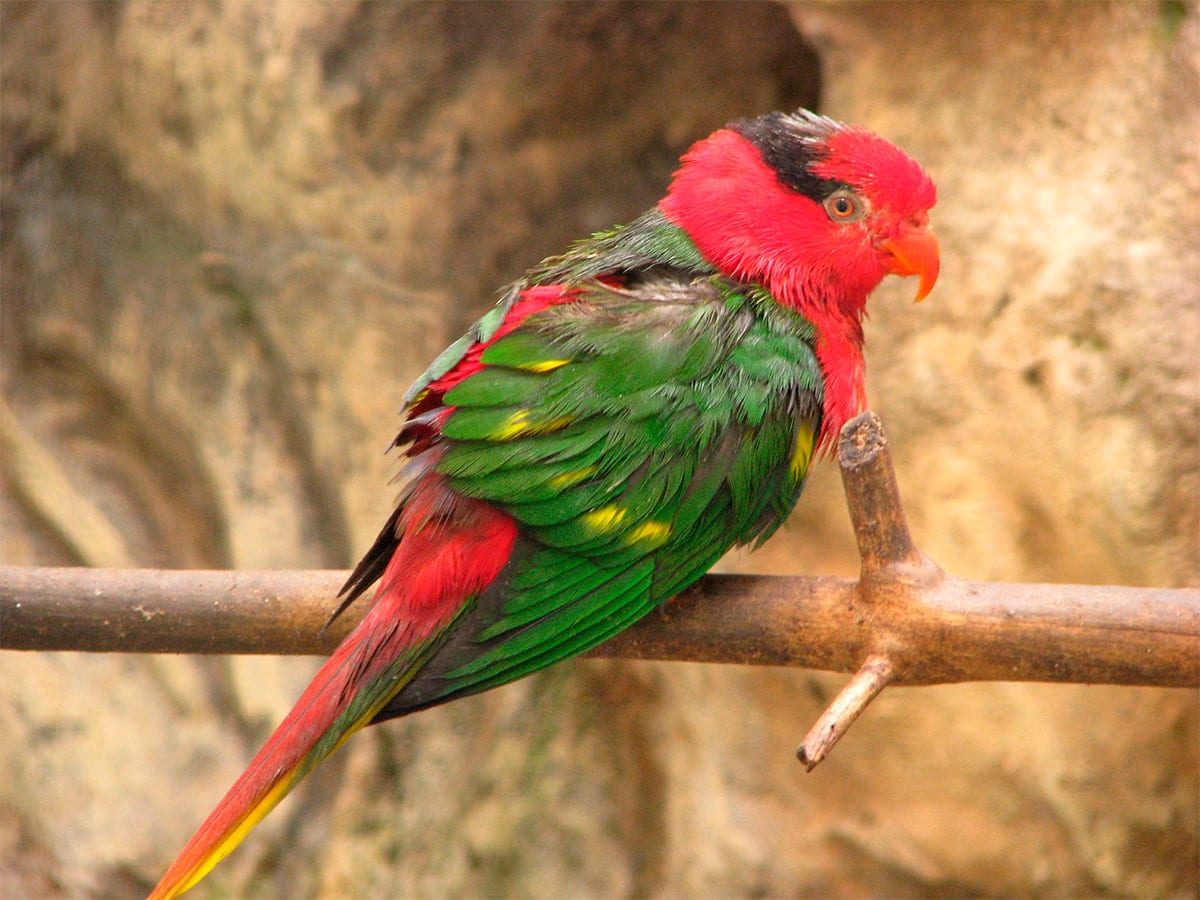
The head of the Fairy Lorikeet (Charmosyna pulchella) is dark red with the back of the crown Black extending from above and behind the eyes up to the nape. Mantle Green with a black area below the nape and collar of color red dark at the height of the shoulders; under the back It shows a patch of dark violet interspersed with some green feathers on the ends; rump and tail coverts view from above of color green.

Wings Green with extremes of color black in them flight feather and in the internal parts of the coats. below the wings Red with coverts marginal green; flight feather blackish.

The underparts Red with stripes of pale yellow in the center of the chest, the thighs purple with yellow stripes. The tail view from the top of green at the top with a black shaft in the Center and the rest of red and yellow at the tip; view from below, the tail is yellow, bathed in red and green ends.

The bill is orange with gray tip; irises yellow red; legs oranges.

The female shows a color green beige, not red, on the sides and a yellow patch in the flanks that extends to the sides of the rump.

The female of the subspecies Rothschildi also shows more green in the underparts males and a green mottling on the upper part of the chest.

The Immature They show the yellow patch of the flanks more defined than the females. The lower part of the back, mainly green with some blue-violet. Top of the chest Green mottled without clearly defined yellow stripes adult. Crown Red with black patch restricted to the nape and mixed with the green of the upper mantle. Lack of the Red of the part back from neck clearly defined in adults. Yellow area at the bottom of the flight feather. Iris brown. Beak and feet grayish brown.

Subspecies description

There are two subspecies including the nominal. A third, Charmosyna pulchella beautiful, described by Devis (1900), is considered here as Charmosyna pulchella pulchella.

  • Charmosyna pulchella pulchella

    : (Gray,GR, 1859) – The nominal


  • Charmosyna pulchella rothschildi

    : (Hartert, 1930) – The patch of the crown descends to find is with them eye; Green fusion behind the yellow lines of the chest, and green fusion in the flanks and the thighs (that can also show some yellow stripes); without the Red of the neck and much less defined the violet patch in the lower part of the back.

Habitat:

Nomads. They are mainly distributed in montane forests, at the edges of forests and secondary growth forests. Its preferred habitat are the mountains between 500 and 1.800 m, but also found in lowlands up to the level of the sea and in the mountains up to 2.300 m.

Found in pairs or flocks of 15 or more members, uniting in the tops of trees in flower with others Charmosyna lorikeets, including the Josephine's Lorikeet.

Reproduction:

In captivity it nests continuously, with incubation of 25 days shared by both parents. Usually, It lays two eggs in a hole in the base of one epiphyte. In nature it is intended that nests between January and April (Pratt picked up breeding males in March).

Food:

It feeds on pollen and nectar.

Distribution:

The Fairy Lorikeet is distributed between New Guinea in Irian Java (Indonesian) and Papua New Guinea, from the East of Vogelkop to the peninsula of Huon. Owen Stanley mountains and southeastern intervals.

Subspecies distribution:

  • Charmosyna pulchella pulchella

    : The nominal


  • Charmosyna pulchella rothschildi

    : The mountains Cyclops and the slope North of the mountains on the idenburg river (Irian Java).

Conservation:
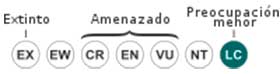

minor concern


โ€ข Current IUCN Red List category: Least concern.

โ€ข Population trend: Stable.

The world's population has not been quantified, It is thought that it surpasses the 500.000 birds. the species, according to information, is abundant in some areas, but few in others due to the trade (pit et to the., 1997). Suspected that the population is stable in the absence of evidence of any reduction or substantial threats.

"Fairy Lorikeet" in captivity:

A small number of captivity.

Alternative names:

Fairy Lorikeet, Little Red Lorikeet, Little Red Lory (ingles).
Lori fรฉรฉrique, Lori ร  croupion noir, Lori fรฉerique, Loriquet ร  croupion noir (French).
Goldstrichellori (German).
Lori Lindo (espaรฑol).

scientific classification:

Order: Psittaciformes
Family: Psittaculidae
Scientific name: Charmosyna pulchella
Citation: Gray,GR, 1859
Protonimo: Charmosyna pulchella

ยซCute Loriยป Images:

————————————————————————————————

ยซLori Lindoยป (Charmosyna pulchella)


Sources:

Avibase
– Parrots of the World โ€“ Forshaw Joseph M
– Parrots A Guide to the Parrots of the World – Tony Juniper & Mike Parr
– Birdlife

Photos:

1 – animalphotos.me
2 – by W. Voit – koppiekrauw
3 – animalphotos.me
4 – Author iggino in Vogelpark Walsrode, Walsrode, Lower Saxony, Germany – lynx
5 – in Neues vom Loro-Parque – koelle-zoo
โ–ท The world of Pets: Dogs, cats, birds, reptiles, amphibians

Black Lory
Chalcopsitta atra

Lori Negro

Content

Description

32 cm.. height and a weight between 230 and 260 gr.

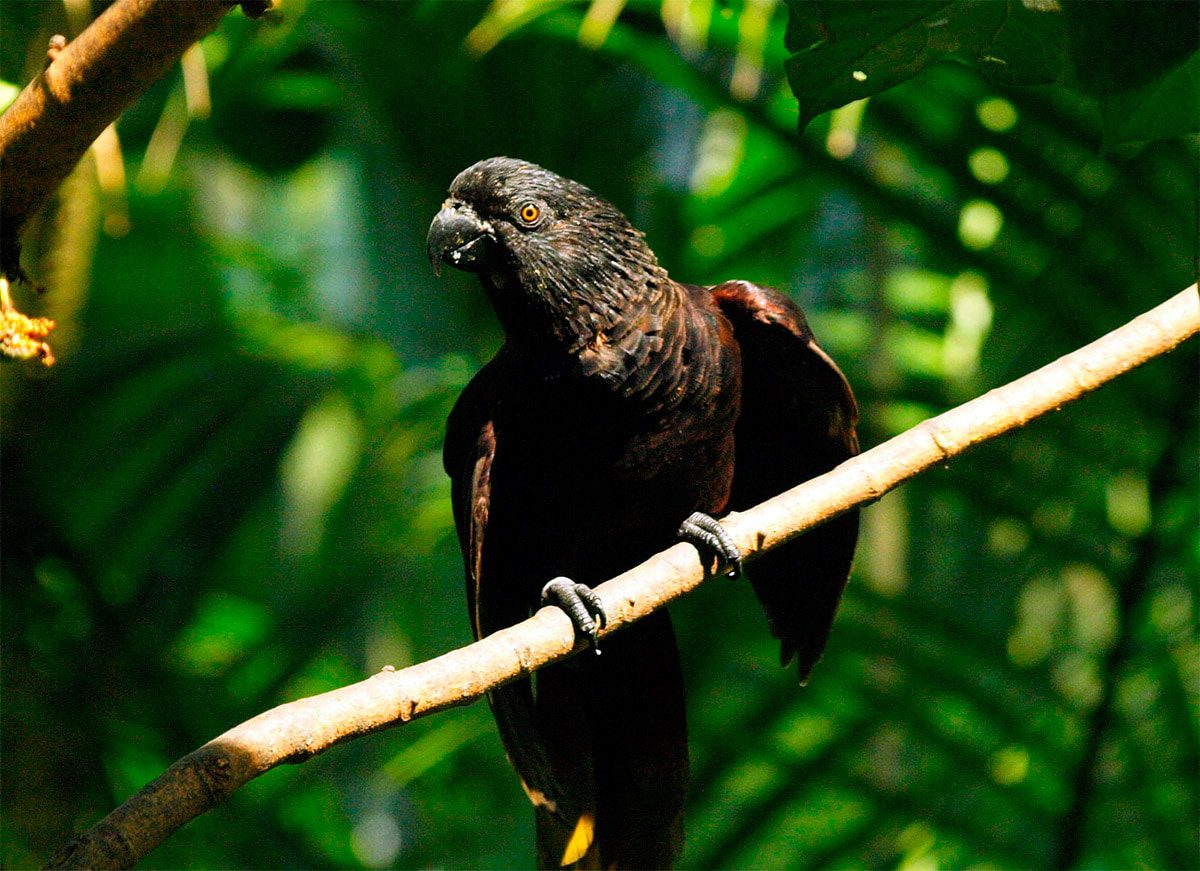
The Black Lory (Chalcopsitta atra) It is the least colorful member of an otherwise very colorful genre. Itร‚ยดs, in poultry, therefore, the least popular. This is unfortunate because it is equally as interesting as the other members of the genus.

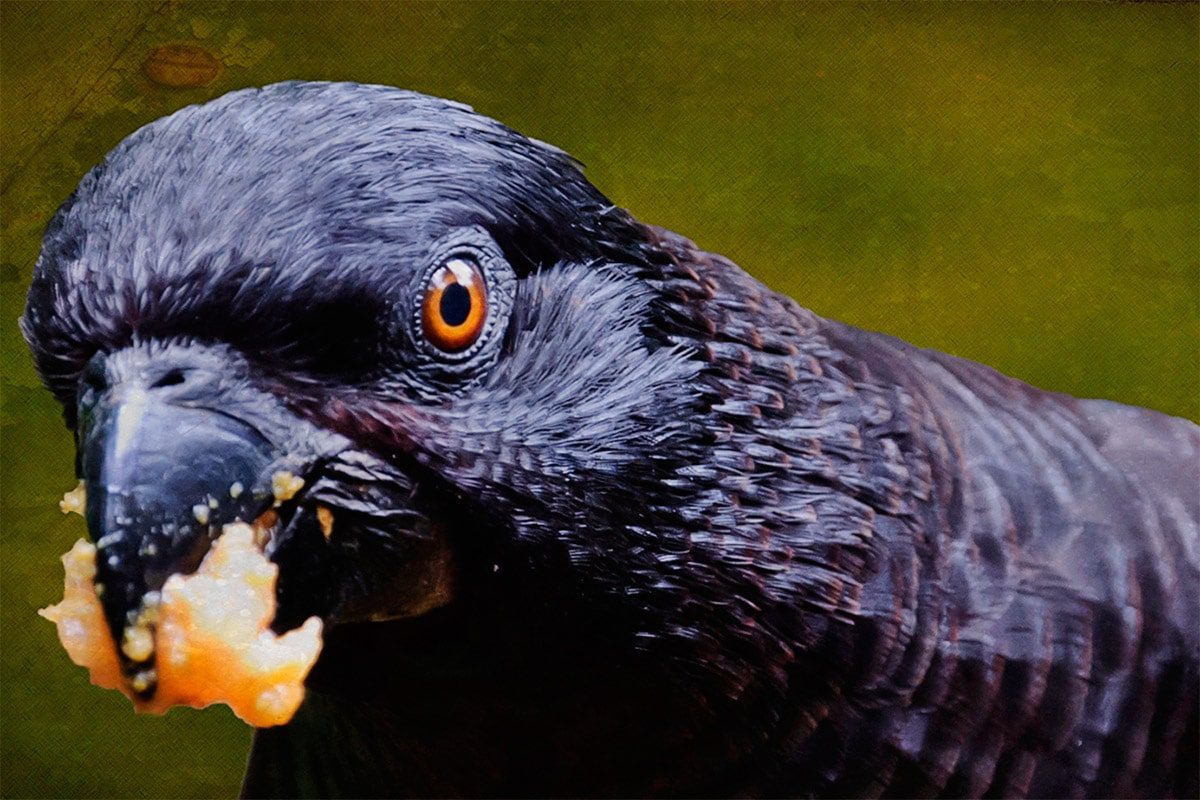
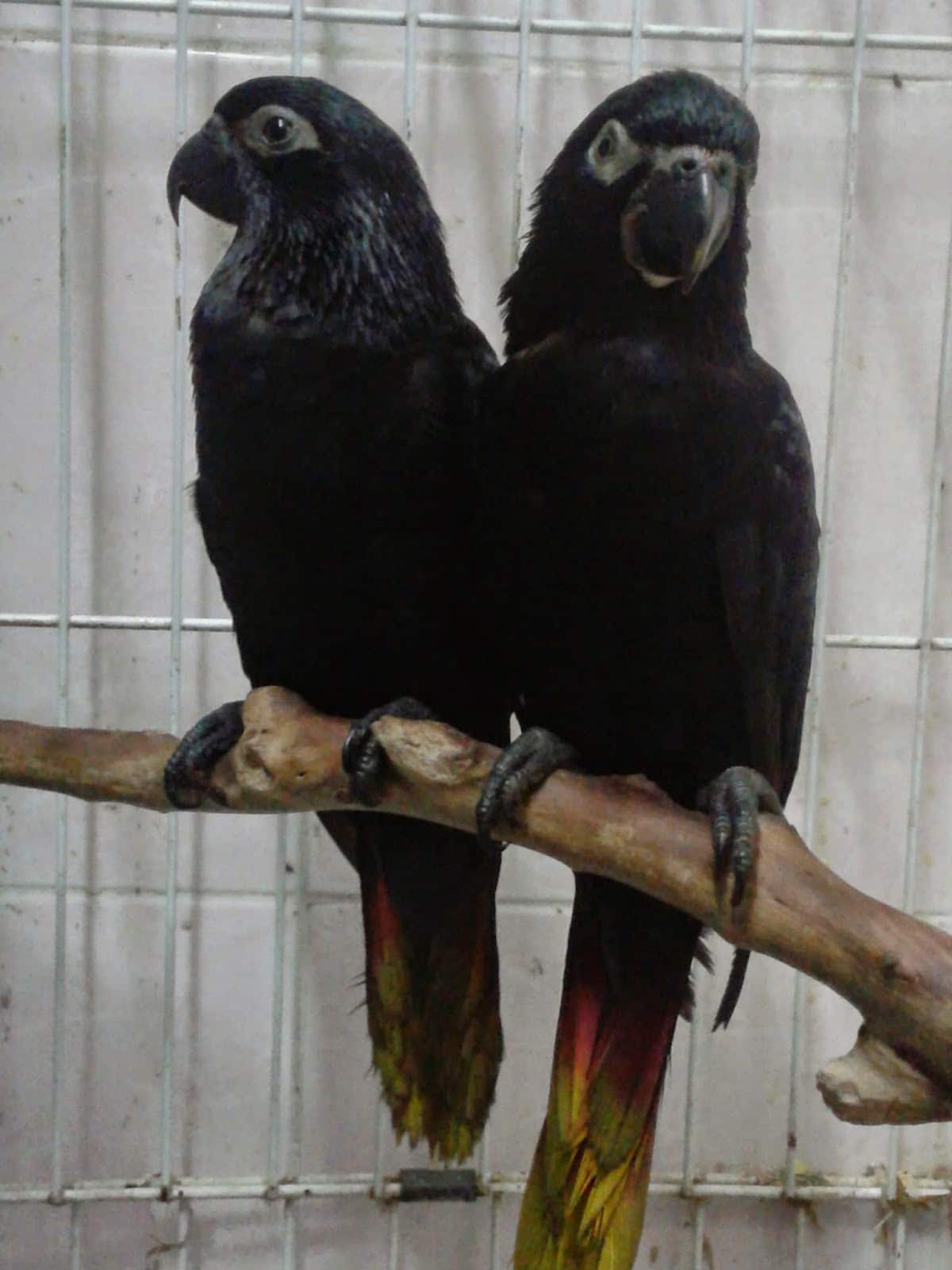
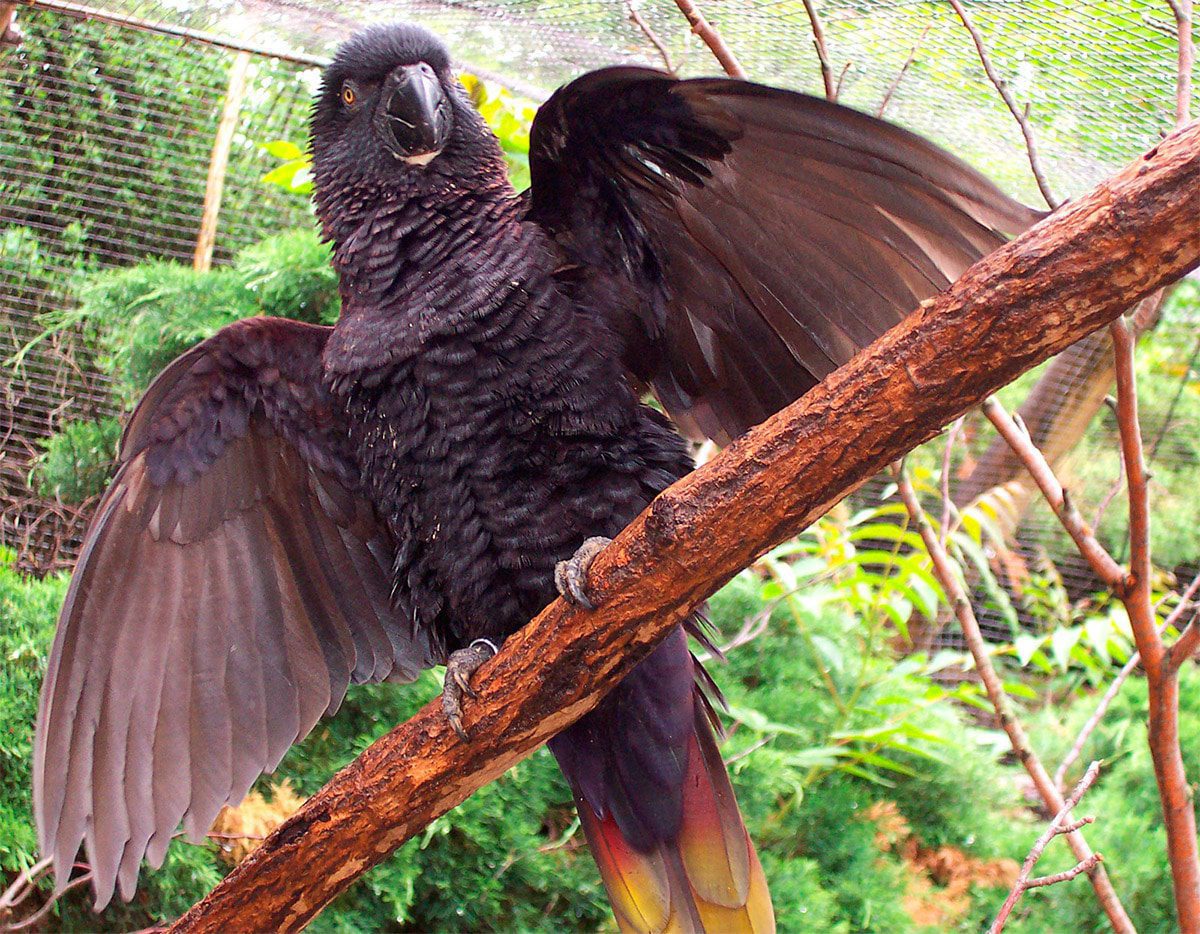
Black in color with a purplish sheen to the plumage that is highly evident in sunlight, which gives it a superficial appearance of a crow. Even their bare parts, as the nose , the skin around the eyes and at the base of the jaws, eyes and claws, they are equally dark. Rump displays a violet blue.

The underside of the tail feathers are color olivaceous with light infusions of red at the base.
The iris is orange-red, the grey legs.

The youth differ little from adults but have an eye-ring and a skin at the base of the peak which are whitish. It is grey.

There is a 3 subspecies, that differ little between if:

  • Chalcopsitta atra atra: Both adults, usually black. The bluish violet rump. The feathers of the bottom of tail olive/yellow washed in red. Naked eye-ring black , black skin at the base of the peak. Orange-red eyes.

  • Chalcopsitta atra bernsteini: Red marks / purple on the forehead and thighs, less evident in females; Blue darker in the rump.

  • Chalcopsitta atra insignis: Head striped gray/blue. The front, the face, the thighs and the underside of the wings are red. The feathers of the throat and underparts with red trim. The rump is dull blue. The lower part of the tail is greyish blue. It is one of the most beautiful parrots that exist. It will be necessary to see any parrot in the light of the Sun to be able to appreciate its beauty.

It is also said that there are other subspecies, the calcopsitta atra spectabilis, resident of the Mamberiok Peninsula, but the data given are running that it was only a hybridization of the Chalcopsitta Atra and the Chalcopsitta Sintillata.

They are nomadic outside of the breeding season., and, they are sometimes found in large groups, associated with the Blackbirds, feeding together on trees in flower.

Habitat:

The Black Lory live in the Plains, rarely above the 200 m. They are very abundant in relatively open habitats, as the mangroves near the coast, swamp forest, coconut plantations, scattered eucalyptus in the Middle areas of meadows and scrub land. From time to time come to the edge of the Woods primary or forest growth. The Black Lory is endemic to New Guinea.

Reproduction:

Most of the information has been obtained from captive birds. In the wild, most of these birds breed between December and February. In captivity, the female lays two white eggs which are incubated for about 25 days. The entire reproductive period is particularly long, lasting approximately 75 days.

The male incubates not, but sometimes it remains in the nest with the female. After birth the chicks remain in the nest approximately one 10 weeks.

Food:

The Black Lory is vegetarian. Primarily feeds on nectar and fruits. Constantly migrates in search of seasonal food. Green corn sprouts and seeds are also in their diet.. Enjoy the Schefflera shrubs.

Distribution:

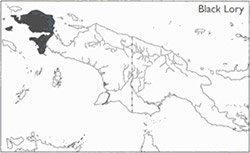
Distribution Lori black
This species is distributed in the westernmost part of West Papua, the Indonesian portion of New Guinea. In particular, they are in the Western Vogelkop, also on the islands of Misool (provinces of Maluku), Batanta (papua province), the Onin and Bomberai and Salawati peninsulas (West Papua), off the coast.

Between the 3 [+] Subspecies:

  • Chalcopsitta atra atra: Distribution. West New Guinea

  • Chalcopsitta atra bernsteini: Distribution. Confined to the island of Misool (Indonesian) in the West of New Guinea.

  • Chalcopsitta atra insignis: Distribution. The Vogelkop, Island Amberpon, Onin, bomberai peninsulas, Northeast of New Guinea.

  • calcopsitta atra spectabilis: Distribution. mamberiok peninsula

Conservation:


minor concern


This lory is evaluated as least concern on the red list of threatened species. Is included in Appendix II of CITES.


The world population is estimated at 50.000 birds.

This number is probably stable, but data are lacking to say it with certainty.

The commercial import of this species in EC was banned in 1991.


"Black Lory" in captivity:

The Black Lory It is said is among the parrots with the sweetest character. They are easy to tame. Its obvious disadvantage is acute cries that often emit. Not everyone can tolerate them. It is however unusual in captivity.

The subspecies insignis is rare, and the subspecies bernsteini practically non-existent.

Alternative names:

Black Lory, Rajah Lory, Red-quilled Lory (ingles).
Lori noir (francรฉs).
Schwarzlori (alemรกn).
Lรณris-negro (portuguรฉs).
Lori Negro (espaรฑol).

scientific classification:

Order: Psittaciformes
Family: Psittaculidae
Scientific name: Chalcopsitta atra
Citation: (Scopoli, 1786)
Protonimo: Psittacus ater

Images ยซBlack Loryยป:


ยซNegro truckยป (Chalcopsitta atra)


Sources:
Avibase
– Photos: sciencio.com,
Goura (zoochat.com), My Birds Region
– Sounds: BAS van Balen (Xeno-canto)

โ–ท The world of Pets: Dogs, cats, birds, reptiles, amphibians

Pohnpei Lorikeet
Trichoglossus rubiginosus

Pohnpei Lorikeet

Content


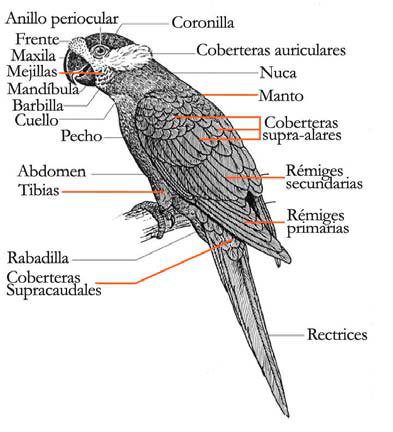
Anatomy-parrots

Description

24 cm.. length and a weight between 70 and 85 gr.

The Pohnpei Lorikeet (Trichoglossus rubiginosus) is unmistakable.

The head and back, dark brown, darker in the head. Scapulars and blankets, are of color Bordeaux dark. The flight feather are blackish in those networks internal and infiltrated with color olivaceous in them vane outer.

The primaries more external are clearly yellow. The bottom of the wings black. The underparts Deep Garnet color, with a black edge in the bottom sides of the edges that draw a bar at the bottom.

The upper part of the tail color is olivaceous, brighter in the vicinity of the tip; lower tail is of color yellow pale. The bill is orange. The irises are yellow-orange, the legs and feet are dark gray.

In the female, the bill seems more yellowish and the irises are greyish white.

In the youth, the feathers seem sharper.

Habitat:

This species is present on the entire surface of the island, until 600 m. It is distributed by a variety of habitats, such as coconut trees, plane trees, dense tropical forests, plots regenerated, forests and mangroves.

The Pohnpei Lorikeet is a bird especially loud, He throws her screams from the roosts after dark. It is fairly easy to detect, Since it wanders in small flocks of February to December in search of food in trees in flower.

It tends to fly high and travel long distances over the ocean.

When fed into the forests of tall trees, usually favors the average vegetation floor.

As the Ponape island receives a large amount of precipitation (until 7600 mm. per year in some places), the Pohnpei Lorikeet seek refuge under the large leaves.

Reproduction:

The Pohnpei Lorikeet It builds its nest on top of a coconut tree or in any cavity of a tree from the forest.
The spawning usually consists of an only egg.
The nesting season generally goes from December to may.

Food:

Consumes nectar, pollen and fruit. While feeding, It tends to keep its head down to pick up their food in the flowers of coconut and banana.
The nectar of Erythrina and the mango is very appreciated by the Pohnpei Lorikeet.

Distribution:

Size of the area of distribution (reproduction / resident): 350 km2

As its name implies, lori this is endemic of the Ponape island, which is the most populated island of the States federate of Micronesia. Formerly, also lived on the atoll of Namoluk about the island of Truk.

It is possible that range was more extensive than it is today.

Conservation:


Near-threatened

– Current IUCN Red List category: Near threatened

– The population trend: Decreasing

This species is listed as near-threatened because it is suspected that their population, which is mostly a subpopulation, It is in decline due to changes in land use. It also has a very small range; But, is unlikely that it is declining, in terms of population, given the adaptability of the species. Neither population is severely fragmented or restricted to a few locations.

Surveys in 1994 suggested that the species had declined a 74-75% Since the beginning of the eighties, probably indicating a decrease in real (Buden 2000). The current population exceeds the 10.000 specimens (Juniper and Parr 1998, M. O'Brien a little. 2011).

In the news, It is the official bird of the State of Pohnpei and your hunting, capture and export is illegal.

"Pohnpei Lorikeet" in captivity:

Is usually not kept out of the Pohnpei island.

Alternative names:

Pohnpei Lorikeet, Pohnpei Lory, Ponape Lorikeet, Ponape Lory, Ponapรฉ lory, Red Lory (ingles).
Loriquet de Panapรฉ, Loriquet de Ponapรฉ (French).
Kirschlori (German).
Loris rubiginosus (Portuguese).
Lori de Ponapรฉ, Tricogloso de Ponapรฉ (espaรฑol).

scientific classification:

Order: Psittaciformes
Family: Psittaculidae
Genus: Trichoglossus
Scientific name: Trichoglossus rubiginosus
Citation: (Bonaparte, 1850)
Protonimo: Chalcopsitta rubiginosa

Images "Pohnpei Lorikeet"


ยซLori de Ponapรฉยป (Trichoglossus rubiginosus)


    Sources:

    Avibase
    – BirdLife.org
    – Parrots of the World – Joseph Forshaw M
    – Parrots-A Guide to the Parrots of the World by Tony Juniper & Mike Parr

    Photos: By Peter – Flickr

    Sounds: Mark Oโ€™Brien (Xeno-canto)

โ–ท The world of Pets: Dogs, cats, birds, reptiles, amphibians

Purple-bellied Lory
Lorius hypoinochrous

Purple-bellied Lory

Content

Description

The Purple-bellied Lory (Lorius hypoinochrous) has an approximate length of 26 cm.. with a weight ranging between 200 and 240 g..

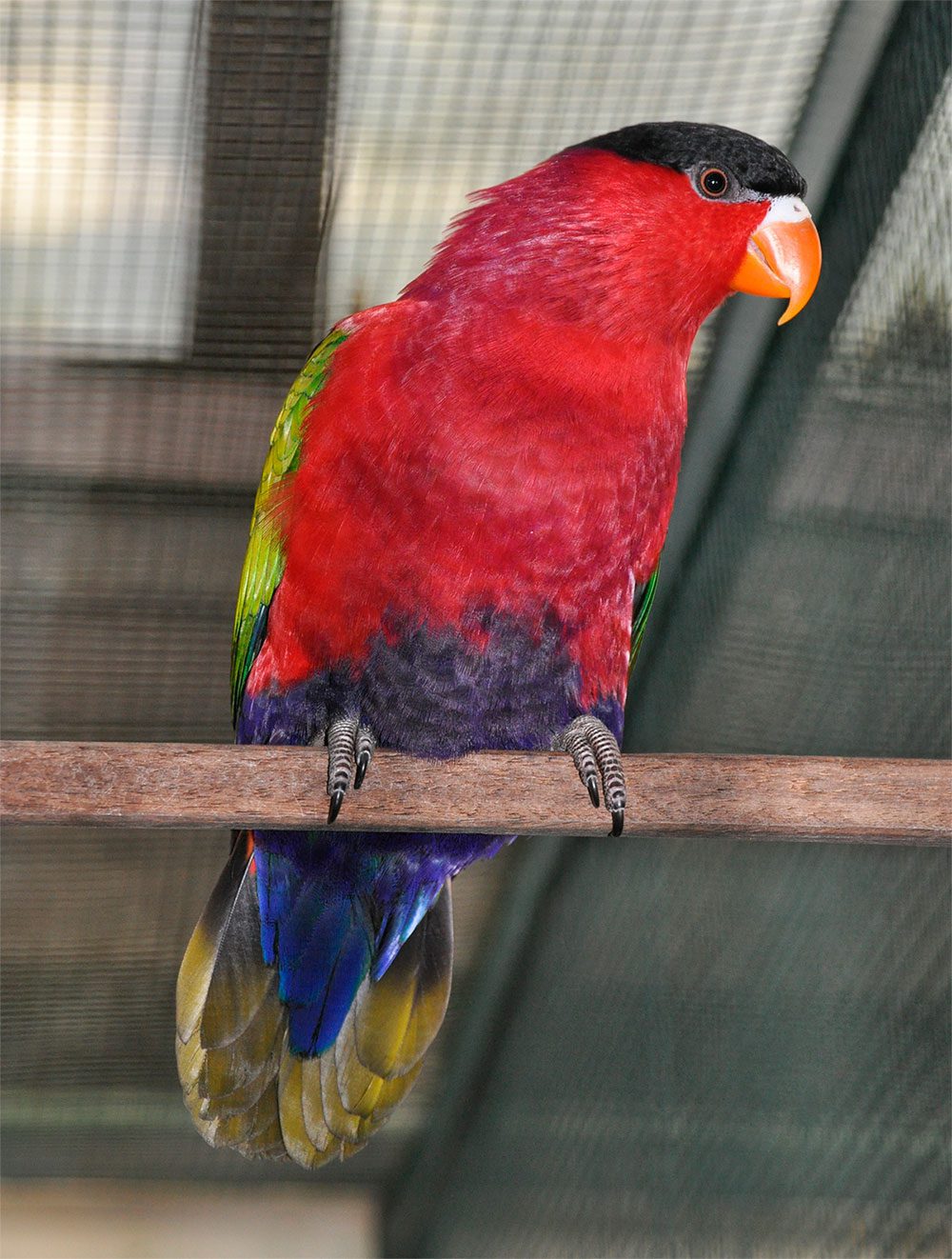
Hood black in color with blue purple sheen extending to the rear of the nape; rest of head red. Upperparts completely red with a band dark variable on the the mantle; upper mantle slightly more purple that the rest of them upperparts.
Primary coverts Bluish; remaining wing Green with the internals of the flight feather in black color. Rojas the wing-coverts with black tips. The flight feather show a large patch yellow in the part internal.

Throat and chest, red, getting more purple towards the top belly; part low belly, the thighs and coverts, dark purple-blue. The parties above of the tail basically red, with the final part in dark blue (appears only teal at rest); undertail, opaque yellow with red hidden base.

Bill orange; cere (waxy soft swelling, containing the nostrils, at the base of the upper beak) white; Iris orange; legs black grey.

There is no significant difference between males and females. In general, the male has a bill a little stronger than the female.

The juveniles has belly pale purple color and peaks are more brownish.

Description 3 subspecies

  • Lorius hypoinochrous devittatus

    (Hartert, 1898) – Differs by the absence of margins black in the large feathers underneath them wings.


  • Lorius hypoinochrous hypoinochrous

    (Gray,GR, 1859) – Nominal.


  • Lorius hypoinochrous rosselianus

    (Rothschild & Hartert, 1918) – Difference with the species rated by the fact of that has the chest the same red that the upper part of the abdomen.

Habitat:

Unlike in the Black-capped Lory, often found in coconut, mangroves and coastal vegetation (especially fond of coconut flowers); the Purple-bellied Lory also frequents low forests, the edges of these, high secondary forests, inhabited or partially cleared areas and gardens. Found individually, in pairs or in small groups of up to 10-20 birds. Ruidoso, visible and Active, they often live in trees or just above the canopy.

In the Island of Papua, they are distributed by the lowlands and foothills, in New Britain up to at least 450 m, in New Ireland until 750 m (where is sympathetic with the White-naped Lory) and up 1.600 metres in the Goodenough island.

Virtually nothing is known of the reproductive ecology of this species., Although is has been able to observe to them males in a, apparent, participation in the cortejo, with repetitive stretching of the neck and movements side of the head.

Reproduction:

Due to its extreme rarity, We know little about their reproductive behavior.
It is likely to be very similar to the of the Black-capped Lory (Lorius lory). This means a spawning two eggs and a incubation period of about 26 days.

Food:

The Purple-bellied Lory It feeds mainly in the canopy in noisy groups. Its diet natural consists of pollen, nectar, flowers, fruits, insects and their larvae, and probably seeds.
Usually see, sometimes, feeding is in company of the Sulphur-crested cockatoo and the Eclectus Parrot.

Distribution:

Size of the area of distribution (reproduction / resident): 61.900 km2

Endemic of the southeast of Papua New Guinea and surrounding island groups. On the island it reaches West, from Lae in the Huon Gulf to the North to Cape Rodney in the South. Is distributed in the islands of the archipelagos of D'Entrecasteaux and Louisiade, including (Goodenough, Fergusson, Normanby, Bentley, Misima Island, Tagula and Rossel, Islands Trobriands, Woodlark and Islands of the Bismarck Archipelago, including Umboi, Sakar, New Britain, New Ireland, Witu, Lolobau, Uatom, New Hanover, Tabar and Lihir.

common and locally abundant. World's largest population of 50.000 birds.

Distribution 3 subspecies

Conservation:


minor concern


โ€ข Current IUCN Red List category: Least concern

โ€ข Population trend: Stable

The world population It has not been quantified, but the species appears to be common and abundant throughout its area of distribution.

Justification of the trend

Suspected that the population is stable in the absence of evidence of declines or substantial threats.

"Purple-bellied Lory" in captivity:

Extremely rare.

Alternative names:

Purple-bellied Lory, Eastern Black-capped Lory, Purple bellied Lory, Stresemann’s Lory (ingles).
Lori ร  ventre violet, Lori de Louisiade (French).
SchwarzsteiรŸlori, Louisiadenlori (German).
Loris Hypoinochrous (Portuguese).
Lori Ventrivinoso, Tricogloso de Streseman, Tricogloso de Vientre Pรบrpura (espaรฑol).

scientific classification:

Order: Psittaciformes
Family: Psittaculidae
Genus: Lorius
Scientific name: Lorius hypoinochrous
Citation: Gray,GR, 1859
Protonimo: Lorius hypoinochrous

Images "Ventrivinous Lori":

————————————————————————————————

"Ventrivinous Lori" (Lorius hypoinochrous)


Sources:

Avibase
– Parrots of the World โ€“ Forshaw Joseph M
– Parrots A Guide to the Parrots of the World – Tony Juniper & Mike Parr
– Birdlife

Photos:

1 – ยซLorius hypoinochrous qtl1ยป by QuartlOwn work. Licensed under CC BY-SA 3.0 via Wikimedia Commons.
2 – Animal Photos – Enlace
3 – parrots-pictures
4 – by Bilder von Marion – papageien.org
5 – Free pet wallpapers – link

Sounds: Frank Lambert (Xeno-canto)

โ–ท The world of Pets: Dogs, cats, birds, reptiles, amphibians

Josephine's Lorikeet
Charmosyna josefinae


Josephine's Lorikeet

Content

Lori-of-Josefina drawing

Description

24 cm.. length and an approximate weight of 68 g..

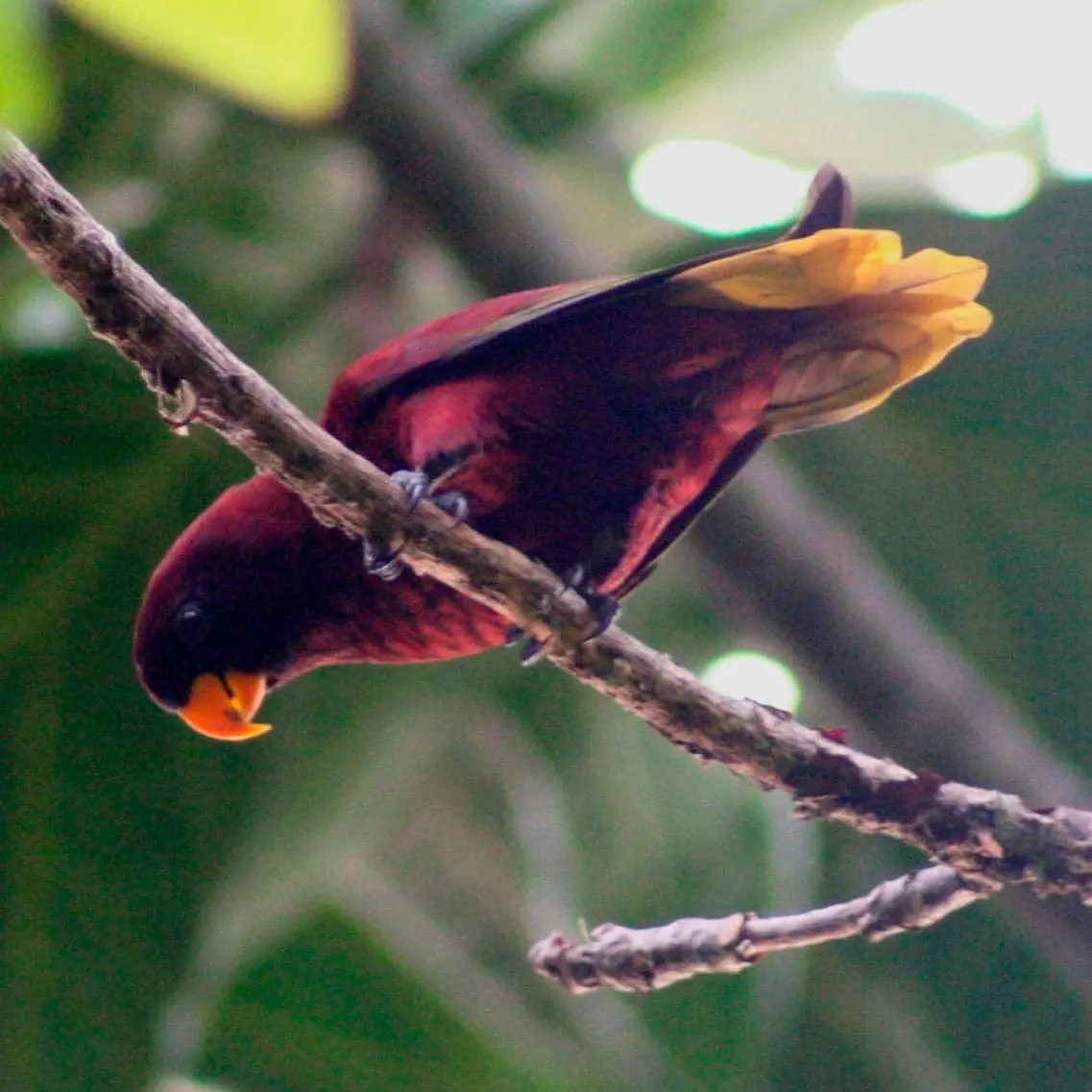
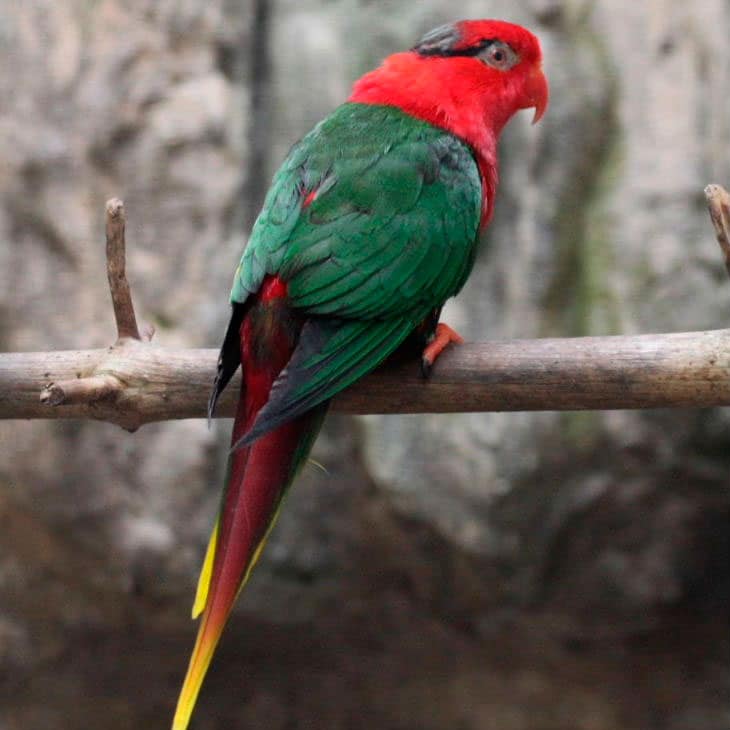
The head of the Josephine's Lorikeet (Charmosyna josefinae) it is red in color with a conspicuous black patch extending from the back of the crown to the nape and in a transverse line to the eyes; back of the Crown is marked with purple stripes; large red necklace. Mantle and scapulars Green; bottom of the Red back: rump with a central patch of dark blue; views from the top, the coverts of the tail of blue to red. The wings, from above, green with vane internal greyish towards flight feathers; marginal coverts Green. View from below, the coverts of Red Wings. Red underparts with a purplish-black spot in the center of the belly, that extends to the flanks on the thighs; seen from below, tail-coats are red. From above, the tail shows red with yellow tip and green color side feathers; from below, the tail is yellow. The peak, orange red; iris yellow ; orange-yellow legs.

The female It shows the lower part of the back of yellow, tending to green on the rump.

The immature with impregnated in green belly patch, and bluish black thighs. The blue rump patch impregnated in green. Makes color lilac in the back of the Crown replaced by blue-green color marks.

Immature females It shows the low back of red with some yellow marks.

Subspecies description

  • Charmosyna josefinae josefinae

    : The nominal.


  • Charmosyna josefinae sepikiana

    : It differs from the nominal value by having more extensive black belly patch and more grey marks on the back of the Crown. Females lack of greenish broadcasting on the flanks and in the low back.


  • Charmosyna josefinae cyclopum

    : Differs from the nominal value by the absence of black belly patch and the practical absence of grisaceo-azul in the back color of the Crown marks.

Habitat:

Possibly Nomad. Frequents montane forests, edges of forests and partially cleared areas, mainly between 760 and 2.200 meters and more common between 850 and 1.200 meters although there have been up to at sea level. Usually seen in pairs or small groups. Despite their striking coloration, is quite discreet. Feeds in the tops of trees in flower, flowering vines or plants epiphytes, often with him Fairy Lorikeet.

Reproduction:

Nesting and breeding to be described.

Food:

Diet includes pollen, nectar, flower buds and soft fruits.

Distribution:

New Guinea in Irian Java (Indonesian) and Papua New Guinea, mainly in the Western and central cordillera, Since the Mountains Parotia and Vogelkop, to the Bismarck range in the Northeast (Jimi and also Baiyer River). There has been since Jayapura, on the North coast of Irian Java, and come to the South of Mount Bosavi, Papua New Guinea.

Subspecies distribution:

  • Charmosyna josefinae josefinae

    : The nominal.


  • Charmosyna josefinae sepikiana

    : Mountains of the region of Sepik, Papua New Guinea and in the Highlands of the West to the East until approximately the area of the jimi river and to the South of Mount Bosavi


  • Charmosyna josefinae cyclopum

    : Cyclops ranges.

Conservation:


minor concern

โ€ข Current IUCN Red List category: Least concern.

โ€ข Population trend: Stable.

The world's population has not been quantified, but it is thought that it may be above the 300.000 specimens.

A small number in captivity.

The population is suspected to be stable in the absence of evidence of any reduction or substantial threats.

"Josephine's Lorikeet" in captivity:

Take it easy, but at the lively and active time. Some new birds may initially be nervous. Young birds, in particular, curious and playful. Aggressive toward other birds. Susceptible to stress and disease during the acclimatization. Strict hygiene necessary due to a mainly liquid diet.

Alternative names:

Josephine’s Lorikeet, Josephine’s Lory (ingles).
Lori de Josephine, Lori de Josรฉphine (French).
Josefinenlori (German).
Lori de Josefina (espaรฑol).

scientific classification:

Order: Psittaciformes
Family: Psittaculidae
Scientific name: Charmosyna josefinae
Genus: Charmosyna
Citation: (Finsch, 1873)
Protonimo: Trichoglossus Josefinae

ยซLori de Josefinยป images:

————————————————————————————————

ยซLori de Josefinaยป (Charmosyna josefinae)


Sources:

Avibase
– Parrots of the World โ€“ Forshaw Joseph M
– Parrots A Guide to the Parrots of the World – Tony Juniper & Mike Parr
– Birdlife

Photos:

1 – danskloriklub.dk
2 – By Drรคgus (Own work) [Public domain], via Wikimedia Commons
3 – By Katerina Tvardikova – Photo of Charmosyna josefinae [By Drรคgus (Own work) [Public domain], via Wikimedia Commons] – Charmosyna josefinae
4 – papageien.org
5 – animalphotos.me
6 – Dibujo by HBW.com

Sounds: BAS van Balen (Xeno-canto)