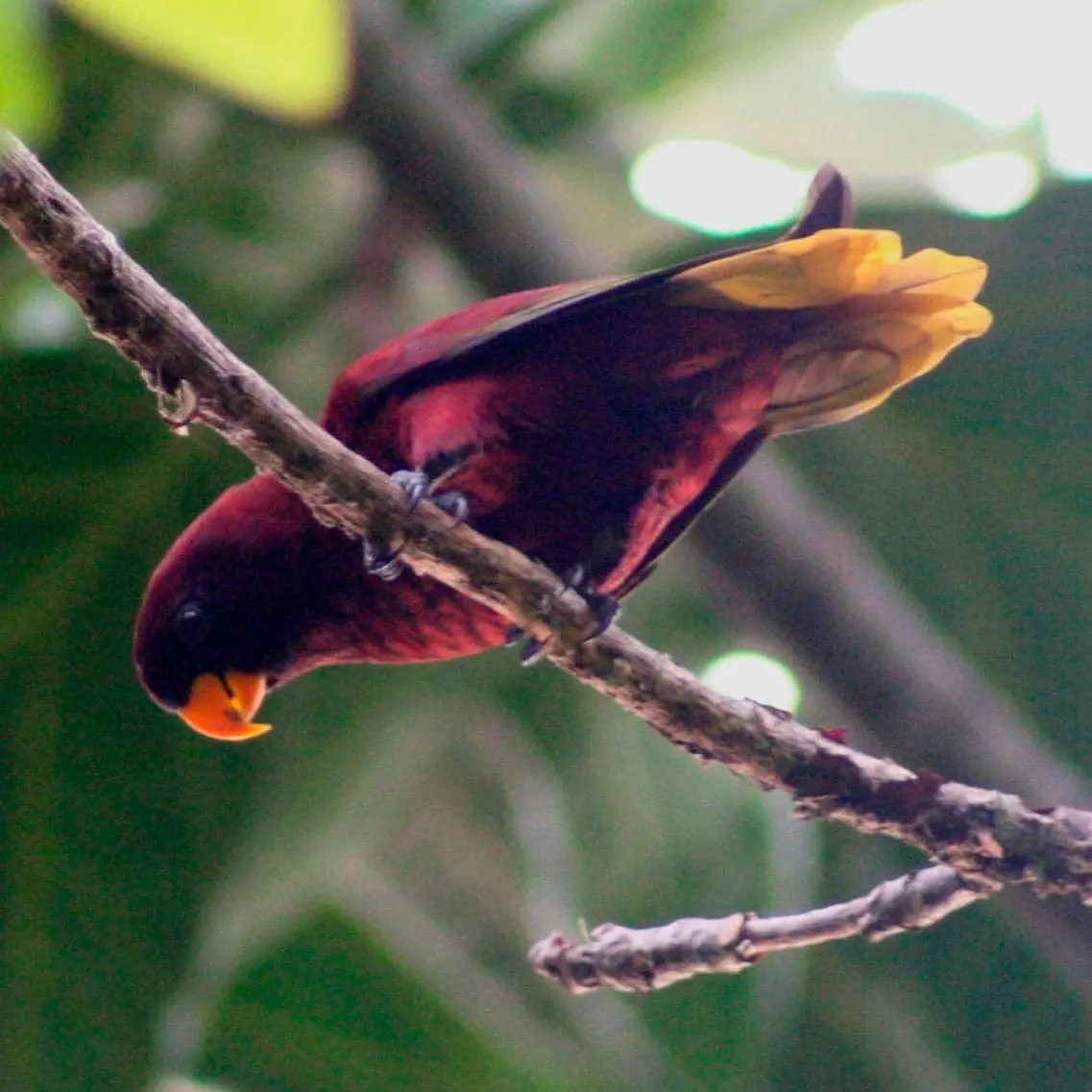
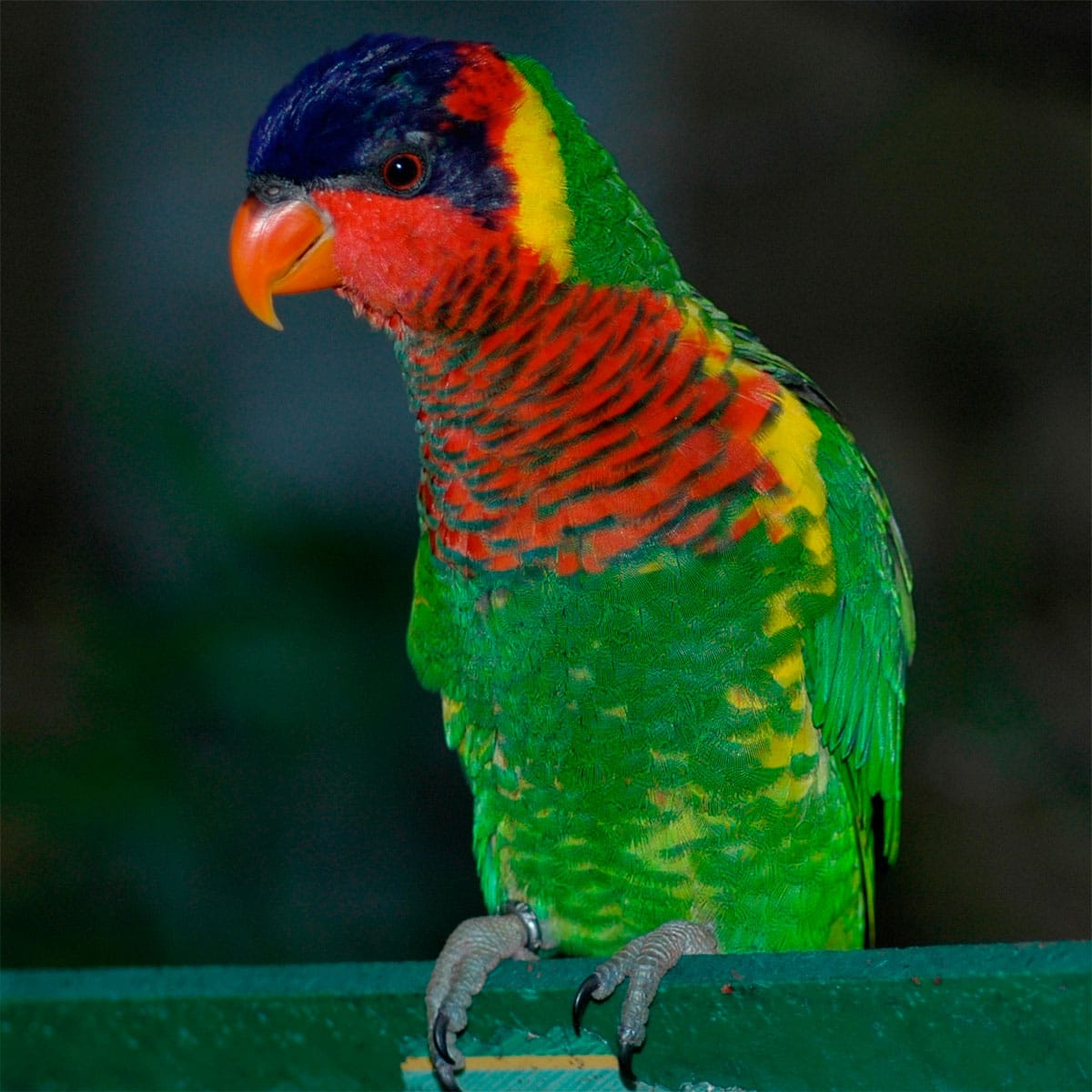
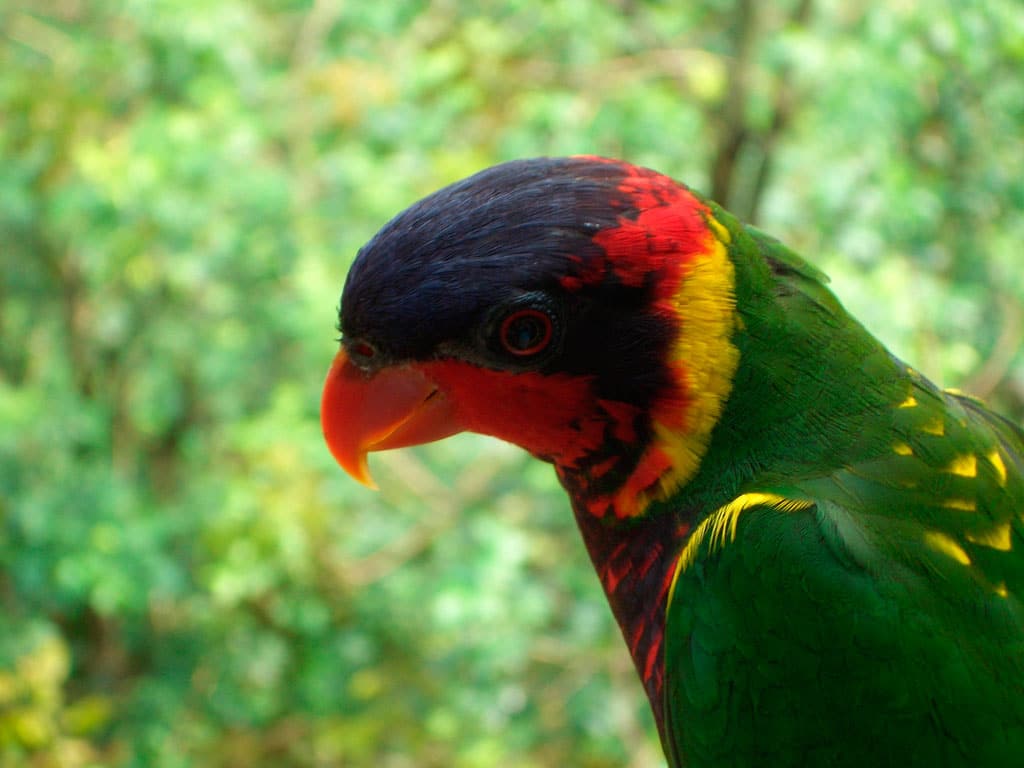
The general plumage of the Ornate Lory (Trichoglossus ornatus) is green. The front, the head and feathers that cover the ears are blue. It has a small red stripe that goes from the upper right corner of the eye to the nape of the neck, It also has a yellow stripe on the sides of the neck. The throat and chest are orange-red and in each pen has a bluish-black wide table. Underwing feathers are yellow.
The rest of the bottom is green with yellowish scales.
Belly pale green with dark green bars. Green-yellow under the tail is bright green ends. The upper part of the tail is dark green with yellow edges in outer feathers. The base of the outer tail feathers is pink.
The circle around the eyes is narrow and dark gray. The iris is red, the legs are grey and orange beaks.
The Ornate Lory they usually visit the swamps and marshy woodlands where there is fresh water. They are also found in the forest, the plots during the regeneration near the edges, scattered shrubs in cropland, including coconut plantations.
Usually, They appreciate the open areas and do not venture far from the primary forests.
In the North and center of the main island, These birds live from sea level up to the 1.000 meters above the sea level, While in the South, You can climb up to the 1.500 m. Its preferred habitat is between 300 and 500 m.
The Ornate Lory They mainly live in pairs or in small groups. Sometimes, when feeding in fruit trees or at the edges of the forest, are associated with the Yellow-and-green Lorikeet (Trichoglossus flavoviridis).
Benefiting from stable climate, These birds are probably sedentary.
Reproduction:
We really know very little about the reproductive habits of this species in the wild.
Most of the birds are able to breed in the months of September and October. There is no information on the construction and composition of the nest.
Spawning usually consists of 3 eggs that are incubated during 27 days. The chicks are nidicolous and depend on their parents during 80 days after hatching.
Food:
The Ornate Lory they are vegetarian birds, most of its menu is made up of nectar, pollen and fruit. When feed, these birds may concentrate in large numbers on flowering trees. The seeds of the trees of the genus Tectona and Casuarina they are also part of their diet.
Distribution:
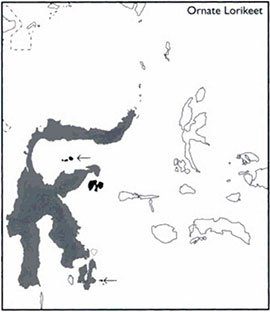
This species is endemic to Indonesia , where is widespread in Sulawesi and surrounds the coast islands including Togian, Peleng, Banggai and the archipelago Tukang Besi. It has been reported that it is no longer common in parts of northern and central Sulawesi, but still seems to be common on the islands Togian and in the lowland forest in Torout (Bogani Nani NP) and to a lesser extent in Tangkoko.
Conservation:
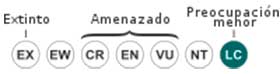
– Current IUCN Red List category: Least concern
– The population trend: Decreasing
It has been described as common and locally very common., with a total population of over of 50.000 specimens.
The trend has not been quantified, but slow descents can be seen due to some pressure from capture, and although it does not require primary forest it is more common in the lowlands and therefore may be affected by habitat loss.
It seems that the Ornate Lory is trapped in national parks as Tangkoko and Lore Lindu, and they are commonly seen in bird markets.
"Ornate Lory" in captivity:
Due to its state of decline in its population, any specimen that can not be returned to their natural habitat (natural range) should preferably be placed in a well-managed breeding program to ensure the survival of the species.
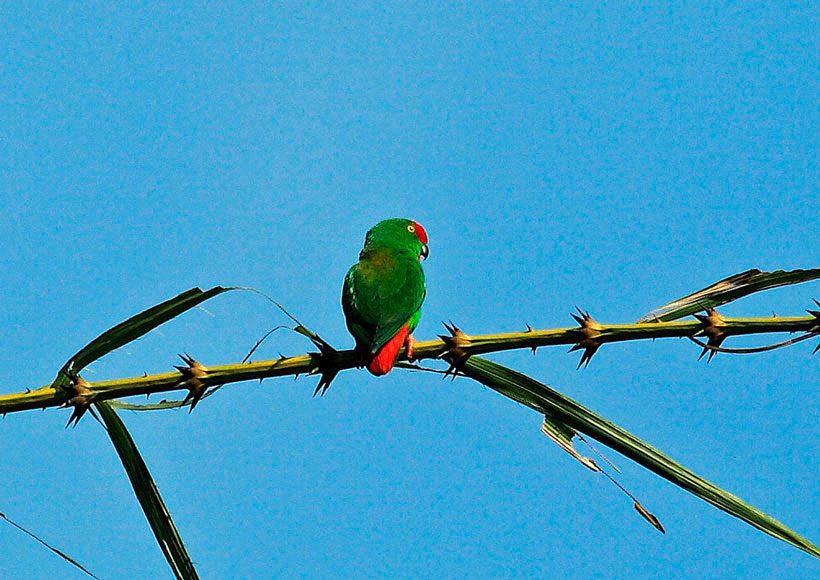
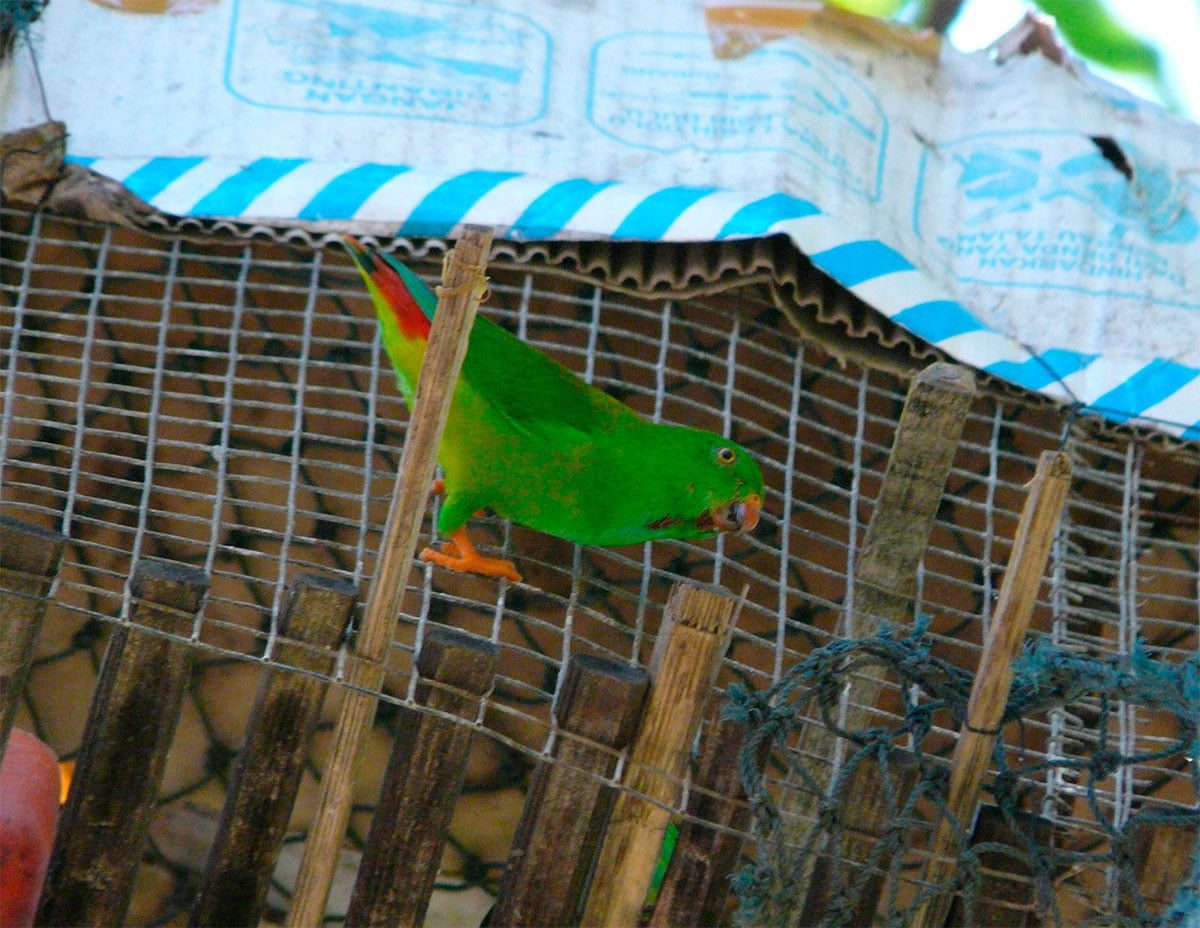
The head of the Pygmy hanging parrot(Loriculus exilis) is green, brighter around the base of the bill and bathed in bluish green at the chin, the throat, the cheeks and the part front of it crown.
The underparts is green, with the rump and uppertail-coverts dark red (very extended below the tail); the sides and the base of the rump are greenish-yellow. Wings green. Under, the wings Turquoise with coverts green. Throat of color red bordered of blue pale and extending is about part superior of the chest; rest of the underparts green, slightly more clear that the upperparts. The tail, at the top, Green with yellowish tips; undertail, the tail is of a pale color green blue.
The bill coral red; irises yellow; legs oranges.
The females lack of the bib red (or have very small bib). Also have a reduced blue diffusion in the chest and irises brown.
The young birds they have a bib Red small, a bill yellowish brown, and a pale brown iris.
Usually little-known. It is distributed by forests, coastal mangroves, around the villages and in the open field, from the lowlands to the wooded hills to some 1.000 m, altitudes and in similar habitats to the of the Great hanging parrot.
The birds are found in groups of up to five copies, feeding in the canopy of figs or the trees in flower nectar; their power moves have been compared with the movements of crawling in the Pygmy Parrot Micropsitta. Larger flocks have been found in the mangroves during may, Although the species can reproduce twice a year, in February and August; it is not known if these represent post-breeding concentrations or nomadic groups.
Reproduction:
A hole in a dead palm tree is the only known record of a zone of nesting.
Food:
Feeds of figs or nectar.
Distribution:
Size of the area of distribution (reproduction / resident): 103.000 km2
The size of the world population It has not been quantified, Although it is estimated at more than 10.000 specimens. The species is described as uncommon and rare.
There are no data on trends in the population, but the species is suspected to be decreasing at a moderately fast pace, due to degradation of the habitat.
– Avibase
– Parrots of the World – Forshaw Joseph M
– Parrots A Guide to the Parrots of the World – Tony Juniper & Mike Parr
– Birdlife
– Photos:
(1) – By Peter Waanders – Caged female has attracted wild male. lynx
(2) – Loriculus exilis by John Gerrard Keulemans [Public domain], via Wikimedia Commons
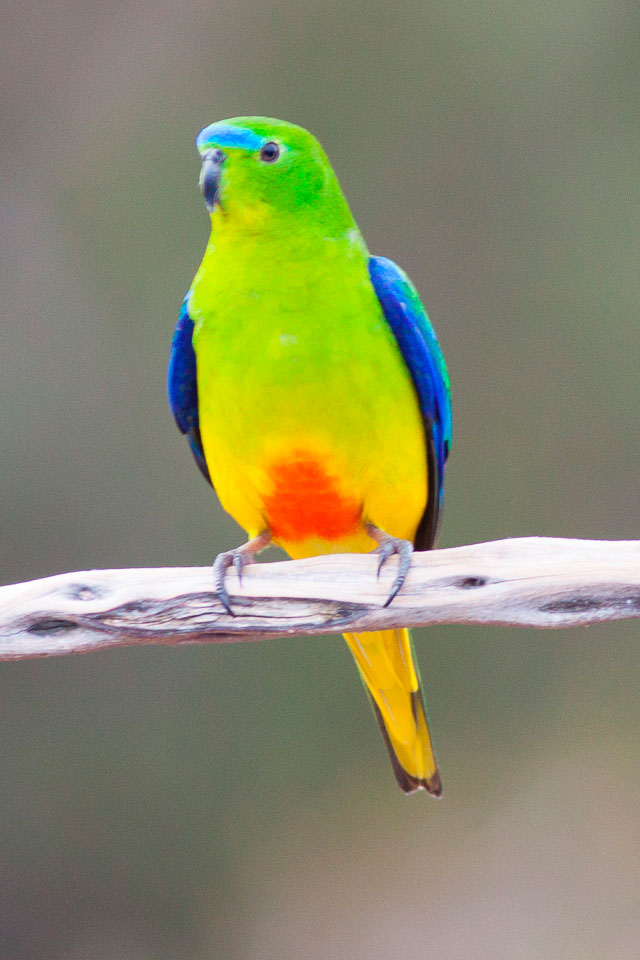
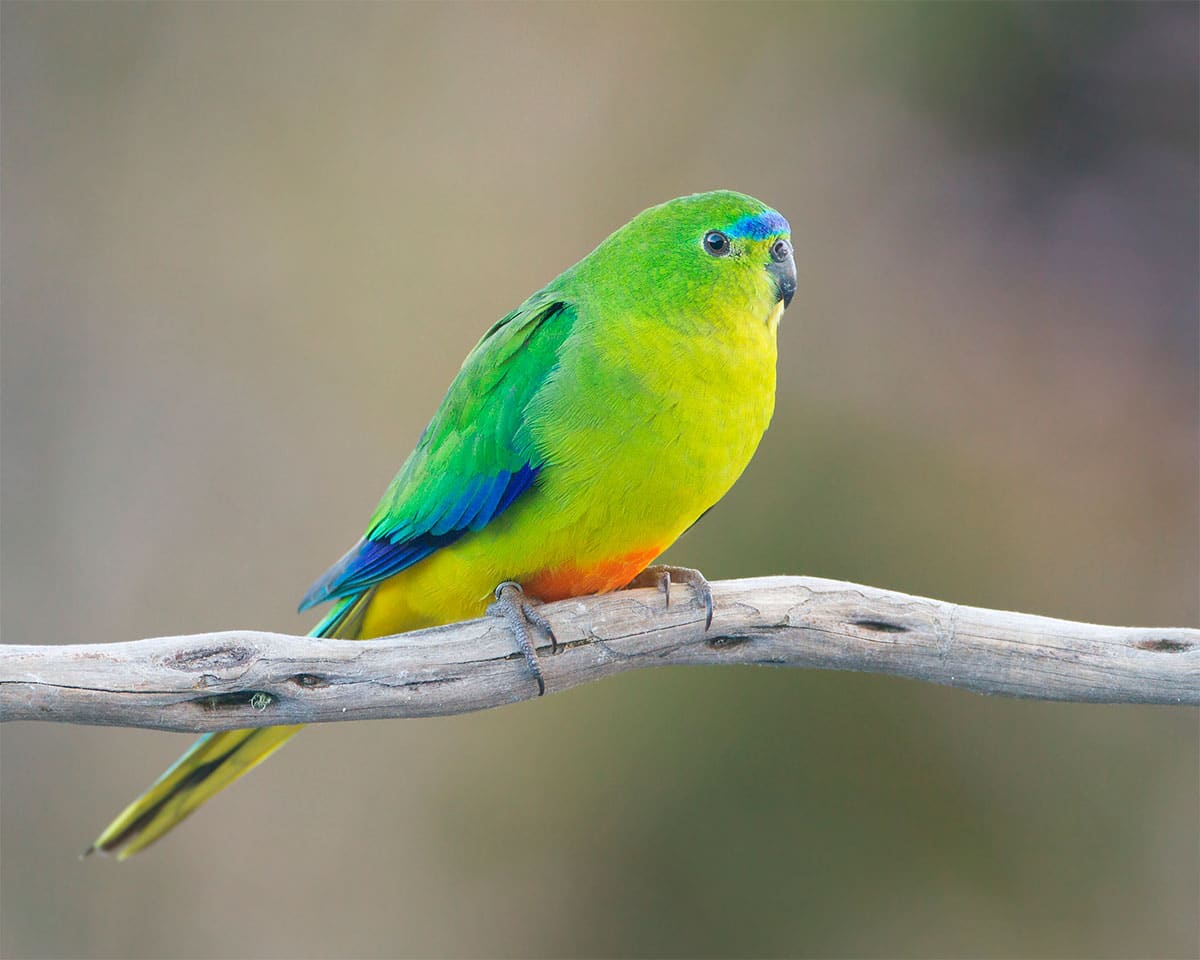
The Orange-bellied Parrot(Neophema chrysogaster) is a small ‘Grass parakeet‘, so called for spending a lot of time on the ground feeding on seeds and grasses.
adults have, approximately, 21 cm length and a weight of around of 45 to 50 g..
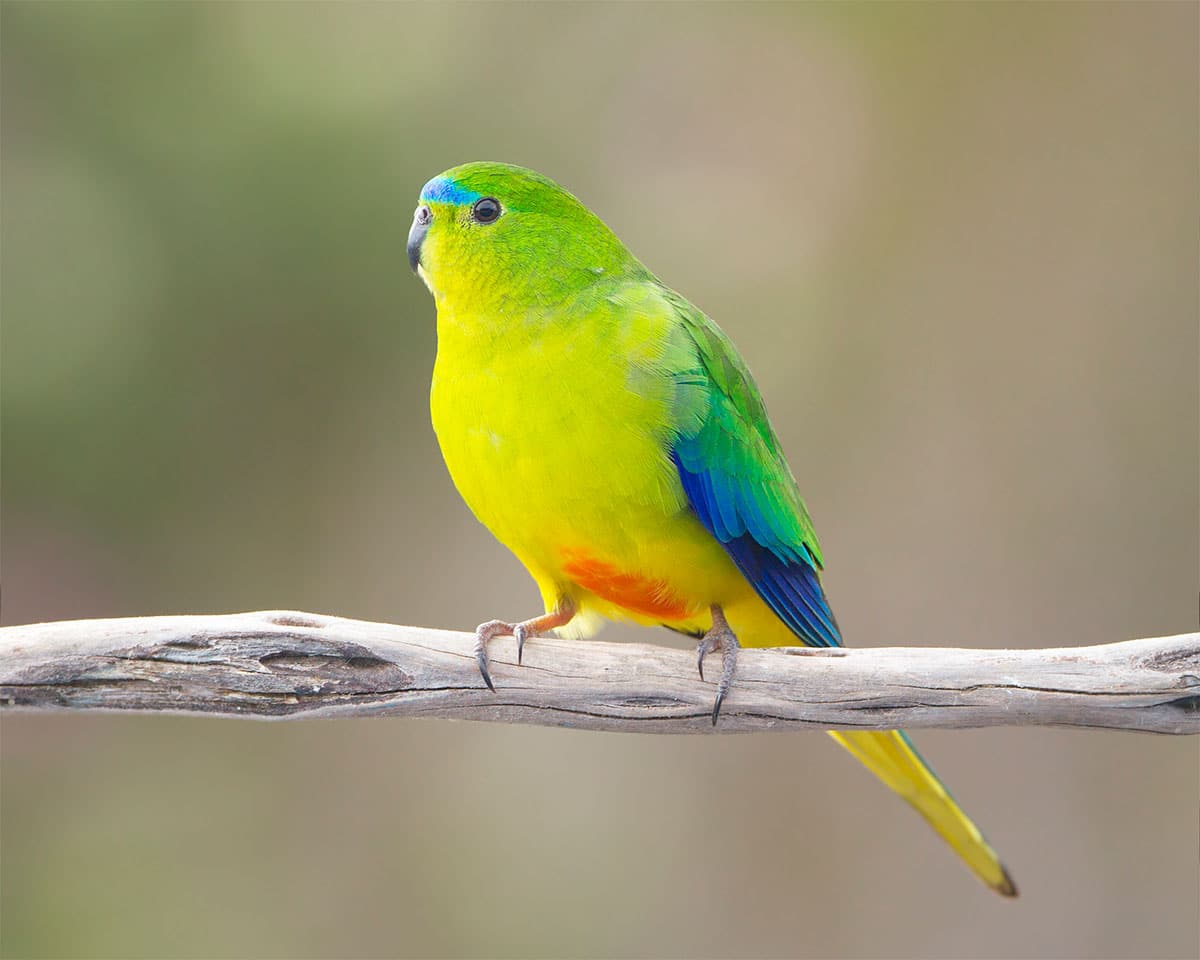
Has the crown, the nape and the the mantle bright green, with one frontal band dark blue and a lighter blue later point that does not extend beyond the eyes.
Face and lores are yellowish-green. You have a few different bands in the wings Green and blue colors, the vane inmates of the wing-coverts are green, the blue outer.
The primary coverts are dark blue. The primary feathers Black has the outside edges with fine violet blue and yellow. The secondaries has a green border.
The underparts is blue. The chest Green is mixed with the greenish yellow color under the tail. The belly is very stained Orange. The top of queue is green with blue tip. The lateral tail feathers they are yellow with blue-green bases.
Peak and iris are black, the legs are grey.
The female is more off than the male, the frontal band has a single tone. The stain ventral Orange is smaller.
Between the juveniles, the frontal band is barely visible. The Wing band is very prominent and the bill is pale.
As one migratory species, its habitat varies throughout the year, with the birds that live in the marshes, coastal dunes, pastures, scrub, estuaries, Islands, beaches and Moors generally within the 10 km of distance from shore.
There is practically no records more towards the inside of 5 km and most are within 2 km from the coast. The holes of mature eucalyptus, as the Smithton Peppermint (Eucalyptus nitida) and the Swamp gum (Eucalyptus ovata), they are used by the Orange-bellied Parrot for the nesting during the breeding season in Tasmania, and breeding habitat is a mosaic of moorland and reed-covered land, dominated by the Button Gras (Gymnoschoenus sphaerocephalus) and forests.
The behavior of foraging species are usually characterized by the power in the suelor or in low vegetation, in general a less than 1 m above ground.
The birds they feed usually in pairs or individually during the breeding season, and in small herds of variable size in non-breeding season. Solitary birds often have been feeding with other species, especially with the Blue-winged Parrot (Neophema chrysostoma).
Reproduction:
In Tasmania, the only breeding place, spawning takes place in the months of November and December.
The nest of the Orange-bellied Parrot is located in natural cavities, between the 8 and 25 meters of height in eucalyptus (Eucalyptus nitida) and less frequently, in the (Eucalyptus ovata). The nest is sometimes maintained during several consecutive years. The marital ties they are strong and sometimes last a lifetime.
The spawning included among 3 and 6 eggs they are incubated during 21 days. Young people are altricial and remain in the nest for at least 5 weeks.
Food:
Initially, on Spring, the Orange-bellied Parrot they feed on plants. They mostly eat seed Sedge (Reedy) and parts of the herbs of the genus Boronia or Actinotus.
At the beginning of Winter, the regime being vegetarian, suffering some transformations. the Orange-bellied Parrot consume algae in decomposition, seeds and herbs Poaceae and Halophyte, that is to say, you adapt to saline environments, as the Rock Samphire (A maritime rhythm).
The goosefoot )Chenopodium) and Salt plants (Atriplex) also classic in their food. Introduced plants such as the Sea rocket (Cakile maritima) they are also popular.
Distribution:
Tamaño del área de distribución (reproducción/residente) 3.100 km2
They migrate across Islands in the West of the bass strait (mainly King Island) towards the coast South of Australia, to Hibernate from the months of March to July, mainly along the coasts of the Bahía Port Phillip, Victoria (largest number of birds in Point Wilson and Swan Island, including the Queenscliffe Golf Course). They also overwinter in small numbers., from Gippsland, Victoria, to the West of the Coorong, Southern Australia. Occasionally occur during winter in areas of Tasmania and surrounding islands, as well as other individuals spend the summer on the mainland.
Every summer around 40 couples are reproduced, and an analysis of nine nests showed an average offspring of 1,7 pups per pair. The post-breeding population increased by about 50 individuals, of around 170 birds, but the population is becoming increasingly smaller, which suggests a high annual mortality. Adults begin to leave the breeding area in February and fly across the coast of Tasmania, crossing the bass strait, mainly through King Island (also records in the Hunter Croup) towards the coast of the Southeast of Australia (young birds usually travel a month later).
The Orange-bellied Parrot They tend to move around the continent, and are in the South of Australia at the end of winter. They return to breed in the months of September and October, they usually travel directly back to their breeding grounds. Since 1979 to 1990, the wintering population has remained relatively stable, with a count of 67 to 126 individuals registered every year (with a maximum of 50% of the world's population known with presence in Point Wilson).
In the last century the species flying in flocks of thousands of individuals (and raised as far East as Sydney up to approximately 1907). Wintering habitat loss and capture for the bird trade are cited as factors in its decline.
Possible winter habitat loss remains a threat, as does competition from introduced herbivores, the disturbance, and the possibility of exploration and exploitation of minerals. A detailed recovery plan includes the management of winter habitat with the exclusion of grazing animals, the diversion of economic activity and the development of Murtcaim Wildlife Management Area about Point Wilson. Captive-bred birds have been released and mixed with wild individuals.
Conservation:
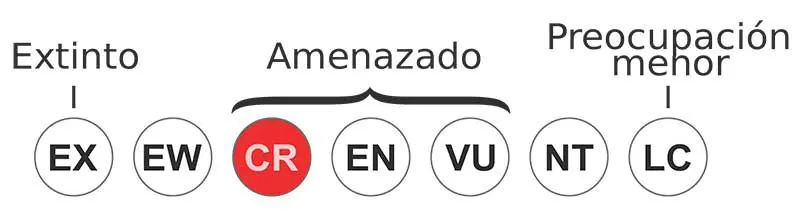
• Current category of the Red List of the UICN: Critically Endangered
• Population Trend: Decreasing
The Orange-bellied Parrot It has a very low population size. This very low population size is even more significant, given that the species migrates through of the Bass Strait, with which this species is subjected to the additional risk by stormy phenomena on their migratory journey.
Has a restricted geographic range when breeding, and apparently a limited supply of food during migration and winter.
The species is found in a single population of between 100 and 150 mature individuals. Habitat loss, fragmentation and modification, particularly on the migration route and in the wintering areas, they are the key threats to the survival of the species.
For a small population, stochastic factors, as the disease, storms during the migratory species, and the destruction of nests by forest fires have the potential to reduce the survival of the species in the long term.
The Orange-bellied Parrot It has a restricted geographical distribution which is precarious for its survival.
The Scientific Committee of Threatened Species considers that the Orange-bellied Parrot has suffered a historic decline since European colonization. It is considered, In addition, that the recent recovery actions that have been implemented are having a beneficial impact on the species and the possibility of future stability in the reproduction sites is becoming apparent. But, as the population of the Orange-bellied Parrot is so low, the data that we have are based on a small area of occupancy and it is likely that this species continue suffering from a series of threats in course, with what the Committee may not be sufficiently secure that available information indicate that the population is stable and safe.
Future declines in population are still likely as a result of potential threats, especially the stochastic and genetic threats to small populations are likely and that can lead to the extinction.
"Orange-bellied Parrot" in captivity:
The Orange-bellied Parrot is very rare in captivity and is, probably, more present in the hands of European collections. There are also some captive birds by some fans in Australia, to the South of the continent.
Fifteen years ago in South Australia, under expert supervision, were built cages with the aim of raising these birds and avoid that the Orange-bellied Parrot disappeared completely. In the early years, most of the young people died from diseases of the beak and feathers (PBFD), a viral disease (virus BFD). Similarly, cold winters in this region, where was launched the project, they had a negative effect on the end result.
Once the aviaries were displaced to areas more temperate and increased its amount, the result is improved and each year dozens of parrots have been released into the wild.
The Orange-bellied Parrot they are birds calm, peaceful and little noisy. They belong to the less active within the genre of the kind Neophema, so tend to the Obesity. These birds spend much time ashore. Usually, bathe once a day, in long baths. Reproduce well in captivity. They are exceptionally susceptible to various infections, including the intestinal parasites. These birds also, often, they die without apparent reason.
Parrots A Guide to the Parrots of the World – Tony Juniper & Mike Parr
Ministry of the environment – Australia – Environment Protection and Biodiversity Conservation Act 1999 (EPBC Act)
Birdlife
Photos:
(1) – Orange-bellied Parrot (Neophema chrysogaster) male, Melaleuca, Southwest Conservation Area, Tasmania, Australia By JJ Harrison (jjharrison89@facebook.com) (Own work) [CC BY-SA 3.0], via Wikimedia Commons
(2) – Orange-bellied Parrot (Neophema chrysogaster) female, Melaleuca, Southwest Conservation Area, Tasmania, Australia By JJ Harrison (jjharrison89@facebook.com) (Own work) [CC BY-SA 3.0], via Wikimedia Commons
(3) – Orange-bellied Parrot (Neophema chrysogaster) Melaleuca,Tasmania by Ron Knight – Flickr
(4) – Orange-bellied parrot, Neophema chrysogaster, photographed at Tasmania, Australia – Image: David Boyle/National Geographic [velociraptorize]
(5) – Photo: Justin McManus
(6) – John Latham – Allen, ELSA G. (1951) The History of American Ornithology before Audubon. Transactions of the American Philosophical Society, New be. 41(3):387-591. See page for author [Public domain], via Wikimedia Commons
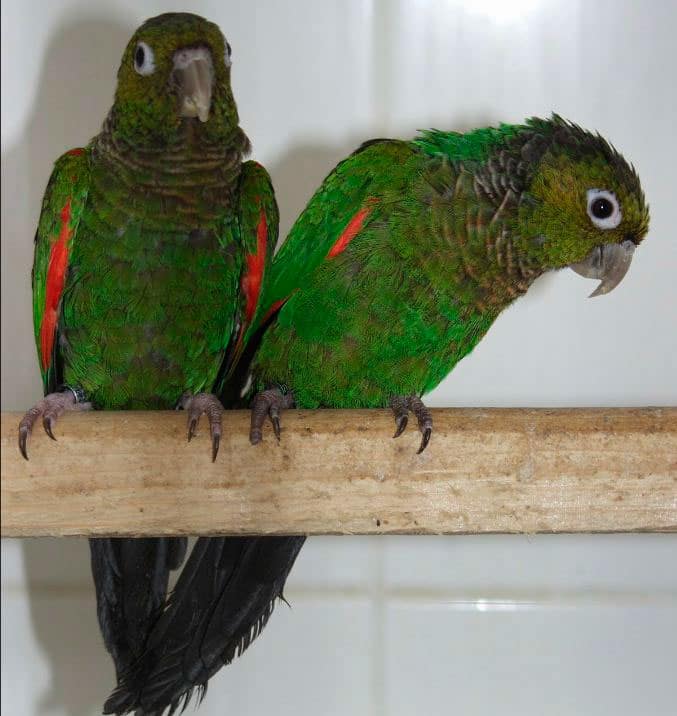
The Maroon-tailed Parakeet(Pyrrhura melanura) is distinguishable mainly by the tail and wings blackish (visible in flight); has the lores, the forecrown, the crown and the rear area of the neck, brownish, with paler reddish brown tips on the crown, forming altogether a speckled pattern; cheeks, ear-coverts and area behind the eyes, green; Brown in the shadows at the back of the crown Green in the nape.
Upperparts Green with tinge of olive in some feathers. Primary coverts Red with yellow tips; Front edge of the wing
, red; upperwing-coverts of color green with dye olive. Primaries Dark greenish blue with dark tips. Underwing-coverts green; underside of flight feather blackish. Throat and feathers of the upper part of the chest, Green or greyish green with pale margins, giving a scaly striking effect; pale edges that become less clear on the sides of the neck; the belly and undertail-coverts Green with dye olive dark. Upper, the tail dark brown with green outer feathers; undertail, the tail shiny black.
Bill pale grey; bare periophthalmic naked, whitish: irises dark brown; legs grey.
Both sexes similar. The immature has less red (greener) in the primary coverts.
(Salvadori, 1891) – Similar to the Pyrrhura melanura souancei, but with even broader and paler margins on the breast feathers (Some birds of Ecuador with almost entirely white breasts), less red on the front edge of the wing
and more pronounced brown patch in the belly. Cheeks dyed with color olive, Red uniform at the edge of the carpus; abdomen more uniform brown/red color.
Pyrrhura melanura chapmani
(Bond & Meyer de Schauensee, 1940) – With suspiciously in the chest more width, No yellow in the wing
; yellowish in the area of the ear and the green of the tail darker.
(Chapman, 1915) – More dark, No yellow in the wing
, grey around the eye, tail more short and reddish.
Pyrrhura melanura souancei
(Verreaux,J, 1858) – With the edge top of the wing
Red and not yellow; Green in the base of the tail more extensive and chest with scaled a little more width.
Habitat:
The Maroon-tailed Parakeet It occupies the temperate tropical formations, including forests of várzea, forests of land low and pre-montanos rainforests and forests cloud, often in areas partially cleared and edges of secondary forests; 150 - 300m in Venezuela (nominal), to 3,200 m in the slopes Andean Eastern (souancei), 1.600-2.800m on the slope of the Andes central (chapmani), at 1,700 m in Nariño (Pacifica), at 1500m (berlepschi). Usually in flocks of 6-12 individuals, staying in them cups of them trees to rest but moving is toward the branches more low for forage.
Reproduction:
Little information about breeding, observed during the months of April-June, headers of the Napo River, Ecuador. Copulation observed in January (Colombia). Clutch four eggs in captivity.
Food:
Few details about the diet, with foods known, including fruits of Miconia tkeaezans (Top of the Magdalena valley). Fagara tachuelo and tree bark (Amazonia).
Distribution:
Size of the area of distribution (reproduction / resident): 1.510.000 km2
The distribution of the Maroon-tailed Parakeet is discontinuous. Northwest of South America in the Western Amazon basin, southern portion of the the Orinoco basin and slope of the peaceful of the Andes, in the southwest of Colombia and West Ecuador.
In Venezuela the species is found in the Centre of the South of Bolívar along the upper Western Amazon basin of Brazil between the riversNegro and Solimões. They are also distributed in Andes Central of Colombia, at the top of the Magdalena valley, from the South of Tolimauntil Huilaand separated to the East from the Andes (in lowlands and up to 500 m in foothills) Since the Macarena mountains, southward through eastern lowlands Ecuador and Northeast and East of Peru.
A separate population is distributed to the West of the Andes, in the Northwest of the South of Ecuador, to the North of The rivers, with a single log in nose, to the southwest of Colombia.
Mainly resident Although the apparent absence during some seasons in some parts of Colombia suggests regular movements.
Unevenly distributed, in some areas very common, being the Parrot more numerous in some parts of the range such as high Magdalena valley and perhaps parts of Esmeraldas in the Northwest of Ecuador.
Alleged decrease in some areas (for example, Pacific slope of Ecuador) due to loss of habitat. Little known in the East of Peru. Not a locally popular cage bird if it has been traded internationally in significant numbers in late 1980 and fairly well known in captivity outside of its area of distribution.
Subspecies distribution
Subspecies distribution
Pyrrhura melanura berlepschi
(Salvadori, 1891) – Valley of Huallaga, is of Peru and Southeast of Ecuador on Cutucú mountain range. A specimen with characteristics of this species was observed at the head of the Magdalena valley suggesting their distribution in Colombia.
(Chapman, 1915) – Northwest of Ecuador and southwest of Colombia.
Pyrrhura melanura souancei
(Verreaux,J, 1858) – It is from Colombia since the Sierra de la Macarena Southwest, until Putumayo through the East of Ecuador, possibly up to the north end of Peru. Probably bordered on the eastern slopes of the Andes and mostly replaced by the nominal species in lowlands.
Conservation:
• Current category of the Red List of the UICN: Least concern.
• Population trend: Decreasing.
Justification of the population
The population size world has not been quantified, but this species is described as «quite common» (Stotz et to the., 1996).
Justification of trend
This species is suspected that he has been able to lose 6,95 to 7,1% of a habitat within its distribution over three generations (18 years) based on a deforestation model of the Amazon (Soares-Filho et to the., 2006, Bird et to the. 2011). Given the susceptibility of the species to the cazay and/or the capture, It is suspected that will decrease in <25% durante tres generaciones.
"Maroon-tailed Parakeet" in captivity:
Ave shy and quiet, get used to people over time. Colonies in large birdcages are possible.
Alternative names:
– Maroon-tailed Parakeet, Magdalena Parakeet, Maroon tailed Parakeet, Maroon-tailed Conure, Black-tailed Conure (English).
– Conure de Souancé, Perriche de Souancé, Perruche de Souancé (French).
– Braunschwanzsittich, Braunschwanz-Sittich (German).
– tiriba-fura-mata (Portuguese).
– Cotorra Colinegra, Perico de Cola Negra, Periquito Colirrojo (español).
– Periquito Colirrojo (Colombia).
– Periquito Colirrojo (Peru).
– Perico Cola Negra (Venezuela).
Of 35 cm.. height and a weight between 400 and 500 g..
The Mascarene parrot †(Mascarinus mascarin) It was a bird dark grayish brown on top, lighter at the bottom; the the tail feathers They were brown with white bases; head lavender gray; lores and area around the bill black. had the bill bright red. The legs They were reddish brown and eyes red.
taxonomy:
A genetic study of 2011 He placed the Mascarene Parrot of Meeting between subspecies of Black Parrot (Coracopsis nigra) of Madagascar and nearby islands, and therefore would not be related to the parrots of Psittacula as believed. It was found that the lineage of Mascarene Parrot It separated made between 4,6 and 9 millions of years, before the formation of the isla Meeting, indicating that it must have happened somewhere else
Habitat:
Nothing is known, although it is likely to be distributed in uninhabited forests where feed on fruits and nuts.
Reproduction:
No data.
Food:
Probably fruits and nuts.
Distribution:
The Mascarene Parrot It was described by many early travelers to Reunion Island (in France), with several captive birds sent to France at the end of the 18th century.
The last accounts of wild birds were from the 1980s. 1770, and the birds were not mentioned by Bory a 1804, so the species may well have been extinct in the wild by then. captive birds in Paris they would also have died at that time, but one bird survived in the collection of birds king Bavaria at least 1834 (checks 1987). Two specimens survive today (Forshaw and Cooper 1989)
Conservation:
• Current category of the Red List of the UICN: Extinct.
• Population size : There are none.
Rationale for the Red List category
This species was known from the Réunion, but it has been extinguished by the hunting pressure. The last record of wild birds dates from 1775, and none was observed on a visit in 1804.
Justification of the population
There are none.
Threats
It is likely to have been hunted to extinction.
"Mascarene parrot †" in captivity:
Several captive birds sent to France at the end of the 18th century.
Alternative names:
– Mascarene Parrot, Mascarine Parrot (English).
– Mascarin de la Réunion, Mascarin malgache (French).
– Maskarenenpapagei, Maskarenen-Papagei (German).
– Papagaio-das-mascarenas (Portuguese).
– Loro de las Mascareñas, Loro Mascarín (español).
The Pohnpei Lorikeet(Trichoglossus rubiginosus) is unmistakable.
The head and back, dark brown, darker in the head. Scapulars and blankets, are of color Bordeaux dark. The flight feather are blackish in those networks internal and infiltrated with color olivaceous in them vane outer.
The primaries more external are clearly yellow. The bottom of the wings black. The underparts Deep Garnet color, with a black edge in the bottom sides of the edges that draw a bar at the bottom.
The upper part of the tail color is olivaceous, brighter in the vicinity of the tip; lower tail is of color yellow pale. The bill is orange. The irises are yellow-orange, the legs and feet are dark gray.
In the female, the bill seems more yellowish and the irises are greyish white.
This species is present on the entire surface of the island, until 600 m. It is distributed by a variety of habitats, such as coconut trees, plane trees, dense tropical forests, plots regenerated, forests and mangroves.
The Pohnpei Lorikeet is a bird especially loud, He throws her screams from the roosts after dark. It is fairly easy to detect, Since it wanders in small flocks of February to December in search of food in trees in flower.
It tends to fly high and travel long distances over the ocean.
When fed into the forests of tall trees, usually favors the average vegetation floor.
As the Ponape island receives a large amount of precipitation (until 7600 mm. per year in some places), the Pohnpei Lorikeet seek refuge under the large leaves.
Reproduction:
The Pohnpei Lorikeet It builds its nest on top of a coconut tree or in any cavity of a tree from the forest.
The spawning usually consists of an only egg.
The nesting season generally goes from December to may.
Food:
Consumes nectar, pollen and fruit. While feeding, It tends to keep its head down to pick up their food in the flowers of coconut and banana.
The nectar of Erythrina and the mango is very appreciated by the Pohnpei Lorikeet.
Distribution:
Size of the area of distribution (reproduction / resident): 350 km2
As its name implies, lori this is endemic of the Ponape island, which is the most populated island of the States federate of Micronesia. Formerly, also lived on the atoll of Namoluk about the island of Truk.
It is possible that range was more extensive than it is today.
Conservation:
– Current IUCN Red List category: Near threatened
– The population trend: Decreasing
This species is listed as near-threatened because it is suspected that their population, which is mostly a subpopulation, It is in decline due to changes in land use. It also has a very small range; But, is unlikely that it is declining, in terms of population, given the adaptability of the species. Neither population is severely fragmented or restricted to a few locations.
Surveys in 1994 suggested that the species had declined a 74-75% Since the beginning of the eighties, probably indicating a decrease in real (Buden 2000). The current population exceeds the 10.000 specimens (Juniper and Parr 1998, M. O'Brien a little. 2011).
In the news, It is the official bird of the State of Pohnpei and your hunting, capture and export is illegal.
The Moluccan hanging parrot (Loriculus amabilis)(Loriculus amabilis) has the head of color green with the front of the crown red. The the mantle slightly tinted Orange; rump and uppertail-coverts dark red. The latter extends almost to the tip of the tail. Wings green; Red and yellow mark in the carpus. Under, the wings blue with coverts greenish blue. Chin red; rest of the underparts more green yellowish to them upperparts, especially the coverts at the bottom of the tail. The tail, at the top, green, by down Bluestone with fine yellowish tips.
The bill black; irises yellowish white; legs oranges.
Female with the crown green, red dots on the forecrown and throat. Iris brown.
The young birds with trademark yellow around the bib, and at the edge of the carpus. Iris pale brown.
It is distributed by primary and secondary forests, in the lowlands until 800 m, along the edges of forests, in the mangroves and the casuarinas coastal, on the edges of agricultural land, around the villages and occasionally in forests of coconut trees.
The species is observed more frequently in solitary, in pairs or in small groups in the vicinity of the trees in flower.
Reproduction:
Little is known of the habits of nesting, only periods of courtship have been recorded.
Food:
Their natural diet consists of nectar, fruit, outbreaks, flowers and seeds.
Distribution:
Size of the area of distribution (reproduction / resident) 23.000 km2
Endemic to Indonesian, where are distributed by the islands off the northeast of Sulawesi including the archipelagos of the Banggai (Peleng. Labobo) and Sula (Seho, Taliabu, Mangole, Sulabesi), and in the North of Moluccas in Kasiruta, Bacan, Halmahera andMorotai.
In the Sula Islands It is rare, its population is probably around of 5.000 birds due to habitat loss. The status of the species in Banggai and Peleng It is insufficiently known.
Conservation:
• Current IUCN Red List category: Least concern
• Population trend: Stable
The size of the world population It has not been quantified, Although it is believed that it is superior to the 20.000. specimens. The species is described as moderately common, although rarer in primary forest and common in secondary forest (pit et to the. 1997).
The population is suspected to be stable in the absence of evidence of any reduction or substantial threats, Although slightly affected by trade.
"Moluccan hanging parrot" in captivity:
Unknown.
Alternative names:
– Moluccan Hanging-Parrot, Halmahera Hanging-Parrot, Moluccan Hanging Parrot, Wallace’s Hanging-Parrot (ingles).
– Coryllis des Moluques, Coryllis des Moluques (nominal), Coryllis des Moluques (nominale), Coryllis des Moluques (race nominale) (French).
– Zierpapageichen (German).
– Loriculus amabilis (Portuguese).
– Lorículo Amable (español).
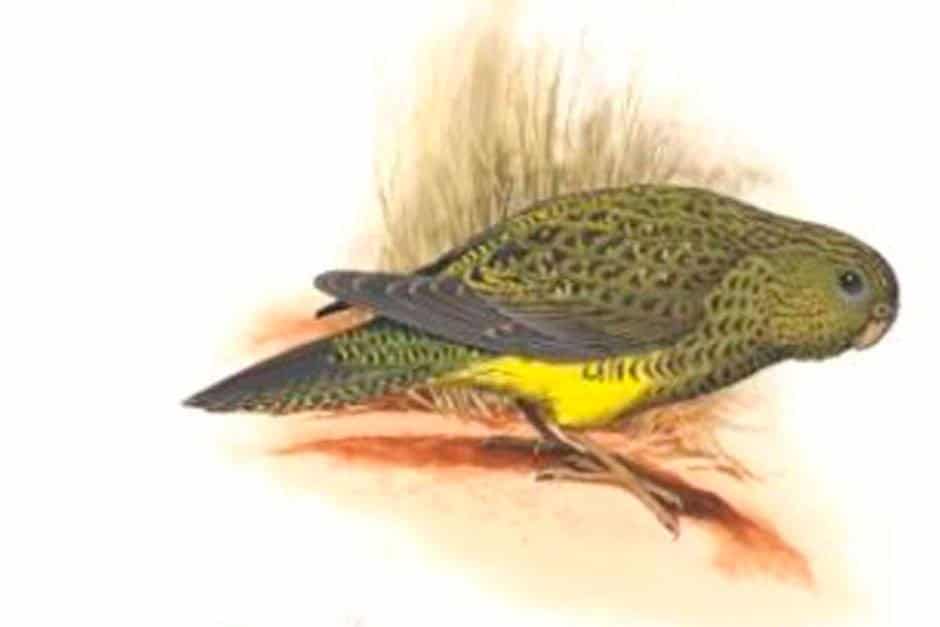
The Night Parrot(Pezoporus occidentalis) It is one of the most elusive and mysterious world of birds.
They have a bill plane, similar to the of the Kakapo (Strigops habroptila), without the apparent hook of the upper jaw. They have feathers around the cere. The tail is short. The legs are relatively elongated, indicating its good predispositions to walk.
The male and female they are similar.
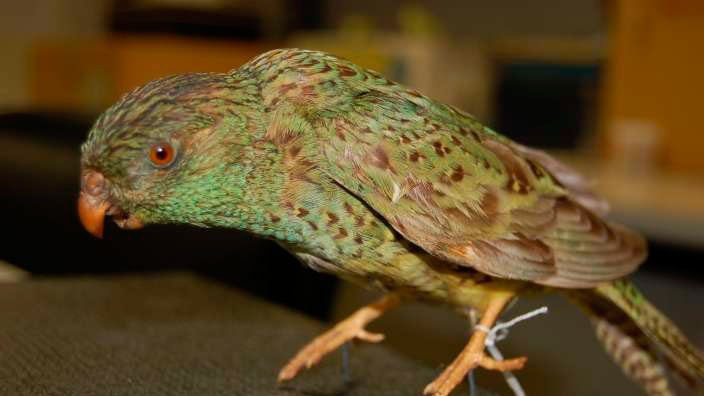
In adults, the upperparts they are generally yellowish-green with dark brown cryptic spots, black and yellow. The front of the neck is greenish yellow. The chest and flanks they have discreet black and yellow stripes. Belly and coats are bright yellow. The flight feather are pale yellow, forming a thin stripe on the lower part of the wing. The central tail feathers are green with a strong yellowish brown shade. The bill is grey-brown, black eyes. Legs long claws dark grey.
In the wild, the Night Parrot It can be confused with the kakapo Parrot, If not we are looking too details which differentiates them.
Habitat:
The Night Parrot It attends a wide variety of habitats in arid or semi-arid land. They are mainly in places where the herbs grow in clumps on rocky peaks, also in the steppes composed of thickets of quenopodios. They also feel a great attraction for the Rock Samphire (A maritime rhythm), plants that are highly resistant to drought and salt.
They are known to flee to the interior areas of Muehlenbeckia, which have a dense foliage. The most recent reports do not come from the areas of Spinifex. It seems that new techniques of fire used to create firewall, They allow you to create favourable conditions for this parakeet.
The night Parrot almost never fly, except when looking for sources of water. To observe them, What has become extremely rare, We must look to the ground, in areas which consists almost exclusively of grasses of the genus Spinifex.
after dark, They fly a short distance until they find a fresh water pond. Once he has satisfied his thirst, they return to the infeed zone.
There is no certainty about the movements of this parakeet. It can be nomadic, Perhaps sedentary. No doubt depend on the climate and territory who attends them. Formerly, when the number of Night Parrot were still substantial, stocks were fluctuating seasonally.
At the end of the 19th century, in Southern Australia, groups of fifteen individuals were local irruptions, a signal that were sensitive to the favorable climatic conditions or were found in the alternative storage sites whose resources were relatively abundant.
All these considerations must be taken with great moderation for the following reason: the well-established notion that birds move through the Plains Spinifex in the direction of places full of thickets of quenopodios according to seasons and seed resources, not always been confirmed in recent reports.
Reproduction:
We know very little about the reproductive habits of this bird. The season of nesting is in July or August. The nest It is a kind of platform built with pieces of wood, on the ground or at low altitude. It is placed in a cavity that has been enlarged and which is accessed by a tunnel whose entrance is in a tuft of grass.. Its diameter is of some 8 centimeters. According to the previous data, the spawning usually contains 4 or 5 eggs. The time of incubation It is unknown.
Food:
The Night Parrot mainly consumed seeds of Spinifex (Triodia). Recent and circumstantial reports, indicate also the absorption of deciduous plants family leaves Poaceae as Enneapogon purpurascens.
Distribution:
Size of the area of distribution (reproduction / resident): 26.300 km2
There is a report of 1913 that places them around Murrayville and Cowangie, Victoria, and another around of Ross Springs between 1954 and 1959. There is also a register of 1.897 that placed them in District of Oxleand, New South Wales.
The species has never been common, but it was more frequently toward the end of the last century (for example, 16 sightings in the region of the Lake Eyre, Southern Australia, in the decade of 1870). Due to marauding habits, many sightings remain unconfirmed, and this makes it difficult to assess its true condition. Even so, It seems certain that the population is declining. The cause of this is unknown, but it may be related to the introduction of predators such as cats, Rats, dogs or foxes. Changes in fire regimes, as well as the introduction of camels, they have also influenced its decline.
The Night Parrot seen only as museum specimens for 25 are not extinct. To cat-killed Night Parrot was recovered recently in western Queensland, Australia. (South Australian Museum)
There have been reports in every decade since its discovery, and all states in recent years, except Victoria (the last record was in 1950). The most notable recent sighting was of four birds in the eastern side of the cooper river, to 8 km to the East of the Lake Perigundi, Northeast of Southern Australia, in June of 1979. The birds were arrebolados in tangled shrubs, Sclerolaena intricata and flew away before perederse in the dense forests of Muehlenbeckia florulenta. In 1990 a long dead individual, It was the first specimen in a Museum from the Decade of 1880, was collected in the southwest of Queensland,to 36 km to the North of Boulia. A more recent record of these birds (between March of 1992 and June of 1993) He was picked up in the South of Cloncurry, about 150 km to the North of the area where the dead bird was found, which confirms the local persistence of this species.
The global population is unknown, but it can be very small and is likely to be declining. There are none in captivity.
The Night Parrot has been the subject of a legal protection in Australia since 1937.
Conservation:
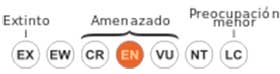
• Current category of the Red List of the UICN: Danger
• Population trend: Decreasing
After no record is confirmed from 1990, despite several exhaustive searches and publicity campaigns, This species was rediscovered in 2005 in the region of Pilbara in Western Australia, and a dead juvenile was found in the Diamantina National Park, Queensland in 2006.
It is likely that they have decreased as a result of a series of threats, and the remaining population can be very small and possibly subject to extreme fluctuations.
Based on the records of 2005 and 2006, and because of the shortage of sightings, a Committee of experts concluded that the species was in danger of extinction.
The population of the Night Parrot is supposed to be very small, and is estimated at less of 50 mature individuals based on the scarcity of records. In 2010 a Committee of experts re-evaluó given records of Western Australia in 2005 and Queensland in 2006, and estimated that there could be 50 to 250 birds in total (Garnett et to the. 2011). Therefore, the number of mature individuals is placed in the band of 50-249, but it can become something bigger.
The population It is suspected that it may be in decline due to a combination of threats, including predation by invasive exotic predators.
If a population can be located, the following measures could be introduced:
• a research and monitoring program
• control of wild animals in and around the place where the population of the Night Parrot
• patch burning to limit the possibility, or to prevent the occurrence of fire in the place of the population until better understanding of the situation and the ecological needs of the population
• minimize disturbance to the population site, which could include leaking information to the public, and the establishment of agreements with landowners and land managers.
• establish a captive breeding program (Blyth 1996; Garnett and Crowley 2000).
Parrots A Guide to the Parrots of the World – Tony Juniper & Mike Parr
Birdlife
Night parakeet photos:
(1) – 1971 painting of a night parrot by William Cooper – Enlace
(2) – The Night Parrot seen only as museum specimens for 25 are not extinct. To cat-killed Night Parrot was recovered recently in western Queensland, Australia. (South Australian Museum) – Top Birding Tours





 Captive Management Using Biological Data