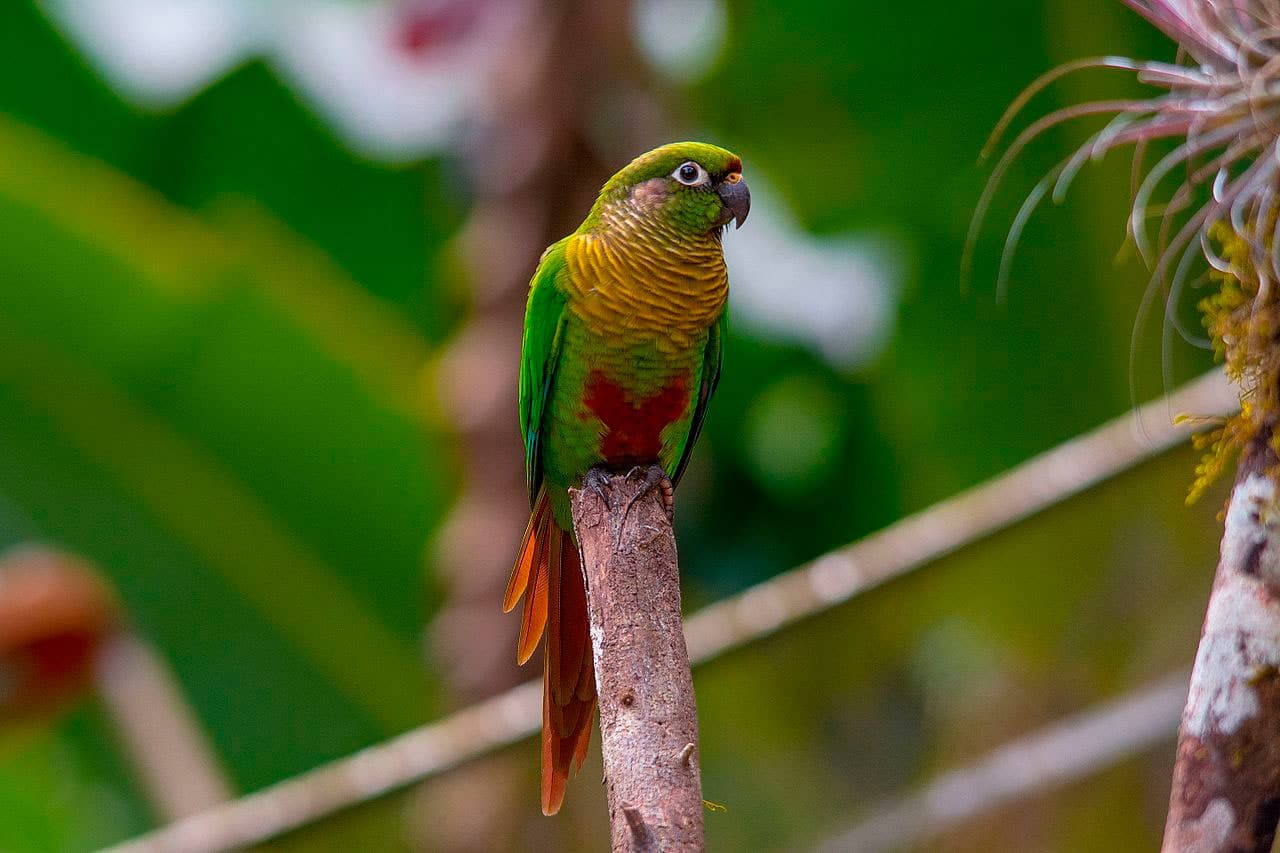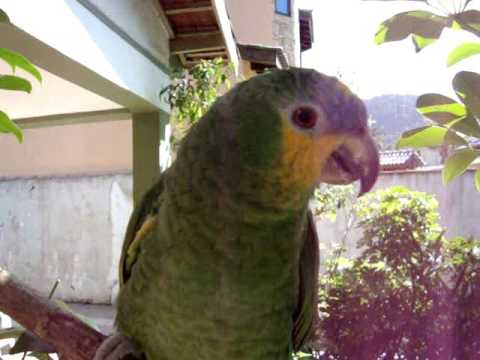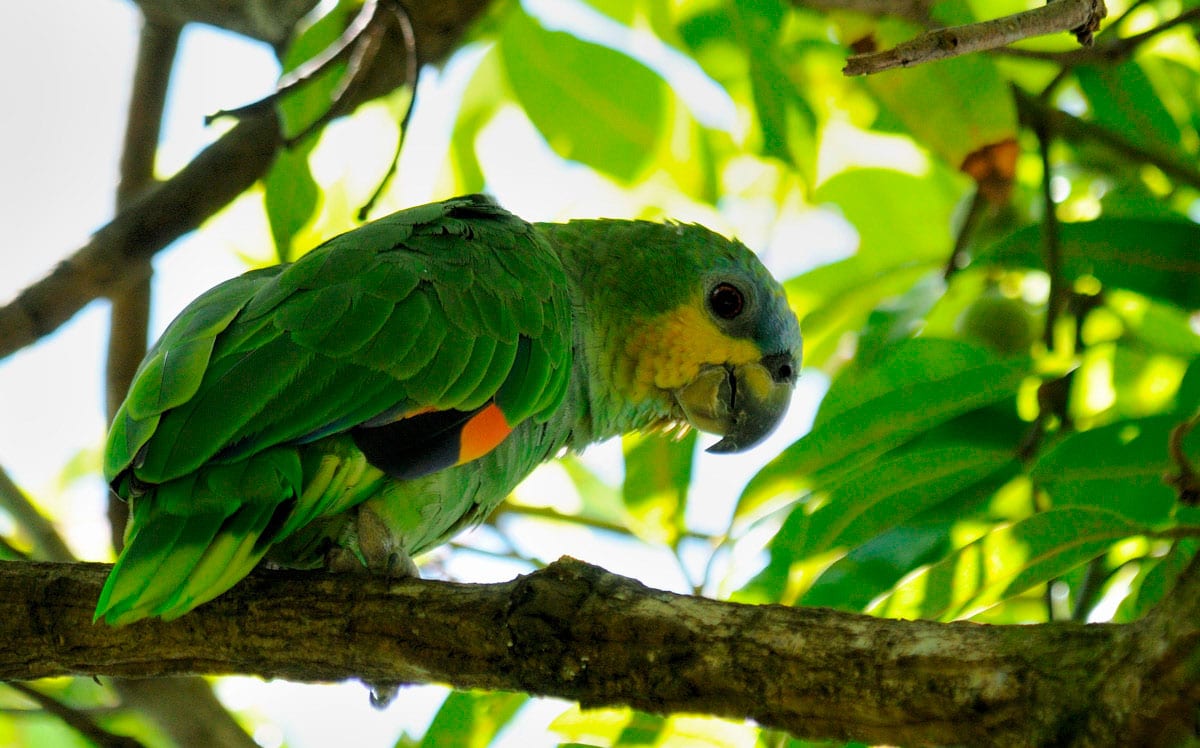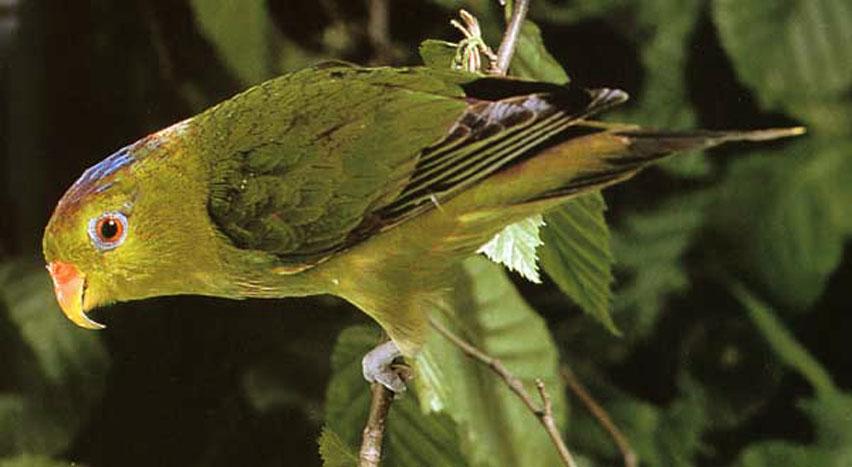
โ–ท The world of Pets: Dogs, cats, birds, reptiles, amphibians

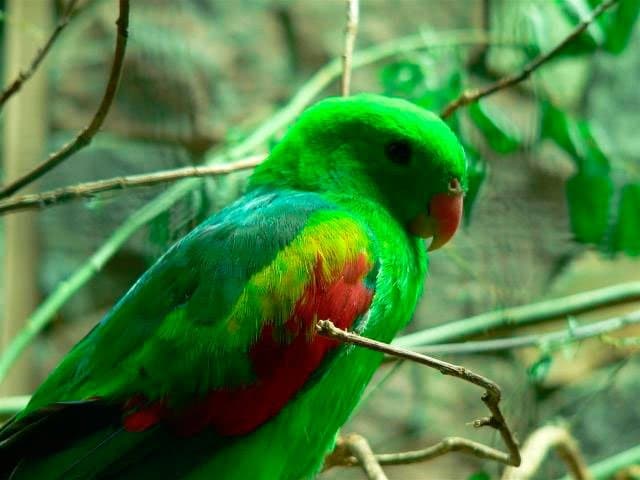
Papuan king parrot
Alisterus chloropterus

Papuan king parrot

Content


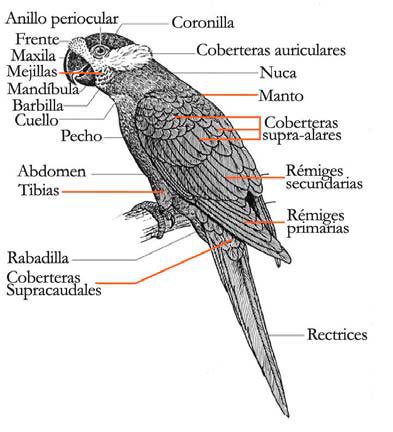
Anatomy-parrots

Description

36 cm.. length between 138 and 190 g. of weight.

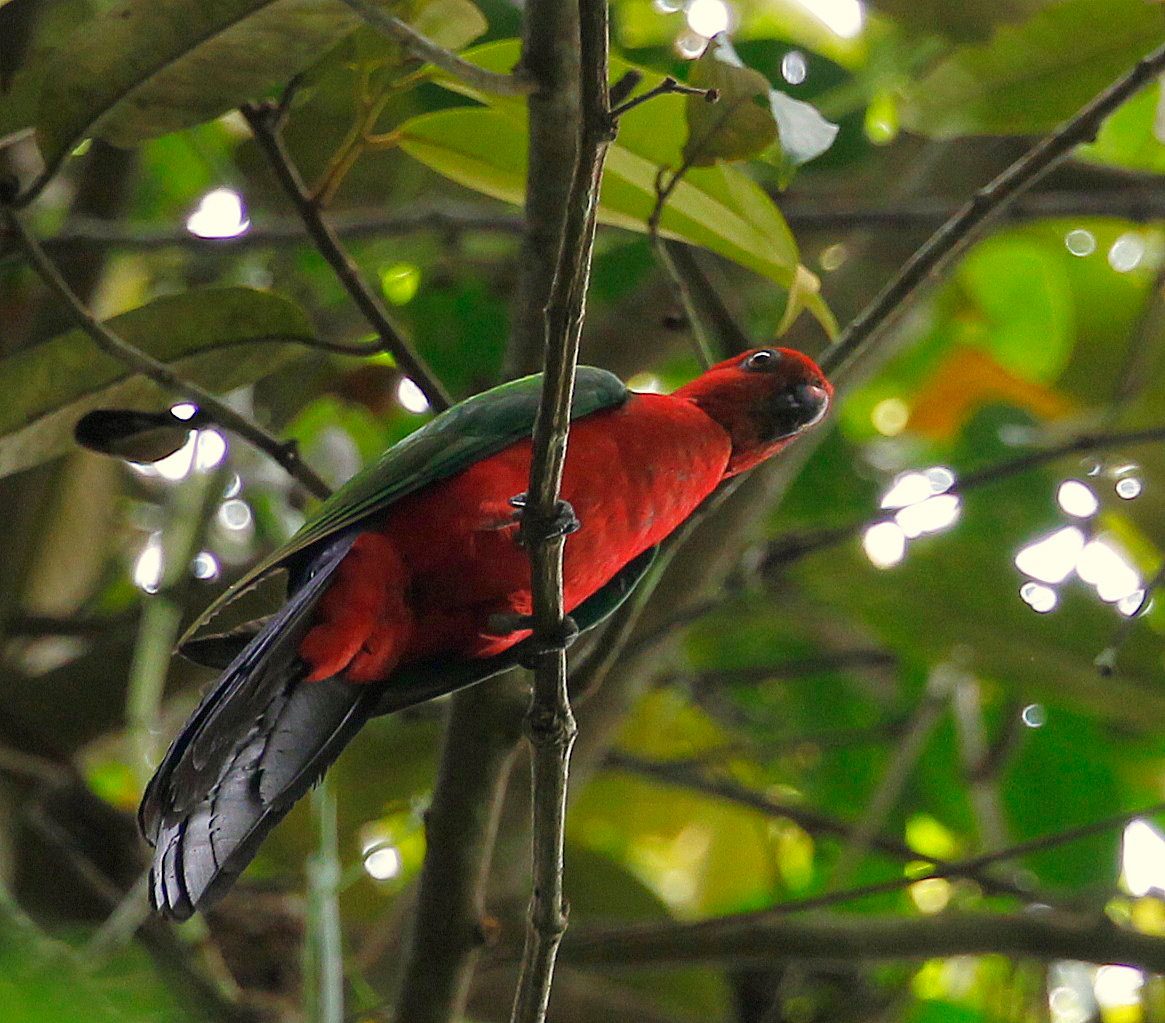
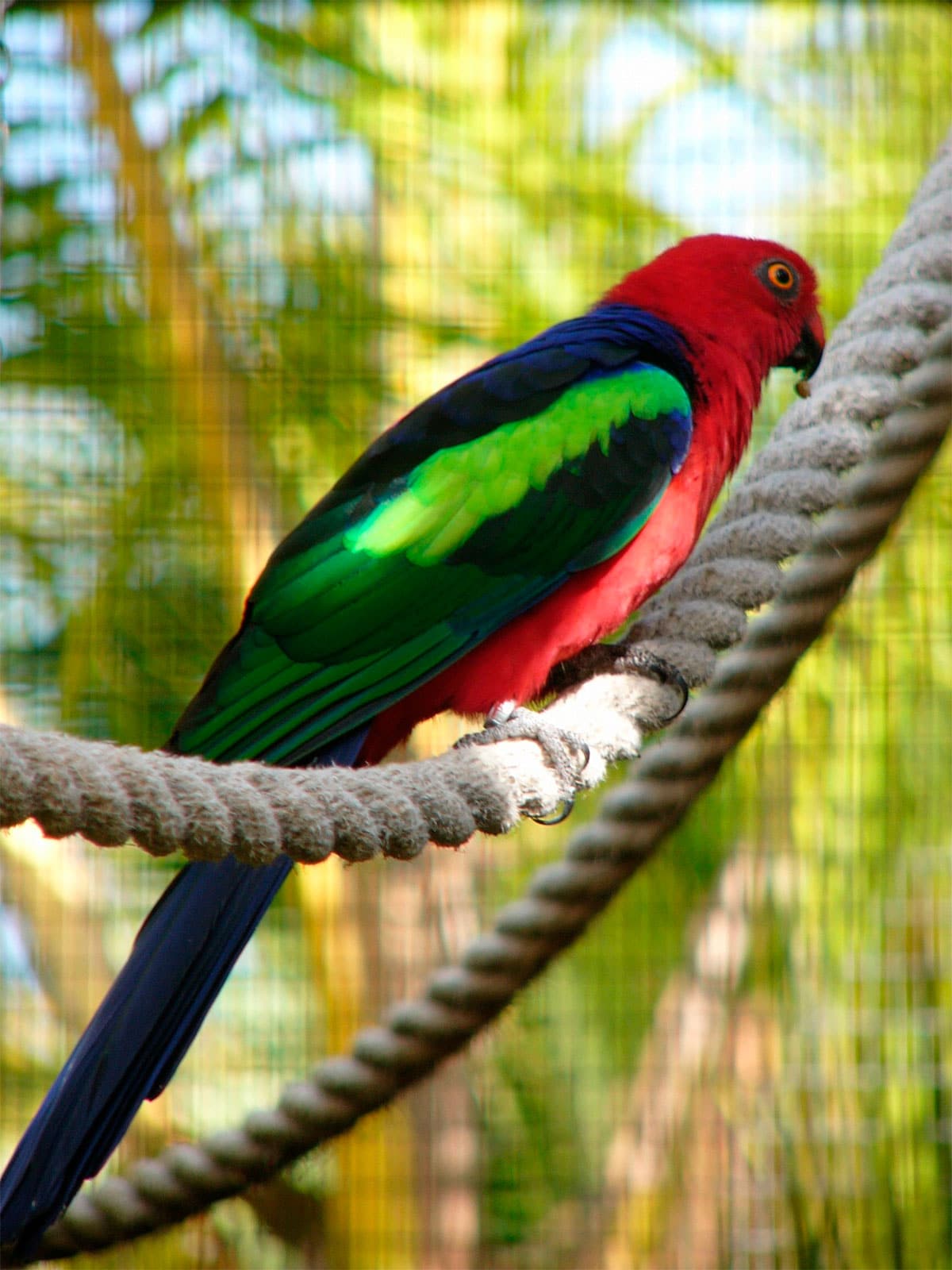
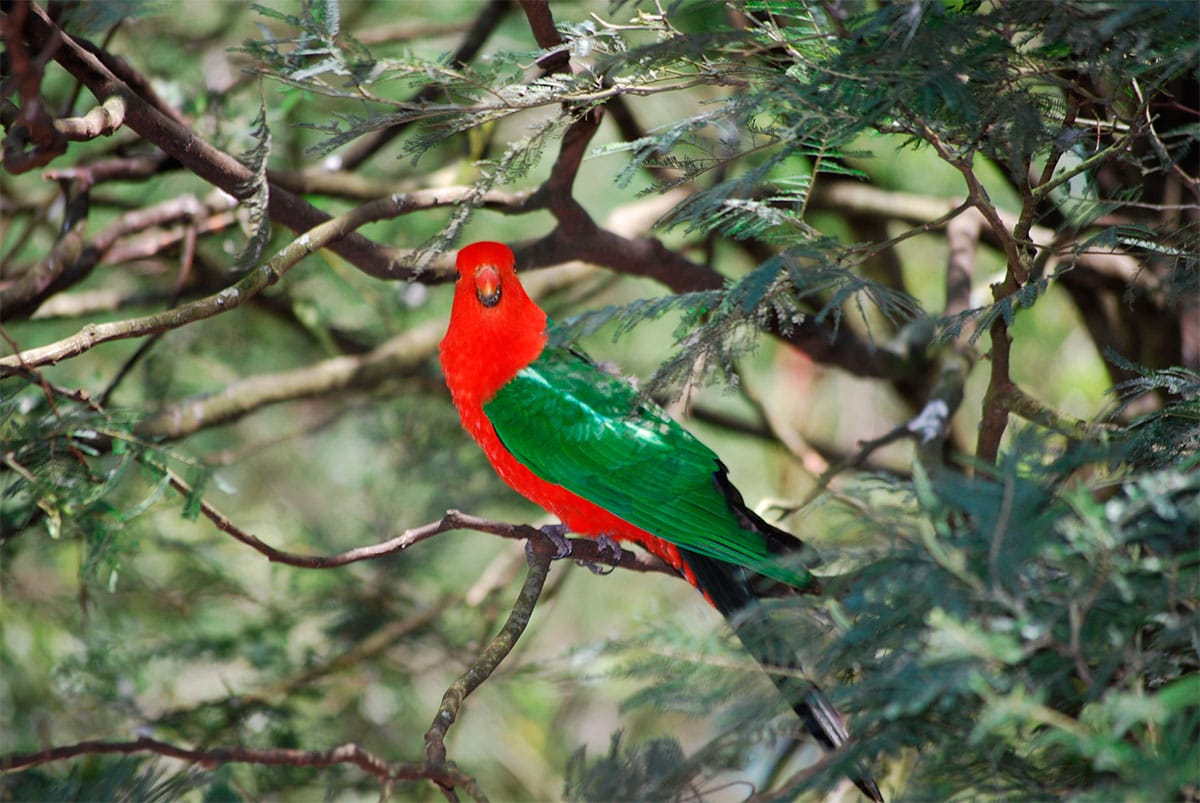
The Papuan king parrot (Alisterus chloropterus) It has a bright red head, wide rear collar of blue stretching at the nape to the back of the Crown and sides of the upper part of the chest. Blackish green mantle, apparently black in the field; lower part of the back, buttocks and supracaudales coverts Dark Violet.

Dark green wings with large patch of yellowish-green through the lower, internal medium and more large inner coverts; Green flight feathers, with vane Dark internal. Under, the wing coverts blue-violet. Bright red bottoms, with hidden dark bases to the coverts infracaudales. Upper, tail bluish black; Black down.

Black bill with red base to upper mandible; Orange iris; feet of color grey blackish.

The female of color green for over, devoid of the pale in wings patch, with a dark blue rump and blackish tail. Head and upper part of the chest of green (reddish mottled), and the rest of of the Red bottoms. Under, the Green wing coverts. Coverts with dark centers infracaudales, but this is less evident in the Australian females. Base with more brown on upper mandible than in males.

Young as females, but with tips to the tail feathers pink, a greener chest, and a peak and iris darker.

Subspecies description

  • Alisterus chloropterus chloropterus

    (Ramsay, EP 1879), the nominal subspecies.


  • Alisterus chloropterus callopterus

    (Albertis & Salvadori 1879) – Male with blue band narrow through the mantle, It does not extend to the rear of the Crown. More green in the mantle.


  • Alisterus chloropterus moszkowskii

    (Reichenow 1911) – Sexes generally similar. Male has no or only shows a blue light in the back of the neck band, and it has the mantle and signs on the sides of the chest of green. Male with violet that extends more down in the back that the nominal species. Both sexes can display tips pink tail feathers. Immature with narrower and more off the wings patch. Green marks on the chest.

Habitat:

They are distributed in the dense forests from close to sea level until the 2.800 m. The birds are also sometimes found in cultivated areas, at higher altitudes, in more open habitats with casuarinas, and in areas of secondary growth. Papagayo Papuans are heard more often than they are seen, and are more frequently asked vislumbrados flying between the trees through breaks in the forest.

Bird alone, couples or groups of up to ten copies, they feed on silently and discreetly in the lower floors and half-height of the forests, and they can be addressed a short distance when they deliberately leave in search of fruits, seeds, berries and nuts; When resent, they usually only fly within walking distance.

Reproduction:

Little-known cycle of reproduction, but nesting, according to sources, begins in the month of March with two or three eggs in the implementation. The period of incubation is of 21 days, and the incipient takes 35 days. Young people reach the independence in 50 days.

Food:

Fruits, seeds, berries and nuts

Distribution:

Size of the area of distribution (reproduction / resident): 324.000 km2

The Papuan king parrot extends from North of Cenderawasih Bay, to the East, about Aitape on the North Coast. Although locally common, the species is probably suffering due to the trade of birds. The world population is estimated at around 70.000 birds.

Subspecies distribution:

Conservation:


minor concern


โ€ข Current category of the Red List of the UICN: Least concern

โ€ข Population trend: Stable

The size of the world's population has not been quantified, Although it is estimated at around 70,000 specimens.

The species is reported as locally common (pit et to the. 1997).

The population is suspected to be stable in the absence of evidence of any reduction or substantial threats.

"Papuan king parrot" in captivity:

active parrot; need extra space because of the tendency that has to turn into an apathetic or lethargic in a small cage bird. It is not very loud. The dietary changes must occur slowly. It has a tendency to internal parasites.

Very rare in captivity.

Alternative names:

– Papuan King-Parrot, Green-winged King Parrot, Green-winged King-Parrot, Papuan King Parrot (ingles).
– Perruche ร  ailes vertes, Perruche royale ร  ailes vertes, Perruche royale de Papouasie (French).
– Papuasittich (German).
– Periquito-rei-de-asa-verde (Portuguese).
– Papagayo Papรบ, Papagayo Real de Alas Verdes (espaรฑol).

scientific classification:

– Order: Psittaciformes
– Family: Psittaculidae
– Genus: Alisterus
– Scientific name: Alisterus chloropterus
– Citation: (Ramsay, EP, 1879)
– Protonimo: Aprosmictus chloropterus

โ€œPapuana Parrotโ€ images:

————————————————————————————————

ยซPapuan Parrotยป (Alisterus chloropterus)

Sources:

– Avibase
– Parrots of the World โ€“ Forshaw Joseph M
– Parrots A Guide to the Parrots of the World – Tony Juniper & Mike Parr
– Wikipedia
– Birdlife

– Photos:

(1) – ยซAlisterus chloropterus-Jurong Bird Park-male-8aยป by Peter Tan – originally posted to Flickr as Australian King Parrot. Licensed under CC BY 2.0 via Wikimedia Commons.
(2) – ยซAlisterus chloropterus -Grantโ€™s picnic ground -in tree-8ยป by Jade Craven – originally posted to Flickr as King Parrot at Grants Picnic Ground. Licensed under CC BY 2.0 via Wikimedia Commons.
(3) – Birds and Birds – Parrocchetto reale aliverdi
(4) – Bottom view of a male perched on a branch by Carmelo Lรณpez – Lynx
(5) – franz.kulman

– Sounds: Sam Woods (Xeno-canto)

โ–ท The world of Pets: Dogs, cats, birds, reptiles, amphibians

Military Macaw
Ara militaris

Guacamayo Militar

Content

Description:

70 to 85 cm.. length and a weight between 900 and 1100 g..
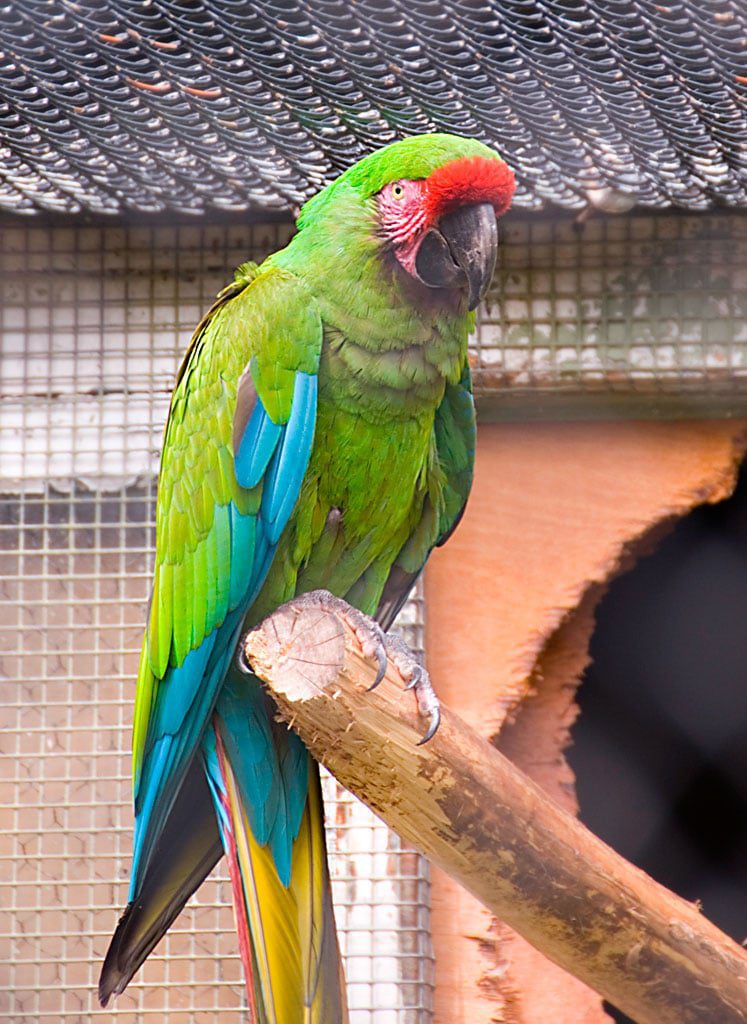
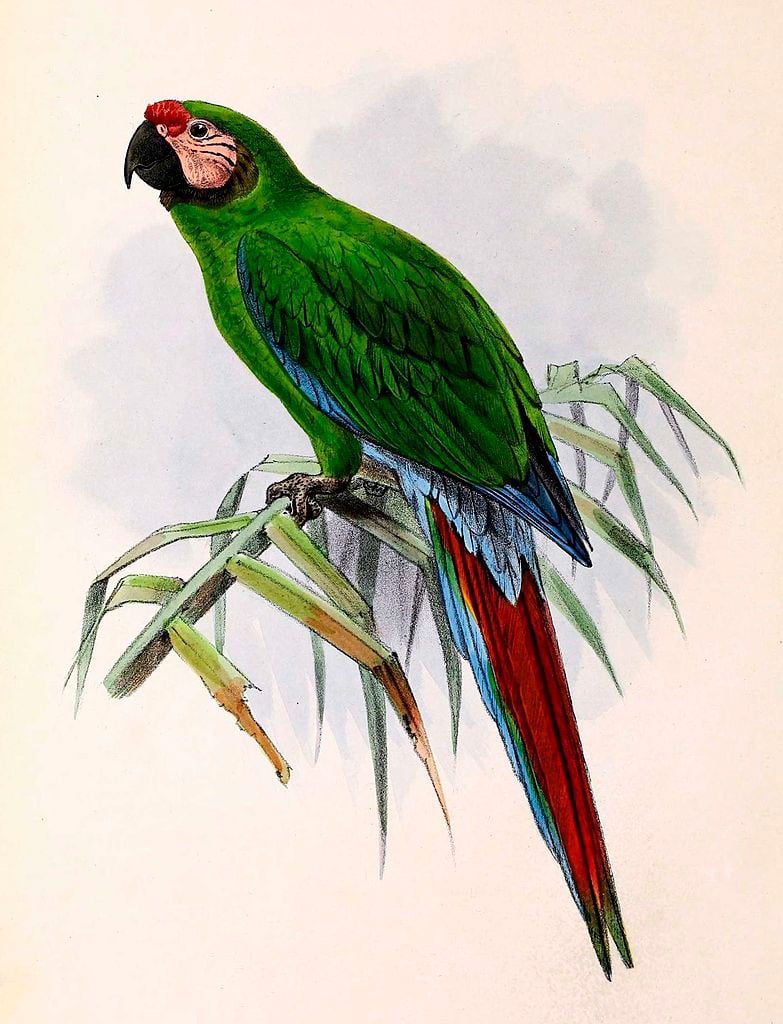
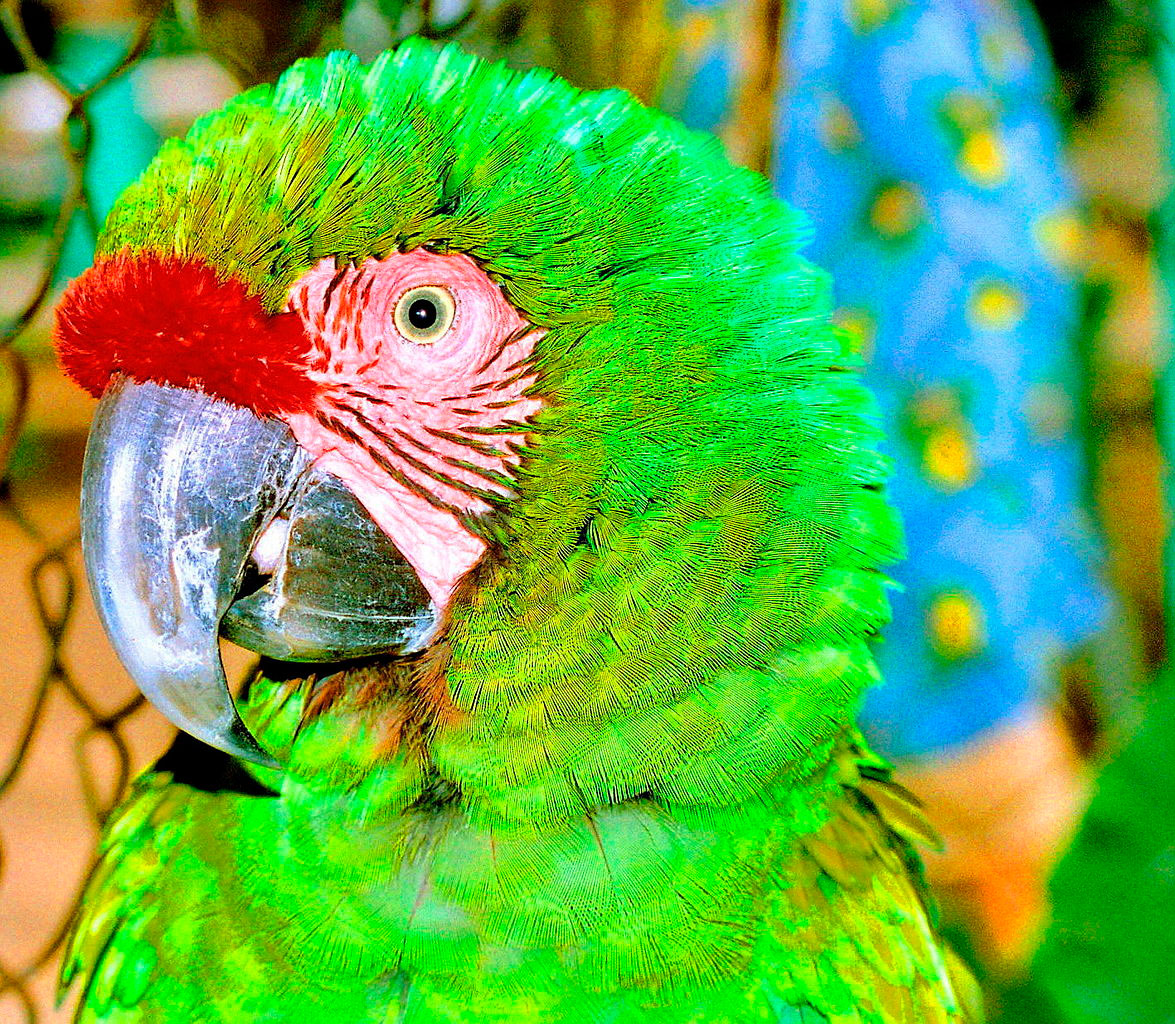
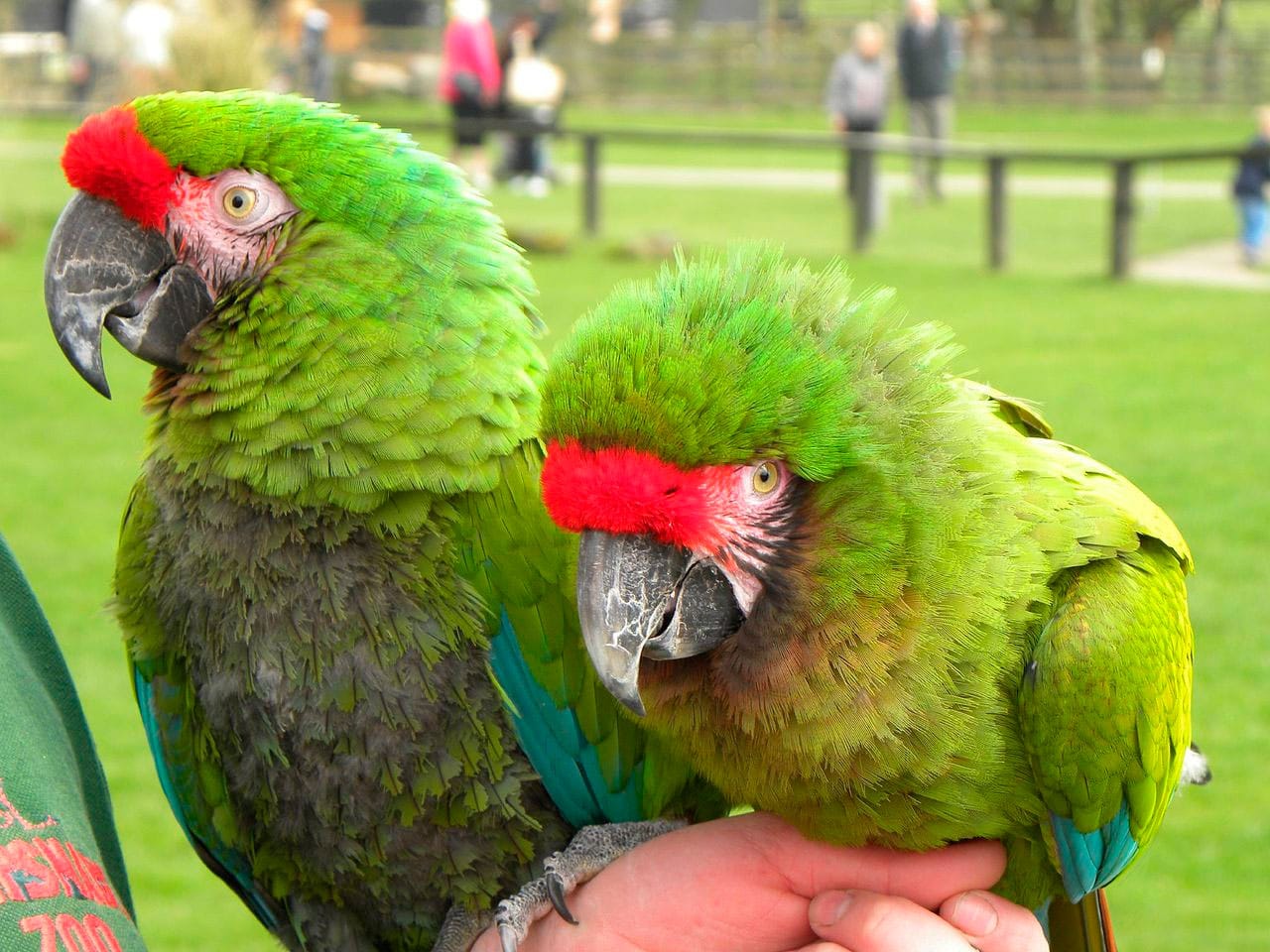
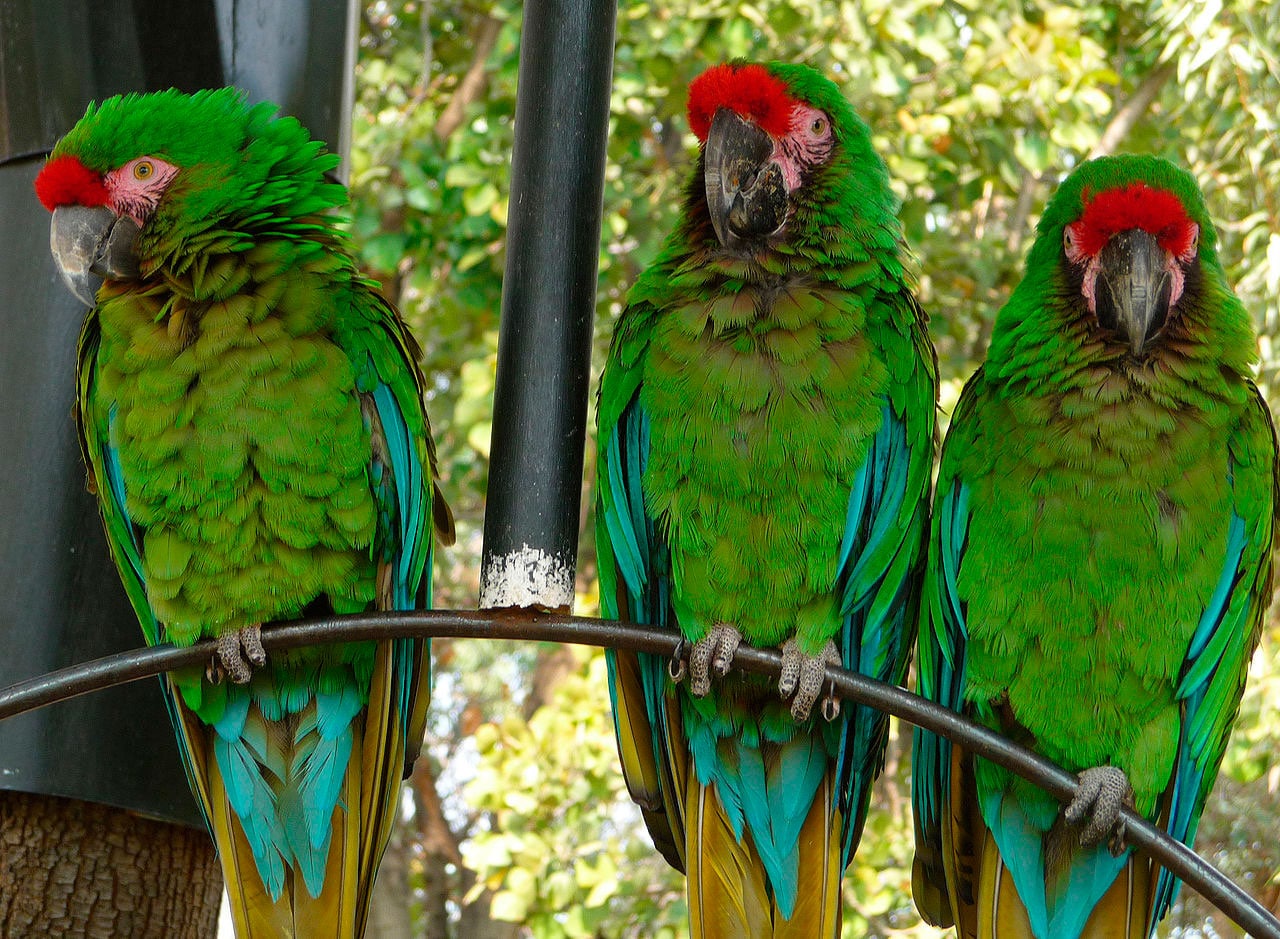
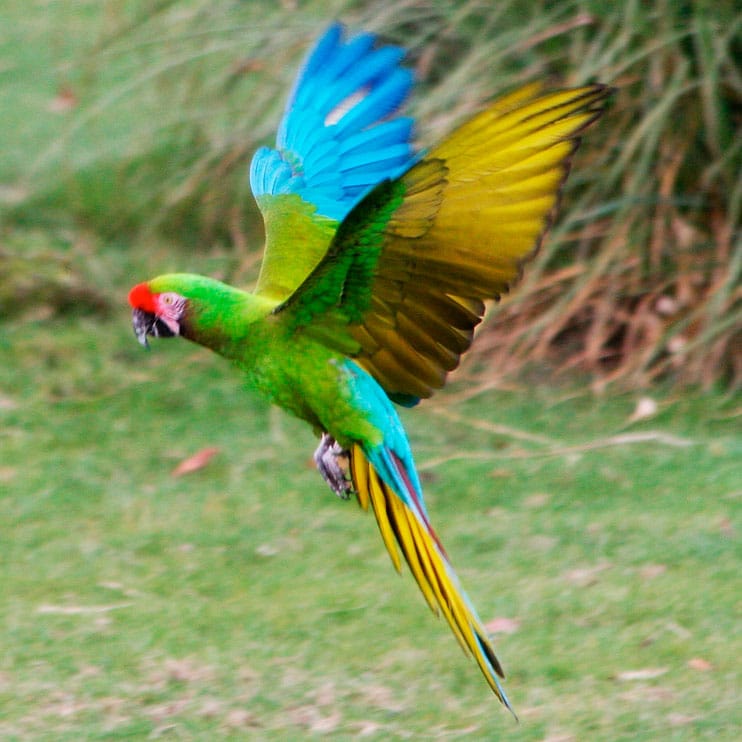
The Military Macaw (Ara militaris) has a dark green color. The head is a green slightly clearer and the crown blue. The back and the top of the wings they have a slightly greenish tone. The rounding of the wings, the edge of the wings and flight feather exterior are light blue.

Illustration military Macaw

The forecrown it is bright red in color and there are a series of purplish-brown lines of feathers on a background of bare skin, since the nose to behind eyes and in the cheeks.

The area of the throat and a narrow strip below the cheeks are olive brown in colour. Breast and belly green; undertail- coverts pale blue.

Upper, the tail orange-red with the ends of the feathers blue; undertail, the tail olive green yellowish.

The eyes has irises yellow. The bill is dark gray, legs dark grey.

Both sexes similar.

Immature not described but as other large macaws, irises probably Brown, tail shorter and the bare facial skin clearer.

Subspecies description:

  • Ara militaris bolivianus

    (Reichenow, 1908) – It differs from the species nominal by the throat reddish brown. The headphones feathers they have a base of reddish and blue present in the wings and at the end of the feathers is a more intense tone.


  • Ara militaris mexicanus

    (Ridgway, 1915) – Almost identical to the species nominal but larger.


  • Ara militaris militaris

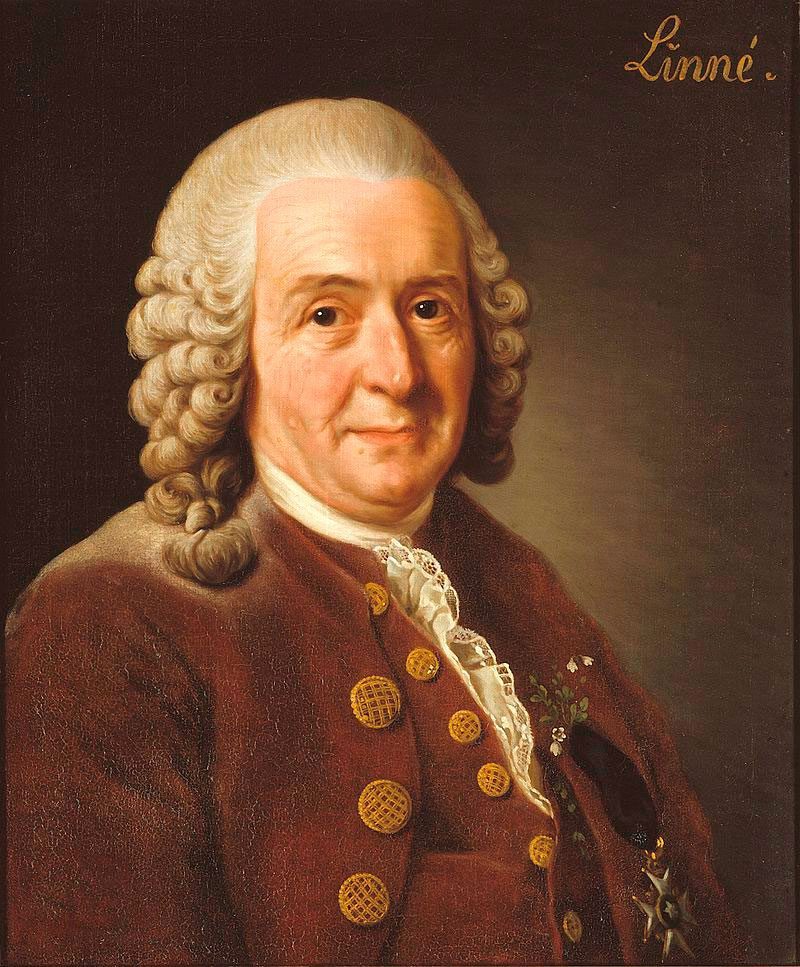
    (Linnaeus, 1766) – The nominal species

Habitat:

The Military Macaw they can be mainly observed in foothills of mountainous terrain in woodlands with cannons fields, mostly between 500 and 1, 500 meters above sea level, at the local level to 2.000 m, (3,100 m reported in Peru, to 2,400 m in Bolivia), but also at sea level in the Pacific of Mexico and in the region of Santa Marta, Colombia.

In Mexico, most are distributed in isolated highlands in semi-arid and arid forests, as well as in forests Quercus and Pinus; sometimes in humid, riparian lowland formations, with altitudinal movements to lower altitude to dense scrub forests between November and January.

Observed in humid forests in the Colombian Andes.

In Venezuela, in the rainforest, in some mountainous areas 600 m, sometimes also in more open dry forests.

Usually in pairs or small flocks (until 10 birds), but much larger swarms reported in flights to the roosts. Communal roosts on cliffs or in trees.

Reproduction:

Nest, usually, in crevices of cliffs; sometimes in large trees (for example, Acer, Pinus or Enterolobium).

In Mexico It has been observed to the Military Macaw making use of old nests of the Imperial Woodpecker (Campephilus imperialis) in dead pine.

Breeding pairs are for life.

The egg laying takes place in the month of June in Mexico. They are of two to three eggs that it will take 24 days to hatch, and where the young will remain with the parents for about a year.

The first flights the chicks are produced between the 97 and 140 days old and reach sexual maturity to the 3 or 4 years of age.

Food:

The diet of the Military Macaw It consists of a wide variety of fruits and nuts, including fruit of the Melia azedarach, Ficus and seeds of the Hura crepitans.

Distribution:

Size of the area of distribution (reproduction / resident): 276.000 km2

distributed by Mexico, In addition to several separate populations of South America, heading south to northwest of Argentina.

Widely distributed in Mexico from Sonora (where they have been observed at 28ยฐ 45'N) and Chihuahua in the North, until Chiapas, in the South and the East, where the birds may be geographically isolated.

Absent from the lowlands of the Caribbean; ancient appearances in Guatemala not confirmed.

In Colombia to the West of the Andes to the South of Dagua, of the Magdalena River Valley, and on the West side of the Andes, to the East of the Sierra Nevada de Santa Marta, in the North, through the East of the Ecuadorian Andes until Huanuco in the Peruvian Andes.

Also distributed by the North of Venezuela on Serrania del Perija and from Northwest of Zulia until Federal District.

In Peru, mostly, observed in the East of the Andes, above all in the Maraรฑรณn region, where at least, formerly, It was a common migrant from the slope of the peaceful between September-October(reported on the west slope at 6ยฐ 50'S) to feed on the fruit available seasonally.

In the East of the slopes of the the Bolivian Andes, in Santa Cruz de la Sierra, Chuquisaca and Tarija and Northwest corner of Argentina in Salta and possibly Jujuy.

Seasonal movements in many areas, for example, visitors to the West of Caquetรก in Colombia, from the western slope of the Andes up to this.

Rare in the South of Mexico (in Chiapas possibly extinct), more numerous in the East and Northwest, where flocks of several hundred birds were reported at the end of 1970.

Very local in the Andes and at risk in Venezuela due to habitat loss and trade.

Fairly common in the North of the region of Santa Marta, but sporadic in other parts of Colombia.

Flocks of up to 60 birds observed in the Manu National Park in Peru and in the Amborรณ National Park of Bolivia.

Very rare in Argentina with only sporadic reports in recent years. Recent declines due to low habitat and bird trade, a large number of birds in captivity.

Subspecies distribution:

  • Ara militaris bolivianus

    (Reichenow, 1908) – South of Bolivia and Northwest of Argentina.


  • Ara militaris mexicanus

    (Ridgway, 1915) – Mexico


  • Ara militaris militaris

    (Linnaeus, 1766) – The species nominal

Conservation:


Vulnerable

โ€ข Current Red List of UICN: Vulnerable

โ€ข Population trend: Decreasing

The population size is estimated, provisionally, You can be in the band between 10.000 and 20.0000 individuals.

It is suspected that the population This species can be decreasing due to ongoing habitat loss and capture for national trade.

The loss of habitat and especially the national trade they are major threats to this species, even within the reserves (Snyder et to the. 2000).

In 1991-1995, 96 wild-caught specimens were found in the international trade, with Bolivia and Mexico, possibly, major exporters (Chebez 1994, D. Brightsmith in litt., 2007).

In Mexico, remains one of the most sought after species for the illegal trade of birds in cage; between 1995 and 2005, was the fifth country with the most parrots seized by the Environmental Control Agency from the country, becoming the fourth with more seizures between 2007 and 2010 (JC Cantรบ in litt. 2010).

In many areas it nests in hard-to-reach cavities in cliff faces., that provide some protection against the pressures of plundering of nests. But, the plundering of nests is a serious threat in Jalisco and Nayarit, where the species nests in tree cavities (C. Bonilla in litt. 2007, K. Renton in litt., 2007).

In Jalisco, Mexico, These macaws were not found in deforested areas, even when it was abundant the Hura polyandra (an important source of food), leaving, in the news, as trees to provide shade for cattle (Renton 2004).

An analysis of the GARP believes that the species has undergone a 23% loss of habitat within its distribution area in Mexico (Rios Munoz 2002).

A subpopulation in the Valle del Cauca, Colombia, account for less than 50 mature individuals, little is to be lost as a dam is expected to flood the only nesting cliff (ProAves Foundation 2011).

"Military Macaw" in captivity:

Very popular in poultry.

Although the Macaw Militar is present for more than one century in Europe, He has never enjoyed special interest among the fans, It's a shame, Since it is a being Intelligent. The main reason should be your little flamboyant plumage; especially compared to the one of other macaws. Other failures affect its presence in aviaries: is very loud and has a strong tendency to gnaw.

The power of their vocal organ is much higher than of any other species of Macaw. On the other hand it also good qualities: is very applied to learn, has a great talented imitator and presents an intelligence out of the ordinary.

With regard to its longevity, according to sources, a specimen lived 46 years in captivity. In captivity, these animals have been known that they can raise some 5 years of age.

Alternative names:

– Military Macaw (English).
– Ara militaire (French).
– Soldatenara (German).
– Arara-militar (Portuguese).
– Guacamaya Verde, Guacamayo Militar, Guacamayo Verde, Papagayo verde (espaรฑol).
– Guacamaya verde oscura (Colombia).
– Guacamayo verde (Venezuela).
– Guacamayo militar (Ecuador).
– Maracan, Paraba militar (Bolivia).
– Jarcia, Sarea (Chaka).
– Panicco (Cofรกn.).

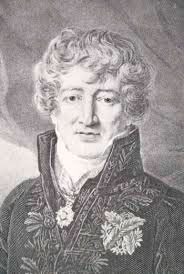
Carl Linnaeus
Carl Linnaeus

scientific classification:


– Order: Psittaciformes
– Family: Psittacidae
– Genus: ARA
– Scientific name: Ara militaris
– Citation: (Linnaeus, 1766)
– Protonimo: parrot military


Images Military Macaw:

Videos "Military Macaw"


Species of the genus Ara


Sources:

– Avibase
– Parrots of the World โ€“ Forshaw Joseph M
– Parrots A Guide to the Parrots of the World – Tony Juniper & Mike Parr
– Birdlife

– Photos:

(1) – Military Macaw (Ara militaris) at London Zoo, England By jon hanson (originally posted to Flickr as military macaw) [CC BY-SA 2.0], via Wikimedia Commons
(2) – Military Macaw Ara militaris in captivity at Occidental Grand Xcaret Resort, Yucatan, Mexico By Tony Hisgett (originally posted to Flickr as Green Parrot) [CC BY 2.0], via Wikimedia Commons
(3) – Military Macaw flying at Whipsnade Zoo, Bedfordshire, England By Ara_militaris_-Whipsnade_Zoo_-flying-8a.jpg: Alex Smithderivative work: Snowmanradio [CC BY 2.0], via Wikimedia Commons
(4) – Three Military Macaws at Zoolรณgico Los Coyotes, Mexico By Gary Denness (originally posted to Flickr as Squawk No Evil) [CC BY 2.0], via Wikimedia Commons
(5) – Two Military Macaws at Whipsnade Zoo, Bedfordshire, England. The macaw on the left has damaged feathers on its chest and abdomen probably because of a feather plucking habit By Mark Fosh (originally posted to Flickr as Macaw) [CC BY 2.0], via Wikimedia Commons
(6) – Two Military Macaws at Moody Gardens, Galveston, Texas, USA By joannapoe (originally posted to Flickr as 2005-06-18_11-52-47) [CC BY-SA 2.0], via Wikimedia Commons
(7) – A Military Macaw at Whipsnade Zoo, Bedfordshire, England. Some of its feathers are damaged probably due to feather plucking By William Warby from London, England (Military MacawUploaded by Snowmanradio) [CC BY 2.0], via Wikimedia Commons
(8) – Military Macaws in Mexico By Gregg (originally posted to Flickr as YOU WANT SOME?) [CC BY-SA 2.0], via Wikimedia Commons
(9) – Military Macaw (Ara militaris). Details of the head and face By Mary Mueller (Flickr) [CC BY 2.0], via Wikimedia Commons
(10) – Arara militaris by John Gerrard Keulemans [Public domain], via Wikimedia Commons

– Sounds: (Xeno-canto)

โ–ท The world of Pets: Dogs, cats, birds, reptiles, amphibians

Maroon-bellied Parakeet
Pyrrhura frontalis

Maroon-bellied Parakeet

Content

Description:

24-28 cm.. length and 72-94 g. of weight.

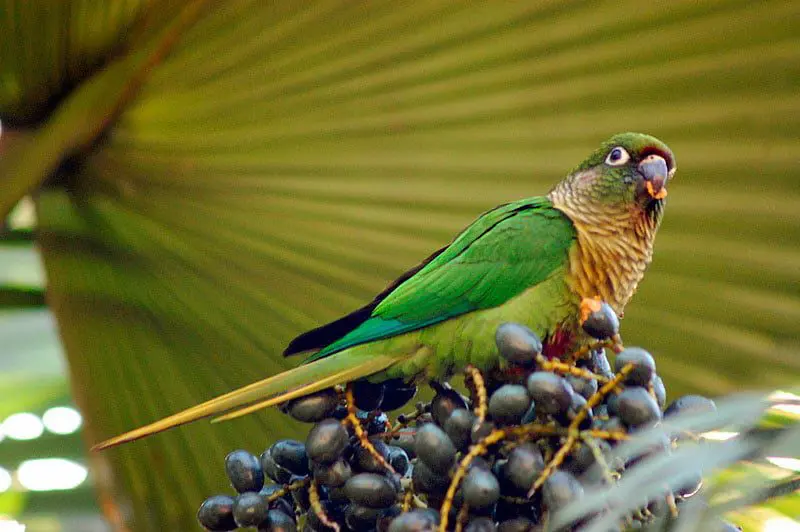
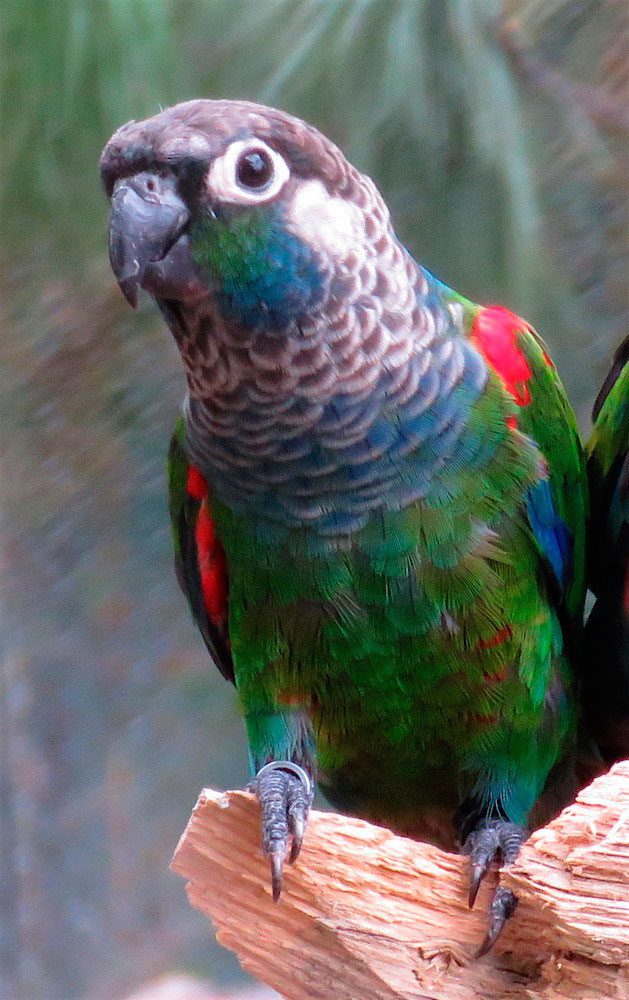
The Maroon-bellied Parakeet (Pyrrhura frontalis) has a frontal band matte red close with a few more bright red feathers behind cere; lores blackish; feathery cheeks and crown, greyish green blackish tips; ear-coverts olive green.

The upperparts They are green grass with a small area reddish at the bottom of the back. Primary coverts bluish green; wing-coverts grass-green, some feathers sometimes with olive tint. Primaries blue in the outerweb. green in the innerwebs, with dark tips; secondaries, mainly green. Sides of neck, throat and chest, brown olivรกceo, feathers subterminally brown and black black tips, giving the whole a scalloped effect; lower breast green with a patch brown in the center of belly; flanks, the thighs and undertail-coverts, green. Upper, green tail in basal half, Shaded bronze to reddish tones on the tips; below, the tail is opaque brown.

Maroon-bellied Parakeet

Bill grey, sometimes paler in base mandible; yellow cere; bare periophthalmic whitish grey; irises dark brown; legs dark gray.

Both sexes are similar. The incipient brown lacks the belly. Immature paler than adult with irises darker.

Taxonomic note:

Closely related to Blaze-winged Parakeet (Pyrrhura devillei), with which it can be conspecific (populations or races that belong to the same species). It has been suggested that the species may also be conspecific with Green-cheeked Parakeet (Pyrrhura molinae).

  • Sound of the Maroon-bellied Parakeet.

Description 2 subspecies:

  • Pyrrhura frontalis chiripepe

    (Vieillot, 1818) – As the nominal, but the upper surface of the tail It is completely green olive. Some orange-red markings on the bend of wing in some birds.


  • Pyrrhura frontalis frontalis

    (Vieillot, 1818) – Subspecies nominal.

Habitat:

Video – "Maroon-bellied Parakeet" (Pyrrhura frontalis)

Pyrrhura frontalis / red forehead snipe / Marron bellied Parakeet

The Maroon-bellied Parakeet They extend through several forest habitats, forests, margins and marshy habitats, including the remaining patches Araucaria (for example, in Rio Grande do Sul). In the Paraguayan Chaco They seem almost confined to coastal areas of growth over the Paraguay River and its main tributaries. In Southeast Brazil They are mainly distributed in the highlands, to 1.400 meters above sea level; in other parts of the lowlands up near 1.000 m, where they are generally tolerant to disturbance, even reaching visit urban parks in the city of Assumption, Rio de Janeiro and Sรฃo Paulo, and feeding in gardens (Rio Grande do Sul). gregarious, usually in flocks of 6-12 birds (until 40).

Reproduction:

They nest in the cavity of the trees. The breeding season It covers the months from October to December. Clutch 5-6 eggs.
The female incubated one for almost 30 days. The young leave the nest after about 45 days, after which they continue to be fed for some time by the two members of the couple.

Food:

In Southeast Brazil, Their diet includes pulp of Euterpe edulis, seeds of Schinus, Xylopia, Cecropia, Croton, Miconia, ficus, Psidium and Pinus; flowers of Ambrosia and Vernonia and aryl of Protium; elsewhere, the Araucaria It is a very important food source, for example in southern Brazil; also they feed dried fruits and fruits of Campomanesia xanthocarpa and Podocarpus lambertii; homoptera sheets Persea pyrifolia and fly larvae. The orange and corn crops sometimes they suffer from their visits, but depredations were lower compared to the damage caused by the Parrot Argentina (Myiopsitta monachus) in cornfields.

Distribution and status:

Size of its range (reproductive / residents): 2.690.000 km2

The Maroon-bellied Parakeet It is endemic in Southeast South America, from the southeast of Brazil to the North of Argentina.

In Brazil They can be observed from south Bay ,through coastal states, until Rio Grande do Sul, and west, in the southeast of Minas Gerais, Brazil and South of Mato Grosso, through Paraguay (extension of records suggests its presence throughout the west end), North of Uruguay and North of Argentina, in Missions, Currents, Formosa, Chaco and sporadically in the past, in the North of Santa Fe (a population in Buenos Aires probably descended from leaks), and southeastern Bolivia.

Resident. Locally common to very common (for example, in Missions) but rare elsewhere (for example Currents) and extinguished in places due to conversion of forests for agriculture.

With He commercialized in large quantities with substantial late eighties exports averaging over 5.000 birds per year. There is a large captive population.

Distribution 2 subspecies:

  • Pyrrhura frontalis chiripepe

    (Vieillot, 1818) – Central and southern Paraguay, northern Uruguay and northern Argentina.


  • Pyrrhura frontalis frontalis

    (Vieillot, 1818) – Subspecies nominal. Southeastern Brazil from southern Bahia to Rio Grande do Sul including southeastern Minas Gerais and south and southeast of Mato Grosso.

Conservation:

State of conservation โ“˜


minor concern Minor Concern โ“˜ (UICN)โ“˜

โ€ข Red List Category: Least concern

โ€ข Population trend: Stable.

Rationale for the Red List category

This species has a extremely large range and, therefore, it does not approach the thresholds for Vulnerable at the discretion of the distribution area size (Extension <20,000 km2 combinada con un tamaรฑo de rango decreciente o fluctuante, extensiรณn o calidad del hรกbitat o tamaรฑo de poblaciรณn y un pequeรฑo nรบmero de lugares o fragmentaciรณn severa). La tendencia de la poblaciรณn parece ser estable, por lo que la especie no se aproxima a los umbrales de Vulnerables bajo el criterio de tendencia poblacional (> 30% decline over ten years or three generations). The population size has not been quantified, but it is not believed to be close to the thresholds for Vulnerable under the criterion of population size (<10.000 individuos maduros con un declive continuo estimado> 10% in ten years or three generations or a population structure). For these reasons, the species is evaluated as least concern.

Justification of the population

The size of the world's population has not been quantified, but this species is described as ยซcommonยป (Stotz et to the., 1996).

Justification of trend

They suspected that the population is stable in absence of evidence of any decline or threatens substantial.

Threats

The species has been marketed strongly: from 1981, when it was included in Appendix II of CITES, 52.523 individuals captured in the wild have been recorded in international trade (Trade database of UNEP-WCMC CITES, January 2005).

"Maroon-bellied Parakeet" in captivity:

The species is listed in Appendix II of the CITES.

There is a large captive population. They are intelligent birds, friendly and active. Readily they adapt to human contact and are easy to train. They are among the quietest cotorras, but its powerful high-pitched voices can become very annoying. Like other parakeets, They tend to express emotion with a series of loud cries, chillidos.

Alternative names:

– Maroon bellied Parakeet, Maroon Parakeet, Maroon-bellied Conure, Maroon-bellied Parakeet, Reddish-bellied Parakeet, Scaly-breasted Parakeet (English).
– Conure de Vieillot, Conure ou, Perriche de Vieillot, Perruche ร  oreillons bruns, Perruche d’Azara, Perruche de Vieillot (French).
– Braunohrsittich, Braunohr-Sittich (German).
– cara-suja, periquito, tiriba, Tiriba-de-testa-vermelha, tiriva (Portuguese).
– Chiripepe, Chiripepรฉ, Chiripepรฉ cabeza verde, Chiripepรฉ de cabeza verde, Cotorra Chiripepรฉ, Perico de Vientre Rojo (espaรฑol).


scientific classification:

Vieillot, Jean Pierre Louis

– Order: Psittaciformes
– Family: Psittacidae
– Genus: Pyrrhura
– Scientific name: Pyrrhura frontalis
– Citation: (Vieillot, 1818)
– Protonimo: Psittacus frontalis

Images Maroon-bellied Parakeet:


Especies del gรฉnero Pyrrhura

Sources:

– Avibase
– Parrots of the World โ€“ Forshaw Joseph M
– Parrots A Guide to the Parrots of the World – Tony Juniper & Mike Parr
– Birdlife

– Photos:

(1) – RED-BROWN TIRIBA Botanical Garden of Sรฃo Paulo By Dario Sanches [CC BY-SA 2.0], via Wikimedia Commons
(2) – Maroon-bellied Conure (Pyrrhura frontalis) on a wooden stump. Botanical Garden of Sรฃo Paulo By Dario Sanches [CC BY-SA 2.0], via Wikimedia Commons
(3) – Pyrrhura frontalis Ilhabela-SP By Dario Sanches from Sรฃo Paulo, Brazil (Maroon-bellied parakeet ( Pyrrhura frontalis)) [CC BY-SA 2.0], via Wikimedia Commons
(4) – Maroon-bellied Conure (Pyrrhura frontalis) – Sรฃo Paulo Forest Garden By Dario Sanches [CC BY-SA 2.0], via Wikimedia Commons
(5) – Pyrrhura frontalis – Track dos Tucanos – Tapirai-SP IBA: Paranapiacaba Forest Massif By Jairmoreirafotografia (Own work) [CC BY-SA 4.0], via Wikimedia Commons
(6) – Parrots A Guide to the Parrots of the World โ€“ Tony Juniper & Mike Parr

– Sounds: Gustavo Luz, XC344423. accessible www.xeno-canto.org/344423

โ–ท The world of Pets: Dogs, cats, birds, reptiles, amphibians

Orange-winged Parrot
Amazona amazonica

Amazona Alinaranja

Content


Anatomy-parrots

Description Orange-winged Parrot

Of 33 to 36 cm.. height can weigh between 350 gr y 450 gr.
The Orange-winged Parrot (Amazona amazonica) It is distinguishable by having the Centre of the crown and cheeks yellow, separated by the forecrown and sides of the crown pale blue, edge of the wing orange, and inside of the tail Orange with stripe green in the Middle.
The copies juveniles have a color different to it of them adults; the head is green, Blue and pale yellow.
It is not possible to determine the sex of the Amazons in a safe manner by their appearance.

Habitat:

Present in varied habitats (dry forests, morichales, Savanna, stubble, mangroves, etc.) below the 500 m.

Frequently is seen in pairs or in flocks numerous out of it breeding season.

Reproduction:

It is a kind monogamous (the couple stays together for life).

It nests in trunks of Palms killed apparently at the end of the season dry.
The female lays from 3 to 5 eggs and she incubates them for three weeks approximately. the chicks take two months to develop.

Food:

It feeds on various fruits, seeds and sprouts leaves. Including the fruit of Palms (Sloanea, Richeria and Byrsonima) , flowers Erythrina and sometimes cocoa.
You can take oranges and mangoes of the cultivated areas when other food is scarce.

Distribution:


Size of the area of distribution (reproduction / resident): 7.420.000 km2

North and Central South America to the East of Peru, Brazilian Amazon and northeast of Bolivia.

Conservation:

State of conservation โ“˜


minor concern Minor Concern โ“˜ (UICN)โ“˜
  • Current red list category of the UICN: Least concern.
  • The population trend: Decreasing.

  • Trapped for the wild bird trade: they have been 268.510 wild-caught individuals for international trade from 1981.
    In some areas of their range they are hunted for food by the indigenous population.
    The loss of habitat is also a concern.


    "Orange-winged Parrot" in captivity:

    Video – "Orange-winged Parrot"

    Amazona Amazonica

    Popular as a mascot for more than 100 years.
    Loving, playful, with good ability to speak, sociable with people.

    Known for being very friendly, easy to train, very Smart.
    They need constant attention of their owners, they carry out all kinds of fun pranks to get that attention.
    Over time they will form a strong bond with their owner., they can however be quite noisy. They will make noise early in the morning and when the Sun is setting. This usually lasts for a few 10 minutes, to wake up and just before sleep.

    Alternative names:

    – Orange winged Parrot, Common Amazon Parrot, Orange-winged Amazon, Orange-winged Parrot (English).
    – Amazone ร  ailes orange, Amazone aourou (French).
    – Venezuelaamazone (German).
    – curica, airu-curuca, ajuru-catinga, ajuru-curau, ajuru-curuca, curau, curuรงรก, Papagaio-do-mangue, papagaio-grego, papagaio-poaieiro (Portuguese).
    – Amazona Alinaranja, Amazona Guaro, Cotorra Alianaranjada, Lora Amazรณnica, Loro Real, Lora alianaranjada (espaรฑol).
    – Lora Amazรณnica (Colombia).
    – Loro Guaro (Venezuela).

    scientific classification:

    – Order: Psittaciformes
    – Family: Psittacidae
    – Genus: Amazona
    – Scientific name: Amazona amazonica
    – Citation: (Linnaeus, 1766)
    – Protonimo: Psittacus amazonicus

    Orange winged Parrot images :


    Species of the genus Amazona


    Sources:

    – Parrot Book, Parrots and macaws Neotropical
    – avibase

    Photos:

    – Our beautiful world
    – An Orange-winged Amazon at Kuala Lumpur Bird Park, Malaysia. It is eating a slice of corn on the cob by Vasenka – Wikimedia
    – by Patrick Ingremeau – IBC.lynxeds.com
    – by Snowmanradio (talk) – Wikimedia
    – by Thore Noernberg – IBC.lynxeds.com

    Sounds: Joao Antonio de B.. Vitto (Xeno-canto)

    โ–ท The world of Pets: Dogs, cats, birds, reptiles, amphibians

    Pygmy Lorikeet
    Charmosyna wilhelminae

    Pygmy Lorikeet

    Content


    Anatomy-parrots

    Description

    The Pygmy Lorikeet (Charmosyna wilhelminae) has an approximate length of 13 cm.. and a weight of 20 g..

    The head is green; the forecrown brighter yellowish green; crown dark purple, with broadcast Blue in them tips and color turquoise bright in the feathers of the nape; rear of the nape with wash of olive. Mantle green; low back and tail reddish color; at the top, the tail purple blue. The wings, by up green with parts internal of the flight feather Blackish and blackish the primary coverts. The wings below rosa-salmon; Tips from the flight feather blackish. The underparts Green yellowish with prominent veins on the chest. Upper, the tail green, Red at the base (normally hidden in the field); olive brown below with red and yellow tips on the base. The bill reddish orange-tipped yellow; cere color red pink; Grey the ring perioftalmico; irises yellow to orange-red; legs light grey.

    Female lack of red on it rump and in the wings view in flight.
    Immature generally more muted and upperparts slightly more Brown. Lacks blue at the tips of the feathers of the nape. Yellow stripes on the top of the chest less distinct or absent. The bill and the irises brown.

    Habitat:

    Mainly inhabits in humid forests and on the edge of forests, but also by forest savanna and established secondary vegetation. It is usually between the 1.000 meters of altitude and the 2.200 m, but in the South and around Port Moresby It is occasionally much closer to sea level, in the forests of lowlands. It forages in couples and small flocks of up to 20 birds in the trees in flower, often in the company of Goldie's Lorikeet and Fairy Lorikeet. Very Active When it feeds and, often difficult to identify due to its size and predominantly green plumage. It is not uncommon, but easily overlooked. and has been found in groups of up to 200 individuals. It has often been seen flying in mixed flocks above the canopy, where they can hardly be identified due to their small size.

    Reproduction:

    Breeding and nesting habits unknown.

    Food:

    Feeds of nectar and pollen.

    Distribution:

    Size of the area of distribution (reproduction / resident): 290.000 km2

    North of New Guinea in Irian Java (Indonesian) and Papua New Guinea. The range of the Mountains Parotia on doberai peninsula, in the West of the island of New Guinea, through the cordillera central, the Huon Peninsula, and South-East of the mountain range of Owen Stanley. In the immediate vicinity of Port Moresby (for example, area Sogeri) There is little (but possibly regular between May and November).

    The population world will think that is of less than 50.000 specimens and is considered to be stable. There are few in captivity.

    Conservation:


    minor concern


    โ€ข Current IUCN Red List category: Least concern.

    โ€ข Population trend: Stable.


    The size of the world population It has not been quantified, but the species according to sources is generally very rare.

    The population suspected to be stable in the absence of evidence of any reduction or substantial threats.


    "Pygmy Lorikeet" in captivity:

    Rare.

    Alternative names:

    – Pygmy Lorikeet, Pygmy Streaked Lorikeet, Pygmy Streaked Lory, Wilhelmina’s Lorikeet, Wilhemina’s Lorikeet (ingles).
    – Lori de Wilhelmina (French).
    – Elfenlori (German).
    – Lori Pigmeo (espaรฑol).

    scientific classification:

    – Order: Psittaciformes
    – Family: Psittaculidae
    – Genus: Charmosyna
    – Scientific name: Charmosyna wilhelminae
    – Citation: (Meyer,AB, 1874)
    – Protonimo: Trichoglossus Wilhelminae

    Images "Pygmy Lorikeet"

    ————————————————————————————————

    ยซLori Pygmyยป (Charmosyna wilhelminae)


    Sources:

    – Avibase
    – Parrots of the World โ€“ Forshaw Joseph M
    – Parrots A Guide to the Parrots of the World – Tony Juniper & Mike Parr
    – Birdlife

    – Photos:

    1 – loromania

    โ–ท The world of Pets: Dogs, cats, birds, reptiles, amphibians

    Olive-shouldered Parrot
    Aprosmictus jonquillaceus

    Olive-shouldered Parrot

    Content


    Anatomy-parrots

    Description

    35 cm.. length and 130 g. of weight.

    The Olive-shouldered Parrot (Aprosmictus jonquillaceus) has the head bright pale green. "Mantle" and back darker green color that the of the head and underparts, showing a blue diffusion; rump bright teal pale. Uppertail brighter yellowish green.

    Upper, the wing feathers with small coverts fused in color yellow-green; Blue dark greenish in the curve of the wings; outer median coverts bright Scarlet, feathers interiors lit of color green yellowish with a bit of red in the tips. Large external coverts scarlet, feathers interiors light green, some showing red ends; some feathers turquoise green on the edge of the carpus; primary coverts Green with broadcasting blue at the tips of the vane outer; secondary green medium, primaries medium green with blue diffusion in the coats of the feathers outermost. Wing feathers brighter yellowish green; underside of flight feather black. The underparts light green, more yellowish in them the thighs and undertail-coverts. Upper, the tail of color green dark with edges of color yellow, and with vane yellowish external to the lateral feathers; undertail, the tail of color Brown blackish with tips yellow, and with yellowish diffusion in vane outside of lateral feathers.

    Bill orange red, with yellow tip; irises orange: legs blackish gray.

    The female lacks of the broadcast Blue in the the mantle, shows less contrast between the head and the the mantle, limb yellowish to them greater coverts red, and have them irises more Brown.

    Immature has green, No greenish-yellow, in the wing-coverts and irises of Brown pale.

    Subspecies description

    • Aprosmictus jonquillaceus wetterensis

      (Salvadori, 1891) – The male as the nominal but the coverts wing lower and Middle are of color green washed with yellow; the mantle and top of the back pale green, with less blue markings; less red on the outer half and the secondary wings covers; smaller.

      The female is like the female of the nominal species, but the uppertail-coverts darker green; slightly smaller in size.

      The youth as the youth of the nominal species, but with the uppertail-coverts darker green; smaller.


    • Aprosmictus jonquillaceus jonquillaceus

      (Vieillot, 1818) – The nominal

    Habitat:

    In Timor the species is found in forests, acacia savannas, primary and secondary forest, from sea level to the 2.200 m (2.600 meters altitude extreme). In Wetar, observed in 1990 in recently logged forests, near the coast.

    The ecology of the species is probably similar to that of the Red-winged Parrot, but it is not well known; observations of birds that fly involve couples and small flocks. A couple allowed a closer approach, observing her in silence to three meters high in a big tree.

    Reproduction:

    Their reproductive habits are unknown, probably similar to the of the Red-winged Parrot.

    Food:

    Probably similar to the of the Red-winged Parrot: seeds, fruit, flowers and insects; in the mangroves, the mistletoe is your favorite food.

    Distribution:

    Size of the area of distribution (reproduction / resident): 28.500 km2

    Endemic and quite common in Timor (for example, about Camplong, Kupang, Lelogama, Mutis and Dili), Wetar and Roti.

    The world population is estimated at around 10.000 specimens and it is probably stable, although like most Indonesian parrots the species is vulnerable to capture and habitat loss. A moderate number in captivity.

    Subspecies distribution:

    Conservation:


    Near-threatened


    โ€ข Current IUCN Red List category: Near threatened

    โ€ข Population trend: Decreasing

    The total population has been estimated at 10,000 individuals (Lambert et to the., 1993), probably including mature individuals 6,700.

    The population is suspected that it may be declining due to the continuous destruction of the habitat and unsustainable levels of exploitation.

    Ongoing conservation actions

    Appendix II of CITES. Quotas were imposed during the Decade zero of 1990 while uncertainty existed about the total population size, but these are not met.

    Conservation Actions Proposed

    โ€ข Review estimates of the population of the species and review the impact of trade on their numbers..
    โ€ข Determine if declines are still evident.
    โ€ข Protect areas of suitable habitat.

    "Olive-shouldered Parrot" in captivity:

    Game, with low noise level, aggressive with other birds. You can require deworming.

    Very rare in captivity

    Alternative names:

    – Olive-shouldered Parrot, Jonquil Parrot, Olive shouldered Parrot, Timor Parrot, Timor Red-winged Parrot (ingles).
    – Perruche jonquille (French).
    – Timorsittich, Timor Sittich (German).
    – Periquito-de-asa-vermelha-de-timor (Portuguese).
    – Papagayo de Timor (espaรฑol).

    scientific classification:

    – Order: Psittaciformes
    – Family: Psittaculidae
    – Genus: Aprosmictus
    – Scientific name: Aprosmictus jonquillaceus
    – Citation: (Vieillot, 1818)
    – Protonimo: Psittacus jonquillaceus

    Images "Olive-shouldered Parrot"

    ————————————————————————————————

    ยซTimor parrotยป (Aprosmictus jonquillaceus)


    Sources:

    – Avibase
    – Parrots of the World โ€“ Forshaw Joseph M
    – Parrots A Guide to the Parrots of the World – Tony Juniper & Mike Parr
    – Birdlife

    – Photos:

    (1) – Aprosmictus Jonquillaceus – LoroMania

    – Sounds: Mike Nelson (Xeno-canto)

    โ–ท The world of Pets: Dogs, cats, birds, reptiles, amphibians

    Maroon-fronted Parrot
    Rhynchopsitta terrisi


    Cotorra Serrana Oriental

    Content

    Description:


    Anatomy-parrots

    Among 40 and 45 cm.. length and 300 g. of weight.

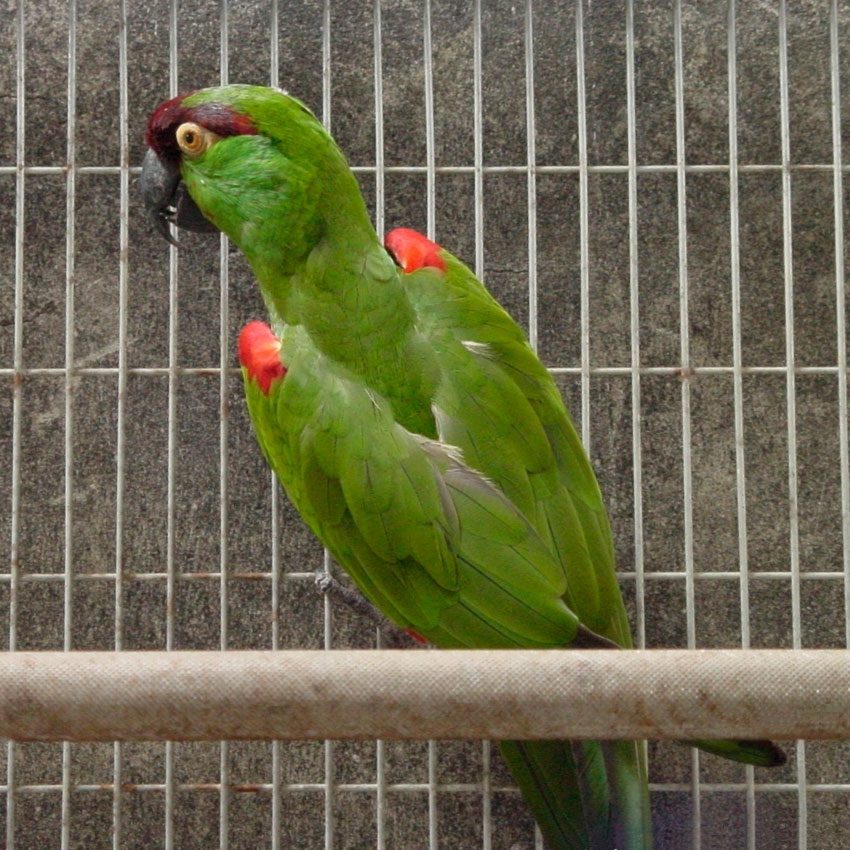
    The Maroon-fronted Parrot (Rhynchopsitta terrisi) It has a size slightly larger than the Thick-billed Parrot. Its bill is large, hooked and curved black. Of tail short in comparison to other members of the family, by high green and below Brown gray. Upright perching, legs short but strong and the fingers toes zigodactilos, i.e. two toes forward and two backwards. Is bright green, slightly more clear and yellowish on the cheekbones and ears. It has a patch brown in the forecrown, red spots on the shoulders and in the the thighs.

    The color of the irises in adults is yellow amber, While in juveniles is coffee. The eye ring is yellow. below the wings they have red border. The rest of the inside of the wings darker Green is. The legs they are greyish.

    Both sexes of similar shape and color.
    Immature with eyes browns and bill paler.

    Often treated as the same species as the Thick-billed Parrot.

    Habitat:

    It lives in temperate with dry winter climates, to high altitudes ranging from the 1,900 to the 3,000 m, exceptionally a 1.300 meters and 3.700 m, in mountainous regions with pine forest (Pinus duranguensis, Pinus ayacahuite, and Pinus arizonica among others), forest of Pine-oak (Pinus spp.. and Quercus spp..), isolated forest fragments of pure FIR (Abies spp..), or mixed forests of oyamel, firs (Pseudotsuga spp..) and poplars (Populus tremuloides). Forests may be at the top of the mountains, open areas or be part of abrupt cliffs and crags land.

    The Maroon-fronted Parrot is a Diurnal with activity social. To the nestsr meets in large flocks, at times of until 100 individuals and to build their nest, Unlike in the Thick-billed Parrot, don't use holes in trees but cavities and cracks in the rock of the cliffs. With pairs once a year with a single partner throughout the reproductive season. Form flocks to find their food. These groups tend to fly at low altitude moving long distances in search of trees with fruits and seeds that can be eaten. It is also possible to find lonely couples looking for food. They sleep in community, flocking on inaccessible crags. Individuals within the flock to communicate by means of strong vocals similar to harsh squawks and squeaks, While they are looking for food or to warn of threats. In general, the species of this family are known to be noisy, especially when they are in groups.

    You know when these birds are approximated by the noises that make, the group flies in a flock that forms an โ€œopen Vโ€. The reproductive colony You can move up to 30 km to find food, If it is scarce. With enough food available near the nests, just move in 3 to 5 daily km.

    Reproduction:

    The breeding season It between July and November. To build the nest using cracks and voids in high limestone crags and they tend to use the same sites year after year to nest. The colony nests above the 1,300 and 1,700 m.

    They put between 2 and 5 eggs (average is 2.7) between mid-June and late July. When is food scarce, drastically reduces the production of broilers. The female incubates eggs between 24 and 27 days which hatch between early September and late October. Since they are born until they fly chicks they remain in the nest for approximately two months, being fed and cared for by both parents. Of all the eggs laid and incubated in the colony only the 60% fledged young occur. The chicks are bred in sync with the maturation of pine seeds, It usually occurs in late summer and autumn.

    Food:

    They eat mainly seeds of coniferous cones, especially of pines (Pinus durangensis, Pinus leiophylla, Pinus ayacahuite, Pinus arizonica, Pinus gregii, Pinus teocote, Pinus montezumae, Pinus cembroides and Pinus engelmannii) and bur-marigold (Pseudotsuga menziesi).

    Its beak is specially adapted to extract seeds from the cones (pine nuts) of Pine. When are pine seeds scarce, include in your diet oak acorns (Quercus spp..) and Guatemalan FIR seeds (Abies spp..). Their diet also includes capulin fruits (Prunus capuli) and flowers of Agave Nectar. In general the diet of both species, the Eastern Mountain Parrot and the Thick-billed Parrot es similar. The Maroon-fronted Parrot has the habit of eating dirt (geophagy) in clay banks.

    Distribution:

    The distribution of the Maroon-fronted Parrot is restricted in the northeast of Mexico. confined in Sierra Madre Oriental, in the southeast of Coahuila de Zaragoza, about Saltillo, in the Centre-West of Nuevo Leรณn, including mountains to the South-West of Monterrey, and the mountains of the West of Tamaulipas.

    Full range of approximately 300 km from North to South, with an average of 60 kilometers from West to East and breeding pairs, possibly, only in the North third.

    Similar to the Thick-billed Parrot, ago seasonal movements (Although probably less extensive) in response to the availability of pine seeds, apparently being distributed to the South of their range only between October and April (old reports of the Thick-billed Parrot in Veracruz they may belong to this species).

    Rare, very local and extinct in many areas. Now limited to restricted areas in the few pine forests that remain (probably around 7.000 kmยฒ of forests within the 18.000 kmยฒ of its range, they are suitable).

    The decrease in its population is mainly due to the loss of habitat by logging, the Agriculture, the burning and the grazing, Although their habits of nesting on cliffs, It avoids the need of old or dead trees. Selective logging can reduce the diversity of pine trees and therefore the availability of food.

    Conservation:

    In 1981 they were estimated between 2,000 and 3,000 individuals of this species.

    State of conservation โ“˜


    Endangered Endangered โ“˜ (UICN)โ“˜

    โ€ข Red List category of the UICN current: In danger of extinction

    โ€ข Population trend: Decreasing

    In 1997 ranked in the The Taray sanctuary, in Coahuila de Zaragoza as the reproductive Center of the species for having been found there near 100 reproductive couples. A 16 km from there, in a place known as Condos the second largest colony was located with 60 couples.

    Census continued and in 1999, the population was estimated at a minimum of 2,500 individuals.

    One recent census based on the large flocks threw an account of approximately 3,500 individuals of Eastern Mountain Parrot.

    The main threat facing the Maroon-fronted Parrot is the destruction and modification of their habitat, mainly due to actions such as agriculture, livestock, logging (to produce wood and paper) and forest fires.

    Its current Habitat is very limited, as well as the area of โ€‹โ€‹its distribution as an endemic species that is.

    The deforestation continues to diminish more and more forests mountain of the region, and unfortunately the recovery or regeneration of these forests is poor compared to pine forests in other parts of the country, which is probably due to the layer of soil of the region is thin and Rocky and scarce rain.

    In 2006, a forest fire devastated about 2,000 It has pine forest in the Sierra, destroying trees that provided food to the Parrot and causing a decrease in the number of chickens raised in the era of nidation. Additionally, when the average size of the trees that make up a forest is reduced and also the area occupied by seed production decreases and the number of defective cones increases, Finally affecting to the Maroon-fronted Parrot that feeds on the seeds.

    Exist protected natural areas on Sierra Madre Oriental that protect and preserve to the Maroon-fronted Parrot.

    Since 1939 was decreed the Cumbres de Monterrey National Park, in Nuevo Leรณn to protect more than 150 thousand hectares of forest, including half of the areas where the species nests. Shortly before it had been decreed, in 1936, The El Potosi National Park, in San Luis Potosi.

    In 1985 created the The El Cielo biosphere reserve, in Tamaulipas. And between the three Protected natural areas partially cover the rest of the known colonies and part of the winter range. Also they have formed private protected natural areas, as the The Taray sanctuary in Coahuila de Zaragoza, nail 350 has of forest, created in 1996 specifically to protect the Maroon-fronted Parrot that contains the nidation largest colony known. This area is managed by the Museum of the birds of Mexico in Saltillo, Coahuila de Zaragoza and has been funded by the National Commission for the knowledge and use of biodiversity (CONABIO) and donations from other national and foreign organizations such as the Zoological Society of San Diego and the Fish and Wildlife Service of United Statess.

    Various research projects they have been conducted from 1995 for the knowledge and conservation of the Maroon-fronted Parrot.

    Recently in 2008, the Universidad Autรณnoma de Nuevo Leรณn (UANL), carried out a project on the Cumbres de Monterrey National Park. For its part, the Instituto Tecnolรณgico de Monterrey (ITESM) and Pronatura After studies in the same area, they have begun to establish landscape-level conservation strategies.

    In the Official standard of species at risk (NAME-059-ECOL-2001), The Maroon-fronted Parrot (Rhynchopsitta terrisi) appears as danger of extinction.

    The Convention on international trade in endangered species of Fauna and Flora Silvestres (CITES) protects it inside of the Appendix I.

    The International Union for the conservation of nature (IUCN for its acronym in English) in his Red list of threatened species, granted the threatened category to the Maroon-fronted Parrot from 1988. Category changed to vulnerable from 1994 up until the present day.

    In the year 2000 the National Consultative Technical Subcommittee for the protection, Conservation and recovery of the Psitacidae, developed the Conservation project, Management and sustainable utilization of the Psitacidae in Mexico (PREP), in which we considered both mountain parrots as priorities for conservation.

    The species of Thick-billed Parrot (R. pachyrhyncha) and Maroon-fronted Parrot (R. terrisi), they are considered from 2008 as priority species in the Species at risk conservation program (NATIONAL HERO) of the National Commission of Protected Natural Areas (CONANP). Due to their biological similarities and a common problem, both were included in a single PACE (Programmes of action for the conservation of species), after the Subcommittee on Psitacidae carried out the Workshop of species identification of priority Psitacidae to be included in a PACE, document that contains, among other aspects related to the biology of the species, the objectives, goals and strategies for the conservation of both Mountain parrots.

    Conservation actions have also been made in the field of the environmental education.

    at the end of 2008, in the framework of the Program for the conservation of species at risk (NATIONAL HERO), seven locations of the Cumbres de Monterrey National Park they conducted environmental education activities with the Maroon-fronted Parrot as a priority species.

    Perhaps the most important conservation measure, the publication is the 14 in October of 2008, in the Official Journal of the Federation, the decree that reforms to the General wildlife law (Decree Art. 60 Bis 2) What prohibits the capture of parrots and macaws from Mexico. The law prohibits the extractive use subsistence or commercial, export, the import or re-export of these native species of the country. With this law is protected 22 bird species of the family Psittacidae in Mexico. The violation of the above provision, is in a federal crime that is punished with prison, through a penalty ranging from 1 to 9 years in prison and up to 12 years if the offence is committed within a protected natural area or is done for commercial purposes.

    The priority regions for the species are located in the Sierra Madre Oriental: The Cumbres de Monterrey National Park, in Nuevo Leรณn, The El Potosi National Park, in San Luis Potosi, the The El Cielo biosphere reserve, in Tamaulipas and the The Taray sanctuary in Coahuila de Zaragoza.

    Source: Site on the network of knowledge on birds of Mexico

    "Maroon-fronted Parrot" in captivity:

    The mountainous region of Wood, Chihuahua, It has been inhabited since makes 1500 years by the ethnic groups that built the "cliff houses", those who originally were hunters and gatherers. The archaeological remains of Paquimรฉ, to 350 km to the Northwest of the city of Chihuahua and half a kilometer from Large houses they indicate that the region had a dedicated trade to the production of feathers from macaws, shells, ceramic and copper among others, the being first settlers in capture and breed, both the Eastern Mountain Parrot as to the Thick-billed Parrot.

    In the conquest increased interest in capturing individuals from the family of the parrots. Starting at the century XVI, they gained greater popularity among Mexicans, mainly as pets.

    During the 20th century This intense trade, In addition to the illegal traffic, has resulted from 1970 and 1982, Mexico It was the largest exporter of live birds to the pet trade coming from the countries of the Neotropics, exporting on average 14,500 Mexican parrots, annually a United States.

    During the period of 1981 to 1985 United States imported a minimum of 703 thousand parrots; and still in 1987 Mexico was the largest source of smuggling of wild birds. In addition only between 1982 and 1983, 104,530 individuals the family were captured in Mexico for the internal domestic market.

    Sale as pets is illegal.

    Alternative names:

    – Maroon-fronted Parrot, Maroon fronted Parrot (English).
    – Conure ร  front brun, Perriche ร  front brun, Perruche ร  front brun (French).
    – Maronenstirnsittich, Maronenstirn-Sittich (German).
    – Papagaio-de-fronte-castanha (Portuguese).
    – Cotorra Serrana Oriental, Cotorra-serrana Oriental (espaรฑol).

    scientific classification:

    – Order: Psittaciformes
    – Family: Psittacidae
    – Genus: Rhynchopsitta
    – Scientific name: Rhynchopsitta terrisi
    – Citation: Moore, RT, 1947
    – Protonimo: Rhynchopsitta terrisi

    Maroon-fronted Parrot images:

    Video of the "Maroon-fronted Parrot"


    Species of the genus Rhynchopsitta

    Maroon-fronted Parrot (Rhynchopsitta terrisi)


    Sources:

    – Avibase
    – Parrots of the World โ€“ Forshaw Joseph M
    – Parrots A Guide to the Parrots of the World – Tony Juniper & Mike Parr
    – Birdlife
    – CONABIO. 2011. Priority species sheets. Maroon-fronted Parrot (Rhynchopsitta terrisi). National Commission of Protected Natural Areas and National Commission for the Knowledge and Use of Biodiversity, Mexico D.F.

    – Photos:

    (1) – An adult Maroon-fronted Parrot in a cage By TJ Lin (originally posted to Flickr as DSC01484) [CC BY-SA 2.0], via Wikimedia Commons
    (2) – Maroon-fronted Parrot by ยฉ greglasley – inaturalist.org
    (3) – Maroon-fronted Parrot by ยฉ greglasley – inaturalist.org
    (4) – Maroon-fronted Parrot by Zรณcalo Saltillo
    (5) – Maroon-fronted Parrot (Rhynchopsitta terrisi) – Loro Parque

    – Sounds: Jon King (Xeno-canto)
    โ–ท The world of Pets: Dogs, cats, birds, reptiles, amphibians

    Pearly Parakeet
    Pyrrhura lepida

    Pearly Parakeet

    Content

    Description:

    Pearly Parakeet

    24 cm.. in length and 70โ€“80 grams in weight.

    The Pearly Parakeet (Pyrrhura lepida) has the head dark blackish brown with mottled light on nape; ear-coverts creamy white; cheeks pale bluish green.

    Upper mantle blue; robe bottom until uppertail-coverts, green. Scapulars green at the base, blue down; lesser wing coverts slightly green tinted olive; median coverts and older, mainly blue; some red at the leading edge of wing . Flight feathers Blue above, secondaries with green in the outerweb; dark gray below. Underwing-coverts bright red. Sides of the neck, the throat and the top chest, mainly brown with some blue marks and points yellowish brown, which gives an overall scaled aspect; The underparts remaining are green with blue on the flanks and the thighs. Upper, the tail mainly brown, green in the basal area and narrow blue tips. Bill black-brown; bare periophthalmic grey; irises dark brown; legs black slate.

    The plumages of both sexes are, apparently, similar.

    taxonomic history

    Confusing taxonomic history: until recently known as Pyrrhura perlata, but that name is actually applied to the known way long as Pyrrhura rhodogaster, currently a synonym for the species Pyrrhura perlata; the current species therefore assumes his next oldest name, Pyrrhura lepida. Forms a pair of species with parapatric Pyrrhura perlata, with which it is sometimes considered conspecific; the recent molecular phylogeny indicated that the closest relatives of these two are the Pyrrhura frontalis and Pyrrhura molinae.

    • Sound of the Pearly Parakeet.

    Description 3 subspecies:

    • Pyrrhura lepida anerythra

      (Neumann, 1927) – Similar to the species nominal but with the chest, the belly and cheeks green with occasional shades of blue.


    • Pyrrhura lepida coerulescens

      (Neumann, 1927) – Similar to the species nominal, but with the forecrown and crown brown, gray throat and upper chest, green on the upper cheeks; bluer in the lower chest

    • .

    • Pyrrhura lepida lepida

      (Wagler, 1832) – Nominal.

    Habitat:

    The Pearly Parakeet, usually, inhabits moist terra firme forests. The species has been observed in forest edges, clear areas and second growth.

    They are seen in flocks of up to ten birds, particularly in places where food is plentiful.

    Reproduction:

    They nest hollow logs. The laying is of 3-4 eggs incubados during 23 days; the hatchling needs close to 7 weeks for independence.

    Food:

    probably catkins, small fruits and flowers.

    Distribution and status:

    Size of its range (breeding/resident): 585.000 km2

    The Cotorra Pulcra is endemic to Northeast Brazil, to the South of the Amazonia. Observed around the basin Xingรบ and its tributaries, from the Pracui River and the left bank of Tocantins River, and from Belem and the Capim River, in For, east to around Sao Luis in maranhรฃo, and from northern maranhรฃo to the East of Rosary, although apparently no longer in some coastal areas, where according to sources, They were formerly quite common.

    Today are rare and extinct in many parts of their former range (for example, North of maranhรฃo) due to large-scale deforestation, although they are, apparently, tolerant habitat alterations.
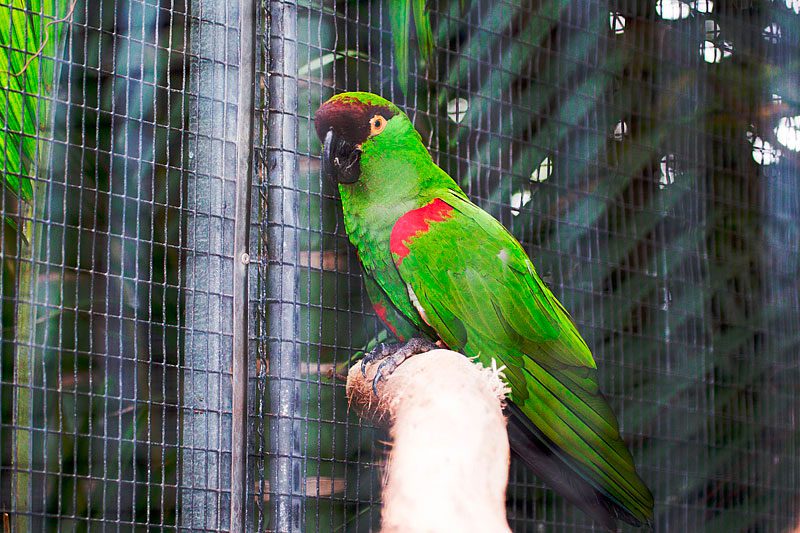
    The coerulescens subspecies It is near extinction due to the almost total loss of their habitat. The species is found in protected areas but its integrity is compromised by the illegal logging.

    Distribution 3 subspecies:

    Note:

    Pyrrhura lepida is the new name of the taxon Pyrrhura perlata, whose name has been shown to be applied first to an immature bird of that species, Crimson-bellied Parakeet (Pyrrhura perlata).

    Conservation:

    State of conservation โ“˜


    Vulnerable Vulnerable โ“˜ (UICN)โ“˜

    โ€ข Current category of the Red List of the UICN: Vulnerable.

    โ€ข Population trend: Decreasing.

    โ€ข Population size : 6700 individuals.

    Rationale for the Red List category

    From a model of future deforestation in the Amazon basin, While shows some tolerance degraded landscapes, It suspected that the population of this species decline rapidly over the next three generations and, therefore, It has risen to Vulnerable.

    Justification of the population

    The population is preliminarily estimated at the number of at least 10.000 individuals, approximately equivalent to 6.700 mature individuals. This requires confirmation.

    Justification of trend

    It is suspected that this species has lost between 47 and the 64,5% of habitat suitable within their distribution during three generations (18 years) starting from a model of deforestation Amazon (Soares-Filho et to the ., 2006, Bird et to the ., 2011). But, because the species seems to have some degree of tolerance to habitat degradation (A. Lees in litt ., 2011), It suspected to decline by 30-49% during three generations.

    Threats

    Despite an apparent tolerance of some degradation of the habitat, It is perhaps close to extinction in coastal areas of northern maranhรฃo, due to the large scale deforestation (Juniper and Parr, 1998). They are distributed within protected areas, but its integrity is compromised by the illegal logging (Juniper and Parr 1998). Deforestation in the Amazon basin is expected to increase as land is cleared for cattle ranching and soy production, provided by the expansion of the road network (Soares-Filho et to the. , 2006). The proposed changes to Brazilian Forest Code reduce the percentage of land that a private owner is legally required to keep as forest and include an amnesty for owners who deforested before July 2008 (That they would later be absolved of the need to reforest the illegally cleared land) (Bird et to the., 2011).

    Conservation Actions Underway

    CITES Appendix II. The species is classified as Vulnerable nationally in Brazil (MMA 2014), with subspecies elegant and coerulescens considered in Danger (Silveira y Straube 2008).

    Conservation Actions Proposed

    * Census and population monitoring to assess the world's population and demographic trends and refine distribution and locate strengths.

    * Investigate its ecology, threats and conservation requirements. Strengthen the network of protected areas within the remaining core habitat.

    Effectively manage resources and management of existing protected areas and new, using the emerging opportunities for funding the management of protected areas with the overall goal of reducing carbon emissions and maximize the conservation of biodiversity. It is also essential conservation on private land, through the expansion of market pressures for proper land management and prevention of deforestation on land not suitable for agriculture (Soares-Filho et to the., 2006).

    Campaign against proposed changes to the Brazilian Forest Code that would lead to a decrease in the width of protected riparian forest areas as Permanent Preservation Areas (APPs), that function as vital corridors in fragmented landscapes.

    "Pearly Parakeet" in captivity:

    Rare in captivity.

    It is a bird Vulnerable nationally in Brazil and protected by CITES Appendix II; each captive specimen of this species that is capable of reproducing, must be placed in a well-managed captive breeding program and not sold as a pet, in order to ensure its long-term survival.

    Alternative names:

    – Pearly Conure, Pearly Parakeet (English).
    – Conure perlรฉe, Perriche perlรฉe, Perruche perlรฉe (French).
    – BlausteiรŸsittich (German).
    – tiriba, tiriba-de-barriga-vermelha, Tiriba-perรณla, tiriba-pรฉrola (Portuguese).
    – Catita cola granate, Cotorra Pulcra, Cotorra Ventrirroja (espaรฑol).


    scientific classification:

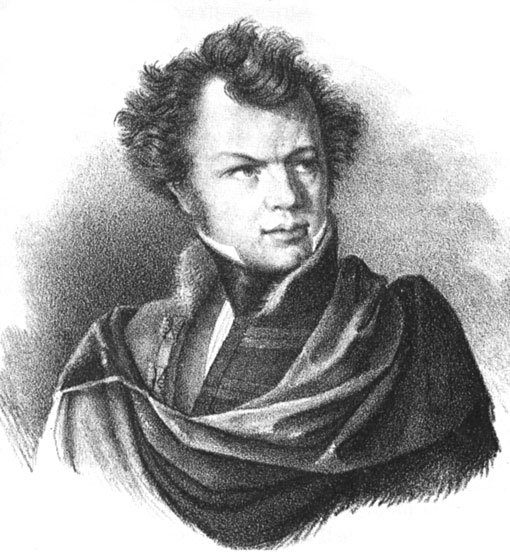
    Johann Georg Wagler
    Johann Georg Wagler

    – Order: Psittaciformes
    – Family: Psittacidae
    – Genus: Pyrrhura
    – Scientific name: Pyrrhura lepida
    – Citation: (Wagler, 1832)
    – Protonimo: Sittace lepida

    Images Pearly Parakeet:

    Videos "Pearly Parakeet"


    Especies del gรฉnero Pyrrhura

    Pearly Parakeet (Pyrrhura lepida)


    Sources:

    – Avibase
    – Parrots of the World โ€“ Forshaw Joseph M
    – Parrots A Guide to the Parrots of the World – Tony Juniper & Mike Parr
    – Birdlife

    – Photos:

    (1) – Pyrrhura lepida by Florin Feneru – Flickr
    (2) – Pyrrhura lepida coerulescens Neumann, 1929 – Huub Veldhuijzen van Zanten / Naturalis Biodiversity Center [CC BY-SA 3.0], via Wikimedia Commons
    (3) – Pearly Parakeet (Pyrrhura lepida) also known as the Pearly Conure in aviculture. A pet parrot By manginwu (originally posted to Flickr as my name is twoday.) [CC BY-SA 2.0], via Wikimedia Commons
    (4) – Tiriba-perola [Pearly Parakeet] by Helio Lourencini – Flickr
    (5) – Tiriba pearl (Pyrrhura perlata) – www.avesilvestre.com.br
    (6) – Parrots A Guide to the Parrots of the World โ€“ Tony Juniper & Mike Parr

    – Sounds: GABRIEL MILK, XC212988. accessible www.xeno-canto.org/212988