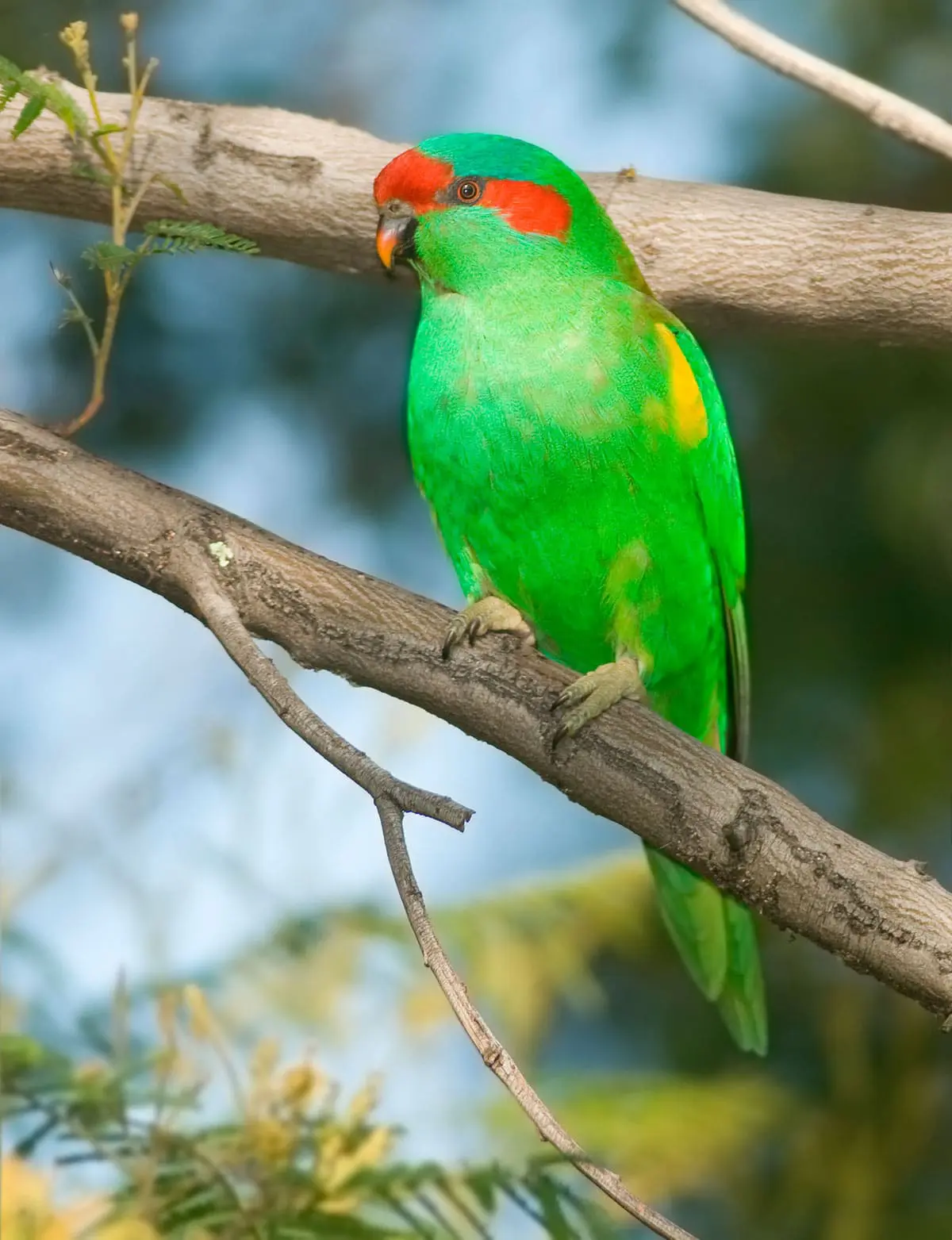
โ–ท The world of Pets: Dogs, cats, birds, reptiles, amphibians

Orange-winged Parrot
Amazona amazonica

Amazona Alinaranja

Content


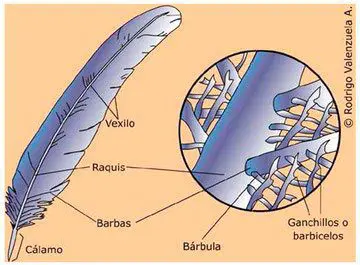
Anatomy-parrots

Description Orange-winged Parrot

Of 33 to 36 cm.. height can weigh between 350 gr y 450 gr.
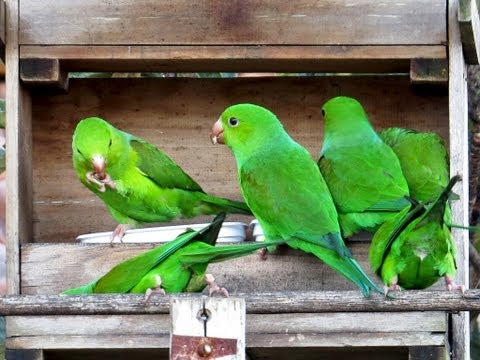
The Orange-winged Parrot (Amazona amazonica) It is distinguishable by having the Centre of the crown and cheeks yellow, separated by the forecrown and sides of the crown pale blue, edge of the wing orange, and inside of the tail Orange with stripe green in the Middle.
The copies juveniles have a color different to it of them adults; the head is green, Blue and pale yellow.
It is not possible to determine the sex of the Amazons in a safe manner by their appearance.

Habitat:

Present in varied habitats (dry forests, morichales, Savanna, stubble, mangroves, etc.) below the 500 m.

Frequently is seen in pairs or in flocks numerous out of it breeding season.

Reproduction:

It is a kind monogamous (the couple stays together for life).

It nests in trunks of Palms killed apparently at the end of the season dry.
The female lays from 3 to 5 eggs and she incubates them for three weeks approximately. the chicks take two months to develop.

Food:

It feeds on various fruits, seeds and sprouts leaves. Including the fruit of Palms (Sloanea, Richeria and Byrsonima) , flowers Erythrina and sometimes cocoa.
You can take oranges and mangoes of the cultivated areas when other food is scarce.

Distribution:


Size of the area of distribution (reproduction / resident): 7.420.000 km2

North and Central South America to the East of Peru, Brazilian Amazon and northeast of Bolivia.

Conservation:

State of conservation โ“˜


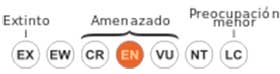
minor concern Minor Concern โ“˜ (UICN)โ“˜
  • Current red list category of the UICN: Least concern.
  • The population trend: Decreasing.

  • Trapped for the wild bird trade: they have been 268.510 wild-caught individuals for international trade from 1981.
    In some areas of their range they are hunted for food by the indigenous population.
    The loss of habitat is also a concern.


    "Orange-winged Parrot" in captivity:

    Video – "Orange-winged Parrot"

    Amazona Amazonica

    Popular as a mascot for more than 100 years.
    Loving, playful, with good ability to speak, sociable with people.

    Known for being very friendly, easy to train, very Smart.
    They need constant attention of their owners, they carry out all kinds of fun pranks to get that attention.
    Over time they will form a strong bond with their owner., they can however be quite noisy. They will make noise early in the morning and when the Sun is setting. This usually lasts for a few 10 minutes, to wake up and just before sleep.

    Alternative names:

    Orange winged Parrot, Common Amazon Parrot, Orange-winged Amazon, Orange-winged Parrot (English).
    Amazone ร  ailes orange, Amazone aourou (French).
    Venezuelaamazone (German).
    curica, airu-curuca, ajuru-catinga, ajuru-curau, ajuru-curuca, curau, curuรงรก, Papagaio-do-mangue, papagaio-grego, papagaio-poaieiro (Portuguese).
    Amazona Alinaranja, Amazona Guaro, Cotorra Alianaranjada, Lora Amazรณnica, Loro Real, Lora alianaranjada (espaรฑol).
    Lora Amazรณnica (Colombia).
    Loro Guaro (Venezuela).

    scientific classification:

    Order: Psittaciformes
    Family: Psittacidae
    Genus: Amazona
    Scientific name: Amazona amazonica
    Citation: (Linnaeus, 1766)
    Protonimo: Psittacus amazonicus

    Orange winged Parrot images :


    Species of the genus Amazona


    Sources:

    – Parrot Book, Parrots and macaws Neotropical
    avibase

    Photos:

    Our beautiful world
    – An Orange-winged Amazon at Kuala Lumpur Bird Park, Malaysia. It is eating a slice of corn on the cob by Vasenka – Wikimedia
    – by Patrick Ingremeau – IBC.lynxeds.com
    – by Snowmanradio (talk) – Wikimedia
    – by Thore Noernberg – IBC.lynxeds.com

    Sounds: Joao Antonio de B.. Vitto (Xeno-canto)

    โ–ท The world of Pets: Dogs, cats, birds, reptiles, amphibians

    Pygmy Lorikeet
    Charmosyna wilhelminae

    Pygmy Lorikeet

    Content


    Anatomy-parrots

    Description

    The Pygmy Lorikeet (Charmosyna wilhelminae) has an approximate length of 13 cm.. and a weight of 20 g..

    The head is green; the forecrown brighter yellowish green; crown dark purple, with broadcast Blue in them tips and color turquoise bright in the feathers of the nape; rear of the nape with wash of olive. Mantle green; low back and tail reddish color; at the top, the tail purple blue. The wings, by up green with parts internal of the flight feather Blackish and blackish the primary coverts. The wings below rosa-salmon; Tips from the flight feather blackish. The underparts Green yellowish with prominent veins on the chest. Upper, the tail green, Red at the base (normally hidden in the field); olive brown below with red and yellow tips on the base. The bill reddish orange-tipped yellow; cere color red pink; Grey the ring perioftalmico; irises yellow to orange-red; legs light grey.

    Female lack of red on it rump and in the wings view in flight.
    Immature generally more muted and upperparts slightly more Brown. Lacks blue at the tips of the feathers of the nape. Yellow stripes on the top of the chest less distinct or absent. The bill and the irises brown.

    Habitat:

    Mainly inhabits in humid forests and on the edge of forests, but also by forest savanna and established secondary vegetation. It is usually between the 1.000 meters of altitude and the 2.200 m, but in the South and around Port Moresby It is occasionally much closer to sea level, in the forests of lowlands. It forages in couples and small flocks of up to 20 birds in the trees in flower, often in the company of Goldie's Lorikeet and Fairy Lorikeet. Very Active When it feeds and, often difficult to identify due to its size and predominantly green plumage. It is not uncommon, but easily overlooked. and has been found in groups of up to 200 individuals. It has often been seen flying in mixed flocks above the canopy, where they can hardly be identified due to their small size.

    Reproduction:

    Breeding and nesting habits unknown.

    Food:

    Feeds of nectar and pollen.

    Distribution:

    Size of the area of distribution (reproduction / resident): 290.000 km2

    North of New Guinea in Irian Java (Indonesian) and Papua New Guinea. The range of the Mountains Parotia on doberai peninsula, in the West of the island of New Guinea, through the cordillera central, the Huon Peninsula, and South-East of the mountain range of Owen Stanley. In the immediate vicinity of Port Moresby (for example, area Sogeri) There is little (but possibly regular between May and November).

    The population world will think that is of less than 50.000 specimens and is considered to be stable. There are few in captivity.

    Conservation:


    minor concern


    โ€ข Current IUCN Red List category: Least concern.

    โ€ข Population trend: Stable.


    The size of the world population It has not been quantified, but the species according to sources is generally very rare.

    The population suspected to be stable in the absence of evidence of any reduction or substantial threats.


    "Pygmy Lorikeet" in captivity:

    Rare.

    Alternative names:

    Pygmy Lorikeet, Pygmy Streaked Lorikeet, Pygmy Streaked Lory, Wilhelmina’s Lorikeet, Wilhemina’s Lorikeet (ingles).
    Lori de Wilhelmina (French).
    Elfenlori (German).
    Lori Pigmeo (espaรฑol).

    scientific classification:

    Order: Psittaciformes
    Family: Psittaculidae
    Genus: Charmosyna
    Scientific name: Charmosyna wilhelminae
    Citation: (Meyer,AB, 1874)
    Protonimo: Trichoglossus Wilhelminae

    Images "Pygmy Lorikeet"

    ————————————————————————————————

    ยซLori Pygmyยป (Charmosyna wilhelminae)


    Sources:

    Avibase
    – Parrots of the World โ€“ Forshaw Joseph M
    – Parrots A Guide to the Parrots of the World – Tony Juniper & Mike Parr
    Birdlife

    Photos:

    1 – loromania

    โ–ท The world of Pets: Dogs, cats, birds, reptiles, amphibians

    Olive-shouldered Parrot
    Aprosmictus jonquillaceus

    Olive-shouldered Parrot

    Content


    Anatomy-parrots

    Description

    35 cm.. length and 130 g. of weight.

    The Olive-shouldered Parrot (Aprosmictus jonquillaceus) has the head bright pale green. "Mantle" and back darker green color that the of the head and underparts, showing a blue diffusion; rump bright teal pale. Uppertail brighter yellowish green.

    Upper, the wing feathers with small coverts fused in color yellow-green; Blue dark greenish in the curve of the wings; outer median coverts bright Scarlet, feathers interiors lit of color green yellowish with a bit of red in the tips. Large external coverts scarlet, feathers interiors light green, some showing red ends; some feathers turquoise green on the edge of the carpus; primary coverts Green with broadcasting blue at the tips of the vane outer; secondary green medium, primaries medium green with blue diffusion in the coats of the feathers outermost. Wing feathers brighter yellowish green; underside of flight feather black. The underparts light green, more yellowish in them the thighs and undertail-coverts. Upper, the tail of color green dark with edges of color yellow, and with vane yellowish external to the lateral feathers; undertail, the tail of color Brown blackish with tips yellow, and with yellowish diffusion in vane outside of lateral feathers.

    Bill orange red, with yellow tip; irises orange: legs blackish gray.

    The female lacks of the broadcast Blue in the the mantle, shows less contrast between the head and the the mantle, limb yellowish to them greater coverts red, and have them irises more Brown.

    Immature has green, No greenish-yellow, in the wing-coverts and irises of Brown pale.

    Subspecies description

    • Aprosmictus jonquillaceus wetterensis

      (Salvadori, 1891) – The male as the nominal but the coverts wing lower and Middle are of color green washed with yellow; the mantle and top of the back pale green, with less blue markings; less red on the outer half and the secondary wings covers; smaller.

      The female is like the female of the nominal species, but the uppertail-coverts darker green; slightly smaller in size.

      The youth as the youth of the nominal species, but with the uppertail-coverts darker green; smaller.


    • Aprosmictus jonquillaceus jonquillaceus

      (Vieillot, 1818) – The nominal

    Habitat:

    In Timor the species is found in forests, acacia savannas, primary and secondary forest, from sea level to the 2.200 m (2.600 meters altitude extreme). In Wetar, observed in 1990 in recently logged forests, near the coast.

    The ecology of the species is probably similar to that of the Red-winged Parrot, but it is not well known; observations of birds that fly involve couples and small flocks. A couple allowed a closer approach, observing her in silence to three meters high in a big tree.

    Reproduction:

    Their reproductive habits are unknown, probably similar to the of the Red-winged Parrot.

    Food:

    Probably similar to the of the Red-winged Parrot: seeds, fruit, flowers and insects; in the mangroves, the mistletoe is your favorite food.

    Distribution:

    Size of the area of distribution (reproduction / resident): 28.500 km2

    Endemic and quite common in Timor (for example, about Camplong, Kupang, Lelogama, Mutis and Dili), Wetar and Roti.

    The world population is estimated at around 10.000 specimens and it is probably stable, although like most Indonesian parrots the species is vulnerable to capture and habitat loss. A moderate number in captivity.

    Subspecies distribution:

    Conservation:


    Near-threatened


    โ€ข Current IUCN Red List category: Near threatened

    โ€ข Population trend: Decreasing

    The total population has been estimated at 10,000 individuals (Lambert et to the., 1993), probably including mature individuals 6,700.

    The population is suspected that it may be declining due to the continuous destruction of the habitat and unsustainable levels of exploitation.

    Ongoing conservation actions

    Appendix II of CITES. Quotas were imposed during the Decade zero of 1990 while uncertainty existed about the total population size, but these are not met.

    Conservation Actions Proposed

    โ€ข Review estimates of the population of the species and review the impact of trade on their numbers..
    โ€ข Determine if declines are still evident.
    โ€ข Protect areas of suitable habitat.

    "Olive-shouldered Parrot" in captivity:

    Game, with low noise level, aggressive with other birds. You can require deworming.

    Very rare in captivity

    Alternative names:

    Olive-shouldered Parrot, Jonquil Parrot, Olive shouldered Parrot, Timor Parrot, Timor Red-winged Parrot (ingles).
    Perruche jonquille (French).
    Timorsittich, Timor Sittich (German).
    Periquito-de-asa-vermelha-de-timor (Portuguese).
    Papagayo de Timor (espaรฑol).

    scientific classification:

    Order: Psittaciformes
    Family: Psittaculidae
    Genus: Aprosmictus
    Scientific name: Aprosmictus jonquillaceus
    Citation: (Vieillot, 1818)
    Protonimo: Psittacus jonquillaceus

    Images "Olive-shouldered Parrot"

    ————————————————————————————————

    ยซTimor parrotยป (Aprosmictus jonquillaceus)


    Sources:

    Avibase
    – Parrots of the World โ€“ Forshaw Joseph M
    – Parrots A Guide to the Parrots of the World – Tony Juniper & Mike Parr
    – Birdlife

    Photos:

    (1) – Aprosmictus Jonquillaceus – LoroMania

    Sounds: Mike Nelson (Xeno-canto)
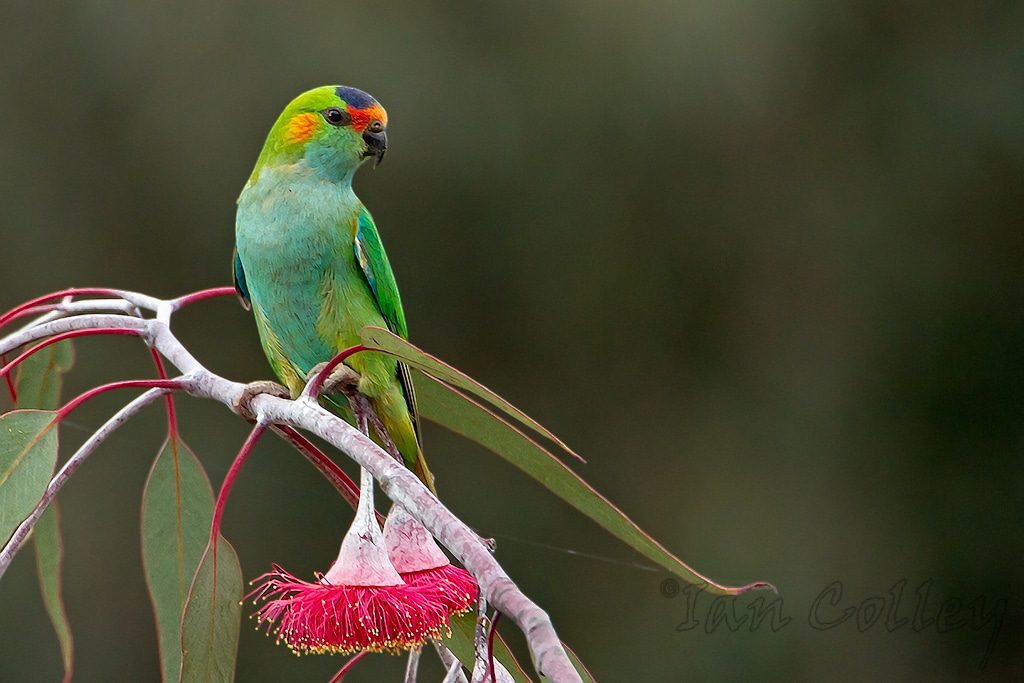
    โ–ท The world of Pets: Dogs, cats, birds, reptiles, amphibians

    Maroon-fronted Parrot
    Rhynchopsitta terrisi


    Cotorra Serrana Oriental

    Content

    Description:


    Anatomy-parrots

    Among 40 and 45 cm.. length and 300 g. of weight.

    The Maroon-fronted Parrot (Rhynchopsitta terrisi) It has a size slightly larger than the Thick-billed Parrot. Its bill is large, hooked and curved black. Of tail short in comparison to other members of the family, by high green and below Brown gray. Upright perching, legs short but strong and the fingers toes zigodactilos, i.e. two toes forward and two backwards. Is bright green, slightly more clear and yellowish on the cheekbones and ears. It has a patch brown in the forecrown, red spots on the shoulders and in the the thighs.

    The color of the irises in adults is yellow amber, While in juveniles is coffee. The eye ring is yellow. below the wings they have red border. The rest of the inside of the wings darker Green is. The legs they are greyish.

    Both sexes of similar shape and color.
    Immature with eyes browns and bill paler.

    Often treated as the same species as the Thick-billed Parrot.

    Habitat:

    It lives in temperate with dry winter climates, to high altitudes ranging from the 1,900 to the 3,000 m, exceptionally a 1.300 meters and 3.700 m, in mountainous regions with pine forest (Pinus duranguensis, Pinus ayacahuite, and Pinus arizonica among others), forest of Pine-oak (Pinus spp.. and Quercus spp..), isolated forest fragments of pure FIR (Abies spp..), or mixed forests of oyamel, firs (Pseudotsuga spp..) and poplars (Populus tremuloides). Forests may be at the top of the mountains, open areas or be part of abrupt cliffs and crags land.

    The Maroon-fronted Parrot is a Diurnal with activity social. To the nestsr meets in large flocks, at times of until 100 individuals and to build their nest, Unlike in the Thick-billed Parrot, don't use holes in trees but cavities and cracks in the rock of the cliffs. With pairs once a year with a single partner throughout the reproductive season. Form flocks to find their food. These groups tend to fly at low altitude moving long distances in search of trees with fruits and seeds that can be eaten. It is also possible to find lonely couples looking for food. They sleep in community, flocking on inaccessible crags. Individuals within the flock to communicate by means of strong vocals similar to harsh squawks and squeaks, While they are looking for food or to warn of threats. In general, the species of this family are known to be noisy, especially when they are in groups.

    You know when these birds are approximated by the noises that make, the group flies in a flock that forms an โ€œopen Vโ€. The reproductive colony You can move up to 30 km to find food, If it is scarce. With enough food available near the nests, just move in 3 to 5 daily km.

    Reproduction:

    The breeding season It between July and November. To build the nest using cracks and voids in high limestone crags and they tend to use the same sites year after year to nest. The colony nests above the 1,300 and 1,700 m.

    They put between 2 and 5 eggs (average is 2.7) between mid-June and late July. When is food scarce, drastically reduces the production of broilers. The female incubates eggs between 24 and 27 days which hatch between early September and late October. Since they are born until they fly chicks they remain in the nest for approximately two months, being fed and cared for by both parents. Of all the eggs laid and incubated in the colony only the 60% fledged young occur. The chicks are bred in sync with the maturation of pine seeds, It usually occurs in late summer and autumn.

    Food:

    They eat mainly seeds of coniferous cones, especially of pines (Pinus durangensis, Pinus leiophylla, Pinus ayacahuite, Pinus arizonica, Pinus gregii, Pinus teocote, Pinus montezumae, Pinus cembroides and Pinus engelmannii) and bur-marigold (Pseudotsuga menziesi).

    Its beak is specially adapted to extract seeds from the cones (pine nuts) of Pine. When are pine seeds scarce, include in your diet oak acorns (Quercus spp..) and Guatemalan FIR seeds (Abies spp..). Their diet also includes capulin fruits (Prunus capuli) and flowers of Agave Nectar. In general the diet of both species, the Eastern Mountain Parrot and the Thick-billed Parrot es similar. The Maroon-fronted Parrot has the habit of eating dirt (geophagy) in clay banks.

    Distribution:

    The distribution of the Maroon-fronted Parrot is restricted in the northeast of Mexico. confined in Sierra Madre Oriental, in the southeast of Coahuila de Zaragoza, about Saltillo, in the Centre-West of Nuevo Leรณn, including mountains to the South-West of Monterrey, and the mountains of the West of Tamaulipas.

    Full range of approximately 300 km from North to South, with an average of 60 kilometers from West to East and breeding pairs, possibly, only in the North third.

    Similar to the Thick-billed Parrot, ago seasonal movements (Although probably less extensive) in response to the availability of pine seeds, apparently being distributed to the South of their range only between October and April (old reports of the Thick-billed Parrot in Veracruz they may belong to this species).

    Rare, very local and extinct in many areas. Now limited to restricted areas in the few pine forests that remain (probably around 7.000 kmยฒ of forests within the 18.000 kmยฒ of its range, they are suitable).

    The decrease in its population is mainly due to the loss of habitat by logging, the Agriculture, the burning and the grazing, Although their habits of nesting on cliffs, It avoids the need of old or dead trees. Selective logging can reduce the diversity of pine trees and therefore the availability of food.

    Conservation:

    In 1981 they were estimated between 2,000 and 3,000 individuals of this species.

    State of conservation โ“˜


    Endangered Endangered โ“˜ (UICN)โ“˜

    โ€ข Red List category of the UICN current: In danger of extinction

    โ€ข Population trend: Decreasing

    In 1997 ranked in the The Taray sanctuary, in Coahuila de Zaragoza as the reproductive Center of the species for having been found there near 100 reproductive couples. A 16 km from there, in a place known as Condos the second largest colony was located with 60 couples.

    Census continued and in 1999, the population was estimated at a minimum of 2,500 individuals.

    One recent census based on the large flocks threw an account of approximately 3,500 individuals of Eastern Mountain Parrot.

    The main threat facing the Maroon-fronted Parrot is the destruction and modification of their habitat, mainly due to actions such as agriculture, livestock, logging (to produce wood and paper) and forest fires.

    Its current Habitat is very limited, as well as the area of โ€‹โ€‹its distribution as an endemic species that is.

    The deforestation continues to diminish more and more forests mountain of the region, and unfortunately the recovery or regeneration of these forests is poor compared to pine forests in other parts of the country, which is probably due to the layer of soil of the region is thin and Rocky and scarce rain.

    In 2006, a forest fire devastated about 2,000 It has pine forest in the Sierra, destroying trees that provided food to the Parrot and causing a decrease in the number of chickens raised in the era of nidation. Additionally, when the average size of the trees that make up a forest is reduced and also the area occupied by seed production decreases and the number of defective cones increases, Finally affecting to the Maroon-fronted Parrot that feeds on the seeds.

    Exist protected natural areas on Sierra Madre Oriental that protect and preserve to the Maroon-fronted Parrot.

    Since 1939 was decreed the Cumbres de Monterrey National Park, in Nuevo Leรณn to protect more than 150 thousand hectares of forest, including half of the areas where the species nests. Shortly before it had been decreed, in 1936, The El Potosi National Park, in San Luis Potosi.

    In 1985 created the The El Cielo biosphere reserve, in Tamaulipas. And between the three Protected natural areas partially cover the rest of the known colonies and part of the winter range. Also they have formed private protected natural areas, as the The Taray sanctuary in Coahuila de Zaragoza, nail 350 has of forest, created in 1996 specifically to protect the Maroon-fronted Parrot that contains the nidation largest colony known. This area is managed by the Museum of the birds of Mexico in Saltillo, Coahuila de Zaragoza and has been funded by the National Commission for the knowledge and use of biodiversity (CONABIO) and donations from other national and foreign organizations such as the Zoological Society of San Diego and the Fish and Wildlife Service of United Statess.

    Various research projects they have been conducted from 1995 for the knowledge and conservation of the Maroon-fronted Parrot.

    Recently in 2008, the Universidad Autรณnoma de Nuevo Leรณn (UANL), carried out a project on the Cumbres de Monterrey National Park. For its part, the Instituto Tecnolรณgico de Monterrey (ITESM) and Pronatura After studies in the same area, they have begun to establish landscape-level conservation strategies.

    In the Official standard of species at risk (NAME-059-ECOL-2001), The Maroon-fronted Parrot (Rhynchopsitta terrisi) appears as danger of extinction.

    The Convention on international trade in endangered species of Fauna and Flora Silvestres (CITES) protects it inside of the Appendix I.

    The International Union for the conservation of nature (IUCN for its acronym in English) in his Red list of threatened species, granted the threatened category to the Maroon-fronted Parrot from 1988. Category changed to vulnerable from 1994 up until the present day.

    In the year 2000 the National Consultative Technical Subcommittee for the protection, Conservation and recovery of the Psitacidae, developed the Conservation project, Management and sustainable utilization of the Psitacidae in Mexico (PREP), in which we considered both mountain parrots as priorities for conservation.

    The species of Thick-billed Parrot (R. pachyrhyncha) and Maroon-fronted Parrot (R. terrisi), they are considered from 2008 as priority species in the Species at risk conservation program (NATIONAL HERO) of the National Commission of Protected Natural Areas (CONANP). Due to their biological similarities and a common problem, both were included in a single PACE (Programmes of action for the conservation of species), after the Subcommittee on Psitacidae carried out the Workshop of species identification of priority Psitacidae to be included in a PACE, document that contains, among other aspects related to the biology of the species, the objectives, goals and strategies for the conservation of both Mountain parrots.

    Conservation actions have also been made in the field of the environmental education.

    at the end of 2008, in the framework of the Program for the conservation of species at risk (NATIONAL HERO), seven locations of the Cumbres de Monterrey National Park they conducted environmental education activities with the Maroon-fronted Parrot as a priority species.

    Perhaps the most important conservation measure, the publication is the 14 in October of 2008, in the Official Journal of the Federation, the decree that reforms to the General wildlife law (Decree Art. 60 Bis 2) What prohibits the capture of parrots and macaws from Mexico. The law prohibits the extractive use subsistence or commercial, export, the import or re-export of these native species of the country. With this law is protected 22 bird species of the family Psittacidae in Mexico. The violation of the above provision, is in a federal crime that is punished with prison, through a penalty ranging from 1 to 9 years in prison and up to 12 years if the offence is committed within a protected natural area or is done for commercial purposes.

    The priority regions for the species are located in the Sierra Madre Oriental: The Cumbres de Monterrey National Park, in Nuevo Leรณn, The El Potosi National Park, in San Luis Potosi, the The El Cielo biosphere reserve, in Tamaulipas and the The Taray sanctuary in Coahuila de Zaragoza.

    Source: Site on the network of knowledge on birds of Mexico

    "Maroon-fronted Parrot" in captivity:

    The mountainous region of Wood, Chihuahua, It has been inhabited since makes 1500 years by the ethnic groups that built the "cliff houses", those who originally were hunters and gatherers. The archaeological remains of Paquimรฉ, to 350 km to the Northwest of the city of Chihuahua and half a kilometer from Large houses they indicate that the region had a dedicated trade to the production of feathers from macaws, shells, ceramic and copper among others, the being first settlers in capture and breed, both the Eastern Mountain Parrot as to the Thick-billed Parrot.

    In the conquest increased interest in capturing individuals from the family of the parrots. Starting at the century XVI, they gained greater popularity among Mexicans, mainly as pets.

    During the 20th century This intense trade, In addition to the illegal traffic, has resulted from 1970 and 1982, Mexico It was the largest exporter of live birds to the pet trade coming from the countries of the Neotropics, exporting on average 14,500 Mexican parrots, annually a United States.

    During the period of 1981 to 1985 United States imported a minimum of 703 thousand parrots; and still in 1987 Mexico was the largest source of smuggling of wild birds. In addition only between 1982 and 1983, 104,530 individuals the family were captured in Mexico for the internal domestic market.

    Sale as pets is illegal.

    Alternative names:

    Maroon-fronted Parrot, Maroon fronted Parrot (English).
    Conure ร  front brun, Perriche ร  front brun, Perruche ร  front brun (French).
    Maronenstirnsittich, Maronenstirn-Sittich (German).
    Papagaio-de-fronte-castanha (Portuguese).
    Cotorra Serrana Oriental, Cotorra-serrana Oriental (espaรฑol).

    scientific classification:

    Order: Psittaciformes
    Family: Psittacidae
    Genus: Rhynchopsitta
    Scientific name: Rhynchopsitta terrisi
    Citation: Moore, RT, 1947
    Protonimo: Rhynchopsitta terrisi

    Maroon-fronted Parrot images:

    Video of the "Maroon-fronted Parrot"


    Species of the genus Rhynchopsitta

    Maroon-fronted Parrot (Rhynchopsitta terrisi)


    Sources:

    Avibase
    – Parrots of the World โ€“ Forshaw Joseph M
    – Parrots A Guide to the Parrots of the World – Tony Juniper & Mike Parr
    – Birdlife
    – CONABIO. 2011. Priority species sheets. Maroon-fronted Parrot (Rhynchopsitta terrisi). National Commission of Protected Natural Areas and National Commission for the Knowledge and Use of Biodiversity, Mexico D.F.

    Photos:

    (1) – An adult Maroon-fronted Parrot in a cage By TJ Lin (originally posted to Flickr as DSC01484) [CC BY-SA 2.0], via Wikimedia Commons
    (2) – Maroon-fronted Parrot by ยฉ greglasley – inaturalist.org
    (3) – Maroon-fronted Parrot by ยฉ greglasley – inaturalist.org
    (4) – Maroon-fronted Parrot by Zรณcalo Saltillo
    (5) – Maroon-fronted Parrot (Rhynchopsitta terrisi) – Loro Parque

    Sounds: Jon King (Xeno-canto)

    โ–ท The world of Pets: Dogs, cats, birds, reptiles, amphibians

    Pearly Parakeet
    Pyrrhura lepida

    Pearly Parakeet

    Content

    Description:

    Pearly Parakeet

    24 cm.. in length and 70โ€“80 grams in weight.

    The Pearly Parakeet (Pyrrhura lepida) has the head dark blackish brown with mottled light on nape; ear-coverts creamy white; cheeks pale bluish green.

    Upper mantle blue; robe bottom until uppertail-coverts, green. Scapulars green at the base, blue down; lesser wing coverts slightly green tinted olive; median coverts and older, mainly blue; some red at the leading edge of wing . Flight feathers Blue above, secondaries with green in the outerweb; dark gray below. Underwing-coverts bright red. Sides of the neck, the throat and the top chest, mainly brown with some blue marks and points yellowish brown, which gives an overall scaled aspect; The underparts remaining are green with blue on the flanks and the thighs. Upper, the tail mainly brown, green in the basal area and narrow blue tips. Bill black-brown; bare periophthalmic grey; irises dark brown; legs black slate.

    The plumages of both sexes are, apparently, similar.

    taxonomic history

    Confusing taxonomic history: until recently known as Pyrrhura perlata, but that name is actually applied to the known way long as Pyrrhura rhodogaster, currently a synonym for the species Pyrrhura perlata; the current species therefore assumes his next oldest name, Pyrrhura lepida. Forms a pair of species with parapatric Pyrrhura perlata, with which it is sometimes considered conspecific; the recent molecular phylogeny indicated that the closest relatives of these two are the Pyrrhura frontalis and Pyrrhura molinae.

    • Sound of the Pearly Parakeet.

    Description 3 subspecies:

    • Pyrrhura lepida anerythra

      (Neumann, 1927) – Similar to the species nominal but with the chest, the belly and cheeks green with occasional shades of blue.


    • Pyrrhura lepida coerulescens

      (Neumann, 1927) – Similar to the species nominal, but with the forecrown and crown brown, gray throat and upper chest, green on the upper cheeks; bluer in the lower chest

    • .

    • Pyrrhura lepida lepida

      (Wagler, 1832) – Nominal.

    Habitat:

    The Pearly Parakeet, usually, inhabits moist terra firme forests. The species has been observed in forest edges, clear areas and second growth.

    They are seen in flocks of up to ten birds, particularly in places where food is plentiful.

    Reproduction:

    They nest hollow logs. The laying is of 3-4 eggs incubados during 23 days; the hatchling needs close to 7 weeks for independence.

    Food:

    probably catkins, small fruits and flowers.

    Distribution and status:

    Size of its range (breeding/resident): 585.000 km2

    The Cotorra Pulcra is endemic to Northeast Brazil, to the South of the Amazonia. Observed around the basin Xingรบ and its tributaries, from the Pracui River and the left bank of Tocantins River, and from Belem and the Capim River, in For, east to around Sao Luis in maranhรฃo, and from northern maranhรฃo to the East of Rosary, although apparently no longer in some coastal areas, where according to sources, They were formerly quite common.

    Today are rare and extinct in many parts of their former range (for example, North of maranhรฃo) due to large-scale deforestation, although they are, apparently, tolerant habitat alterations.

    The coerulescens subspecies It is near extinction due to the almost total loss of their habitat. The species is found in protected areas but its integrity is compromised by the illegal logging.

    Distribution 3 subspecies:

    Note:

    Pyrrhura lepida is the new name of the taxon Pyrrhura perlata, whose name has been shown to be applied first to an immature bird of that species, Crimson-bellied Parakeet (Pyrrhura perlata).

    Conservation:

    State of conservation โ“˜


    Vulnerable Vulnerable โ“˜ (UICN)โ“˜

    โ€ข Current category of the Red List of the UICN: Vulnerable.

    โ€ข Population trend: Decreasing.

    โ€ข Population size : 6700 individuals.

    Rationale for the Red List category

    From a model of future deforestation in the Amazon basin, While shows some tolerance degraded landscapes, It suspected that the population of this species decline rapidly over the next three generations and, therefore, It has risen to Vulnerable.

    Justification of the population

    The population is preliminarily estimated at the number of at least 10.000 individuals, approximately equivalent to 6.700 mature individuals. This requires confirmation.

    Justification of trend

    It is suspected that this species has lost between 47 and the 64,5% of habitat suitable within their distribution during three generations (18 years) starting from a model of deforestation Amazon (Soares-Filho et to the ., 2006, Bird et to the ., 2011). But, because the species seems to have some degree of tolerance to habitat degradation (A. Lees in litt ., 2011), It suspected to decline by 30-49% during three generations.

    Threats

    Despite an apparent tolerance of some degradation of the habitat, It is perhaps close to extinction in coastal areas of northern maranhรฃo, due to the large scale deforestation (Juniper and Parr, 1998). They are distributed within protected areas, but its integrity is compromised by the illegal logging (Juniper and Parr 1998). Deforestation in the Amazon basin is expected to increase as land is cleared for cattle ranching and soy production, provided by the expansion of the road network (Soares-Filho et to the. , 2006). The proposed changes to Brazilian Forest Code reduce the percentage of land that a private owner is legally required to keep as forest and include an amnesty for owners who deforested before July 2008 (That they would later be absolved of the need to reforest the illegally cleared land) (Bird et to the., 2011).

    Conservation Actions Underway

    CITES Appendix II. The species is classified as Vulnerable nationally in Brazil (MMA 2014), with subspecies elegant and coerulescens considered in Danger (Silveira y Straube 2008).

    Conservation Actions Proposed

    * Census and population monitoring to assess the world's population and demographic trends and refine distribution and locate strengths.

    * Investigate its ecology, threats and conservation requirements. Strengthen the network of protected areas within the remaining core habitat.

    Effectively manage resources and management of existing protected areas and new, using the emerging opportunities for funding the management of protected areas with the overall goal of reducing carbon emissions and maximize the conservation of biodiversity. It is also essential conservation on private land, through the expansion of market pressures for proper land management and prevention of deforestation on land not suitable for agriculture (Soares-Filho et to the., 2006).

    Campaign against proposed changes to the Brazilian Forest Code that would lead to a decrease in the width of protected riparian forest areas as Permanent Preservation Areas (APPs), that function as vital corridors in fragmented landscapes.

    "Pearly Parakeet" in captivity:

    Rare in captivity.

    It is a bird Vulnerable nationally in Brazil and protected by CITES Appendix II; each captive specimen of this species that is capable of reproducing, must be placed in a well-managed captive breeding program and not sold as a pet, in order to ensure its long-term survival.

    Alternative names:

    Pearly Conure, Pearly Parakeet (English).
    Conure perlรฉe, Perriche perlรฉe, Perruche perlรฉe (French).
    BlausteiรŸsittich (German).
    tiriba, tiriba-de-barriga-vermelha, Tiriba-perรณla, tiriba-pรฉrola (Portuguese).
    Catita cola granate, Cotorra Pulcra, Cotorra Ventrirroja (espaรฑol).


    scientific classification:

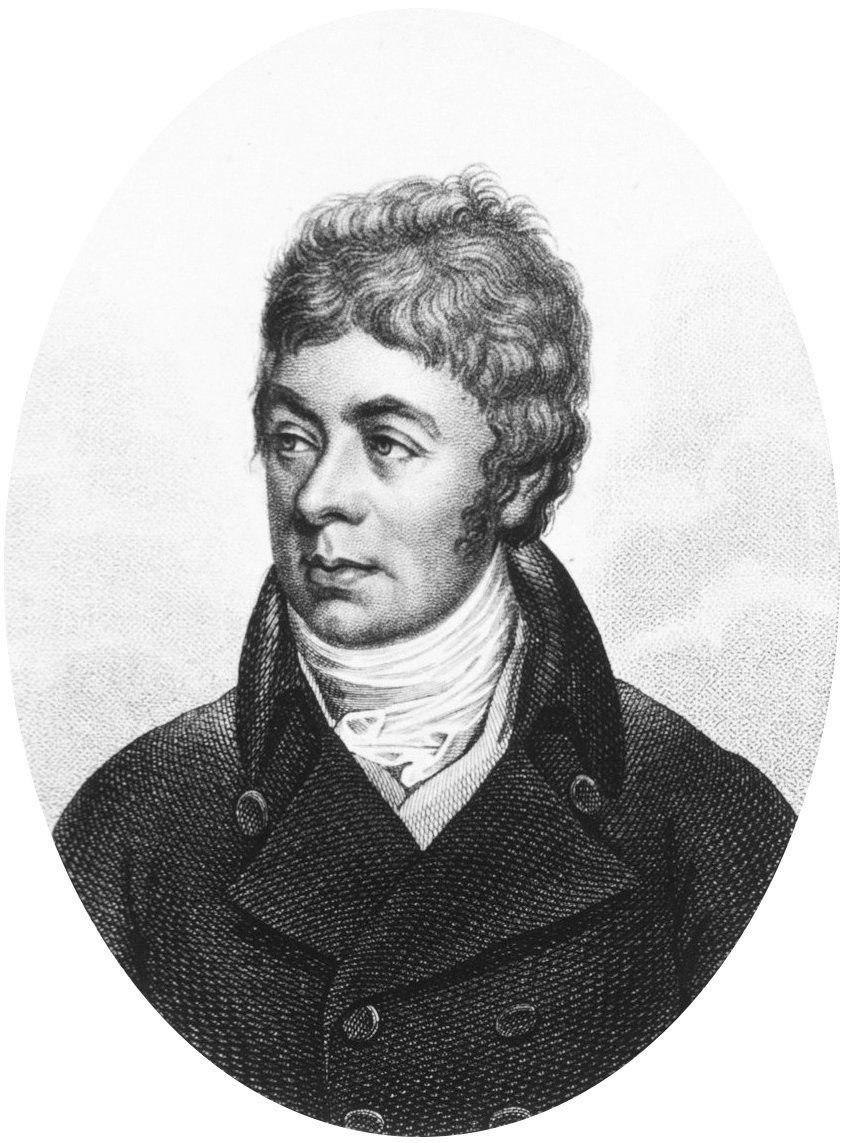
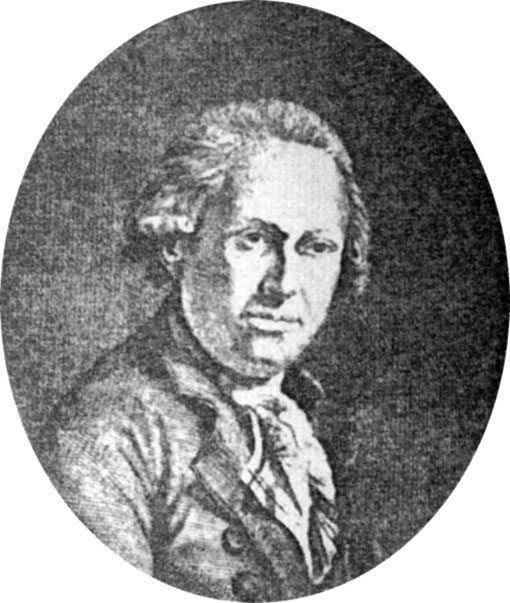
    Johann Georg Wagler
    Johann Georg Wagler

    Order: Psittaciformes
    Family: Psittacidae
    Genus: Pyrrhura
    Scientific name: Pyrrhura lepida
    Citation: (Wagler, 1832)
    Protonimo: Sittace lepida

    Images Pearly Parakeet:

    Videos "Pearly Parakeet"


    Especies del gรฉnero Pyrrhura

    Pearly Parakeet (Pyrrhura lepida)


    Sources:

    Avibase
    – Parrots of the World โ€“ Forshaw Joseph M
    – Parrots A Guide to the Parrots of the World – Tony Juniper & Mike Parr
    – Birdlife

    Photos:

    (1) – Pyrrhura lepida by Florin FeneruFlickr
    (2) – Pyrrhura lepida coerulescens Neumann, 1929 – Huub Veldhuijzen van Zanten / Naturalis Biodiversity Center [CC BY-SA 3.0], via Wikimedia Commons
    (3) – Pearly Parakeet (Pyrrhura lepida) also known as the Pearly Conure in aviculture. A pet parrot By manginwu (originally posted to Flickr as my name is twoday.) [CC BY-SA 2.0], via Wikimedia Commons
    (4) – Tiriba-perola [Pearly Parakeet] by Helio LourenciniFlickr
    (5) – Tiriba pearl (Pyrrhura perlata) – www.avesilvestre.com.br
    (6) – Parrots A Guide to the Parrots of the World โ€“ Tony Juniper & Mike Parr

    Sounds: GABRIEL MILK, XC212988. accessible www.xeno-canto.org/212988

    โ–ท The world of Pets: Dogs, cats, birds, reptiles, amphibians

    Papuan Lorikeet
    Charmosyna papou

    Papuan Lorikeet

    Content

    Papuan Lorikeet

    Description

    25 cm.. length and a weight between 90 and 115 g..

    The head of the Papuan Lorikeet (Charmosyna papou) It is red with a black patch on the back of the crown and a crescent-shaped mark on the nape; patch in the crown with mottled blue extends to the top of the eyes.

    Under the nape a red uniform coat; centre of back Dark emerald green; under the back bright red; rump light blue. Wings Emerald green with vane internal black; undertail, the flight feather grey with coats red; coverts marginal green. Throat red, darker than the upper part of the chest and a little more off: lower chest Red clear with a variable black patch in the center of the belly, Sometimes it extends over them the thighs; the sides of chest and flanks with two obvious yellow stripe sets; bottom of the belly and coverts of the tail, red. View from the top, the tail is green and yellow is your long tip, the axis of the Central feathers is of dark brown; below, the tail is yellow, finished in Orange at its end.

    The bill orange; Orange the irises; Orange and the legs.

    In the nominal species, both sexes are equal.

    Immature more turned off than adults. A band yellow variables at the bottom of the secondaries; rump with mottled Green; Naranja-Pardo the bill and legs; irises pale yellow.

    Description 4 subspecies

    • Charmosyna papou papou

      (Scopoli, 1786) The nominal.


    • Charmosyna papou goliathina

      (Rothschild & Hartert, 1911) With sexual dimorphism and two different colors. The normal morph is similar to the subspecies Stellae, but differentiated by the yellow at the tip of the tail (non-fusion Orange to yellow). The coverts of the tail they are longer, in color purple blue, not red as in the stellae. As in the subspecies stellae, This subspecies has melanism, the upperparts is green, and underparts blue-black in their entirety. Head and the mantle, only broken by the blue of the stripes in the nape; Red in the coverts of the back and bottom of the tail. The wings are green. The tail seen from below it is more yellow-green in color than in normal morphology, and streamers they are fused opaque to verdoso-amarillo down Green.


    • Charmosyna papou wahnesi

      (Rothschild, 1906) Similar to the subspecies goliathina, but the Red of the part superior of the chest It is bordered below with a narrow yellow band. Does not have a green-washing in the flanks and abdomen top. The belly Central and tail coverts are red.


    • Charmosyna papou stellae

      (Meyer,AB, 1886) This species has sexual dimorphism and also has a melanism (excess of dark pigmentation). In comparison with the nominal, the black patch has much more extensive of the nape, blue-violet striped; This black patch replaces the two areas of black in the crown and in the nape of the speciesnominal. The streamers of the tail They also differ, merging from green to orange red (instead of green to Orange) and finally to yellow on the tips. The subspecies stellae also lacks of the chest yellow and stripes on the flanks that if you have the Papou, as well as his black patch on the belly that extends to the flanks.

      The females They show a visible patch of yellow on the lower of the back Green-tipped on the longest feathers, and coverts of the tail red (male shows red with blue on the patch of the rump). The Red of the part superior of the chest seems more uniform. In the metamorphosis by melanism the Red is largely replaced by black (see goliathina).

      The young birds with dark and thin stripes on the underparts.

    Habitat:

    Have been recorded at an approximate height of 1.200 meters above a row of trees and also to the 3.500 m, although the most common is to see them above the 2.000 meters and rare to see them below the 1.500 m; found by Forshaw in the forest of Nothofagus and Podocarpus to 2.800 m.

    A species active and agile you are often found in pairs or in small groups. The birds move through the trees with jerky movements, often waving his serpentine tail, However, It can be very discreet between the tops of the trees.

    Observed in Scheffleras, often in the company of other species, with the same food taste, as the Yellow-billed Lorikeet (Neopsittacus musschenbroekii). Seen often making passes above the trees or half-height, among the plants through the clear.

    Reproduction:

    The nesting in nature it is not described, but Pratt observed an adult tracing branches above and below a large group of epiphytes , Perhaps in search of a nesting site. A pair in breeding conditions was also observed in late August., and young people have been in nature during October and November. In captivity, the implementation has been two eggs, lasting about three weeks of incubation and the young remain in the nest for about two months.

    Food:

    Feeds on flowering trees or flowers of the epiphytes, nectar, pollen, fruits and small seeds. Larvae of insects occasionally.

    Distribution:

    Intervals in the center of New Guinea in Irian Java (Indonesian) and Papua New Guinea, in where are distributed from the southeast of Vogelkop towards the Adelbert range, Huon Peninsula and intervals in the Southeast.

    Distribution 4 subspecies:

    Conservation:


    minor concern


    โ€ข Current IUCN Red List category: Least concern.

    โ€ข Population trend: Stable.

    The world population It has not been quantified, Although that it is more thought of 500.000 specimens. The species appears to be quite common throughout its area of distribution (pit et to the ., 1997).

    The hunting of this species for the use of their feathers as tribal headdresses and capture for the bird trade do not believe today that can affect the size of the population.

    It is suspected that the population is stable in the absence of evidence of any reduction or other substantial threat.

    "Papuan Lorikeet" in captivity:

    Coupled pairs will defend their territory vigorously. Individual birds active and playful; they require a cage as big as possible. May be a bit uncomfortable due to liquid diet.

    Son rare in captivity.

    Alternative names:

    Papuan Lorikeet, Fairy Lorikeet, Fairy Lory, Papuan Lory, Stella’s Lorikeet (ingles).
    Lori papou, Lori de Stella (French).
    Papualori (German).
    Lori de Cola Larga, Lori Rabilargo (espaรฑol).

    scientific classification:

    Order: Psittaciformes
    Family: Psittaculidae
    Genus: Charmosyna
    Scientific name: Charmosyna papou
    Citation: (Scopoli, 1786)
    Protonimo: Psittacus Papou

    Images ยซLori Long-tailedยป:

    Videos "Papuan Lorikeet"

    ————————————————————————————————

    "Lori Rabilargo" (Charmosyna papou)


    Sources:

    Avibase
    – Parrots of the World โ€“ Forshaw Joseph M
    – Parrots A Guide to the Parrots of the World – Tony Juniper & Mike Parr
    – Birdlife

    Photos:

    1 – (1) ยซCharmosyna papou goliathina1ยป by dragusOwn work. Licensed under Public Domain via Wikimedia Commons.
    2 – (2) ยซStellas Lory 2ยป by LtshearsOwn work. Licensed under CC BY-SA 3.0 via Wikimedia Commons.
    3 – (3) ยซCharmosyna papou-Fort Worth Zoo-8" for Philip Shoffner – originally posted to Flickr as Dsc_0120. Licenciado sob CC BY 2.0 via Wikimedia Commons.
    4 – (4) Charmosyna papou goliathina by Zdenek Chalupabiolib.cz
    5 – (5) Charmosyna papou goliathina – Birds-pet-wallpapers
    6 – (6) Charmosyna papou goliathina By Elaine Radford (ilustraciรณn) – rightpet.com

    Sounds: Andrew Spencer (Xeno-canto)

    โ–ท The world of Pets: Dogs, cats, birds, reptiles, amphibians

    Mallee Ringneck
    Barnardius barnardi

    Mallee Ringneck

    Content


    Anatomy-parrots

    Perico description of Barnard

    Of 35 cm.. length between 105 and 143 g. of weight.

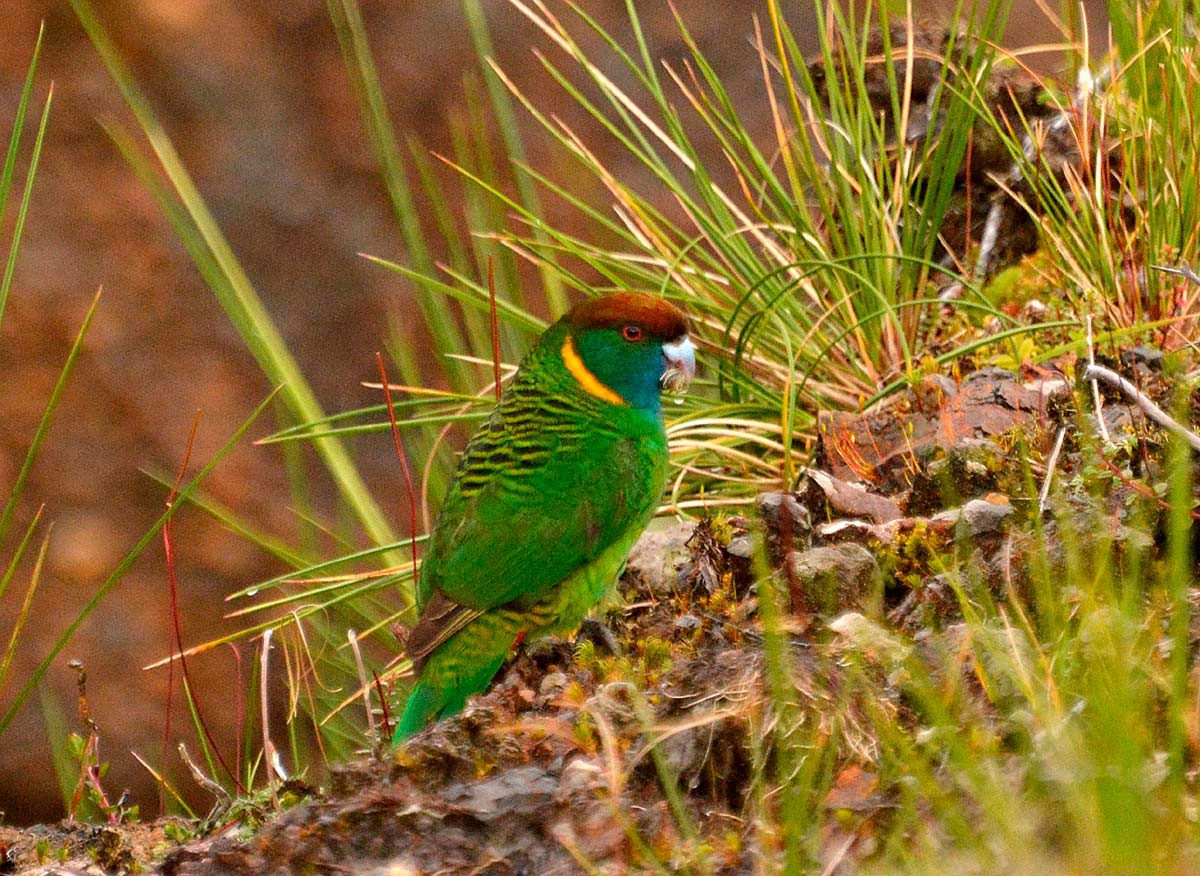
    The Mallee Ringneck (Barnardius barnardi) has the plumage predominantly Green, crown and sides of the head bright green, with the cheeks slightly tinged blue and a small red band across the forecrown. The neck It is olive brown with a yellow ring around its back.

    The lower area of the back is dark blue. The chest and the abdomen are turquoise blue, separated one from the other by a transverse band of yellow color which is more or less wide. The curvature of the wing It shows a greenish blue that overflows on the mantle.

    The greater coverts are yellowish-green. The secondaries They are pale blue, In contrast with the covered and primaries which they are dark blue.

    The underparts is blue. The upperparts tail is dark green, their central feathers with blue spikes and outer blue with pale tips.

    The bill is whitish grey. The strait bare periophthalmic is solid gray. The irises is of color Brown dark and the legs grey.

    The female It has colors more muted than your partner. The back and the lumbar area show a dark greenish gray. The underside is grey, with a more or less visible clear band.

    The immature with even duller colors than females. They have the neck and back of the crown brown. The cheeks blues are often more developed. The back and tail are greyish green. The band underwing usually visible.

      Two species were traditionally recognized in the genus Barnardius, Barnardius zonarius and Barnardius barnardi, but both hibridaban in the contact area and are currently considered a single species.

      Taxonomic status:

    This taxon is considered a subspecies of Barnardius [zonarius or Barnardi] (sensu lato) by some authors

    Subspecies Barnardius barnardi

    • Barnardius barnardi barnardi

      : (Vigors and Horsfield, 1827) The nominal species

    • Barnardius barnardi whitei

      : (Mathews, 1912) Of 35 cm.. length. It has feathers off, especially the chest and abdomen where the turquoise color is absent. Female plumage more clear than the nominal. Is believed to be a hybrid of the Barnardius Zonarius with the Barnardius Barnardi.

    • Barnardius barnardi macgillivrayi

      : (North, 1900) Of 33 cm.. length. More small, more pale, with the greenish-yellow forehead more pale and with clear bright blue hue on the cheeks and below the headphone feathers. Broad band of yellow on the abdomen.

    Barnard's Parakeet Habitat:

    The Parakeets Barnard They are mainly sedentary, but there may be some moves to small scale in response to climate change.

    The species occupies the arid areas of mallee composed almost exclusively of Eucalyptus gracilis. Also found in shrubs of acacia and cypresses and in a wide variety of very similar habitats.

    The species living in the areas of the North has a clear preference for the rubber Red (Eucalyptus camaldulensis) It covers temporary streams and shows a more arboreal lifestyle.

    Generally less common in populated areas and in more humid regions. Large flocks are more rare to observe; pairs or small groups are the usual social units.

    Less bold and curious that the Australian Ringneck, Although the two species share habits, diet and cortejo similar.

    The Mallee Ringneck have been recorded feeding in the company of the Crimson Rosella (Platycercus elegans), Pale-headed Rosella (Platycercus adscitus), Red-rumped Parrot (Psephotus haematonotus) and Bluebonnet

    Reproduction:

    During courtship, the male shrugs, causing the wings to vibrate slightly.
    Like most other parrot species, the Mallee Ringneck they have as a practice gnaw and chew wood, whether to put his personal stamp on his favorite tree, or to enlarge the cavity entrance. This activity allows them to keep their beaks in good condition.

    The nest is usually in a hollow tree, and usually four to five eggs make up the implementation, deposited on a base of wood decaying waste.

    In the North, breeding season tends to be governed by weather, and the nesting coincides with the end of the wet planting season.

    In the South, playback starts in July or August and the season can be extended until January with a second litter. Incubation lasts around 20 days and is carried out by the female.

    The young birds leave the nest after 5 weeks, but remain in the household with his parents for a while.

    Food:

    The Mallee Ringneck they are mainly vegetarians, they feed on seeds – Melon seeds (Cucumber myriocarpus), bitter melons (Citrullus lanatus), fruits of the tree of the tobacco (introduced), fruits, nectar and flowers. Its menu is complemented with insects and larvae.

    ยซBarnard's Parakeetยป Distribution:

    The Mallee Ringneck they are distributed through the interior of the East Australia, to the West of the Great dividing range, with a practically isolated population in the Northwest of Queensland, stretching across the border of the Northern Territory, along the nicholson river, in the North, and reaching Glenormiston, and western part of Queensland, in the South; its eastern limit is about Kynuna.

    The the Northern subspecies meets the nominal species in the region of Range Forsythe, and extends to the South, with its eastern boundary running near Barcaldine, Mitchell and Goondiwindi, and in New South Wales.

    To the South extends East through Moree, Dubbo and Wagga Wagga to get up to Kerang in Victoria.

    In the West, the species is dispersed through of Western Queensland to the region of Cooper Creek of South Australia around Innamincka.

    In New South Wales, is located to the West of the basin of the darling river, about Broken Hill.

    Distributes lengthwise of the murray river, and in Victoria It extends through the Northwest corner to the South, until around Edenhope.

    In the southeast of South Australia ranges through Naracoorte and Mount Lofty Ranges in Port Augusta and Montes Flinders, where is integrated with the Australian Ringneck; the two species are also more North.

    Getaways birds have been registered in Brisbane, Melbourne and Sydney.

    Subspecies B distribution. barnardi

    • Barnardius barnardi barnardi

      (Vigors and Horsfield, 1827) The nominal species

    • Barnardius barnardi whitei

      (Mathews, 1912) Flinders Ranges, South Australia

    • Barnardius barnardi macgillivrayi

      (North, 1900) This, Territory of the North and Northwest Queensland

    Conservation ยซBarnard's Parakeetยป:


    minor concern


    โ€ข Current category of the Red List of the UICN: Least concern

    โ€ข Population trend: Growing

    The species is considered common throughout its range..

    The world population is estimated at around 500 000 individuals and it seems stable.

    But, seems less able to adapt to the changes that have occurred in the habitat that the Australian Ringneck.

    In captivity:

    The Mallee Ringneck It is appreciated as a pet, but the birds in captivity are relatively few.

    Una muestra viviรณ 17,9 years in captivity. According to some sources, these animals can live up to 31,6 years in captivity, but this has not been verified.

    Most common in Europe and Australia; not so much in the United Kingdom or United States.

    Initially it is a timid and nervous bird, Although soon it acclimatizes caregiver. Bonding with a partner to do when both birds are young, as adults they do not usually live in harmony. Aggressive with other parrots.

    Alternative names:

    Mallee Ringneck, Mallee Parrot, Mallee Ringneck Parrot, Ringneck Parrot (ingles).
    Perruche de Barnard, Barnardius barnardi, Perruche cloncurry (French).
    Barnardsittich, Barnard Sittich, Barnard-Sittich (German).
    Periquito-de-Barnard (Portuguese).
    Perico de Barnard (espaรฑol).

    scientific classification:

    Order: Psittaciformes
    Family: Psittaculidae
    Genus: Barnardius
    Scientific name: Barnardius barnardi
    Citation: (Vigors & Horsfield, 1827)
    Protonimo: Platycercus theelectronicjumper

    Images "Mallee Ringneck"

    Videos "Mallee Ringneck"

    ยซBarnard's Pericoยป (Barnardius barnardi)


      Sources:

      Avibase
      – Parrots of the World โ€“ Forshaw Joseph M
      – Parrots A Guide to the Parrots of the World – Tony Juniper & Mike Parr
      – LoroMania
      AnAge: The Animal Ageing and Longevity Database – Genomics.senescence.info
      – Birdlife

      Photos:

      (1) – By AlexKant – Israel> Petach Tikva Zoo – ZooChat

      Sounds: Patrik ร…berg (Xeno-canto)
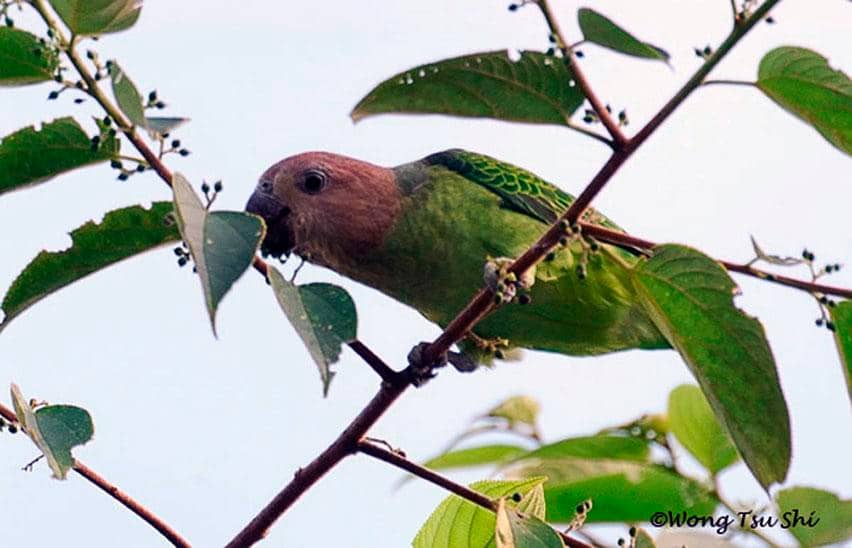
    โ–ท The world of Pets: Dogs, cats, birds, reptiles, amphibians

    Nanday parakeet
    Aratinga nenday


    Aratinga ร‘anday

    Content

    Description:


    Anatomy-parrots

    Of a length between 32-37 cm.. and a weight between 120-141 g..
    The Nanday parakeet (Aratinga nenday) has the forecrown, crown, lores previous and most of the cheeks tiznadas black: both sides of the neck and ear-coverts pale yellowish green; some feathers Brown or reddish in the margins of the pileum black; the nape grass-green. Mantle and back pale green faded yellowish-green in the rump and uppertail-coverts.

    Scapulars mostly green, Although some medium-sized pens are dark blue in the vane inner; under wing-coverts mostly green, with the exception of the primary coverts that are blue. The flight feather dark blue above with vane outer paler in some primaries; then color between Brown and pale black.

    Aratinga ร‘anday

    Most of the underwing-coverts pale yellowish green. Throat pale yellowish green with shades of pale blue at the top of the chest; underparts remaining of pale yellowish green color, except the the thighs Red and some blue feathers in undertail-coverts.

    Upper, the tail reddish brown, distal blue; undertail, dull brown.
    The bill black; bare periophthalmic pale grey: the irises reddish brown; legs Pink.

    Both sexes similar.

    The immature It has less blue on the top of the chest and throat.

    • Sound of the Nanday parakeet.
    [audio:HTTPS://www.mascotarios.org/wp-content/themes/generatepress_child/sonidos/Nanday Conure.mp3]

    Habitat:

    Video – "Nanday parakeet" (Aratinga nenday)

    The road (Aratinga nenday)

    The Nanday parakeet they live in open lowland some 800 m, including the Humid or Eastern Chaco (a report on the dry Chaco in Bolivia), wetlands and livestock areas with palms. In the Humid or Eastern Chaco and lower basin of the the Paraguay River they prefer areas with fan palm treesCopernicia, growing in the seasonal flood plains with xerophytic vegetation drought related, and observed in areas of swamps with Palm trees in the Santa Cruz Department, Bolivia.

    Gregaria, with flocks of up to a dozen birds during the breeding season; often several hundred birds congregate at roosts.

    Reproduction:

    Nest in holes of Palmas, trees or fence posts, for example, of cattle pens.

    The breeding season in November in Mato Grosso. The laying is of 3-4 eggs. after breeding to their young, all birds build large communal roosts until the next breeding season.

    Food:

    Diet Nanday parakeet includes the Palm fruits Copernicia, sometimes taken in the ground.

    They can cause damage to the crops, for example, corn.

    Often seen in water wells.

    Distribution:

    Size of the area of distribution (reproduction / resident): 260.000 km2

    This species is native from South America from the southeast of Bolivia to the southwest of Brazil, the center of Paraguay and North of Argentina, of the region known as the Pantanal.

    The species is found in a band of approximately 200 km from East to West, focusing on the wetlands of the upper basin of the Paraguay River, in the East of the Santa Cruz Department, Southeast Bolivia, South-West of Mato Grosso and West Mato Grosso from the South in Brazil, to the South, by the middle of Paraguay up to the Chaco province, Formosa province and North of Province of Santa Fe in Argentina (occasional in Province of Misiones and Province of Corrientes). A report of the Province of Santiago del Estero is probably wrong.

    There are several wild populations in Buenos Aires and California. You can wander, outside the breeding season, the area inside of Central Chaco.

    In general locally abundant and common, especially in areas where their favorite plants concentrate. In Argentina they are more numerous in the Formosa province, and is the most common parrot in some parts of Mato Grosso.

    Trapped for the bird trade, with more than 114.000 individuals exported from Argentina in the years between 1985-1990, Although many of these birds is probably came from Paraguay.

    Note:

    Copies released observed in the Canary Islands (Spain), in particular in the South of Tenerife and Fuerteventura, sometimes confused with the Rose-ringed Parakeet. It transpires that the species has been reproduced, In addition, in Andalusia, Catalonia. It has also been observed in points of Madrid, Basque Country and Valencia (Spain).

    You escape to the South of Portugal.

    Copies also introduced at different points of North America and in Asia.

    Conservation:

    โ€ข Red List category of the UICN current: Least concern

    โ€ข Population trend: Growing

    Global population size has not been quantified, but this species is described as ยซquite commonยป (Stotz et to the., 1996).

    The species has undergone intense trade: from 1981, When it was included in the Appendix II, 267,246 individuals caught in the wild were recorded in international trade (UNEP-WCMC trade database CITES, January 2005).

    Thousands are legally exported from Argentina.

    "Nanday parakeet" in captivity:

    Very common in captivity.

    In captivity they are wonderful pets if care and properly socialized. They all have distinct personalities and appreciate the toys that are provided with. They like to be out of their cage for at least six hours a day..
    These birds are escape artists, extremely intelligent and skilful. Some of them speak, others do not, Depending on your personality. They are characterized by having a very strong call and they are not suitable for apartments.

    They are birds they reproduce quite easily in spacious accommodations and Cologne. Son, usually, good parents.

    There are places, as Puerto Rico, that its possession is illegal.

    They can live between 35 and 45 years.

    Alternative names:

    Nanday Parakeet, Black-headed Parakeet, Black-hooded Conure, Black-hooded Parakeet, Black-masked Parakeet, Nanday Conure (English).
    Conure nanday, Perriche nanday, Perruche ร  tรชte noire, Perruche nanday (French).
    Nandaysittich, Nanday Sittich (German).
    jandaia-de-cabeรงa-negra, maracanรฃ, nendai, periquito-de-cabeรงa-preta, Periquito-de-cabeรงa-preta / Periquito-nandaรญ, Principe-negro, prรญncipe-negro (Portuguese).
    Aratinga Nanday, Aratinga ร‘anday, Cotorra de Cabeza Negra, Loro Cabeza Negra, Nanday, ร‘anday, ร‘enday (espaรฑol).
    ร‘anday, ร‘enday (Argentina).
    ร‘anday (Guarani).

    scientific classification:

    Order: Psittaciformes
    Family: Psittacidae
    Genus: Aratinga
    Scientific name: Aratinga nenday
    Citation: (Vieillot, 1823)
    Protonimo: Psittacus nenday

    Aratinga ร‘anday images:


    Species of the genus Aratinga

    Sources:

    Avibase
    – Parrots of the World โ€“ Forshaw Joseph M
    – Parrots A Guide to the Parrots of the World – Tony Juniper & Mike Parr
    – Birdlife
    – Parrot Book, Parrots and macaws

    Photos:

    (1) – Feral Nanday Parakeet (also known as the Black-hooded Parakeet or Nanday Conure) eating sunflower seeds in a garden in Sarasota, Florida, USA By Apix (Picasa Web Albums) [CC BY-SA 3.0], via Wikimedia Commons
    (2) – Feral Nanday Parakeets (also known as the Black-hooded Parakeet or Nanday Conure) eating sunflower seeds in a garden in Sarasota, Florida, USA By Apix (Picasa Web Albums) [CC BY-SA 3.0], via Wikimedia Commons
    (3) – Nanday Parakeet By J. Patrick Fischer (Own work) [GFDL or CC BY 3.0], via Wikimedia Commons
    (4) – A pet Black-hooded Parakeet (also known as the Nanday Parakeet and Nanday Conure) By MAULI (originally posted to Flickr as Little Big Mouth) [CC BY-SA 2.0], via Wikimedia Commons
    (5) – A pet Nanday Conure, named Jack By Mceder at English Wikipedia (Transferred from en.wikipedia to Commons.) [Public domain], via Wikimedia Commons
    (6) – digital illustration /digital illustration – dibuixosnatura

    Sounds: (Xeno-canto)