โ–ท The world of Pets: Dogs, cats, birds, reptiles, amphibians

Rosy-faced Lovebird
Agapornis roseicollis


Inseparable de Namibia

Content

Description Rosy-faced Lovebird
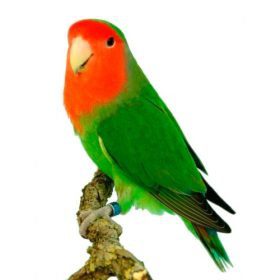
Inseparable de Namibia

Among 15 and 18 cm in length and a weight between 43 and 63 g..

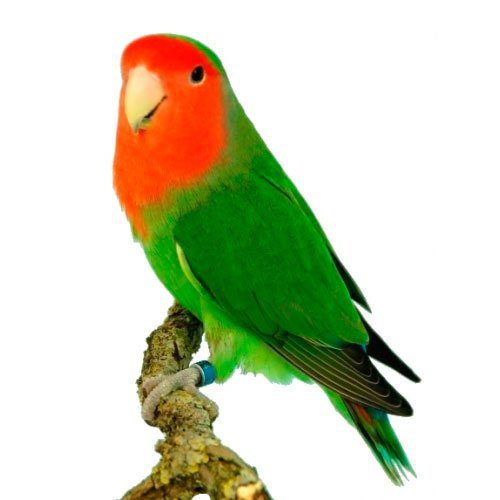
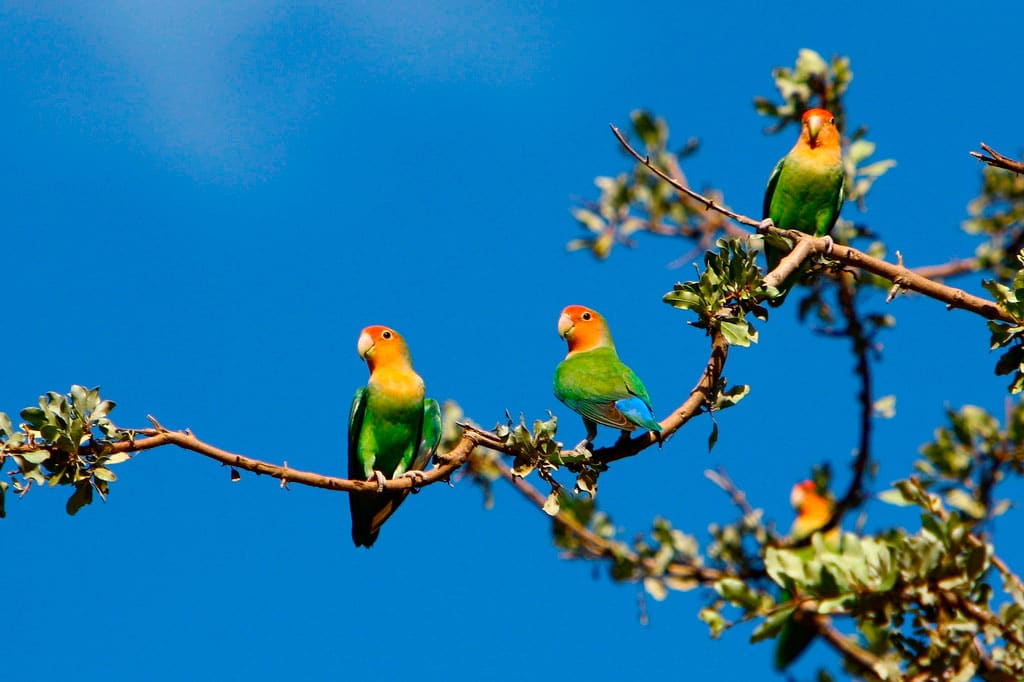
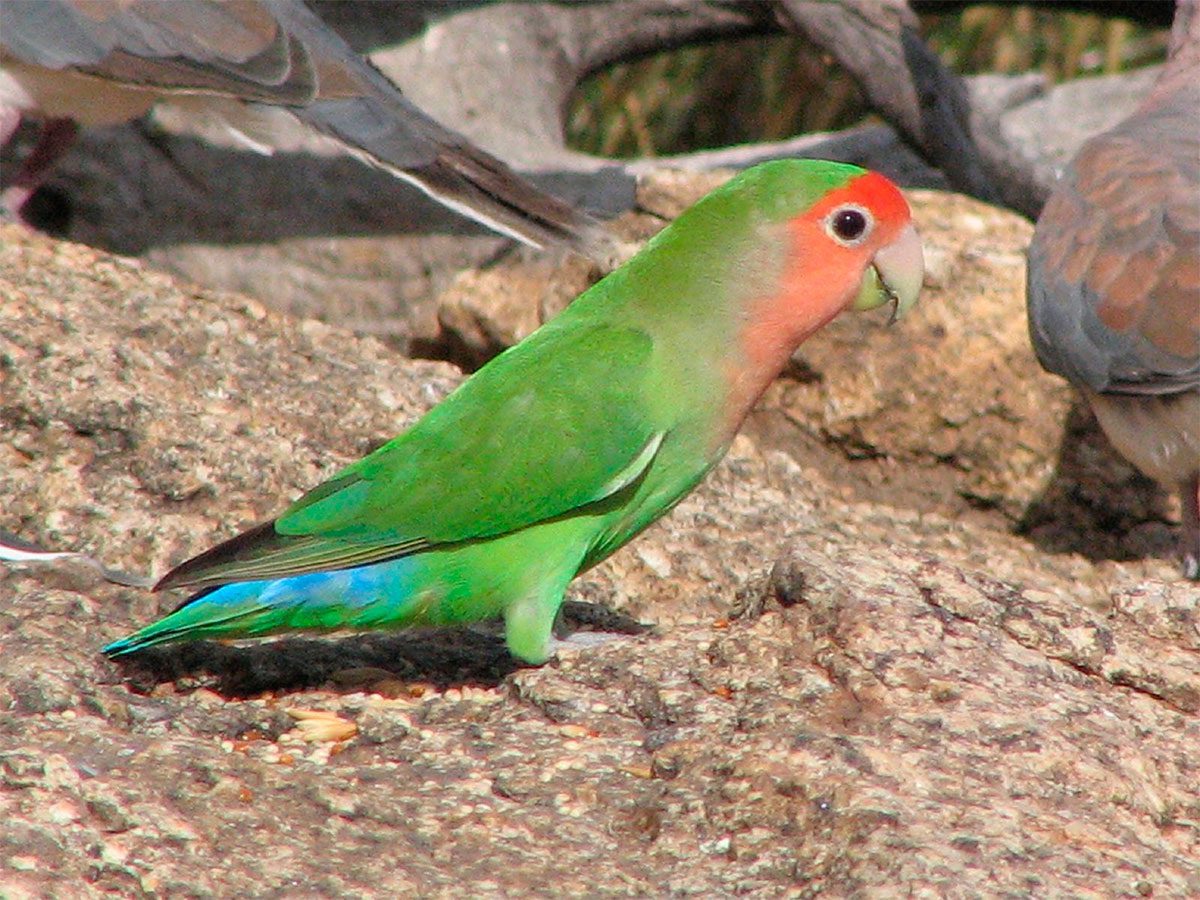
The Rosy-faced Lovebird (Agapornis roseicollis) has the upperparts green, except in the rump and uppertail-coverts they are bright blue. The tail is green, but the side feathers are black base, orange-red edges and subterminal band black. The flight feather They have black tips.

The underparts They are pale green from the bottom of the chest up to the undertail-coverts. The feathers of the tail and flight feather son negruzcas.

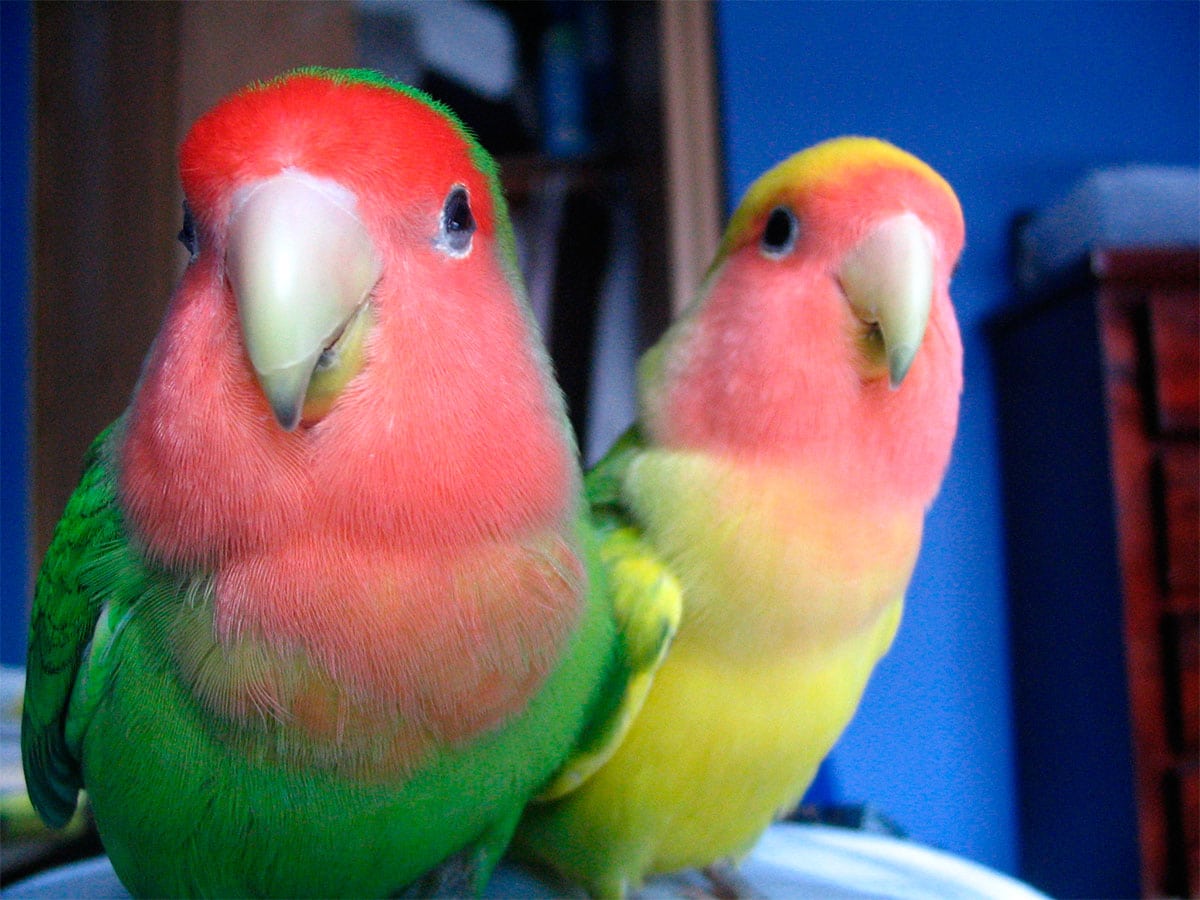
The head, the forecrown and the part behind eyes They are red, while the face, the chin, the throat and the top chest They are pink.

The bill It is white with greenish-gray tint. The eyes are dark brown, surrounded by a eye ring white. The legs are grey.

Both sexes are similar.

The youth They are duller with forecrown green tinged with red rose. The face is pale pink to the top chest. The bill It has a black base.

Subspecies description:

  • Agapornis roseicollis catumbella (Hall,BP 1952) – Brighter colors, with the front of the crown a dark red and the cheeks Bright color.

  • Agapornis roseicollis roseicollis (Vieillot, 1818) – The species nominal

Habitat Rosy-faced Lovebird

The Rosy-faced Lovebird frequents dry woodlands fields altitudes up to 1.500 m. Sub-desert steppes observed, wooded savannah with scattered forest cover, forest belts along rivers and farmland; often near standing water.

Usually, in flocks of 5 to 20 birds, although sometimes as many as several hundred may gather in areas where grass seeds ripen or near water sources.

They are very sociable and noisy, but also pretty tame. When resent, They fly to the nearest tree or vegetation, before returning quickly to the food source.

They used as roosts, nests Sociable Weaver (Philetairus socius) and the White-browed Sparrow-Weaver (Plocepasser mahali). Birds huddle in small groups in branches when the weather is rather cool.

Reproduction Rosy-faced Lovebird

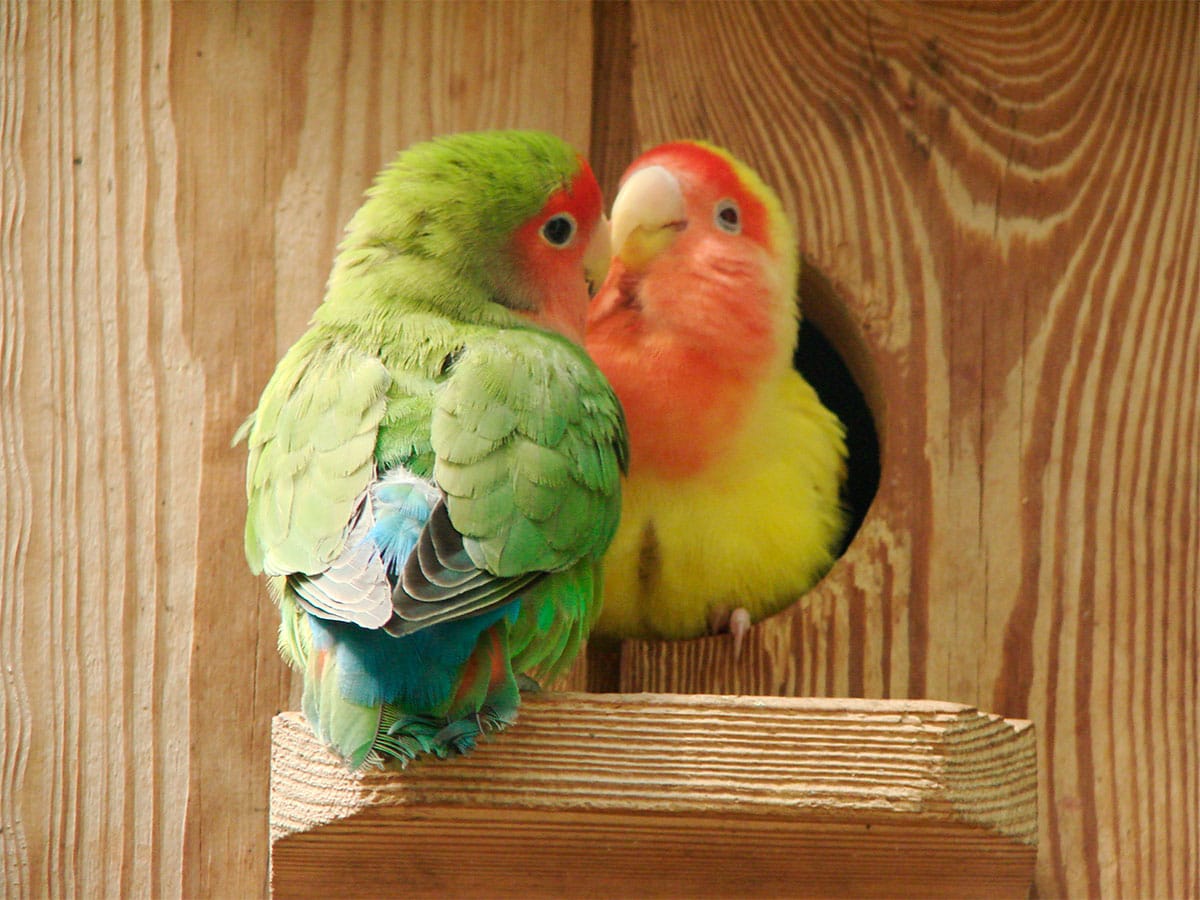
The Rosy-faced Lovebird can pair off from two months of age. The male wait until the female accepts him before approaching. She adopts a "ruffled" position when she is ready.. The male It provides food, while balancing the head to get his attention. Also head scratching, especially around peak. When the male tries his approach, gently slides his hand. You can try out the other side if female It is shown aggressive.

The Rosy-faced Lovebird they are monogamous.

Nest in rock crevices, human constructions, bridges or communal nests Sociable Weaver (Philetairus socius) and the White-browed Sparrow-Weaver (Plocepasser mahali). The nest It is made of straw and branches, as well as some other materials such as pieces of bark, leaves and herbs, carried by the female rump feathers. The nest of the weavers carries no additional material added. The nests are communal.

The breeding season It has been recorded in the months Feb-Mar, April and October; most clutches seem to take place in the months of February-May.

The female lays 4-6 eggs. The incubation lasts a few 23 days, What does the female do alone?. It is fed by the male during this period.. The chicks are fed by regurgitation female, but it is the male who carries food. The period in the nest It is close to the 5-6 weeks, during which both parents feed the young. Flying around the age of 43 days.

Food Inseparable de Namibi

The Rosy-faced Lovebird they feed on, mainly, seed, sometimes taken directly from the soil, including grasses, Albizia and Acacia; usually they do visits to gardens to feed on sunflower seeds to cropland for him millet and the corn.

Sean is not considered a serious pest for crops because agriculture is scarce in the inhabited regions. They also eat flowers Albizia and other foliage plants, such as leaves of the genus Euphorbia. You can drink several times a day.

Distribution:

Size of the area of distribution (reproduction / resident): 774.000 km2

The Rosy-faced Lovebird They are endemic areas southwestern africa. In Angola, where the range of Rosy-faced Lovebird It is little known, The species is found in the region Sumba (perhaps further north) to the south, in parallel to the shore area through Namibia north of Cape, South Africa, extending from the east to the north. In Namibia to Lago Me, Botswana, although there are no recent records of the species there.

A sighting 1992 in Victoria Falls, Zimbabwe, suggests little-known eastern limits or nomadic behavior.

The main population Rosy-faced Lovebird It is within 400 km of Atlantic coastline. Records in the ancient province of Transvaal They are considered leaks. There is a wild population in the sector Fish Hoek of the Cape Peninsula, South Africa.

Subspecies description:

  • Agapornis roseicollis catumbella (Hall,BP 1952) – Southwest Angola, with a population in the wild Kissama National Park Northwest of Angola.

  • Agapornis roseicollis roseicollis (Vieillot, 1818) – The species nominal

Conservation Rosy-faced Lovebird


minor concern

โ€ข Current Red List of UICN: Least concern

โ€ข Population trend: Decreasing

The size of the world population Rosy-faced Lovebird It has not been quantified, but the species is described as locally common or even abundant in the vicinity of areas where water is abundant.

However it is suspected that the population of the Rosy-faced Lovebird can be in decline due to unsustainable levels of exploitation.

There has been a historic decline due to the capture and export of thousands of birds from Angola, This has contributed, to a large extent, a significant reduction in the population Rosy-faced Lovebird in the south of that country.

The Rosy-faced Lovebird in captivity:

The small Rosy-faced Lovebird It is a brilliant bird, joyful, Robust and gregarious. It is one of the most common parrots in captivity, along with the Budgerigar and Cockatiel, because of its ease of maintenance and reproduction.

Birds are considered easy, ideal for people who want to start breeding small parrots. The Rosy-faced Lovebird They can live in a large aviary cage outdoors, including winter. But, they will need to have a frost shelter to shelter in when it gets too cold outside.

Son active birds they like to fly. If they have to live in a cage, this will have to be wide and longer than high (birds are not helicopters). Ideally, the bird should be able to leave its cage for a while in order to be able to fly greater distances..

Contrary to popular belief, the Lovebirds They can perfectly live without a partner. Why do sellers try to sell both?, It is a purely financial maneuver. One Lovebirds only, will not die.

Similarly, when we say that a Lovebirds He will die of sadness when you lose your partner, It is once again a commercial argument. The bird can pass through a period of mourning during which try to call your partner / yy shouts, even more so when the other members of the aviary belong to another species.

All parrots are aves gregarias and they depend on the group to survive. A widow bird accept another partner, previous adaptation before sharing the same cage. It is possible however, two birds never understand (which it is rare, with the Lovebirds).
To end this belief, the "couples" of Lovebirds They not necessarily have to be of the opposite sex. Homosexual couples are common among Lovebirds.

His behavior with birds of their own species is quite good or very good, It is not the same for their behavior with other species: the Rosy-faced Lovebird are restless and vengeful birds. Coexistence with other species is totally discouraged by the vast majority of poultry farmers: the peak of a lovebird can easily cut your finger or injure another bird, smaller and more peaceful.

In general, the Rosy-faced Lovebird they are birds, relatively, easy to educate, provided that taken from young. Son tame birds, loving, playful, sleepers, large pet birds. The bite related to its small peak is still very painful, especially in the soft fingers of children.

It is permissible to say that males are better pet birds than females. The breeding females are often within their hormonal period, making them very territorial. A sweet female domesticated before sexual maturity can be very aggressive to the point of not being manipulated when in hormonal period. Once again, this does not affect all birds, because there are always exceptions.

In general, to the Lovebirds, They are not considered good speakers.

Not recommended for people with incompatible squeals.

No sexual dimorphism in this species. The only way to know the sex of the bird is to carry out a DNA test using a blood or feather sample..

It is not known much about the longevity of the Rosy-faced Lovebird. according to some sources They can live up to 34.1 years in captivity, It is plausible, but it has not been confirmed. Age of sexual maturity of 2 months to almost a year.

Due to the depletion of stocks, in poultry in the early 20th century, It will be started hybridize with other species, but thanks to some breeders are you has been able to preserve in its pure State.

Mutations Agapornis roseicollis
Mutations

Mutations.

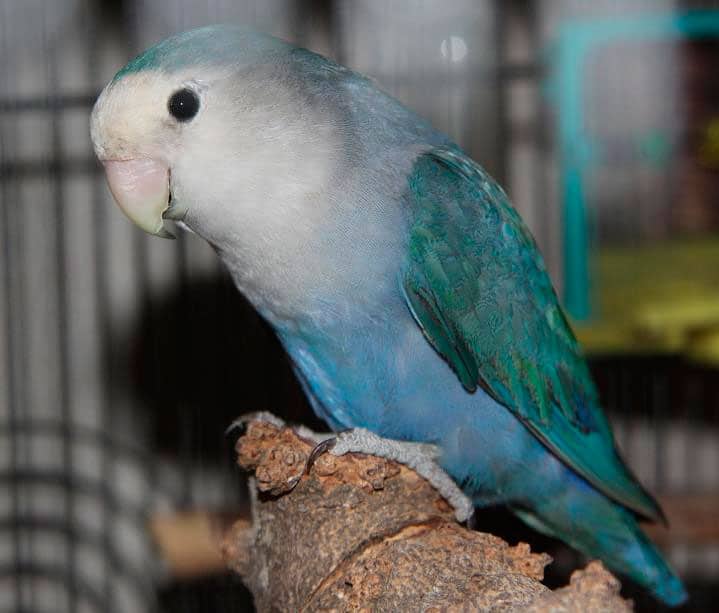
There are over 500 mutations or combinations of different colored. Mutations in genes lead to changes in the pigments that give color pens, such as psittacin (red, yellow or orange) or eumelanin (black, brown) or variations on feather structure. They may be sex-linked recessive mutations (They depend on the sex of birds) or autosomal recessive and dominant (irrespective of gender). Among the sex-linked mutations have: ino (known the lutino. There have eumelanin), cinnamon (produce eumelanin brown instead of black), Balls (quantitative reduction of melanin 60 %) andopaline (red psittacine of the mask has spread from the back of the head, the rump is the same color as the body). Also shows some combinations as are the pallidino (Only males, -pallid gene on one X chromosome and ino gene on the other X chromosome) and canela-ino (It is given by crosslinking between cinnamon and ino on the same chromosome and can be male and female). In all these mutations, females never carry the mutation. Years ago, the cinnamon cinnamones were called Americans and Australians palids cinamones or Isabelas.

Consider several crossings (to better understand the sex-linked mutations):

  • Crossing 1: Green x lutino male female = green and lutino male carrying female lutinas
  • Crossing 2: Green male x female = green Lutina carriers lutino males and green females
  • Crossing 3: Green male carrying female green x lutino = green and green lutino male carriers, Green and females lutinas
  • Crossing 4: Green male carrying female lutino Lutina x = green and lutino male carriers lutinos, Green and females lutinas
  • Crossing 5: Lutina x lutino male female = male and female lutinas

As autosomal recessive mutations have:

  • aqua (reducing a yellow psittacine 50 %)
  • turquoise (reducing a yellow psittacine 80-90 %)
  • aquaturquesa (combination thereof)
  • edged dilute (reduction of eumelanin 50 % in the body, in the center of the back and wing feathers eumelanin it is lower than in the edge, it seems that feathers are trimmed)
  • dilute (reduction of eumelanin 80-90 %, having a green veil over the whole body)
  • bronze fallow (It presents grayish brown eumelanin and red eyes)
  • pale fallow (greyish brown eumelanin sparingly, light green eyes and red veil in the abdomen)
  • recessive harlequin (reduction of eumelanin 95 %, smaller mask)
  • orange face (psittacin mask and tail is orange rather than red)

In these mutations, both males and females can be carriers. To be transmitted, or both are carriers or join a carrier with a mutated. Years ago, to dilute edged was called golden cherry and if it was combined with aqua, aquaturquesa or turquoise, silver cherry o plata.

As we autosomal dominant mutations:

  • dominant harlequin (reduction eumelanin and randomly scattered throughout the body)
  • pale headed (psittacine of the mask and the tail is light orange pink. Hay SF,factor simple y DF, double factor, ie more or less mask dark)
  • dark factor (a change occurs in the structure of the pen, in the spongy zone, so they look darker. There SF and DF, naming as a factor D and DD for two)
  • purple (a change occurs in the structure of the pen, in the spongy zone. We have SF and DF. The ideal is to combine a dark factor)

As discussed above, both headed as pale as dark violet factor are dominant incomplete, so we say what the single and double factors. In these mutations is mutated or not is, no carriers and being transmitted need only one parent to the present.

Is a type of harlequin which it is transmitted to different recessive and dominant form, is the progressive harlequin or mottle. The harlequin is increasing as the bird will be more adult, as it is getting older.

The mutation bee does not exist in the A. roseicollis. We have the combination of turquoise with ino, if they go selecting, we can get a completely white bird with red eyes, what would look like albino.

Apart from all these mutations, There is a variety called Long Feathered, of larger size and colors sharper the ancestral. It was obtained through years of selection, according to some or emerged spontaneously in some aviary, according to others and from there they began to work with them. Something similar happened with mandarins (Poephila guttata), Giant calling mandarins. So the variety would call if they have achieved by selection and mutation if they have arisen spontaneously.

Once you view the different mutations must say that several cases can occur, that make possible the multiple existing color combinations. They may have a recessive mutation with a dominant (edged dilute violeta), two or more mutations at the same time (turquesa edged dilute violeta arlequin DD), and it can even happen to have two different mutations and make the other not appreciated (normal and lutino lutino D or DD are exactly the same visually).

Source: The bird aviary

Alternative names:


Rosy-faced Lovebird, Peach-faced Lovebird, Rosy faced Lovebird, Rosyfaced Lovebird (English).
Insรฉparable rosegorge, Insรฉparable ร  face rose, Insรฉparable roseicollis (French).
Rosenkรถpfchen, Rosenpapagei (German).
Inseparรกvel-de-faces-rosadas (Portuguese).
Inseparable de Cuello Rojo, Inseparable de Namibia, Agapornis Roseicollis, Inseparable de Cara Melocotรณn (espaรฑol).

scientific classification:


Order: Psittaciformes
Family: Psittaculidae
Genus: Lovebirds
Scientific name: Agapornis roseicollis
Citation: (Vieillot, 1818)
Protonimo: Psittacus roseicollis

Images Rosy-faced Lovebird:

Videos "Rosy-faced Lovebird"


Species of the genus Agapornis


Rosy-faced Lovebird (Agapornis roseicollis)


Sources:

Avibase
– Parrots of the World โ€“ Forshaw Joseph M
– Parrots A Guide to the Parrots of the World – Tony Juniper & Mike Parr
– Birdlife

Photos:

(1) – Peach-faced Lovebird in Namibia, Africa By Alastair Rae from London, United Kingdom (Rosy-faced Lovebird) [CC BY-SA 2.0], via Wikimedia Commons
(2) – Picture taken in the zoo of Wrocล‚aw (Poland) By Nicolas Guรฉrin (messages) (Own work) [GFDL or CC BY-SA 3.0], via Wikimedia Commons
(3) – A pet chick By Toumoto๏ผšhttp://opi.toumoto.net (Self-photographed) [GFDL or CC-BY-SA-3.0], via Wikimedia Commons
(4) – Rosy-faced Lovebirds at Etosha National Park, Namibia By Brian Taylor from U.S.A (Rosy-faced Lovebirds) [CC BY 2.0], via Wikimedia Commons
(5) – Peach-faced Lovebirds (also known as the Rosy-faced Lovebird) eating seeds from a seed-block garden bird feeder in a garden in Scottsdale, Arizona, US By D. Patrick Lewis [CC BY 2.0], via Wikimedia Commons
(6) – Mutation in roseicollis : opaline double dark factor By Roseicollis (Own work) [GFDL or CC BY-SA 3.0], via Wikimedia Commons
(7) – Turquoise mutation By Sergi Bio (Own work) [Public domain], via Wikimedia Commons
(8) – Mutations in Agapornis roseicollis yellow machine-readable By No author provided. Ajit S.~commonswiki assumed (based on copyright claims). [Public domain], via Wikimedia Commons
(9) – Peach-faced Lovebird (Agapornis roseicollis). Pet on a perch. Shows blue rump feathers By Peter Bรฉkรฉsi (Flickr) [CC BY 2.0], via Wikimedia Commons

Sounds: Andrew Spencer (Xeno-canto)
โ–ท The world of Pets: Dogs, cats, birds, reptiles, amphibians

Yellow-collared Lovebird
Agapornis personatus


Inseparable Cabecinegro

Content

Description "Inseparable Cabecinegro":

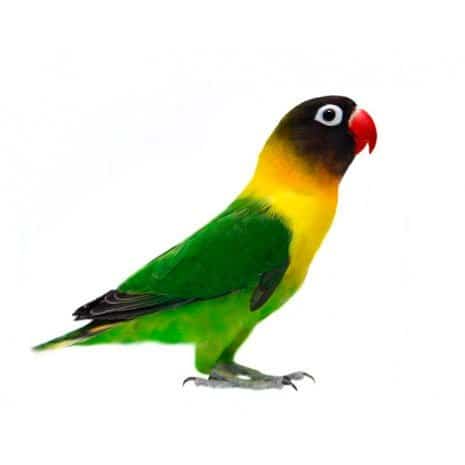
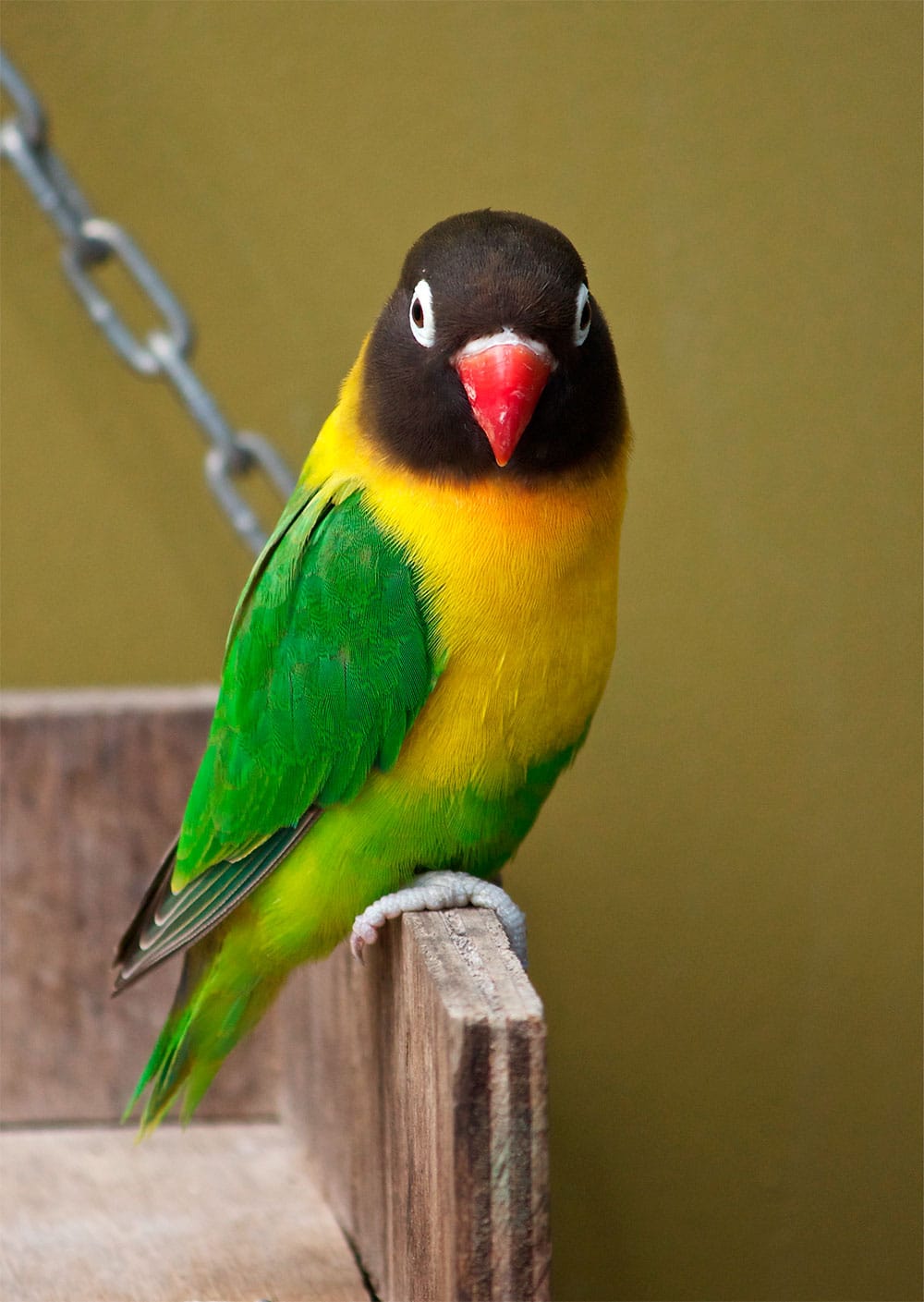
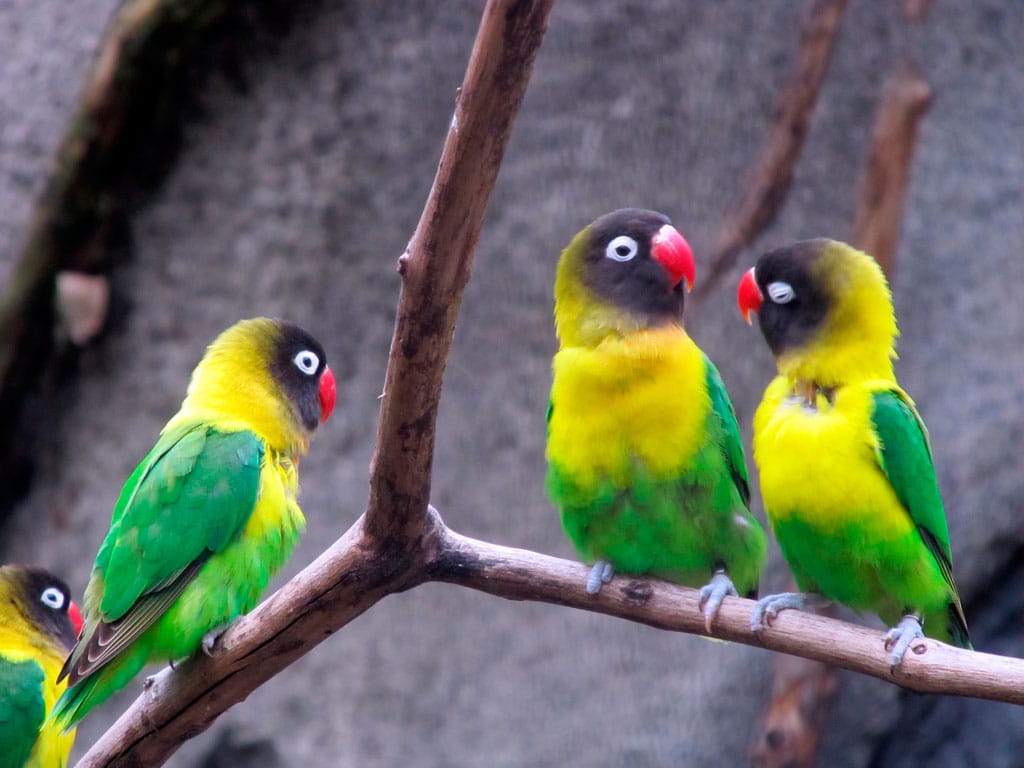
Among 13 and 15 cm.. length and a weight between 43 and 47 g., the Yellow-collared Lovebird (Agapornis personatus) They are surprisingly beautiful.

Inseparable Cabecinegro

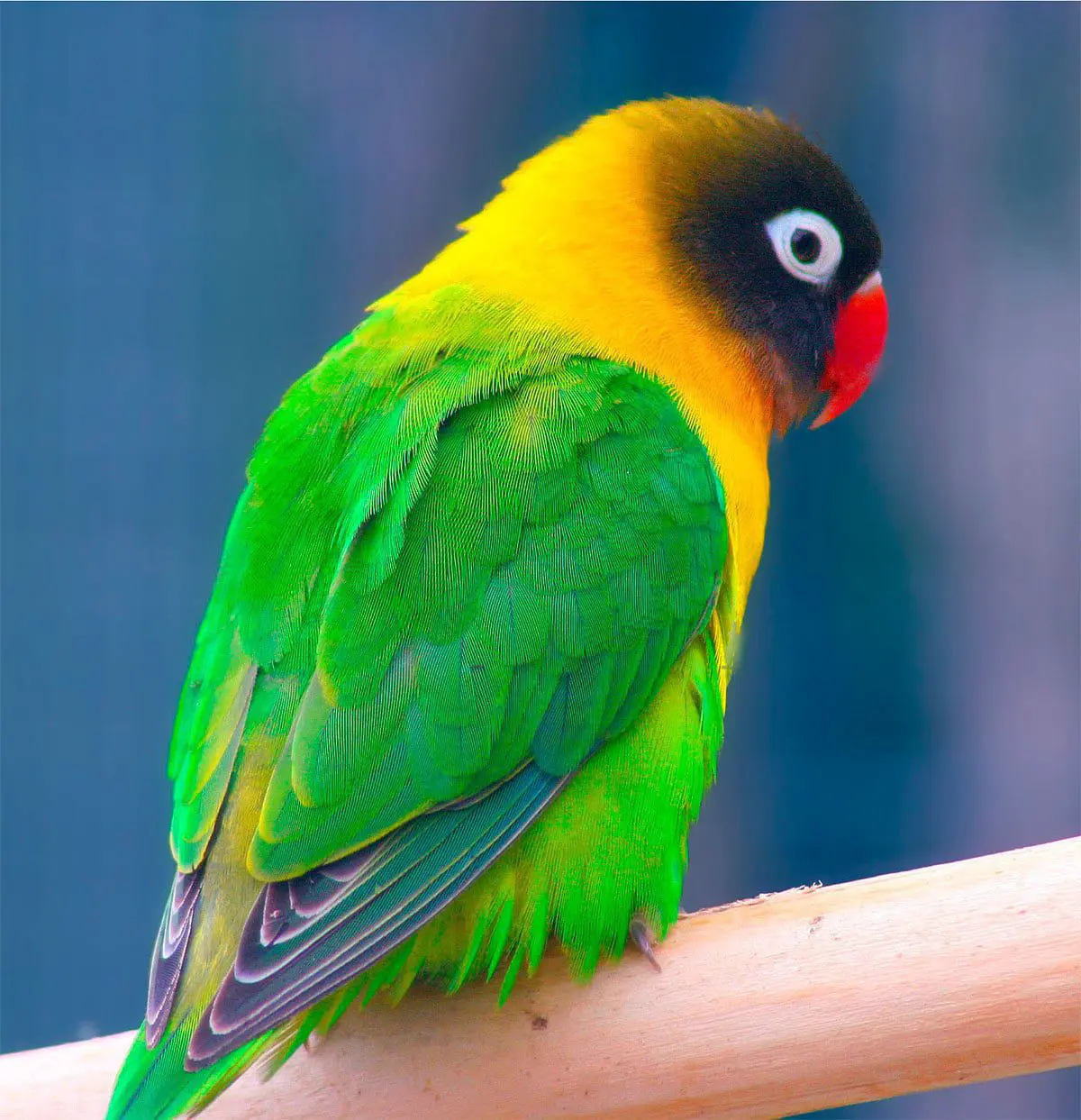
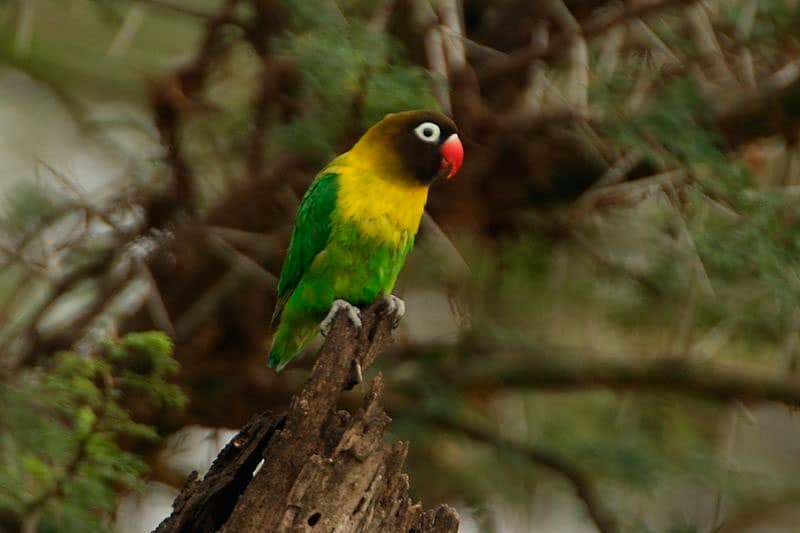
They have head, the throat and the top of the nape blackish brown, merging into yellow at the bottom of the nape and top of the the mantle, forming a distintivo collar. The remaining the mantle, scapulars and rump, are green; uppertail-coverts blue. Upper, the wing-coverts green; primaries green, darker in vane inner; vane outside of secondaries green, the vane internal black.

Under, wing-coverts green; underside of flight feather grey-black. Top of the chest bright lemon yellow; belly and undertail- coverts pale green. Tail mostly green, but all feathers, except the central pair, labeled orange opaque; subterminal band negruzca.

Bill coral red, white at the base of the upper jaw; cere white; irises brown; eye ring white (2mm wide); legs pale grey.

Both sexes are similar.

Immature and adults, but the head it is less dark and bright; neck yellow duller; black markings, sometimes at the base of the upper jaw.

Habitat "Inseparable Cabecinegro":

The Yellow-collared Lovebird They are distributed in well wooded pastures, including the cultivated areas, with Acacia, Commiphora and, above all, Adansonia, at altitudes between 1,100-1,800 m. Avoid miombo woodland.

Usually observed in small flocks of 4-5 birds but sometimes they can meet up to a hundred.

Reproduction "Inseparable Cabecinegro":

The nests of the Yellow-collared Lovebird they find, normally, in tree cavities, with a strong preference for Adansonia. They can also use free domed nests of other species. In Dar-es-Salaam, the nest, sometimes, They build it in the cavity of a building or in a free nest Little Swift (Apus ajffinis).

The nest is a complex domed structure built from long stems and strips of bark, carried by the female at the peak. The Eggs are laid in the dry season (March-April and June-July). The laying is of 3-8 in captivity. The egg incubation hard 23 days. During the first six weeks after hatching, the females they feed the young. Then, Once the young birds leave the nest, the males They take care of feeding pigeons During two weeks, or until young birds achieve independence.

"Inseparable head":

The Yellow-collared Lovebird feed of grass seeds, the millet and the sorghum, Also seed Cassia. They require regular access to water and can drink several times a day.

Distribution:

Size of its range (breeding/resident): 224.000 km2

Except track in southwest Kenya (in Taveta), the Yellow-collared Lovebird appear to be limited to the plateau in eastern and southern Tanzania, from northern, Mount Meru south to Morogoro and west on Regiรณn de Rukwa and Mbeya Region.

In Kenya, there are considerable feral populations in Naivasha, Nairobi and Mombasa; smaller in some highlands and the coastal towns (6.000 birds in 1.986.); in Tanzania, in Dar-es-Salaam and Thong.

Sedentary, in general, common and sometimes abundant. Wild population probably in decline due to the large scale capture for the bird trade. One large number in captivity.

Conservation:


minor concern

โ€ข Current Red List of UICN: Least concern

โ€ข Population trend: Stable

Until this year (2007) It was included in Appendix II (o anexo B) convention C.I.T.E.S.. Not globally threatened, but still vulnerable by presenting a reduced distribution area. Importation is no longer necessary to be a sufficient number in captivity.

The population size World has not been quantified, but the species according to sources is locally quite common.

The "inseparable head" in captivity:

The Yellow-collared Lovebird It, next to the Rosy-faced Lovebird and the Fischer's Lovebird, one of the most Lovebird bred in captivity.

The Yellow-collared Lovebird (Agapornis personatus) It is a bird very sociable with his kind and can live in a group.

Its aggressiveness does not reach the limit of being able to kill a fellow, as if they would Rosy-faced Lovebird.

Very common, available in all pet stores. A bit less noisy some other Lovebirds, their cry is less annoying. Like all Lovebirds, the Yellow-collared Lovebird they are very agile, Dynamic, good climbers and skilled in all kinds of acrobatics. After the breeding period, Some couples prefer to be alone if they spent this time with other couples of their species.

The Lovebirds rarely talk, but there is the possibility that learn to imitate human speech if they are taught since very young. It is important to remember that you should never have the expectation that a bird can speak.

With regard to its feeding, We provide our Yellow-collared Lovebird a set of seeds, such as millet, mixture of canary, sunflower and hemp. Alternatively, we can provide insect, ears of corn and an abundance of fruit, vegetables.

Give them opportunity to bathe and change the water regularly.

The Yellow-collared Lovebird are very easy to play, at humidity 70%. Three nidadas by year. The female tends to lead twigs on his rump to decorate your nest.

A cage of 80 x 40 x 40 cm.. It is suitable for these Lovebirds. The nest It must be a horizontal box height 25cm, 18cm wide and 18cm deep. The laying is of 3 to 6 eggs. The time of incubation of these eggs is 23 days and the chicks leave the nest 4 to 5 weeks after hatching.

Mutations Agapornis personatus

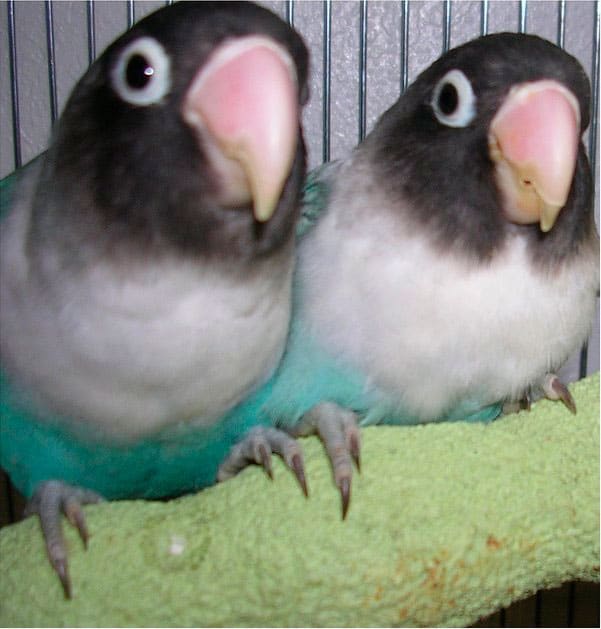
No sex-linked mutations present, All are autosomal. They can be recessive, dominant and incomplete dominant. They are recessive: blue, pastel, ino, albino, recessive harlequin, DEC, dilute, bronze fallow y pale fallow. The only dominant as such they are dominant harlequin and slaty. Incomplete dominant They are dark factor, purple, misty y edged.

One type of harlequin which it is transmitted to different recessive and dominant form, is the progressive harlequin o mottle. The harlequin is increasing as the bird will be more adult, as it is getting older.

This species has been used to "pass" its mutations to other species such as A. fischeri and A. nigrigenis. This step is called transmutation (type hybridization). In fact, personatus lutino comes from the transmutations with A. lilianae, species which came first. This whole process is possible to be fertile birds resulting from joining any of these 4 species including. With the A. roseicollis sterile individuals out. For all that we have seen, Finding Agapornis Persatus "pure" is a difficult task.

Source: The Bird Aviary

Alternative names:

Yellow-collared Lovebird, Black-masked Lovebird, Masked Lovebird, Yellow collared Lovebird (English).
Insรฉparable masquรฉ, Insรฉparable personata (French).
Schwarzkรถpfchen (German).
Inseparรกvel-mascarado (Portuguese).
Inseparable Cabecinegro, Inseparable de Mascara, inseparable enmascarado (espaรฑol).


scientific classification:

Anton Reichenow
Anton Reichenow

Order: Psittaciformes
Family: Psittaculidae
Genus: Lovebirds
Scientific name: Agapornis personatus
Citation: Reichenow, 1887
Protonimo: Agapornis personata


Images "Inseparable Cabecinegro":

Videos "Yellow-collared Lovebird"


Species of the genus Agapornis


"Black-neck lovebird" (Agapornis personatus)


Sources:

Avibase
Parrots of the World โ€“ Forshaw Joseph M
Parrots A Guide to the Parrots of the World – Tony Juniper & Mike Parr
Birdlife
Wikipedia

Photos:

(1) – Masked Lovebird (Agapornis personata) at Auckland Zoo By Chris Gin (originally posted to Flickr as Masked Lovebird 2) [CC BY 2.0], via Wikimedia Commons
(2) – A Yellow-collared Lovebird in Serengeti, Tanzania By Demetrius John Kessy from Arusha, Tanzania (Serengeti(Fisher Love Bird)) [CC BY 2.0], via Wikimedia Commons
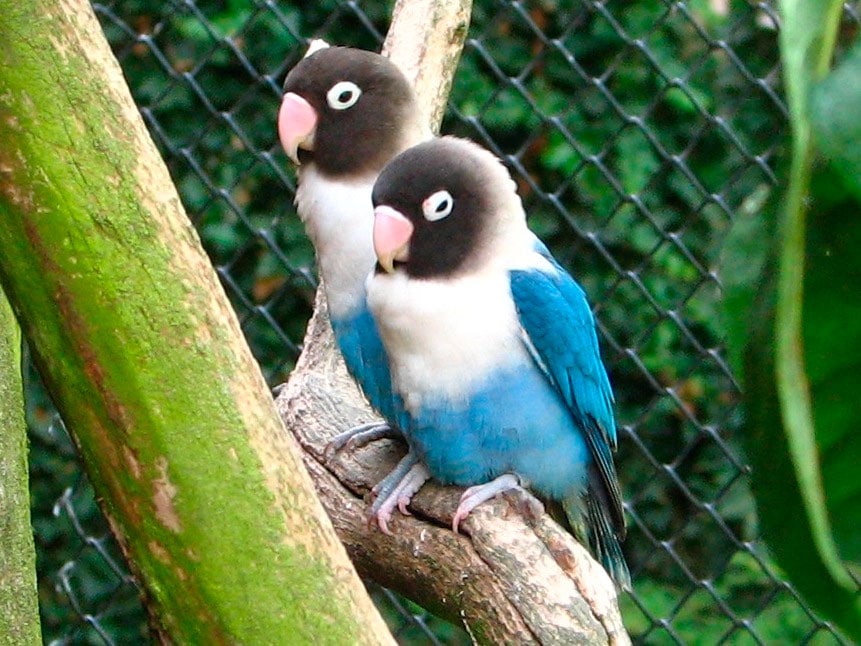
(3) – The blue colour mutant of the Masked Lovebird, at ฤŒastolovice Castle, Czech Republic By Mistvan (Own work) [CC BY-SA 3.0 or GFDL], via Wikimedia Commons
(4) – Several Yellow-collared Lovebirds at Kansas City Zoo, Missouri, USA By KCZooFan from Olathe, KS, U.S.A (Black-masked Lovebirds) [CC BY-SA 2.0], via Wikimedia Commons
(5) – A Yellow-collared Lovebird at Pukekura Park, New Plymouth, Taranaki, New Zealand By Virginia McMillan from Wellington, New Zealand (yellow breasted bird) [CC BY 2.0], via Wikimedia Commons
(6) – A Yellow-collared Lovebird at Honolulu Zoo, Hawaii, USA. It is perching by the entrance to a nestbox By Daniel Ramirez from Oakland, USA (Masked Love Bird) [CC BY 2.0], via Wikimedia Commons
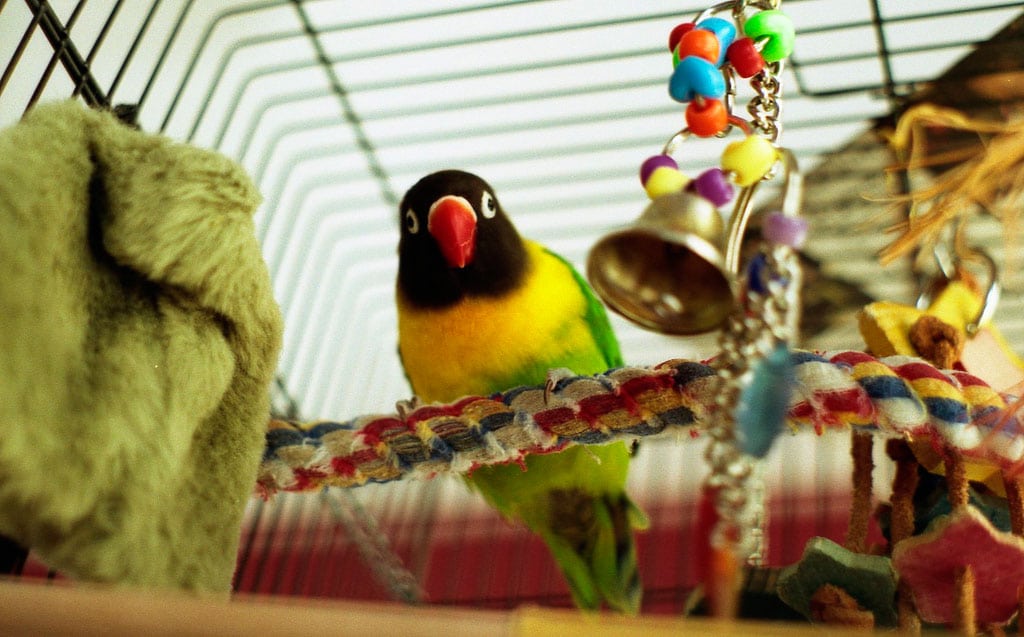
(7) – A pet Yellow-collared Lovebird in a cage with toys By Mike Fernwood from Santa Cruz, California, United States (Lauraโ€™s prisoner) [CC BY-SA 2.0], via Wikimedia Commons
(8) – Lovebird hybrids (Fischerโ€™s Lovebird x Masked Lovebird) in a back garden near Bangkok, Thailand By krisprachant [CC BY 2.0], via Wikimedia Commons
(9) – The blue mutant of the Masked Lovebird Agapornis personata. This variety is called blue Masked Lovebird By Autor: norasuered [CC BY-SA 2.0], via Wikimedia Commons

Sounds: Stein ร˜. Nilsen (Xeno-canto)
โ–ท The world of Pets: Dogs, cats, birds, reptiles, amphibians

Fischer's Lovebird
Agapornis fischeri


Inseparable de Fischer

Content

Description Fischer's Lovebird:

Inseparable de Fischer

Of 12,7 to 15 cm in length and a weight between 42 and 58 g..

The Fischer's Lovebird (Agapornis fischeri) has a frontal band, the lores and cheeks bright red with an orange shaded in red chin and throat. Upper chest is orange-yellow; crown and nape They are brown. Width collar adjacent yellowish brown and yellowish orange band at the top of chest.

The the mantle, scapulars and front of the rump, are green; the back of the rump and uppertail-coverts dark blue. Upper, the wing-coverts green; primaries and secondaries blackish brown with green edges to the vane outer. Under, the wing-coverts green; underside of flight feather grey-black. The low area chest up to the undertail- coverts pale yellowish green.

Tail bluish green, tipped yellow and bordered by a black line.

The bill is red, whitish towards the base of the upper jaw; cere white; irises brown; periophthalmic ring white of a 2 mm; legs pale grey.

Both sexes similar, indeed there no sexual dimorphism Between both.
One method that is very effective in distinguishing the sex of our Fischer's Lovebird It is the bone of the pelvis, being more open in females than in males.

The immature They have reduced the blue in the uppertail-coverts and they are both duller than adults, particularly on neck, the head and the chest; black markings, sometimes at the base of the upper jaw.

Habitat Fischer's Lovebird:

The Fischer's Lovebird They inhabit wooded grasslands with acacias, Commiphora; especially in the west, also in more open grasslands with Adansonia and cultivated areas. More common in sheets with different types of acacias and trees of the genus Egyptian balanites; also in terrestrial flora zones including Penisetum, Digitaria, Themeda and pastures Eustachys.

In the south of its range They are present in the forest with palm trees Borassus aethiopum.

When the season is dry, They can also be seen in areas of riverine forests Ficus, Boolean, Tamarindus, Aphania, Garcinia and Eckberg.

Avoid wooded savannah type miombo.

usually in altitude between 1,100-2.000 m. Often near water, especially in hot weather.

Gregarious, at least outside the breeding season , and generally in small flocks. Sometimes more important meetings form, for example, where abundant food.

In Tanzania They meet roosting nests leveraging Rufous-tailed Weaver (Histurgops ruficauda).

The main known predators Fischer's Lovebird they are the Borni Falcon (Falco biarmicus).

Reproduction Fischer's Lovebird:

The Fischer's Lovebird They breed in colonies.

The breeding It takes place from January to April and in June and July, coinciding with the dry season; the exact timing depends on the locality.

Most of the nests They are located 2.15 meters above the ground, at the base of leaves overhead palm, in the holes and cracks of dead trees or dead branches and live trees, sometimes nest on cliffs.

The nest It comprises grass stalks and peel strips carried by the female in his beak.

The Clutch size in captivity is three to eight eggs, with a period of incubation of 23 days and period incipient of 38 days.

Food Fischer's Lovebird:

The diet of the Fischer's Lovebird is mainly granivorous. It feeds on seeds such as Pennisetum mezianum, also it feeds millet and corn, although the species does not come to be considered a serious pest for crops; Also they take seeds Acacia directly from trees, grass Achyranths asper, fallen berries and fruit Ficus, Rhus shaggy and Commiphora.

They need to drink daily.

Distribution:

The Fischer's Lovebird They are endemic to the north and northwest Tanzania from Kondoa in the South-East, Serengeti National Park, in the north and the Lago Manyara in the East; possibly closer to the border Kenya in some areas.

In Rwanda and Burundi the species is either a recent natural settler, or I asilvestrado from 1970, or an irruptive visitor in response to drought.

Observed on the islands Ukerewe and KNIT in southern Lago Victoria.

Wild populations established in the region Dar es Salaam and Thong in Tanzania, and around Mombasa, Nairobi, Naivasha and Isiolo, in Kenya.

Probably some Local movements in the dry season with irruptions in drought years. Within its tiny range, is a common bird, with large flocks in some areas, scarce and seemingly in decline, especially outside protected areas where low density is attributed to the capture for trade.

There is a self-sustaining wild population derived from escapes from captivity in Southeast France, where Yellow-collared Lovebird (Agapornis personatus) also they escaped, along with hybrids also observed.

A big number of Fischer's Lovebird in captivity.

Conservation:


Near-threatened

โ€ข Current Red List of UICN: Near threatened

โ€ข Population trend: Decreasing

The population of the Fischer's Lovebird release has been estimated to range between 290.205 and 1.002.210 birds.

There has been a significant population decline Since the Decade of 1970, mainly because of widespread trapping for the wild bird trade.

The Fischer's Lovebird wild bird was the most traded in the world 1987 and was the most popular wild parrot imported into the then European economic community, representing about 80% exports of parrots in Tanzania (RSPB 1991).

The legal collection for export has been stopped, but the population remains much lower than it was, and trade could start again (Moyer 1995).

The species hybridized with the Yellow-collared Lovebird (Agapornis personatus) in the nature, but not within the natural range of the species (there is a range of overlap but the Fischer's Lovebird It appears to be a non-breeding visitor habitat Yellow-collared Lovebird [N. Baker a slightly. 1999, Morton y Bhatia 1992]) so this is unlikely to pose a threat.

Conservation Actions Proposed

– Conduct surveys to obtain an estimate of the population-date.
– Monitor population trends through regular surveys.
– It prevent capture for export to start again. Investigate the extent of hybridization with the Yellow-collared Lovebird (Agapornis personatus).

The Fischer's Lovebird in captivity

The Fischer's Lovebird They have been kept as pets from, approximately, mid-sixteenth century. They became part of the trade in live birds 1926. The first successful captive breeding of Agapornis fischeri It was documented 11 in January of 1928. For the year 1931, the berlin zoo (Germany) they had raised 68 copies successfully in captivity. Today they are bred and sold as pets, mainly in the United States and Europe. In 1987 was the most traded bird species in the world.

The Fischer's Lovebird they are difficult birds to keep healthy in captivity. Son active birds they need a lot of space. When you are confined in a cage, health tends to deteriorate. Instead of being active and vocal, often they sit on the floor of the cage in a corner. physical problems such as negative young and the overweight also they shortened their longevity.

Being very active birds and require wide cage (a minimum of 50 x 50 x 75 cm. to a bird and 65 x 65 x 75 cm for a couple.). It is appropriate to give a little spot inside the cage to hide in when they feel insecure.

Surprisingly, they don't seem to have much trouble acclimatizing to cold weather even though their original habitat is tropical. If they kept away from drafts, they can withstand the long winters on other continents.

If allowed out of his cage must be very careful not to have utensils close that they can damage or may damage, they are avid chewers, they have strong beaks and can quickly cause damage.

They are very vocal birds and their shrill noise can be a nuisance.
.
Of all species of Lovebirds, the Fischer's Lovebird He is known to be the most acrobatic.

With regard to its longevity, a demographic study suggested that these birds are aging rapidly with maximum longevity 7,7 years. An exemplary, as indicated sources, lived 12.6 years in captivity. Maximum longevity could be underestimated; More studies are needed. It has also been informed by other sources that these animals can live up 32,2 years in captivity, but this has not been verified.

Alternative names:

Fischer’s Lovebird (English).
Insรฉparable de Fischer (French).
Pfirsichkรถpfchen (German).
Inseparรกvel-de-fisher (Portuguese).
Inseparable de Fischer, Agapornis Fischer (espaรฑol).


scientific classification:

Fischer's Lovebird - Anton Reichenow
Anton Reichenow

Order: Psittaciformes
Family: Psittaculidae
Genus: Lovebirds
Scientific name: Agapornis fischeri
Citation: Reichenow, 1887
Protonimo: Agapornis Fischeri


Images Fischer's Lovebird:

Videos "Fischer's Lovebird"


Species of the genus Agapornis


Fischer's Lovebird (Agapornis fischeri)


Sources:

Avibase
– Parrots of the World โ€“ Forshaw Joseph M
– Parrots A Guide to the Parrots of the World – Tony Juniper & Mike Parr
– Birdlife

Photos:

(1) – Fischerโ€™s Lovebird, (Agapornis fischeri); side view of a pet on a perch By Peter Bรฉkรฉsi (Flickr) [CC BY 2.0], via Wikimedia Commons
(2) – Two Fischerโ€™s Lovebirds, (Agapornis fischeri). Pets on a perch By Peter Bรฉkรฉsi from Budapest, Hungary (IMG_2303) [CC BY 2.0], via Wikimedia Commons
(3) – Three Fischerโ€™s Lovebirds at Ueno Zoo, Japan By Agapornis_fischeri_-Ueno_Zoo,_Japan_-three-8a.jpg: Takashi Hososhima from Tokyo, Japanderivative work: Snowmanradio [CC BY-SA 2.0], via Wikimedia Commons
(4) – Fischerโ€™s Lovebirds, Agapornis fischeri, social grooming By Peter Bรฉkรฉsi (originally posted to Flickr as IMG_0692) [CC BY-SA 2.0], via Wikimedia Commons
(5) – Fischerโ€™s Lovebird perching on a branch in captivity By Franรงoise Walthรฉry from Bruxelles, Belgium (8_Buiten_reeks_8) [CC BY-SA 2.0], via Wikimedia Commons
(6) – Fischerโ€™s Lovebirds at World of Birds Wildlife Sanctuary and Monkey Park in Cape Town, South Africa By Mara 1 (originally posted to Flickr as I Love You !) [CC BY 2.0], via Wikimedia Commons
(7) – Fischerโ€™s Lovebird (Agapornis fischeri). Two on a branch By Lucia Smit (originally posted to Flickr as Sonny & Cher) [CC BY 2.0], via Wikimedia Commons
(8) – Fischerโ€™s Lovebirds, Agapornis fischeri By Peter Bรฉkรฉsi (originally posted to Flickr as IMG_0736) [CC BY-SA 2.0], via Wikimedia Commons
(9) – A group of Fischerโ€™s Lovebirds feeding at Ueno Zoo, Japan By kanegen (originally posted to Flickr as Ueno Zoo) [CC BY 2.0], via Wikimedia Commons
(10) – Fischerโ€™s Lovebird, (Agapornis fischeri) perching on a box By Peter Bรฉkรฉsi (Flickr) [CC BY-SA 2.0], via Wikimedia Commons

Sounds: Rory Nefdt (Xeno-canto)