โ–ท The world of Pets: Dogs, cats, birds, reptiles, amphibians

Varied Lorikeet
Psitteuteles versicolor

Varied Lorikeet

Content

Description

19 cm.. length and a weight between 50 and 60 gr.

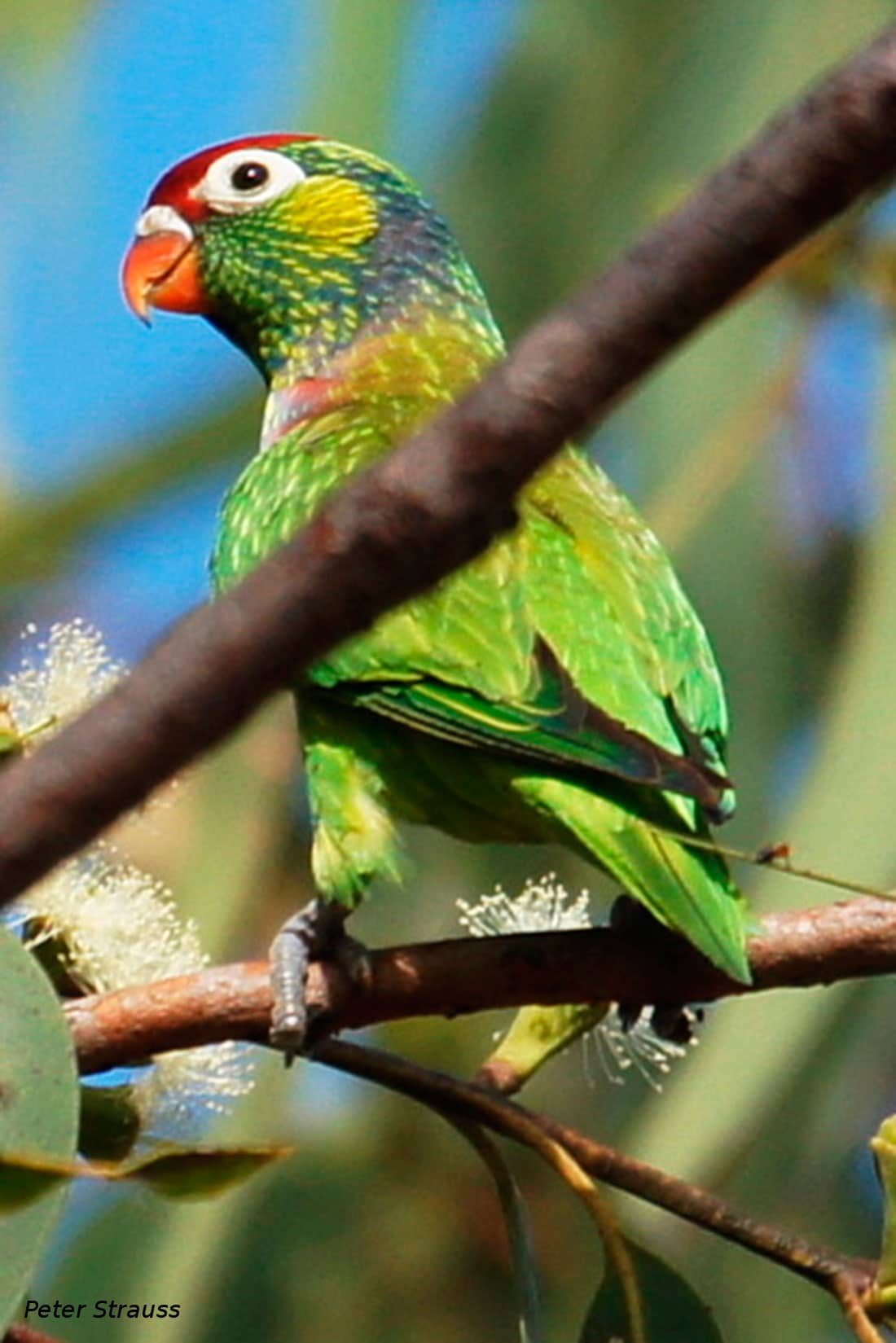
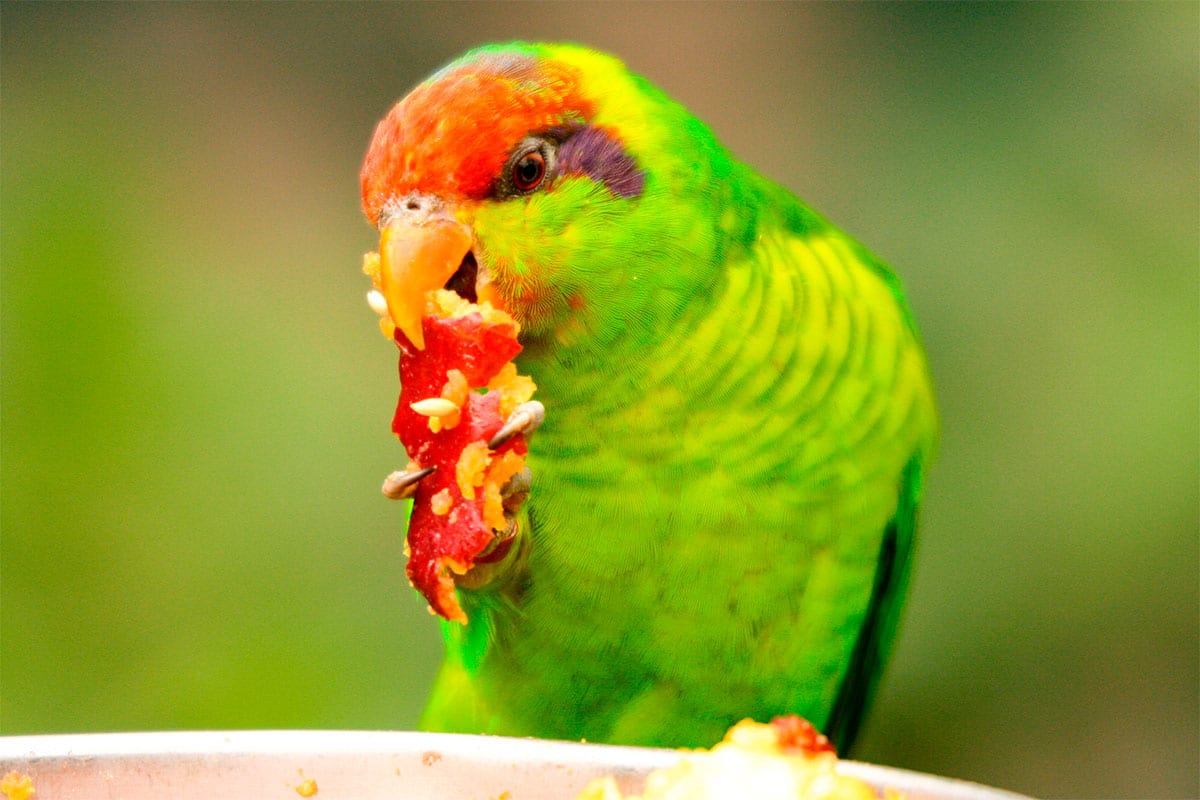
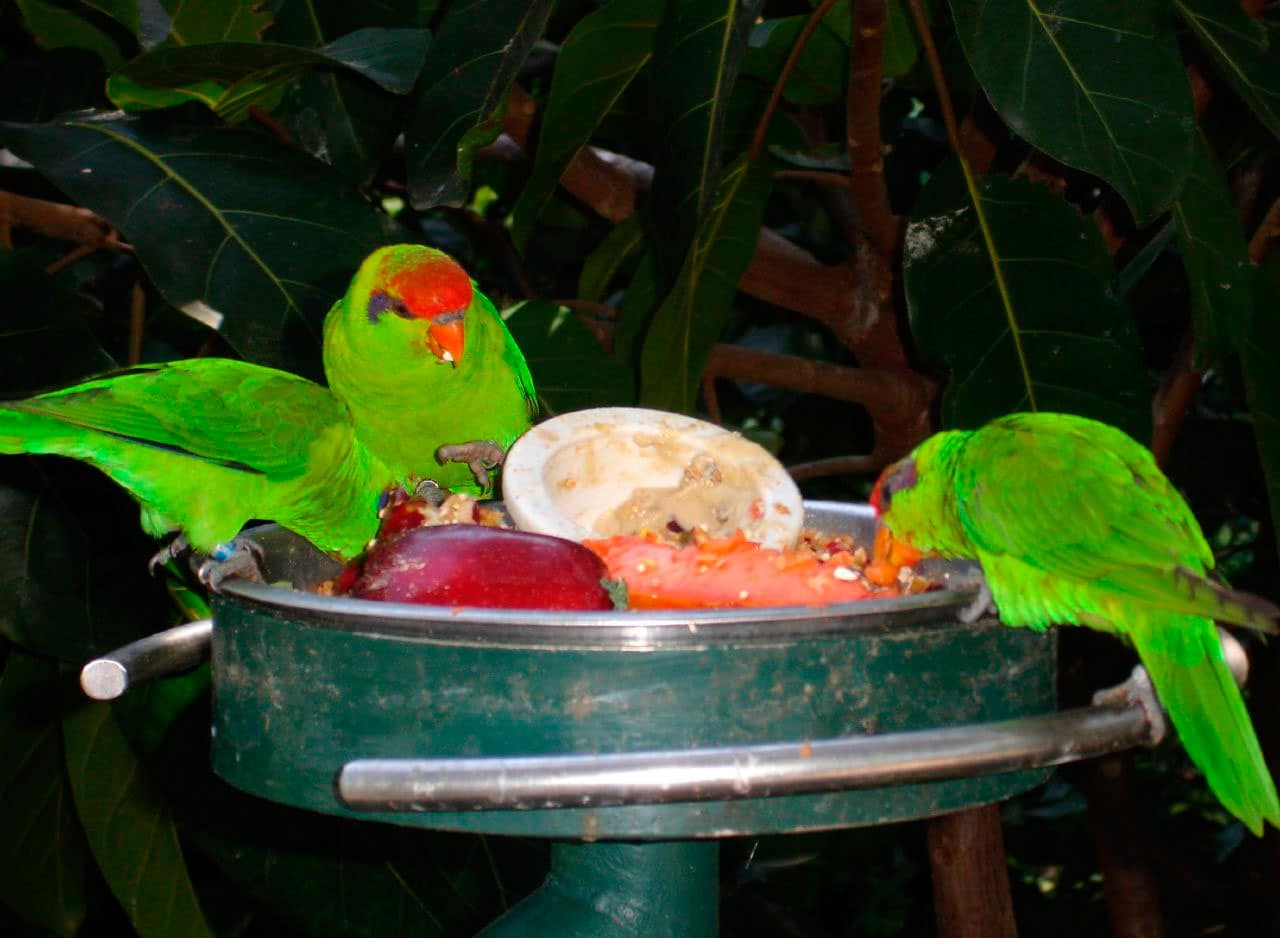
The Varied Lorikeet (Psitteuteles versicolor) has the forecrown and beginning of skull red-scarlet; the mumps and cheeks They are bright yellow-green with a slight bluish green stripe; the back of the mumps and the back of the head They are greenish blue with yellow streaks.

The upperparts They are olive green with pale green streaks along the rump; the Feather coverts are green with a pale border; the flight feather They are blackish green inside and outside with a thin yellow stripe on the edge.

The bottom of the wings It is green with a yellow border; the throat It is dotted with yellow and blue-green; lower throat and the chest show infiltrations green with pink and orange; the abdomen It is pale greenish yellow with yellow stripes.

The upper part of the tail is green, yellow-green below, darker when tail is closed.

The bill is orange. The area covering the nostrils and the bare periophthalmic, are white. The irises It is yellow and legs grey.

The Red coloration of the head on female It is less intensive and extensive. Its chest It is pink with less infiltrations.

In the immature, red color lores and the cap It is absent. The bill It is more marked in brown and irises They are darker.

Habitat:

This species lives a nomadic life, mainly on the Plains. It is in a wide variety of forest habitats, including dense eucalyptus plots Melaleuca, swamp forest, savannas and Shrublands, grasslands and sometimes mangroves.

The Varied Lorikeet They also inhabit regions of rolling hills and wooded areas along streams. They live in pairs, in small groups or large groups that are often associated with the Red-collared Lorikee (Trichoglossus rubritorquis), although they have a much calmer demeanor than the latter.

are very aggressive with other species nectarivores that are competing for the same flower beds.

outside the breeding season, the Varied Lorikeet they become more mobile because the blooming trees are rarer. In some areas they are most abundant from April to may and from September to October. But, the information is not sufficient to say that this bird is a seasonal migrant.

Reproduction:

The reproduction It takes place throughout the year, However, It is most active between April and August.

install nest in the cavity of a trunk or branch, usually near a water source. The bottom of the hole is lined with wood chips or leaves that have been previously "chewed".

The spawning is between 2 and 5 white eggs that are incubated by the female alone for about 22 days. The young are fed by both parents, and leave the nest after 6 weeks.

Food:

Their diet consists of pollen, fruits, seed and probably some insects. These birds feed on the Ceiba or Kapok, wood and Red eucalyptus trees of Melaleuca.

Distribution:

Size of its range (reproduction / resident): 2.170.000 km2

This bird is endemic in northern Australian continent.

Its area of distribution extends from Broome and the surroundings of the fitzroy river (Western Australia), to the Northwest of Queensland and Mount Isa.

Crosses the region from Kimberley, all the Arnhem Land and in the Gulf of Carpentaria.

The Varied Lorikeet It is also present in the Cape York Peninsula and in the South, Townsville.

Conservation:

minor concern


โ€ข Current IUCN Red List category: Least concern

โ€ข Population trend: Stable

The Varied Lorikeet they are usually fairly common. In the Darwin region, for example, It can be found in large quantities when the trees are in bloom. They are less common in the Cape York Peninsula and along the east coast.

The world population It is estimated in more than 100.000 specimens. The species is not globally threatened and does not receive any specific protection measures..

"Varied Lorikeet" in captivity:

It is not found outside Australia; limited breeding in Australia.

Alternative names:

Varied Lorikeet, Northern Varied Lorikeet (ingles).
Loriquet variรฉ, Loriquet versicolore (French).
Buntlori (German).
Lรณris-versicolor (Portuguese).
Lori Versicolor, Tricogloso Versicolor (espaรฑol).

scientific classification:

Order: Psittaciformes
Family: Psittaculidae
Genus: Psitteuteles
Scientific name: Psitteuteles versicolor
Citation: (Lear, 1831)
Protonimo: Trichoglossus versicolor

ยซLori Versicolorยป images:

Videos "Varied Lorikeet"

————————————————————————————————

ยซLori Versicolorยป (Psitteuteles versicolor)


Sources:

Avibase
– Parrots of the World โ€“ Forshaw Joseph M
– Parrots A Guide to the Parrots of the World – Tony Juniper & Mike Parr
– BirdLife.org

Photos:

1 – by Peter Strauss – IBC.lynxeds.com
2 – ยซPsitteuteles versicolor - Queensland-8-4 cยป by Psitteuteles_versicolor_-Queensland-8.jpg: Joshua Robertsonderivative work: Snowmanradio (talk) – originally posted to Flickr as Varied Lorikeet [Psitteuteles versicolor] and uploaded to commons at Psitteuteles_versicolor_-Queensland-8.jpg. Licensed under CC BY 2.0 via Wikimedia Commons.
3 – by Steve_Murphy – IBC.lynxeds.com
4 – Varied Lorikeet (Psitteuteles versicolor), Bell Gorge, WA – olsvik.info
5 – Alan Marshallโ€™s Pictures of Varied Lorikeet – members.ozemail.com.au
6 – Varied Lorikeet (Psitteuteles versicolor) Illustration by Edward Lear [Public domain], via Wikimedia Commons
โ–ท The world of Pets: Dogs, cats, birds, reptiles, amphibians

Yellow-bibbed Lory
Lorius chlorocercus

Yellow-bibbed Lory

Content

Description

28 cm.. length and an approximate weight of 200 g..

The Yellow-bibbed Lory (Lorius chlorocercus) is the only member of the genus Lorius It found in the Solomon Islands Orientales. In flight it has a robust construction, with a distinctive tail short.

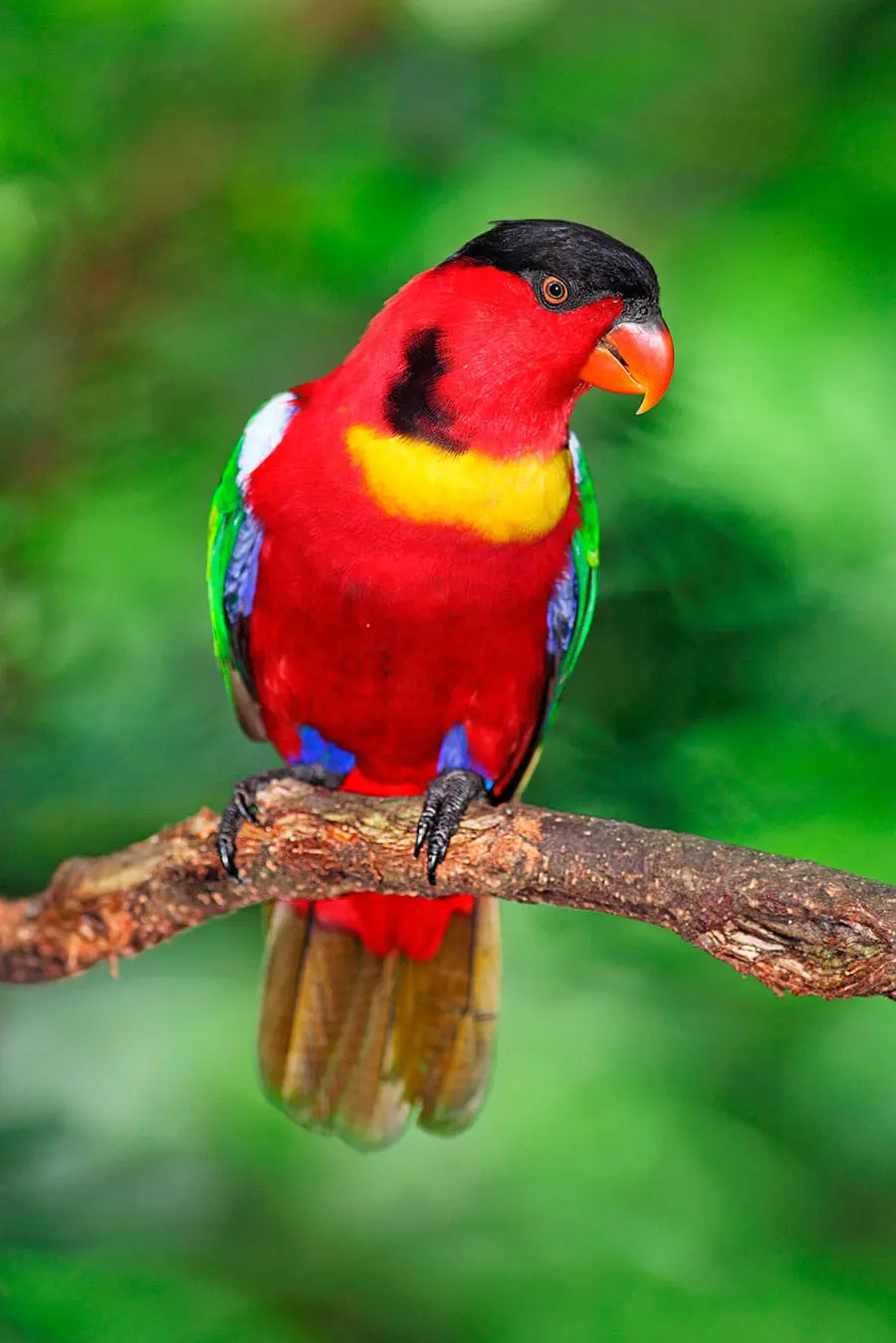
It has a hood black running from the top of the bill up to the nape; the rest of the head is bright red with a prominent patch black, Crescent-shaped, on one side of neck. The upperparts They are red; center of the mantle, dark red. The wings green with yellow light bronze glow, in particular coverts and tertiary.

internals flight feather and greater coverts, black; bend of wing with a white spot and sometimes showing blue below wing-coverts; the coverts are blue, black tip, with a reddish pink broadband in the Central, on the undersides of the primaries. axillary purple blue.

The underparts They are red with a prominent yellow necklace; the thighs blue. Top, of the tail, red with green tips; lower tail, red with yellow opaque tip.

The bill It is orange with dark base to lower jaw; Orange the irises; legs dark gray.

The immature They have yellow band chest and marks on the sides and virtually absent bill is brown.

The cap black, wings green and underparts red with a band in the chest yellow, you are distinguished from other sympatric species of similar size as the Cardinal Lory and the Coconut Lorikeet.

Habitat:

Found in the canopy of the forest and secondary growth at all altitudes up to 1.000 m. In Guadalcanal it is more common in foothills than in lowlands and more common in low cloud forest. Other islands also occasionally observed around coconut plantations. Usually moves individually, in pairs or in groups of up to ten birds. Ecology generally little known although presumably typical of the genus.

Reproduction:

Little is known of its reproduction in the wild.

In captive, the setting is two eggs and incubation lasts and 25 days. The young remain in the nest during 8 to 10 weeks.

Food:

Its diet pollen compose, nectar, flowers and seeds.

Distribution:

Size of its range (reproduction / resident): 78.200 km2

endemic to the Solomon Islands Eastern on Savo, Guadalcanal, Malaita, Suavanao, Uki, San Cristรณbal and Rennell. Quite common. World population 10.000 – 50, 000 specimens.

Conservation:


minor concern

โ€ข Current IUCN Red List category: Least concern.

โ€ข Population trend: Stable.

Least concern – in the news quite common in the natural and abundant across most of its range.

Many species of birds in the Solomon Islands are vulnerable simply because of their small natural ranges, and the felling of forests for agriculture is a constant threat.

"Yellow-bibbed Lory" in captivity:

Before the Decade of 1990, the Yellow-bibbed Lory (Lorius chlorocercus) it was almost unknown in the United States and poultry farming, even then, a handful of birds were imported from the Solomon Islands. In 1998, a captive breeding consortium, call Solomon Island Parrot Consortium (SIPC), It was formed and received permission from the Government of the Solomon Islands and permissions of USFWS to import 30 pairs of each of the six species of parrots that are found in the Solomon Islands.

These 60 Yellow-bibbed Lory they were the first species imported under this permit. From these original 60 birds, now there are enough birds that are starting to appear as pets from time to time. They were first bred in United States in 1989, in the aviaries of Seattle by Jan van Oosteen, who is considered the force behind the obtaining of this group of 30 couples.

More information on –> birdchannel

Alternative names:

Yellow-bibbed Lory, Yellow bibbed Lory (ingles).
Lori ร  collier jaune (French).
Grรผnschwanzlori (German).
Lรณris-de-colar-amarelo (Portuguese).
Lori Acollarado, Tricogloso de Collar (espaรฑol).

John Gould
John Gould

scientific classification:


Order: Psittaciformes
Family: Psittaculidae
Scientific name: Lorius chlorocercus
Genus: Lorius
Citation: Gould, 1856
Protonimo: Lorius chlorocercus


Images ยซCollared Loriยป:

Videos "Yellow-bibbed Lory"

————————————————————————————————

ยซLori Acollaradoยป (Lorius chlorocercus)


Sources:

Avibase
– Parrots of the World โ€“ Forshaw Joseph M
– Parrots A Guide to the Parrots of the World – Tony Juniper & Mike Parr
– Birdlife

Photos:

1 – By Benjamint444 (Own work) [GFDL 1.2], via Wikimedia Commons
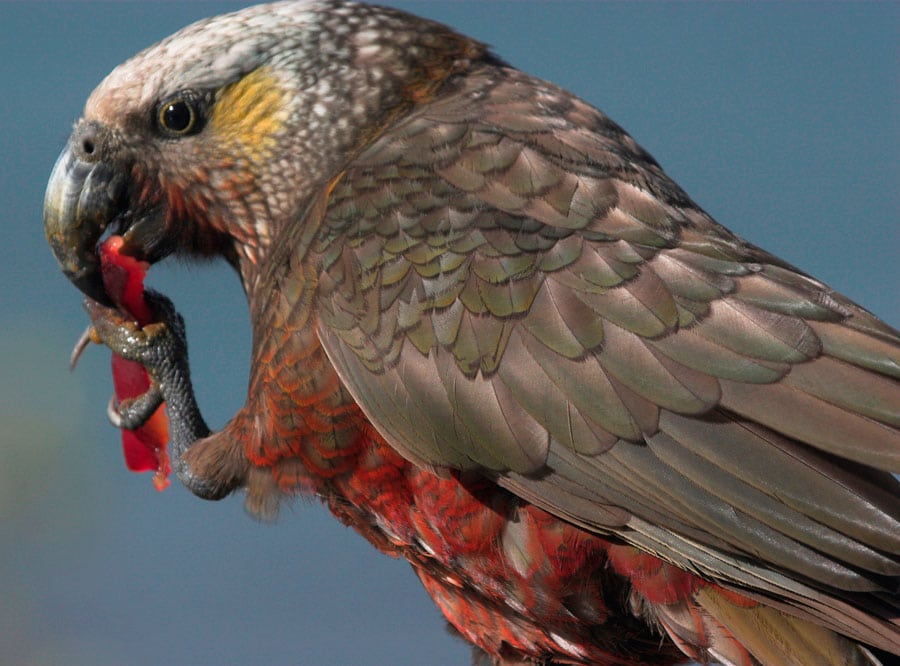
2 – Birds-pet-wallpapers – link
3 – By Benjamint444 (Own work) [GFDL 1.2], via Wikimedia Commons
4 – Young Yellow-bibbed lory feeding from spoon – kcbbs.gen.nz
5 – Singapore Jurong Bird Park – jaxstumpes

Sounds: Niels Krabbe (Xeno-canto)

โ–ท The world of Pets: Dogs, cats, birds, reptiles, amphibians

Orange-fronted hanging parrot
Loriculus aurantiifrons

Loriculo Bean

Content


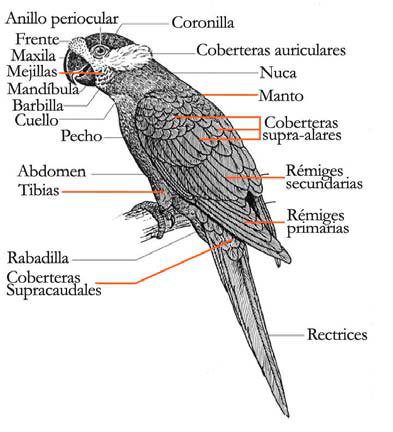
Anatomy-parrots

Description

It measures each 11 cm.. length and a weight between 13 and 16 g..

Hanging-Papu

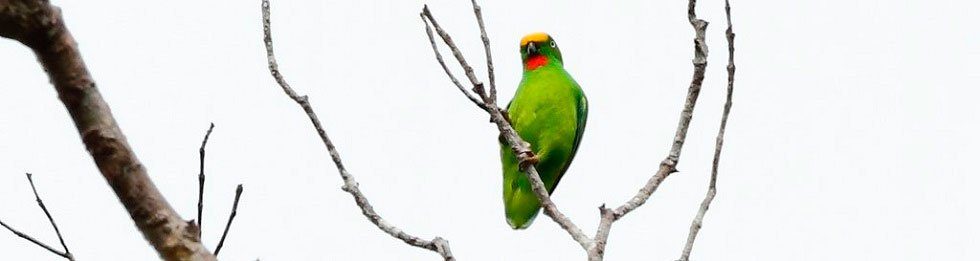
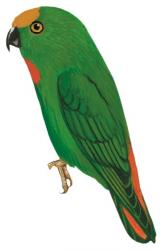
The head of the Orange-fronted hanging parrot (Loriculus aurantiifrons) is green, with the front of the crown yellow (sharp demarcation of the green in the crown rear). Upperparts green, with rump and uppertail-coverts bright red; sides rump with yellow marks. Wings Greens with vane internal to the flight feather blackish. Blue with green Underwing coverts. Chin red, rest of the underparts are slightly more yellowish than upperparts (especially coverts). Timoneras pens Green with tips yellow; undertail bluish.

Bill black; Iris whitish; legs brownish black.

Female has the face and the part front of it crown Green with red and pale blue feathers. Spada Red more small that it's the male. Iris brown.

The young birds lack of the crown and throat red. Bill brown.

Description 3 subspecies

  • Loriculus aurantiifrons aurantiifrons

    (Schlegel, 1871) – Nominal


  • Loriculus aurantiifrons batavorum

    (Stresemann, 1913) – Male with less yellow in forecrown. Female similar to nominal.


  • Loriculus aurantiifrons meeki

    (Hartert, 1895) – The male as of the subspecies batavorum but slightly larger. Female also similar to nominal but larger and bases of feathers on the front of the crown, yellow-brown color.

Habitat:

The Orange-fronted hanging parrot they are distributed in the low jungle to a altitude approximate of 1.200 m (from time to time to 1.000 m), along the edges of forests, in palm plantations, areas of secondary growth, casuarinas, pines, gardens and partially cleared areas.

The species is inconspicuous and usually difficult to detect, except when they are called among them, Since it flies above the canopy. It is usually found in groups of two to four members, foraging at various levels in the forest.

Birds perch on occasions in a branch and sing (possibly part of their courtship behavior).

Reproduction:

Guidelines of nesting you have registered between July and October, and it is said that on one occasion a bird was found incubating four eggs in a hole to 12 meters above the ground. The birds have also been observed visiting holes in arboreal termite, perhaps to rest.

Food:

Is them has observed entering their peak next to the needles of casuarinas, probably in search of Lerp insects. The diet also includes outbreaks, fruits and flowers.

Distribution:

Size of the area of distribution (reproduction / resident): 576.000 km2

Widely distributed, Although not particularly continuously, through much of the lowlands of New Guinea, in both Irian Java, Indonesian, and Papua New Guinea, Although it can be absent from most of the Center-South of the big island.

Its small size, coloration and habits make difficult his observation. Field work are running that the species is continuing in the North and South of New Guinea with the clinal variation in size. The range includes the following islands of the coast: Misool, Waigeo, Karkar, Fergusson and Goodenough.

Distribution 3 subspecies:

  • Loriculus aurantiifrons aurantiifrons

    Nominal.


  • Loriculus aurantiifrons batavorum

    Waigeu, West of the papua islands, and Northwest of New Guinea, East Coast region North of Sepik River, North of Papua New Guinea, and the South coast of Setekwa River, Irian Jaya.


  • Loriculus aurantiifrons meeki

    Fergusson, Goodenough, Karkar Islands (Papua New Guinea), and this from New Guinea, from the coast north to the West of the region of Sepik River, and in the South West area of lowland up to the region of Fly River, and possibly in the vicinity of Irian Jaya.

Conservation:


minor concern


โ€ข Current IUCN Red List category: Least concern.

โ€ข Population trend: Stable.

The world population of the Orange-fronted hanging parrot It has not been quantified, Although it is suspected that it may be most of 100.000 specimens and are considered stable and locally common (pit et to the. 1997).

The population is suspected to be stable in the absence of evidence of any reduction or substantial threats.


"Orange-fronted hanging parrot" in captivity:

extremely rare.

Alternative names:

Orange-fronted Hanging-Parrot, Bat Lorikeet, Golden-fronted Hanging-Parrot, Misool Hanging-Parrot, Orange fronted Hanging Parrot, Orange-fronted Hanging Parrot, Papuan Hanging Parrot, Papuan Hanging-Parrot (ingles).
Coryllis ร  front orange (French).
Goldstirnpapageichen, Grรผnstirnpapag (German).
Lorรญculo Papรบ (espaรฑol).


scientific classification:

Hermann Schlegel
Hermann Schlegel

Order: Psittaciformes
Family: Psittaculidae
Genus: Loriculus
Scientific name: Loriculus aurantiifrons
Citation: Schlegel, 1871
Protonimo: Loriculus aurantiifrons

Images "Orange-fronted hanging parrot"

ยซPapรบ Loricleยป (Loriculus aurantiifrons)


Sources:

Avibase
Parrots of the World โ€“ Forshaw Joseph M
Parrots A Guide to the Parrots of the World – Tony Juniper & Mike Parr
Birdlife

Photos:

(1) – Rockjumper
(2) – hbw

โ–ท The world of Pets: Dogs, cats, birds, reptiles, amphibians

New Zealand Kaka
Nestor meridionalis

New Zealand Kaka

Content

Illustration of a Kaka.

Description

45 cm.. length and an average weight of 550 g..

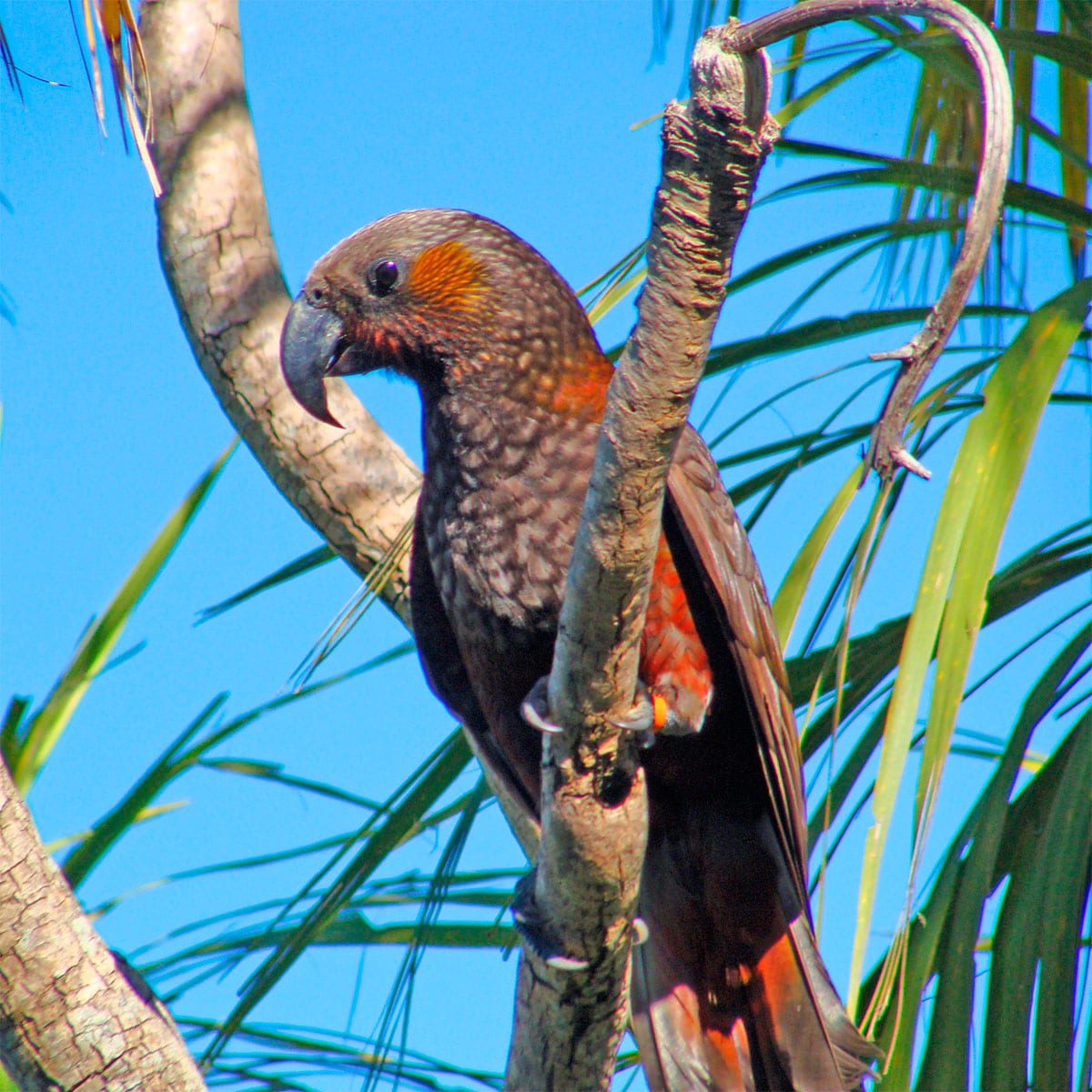
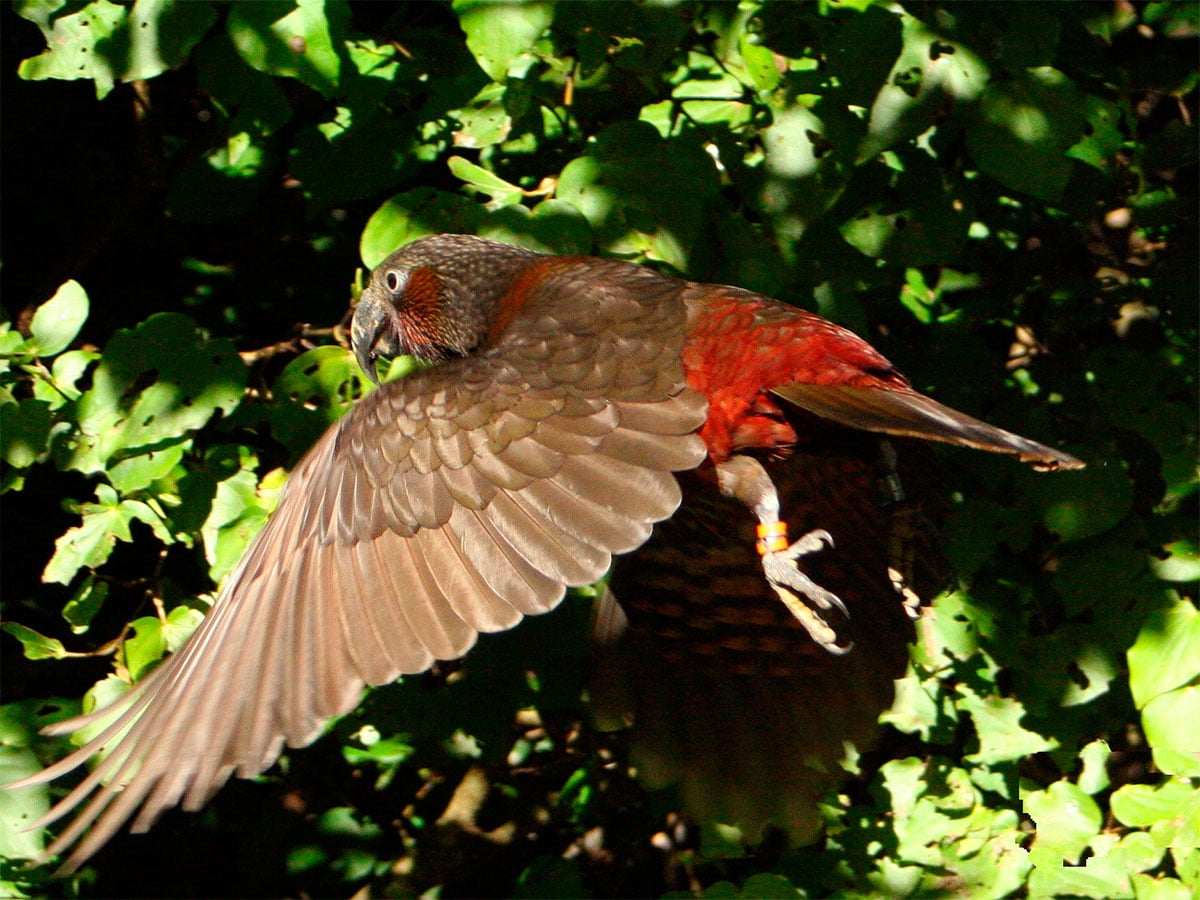
The New Zealand Kaka (Nestor meridionalis) they are some great parrots with a tail of medium length and a plumage predominantly Brown and Red.

The adult male has the crown whitish grey color and the neck with a greyish Brown appearance due to large brown feathers that surround you.

The under eye and the sides of the neck has a bluish grey clear. The lores are greyish Brown, that contrast with the ear-coverts strongly tinged with orange. The sides of the chin they have reddish-brown infiltrations.

The feathers of the upperparts are greenish Brown with darker stripes and stripes. Those in the back of the neck They are crimson red with yellow endings and browner bases..

The the mantle, sometimes, has some red spots. Rump and uppertail-coverts are red with dark brown trim. The lower area of the wings and axillary they are also red.

The feathers of the chest are olive brown in colour with reddish edges subterminales. Belly and undertail-coverts are red with dark edges.

The tail is brown with lighter tip.

The bill is brownish grey, more powerful that the of the Kea. The cere Brown it is decorated with a few whiskers. The irises is dark brown, legs dark gray.

The adult female presents a bill shorter and one mandible less curved top.

The youth they are similar to adults, but have a small yellow spot at the base of the lower jaw.

Subspecies description

  • Nestor meridionalis meridionalis (Gmelin, 1788) – Nominal species

  • Nestor meridionalis septentrionalis (Lorenz von Liburnau, L 1896) – It measures 42 cm approximately. Variation of the nominal (Nestor Meridionalis). More small, in general, and plumage more off. The red band of the neck is more small and dark. The back of the wings olive color is more dark.

Habitat:

The New Zealand Kaka (Nestor meridionalis) they frequent the compact forests of low to medium height, where there are mainly podocarp and beech trees of the genus Nothofagus. Occasionally they come into gardens and orchards, especially in winter.

These birds they tend to live at altitudes between 450 and 850 meters in the summer and from the sea level to the 550 meters in winter. But, from time to time, You can climb up to the 1.500 m.

The New Zealand Kaka they live in pairs or in small groups of up to ten birds.

These birds are not as well known as the Kea (Nestor notabilis), Although in some places come to feed in the hand of the tourists.

We can often see them at the top of trees or simply flying over the canopy.

The birds that are found in the air almost always heard before to be seen.

The New Zealand Kaka they are active during the morning and afternoon. At the hottest time of the day, around midday, They lie between the foliage of the trees.

Around the darkness, they perform a series of acrobatic flights, before returning to their roosts. Screams and calls can be heard well into the night.

In some areas, the New Zealand Kaka they are sedentary. But, most of the time they are erratic or perform short altitudinal migrations. These birds are able to fly long distances. They fly to vigorous banging of wings.

Reproduction:

The season of nesting is from September to March, but it is above all active between November and January.

The nest is located in a tree cavity between 3 and 9 meters above the ground. The pair sometimes enlarges the entrance hole with its beak..

The spawning contains 4 or 5 eggs white. These are deposited on a layer of sawdust that covers the bottom of the cavity.

The incubation, that lasts a few 24 days, It is done solely for the female. She leaves the nest at dawn and dusk to be able to be powered by your partner. an assistant, sometimes, can participate in the feeding of the female during the period in which she incubates.

In the North, the young have white down, While the of the South they have grey down at the bottom.

The juveniles they acquire their full plumage in ten weeks.

For the duration of the stay in the nest, they are fed by both parents.

The breeding success rate is relatively low and they rarely lay more than one egg per year..

Food:

The New Zealand Kaka It has a long tongue terminated tip, What helps you to extract nectar from the flowers and to collect molasses.

In the Spring, in the South of the island, the New Zealand Kaka almost passes the 30% of their time in the trees (Beech) where feeding of honeydew produced by the local cochineal (Ultracoelostoma assimilates). In other stations, This food is a less important resource due to competition with the WaSP, which is also a great consumer.

The larvae of beetles of long antennae they are also a good source of nutrition.

Throughout the year the New Zealand Kaka, regularly, frequent trees, where it used its powerful curved beak to hunt insects hidden beneath the bark.

When opossum populations disperse, the New Zealand Kaka they spend nearly the 60% of their time feeding on flowers and berries. It also, consume sprouts, seeds, nectar and SAP.

Distribution:

Size of the area of distribution (reproduction / resident): 71.100 km2

This species is endemic of New Zealand.

Subspecies distribution

Conservation:


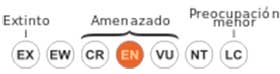
Endangered

โ€ข Current Red List of UICN: Danger

โ€ข Population trend: Decreasing

This species has a very irregular distribution. in most places, is rather sparse, but in other places, is common locally, especially in some coastal islands.

Its population It is estimated between 3750 and 15,000 specimens.

The main threat is the habitat degradation. It stays within primary forest fragments, showing its very low adaptation to artificial habitats.

The New Zealand Kaka not nest every year in a systematic way. When I was try to reproduce in captivity, the success rate was not very high (on average the 56% eggs not hatched ).

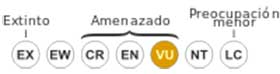
Clutches often suffer from the predation on the part of the weasels It was introduced on the island. For all these reasons that the species is classified as VULNERABLE.

"New Zealand Kaka" in captivity:

Very rare in captivity.

In terms of their longevity, according to sources, a specimen in captivity lived during 15 years.

Taking into account the longevity of the similar species, the maximum longevity of these birds might be underestimated. Other sources indicate that these birds can live up to the 35,5 years in captivity, something that is plausible, pero que no ha sido verificado; el mismo estudio informรณ que los New Zealand Kaka can reproduce a partir de los 7 years of age in captivity.

Alternative names:

New Zealand Kaka, Common Kaka, Kaka (English).
Nestor superbe (French).
Kaka (German).
Kฤkฤ (Portuguese).
Kaka (espaรฑol).

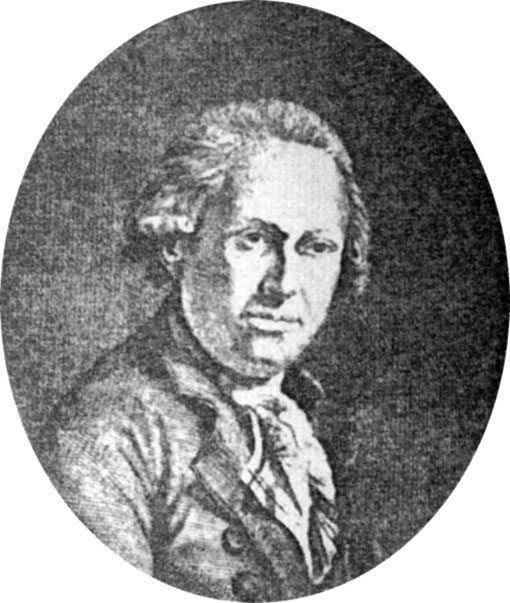
Gmelin Johann Friedrich

scientific classification:

Order: Psittaciformes
Family: Strigopidae
Genus: Nestor
Scientific name: Nestor meridionalis
Citation: (Gmelin, JF, 1788)
Protonimo: Psittacus meridionalis


"Kaka" images:

Videos "New Zealand Kaka"

————————————————————————————————

ยซKakaยป (Nestor meridionalis)


Sources:

Avibase
– Parrots of the World โ€“ Forshaw Joseph M
– Parrots A Guide to the Parrots of the World – Tony Juniper & Mike Parr
– Birdlife

Photos:

(1) – Car (Nestor meridionalis) in Wellington, New Zealand By derivative work: Snowmanradio (talk)Kaka_(Nestor meridionalis)-_Wellington_-NZ-8.jpg: PhillipC [CC BY 2.0 or CC BY 2.0], via Wikimedia Commons
(2) – North Island in Kaka, at Auckland Zoo, New Zealand By Small [CC BY-SA 2.0], via Wikimedia Commons
(3) – A New Zealand Kaka in Karori Wildlife Sanctuary, Wellington, North Island, New Zealand By Rosino (the colorful kฤkฤUploaded by Snowmanradio) [CC BY-SA 2.0], via Wikimedia Commons
(4) – Nestor meridionalis meridionalis, South Island Turkey, on Stewart Island, New Zealand By derivative work: Snowmanradio (talk)Kaka-parrot_-Stewart-Island.jpg: giles.breton [CC BY 2.0 or CC BY 2.0], via Wikimedia Commons
(5) – Kaka in flight. Karori Wildlife Sanctuary, Wellington, New Zealand. I, Tony Wills [CC BY-SA 3.0], via Wikimedia Commons
(6) – Illustration of a Kaka By J. G. Keulemans, in W.L. Bullerโ€™s A History of the Birds of New Zealand. 2nd edition. Published 1888. (New Zealand Electronic Text Centre) [CC BY-SA 3.0 nz], via Wikimedia Commons
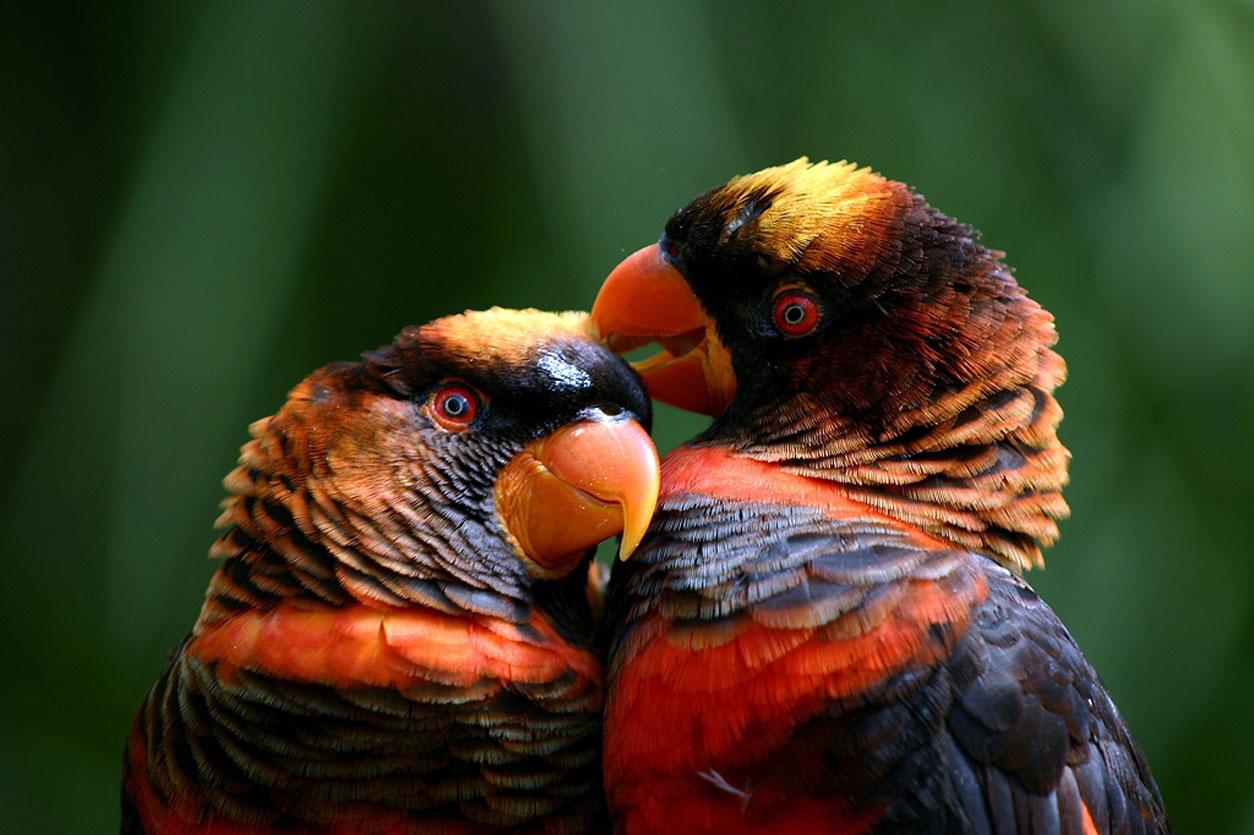
Sounds: Fernand DEROUSSEN (Xeno-canto)

โ–ท The world of Pets: Dogs, cats, birds, reptiles, amphibians

Dusky lory
Pseudeos fuscata

Lori Sombrรญo

Content

Description

23-28 cm.. height and a weight between 140 and 190 gr.

The plumage of the Dusky lory (Pseudeos fuscata) It is difficult to describe since there are many differences in tonality between one and the other specimens.. Some are of a very dark brown color, almost black and others have a much lighter shade. In addition the same happens with the two bands that cross you the chest Since the species goes through three phases: red, Orange and yellow, according to age, gender and the place of origin.

Characteristic of this species is the area of โ€‹โ€‹bare skin under the lower jaw until the birth of the throat. The lower wing coverts are orange and the lower flows dark blue. The obispillo is a silvery-white the bill is bright orange. The irises is orange and the legs dark.

There is no sexual dimorphism and the only way to differentiate male and female will be through DNA, Although some authors (Tomas Arndt) they are running that adult females lack the white feathers of the obispillo.

Habitat:

The Dusky lory they are quite widespread and locally common in primary forests , that is to say, those who have not undergone any transformation. But they are also found in wooded areas, up to an altitude of 2.400 m, During regeneration, especially those with large mature trees.

They are also distributed among residual tree beds during their flowering period., including those located in the parks and gardens in cities.

They are occasionally present in the lightly wooded Savannah or plantations of teak and coconut trees.

They normally reside in the landscape of hills or slopes steep slightly from low and middle mountain.

Itร‚ยดs gregarious and when flies or are fed in the cup of them trees full of flowers it makes in groups of 20 to 100 individuals or more.

Reproduction:

The nesting season It is very different depending on the region: It extends from November to April in the mountainous areas of East, While in Irian Jaya, the Indonesian part, they do in July.

The Dusky lory they prefer to nest in tall trees in the mountain area, the choice of a hole at high altitude on Earth probably do to protect itself against potential predators.

If the site is of your liking, reuse it for many years consecutively. Male and female participate in the work, the enlargement of the entrance or the cavity itself. Even if the nest has been used in the past, There are always minor changes to be carried out.

Although this species is quite common, We really know very little about its reproduction in the wild. In captivity, the female lays two eggs which are incubated for approximately 24 days. As in most New Guinea lories, the reproductive cycle is very long, about 70 days.

Food:

Consumes mainly nectar and perhaps the pollen it accumulates in plants of the genus schleffera or tree Rudraksha (Elaeocarpus sphaericus). Also consume flowers and fruits. It can be seen in large flocks in mango plantations and other cultivated trees. Feeds, occasionally, teak moth (Hyblaea puera).

Distribution:

The Dusky lory It has its area of distribution largely of New Guinea, except the mountains more high of the interior and the peaks more high of the mountains of Parotia.

They are present in Salawati on the Western Islands of papua and further to the East in the Yapen island on Cenderawasih Bay.

Conservation:


minor concern


– Current IUCN Red List category: Least concern

– The population trend: Stable

The species are not threatened. Common and very sociable, It often forms bedrooms that can reach thousand of birds.

A wild population estimated above 100.000 individuals.

In some parts of the southeast of New Guinea, its density may be superior to 30 birds per square kilometer.

"Dusky lory" in captivity:

Are birds enough prolific and sociable you adapt easily to captivity.

Contrary to other parrots that eat mainly seeds and nuts; The loris require a greater percentage of fruits, outbreaks, nectar and pollen in your diet. In fact, in the nature, they can feed a maximum of 640 flowers in a day. They also feed on seeds.

It is usually aggressive with other species of lory. Easy to startle with strangers.

Alternative names:

Dusky Lory, Dusk-orange Lory, Dusky-Orange Lory, White-rumped Lory (ingles).
Lori sombre, Lori ร  dos blanc (French).
WeiรŸbรผrzellori (German).
Lรณris-dusky (Portuguese).
Lori Sombrรญo, Lorito crepuscular (espaรฑol).

scientific classification:

Order: Psittaciformes
Family: Psittaculidae
Scientific name: Pseudeos fuscata
Genus: Dusky
Citation: (Blyth, 1858)
Protonimo: those darkened

Images "Lori Mson":


"Lori bleak" (Pseudeos fuscata)


Sources:

Avibase, mundoexotics, Oiseaux.NET

Photos: Wikimedia, birdsville.NET.au, Dick Daniels – Tampaโ€™s Lowry Park Zoo, Dusky Lory – Woburn Safari Park (Wikimedia),

Sounds: BAS van Balen (Xeno-canto)

โ–ท The world of Pets: Dogs, cats, birds, reptiles, amphibians

Iris Lorikeet
Psitteuteles iris


Iris Lorikeet

Content

Description

20 cm.. length and a weight between 65 and 75 gr.

The Iris Lorikeet (Psitteuteles iris) It has three subspecies recognized including the nominal, the extent and gradation of red and purple coloration in the head varies among the three subspecies:

  • Psitteuteles iris iris

    The Iris Lorikeet (Psitteuteles iris) has a plumage, in general, Green with stripes of color green light in the underparts.

    The forecrown, lores and zone extending in a narrow line around the Crown rear, red.
    Cheeks yellowish green. The eye-stripe and headphones feathers purple.
    Center of the crown, Turquoise, extending it until it nape in a large yellow-green necklace.
    The chest and abdomen are yellowish-green. The feathers of the neck and the chest they have dark green edges. Wings and tail green.
    Bill and irises orange. The legs greyish black.

    It presents sexual dimorphism. The Red coloration of the female on head It is more off and less extensive that in the male.


  • Psitteuteles iris rubripileum

    It has all the forecrown and crown Red and the headphones feathers Violet Blue.


  • Psitteuteles iris wetterensis

    Larger, the crown It is red and mixed with Violet Blue variable extension. The cheeks they are dark green. The chest bright yellow contrast with the Panza green.

Note:

It has placed at times as subspecies to the Neopsittacus. The validity of the subspecies Psitteuteles iris rubripileum, is questionable, and it was claimed that the differences with the nominal species It may be due to age or individual variation.

Habitat:

Found up to a height of 1.500 meters above the sea level.

The Iris Lorikeet They inhabit monsoon forests, plantations and agricultural land with flowering trees.
Although they are apparently more common in the higher elevations, its local abundance is based on the availability of trees with flowers for food, as is the case with most Lori.
The flight of the Iris Lorikeet fast and slightly wavy.

Reproduction:

Little is known about the breeding ecology of this species in its natural environment.. A record of a captive calf states that the laying is of two eggs, with a period of incubation of 23 days and emancipation some nine weeks more afternoon.

Food:

Feeds of nectar of the flowers Sesbania sp.

Distribution:

Size of the area of distribution (reproduction / resident): 31.300 km2

Endemic to the Islands Wetar and Timor (Indonesian).

Subspecies distribution:

  • Psitteuteles iris Iris

    : West of Timor.


  • Psitteuteles iris Rubripileum

    : It is from Timor.


  • Psitteuteles iris Wetterrensis

    : Wetar island.

Conservation:


Near-threatened


โ€ข Current IUCN Red List category: Near threatened

โ€ข Population trend: Decreasing

There are no data on population trend; But, the species is suspected to be in decline due to the capture and the degradation of the habitat.

Previously considered common, but not found in the Island of Wetar during a search in 1990, found only in two places during a study of nine weeks in the jungle in Timor West in 1993. Considered main many that the Olive headed Lorikeet and the Coconut Lorikeet in East Timor. World population around 10.000 specimens. VULNERABLE.

"Iris Lorikeet" in captivity:

Quite rare.

Alternative names:

Iris Lory, Iris Lorikeet (ingles).
Loriquet iris, Loriquet d’Iris (French).
Irislori (German).
Lรณris-รญris (Portuguese).
Lori de Goldie, Lori Iris, Tricogloso Iris (espaรฑol).

scientific classification:

Order: Psittaciformes
Family: Psittaculidae
Scientific name: Psitteuteles iris
Citation: (Temminck, 1835)
Protonimo: Psittacus iris

Images ยซLori Irisยป:

————————————————————————————————

ยซIris Truckยป (Psitteuteles iris)


Sources:

Avibase
– Parrots of the World โ€“ Forshaw Joseph M
– Parrots A Guide to the Parrots of the World – Tony Juniper & Mike Parr
– BirdLife.org

Photos:

1 – By Dirk (originally posted to Flickr as DSC_7897) [CC-BY-2.0], via Wikimedia Commons
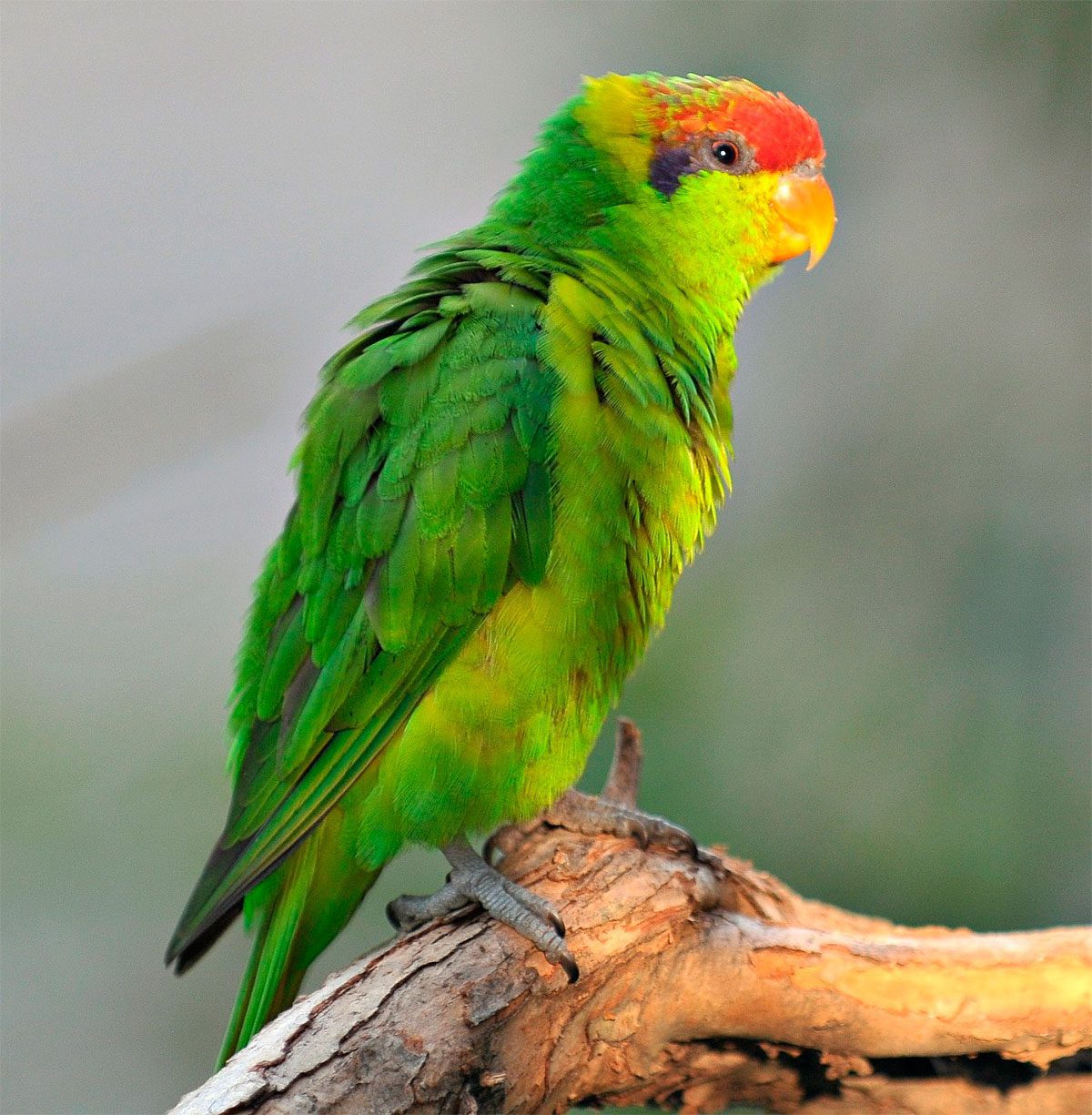
2 – By Dirk (originally posted to Flickr as DSC_2608) [CC-BY-2.0], via Wikimedia Commons
3 – By Asim Bharwani (originally posted to Flickr as San Diego Zoo) [CC-BY-2.0], via Wikimedia Commons
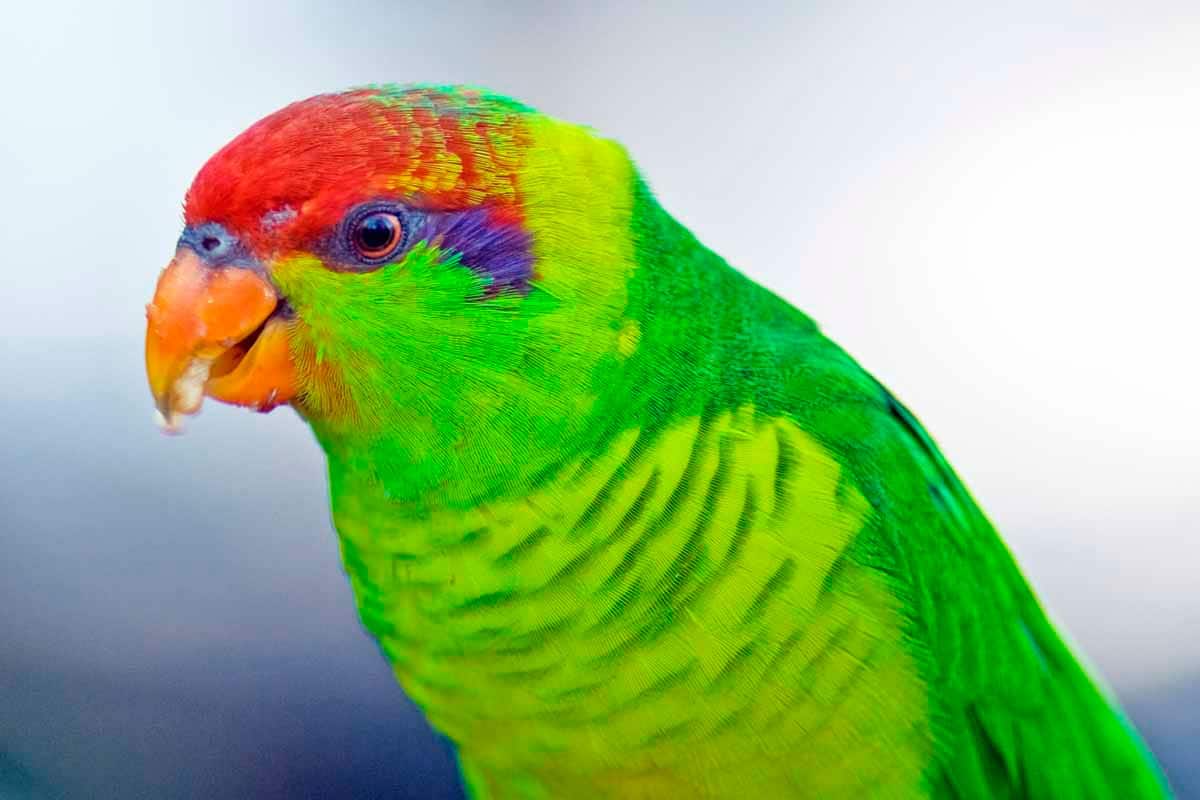
4 – By tinyfroglet [CC-BY-2.0], via Wikimedia Commons
5 – By Liam from Washington DC, USA (IMG_9040Uploaded by snowmanradio) [CC-BY-2.0], via Wikimedia Commons
Sounds: Filip Noel (Xeno-canto)

โ–ท The world of Pets: Dogs, cats, birds, reptiles, amphibians

Chattering Lory
Lorius garrulus


Chattering Lory

Content

Description

30 cm.. length and a weight between 180 and 250 g..

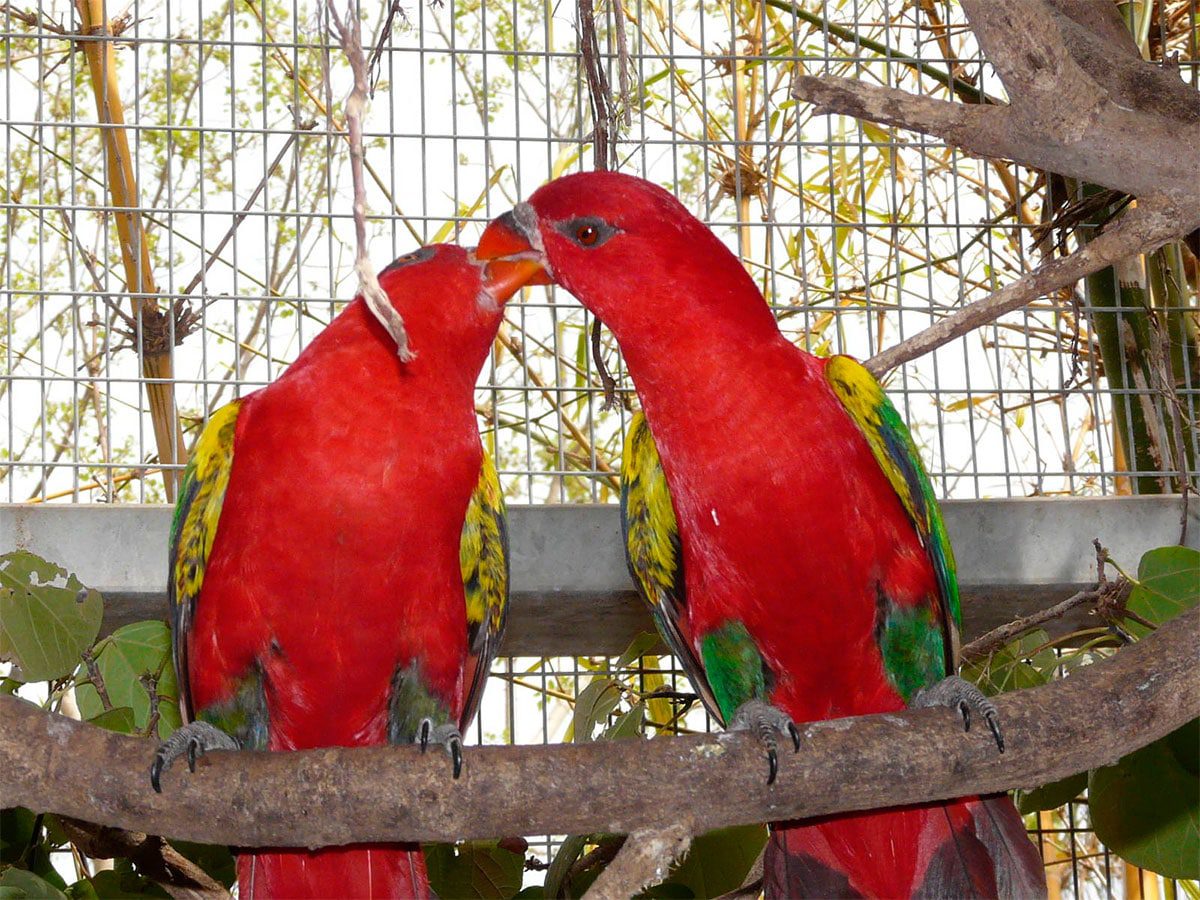
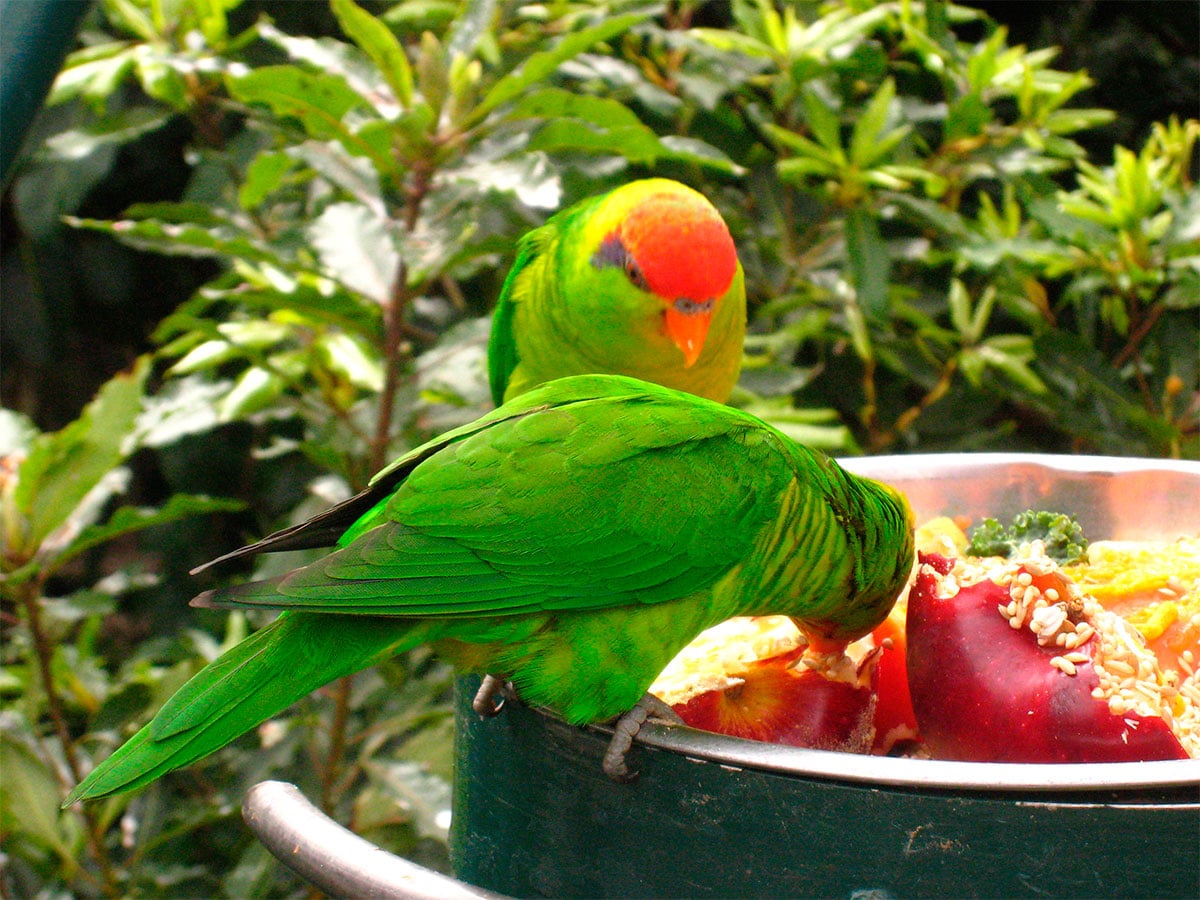
The Chattering Lory (Lorius garrulus) has the head, the nape and the the mantle top of color Scarlet bright. Great stain yellow in the center of the the mantle surrounded above and below a light spread of green opaque; scapulars Scarlet, a little darker than the the mantle; rump and top of the tail, bright Scarlet.

the flight feathers green up; coverts a little more pale and with a vague diffusion in bronze. The great coverts a dark gray at their ends; the alula Blackish green with yellow spot in the bend of wing and along the edge of the carpus.

Lori White ilustracion

The bottom of the flight feather of color black with band broadband of color tints in the Center, the coverts yellowish green. Underparts bright Scarlet; green thighs. The feathers of the tail red, with the black end fade Green. The bill orange; irises Orange to yellowish brown; legs grisaceo-negro color.

Both sexes are equal.

Immature with the bill brown, and the irises dark brown.

Description and distribution of subspecies

  • Lorius garrulus garrulus

    (Linnaeus, 1758) – (Halmahera, the Widi Islands and Ternate) The nominal


  • Lorius garrulus flavopalliatus

    (Salvadori, 1877) – (Bacan and OBI) Large yellow patch in the the mantle with much less greenish broadcasting.


  • Lorius garrulus morotaianus

    (Bemmel, 1940) – (Morotai and Riau) Small yellow patch in the mantle of green-dyed.

  • Sound of the Chattering Lory
[audio:HTTPS://www.mascotarios.org/wp-content/themes/generatepress_child/sonidos/Lori Garrulo.mp3]

Habitat:

Though White and Bruce they say the species is common in coastal lowlands with coconut palms, recent observations seem to point to forested areas of high land as their main habitat. It is unclear if the capture is responsible for the apparent absence of their previously preferred habitat. Seasonal movements or nomadic behavior could also be factors for this absence from the coastal lowlands.. The Chattering Lory they occur more often in mature primary and secondary forests, far from human settlements from the lowlands up to 1.300 m.

They are usually in pairs, and are noisy and visible in flight but, like many other parrots, can become difficult to spot when feeding quietly in the forest canopy.

Reproduction:

Little is known about the reproduction of the species in the wild. A couple was seen building a nest in June, other records include the observation of a calf feeding during October and November, and a couple occupying a nest high in a dead tree, also during October.

In captivity, the laying is of two eggs and the abandonment of the nest of the young at 76 days.

Food:

The primary food of the Chattering Lory It is believed to be the nectar and pollen, with local reports of feeding on the flowers of coconut along the coast, although fruits and corn are also included in their diet.

Distribution:

Endemic to the North of the Moluccan Islands, Indonesian, from Morotai, Riau, Halmahera, Ternate, Bacan, OBI and, possibly, Kasiruta and Obilatau. The Chattering Lory has also been released in Sangihe, to the North of Sulawesi.

Locally common, but around human settlements have apparently been reduced by means of traps. It is very popular in the trade because of its imitative abilities.

Conservation:


Vulnerable


โ€ข Current IUCN Red List category: Vulnerable.

โ€ข Population trend: Decreasing.

The main threat comes from the capture for the cage bird trade. This is the most popular bird exported from the East of Indonesian, largely due to his large imitative abilities. Thousands of copies were legally caught each year in your environment during the Decade of 1980 and principles of 1990, but the real value is probably much higher.

The legal trade was reduced at the end of the Decade of 1990 and ceased in 2003; But, illegal trade continues: in 2007 about 2.800 birds were recorded as looted and in the 2008, 60 were recorded for trade in the markets of birds of Java.

Forests within its area of distribution are largely intact since the beginning of the Decade of 1990, but the exploitation by timber companies has become intensive. Important nesting trees are felled because of its large size, and logging roads greatly facilitating access for trappers, create the perfect combination to bring to the Chattering Lory as threatened species.

Ongoing conservation actions –> Ver and Birdlife

"Chattering Lory" in captivity:

Previously it was very common, now not so much.

Smart, playful and good imitators. The Chattering Lory, However, is very aggressive with other birds. Also messy mainly due to the liquid in his diet.

Alternative names:

Chattering Lory (ingles).
Lori noira, Lori des Moluques, Lori noir (French).
Prachtlori, Gelbmantelllori (German).
Lรณris-amor-amor (Portuguese).
Lori Gรกrrulo, Tricogloso Gรกrrulo (espaรฑol).

scientific classification:

Order: Psittaciformes
Family: Psittaculidae
Scientific name: Lorius garrulus
Genus: Lorius
Citation: (Linnaeus, 1758)
Protonimo: Psittacus garrulus

Images ยซLori Gรกrruloยป:

Videos "Chattering Lory"

————————————————————————————————

ยซOn the garrisonยป (Lorius garrulus)


Sources:

Avibase
– Parrots of the World โ€“ Forshaw Joseph M
– Parrots A Guide to the Parrots of the World – Tony Juniper & Mike Parr
– Birdlife

Photos:

1 – By Benjamint444 (Own work) [GFDL 1.2], via Wikimedia Commons
2 – Birds-pet-wallpapers – link
3 – by Alexkant in Israel. Kiryat Motzkin – zoochat
4 – Photos Zoochat – link
5 – by Josep de el Hoyo – lynx
6 – riscosapenas – link

Sounds: Marc Thibault (Xeno-canto)

โ–ท The world of Pets: Dogs, cats, birds, reptiles, amphibians

Bismarck hanging parrot
Loriculus tener


Bismarck hanging parrot

Content

Description

Measured around 10 cm.. length and approximately 12 g. of weight.

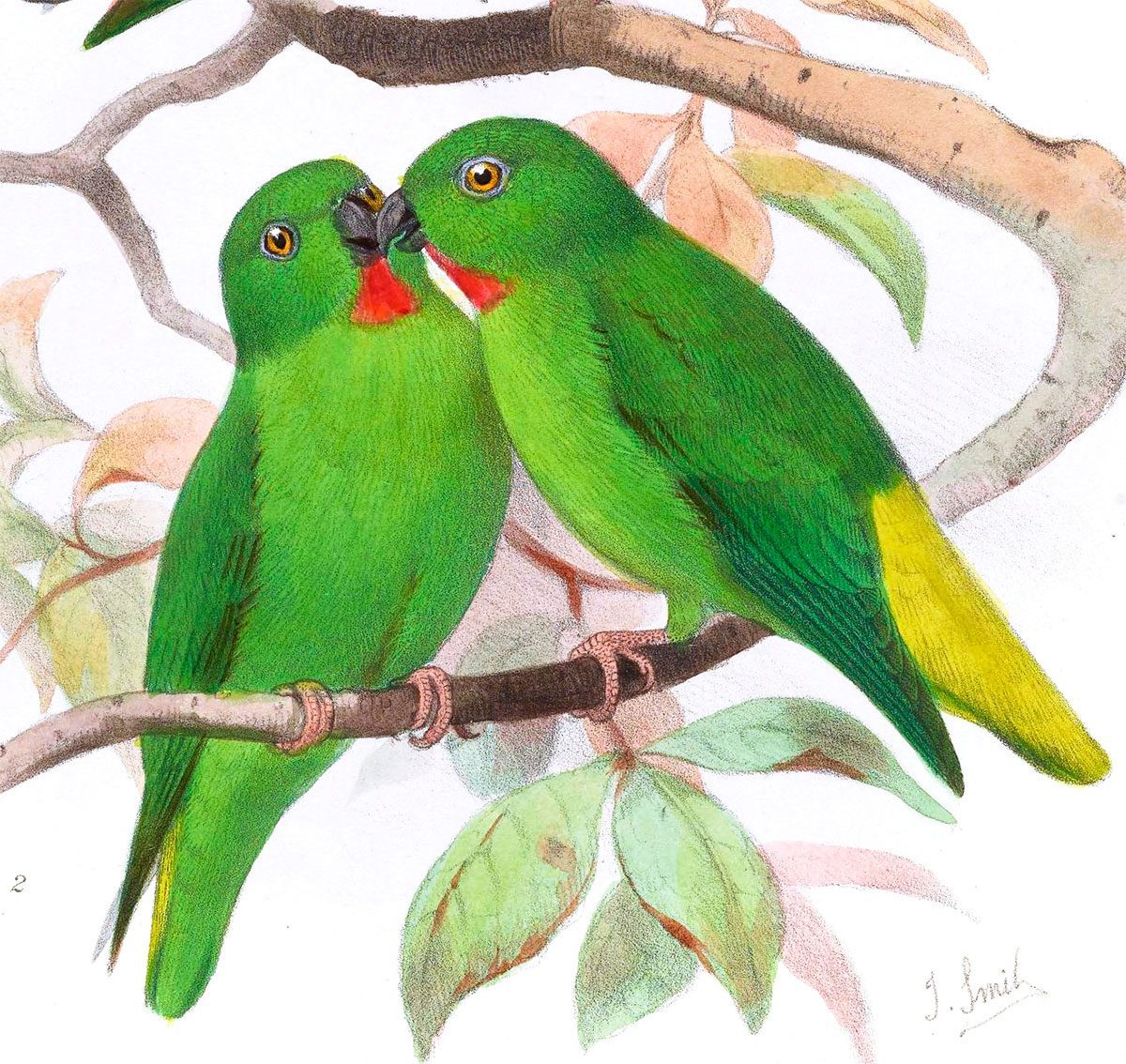
The head of the Bismarck hanging parrot (Loriculus tener)(Loriculus tener) is green. Upperparts Green except for the rump and upper coverts of the tail that are yellowish-green. The wings they are green with vane internal darker towards the flight feather.

Under, the wings blue with Feather coverts green. Chin red orange; rest of the underparts green. Upper, the tail green, pale blue view from below.

The bill black; irises yellowish white; legs yellowish brown.

The female have the front part of the crown and face blue.

The young birds they lack the orange patch of the throat and your bill is pale-brown.

Habitat:

A species very little known. Has been recorded along of the edge of forests and partially cleared from the lowlands up to the low hills areas.

Reproduction:

There is practically no information. Only a nest found, in the stump of one areca palm.

Food:

There is practically no information, but it is suspected that they feed on flowers and small fruit, usually, alone or in pairs, and often hung upside down.

Distribution:

Size of the area of distribution (reproduction / resident): 26.300 km2

Endemic to the Islands in the Bismarck Archipelago, registered in New Britain, New Ireland, Duke of York and New Hanover.

Conservation:


Near-threatened


โ€ข Current IUCN Red List category: Near threatened

โ€ข Population trend: Decreasing

This little known species is classified as Near-threatened, Since it is believed that it has a moderately low population that is limited to the lower forests. These areas are developing rapidly in oil palm plantations and therefore the population is undoubtedly decreasing.

In New England, clearing of lowland forests for conversion to oil palm plantations has been intense in recent decades.

The population size is between the 10.000 and 19.999 mature individuals.

"Bismarck hanging parrot" in captivity:

Usually they are not in captivity.

Alternative names:

Green-fronted Hanging Parrot, Bismarck Hanging Parrot, Bismarck Hanging-parrot, Green fronted Hanging Parrot, Green-fronted Hanging-Parrot (ingles).
Coryllis des Bismarck, Coryllis ร  front vert, Coryllis des Bismark (French).
Bismarckpapageichen, Goldstirnpapageichen, Zartpapageichen (German).
Lorรญculo de las Bismarck (espaรฑol).

scientific classification:

Order: Psittaciformes
Family: Psittaculidae
Genus: Loriculus
Scientific name: Loriculus tener
Citation: Sclater,PL, 1877
Protonimo: Loriculus tener

Images ยซBismarck's Parrotยป:

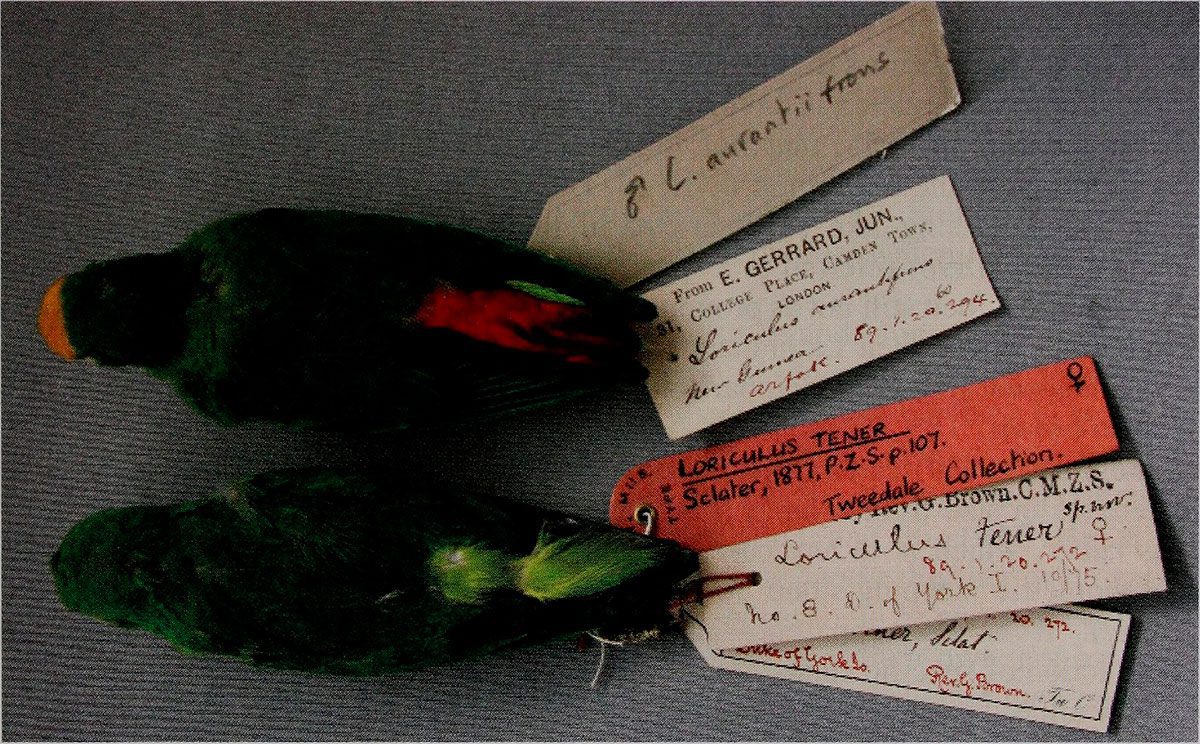
Loriculus tener. Image from page 18 of "Bulletin of the British Ornithologists' Club" (2007) - (N. J. Collar ยฉ Natural History Museum)
Loriculus tener. Image from page 18 of ยซBulletin of the British Ornithologists’ Clubยป (2007) – (N. J. Collar ยฉ Natural History Museum)

————————————————————————————————

"Bismarck's Parrot" (Loriculus tener)


Sources:

Avibase
– Parrots of the World โ€“ Forshaw Joseph M
– Parrots A Guide to the Parrots of the World – Tony Juniper & Mike Parr
– Birdlife

Photos:

(1) – ยซLoriculus tener Smitยป by Joseph Smit – Ornithological Miscellany. Volume 2. Licensed under Public Domain via Wikimedia Commons – http://Commons.wikimedia.org/wiki/file:Loriculus_tener_smit.jpg#mediaviewer/file:Loriculus_tener_smit.jpg