โ–ท The world of Pets: Dogs, cats, birds, reptiles, amphibians

Plum-faced Lorikeet
Oreopsittacus arfaki

Plum-faced Lorikeet

Content

Description

15 cm.. length between 16 and 23 g. of weight.
Plum-faced Lorikeet

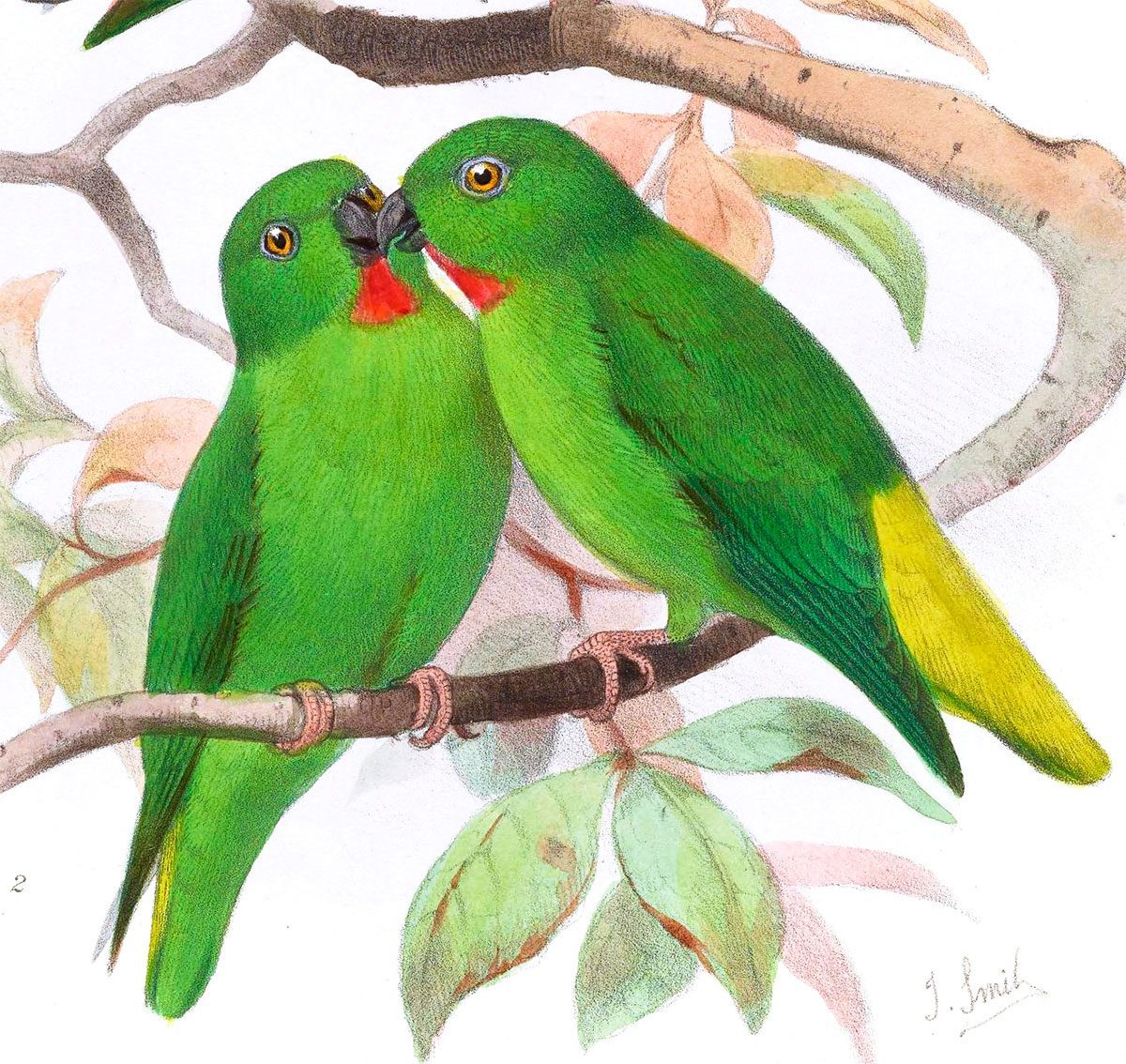
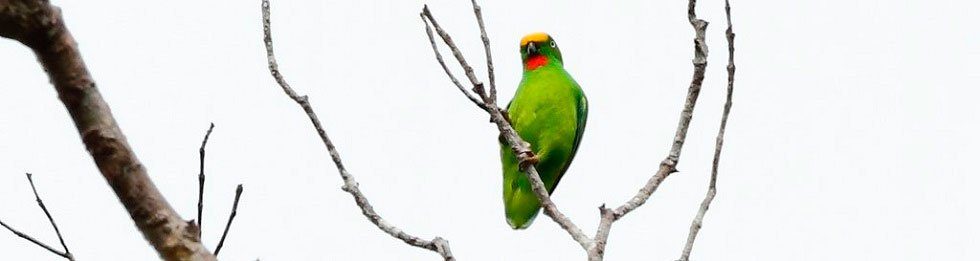
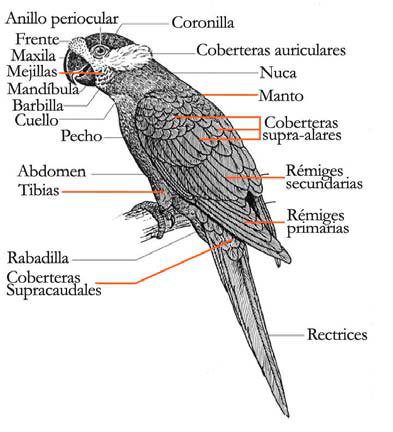
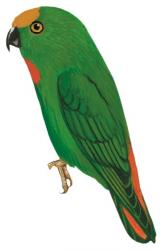
The hood of the Plum-faced Lorikeet (Oreopsittacus arfaki), from the top of bill up to the crown rear, is Scarlet Red ; chin and Spada color plum (with bluish Sheen), broken by two rows of thin stripes.

Upperparts of color green uniform with a light spread of olive in the the mantle. Wings, views from the top are green; vane internal to the flight feather, blackish in color and vane external to the primaries outermost, bluish green. Underwing-coverts and axillary, red (Outer secondaries slightly marked with yellow); flight feather Blackish with yellow central band. The mauve of it chin be extended slightly in the throat; top of the chest green, center of chest and belly bathed in orange-red; under belly green; undertail-coverts green, lightly bathed in yellow on sides. Uppertail green, merging to blackish and ending in pinkish-Red, in the tip lighter fusion: below, the tail is red with marked with black side feathers.

The bill black; irises blackish brown; legs grey.

Female lack of top red (but you can show a bit of red on the part rear of the Crown).

Immature male with only red on the back of the crown. The young birds have a slightly 'scaly' appearance; also off the tip of orange-yellow color of the tail.

Description 3 subspecies

  • Oreopsittacus arfaki arfaki

    (Meyer,AB, 1874) – The nominal.


  • Oreopsittacus arfaki grandis

    : (Ogilvie-Grant, 1895) – Greater than the nominal. Lack of the flanks redorange and markings of the belly of the other two subspecies.


  • Oreopsittacus arfaki major

    : (Ogilvie-Grant, 1914) – Larger that the nominal and more red-tipped in the tail.

Habitat:

The distribution of the Plum-faced Lorikeet is more or less continuous in the extension of the moss forests; the species is mainly found among the 2.000 and 3,750 m, but can observe is to 1.000 m occasionally. Be found with greater frequency in pairs or small flocks very vocal. They feed acrobatically in the canopy; They also feed on plants, especially in the flowers of epiphytes, often in the company of other flower aficionados such as the lories of the genus Neopsittacus.

Reproduction:

Habits of nesting unknown, birds in reproductive attitudes they have been observed in August and October. The display of marks under the wings have been observed in pairs and can be linked to courtship, as well as by the male head rolling.

Food:

It feeds on pollen, nectar, possibly, flowers, fruit (especially Schefflera) and berries.

Distribution:

Size of the area of distribution (reproduction / resident): 108.000 km2

New Guinea in Irian Java (Indonesian) and Papua New Guinea, ranging from the East ofVogelkop to the Huon Peninsula and ranges from the Southeast. A small number of captivity

Distribution 3 subspecies:

  • Oreopsittacus arfaki arfaki

    (Meyer,AB, 1874) – The nominal.


  • Oreopsittacus arfaki grandis

    : (Ogilvie-Grant, 1895) – Mountains of the Central and East of Papua New Guineto, including, those in the southeast of the region of the Huon Peninsula and Sepik, extending to the West of Victor Emanuel Range


  • Oreopsittacus arfaki major

    : (Ogilvie-Grant, 1914) – Snow Mountains (Papua New Guinea)

Conservation:


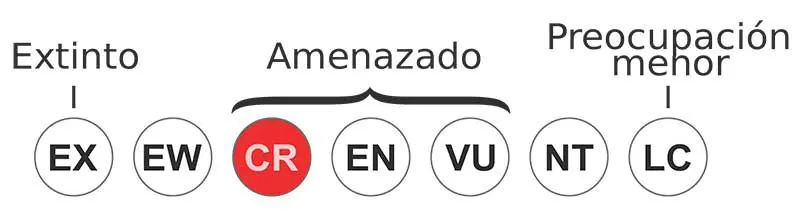
minor concern

โ€ข Current IUCN Red List category: Least concern

โ€ข Population trend: Stable

The world population It has not been quantified, Although it is thought of more than 300.000 specimens. The species is reported to be quite common (pit et to the. 1997).

The population suspected to be stable in the absence of evidence of any reduction or substantial threats.

"Plum-faced Lorikeet" in captivity:

The Plum-faced Lorikeet is a bird quiet and at times active. Young birds are susceptible to stress and disease during the acclimatization; can die suddenly without apparent cause. They become much more resistant and less timid after acclimatization.. You can be accommodated with members of their own species in a system of colony.

It is very rare in captivity.

Alternative names:

Plum-faced Lorikeet, Plum faced Lorikeet, Plum-faced Mountain Lory, Plum-faced Mountain-Lory, Whiskered Lorikeet (ingles).
Lori bridรฉ (French).
Arfaklori, Arfakalori (German).
Lori Bigotudo, Lori de Bigotes (espaรฑol).

scientific classification:

Order: Psittaciformes
Family: Psittaculidae
Genus: Oreopsittacus
Scientific name: Oreopsittacus arfaki
Citation: (Meyer,AB, 1874)
Protonimo: Trichoglossus (Charmosyna) Arfaki

ยซWhiskered Loryยป Images:

Videos "Plum-faced Lorikeet"

————————————————————————————————

ยซOn Bigotryยป (Oreopsittacus arfaki)


Sources:

Avibase
– Parrots of the World โ€“ Forshaw Joseph M
– Parrots A Guide to the Parrots of the World – Tony Juniper & Mike Parr
– Birdlife

Photos:

(1) – Dansk Lori Klub
(2) – arfak lori man oreopsittacus arfaki – photobucket
(3) – By Katerina Tvardikova – pngbirds.myspecies.info
(4) – By Guy Dutson – lynx
(5) – By Katerina Tvardikova – pngbirds.myspecies.info
(6) – Illustration – HBW.com

Sounds: Patrik ร…berg (Xeno-canto(

โ–ท The world of Pets: Dogs, cats, birds, reptiles, amphibians

Yellow-crowned parakeet
Cyanoramphus auriceps

Yellow-crowned parakeet

Content


Anatomy-parrots

Description

23 cm.. length and an approximate weight of 95 g..

In the distance, the Yellow-crowned parakeet (Cyanoramphus auriceps) appears as a fully green Parrot, light and bright above that below.

It has a yellow spot in the forecrown, above a red stripe that goes from the bill both eyes. It can be confused with the Red-crowned parakeet (Cyanoramphus novaezelandiae) who lives in the same circles.

The upperparts they are green with a red patch on each side of the rump. Alula, primary covertss and vane outside of the primaries are blue-violet color.

feathers of the wings Green with blue at the edges of the previous; a wing bar at present times.

The underparts more yellowish green, sometimes with yellow marks.

Tail of color green for over, dark grey below.

The bill blue grey at the base, Blackish at tip; irises orange-red; legs greyish brown.

The females they are slightly smaller than males.

The young birdss have the peaks paler, queues shorter and the irises light brown.

Both females as the juveniles They show a drawing in the form of bar under the wings.

Habitat:

Yellow-crowned parakeet

On the Mainland, the Yellow-crowned parakeet, they are mainly distributed among the lush native forests, mainly in the provided ecosystems of Nothofagus and Podocarpus, at an altitude of about 600 m. Although these birds are at much lower altitudes, the species tends to move at altitudes which are the Red-crowned parakeet, especially when their habitats overlap.

The Yellow-crowned parakeet they are more common in closed areas of scrub, less common in open spaces by which moves the Red-crowned parakeet.

It is more common on offshore islands, where predation by introduced mammals is reduced.

Birds are found more often in pairs or small groups, feeding in the middle or upper floor of forest or large shrubs. Although it is, generally, more arboreal than the Red-crowned parakeet, they tend to feed on land in the islands of the coast.

Reproduction:

The breeding habits they are similar to the of the Red-crowned parakeet, but these birds seem to be more territorial around the nest.

The Yellow-crowned parakeet They nest in tree holes.

The implementation is performed between the months of October to December but have been observed nesting in almost every month, presumably in response to food availability. Of five to nine eggs whites make up the implementation, with one incubation between 18 and 20 days. The calf is fed by the female who in turn receives food from the male., the young remain in the nest from five to six weeks.

Food:

The diet consists of plant material including outbreaks, berries, flowers and seeds, as well as invertebrates such as larvae, for example, Heliostibes vibratrix and mealybugs Ultracoelostoma assmile. The insects They seem to be more important in the diet of the Yellow-crowned parakeet that in the of the Red-crowned parakeet.

Distribution:

The Yellow-crowned parakeet they can be found in New Zealand and in some islands of the coast.
They are absent, to a large extent, in the North of Auckland, but they are moderately common in some of the largest forested areas, including Urewera, Montes Raukumara, the area of the motu river, Pirongia, Pureora, Ruahine mountains, Tararua mountains, and in the South Island in the National Park Abel Tasman, the Nelson district, the Paparoa mountain range, Arthur's pass, Districts the Hope River and Canterbury, and in Fiordland about Te Anau and Cascade Creek.

Yes the aclaramineto of their continuous habitat, It might be a threat to the species.

The Yellow-crowned parakeet also you can find in the following islands of the coast: Three Kings, Polla, Big Chicken, Little Barrier, Great Barrier (rare), Kapiti (rare), the Chetwode Islands (absent the Red-crowned parakeet), Stewart Island e satellite islets, Codfish, Solander, Ruapuke and Auckland Islands, including the Adams island.

The species is also found in the chatham islands, where the Chatham Parakeet It has suffered from habitat loss, as well as competition and hybridization with the Red-crowned parakeet: both hybrids together with the Red-crowned parakeet, they survive better in open areas, helped by the improvement of the habitat and hybridisation control, so getting a slow recovery.

Conservation:


Near-threatened


โ€ข Current Red List of UICN: Near threatened

โ€ข Population trend: Decreasing

In the past the population of the Yellow-crowned parakeet has declined in number and the species is now rare throughout its range. As a result, is suspected to have one moderately low population. The world's population believed that it is inferior to the 5.000 specimens.

It is believed that this species has been adversely affected by the logging of forests, introduced predators, (cats, stoats and rats) and hybridization. Consequently, that you have been moderate declines in population to this day.

In the islands of the coast, the Red-crowned parakeet is usually much more common (Heather and Robertson 1997) and can be replaced by full to the Yellow-crowned parakeet in Solander Island. In Auckland Islands, There is an abnormally high rate of hybridization between the two species.

"Yellow-crowned parakeet" in captivity:

not as common as Red-crowned parakeet.

For its upbringing it is enough to have previous experience in the breeding of any of the smaller Australian parrots..

Reasonably hardy to cold, It has a thick plumage on their underparts which gives them a good insulation against the harsh winters; they withstand a cooler climate than most Australian species.

The sound of their voices is not strong or offensive and consists of pleasant chattering.

In terms of their longevity, according to sources, one specimen was still alive after 9.3 years in captivity

Alternative names:

Yellow-fronted Parakeet, Kakariki, Yellow-crowned Parakeet (English).
Perruche ร  tรชte d’or (French).
Springsittich (German).
Kakariki-fronte-amarela (Portuguese).
Perico Maorรญ Amarillo, Perico Maorรญ Cabecigualdo (espaรฑol).

scientific classification:


Order: Psittaciformes
Family: Psittaculidae
Genus: Cyanoramphus
Scientific name: Cyanoramphus auriceps
Citation: (Kuhl, 1820)
Protonimo: Psittacus auricep

ยซWild-headed Maori Parakeetยป images:

Videos "Yellow-crowned parakeet"

Yellow-crowned parakeet (Cyanoramphus auriceps)

Kuhl, Heinrich
, via Wikimedia Commons
(2) – Yellow-crowned Parakeet, (Cyanoramphus auriceps) Nga Manu, Nr. Wellington, New Zealand. By Phillip Capper [CC BY 2.0], via Wikimedia Commons
(3) – A Yellow-crowned Parakeet in Otorohanga Kiwi House, New Zealand By Takver from Australia [CC BY-SA 2.0], via Wikimedia Commons
(4) – A captive Yellow-crowned Parakeet By Nrg800 (Own work) [CC BY-SA 3.0 or GFDL], via Wikimedia Commons
(5) – Photo of Kakariki (Cyanoramphus auriceps) taken during Routeburn Classic 2012 By Grapeman4 (Own work) [CC BY-SA 3.0], via Wikimedia Commons
(6) – Yellow headed parakeet Cyanoramphus auriceps (1884) By William Thomas Greene (Birds in captivity) [Public domain], via Wikimedia Commons
โ–ท The world of Pets: Dogs, cats, birds, reptiles, amphibians

Yellow-streaked Lory
Chalcopsitta scintillata

Lori Chispeado

Content

Description

Measured between 30 to 31 cm.. and a weight between 180 and 245 gr.

The adults of the species Yellow-streaked Lory (Chalcopsitta scintillata) have plumage dark green, pale green veins in head and the abdomen, and bright yellow bands in the chest and in the the mantle.

Chalcopsitta sintillata rubrifrons

The forecrown, cheeks and the thighs are bright red. The sides of the chest with large red infiltrations.

The under wing It is crossed by a thick yellow band. The bill is black. Bare skin eye and at the base of bill is dark gray. The irises are orange-red, the legs grey.

There is no sexual dimorphism, but in the female, the front spot It is less pronounced.

The immature They resemble adults, but have less red in the forecrown. The basis of the bill It is less stained yellow. The irises They are brown.

They are particularly visible in the early hours of the day, When the bands fly over canopy, sometimes very large heights.

They have a direct flight with rapid wing beats. In spite of this, they give the impression of moving slowly, almost in a hesitant way. Its neck tense and the tail feathers widely deployed gives them a vision in flight that is very characteristic. Couples often engage in stunts, with many screams.

Description 3 subspecies

  • Chalcopsitta scintillata chloroptera

    (Salvadori, 1876) – Adults of this subspecies differ little from those of the nominal species. But, they differ from the latter by the narrower stripes on the plumage. The bottom of your wings They are green or green with red markings.


  • Chalcopsitta scintillata rubrifrons

    (Gray,GR, 1858) – In this subspecies, both adults and juveniles, they are identical to the nominal species, but the veins of body plumage They are more spacious and orange-yellow.


  • Chalcopsitta scintillata scintillata

    (Temminck, 1835) – Nominal.

Habitat:

common in the lowlands, in the Savanna They are covering the hills, in plantations cocoteros and in the mangroves.
They are also in the primary forest and secondary adjacent, even in narrow bands of gallery forests bordering rivers in open country.
Occasionally, the Yellow-streaked Lory They sit near or inside Gardens in local villages.
They can fly to 800 m above sea level.

Reproduction:

Typically install their nests in treeholes high. There is not much information about the reproduction in the center of nature.

In captivity, the implementation is of 2 eggs which both parents incubate alternately during 26 days. At hatching, hatchlings weigh 7 u 8 g.. Duration reproductive cycle It is very long and can overcome 80 days. Despite this, There may be a second clutch in the season.

Food:

They feed in the trees.

consume nectar, pollen and fruit. Are said to some insects complete this predominantly vegetarian diet.

Distribution:

Size of its range (breeding/resident): 586.000 km2

These birds are endemic to the Islas Aru and South of Papua New Guinea.

Distribution 3 subspecies

  • Chalcopsitta scintillata chloroptera

    (Salvadori, 1876) – High of the fly river to Southeast Papua New Guinea.


  • Chalcopsitta scintillata rubrifrons

    (Gray,GR, 1858) – Only in the islas Aru.


  • Chalcopsitta scintillata scintillata

    (Temminck, 1835) – Nominal. South of New Guinea (triton bay to lower fly river.

Conservation:


minor concern

โ€ข Current IUCN Red List category: Least concern.

โ€ข Population trend: Stable.

It is not an endangered species. In a study in Southeast New Guinea, its density was estimated at 20 birds per square kilometer.
Its world population approaches the 100.000 birds.

The population suspected to be stable in the absence of evidence of any reduction or substantial threats.

"Yellow-streaked Lory" in captivity:

Pretty common.

They are birds very noisy People who like to let their loud cries are heard. They are playful, they have no fear and they can easily become meek in the hands of your caregiver. They are not only extremely aggressive against other Yellow-streaked Lory, also as with other species.

Alternative names:

Yellow-streaked Lory, Greater Streaked Lory, Streaked Lory, Yellow streaked Lory, Yellowish-streaked Lory (ingles).
Lori flammรฉchรฉ, Lori ร  front jaune, Lori ร  front rouge, Lori striรฉ (French).
Schimmerlori (German).
Lรณris-listrado-amarelo (Portuguese).
Lori Chispeado (espaรฑol).

scientific classification:

Order: Psittaciformes
Family: Psittaculidae
Genus: Chalcopsitta
Scientific name: Chalcopsitta scintillata
Citation: (Temminck, 1835)
Protonimo: Psittacus sintillatus

โ€œSparkling Loriโ€ Images:

Videos "Yellow-streaked Lory"

————————————————————————————————-

"Sparkling Lori" (Chalcopsitta scintillata)


Sources:
Avibase, Oiseaux.NET

Photos:

Wikipedia
– Goura (zoochat.com)
– loryland.NET
Wikimedia
Wikipedia
– Chalcopsitta rubrifrons = Chalcopsitta sintillata rubrifrons by Joseph Wolf [Public domain], via Wikimedia Commons
Sounds: BAS van Balen (Xeno-canto)

โ–ท The world of Pets: Dogs, cats, birds, reptiles, amphibians

Yellow-and-green Lorikeet
Trichoglossus flavoviridis

Yellow-and-green Lorikeet

Content

Yellow-and-green Lorikeet

Description

20 cm.. length and a weight between 80 and 95 gr.

Very similar to the Scaly breasted Lorikeet by appearance scaly on underparts, but differs from it by color low wing and brands that adorn their head.

The adults of the Yellow-and-green Lorikeet (Trichoglossus flavoviridis) they have the upperparts plumage of a beautiful green.

The forecrown and top They are are greenish brown. The throat and the chest to abdomen It is yellow with dark green flakes. Area of sides up to the coverts and the bottom of the wings It shows a beautiful yellow-green.

The bill is orange. The irises is orange-yellow, the legs grey.

It has no sexual dimorphism.

In the youth, all the yellow markings are derived more green. The bill is brown, while the bare parts of the face are white. The irises is brown.

Description 2 subspecies

  • Trichoglossus flavoviridis flavoviridis

    (Wallace, 1863) – Nominal. Overall plumage It is olive green. The forecrown and crown yellow. The back of the neck brown. the yellow throat and the chest to abdomen, with the scalloped dark green.


  • Trichoglossus flavoviridis meyeri

    (Walden, 1871) – Shown in upperparts a darker shade of green; the underparts They are less scaly. The back of the top, the occiput and nape are greenish-Brown. The cheeks and throat They are yellow with dark green stripes. This subspecies is much smaller, between 40 and 50 gr.

Habitat:

The Yellow-and-green Lorikeet they are distributed with greater diligence between primary forest and mature secondary forest than their close relatives, the Ornate Lory. But, This does not prevent them from entering the open lands to feed from the ceibos in flower (coral trees).

Throughout its area, these birds are considered fairly common. In Celebes, are common in the mountainous areas where have been supplanted to a large extent to the Ornate Lory. In the Sula Islands, they are common in almost all altitudes.

They live in small flocks of noisy and sometimes mingle with the Ornate Lory When looking for food in the trees in flower at the edge of forests.

These birds are relatively Shy and they tend to stay inside the dense forest foliage, where their cryptic plumage makes them virtually invisible. When they feel threatened, leave the foliage uttering cries penetrating and powerful. They are easier to fly above the treetops on quick flights or the circulating a flight above the trees, just before landing in the branches more high.

Reproduction:

There is little information reproduction in the natural environment. The only one nest we have discovered so far was in a mossy forest, about 2.400 meters above the sea level. It was located high above the ground in a dead tree.

In captivity, the implementation is, usually, two white eggs that incubate for a few parents will be 23 days. As with all the Lori, the reproductive cycle It is particularly long and hard about 65 days.

Food:

The Yellow-and-green Lorikeet is above all vegetarian. Their language is particularly suitable for crop pollen and the nectar from the flowers. It is equipped with long buds that allows you to easily reach their favorite food. They have a predilection for the trees of the genus Euphorbia and Erythrina.

Distribution:

Size of its range (reproduction / resident): 6.300 km2

The Yellow-and-green Lorikeet They are endemic to the islands east of Indonesian. They are exclusively on the Sula Islands (Taliabu, Mangole, Sanana) and especially in the area of Celebes island.

Description 2 subspecies

Conservation:


minor concern


โ€ข IUCN Classification: Least concern.

โ€ข No threats at present.

The species is not threatened. In Taliabu, is very common in altitude zones, but it is also quite common in degraded areas bordering the coast. It is estimated one world population above the 100.000 specimens.

Justification of trend

They suspected that the population is stable in absence of evidence of any decline or threatens substantial.

"Yellow-and-green Lorikeet" in captivity:

Pretty common in captivity.

Take it easy, Nice trill. Sensitive to cold temperatures and somewhat susceptible to disease. He will join his caregiver over time although initially shy.

Alternative names:

Yellow-and-green Lorikeet, Citrine Lorikeet, Yellow & Green Lorikeet, Yellow and Green Lorikeet, Yellow&green lorikeet, Yellow-and- Green Lorikeet, Yellow-green Lorikeet (ingles).
Loriquet jaune et vert (French).
Celebeslori (German).
Lori flavoviridis (Portuguese).
Lori Verdigualdo, Tricogloso Verde y Amarillo (espaรฑol).

Alfred Russel Wallace

scientific classification:


Order: Psittaciformes
Family: Psittaculidae
Genus: Trichoglossus
Scientific name: Trichoglossus flavoviridis
Citation: Wallace, 1863
Protonimo: Trichoglossus flavoviridis


Images ยซLori Verdigualdoยป:

Videos "Yellow-and-green Lorikeet"

————————————————————————————————

"Lori Verdigualaldo" " (Trichoglossus flavoviridis)


Sources:

Avibase
– Parrots of the World – Joseph Forshaw M
– Parrots-A Guide to the Parrots of the World by Tony Juniper & Mike Parr
Birdlife

Photos:

(1) – Yellow and Green Lorikeet (Trichoglossus flavoviridis) in the Walsrode Bird Park, Germany By Quartl (Own work) [CC BY-SA 3.0], via Wikimedia Commons
(2) – Trichoglossus flavoviridis Proceedings of the Zoological Society of London 1862 by Joseph Wolf [Public domain], via Wikimedia Commons
Sounds: Frank Lambert (Xeno-canto)

โ–ท The world of Pets: Dogs, cats, birds, reptiles, amphibians

Purple-naped Lory
Lorius domicella

Purple-naped Lory

Content

Lori damsel drawing

Description

The Purple-naped Lory (Lorius domicella) has a length of 28 cm.. and an approximate weight of 235 g..

The forecrown, crown and nape black, with variable purple spots on the back of the top. The cheeks, lores and ear-coverts red. Upperparts red, darker in the center of the the mantle. Upper wing Green with white and purple patch in the shoulder. Color bronze in all the upper inner coverts, the most marked inside opaque red. the flight feather Blackish with area central in the interior of color yellow. Underwing-coverts Violet Blue impregnated white. Underwing coverts black; blue purple in them axillary. Parts low Red with band yellow, variable at the top of the chest; Violet Blue the the thighs, slightly impregnated in green. Tail red, reddish brown tipped. Bill orange; irises reddish brown; dark grey the legs.

Males and females are equal.
Immature with yellow stripe in the chest more extensive and more diffuse. Bill Brown in very young birds.

There is no geographic variation

Habitat:

In Seram the Purple-naped Lory found in montane and submontane forests, both primary and secondary, a altitude between 400 and 1.050 m; also in the jungle in the this of the island and in the areas cultivated. They move in pairs, rarely in groups and can be territorial. reproductive ecology of the species in the wild is unknown. Forshaw gives details of an instance of poultry farming in which two eggs were laid., hatching around the 25 days; the young are independent only three months more afternoon.

A group birding in Ambon

Reproduction:

The reproduction of the species in the wild is unknown. Details of breeding in poultry farming establish a clutch of two eggs, incubation in a few 25 days, and the young three months after independence.

Food:

Feed on fruits of Pandanus scattered.

Distribution:

Size of the area of distribution (reproduction / resident): 6.300 km2

endemic to the Seram Islands and Ambon (has also been seen in Buru: probably an escaped bird), in Indonesian. There are no recent records of Ambon or Buru. The current records come from the Manusela National Park (uncommon) and the center of Seram and WAE Fufa (locally common).

In 1987 Bowler and Taylor they found a rate of 0,7 birds per hour in Kineke, in the Manusela National Park; But during nearly two months of observations in 1990, they only saw 10 individuals.

The species is a bird people of cage in Seram and throughout the province of Maluku and the expansion of foreign trade could pose a threat to their survival.

The population worldwide is estimated at less than 20.000 individuals in 1991, but currently, the population, is considered on the rise. VULNERABLE.

Conservation:


Endangered

โ€ข Current IUCN Red List category: Danger.

โ€ข Population trend: Decreasing.

This species has been upgraded to In danger Since its population It is suspected that has fallen below 2.500 individuals mature, with more than 250 in any subpopulation mature individuals.

Capture unsustainable for local and national trade, as well as the loss of forests due to logging, oil extraction and hydroelectric power combinations.

These facts, It is suspected, they are causing an downhill fast and constant in the species.

"Purple-naped Lory" in captivity:

Very rare.

Alternative names:

Purple-naped Lory, Purple naped Lory (ingles).
Lori des dames (French).
Erzlori (German).
Loris-de-nuca-roxa (Portuguese).
Lori Damisela, Lori Domicela (espaรฑol).

scientific classification:

Order: Psittaciformes
Family: Psittaculidae
Genus: Lorius
Scientific name: Lorius domicella
Citation: (Linnaeus, 1758)
Protonimo: Psittacus Domicella

โ€œDamsel Loriโ€ Images:

Videos "Purple-naped Lory"

————————————————————————————————

ยซLori Damiselaยป (Lorius domicella)


Sources:

Avibase
– Parrots of the World โ€“ Forshaw Joseph M
– Parrots A Guide to the Parrots of the World – Tony Juniper & Mike Parr
Birdlife

Photos:

1 – Zoolรณgico de Praga: Pรบrpura-naped Lory – animalphotos
2 – ยซLorius domicella-Artis Zoo-Netherlands-8aยป by Arjan Haverkamp – originally posted to Flickr as Img_4196e. Licensed under CC BY 2.0 via Wikimedia Commons.
3 – ยซLorius domicella-Banda Islands-Indonesia-upper body-8ยป by Henri – originally posted to Flickr as Lory = green-tailed lory. Licensed under CC BY 2.0 via Wikimedia Commons.
4 – Birds-pet-wallpapers – link
5 – ยซLorius domicella-Jurong Bird Park, Singapore-8a-tocยป by Lorius domicella-Jurong Bird Park,_Singapore-8a.jpg: kwang chongderivative work: Snowmanradio (talk) – originally posted to Picasa Web Albums as Picasa Web Albums and uploaded to Commons as Lorius domicella-Jurong Bird Park,_Singapore-8a.jpg. Licensed under CC BY-SA 3.0 via Wikimedia Commons.
6 – Illustrations ยฉ2010 by Frank Knight

Sounds: George Wagner (Xeno-canto)

โ–ท The world of Pets: Dogs, cats, birds, reptiles, amphibians

Yellow-billed Lorikeet
Neopsittacus musschenbroekii

Yellow-billed Lorikeet

Content

Yellow-billed Lorikeet

Description

23 cm.. length and a weight between 43 and 55 g..

The head of the Yellow-billed Lorikeet (Neopsittacus musschenbroekii) is green, strongly impregnated with olive brown, veined in ear-coverts and showing a shaft of yellow stripes on the crown; darker line in the lores, above the bill; forecrown green.

Upperparts green intermediate. The wings green above with vane blackish internal to the coverts and black on the tips of the flight feather. Rojas the Underwing coverts. Flight feathers blackish with wide red central band. Throat greenish yellow yielding to red chest to the top of the the thighs. Flanks yellowish green to the sides of chest, with a central area in the bottom area chest and belly, red; coverts more yellowish than the rest of the underparts.

Cover top of queue, green, yellow tips, Brown shafts with red bases on the side of the feathers; undertail yellow-orange, showing red bases in lateral feathers when they deployed.

Bill pale yellow; irises red; gray of the legs.

Sexes alike.

Immature duller than adults with brands head less clear and red on the underparts restricted to spots in the center of belly and in the chest. Bill brownish-orange, irises yellow brown or orange. Young birds also show feathers tail pointy, which they are rounded as adults.

Description 2 subspecies

  • Neopsittacus musschenbroekii musschmbrorkii

    (Schlegel, 1871) – The nominal.


  • Neopsittacus musschenbroekii mayor

    (Neumann, 1924) – Slightly larger than the nominal and paler in upperparts.

Habitat:

It inhabits in montane forests, edges of forests, partially cleared areas of secondary growth, mainly between 1.400 and 2.500 m, even if you are also registered at altitudes as low as 1.100 meters and as high as 3,000 m. It is also common in altered areas or in groves of Casuarina or eucalyptus in garden areas.

It seems that they have adapted well to the impacts of the man. But it is absent from the places where the forest has been removed completely over large areas.

Visible and noisy, they are in pairs, small flocks and in larger congregations of up to 50 birds in flowering trees. Over most of New Guinea, This species is replaced at higher altitudes by the smaller Orange-billed Lorikeet, commonly found in the company with the latter in the upper band of its altitudinal range (except Vogelkop).

Most frequently found in flowering trees, often in the company of other species such as the Papuan Lorikeet, also in the fructification of the Schefflera and feeding is sometimes lower levels even on the weeds at ground level.

Reproduction:

Observed to be moving like a rodent along branches. The laying It is two eggs in a hole in the trunk of a tree. Period unknown but an immature nesting was observed in the Province of West Papua in late August and a fledgling in the same area in the middle of November.

Food:

Feeds of pollen, nectar, small fruits and berries. It is also thought that feed on seeds as part regular your diet, while the Orange-billed Lorikeet is limited to nectar only. As other parrots can eat insects and their larvae, deliberately or accidentally.

Distribution:

Size of its range (reproduction / resident): 587.000 km2

New Guinea in Irian Java (Indonesian) and Papua New Guineto. Is distributed from East of Vogelkop up to the Huon Peninsula and scattered areas in the Southeast. In Vogelkop, Despite the absence of the Orange-billed Lorikeet, the population of the Yellow-billed Lorikeet is relatively low. A small amount in captivity.

Distribution 2 subspecies

  • Neopsittacus musschenbroekii musschmbrorkii

    (Schlegel, 1871) – The nominal.


  • Neopsittacus musschenbroekii mayor

    (Neumann, 1924) – Live from the East of the region of Sepik to the Huon Peninsula and areas southeast.

Conservation:


minor concern


โ€ข Current IUCN Red List category: Least concern.

โ€ข Population trend: Growing.

The world population It has not been quantified, Although it is probably superior to the 300.000 specimens.

The species according to information is usually common.

The population is suspected can be increased. As the degradation of the habitat is permanent, new suitable habitat areas are being created.

"Yellow-billed Lorikeet" in captivity:

Rare in aviculture.

More distant other parrots. Average noise level. Shy.

Alternative names:

Yellow-billed Lorikeet, Musschenbroek’s Lorikeet, Yellow billed Lorikeet, Yellow-billed Mountain Lory (ingles).
Lori de Musschenbroek (French).
Gelbschnabel-Berglori, Gelbschnabelberglori (German).
Lori Montano Grande, Lori Moteado Grande (espaรฑol).

Hermann Schlegel

scientific classification:

Order: Psittaciformes
Family: Psittaculidae
Scientific name: Neopsittacus musschenbroekii
Genus: Neopsittacus
Citation: (Schlegel, 1871)
Protonimo: Nanodes Musschenbroekii


โ€œLori Montano Grandeโ€ images:

Video

————————————————————————————————

ยซLori Montano Grandeยป (Neopsittacus musschenbroekii)


Sources:

Avibase
– Parrots of the World โ€“ Forshaw Joseph M
– Parrots A Guide to the Parrots of the World – Tony Juniper & Mike Parr
– Birdlife

Photos:

(1) – Animal Photos – link
(2) – ยซNeopsittacus musschenbroekii-two captive-8aยป by TJ Lin – originally posted to Flickr as Dscn8852. Licensed under CC BY-SA 2.0 via Wikimedia Commons.
(3) – papageien.org – link
(4) – Animal Photos – link
(5) – neopsittacus musschenbroekii, male By iggino – lynx
(6) – Illustration

Sounds: Frank Lambert (Xeno-canto)

โ–ท The world of Pets: Dogs, cats, birds, reptiles, amphibians

Malherbe's parakeet
Cyanoramphus malherbi

Malherbe's parakeet

Content


Anatomy-parrots

Description

19 to 22 cm. length and a weight between 40 and 52 grams for males and between 30 and 41 grams for females.

The Malherbe's parakeet (Cyanoramphus malherbi) they are small bright green parakeets, equipped with a long tail and with a bluish green colour wash in belly and chest.

The wings they have the primary coverts and the edges to the primary external of azure-blue. The crown is lemon-yellow colour and the front band, it reaches the eyes, is orange, as well as two patches on each side of the rump.

The bill is bluish grey, with the tip of black. The eyes are red and the legs are brown.

The colors tend to have a brighter tone in the males.

The youth they are more opaque, especially the patch of front band and the crown, which may be absent. The tail It is short for several weeks after feather. The bill is a pale pink color that darkens gradually when the young bird matures. They have darker the eyes, a reddish brown tone.

Habitat:

The Malherbe's parakeet tends to be quiet and hard to see. A brief and loud chatter or a quieter soft contact call can denote its presence, but locating the bird can be extremely difficult. The Malherbe's parakeet often confused with the Yellow-crowned parakeet.

Even though have been recorded in subalpine bushes and thickets of Matagouri open zones (Discaria toumatou), the Malherbe's parakeet they are predominantly in the forest.

They usually feed in the canopy, but also under frequent places with low vegetation and soil.

Reproduction:

The Malherbe's parakeet can reproduce in every month, with a main breeding period between December and April; incubation peak is in January.

Clutch size media is of approximately 7 eggs, but register a wide range (range of 1 to 10). Egg laying is asynchronous with an interval between eggs of 2 days. The incubation lasts from 21 to 26 days, and the period of breeding ranges between 35 and 45 days.

The females They seem to choose the nesting sites, as well as carry out all the preparation, incubation and breeding, the male provides most of the food during incubation.

It is suspected that the female only feeds the chicks during the first 10-14 days, just as they do other species Cyanoramphus. Once past this period, both sexes take care, equally, feeding the pigeons.

There may be second clutches If there is enough food available, for example, during the sowing of beech, or if the first attempt failed. The female may lay a second clutch when first chicks have, approximately, 2 weeks of age. This leaves the male as the sole provider for both the chicks and the incubating female..
Second clutches are not uncommon; When is food plentiful, some couples can reproduce 3 or 4 times on.

The nests are accessed normally through holes in knots of branches and the main trunk of a tree.

They use all species of you have to build the nest, predominantly the Red beech (69% nests monitored in the continent, n = 138) and dead trees (20%).
Nests may have more than one meter of depth. Records placed nests in heights that range between 2,5 and 26 m.

Food:

The Malherbe's parakeet consume seeds, flowers, buds and small invertebrates (mealybugs and caterpillars). In a year of abundance of fruits, the seeds become the dominant element of their diet, and they seem to be the main food for young people.

Invertebrates seem to play an important role in the diet of this species of parakeet which for the Yellow-crowned parakeet.

Distribution:

Size of the area of distribution (reproduction / resident) 360 km2

To the Malherbe's parakeet les is in areas where the South beeches (Nothofagaceae), in forest valleys in the South Island, the valleys Hawdon and Poulter in the Arthur Pass National Park and the South Branch of the Hurunui Valley in Lake Sumner Forest Park. Are unevenly distributed within these valleys; absent in many parts, but in some other places can be quite common.

They have been transferred to four islands: Maud and Blumine in Marlborough Sounds, Chalky Island in Fiordland, and Largest Island / Tuhua on bay of plenty.

Conservation:


critical hazard


โ€ข Current Red List of UICN: critically endangered

โ€ข Population trend: Decreasing

This species is the smallest of the class Cyanoramphus along with the Yellow-crowned parakeet.
The Malherbe's parakeet It is the kind of rare parrots of New Zealand. The population was wiped out by rats and stoats introduced by men.

Also the changes in the habitat due to the ungulates and opossums they have affected the species.

Some diseases have been discovered in two of the areas in which live.

It is in progress conservation actions such as the predator control in the three valleys of the continent and the protection of the trees hosting the nests.

The captive breeding programs they have helped to release the birds in 4 Islands cleared of predators. This work is still in progress.
On the Mainland, all populations are monitored closely by the Department of conservation.

The total population It was estimated in 290/690 individuals at the beginning of 2013.
The continent has between 130 and 270 specimens and Islands surrounding between 160 and 420.

"Malherbe's parakeet" in captivity:

Usually they are not in captivity.

A small captive breeding program was established in 2003.

Alternative names:

Malherbe’s Parakeet, Alpine Parakeet, Malherbe’s Parrot, Orange-fronted Parakeet (English).
Perruche de Malherbe, Kakariki de Malherbe (French).
Malherbesittich (German).
Kakariki-fronte-laranja (Portuguese).
Perico Maorรญ Montaรฑรฉs, Perico Maorรญ Montano (espaรฑol).

scientific classification:

Order: Psittaciformes
Family: Psittaculidae
Genus: Cyanoramphus
Scientific name: Cyanoramphus malherbi
Citation: Souancรฉ, 1857
Protonimo: Malherbe's Parakeet

Images ยซPerico Maorรญ Montanoยป:

Videos "Malherbe's parakeet"

ยซPerico Maorรญ Montanoยป (Cyanoramphus malherbi)

Sources:

  • Avibase
  • Parrots of the World โ€“ Forshaw Joseph M
  • Parrots A Guide to the Parrots of the World – Tony Juniper & Mike Parr
  • Birdlife

  • Photos Perico Maori Montano:

(1) – This is one of several birds being bred in captivity at Isaac Peacock Springs wildlife refuge.
Christchurch, New Zealand By Jon Sullivan from Christchurch, New Zealand [CC BY 2.0], via Wikimedia Commons
(2) – Orange-fronted parakeet. Adult male in captivity. Isaacs Wildlife Trust, Christchurch. Image ยฉ John Kearvell by John Kearvell – nzbirdsonline
(3) – Orange-fronted parakeet. Captive adult female. Isaacs Wildlife Trust, February 2012. Image ยฉ Sabine Bernert by Sabine Bernert www.sabinebernert.fr – nzbirdsonline
(4) – Orange-fronted parakeet. Juvenile feeding. Nelson, January 1983. Image ยฉ Department of Conservation (image ref: 10028825) by Dave Crouchley, Department of Conservation Courtesy of Department of Conservation – nzbirdsonline
(5) – Orange-fronted parakeet. Adult male (left) and female in captivity. Isaacs Wildlife Trust, Christchurch. Image ยฉ John Kearvell by John Kearvell – nzbirdsonline

โ–ท The world of Pets: Dogs, cats, birds, reptiles, amphibians

Brown Lory
Chalcopsitta duivenbodei


Lori Pardo

Content

Description

31 cm.. length and a weight between 200 and 230 gr.

The bottom of the wings of the Brown Lory (Chalcopsitta duivenbodei) are bright yellow narcissus.

Two other features of its plumage that powerfully attract attention are, seen head-on , the yellow that completely surrounds the bill and forecrown and also the contrast of color violet or blue deep in it low back, the thighs and feathers of the tail.

The feathers of the chest have pointed yellow, giving a scaly appearance to the area.

The bill is black, as the eye ring and the skin bare at the base of the bill. The irises are orange-red, the legs are grey.

There is no sexual dimorphism, females are identical to males.

The youth they have more muted colors, with less yellow.

To the Brown Lory may be mistaken for it is a very similar species, the Dusky lory (Pseudeos fuscata). The latter, However, can be distinguished by their underparts predominantly orange or yellow, rump white, their bill Orange and its smaller size.

It is a bird of extraordinary beauty.

Subspecies description

  • Chalcopsitta Duivenbodei Syringanuchalis

    (Neumann, 1915) – 31 cm approx.. Brown is more dark by the area of the head and back. Many specimens with dark violet hue.


  • Chalcopsitta Duivenbodei Duivenbodei

    (Dubois, 1884) – The nominal

Habitat:

They frequent the primary and secondary forests with large mature trees.
They seem to especially appreciate the edges of wooded areas. They are also found in the partially open forests. They seem to be able to adapt to areas that have suffered more or less significant damage.

The Brown Lory It is a bird of lowland, It is usually present below the 200 m.

There is little information about the habits of this species. Often live in pairs or in small groups in that often is associated with other species of parrots dining rooms of nectar or near those trees in flower.

They usually seek food the canopy of the forest and vegetation at ground level. Their activity seems to have no end. At night they retire to dormitories in the branches.

When moving, they have a very characteristic flight made with very accentuated flapping at the tips of the wings.
Their flight is much slower than the Coconut Lorikeet (Trichoglossus hamatodus). Yellow-orange color under the wings are very obvious.

Reproduction:

The breeding season is produced in April. In captivity, the females usually lay two eggs, which hatch in approximately 24 days. The total duration of the nesting is very long. 11 weeks from the construction of the nest to the full autonomy of the young. We don't have more information.

Food:

We don't have many details about their menu. One thing is certain, their diet is almost exclusively vegetarian. It feeds on fruits, seeds and sprouts. Given the fact that spends most of its time in shrubs or flowering trees, pollen and nectar should be an essential resource in your diet.

Distribution:

This species has a patchy distribution along the lowlands of the North coast of New Guinea, since the Cenderawasih Bay between papua and West Papua (Indonesian) to the Astrolabe Bay in Papua New Guinea. In general they are rare (Coates 1985, Beehler et to the., 1986), but it is quite common locally in locations such as the southern zone of Vanimo Puwani River and in the area of the wapoga river (A. Mack in lit. . 1999, KD Bishop in litt. 1999, B. Beehler in litt., 2000).
Subspecies distribution

  • Chalcopsitta Duivenbodei Syringanuchalis

    (Neumann, 1915) – Cenderawasih Bay between Papua and West Papua and Astrolabe Bay, in Papua New Guinea.


  • Chalcopsitta Duivenbodei Duivenbodei

    (Dubois, 1884) – The nominal

Conservation:


minor concern


โ€ข Current IUCN Red List category: Least concern.

โ€ข Population trend: Stable.

The species has a population global estimated at more of 50.000 individuals.
Forests throughout its area of distribution is threatened by commercial logging, but the abundance of the species in secondary forest suggests that it is not threatened.

The fact that are able to adapt to them areas forest exploited or degraded, It is an encouraging sign and the mark of the relative health of the species.

"Brown Lory" in captivity:

It is of a bird rare in captivity, but its breeding is easy.

Information in BeautyofBirds

Alternative names:

Brown Lory, Duyvenbode’s Lory (ingles).
Lori de Duyvenbode (French).
Braunlori (German).
Lรณris-castanho (Portuguese).
(espaรฑol).

scientific classification:

Order: Psittaciformes
Family: Psittaculidae
Genus: Chalcopsitta
Scientific name: Chalcopsitta duivenbodei
Citation: (Dubois, 1884)
Protonimo: Chalcopsittacus Duivenbodei

ยซLori Pardoยป images:

Videos "Brown Lory"

—————————————————————————————————

ยซLori Pardoยป (Chalcopsitta duivenbodei)


Sources:
Avibase, Birdlife International, Oiseaux.NET

Photos: bob|P-&-S (Flickr), Wikimedia, J. Brubaker (IBC.lynxeds.com), iggino (IBC.lynxeds.com), animalphotos.me

Sounds: BAS van Balen (Xeno-canto)