Of 16 cm.. length and a weight between 23 and 32 g..
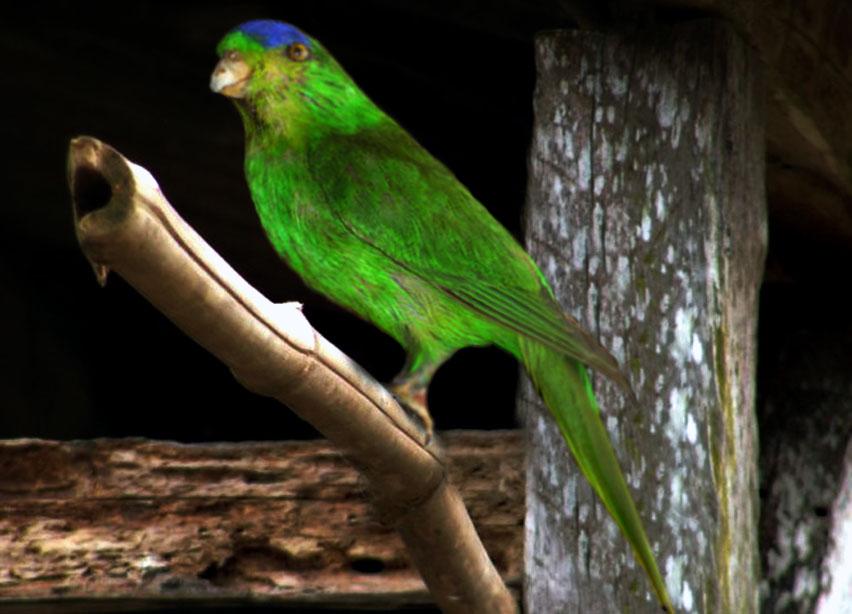
The head of the Meek's Lorikeet (Charmosyna meeki) is bright green, more yellowish in the Chin and throat, darker on crown and streaked on ear coats; patch of dark green blue above and in front of the eye. Green upper parts with fused olive through the mantle.
The wings of green at the top. Under the yellowish-green wing coverts. The yellowish green underparts, lighter in the back and more yellow from the chest to the belly. Top of tail dark green with yellow tip; the yellow bottom. Orange peak; pale red irises; legs Orange.
Both sexes are equal. Immature with the paler beak with base brown color and shorter tail.
Nomad. It is distributed in the humid hills and montane forests, but they have also found found in lowland coconut palms. Usually found alone or in small flocks of about of 10 to 15 birds flying through or above the forest cover. Larger groups can gather in the blooming of trees to feed on pollen and nectar. It can be associated with other parrots as the Duchess Lorikeet, Finsch's Pygmy-Parrot, Yellow-bibbed Lory and Coconut Lorikeet
Reproduction:
Information is not available.
Food:
Its diet includes pollen and nectar.
Distribution:
Endemic to the mountains of the largest islands in the Group of Solomons: Bougainville, New Georgia, Malaita, Kolombangara, Guadalcanal and in the past Santa Isabel. Moves starting from the 300 m, until the 1.700 m, but reportedly rarely in the lowlands or above 1.200 m. The world's population is believed to be below 50,000 exemplary but probably stable.
Conservation:
• Current IUCN Red List category: Near threatened
• Population trend: Decreasing
The size of the world's population has not been quantified, It is believed that it is below 50,000 specimens, but the species is described as abundant at the Summit of Kolombangara.
There is still no evidence of a decline in its population, but would be threatened by any future large-scale export trade
"Meek's Lorikeet" in captivity:
They are not known to be in captivity.
Alternative names:
– Meek’s Lorikeet (ingles).
– Lori de Meek (French).
– Salomonenlori (German).
– Lori de Meek (español).
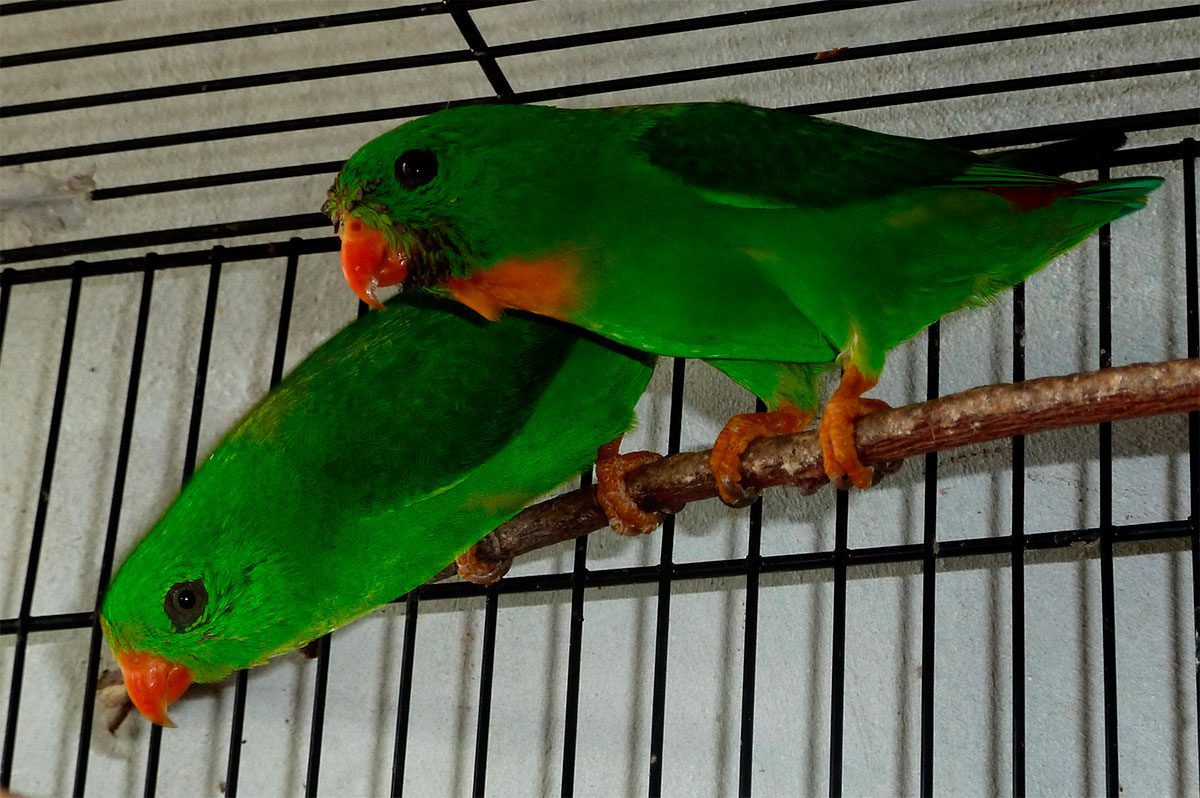
The head of the Yellow-throated hanging parrot(Loriculus pusillus) is bright green.
Upperparts green with yellow orange washing pale in the mantle; rump and uppertail-coverts, bright red. Wings green above, undertail, Turquoise with coverts green. Throat bright yellow, rest of the underparts bright green. Feathers of the tail green above, with side coverts yellowed and pale blue below. The bill orange; irises yellowish white; legs oranges.
Female and immature with yellow throat very small.
Reported along the edges of the forest, and in the marshy forests of the lowlands to 1.850 meters above sea level.
Possibly Nomad in response to local plant phenology.
The species shows great activity, climbing acrobaticamente on the canopy at time of collection, and resting and sleeping mouth below as well as other members of the genus.
The birds are alone, in pairs or in groups of up to eight individuals.
Larger groups sometimes gather in trees to feed.. Although discrete, the Yellow-throated hanging parrot They attract attention, since when flying between the trees they beat their wings emitting a characteristic buzz, accompanied by shrill calls.
Reproduction:
The laying tends to be of two eggs, deposited in the hollow of a tree, Palm or arbol-helecho, from time to time in an old nest of a barbet or Woodpecker. The nesting in West Java It was recorded between March and May.
Food:
They feed on nectar, fruit (including the Ficus figs), leaves and flower buds, as Cassia and Erythrina.
Distribution:
Size of its range (breeding/resident): 167.000 km 2
Endemic to Java and Bali, where it is usually uncommon. The world's population is thought to be superior to 10.000, but it may have decreased due to the logging of forests
Conservation:
• Current IUCN Red List category: Near threatened
• Population trend: Decreasing
The world population It has not been quantified, It is thought to be above 10.000 specimens. The species is generally described as rare throughout its area of distribution (pit et to the., 1997).
There are no data on population trends; However, the species is suspected decreasing at a moderately fast pace, due to the loss and degradation of its habitat.
"Yellow-throated hanging parrot" in captivity:
Rare in captivity.
Alternative names:
– Yellow-throated Hanging-Parrot, Javan Hanging-Parrot, Little Hanging-Parrot, Yellow throated Hanging Parrot, Yellow-throated Hanging Parrot (ingles).
– Coryllis à gorge jaune (French).
– Elfenpapageichen (German).
– Lorículo do Java (Portuguese).
– Lorículo de Java, Lorículo Javanés (español).
The Jandaya parakeet(Aratinga jandaya) they have both sides of the neck, cheeks, lores, ear-coverts and forecrown orange, deeper in the ear-coverts, around the eyes and in the lores; the crown and nape are yellowish-Orange (Some birds with paler yellow tones in the head).
Mantle and scapulars olive green; back and top of the rump, Green with orange-red horizontal bars; lower rump and uppertail-coverts olive green. Main feathers of the wings blue, the others feathers, green (brightest that in the the mantle). The flight feather blue color above, on the vane outer, Blackish towards the tip and grey below. Underwing-coverts orange-red. The underparts orange-red, slightly paler in the upper part of the chest and in the throat; undertail-coverts green.
Upper, the tail of olive with blue tips; undertail, charcoal grey.
Bill grey-black; bare periophthalmic pale grey; irises brown; legs grey.
Both sexes similar.
The immature has the head yellow and the neck with green markings; Dim Orange below.
Habitat:
The Jandaya parakeet move between deciduous woodlands, closed, thickets and clear areas of humid forest. Sporadically at the edge of the humid forest and in the caatinga. In palm groves of coconut on the coast of Pernambuco. Also frequent croplands and pastures. (Usually in flocks of approximately 12 birds, but sometimes in pairs or individually.
Reproduction:
Nests in tree cavities, at least a 15 metres in height. Observed young in the December nest in Maranhão; eggs hatch between August-December, in the area of Belem. Clutch, probably composed of three eggs.
Locally common, While perhaps decreasing in some areas. It is possible that its range is usually expanding through the colonization of cleared areas of high humid forest., especially in For and Maranhão.
Their status in the East its area of distribution is unknown.
Maintained in captivity with consequences serious, Perhaps derived from the illegal trade internal in Brazil and, possibly, by smuggling towards Asia South-East.
Conservation:
State of conservation ⓘ
Minor Concern ⓘ(UICN)ⓘ
• Red List category of the UICN current: Least concern
• Population trend: Stable
This species has a range very large, and therefore not approaching the thresholds for vulnerable under the criterion of size range
The size of the world population of Jandaya Parakeet It has not been quantified, but this species has been described as «rare» (Stotz et to the., 1996).
Its population is suspected to be stable in the absence of evidence of any reduction or substantial threats.
"Jandaya parakeet" in captivity:
Pretty common in captivity and easy to raise.
Like all the Parakeets, This species is not characterized by their ability to speak, still, can get to say some words with crystal clarity.
Its feeding is made up of different fruits, vegetables, soaked legumes and specific feed for parrots. There are species Meek and intelligent to which are the trains very well and are playful, What makes them good pet to maintain in a House. Being aves gregarias, is convenient to provide them a companion, Since solo can be quite noisy.
Enjoy the bathrooms, and is advisable to keep them in an Aviary or in cage of good proportions; It is also convenient to let the small flights out of its enclosure.
Its longevity often haunt them 20 years in captivity, being able to get to the 30 years, Depending on your care.
– Avibase
– Parrots of the World – Forshaw Joseph M
– Parrots A Guide to the Parrots of the World – Tony Juniper & Mike Parr
– Birdlife
– Photos:
(1) – Jandaya Parakeet (Aratinga jandaya) aka Janday Conure. Photographed in Puerto Rico at the Mayaquez Zoo By Dick Daniels (http://carolinabirds.org /) (Own work) [CC BY-SA 3.0 or GFDL], via Wikimedia Commons
(2) – Jandaya Parakeet (also known as Jenday Conure) in Beale Park, Reading, Berkshire, England By David Long from London, United Kingdom (IMG_4798Uploaded by Snowmanradio) [CC BY 2.0], via Wikimedia Commons
(3) – Jenday Conure or Jandaya Parakeet in a tree. By GIANNIZZZERO at English Wikipedia [Public domain], via Wikimedia Commons
(4) – Jenday Conure or Jandaya Parakeet (Aratinga jandaya) at Iguaçu Bird Park, Foz do Iguaçu, Brazil. Photographed on 23 April 2003 By Arthur Chapman [CC BY 2.0], via Wikimedia Commons
(6) – Aratinga jandaya and Aratinga solstitialis at Kobe Kachoen (Kobe Flowers and Birds Garden) in Kobe, Hyogo prefecture, Japan By Chris Gladis from Kyoto, Japan (Jandaya Parakeet) [CC BY 2.0], via Wikimedia Commons
(7) – Jendayasittiche (Aratinga jandaya) im Karl-Foerster-Garten des Tierparks Berlin-Friedrichsfelde By Lotse (Own work) [GFDL or CC BY-SA 3.0], via Wikimedia Commons
(8) – A Jandaya Parakeet (also known as Jenday Conure) at Beale Park, Lower Basildon, Reading, Berkshire, England By David Long (originally posted to Flickr as IMG_4800) [CC BY 2.0], via Wikimedia Commons
(9) – Jandaya Parakeet (also known as Jenday Conure) in Beale Park, Reading, Berkshire, England By David Long from London, United Kingdom (IMG_4802Uploaded by Snowmanradio) [CC BY 2.0], via Wikimedia Commons
About 30 cm.. length and a weight between 140 and 170 gr.
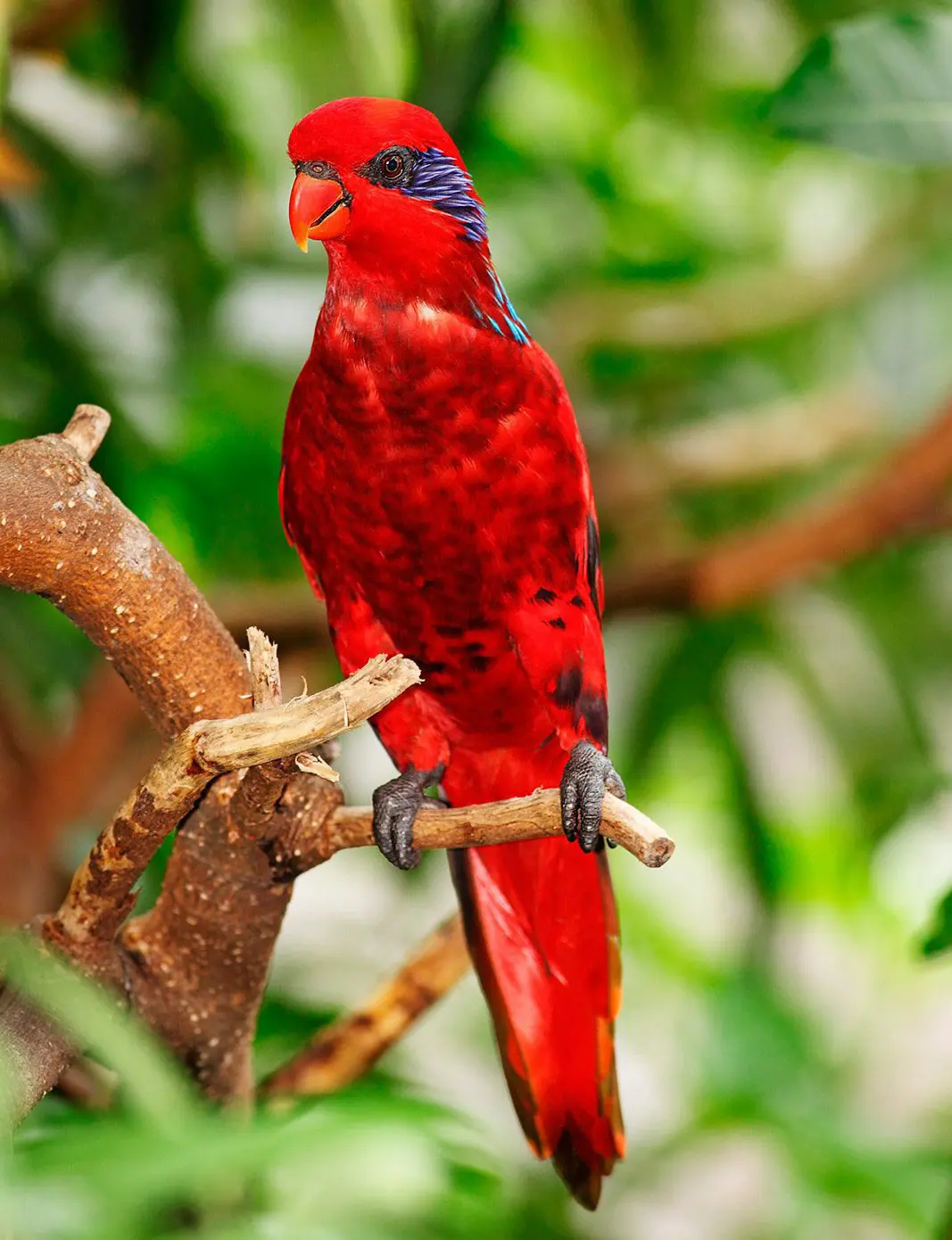
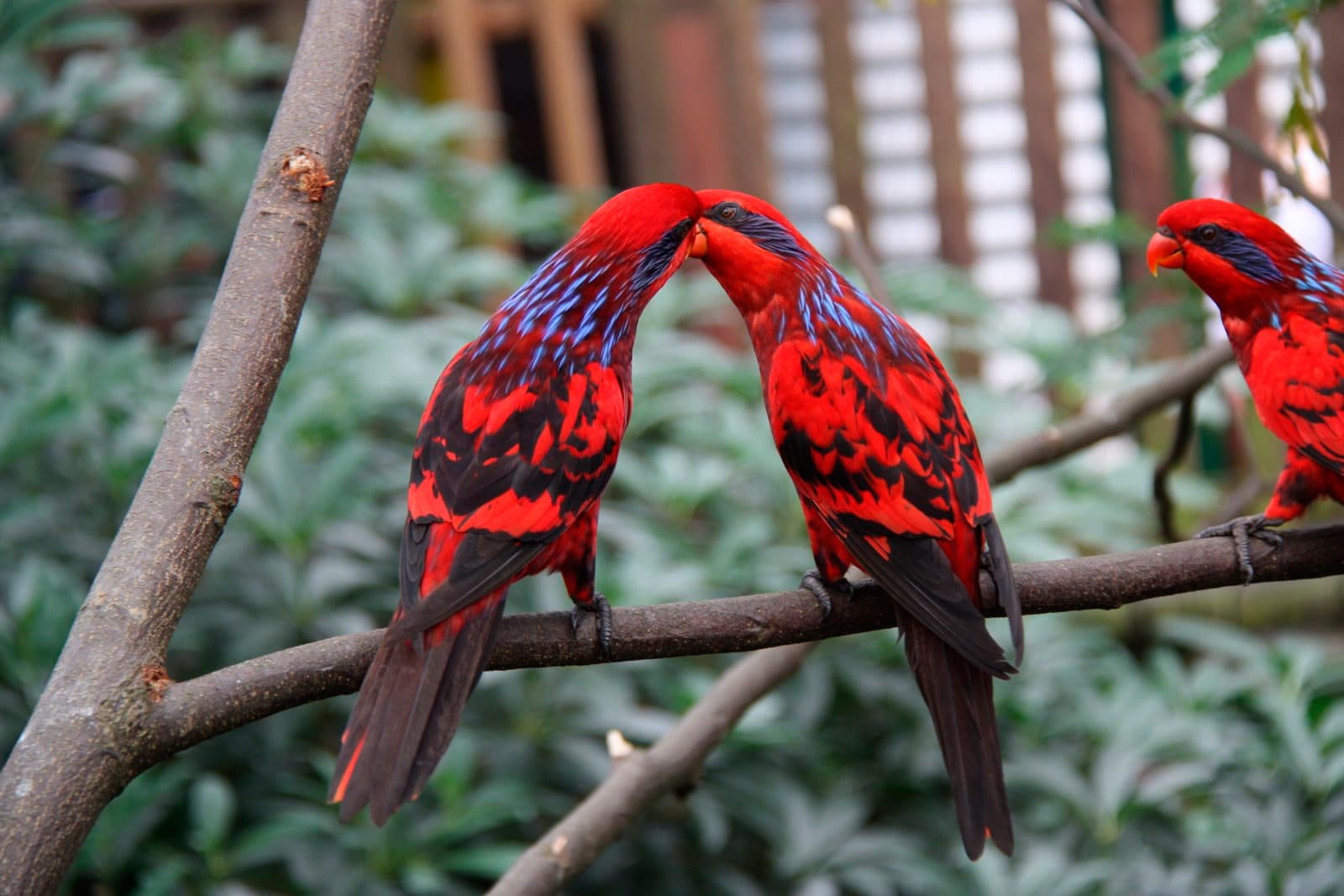
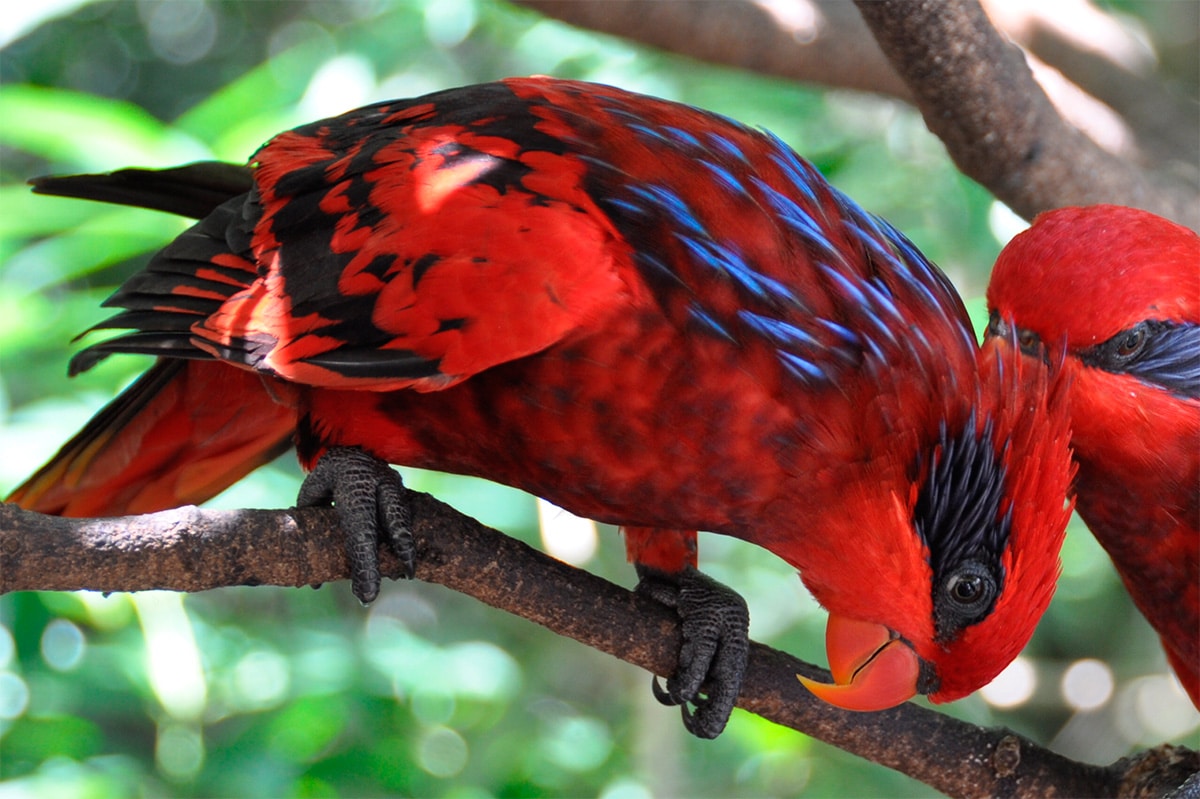
Like all species of the genus Eos, the “Tanimbar Lory” (Eos reticulata), shows a beautiful plumage mainly red. In adults, a great band blue-violet crosses the region of the eye and continues in the patches that cover the ears, at the sides of the neck.
The under neck and the mantle they are covered with long, violet-blue stripes.
The back and tail they are more or less blue red striped.
The pens and large blankets have terminations in black. The primary is almost entirely black. The tail is brownish black above and below a red opaque.
The bottom of the wings they have the edge and dark tips. Thighs and flanks they are completely Red. The bill coral red. Iris orange-red. The legs are grey.
In youth , the feathers the lower parts are aligned blue-black variably. The shield It is covered with blue spots instead of stripes. The bill is brownish Orange. The irises They are brown.
The Blue streaked Lory they live mostly in the most wooded areas, including primary and secondary forests. They are also found in coconut plantations, of sago palms, in the mangroves and the cultivated lands.
It seems that they show a certain attraction for the monsoon forests, relatively open and located in low-lying areas.
They live alone, in pairs or in small groups of up to ten or more individuals. These are rather shy and discreet, but their presence is often betrayed by the screams produced flocks in flight.
They have a direct flight, quite fast and composed of many flapping. Often feed on coconut blossom trees and the sago palms.
Reproduction:
There is little information of the natural environment. The Blue streaked Lory They typically make 2 or 3 eggs that colouring of 24 to 26 days. The chicks leave the nest after 7 to 8 weeks. But, even after feather, they return regularly to rest awhile. The youth they stay in the family throughout the summer and then join the dormitories where they continue their learning.
Food:
They have an exclusively vegetarian diet. They feed on fruits, seeds, buds and immature seeds. His tongue with a brush-shaped end is specialized to collect nectar and pollen.
Distribution:
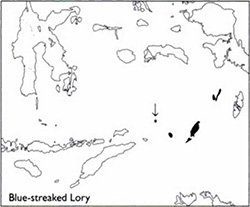
Is located in Yamdena and Larat, Tanimbar Islands and island of Babar, Indonesian. Introduced in Kai Islands and island of Damar, where has possibly gone.
Conservation:
– Current IUCN Red List category: Near threatened
– The population trend: Decreasing
Habitat loss continues apace in southern Yamdena
The species is suspected that it is decreasing at a rate of slow to moderate, due to the combined forces of habitat loss and capture.
It is estimated a population of 220.000 ± 50.000 birds in Yamdena
Nearly 3000 birds are traded on the international market of birds each year, fact that probably has not caused a decrease in its population. Habitat loss continues however, and this, combined with capture, probably if that will lead to more declines.
Conservation Actions Proposed:
– Regularly monitoring at certain sites throughout its range to determine population trends.
– Investigate the degree of capture and take appropriate measures, including the use of awareness-raising campaigns, to address these issues.
– Protection of the areas significant of forest right in all the Islands where is distributes the species.
"Blue streaked Lory" in captivity:
Lives of 15 to 30 years in the wild; and between 28 and 32 years in captivity.
Fairly common in the s 1970. Nowadays it is not unusual to see them in captivity.
Alternative names:
– Blue streaked Lory, Blue-streaked Lory (ingles).
– Lori réticulé, Lori à raies bleues, Lori strié bleu (French).
– Strichellori (German).
– Lóris-de-crista-azul (Portuguese).
– Lori de las Tanimbar, Lori Reticulado (español).
16 to 19 cm.. length and an approximate weight of 40 g.. The Little Lorikeet(Parvipsitta petty) is the smallest of the Parrots Australian.
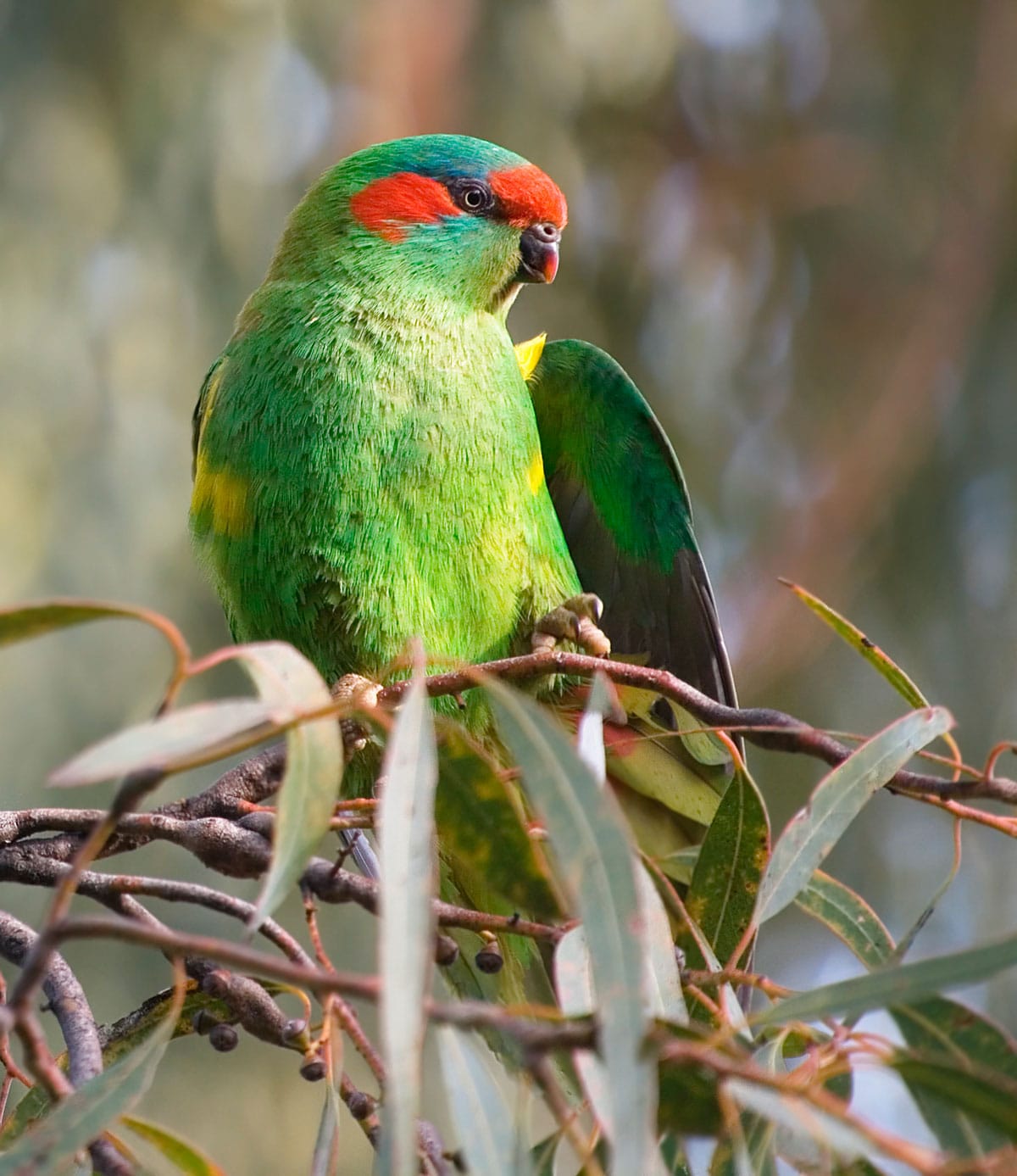
The body is bright green, the area of the nose, the forecrown, the neck, part of the forecrown and cheeks They are red.
The ear-coverts are of color green with stripes of color green light. The neck and back top are brown-green. Under the wings brighter yellowish green. The primary flight feathers they have a very narrow yellowish Board, their underparts is yellowish-green.
The feathers of the tail has reddish orange base, the circle around the eyes is narrow and black, the irises is orange, the legs grayscale and the bill black.
The Little Lorikeet dispatched virtually all areas and at all altitudes with trees. They prefer open areas with flowering or fruit trees and riverbanks.. Found up to one altitude of 1600 m.
Occasionally seen in orchards and farming areas.
Son nomads and outside the breeding season they gather in small groups of 4 to 12 birds.
They prefer tall treetops and are difficult to see due to their small size and green color.. They prefer trees of eucalyptus that they are in bloom and they can attend major meetings when they are feeding, often associated with other lori as the Coconut Lorikeet and the Musk Lorikeet.
Ruidoso. Their flight is flapping fast and straight, accompanied by shrill calls.
Reproduction:
The breeding season It is going may in the North, or August in the South, to December. It nests in the Hollows of trees, where sets of 3 to 5 rounded whitish eggs. The incubation hard ones three weeks.
Food:
It feeds mainly from fruits and flowers, including native plants such as those belonging to the genera Xanthorrhoea and (Melaleuca and Loranthus, and introduced plants such as the medlar (Eriobotrya japonica). Occasionally visit orchards.
Distribution:
Size of the area of distribution (reproduction / resident): 788.000 km2
The Little Lorikeet is located in the East and Southeast of Australia, from the vicinity of Cairns to the South by Queensland and New South Wales from the slopes of the Great dividing range until the eastern coasts to most of Victoria and Southeast of Southern Australia. Also located in Tasmania, although there is little abundant.
Conservation:
• Current category of the Red List of the UICN: Least concern.
• Population trend: Stable.
The main threats to these small parrots are the loss of breeding sites and of those resources food by the clearing of land in course. Most breeding records come from the western slopes, where has been a great loss of habitat trees. The loss of trees nest along the verges of Highway, often associated with roadwork, It is still a constant threat.
"Little Lorikeet" in captivity:
Although it was exported to Europe for the first time in 1877, the Little Lorikeet rarely seen outside of Australia. And even in the country of which it is native it is rare in captivity. Has a reputation for being difficult to maintain.
Alternative names:
– Little Lorikeet, Little Red Lorikeet (ingles).
– Lori à masque rouge, Petit Loriquet (French).
– Zwergmoschuslori (German).
– Loris Pusilla (Portuguese).
– Lori Carirrojo, Lori de Cabeza Roja (español).
1 – By JJ Harrison (jjharrison89@facebook.com) (Hand darbas) [CC BY-SA 3.0 or GFDL], via Wikimedia Commons
2 – By Joxerra Aihartza (à‘ire argazki bilduma / own picture) [FAL], via Wikimedia Commons
3 – Little Lorikeets by Julian Robinson, on Flickr – Flickr
4 – Little Lorikeets (Glossopsitta pusilla) by David Cook, on Flickr – Flickr
5 – Musk Lorikeet [Glossopsitta concinna] again! by Norm Hanson, on Flickr – Flickr
Sounds: Marc Anderson (Xeno-canto)
▷ The world of Pets: Dogs, cats, birds, reptiles, amphibians
The females of the New Caledonian Lorikeet(Charmosyna diadema) are green in general, with the crown Violet Blue intense and the thighs Blue dark, a face Beige and it bottom side and anal region red. The tail It is green above and yellowish olive below, with the four lateral feathers with red basal markings followed by a band of black, with yellow tip on the bottom. The bill is red-orange, the irises dark orange, probably, similar to the legs.
The males they have not been registered. On the basis of similar species, they probably have a more red coloration, probably including the face, the bottom of the primaries and the sides of the rump; and it is likely to be slightly larger than. The immature should look like females but paler.
Habitat:
This bird is difficult to track because it is Nomad and is relatively little visible. The species is believed to be able to live in moist montane forests but (seasonally). Flying in and out of the lowland forests of Melaleuca. Most reports come from such lowland forests, but this probably reflected only a better accessibility for observation. Mt. Ignambi It is believed that it is an ideal habitat for the species. The report Yacht Lake was an area of low scrub.
Reproduction:
Data playback of the New Caledonian Lorikeet (Charmosyna diadema) are only available the of the Red-flanked Lorikeet(Charmosyna placentis) and the Red-fronted Lorikeet (Charmosyna rubronotata). The breeding season, probably, is from July to December, and possibly until February, or even all year round. They dig in the arboreal nests of termites or in epiphytic ferns. Link gives as a result the implementation of two (sometimes three?) White rounded eggs; the incubation period likely to be similar to other species of Loris.
Food:
The bird apparently is fed into the tops of the trees.
Related species eat nectar, pollen, flowers and sometimes delicate fruits, in pairs or small groups feeding (usually less than 10). The Erythrina is specifically mentioned as plants on which this species feeds.
Distribution:
Size of the area of distribution (reproduction / resident): 1 km2
Possibly extinct. Endemic to New Caledonia and known from two female specimens collected in 1859. The species also could have been observed in the forests of the North of the island in the year 1900. and it was identified by the Islanders with the reference of a picture (at Delacour 1966) of Anthony Stokes in December of 1976. One Islander claimed to see a single individual in the Decade of 1920, and another had observed two the 3 in June of 1976 to the West of Monte Panie. This last observation was made by an experienced observer who noticed the birds by their call, and said it was different to Coconut Lorikeet. The authors are in agreement with Necklace et to the. (1994) in the extension of remaining forests in New Caledonia and the size of the island indicate that this species may well still exist and that observations and studies should be within suitable habitat including the Monte Panie, Mount Humboldt and other forest areas of the Highlands. IN DANGER.
Conservation:
• Current IUCN Red List category: Critical Hazard
• Population trend: Unknown
The population It is estimated between 1 and 49 individuals mature.
This species has not been recorded with certainty since 1913, despite specific searches in 1998, and it may have decreased as a result of a number of different threats. But, cannot be assumed that they have become extinct, because there were local reports in the Decade of 1950 and in 1976, and lorites of this genus are notoriously difficult to detect, being discreet and nomadic, more studies are needed. Any remaining population is likely to be small, and for these reasons it is in Critical Hazard.
The montane moist forest is not under threat, but it is possible that this species has a requirement for other habitats, some of which, forests semi-deciduous in particular, the lowlands, they have almost disappeared from the island (Ekstrom et to the. 2000, Ekstrom et to the . 2002). Several Lori headband have suffered severe population decreases and fluctuations by unknown causes (Forshaw 1989). The introduction of any disease is possible (such as malaria, avian) or more likely mammals (especially rats) they may have been one of the causes of the decline of this species.(Bregulla 1992, Ekstrom et to the. 2000, Ekstrom et to the ., 2002).
"New Caledonian Lorikeet" in captivity:
Not found in captivity.
Alternative names:
– New Caledonian Lorikeet, New Caledonia lorikeet (ingles).
– Lori à diadème, Loriquet à diadème (French).
– Diademlori (German).
– Lori Diadema (español).
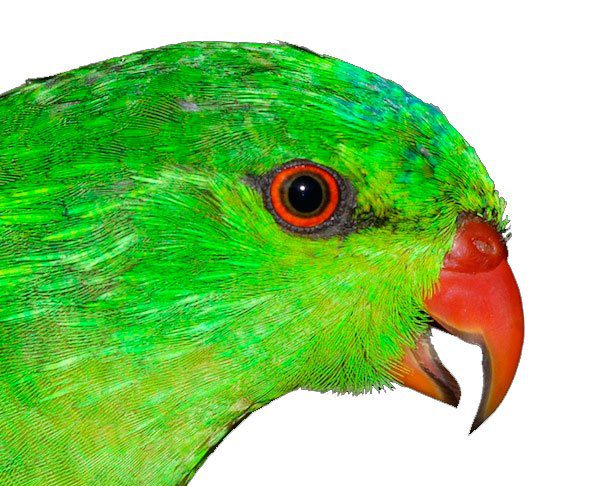
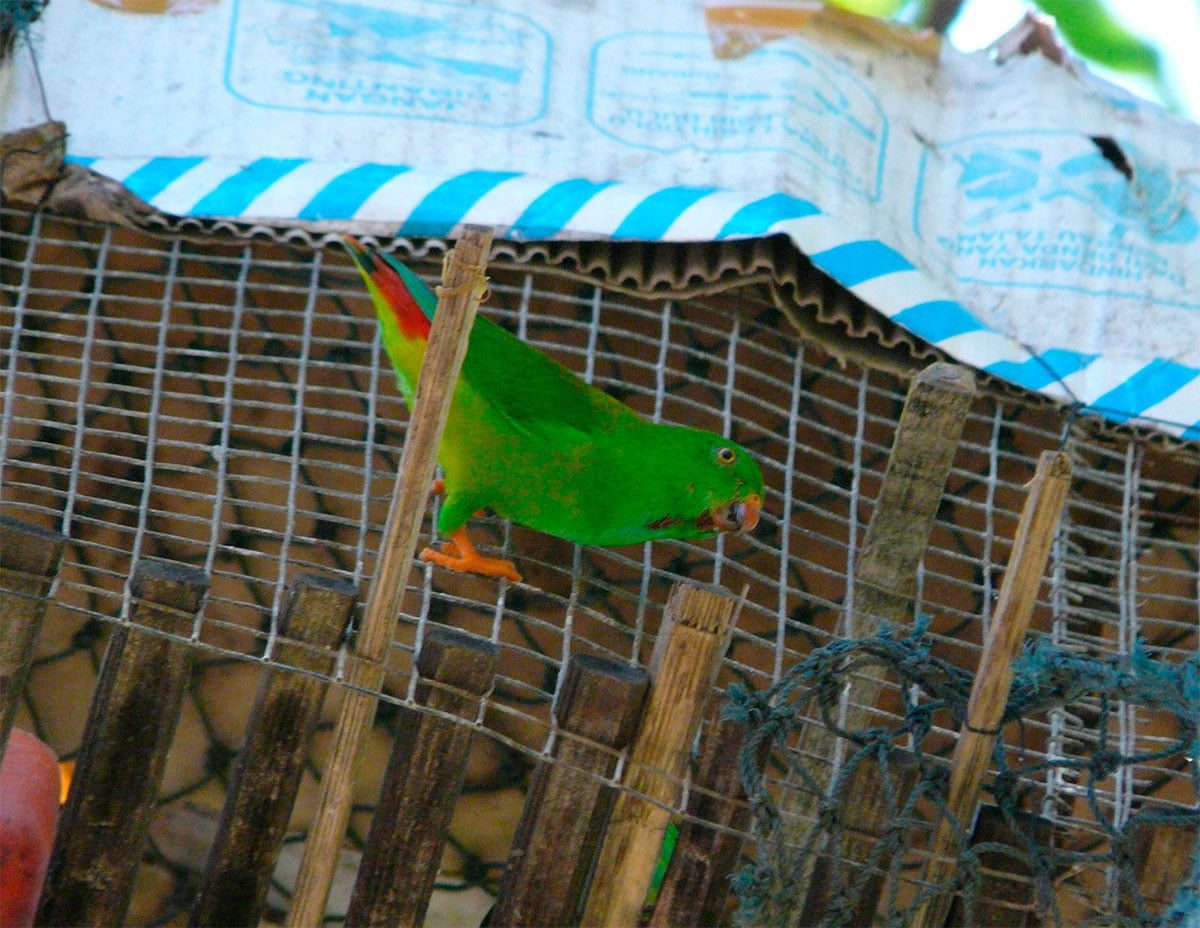
The head of the Pygmy hanging parrot(Loriculus exilis) is green, brighter around the base of the bill and bathed in bluish green at the chin, the throat, the cheeks and the part front of it crown.
The underparts is green, with the rump and uppertail-coverts dark red (very extended below the tail); the sides and the base of the rump are greenish-yellow. Wings green. Under, the wings Turquoise with coverts green. Throat of color red bordered of blue pale and extending is about part superior of the chest; rest of the underparts green, slightly more clear that the upperparts. The tail, at the top, Green with yellowish tips; undertail, the tail is of a pale color green blue.
The bill coral red; irises yellow; legs oranges.
The females lack of the bib red (or have very small bib). Also have a reduced blue diffusion in the chest and irises brown.
The young birds they have a bib Red small, a bill yellowish brown, and a pale brown iris.
Usually little-known. It is distributed by forests, coastal mangroves, around the villages and in the open field, from the lowlands to the wooded hills to some 1.000 m, altitudes and in similar habitats to the of the Great hanging parrot.
The birds are found in groups of up to five copies, feeding in the canopy of figs or the trees in flower nectar; their power moves have been compared with the movements of crawling in the Pygmy Parrot Micropsitta. Larger flocks have been found in the mangroves during may, Although the species can reproduce twice a year, in February and August; it is not known if these represent post-breeding concentrations or nomadic groups.
Reproduction:
A hole in a dead palm tree is the only known record of a zone of nesting.
Food:
Feeds of figs or nectar.
Distribution:
Size of the area of distribution (reproduction / resident): 103.000 km2
The size of the world population It has not been quantified, Although it is estimated at more than 10.000 specimens. The species is described as uncommon and rare.
There are no data on trends in the population, but the species is suspected to be decreasing at a moderately fast pace, due to degradation of the habitat.
– Avibase
– Parrots of the World – Forshaw Joseph M
– Parrots A Guide to the Parrots of the World – Tony Juniper & Mike Parr
– Birdlife
– Photos:
(1) – By Peter Waanders – Caged female has attracted wild male. lynx
(2) – Loriculus exilis by John Gerrard Keulemans [Public domain], via Wikimedia Commons
Origin: Venezuela, Guyana, Suriname, French Guiana, Brazil
Character: Sociable
Life expectancy: 30 years.
Height: 30 cm..
Content
Description:
Of 30 cm.. length and a weight between 120 and 130 g.
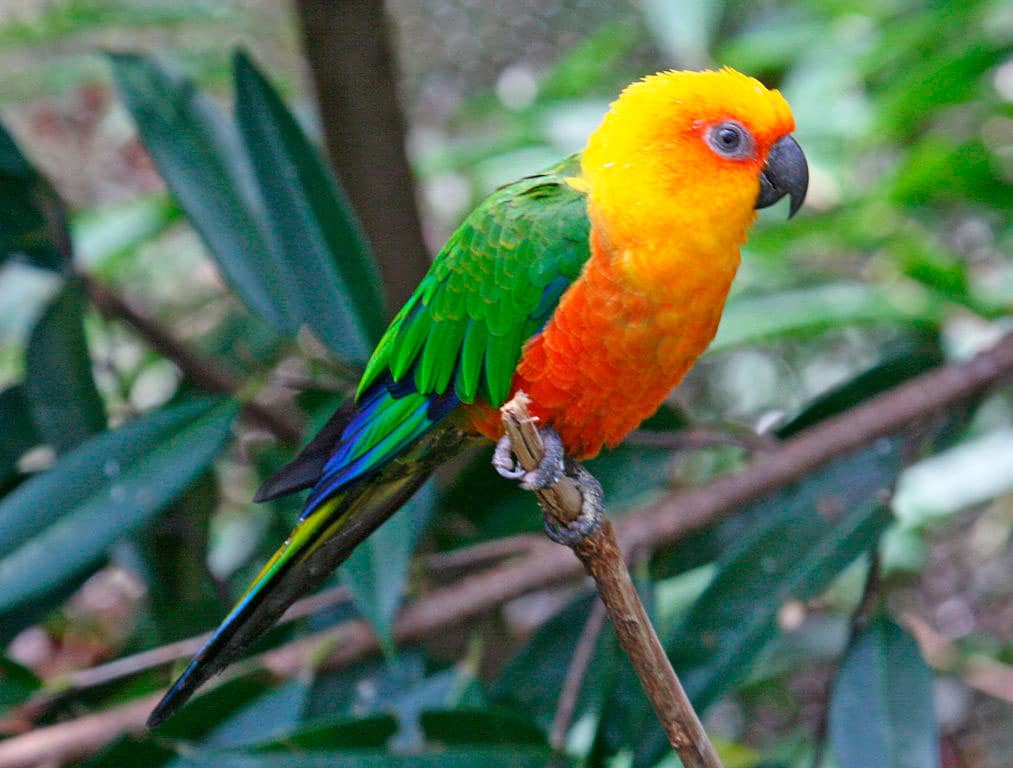
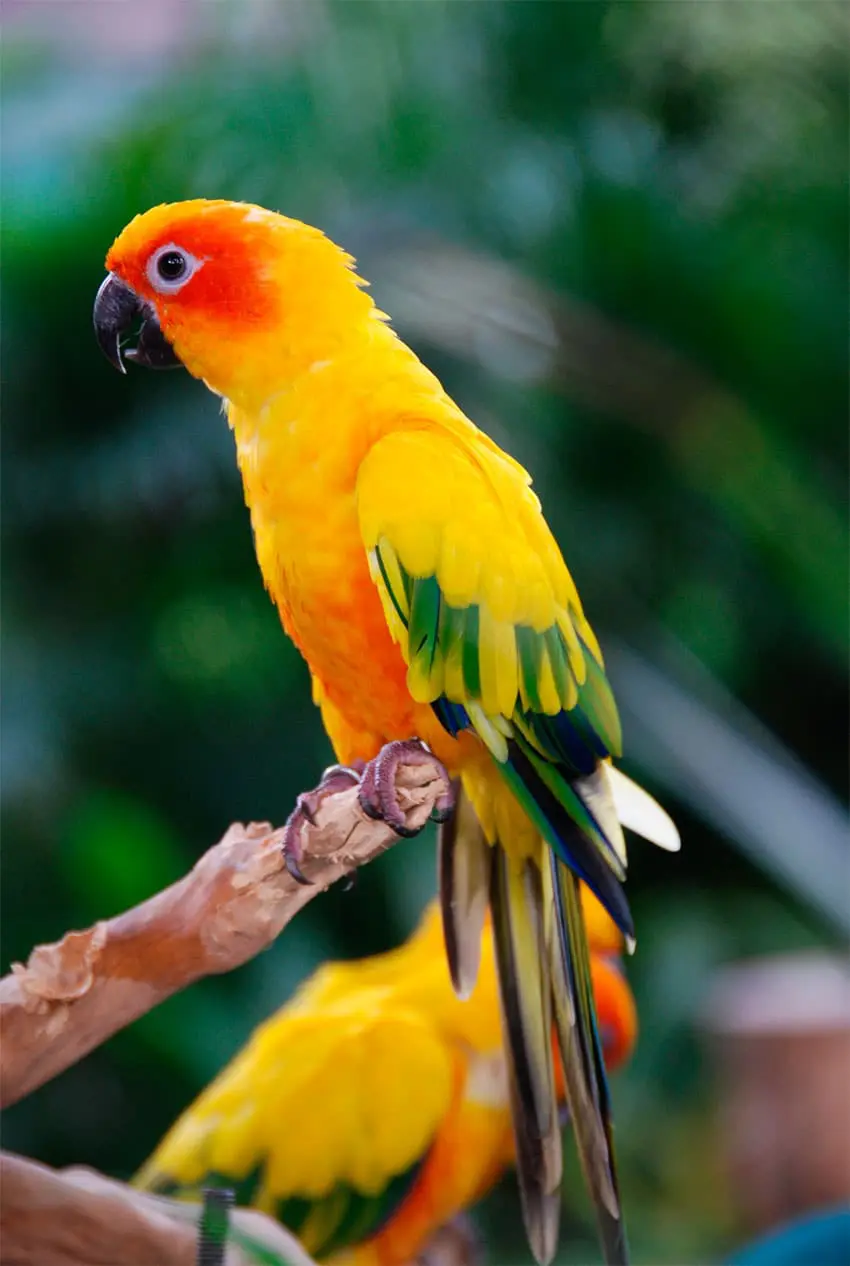
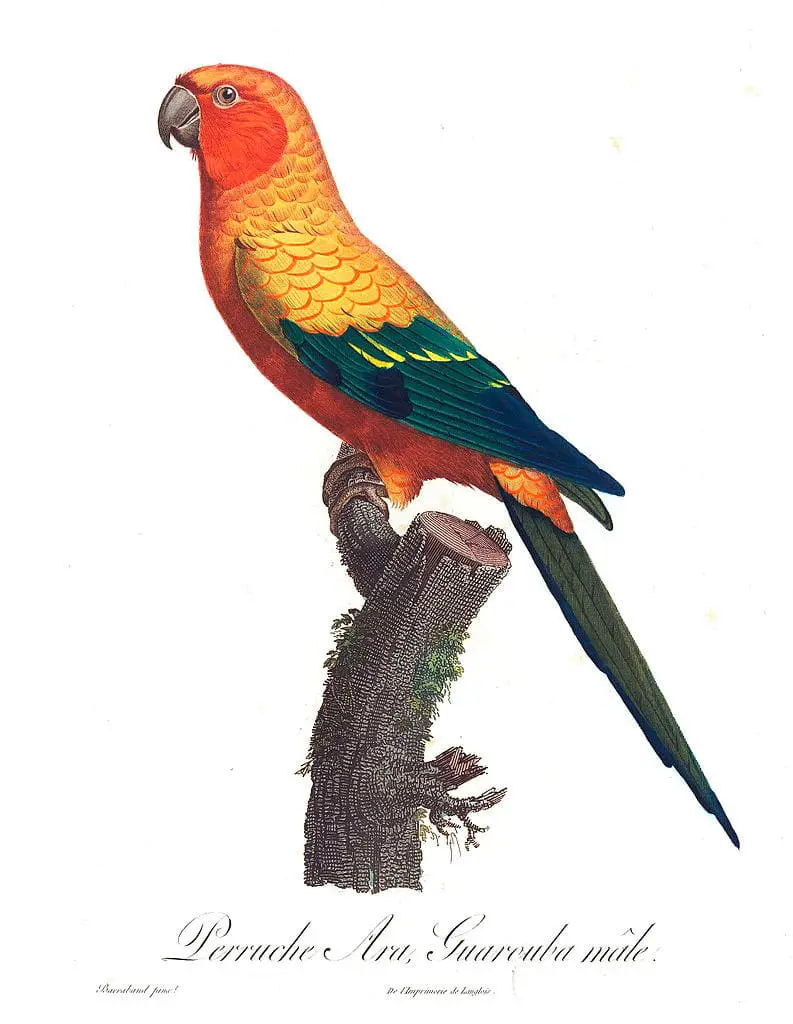
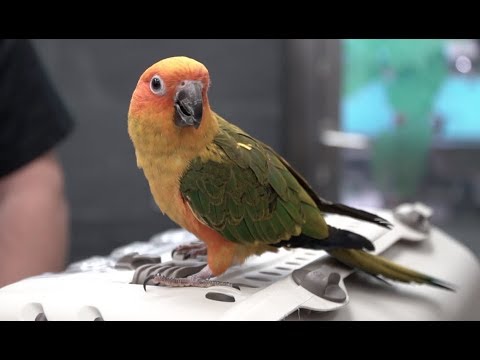
Of great beauty, the Sun Parakeet(Aratinga solstitialis) has the lores, ocular region and ear-coverts golden yellow, changing to shades red orange glossy; the forecrown, crown and nape are of a rich color yellow brilliant with color orange.
Bright yellow in the the mantle, the back and rump; uppertail-coverts of color yellow with exotic feathers of color blue. Scapulars Green Tips and the vane inner blue; the coverts smaller and medium, of color yellow with variable staining Green; greater coverts with tips of color green beige, primary coverts, blue. Flight feathers, green above, primaries with tips and vane inner blue; grayish brown then. Undertail-coverts yellow (or orange / yellow). The throat Orange with yellow shading at the top of the chest; lower chest and the belly orange; Flanks and area of the vent yellow.
Upper, the tail mainly of color green yellowish with tips of color blue; undertail, of color grey with dye beige.
The bill of color Brown dark to black; the irises dark brown; legs distant.
Both sexes similar.
Immature usually with more muted than adults with the yellow colors of the head and the body replaced by an orange-Green. Lesser and medium uppertail-coverts green.
In general, live in Savanna, in dry forests with Palm trees and some times in flooded areas, until 1200 m. Cross the habitats more open only when traveling between the patches of forest. Son Bird social, usually observed in flocks of 30 or more individuals, with aggregations over large in tree fruit.
Reproduction:
It nests in hollow of trees or palms (for example, Mauritia).
Nest with a chick only in the month of February in Suriname. The size medium of laying is of 3 to 4 eggs. These eggs are hatch during 23 to 27 days, that is almost the forty percent more that it from other birds, in comparison with the mass of egg.
Food:
Their diet is poorly documented, Although it probably consists of locally available food, such as different fruits, berries, nuts, sprouts and flowers. Some foods known including pods of legumes, small fruits of the family Melastomataceae, fruits Red's Cactus and possibly berries of the genus Malpighia.
Distribution:
Size of the area of distribution (reproduction / resident): 96.600 km2
The Sun Parakeet are distributed in the northeast of South America, from the Monte Roraima in the extreme north of Brazil (a single record in 1848 previously attributed to Venezuela), areas adjacent of it Pacaraima mountains in Venezuela and North of Guyana, to pomeroon river, eastward through Suriname (apparently unknown in the North) and French Guayana until Brazil in Amapá.
Observed also in For and Eastern Amazonas (bounded on the west about Rio Branco and locally to the South of the Amazon, from Santarém to the region of the Canuma River).
Although in general can be considered is usual, records sporadic suggest appearances local of the Sun Parakeet in an extended range of its distribution area.
Maintained locally as domestic fowl and trapped for the bird trade Vivas.
Conservation:
• Red List category of the UICN current: In danger of extinction
• Population trend: Decreasing
A well known in the South flock of Guyana has been registered with a maximum number of 200 individuals (Bergman 2009), with other recent records in Roraima (Laranjeiras et to the. 2011). The population is estimated therefore between 1,000-2,499 mature individuals, based on recent records. This is equivalent to 1,500-3,749 birds in total, rounded in 1.500-4.000 individuals.
The population of the Sun Parakeet It is thought that can be in continuous descent, because, probably, continuous pressure which is subjected due to hunting.
THREATS:
Due to the high demand for this species in the pet market, its population has declined dramatically over the last twenty years (J. Gilardi in litt., 2007).
Have been exported largely from Guyana during this time, which has led to its virtual extinction in that country. Trappers of Guyana and French Guiana have traveled to the border with Brazil to buy these birds for export (T. Arndt in litt. 2007, L. Silveira in litt., 2007).
A fit annual of export of 600 bird was established in Guyana in the years 1980 and it is believed that more than 2.200 they were imported into the United States between 1981 and 1985 (J. Gilardi in litt., 2007).
Its trade is in course, and because of the ease with which these birds can be attracted to the bait (for example corn) and the long distances that will be traveling, It is easy to catch all individuals in a given area(J. Gilardi in litt., 2007).
Conservation Actions Underway:
• It is very common in captivity, but it is not known what percentage of this population are hybrids between the Aratinga solstitialis and the Aratinga maculata (Silveira et to the., 2005, LF Silveira in litt. 2012).
Conservation Actions Proposed:
• Consider listing the species in Appendix I.
• Stop cross-border trade immediately CITES.
• Work with the indigenous inhabitants of the Raposa Serra do Sol Indian Land and the Amerindian Community in Karasabai to avoid entrapment and protect suitable habitat.
• Survey to locate additional important subpopulations.
• Establish captive breeding lines of purebred birds..
"Sun Parakeet" in captivity:
The Sun Parakeet is known for its quacking very strong in comparison with its size relatively small. It is capable of imitating human beings, but not as well as some larger parrots.
Son popular as pets, due to their bright coloration while they have a very limited ability to speak.
Due to its inquisitive temperament, demand much attention from their owners, and sometimes they can be very noisy.
– Avibase
– Parrots of the World – Forshaw Joseph M
– Parrots A Guide to the Parrots of the World – Tony Juniper & Mike Parr
– Birdlife
– Cover photo:
(1) – Sun Conure or Sun Parakeet (Aratinga solstitialis) at a bird park in Singapore By Michael Gwyther-Jones (originally posted to Flickr as Singapore) [CC BY 2.0], via Wikimedia Commons
– Image gallery:
(2) – Three Sun Parakeets (also known as Sun Conure) at Jurong Bird Park, Singapore. The bird in the middle of the photograph has been wing clipped By Michael Gwyther-Jones from UK (FlickrUploaded by snowmanradio) [CC BY 2.0], via Wikimedia Commons
(3) – Sun Parakeets (also known as Sun Conures) at Jurong Bird Park, Singapore By Michael Spencer (originally posted to Flickr as Jurong Bird Park) [CC BY 2.0], via Wikimedia Commons
(4) – Sun Parakeet (also known as Sun Conure) at Jurong Bird Park, Singapore By Michael Spencer (originally posted to Flickr as Jurong Bird Park) [CC BY 2.0], via Wikimedia Commons
(5) – Sun Conures at Jurong Bird Park, Singapore. Wing clipped By Doug Janson (Own work) [CC BY-SA 3.0 or GFDL], via Wikimedia Commons










_RWD2.jpg)


_-_1019-901-(118).jpg)


.jpg)


.jpg)


.jpg)
