
Content
|
30 cm.. length and 100 g. of weight.
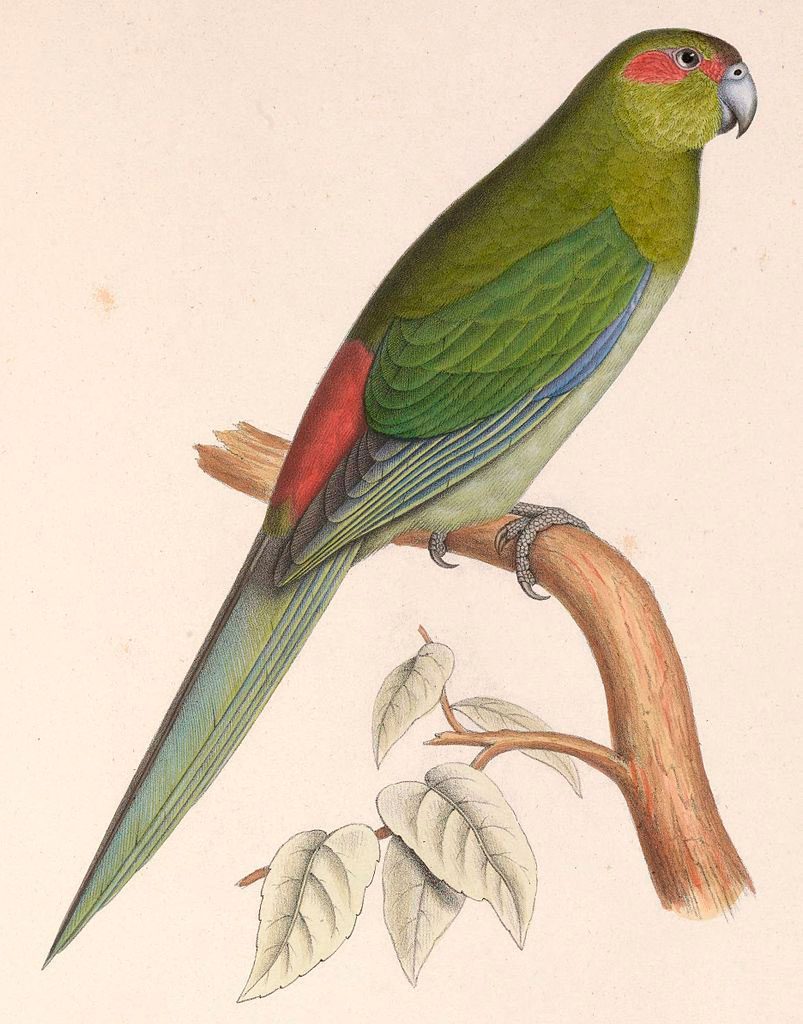
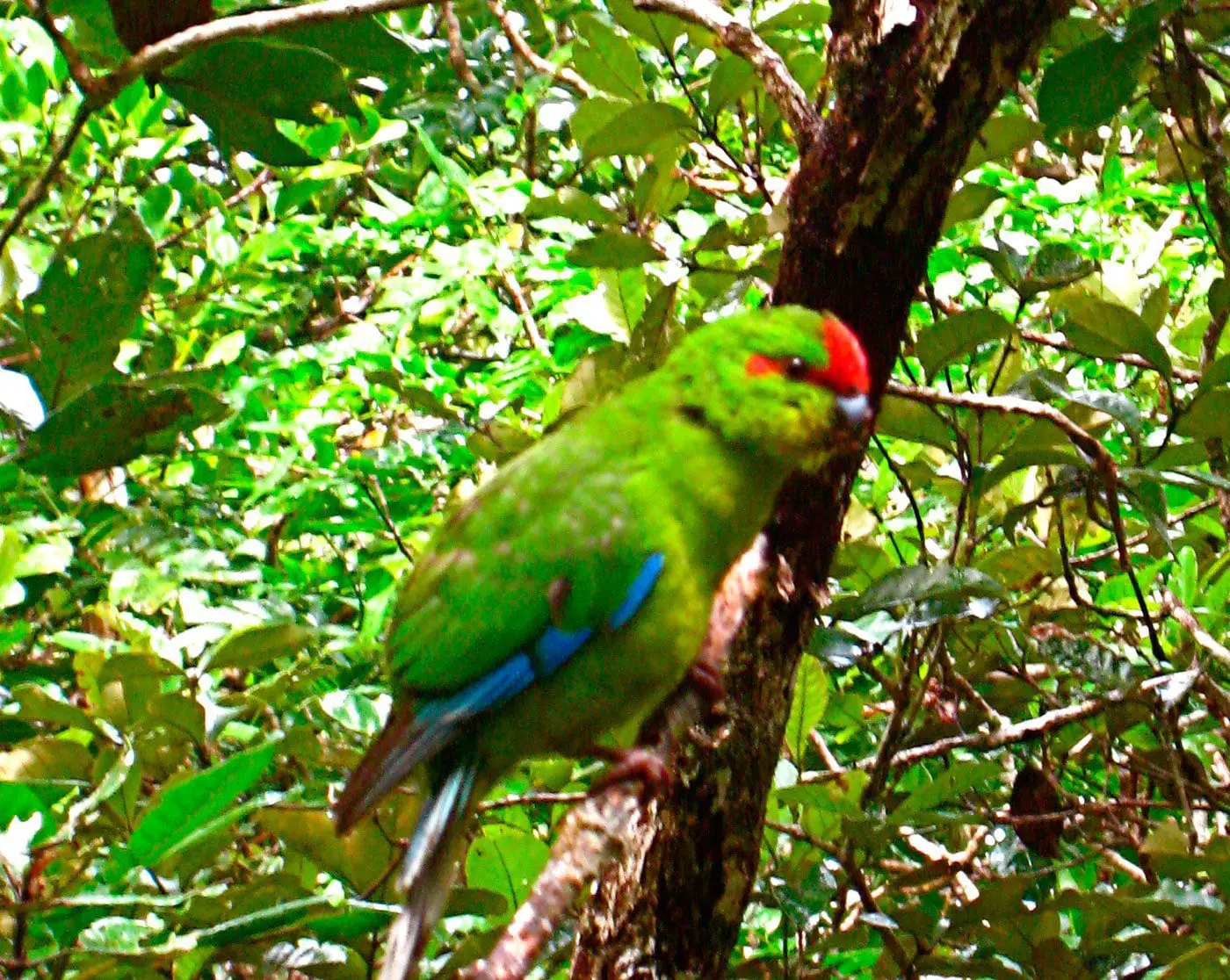
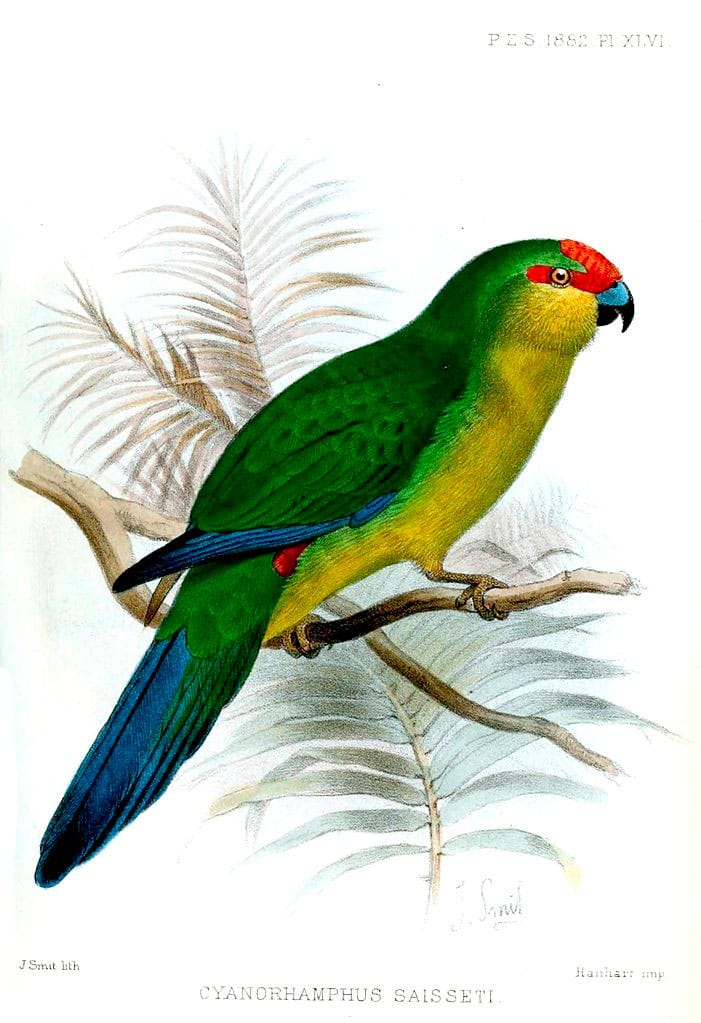
The Norfolk Island Parakeet (Cyanoramphus cookii) has a plumage bright green with reddish front, one red band extending through each eye; and light blue region in the leading edge of each wing
. Upperwing-coverts green. Primary coverts and outerweb of primaries violet blue. Underwing-coverts yellow-green. red spot on each side of the rump. Above, the tail dark green with yellow edges, under dark gray. Eyes red.
The sexes are similar in appearance. The females They are distinguished by their smaller size, less red in the forecrown, stains on the front of the crown, and bill smaller and narrower. The pups hatched are coated with a thin gray background.
The youth They are similar in appearance to adults, but the red is less extensive (Forshaw 1981; Higgins 1999). Juveniles have a bill distinctive color meat during the first 4 to 6 weeks after the flight (Forshaw 1981).
Taxonomic status:
This taxon is considered a subspecies of Cyanoramphus [novaezelandiae, erythrotis, subflavescens, hochstetteri, saisseti or cookii] (sensu lato) by some authors
- Sound of the Norfolk Island Parakeet.
The Norfolk Island Parakeet It is found mainly in the rainforest remainder, although it can also be seen in other areas of the island (Garnett & Crowley 2000; Hicks & Greenwood 1989; Higgins 1999; J. Hicks pers. comm. quoted in Hill 2002).
It is considered sedentary (Higgins 1999). The species moves from the National Park Norfolk Island to orchards and gardens when fruit available (Hicks & Greenwood 1989; Higgins 1999). Most of the sightings of the Norfolk Island Parakeet outside the National Park Norfolk Island They are recorded in December and January (Lane et al., 1998).
Foraging occurs in all strata of vegetation (Higgins 1999), including in the forest canopy, on the floor, in disturbed habitats and habitats modified depending on food availability (Forshaw & Cooper 1989; Higgins 1999). It has been observed to Perico Norfolk, including youth, feeding on the ground during winter, eating fallen seeds and fruits of African olive, Pine Norfolk Island and red guava (Garnett & Crowley 2000; Higgins 1999; Lane et al., 1998; Ortiz-Catedral 2013).
The Norfolk Island Parakeet It gregarious, usually they are seen in pairs or in family groups (Higgins 1999) and flocks (C. Jones pers. comm. 2016). The species occurs as a single contiguous breeding population (Garnett et to the., 2011).
The Norfolk Island Parakeet usually nest less than two meters above the ground, usually in a recess or cavity in the branch, trunk or stump living or dead trees, especially in larger native trees. This includes Nestegis apetala (ironwood), Blood Wood (Corymbia spp. / Eucalyptus spp.), Cordyline spp. and Araucaria heterophylla (Norfolk Island Pine) (Garnett et to the., 2011; Hicks & Greenwood 1989; Higgins 1999; Lane et al., 1998). The species has occasionally been observed nesting in holes in the ground created by rotting pine roots. (C. Jones pers. comm. 2016).
Usually it perches in hidden areas with thick vegetation, including treeholes, epiphytes, tussocks, sedges and ferns. The species often perches on nesting sites (Higgins 1999). Inexperienced chicks often roost in exposed sites (Higgins 1999).
The reproduction It occurs throughout the year, peaking from December to March (Greenwood et al., 1989; Hicks & Preece 1991). The females. hatch eggs and are very reluctant to leave their nests during this time (P. Stevenson com. pers. quoted in Hill 2002). The incubation hard 21 days (Hicks & Preece 1991). When the chicks reach about two weeks old, the female can leave to start a new nest (Greenwood 1993). Norfolk Parakeets can have multiple clutches and give birth successfully up to four times a year., with males and females sharing the care of the young (R. Ward com. pers. quoted in Hill 2002). They prefer to use a fresh nest site for each clutch (Hill 2002). The chicks leave the nest six to seven. weeks after hatching and depend on their parents to feed three to seven weeks (Davidson 1997; Forshaw 1981; Hicks & Greenwood 1989; Hicks & Preece 1991). The clutch is large (1-8) (Hicks & Greenwood 1989). the age of first reproduction is unknown, but it may be soon after independence (Greene 1990).
Adults eat mainly seeds, fruit, flowers, bark and leaves of native and introduced trees, and shrubs, including Pine Norfolk Island, ironwood, Rhopalostylis Bauer (Palm Norfolk Island), Blood Wood, Cordyline, Lagunaria (White Oak), Elaeodendron curtipendulum (silvestre) arce), wild snuff (Solanum mauritianum), red guava (Psidium spp.), African olive (Olea europaea subsp. cuspidate), peach (Prunus persica) and lantana (Lantana camara) (Forshaw & Cooper 1978; Garnett & Crowley 2000; Higgins 1999; Lane et al., 1998).
The Norfolk Island Parakeet (Cyanoramphus cookii) is endemic of the Norfolk island. Before the European establishment it spread throughout the island, but now it is mainly in the region Mt Pitt de Norfolk. (460 has) and in the Botanical Gardens Norfolk Island (5,5 has) (Director of National Parks 2010; Garnett et to the., 2011). The Norfolk Island Parakeet also they are seen in wooded areas outside the national park and botanical gardens, and they are observed throughout the island in small amounts (Director of National Parks 2010).
The breeding of Norfolk Island Parakeet It is largely confined to a suitable habitat within the range of Norfolk Island National Park (Hill 2002), although there are reports playback on adjacent private property to the National Park Norfolk Island (C. Rowston press. comm. cited in Garnett et al., 2011).
In 2013, One study estimated that its population on Norfolk Island It was only 46-92 individuals (Ortiz-Catedral 2013).
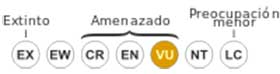
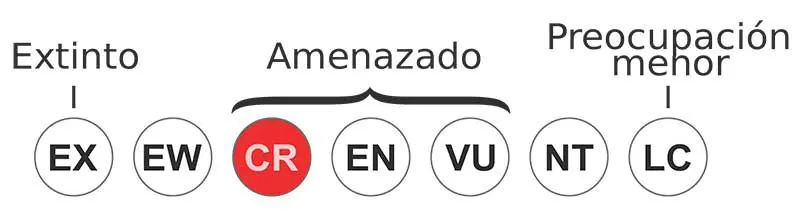
• Law on Environmental Protection and Biodiversity Conservation 1999 (Cwlth) (EPBC Law): Critically Endangered.
• Population trend: Decreasing.
• Population size : 50-100 mature individuals.
The Norfolk Island Parakeet (Cyanoramphus cookii) It is classified as In danger under the Law on Environmental Protection and Biodiversity Conservation 1999 (Cwlth) (EPBC Law). The species is eligible for inclusion on the list since before the start of the EPBC Act, It was included as endangered under Annexed 1 of the Law on Protection of Endangered Species 1992.
Garnett et to the (2011) They reviewed the state of conservation Norfolk Island Parakeet and they considered in Critical Hazard. The Scientific Committee of Threatened Species You are using the findings of Garnett et al. (2011) to consider whether the reassessment of the conservation status of each of the threatened birds listed in the EPBC Law It is mandatory.
The main factors causing the species to be eligible for inclusion in the List of Endangered Species are are very restricted area of ​​occupancy (< 10 km2).) and a population small (< 250 mature individuals) (Garnett et to the., 2011).
Threats
Extensive vegetation clearing for agriculture and logging of large trees destroyed nesting sites most suitable in Norfolk island (Hicks & Greenwood 1989).
A change in the structure of forests in the Norfolk island, as a result of the invasion of weeds, there may also be reduced available habitat area. (Garnett et to the., 2011).
Introduced the Crimson Rosella (Platycercus elegans), European starlings (Sturnus vulgaris), and occasionally European honey bees (Apis mellifera) competing for residues treeholes (Hicks & Preece 1991; Hill 2002).
Predation by black rats (Rattus rattus) has resulted in most nest failures and an imbalance in the sex ratio in the nest population. Norfolk Island Parakeet, as rats often surprise female incubating (Hicks & Preece 1991; Hill 2002).
The cats (Felis catus) They are also significant predators (Garnett et to the., 2011).
The illness psitacina circoviral It is present in the population and can cause mortality in individuals stressed (Hicks & Preece 1991).
Window collisions also cause a small number of deaths annually. (Hill 2002).
conservation actions
Conservation and management priorities Invasive species
or Maintaining a control program black rat in the National Park Norfolk Island using baits to reduce the number of black rats.
or Maintaining a control program cats in the National Park Norfolk Island using trapping methods to reduce the number of cats.
or Maintaining a control program Crimson Rosella (Platycercus elegans) in the National Park Norfolk Island using shooting methods to reduce their number.
Continue implementing and maintaining or protecting trees tin nesting sites (predator-proof) inside of the National Park Norfolk Island, And Botanical gardens adjacent private lands where appropriate.
Continue removing or European starlings and nesting material for nest sites.
or continue destroying the hives of european honey bees nesting sites if necessary.
o Perform intensive control weed in the National Park Norfolk Island, appropriate methods, focusing on improving habitat areas suitable playback.
Lost, disturbance and habitat modifications
o Perform habitat restoration within the National Park Norfolk Island by revegetation. appropriate areas with native plants, in conjunction with the weed control program. Breeding, reproduction and other measures ex situ
o Maintain nest sites to support breeding pairs by adding suitable nesting material and repairing nests as necessary.
or establish a wild population Phillip Island by methods translocation, when you consider that the source population is large enough to support the reduction of individuals.
Participation of stakeholders
or engage with the local community to provide information on the species and the importance of conservation actions.
o Engage with the public about Norfolk Island green parrots through conservation. and environmental interpretation center National Park Norfolk Island.
Priorities and follow-up survey
Keeping monitoring or rats and black cats within the National Park Norfolk Island to determine its relative density within the park and report management actions.
Monitor or nesting sites known to detect the presence of Crimson Rosella (Platycercus elegans), European starlings and European honey bees to determine the ongoing impact of competition from these species and the Norfolk Island Parakeet and reporting on management actions.
o Conduct population studies to assess more accurately the size of the population, reproduction and breeding of these birds, success and demographic trends.
or to perform monitoring for the presence of disease psitacina circoviral in population Norfolk Island Parakeet.
o Monitor the progress of conservation actions, including the effectiveness of management actions and adapt them if necessary to contribute to the recovery of the species.
Priorities for research and information
o Investigate options to improve the current population.
or investigate conservation benefits to establish a wild population in Lord Howe Island.
or investigate the effectiveness and cost-benefit methods for controlling predators and competitors introduced nest.
or investigate the effectiveness and cost-benefit methods for weed control.
"Norfolk Island Parakeet" in captivity:
More than 600 pups of Norfolk Island Parakeet They were banded between 1985 and 2007, most of which were bred in the national park's assisted wild breeding program.
– Cook’s Parakeet, Norfolk Island Green Parrot, Norfolk Island Parakeet, Norfolk Island Parrot, Norfolk Parakeet, Tasman Parakeet (English).
– Perruche australe, Perruche de Norfolk (French).
– Norfolkziegensittich, Ziegensittich (German).
– Periquito de Norfolk (Portuguese).
– Perico de Norfolk (español).
scientific classification:
– Order: Psittaciformes
– Family: Psittaculidae
– Gender: Cyanoramphus
– Scientific name: Cyanoramphus cookii
– Subpoena: (Gray, GR, 1859)
– Protonimo: Platycercus Cookii
Images «Norfolk Parakeet»:
Videos "Norfolk Island Parakeet"
Sources:
• Avibase
• Parrots of the World – Forshaw Joseph M
• Parrots A Guide to the Parrots of the World – Tony Juniper & Mike Parr
• THREATENED SPECIES SCIENTIFIC COMMITTEE © Commonwealth of Australia
• Perico de Norfolk cheating extinction with a little help from their human friends – abc.net.au
Photos:
(1) – Norfolk Island Parakeet (Cyanoramphus cookii) by David Cook – Flickr
(2) – Norfolk Parakeet (Cyanoramphus cookii), 2011 Norfolk Island National Park by Duncan Watson [CC BY-SA 4.0], from Wikimedia Commons
(3) – A Norfolk Parakeet (also called Tasman Parakeet, Norfolk Island Green Parrot or Norfolk Island Red-crowned Parakeet) in Palm Glen, Norfolk Island, Australia by Paul Gear [CC BY-SA 3.0], via Wikimedia Commons
(4) – A juvenile Norfolk Parakeet (also called Tasman Parakeet, Norfolk Island Green Parrot or Norfolk Island Red-crowned Parakeet) in Palm Glen, Norfolk Island, Australia. by Paul Gear [CC BY-SA 3.0], via Wikimedia Commons
(5) – Norfolk Island Parakeet (Cyanoramphus cookii) by David Cook – Flickr





.jpg)

