21 to 27 cm. length and a weight between 130 and 180 g..
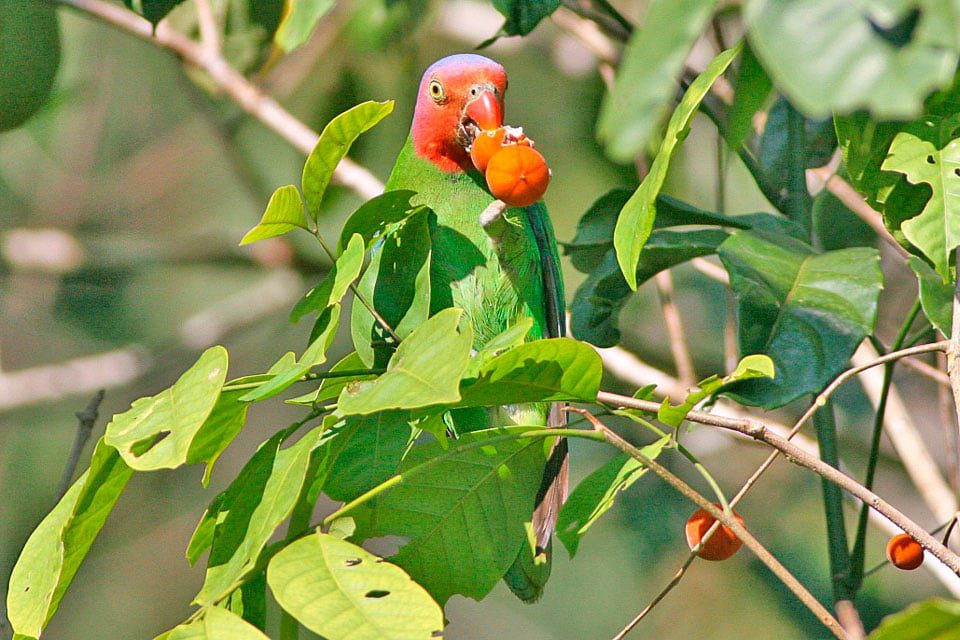
The face of the Red-checked Parrot(Geoffroyus geoffroyi) is of color rojo-rosaceo up to just above the eyes, more pink in the ear-coverts; front of the crown of color rojo-rosaceo. Half of the crown to the nape mauve-blue. Upperparts green. Wings with patch red in them Middle coverts interiors.
Flight feathers with vane Dark internal and external Green. Edge of yellow to vane internal of greater coverts and secondaries. Wing feathers and axillary, bright blue; below, the rest of the wings, blackish. The underparts green, more yellowish in them lower flanks. Upper, the feathers of the tail of color green, drenched sides of yellow; below, brighter yellowish green.
The bill red orange in upper jaw, the lower jaw in color black; irises yellow; legs grey.
Female with head Brown and upper jaw black.
Youth they have the head green, irises dark and bill pale. The male juveniles go through a plumage «female stage» before they begin to acquire masculine characters (bird takes over one year to mature). The birds young also lack of the brand red on them small coverts.
(Müller, 1841) – The darker male in general that the nominal; purple blue crown comes to the part back from the neck; neck light blue; Marron-bronce washing variable on the mantle and top of the back; Green bluish in the part superior of the chest and zone inferior of the abdomen ; brown reddish of them coats internal of the wings absent; Blue more dark in them Underwing coverts. Larger in size.
The female with the head more dark that the nominal; purple diffusion in the crown; nape blue, reaching the neck with color blue light.
Geoffroyus geoffroyi obiensis
(Finsch, 1868) – Adults as the subspecies cyanicollis but collar Blue in the part back from the neck more comprehensive, reaching almost up to the eyes; blue-purple in the male or brown in the female does not reach the lower part of the occiput; reddish brown in the bottom of the back to rear.
Geoffroyus geoffroyi rhodops
(Schlegel), 1864) – Similar to the subspecies males floresianus, but darker in general; marks of the coats internal of the wings of color brown reddish dark; crown Blue separate with red in the face; Underwing coverts Blue more dark. Larger in size.
The female with the crown castano-oscuro color.
Geoffroyus geoffroyi explorator
(Hartert, 1901) – Synonymous with Geoffroyus geoffroyi rhodops
Geoffroyus geoffroyi keyensis
(Finsch, 1868) – The male resembles the subspecies floresianus, but in general more greenish-yellow, in particular in the tail; cheeks Pink and ear-coverts washed with Blue Lilac; Yellow greenish pale in the neck through the part back from the neck and a strip Green, darker, in the early part of the neck; Underwing coverts pale blue. Larger in size.
The female chestnut brown on the head.
Geoffroyus geoffroyi floresianus
(Salvadori, 1891) – The male is like the nominal, but darker in general; the purple blue of the crown It's darker and reached to the nape; coats internal of the wings dark reddish brown; Blue more dark them Underwing coverts. Larger in size. Largest peak. Female with the crown darker brown, coming up to the nape.
(Meyer, 1884) – The subspecies resemble adults Kei, but smaller.
Geoffroyus geoffroyi pucherani
(Souancé, 1856) – Adults and juveniles with bronze-colored marking of the parts internal of the wings, minimal or absent; the mantle have less marron-bronce washing; Brown more pale in the part low of it back; the buttocks with less red; coats dark blue low the wings.
Geoffroyus geoffroyi minor
(Neumann, 1922) – Male adults are as the subspecies aruensis, but with reddish brown under the back to rear; face darker red; washing Marron-bronce in the the mantle; brands in the coats internal of the wings minimal or absent.
The female as the subspecies aruensis, but with the head of brown slightly more dark.
Geoffroyus geoffroyi jobiensis
(Meyer, 1874) – Adults and juveniles but with Underwing coverts pale blue; bright red in the lower part of the back to the rear; in males, the red in the forecrown back to the front of the crown.
Geoffroyus geoffroyi mysoriensis
(Meyer, 1874) – Males as juveniles, but with the crown blue-purple, down on the back of the neck, and red in the face, coming up to the throat; washing marron-bronce absent in the the mantle; extensive reddish brown marks in inner median coverts; Underwing coverts dark blue; dark brown in the bottom of the back to rear.
The female as juveniles, but the color brown in the crown comes to the part back from the neck.
Geoffroyus geoffroyi orientalis
(Meyer, 1891) – Hardly differs from the subspecies aruensis; Crown of the male is slightly more pale.
Geoffroyus geoffroyi sudestiensis
(Estimate, 1890) – The adult male is similar to the subspecies aruensis, but with the underparts darker; the trademark brown reddish of them coats internal, absent.
The crown and nape of the female, is dark green.
Geoffroyus geoffroyi cyanicarpus
(Hartert, 1899) – The adult male is similar to the subspecies aruensis, but with azul-lila wash in them cheeks and ear-coverts; bend of wing has edge blue.
The female is as the subspecies aruensis, but the crown and nape They are brown, with light green dye; edge blue in the part outside of the wing
as in the male.
Geoffroyus geoffroyi aruensis
(Gray, 1858) – Similar to the species males nominal, but darker purple blue from the crown up to the nape; inner coverts a reddish brown marked darker; Blue more dark in them Underwing coverts.
The female Brown darker from the crown even the nape.
Geoffroyus geoffroyi maclennani
(W. D. K. Macgillivray, 1913) – The male is similar to the subspecies aruensis, but darker in general; the Red of the face is darker and more uniform; Underwing coverts paler blue. Female similar to the female of subspecies aruensis, but darker in general; head dark brown; Underwing coverts paler blue.
* The varieties sumbavensis and tjindanae proposed as subspecies are synonymous of floresianus; rhodops stresemanni; explorator It is also synonymous of rhodops.
Habitat:
Distributed by primary and secondary forests, tree savannas, plantations, Open forests, mangrove forests and farmland, a altitude of 1.400 m. Usually replaced by the Blue-collared Parrot at higher altitudes. Exclusive tropical jungle in the North of Australia. View the birds, generally, flying high above the trees, making calls to cries.
Groups of birds in the North of Australia, many still in family units, they have been observed leaving their roosts early, to feed into the dense jungle; in their flights to areas of foraging, We have seen some of these birds perched in the upper branches of the trees, by calling aloud for a few minutes and dithered wings before continuing. The reason for this unknown behavior can be a way of requesting food due to early maturation.
During the day the birds are less visible, they can draw attention by discarded food falling from their food trees.
They are usually in couples, in small groups or assembled in groups in fruit trees.
Reproduction:
The nest It is a hole that the birds excavate in a rotten limb of a tree from the forest, sometimes also in a knot in the trunk; probably only the female excavates. The entrance to the nest is of 80 to 90 mm. wide, and the tunnel, that it can twist in order to hide the eggs, You can have a length of 42 cm.. Includes the implementation of 2 to 4 eggs. The female alone incubates and is fed by the male during this time. In the West, the breeding season It takes place between April and September at least, month in which a live nest was found in Seram.
In New Guinea, the nesting is been registered during several months more, including February in the North and between the months of April to December in other places.
In Australia, in where the season seems to extend is from August to December, little information about the cycle reproductive is available.
It is known that the species It has never been raised successfully in captivity.
Food:
The diet It includes seeds, fruits and flowers. The birds tend to hang acrobaticamente to reach their food.
Distribution:
Size of the area of distribution (reproduction / resident): 793.000 km2
Generalized from the West of Lombok, through the Moluccas, the lowlands of New Guinea, and observed in the groups of associated Islands, to the East of Rossel in the Louisiade archipelago.
The species can also be observed in the northeast of the Cape York Peninsula, Australia, at its southern end, and North ranges up to Morotai in the North of the Moluccas. In many areas, throughout its distribution area, is the most abundant Parrot (rarer over the 800 meters above sea level), even around inhabited areas. Despite this, It may be extinct in Ambon.
The size of the world population It has not been quantified, Although it is estimated above 1.000.000 of copies. The species according to sources, is of common to abundant much of its area of distribution (pit et to the. 1997).
The population suspected to be stable in the absence of evidence of any reduction or substantial threats, Although you can that its population is affected by the capture in various parts of its area of distribution.
"Red-checked Parrot" in captivity:
Very rare or impossible to see in poultry.
Passive Parrot. Extremely susceptible to stress and disease; they may die suddenly without apparent reason. Few times you live long in captivity
Alternative names:
– Red-checked Parrot, Red cheeked Parrot, Red-cheeked Parrot (ingles).
– Perruche de Geoffroy, Eclectus de Geoffroy, Éclectus de Geoffroy (francés).
– Rotkopfpapagei (alemán).
– Papagaio de bochechas vermelhas (portugués).
– Lorito Carirrojo, Lorito de Mejillas Rojas (español).
– Avibase
– Parrots of the World – Forshaw Joseph M
– Parrots A Guide to the Parrots of the World – Tony Juniper & Mike Parr
– Wikipedia
– Birdlife
– parrots.org
– Photos:
(1) – By Ron Knight (Flickr: Red-cheeked Parrot) [CC BY 2.0], via Wikimedia Commons
(2) – By Nick Athanas/Tropical Birding – Birds-pet-wallpapers
(3) – A male perched in a tree by Josep del Hoyo – Lynx
(4) – A male and a female looking for a suitable nest by mehdhalaouate – Lynx
(5) – By markharper1 [CC BY-SA 2.0], via Wikimedia Commons
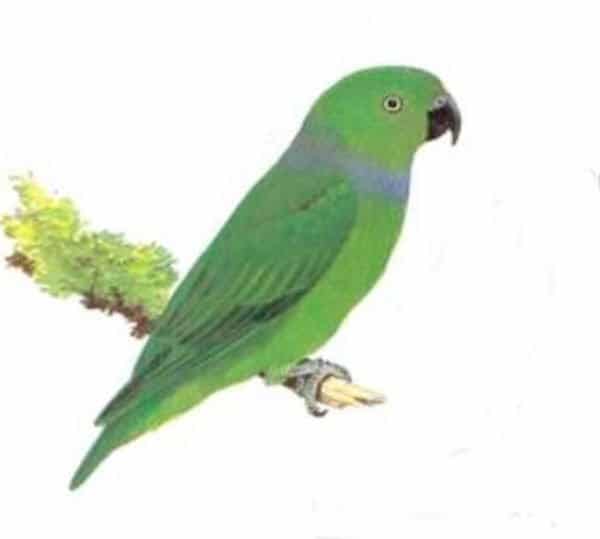
The Blue-collared Parrot(Geoffroyus simplex), they have the head green, more pale and more yellowish in the chin and lower cheeks, with a collar weak but clearly identified blue across the top of the chest and rear of the neck. The upperparts are blackish Green. Curve of the wings yellow; patch Brown in medium-sized inner cover; greater coverts with yellowish green trim; flight feather Black with green in the vane outer; pale line along the inner edge of the tips of the wings closed, formed by yellow tipping in the vane inmates of the flight feather. Underwing coverts and axillary, blue. Ventral pale, more yellowish green than the upper parts. Upper, the tail green; undertail, yellowish.
Bill greyish black; Iris White pale yellowish; legs gray-green.
The females they lack the collar Blue males but have a little blue on the back of the crown.
Geoffroyus simplex simplex (Meyer, AB, 1874): The nominal.
Geoffroyus simplex buergersi (Neumann, 1922): It measures each 25 cm in length and has purplish blue collar more extensive. Coverts of the wings with Violet Blue. Females have Violet Blue Underwing.
Habitat:
The species is distributed mainly between humid hills and medium-montane forests., along its edges and areas of secondary growth between 500 and 2.500 meters above sea level, being more frequent among the 800 and 1.900 m. Variations in food supply can lead to birds at elevations lower than normal (even at altitudes near sea level).
The Blue-collared Parrot they are shy and hard to spot when perched in trees. Large flocks of birds, of up 200 specimens, can be seen and heard flying above the treetops.
The species tends to form large groups with the Red-checked Parrot, Although sometimes single birds are, in pairs or in small groups.
Reproduction:
Little is known of the breeding ecology. A nest dug with three young was found in mid-January to nine metres in height, close to the top of a stump. The entrance was of 80 mm in diameter, and the gap between 200 mm and 400 mm deep. Nesting is also reported in October.
Food:
The Parrot Acollarado quietly feed in the canopy of seeds, fruit, berries and nectar. They are particularly fond of the seeds of (Castanopis and Oaks Lithocarpus).
Distribution:
New Guinea, Indonesian and Papua New Guinea, with an isolated population in the Doberai Peninsula, from Tamrau to Mountains Parotia. The main population is distributed through the central highlands, absent from the higher central areas, But coming to the Owen Stanley mountain range at the end of this. generally common, but the difficulty of detection makes these less abundant parecezcan birds.
Distribution of the subspecies:
Geoffroyus simplex simplex (Meyer, AB, 1874): The nominal.
Geoffroyus simplex buergersi (Neumann, 1922): Mountains of New Guinea, except Península Bird's Head.
Conservation:
• Current IUCN Red List category: Least concern.
•Population trend: Stable.
The size of the world's population has not been quantified, Although estimated at more of 50.000 specimens. The species, according to sources, is generally rather rare to fairly common (pit et to the. 1997).
The population is suspected to be stable in the absence of evidence of any reduction or substantial threats.
"Blue-collared Parrot" in captivity:
Rare.
Alternative names:
– Blue-collared Parrot, Blue collared Parrot, Lilac-Collared Parrot, Simple Parrot (ingles).
– Perruche à col bleu, Eclectus à col bleu, Éclectus à col bleu (French).
– Blauhalspapagei (German).
– Geoffroyus simplex (Portuguese).
– Lorito Acollarado, Lorito Acollorado, Lorito de Collar (español).
25 cm.. length and a weight between 160 and 195 g..
The Singing Parrot(Geoffroyus heteroclitus) they have the head bright pale yellow.
A band Large blue-gray adorns the back of neck and gradually it fades in green on the the mantle. The throat is bluish grey. All upperparts are light green. The median stained reddish brown. You can see the pale yellow stripes on the innerwebs of the flight feather. The underparts is bright blue. Upper chest is blue-gray, which contrasts with the rest of the underparts, that are of a much lighter green back. The upper part of the tail is green. The bottom of the tail is grey, but with a slight yellow color in the outerweb external feathers tail.
The upper jaw is of color yellow pale, the dark gray lower jaw. The irises are yellow, the legs gray-green.
The sexes are dimorphic. The female has a bill totally dark. Yellow beginning of the head and neck greenish blue are away. In its place, the top It is gray and cheeks They are brownish green.
Immature show greener on the head than females. Its bill is paler and its irises dark.
The Singing Parrot frequent humid lowlands, undisturbed, Hills generally below and of the 600 meters up to a maximum of 1.760 meters in the South of New Ireland . They are also partially cleared areas, at the edge of forests, in stands of trees in regeneration and in gardens.
The birds, often, they are heard when they make calls from the exposed or isolated trees, or view flying rapidly above the canopy.
They are alone, in pairs, or having relationships in small groups. There have been next to the Cardinal Lory and Duchess Lorikeet in Bougainville. They are often calm and difficult to detect when they remain perched among the dense foliage.
Reproduction:
The nest is a hole dug by the female in a dead tree stump or rotten, but nothing more is known about the breeding ecology of the species.
Food:
The diet It includes seeds, fruit, flowers and buds.
Distribution:
Size of the area of distribution (reproduction / resident): 576.000 km2
The Singing Parrot They are endemic Bismarck Archipelago and Solomon Islands. These birds are found in the following Islands: Umboi, New Britain, Lolobau, Duke of York, New Ireland, New Hanover, Tabar, Lihir, Buka, Bougainville (Papua New Guinea). It can also be seen in Choiseul, Santa Isabel, San Jorge, Malaita, New Georgia, Guadalcanal and all the little Islands Rennell (Solomon Islands).