Content |
|---|
Description:
28-31 cm. length and 120-140 weight g
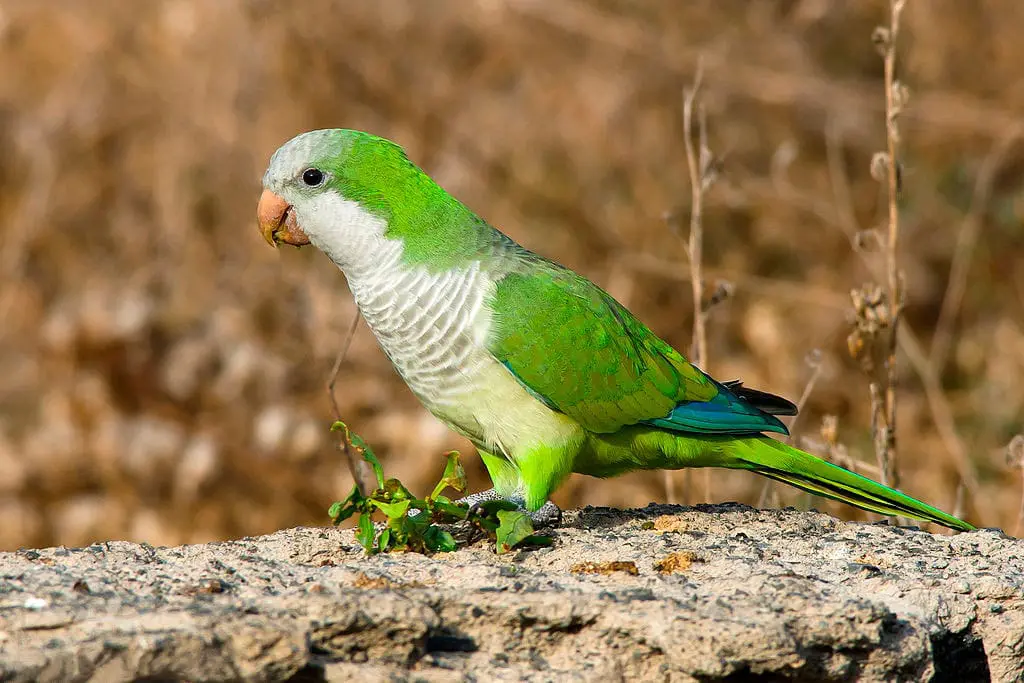
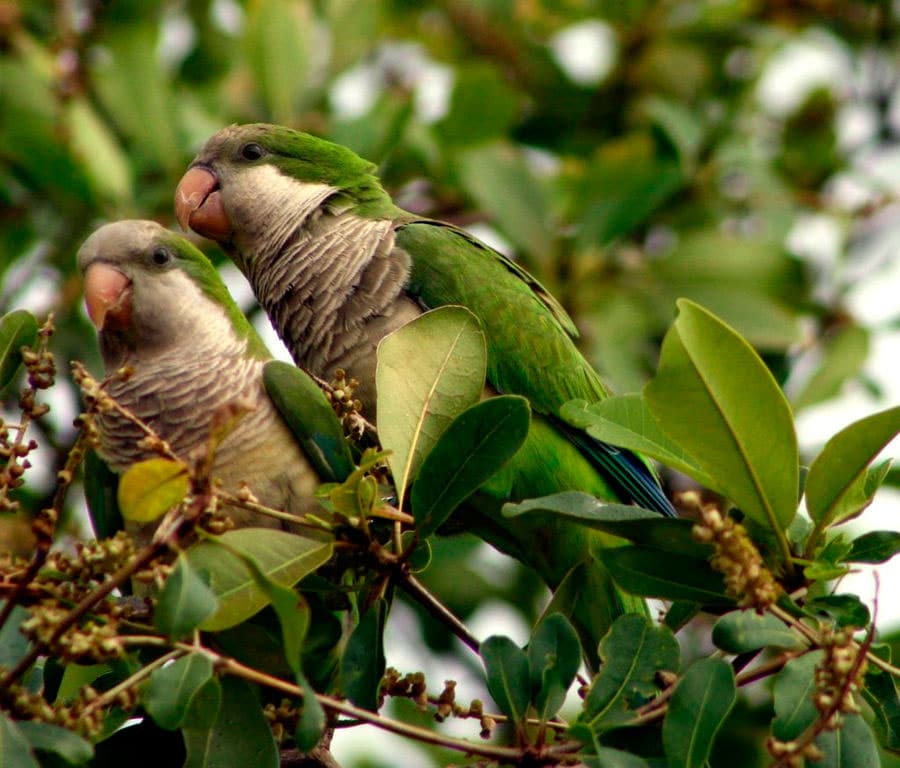
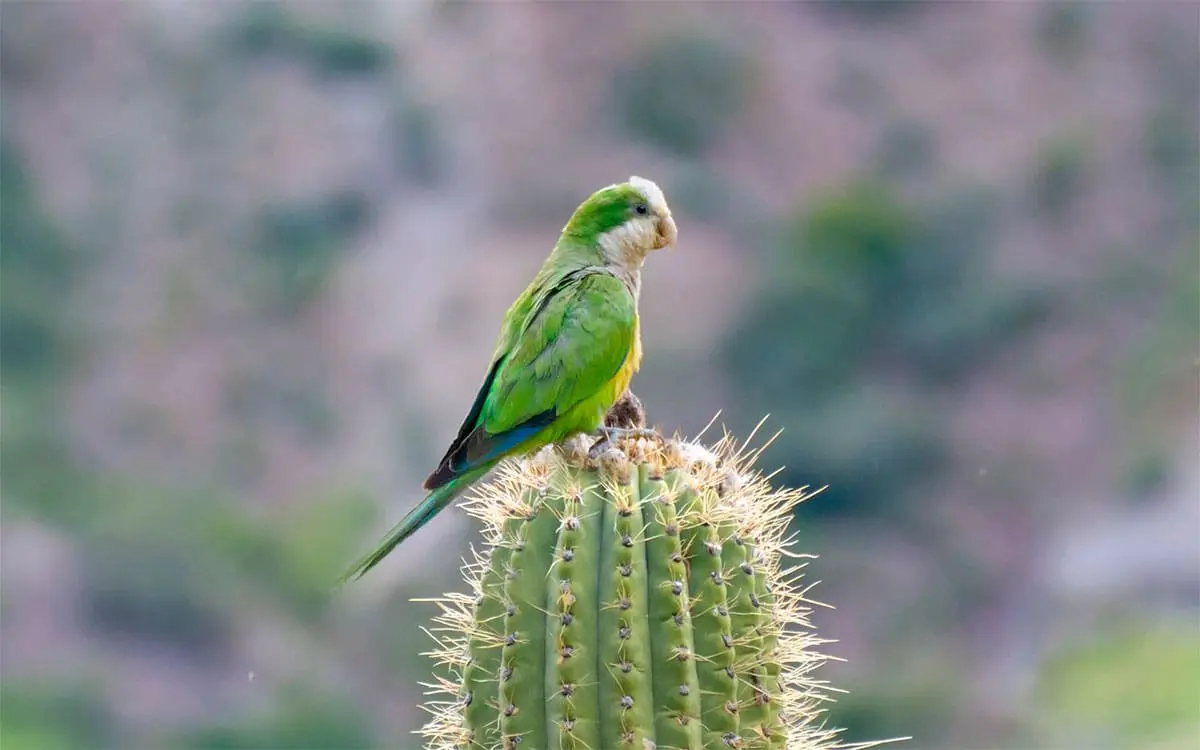
The Monk Parakeet (Myiopsitta monachus) has the forecrown (up to the half of the crown), the lores and cheeks, pale ash gray; the rear of the crown and nape, grass-green, fading to green, slightly more off, in the the mantle, the back and scapulars; rump green. Primary coverts, blue; other coverts, green.
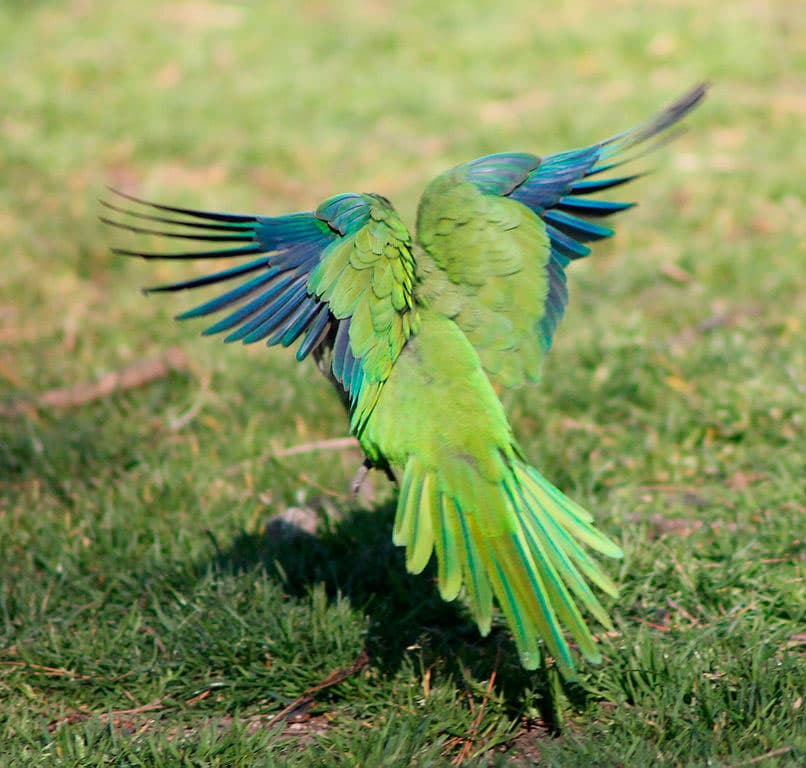
Flight feathers Blue by up. Under the wings has the lesser coverts green, the coverts more large and innerwebs of the the flight feathers, blue. Throat and upper area of the chest, ash gray, with pale edges to the feathers, giving a beaming effect; lower area of the chest, pale yellow; Abdomen, the thighs and vent, pale green.
Upper, the tail is green with blue in the Center; below, pale bluish-green.
Bill color horn; Brown of the irises; legs grey.
Both sexes are similar.
Immature has the front green-tinted.
- Sound of the Monk Parakeet.
Subspecies description:
-
Myiopsitta monachus calita
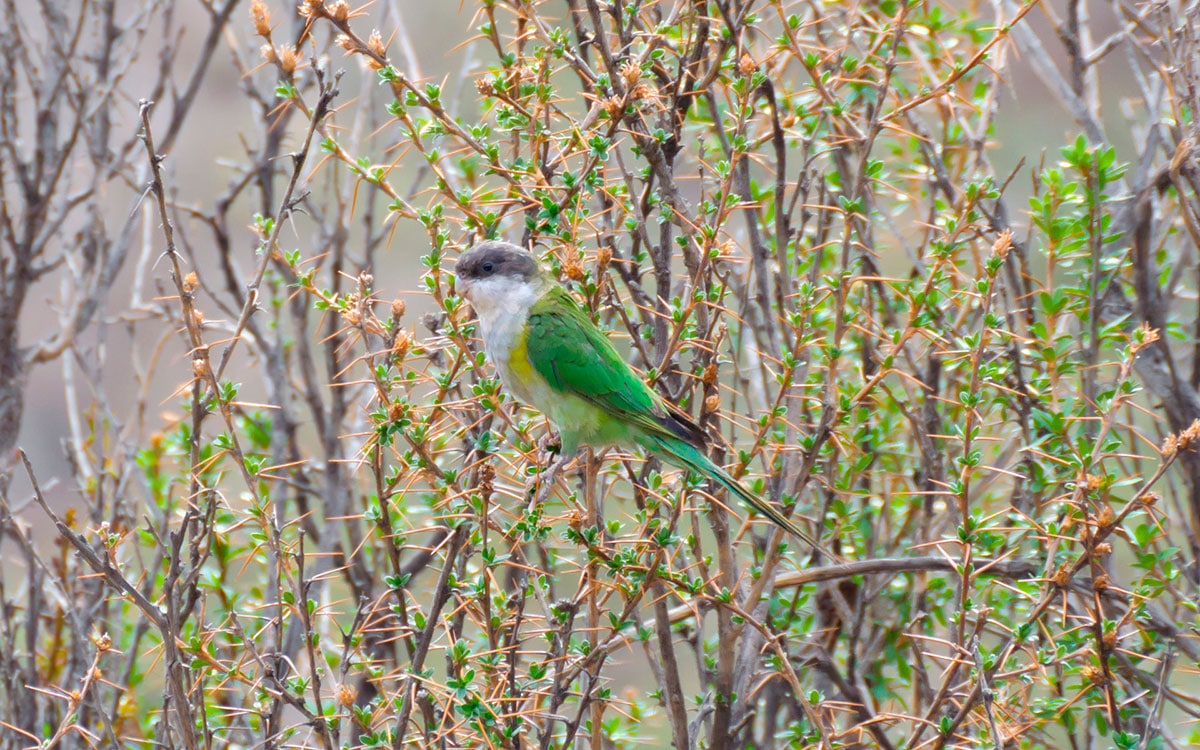
(Jardine & Selby, 1830) – Less of the nominal species (27cm.) with wings more blue and head dark gray.
-
Myiopsitta monachus cotorra
(Vieillot, 1818) – Very similar to the subspecies Myiopsitta monachus calita, but supposedly more bright, belly least yellow.
-
Myiopsitta monachus monachus
(Boddaert, 1783) – Nominal.
Habitat:
Video – "Monk Parakeet" (Myiopsitta monachus) |
|---|
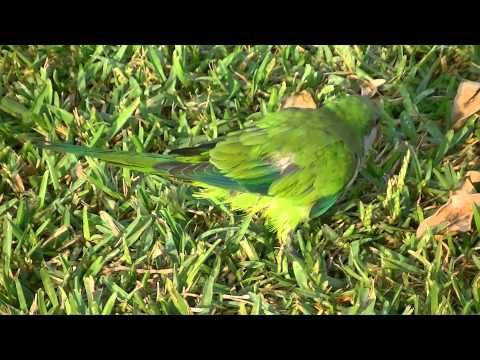
The Monk Parakeet is, mainly, in dry wooded areas or fields open with trees, such as gallery forest, isolated thickets, palm groves, forests, linens and areas with thorny thickets with Cactus, also in land cultivation and in urban areas with trees, mainly below 1.000 m.
They tend to be observed in pairs or flocks of 30-50 individuals; with much larger gatherings out of breeding season. Rest communally, Sometimes the nests, While you are not playing.
Note:
-
There are reports of transmission lines damaged by birds while nesting. In general, in the area in which have been introduced these birds, the impacts are associated mainly to the behaviors of nesting. This species of birds build large, bulky nests in communications and transmission towers, and distribution poles. In the towers of transmission represent simply a problem of maintenance and does not affect the communications, but in electrical installations can cause blackouts and fires since the nests can create electrical circuits. This problem is intensified in the rainy season and humid climates.. The nests of these birds can cause significant damage to the facilities power including a decrease in electrical reliability, damage to equipment and loss in income due to power outages caused by nests, an increase in maintenance and operating costs associated with removing nests and repairing damaged structures as well as public safety issues (ISC 2011).
Source: Naturalist
Reproduction:
It's the only one, between the parrots, It builds, usually, his nest with twigs (commonly from Celtis shrubs) in branches of tree (sometimes in telephone poles, etc.). Sometimes build nests alone (especially in those areas more dry), Although they are usually communal (until 100 nests, usually around 10) combined to form large structures cluttered of several meters of width, with inputs from the side or by under. Each nest It is built with remains of chewed branches. The nests are sometimes used by them Spot-winged Falconet (Spiziapteryx circumcincta) and other birds, to nest and rest. One nest can get to to weigh 50 kilos and be formed by more than 20.000 remained.
The breeding season, in your area natural's distribution, is between October-December. The clutch generally 4-6 eggs, Although according to some sources, the laying You can understand between 1-11 eggs.
Food:
Its diet includes a wide range of seeds wild and cultivated, wild fruits, as well as various plant material including grass seeds and grains, stems of cactus, estate vegetables and fruits cultivated, sometimes also insects and their larvae. Feeds, both in trees as in the soil, sometimes with other species including pigeons and birds of the genus Molothrus.
Distribution:
Size of the area of distribution (reproduction / resident): 2720000 km2
The Monk Parakeet lives in the lowlands of the South of South America, to the East of the Andes front Bolivia to Rawson Department (Chubut) in Argentina.
Observed in the East and North of Bolivia in the southeast of Peace, to the south, in Cochabamba, West of Santa Cruz, North of Chuquisaca and possibly in other areas (for example, Tarija), Paraguay and South of Brazil, in the South and West of Mato Grosso, Mato Grosso from the South and two-thirds of the southwest of Rio Grande do Sul, in all the Uruguay and in the Argentina, to the South of Rio Negro and probably to the North of Chubut.
Usually common and abundant in Uruguay and Rio Grande do Sul (although it does not play there). It is the most common parrot in much of its range and largely local expansion is due to the plantations of Euralyptus in areas without trees, partial deforestation in other areas, the Elimination of predators and the expansion of crops.
Pursued in several areas, Although the overall effect on its population is apparently slight.
Wild populations established in many towns outside of the range, including Puerto Rico, Florida, New York City (where there are fears it could become a major agricultural pest) and several cities more than them EE.UU. There have also been populations of the Monk Parakeet in Rio de Janeiro (Brazil), berlin (Germany), Austria, Belgium, Italy, Spain (including the Islas Canarias) and several places over the Mediterranean.
Is a trade in these birds, both local, as international, with large numbers of this species in captivity.
Subspecies distribution:
-
Myiopsitta monachus calita
(Jardine & Selby, 1830) – Santa Cruz and Tarija, Bolivia, Paraguay in where the range not is clear, and Argentina from the center of Formosa, Salta and Jujuy, to the south, until Black river and possibly Chubut.
-
Myiopsitta monachus cotorra
(Vieillot, 1818) – South of Brazil, in West Mato Grosso and Mato Grosso from the South and probably Rio Grande do Sul, Argentina, in the East of Formosa, Chaco, North of Santa Fe, Currents and Missions, the Chaco Bolivian and Paraguayan and southward along the Paraguay River and Paraná. Distribution in Bolivia and Paraguay with regard to the reported distribution of subspecies Myiopsitta monachus calita, unclear
-
Myiopsitta monachus monachus
(Boddaert, 1783) – Nominal.
Conservation:
State of conservation ⓘ |
||
|---|---|---|
 Minor Concern ⓘ
(UICN)ⓘ
Minor Concern ⓘ
(UICN)ⓘ
| ||
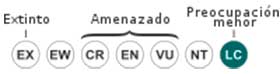
• Current category of the Red List of the UICN: Least concern.
• Population trend: Increasing.
Justification of the population
Global population size has not been quantified, but this species is described as «common» (Stotz et to the., 1996) and ‘common to abundant‘ (pit et to the., 1997).
Justification of trend
The population is suspected to have increased as a consequence of the creation of new areas of habitat suitable (pit et to the., 1997).
Threats
The species has been marketed strongly: from 1981, When is included in the Appendix II of the CITES, they have been 710.686 individuals captured in the Middle wild for the Commerce International (database CITES from the UNEP-WCMC, January 2005).
"Monk Parakeet" in captivity:
Renowned for her beauty and intelligence, the Monk Parakeet is a pet people, especially in North America, since the 1960's (ISC, 2011). Can learn to imitate great amount of words, but at the same time are very bustling, demanding of attention and affection, with much character, and very territorial, by what not is rare that attack to their own owners when the manipulated or manipulate your cage. In captivity is reproduced with ease, but to the have many colonies in State Wildlife, not be usually stimulate its reproduction in captivity.
Its life expectancy It 3-10 years in freedom and 25 to 35 years in captivity (Álvarez-Romero et al., 2008).
Before trying to acquire one of these birds as a pet, you should know that in many countries its sale is prohibited as it is classified as species invasive.
MINISTRY OF AGRICULTURE, FOOD AND ENVIRONMENT
Royal Decree 630/2013, of 2 of August, which regulates the Spanish catalog of invasive alien species.
Invasive exotic species: exotic species that is introduced or set to an ecosystem or natural or semi-natural habitat, and is an agent of change and threat to native biodiversity, due to its invasive behaviour, or because of the risk of genetic contamination.
Article 7. Effects of the inclusion of a species in the catalogue.
- The inclusion of a species in the catalogue, According to the article 61.3 of the law 42/2007, of 13 of December, entails the prohibition generic in its possession, transport, traffic and trade of exemplary living or dead, of their remains or propagules, including the trade exterior. This prohibition is limited to the scope of application specified for each species in the annex.
Alternative names:
– Monk Parakeet, Monk Parakeet (Monk), South American monk parakeet (English).
– Perriche veuve, Conure veuve (French).
– Mönchsittich, Mönchssittich, Südamerikanischer Mönchsittich (German).
– catorra, catorrita, Caturrita, papo-branco, periquito-do-Pantanal (Portuguese).
– Cata Aliazul, Cotorra, Cotorra Argentina, Cotorra Común, Cotorrita, Perico Monje (español).
– Cotorra (Argentina).
– Cotorra argentina (Chile).
– Cotorrita (Paraguay).
– Cotorra, Cotorra Común (Uruguay).
– Periquito (Venezuela).
scientific classification:
– Order: Psittaciformes
– Family: Psittacidae
– Genus: Myiopsitta
– Scientific name: Myiopsitta monachus
– Citation: (Boddaert, 1783)
– Protonimo: Psittacus monachus
Monk Parakeet images:




-
Sources:
– Avibase
– Parrots of the World – Forshaw Joseph M
– Parrots A Guide to the Parrots of the World – Tony Juniper & Mike Parr
– Birdlife
– Wikipedia
– Photos:
(1) – A Monk Parakeet (also known as the Quaker Parrot) on Gran Canaria, Canary Islands, By Juan Emilio Spain from Las Palmas, Spain [CC BY-SA 2.0], via Wikimedia Commons
(2) – An argentina Parrot (Myiopsitta monachus) in Madrid (Spain) by Luis García [GFDL or CC BY-SA 3.0 It], via Wikimedia Commons
(3) – An argentina Parrot (Myiopsitta monachus) en el Parque del Retiro de Madrid (Spain) by Luis García [GFDL or CC BY-SA 3.0 It], via Wikimedia Commons
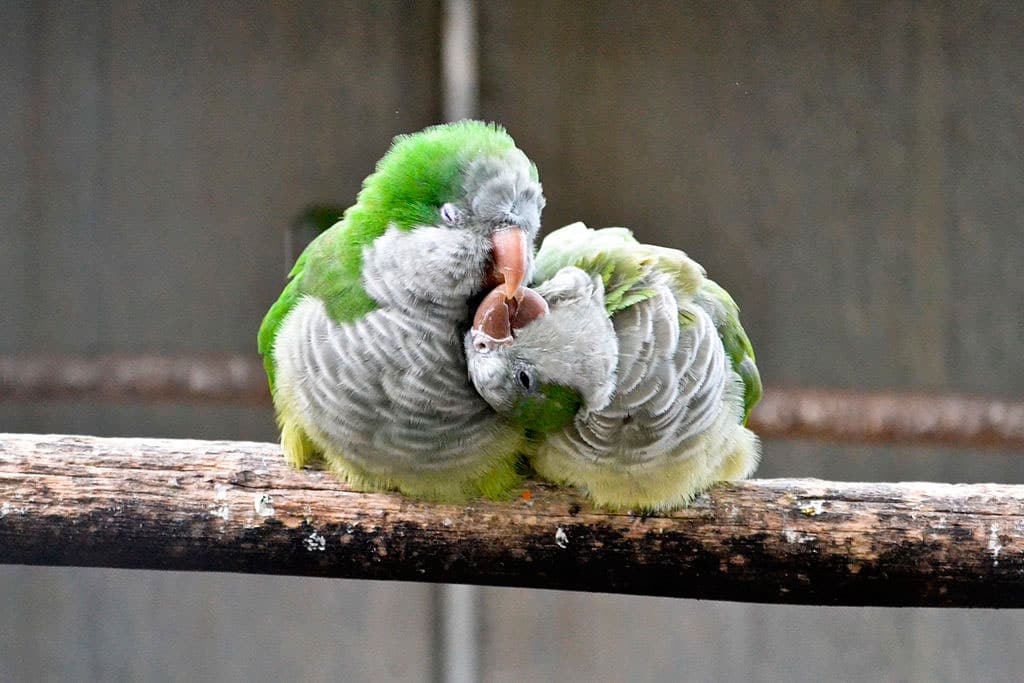
(4) – Two Monk Parakeets (also known as the Quaker Parrot) in Funchal, Madeira. It looks like the bird with its beak facing upwards is trying to obtain food from the other parrot By straman from Brussels, Belgium [CC BY 2.0], via Wikimedia Commons
(5) – A Monk Parakeet (also known as the Quaker Parrot) in Punta del Diablo, Rocha, Uruguay By Cláudio Dias Timm from Rio Grande do Sul [CC BY-SA 2.0], via Wikimedia Commons
(6) – Monk Parakeet (Myiopsitta monachus) Old San Juan, Puerto Rico Ujorge at English Wikipedia [CC BY-SA 3.0], via Wikimedia Commons
(7) – Photography taken in Uruguay By Dario Niz (http://avesdeuruguay.blogspot.com/) [CC BY 3.0], via Wikimedia Commons
(8) – Monk Parakeets (also known as the Quaker Parrot) in Boynton Beach, Florida, USA By Maureen Leong-Kee [CC BY-SA 2.0], via Wikimedia Commons
(9) – Monk Parakeet (also known as the Quaker Parrot) nest colony By Eduardo Merille [CC BY-SA 2.0], via Wikimedia Commons
– Sounds: Fernando Igor de Godoy (Xeno-canto)




_15.jpg)
_21.jpg)


