
Its Visual field range It is broader than that of humans but sees less details, Therefore, towards what is the background of the vision image, the dog is "myopic" since it distinguishes very blurry details because they see in gradations of gray and certain ranges of colors but these gradations become indistinguishable at a certain distance..
This type of vision and the increased importance of the other senses in the dog because his predecessors were crepuscular hunters and in light conditions the sight was inefficient, therefore they had to be guided more by smell and hearing. From this it is concluded that the canine visual system is designed to be efficient under low light conditions in contrast to the human that was designed to work in broad daylight.
The canine visual system is perfectly capable of working adapting to a wide range of light conditions., its visual in conditions of low light ability helps him as a predator, since if he could not see very well in twilight conditions he would not be able to hunt his prey, the amount of light a dog needs to see is far less than a human needs.
The retina of the canine eye is mainly composed of foothoreceptors in the form of canes, These photoreceptors work very well in low light conditions, They also have a limited amount of photoreceptors in cone-shaped working in good lighting conditions. These cones are responsible for in human color vision because the human eye contains large amount of cones and fewer sticks, exactly to the setback that in dogs therefore the vision of these is not in colors completely.
The night vision or twilight of the dogs is also helped by the use of the lucidum tapetum that resembles a reflective screen located behind the photoreceptors, This membrane is what makes shine the eyes of dogs when light reaches them in the dark, this membrane acts as a kind of light amplifier and makes the photoreceptors work as if there were a greater amount of light. This membrane is located in the upper half of the retina, the lower part is called tepetum nigrum and is composed of dark pigments not refractory, These two parts are the dog to have good vision in conditions of low light or with a very bright sky or light conditions which reflect very clearly (Sea, desert, etc).In Rod photoreceptors are responsible for the detection of movement and the shadows which is more difficult to do in cone photoreceptors.
The Dog vision Therefore it is very well prepared to detect movements at distances higher than 850 m, But if the same object is still only can differentiate it into one smaller distance range (less than the 550 m).
The visual field of dogs varies to some degree depending on the breed due to the particular shape of the skull., position of the eyes and shape and position of the nose.
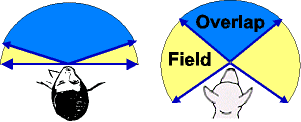
The campo visual A dog average is among the 240 – 250 degrees, much larger than the human that is only 180 degrees. Is this difference in the visual field dogs detected movements to its around us still by his side can not perceive, This visual field is wider than sideways in the dog but turn the dog sees far less detail than the human.The depth of the visual field, as already said, It is directly related to the cranial structure, therefore it differs according to the race and the type of skull.
The average depth of the visual field In dogs it goes from 30 to the 60 degrees, much smaller than the human that is in 140 degrees through its binocular vision.This shallow in the visual field of the dog makes you cannot very well measured distances far away and allows you to distinguish detail at certain distances, nor are they working in the accommodation of the visual and just focus can carry it out with placed objects between the 50 and 33 cm., In contrast to the children that can do you with placed objects to 7 cm., dogs compensate for this lack using his other senses such as smell and taste, as humans age dogs begin to have disorders in visual accommodation.
The vision or not in colors of dogs there are studies to the contrary and to favour, the most modern and scientifically controlled indicate that dogs have a type of color vision, but not in the same grades than humans.
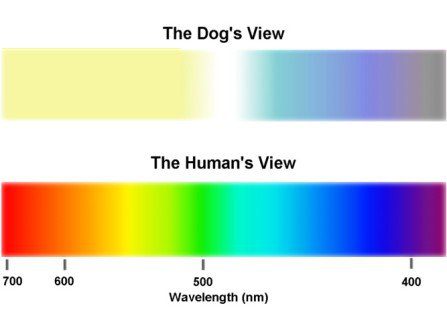
The photoreceptor used in color vision is the cone and cone in the retinas of the dogs have been found. These cones are present but in much fewer numbers and represent slightly less than the 10% of the total of the photoreceptors of the dog.
Apparently there are two types of Cones in the canine retina: one of them see in shades of purple and the other type does see yellow greenish shades. Due to this, it could be said that the visual spectrum of dogs is divided into two tonalities., in the purple range- purplish blue (probably more bluish) and the other yellow-green yellow and Red (probably be seen as yellowish).
The greenish-blue tones are probably seen by dogs as grey shades. The dogs are unable to distinguish colors that we appear as green, yellow-green, Orange or red and are also unable to differentiate between the blue-green gray. But dogs are much better able to differentiate between the different shades of grey that people which is a great advantage to be able to see and discriminate objects with low light.
All preceding may indicate us that the visual system of the canines is worse than the human but this occurs only in some aspects, in others, such as seen in bright or low-light conditions (Sea, desert, snow) differentiation of gray and their depths, etc. the canine system is much more efficient than the human. These differences must be in a 90% to each visual system is made to measure for each species natural and primitive living conditions.
Source:»Vision in dogs», Paul E. Miller, DVM and Christopher J. Murphy, DVM.