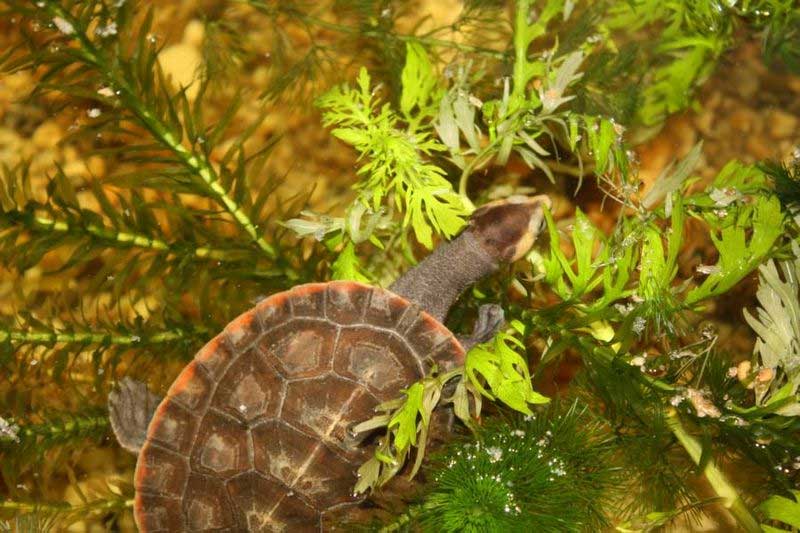
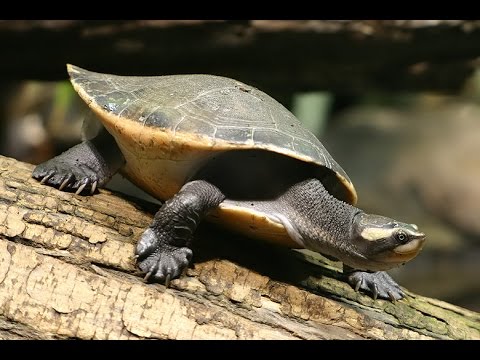
โ–ท The world of Pets: Dogs, cats, birds, reptiles, amphibians

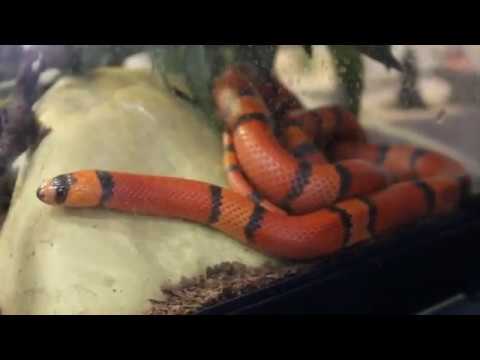
Honduran milk snake
- Lampropeltis triangulum hondurensis

The name of Honduran milk snake has its origin in the erroneous belief that they drank milk from the udders of cows, because they were often seen in barns and stables.
Honduran milk snake
Lampropeltis triangulum hondurensis at the Louisville Zoo – Ltshears, CC BY-SA 4.0, via Wikimedia Commons

Content

Origin / Distribution

naturally, the Honduran milk snake (Lampropeltis triangulum hondurensis) found in the tropical rainforests of northeastern Costa Rica, in almost all of Honduras -area from which this snake receives its common name- and in Nicaragua.

Characteristics / Appearance

The Honduran milk snake It is one of the largest species of Lampropeltis and is second only to the large Lampropeltis triangulum gaigeae. They have a calm character and, Like most species of Lampropeltis, a strong feeding response. This, combined with the many mutations that exist today, makes them a fan favorite milk snakes.

On average, the Honduran milk snake In captivity it reaches a length of 130 cm.. But, there are many cases in captivity in which the snakes reach a length of 150 to 160 cm.. Young animals already measure between 25 and 32 cm when hatched.

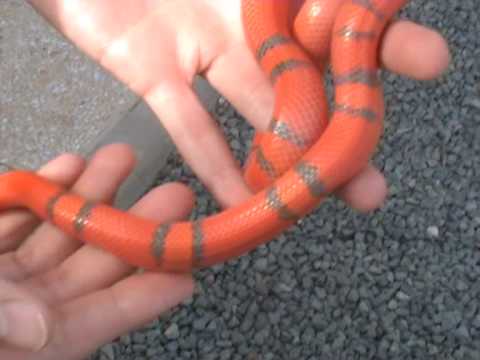
The head is wide and slightly separated from the neck.. Two natural variants are known, the well-known "tricolor", with the classic red-black-white-black band ring, and the "bicolor", also called "tangerine", in which the normally white band is orange to red. At the end of each scale there is a small black dot. Melanin level increases as snakes mature. Sometimes makes them almost black with faint pattern.

If you want an adult with the appearance of a Lampropeltis t. hondurensis new born, it is an option to buy one of the โ€œhypomelanisticโ€ variants. These have a reduced melanin content and thus retain their more youthful appearance.

Habitat

They are true bottom dwellers and live naturally among the fallen leaves and branches on the jungle floor.. Temperatures here are moderate and there is little difference between day and night temperatures, humidity is relatively high. Keep this in mind when preparing an enclosure for these snakes..

Behavior
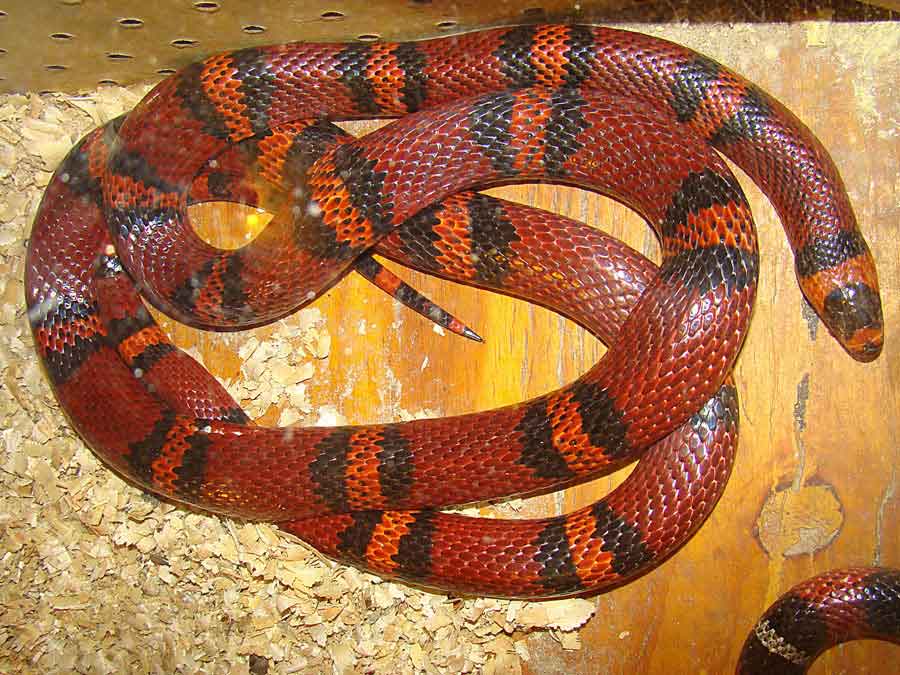
Honduran milk snake
Honduran milk snake in the Serpentarium of Mendoza, Argentina – Dick Culbert, CC BY 2.0, via Wikimedia Commons

They like to hide among the vegetation cover of the forest, between fallen branches, leaves and stems. In the past, the Honduran milk snake wild-caught could be very shy and would hide when disturbed. Most of the time they tried to get away, but could bite when improperly fixed or handled. Today, virtually all of the Honduran milk snakes that are kept come from the offspring of many generations of animals kept in captivity and this has resulted in active snakes, curious and calm. This species is most active during dusk and night.

Diet

Small mammals like voles, mice and rats, birds, eggs and other reptiles (ofiofagia) including snakes (even poisonous ones) and lizards.

Reproduction

  • Oviparous, lays eggs
  • As in most snakes, sexual maturity is usually reached by size, more than age. But, Honduran women are usually mature at the age of 18 months. Most mating occurs in May. Females appear to gather at communal egg-laying sites in early June.. It is not known why they do it. It is suspected that it may be due to the lack of suitable places to nest., more than for social reasons.
  • The female lays between 3 and 18 leathery shell eggs under rocks, on decaying plants or rotting logs, compost and manure piles, under boards and on loose earth. The incubation period is 10 weeks. The young are large and robust and should start eating after their first moult., that occurs at 5-10 days out of the egg.
  • Like many reptiles, the incubation temperature of their eggs determines the sex of the hatchlings (hotter = males; cooler = females).

  • Threats to the species

  • use and trade: suffers from collection for the pet trade
  • Threats: The two biggest causes of their population decline are likely mortality on the roads and deliberate killing by humans who believe they are dangerous.. Habitat loss will also end up affecting their numbers.
  • predators: Birds of prey, wild felids, humans (mimics the brightly colored banding of local poisonous coral snakes and so protects itself from predators).
  • many other important predators, like birds of prey, they feed on young snakes. This means that snakes serve both predator and prey roles in regional food chains.. Milk snakes are also valuable for their role in curbing rodent populations, especially those near human settlements.

  • The "Honduran milk snake" in captivity

    The Honduran milk snake is well adapted to captivity due to its relative ease of care and docile nature, and its moderate size and bright colors make it an impressive and attractive pet.

    The terrarium

    Like many species of Lampropeltis, the Honduran milk snake can be cannibal, so it is advisable to always have them separated outside the breeding season. Young animals can be raised in a small tub or faunabox as the Faunarium PT2310 from Exo-Terra. For adult animals, a minimum area of 100 x 50 cm.. Large individuals deserve a terrarium with a bottom surface of 120 x 50 cm or greater.

    Substrate

    Offer them a substrate in which they can dig, like a poplar bed or a coconut based soil, such as coco peat or Exo-Terra planting soil. The average humidity should be between 60 and the 70%. High humidity does not mean a wet substrate. Coco peat will retain moisture better and help maintain a higher humidity level, while the Aspen will have less effect in this regard. But, it is easier to see the dirt on the aspen bed and remove it when it stains. You can also choose to keep the ground cover slightly drier and offer a stash box filled with moist moss. This moist shelter will be used especially when in the shed or for laying eggs.

    Temperature

    Heating can be done with a heating cable or heating tape. Since these snakes do not bask in the sun, you don't need a place to sunbathe. This heat source should not exceed a third of the ground floor so that the snake always has space to move away from the heat source and to thermoregulate between the warmest and coldest areas..

    The average temperature should be 24-25C in the cold zone and 28C in the warm zone., with a hot spot of 30C. At night, the temperature may drop slightly, but preferably not below 20C. Always take a good look at your snakes and monitor their behavior. If your Honduran is continually on the cold side or lies in the water bowl, may be an indication that it is too hot in the warm zone.

    Provide plenty of hiding places in various temperature zones in the terrarium. As these snakes are mainly land animals, the height of the container plays a small role. That makes this species very suitable for housing in the so-called "shelf system". Of course, It is always best to observe your snake's natural behavior in a well decorated terrarium and with a snake rack you lose a lot of the fun in keeping these animals.

    Hibernation

    The Honduran milk snake naturally withstands a period of lower temperatures. This colder season starts in October, when you stop feeding for three weeks under normal conditions. Temperatures drop during the following month to about 10 at 15C and lighting hours are reduced during this month of 12 hours to 8 hours. This break lasts an average of 8 to 12 weeks. After this period, the temperature can be raised again to its previous level.. The breeding season begins after this period, so make sure Lampropeltis are well fed before placing animals together for breeding.

    Diet

    By nature these snakes have a very varied diet consisting of small mammals but also a variety of lizards and snakes.. Young animals also sometimes feed on small amphibians. In captivity, this species feeds very well on small mammals such as mice and young rats.. Do not feed these snakes with a single large prey, but with several small or medium-sized prey per feeding that are no wider than the 110% from the thickest part of the snake.

    Young animals can be fed once every 4 or 5 days during the first year of his life. Do not offer any food during the moulting period. The Lampropeltis subadults and adults may feed once every 7 or 10 days. Due to the large size of the young when they hatch, this species is, with much, one of the easiest to get started with mice of all Lampropeltis. Sometimes one immediately starts feeding little fuzzies instead of little mouse pinkies.

    Curiosities

    The milk snakes they got their name from the ancient belief that they drank cow's milk. People actually believed this because milk snakes were frequently found in barns full of dairy cows., where they were probably attracted by rodents that lived inside.

    Buy one "Honduran milk snake"

    The price of a "Honduran milk snake" at the exotic animal market , ranges between 100 – 150 EUR.

    Videos "Honduran milk snake"

    Nelson's milksnake: Lampropeltis triangulum hondurensis

    lampropeltis hondurensis triangle(extreme hipo tangerine)

    Alternative names:

    1. Honduran milk snake (English).
    2. Serpent de lait du Honduras (French).
    3. Honduras Kรถnigsnatter (German).
    4. Cobra leiteira hondurenha (Portuguese).
    5. "Serpiente de leche hondureรฑa" (espaรฑol).

    โ–ท The world of Pets: Dogs, cats, birds, reptiles, amphibians

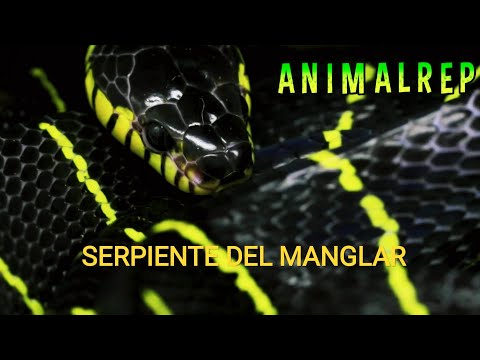
    Gold-ringed cat snake – Mangrove snake
    - Boiga dendrophila

    The toxin of the Mangrove snake, call denmotoxina, it is especially useful for hunting its main prey, birds.
    Gold-ringed cat snake
    Gold-ringed cat snake – Cymothoa, CC BY-SA 3.0, via Wikimedia Commons

    Content

    Origin / Distribution

    The Gold-ringed cat snake – Mangrove snake (Boiga dendrophila) It is widely distributed in Southeast Asia., including Indonesian, Malaysia, Thailand, Singapore, Viet Nam, Cambodia and the Philippines. is native, but not common, in singapore. A population of mangrove snakes was also accidentally introduced to Texas.

    Taxonomists currently recognize nine subspecies of mangrove snake. But, it is still debated whether some of them are distinct species, or if there are more subspecies to be determined. The nine recognized subspecies occupy different parts of the snake's range and exhibit slight color variations..

    Subspecies

    • Boiga dendrophila occidentalis – Indonesian (BABi, Batu Archipelago, Girls, Sumatra)
    • Boiga dendrophilaannectens – Indonesian (Kalimantan); Brunei; Malaysia (East Malaysia).
    • Boiga dendrophila dendrophila – Indonesian (Java).
    • Boiga dendrophila divergens – Philippines (Luzon, Polillo)
    • Boiga dendrophila gemmicincta – Indonesian (Celebes).
    • Boiga dendrophila latifasciata – Philippines (Mindanao)
    • Boiga dendrophila levitoni – Surigao del Sur (and others from the Visayas)
    • Boiga dendrophila melanota: Thailand, Malaysia, Singapore, Indonesian (Sumatra)
    • Boiga dendrophila multicincta: Philippines (Balabac, Palawan)

    Characteristics / Appearance

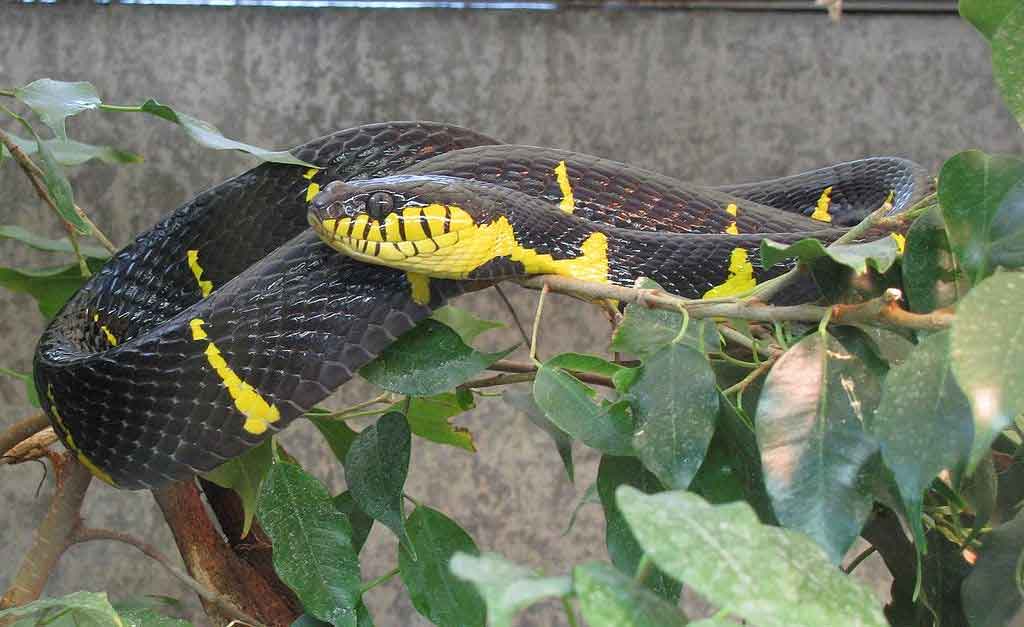
    This slender snake is primarily black with yellow scales around the face and bands around the body.. The yellow bands do not usually meet on the back or under the belly. the eyes of the Mangrove snake they are big, with narrow, vertical slits, which has earned it another common name: yellow ringed cat snake. The structure of the eyes allows you to see better at night, when active and hunting.

    The Mangrove snake it is slightly venomous with rear fangs. Like other members of the family of colubrids, has a Duvernoy's gland, which is distinct from the venom gland and is composed of cells that produce saliva. Duvernoy's gland is located at the posterior end of the eye with a duct that connects to the rear fangs., which are enlarged and have grooves through which the poison flows. This is a common adaptation of snakes with rear fangs. The fangs are angled backwards to aid in biting and holding onto prey., although sometimes it is necessary to chew the prey so that the poison is injected correctly.

    The toxin of the Mangrove snake, call denmotoxina, it is especially useful for hunting its main prey, birds. In a study published in 2006 in the Journal of Biological Chemistry, scientists found that the muscles of mice were not as susceptible to the Mangrove Snake's immobilizing venom as the muscles of birds. Snake venom is not lethal to humans, but can cause painful swelling and skin discoloration.

    Although intoxication in humans is mild, visually, due to the alternating black and yellow transverse bands and the triangular cross section of the body, the Gold-ringed cat snake – Mangrove snake can be confused with the Banded krait (Bungarus fasciatus), which is extremely poisonous.

    Habitat

    The Mangrove snake gets its name from the areas it inhabits: forests of mangrove, river areas and lowland forests. They spend most of their time basking in the sun on tree branches. 30 meters or more, but they descend to the forest floor at night to hunt.

    Food

    These snakes hunt a wide variety of prey., like other snakes, lizards and frogs. Most often they seek out small mammals, like bats and birds (and her eggs).

    Reproduction

    The Mangrove snake lays its eggs in tree holes. Their clutch size is an average of 10 eggs, but it ranges between four and 15. After a gestation period of about 45 days, the pups are born. The pups measure about 20 centimeters long and have a color similar to that of adults.

    Behavior

    Mainly occurs in mangrove or river habitats. During the day it remains motionless on the overhanging branches, but at night it becomes active, approaching the ground and feeding on other vertebrates, as rodents, small birds and their eggs, frogs, bats and, sometimes, other snakes. She is also an expert swimmer.

    It is a venomous species with rear fangs. Although during the day it can seem quite tame, don't get too close, as some individuals may have an unpredictable temperament.

    Threats to the species

    The population and trade study together with the education and information campaign, and habitat protection and restoration could help conserve populations of these mangrove snakes

    The "Gold-ringed cat snake – Mangrove snake" in captivity

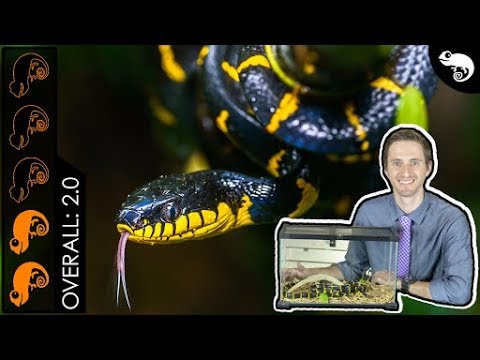
    Mangrove snake, best pet snake?

    Mangrove Snake, The Best Pet Snake?

    The Gold-ringed cat snake it is a potentially aggressive snake, mostly nocturnal. Even captive-bred specimens can be nervous and can strike repeatedly. Although many specimens calm down and allow manipulation, they are usually easily stressed and may refuse food for long periods of time if disturbed. The manipulation, of course, must involve safety precautions for the handler, due to the nervous nature of the snake and the fact that a bite can cause pain and injury.

    The most important thing when acclimating wild-caught animals is peace and quiet, preferably kept alone in a relatively small, dark terrarium.

    The terrarium

    Depending on the size of the adults, the measures of the terrarium can oscillate between 80 x 60 x 80 cm and 120 x 70 x 100 cm.. the climbing branches, best planted in abundance and providing hiding places, relax the animals. spray liberally, animals prefer to drink the spray water. Daytime temperature 27-29 ยฐC, nocturnal 23-25 ยฐC, humidity 60-90 %. Fluorescent tubes, wall or ceiling heating, substrate, for example, coconut fiber mixed with moss or coconut shreds or other loose, absorbent substrate.

    Food

    rodents, birds, eggs, fish, frogs, lizards, Snakes. If the wild birds do not want to eat, quail eggs or even chicken eggs often help.

    Posible problems

    Puddles can cause skin and lung infections.
    Wild-caught birds are always infested with endoparasites, usually protozoa and gastrointestinal or pulmonary nematodes, which should be treated with metronidazole or panacur respectively. Use ivermectin against nematodes.
    Tendency to cannibalism even in individuals of the same size.

    Breeding and reproduction

    It is possible to keep them in pairs, but see the keyword โ€œfoodโ€. I highly recommend single tenure, which should only be kept for mating attempts. 5-15 eggs, hatching (pups of 35-40 cm.) after 110-120 days to 27-29 ยฐC.

    Buy one "Gold-ringed cat snake – Mangrove snake"

    The price of the "Gold-ringed cat snake – Mangrove snake" at the exotic animal market, ranges between 300 – 700 EUR.
    Unfortunately, it is very difficult to find and obtain healthy animals.

    Videos "Gold-ringed cat snake – Mangrove snake"

    MANGROVE SNAKE (Boiga dendrophila)

    BOIGA DENDROPHILA SNAKE / MANGROVE SNAKE

    Alternative names:

    1. Mangrove snake (English).
    2. Serpent des palรฉtuviers (French).
    3. Mangroven-Nachtbaumnatter (German).
    4. Cobra-Dos-Mangues (Portuguese).
    5. "Ularburong – Serpiente del manglar" (espaรฑol).

    โ–ท The world of Pets: Dogs, cats, birds, reptiles, amphibians

    Bronze grass skink
    - Mabuya macularia

    Bronze grass skink

    Beautiful skink from Indonesia with a robust appearance and with colors that make it look metallic. Maintenance is exactly the same as for the rest of your family. Diet based on insects and worms.

    โ–ท The world of Pets: Dogs, cats, birds, reptiles, amphibians

    Banded bullfrog
    - Kaloula pulchra

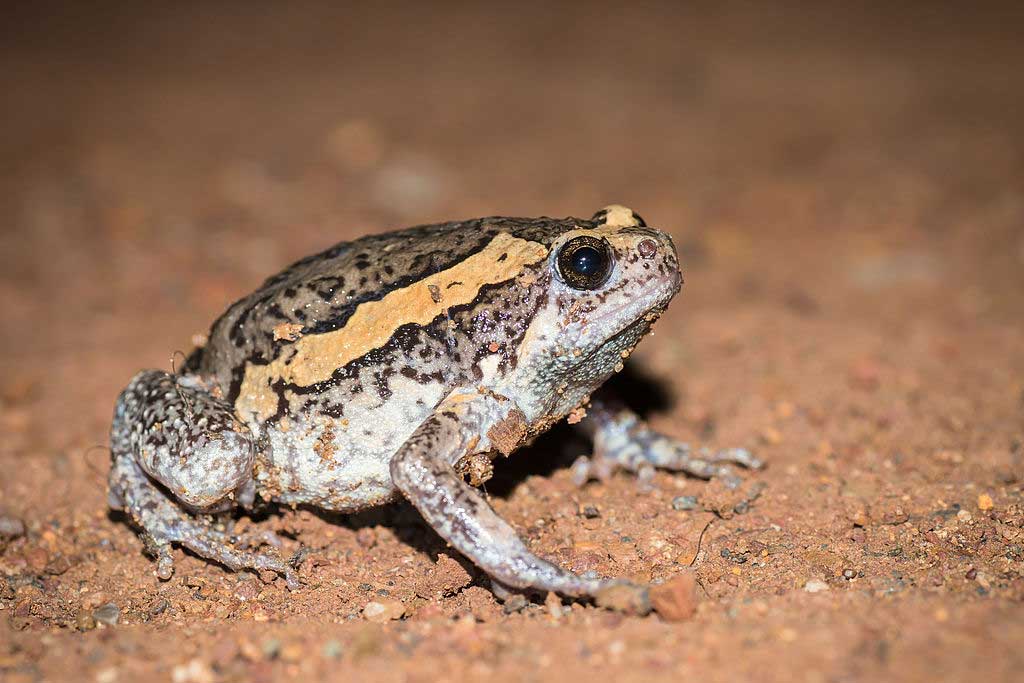
    This curious terrestrial frog comes from Southeast Asia, from wetlands, what we will take into account to install the terrarium.
    Banded bullfrog
    Banded bullfrog (Kaloula pulchra) – Rushen, CC BY-SA 2.0, via Wikimedia Commons

    Content

    The Banded bullfrog (Kaloula pulchra) it is known by many names. Estas frogs originally come from Southeast Asia. They are especially widespread in China, Hong Kong, India, Thailand and Indonesia. But, Isolated specimens of these narrow-mouthed frogs have also been sighted in Australia or New Zealand. In their natural habitats, the Kaloula pulchra is preferably found in forest soils, paddy fields or near settlements. Their diet consists mainly of ants.

    Behavior

    These frogs are peaceful animals. The ideal is to keep them in pairs or in a group with other members of the same species.
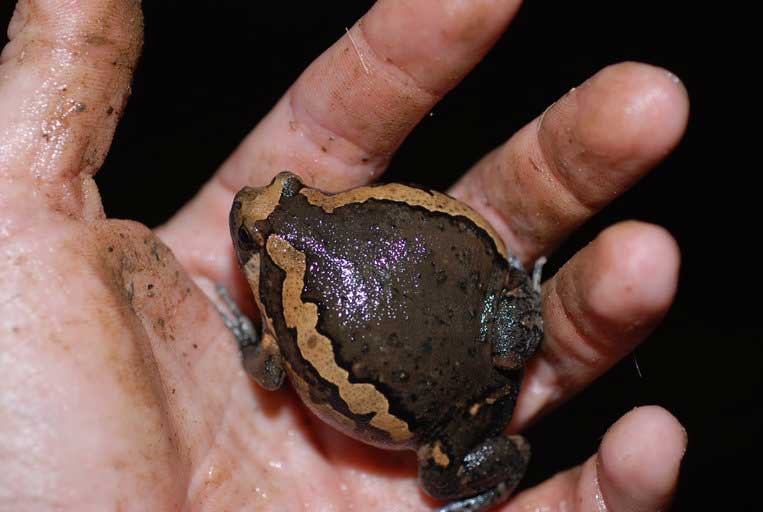
    It has the particularity that when it is disturbed it swells like a balloon to incredible extremes..

    Terrarium

    Kaloula pulchra
    Kaloula pulchra – Pierre Fidenci, CC BY-SA 2.5, via Wikimedia Commons

    The Banded bullfrog can reach a maximum size of about 8 cm.. A recommended aquaterrarium for the maintenance and care of these exotic species. The "accommodation" must have at least 90 x 50 x 50 cm and have a part of land and another of water. At least 1/4 of the container must be made up of water.

    For the land part, a soil substrate is recommended, sand, gravel or bark mulch. It is important that the substrate has a certain height. Its Banded bullfrog nocturnal will immediately dig into it. Other hiding places and shelters also contribute to the well-being of frogs.. Terrarium plants or roots are suitable for it. The plants also serve so that these climbing artists can climb.

    To the Banded bullfrog likes an air temperature between 26 and 29 degrees Celsius. During the evening and night hours, the temperature can be lowered to 20 – 22 degrees Celsius. But, in the water section a temperature of 25 degrees Celsius. It is important that the water is always pure and without chlorine residues. Chlorine has a negative effect on the health of your exotics.

    To the Banded bullfrog he likes humidity. The humidity should be between 70 and the 80 %. For this very reason, you, as a caregiver, you should spray the terrarium and the animals with water several times a day.

    Frogs hibernate. So, during the winter months there should be less water in the aquaterrarium. The ambient temperature should also be lowered to 4 Celsius degrees.

    Diet

    The Banded bullfrog gratefully accept the food. Especially crickets, caterpillars or earthworms.

    Mealworms can be their food once a week or so if one Banded bullfrog stays at home, but it shouldn't make up the majority of your diet, can be used as laxatives.

    Breeding

    The Banded bullfrog (Kaloula pulchra) has already been raised in the aquaterrarium. The laying of the female may contain up to 1.000 eggs. The young hatch after a day.

    Buy one "Banded bullfrog"

    The market price of a Banded bullfrog ranges between 20 and 30 EUR.

    Alternative names:

    1. Asian painted frog, Malaysian painted frog, Burmese painted frog, rice frog, bubble frog, chubby frog (English).
    2. Chubby grenouille, crapaud buffle, Grenouille peinte dโ€™Asie, discoglosse asiatique, crapaud ร  bouche รฉtroite de Malaisie (French).
    3. Reisfrosch, Blasenfrosch, Gemalter Ochsenfrosch, (German).
    4. Sapo pintado da รsia, sapo pintado da Malรกsia, Sapo pintado de birmanรชs, sapo de arroz, e sapo bolha (Portuguese).
    5. Rana toro con bandas, Sapo Pintado de รsia (espaรฑol).

    โ–ท The world of Pets: Dogs, cats, birds, reptiles, amphibians

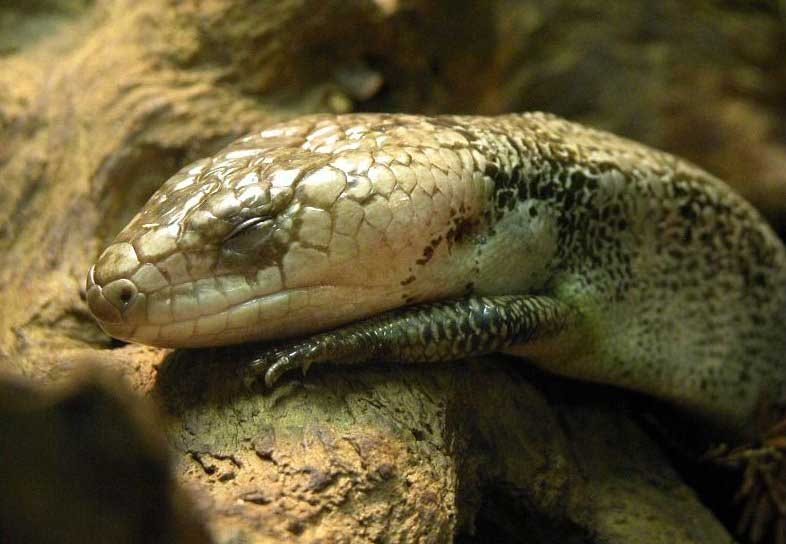
    Pink-tongued skink
    - Cyclodomorphus gerrardii

    The Pink-tongued skink it is a forest animal so in the terrarium we will put some humidity. very easy maintenance.
    Pink-tongued skink
    Pink-tongued skink – The original uploader was Wilfried Berns at German Wikipedia., CC BY-SA 2.0 OF, via Wikimedia Commons

    Content

    Description

    The Pink-tongued skink reaches more than 45 cm.. The female measures 42 cm long, of which 18 cm correspond to the trunk of the head.

    Coloration is grey-brown with a hint of silver, about her until 40 dark brown horizontal stripes, on juveniles strongly contrasting black stripes , that fade in the first year of life after several moults.

    Yellow background is not uncommon in young. Adult specimens without transverse stripes have also been seen, raised in the third generation.

    The underside is solid gray to pink.. In the young, the tongue is deep blue and only turns pink after two years, which explains the English name ยซPink-Tongued Lizardยซ. Oral mucosa is bright cobalt blue in young, later fades.

    In the lower jaw there is an enlarged molar on the left and one on the right, a functional device for crushing shell snails?.

    The claws are rather short, they only allow safe climbing even on smooth bark, because the body is relatively light and the long prehensile tail and the long prehensile tail supports it. Once the tail breaks, it only regenerates 1-2 cm..

    The sex of an animal can only be determined with certainty it can only be determined with certainty if comparison animals can be used. As is often the case with skinks, males tend to have thicker and wider heads.

    Then compare the root of the tail from the ventral side: the female's tail tapers immediately after the cloaca, in contrast to that of the male.

    Pink-tongued skink
    Pink-tongued skink

    Distribution and habitat

    The Skinks (Scincidae) they are the most diverse family of lizards on the Australian continent, with 140 species. The genus Cyclodomorphus comprises 10 species, 9 of which are restricted to Australia, with at least one species represented in each state. the tenth species, Cyclodomorphus gerrardii, lives outside of Australia in Indonesia and New Guinea. Cyclodomorphus gerrardii is an active skink like Cyclodomorphus casuarinae, but the only species in the genus with a long prehensile tail.

    The females of all species of Cyclodomorphus are viviparous. They have a simple built placenta.

    The Pink-tongued skink is located north of sydney, in the Gosford/New South Wales region, to Cape York/Queensland. Lives in the coastal jungle on the ground, but also likes to climb low vegetation. It was found in a banana plantation near Coff's Harbor., as well as in a dry hardwood forest in North Queensland.

    Diet

    They prefer snails to any other food. Field observations in Australia showed that the usual garden snail (Helix sp.) is their usual prey, even if a second, smaller species (Mitor sp.) is present in the same biotope.

    It is important to add fiber, for example, cooked rice or buckwheat flakes, as well as calcium, lime, vitamins and trace elements.

    A very elaborate substitute food could be mussel meat after having watered it several times.
    The drinking needs of the Pink-tongued skink are easy to satisfy. Or they quench their thirst by licking the water sprayed or from the drinker.

    Terrarium

    Terrarium
    Terrarium

    A terrarium with the dimensions 60 x 60 x 80 (Length x width x height) is enough for a couple of Pink-tongued skink, even for a third animal.

    It is important that the Pink-tongued skink, as climbing animals, can also use the side walls. Cork or tree fern boards are good for covering. Tested glass containers with a ventilation hole on the side and another on the lid.
    At the top there is a separate lamp box in which the electrical system, including lighting, is built-in, inaccessible to animals.
    If high humidity is created by spraying, the lamp box also ensures more security.

    After some experiments, bark mulch with a ratio of sand and peat in the ratio is preferable 3 : 2 : 1 as a substrate. Various ornamental cork tubes serve as decoration and as climbing and hiding places for animals. The walls are covered on all sides with flat cork boards. You can also integrate plants, like ivy (Scindapsus) or a wax flower (Fleshy hoya).

    With a sufficient distance to the plant, you can use an HQL lamp from 80 W as a light source, what benefits animals and plants. High luminous efficacy, a certain amount of UV rays and the heat of the focus and ballast make it stand out. It also, there is a focus of 60 W from above.

    HQL lamp ballast heats the terrarium floor from the outside. As such, a small Eternit plate is glued under the glass floor as protection against overheating and the ballast is mounted underneath. Try to maintain a constant relative humidity around the 70 % in the terrarium, as well as an air temperature of 28ยฐ C. For the soil, 20ยฐC is enough. For the soil, 20ยฐC is enough.

    Manual spray can be replaced, time-consuming, by an automatically controlled spray system.

    The Pink-tongued skink they move in their terrarium from the 16:00 until midnight.

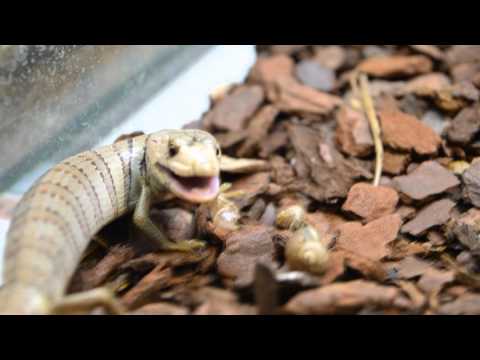
    Another notable feature is the technique of cracking the shell snails or removing them from it. The small shell snails are swallowed whole by the Pink-tongued skink. If the shell snail is large, the skink they try to break it with their jaws.

    For sale Pink-tongued skink

    The price of a Pink-tongued skink in the exotic animal market is about 200 EUR.

    Video Pink-tongued skink

    Cyclodomorphus gerrardii.

    Alternative names:

    1. Pink-tongued lizard (English).
    2. Scinque mangeur d’escargot (French).
    3. Rosazungenskink, Schnecken-Blauzungenskink (German).
    4. Lagarto de lรญngua rosa (Portuguese).
    5. Escinco gigante de lengua rosa (espaรฑol).

    โ–ท The world of Pets: Dogs, cats, birds, reptiles, amphibians

    Cat gecko
    - Aeluroscalabotes felinus

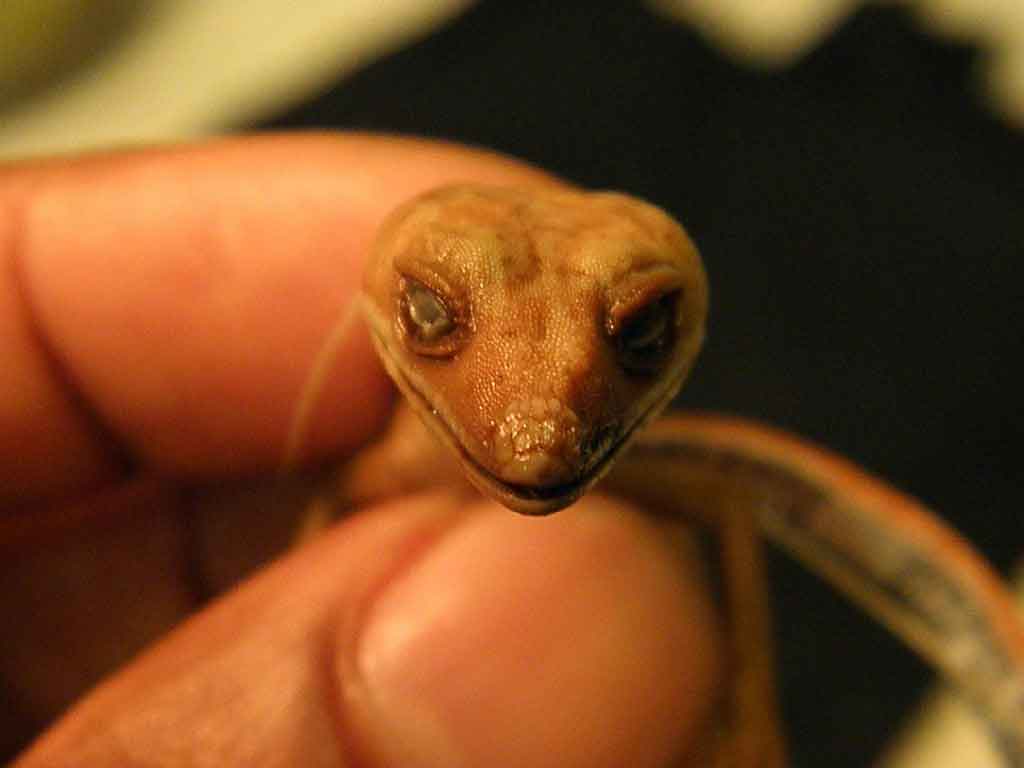
    The Cat gecko is an elegant gecko highly sought after by gecko collectors. It's relatively easy to create, but can be difficult to find in the market.
    Gecko cat arboricola
    ยซGecko-gato-arboricolaยป – Natural History Museum, CC BY 4.0, via Wikimedia Commons

    Content

    Origin

    The Cat gecko (Aeluroscalabotes felinus) is a tree species of the family Eublepharidae.

    They are found in Indonesia, Malaysia, Singapore and Thailand, where they prefer to live in moist and cool jungles with streams or rivers.

    These Geckos occasionally enter the terrarium trade as wild-caught specimens, so most individuals die during transport. Thailand has a law that prohibits the capture, trade, the import and export of gekcos.

    Its name comes from its habit of sleeping curled up with its tail over the nose and eyes..

    The nominal shape A. felinus felinus was described by Gรผnther in 1864, the subspecies A. felinus multituberculatus was first described by Kopstein in 1927.

    Characteristics

    Cat gecko
    ยซCat Geckoยป, Aeluroscalabotes felinus (a gecko) – No machine-readable author provided. Hexasoft assumed (based on copyright claims)., CC BY-SA 2.5, via Wikimedia Commons

    The Cat gecko can be measured 12 cm., 21 cm if we add the tail. Males are still smaller.

    The head is clearly separated from the body, has an elongated muzzle and is wider than the body.

    The neck and body they are flattened laterally and are covered with small dorsal scales, flat and almost uniform. A row of small flat tubers are present, although they may be missing; the ventrals are small, smooth and elongated.

    Sexually mature males have an angular row of 25-28 enlarged preanal scales, with 10-23 Pores. Thin limbs end in short, clawed fingers.

    The hemipenes clearly visible facilitate sex determination.

    The original tail is able to grip, the regenerated one is shorter and bulkier.

    Dorsal coloration between dark and reddish-brown, 1 or 2 rows of reddish beige spots, yellow or whitish running from the nape of the neck to the back, often framed in dark color.

    The head and limbs are unicolored or with brown patterns; the sides of the body may have irregular and partially indistinct light or dark lines or spots.

    Lip and chin protections are whitish, eyes are blackish brown.

    The throat is reddish beige, the ventral part is reddish-brown and with small irregular dark spots.

    Original tail conspicuous and irregularly stained white. Regenerated tails have only indistinct black and brown spots.

    The youth are stronger in their overall coloration.

    Habitat

    The Cat gecko is an inhabitant of the primary forest from sea level to some 800 m above sea level. There it lies close to the ground, especially moving in the branches of the bushes and possibly also in the trees.

    It is a Gecko strictly nocturnal, well hidden during the day. Its mode of locomotion is of a chameleon slowness. Climb skillfully on small branches, using its prehensile tail as an aid to climbing.

    The "Cat gecko" in captivity

    Terrarium

    For a mate or a male with a maximum of 3 females, are enough terrariums of 60 x 40 x 40 cm. (width x depth x height). But, a higher height adapts to the need of this species of Geckos.

    The substrate consists of garden soil or a mixture of soil and peat, of about 5 height cm. Make sure the soil is always moist. It is essential that there are branches that animals can climb on., as well as plants, as they like to climb them. Pieces of cork or tubes placed on the ground and in branches serve as a hiding place during the day. Despite constant spraying (at least every two days), you should not miss a bowl of water, since animals visit it frequently and also like to defecate on it. Once a week, spray water should be enriched with a mixture of vitamins.

    Terrarium lighting

    Lighting is provided by fluorescent tubes, temperatures should be a maximum of 27ยฐ C during the day (25ยฐC is better) with a reduction to about 23ยฐ C at night.

    It is advisable to reduce the lighting time and slightly lower the temperatures in winter.

    Food

    The Cat gecko eat the usual gecko food in the right size, that is to say, crickets, Little grasshoppers, etc. But, tend to prefer smaller foods. Sprinkle regularly 3-4 times a month with a mixture of lime with vitamins.

    Reproduction

    Females put 2 elongated soft-shelled eggs several times a year in the moist substrate or in the pot.

    At 24-26ยฐC during the day, with an overnight setback at 20-22ยฐ C, incubation lasts between 70 and 85 days. The babies measure 43-57 mm y have a length of 75-92 mm.

    They must be raised individually.

    during breeding, regular vitamin supplementation in the form of lime preparations and in spray water must be guaranteed.

    For sale "Cat gecko"

    The price of a "Cat gecko" at the exotic animal market, captive bred, ranges between 100 – 300 EUR, depending on its size.

    Videos "Cat gecko"

    Malaysian Cat Eyed Gecko Handling (Aeluroscalabotes felinus)

    Unboxing The Purrrrrfect Gecko | Aeluroscalabotes felinus the Cat Gecko

    Alternative names:

    1. Cat gecko (English).
    2. Gecko chat (French).
    3. Katzengecko (German).
    4. Llagartixa de gato (Portuguese).
    5. "Gecko gato arborรญcola" (espaรฑol).

    Sources:

    GROSSMANN, W. & C. SHEPHERD (2005): Breeding and propagation experiences of the Cat gecko (Aeluroscalabotes felinus) (GรœNTHER, 1864). — SAURIA, berlin, 27 (1): 33-46.
    GROSSMANN, W. (in the press): Cat gecko (Aeluroscalabotes felinus). — Mรผnster, species by species, Terrarium Library (Natur und Tier – Verlag GmbH), 64 p.
    MANTHEY, U. & W. GROSSMANN (1997): Amphibians & Reptiles of Southeast Asia. – Mรผnster (Natur und Tier – Verlag), 512 p.

    โ–ท The world of Pets: Dogs, cats, birds, reptiles, amphibians

    Florida red-bellied cooter
    - Pseudemys nelsoni

    The Florida red-bellied cooter only suitable for keeping in a pond in summer. As this turtle does not hibernate with the cold, should never be attempted. It would mean the death of the animal.

    Florida red-bellied cooter
    "Florida red-bellied turtle" (Pseudemys nelsoni) at Boy Scout Camp Echockotee. Fresh water spring covered with vegetation. – 159766 – dr. Tibor Duliskovich – http://www.duliskovich.com, CC BY-SA 4.0, via Wikimedia Commons

    Content

    Origin

    The Florida red-bellied cooter, of scientific name Pseudemys nelsoni, is originally from the United States. This turtle is especially common in Florida and Georgia.

    Characteristics / Appearance

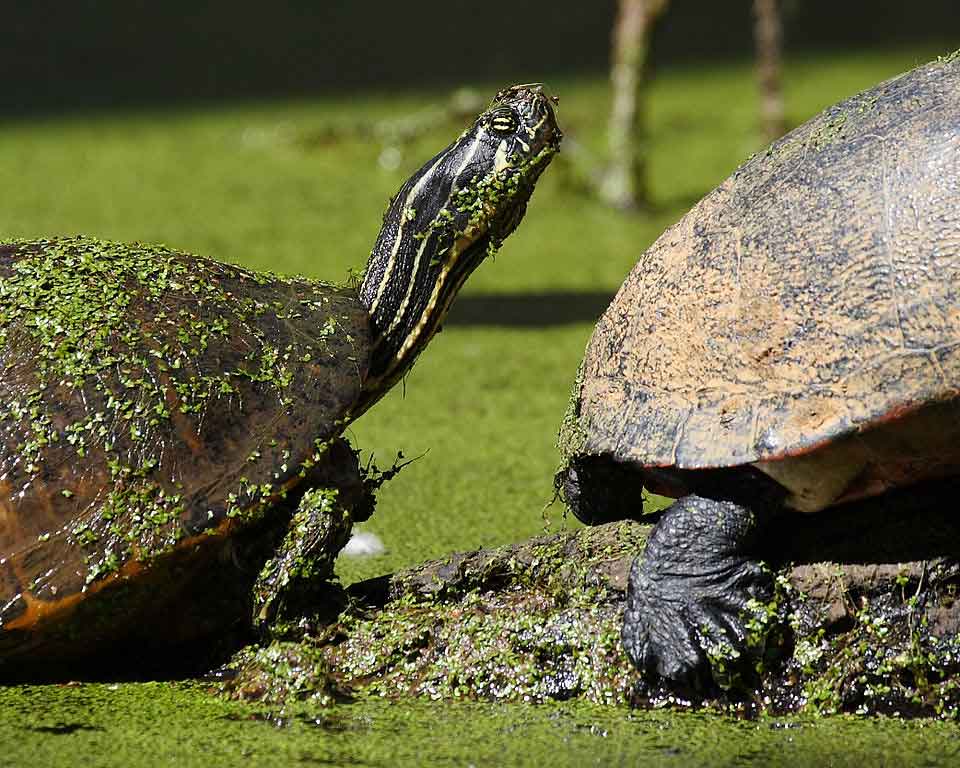
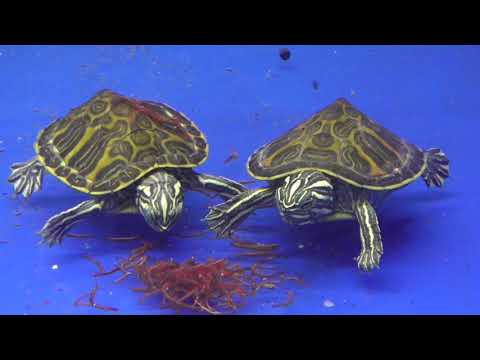
    The Florida red-bellied cooter It is a large, heavily armored turtle with a relatively tall shell.. Head lines are less conspicuous than in other ornate turtles, but a fringe runs below the eyes, it forks and a branch on each side runs to the nose.

    There are two small bumps on the edge of the upper jaw., like little teeth. The marginal scutes have a reddish stripe and black dots below.. The plastron is yellow-orange to reddish in color and gives the species its name.. The front claws of males are elongated as a mating tool.

    The females of the species barely grow larger than the males and reach a length of up to 37,5 centimeters. Older animals discolor with age.

    There are no known subspecies of the Florida red-bellied cooter.

    Habitat

    The relatively small range of the Florida red-bellied cooter ranges from the Okefenokee Swamp in Georgia to the Everglades. This area is quite lush, with open swamps and extensive wetlands. Habitats include slow-flowing waters, as well as marshes and wetlands.

    Behavior

    The Florida red-bellied cooter is active all year round and is often seen basking in the sun. They are the most common turtles in the Okefenokee Swamp and in the canals of Florida..

    Males reach sexual maturity at three to four years of age., and its plastron then measures between 17 and 21 cm.. Females do not reach sexual maturity until they are five to seven years old, at which time they have a body length of 26 to 27 cm.. They are of 6 to 31 eggs several times a year, The young hatch after 60 to 75 days.

    Threats to the species

    State of conservation โ“˜


    minor concern Minor Concern โ“˜ (UICN)โ“˜

    Numerous native mammals, like raccoons, otters and skunks, they are a threat to the grounding. In water, The aligators, snapping turtles and large fish are enemies of hatchlings. But, the thick and tall shells of adults allow them to coexist with common alligators. The shells can't even be cracked for adult alligators.

    Trade and maintenance

    In 2003, were exported from the United States 5 million ornamental turtles of the genus Pseudemys. Export statistics do not allow a more precise specification by species, but besides the Florida red-bellied cooter, only the common ornamental tortoise and the peninsular ornamental tortoise are exported. So, It can be assumed that many copies of the Florida red-bellied cooter also enters the market as pets or as food. The exporters declared that the majority of the animals came from breeding.

    The "Florida red-bellied cooter" in captivity

    Florida red-bellied cooter
    A photo of a "Florida Red-bellied Turtle" in a pond in South Carolina, EE. UU.

    Maintenance

    The Florida red-bellied cooter she is a good swimmer and needs an aquaterrarium with enough space to swim, as well as various hiding places and opportunities to rest on the furniture.

    They like to sit under lianas and roots in aquariums or cling to them so that only their heads are above the water to breathe. The terrestrial part must be at least twice the length and width of the dorsal shell so that the animal can stretch out and bask there. As a key to the size of the aquaterrarium we recommend calculating with the length of the animal's carapace. The carapace is the dorsal. The size of the terrarium is calculated as follows for non-adult animals:

    • Part of water: Five times the length of the animal's carapace, plus at least twice the length of the shell for the height of the water.
    • Terrestrial part: At least twice the length of the animal's carapace.

    Observe the growth of the animal in the coming months (fast-growing animal/slow-growing animal).

    as a norm, We recommend aquarium measurements of 200 x 100 x 70 cm. (for 2 Turtles).

    Aquaterrarium decoration

    The aquaterrarium it should be arranged in such a way that the turtle has enough space to swim, but also enough places to rest or retire. aquarium stones, aquarium roots and lianas are suitable for it. It is important that they are placed in such a way that the turtle cannot collapse them or get trapped. Natural gravel with an average grain size of up to 5 mm.

    The terrestrial part it must be built in such a way that the turtle can get to it and get out again without major problems. It must also be built in such a way that it is completely dry, so the tortoise can dry off completely and rest and bask extensively in the heat and ultraviolet light above it.

    If females or a pair are kept, the land part must be built in such a way that egg laying is also possible. A digestible substrate is suitable for this, for example a mixture of clayey sand for terrariums such as Exo Terra Stone Desert and a mixture of sand with humus as JBL Terra Basis.

    Temperature and lighting

    The Florida red-bellied cooter comes from Florida and neighboring states to the north. There they inhabit the largest and smallest lakes, as well as in some rivers.

    They need a sunny spot on the land side of their aquaterrarium.. This is created by spot lighting, that provides light, heat and UV rays. The highest quality products are good enough here, because only they are equal to the natural light of the sun. Only an optimal supply of UV-B light provides your animal with enough vitamin D3 for young animals to grow optimally and adult animals to also be in top shape and display their bright colors.. We recommend the JBL L-U-W Light, which is available in different powers and in the version ยซDesertยป o ยซJungleยซ. This type of lighting provides light, heat and UVA/UVB rays.

    For uniform lighting of your terrarium as decoration of your living space, we recommend LED lighting across the entire terrarium. Light and heating sources are basically turned on and off at a daily rate using a timer, 14h on, 10h off.

    Filter and heater

    To heat the part of the water and not take away space for swimming, we recommend an external heater, as the JBL ProTemp e300 or e500. This allows the aquarium water to be heated to an optimum temperature of 25 to 27 degrees.

    To filter and clean the water, high performance external filter recommended (at least 4 or 5 times the volume of water circulating per hour). series external filters Cristal Profi e of JBL are ideal for this purpose.

    Food

    The Florida red-bellied cooter eat up to a 95% of herbivorous foods, that is to say, eat plant foods and a small amount of animal foods. Suitable foods include various aquarium plants, food plants for terrariums like Golliwoogยฎ, lettuce, leaf spinach or pelleted turtle food. Gammarus, smelts, mussel meat, mixture for turtles or mosquito larvae are suitable to provide the small amount of animal protein. But, pet food should only be given once a week.

    A general rule of thumb for food quantity is once or twice a day as much food as the size of the turtle's head.
    Food is always sprinkled with vitamin and mineral mixes. This is the only way to avoid irreversible deficiencies, which can often cause serious illness and even death in young animals and pregnant females, for example.
    It also, there should always be a cuttlefish bone in the water section so that the animals can absorb the calcium for themselves.

    Social behavior and reproduction

    The Florida red-bellied cooter not considered very aggressive within the species, which means that these turtles can also be kept in pairs or in a group of a male with several females.
    The Florida red-bellied cooter does not hibernate with cold, since the temperature in its original habitat is at least 16 – 17 degrees even in winter.
    In spring, the Florida red-bellied cooter gets ready to mate. After mating, the female usually lays up 20 eggs in a pit up to 15 cm deep in the terrestrial part. With an incubation period of 60 to 80 days, the pups are born.

    Buy one "Florida red-bellied cooter"

    The price of a "Florida red-bellied cooter" at the exotic animal market, bred in captivity, ranges between 25 – 60 EUR, depending on its size.

    Videos "Florida red-bellied cooter"

    Pseudemys nelsoni / nelson's turtle

    Florida Redbelly Turtle (Pseudemys nelsoni)

    Alternative names:

    1. Florida redbelly turtle (English).
    2. Pseudรฉmyde de Nelson (French).
    3. Nelsons Schmuckschildkrรถte (German).
    4. Cooter de barriga vermelha da Flรณrida, Tartaruga Pseudemys Nelsoni (Portuguese).
    5. Tortuga Pseudemys nelsoni, Tortuga Laberinto (espaรฑol).

    โ–ท The world of Pets: Dogs, cats, birds, reptiles, amphibians

    Red-bellied short-necked turtle
    - Emydura subglobosa

    Are you looking for an active and colorful turtle that does not need to spend the winter? So, the Red-bellied short-necked turtle is ideal for you!
    Red-bellied short-necked turtle
    Red-bellied short-necked turtle – Location taken: National Aquarium in Baltimore, Baltimore – Photo by David J. pole, CC BY-SA 4.0, via Wikimedia Commons

    Content

    Origin / Distribution

    The species had been described in 1876 by the director of the Sydney Natural History Museum, born in Brunswick, Johann Ludwig Gerard KREFFT, as Emydura subglobosa and in 1888 by BOULENGER as Emydura albertisii. For a long time the name given by BOULENGER was used. The specimens described as Emydura australis albertisii in the literature of a few years ago or still today in zoos they belong to the Emydura subglobosa. The two subspecies are distinguished subglobosa and worrelli.

    The Red-bellied short-necked turtle (Emydura subglobosa) found on islands and rivers off the coast of Australia and New Guinea, like Fraser Island, the garden river, Daru, cape york, the Stradbroke Islands and the Torres Strait Islands. These turtles are also found in lowland swamps, covering large areas of the open tropical plains in western Papua New Guinea.

    Characteristics / Appearance

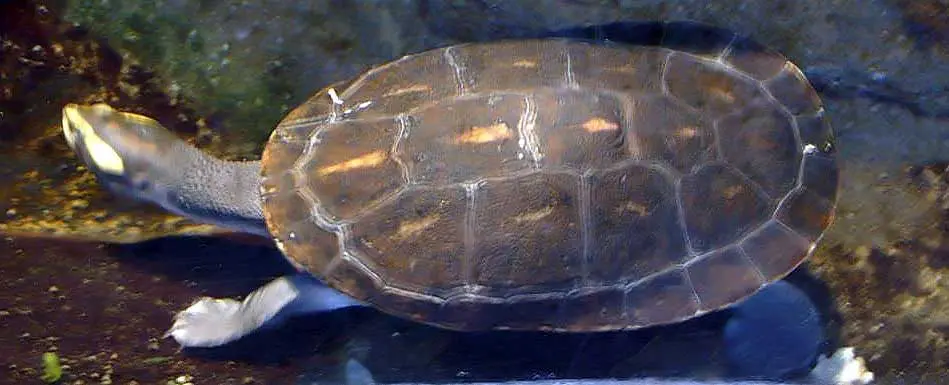
    The Red-bellied short-necked turtle owes its name to its purple-red ventral carapace, that fades with age. Shell, of up 26,5 cm length, it's rather flat, wider behind than in front, with a keel in juveniles and without it in adults. It is brown or gray, except marginal shields, whose edge and bottom are red.

    The plastron is red, pink or yellow with a reddish lateral stripe. Bright yellow stripe over eye to ear is eye-catching. The neck is relatively short. the snout is pointed. There are two yellow barbels on the chin. Juveniles are more colorful than adults, males have more contrasting colored heads than females.

    In many sea turtles, freshwater and terrestrial, the sex of the embryo is influenced by the incubation temperature. But, this is not the case for Australian chelids studied to date, lacking temperature-dependent sex determination.

    Habitat

    Red-bellied short-necked turtle
    Red-bellied short-necked turtle – Sweetsandz, CC BY-SA 3.0, via Wikimedia Commons

    The preferred habitat of the Red-bellied short-necked turtle are the rivers, swamps and ponds of Papua New Guinea and Australia. In the lower reaches of the Kikori and Omati rivers they inhabit slow-moving waters, seasonal wetlands and wetlands.

    Like other freshwater turtles, the Red-bellied short-necked turtle alternate periods in the water with sunny time to increase body temperature. Most of their life is spent in the water, where they look for food. If there is a shortage of water in the warmer months, move to flooded areas.

    Behavior

    The Red-bellied short-necked turtle swims and sunbathes to control internal body temperature. During the sunbathing process, tears go down the side of the turtle's head and enter the mouth as it opens and closes, what are known as gular movements. Wheezing and foaming at the mouth have been observed, although it is more common in Emydura macquarii than in the other Emydura species. Wetting the head or limbs, removing limbs from heat exposure and changing breathing patterns are mechanisms that prevent overheating

    The Red-bellied short-necked turtle snap and bite when threatened, causing painful wounds. They stick their heads in while tilting their shell towards predators to reduce damage to soft body parts.

    The Red-bellied short-necked turtle has highly developed senses, necessary for communication and perception. These senses help them locate food, avoid predators and find a mate during the breeding season. Studies have shown that these freshwater turtles can communicate with each other through a wide range of vocalizations that are too soft for humans to hear.. Evidence also suggests that echolocation may evolve to find prey., in addition to being used to obtain a three-dimensional image of the turtle pond).

    The Red-bellied short-necked turtle, like other freshwater turtles, has a nictitating membrane (transparent third eyelid) for underwater vision. Your sense of smell is achieved through your nose and a specialized Jacobsen's organ., that identifies chemical residues floating in the air and water.

    Although turtles do not have an external ear hole, they have an eardrum that is covered with skin and can detect low-frequency vibrations underwater and on land. Red-bellied short-necked turtles have four scent glands in their shell. These glands produce a scent as a defense against predators and between competing males during the breeding season.. They communicate with potential mates through extensive courtship ceremonies that include bobbing their heads as they align their bodies..

    Food

    The Red-bellied short-necked turtle it is omnivorous and feeds on filamentous algae, perifiton, sponges, aquatic macrophytes, aquatic macroinvertebrates, terrestrial insects falling into the water and carrion. These turtles also rely heavily on mollusc crushing., fish, insects, worms, aquatic plants, plant matter and seeds as part of your daily life.

    Reproduction

    During the breeding season, males communicate with females with a series of signaling postures, including a combination of simultaneous caresses, blinking eyes and swinging of the head.

    In the Red-bellied short-necked turtle, females have a large area inside their shell to store eggs, while the males have a larger tail. Ovulation and nesting begin in early spring. Only female turtles come out of the water at night or first thing in the morning to lay eggs in hollow cavities built into sand or soil.. Females lay eggs in about an hour.

    These turtles can produce two to four clutches a year., laying four to eleven eggs each time, with an average of 7 eggs in each clutch. The eggs hatch and hatch in the next dry season, between July and August.

    Threats to the species

    The Red-bellied short-necked turtle It is listed as a species of least concern by the UICN. But, isolated populations may occur in arid regions throughout their range and have long times to sexual maturity. This combination leads some associations to think that a preventive conservation program should be applied. Increasing anthropogenic threats also pose a threat.

    Human predation includes the collection of eggs and the capture of adult turtles as a local food source..

    The "Red-bellied short-necked turtle" in captivity

    Aquaterrarium

    For the maintenance and care of the Red-bellied short-necked turtle, an aquaterrarium with a rim length of at least 150 cm.. This aquaterrarium must have an aquatic part and a terrestrial part for the benefit of the animals. The water part must be very large and offer swimming animals a lot of free space. Other decorations would only unnecessarily restrict the turtles' swimming space and, Therefore, are not necessary.

    The Red-bellied short-necked turtle he is a peaceful and friendly creature. They can be kept as a couple or in a group without problems..

    They prefer water temperatures between 22 and 28 degrees centigrade and a pH value between 6 and 8. A UV lamp must be installed for the turtles to sunbathe. It is important that turtles always stay in clean water. Animals are native to tropical and subtropical regions. They don't go into hibernation.

    Temperature

    The duration of illumination is always given as twelve hours, because in the natural range the length of the day hardly changes over the course of the year. December is hotter than July, which is easy to explain: The red-bellied pointy-headed turtle comes from the southern hemisphere, and the seasons there shift half a year, compared to our seasons in the northern hemisphere.

    But, it makes sense to care for these aquatic turtles according to our seasons, that is to say, shift temperatures half a year. In this way, heating costs are reduced in winter and also less water evaporates in winter (danger of mold!).

    In summer, animals should be kept at a water temperature slightly lower than the 30 ยฐC, while in spring and autumn temperatures of about 26-27 ยฐC. This species does not hibernate, so it is enough to lower the temperatures to 25ยฐC to simulate winter.

    Food

    The Red-bellied short-necked turtle it is a species that feeds in a mixed way and to which the full range of foods of animal origin can be offered, but plant-based foods should also be on the menu. But, the emphasis is clearly on foods of animal origin.

    These aquatic turtles also like to eat creek fleas, various mosquito larvae and insects (like crickets).

    Reproduction

    Both sexes of this turtle reach sexual maturity with a carapace length of between 14 and 16 cm.. Smaller specimens are assumed to be sexually mature with 12 cm of shell length.

    In New Guinea, egg laying takes place in August and October, and is often dispersed throughout the year in captive breeding. A clutch usually consists of five to eleven eggs and is laid at a depth of five to 15 cm.. In the Red-bellied short-necked turtle, three to four clutches may occur per year.

    The Emydura subglobosa belongs to the group of aquatic turtles with genetic sex fixation, that is to say, sex is not influenced by breeding temperature. At a rearing temperature of 25-30 ยฐC, The young are born after 50 to 80 days.

    Buy one "Red-bellied short-necked turtle"

    Occasionally, the Red-bellied short-necked turtle are offered in pet stores. The specimens offered in the pet shop are usually European pups. But, it is more advisable to buy this beautiful tortoise from a breeder. Since this turtle is comparatively easy to breed, there are some breeders.

    Its price ranges from 80 – 100 EUR.

    Videos "Red-bellied short-necked turtle"

    Tortuga Emydura Subglobosa, Meet the CLOWN TURTLE

    Red-bellied Short-necked Turtle / Emydura Subglobosa

    Alternative names:

    1. Red-bellied short-necked turtle, Pink-bellied side-necked turtle, Jardine River turtle (English).
    2. Tortue ร  ventre rouge, Emydure ร  ventre rouge (French).
    3. Rotbauch-Spitzkopfschildkrรถte (German).
    4. Tartaruga-de-barriga-vermelha, Tartaruga de barriga vermelha e pescoรงo curto (Portuguese).
    5. "Tortuga de cuello corto", Tortuga de cuello corto de vientre rojo, Tortuga de cuello lateral de vientre rosado, tortuga del rรญo Jardine, Tortuga payaso (espaรฑol).