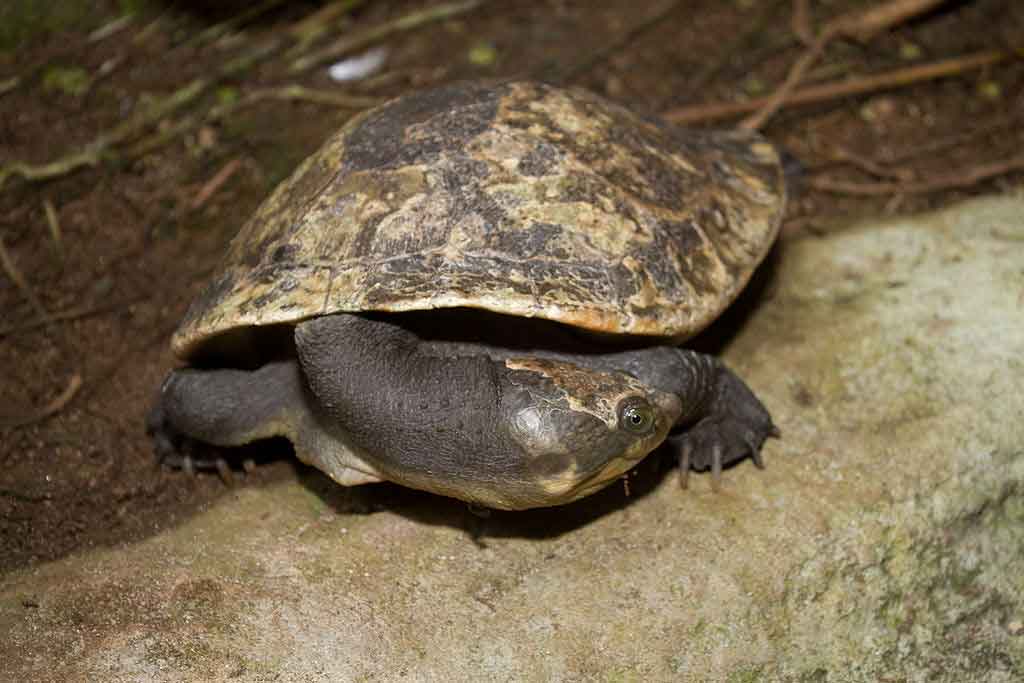
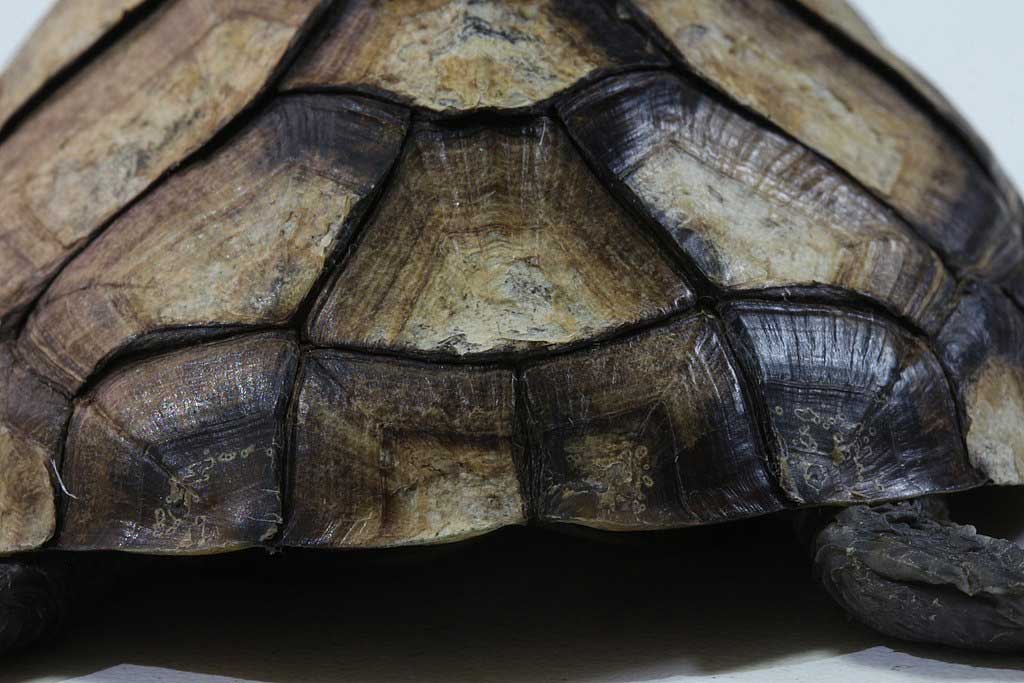
The New Guinea snapping turtle (Elseya novaeguineae) found on islands and rivers off the coast of Australia and New Guinea, like Fraser Island, the garden river, Daru, cape york, the Stradbroke Islands and the Torres Strait Islands. These turtles are also found in lowland swamps, covering large areas of the tropical and open plains of western Papua New Guinea.
Characteristics / Appearance
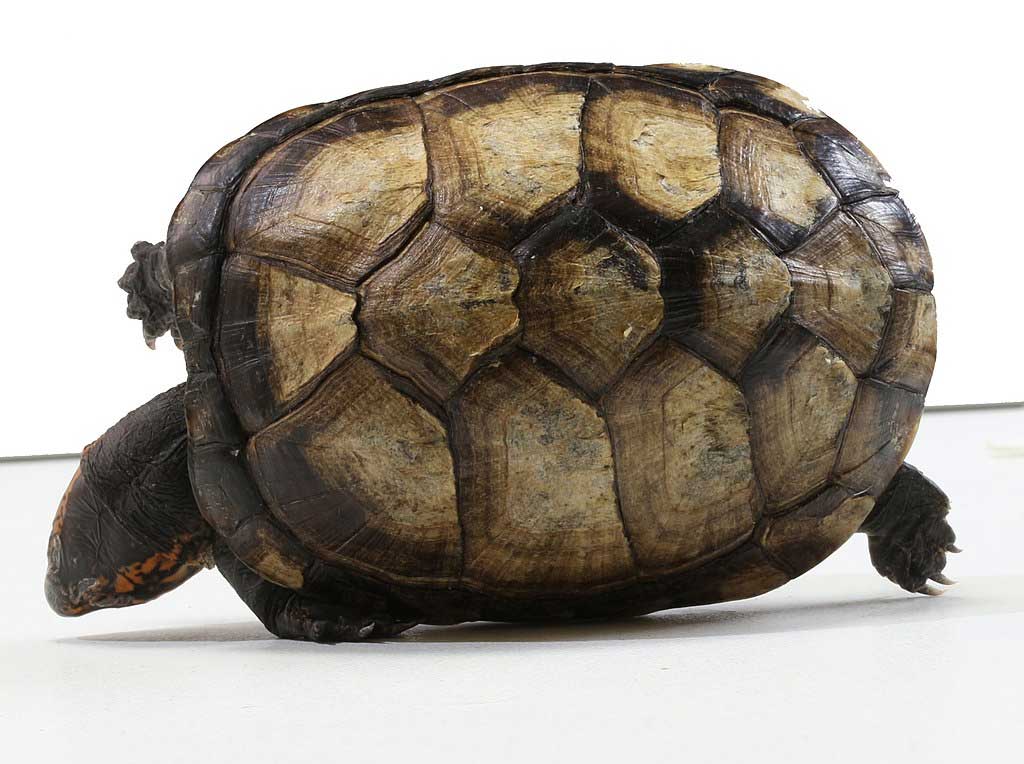
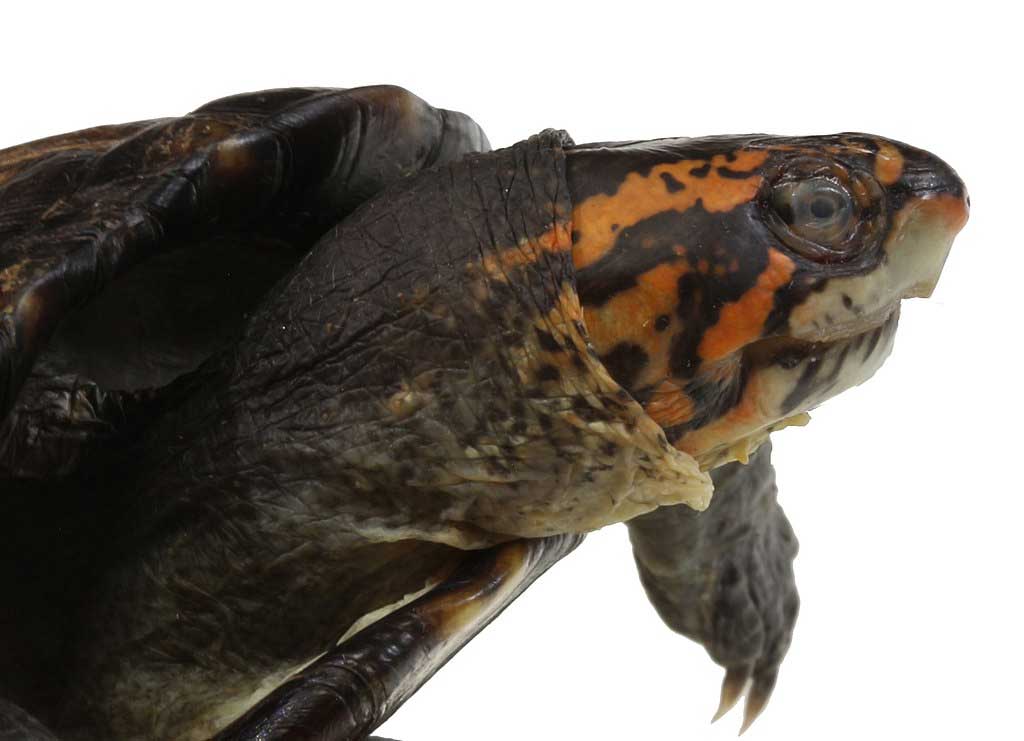
The New Guinea snapping turtle has an olive-colored head with a yellow-cream stripe that runs from the tip of the nose to the iris, passing through the eye. They have a prominent upper jaw and two yellow whiskers on their chins.; the same yellow coloration runs along the light-colored jaw line.
The upper neck region is dark gray and the lower, light grey, with red veins that run through it. This same coloration appears on the lower jaw and on the belly of the turtle., although the color may vary between bright orange, yellow or pink. The extremities, the tail, the plastron and abdominal regions are marked with red.
The New Guinea snapping turtle Young usually has brighter marks that fade as it grows., and its red color turns pink over time.
Females have a larger shell, but its tail is shorter. The shells of males oscillate between 13,3 and 17,3 cm., and those of females between 15,2 and 25,5 cm..
The New Guinea snapping turtle is a member of the family of side-necked freshwater turtles, Chelidae. They can be characterized by the way they extend and retract the neck. Place the neck and head on their side, below the top edge of the shell.
Habitat
The preferred habitat of the New Guinea snapping turtle are the rivers, swamps and ponds of Papua New Guinea and Australia. In the lower reaches of the Kikori and Omati rivers they inhabit slow-moving waters, seasonal wetlands and wetlands.
Like other freshwater turtles, the New Guinea snapping turtle alternate periods in the water with sunny time to increase body temperature. Most of their life is spent in the water, where they look for food. If there is a shortage of water in the warmer months, move to flooded areas.
The New Guinea snapping turtle swims and sunbathes to control internal body temperature. During the sunbathing process, tears go down the side of the turtle's head and enter the mouth as it opens and closes, what are known as gular movements.
Wetting the head or limbs, removing limbs from heat exposure and changing breathing patterns are mechanisms that prevent overheating.
The New Guinea snapping turtle, just like other short-necked turtles, snaps and bites when threatened, causing painful wounds. They stick their heads in while tilting their shell toward predators to reduce damage to soft parts of the body..
Reproduction
In many sea turtles, freshwater and terrestrial, the sex of the embryo is influenced by the incubation temperature. But, this is not the case for the Australian turtles studied to date, lacking temperature-dependent sex determination.
Species Elseya novaeguineae mate all year round, with peaks in spring and autumn.
During the breeding season, males communicate with females with a series of signaling postures, including a combination of simultaneous caresses, blinking eyes and swinging of the head. The female may be motionless or swimming; when she stops the encounter and comes to the surface, the male quickly adopts a nose-to-nose position, making nose jets. Males and females continue to bob their heads in an alternating sequence while aligning their bodies.. Once this maneuver is completed, mating begins.
The New Guinea snapping turtle has odor glands in its shell that produce odors used during competition between males during the breeding season.
The gestation period lasts from 2 to 4 months.
Ovulation and nesting begin in early spring. Only female turtles come out of the water at night or first thing in the morning to lay eggs in hollow cavities built into sand or soil.. Females lay eggs in about an hour.
These turtles can produce two to four clutches a year., laying four to eleven eggs each time, with an average of 7 eggs in each clutch.
The eggs hatch and hatch in the next dry season, between July and August. There are many factors that can influence the incubation and hatching period: ambient temperatures, cloudiness, the level and flow of the river, the tides and the phase of the moon. Elevated temperatures favor early hatching and cold temperatures favor late hatching..
After digging a cavity and laying the eggs, the female of New Guinea snapping turtle immediately returns to fresh water, leaving eggs exposed.
The hatchlings make their journey to fresh water without the guidance or protection of their parents..
Food
The New Guinea snapping turtle it is omnivorous and feeds on filamentous algae, perifiton, sponges, aquatic macrophytes, aquatic macroinvertebrates, terrestrial insects falling into the water and carrion. These turtles also rely heavily on mollusc crushing., fish, insects, worms, aquatic plants, plant matter and seeds as part of your daily life.
They depend on their wide jaws, sharp and and their front legs to tear food, and its tongue serves to direct the food towards the gaznate.
Threats to the species
State of conservation ⓘ
Minor Concern ⓘ(UICN)ⓘ
The New Guinea snapping turtle it is listed as a species of least concern by IUCN. But, there may be isolated populations in arid regions throughout their range and have extended times until sexual maturity. This combination leads some to think that a preventative conservation program should be applied.. Growing anthropogenic threats also pose a threat.
Predators include introduced red foxes and domestic cats. Water rats, goannas and crows prey on their nests and the offspring of many species of the genus Elseya.
Human predation includes the taking of eggs and adults as a local food source. The Emydura subglobosa has four scent glands as a defense mechanism against predators. The odor is usually only released when threatened. Although the use of musk is unknown, Recent data suggests that once the powerful smell is released, nearby predators leave the surrounding area.
The "New Guinea snapping turtle" in captivity
Aquaterrarium
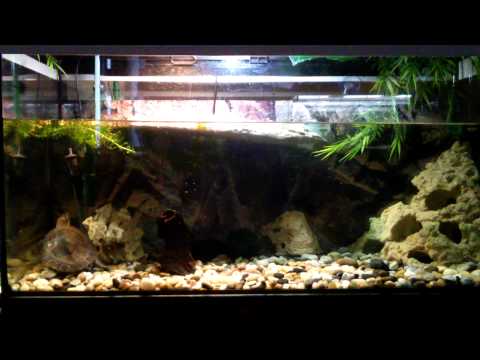
The New Guinea snapping turtle can reach a maximum size of 30 cm in the aquarium. For its maintenance and care, an aquarium with an integrated terrestrial part is recommended. This container must have an edge length of at least 150 cm.. The water part should be very large and offer these swimming turtles a lot of free space. Other decorations would only unnecessarily restrict the turtles' swimming space and, Therefore, are not necessary.
These aquatic turtles are peaceful and friendly creatures.. They can be kept in pairs or in a group with several congeners without any problem.. It is also possible to keep them with other turtles of the same size and tranquility.
The New Guinea snapping turtle prefers a water temperature between 22 and 28 degrees centigrade and a pH value between 6,0 and 8,0. A UV lamp must be installed for the turtles to sunbathe. Below this temperature, animals can also enjoy temperatures between 35 and 40 degrees Celsius.
Food
The New Guinea snapping turtle is omnivorous. They can be fed frozen and live food. Especially fish, insects and invertebrates are easily accepted.
Reproduction
The New Guinea snapping turtle (Emydura novaeguineae) has already been successfully bred in the aquarium. They are possible almost 4 put per year.
Buy one "New Guinea snapping turtle"
The price of a "New Guinea snapping turtle" at the exotic animal market, bred in captivity, ranges between 90 – 120 EUR.
1. Western New Guinea stream turtle or New Guinea snapping turtle (English).
2. Tortue de Nouvelle-Guinée (French).
3. Neuguinea-Schnappschildkröte (German).
4. Tartaruga de córrego do oeste da Nova Guiné (Portuguese).
5. Tortuga mordedora de Nueva Guinea, Tortuga del arroyo de Nueva Guinea occidental (español).
Sources:
1 – (Legler y Georges, 1993)
2 – (Adams y Georges, 1996; Georges, 1995; Georges, et to the., 2006; Legler y Georges, 1993; Webb, 1978)
3 – (Georges Guarino and Bito, 2006)
4 – (Legler y Georges, 1993; Ernst y Barbour, 1989)
5 – (Werneburg et al., 2009)
▷ The world of Pets: Dogs, cats, birds, reptiles, amphibians
Scorpion mud turtle
- Kinosternon scorpioides
Origin: Central and South America.
Gender: Kinosternon
Life expectancy: 45 years
Length: Until 20 cm.
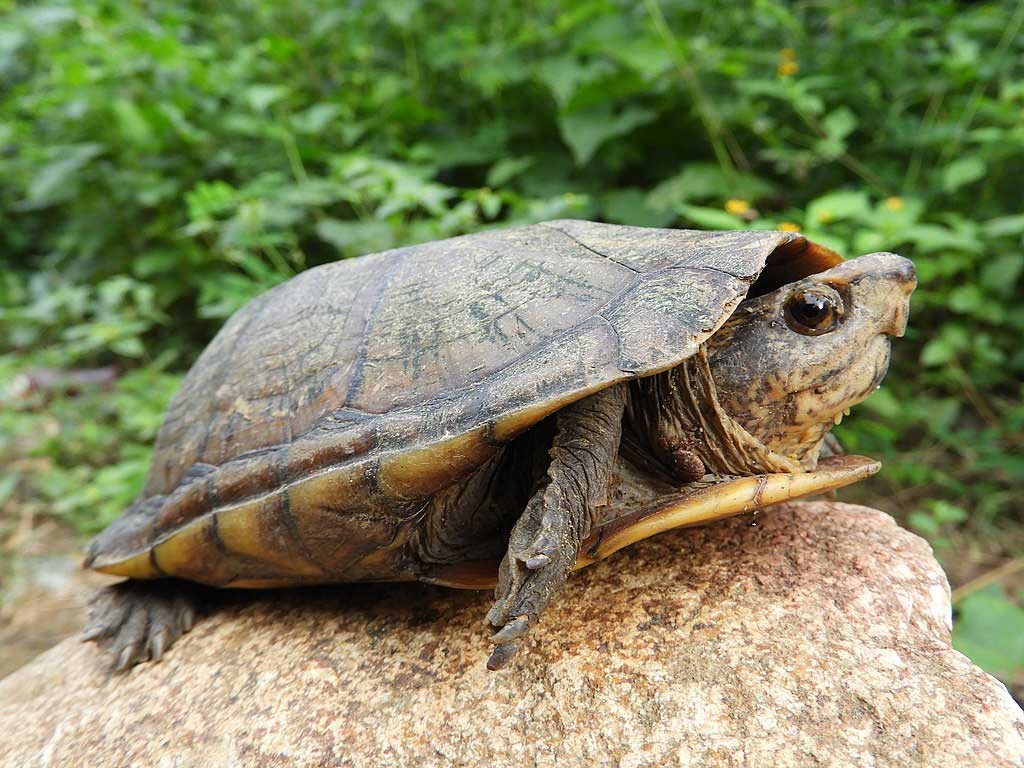
The Scorpion mud turtle is a Kinosternidae (mud turtle) medium to large in size with an oval shell (top shell) with a length of 92-270 mm.
The Scorpion mud turtle (Kinosternon scorpioides) It is native to the south-southeast of Mexico., including Cozumel Island), south to Belize, and in the Caribbean channels in Honduras, Nicaragua and on the Island of San Andres, Colombia. It also, It is distributed in the Pacific channels in southern Mexico., Central America to Panama; Atlantic drainages, and other inland or coastal regions of South America, including Bolivia, Brazil, Colombia, the Guianas, Ecuador, Peru, Trinidad, Venezuela, and disjunct populations in Argentina and Paraguay.
Red cheeked mud turtle – Kinosternon scorpioides cruentatum (Duméril, Bibron and Duméril, 1851)
Characteristics / Appearance
The Scorpion mud turtle is a Kinosternidae (mud turtle) medium to large in size with an oval shell (top shell) with a length of 92-270 mm. The shell may have three keels (Crests) in many individuals . The plastron (lower shell) has two hinges and little or no anal notch on posterior lobe. The first vertebral scale (shield or foil) of the carapace is wider than long, and the vertebral scales 1 to 4 have distinct posterior notches. Shell color varies from light brown to olive or black; head may be brown, gray or black with a reticulate or cream-colored spotted pattern, orange, red, pink or yellow. In most individuals the tip of the tail has a horny spine.. This description of Scorpion mud turtle should be compared with the anatomical features of other kinosteridos similar-looking North Americans described in other works.
Scorpion mud turtle
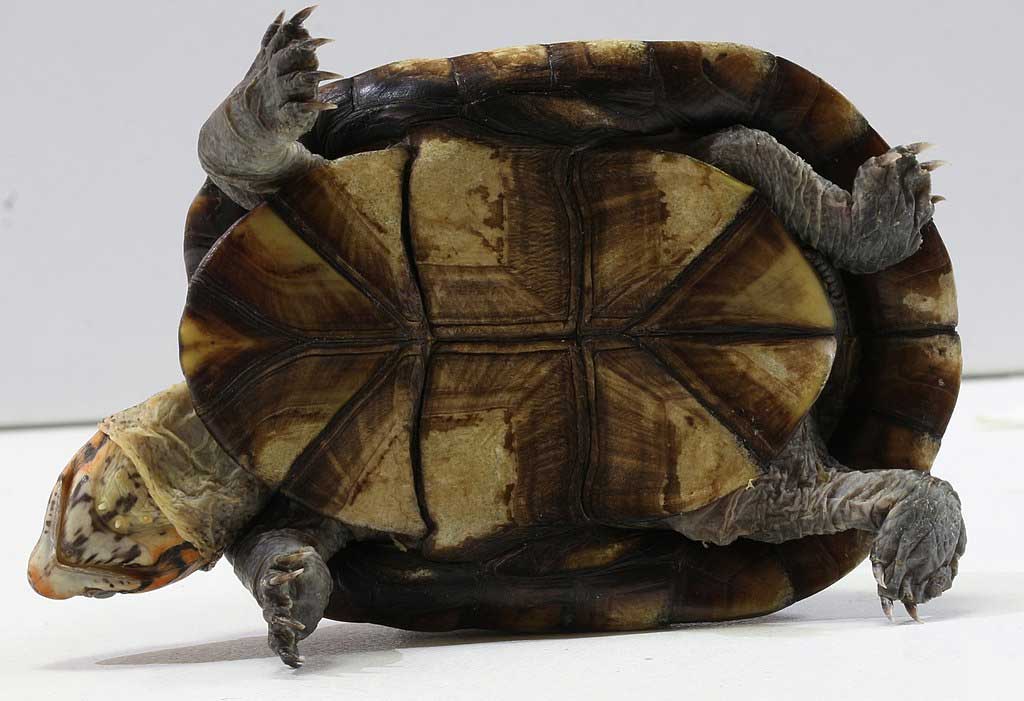
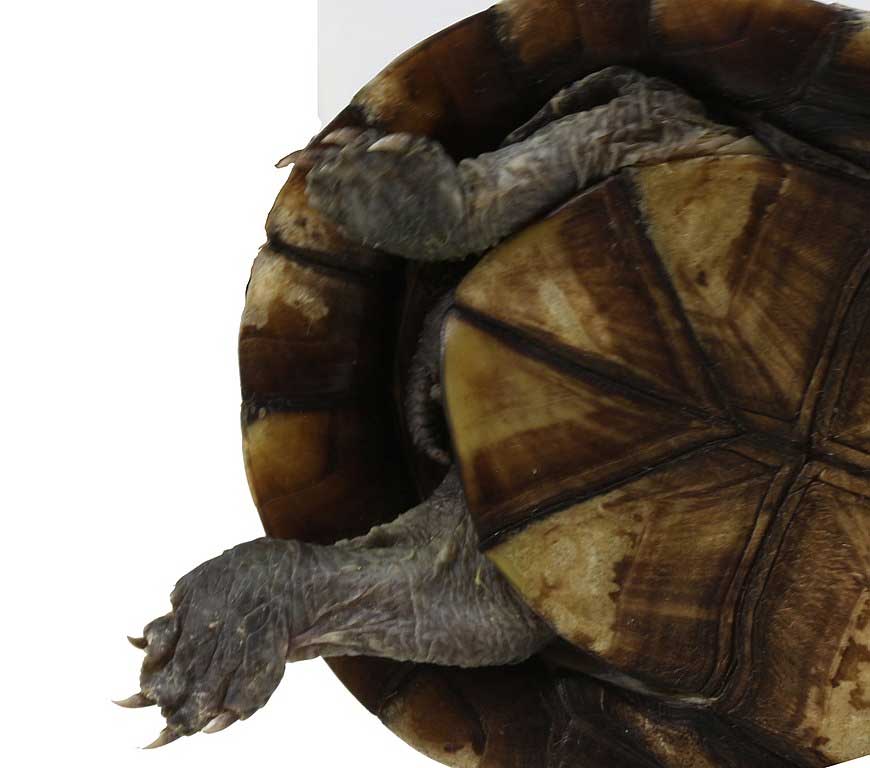
Detail view of the plastron, look at the shape and shields of the bridge
They are found in shallow water, in flooded forests, swamps and ponds from Mexico to Argentina and is said to be the quelonio with the widest distribution in the neotropics.
Behavior
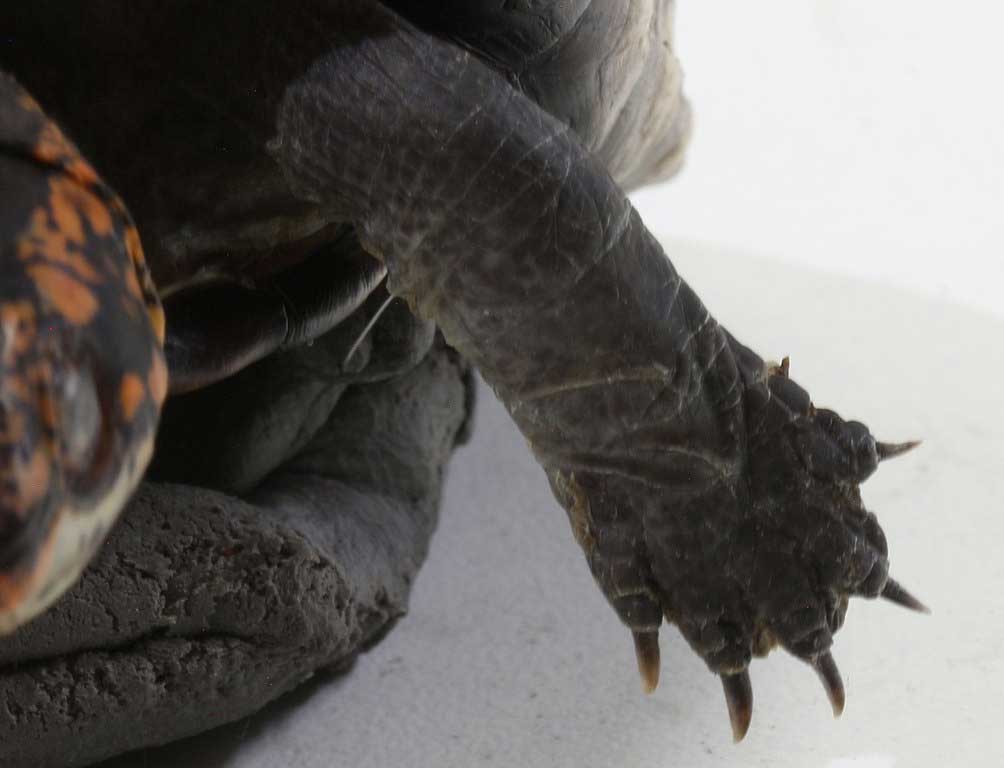
Its feet are webbed, but this species of turtle divides its time between water and land and prefers to walk on the bottom instead of swimming. They can be aggressive and can inflict a painful bite with their horny parrot-like beak. When the male of a species is larger than the female, usually indicates that males compete for females or have to subdue them.
Diet: Omnivores, they eat fruit, seeds, algae, fish, amphibians and carrion. They tend towards the more carnivorous end of the omnivorous scale.
Reproduction: They are of 2 to 6 eggs in a shallow ground nest. The incubation period varies from 3 to 6 months and is determined by a series of environmental conditions, not necessarily the temperature. The sex of the offspring is determined by temperature..
Threats to the species
Not currently classified as at risk, but the widespread consumption of adults and eggs, along with deforestation, has caused a decrease in their number in some areas.
This species is widely consumed in For, where the "casquinha de Muçuã» is one of the most famous dishes of Belem.
The "Scorpion mud turtle" in captivity
The Scorpion mud turtle usually kept as a pet. Of course, they are beautiful aquatic turtles, but that alone is not enough. They are easy to care for. One of the reasons is that, like tropical turtles, they do not need to hibernate. Since they feed almost exclusively on foods of animal origin, planted aquariums are also possible.
Aquaterrarium
To the Scorpion mud turtle he likes to climb.
The Scorpion mud turtle can grow to a maximum body length of 20 cm in the aquarium. These aquatic turtles need an aquarium with an integrated terrestrial part for basking.. Said container must have a size of at least 80 x 40 x 40 cm.. The water part must have a sand or gravel substrate. It also, the Scorpion mud turtle needs climbing opportunities. especially the stones, roots or plants are very popular.
The Scorpion mud turtle is a solitary animal. The ideal is to keep them individually in a nice aquarium.
These reptiles adapt perfectly to the conditions of the aquarium water.. They prefer water temperatures between 20 and 28 Celsius degrees. low heat point, temperature can also be 40 degrees Celsius.
Food
The Scorpion mud turtle accepts meat and vegetable food. In the aquarium, However, live and frozen food preferred. They also eat turtle sticks or dried animals.
Reproduction in the aquarium
The Scorpion mud turtle (Kinosternon scorpioides) have already been successfully bred in the aquarium. They lay eggs, which they then bury in the sand. A set can contain up to 5 eggs. The young hatch after 60 to 120 days.
Buy one "Scorpion mud turtle"
The price of the offspring "Scorpion mud turtle" at the exotic animal market, ranges between 80 – 120 EUR.
1. Scorpion mud turtle (English).
2. Tortue scorpion, Cinosterne de l’amazone (French).
3. Skorpions-Klappschildkröte (German).
4. Muçuã, Jurará (Portuguese).
5. "Tortuga estuche", Casquito escorpión, Morrocoy de agua, Tapaculo, Chachagua y Tortuga de pecho quebrado (español).
▷ The world of Pets: Dogs, cats, birds, reptiles, amphibians
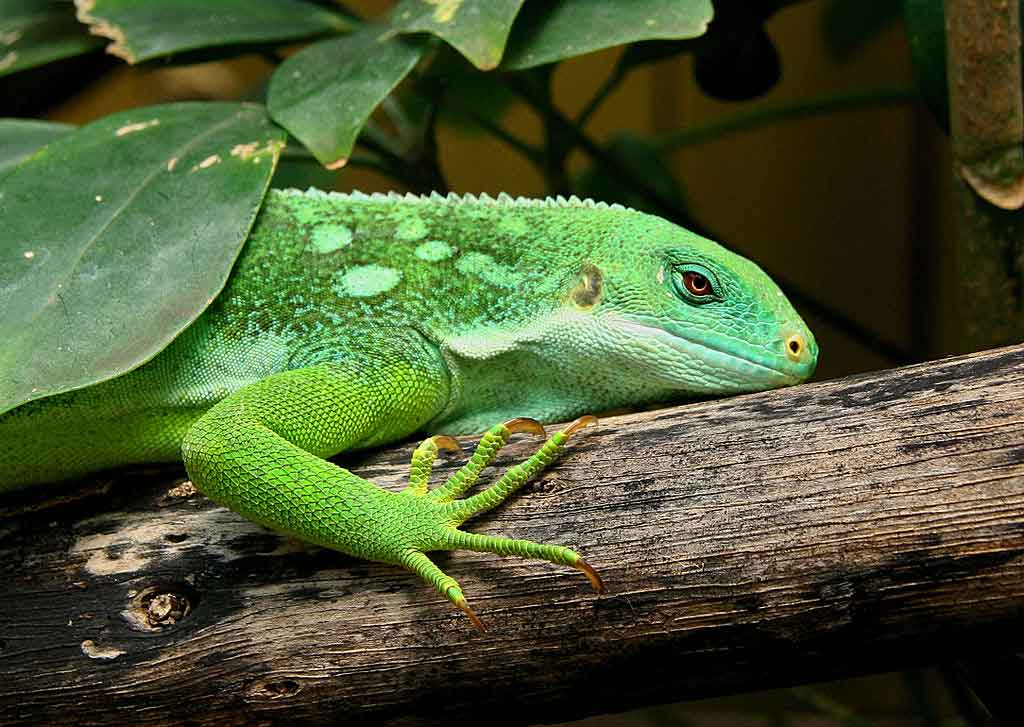
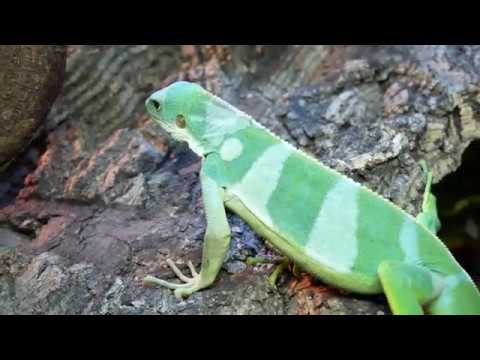
Lau banded iguana
- Brachylophus fasciatus
Origin: fiji
Gender: Brachylophus
Life expectancy: About 25 years
Length: head-torso: until 20 cm.
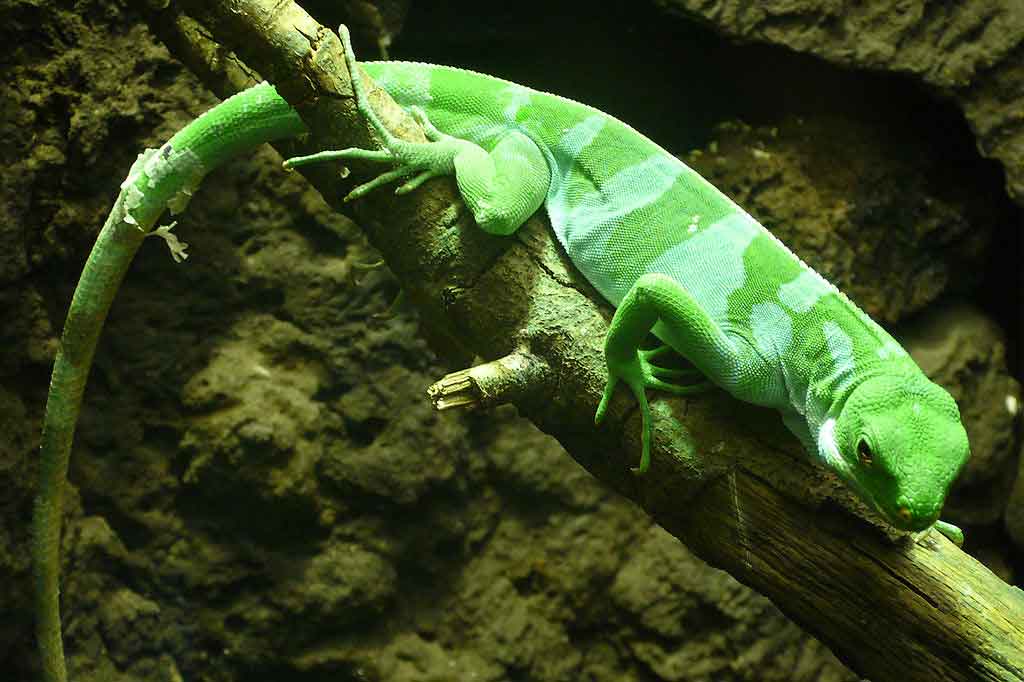
The Lau banded iguana is considered a national treasure by the government of this country, and his image has appeared on postage stamps, currency and phone book covers.
Lau banded iguana – TimVickers, Public domain, via Wikimedia Commons
Content
Origin / Distribution
two species (Brachylophus fasciatus and Brachylophus vitiensis) belong to the genus Brachylophus (Fiji iguanas).
Its geographical distribution is limited to some islands of the archipelago of Fiyi y Tonga. Son, Therefore, the most isolated members of the subfamily Iguaninae (major iguanas), whose other representatives live in America. Until a few years ago, gender was supposed to Brachylophus was monotypic. The nominal species Brachylophus brevicephalus is considered a synonym of Brachylophus fasciatus. Was not up 1981 that a second valid species of Brachylophus, Brachylophus vitiensis.
Characteristics / Appearance
The Lau banded iguana It is a slender build iguana that reaches a total length of more than 70 cm.. The difference in size between both sexes is minimal. The measures, (head – torso), for adults are in the range of 14-19 cm. (male) and 14-18 cm. (female) with a mass of 95-210 g (male) and 105-220 g (female). These weights refer to mating males and egg-laying females..
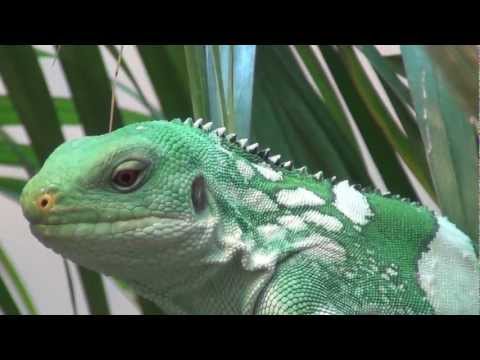
The Crest Ridge is little pronounced in both sexes. there is between 11 and 17 femoral pores on the bottom of each thigh, which are more pronounced in males. Each animal has an individual pattern, neither looks like the other. The normal coloration of females is mostly uniform green, with a light green or white stripe on the front of the body in some specimens. The nostrils are edged with yellow in both sexes.. Males, on the other hand, have a contrasting cross-hatching (green and light blue to two different shades of green) of the body and tail. The intensity of the coloration depends a lot on the mood. In courtship or aggressive phases, light blue stripes on males turn almost white and green stripes dark blue to black.
When the coloration is very intense, yellow spots also appear on front and back legs.
Habitat
The Lau banded iguana feeds on leaves and other plant material. During the day these animals rest in the tops of tall trees. Life expectancy is about 10-15 years.
Behavior
The species is diurnal, spending their days looking for food, basking in the sun and guarding their territories during the day and retreating to the treetops at night. Male iguanas are highly visual and aggressively defend their territories from rival males.. Iguanas deepen their green coloration to intensify their bands, and shake their heads and intimidate intruders by pouncing on them with their mouths open.
Threats to the species
State of conservation ⓘ
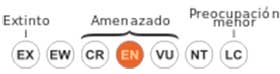
in danger ⓘ(UICN)ⓘ
The Lau banded iguana (Brachylophus fasciatus) is unfortunately highly endangered in its natural habitat and is listed on the IUCN red list. If you want to have this species of iguana in Europe, you must have the corresponding papers and regularly document the animals with photos. feral pigs, the goats, dogs, cats and introduced species, like the mongoose, has contributed to the fact that there are only less than 10.000 animals of this species in freedom.
But, in the meantime, there are breeding projects to increase the natural population of the animals again. Unfortunately, A few years ago it was not known that both Brachylophus bulabula as the Brachylophus fasciatus were kept in private homes. The two species were thought to be the same. As the animals hardly differ from each other visually, many animals mixed with each other. It is very likely that there are no pure species of the Lau banded iguana in Europe.
The "Lau banded iguana" in captivity
The terrarium
The Lau banded iguana should be housed in terrariums 200 x 80 x 120 cm.. Containers can be made of plastic plates (of 1 cm thick). This material is lighter, more hygienic and easier to work with than for example, timber. It also has a much longer shelf life.
Since Lau banded iguana only kept singly or in pairs, the terrariums will be designed so that they can be separated in the center with a plastic plate. The advantage is that the iguanas can be separated and reunited without removing them from their usual environment.. Plastic strips will be placed on the front (20 cm height at the bottom, 10 cm at the top). ventilation (round plastic grilles) will also be incorporated into these two front panels. This has the advantage that there is sufficient air circulation but no drafts. But, this design is not suitable for small terrariums. The front is completed with sliding glass panels of 4 mm thick.
Illumination
Lighting is provided by a fluorescent tube (18 watts) per side and one HQL mercury vapor lamp (80 W). The weights are outside the terrarium. The fluorescent tubes will be on during 14 hours all year (of 7:00 to 21:00 hours), HQL lamps will light at 10:00 hours and will be on until 15:00. In general, It should be noted that the intensity of light plays a decisive role in the breeding.
Terrarium Decoration
The terrariums they are provided with thick branches and cork tubes. Pressed cork boards or coconut fiber mats are placed on the rear wall, that are increasingly accepted by juvenile iguanas to climb.
The plastic plants are used as decoration, Since the Lau banded iguana consider real plants as food. This makes food control difficult and can lead to deaths if the plants are poisonous or hard-fibered.. The substrate is filled with river sand (height of 5 to 15 cm.). The females also use it to lay their eggs.. A water reservoir 45 x 20 x 5 cm. , not used for drinking, complete the assembly.
Bottom heaters are not used, as they would be atypical for tree dwellers. Hideouts are not necessary, Since the Lau banded iguana does not seek visual protection from human observers in terrarium conditions.
Terrarium temperature
The air temperature is about 30°C during the day in summer and about 27°C in winter. At night, values drop by about 5°C each. On very hot summer days, temperatures rise to 35°C, but this does not cause any negative reaction in animals.
Measurements are always made at the center of the sidewall, outside the radiation zones of light sources. The iguanas cover their water needs by spraying the terrariums. This is done daily, depending on the season, once in winter to four times in summer.
Food
Augsburg Zoo, Fijian, Brachylophus fasciatus – Rufus46, CC BY-SA 3.0, via Wikimedia Commons
Feeding is done at different intervals. Seasonal conditions and the weight of the animals play a decisive role. As a rule, iguanas feed every five days.
Overweight specimens are only offered vegetable food every two days.
The Lau banded iguana can be fed with tomatoes, cucumbers, carrots, courgettes, various lettuces, chinese cabbages, dandelions and their flowers, as well as with the following fruits: apples, grapes, oranges, tangerines, peaches and bananas. It also, can accept insects (black beetle larvae, Argentine giant cockroaches, grasshopper, crickets and house crickets). All insects are given only with tweezers to prevent their unhindered dispersal.
The Lau banded iguana develop a character of their own and also have individual food preferences. But, the favorite food of adult iguanas is black beetle larvae (Zophobas morio), that are only offered recently dead for security reasons. Females are less picky eaters than males.. The vitamin preparation, minerals and amino acids Korvimin-ZVT is added to each feed.
Management "Lau banded iguana"
The management of Lau banded iguana too easy, since they are not aggressive and do not bite. But, watch out for their sharp claws. Females are usually a bit more shy than males.. It should be noted that the Lau banded iguana seem to be very susceptible to stress when moved.
Reproduction
Good conditioning of the animals is important as a prerequisite for successful breeding. Fat animals are largely unsuitable for breeding. The females of more than 230 g could only have false pregnancies. Males with excess fat just sit in the terrarium. Males reach sexual maturity already under the year. Females do not reach sexual maturity until they are two years old.. In some cases even before.
The Lau banded iguana does not have a specific breeding season, but can reproduce throughout the year. However, the best time for successful copulation is spring..
The male will approach the female with a strong movement of his head.. If the female is willing to mate, does not change color and retains its normal green coloration. The males are normally very gentle in their approach.. But, this can change drastically if the female is unwilling to mate. The chase then becomes increasingly vehement and aggressive and ends with the female seeking shelter and hiding places on the ground.. Then takes on a stress coloration (dark olive green to almost black). I eat very late, stop the experiment and separate the animals to avoid serious bite injuries. Females can also injure smaller males if they are not ready to mate.. Dominant females do not discolor, they do not take stress coloring. when you put them together, always take the time to observe if they harmonize. In the early years, the iguanas were kept in pairs between one day and four weeks.
Otherwise, they were staying individually. with this method, mating is usually quick, but sometimes with little success (false pregnancies, unfertilized clutches). Females that do not lay clutches for a long period of time are mixed with other males on a trial basis.. With this breeding method, females do not show any stress behavior. When copulation occurs, the male carefully approaches the female from behind and harasses her. This is followed by the typical bite on the neck of lizards. In most cases, copulation takes place on branches or cork tubes. No mating has been observed on the ground. Mating lasts only a few minutes.
As places of oviposition, some areas of the bottom substrate remain more or less moist. Moist sandy areas are preferred, whose surface is additionally protected with a cork branch or tube. The first signs that oviposition is approaching are shown by the female searching the ground and exploring suitable places in the sand.. The period of burrowing activity is highly variable. In the fertilized clutches, the burrowing activity of the female is much more constant than in the non-fertilized. If wet sand areas are not prepared, it can happen that the female destroys the entire floor of the terrarium. Post-inserted storage containers are not accepted, e.g. with peat substrate. The females need between one and two weeks from the beginning of the excavation until the laying of fertilized eggs.. For unfertilized eggs, deposition may occur spontaneously; often, the eggs are simply distributed on the ground without the need to dig. In the upper part of the branches, unfertilized eggs can also be deposited., then they will fall to the ground. But, the period can also last 2 months, with the animal taking several breaks.
When the female has found a suitable place, dig a hole about 10 cm in diameter with a lot of intensity, observing their surroundings carefully. It is barely possible to observe the female doing this. If a male is in the terrarium at the time, the female is not disturbed by him. It also ignores the egg-laying activities of the female.. No matter how high the bottom substrate is filled, animals always dig to the bottom of the terrarium. So, the ground level in the planned storage places must be at least 10 cm.. When they are satisfied with their work, its color changes from green to dark olive green (work coloring). This transformation can only be observed for a very short time. This is followed by egg laying. According to observations, clutch size ranges from 1 and 7 eggs, these two being the extremes. They usually put on 3 to 5 eggs. Once the setting is finished, the eggs are placed in the correct position and the clutch is sealed.
Incubation time varies a lot, although the reasons are not clear. The incubation temperature plays, of course, an important role in this regard, but it does not fully explain this phenomenon. the season of the year, the substrate and predevelopment in the female body probably also play a role. At 28°C the young will hatch after 113 to 126 days, at 29.5°C after 103 to 146 days.
When hatchlings see the light of day, They usually need between 6 and 12 hours from when they open the egg shell until they completely leave it. The sex of the pups can now be clearly recognized by their markings. Usually, the yolk sac has not yet been fully depleted, but falls off on its own after a day or two. The newborn pups have a total length of 17 to 24 cm and a mass of approximately 8 g.
the brood, especially in the first four weeks, requires a lot of time and patience. The food spectrum is the same as that of adult iguanas. So far, young animals have mostly rejected all food in the first period. About five days after hatching, they are offered freshly killed wax worms with tweezers. You have to be careful not to stress the iguanas too much, so the animals should not be surprised. If required, repeat feeding attempts several times a day. after a few days, young iguanas usually start eating waxworms on their own (placed on a branch in front of its snout). Only still mineral water is given as a drink up to nine months of age. The same goes for spraying two or three times a day.. This is done as a precaution (chlorine content in tap water). Young animals are moved to terrariums just as large as adults, since this seems to favor its growth. A small disadvantage is that the insects (except grasshoppers) should always be given with tweezers. Solitary breeding is not necessary in the first months; even several males can be kept together without problems. Only in very difficult cases is solitary breeding preferred.. The character of the young animals is already pronounced individually. Some are more confident, others more reserved.
Buy one "Lau banded iguana"
if you want to buy one Lau banded iguana, you should expect to pay a lot of money for it. They are not easy to find online and you are not likely to find one at your local pet store.. As a result, you could end up paying 1.000 euros for one of these iguanas.
1. Lau banded iguana (English).
2. Iguane des Fidji (French).
3. Kurzkammleguan (German).
4. Iguana-listrada-de-fiji (Portuguese).
5. "Iguana bandeada de Fiyi" (español).
▷ The world of Pets: Dogs, cats, birds, reptiles, amphibians
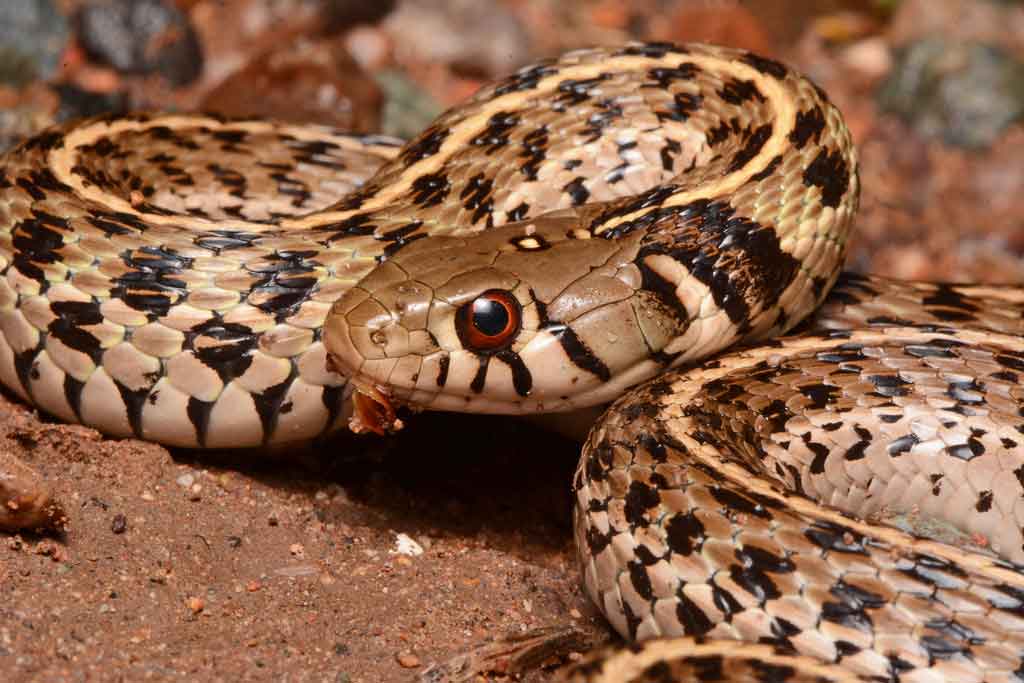
Checkered garter snake
- Thamnophis marcianus
Origin: United States, Mexico, Guatemala, Belice, El Salvador, Honduras, Nicaragua and Costa Rica
Gender: Thamnophis
Life expectancy: 15 years
Length: 45 - 90 cm.
This species has a calm character. When the Checkered garter snake feels threatened, usually flees.
(Thamnophis marcianus marcianus) from Hidalgo County, New Mexico, USA. – Andrew DuBois – Flickr
Content
Origin / Distribution
The Checkered garter snake (Thamnophis marcianus) is commonly found in the United States, Mexico and some parts of Central America. In United States, are found in Southwestern California, southwestern Arizona and southern New Mexico. In Mexico, have been found as disjoint populations along the Rio Grande, Veracruz, Juchitán de Zaragoza, Tabasco and the center of the Yucatan Peninsula. In Central America, have been found in Tegucigalpa, Honduras; Lake Nicaragua and Managua, Nicaragua; northeastern Costa Rica; The Estrus, Guatemala and Orange Walk, Belice.
Characteristics / Appearance
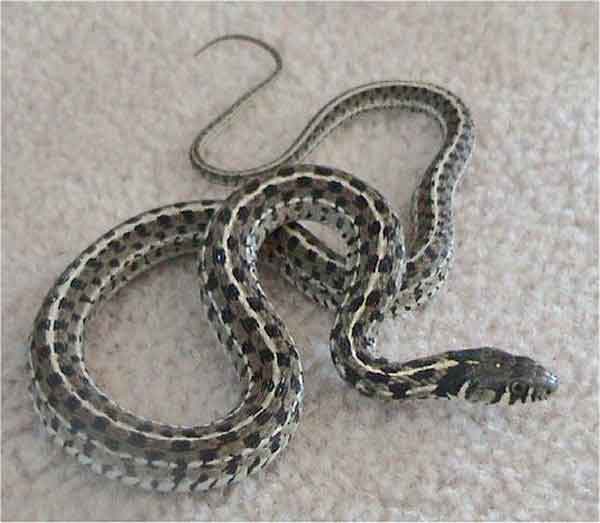
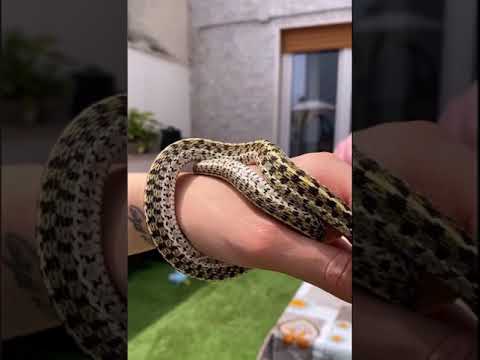
The Checkered garter snake it gets its common name from the checkered pattern of light black and gray spots along its body.. Both females and males have the same pattern. They have pale yellow stripes along their spines and sides, while its ventral sides are cream-colored. Their heads are olive green with a single thick black line on the neck.. Your body may be gray, brown, oliva, tanned or albino. They have 21 rows of keel-shaped dorsal scales.
Adults weigh an average of 60 g, but they can come to weigh between 31 and 122 g. Adults, can measure between 45 and 106 cm., but the average for adults is 55 cm. (including the queue). The average length of the tail is 16 cm.. The tip of the tongue is black and the rest is a deep red. On the head they have a pale yellow crescent in front of the neck. The females of the Checkered garter snake are bulkier and longer than males, that are thinner and shorter. Females measure an average of 82 cm and weigh 81 g, while males measure 51 cm and weigh 51 g.
The Checkered garter snake measured between 15 and 20 cm. (including the queue) at birth. Juveniles have the same checkerboard patterns as adults.
Habitat
The Checkered garter snake it inhabits areas ranging from sea level to elevations of 2.200 m. It can be found in a variety of habitats ranging from wetlands. (for example, humid tropical forests) to the drylands (deserts and dry forests). They are located in or near water sources such as rivers, ponds, Springs, ditches and lakes. When they are in the grasslands, tend to dig under rocks, logs and thick vegetation. They can also be found in courtyards and gardens. Their populations are shifting westward, traveling along irrigation canals.
From November to the end of February, hibernates at a temperature between 10 and 15° C.
Mating takes place between March and April. From June to August you can give birth to more than 30 live offspring.
Behavior
This species has a calm character. When the Checkered garter snake feels threatened, usually flees. If escape is not possible, defend themselves by threatening and, if that doesn't work, Biting. A last defensive technique that can be used by the Checkered garter snake is emptying your glands and often defecating at the same time. This releases a very unpleasant smell.
Reproduction
The Checkered garter snake begins mating in spring – as soon as it comes out of hibernation at the end of March- until the beginning of April. When it's time to mate, females stop eating and groups of males emit strong pheromones so that females can find them. Once a female has mated, her partner goes to find another female to inseminate her. Females also have the ability to store sperm.
In the North, mating occurs in burrows, where temperatures are warmer; temperatures below 10 °C may cause death or neurological disorders. In the South, when temperatures are 15 at 30°C, reproduction is usually more successful. When they finish mating, females can store sperm or fertilize immediately after mating. Its gestation period is normally 80 to 105 days. Females give birth to a clutch from between 6 and 35 offspring between the months of July and September. Ford and Karges (1987) studied cage snakes in south Texas and northeastern Mexico, and hypothesized that some females may have two clutches a year.. Although they do not support it directly, his anecdotal evidence was the discovery of "fully developed" offspring at two points in the season.: April and September.
Males reach sexual maturity at 1,5 years, while females do it to the 2 years. As soon as they are born they are already independent. At birth, the Checkered garter snake weighs an average of 13 g.
The males of the Checkered garter snake have no parental involvement beyond the act of insemination. Females carry and protect their young in their body until they are born. Once born mothers do not provide more parental care.
Food
Diet Checkered garter snake consists of a wide variety of animals, like worms, mice, fish, lizards, slugs, amphibians and eggs. Types of amphibians they eat include tadpoles, adult frogs and salamanders. They hunt small prey in ditches and streams using smell and sight. When kept in captivity, eat thawed mice or other snakes.
Threats to the species
State of conservation ⓘ
Minor Concern ⓘ(UICN)ⓘ
The Checkered garter snake is classified as a species of "Least Concern" on the IUCN Red List. They do not have special status on the U.S. federal list, in CITES or on the State of Michigan's list.
Most of the populations of the Checkered garter snake throughout their range are stable, but a few disjoint populations in Mexico could be threatened. Several emerging threats include excessive use of pesticides (that can eliminate prey species or bioaccumulate in snakes), the loss of amphibious prey in Mexico and habitat loss.
In some cases, the Checkered garter snake already inhabits protected land (for example, national parks) and there are captive breeding colonies in Mexico. They are also somewhat common in the pet trade., because they are easy to keep in captivity and quite docile. It is believed that the Checkered garter snake is increasing its range following irrigation ditches (in correlation with the expansion of agricultural practices).
The Checkered garter snake is active throughout the day. This species is usually more active than most domestic snakes.. During the coolest hours of the day they travel their territory in search of food.
The terrarium
Minimum enclosure size for a couple: 80 x 50 x 50 cm..
Surface: 0,5 m2
Daytime temperature: 24-28º
Night temperature: 18-22º
Daylight hours: 12 hours
Humidity: 40% -60%
Land cover: newsprint, humus or sand
Diet
You can choose between offering live or dead prey. It is advisable to offer dead food. This is more practical and prevents the animal that serves as your food from harming your snake.. It also, it is recommended to offer the food with a clamp and do it outside the enclosure. This ensures that her hand is not exposed as food and prevents it from clinging to your hand while you feed it.. If you choose to feed it with live food, you should watch while feeding it. This is because two snakes that have the same prey can injure each other and, sometimes, even eating each other. The ideal prey is as wide as the widest part of the snake.
Cleaning
A hygienic living environment is important to maintain the health of your Checkered garter snake. As such, it is necessary to clean the enclosure regularly. Cleaning once a week is enough. To prevent the accumulation of bacteria, you have to clean and disinfect the entire terrarium a couple of times a year.
Management
This variety has a calm character and is usually easy to handle. But, you have to take into account some things when handling it. Never squeeze the Checkered garter snake when handling it, as the rotating links are fragile and can break easily. It is best to let the snake rest comfortably in the hand. Also make sure your hands are washed and don't smell like food..
Buy one "Checkered garter snake"
When buying, preferably choose young offspring. Animals caught in the wild are usually infected with parasites (internal and/or external), are habitual carriers of diseases and are very sensitive to stress.
Its price in the exotic animal market ranges from 50 – 100 EUR.
1. Checkered garter snake (English).
2. Serpent jarretière à damier (French).
3. Karierte Strumpfbandnatter, Bunte Strumpfbandnatter, Schachbrettnatter (German).
4. Cobra-liga quadriculada, Serpente de liga quadriculada (Portuguese).
5. "Culebra listonada manchada", Sochuate, Culebra de agua, Culebra Jarretera Ajedrezada (español).
▷ The world of Pets: Dogs, cats, birds, reptiles, amphibians
Eastern kingsnake
- Lampropeltis getula
Origin: United States, Mexico
Gender: Lampropeltis
Life expectancy: 25 years
Length: 100 - 140 cm.
Primary habitat varies by subspecies. The Eastern kingsnake can be found in forests, Meadows, deserts and urban areas.
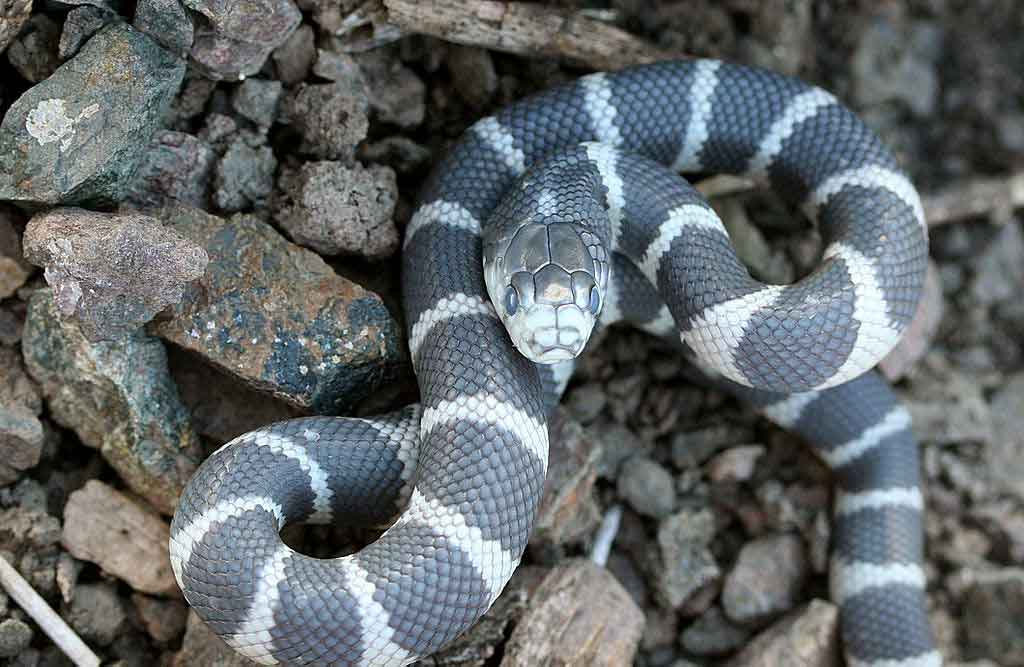
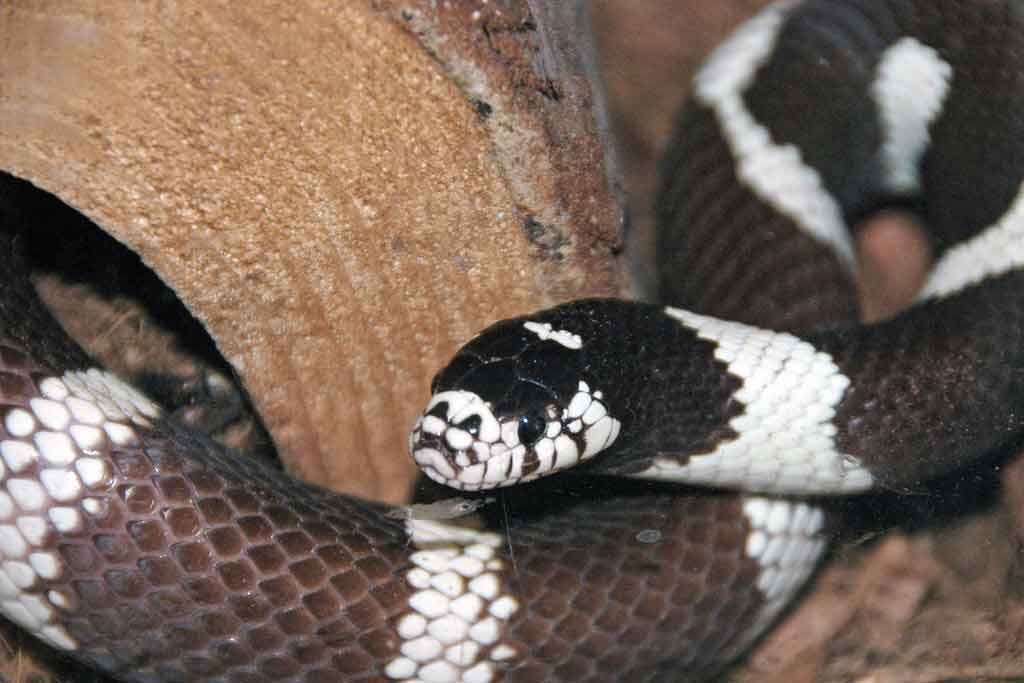
oven «California king snake» (Lampropeltis getula californiae) taken at Coyote Hills Regional Park in the San Francisco Bay – Calibas, CC BY-SA 3.0, via Wikimedia Commons
Content
Origin / Distribution
The Eastern kingsnake (Lampropeltis getula) it is one of the only species of king snakes found in most of North America.
There are seven subspecies of Lampropeltis getula in North America.
The Lampropeltis getula getula (Eastern kingsnake) found on the east coast of North America, from southern New Jersey and southeastern Pennsylvania to eastern parts of West Virginia, southwest to Mobile Bay, Alabama, and east to northern Florida.
The Lampropeltis getula floridana (Florida kingsnake) is located on the Florida panhandle south of Dade County.
Lampropeltis getula californiae (California kingsnake) is restricted to southwestern California and Baja California. in the Canary Islands (Spain), is considered an invasive species, being the native lizard of Gran Canaria, prey of that species.
Lampropeltis getula holbrooki (Speckled kingsnake) is located in southwestern Illinois, eastern Iowa and south-central Alabama.
The Lampropeltis getula nigra (Black kingsnake) lies west of the Appalachian Mountains and east of the Mississippi River; this includes the region from West Virginia to southern Ohio, southeastern Illinois and northern Alabama.
The Lampropeltis getula splendida (Desert kingsnake) would originate from Texas, Arizona and New Mexico, United States.
The Lampropeltis getula nigrita (Mexican black kingsnake) found in southern Arizona and northwestern Mexico.
Subspecies overlap and interbreed in several different regions of North America.
Subespecies Lampropeltis getula
Lampropeltis getula getula (Eastern kingsnake)
Lampropeltis getula floridana (Florida kingsnake)
Lampropeltis getula californiae (California kingsnake)
Lampropeltis getula nigrita (Mexican black kingsnake
Characteristics / Appearance
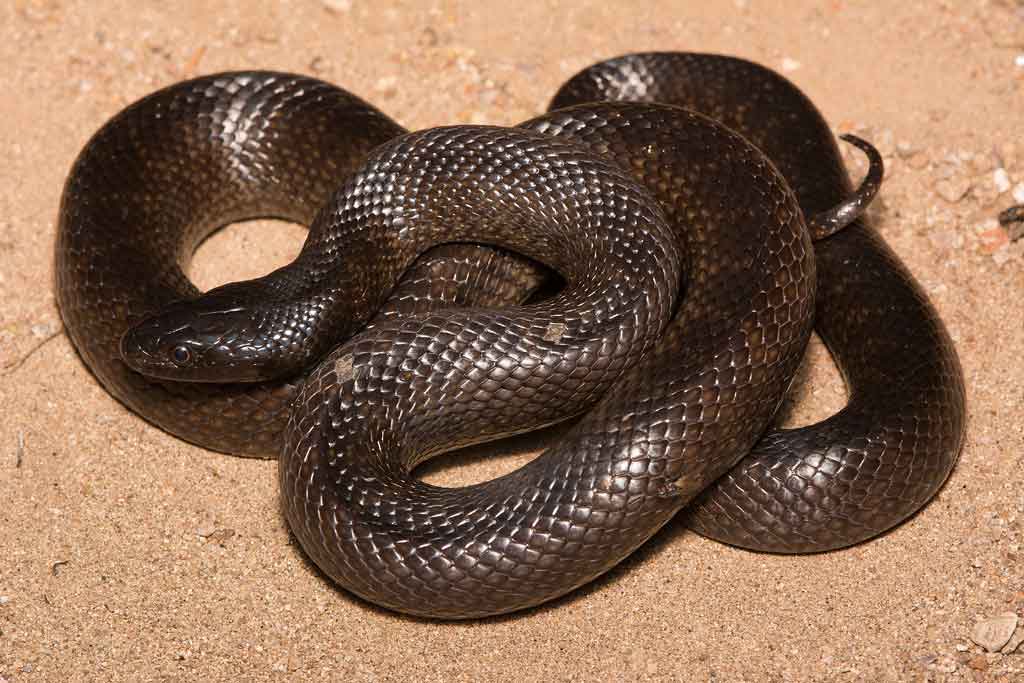
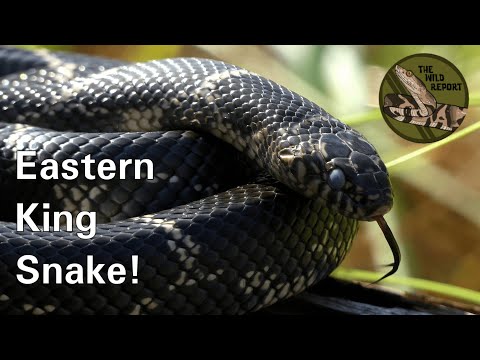
Since the physical description of Lampropeltis getula varies greatly between subspecies, Each of them will be described separately.. One measurement they all share is the length of the pups.: of 20 to 28 cm al nacer. The adults of the Eastern kingsnake (L. g. getula) They can reach a length of 61 to 153 cm.. They are big snakes, solid and shiny black with yellow crossbars (sometimes white) stretching along the snake. The head is solid black with several yellow or white spots decorating the scales on the head..
The Speckled kingsnake (L. g. holbrooki) can reach a length of 51 to 132 cm in adulthood. They are black with yellow "flecks" on their scales and along them. The underside is pale yellow to white with some of the black scales curling on the sides..
The California kingsnake (L. g. california) can reach a length of 91 to 106 cm.. They have white crossbars that intersect with black spots along the back.. The head is normally white with a black upper part and some black scales on the side..
The Florida kingsnake adult (L. g. floridana) can measure between 106 and 138 cm.. The only major difference between Florida and Eastern garter snakes is that they have 60 transverse bands, while the eastern ones only have 30. The belly is pale yellow with alternating "zigzag" patterns of black scales..
The Black kingsnake (L. g. nigra). Adult specimens reach an average size of 90 to 122 centimeters in total length, with some reaching maximum total lengths of 147 to 183 centimeters. It is generally similar to L. getula getula, although it can be distinguished by its geography and appearance. Has a black body interspersed with widely spaced yellow or cream-colored specks, larger and more numerous along sides. the back, in some cases, it has no drawings and in others it has crossed bands. The belly shows a black and yellow checkered pattern (or cream). The ventral scales range from 197 and 222 in both sexes, and the subflows between 45 and 59 in males and 37 and 51 in females.
The Desert kingsnake (L. g. splendida) can reach from 123 to 153 cm.. The shiny back of the snake is black or very dark brown., finely mottled blanco or amarillo. These pale specks form vaguely defined narrow vertebral crossbands, between which the intervening rectangular areas are black. Pale yellow scales may predominate along lower sides. The abdomen of adult and young snakes is mostly black, with white or pale yellow spots marking outer ends of ventral plates. The smooth dorsal scales are arranged in 23 to 25 rows in the middle of the body and the anal plate is not divided.
The Mexican black kingsnake (L. g. nigrita) can reach a length of 106 to 132 cm.. They are black and shiny, with approximately 75 thin yellow crossbars. This subspecies also has yellow spots on the black scales that run down the sides of the snake..
Life expectancy
Little information is available on the longevity of Eastern kingsnake in its natural environment. Most of the available information comes from captive snakes. The Eastern kingsnake older wild had 9 years (reported in 1937). The Eastern kingsnake longest in captivity had 33,3 years.
Habitat
Primary habitat varies by subspecies. The Eastern kingsnake can be found in forests, Meadows, deserts and urban areas. The microhabitats of most subspecies include: under the wood, in rubbish heaps, barns, along stone walls, on sunny embankments, in stump holes or sunny clearings.
The coastal subspecies, as the Florida kingsnake and some Eastern king snakes, can be found along the edges of swamps, marshes and levees. Other subspecies, as the California kingsnake and Mexican black kingsnake, limited to arid areas. Elevation also varies by subspecies. These may include, the California kingsnake has the widest lifting range, from the Pacific coast to the 915 m. The Eastern kingsnake (123 to 305 m) and Black kingsnake (153 to 305 m) share similar limited elevation ranges. The Speckled kingsnake can be found at elevations up to 610 m.
The Eastern kingsnake it is diurnal. Its annual activity period is between the end of March or the beginning of April and October and the beginning of November.. They hibernate during the winter in caves., cracks in the rocks, mammal burrows, hollow logs and on old stumps. During the cooler days of spring and fall they can be found outside during the day basking in the sun.. They spend most of the day under leaf litter and other debris and spend the rest of the time traveling, sunbathe and hunt. The Eastern kingsnake not limited to the ground, but can climb trees and swim quite well. Fights between males are common (during mating season).
Developing
Snake eggs have a large amount of yolk that contains the fats and carbohydrates necessary for the development of the embryo.. Towards the final stages of development, the snake fetus absorbs the yolk. It also, the embryo extracts part of the calcium for the egg shell and uses it to form its skeleton. Once the skeleton is formed, the shell becomes thinner and more flexible. Oxygen exchange decreases over time, which in turn drives the hatchling out of the egg, using the "tooth" of the deciduous egg in the nose.
after hatching, the young remain in the nest until they shed their skin for the first time. This usually lasts about a week. Next, the hatchlings scatter. Information on the period after hatching is scarce.. The Eastern kingsnake reaches sexual maturity at about half its maximum potential size, between 60 and 92 cm.. In captivity, can reach sexual maturity much earlier due to abundant food source and limited parasites and disease.
Reproduction
The males of the Eastern kingsnake compete for females. If two males are in the same area, both raise their heads, the neck and the front of the body and intertwine them. The males then try to press each other to the ground.. The losing male will withdraw and curl up in a prone position with his head resting on the ground.. The victorious male will return to the female waiting nearby and copulate.. Males are able to find females through pheromone trails.. when they mate, males lie on top of females and bite their necks. Next, males curl their tails under females until their vents line up. The male uses his hemipenis to enter the female's cloaca.. Copulation can last from several minutes to several hours.
The Eastern kingsnake appears in spring, allowing females to lay their eggs when the weather is still warm enough for proper incubation. Its gestation period is about 60 days. In the hottest climates (for example, Florida), courtship can start as early as March. In the northern parts of the range, courtship is delayed until April or May.
A female can produce a single clutch of multiple pairs.. Females can also produce more than one clutch per season as a result of more than one mating.. The female chooses the nesting site., which can include rotten logs and stumps, as well as piles of sawdust. The Eastern kingsnake breeds annually and has been known to produce more than one clutch per season. The breeding season is between March and August. The average number of offspring is 10 eggs per clutch (between 3 and 24). The average gestation period for females is 60 to 62 days (range of 50 to 80 days). The young can weigh between 9 and 14 g.. Females reach sexual maturity between the 2 and 4 years. Males reach sexual maturity between 1 and 4 years.
after intercourse, male will leave female and not return to help with parental care. After the female lays her eggs, will disperse and will not return to the nest.
Food
The diet of adults Eastern kingsnake varies between subspecies and is very wide, but published reports are available on some representative subspecies. The Eastern kingsnake and of Florida they feed mainly on other snakes, including poisonous (coral vipers, copper heads, massasaugas and rattles), the Eastern garter snakes (Thamnophis sirtalis), the Northern water snakes (Nerodia sipedon), the Ring-neck snakes (Diadophis punctatus), the Smooth earth snakes (Virginia valeriae) and Worm snakes (Carphasphis amonenus). They also feed on Five-lined skinks (Plestiodon fasciatus), the White-footed mice (Peromyscus leucopus) and the eggs of the Northern bobwhite quail (Colinus virginianus).
The Eastern kingsnake listed as a "species of concern" on the US federal list. This may be because the Florida kingsnake, L. g. floridana, is in decline. Among the reasons for the decline are anthropogenic causes due to the extensive pet trade, road deaths and habitat loss.
The fire ants invasive (Solenopsis invicta) are also harming the populations of L. g. floridana by competing for food sources such as turtle eggs.
Benefits for the human being
The Eastern kingsnake it is one of the most popular snakes to keep as a pet, Next to the Boa constrictor. They play an important role in controlling poisonous snake populations, that can pose a threat to humans.
The Eastern kingsnake or lampropeltis getula is one of the most common snakes in the United States, at least for a good reason: it is relatively easy to maintain.
Due to its presence throughout North America, he has no problem living in captivity and is used to humans.
It was one of the first captive-bred snakes.
The terrarium
First of all, these snakes eat other snakes, so ONLY ONE snake per Terrarium
For one Eastern kingsnake baby, you can choose a terrarium of dimensions 60 x 40 x 40 cm.. For one Eastern kingsnake adult, choose at least one vivarium of dimensions 80 x 40 x 40 cm.. Make sure it has a secure, leak-proof opening. If there is a weak point, the Eastern kingsnake will find it and escape.
Caveat: Do not keep together Eastern kingsnake juveniles or adults, since they could eat each other.
In the case of females, cohabitation can be considered once they have reached a medium size (90 cm.).
But, separate them to feed them.
What to put in your terrarium?
Place a hiding place in your nursery, a container of water (see humidity section below) and non-toxic plant ornaments (synthetic soles in case of doubt).
Temperature and lighting
The Eastern kingsnake does not need special lighting if the cage is in a room with natural light. Otherwise, use a light bulb, that will mimic natural sunlight.
Be careful not to place the cage in or near a window where it is getting direct sunlight., otherwise it could get too hot and be fatal to your Eastern kingsnake.
What temperature is ideal for a Eastern kingsnake?
The temperature for a Lampropeltis getula during the day is 27 at 30°C at hot spot, and 24°C at the cold point. At night, the temperature is 24°C in the hot spot and 22-23°C in the cold spot.
The Eastern kingsnake thermoregulates in nature. They move to find and hold (when they can) a preferred temperature. being cold blooded, get the temperature of their environment. In captivity, options are limited to what is offered. So, must have a hot and a cold end of his cage.
There are many heaters, pads, cables and tapes available to do it. Some people use lamps for warmth, but this is not an efficient use of energy and has its drawbacks.
What substrate do I use for a Eastern kingsnake?
The ideal substrates for Eastern kingsnake are : reptile mat, and natural bark.
Feed them in another box to prevent them from swallowing the substrate, o leave food on newspaper or paper towels.
Avoid, at all costs, cedar-based sand or chips, since sand favors the growth of bacteria and cedar is toxic to reptiles and could cause your snake serious respiratory problems.
what does one eat Eastern kingsnake?
In the wild, the Eastern kingsnake eats almost any animal or bird small enough to swallow whole, including other snakes.
In captivity, ofréceles rodents like little mice (they are the most affordable and easy to get). Usually, snakes are given freshly thawed or "freshly" dead mice. Live mice can do a lot of damage to your snake, or even kill her!
Feed her twice a week when she is growing, and once a week when it reaches adult size.
Regarding the size, it is better not to exceed the diameter of the snake's body. You should also not handle your snake until it has finished completely digesting its food..
What type of humidity is ideal for Eastern kingsnake?
Place a container of water deep enough for your snake to bathe half of its body, and without the water overflowing in the cage.
This will help to get the necessary humidity (higrometría) for your snake: 60%. Calculate it with a hygrometer.
Management and temperament Eastern kingsnake
Although it is bred in captivity, the Eastern kingsnake can be aloof and fearful of humans. May defecate or urinate on you when you pick it up. This is a natural behavior to deter you (as a potential predator) to eat it. If you see that it is in “S”, don't get too close, is in attack mode (like an abo in pokemon).
With regular and gentle treatment, your lampropeltis will feel more and more safe with you. Caress, moving away from his face, with a bit of friction to slow down their shaking, is the best way to start handling it.
molt of the Eastern kingsnake
The Lampropeltis Getulus if changes each 2-3 months approximately. It's easy enough to see when this is the case: your eyes will have a white or bluish "glassy" appearance. Your snake will take a few days to completely shed its skin., so it is likely that he will do it in his hiding place. Check that everything is going well and that he is still eating/pooping during this period. Do not handle your snake when it is about to shed.
If you see that it is difficult for it to detach from the skin and dry pieces stick to the scales, consider giving him a quick bath at room temperature to help him shed any remaining skin.
Buy one "Eastern kingsnake"
The California kingsnake it is the most popular subspecies among fans of terrarium animals. Its price in the exotic animal market ranges from 150 – 200 EUR.
Videos "Eastern kingsnake"
🐍 California Kingsnake (Lampropeltis california) - Information, care..etc 🐍
1. Eastern kingsnake, Common kingsnake, Chain kingsnake (English).
2. Serpent roi (French).
3. Kettennatter, Ketten-Königsnatter (German).
4. Cobra-real oriental, Cobra-real comum, Cobra-real de cadeia (Portuguese).
5. "Serpiente real común", Serpiente rey del este, Serpiente rey de la cadena, Serpiente rey oriental (español).
▷ The world of Pets: Dogs, cats, birds, reptiles, amphibians
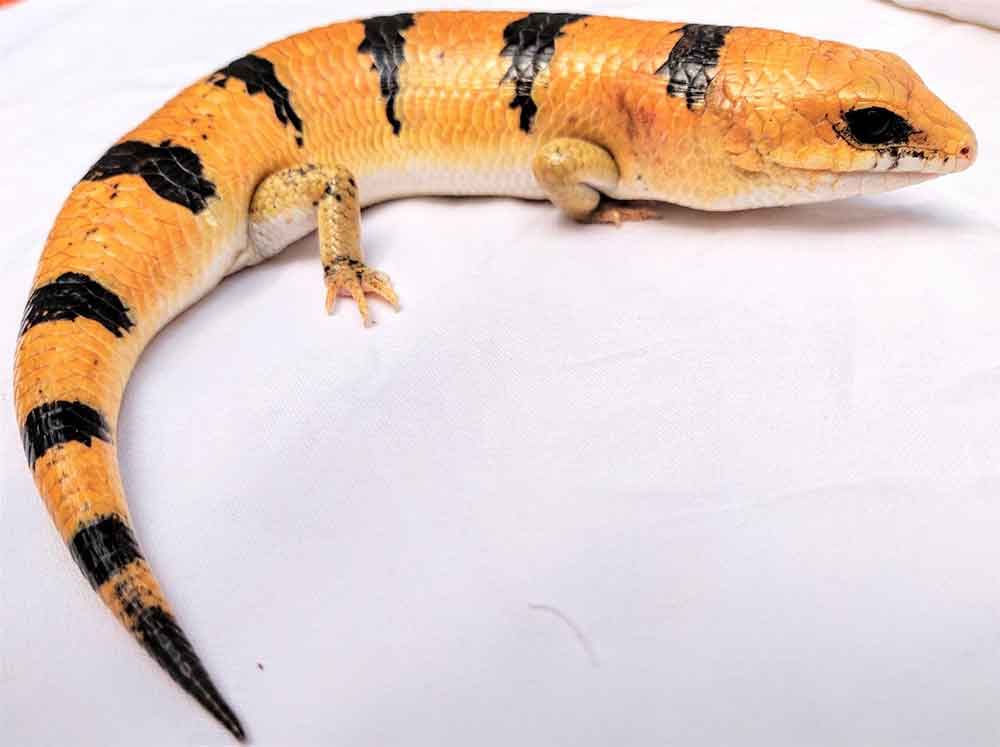
Very rare and very little seen niger skink. It is an animal of terrestrial customs and dry areas, desert and semi-desert type Sahel. The diet is based on insects. It is convenient to put a grotto to make you feel more comfortable, although it is a sociable and very docile animal.
Its price ranges from 90 and 140 EUR.
Alternative names:
1. Peters's banded skink (English).
2. Scinque bandé de Peter (French).
3. Tunesischer Nachtskink (German).
4. Lagartixa de Peters (Portuguese).
5. "Escinco gigante de Níger" (español).
▷ The world of Pets: Dogs, cats, birds, reptiles, amphibians
Mountain horned dragon
- Acanthosaura capra
Origin: Cambodia, Laos and Vietnam
Gender: Acanthosaura
Life expectancy: More than 7 years
Length: 30 cm.
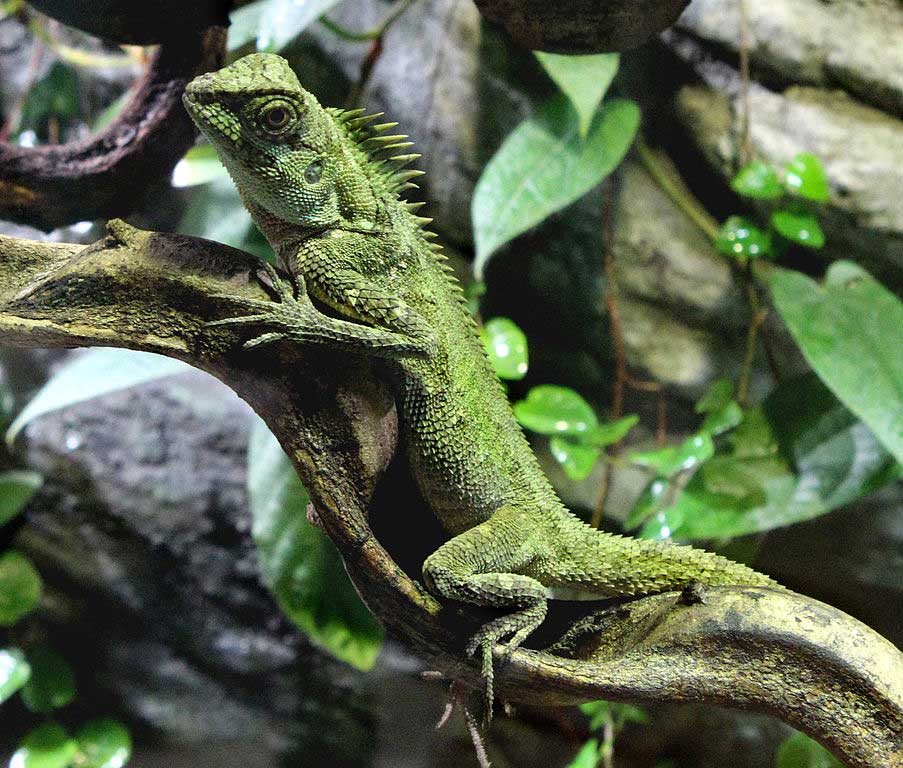
The Mountain horned dragon is a beautiful lizard that is also called asian chameleon, due to its color changes and its arboreal habits.
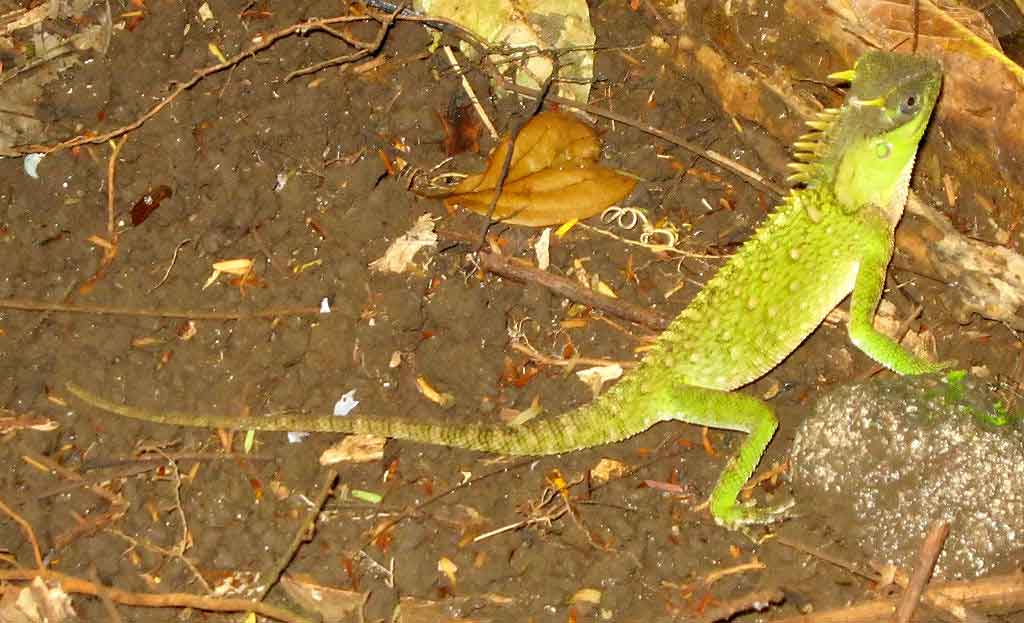
Acanthosaura capra, Cat Tien National Park – Roy Bateman, CC BY-SA 3.0, via Wikimedia Commons
Content
Distribution and habitat
The range of the species is Cambodia, Laos and Vietnam.
The Mountain horned dragon lives in dense forests on top of tall tree trunks. These lizards prefer the shady area under the treetops, and they rarely look for sunny places.
Like many other arboreal lizards, only flowing water is seen and they would even like a lake.
It is a kind of calm lizard that prefers to remain motionless rather than run away.
Description
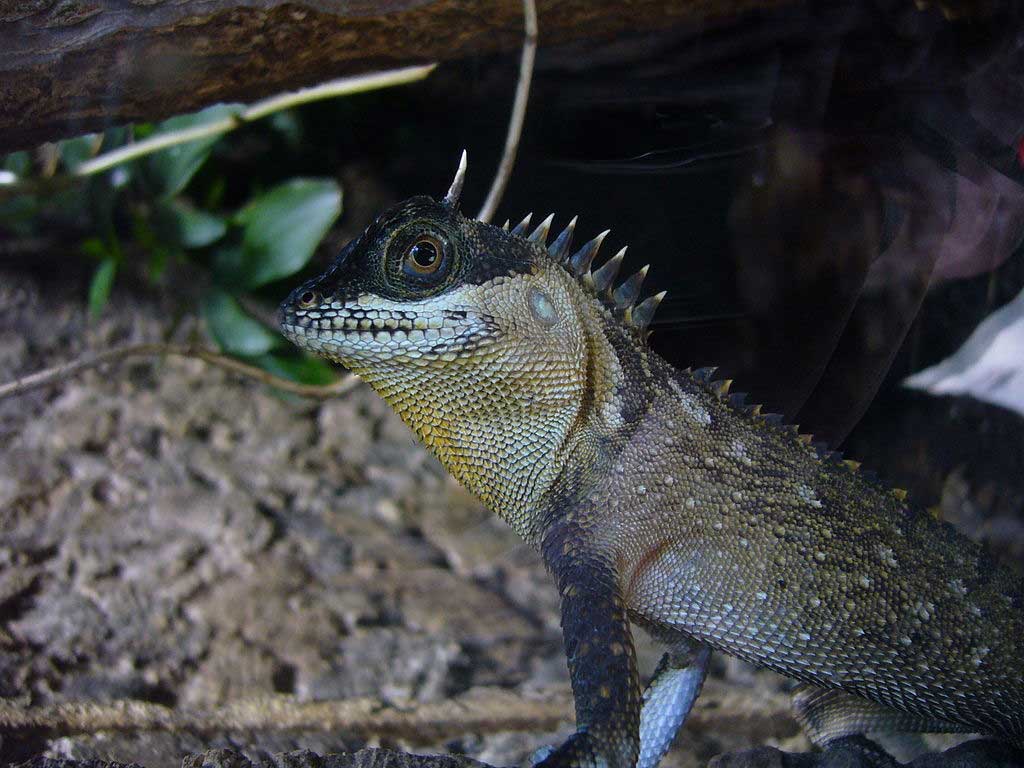
The Mountain horned dragon has a thorn above each arch of the brow. They can lose this column, which does not regenerate. Otherwise, this spiny lizard has no thorn on the back of its head, although all other species show it..
The nuchal ridge is quite high and clearly separates from it in a uniformly flattened dorsal ridge.. The eardrum is clearly visible. Body markings are a brown web on an olive background. When they are stressed, these animals only show dull brown colors.
The eyes are surrounded by a light green ring followed by a dark green ring.
Strong toes correspond to being in trees.
The tail is slightly flattened.
Size
Males reach a total length of 30,5 cm.. Females appear larger, 32 cm..
Sex differences
The species has a sexual dichromatism. The male has a large throat pouch, yellowish with a green stripe. The head is also yellowish with a green band under the eye ring.
Females appear more robust in body structure.
The species is shy in nature and tends to run away.
The terrarium should be thickly covered and deep enough to provide security. Vertically anchored branches are especially important, since animals do not like to stay horizontal.
Otherwise, they are a calm species that does not change position for many hours. Animals are not sun worshipers at all, rather they avoid bright light and remain under the treetops.
Although they are native to the rainforests, I can describe an aversion to direct irrigation. They like running water and prefer swimming pools.
Courtship and mating
The male woos with a beautiful tilt of the head. He also shows his yellow throat bag. Here a tall trunk is important for the female to recognize this beautiful presentation. Neck bite is immediately followed by mating.
Clutches and incubation
Clutches mature in a few 4 weeks and are carried out by the female in a sufficiently high and moist substrate. Dig a hole of about 10 depth cm, put there between 12 and 15 eggs and compacts the substrate with strong head blows.
At 21-25°C the embryo develops in 190 days to hatch.
Hibernation
Simply turn off the power and reduce lighting to a minimum for a few 8 weeks.
The Mountain horned dragon has a very diverse nutritional spectrum, in which he does not disdain the lizards.
Earthworms and other worms are preferred. Fish are active prey, young rodents from the nest are also on the menu. Of course, all insects can be offered. Meadowsweet plankton should be preferred, as well as various species of crickets, grasshoppers and cockroaches, and even waxworms and black beetle larvae.
It is essential to guarantee a moderate feeding of the animals according to their calm way of life. How they live in a rather cool climate, tend to become obese quickly if fed too much.
As an example, just to illustrate the amount, they can feed 2 common earthworm (Lumbricus terrestris) big and one Dubia roach (Blaptica dubia) average size per week. If the lizard also actively catches a fish, this is enough.
Supplementation
Insects must be well fed and, of course, continue to be dusted with a multivitamin and mineral supplement. Range is recommended Herpetal or Korvimin ZVT with a mixture of calcium.
Keep in mind that neither fish nor earthworms can complement each other, but they have a very good nutritional value. Earthworms, in particular, they are rich in calcium, and that's why they are so important.
Terrarium
The Mountain horned dragon can be kept in a paludario ⓘ.
Paludarium already indicates that it is a terrarium with a large basin of water and a waterfall.
Dimensions must not be less than 140 cm x 70 cm x 170 cm. (length x widht x hight). Height is especially important because animals live under a canopy of leaves. But, above the dense vegetation there must be lighting, that animals largely avoid.
The distance to the substrate must also be maintained, since to him Mountain horned dragon he likes to stay on tree trunks.
Installation
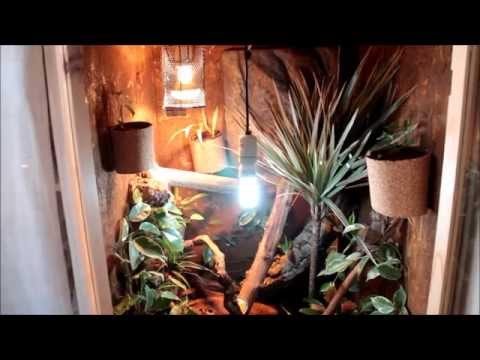
Presentation terrarium of Sin, mon Acanthosaura capra
The habitat is the subtropical jungle and must be recreated in a terrarium. You should focus on the essentials, that is to say, a basin with fish, a great waterfall, plants and soil.
The back walls are designed so that many plants can thrive there. Can be designed using Xaxim or humus, as this material also retains moisture well. The substrate is filled high enough and moist. Plants and many branches offer the freedom of movement of a tree.
The sunny areas are rather secondary, since the Mountain horned dragon prefers cooler and shady places. Lighting is mainly for plants.
Plants
Plants not only regulate the climate in the terrarium, they also serve as protection, residence and welfare for animals.
Planting with ficus species, like the "oakleaf ficus" Ficus quericifolia and Ficus scandens, is the most sensible option. It also, a variety of other plants can be chosen, all of which must tolerate high humidity and be small-leaved. These may include, the Chirita Tamiana, the Pellionia daveauana, the Hemigraphis repanda, and the Parthenocissus inserta they are suitable, but it is also enough to choose the ivy Epipremnum pinnatum.
Substrate
The choice of substrate is important because it must retain a lot of moisture, must not become moldy and must have good egg-laying properties. An unfertilized soil is recommended, preferably from deciduous forests.
The substrate must have 15 cm in height so that the female has optimal conditions for laying eggs. If the female feels insecure, if the substrate is too poor or not moist enough, this can lead to an egg-laying drought.
Illumination
Lighting in a forest terrarium plays a subordinate role for animals, not for plants. The Mountain horned dragon they are not usually sun worshipers, rather they avoid a light level. It is important to avoid excess heat through good lighting. Fluorescent tubes have been successful.
Example: for a terrarium of 140 x 60 x 170, 6 BioVital full spectrum tubes, T5, with 54 high output watts, have proven their effectiveness. It also, UV lamp can be offered for a few hours.
Temperatures
In the terrarium a basic temperature of 23-25°C should be offered. A spotlight can also be used to provide a temperature of 30°C, but this should not raise the base values. It is important to keep the temperature at 18°C at night.
Humidity
Relative humidity should be 50-60% during the day and increase to about 90% At night. Due to the cold night, to the plants, to the moist substrate and to the walls, plus a water basin, humidity inevitably increases at night.
For sale "Mountain horned dragon"
The price of a "Mountain horned dragon" ranges between 35 – 45 EUR.
Alternative names:
1. Indo-Chinese spiny lizard, Green pricklenape (English).
2. Dragon cornu des montagnes, Lézard cornu des montagnes, Dragon de montagnes (French).
3. Berg gehörnten Drachen (German).
4. Dragão com chifres da montanha, Lagarto espinhoso indo-chinês, Pinheiro verde (Portuguese).
5. Acantosaurio, Dragon cornudo de Vietnam, Camaleón asiático, Lagarto Jesucristo (español).
Sources:
DREWS, Olive (2009): Kompaktwissen Agamen, VIVARIA Verlag, Meckenheim, 29-31 S.
HALLERMANN, Jacob (2000): The taxonomic status of Acanthosaura fruhstorferi Werner, 1904 and Calotes brevipes Werner, 1904 (Squamata: Agamidae). Mitt. Mus. Natural. Berl., Sole. row, 76 (1): 143 150
HALLERMANN, Jakob (2005): With horns, Combing and gliding - the bizarre tree agamas. reptile 10 (1), NTV publishing house, Münster; 18-25 S.
HARBIG, P. & U. MARONDE (-01/1983): The genus Acathosaurus: Acanthosaura armate, A. capra, A. crucigera und A. lepidogaster. SAURIA publishing house, Berlin, page 31-33
ASK, Werner & H. Hermann SCHLEICH (2000): Quote in: JACOB HALLERMANN (2005) With horns, Combing and gliding - the bizarre tree agamas. Reptilia10(1) NTV publishing house, Münster, 18-25 S.
MANTHEY, U. & N. Schuster (1992): agamem. Herpetological specialist publisher 120 S.
MANTHEY, U. & W. GROSSMANN (1997): amphibians & Reptiles of Southeast Asia. Nature and Animal Publishing House (Münster), 512 pp.
MANTHEY, Ulrich & Norbert SCHUSTER (1999): agamem. NTV publishing house, Münster
MANTHEY, Ulrich (2008): Agamid lizards of Southern Asia, Draconinae 1. Terralog 7, 160 pp.
MANTHEY, Ulrich (2010): Agamas of southern Asia / Agamid Lizards of southern Asia: Draconinae 2 – Leiolepidinae – Frankfurt am Main, Edition Chimaira
▷ The world of Pets: Dogs, cats, birds, reptiles, amphibians
Boa constrictor
- Boa constrictor
Origin: South America
Gender: Boa
Life expectancy: 20 - 40 years
Length: 2 - 3 m
In some countries, the possession of the Boa constrictor is regulated by the regulations on the possession of so-called “potentially dangerous animals”
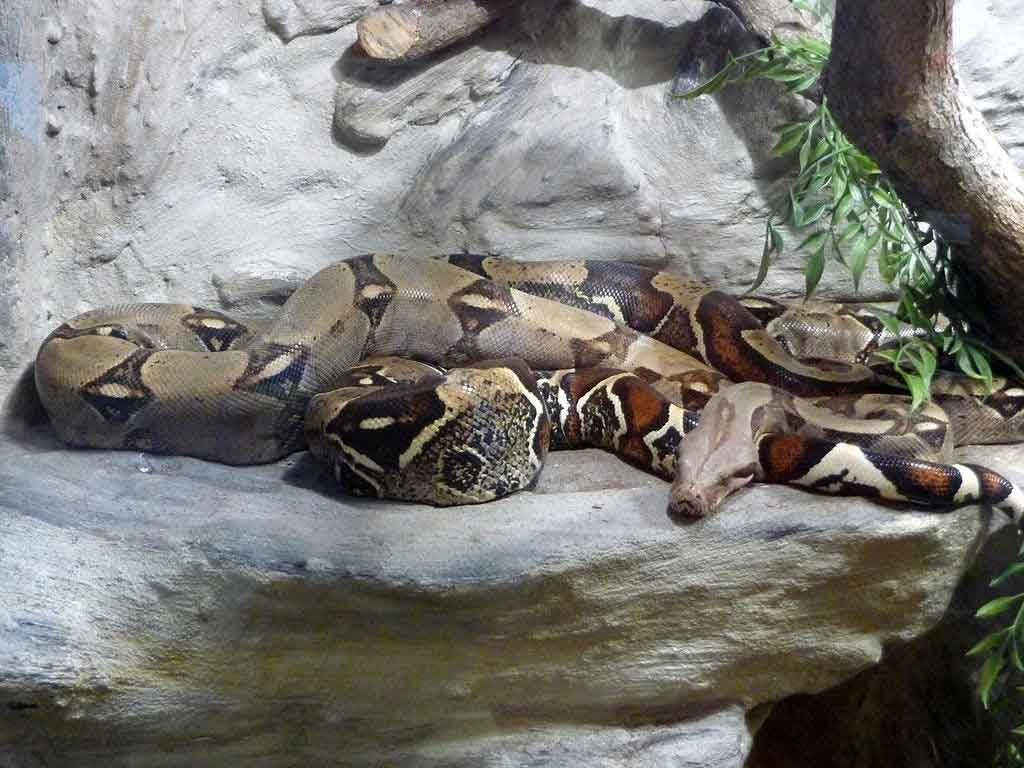
Boa constrictor, Terra Fauna exhibition in the Vaňkovka shopping center in Brno – Pavel Ševela, CC BY-SA 4.0, via Wikimedia Commons
Content
Description
The Boa constrictor bears some of the most distinctive markings of all reptiles. Depending on the habitat in which they try to camouflage themselves, their bodies may be tan in color, green, red or yellow, and display cryptic patterns of jagged lines, Ovals, rhombuses and circles.
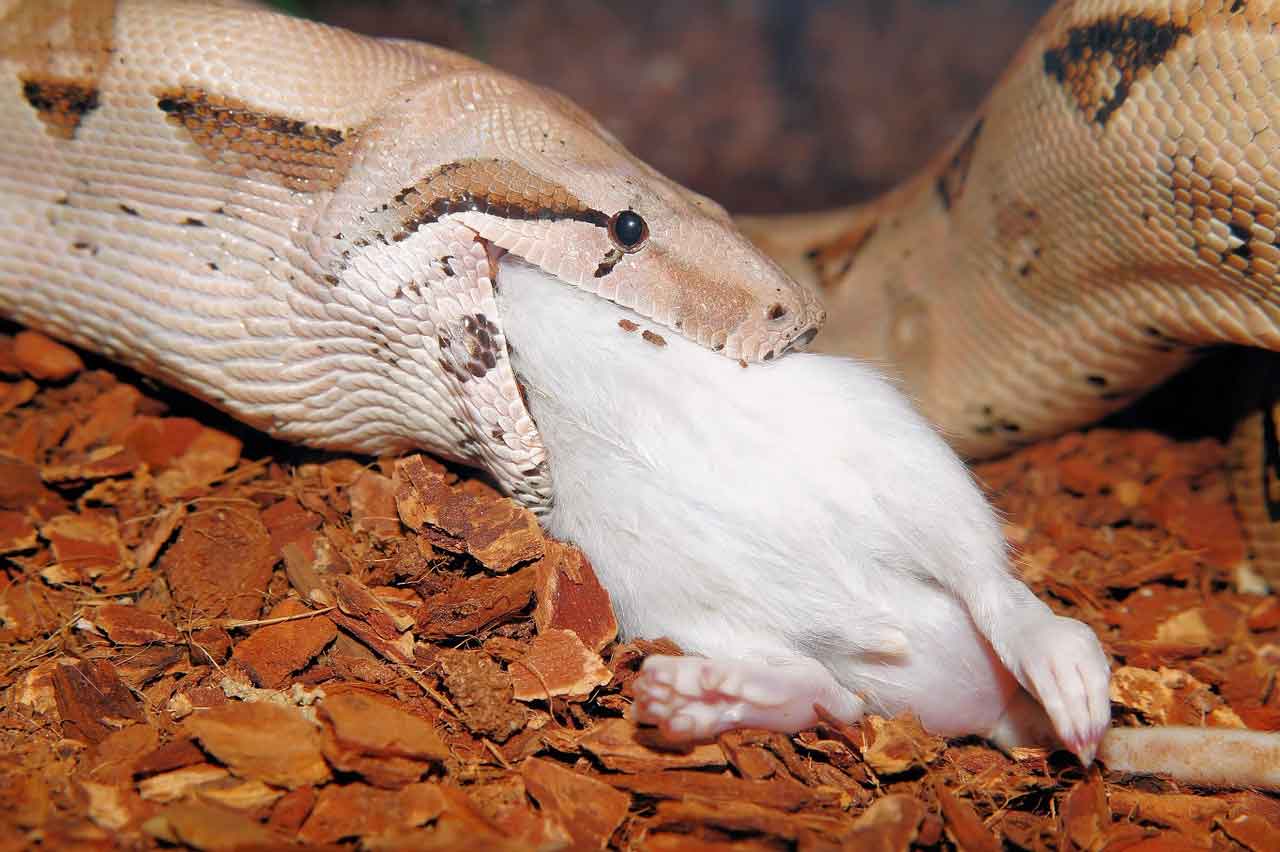
Much smaller than anacondas, boas can measure up to 4 meters and weigh more than 45 kg. Their jaws are lined with small hook-shaped teeth to grab and hold prey as they wrap their muscular body around the victim., squeezing it until it suffocates. Boas eat almost everything they can catch, including birds, monkeys and wild pigs. Their jaws can stretch very far to swallow large prey whole.
Habitat
Boa imperator (Boa constrictor imperator)
The Boa constrictor (Boa constrictor) is a giant snake that is distributed in several subspecies from South America to Central America.
Just like their premiums, the Anacondas, they are excellent swimmers, but prefer to stay on dry land, living mainly in hollow logs and abandoned mammal burrows.
Several subspecies are bred in captivity, local forms, as well as crosses and color variants, most often the two subspecies:
Red-tailed Boa (Boa constrictor constrictor)
Boa imperator (Boa constrictor imperator)
Specimens caught in the wild in the trade can also be found. If possible, specimens bred in captivity should be used.
In many countries, snakes Boas are subject to species protection legislation. The two subspecies mentioned are not subject to registration; However, proof of origin is mandatory for the holder.
In some countries, the possession of the Boa constrictor is regulated by the regulations on the possession of so-called “potentially dangerous animals”.
Sex differences
Sex determination based on external characteristics is difficult. Males have longer spurs; females are usually larger and heavier. Other methods of sex determination, Like "popping" and survey, should only be performed by a veterinarian who is familiar with reptiles, due to the risk of injury.
The Boa constrictor in captivity
Boa constrictor
Behavior
The Boa constrictor is a solitary animal, but it can usually be socialized without problems if the animals are expected to be about the same size..
The Boa constrictor it is viviparous. The eggs are not laid by the female - as is often the case with snakes., Rather, they remain in the uterus until the young hatch.. Litter size can be up to 60 pups in large females. So, if breeding is not planned or desired, animals should only be kept individually or in groups of the same sex.
As there is currently an oversupply of Boa imperator and there are hardly any buyers for the young, animals should only mate if there are reliable buyers for the offspring.
The Boa constrictor is twilight and nocturnal, but it also has diurnal phases.
Accommodation (Terrarium)
To keep one or two adult animals, the terrarium must be at least the size 250 x 100 x 200 cm.. For animals with a body size greater than 2 m, even larger base areas needed. Permanent maintenance is not allowed on so-called racking systems.
Terrarium temperature
Like warm-blooded animals, the Boa constrictor you need a temperature gradient in the terrarium that allows you to reach your optimal body temperature. As such, a heating system is installed on the floor outside the terrarium, on one side, to ensure localized heating of up to 35 °C. It is also possible to use radiant heaters with UV components. The soil temperature in the rest of the terrarium should be about 26 – 28 °C; at night the temperature should drop to a few 22 °C.
Terrarium humidity
Humidity should hover between the 60 and the 80 % and can increase up to more than 90 % At night. This can be achieved by spraying the terrarium daily with warm water or using an irrigation system.. Precise thermometers and hygrometers are needed to measure temperature and humidity.
Terrarium lighting
Fluorescent tubes are suitable as basic lighting; the duration of illumination should be 10 to 12 hours. Lighting should be placed out of reach of snakes or secured with a metal mesh basket (Fire danger!).
Terrarium furniture
The shelves, stable rock structures (also imitations), the thickest roots and/or branches, as well as cork tubes and other cave-like hiding places have proven to be suitable. There must be at least one retreat for each animal. The Boa constrictor climb well; Therefore, the furniture must be well installed in the terrarium so that the animals can not harm themselves. The presence of a sufficient number of rough surfaces makes it easier for animals to moult regularly.. It also, a sufficiently large and temperature-controlled water battery, in which animals can also bathe, is part of the basic equipment. An absorbent substrate (for example, bark mulch) is suitable as a substrate, which should always be slightly moist at one point.
Important: There should always be a slightly moist hiding place.
Food
Boa constrictor
The Boa constrictor feeds mainly on mammals, reptiles and birds in the wild. Usually, can be fed with rodents or frozen rabbits of suitable size, that thaw quickly (for example, in warm water) and are brought to an approximate body temperature (35 – 40 °C) before feeding them. If required, frozen foods can be vitaminized with suitable preparations. Feeding live animals for food should be avoided due to animal welfare aspects and the risk of animal bite injuries for food. Fresh water must be available at all times.
If several animals are kept in the terrarium, they must be placed individually in boxes to be fed or monitored during feeding. after feeding, the animals need several days of rest and should not be disturbed.
Note: In the case of the pups, weekly feeding is adequate; in the case of older specimens, the feeding interval can be extended to 3 or 4 weeks.
Care
Food scraps, molts and droppings should be removed daily. In the case of young animals, water bowls should be cleaned daily. Larger water bowls should be cleaned and filled with fresh water at least once a week or when dirty.
Animal health should be checked daily. The most frequent health problems in the Boa constrictor are the difficulties of molting, skin mites, eating disorders, movement disorders, as well as inflammation of the respiratory tract, skin fungus, feces and mucosal alterations. In case of anomalies, you have to consult a reptile veterinarian. It is recommended to perform fecal examinations once a year to detect endoparasites.
Boas are very susceptible to inclusion body disease, a viral disease that ends up being fatal. As there is still no treatment for this disease, newly acquired animals must be quarantined for at least six months and examined by a veterinarian before they come into contact with the existing population.
The intestinal flora of the Boa constrictor usually includes salmonella, that are harmless to animals, but they can cause disease in humans. Hygiene measures (wash your hands well, etc.) can prevent infection.
Acclimatization and handling
Reptiles are observation animals and NOT companion animals. For this reason, in the first days in their new home, animals need adequate rest to get used to their new environment.
Animals should only be caught if necessary. Boas are usually peaceful, but they can bite sensitively; in the case of aggressive specimens, it is recommended to handle them with the help of gloves and / or a hook for snakes.
Attention: During the molt, animals should not be fed or taken out of the terrarium.
Special features
Colored breeds with reduced pigmentation (for example, albinos) may show increased sensitivity to light.
Buy one Boa constrictor
The price of a Boa constrictor in the exotic animal market ranges from 120 – 150 EUR.
Video Boa constrictor
Boa Constrictor Facts: the Red Tailed Boa facts 🐍 | Animal Fact Files

 Minor Concern ⓘ
(UICN)ⓘ
Minor Concern ⓘ
(UICN)ⓘ












.jpg)


.jpg)