▷ The world of Pets: Dogs, cats, birds, reptiles, amphibians

Black Lory
Chalcopsitta atra

Lori Negro

Content

Description

32 cm.. height and a weight between 230 and 260 gr.

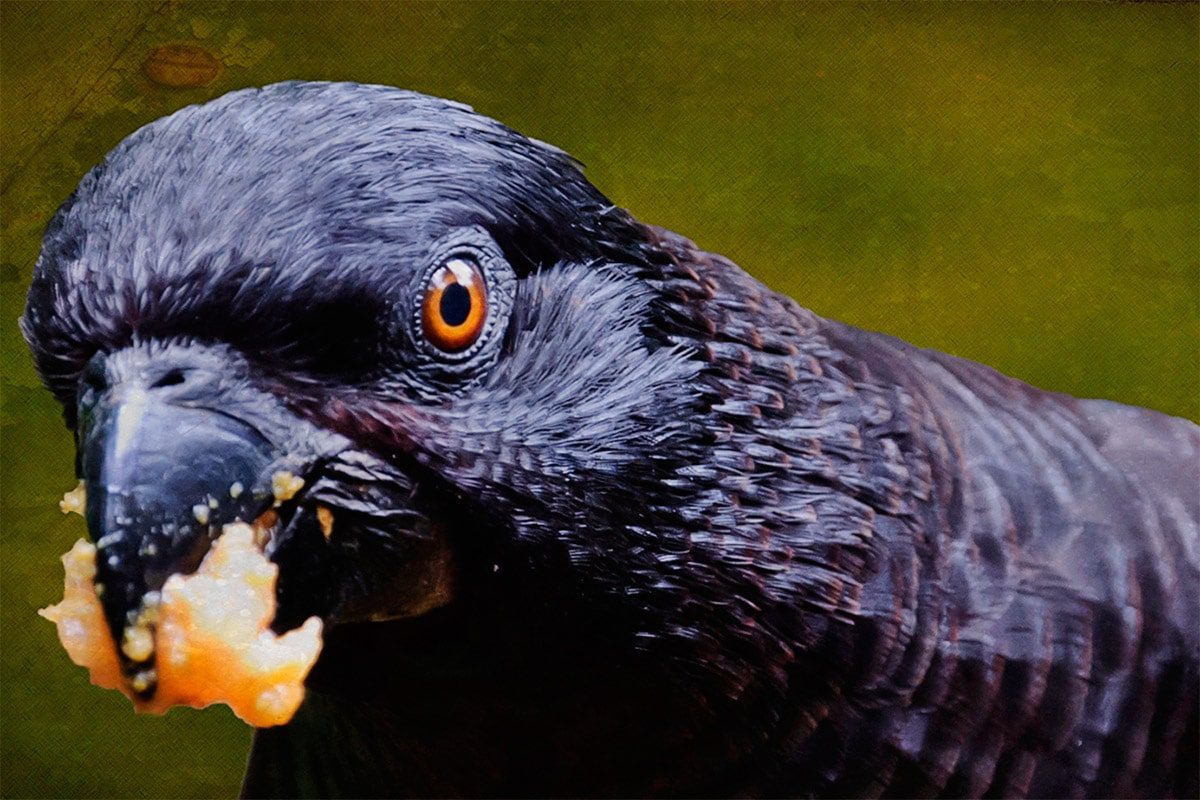
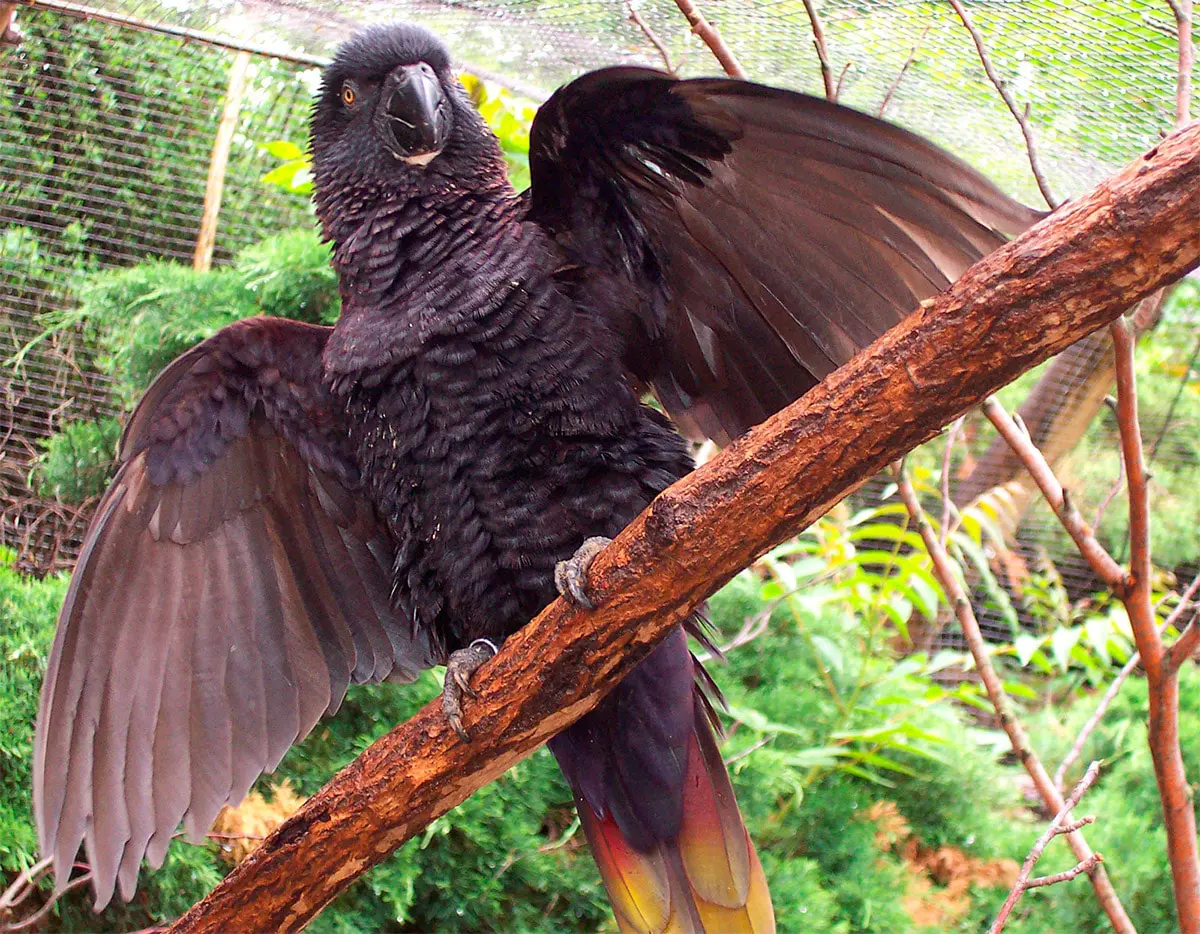
The Black Lory (Chalcopsitta atra) It is the least colorful member of an otherwise very colorful genre. It´s, in poultry, therefore, the least popular. This is unfortunate because it is equally as interesting as the other members of the genus.

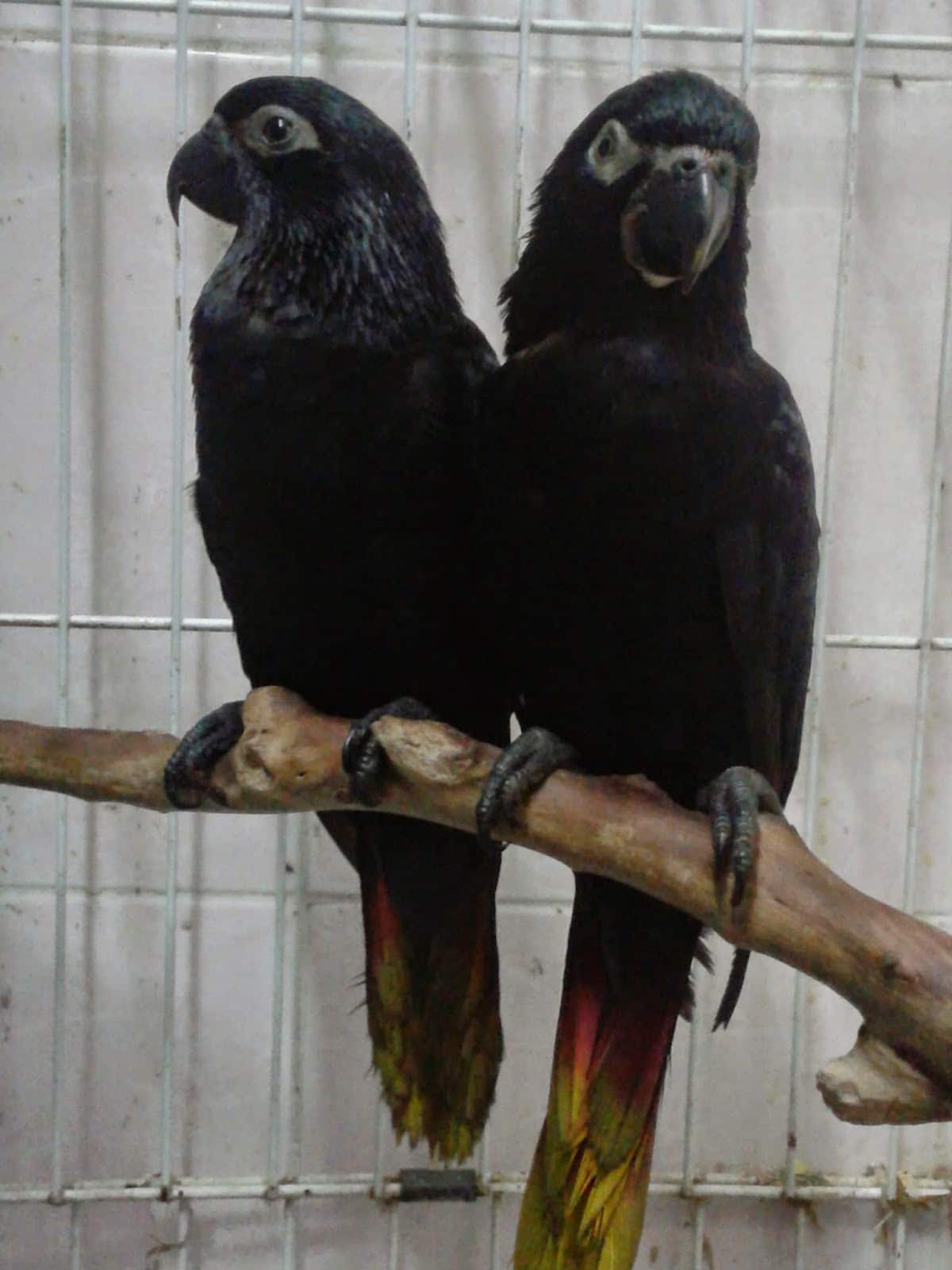
Black in color with a purplish sheen to the plumage that is highly evident in sunlight, which gives it a superficial appearance of a crow. Even their bare parts, as the nose , the skin around the eyes and at the base of the jaws, eyes and claws, they are equally dark. Rump displays a violet blue.

The underside of the tail feathers are color olivaceous with light infusions of red at the base.
The iris is orange-red, the grey legs.

The youth differ little from adults but have an eye-ring and a skin at the base of the peak which are whitish. It is grey.

There is a 3 subspecies, that differ little between if:

  • Chalcopsitta atra atra: Both adults, usually black. The bluish violet rump. The feathers of the bottom of tail olive/yellow washed in red. Naked eye-ring black , black skin at the base of the peak. Orange-red eyes.

  • Chalcopsitta atra bernsteini: Red marks / purple on the forehead and thighs, less evident in females; Blue darker in the rump.

  • Chalcopsitta atra insignis: Head striped gray/blue. The front, the face, the thighs and the underside of the wings are red. The feathers of the throat and underparts with red trim. The rump is dull blue. The lower part of the tail is greyish blue. It is one of the most beautiful parrots that exist. It will be necessary to see any parrot in the light of the Sun to be able to appreciate its beauty.

It is also said that there are other subspecies, the calcopsitta atra spectabilis, resident of the Mamberiok Peninsula, but the data given are running that it was only a hybridization of the Chalcopsitta Atra and the Chalcopsitta Sintillata.

They are nomadic outside of the breeding season., and, they are sometimes found in large groups, associated with the Blackbirds, feeding together on trees in flower.

Habitat:

The Black Lory live in the Plains, rarely above the 200 m. They are very abundant in relatively open habitats, as the mangroves near the coast, swamp forest, coconut plantations, scattered eucalyptus in the Middle areas of meadows and scrub land. From time to time come to the edge of the Woods primary or forest growth. The Black Lory is endemic to New Guinea.

Reproduction:

Most of the information has been obtained from captive birds. In the wild, most of these birds breed between December and February. In captivity, the female lays two white eggs which are incubated for about 25 days. The entire reproductive period is particularly long, lasting approximately 75 days.

The male incubates not, but sometimes it remains in the nest with the female. After birth the chicks remain in the nest approximately one 10 weeks.

Food:

The Black Lory is vegetarian. Primarily feeds on nectar and fruits. Constantly migrates in search of seasonal food. Green corn sprouts and seeds are also in their diet.. Enjoy the Schefflera shrubs.

Distribution:
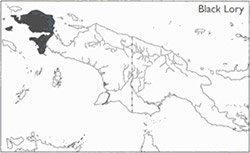
Distribution Lori black
This species is distributed in the westernmost part of West Papua, the Indonesian portion of New Guinea. In particular, they are in the Western Vogelkop, also on the islands of Misool (provinces of Maluku), Batanta (papua province), the Onin and Bomberai and Salawati peninsulas (West Papua), off the coast.

Between the 3 [+] Subspecies:

  • Chalcopsitta atra atra: Distribution. West New Guinea

  • Chalcopsitta atra bernsteini: Distribution. Confined to the island of Misool (Indonesian) in the West of New Guinea.

  • Chalcopsitta atra insignis: Distribution. The Vogelkop, Island Amberpon, Onin, bomberai peninsulas, Northeast of New Guinea.

  • calcopsitta atra spectabilis: Distribution. mamberiok peninsula

Conservation:
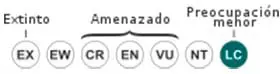

minor concern


This lory is evaluated as least concern on the red list of threatened species. Is included in Appendix II of CITES.


The world population is estimated at 50.000 birds.

This number is probably stable, but data are lacking to say it with certainty.

The commercial import of this species in EC was banned in 1991.


"Black Lory" in captivity:

The Black Lory It is said is among the parrots with the sweetest character. They are easy to tame. Its obvious disadvantage is acute cries that often emit. Not everyone can tolerate them. It is however unusual in captivity.

The subspecies insignis is rare, and the subspecies bernsteini practically non-existent.

Alternative names:

– Black Lory, Rajah Lory, Red-quilled Lory (ingles).
– Lori noir (francés).
– Schwarzlori (alemán).
– Lóris-negro (portugués).
– Lori Negro (español).

scientific classification:

– Order: Psittaciformes
– Family: Psittaculidae
– Scientific name: Chalcopsitta atra
– Citation: (Scopoli, 1786)
– Protonimo: Psittacus ater

Images «Black Lory»:
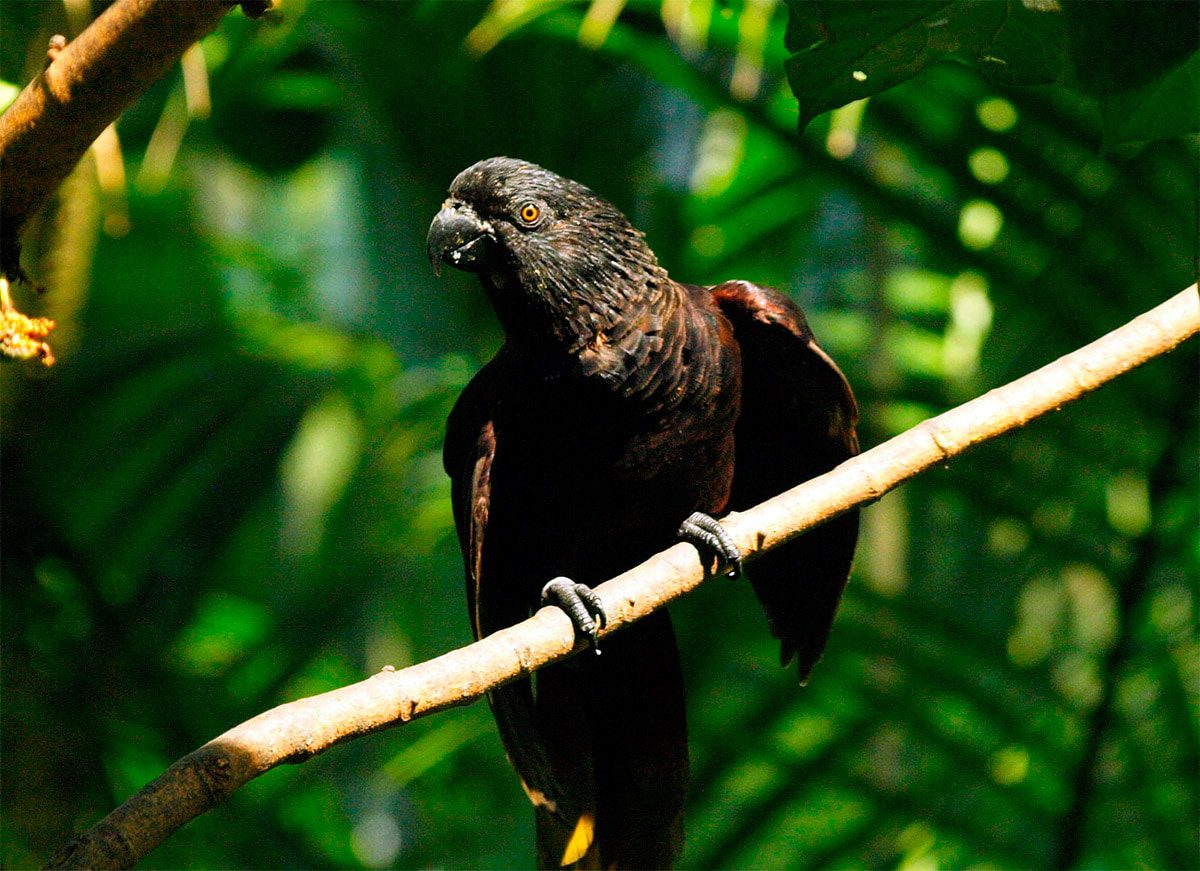

«Negro truck» (Chalcopsitta atra)


Sources:
– Avibase
– Photos: sciencio.com,
Goura (zoochat.com), My Birds Region
– Sounds: BAS van Balen (Xeno-canto)
▷ The world of Pets: Dogs, cats, birds, reptiles, amphibians

Cardinal Lory
Pseudeos cardinalis


Lori Cardenal

Content

Description

31 cm.. height and weight of 175 to 215 gr.

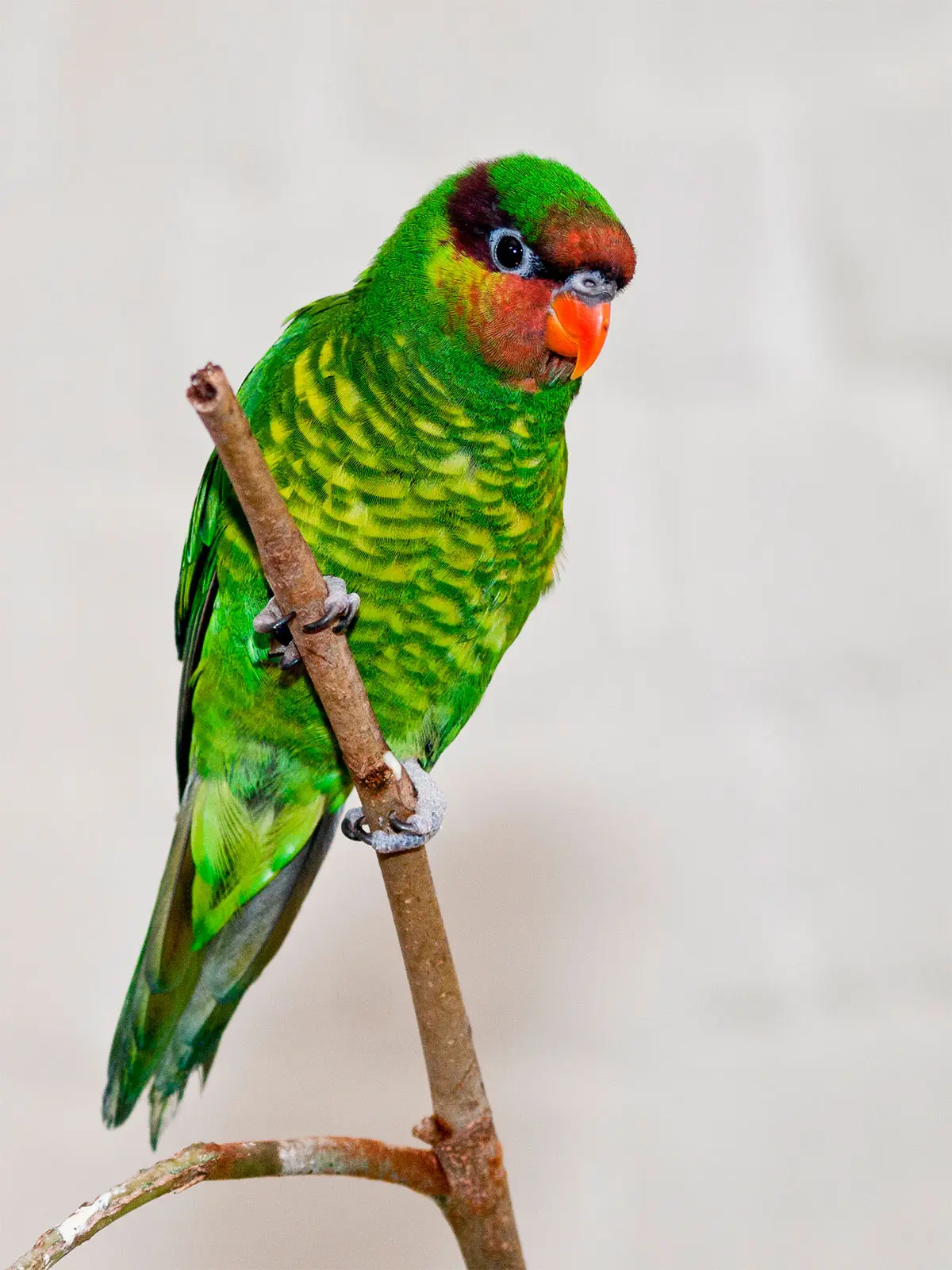
The Cardinal Lory (Pseudeos cardinalis) has a characteristic shape due to its relatively long tail.

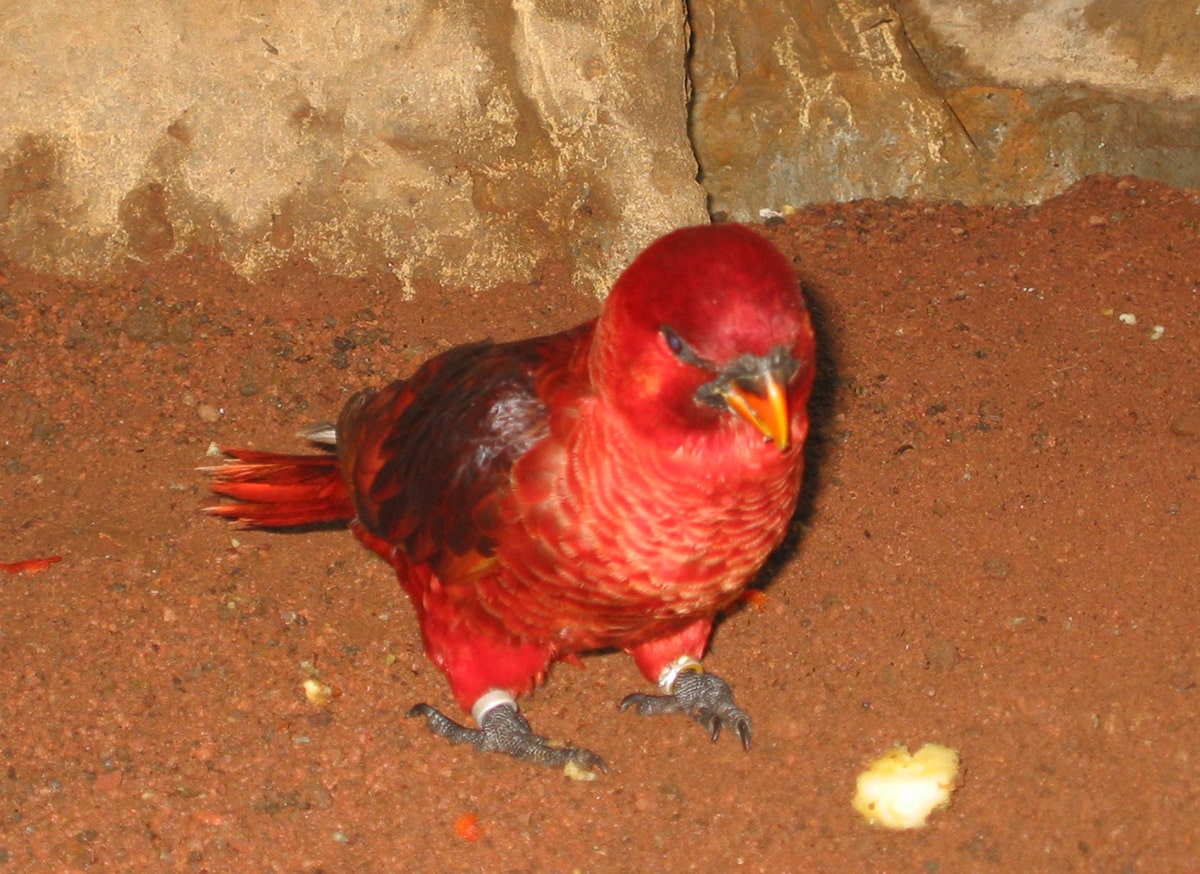
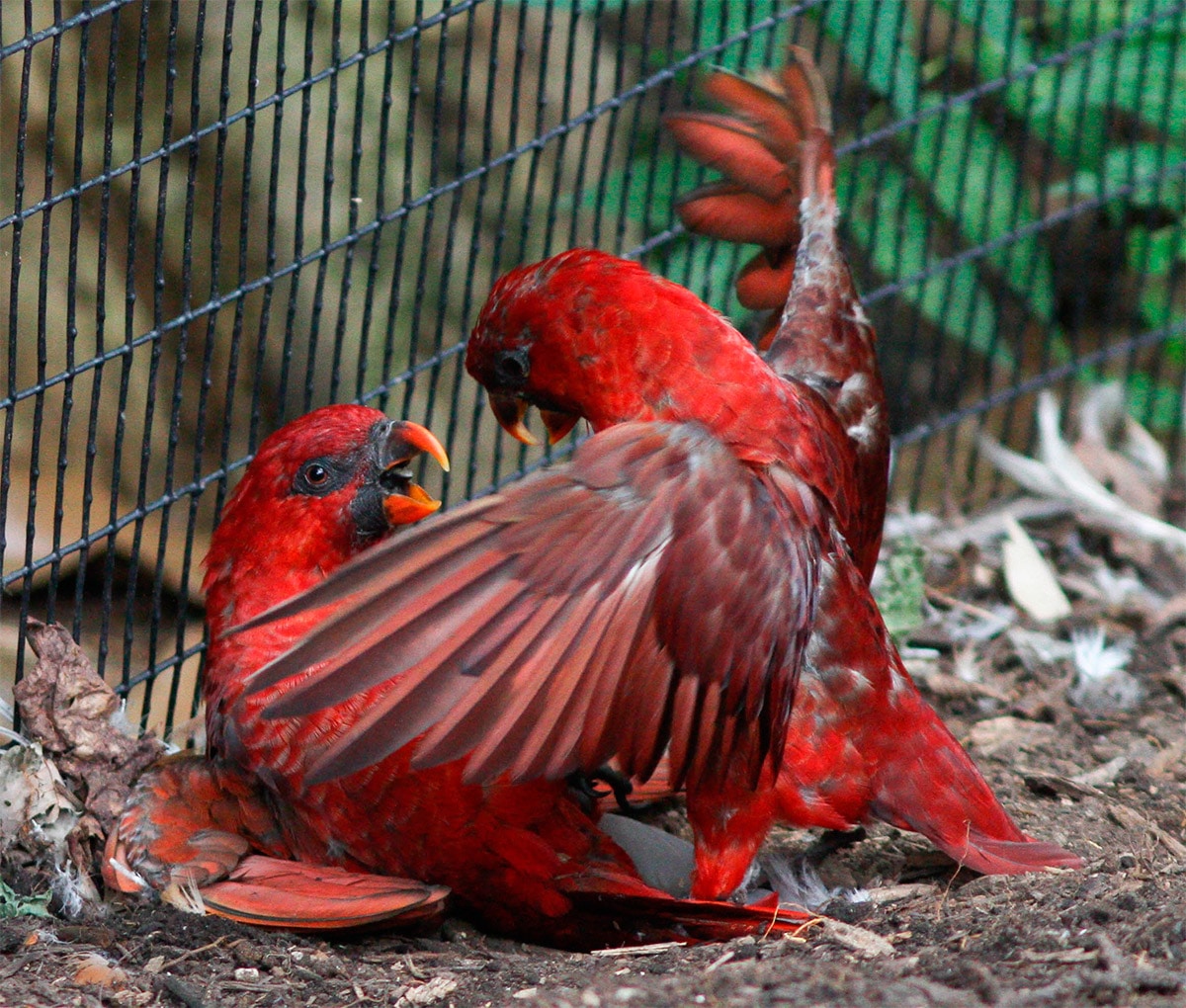
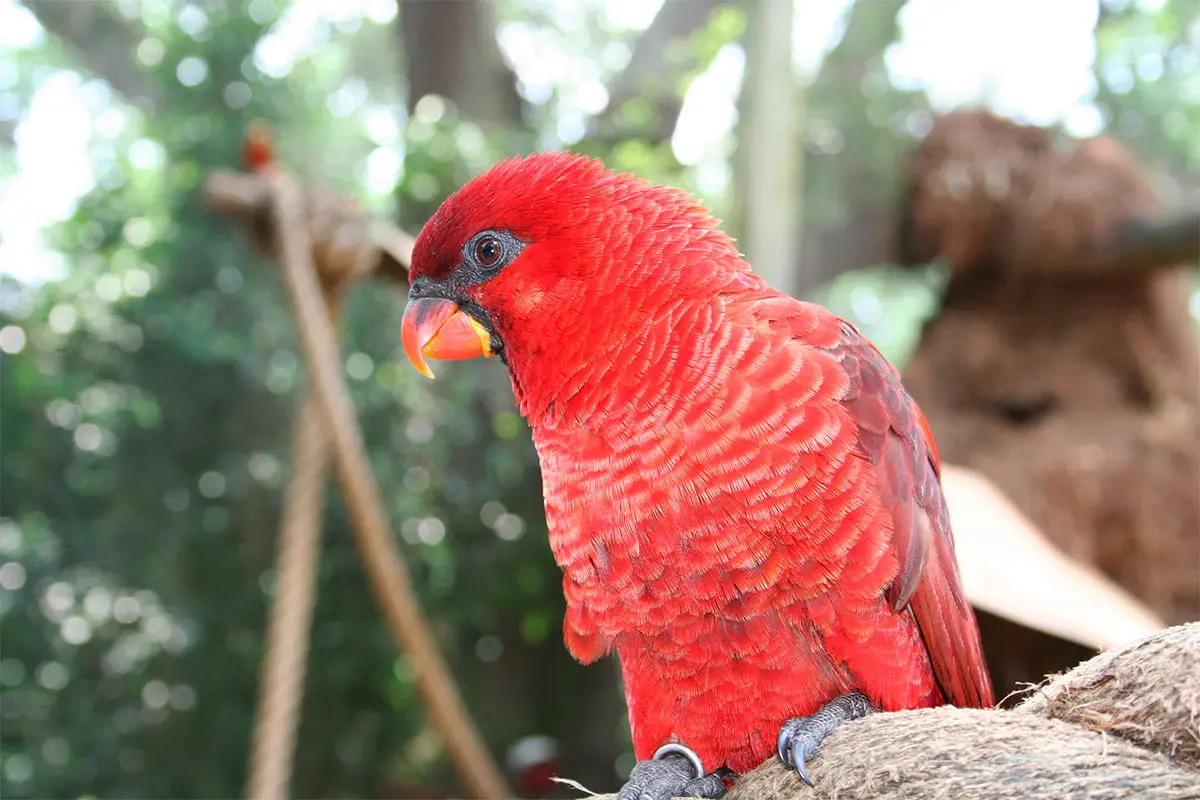
Among adults, There is no sexual dimorphism, the plumage is completely brilliant red, but the upperparts and wings They seem to be darker.

The bill is orange-red with a black color in the base area.
The bare orbital skin is black.

The feathers the lower parts have small yellowish features, What gives a vaguely scaly appearance.
The legs are grey.

The irises is red-orange.

The immature has the back and blankets of Red Wings clear. Its bill It is pale orange with small black marks. Its orbital skin is whitish grey. Their irises are pale yellow.

Habitat:

It is a kind forest. It is very widespread and is locally abundant in primary and secondary forests. It is also in the forests in regeneration in coconut plantations and mangroves where there are trees in flower.

Can rise to 1.200 m above sea level, Although in the Bougainville Island (Papua New Guinea), does not exceed of the 800 m.

It is a bird loud that does not happen easily unnoticed.

It is usually in small flocks of up to 20 birds flying high above the canopy. Also gets into branches higher trees in flower which is notable for its continuous shrieks and its beautiful bright colors.

It is often found in the company of the Coconut Lorikeet (Trichoglossus haematodus) and they particularly appreciate red flowers.

This bird moves constantly in the day, flying from one island to another.

Reproduction:

The breeding season probably starts in June. There are reports of links in August and stops extending to September.

To date, We have found a nest in a high tree cavity, at low altitude above the ground. This is the only information we have about the natural environment.

In captivity, the Cardinal Lory puts two white eggs. Both parents incubate and care for young people.
The incubation period is 24 days.

When out of the shell, chicks weigh in 6 to 7 g.. They are covered with a white quilt, long and dense.

As with all the Loris type Chalcopsitta y Pseudeos the nest is especially long and hard between 65 and 80 days.

Food:

The Cardinal Lory is exclusively vegetarian. Feeds in the canopy and fruit Palms, small berries, flowers, outbreaks, also pollen and nectar.

This Parrot seems to mark a clear preference for the flowers and red fruits.

Distribution:

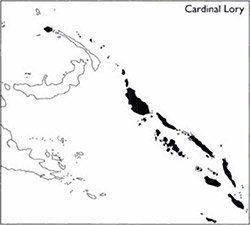
Distribucion Chalcopsitta cardinalis

The Cardinal Lory It is endemic to the Islands to the East of New Guinea. Its area of distribution covers New Hanover and the islands surrounding (Tabar, Lihir, Thong, FeNi and Nissan). Extends to Buka and Bougainville. In the Solomon Islands occupies a territory that extends to the South of San Cristóbal.

Conservation:


minor concern

– Current IUCN Red List category: Least concern

– The population trend: Stable

The world population It has not been quantified, but the species is described as abundant (pit et to the. 1997). Sources estimate that the total population in nature exceeds the 100 thousand copies.
The population is suspected to be stable in the absence of evidence of any reduction or substantial threats.

But, is classified by the UICN as a species "in restricted area", which means that it has a territory whose surface is less to 50 000 km, therefore, potential danger.

"Cardinal Lory" in captivity:

Very rare.

In 1989, the Solomon Island allowed that a few Cardinal Lory were exported to the EE.UU.. But, because of the Law on the conservation of wild birds in 1992 The export of the Lori of Solomon Islands to the United States. UU. they banned except that is for authorized reproduction.

Alternative names:

– Cardinal Lory (ingles).
– Lori cardinal (French).
– Kardinallori (German).
– Lóris-cardinal (Portuguese).
– Lori Cardenal (español).

scientific classification:

– Order: Psittaciformes
– Family: Psittaculidae
– Scientific name: Pseudeos cardinalis
– Genus: Dusky
– Citation: (Gray,GR, 1849)
– Protonimo: cardinal lorius

«Lori Cardenal» images:

Videos "Cardinal Lory"


«Lori Cardenal» (Pseudeos cardinalis)


Sources:

Avibase, BirdLife.org, Oiseaux.NET

Photos: Wikipedia, Chalcopsitta cardinalis - Cincinnati Zoo (Wikipedia), Ethan Ograngy (IBC.lynxeds.com), Minppu (IBC.lynxeds.com)

Sounds: Niels Krabbe (Xeno-canto)
▷ The world of Pets: Dogs, cats, birds, reptiles, amphibians

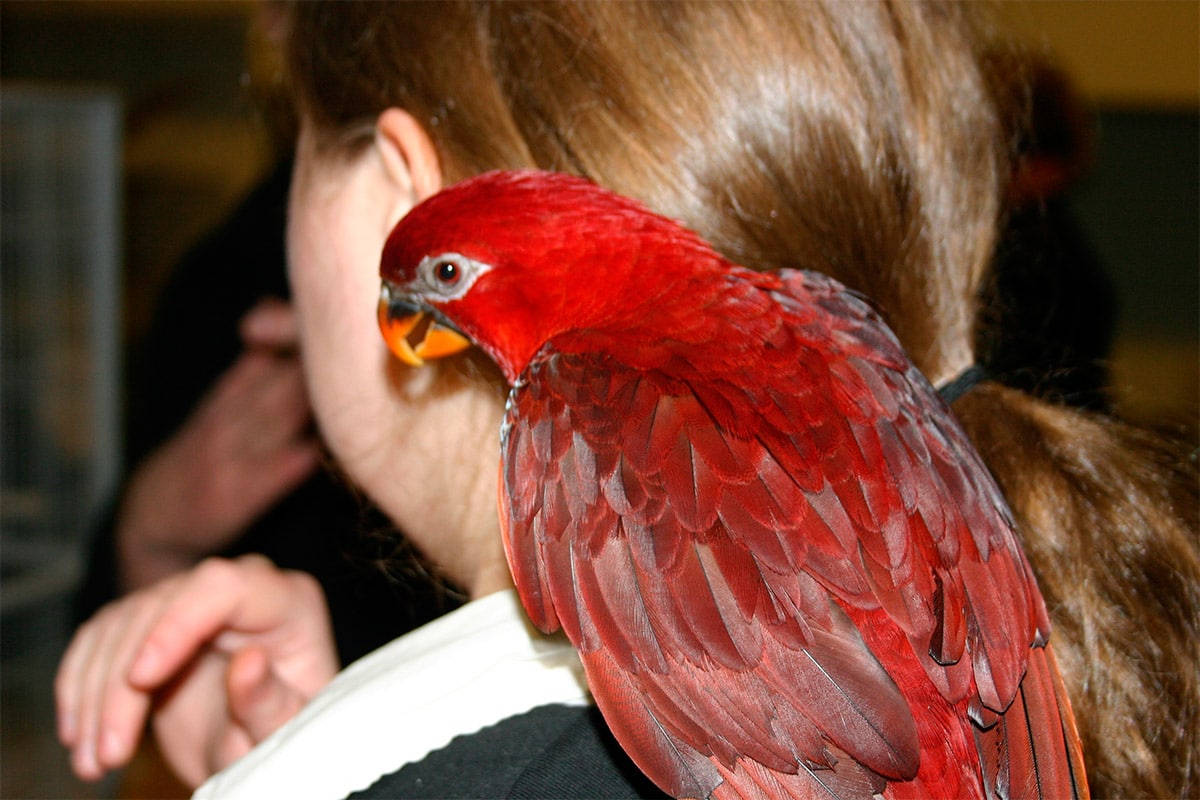
Black-winged Lory
Eos cyanogenia

Lori Alinegro

Content

Description

30 cm.. height and an approximate weight of 120 gr.

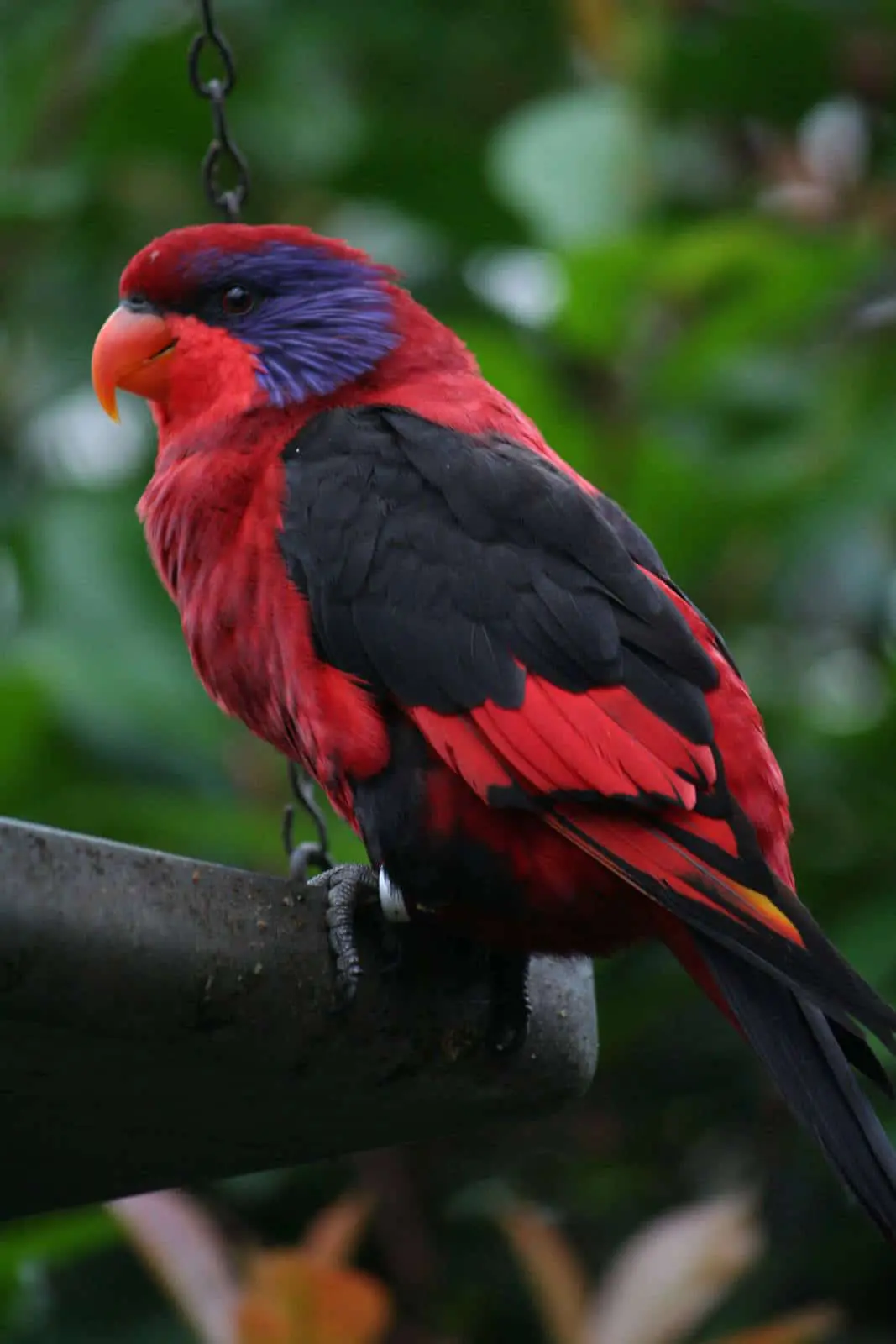
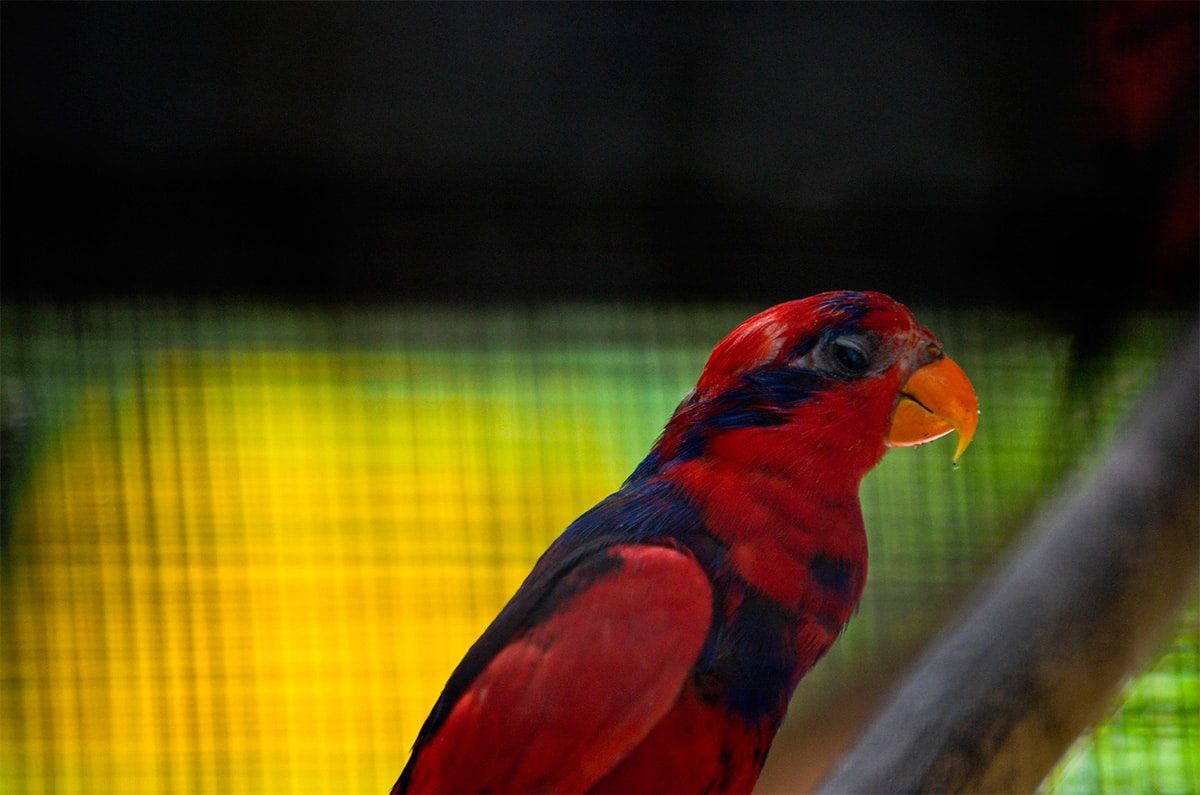
The Black-winged Lory (Eos cyanogenia) has a plumage predominantly red.

Adults have a blue patch surrounding the eyes, cover the tops of the ear and reaches the back of the neck.

Feathers covering the shoulder blade (scapular), small feathers that cover the outside (coverts) and bend of wing are black. The primary and high school they have a black bordered.

The the thighs and flanks they are sprinkled with black. The bottom of the wings shows a wide band Red. The feathers of the tail are black contrasted with red feathers.

The bill is red-orange. The irises they are red, legs grey.

The youth they are more muted than adults. They have blue-black ends in feathers of the head, neck and underparts. The the wing covers are black, with a green light opaque. The bill is of color brown orange, irises brown.

The Black-winged Lory It can be confused with almost all parrots of the genus Eos, but it is the only one of this category that has the covered wing in black color.

Habitat:

The Black-winged Lory they are quite common and widespread in coastal areas, coconut plantations, the forested areas in the process of regeneration, in some large trees scattered in bushes Moors and local gardens.

In some small islands such as Supiori, they are also present in large numbers in inland forests.

Residing in altitudes ranging from sea level to the 460 m.

They live in pairs or in small family groups. They are also often found in flocks of forty individuals or more.

Son noisy birds and easily observable. At the local level are very popular. In the reflection of both, the natives capture them frequently as pet birds.

The Black-winged Lory they have a fly quick and direct. Often you can hear the hum of their wings when they fly over the villages. They are even more recognizable when they often fly low, well below the tops of the trees.

Reproduction:

Little is known of their reproductive ecology., but it was observed the presence of a possible nesting site in a hole in a tall tree in the forest by a couple during the observations in 1982.

The incubation in harsh captivity around 26 days, and as in all loris, the nesting cycle is particularly long and hard between 75 and 89 days.

Food:

They have a regime that differs little from other parrots of the genus Eos. Feed in the trees in flower of nectar of Brugierto and pollen. Your menu will probably be complemented by fruit, berries of the mistletoe and sometimes insects.

Distribution:

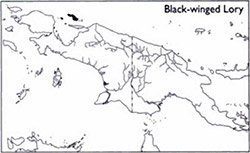
Distribution Lori Alinegro


Being endemic to the islands of the Cenderawasih Bay in the part Indonesia of New Guinea.

They live on most islands (Numfor, Biak, Manim, Pulau Num) but are absent from Yapen, the main island, where are replaced by the Dusky lory (Pseudeos fuscata).


Conservation:


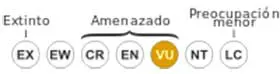
Vulnerable

– Current IUCN Red List category: Vulnerable

– The population trend: Decreasing

The population is estimated at 2,500 to 9,999 mature individuals.

Logging and subsistence agriculture have driven the loss of forests within their range and the hunting pressure remains a threat. Consequently, the species is suspected to be declining at a moderate pace.

Relatively large numbers of birds have been trapped for the national and international trade.

Since December of 1989, the import of the Black-winged Lory It is strictly prohibited in the European Community.

Conservation Actions Proposed:

– Conduct surveys on all the Geelvink Islands to clarify its distribution and current population status.
– Investigation of their ecology and movements to facilitate conservation planning.
– Investigate the species trade and design and implement appropriate controls.
– Estimating the rate of loss of forests within its range.
– Check the register in Supiori and establish a captive breeding program to support future reintroduction and supplementation efforts.

"Black-winged Lory" in captivity:

This species is observed commonly as a pet in Biak (island located in the bahía Paradise, off the north coast of Papua).

Due to its status in danger of extinction, any specimen that can not be returned to their natural habitat (natural range) should preferably be placed in a well-managed breeding program to ensure the survival of the species.

Alternative names:

– Black winged Lory, Biak Red Lory, Black-winged Lory (ingles).
– Lori à joues bleues (French).
– Schwarzschulterlori (German).
– Lóris-asa-negra (Portuguese).
– Lori Alinegro, Lori de Alas Negras (español).

scientific classification:

– Order: Psittaciformes
– Family: Psittaculidae
– Scientific name: Eos cyanogenia
– Citation: Bonaparte, 1850
– Protonimo: Eos cyanogenia

«Lori Alinegro» images:

Videos "Black-winged Lory"

————————————————————————————————-

«Lori Alinegro» (Eos cyanogenia)


Sources:
– Avibase, Oiseaux.NET, BirdLife.org
– Photos: galleryhip.com, Sheri Hanna
– Sounds: Hans Matheve (Xeno-canto)

▷ The world of Pets: Dogs, cats, birds, reptiles, amphibians

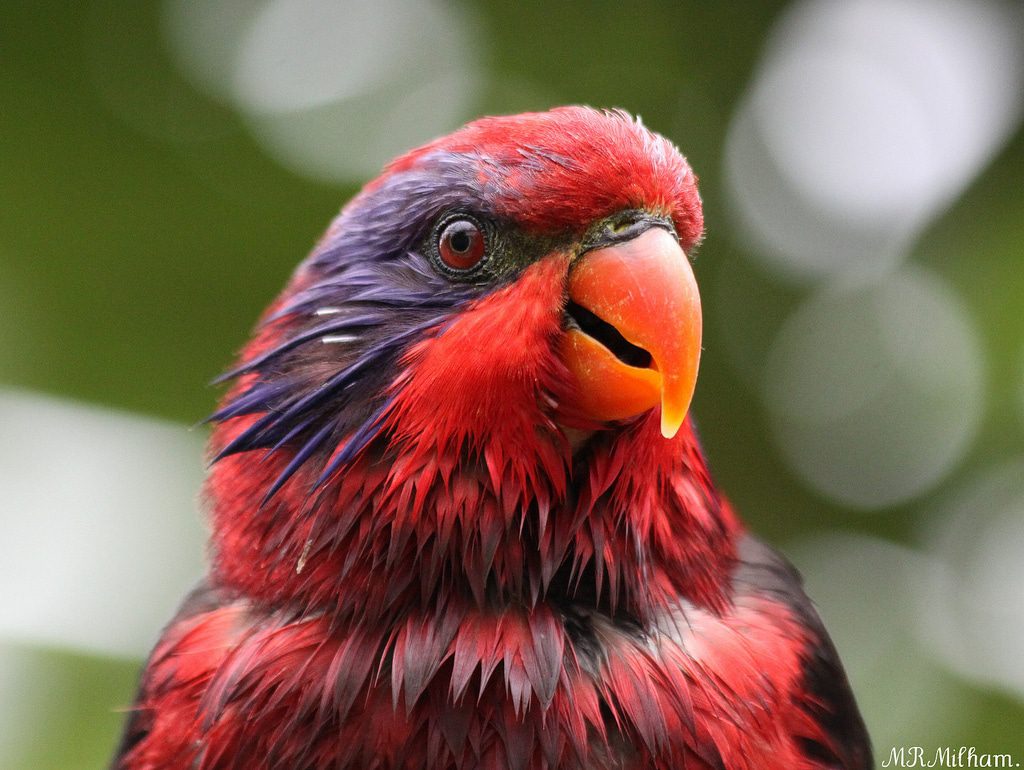
Red-and-blue Lory
Eos histrio

Eos histrio

Content

Lori-of-them-sangihe-6

Description

31 cm.. length and a weight between 150 and 185 gr.

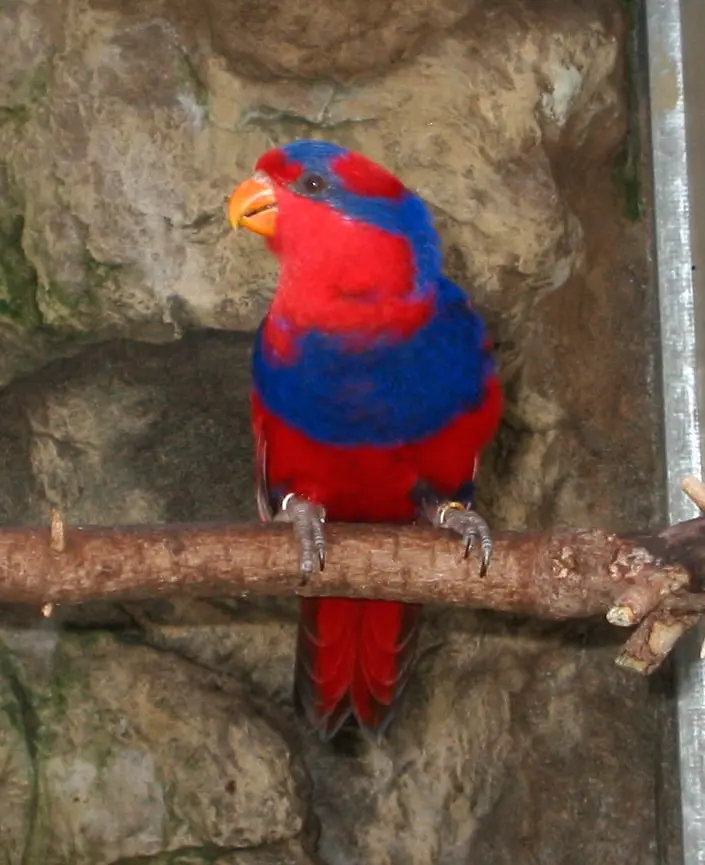
The two main colors of the Red-and-blue Lory (Eos histrio) they are the red and blue.

A broad blue-purple line extends from the eyes through the ears and for the sides of the neck. A broad transverse band blue on the chest. The tail coverts they have blue pink. The feathers of the part superior of the tail they are reddish purple.

The irises is red, the legs grey.

Both sexes are very similar.

In immature, the feathers of the head and the chest they have a dark blue edging. The blue of the crown extends up to the neck and below the eyes. Thighs they are dull purple. The irises They are brown.

Description 3 subspecies

  • Eos histrio challengeri

    (Salvadori, 1891) – The band blue of the chest is of smaller size and mixed with red; the blue band of the eyes does not extend to the the mantle; smaller.


  • Eos histrio histrio

    (Statius Müller, 1776) – Nominal.


  • Eos histrio talautensis

    (Meyer,AB & Wiglesworth, 1894) – More black in the corbeteras wing and in the flight feather.

Habitat:

The Red-and-blue Lory they are common in primary forests, and on the hills of the hills. The feed, they made raids in coconut plantations along the coast and in the more open areas.

They make short trips daily. In the Talaud Islands You can see flying from island to island.

Initially, They lived in large flocks and concentrated in large numbers in common dormitories..

Today, in view of its decline, them find in pairs or in small groups. Large gatherings have become extremely rare or virtually non-existent.

In the Karakelong island were seen, However, on two occasions, more groups of 400 birds.

The Red-and-blue Lory they are birds noisy, which makes them quite easy to observe.

Reproduction:

The species nests in holes in tall trees, most belonging to the class canarium family Burseraceae, and the breeding period main seems to be from May to June, Although it is suspected that nesting may include other months.

We find nests, both in the forests and cultivated areas. The spawning usually includes 2 eggs which are incubated for approximately 25 or 26 days. There is no any other information in the natural environment.

Food:

Although they also consume some insect larvae, the Red-and-blue Lory are mostly vegetarian. They feed on coconut plantations, in the fig trees and trees of the genus canarium It produces edible nuts.

Distribution:

Size of the area of distribution (reproduction / resident): 1,000 km2

The Red-and-blue Lory is confined to the Talaud Islands (almost exclusively in Karakelang) front North of Sulawesi, Indonesian

Description 3 subspecies

Conservation:


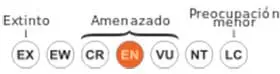
Endangered

• Current category of the Red List of the UICN: Endangered.

• Population trend: Decreasing.

This species has a very small range (It is known only in some places), and it is declining due to habitat loss. It has been a downhill fast in the population, largely as a result of their capture for trade, and this is expected to increase in the future. So, qualified as In danger.

Although it was previously abundant, the species has decreased and the population in KarakelongIt was estimated in 8,230-21,400 birds in 1999 (Riley 2003). The subspecies of the nominal of the Sangihe Islands, is likely that has been extinguished.

The encroachment and logging are driving the loss of forests, aggravated by the threat of illegal trade in the species, contribute to the acceleration in the decrease of the population.

In 1999, the investigation concluded that you the 1.000 and 2.000 birds were being captured in Karakelang each year, the 80% (illegally) for the markets of birds of the Philippines.

Ongoing conservation actions:

Since 1995, the project "Action Sampiri» has been working for the conservation of biodiversity in Sangihe and Talaud, in the implementation of awareness-raising programmes of field work and the conservation and development of ideas for the future use of the land.

Efforts have been made to promote the local support of the species at Talaud, his last bastion.

It has been reported that the poaching and the trade of this species have decreased drastically after the confiscation of assets by Ranger of the forest Department in 2005 (RT Prayudhi in litt., 2008).

The bird is part of the European Association of Zoos, the program Aquaria’s European Endangered [species] and Parrot Taxon Advisory Group (Wilkinson 2000), where it is being bred in captivity (Sweeney, 1998).

"Red-and-blue Lory" in captivity:

It is currently very rare in captivity.

Due to its status in danger of extinction, any specimen that can not be returned to their natural habitat (natural range) should preferably be placed in a well-managed breeding program to ensure the survival of the species.

Alternative names:

– Red-and-blue Lory, Blue-tailed Lory, Red & Blue Lory, Red and Blue Lory, Red-blue Lory (ingles).
– Lori arlequin, Lori histrion (French).
– Harlekinlori (German).
– Lóris-arlequin (Portuguese).
– Lori de las Sangihe, Lori Rojo y Azul (español).

scientific classification:

– Order: Psittaciformes
– Family: Psittaculidae
– Genus: Eos
– Scientific name: Eos histrio
– Citation: (Statius Müller, 1776)
– Protonimo: A player parrot

“Sangihe Lory” images:

——————————————————————————————————-

«Lori de las Sangihe» (Eos histrio)


Sources:

– Avibase, BirdLife.org

– Photos:

1 – En Loro Parque (Spain, Tenerife) by Drägüs – Wikimedia
2 – Lori en Loro Parque, Tenerife, España by Drägüs – Wikimedia
3 – En ZooParc de Beauval, France by User:Edhral – Wikimedia
4 – Red-and-blue lory. two in a cage. by TJ Lin – Wikimedia
5 – A Red-and-blue lory in a zoo by jojo nicdao – Wikimedia
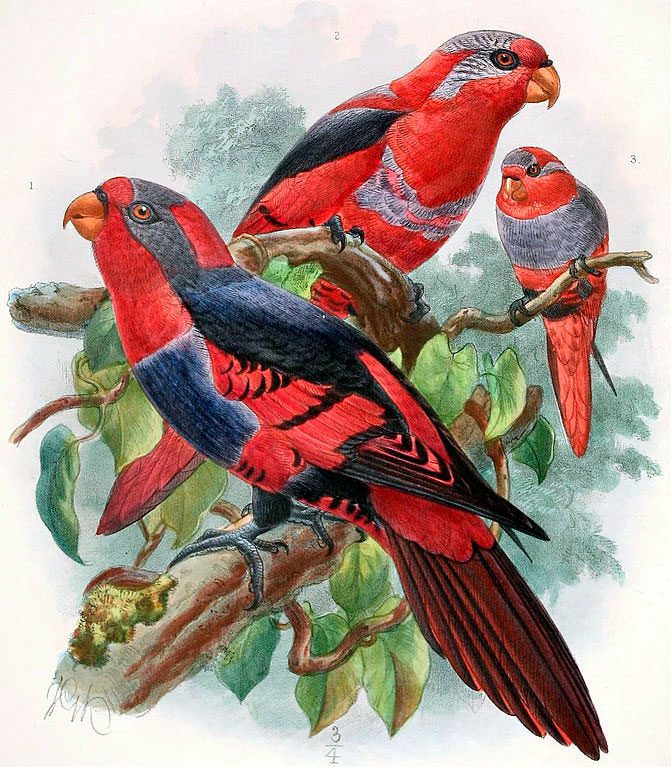
6 – The Red and Blue Lory (Eos histrio now Eos histrio histrio) and The Challenger Lory (EOS challengeri now Eos histrio challengeri) Chromolithograph. Plate VII from A monograph of the lories, or brush-tongued parrots, composing the family Loriidae. By St. George Jackson St. Mivart (1827–1900). Artwork by John Gerard Keulemans (1842-1912). This was published by R. H. Porter (London) in 1896. By John Gerard Keulemans [Public domain], via Wikimedia Commons

– Sounds: Frank Lambert (Xeno-canto)

▷ The world of Pets: Dogs, cats, birds, reptiles, amphibians

Coconut Lorikeet (deplanchii)
T. haematodus deplanchii


Coconut Lorikeet (deplanchii)

Content

Description (1)

26 cm.. of length and a weight of 140 gr.

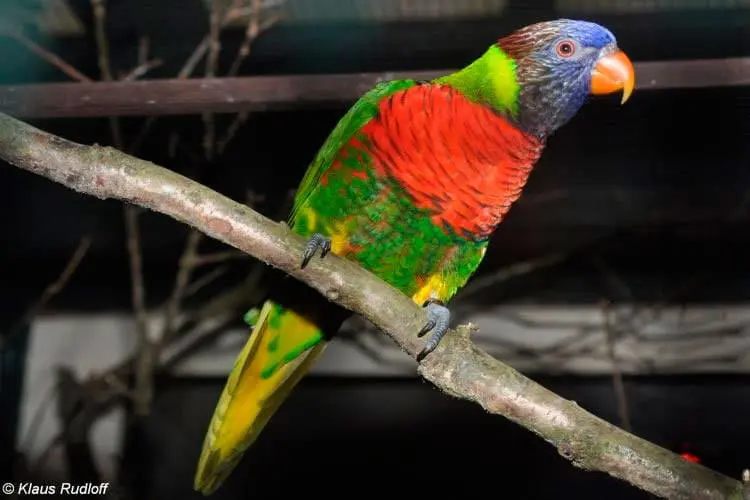
The Coconut Lorikeet (deplanchii) (T. haematodus deplanchii) is a variation of the nominal (Trichoglossus Haematodus)

Similar to the nominal Haematodus, but slightly paler plumage. The head has a bright blue. Reddish orange on the chest, similar to the Trichoglossus haematodus massena, only that more alive. The abdomen is yellowish green and extends to the back of the neck. The thighs and the feathers under the yellow tail and tail olive green top.

Distribution:

New Caledonia and Loyalty Islands.

Alternative names:

– Coconut Lorikeet (deplanchii) (ingles).
– Loriquet à tête bleue (deplanchii) (French).
– Allfarblori Deplanche (German).
– Loris Arco Iris Deplanchii (Portuguese).
– Lori Deplanche, Lori Arcoiris Deplanche (español).

scientific classification:

– Order: Psittaciformes
– Family: Psittaculidae
– Scientific name: Trichoglossus haematodus deplanchii
– Genus: Trichoglossus
– Citation: Verreaux,J & Des Murs, 1860
– Protonimo: Trichoglossus Deplanchii

————————————————————————————————

    (1) – Subspecies Coconut Lorikeet (Trichoglossus haematodus)

————————————————————————————————

«Lori Arcoiris Deplanche» (T. haematodus deplanchii)


Sources:

– Avibase

– Photos: by Klaus Rudloff (kdrudloff@web.de) – biolib.cz

▷ The world of Pets: Dogs, cats, birds, reptiles, amphibians

Olive headed Lorikeet
Trichoglossus euteles

Olive headed Lorikeet

Content

Description

Its length is about 25 cm. and weigh between 80 and 85 gr.

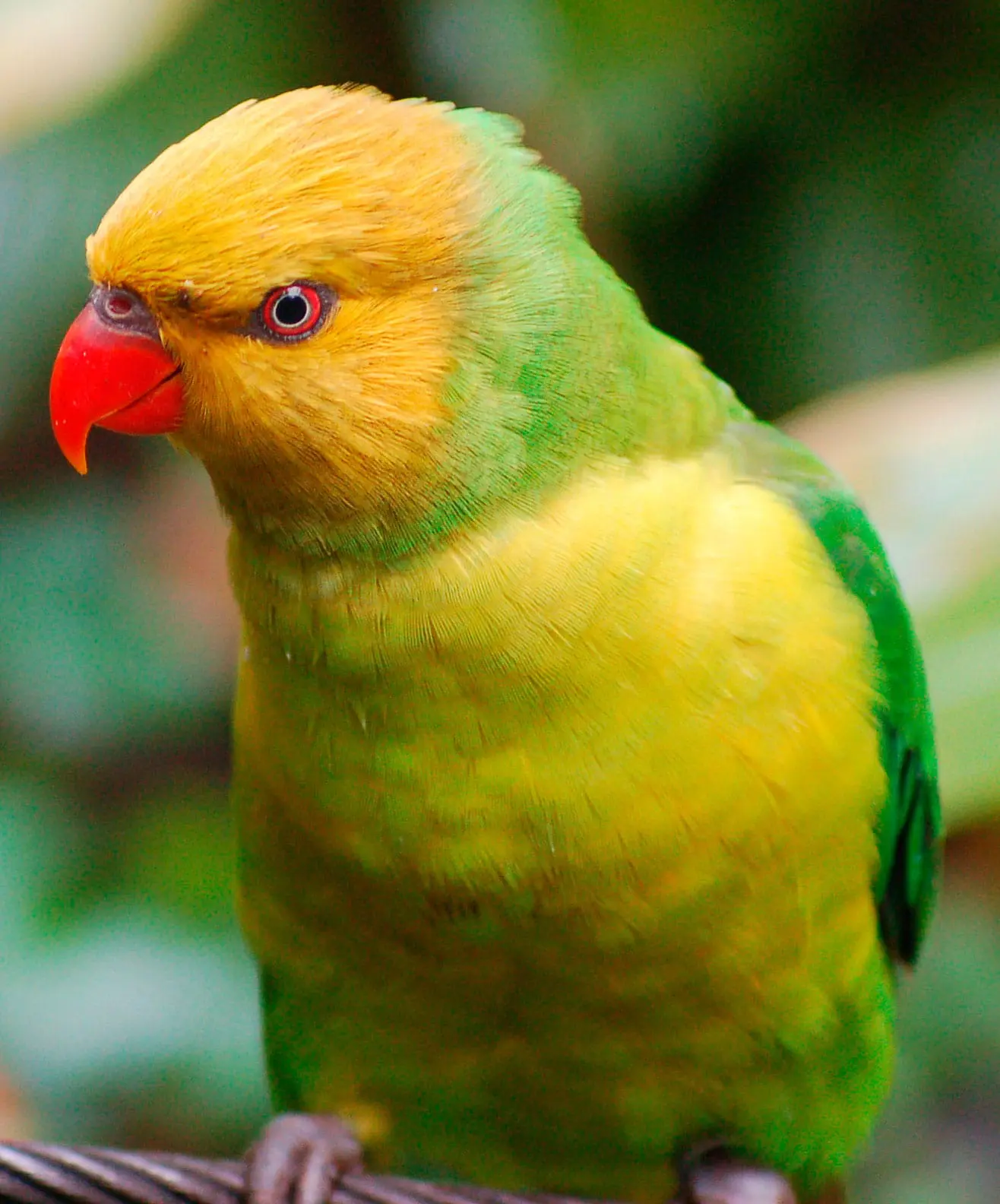
The Olive headed Lorikeet (Trichoglossus euteles) show, in general, a green shade.
The head color is olive with waves pale mustard and yellow stripes over the entire surface of the top.
The neck and its part rear are surrounded by a collar of color green brilliant that continues until the throat.

The underparts below the throat are entirely greenish-yellow.
The bill is red-orange. The irises they are red, and legs grey.

The youth they are more muted than adults. Its head is slightly greenish with streaks pale. The bill is brown. The irises They are brown. The species is considered monotype.

Habitat:

They frequent humid subtropical forests., secondary forests and wooded meadows. Adapt quite well to cultivated land and the gardens in cities.

In Timor, they are relatively abundant between 1.000 and 2.300 meters above sea level, apparently, substitute to the Coconut Lorikeet in these heights. Also they can be observed at sea level in the island of Timor. In the rest of the Islands it frequents lowland areas.

The Olive headed Lorikeet they live in small groups. They are especially visible when they are in flight because they emit continuously shouts. On the other hand, when feeding or resting in trees, they are very difficult to observe because of their green plumage mixed with the color of the foliage.

They are birds territorial, capable of showing great aggressiveness if the limits of their area of ​​influence are violated.

Usually disperse in search of their food, forming large groups when resources are abundant.

Outside the breeding season they form large roaming flocks of a hundred or more individuals.. Move in flying fast and slightly wavy.

In Timor, during the season, dry, These birds seem to descend below 1.000 meters and are scattered in coastal areas.

Reproduction:

The anidacio seasonn would take place perhaps between September and October, but this information needs to be confirmed.

In captivity, the Olive headed Lorikeet put 3 white eggs that parents are in charge of incubate for a few 23 days. As in the majority of the Lori, the nesting cycle is particularly long.

Food:

Feed primarily of nectar and fruit. They forage in trees in flower and shrubs.

Distribution:

Size of the area of distribution (reproduction / resident): 38.100 km2

Timor and Lesser Sunda Islands, from the East of Lembata until Nila and Babar.

Conservation:


minor concern


• Current IUCN Red List category: Least concern

• Population trend: Stable


The population size This species has not been quantified. Suspected that the population is stable in the absence of evidence of any reduction or substantial threats.

Like most brightly plumaged parrots, the Olive headed Lorikeet It victim of trade bird cage or Aviary.


"Olive headed Lorikeet" in captivity:

Pretty common. They can be housed with others of its kind.

Alternative names:

– Olive headed Lorikeet, Olive-headed Lorikeet, Perfect Lorikeet (ingles).
– Loriquet eutèle (French).
– Gelbkopflori (German).
– Lóris-de-cabeça-amarilla (Portuguese).
– Lori Humilde, Tricogloso Humilde (español).

scientific classification:

– Order: Psittaciformes
– Family: Psittaculidae
– Genus: Trichoglossus
– Scientific name: Trichoglossus euteles
– Citation: (Temminck, 1835)
– Protonimo: Psittacus euteles

Images "Humned Lori":

Videos "Olive headed Lorikeet"

———————————————————————————————–

"Lori humilde» (Trichoglossus euteles)


Sources:

– Avibase
– Parrots of the World – Joseph Forshaw M
– Parrots-A Guide to the Parrots of the World by Tony Juniper & Mike Parr
– BirdLife.org

– Photos:

1 – Photo by and (C)2007 Derek Ramsey (Ram-Man) – Self-photographed – Wikipedia
2 – By James Eaton – IBC.lynxeds.com
3 – «Trichoglossus euteles-captive-8a-ec» by Trichoglossus_euteles_-captive-8a.jpg: Ruth Rogersderivative work: Snowmanradio (talk) – originally posted to Flickr as P8120395 and uploaded to commons at Trichoglossus_euteles_-captive-8a.jpg. Licensed under CC BY 2.0 via Wikimedia Commons.
4 – "Scaly-breasted Lorikeet Kobble Dec06" von Aviceda – Eigenes Werk. Lizenziert unter CC BY-SA 3.0 über Wikimedia Commons.
5 – By Marcella (Picasa Web Albums) [CC-BY-SA-3.0], via Wikimedia Commons

– Sounds: Colin Trainor (Xeno-canto)

▷ The world of Pets: Dogs, cats, birds, reptiles, amphibians

Mindanao Lorikeet
Trichoglossus johnstoniae

Mindanao Lorikeet

Content

Description

20 cm.. length and a weight between 48 and 62 gr.

The plumage of the Mindanao Lorikeet (Trichoglossus johnstoniae) is usually Green. The facial area It is red with a tendency to pink. The band that goes from the eye until the part back from the neck it is dark purple.

The underparts are yellow, scalloped with green resembling scales. They have the Underwing coverts and subcaudales yellowish green. The band less of them wings is yellow. Its bill is reddish orange, the legs grayscale and the eye ring dark gray. The eyes orange-red.

The birds immatures have less red on the face. Instead of the band dark purple in adults, young birds have an off color lilac and a Brown stain behind the eye. The rings of the eyes are of color grey white. The eyes They are brown.

There are no significant differences between males and females.

  • Sound of the Mindanao Lorikeet.

Habitat:

Found of 1.000 to 2.500 m in the Mount Apo and 1.000 1,700 m in the Mount Malindang.

The Mindanao Lorikeet they prefer mossy forests, but also you can see them along the edge of the forest and in degraded areas.

Usually noisy during the flight, but when they feed on, remain calm. They migrate daily between different altitudes in the morning looking for food in the Highlands and in the evening return to their resting places in the lower areas.

They move higher during the day, in flocks of up to 50 birds, to feed on trees with flowers and shrubs. At sunset, they return to the lower slopes to rest.

Reproduction:

Little is known about the ecology of reproduction.. Probably it breeding is performed between months of March and may.

Captive breeding records indicate that the laying tends to be of two eggs, the incubation of some three weeks and that the young leave the nest between three weeks and a month more afternoon.

Food:

With feeds nectar, flowers, fruits, pollen and insects.

Distribution:

Size of the area of distribution (reproduction / resident): 8.700 km2

Endemic to the mountains of Mindanao (Philippines)

Conservation:


Near-threatened

• Current IUCN Red List category: Near threatened

• Population trend: Decreasing

Its habitat favorite is relatively unlikely that is affected by human activities in the medium term, but logging and capture should remain concerns.

The world population apparently not been quantified formally, but the species is described as very rare and there are those who think that there are less than 10.000 individuals.

"Mindanao Lorikeet" in captivity:

Very rare in captivity.

Due to its decreasing trend in terms of its population, any specimen that can not be returned to their natural habitat (natural range) should preferably be placed in a well-managed breeding program to ensure the survival of the species.

Alternative names:

– Mindanao Lorikeet, Apo Lorikeet, Johnstone’s Lorikeet (ingles).
– Loriquet de Johnstone (French).
– Mindanaolori, Mindanao-Lori (German).
– Loris johnstoniae (Portuguese).
– Lori de Mindanao, Tricogloso de Mindano (español).

scientific classification:

– Order: Psittaciformes
– Family: Psittaculidae
– Genus: Trichoglossus
– Scientific name: Trichoglossus johnstoniae
– Citation: Hartert, 1903
– Protonimo: Trichoglossus johnstoniae

“Mindanao Lory” Images:

————————————————————————————————

«Lori de Mindanao» (Trichoglossus johnstoniae)


Sources:

– Avibase
– Parrots of the World – Forshaw Joseph M
– Parrots A Guide to the Parrots of the World – Tony Juniper & Mike Parr
– BirdLife.org

– Photos:

1 – «Trichoglossus johnstoniae - London Zoo, England-8a» by William Warby from London, England – Unknown-Tropical BirdUploaded by Snowmanradio. Licensed under CC BY 2.0 via Wikimedia Commons.
2 – «Mindanao Lorikeet (Trichoglossus johnstoniae)-3c» by Mindanao_Lorikeet_(Trichoglossus johnstoniae).jpg: Elizabeth Ellisderivative work: Snowmanradio (talk) – originally posted to Flickr as lovebird and uploaded to commons at Mindanao_Lorikeet_(Trichoglossus johnstoniae).jpg. Licensed under CC BY-SA 2.0 via Wikimedia Commons.
3 – by Jonathan Beilby – IBC.lynxeds.co
4 – zoochat.com
5 – papageien.org

– Sounds: Kennedy, Robert S. – © 2014 Cornell University

▷ The world of Pets: Dogs, cats, birds, reptiles, amphibians

Goldie's Lorikeet
Psitteuteles goldiei

Goldie's Lorikeet

Content

Description

19 cm.. long and weighing between 45 and 60 g..

The Goldie's Lorikeet (Psitteuteles goldiei) has the top red. Its neck is surrounded by a strip blue opaque that it extends to the edge of the eye.

The mumps and their cheeks They are pink with multiple dark blue veins.. The upperparts of color green dark streaked of black in the part inferior of the neck and of color yellow greenish mottling on the sides of the layer.
The feathers that cover the wing are dark green, as well as the top of the tail.
The feathers they have a green color with black internal wires and a fine yellow edge.

The underparts are yellowish green with many streaks of dark green, more concentrated in the area of the chest. The bottom of the tail is of color yellow grey.

The bill is black, brown the iris. The legs son grises.

The females adult, they have the top more opaque and less developed.

In the immature, the top is reddish with dark blue spots. The upper mantle is spotted of yellow.

There are no geographic variations. The species is considered monotype.

Habitat:

The Goldie's Lorikeet It is distributed mainly by primary forests, mountain forests and eucalyptus between 1.000 and 2.200 meters above sea level. But, These birds are very Mobile and their habitat may vary from sea level to the 2.800 m.

At higher altitudes, sometimes be parked in the forests of beech and false Podocarpus. They are also set fairly regularly in the areas where the trees are in bloom and around small mountain villages. They have been , occasionally, in small groups of trees isolated in the middle of open spaces.

The Goldie's Lorikeet they are very sociebles. They are often associated with other Charmosyna type Loris: Fairy Lorikeet (Charmosyna pulchella) and Lori Flanquirrojo (Charmosyna placentis).

Most of the time they live in large groups of 30 or more individuals. These birds make long flights daily, often in the company of Pygmy Lorikeet (Charmosyna wilhelminae). Move from their places of rest to its feeding sites found at the middle level, or at the top of the tall trees in flower.

They probably make seasonal migrations to meet their specific feeding needs.. Between mid June and early January, the Goldie's Lorikeet they are common in the forests of the lowlands around Port Moresby.

Reproduction:

We really know very little about free-range breeding.. Apparently, the nest is well hidden inside a tree in thick foliage dry, mostly big pandanus. The female lays two white eggs.

In captivity, the incubation period ranges between 23 and 24 days. Young are altricial, and leave the nest after 8 to 9 weeks.

Food:

The Goldie's Lorikeet they have a scheme rather similar to all the lori, that is to say, they are almost exclusively vegetarian. Its menu consists mainly of pollen, nectar, flowers and fruits than that found in the trees of the genus Casuarina in shrubs of the genus honey Grevillea and of the eucalyptus.

Distribution:

Size of the area of distribution (reproduction / resident): 307.000 km2

This species is endemic of New Guinea. Lives exclusively in the mountains in the center of the island and stretches to the mountains of the Huon Peninsula and Owen Stanley.

Conservation:


minor concern

– Current IUCN Red List category: Least concern

– The population trend: Stable

The population suspected to be stable in the absence of evidence of any reduction or substantial threats.

The world population It has not been quantified, It is estimated above 100.000 specimens, but the species is reported to be locally common depending on food availability.

"Goldie's Lorikeet" in captivity:

The Goldie's Lorikeet is a bird prized as a pet. His character is not aggressive, or destructive and is quite silent for a parrot. They can be taken in pairs or in large communities. Some of them come to imitate the human voice.

Alternative names:

– Goldie’s Lorikeet, Red-capped Streaked Lorikeet, Red-capped Streaked Lory (ingles).
– Loriquet de Goldie (French).
– Veilchenlori (German).
– Lóris-de-goldie (Portuguese).
– Lori de Goldie, Tricogloso de Goldie (español).

scientific classification:

– Order: Psittaciformes
– Family: Psittaculidae
– Genus: Psitteuteles
– Scientific name: Psitteuteles goldiei
– Citation: (Sharpe, 1882)
– Protonimo: Trichoglossus Goldiei

"Goldie's Lory" Images:

————————————————————————————————

"Lori de Goldie" (Psitteuteles goldiei)


Sources:

– Avibase
– Parrots of the World – Forshaw Joseph M
– Parrots A Guide to the Parrots of the World – Tony Juniper & Mike Parr
– BirdLife.org
– Wikipedia

– Photos:

1 – «Psitteuteles goldiei - Pittsburgh National Aviary-8-3 c» by derivative work: Snowmanradio (talk)Psitteuteles_goldiei_-Pittsburgh_National_Aviary-8.jpg: Benny Mazur – originally posted to Flickr as Goldie’s Lorikeet and uploaded to commons as Psitteuteles_goldiei_-Pittsburgh_National_Aviary-8.jpg. Licensed under CC BY 2.0 via Wikimedia Commons.
2 – animalhouse.Re.it
3 – «Goldies Lorikeet» by Ltshears – Own work. Licensed under CC BY-SA 3.0 via Wikimedia Commons.
4 – Jackson Zoological Park – Jackson, MS, USA © 2004 Jeff Whitlock
5- Bird feeding on fruit in a tree. by David Cook Wildlife Photography – IBC.lynxeds.com

– Sounds: Michiel de Boer (Xeno-canto)