Origin: Venezuela, Colombia, Ecuador, Peru, Bolivia
Character: shy
Life expectancy: ---
Height: 33 to 38 cm..
Content
Description
33 to 38 cm.. tall and 300 g. of weight.
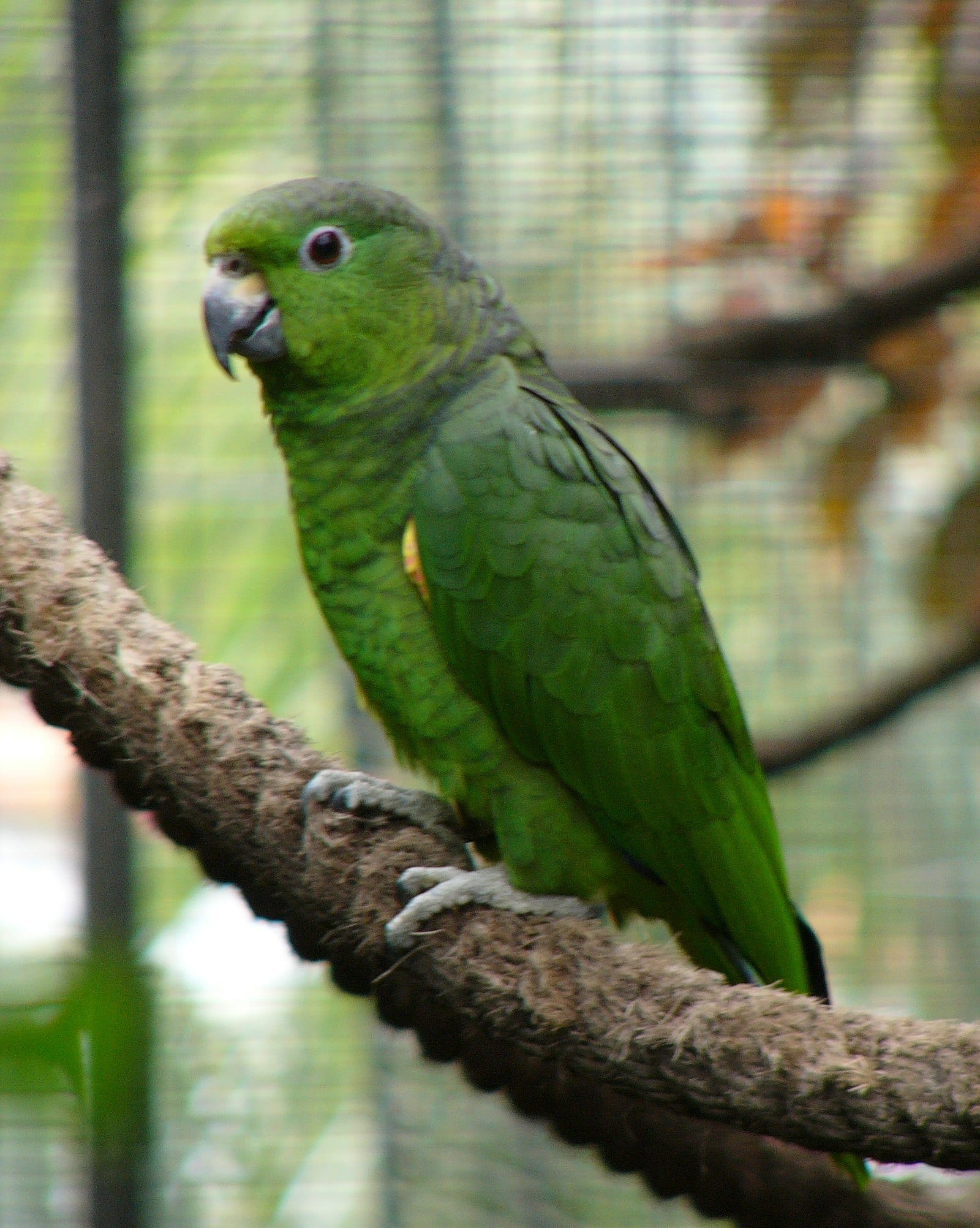
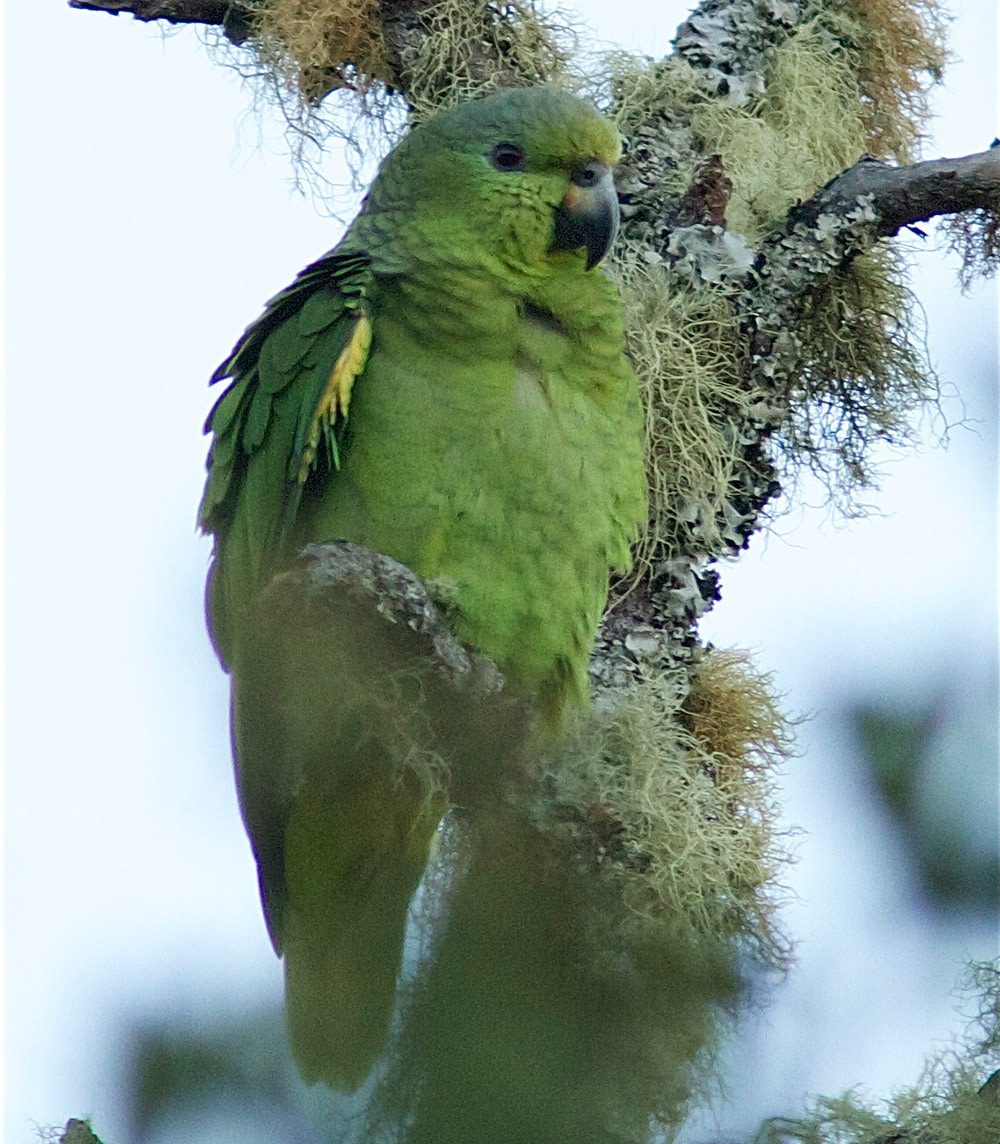
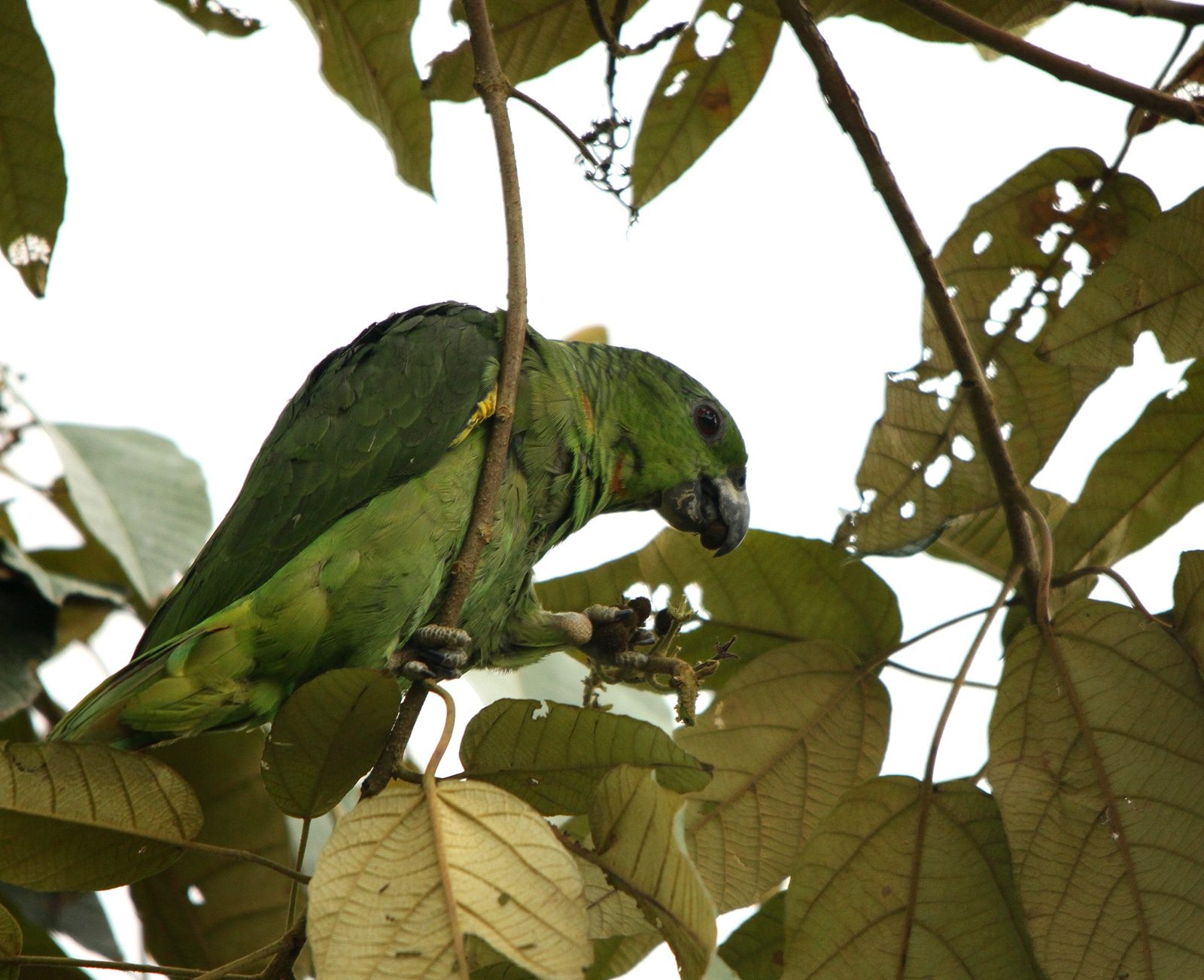
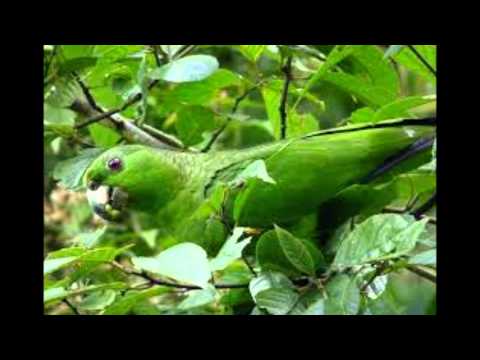
The Scaly-naped Amazon (Amazona mercenarius) it is the only amazon in mountainous areas.
General coloring green, with the feathers of the chest with black border, It is distinguished by having the wingtip yellow with orange spots, and external feathers tail tricolor with blue base, middle part red and yellow tip.
Bill pale gray area at the base of jaw; irises orange; legs brown.
Both sexes are similar. It is thought that immature they are similar to adults.
(Cabanis, 1874) – Speculum red absent. bases outer secondaries marked with brown spots. Some specimens show scattered red feathers crown, the throat top of the chest.
Andean and sub-Andean forests permanently cloudy between 1200 and 3000 m. Occasionally in warm floor and cultivated land.
Usually in pairs or groups of 30 to 40 individuals.
Reproduction:
They have reported evidence reproduction between March and May in Colombia. Nest and eggs not yet described. The incubation period apparently it lasts 25 and 26 days.
Food:
Little information on their diet, but he has seen taking figs and fruit unidentified in Colombia.
In Colombia they have been observed down to attack corn fields.
Distribution:
Size of the area of distribution (reproduction / resident): 3.160.000 km2
Andes from Venezuela to the North of Bolivia.
Distribution 2 subspecies
Amazona mercenarius canipalliata
(Cabanis, 1874) – Andes of Colombia to northwest Venezuela and Ecuador.
Amazona mercenarius mercenarius
(Tschudi, 1844) – Nominal. Andes North of Peru to the North of Bolivia; a single record in Argentina.
Conservation:
State of conservation ⓘ
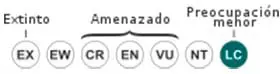
Minor Concern ⓘ(UICN)ⓘ
• Current category of the Red List of the UICN: Least concern.
• Population trend: Decreasing.
Justification of the population
The population size World has not been quantified, but this species is described as «quite common» (Stotz et to the., 1996).
Justification of trend
It is suspected that the population is in decline due to the continuous habitat destruction.
Sources:
– Parrot Book, Parrots and macaws Neotropical
– avibase
– Parrots of the World – Forshaw Joseph M
– Parrots A Guide to the Parrots of the World – Tony Juniper & Mike Parr
– Birdlife
55 to 65 cm.. length and a weight of up to 900 g..
The Yellow-tailed black cockatoo (Calyptorhynchus funereus) stands out clearly by its plumage mostly black, patch yellow in cheek and yellow panels in tail.
The body feathers They are lined with yellow giving it a scalloped appearance. It has a crest short and moving on top of her head.
The female It has a yellow stain on the cheek more defined and larger than the male, Bello to singr pale gray (Pink in males)
The juveniles has plumage duller overall.
The bill top of immature male black obscures two years old, While the lower peak black four years.
(Gould, 1838) – Smaller size, tail shorter dark mottled.
Habitat:
Variety of types habitats, including forests of eucalyptus, heaths, subalpine areas, pine plantations and occasionally in urban areas.
They are often seen flying in pairs or trios formed by a pair and their young., although outside the breeding season they can join in more numerous flocks.
Reproduction:
have a long breeding season, that varies throughout its range, although Tasmania in general it is from October to February. Both sexes construct the nest in holes of mature trees, high, generally eucalyptus. Fill the hole of wood chips. The same tree can be used for many years.
One or two eggs form a clutch. Only the female incubates the eggs, While the male supplies the food. Both parents help rear the chicks, Although usually only one chick survives. The chicks leave the nest about three months after hatching and remain in the company of their parents until the next breeding season.
Food:
Seeds native trees, terrestrial plants and pine cones. Some insects also part of their diet. Unlike other cockatoos, a significant proportion of the diet up wood borers worms. The bird put his ear against the surface of dead trees to hear the sound of worms. If a worm is detected, the bird will use their powerful beaks to pull pieces of the tree until you get to the meal, often leaving a pile of wood chips at the base of the tree. These scars on dead trees are a common sight in the forests of Tasmania.
Distribution:
Size of its range (breeding/resident ): 2.700.000 km2
It is up to the 2000 meters throughout Southeast Australia, from South Eyre Peninsula to the east-central Queensland.
Your number is declining in parts of its range due to habitat fragmentation and loss of large trees used for breeding.
In Tasmania is common and nomadic. They can be seen in many parts of the state and in the larger islands Bass Strait.
• Current category of the Red List of the UICN: Least concern.
• Population trend: Stable.
This species has a very large range, and therefore not approaching the threshold of vulnerable. Not threatened worldwide. CITES II. As with most other cockatoos, its long-term existence depends on the continued availability of hollow trees for nesting,
The population is estimated at at least 25.000 birds.
The population trend appears to be stable.
"Yellow-tailed black cockatoo" in captivity:
In the poultry industry this species is extremely rare and expensive. In Australia It has attained breed in captivity.
Like all cockatoos, they come to live over 40 years.
Alternative names:
– Yellow-tailed Black-Cockatoo, Black Cockatoo, Common Black-Cockatoo, Funeral Cockatoo (English).
– Cacatoès funèbre, Cacatoès noir à queue jaune (French).
– Gelbohrkakadu, Gelbschwanz-Rußkakadu, Rußkakadu (German).
– Cacatua-negra-de-cauda-amarela (Portuguese).
– Cacatúa Fúnebre Coliamarilla, Cacatúa Fúnebre de Cola Amarilla (español).
46 to 51 cm.. height and between 400 and 500 g. of weight.
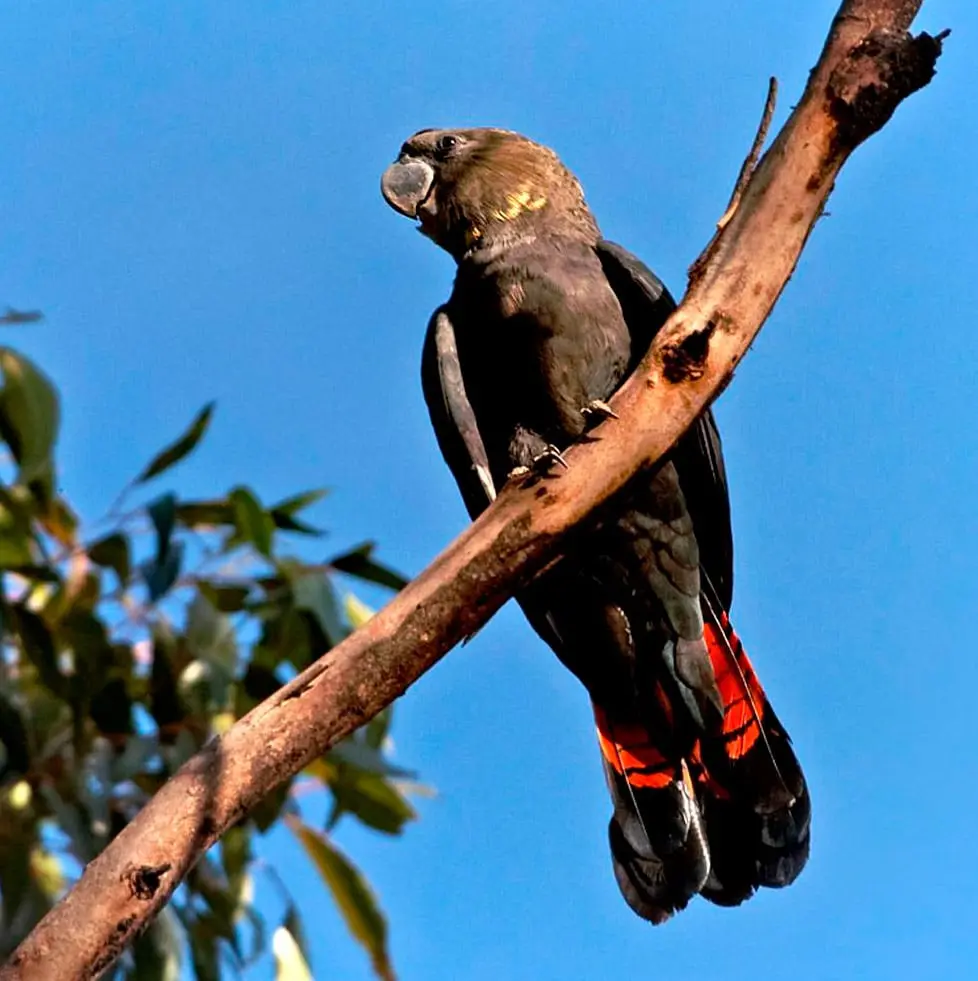
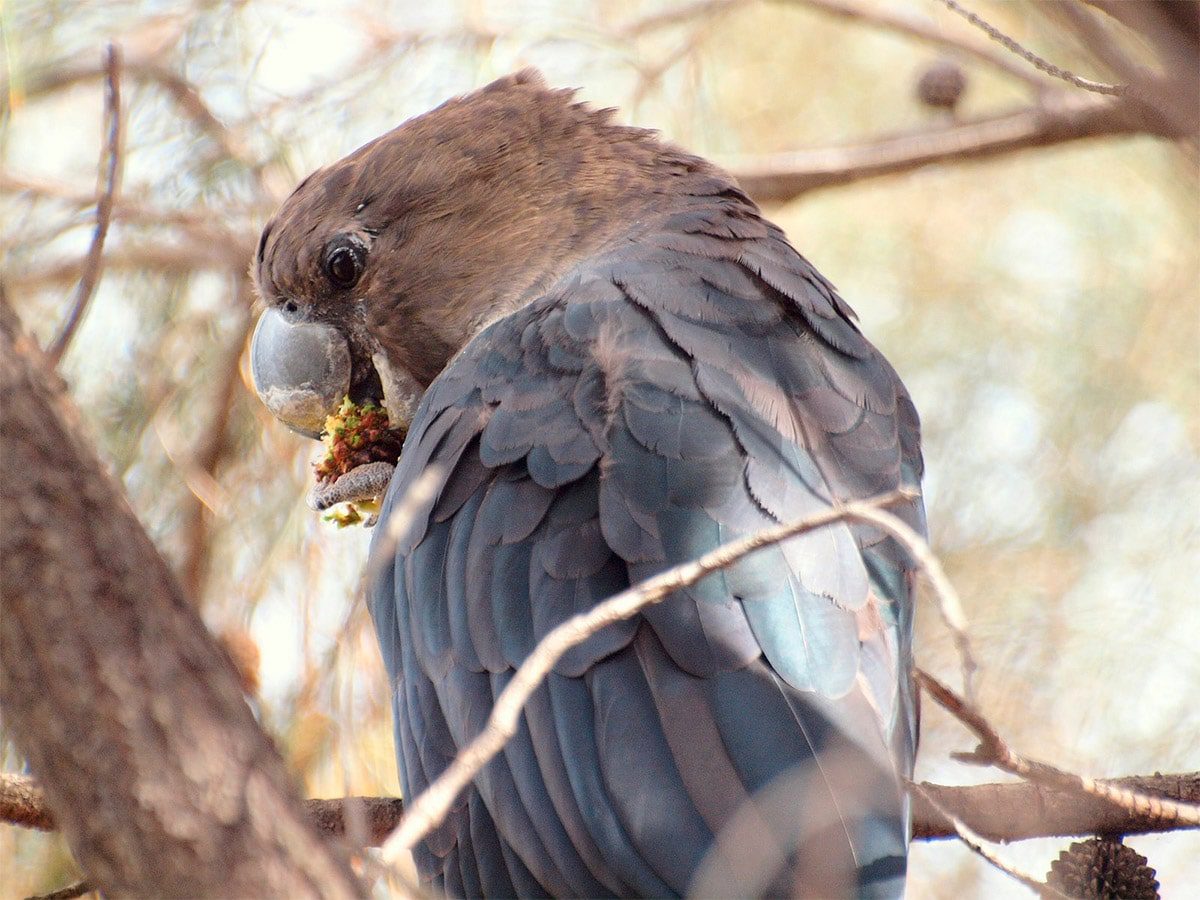
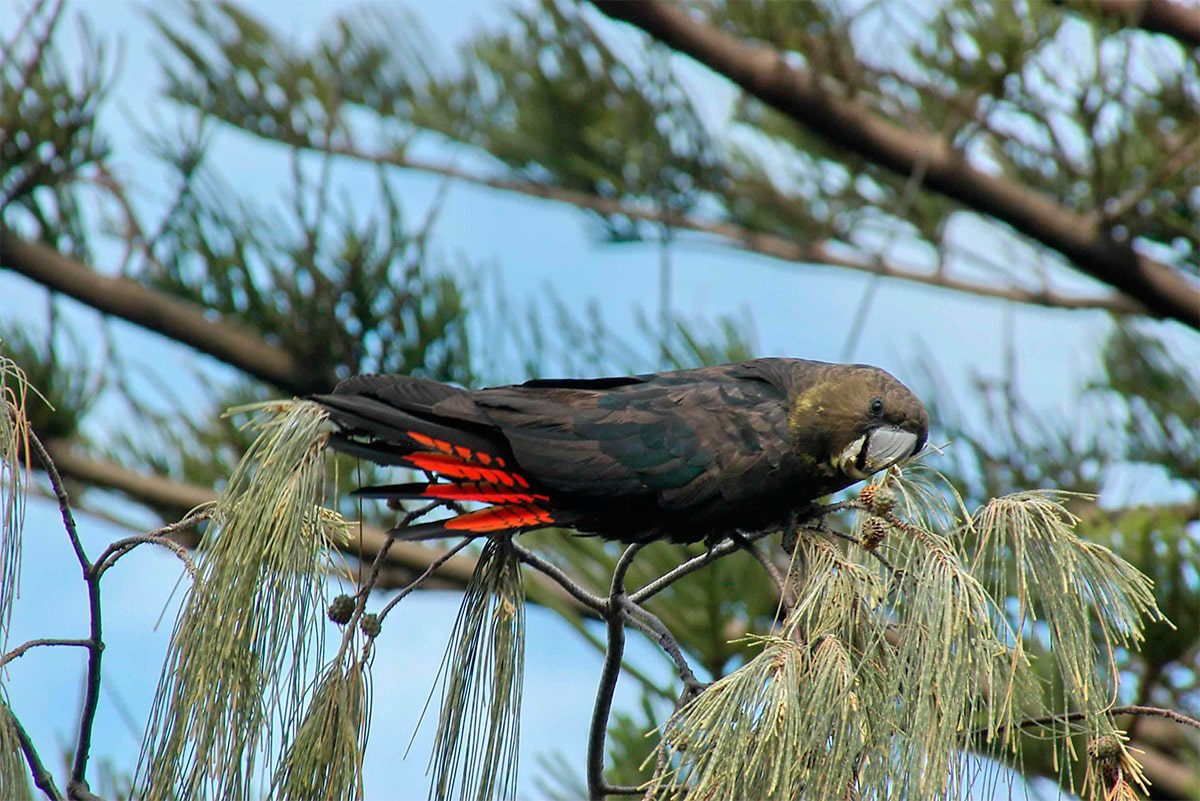
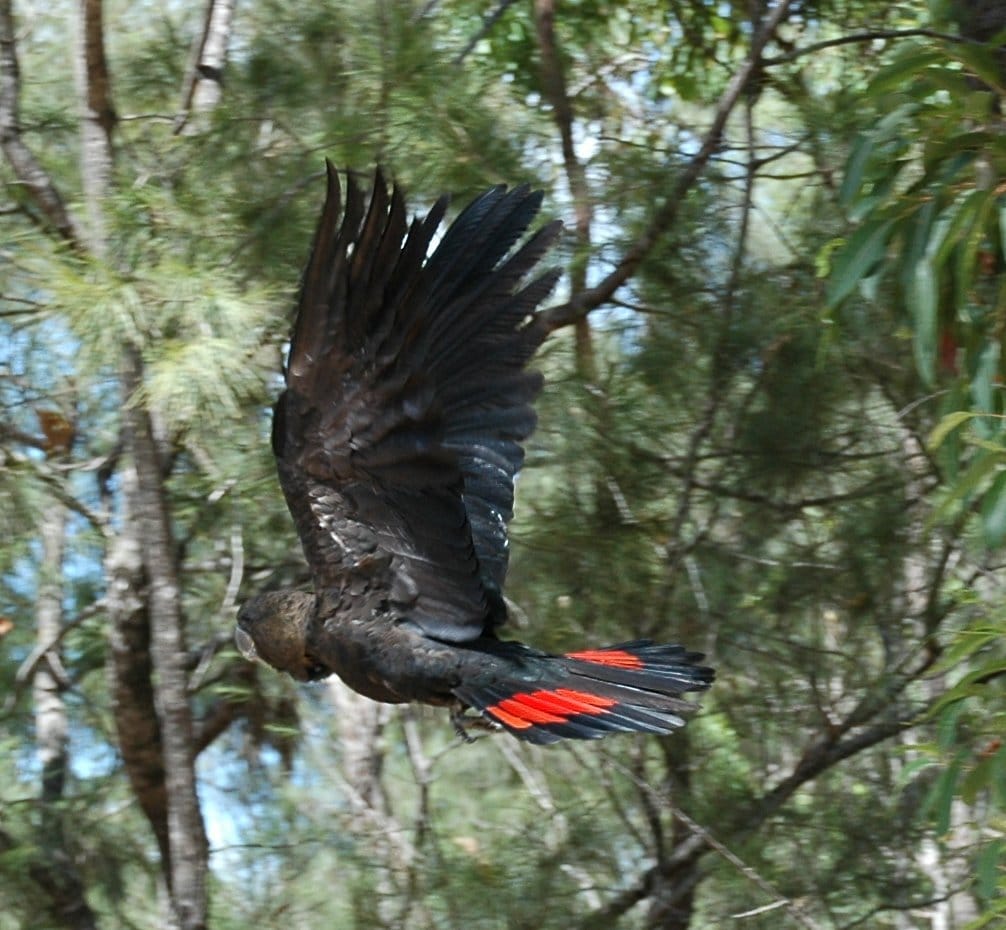
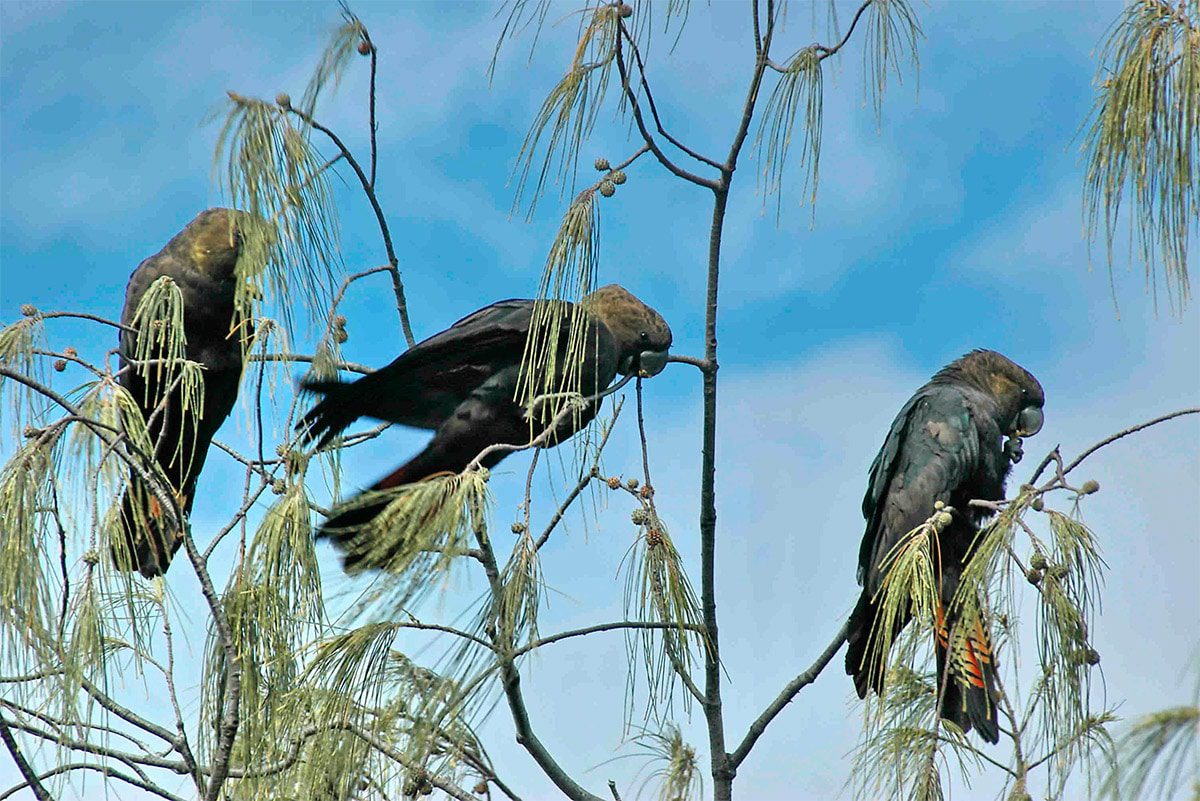
The Glossy black cockatoo(Calyptorhynchus lathami) is the smallest of the 5 black cockatoos and is restricted to the East coast of Australia (a population isolated also is reproduced in the Islands Kangaroo).
The male is brown-black color with a small crest rounded and bright Scarlet spots in the tail. The female shows spots irregular in color yellow in it head, The Scarlet patches in the tail they are permeated by narrow black bars and edges of pale yellow on the underparts of the wings.
The immature they are similar to the females, but they lack the yellow markings on the head and show different yellowish tones in the feathers, the chest and in the belly.
(Mathews, 1912) – Medium-size ones 48 cm. length and 510 to 515 weight g, with a wing
of approximately 90 cm.. The of adults they are mainly black, dark brown in the head, the neck and the bottom of the body, and Red panels (in males) or orange-red with bars Black (in females) on tail. The female adult is also conspicuous in the head. These patches are absent from most males., Although they can be expressed faintly in a few individuals (Higgins 1999).
The immature are similar in appearance to the male adult, but have small stains yellow in it head; spots or bars yellow in the chest, belly and flanks; yellow or orange spots on the wing
(mainly on the bottom); Red or orange-yellow panels with black bars at the tail; One bill pale grey (instead of dark); And a ring of skin around the eye pale grey (instead of grey dark) (Higgins 1999, L. Pedler 2007, com. Pers.).
Calyptorhynchus lathami erebus
(Schodde & Mason,IJ, 1993) – The only difference with the nominal species resides in that has the bill shorter.
Habitat:
Video – "Glossy black cockatoo" (Calyptorhynchus lathami)
Glossy-black Cockatoo (Calyptorhynchus lathami ) HD Video clip 1/3
Areas forested frequently dominated by casuarinas of which are highly dependent for its food. These are small shrubs commonly known as the Sheoaks, wood for beef (Beefwood) or Australian pine. These shrubs are widespread in tropical and subtropical regions.
They are also distributed in open humid forests, difficult terrain where deforestation has not been too great. They have an imperative for natural tree cavities to nest.
Reproduction:
Forman couple during all the life. The couple has relationships throughout the year. This type of family of them parrots prefers to nest in cavities natural of the eucalyptus, whether dead or in full vitality. The nest usually placed at an altitude that ranges between the 3 and 30 meters above the ground. The cavity is filled with leaves and branches. Sometimes, together with other breeding pairs, they share the same tree year after year.
In New South Wales the season extends from March to August. The spawning It consists of a single egg white. It is the female that takes charge of most of the tasks.: It prepares the nest and incubates herself. Never leave the nest until the small is reached the age of one week. In most cases, the male provides the female with food and assistance until the young can fend for itself, normally four months which remains with them until the next breeding season.
Food:
It feeds almost exclusively on the seeds several species of She-oak (Casuarina and Allocasuarina). You can also sometimes eat larvae of wood-boring. They feed in threes, less frequently in pairs, small groups or flocks of up to 60 birds. They can be detected by the snapping of their beaks and the remains of the casuarina cones and twigs that fall.
Distribution:
Size distribution (reproduction / resident): 770.000 km2
The species is Rare Although widespread in suitable forests of the central coast and forest habitats of Queensland and in the interior of the southern plateaus and Plains of the Midwest's New South Wales, with a small population in the Riverina. There is an isolated population in the Kangaroo Island, South of Australia.
(Schodde & Mason,IJ, 1993) – It is from Australia (the central eastern coastal area of Queensland)
Conservation:
State of conservation ⓘ
Minor Concern ⓘ(UICN)ⓘ
• Current category of the Red List of the UICN: Least concern.
• Population trend: Decreasing.
Like most parrot species, the Glossy black cockatoo is protected by the Convention on international trade in endangered species of Fauna and Flora Silvestres ( CITES ), with its inclusion in the list of the Appendix II of vulnerable species, What makes the import, the export and trade of animals captured in the wild is illegal.
Justification of the population
Garnett and Crowley (2000) estimated the size of the population in the following way: 12.000 individuals of the subspecies lathami, 70 breeding pairs of the subspecies halmaturinus (equivalent to 140 individuals) and 5.000 individuals of the subspecies erebus giving a total of 17.140 individuals.
Justification of trend
They suspected that the population is declining in general Since the largest subpopulation, lathami, It is slowly decreasing throughout its range. However it is believed that the subspecies Erebus is increasing and the subspecies halmaturinus It is increasing as a result of conservation efforts in the Island Ganguro (Garnett and Crowley 2000).
"Glossy black cockatoo" in captivity:
Like the other black cockatoos, the Glossy black cockatoo(Calyptorhynchus lathami) is extremely rare in the poultry. In Australia It has attained breed in captivity.
35 cm.. length and weighing approximately between 340 and 425 g.
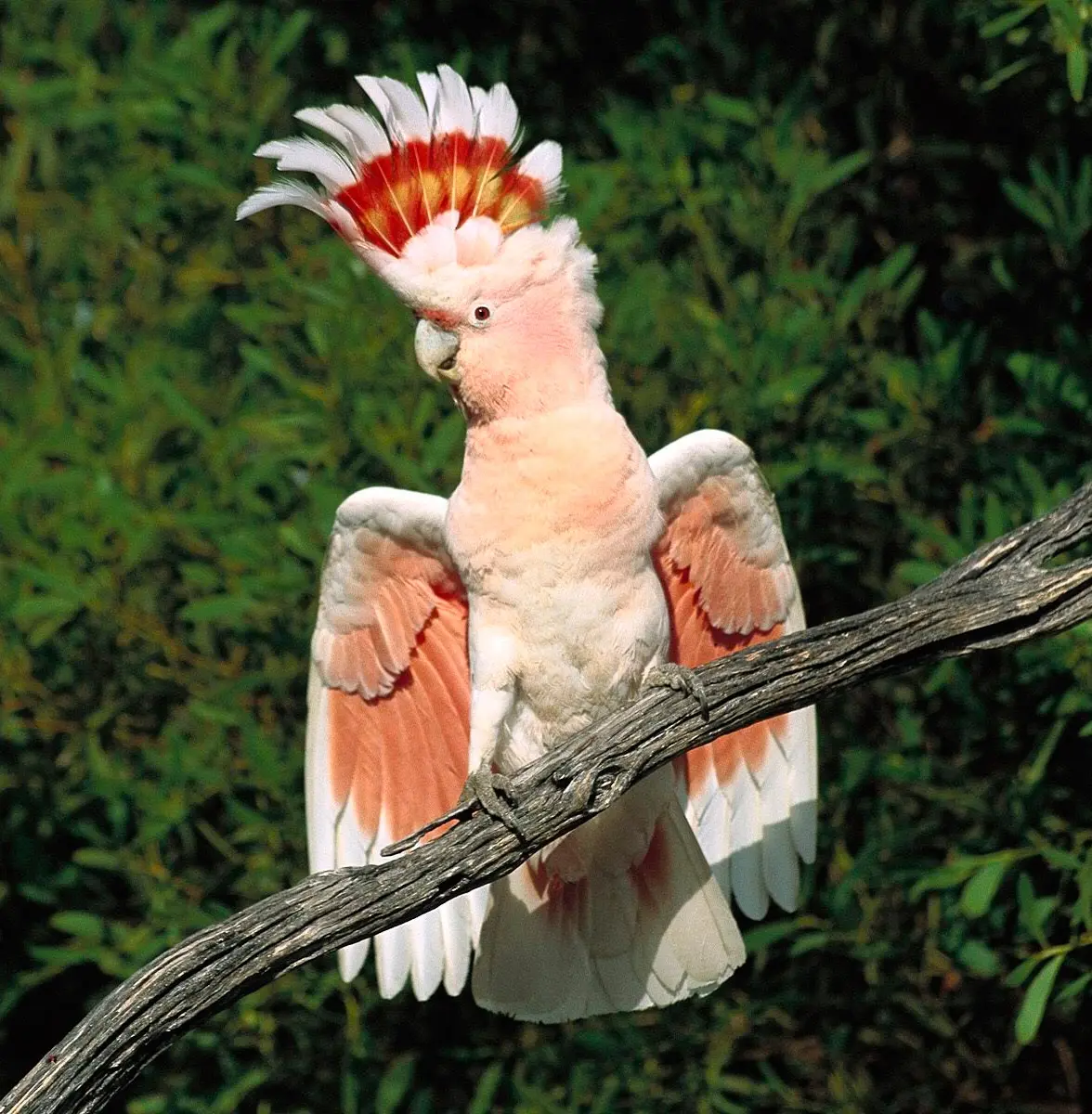
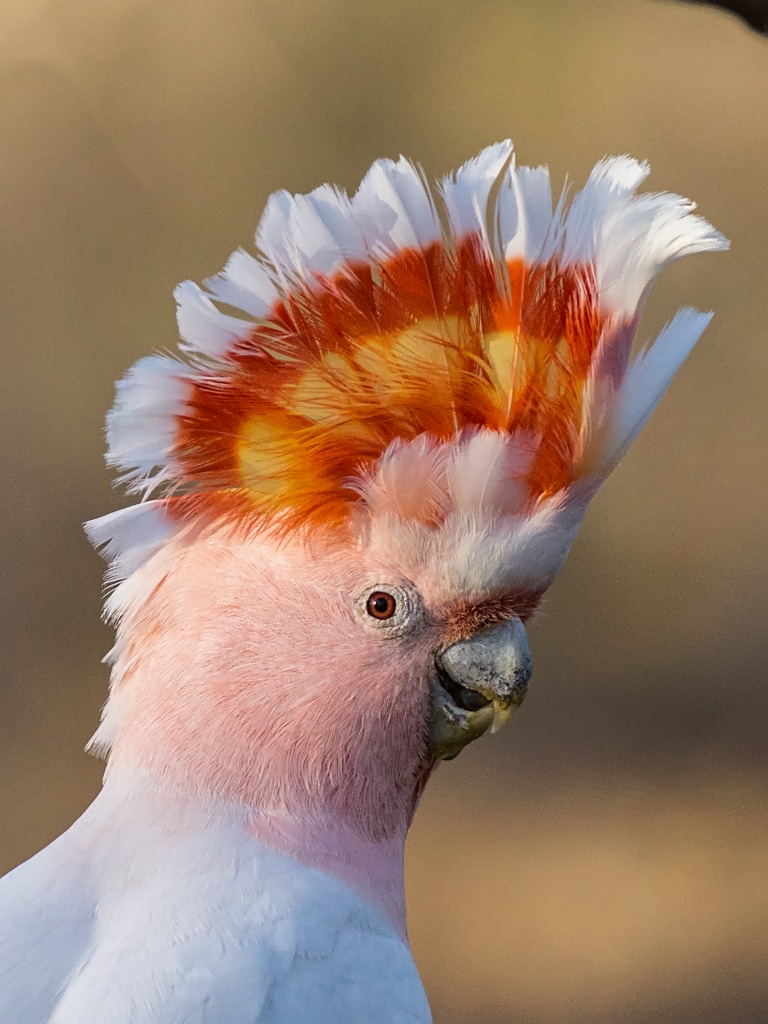
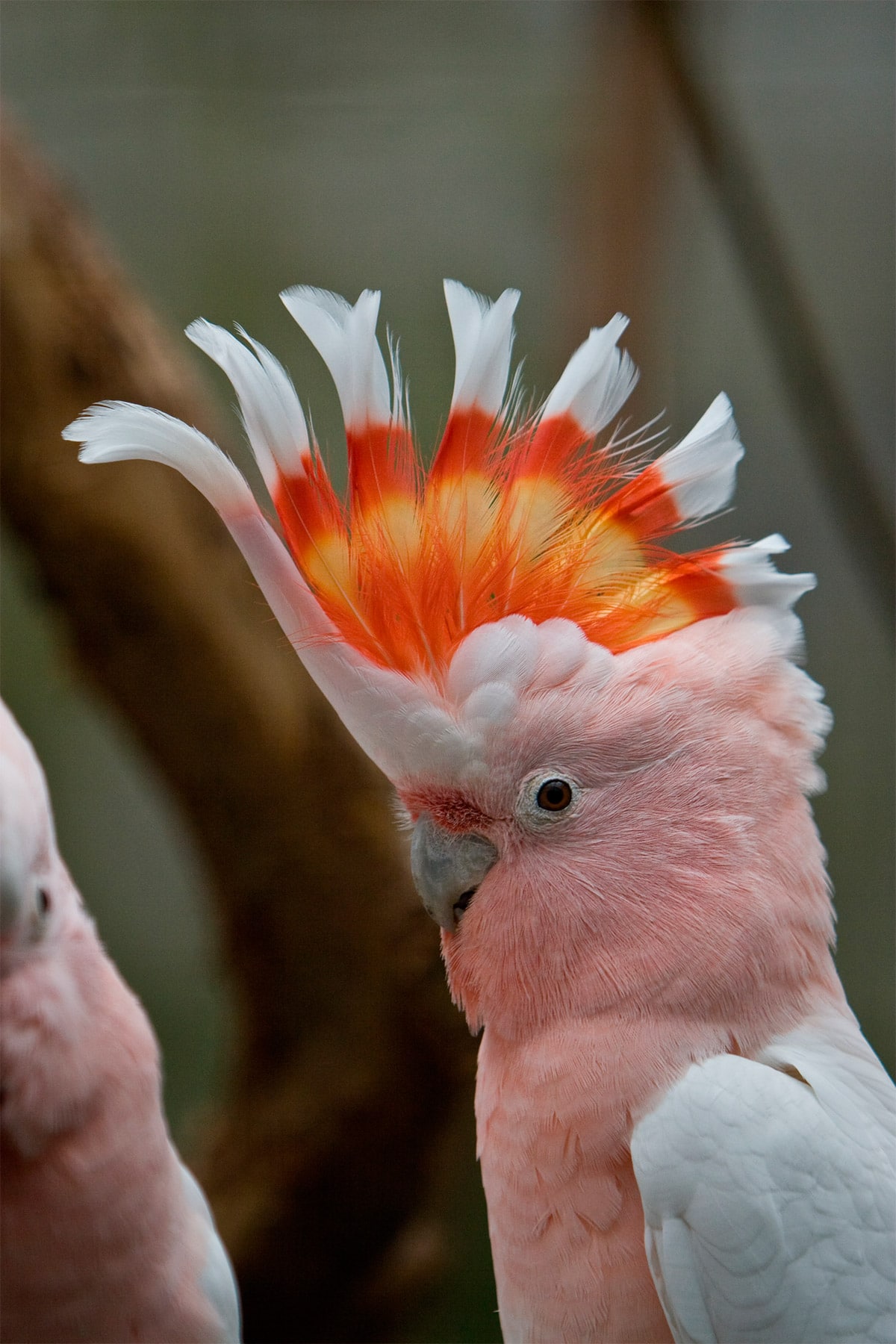
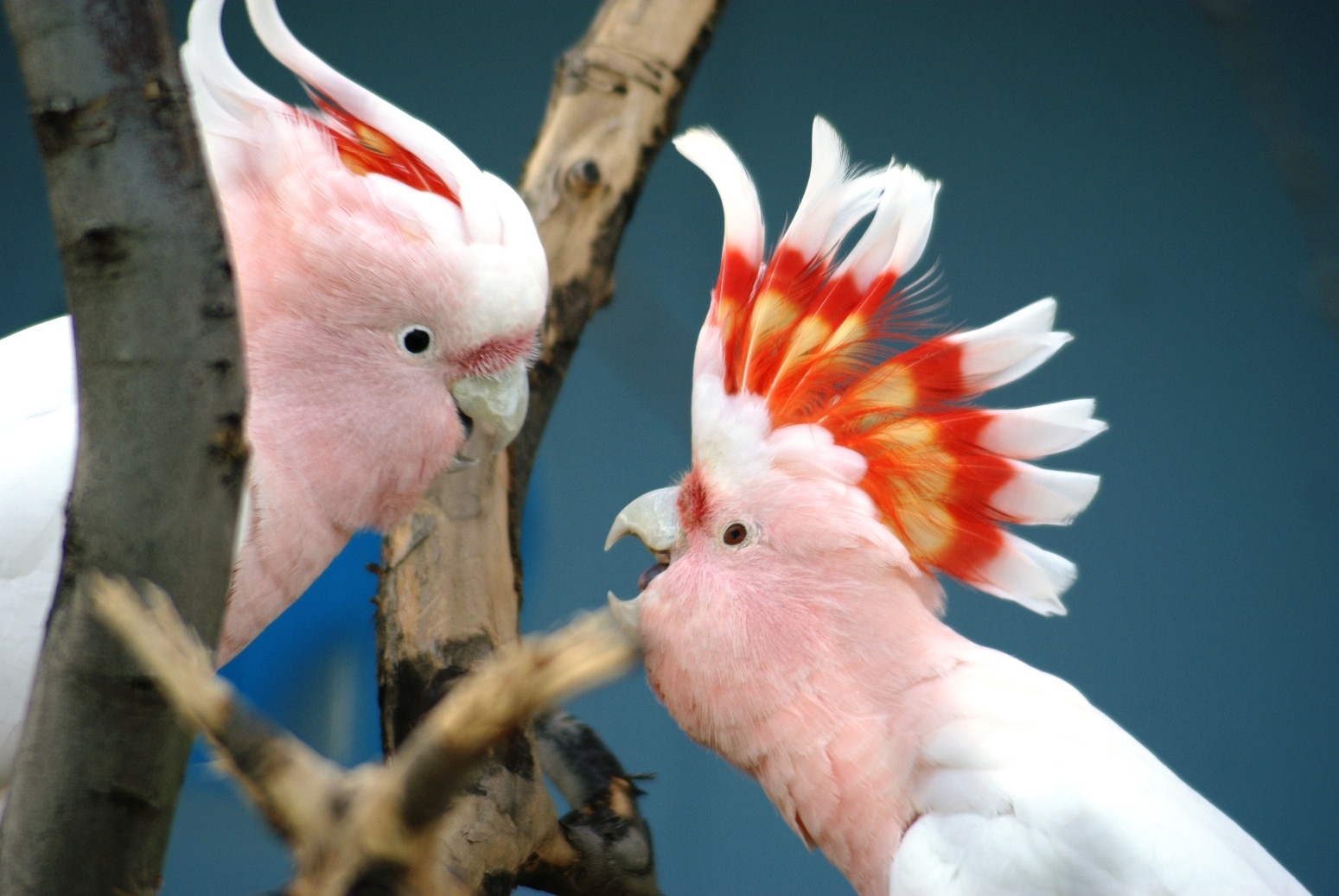
The Pink cockatoo(Cacatua leadbeateri) is distinguishable by its spectacular Crest composed by 16 long feathers forward curved. These pens have a wide base with a slightly pink and yellow red-stained central part.
The top ends of the crest are white. Another set of more rounded feathers grow over the eye, forming a white base when the crest is raised. The forecrown is spanned by a band thin and reddish.
The face, neck and underparts are salmon, becoming is white in the coverts.
The flight feather and tail are white with infiltration of salmon on the bottom.
The bill is horn. The irises dark brown and legs grey.
The female looks like your partner, but the head Pink salmon and underparts they are paler. The band Yellow that decorates the bill is brighter and wider. Upper belly It is white instead of Pink salmon. The irises are reddish-pink.
The immature they are identical to the female. The frontal band is bright orange-red, the irises light brown.
(Mathews, 1912) – Both similar to the kind adults nominal, but with the crest darker red, with little or no yellow. White Peak.
Behavior:
The couple is the basic social unit, but are maintained contact with other couples nonreproductive through the establishment of groups.
Out of it breeding season, There are mainly small bands consisting of 10 to 50 birds. Major gatherings occur only during periods of drought or when food sources are abundant. In this case, There may be a few hundred individuals, among them, small Galah.
Dormitories they are occupied exclusively outside the breeding season and the birds leave early at dawn.
The Pink cockatoo they forage in trees and on the ground. But, This species is more arboreal that the Galah wave Little corella.
When moving on the ground, He walks slowly to avoid the tall grass.
In the Flock, a bird play always the role of Sentinel. It adopts a very careful attitude, it partially roughcast its crest and regularly pauses during which is very upright inspecting the surroundings.
During the mid-day heat, it finds shelter in the foliage of the trees.. During the summer, rest period is longer.
The paired birds they are always near each other. During periods of intense heat, This bird visit water points, even during the day. At sunset, they return to your bedroom.
Its population is distributed by a variety of forest habitats in arid or semi-arid areas.
The species is closely related to the areas of «Mallee«.
Found particularly in afforestation of cypress and eucalyptus, in mixed plots of eucalyptus and Casuarinas or near cliffs.
Its presence in a place is largely also to the existence of a water fountain.
On the other hand, shows a very weak attachment to the fragmented habitats that is no long.
Reproduction:
The nesting season running from August to December. Cockatoos return to their traditional nesting sites.
The cavity for the nest receives improvements: the entrance is enlarged and covered with a layer of fresh chips placed at the bottom of the nest. The nests they are almost always far from one another, at a distance of 2 km.
The spawning is between 2 and 5 eggs being deposited between 2 and 3 days. The incubation It made both parents, begins after the deposit of the third egg and lasts between 23 and 24 days.
The chicks they remain at the bottom of the cavity during 57 days and are fed by the male and the female indistinctly. The family stays near the nest until the last hatchling leaves the nest., they will then join other family groups in the place where food resources are appropriate.
On rare occasions, the Pink cockatoo is forced to eject a couple of Galah He started to lay eggs in their nest, but it can also happen that this form of parasitism is a success. In this case, the partner of the Pink cockatoo takes care of eggs and young after hatching. When are born, the young of the species Eolophus roseicapilla, they behave exactly like their hosts, ignoring the difference in origin.
Food:
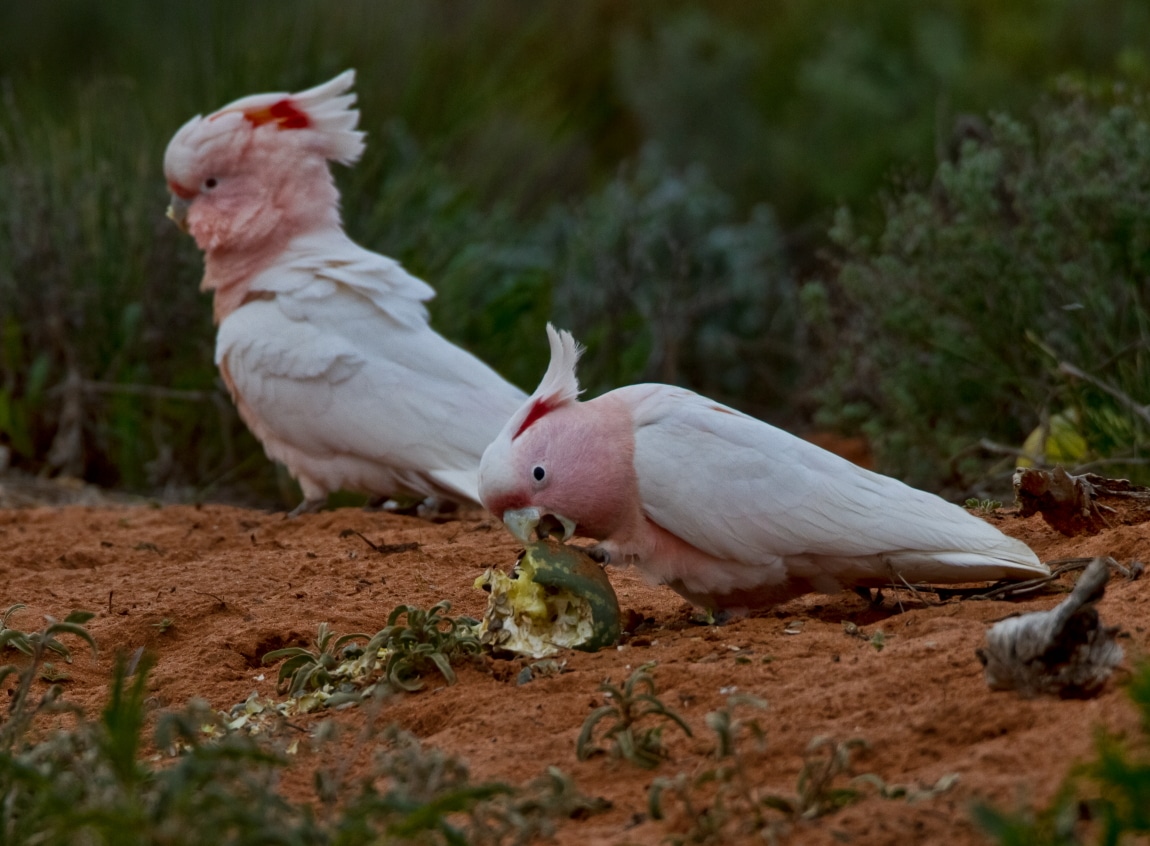
With feed seed, herbs, cereals and often of melons (Cucumber myiocarpus). Also consume fresh local figs, pine cones, eucalyptus seeds, bulbs, dried fruits, estate, insects and larvae.
During and after your meal, These birds biting branches and pieces of bark, causing a shower of timber crushed at the foot of the trees.
During periods of intense heat, increase the frequency of his visits to water points.
Distribution:
Size of the area of distribution (reproduction / resident): 2,88 million km2
endemic to Australia. Its main strongholds are in the southwest of Queensland where is quite extended and South of Australia, where is locally common.
In other parts of the continent are very rare and scarce, going back to the vicinity of the Northern Territory and carrying out raids in Western Australia.
(Mathews, 1912) – Interior West and centre of Australia, towards the East, up to the eyre peninsula and the basin of the Lake Eyre, South of Australia.
Conservation:
• Least concern (Red list 2006).
• Listed as vulnerable by NSW national parks and wildlife.
• Threatened by the law of conservation of species (2005).
Its distribution is very unequal, but only in the Centre - this actually is and South-East where they have widespread. In other parts of Australia, This species is declining due to the thinning of the habitat and its marketing as bird cage.
Competition with the Galah's disability for nesting cavities may be a crucial problem in the future if this species continues to grow. The world population of the Pink cockatoo It is estimated in a little less than 20 000 birds. It is classified as near threatened.
"Pink cockatoo" in captivity:
It is a frequently held in captive animal in your Australia natal, but it is less known in other countries like ours. Its price in the market is very high, especially that of males, being one of the most expensive white cockatoos.
Very noisy, with a great personality, playful and very active. It is very destructive, We must therefore provide toys and wood to gnaw, or otherwise you will satisfy with house furniture and other elements. Inactive animals, bored or stressed tend to yell a lot.
Its life expectancy round between the 40 and 60 years of life.
35 to 41 cm.. length. The weight of 500 to 600 g..
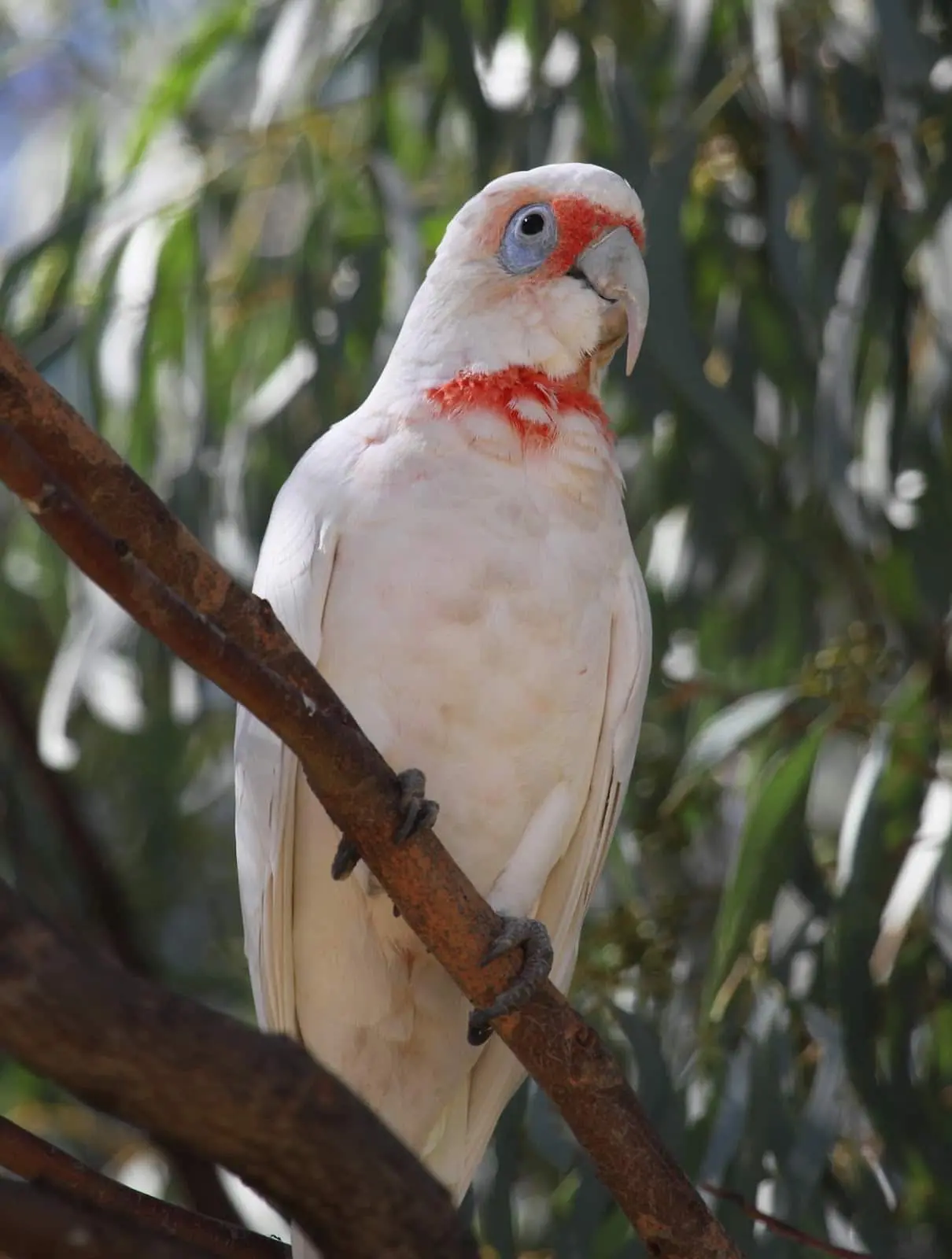
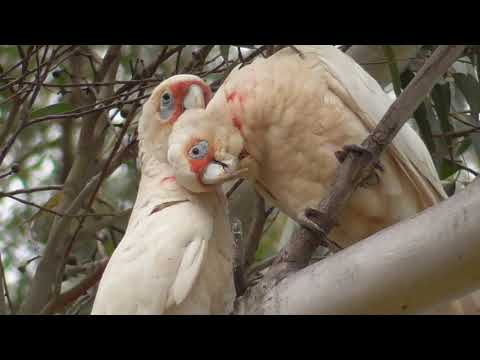
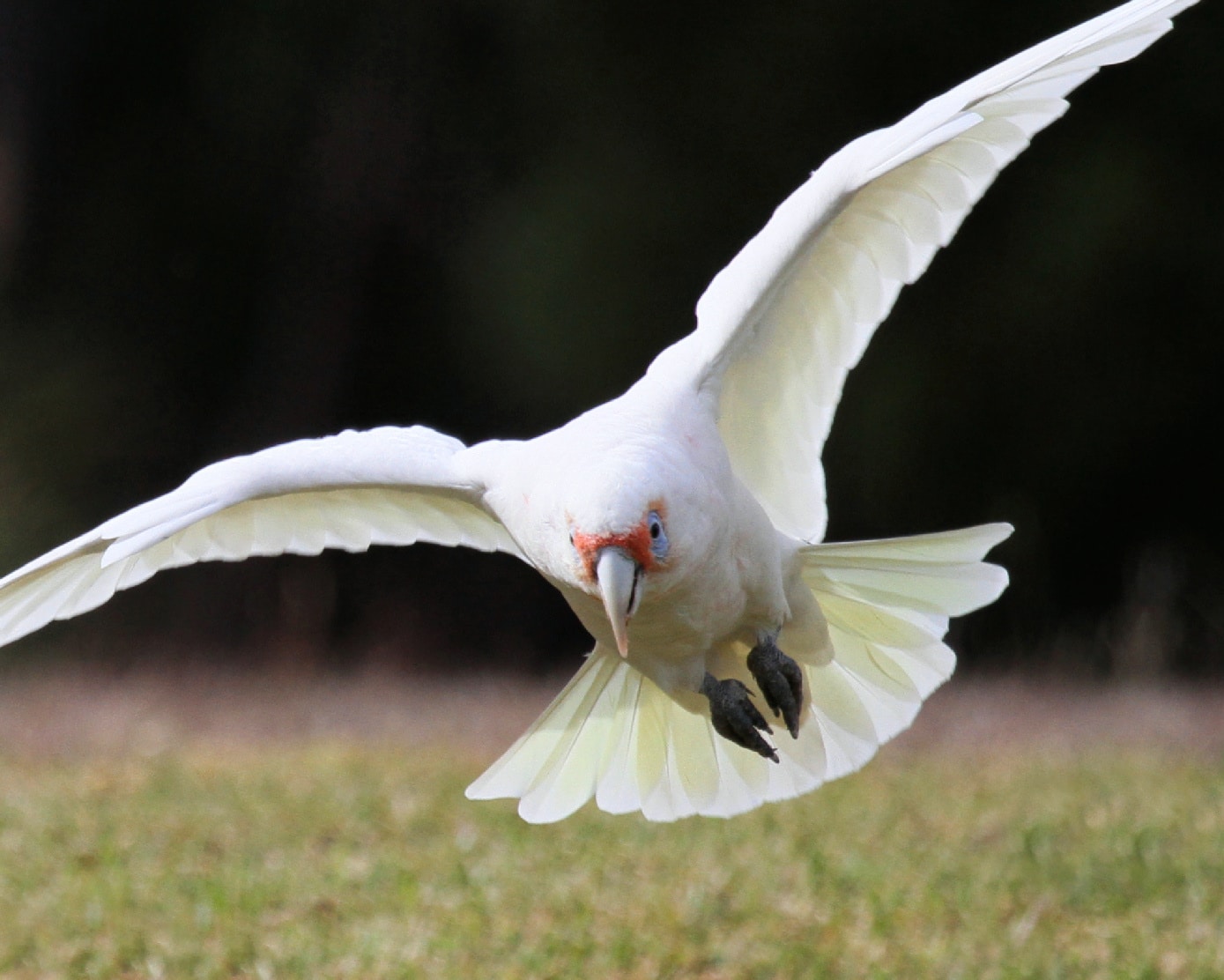
The Long-billed corella(Cacatua tenuirostris) has white plumage. The undertail coverts and the parts below from the wings they are bathed in pale yellow, very visible in flight. It has red coloration in the throat and the chest, with a Red Crescent ranked in the upper breast.
The Head shows a small crest white, Red front and a wide, nude and fleshy eye ring blue-grey around the eyes dark browns. The bill is white with blue base. upper jaw is long and hooked. The legs and feet are dark gray.
The female is similar to the male, with the upper jaw more short and less red.
There are two similar species:
– Cacatua sanguinea. Lack of forecrown Red and the red color in the neck. The upper jaw is shorter.
– Cacatua galerita. Similar in flight, has crest yellow and lacks of colour red. The bill is black.
Common in forests and remnant trees on farmland. It nests in Eucalyptus camaldulensis in the flooded Plains or close to streams. Wild populations living on farms and parks in urban areas.
Behavior:
It´s resident in their area of distribution, some local movements. Outside of breeding season, You can see in large flocks of up to 2.000 birds or more. Son noisy and visible, pronouncing discordant calls.
Pose in large eucalyptus near water. They leave the roost in the morning to drink, and then, go to the feeding areas. Again when the darkness comes to sleep, but not before excited participate in games and stunts .
They move on the floor with stunning movement jump. They do not have the other species waddling gait cockatoo. It causes damage to crops of cereals and tree fruit, considered as one pest for farmers.
Nest colonies. They can create their nests with other species of Corella, and sometimes they hybridize. Populations feral in Sydney and Perth, from the release of unwanted birds, they may hybridize with endangered species such as the Cacatua pastinator
Reproduction:
Held from July to November. Forman couples monogamous. The male and female prepared the nest in the Hollows of large old eucalypts. If you do not find a suitable tree, You can make a burrow in soft soil Bank. They fill the nest of wood chips and often reuse it for several years.
They nest in large colonies, with several nests in the same tree.
The female lays 2-4 eggs White. The incubation lasts a few 24 days, shared by both parents. The young leave the nest 55 days after hatching, being fed by the parents for three weeks more.
Food:
Feeds mainly on what obtained from soil, seeds, estate and bulbs that unearths with its upper jaw. They feed in the coolest hours of the day. Also consumes insects.
Distribution:
Size of the area of distribution (reproduction / resident): 382.000 km2
Is located in the southeast of Australia. Introduced in urban centers of Australia and Tasmania.
Conservation:
State of conservation ⓘ
Minor Concern ⓘ(UICN)ⓘ
• Current IUCN Red List category: Least concern.
• Population trend growing
Populations may be declining due to loss of breeding grounds in its original distribution area.
But, the Long-billed corella It common in its range.
Is created that in the world there are more than 250 thousand individuals.
"Long-billed corella" in captivity:
It is very popular as a pet for the most part of Australia, and has been classified as the best «talkative" of the australian cockatoos for its ability to mimic words almost to perfection.
Has a personality playful and active.
Out of its area of distribution is rare in poultry farming.
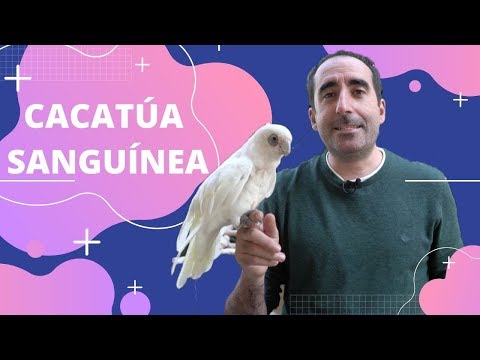
It measures 35-40 cm.. and weighs approximately 500 g..
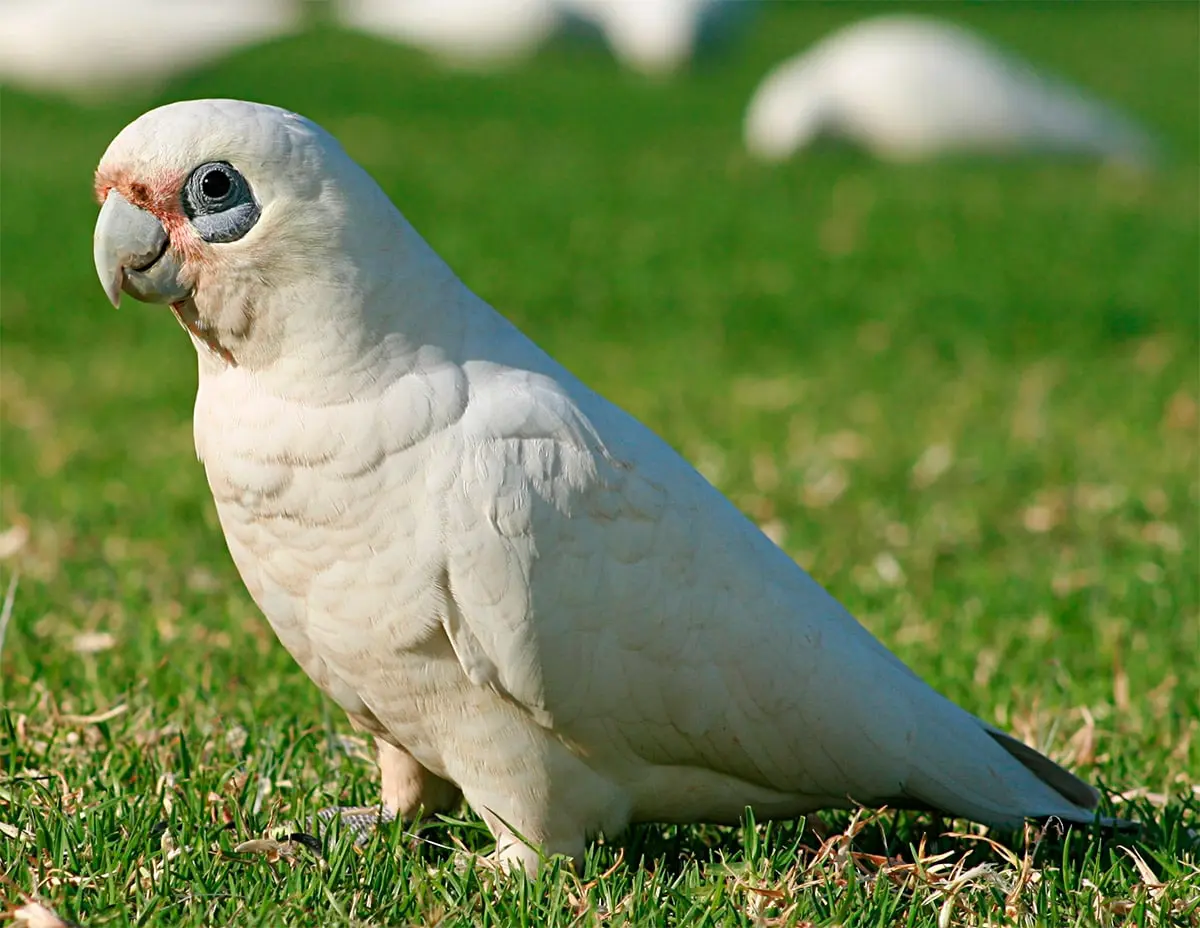
In the Little corella(Cacatua sanguinea), the head and crest (that most of the time stays low) are white. The pink base of the feathers are almost completely hidden and yet barely visible small flakes in the cheeks.
Dissemination of salmon-rosa color to the area around the eyes. The upperparts and coverts of the wing are white. There is a remarkable spread of yellow color on the bottom of the flight feather and of the tail.
The bill is grayish white. The skin nude around the eyes is blue grey. The irises is dark brown, the legs grey.
Both sexes are identical in all aspects, including the color of the irises.
The immature have a look more white and the skin of the periphery eyepiece less prominent.
(Sclater,PL, 1871) – Features with more naranja-rosa around them eyes and in the bases of the feathers of the head, neck and top of the chest. Its orbital skin is darker.
(Mees, 1982) – Displays below the wings and tail infiltrations slightly yellow pulling a Brown.
Cacatua sanguinea westralensis
(Mathews, 1917) – It has bright orange-red colors around the eyes and the bases of feathers, also in the the mantle and in the part inferior of the abdomen.
Habitat:
Video – "Little corella" (Cacatua sanguinea)
The spectacular BLOODED COCKATOO - BIRD VETERINARY
It nests in riparian forests bordering permanent pasture and cropland. In the breeding season, they can be found in a wide variety of habitats, including areas of acacias and eucalyptus bushes of short grass or pasture with groups of scattered trees. During this time, they are also present in the rice fields, cane extensions, areas of shrubs, at the edges of mangrove areas, in the pastures for horses, on roads and gardens on the outskirts of cities.
Behavior:
The Bloody Cockatoos they often form large gatherings in crops and pastures.
Out of it breeding season, It is not uncommon to see flocks of up to 70.000 birds.
At night they fly to their bedrooms, located near the water.
Early in the morning, they drink before heading to the feeding sites often many kilometres from the bedroom.
During the hottest hours of the day, they seek shelter in the shade of the leaves..
Reproduction:
In Australia they can be played back in any month of the year, When are conditions good. But, the nesting seems to be further developed early in the North (from May to October) and in the Southeast (August-December).
In Queensland, the implementation is carried out mainly from December to April and from July to October. Reproduction is strongly influenced by climate, usually begins 2 or 3 months after the end of the rainy season in northern districts.
There may be two or three broods per season. Couple ties are very strong and seem to last for life. They are loyal to the same nesting sites year after year. The nest is usually placed in a eucalyptus (Eucalyptus camaldulensis) between 3 and 10 meters above the ground.
The cavity is approximately one meter in depth. It is fairly easy to detect since crust is often removed around inlet. They also nest on cliffs or termite mounds..
They put 2-4 eggs in a bed made from chips of wood that is replaced each year.
In general, two chicks manage to break the shell after 25 days. They remain in the nest for nine weeks, After this take off.
Food:
It has a diet mainly vegetarian. They feed on seeds you are in the trees of the genus EMEX, green areas or fields of melon (cucumber myriocarpus). They also eat nuts, fruit, berries, flowers, estate, bulbs, shoots as well as insects and larvae.
Distribution:
Size of the area of distribution (reproduction / resident): 5.300.000 km2
The Little corella lives in New Guinea and Australia. In Australia, We found in the Northwest, on the plateau of Kimberley and Arnhem in the this of the Cape York Peninsula. They are absent from the east coast and the entire southwestern part of the country..
Subspecies distribution
Cacatua sanguinea gymnopis
(Sclater,PL, 1871) – Within the Centre and it's Australia.
Its population is estimated at more than 1 million of birds and it believes that is in constant increase, especially in the South of Australia.
Its growth and expansion depends on the development of agriculture and the availability of artificial reservoirs. It is a Bird protected, except in the the Australia South. In this last area, the landowners are allowed to kill birds to prevent the formation of large destructive meetings for crops.
"Little corella" in captivity:
The Australian poultry to the blood cockatoo is it considered common.
They are very docile and Welcome to as pets, but you must pay them attention.
Alternative names:
– Little Corella, Bare-eyed Cockatoo, Bare-eyed Corella, Blood-stained Cockatoo, Blue-eyed Cockatoo, Corella, Dampier’s Corella, Little Cockatoo, Short-billed Cockatoo, Short-billed Corella (ingles).
– Cacatoès corella, Cacatoès à oeil nu (French).
– Nacktaugenkakadu (German).
– Cacatua-corella-pequena (Portuguese).
– Cacatúa Sanguínea (español).
It measures 31 cm. and weighs around 300 g..
To the Philippine cockatoo(Cacatua haematuropygia) It is called locally Katala.
Its plumage is of a beautiful white color except for the feathers of the crest they are yellow or pink on its base and the bottom of the tail and wings they are yellow and Red.
The bill is a grayish-white color, and males has irises dark brown, While the of the female are brown-red color.
Is restricted to lowland not more than 50 meters above the sea level, in or adjacent to rivers, and in coastal mangrove areas.
outside the breeding season (March to June, and, times, from February to August), frequents corn and rice crops. This depends on the station where foods are grown and have the available resources, being partially nomadic.
These birds can fly from their island to the adjacent if they are not more than a few 8 km. distance.
Reproduction:
breeding season between February and June. Of one to three eggs they are placed on a nest on a tree branch. The eggs are hatch for a few 28 days, and the chicks remain in the nest for nine to ten weeks after the hatching.
Food:
They feed on seeds, vegetables, fruits and berries.
They are known to attack corn crops in agricultural areas.
Distribution:
Size of the area of distribution (reproduction / resident): 22.700 km2
This cockatoo is endemic in Philippines, and the only representative of the cockatoos that we will find there; This has become a treasure of these islands.
Conservation:
State of conservation ⓘ
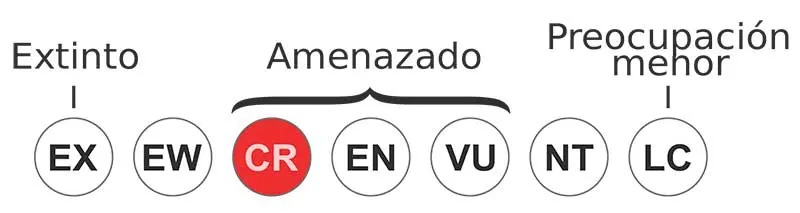
critically endangered ⓘ(UICN)ⓘ
• Current IUCN Red List category: Critical Hazard.
• Population trend: Decreasing.
• Population size: 370-770 mature individuals.
In Palawan the capture of the cockatoos for the international illegal trade is particularly serious, something which is reflected in the high price of these birds ($ 160 Americans in Manila in 1997); to have been looted all the visible nests each time the price is higher because it costs more to catch them.
The deforestation and the destruction of mangroves have been extensive in their range of occupancy and have contributed significantly to their decline.
It is also hunted and hunted for consumption as food.
The release of captive birds can introduce diseases into wild populations.
Conservation Actions Proposed:
• Conduct surveys on all range islands to assess species population size and distribution.
• Monitor population trends.
• Monitor rates of habitat loss and degradation.
• Quantify catch levels, persecution and trade.
• Designate more protected areas (for example Tawi-Tawi and towns in or near Palawan).
• Support the proposal to expand the Puerto Princesa Subterranean River National Park.
• Prevent destruction of mangroves.
• Promote economically viable alternatives to avoid the capture of this cockatoo.
• Continue with education programs and captive breeding programs.
• Establish staff at airports and ferry terminals to control the departure of specimens.
• Translocate animals to suitable areas such as lowland forests or mangroves..
Loro Parque Foundation It has warned of the risk of extinction that runs the Philippine cockatoo by the construction of a power plant in Palawan, an island province of Philippines in the region of Western Visayas.
This Spanish NGO has invested 1,3 millions of dollars and more than 14 years of work in the recovery project of this cockatoo, and fears that with the construction of this station, the less than 1.000 remaining specimens in the world could be electrocuted by high-voltage lines, In addition to being blocked their migration in search of food.
23-28 cm.. height and a weight between 140 and 190 gr.
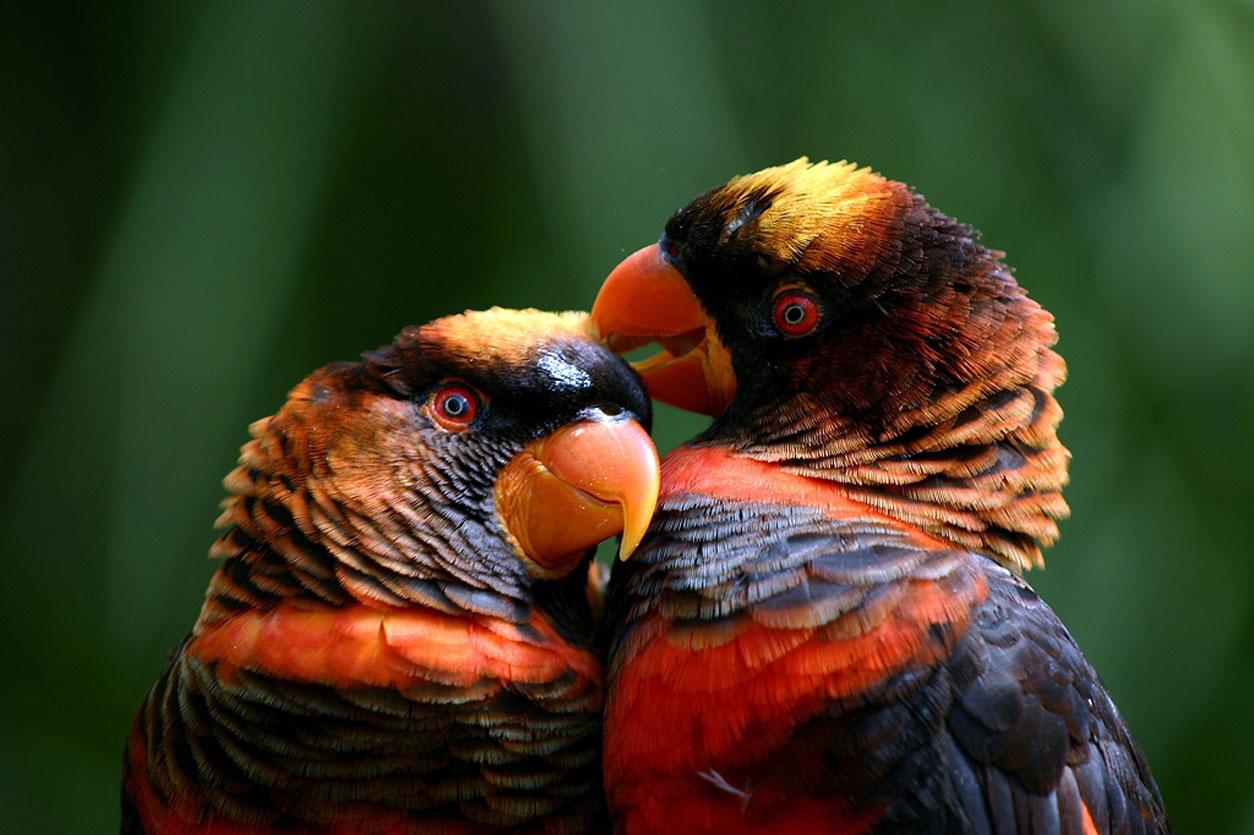
The plumage of the Dusky lory(Pseudeos fuscata) It is difficult to describe since there are many differences in tonality between one and the other specimens.. Some are of a very dark brown color, almost black and others have a much lighter shade. In addition the same happens with the two bands that cross you the chest Since the species goes through three phases: red, Orange and yellow, according to age, gender and the place of origin.
Characteristic of this species is the area of bare skin under the lower jaw until the birth of the throat. The lower wing coverts are orange and the lower flows dark blue. The obispillo is a silvery-white the bill is bright orange. The irises is orange and the legs dark.
There is no sexual dimorphism and the only way to differentiate male and female will be through DNA, Although some authors (Tomas Arndt) they are running that adult females lack the white feathers of the obispillo.
The Dusky lory they are quite widespread and locally common in primary forests , that is to say, those who have not undergone any transformation. But they are also found in wooded areas, up to an altitude of 2.400 m, During regeneration, especially those with large mature trees.
They are also distributed among residual tree beds during their flowering period., including those located in the parks and gardens in cities.
They are occasionally present in the lightly wooded Savannah or plantations of teak and coconut trees.
They normally reside in the landscape of hills or slopes steep slightly from low and middle mountain.
It´s gregarious and when flies or are fed in the cup of them trees full of flowers it makes in groups of 20 to 100 individuals or more.
Reproduction:
The nesting season It is very different depending on the region: It extends from November to April in the mountainous areas of East, While in Irian Jaya, the Indonesian part, they do in July.
The Dusky lory they prefer to nest in tall trees in the mountain area, the choice of a hole at high altitude on Earth probably do to protect itself against potential predators.
If the site is of your liking, reuse it for many years consecutively. Male and female participate in the work, the enlargement of the entrance or the cavity itself. Even if the nest has been used in the past, There are always minor changes to be carried out.
Although this species is quite common, We really know very little about its reproduction in the wild. In captivity, the female lays two eggs which are incubated for approximately 24 days. As in most New Guinea lories, the reproductive cycle is very long, about 70 days.
Food:
Consumes mainly nectar and perhaps the pollen it accumulates in plants of the genus schleffera or tree Rudraksha (Elaeocarpus sphaericus). Also consume flowers and fruits. It can be seen in large flocks in mango plantations and other cultivated trees. Feeds, occasionally, teak moth (Hyblaea puera).
Distribution:
The Dusky lory It has its area of distribution largely of New Guinea, except the mountains more high of the interior and the peaks more high of the mountains of Parotia.
The species are not threatened. Common and very sociable, It often forms bedrooms that can reach thousand of birds.
A wild population estimated above 100.000 individuals.
In some parts of the southeast of New Guinea, its density may be superior to 30 birds per square kilometer.
"Dusky lory" in captivity:
Are birds enough prolific and sociable you adapt easily to captivity.
Contrary to other parrots that eat mainly seeds and nuts; The loris require a greater percentage of fruits, outbreaks, nectar and pollen in your diet. In fact, in the nature, they can feed a maximum of 640 flowers in a day. They also feed on seeds.
It is usually aggressive with other species of lory. Easy to startle with strangers.
Alternative names:
– Dusky Lory, Dusk-orange Lory, Dusky-Orange Lory, White-rumped Lory (ingles).
– Lori sombre, Lori à dos blanc (French).
– Weißbürzellori (German).
– Lóris-dusky (Portuguese).
– Lori Sombrío, Lorito crepuscular (español).


 Minor Concern ⓘ
(UICN)ⓘ
Minor Concern ⓘ
(UICN)ⓘ