Content |
|---|
All breeds and species.
 Pets
Pets
Content |
|---|
Its length is about 25 cm. and weigh between 80 and 85 gr.
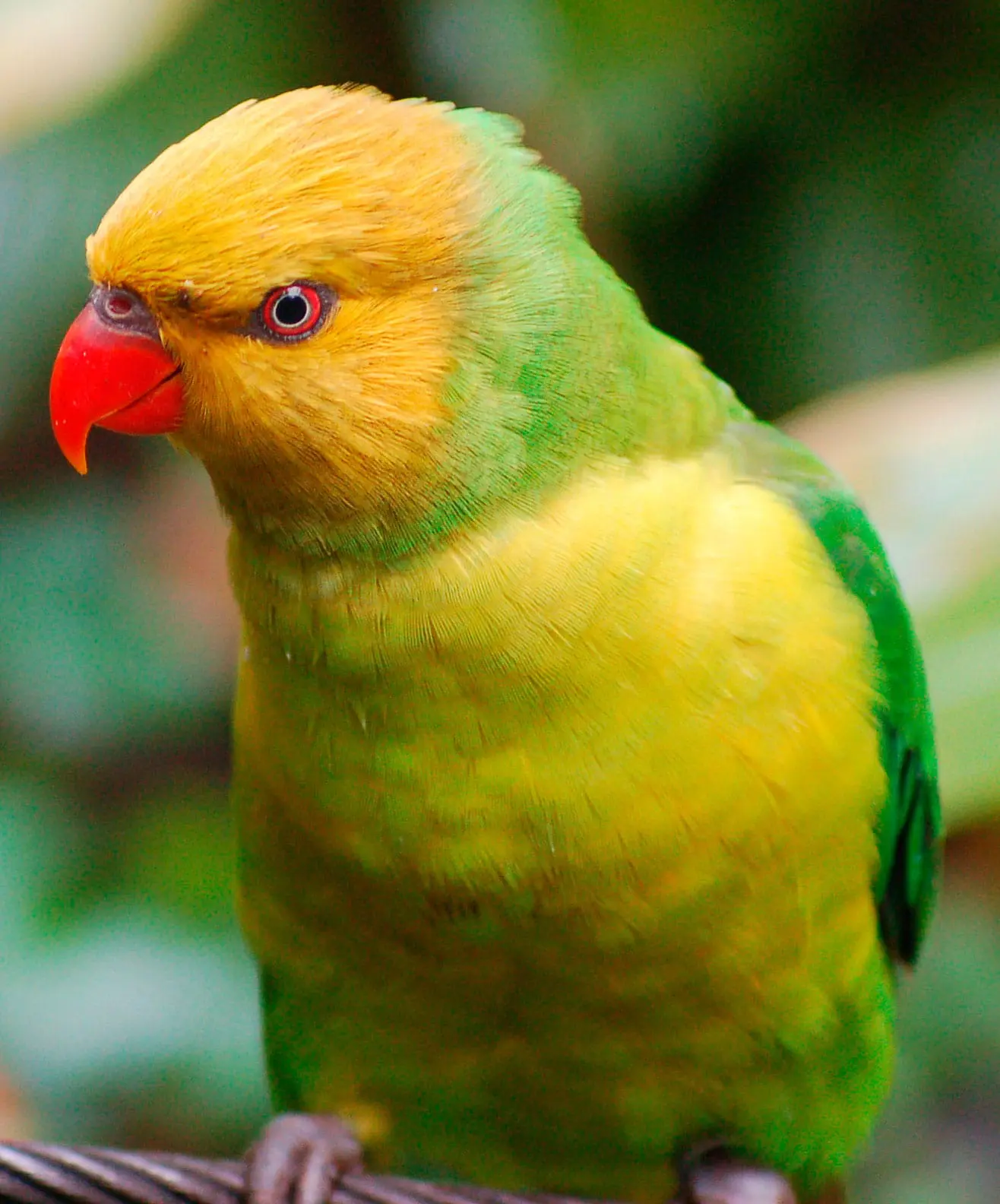
The Olive headed Lorikeet (Trichoglossus euteles) show, in general, a green shade.
The head color is olive with waves pale mustard and yellow stripes over the entire surface of the top.
The neck and its part rear are surrounded by a collar of color green brilliant that continues until the throat.
The underparts below the throat are entirely greenish-yellow.
The bill is red-orange. The irises they are red, and legs grey.
The youth they are more muted than adults. Its head is slightly greenish with streaks pale. The bill is brown. The irises They are brown. The species is considered monotype.
They frequent humid subtropical forests., secondary forests and wooded meadows. Adapt quite well to cultivated land and the gardens in cities.
In Timor, they are relatively abundant between 1.000 and 2.300 meters above sea level, apparently, substitute to the Coconut Lorikeet in these heights. Also they can be observed at sea level in the island of Timor. In the rest of the Islands it frequents lowland areas.
The Olive headed Lorikeet they live in small groups. They are especially visible when they are in flight because they emit continuously shouts. On the other hand, when feeding or resting in trees, they are very difficult to observe because of their green plumage mixed with the color of the foliage.
They are birds territorial, capable of showing great aggressiveness if the limits of their area of influence are violated.
Usually disperse in search of their food, forming large groups when resources are abundant.
Outside the breeding season they form large roaming flocks of a hundred or more individuals.. Move in flying fast and slightly wavy.
In Timor, during the season, dry, These birds seem to descend below 1.000 meters and are scattered in coastal areas.
The anidacio seasonn would take place perhaps between September and October, but this information needs to be confirmed.
In captivity, the Olive headed Lorikeet put 3 white eggs that parents are in charge of incubate for a few 23 days. As in the majority of the Lori, the nesting cycle is particularly long.
Feed primarily of nectar and fruit. They forage in trees in flower and shrubs.
Size of the area of distribution (reproduction / resident): 38.100 km2
Timor and Lesser Sunda Islands, from the East of Lembata until Nila and Babar.
• Current IUCN Red List category: Least concern
• Population trend: Stable
The population size This species has not been quantified. Suspected that the population is stable in the absence of evidence of any reduction or substantial threats.
Like most brightly plumaged parrots, the Olive headed Lorikeet It victim of trade bird cage or Aviary.
Pretty common. They can be housed with others of its kind.
– Olive headed Lorikeet, Olive-headed Lorikeet, Perfect Lorikeet (ingles).
– Loriquet eutèle (French).
– Gelbkopflori (German).
– Lóris-de-cabeça-amarilla (Portuguese).
– Lori Humilde, Tricogloso Humilde (español).
– Order: Psittaciformes
– Family: Psittaculidae
– Genus: Trichoglossus
– Scientific name: Trichoglossus euteles
– Citation: (Temminck, 1835)
– Protonimo: Psittacus euteles


———————————————————————————————–
Sources:
– Avibase
– Parrots of the World – Joseph Forshaw M
– Parrots-A Guide to the Parrots of the World by Tony Juniper & Mike Parr
– BirdLife.org
– Photos:
1 – Photo by and (C)2007 Derek Ramsey (Ram-Man) – Self-photographed – Wikipedia
2 – By James Eaton – IBC.lynxeds.com
3 – «Trichoglossus euteles-captive-8a-ec» by Trichoglossus_euteles_-captive-8a.jpg: Ruth Rogersderivative work: Snowmanradio (talk) – originally posted to Flickr as P8120395 and uploaded to commons at Trichoglossus_euteles_-captive-8a.jpg. Licensed under CC BY 2.0 via Wikimedia Commons.
4 – "Scaly-breasted Lorikeet Kobble Dec06" von Aviceda – Eigenes Werk. Lizenziert unter CC BY-SA 3.0 über Wikimedia Commons.
5 – By Marcella (Picasa Web Albums) [CC-BY-SA-3.0], via Wikimedia Commons
– Sounds: Colin Trainor (Xeno-canto)
Content |
|---|
26 cm.. of length and a weight of 140 gr.
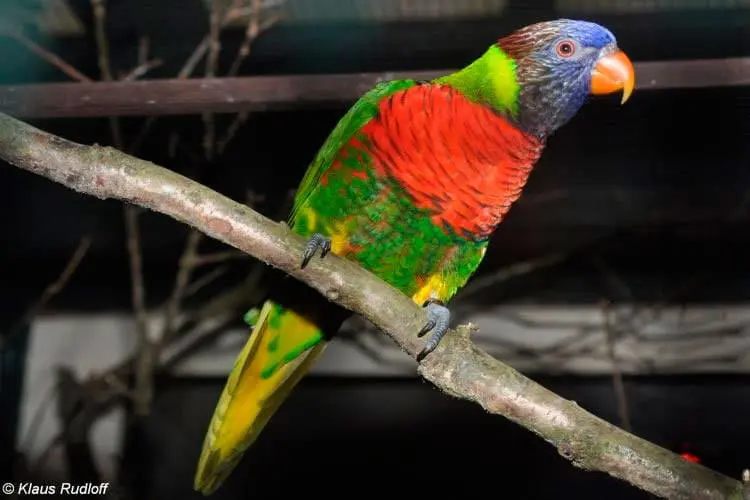
The Coconut Lorikeet (deplanchii) (T. haematodus deplanchii) is a variation of the nominal (Trichoglossus Haematodus)
Similar to the nominal Haematodus, but slightly paler plumage. The head has a bright blue. Reddish orange on the chest, similar to the Trichoglossus haematodus massena, only that more alive. The abdomen is yellowish green and extends to the back of the neck. The thighs and the feathers under the yellow tail and tail olive green top.
New Caledonia and Loyalty Islands.
– Coconut Lorikeet (deplanchii) (ingles).
– Loriquet à tête bleue (deplanchii) (French).
– Allfarblori Deplanche (German).
– Loris Arco Iris Deplanchii (Portuguese).
– Lori Deplanche, Lori Arcoiris Deplanche (español).
– Order: Psittaciformes
– Family: Psittaculidae
– Scientific name: Trichoglossus haematodus deplanchii
– Genus: Trichoglossus
– Citation: Verreaux,J & Des Murs, 1860
– Protonimo: Trichoglossus Deplanchii
————————————————————————————————
————————————————————————————————
Sources:
– Avibase
– Photos: by Klaus Rudloff (kdrudloff@web.de) – biolib.cz
Content |
|---|
Of 25 cm.. length and 100 to 120 gr. weight.
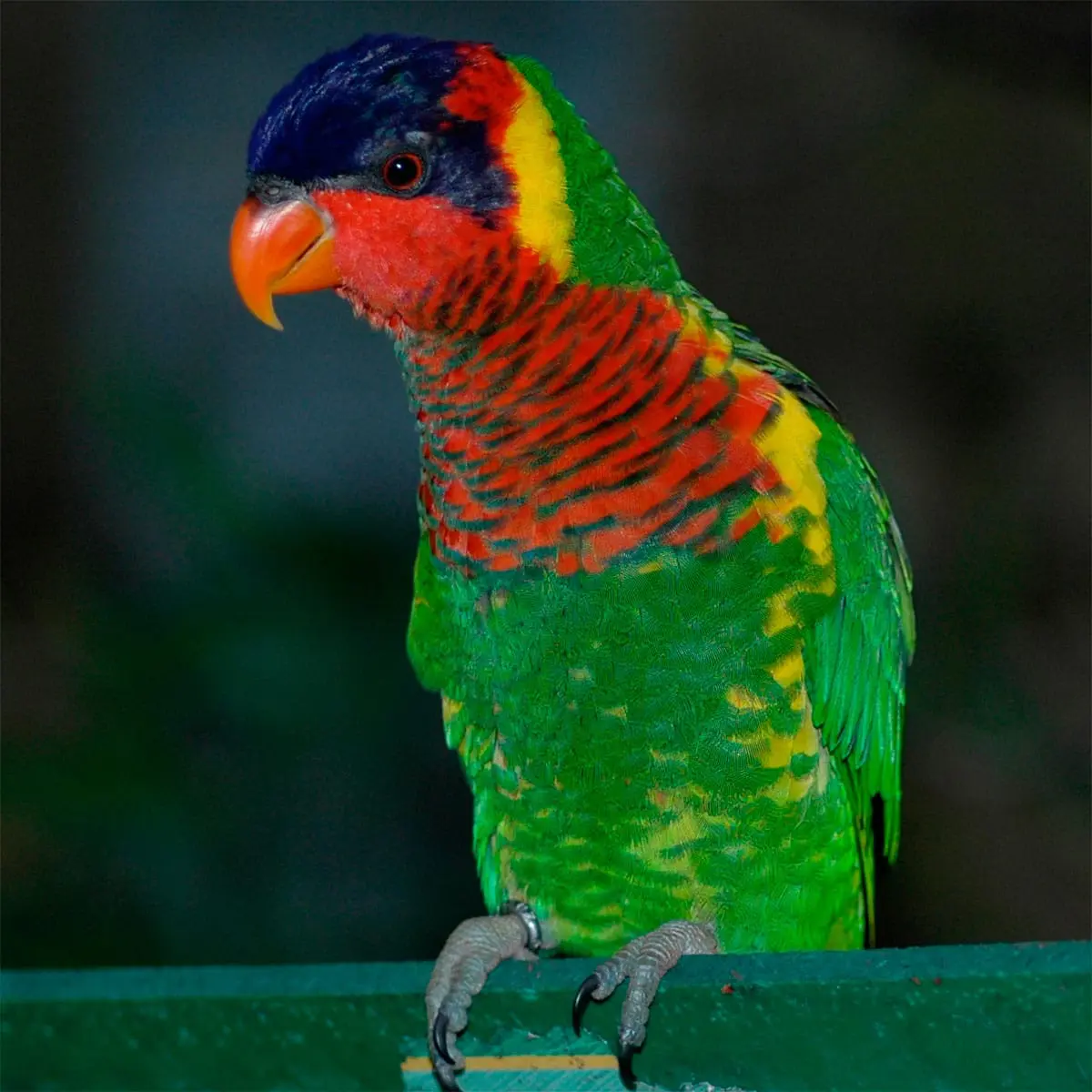
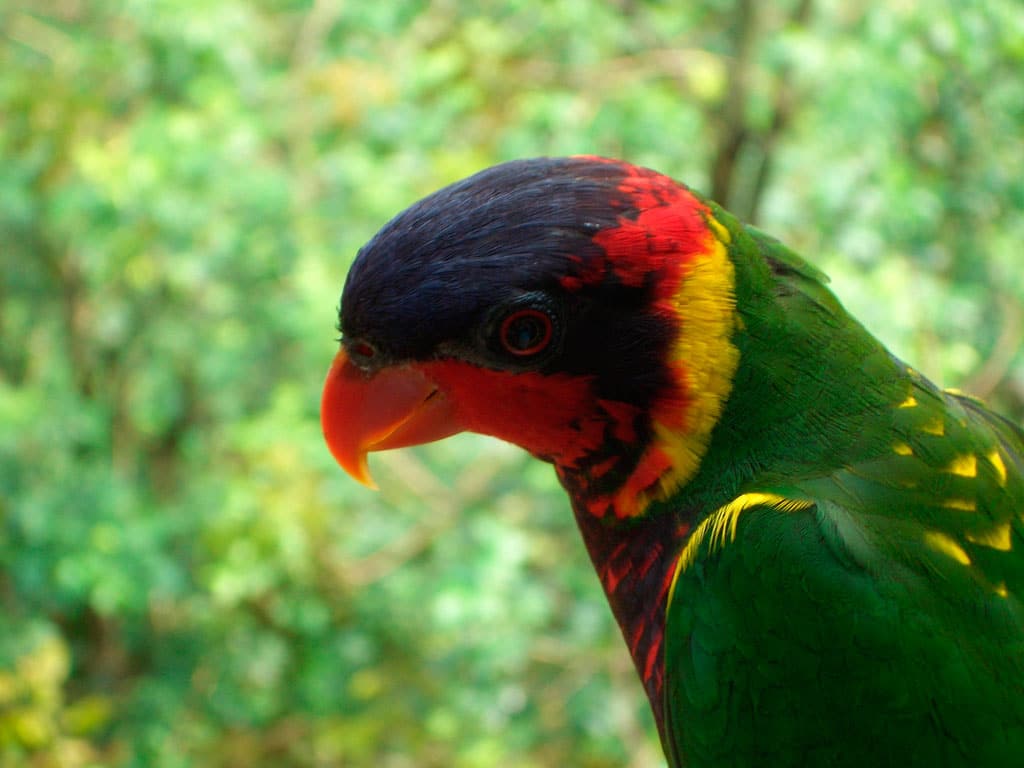
The general plumage of the Ornate Lory (Trichoglossus ornatus) is green. The front, the head and feathers that cover the ears are blue. It has a small red stripe that goes from the upper right corner of the eye to the nape of the neck, It also has a yellow stripe on the sides of the neck. The throat and chest are orange-red and in each pen has a bluish-black wide table. Underwing feathers are yellow.
The rest of the bottom is green with yellowish scales.
Belly pale green with dark green bars. Green-yellow under the tail is bright green ends. The upper part of the tail is dark green with yellow edges in outer feathers. The base of the outer tail feathers is pink.
The circle around the eyes is narrow and dark gray. The iris is red, the legs are grey and orange beaks.
The Ornate Lory they usually visit the swamps and marshy woodlands where there is fresh water. They are also found in the forest, the plots during the regeneration near the edges, scattered shrubs in cropland, including coconut plantations.
Usually, They appreciate the open areas and do not venture far from the primary forests.
In the North and center of the main island, These birds live from sea level up to the 1.000 meters above the sea level, While in the South, You can climb up to the 1.500 m. Its preferred habitat is between 300 and 500 m.
The Ornate Lory They mainly live in pairs or in small groups. Sometimes, when feeding in fruit trees or at the edges of the forest, are associated with the Yellow-and-green Lorikeet (Trichoglossus flavoviridis).
Benefiting from stable climate, These birds are probably sedentary.
We really know very little about the reproductive habits of this species in the wild.
Most of the birds are able to breed in the months of September and October. There is no information on the construction and composition of the nest.
Spawning usually consists of 3 eggs that are incubated during 27 days. The chicks are nidicolous and depend on their parents during 80 days after hatching.
The Ornate Lory they are vegetarian birds, most of its menu is made up of nectar, pollen and fruit. When feed, these birds may concentrate in large numbers on flowering trees. The seeds of the trees of the genus Tectona and Casuarina they are also part of their diet.
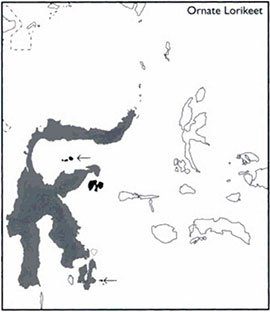
This species is endemic to Indonesia , where is widespread in Sulawesi and surrounds the coast islands including Togian, Peleng, Banggai and the archipelago Tukang Besi. It has been reported that it is no longer common in parts of northern and central Sulawesi, but still seems to be common on the islands Togian and in the lowland forest in Torout (Bogani Nani NP) and to a lesser extent in Tangkoko.
– Current IUCN Red List category: Least concern
– The population trend: Decreasing
It has been described as common and locally very common., with a total population of over of 50.000 specimens.
The trend has not been quantified, but slow descents can be seen due to some pressure from capture, and although it does not require primary forest it is more common in the lowlands and therefore may be affected by habitat loss.
It seems that the Ornate Lory is trapped in national parks as Tangkoko and Lore Lindu, and they are commonly seen in bird markets.
Due to its state of decline in its population, any specimen that can not be returned to their natural habitat (natural range) should preferably be placed in a well-managed breeding program to ensure the survival of the species.
– Ornate Lorikeet, Ornate Lory (ingles).
– Loriquet orné (French).
– Schmucklori (German).
– Lóris-ornado (Portuguese).
– Lori Adornado, Tricogloso Adornado (español).
– Order: Psittaciformes
– familia: Psittaculidae
– Scientific name: Trichoglossus ornatus
– Citation: (Linnaeus, 1758)
– Protonimo: parrot furniture



—————————————————————————————————
Sources:
– Avibase
– Oiseaux.NET
– Photos:
– Ornate Lorikeet at San Antonio Zoo, Texas, USA. by George Coller – Wikimedia
– by © 2004 Jeff Whitlock – Jacksonville Zoo
– by iggino – IBC.lynxeds.com
– Trichoglossus ornatus parrot eating banana – free-pet-wallpapers.com
– Sounds: Mike Nelson (Xeno-canto)

Content |
|---|
31 cm.. length and an approximate weight of 170 gr.
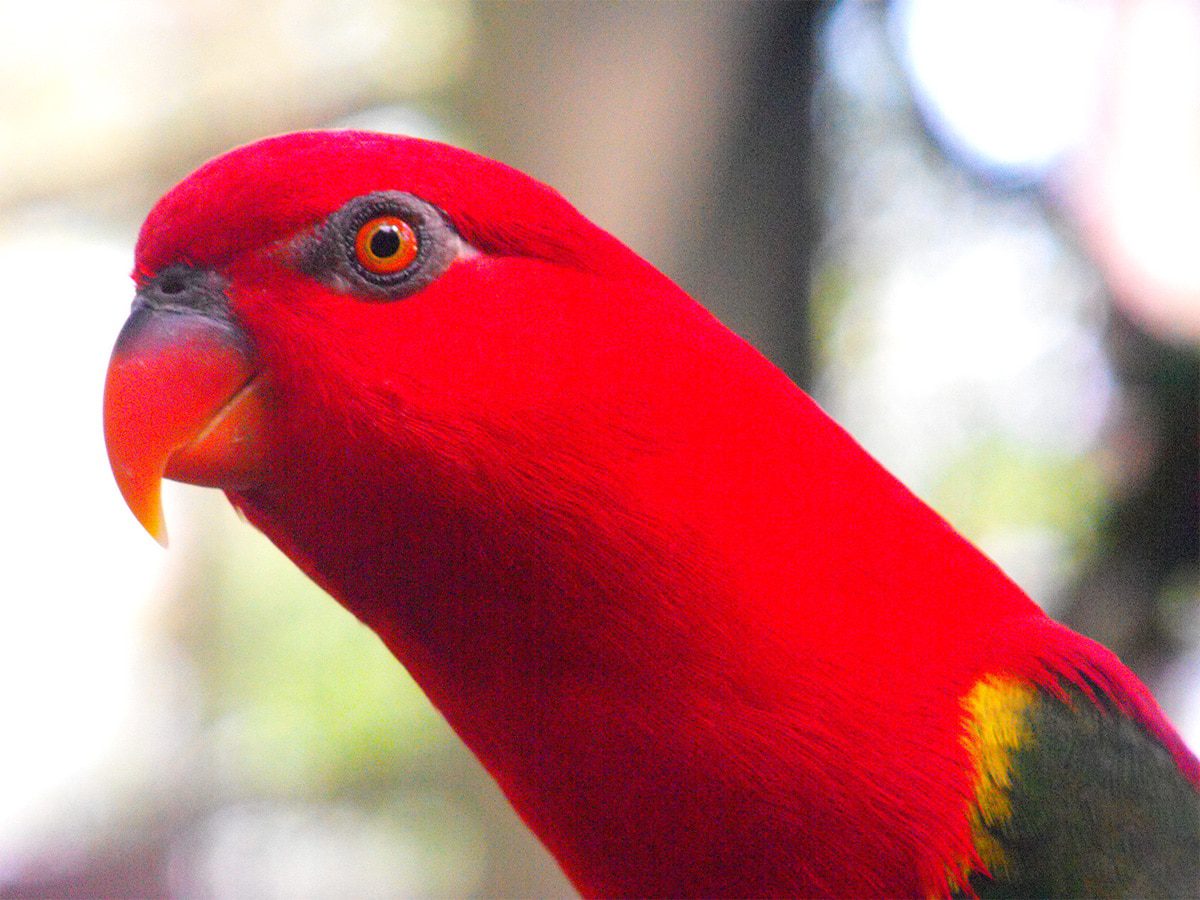
The head and the neck of the Red Lory (Eos bornea) are entirely of a deep red color.
In the adult the primary feathers are black with a large red mirror. The feathers tertiary and the coverts are of color blue. The joint of the feathers of the helmsman they are reddish-brown. The irises they are red, legs grayscale and the bill dark orange.
The immature they tend to be more off than their parents coloring. They show the feathers tertiary grey, lightly stained blue. The ear-coverts Sometimes it tinges of blue. Times, the area of the vent and the thighs it infiltrates with small stains blue. The feathers of the abdomen often carry some edges blue dark. They have the irises brown.
Not exists no sexual dimorphism visible although the males tend to be more corpulent that the females.
(Linnaeus, 1758) – Nominal.
(Vieillot, 1818) – The Red of his plumage is much more dark almost brown.
They are mostly primary forests, in the wooded areas during regeneration, Forest Hills, coconut plantations, in abandoned gardens and mangroves.
They are mainly in coastal areas, What does not climb up to 900 m in the island of Ceram and up 1.800 m in the of Buru.
Throughout its area, the Red Lory are fairly common, However, some populations are more dispersed around the villages, since they are very cautious towards humans.
The Red Lory they live in pairs or in small groups, but sometimes you can observe large flocks of 50 individuals.
They are birds noisy and quite easy to observe, as they often fly above the canopy attracted by the red flowers of the tree of coral (Erythrina).
They have a fast and direct flight and when moving, make your buzz due to its quick flapping.
In the Kai Islands, their movements are common: all days, they cross the arm of sea that separates the different islands flying rapidly and at high altitude.
During the rest hours that occur at noon, the Red Lory they spend most of their time smoothing their feathers in the shade of a tree. Probably, This practice is designed to strengthen marital ties. Parties that enjoy priority are the head and neck; as you can not reach these areas with its beak, you will always need your partner collaboration. The "patient" that undergoes this preferential treatment seems to express a great sense of satisfaction.
The couples begin to look for the location of the nest between the months of August and September. It is located high in a big tree.
In mid-December some young leaving the nest have observed.
As in all loris, the nesting period is very long and hard 7 to 9 weeks.
In captivity, the Red Lory puts 1 or 2 litters per year. Each spawning has usually 2 white eggs that are incubated for a period ranging from 24 to 26 days.
In their natural habitats, the Red Lory feed of nectar, pollen, fruits and insects of fashion casual.
Your food › seem to be them flowers of the trees of the species Eugenia and Erythrina.
All the Loris they have a language that is especially suited, with a brush tip made up of elongated papillae. This characteristic allows birds to collect pollen from flowers and compress it in a suitable way for swallowing.. They play an important role in the pollination of flowering plants and trees.
Size of the area of distribution (reproduction / resident): 57.900 km2
The Red Lory they have a very restricted distribution area. They live South of the Moluccan Islands, halfway between Sulawesi and the western end of New Guinea.
(Linnaeus, 1758) – Nominal.
(Vieillot, 1818) – Is located in the island of Buru.
• Current IUCN Red List category: Least concern
• Population trend: Decreasing
This species has a very large range, and therefore not approaching the thresholds for Vulnerable according to the range size criterion.
The population is suspected of being in decline due to unsustainable levels of exploitation.
The species has undergone intense trade from 1981, When it began trading in Appendix II. 99.834 wild-caught specimens have been recorded in international trade, Although none from 2000 (UNEP-WCMC trade database, January 2005 CITES).
This lori is considered one of the most widespread within poultry. It's an interesting bird, robust and easy of play, ideal for a start in the world of the loris. It also has a very attractive red color; It playful and is easy for tame.
It is a great conversationalist. Some have entire sentences in their vocabulary. Unfortunately, his voice is sometimes very strong, with a high sharp squeal. Most are docile, even at maturity. They can be prolific breeders and are fairly easy to find as hand-raised pets..
Too much protein in the diet can lead to gout., a type of arthritis that crystals are deposited in the joints. May be a bit uncomfortable due to liquid diet.
–
Red Lory, Buru Red Lory (ingles).
– Lori écarlate, Lori rouge (French).
– Rotlori (German).
– Lóris-vermelho (Portuguese).
– Lori Rojo (español).
– Order: Psittaciformes
– Family: Psittaculidae
– Genus: Eos
– Scientific name: Eos bornea
– Citation: (Linnaeus, 1758)
– Protonimo: Psittacus borneus



——————————————————————————————————–
Sources:
– Avibase
– BirdLife.org
– mundoexotics
– Oiseaux.NET
– Photos:
* A Red Lorry at Taronga Zoo, Sydney, Australia by Navin – wikimdia
* Red Lory (Eos bornea) looking upwards by shahram sharif – Wikimedia
* Red Lory (Eos bornea) at Singapore Zoo by Joost Rooijmans – Wikimedia
* Red Lory – KL Bird Park – Malaysia by diego_cue – Panoramio
* Moluccan Red Lory – Parrots Australia
– Sounds: BAS van Balen (Xeno-canto)

Content |
|---|
23-28 cm.. height and a weight between 140 and 190 gr.
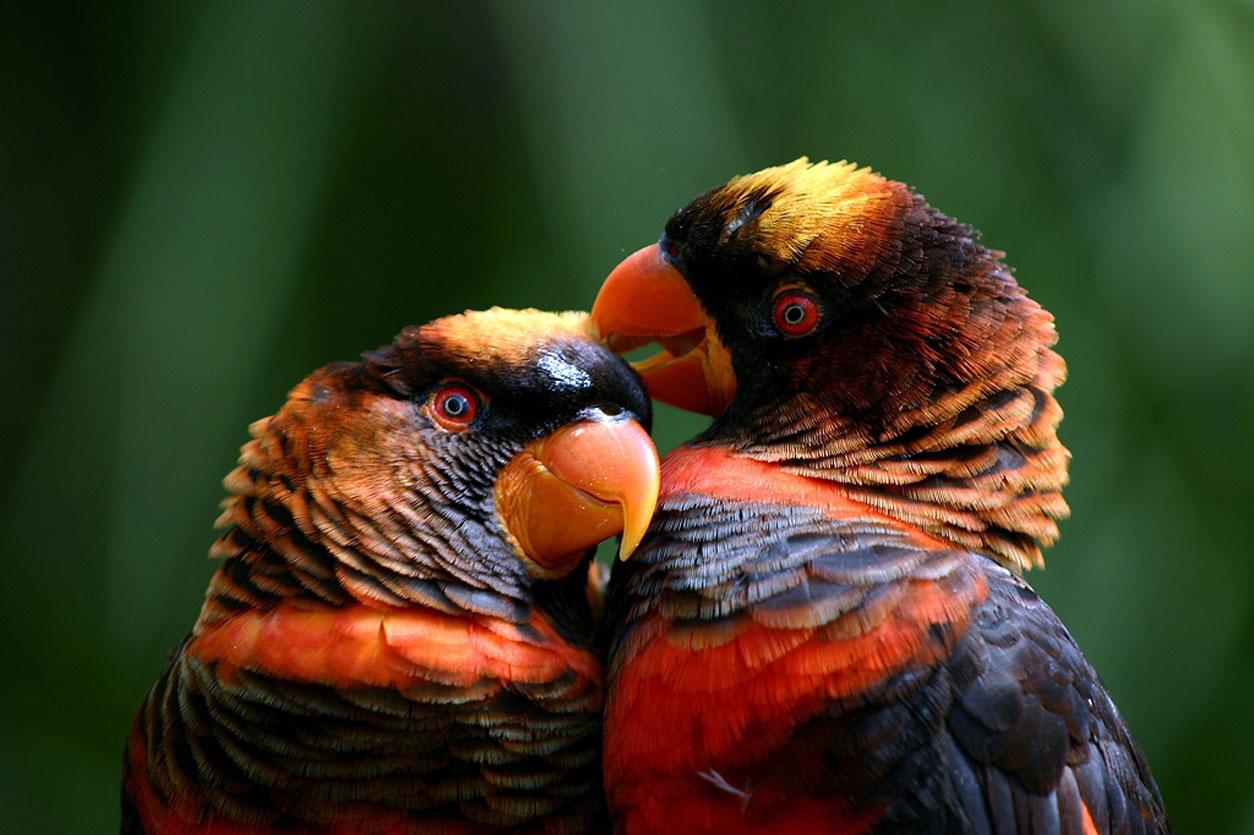
The plumage of the Dusky lory (Pseudeos fuscata) It is difficult to describe since there are many differences in tonality between one and the other specimens.. Some are of a very dark brown color, almost black and others have a much lighter shade. In addition the same happens with the two bands that cross you the chest Since the species goes through three phases: red, Orange and yellow, according to age, gender and the place of origin.
Characteristic of this species is the area of bare skin under the lower jaw until the birth of the throat. The lower wing coverts are orange and the lower flows dark blue. The obispillo is a silvery-white the bill is bright orange. The irises is orange and the legs dark.
There is no sexual dimorphism and the only way to differentiate male and female will be through DNA, Although some authors (Tomas Arndt) they are running that adult females lack the white feathers of the obispillo.
The Dusky lory they are quite widespread and locally common in primary forests , that is to say, those who have not undergone any transformation. But they are also found in wooded areas, up to an altitude of 2.400 m, During regeneration, especially those with large mature trees.
They are also distributed among residual tree beds during their flowering period., including those located in the parks and gardens in cities.
They are occasionally present in the lightly wooded Savannah or plantations of teak and coconut trees.
They normally reside in the landscape of hills or slopes steep slightly from low and middle mountain.
It´s gregarious and when flies or are fed in the cup of them trees full of flowers it makes in groups of 20 to 100 individuals or more.
The nesting season It is very different depending on the region: It extends from November to April in the mountainous areas of East, While in Irian Jaya, the Indonesian part, they do in July.
The Dusky lory they prefer to nest in tall trees in the mountain area, the choice of a hole at high altitude on Earth probably do to protect itself against potential predators.
If the site is of your liking, reuse it for many years consecutively. Male and female participate in the work, the enlargement of the entrance or the cavity itself. Even if the nest has been used in the past, There are always minor changes to be carried out.
Although this species is quite common, We really know very little about its reproduction in the wild. In captivity, the female lays two eggs which are incubated for approximately 24 days. As in most New Guinea lories, the reproductive cycle is very long, about 70 days.
Consumes mainly nectar and perhaps the pollen it accumulates in plants of the genus schleffera or tree Rudraksha (Elaeocarpus sphaericus). Also consume flowers and fruits. It can be seen in large flocks in mango plantations and other cultivated trees. Feeds, occasionally, teak moth (Hyblaea puera).
The Dusky lory It has its area of distribution largely of New Guinea, except the mountains more high of the interior and the peaks more high of the mountains of Parotia.
They are present in Salawati on the Western Islands of papua and further to the East in the Yapen island on Cenderawasih Bay.
– Current IUCN Red List category: Least concern
– The population trend: Stable
The species are not threatened. Common and very sociable, It often forms bedrooms that can reach thousand of birds.
A wild population estimated above 100.000 individuals.
In some parts of the southeast of New Guinea, its density may be superior to 30 birds per square kilometer.
Are birds enough prolific and sociable you adapt easily to captivity.
Contrary to other parrots that eat mainly seeds and nuts; The loris require a greater percentage of fruits, outbreaks, nectar and pollen in your diet. In fact, in the nature, they can feed a maximum of 640 flowers in a day. They also feed on seeds.
It is usually aggressive with other species of lory. Easy to startle with strangers.
– Dusky Lory, Dusk-orange Lory, Dusky-Orange Lory, White-rumped Lory (ingles).
– Lori sombre, Lori à dos blanc (French).
– Weißbürzellori (German).
– Lóris-dusky (Portuguese).
– Lori Sombrío, Lorito crepuscular (español).
– Order: Psittaciformes
– Family: Psittaculidae
– Scientific name: Pseudeos fuscata
– Genus: Dusky
– Citation: (Blyth, 1858)
– Protonimo: those darkened


Sources:
Avibase, mundoexotics, Oiseaux.NET
Photos: Wikimedia, birdsville.NET.au, Dick Daniels – Tampa’s Lowry Park Zoo, Dusky Lory – Woburn Safari Park (Wikimedia),
Sounds: BAS van Balen (Xeno-canto)
Content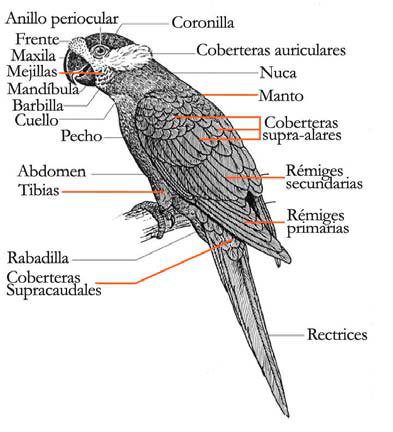
|
|---|
40 cm.. length between 132 and 157 g. of weight.
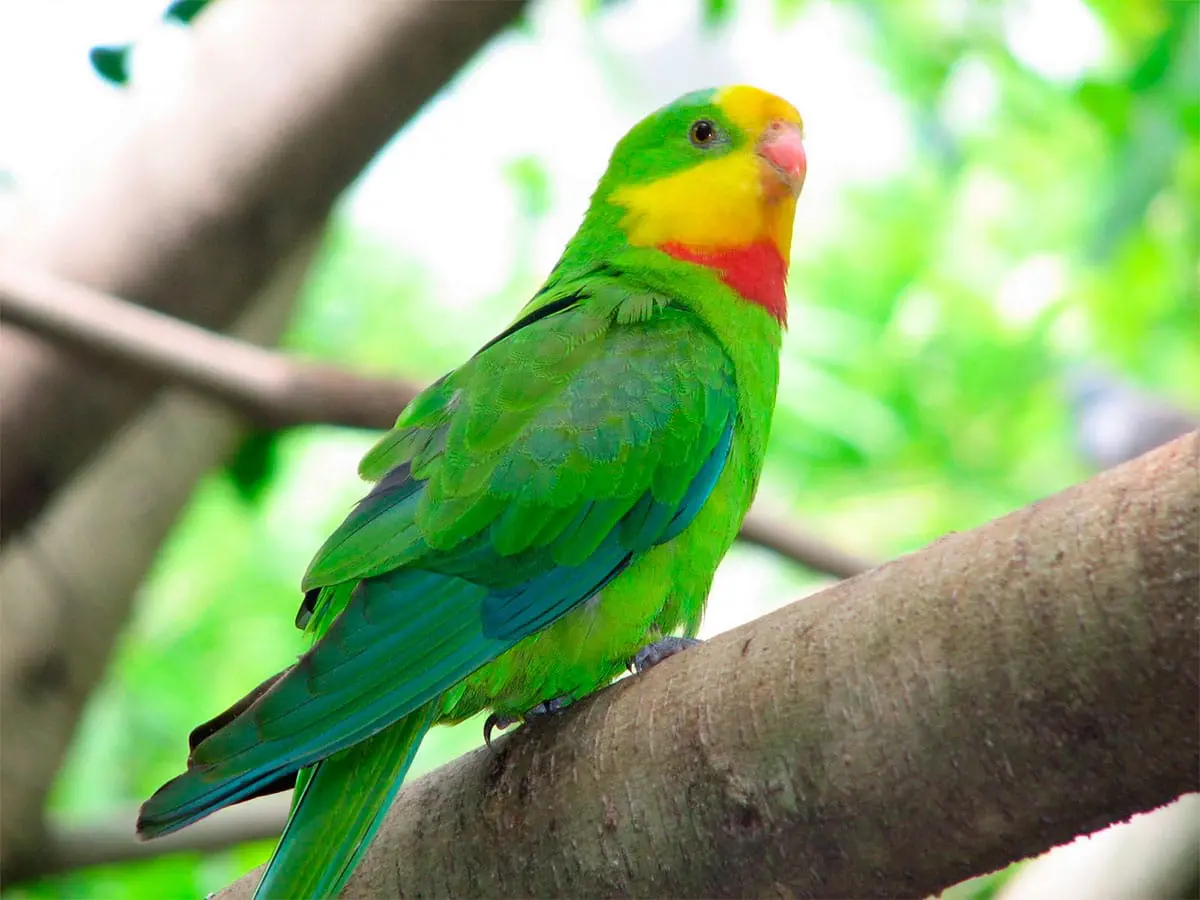
The Superb parrot (Polytelis swainsonii) has the front, crown, Chin and throat of bright yellow; back of the bright green Crown with turquoise blue wash: headphones coverts and Lords, green. Bright green upper parts. Upper, the wings, bright green, with dark diffusion in the inner margins of the vane internal and blue diffusion in vane outer (fine yellow rear margin for flight feathers); bluish carpal edge: light blue primary coverts; primary elongated.
Wing of bright green feathers; bottom of blackish brown flight feathers. Underparts pale bright green, with thin bright red Ruff between throat yellow and green at the top of the chest. Upper, bright green tail, with dark elongated Central feathers Slightly bulbous tips. outer feathers with bluish edges vane outer. The lower part of the tail is black.
Bill, coral red; yellow-orange irises; Blackish legs.
The female is completely Green, with a bath pink Brown throat and with the headphones cinnamon and the Crown of blue-grey. The mantle is more off, more greenish Brown, contrasting with the Green rump and dark flight feathers. The underparts are paler, orange-red legs. She also has distinctive pink trim and pink tips to yellow vane internal bottom of the queue.
Yellow IRIS.
Immature as females but with Brown iris. Males attain adult plumage in about 12 months.
A part of the population of the Superb parrot is migratory, wintering in the North of the breeding areas.
Habitat preferences of breeding populations vary slightly from east to west within the slopes of the Great dividing range and open areas in forests of eucalyptus, It is the dominant vegetation type. Here the species nests far from watercourses, and it uses a variety of tree species.
In the region of Riverina, to the West, birds breed almost exclusively on the banks of rivers, in forests of Eucalyptus camaldulensis, feeding on nearby forests of Eucalyptus bicolor, Eucalyptus melliodora and White Pino-CIPRES (Callitris columellaris).
They sometimes also found in farmland and villages.
The size of the flocks are usually small, but groups of up to 100 individuals have been recorded after the breeding season.
The superb Parrot feed in the trees, in the understory, and also in land, where can be accessible, feeding on spilled grain on the roadsides and keeping the company of the Yellow Rosella and Cockatoos.
The breeding season of the Superb parrot is from September to November.
Male parade making small greetings and nodding his head. Both members of the couple make ritual exchanges of food.
The nest is usually a hollow, full of scrap wood, at the top of a tree dead or alive and a considerable height that is usually between 11 and 51 meters above the ground. The individual sites tend to be reused.
The Superb parrot, they often nest in colonies ranging up to six couples. Spawning contains 4 or 6 eggs which are incubated for at least 20 days. The chicks are altricial and leave the nest after 30 days.
The diet includes fruits and flowers of Acacia and eucalyptus, fruit shrubs (for example Exocarpos); seeds of crops, pastures, weeds and grasses
Size of the area of distribution (reproduction / resident): 95.300 km2
The Superb parrot they are endemic in Australia, where are distributed only in New South Wales and the north end of Victoria.
The species are concentrated in two main areas: on the South-West slope of the Great dividing range (regions of Cowra, Boorowa, Cootamundra and Yass), and in the area of Riverina, New Wales of the itsr. In the latter the range extends along the murrumbidgee river, from There is a to Darlington Point, Narrandera and Wagga Wagga.
Also found in the North of Goolgowi and the river lachlan, and in South, in the rivers Edward and Murray (Barham. Deniliquin, Tocumwal, Cobram, Getafe and Albury).
In the North of Victoria, concentrated along the rivers Goulburn and Ovens, and in the area of Barmah Forest.
Wandering birds occasionally appear more to the West, along the border of Victoria and New South Wales.
The Superb parrot, do not normally breed above 33° S, but at least part of the population disperses north to 33° S at the end of the breeding season.
These birds are found from April to August in the northeast of New South Wales from Gunnedah to Narrabri, Gilgandra and Coonamble, and between river systems to the West (Barwon, Namoi, Macquarie, Castlereagh, Marthaguy Creek).
Occasionally, alleged migratory birds, They fly to the West, about Tottenham and Hermidale.
Escapes have been recorded around Sydney and Melbourne.
A moderate number of captive.
Protected by law.
• Current category of the Red List of the UICN: Least concern
• Population trend: Stable
Its population, apparently, fell in 1920 as an accidental effect of a poisoning by the crop protection.
A panel of experts considered that it was very likely that the population in 2010 exceeds the 10.000 mature individuals. The current estimate ranges in the Strip between 10.000 and 20.000 specimens.
The general trend of the population of the Superb parrot (Polytelis swainsonii) is uncertain, but there is no evidence of a continuous decline.
In Australia is also classified as vulnerable species the law of protection of the environment and conservation of the biodiversidadad of 1999. In addition, its conservation status varies between states., for example in the law of Victoria (1988) is considered to be threatened species.
Take it easy, relatively little aggressive with other birds, and very social.
Una muestra vivió 15,1 years in captivity. According to sources, these animals can live up to 24,2 years in captivity, It is possible to, but the source is not verified; the same study reported that these animals can reproduce in approximately 2 years of age in captivity.
Pretty common in captivity, above all in Australia.
– Superb Parrot, Barraband, Barraband Parakeet, Barraband Parrot, Green Leek, Scarlet-breasted Parrot (ingles).
– Perruche de Barraband, Perruche Barraband, Perruche superbe (French).
– Schildsittich (German).
– Periquito-soberbo (Portuguese).
– Perico Soberbio, Periquito de Barraband (español).
– Order: Psittaciformes
– Family: Psittaculidae
– Genus: Polytelis
– Scientific name: Polytelis swainsonii
– Citation: (Desmarest, 1826)
– Protonimo: Psittacus Swainsonii


————————————————————————————————
Sources:
– Avibase
– Parrots of the World – Forshaw Joseph M
– Parrots A Guide to the Parrots of the World – Tony Juniper & Mike Parr
– Birdlife
– The Animal Ageing and Longevity Database – Polytelis swainsonii
– Photos:
(1) – By paulgear (Picasa Web Albums) [CC BY-SA 3.0], via Wikimedia Commons
(2) – Image Credit: Stuart Harris – Canberra Birds
(3) – Image Credit: Julian Robinson – Canberra Birds
(4) – Image Credit: Stuart Harris – Canberra Birds
(5) – Image Credit: Julian Robinson – Canberra Birds
– Sounds: Ding Li Yong (Xeno-canto)
Content
|
|---|
39-43 cm.. length between 195 and 275 g. of weight.
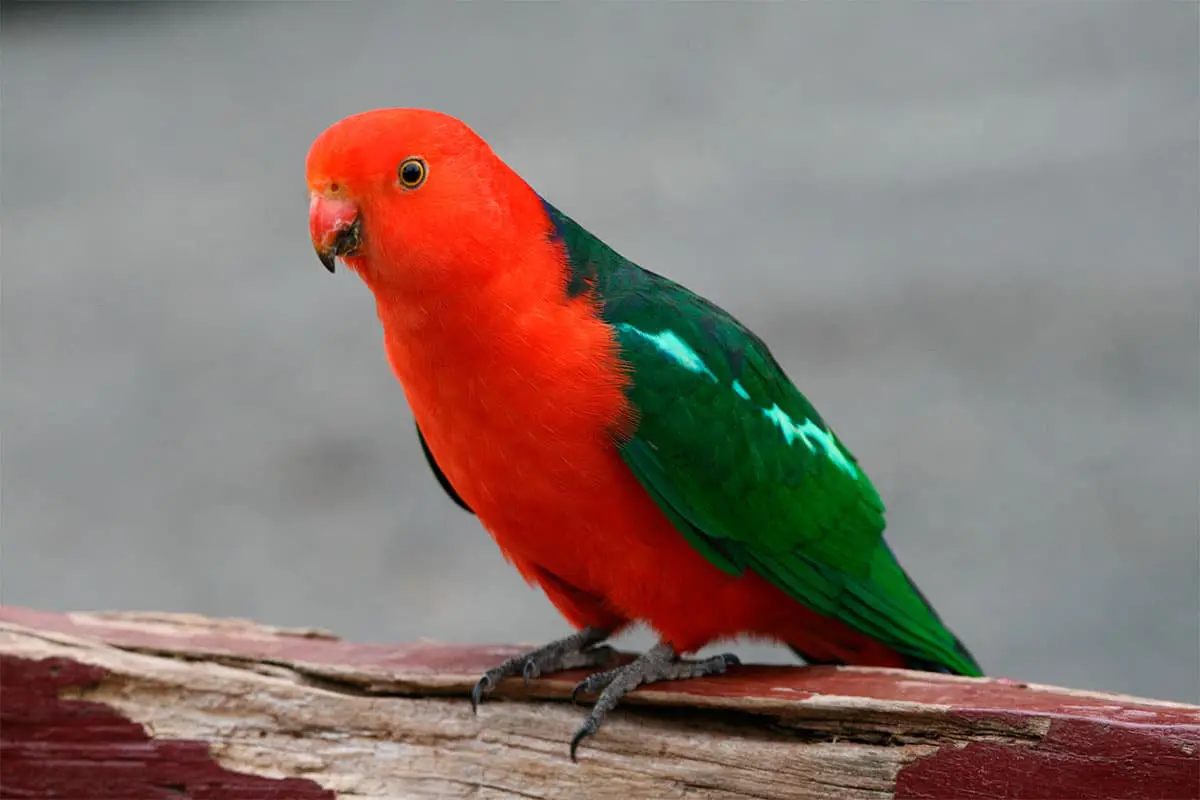
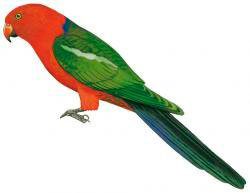
The Australian King-Parrot (Alisterus scapularis) is very similar to the Moluccan King-Parrot, but larger.
It has the head and bright Scarlet underparts, with the exception of the coverts black infracaudales, with large red tips. Narrow rear necklace with mixture of the dark blue to dark green of the mantle (mantle feathers fringed even darker); lower back and rump, dark blue. Pale necklaces, slightly greenish-blue, forming a distinctive 'brace'; green wing coverts, and green flight feathers with vane blackish internal. Under, feathers dark green bathed in blue wing. Upper, Black tail with a light blue bathroom in the vane external side feathers; undertail, black tail.
Bright coral red beak, with black tips; iris yellow ; grey legs.
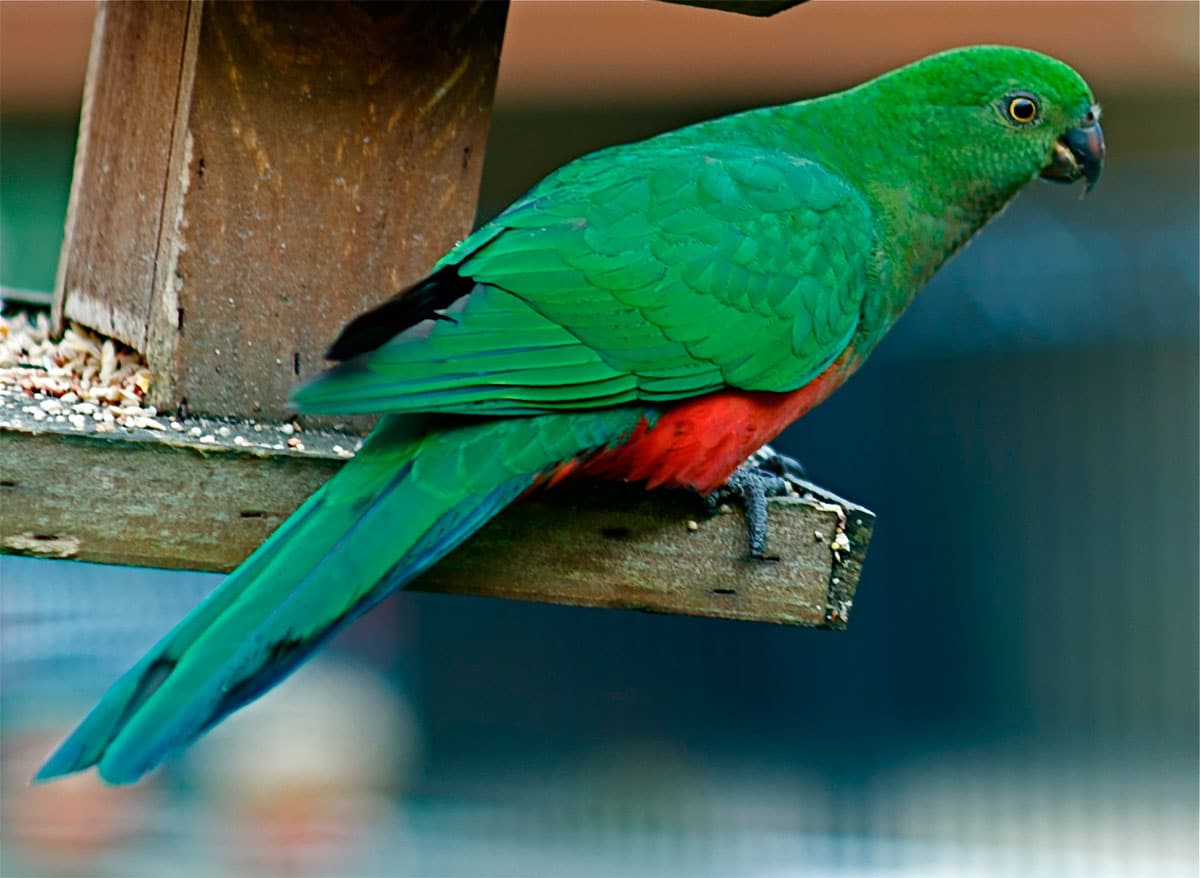
Strong dimorphism in female, with the Crown and green upper parts (including supracaudales coverts and tail, but not the Croup which is a lighter blue than in males). The face and the chest are coloured green opaque with a reddish spread warm. Females may occasionally show some pale necklaces. The infracaudales coverts are green, very red-tipped. The Central tail feathers are green, the lateral blackish with narrow pink tips.
The peak is a blackish brown dark.
The immature birds are like females, but with a pale beak and dark iris.
Younger females are less red below. Males get the adult plumage during a slow change that starts around of the 16 months, and continue for others 14 to 15 months.
The Australian King-Parrot disperse, regularly, after the breeding season, in wooded areas, reaching altitudes of 1.625 m, Although rarely seen on top of the 1.200 m, from where come down to more open habitats; they have seen other apparently climate-related movements. They can travel moderate distance; a ringed bird was recovered to 270 kilometers from their place of origin.
During the breeding season, they are often found in dense forests (sclerophyllous forest wet), wooded streams and associated habitats, including more open eucalyptus forests and savannahs bordering riparian forests.
Outside the breeding season, they are in a wider variety of habitats, including the cultivated areas, parks, orchards and occasionally suburban gardens.
They are usually in pairs or small groups, although subsequent flocks of immatures may form groups of up to 50 or more birds. The Australian King-Parrot, often, they sit in a visible way on high exposed branches. When feed, However, the birds are still cautious and fairly quiet. They gather to feed early in the morning, sometimes in mixed groups with Rosella parakeets and other parrots. They remain silent during the hottest part of the day, to re-enable the afternoon.
Noisy flocks, often, they might be returning to the roosts at night.
During courtship, males move head, the wings and inflate their feathers; the female responds with Wiggles head, and asking for food. The breeding season extends from September to February. The nest is a hollow in a tree dead or alive (often a large eucalyptus with hollow tips). The entrance of the nest is usually at a certain height. Between three and six (usually four) eggs are deposited in a deep hollow on a bed of wood dust. The female incubates alone during 20 days, with the male nearby to provide her with food.
The young remain in the nest during 5 weeks, after which they leave the nest and remain with their parents.
The diet consists of fruit, berries, nuts, seeds, insect larvae, flowers, outbreaks and other vegetable materials. The species is also fond of mistletoe VISCUM album, eucalyptus and acacia trees. It can cause damage in orchards and fields, usually in search of potato, corn and other crops.
When feed, They argue the food with their legs, and extract with its beak. If you bother, These parrots flying quickly to hide, but they can become tame in some inhabited areas.
The Australian King-Parrot is distributed along the East coast of Australia, in the interior of the western slopes of the Great dividing range, extending from Cooktown in the North of Queensland, to the South, the District of Atherton, then through Eungella, Blackall, MooNiE and in New South Wales, where it reaches inside approximately in Bingara, Mudgee and Albury. In Victoria is limited to the South-East, being Portland its southwestern border.
It is common in Canberra, especially during autumn and winter, and birds Getaways, occasionally seen in adelaide, along the murray river and in the West of Victoria.
The species can also be seen in Fraser, Stradbroke and Broughton Islands.
The world's population is considered that it is far superior to 50.000 specimens and stable, although they may have been affected by trade and to some degree habitat loss.
• Current category of the Red List of the UICN: Least concern
• Population trend: Decreasing
The size of the world's population has not been quantified, Although it is estimated above 50,000 specimens.
The species, according to sources, is usually common, but may be declining due to deforestation and the destruction of their habitat in course (pit et to the. 1997).
Fairly common in Australia, not so much in other places.
Sweet disposition, tame; will tolerate other species outside of breeding season.
– Australian King-Parrot, Australian King Parrot, Blood Rosella, King Lory, King Parakeet, King Parrot, King-Red Lory, Queensland King-Parrot, Scarlet-and-Green Parrot, Southern King-Parrot, Spud Parrot (ingles).
– Perruche royale (French).
– Königssittich, Königsittich (German).
– Periquito-rei-australiano (Portuguese).
– Papagayo Australiano, Papagayo Real Australiano (español).
– Order: Psittaciformes
– Family: Psittaculidae
– Genus: Alisterus
– Scientific name: Alisterus scapularis
– Citation: (Lichtenstein, MHC, 1816)
– Protonimo: Psittacus scapularis



————————————————————————————————
Sources:
– Avibase
– Parrots of the World – Forshaw Joseph M
– Parrots A Guide to the Parrots of the World – Tony Juniper & Mike Parr
– Birdlife
– Photos:
(1) – «Alisterus scapularis (male) -Bunya Mountains-8» by Arthur Chapman – originally posted to Flickr as Alisterus scapularis (Australian King Parrot). Licensed under CC BY 2.0 via Wikimedia Commons.
(2) – By Andy (originally posted to Flickr as King Parrot Couple) [CC BY-SA 2.0], via Wikimedia Commons
(3) – By Geoff Penaluna from Australia (Female King parrotUploaded by snowmanradio) [CC BY 2.0], via Wikimedia Commons
(4) – By Jan from Singapore, Singapore [CC BY 2.0], via Wikimedia Commons
(5) – «Alisterus scapularis-Commonwealth Park, Canberra, Australia-male-8» by Duncan McCaskill – Picasa Web Albums. Licensed under CC BY 3.0 via Wikimedia Commons.
(6) – HBW Alive – hbw
– Sounds: Diego Caiafa (Xeno-canto)
Content
|
|---|
35 to 40 cm.. length between 145 and 163 g. of weight.
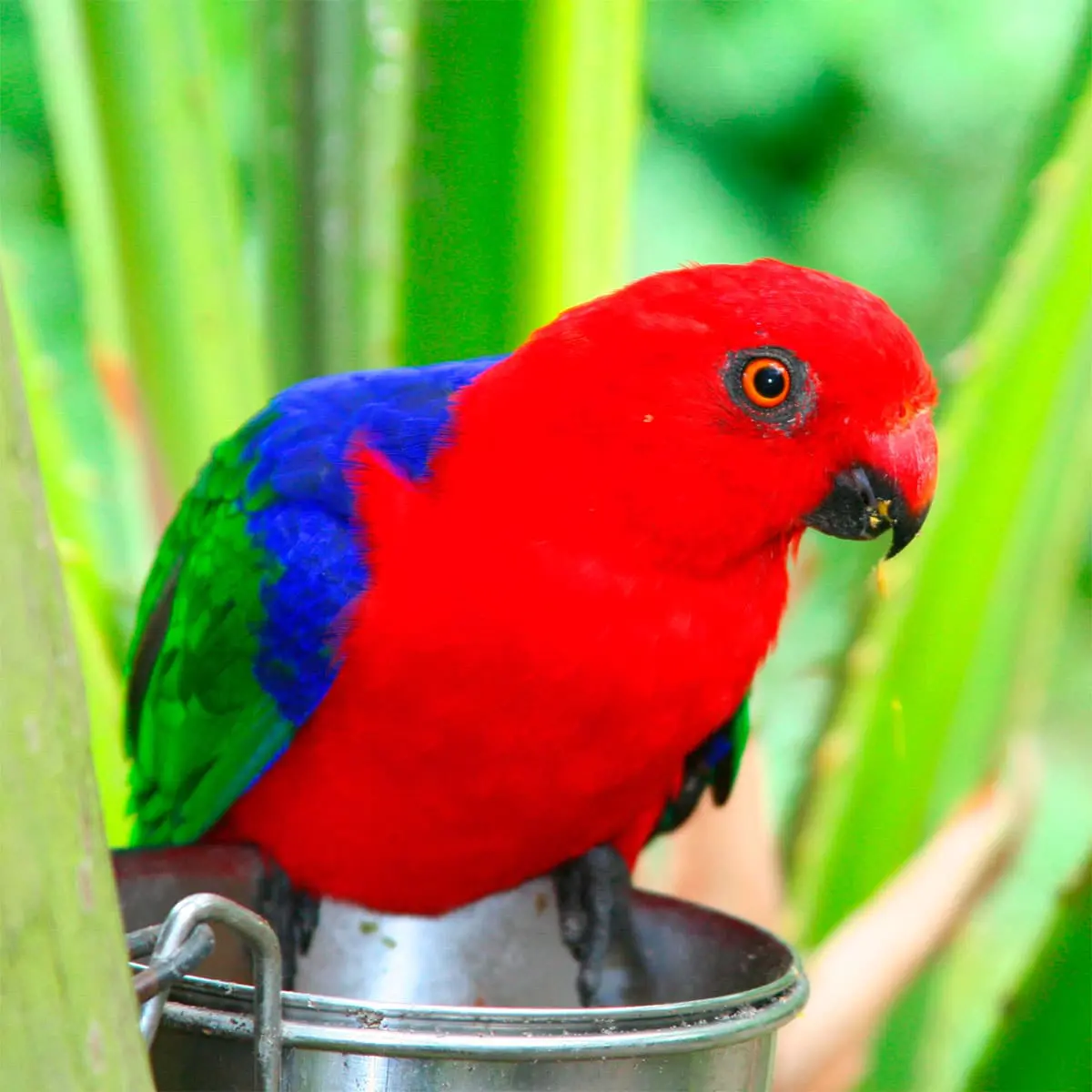
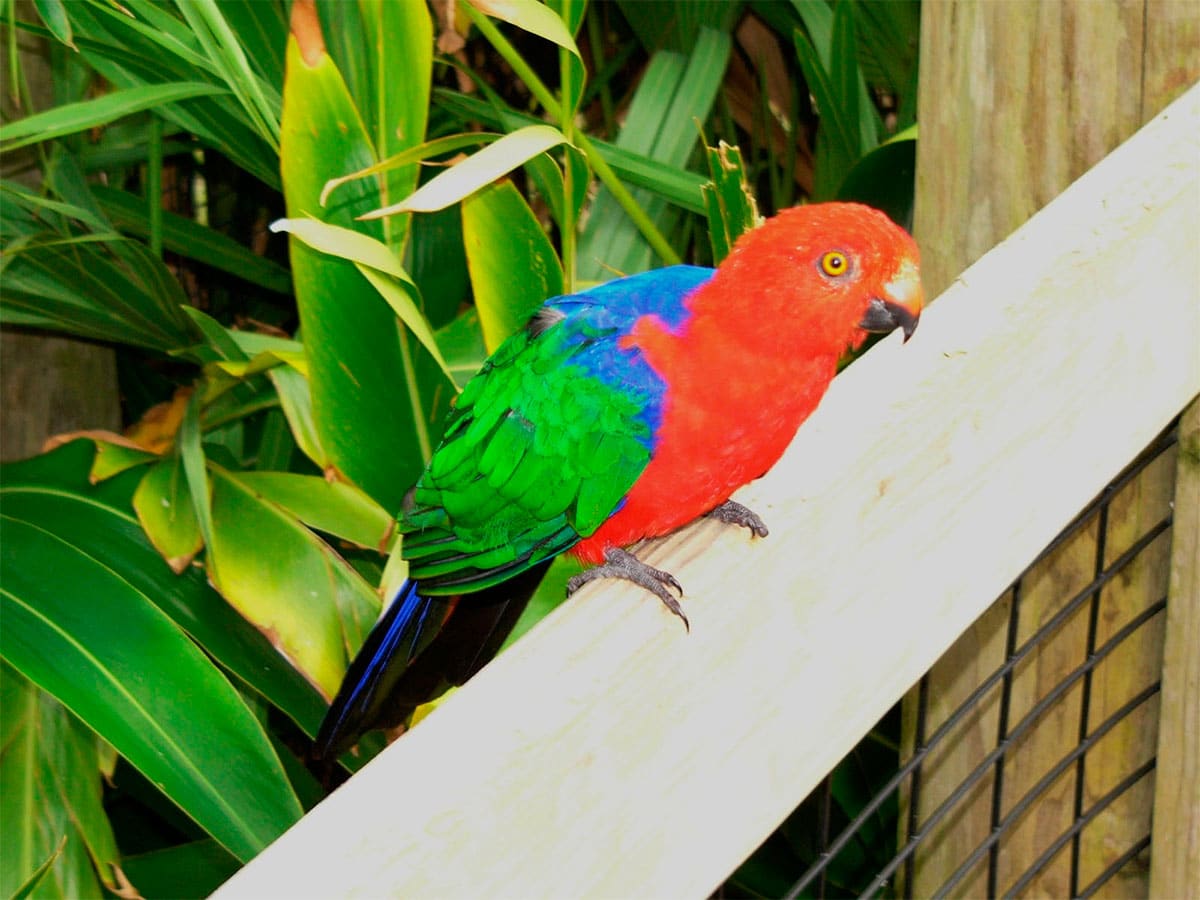
The Moluccan King-Parrot (Alisterus amboinensis) has a head, neck, the nape of the neck and the upper mantle of bright red, with strong demarcation to dark blue-violet in the lower mantle, back, buttocks and supracaudales coverts. Green wings with the exception of the blue in the small inner coverts and carpal edge. Under, black wings with blue-violet coverts. Bright red bottoms, with mauve bases to coverts infracaudales, sometimes visible; flanks with a little blue. Upper, the very dark blue colal; below black grey color wide-margin rose to the side feathers.
Bill with an orange-red base on the upper mandible, Blackish lower; Orange iris; black grey legs.
The two sexes, somatic sexual dimorphism is not presented..
Immature with more green in the back; Brown-Black beaks; pale eye-ring and darker than the adults of iris. Dotted pink on the outer tail feathers. Mature in one year.

The Moluccan Parrot is distributed through the dense primary and secondary humid forests, and from time to time in the adjacent plantations, farmland and gardens, from the lowlands up to around the 2.100 meters above sea level.
The birds are usually found in pairs or in small groups, and they are very calm while feeding and shy at all times, hiding in the thick foliage and flying amid shrill calls at the first sign of an intruder.
Just nothing is known of the cycle of reproduction in the wild, although according to sources, nesting takes place between the months of February and April.
Two young birds nests have been found on two occasions in hollow trees.
One instance of captive breeding gave data for incubation of 19 days, with the emerging young in nine weeks.
The courtship was observed during feeding, and two eggs were deposited.
The diet includes acorns Lithocarpus, as well as hard fruits, outbreaks and other forest tree berries.
Size of the area of distribution (reproduction / resident): 149.000 km2
Is distributed from Peleng and Sula Islands eastward through the Moluccas, including Halmahera, Buru, Ambon and Seram. Also found in the Western Islands of papua, including Waigeo, Batanta and Salawati.
In New Guinea is from Vogelkop and East of the Bomberai Peninsula some 135 ° E.
Usually Rare due to habitat loss and trade in birds.
• Current category of the Red List of the UICN: Least concern
• Population trend: Decreasing
The size of the world's population has not been quantified, but the species is described as generally common, Although rare in Halmahera.
The nominal subspecies population is estimated at 70.000 specimens (pit et to the. 1997).
The population is suspected to be declining due to the destruction of habitat in course.
Occasionally available.
Nervous, is a bird a pet bird.
In captivity will have failed to reproduce.
In the Zoological Garden of Loro Parque, Tenerife, on Canary Islands, biologists Dr. Burkard and Dr. Gerlach they have made so large colonies, but since 1972 they have succeeded until now non.
More information on loromania
– Moluccan King-Parrot, Amboina King Parrot, Amboina King-Parrot, Ambon King-Parrot, Moluccan King Parrot (ingles).
– Perruche tricolore, Perruche royale d’Amboine (French).
– Amboinasittich (German).
– Periquito-rei-amboina (Portuguese).
– Papagayo Moluqueño, Papagayo Real de Amboina (español).
– Order: Psittaciformes
– Family: Psittaculidae
– Genus: Alisterus
– Scientific name: Alisterus amboinensis
– Citation: (Linnaeus, 1766)
– Protonimo: Psittacus amboinensis



————————————————————————————————
Sources:
– Avibase
– Parrots of the World – Forshaw Joseph M
– Parrots A Guide to the Parrots of the World – Tony Juniper & Mike Parr
– Birdlife
– World Parrot Trust – parrots.org
– Photos:
(1) – «Alisterus amboinensis-Brevard Zoo-8a-ec» by Alisterus_amboinensis_-brevard_zoo-8a.jpg: Malinderivative work: Snowmanradio (talk) – originally posted to Flickr as Puuuuuuuuuuuurdy Birdy and uploaded to commons at Alisterus_amboinensis_-brevard_zoo-8a.jpg. Licensed under CC BY-SA 2.0 via Wikimedia Commons.
(2) – By richard broderick (T0010716uploaded by Snowmanradio) [CC BY-SA 2.0], via Wikimedia Commons
(3) – Brevard Zoo – Melbourne, FL, USA © 2004 Jeff Whitlock – The Online Zoo
(4) – Brevard Zoo – Melbourne, FL, USA © 2004 Jeff Whitlock – The Online Zoo
(5) – Vogelpark, Alphen Aan Den Rijn – ZOOTOGRAFIANDO
(6) – «Swainson king parakeet» by William John Swainson – Transferred from en.Wikipedia. Licensed under Public Domain via Wikimedia Commons.
– Sounds: Frank Lambert (Xeno-canto)



_-Bunya_Mountains-8.jpg#/media/File:Alisterus_scapularis_(male)_-Bunya_Mountains-8.jpg)
_-Australia-8c.jpg)


