▷ The world of Pets: Dogs, cats, birds, reptiles, amphibians

Collared Lory
Phigys solitarius


Collared Lory

Content

Description

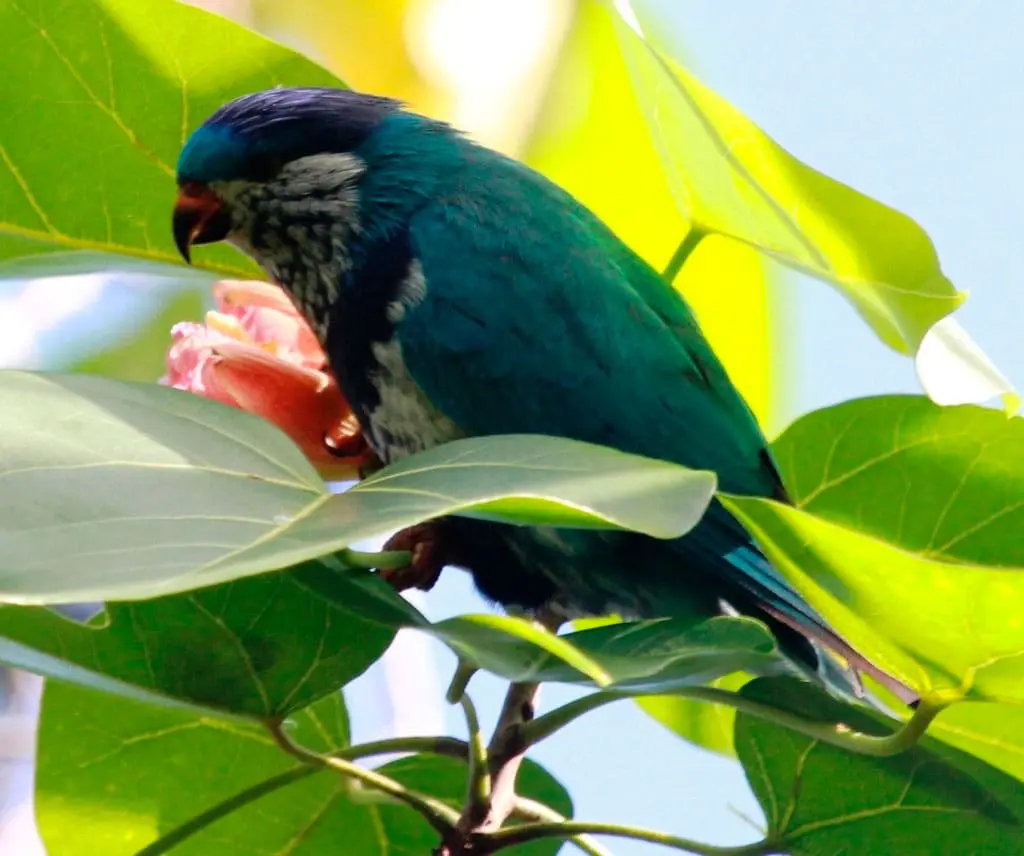
The Collared Lory (Phigys solitarius) has an approximate length of 20 cm.. and a weight ranging between 75 and 85 g..

The upper zone of the crown it is dark purple, In contrast with the ear-coverts, cheeks and throat that have a bright color red Scarlet;

The front of the crown, occasionally, with a mottled red light;
The tail feathers of the neck are of a green living with completion in red and a colorful blanket.
Under the the mantle, rump and top of the tail, bright green.

Upper wing green colour with the inside of the flight feather and coverts, in black color.
Underwing coverts Red and green. Underparts Scarlet Red, but with the bottom of the abdomen, lower side of the rump and the thighs, in dark purple.
Orange-yellow spot in Central feathers of the tail. Undertail Matt Brown-Green, showing orange spots on the basis.

Bill orange; Iris from yellow to red; Orange yellow the legs.

The females has more green under the nape, less red in the the mantle, a pronounced green glow in the crown back and a bright purple on the crown front.

The immature show freckles slightly purplish color and some greenish hidden spots in the chest; crown Green rear: they lack the elongated feathers red of the nape up to eight months of age. They lack orange spots in the tail. Bill more Brown than adults; irises brown: legs dark.

Habitat:

Visible and noisy. Found usually in pairs or in small groups of five to fifteen members, Although flocks have also been of up to 50 birds . They are mainly distributed in the lowlands of humid forest, edge of the forest, plantations and second growth up to 1,200 m, but they can be found anywhere with flowering gardens.

It is usually more common in wet windward areas, being less common on agricultural leeward coasts.

The Collared Lory are Mobile and something nomads, they are prepared to travel to almost any habitat with trees in bloom.

Often seen flying over trees or feeding are loud in acrobatic groups.

Reproduction:

The nesting they occur in the second half of the year, especially after August. Two white eggs are placed in a hollow tree. Adults aggressively defend the nesting sites.

In an instance of captive breeding, the incubation lasted 30 days and the young bird left the nest almost nine weeks later.

Food:

The diet of the Collared Lory consists of seeds, nectar and flowers. Trees of your choice include the drala (Erythrina variegata), the coconut tree (Cocoa nuts) and the African tulip introduced and invasive (Spathodea campanulata).
Also eat fruits as the Mango (Mangifera indica).

Distribution:

The Collared Lory is endemic of the Fiji Islands, including the main islands of Vanua Levu and Viti Levu, In addition to Rabbi, Taveuni, Koro, Wakaya, Ovalau, Gau, Ono, Kadavu, Matuku, Moala and some islands in the Lau group (Naitaba, Vatu Vara, Lakeba). In the extreme south of the Fiji Islands group, the Collared Lory It is replaced by the Blue-crowned Lorikeet.

The species is common and the world population is estimated between 10.000 and 100.000 specimens.

Some are kept in captivity. Red feathers were previously used by the Samoan and Tongan to make edges of floor mats, but trade does not seem to have had an impact on the abundance of the species in Fiji. Some birds are reported, they have escaped in Tonga and Samoa.

Conservation:

minor concern


– Current IUCN Red List category: Least concern.

– The population trend: Stable.

The world's population has not been quantified, but the species is described as common in Viti Levu, the island of Vanua Levu and Makogai and rare in the Ngau island, Fiji.

The population It is suspected to be stable in the absence of evidence of any reduction or substantial threats.

"Collared Lory" in captivity:

Very rare to see them in captivity.

Alternative names:

– Collared Lory, Solitary Lory, Ruffed Lory, Fiji Lory (ingles).
– Lori des Fidji, Lori phigy (francés).
– Einsiedlerlori (alemán).
– Lóris-solitário (portugués).
– Lori Solitario (español).

scientific classification:

– Order: Psittaciformes
– Family: Psittaculidae
– Scientific name: Phigys solitarius
– Genus: Phigys
– Citation: (Suckow, 1800)
– Protonimo: lone parrot

“Lonely Lory” Images:

Videos "Collared Lory"

————————————————————————————————

«Lonely Lori» (Phigys solitarius)


Sources:

– Avibase
– Parrots of the World – Forshaw Joseph M
– Parrots A Guide to the Parrots of the World – Tony Juniper & Mike Parr
– Birdlife

– Photos:

1 – «Phigys solitarius - San Diego Zoo, California, USA-8a (1)» by DerekL123 from Cypress, USA – San Diego Zoo-48.jpgUploaded by snowmanradio. Licensed under CC BY-SA 2.0 via Wikimedia Commons.
2 – Collared lory (Vini [Phygis] solitarius) handjob by Chlidonias – ZooChat
3 – Collared Lory Perroquets – computer wallpapers
4 – Collared lory [Phigys solitarius] – Birds-pet-wallpapers
5 – By DickDaniels (http://carolinabirds.org /) (Own work) [CC BY-SA 3.0 or GFDL], via Wikimedia Commons

– Sounds: Matthias Feuersenger (Xeno-canto)
▷ The world of Pets: Dogs, cats, birds, reptiles, amphibians

Ultramarine Lorikeet
Vini ultramarina

Ultramarine Lorikeet

Content

Description

The Ultramarine Lorikeet (Vini ultramarina) has a length of 18 cm.. and an approximate weight of 35 g..

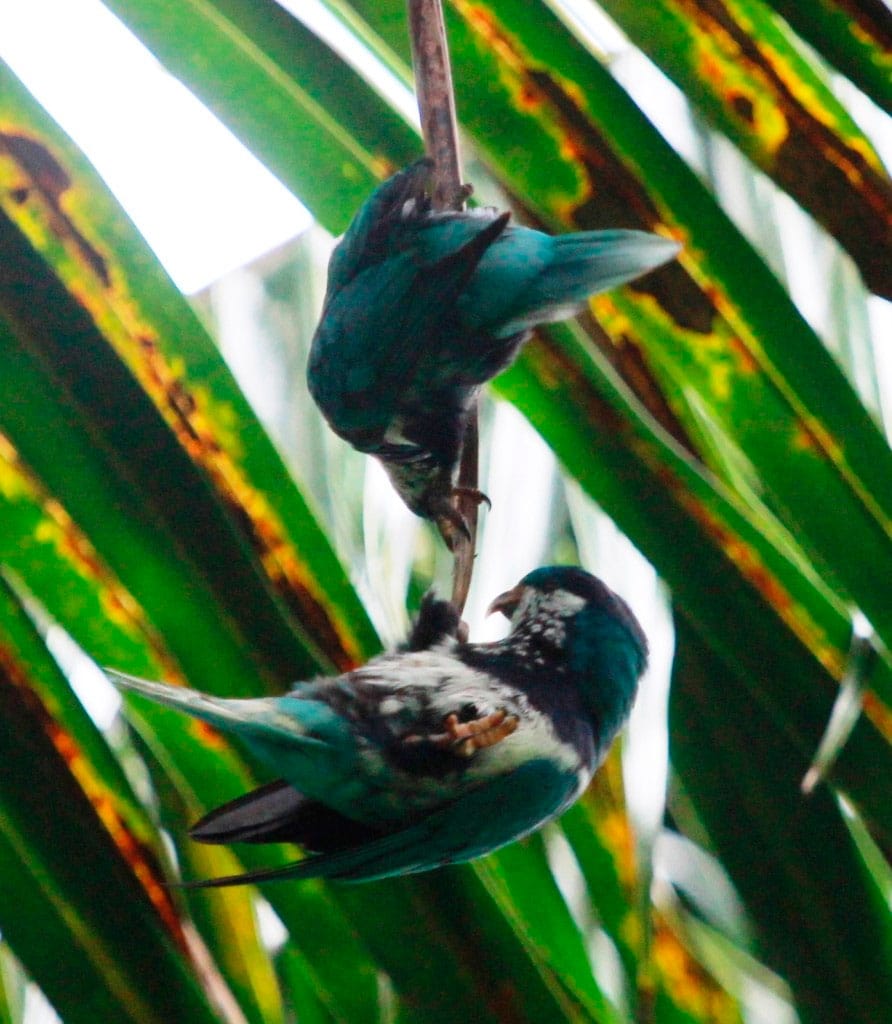
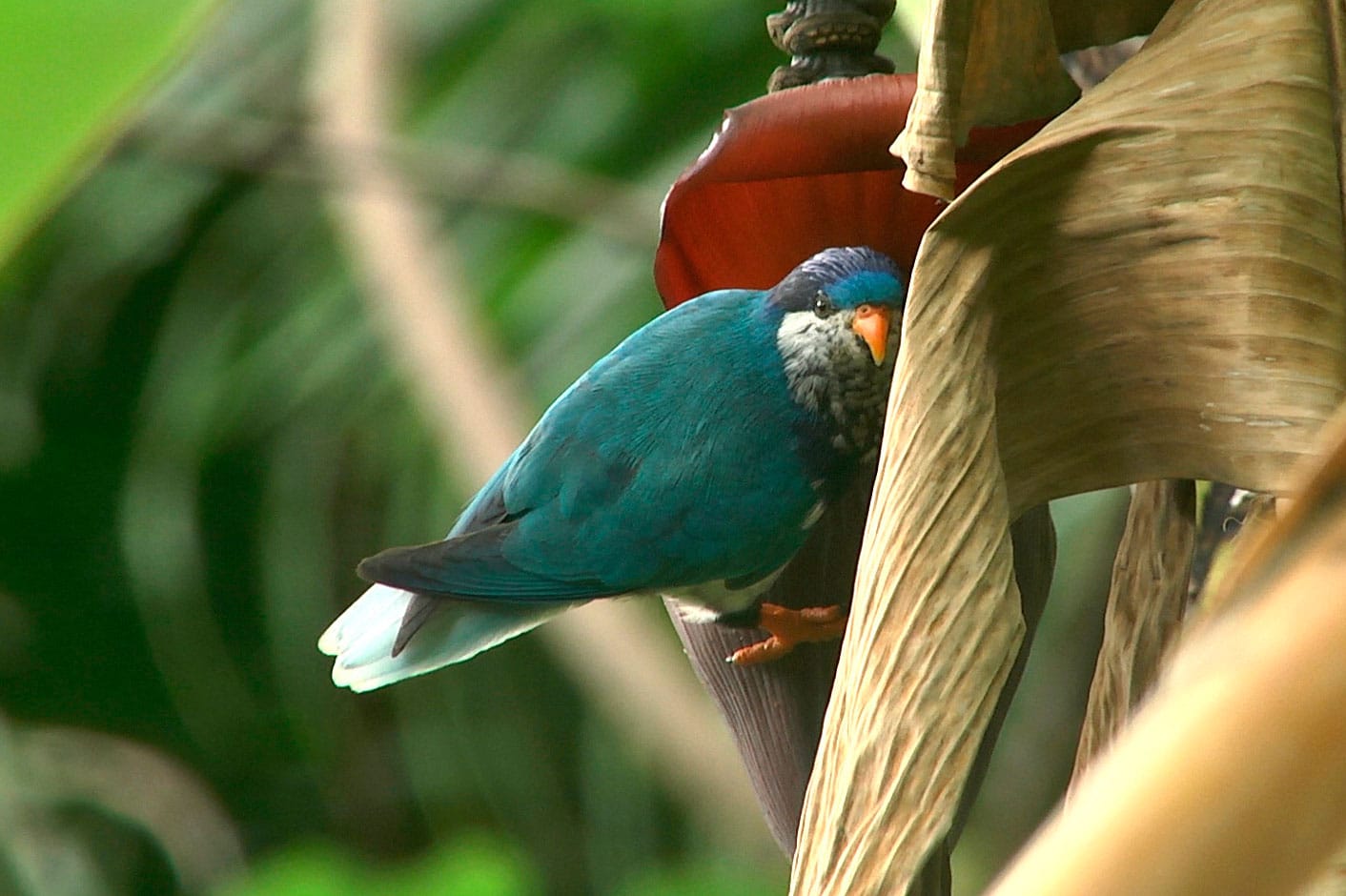
Forehead bright navy blue iridescent; crown and nape Mallow dark blue with streaks of light blue; lores and spots on ear-coverts, white (bases of ear-coverts, purple and blue color). Mantle and covert wing, Navy blue; rump and tail coverts, dark blue light. The flight feather, light blue, blackish internal. Blue off the Underwing coverts. Throat dark blue with white speckles; in the band chest mauve blue with área subterminal pale blue feathers. Belly blank slate bases in feathers, giving a mottled appearance; the thighs dark blue malva; coverts, Turquoise.

The uppertail-coverts, whitish blue with navy blue light diffuse in the outer margins;
undertail coverts whitish merged with navy and some irregular gray markings.

Bill yellow orange, upper jaw, blackish brown at the base; irises brownish yellow; the orange legs.

Both sexes are equal but the female It is slightly smaller.

The immature adult differ by the absence of white on underparts, they are uniformly blackish. Also by bill black, irises Dark Brown and legs orange-brown.

Habitat:

In the Decade of 1970 in Nuku Hiva, these parrots were found only in pristine forests (that they have not been touched and that it is in its original condition) on the 700 m.

There is a similar habitat preferences in UA Pu, where are located mainly in montane forests between 700 and 1.000 m. Populations have also been of Ultramarine Lorikeet in banana plantations, coconut and mango (Mangifera indica), in coastal areas.

The species seems to have a wider range of habitat preferences in UA Pu., being found at altitudes ranging from the coast to wooded crests.

They feed in trees with flowers, especially coconut trees and Erythrina.

Loud and lively; the birds move freely between the canopy and lower floors, allowing the human approach. They usually travel in pairs or groups of up to a dozen of individuals. Most of its flights are made below the level of the trees, but for longer distances they rise spiral up to considerable heights.

Extremely Active, rarely long they stay in a tree and feeds using the peak acrobaticamente support.

Reproduction:

The nesting of these birds is from June to August.

It nests in hollow trees, preferring Artocarpus altilis, Pometia, Pandanus tectorius and Hibiscus tileacus. Sometimes they use the old nest of another species. They lay two white eggs.

A captive breeding record gives the chick eight weeks to become independent.

Food:

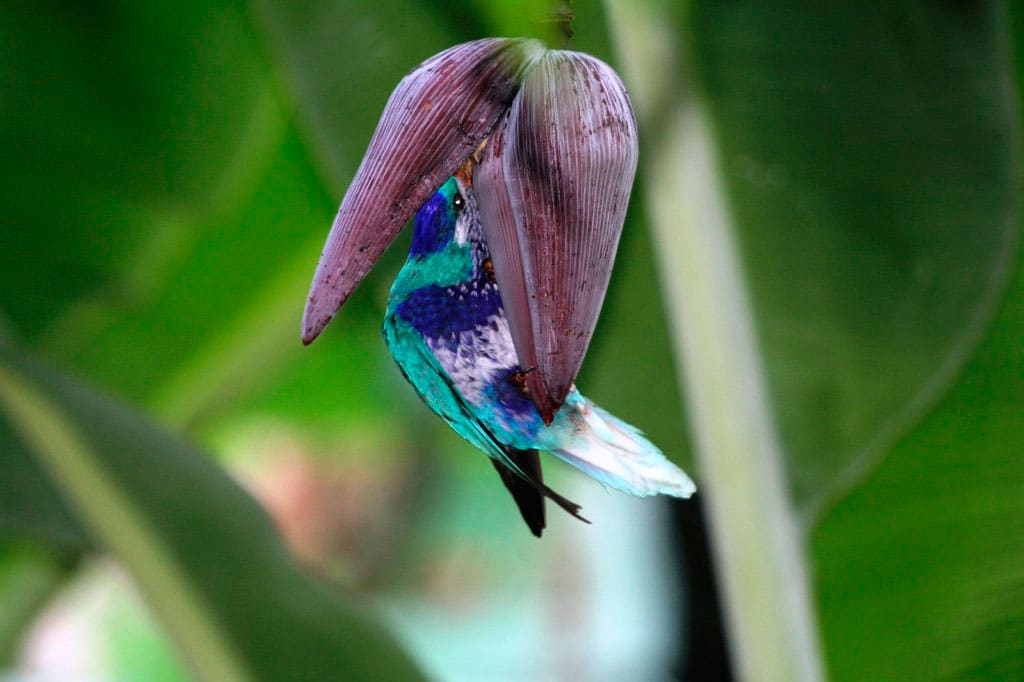
It feeds on a great variety of trees in flower, nectar and pollen. Within your preferences are the flowers of the coconut palm, the native tree and banana Hibiscus tileaceus.

It also feeds on fruits, especially mango and insects.

Distribution:

Size of its range (reproduction / resident): 100 km2

The Ultramarine Lorikeet is endemic of the Marquesas Islands, of Nuku Hiva, UA Pu and UA Huka, Although fossil remains show that previously most widely spread.

In UA Pu the population was estimated at 250-300 couples in 1975. But in 1988 had shrunk around the 60%, probably due to the spread of rats Rattus rattus, and a hurricane in 1988, Although its effects on the population of birds are uncertain.

In Nuku Hiva the small population of around of 70 birds that inhabited the high valleys and ridges in the northwestern part of the island, between 700 and 1.000 d., You can that they are now extinct.

The majority of the population, to this day, remains in UA Huka, where the species was introduced in 1940. This population would have grown from 200 to 250 couples in the late 1970s and was considered abundant in 1990 at altitudes environment to the 500 d., with a population estimated between 1.000 and 1.500 birds. The main threat to the species, here, is the potential arrival of rats, and between 1993 and 1994, 14 Ultramarine Lorikeet they were moved to Fatu Hiva in an attempt to keep them safe from rats; But, habitat deterioration by grazing mammals and avian malaria, also they have been and are still potential factors to increase the vulnerability of this species.

Conservation:


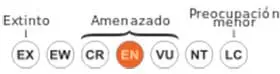
Endangered


• Current IUCN Red List category: Danger.

• Population trend: Decreasing.

CITES Appendix I. in danger of extinction.

The entire population is located on an island where the species is stable, in other islands recently has been extinguished. The general trend is suspected to be a slow and continuous decrease. If the black rats come to UA Huka the decrease will be quick and severe.

Other threats included are logging in some sectors of the habitat of the Ultramarine Lorikeet to plant crops, fruit trees, and use the trunks for woodcarvings for tourism.

"Ultramarine Lorikeet" in captivity:

Extremely rare.

Alternative names:

– Ultramarine Lorikeet, Marquesas Lorikeet, Ultramarine Lory (ingles).
– Lori ultramarin, Lori de Goupil, Lori des Marquises (French).
– Ultramarinlori (German).
– Loris Vini Ultramarine (Portuguese).
– Lori Ultramar, Lori Ultramarino (español).

scientific classification:

– Order: Psittaciformes
– Family: Psittaculidae
– Scientific name: Vini ultramarina
– Citation: (Kuhl, 1820)
– Protonimo: Psittacus ultramarinus

Images «Overseas Lory»:

Videos "Ultramarine Lorikeet"

————————————————————————————————

«Lori Ultramar» (Vini ultramarina)


Sources:

– Avibase
– Parrots of the World – Forshaw Joseph M
– Parrots A Guide to the Parrots of the World – Tony Juniper & Mike Parr
– Birdlife

– Photos:

1 – Miles to the wild – link
2 – Miles to the wild – link
3 – Miles to the wild – link
4 – An adult bird perched on a palm tree – Author Josep del Hoyo – IBC.lynxeds.com
5- A juvenile bird feeding in a tree. – Author Josep del Hoyo – IBC.lynxeds.com

– Sounds: Mark Todd (Xeno-canto)

▷ The world of Pets: Dogs, cats, birds, reptiles, amphibians

Purple-crowned lorikeet
Parvipsitta porphyrocephala

Purple-crowned lorikeet

Content

Description

The Purple-crowned lorikeet (Parvipsitta porphyrocephala) has a length of 16 cm.. and a weight between 40 and 50 g..

The part forward of the crown is orange, merging is in red in the lores. Above and in front of the eyes, orange-yellow. Crown dark purple color, merging into green at the nape, also showing a few feathers of orange-red.
The ear-coverts, yellowish-orange, Red Centre. Chin and throat, of color turquoise light.
Upperparts, of color green with washed Brown in the the mantle and rump more bright, slightly greenish-blue.

The upperwing green color, bright blue marked in the curve and on the edge of the carpal area.

The interior of the flight feather color black; fine yellow margins in primaries.
Coverts interiors, red. Breast , neck and upperparts, of color green with a wash light blue turquoise; sides chest top with slight brownish wash; Center of belly washed turquoise with flanks and coverts, of color color green; yellowish stains on the bottom sides of the chest hidden with the wing folded. Green the upper part of the tail and yellow on the inside.

Its small bill curved is black, their legs grayscale and the irises her Brown eyes.

The female is similar but has the irises darker, the ear-coverts lighter and lacks crimson spots.

The immature are more muted tones and lack of purple coloration of the head.

Habitat:

It is a nomadic local that often are found in the forests dried sclerophyllous, especially when the eucalyptus Bloom.
Nomadic flocks may also travel far, Sometimes the inside of the Australian continent.

The flowering of the eucalyptus is mainly responsible of its movements unpredictable, Although in some areas, the birds may be present throughout the year.

Found in diverse areas forming large flocks of hundreds of individuals, often with groups mixed from others Lori including the Musk Lorikeet.

Found commonly in Woods and forests, but also visitors are urban areas, where feed on ornamental flowers.

Casual visitors during the winter of banksias in habitats of Heath.

The Purple-crowned lorikeet is characteristic of drier areas, lightly lined, especially eucalyptus Woods.
Can convert it in a plague to the orchards.

Roosts in large groups, sometimes very far from the feeding areas. Manso and discreet While feeds, except the constant calls. Usually feed on low branches and shrubs.

Reproduction:

The breeding season It includes the months of August to December. The nests are located in holes in trees, preferably a eucalyptus near the water. Several couples often occupy neighboring holes in the same tree.

The cycle of of reproduction in captivity gives a period of incubation of around 22 days, with the young people of 6 to 7 weeks weaned high is after the hatching.

Food:

Feed primarily of nectar and pollen of the flowering of the eucalyptus, but they can also attack the orchards to feed on ripe fruit.

Distribution:

Size of the area of distribution (reproduction / resident): 938.000 km2

The Purple-crowned lorikeet are located in two areas separate from Australia to the Southwest and Southeast of the continent. Separate ranges, but racial differences are not recognized, and it is possible that the birds can travel from time to time between the two areas of distribution. Also located in the Kangaroo Island, Although not found in Tasmania.

Conservation:


minor concern

• Current IUCN Red List category: Least concern

• Population trend: Decreasing

The world population It is believed that it is superior to 50.000 individuals.
This species has a very large range, and therefore not approaching the thresholds for Vulnerable according to the range size criterion.

While the trend of the population seems to be decreasing, the descent do not believe that it is sufficiently fast for approaching the thresholds of Vulnerable according to the criterion of population trend.

For these reasons, the species is evaluated as Least concern.

"Purple-crowned lorikeet" in captivity:

It is a bird noisy, sociable and always in motion.

Very rare in captivity out of Australia.

Alternative names:

– Purple crowned Lorikeet, Purple-crowned Lorikeet (ingles).
– Lori à couronne pourpre (French).
– Blauscheitellori (German).
– Lorikeet Roxo-coroado (Portuguese).
– Lori Coronipúrpura, Lori de Corona Púrpura (español).

scientific classification:

– Order: Psittaciformes
– Family: Psittaculidae
– Genus: Parvipsitta
– Scientific name: Parvipsitta porphyrocephala
– Citation: (Dietrichsen, 1837)
– Protonimo: Trichoglossus porphyrocephalus

Images "Lori Coronipurpin":

Videos "Purple-crowned lorikeet"


«On Coronipright» (Parvipsitta porphyrocephala)


Sources:

Avibase
Parrots of the World – Forshaw Joseph M
Parrots A Guide to the Parrots of the World – Tony Juniper & Mike Parr
BirdLife.org

Photos:

1 – by Ian Colley – IBC.lynxeds.com
2 – "Purple-crowned Lorikeetvon KeresH – Eigenes Werk. Lizenziert unter CC BY-SA 3.0 über Wikimedia Commons.
3 – by Nick Talbot – IBC.lynxeds.com
4 – by Nick Talbot – IBC.lynxeds.com
5 – gopixpic.com

Sounds: nick talbot (Xeno-canto)

▷ The world of Pets: Dogs, cats, birds, reptiles, amphibians

Goldie's Lorikeet
Psitteuteles goldiei

Goldie's Lorikeet

Content

Description

19 cm.. long and weighing between 45 and 60 g..

The Goldie's Lorikeet (Psitteuteles goldiei) has the top red. Its neck is surrounded by a strip blue opaque that it extends to the edge of the eye.

The mumps and their cheeks They are pink with multiple dark blue veins.. The upperparts of color green dark streaked of black in the part inferior of the neck and of color yellow greenish mottling on the sides of the layer.
The feathers that cover the wing are dark green, as well as the top of the tail.
The feathers they have a green color with black internal wires and a fine yellow edge.

The underparts are yellowish green with many streaks of dark green, more concentrated in the area of the chest. The bottom of the tail is of color yellow grey.

The bill is black, brown the iris. The legs son grises.

The females adult, they have the top more opaque and less developed.

In the immature, the top is reddish with dark blue spots. The upper mantle is spotted of yellow.

There are no geographic variations. The species is considered monotype.

Habitat:

The Goldie's Lorikeet It is distributed mainly by primary forests, mountain forests and eucalyptus between 1.000 and 2.200 meters above sea level. But, These birds are very Mobile and their habitat may vary from sea level to the 2.800 m.

At higher altitudes, sometimes be parked in the forests of beech and false Podocarpus. They are also set fairly regularly in the areas where the trees are in bloom and around small mountain villages. They have been , occasionally, in small groups of trees isolated in the middle of open spaces.

The Goldie's Lorikeet they are very sociebles. They are often associated with other Charmosyna type Loris: Fairy Lorikeet (Charmosyna pulchella) and Lori Flanquirrojo (Charmosyna placentis).

Most of the time they live in large groups of 30 or more individuals. These birds make long flights daily, often in the company of Pygmy Lorikeet (Charmosyna wilhelminae). Move from their places of rest to its feeding sites found at the middle level, or at the top of the tall trees in flower.

They probably make seasonal migrations to meet their specific feeding needs.. Between mid June and early January, the Goldie's Lorikeet they are common in the forests of the lowlands around Port Moresby.

Reproduction:

We really know very little about free-range breeding.. Apparently, the nest is well hidden inside a tree in thick foliage dry, mostly big pandanus. The female lays two white eggs.

In captivity, the incubation period ranges between 23 and 24 days. Young are altricial, and leave the nest after 8 to 9 weeks.

Food:

The Goldie's Lorikeet they have a scheme rather similar to all the lori, that is to say, they are almost exclusively vegetarian. Its menu consists mainly of pollen, nectar, flowers and fruits than that found in the trees of the genus Casuarina in shrubs of the genus honey Grevillea and of the eucalyptus.

Distribution:

Size of the area of distribution (reproduction / resident): 307.000 km2

This species is endemic of New Guinea. Lives exclusively in the mountains in the center of the island and stretches to the mountains of the Huon Peninsula and Owen Stanley.

Conservation:


minor concern

– Current IUCN Red List category: Least concern

– The population trend: Stable

The population suspected to be stable in the absence of evidence of any reduction or substantial threats.

The world population It has not been quantified, It is estimated above 100.000 specimens, but the species is reported to be locally common depending on food availability.

"Goldie's Lorikeet" in captivity:

The Goldie's Lorikeet is a bird prized as a pet. His character is not aggressive, or destructive and is quite silent for a parrot. They can be taken in pairs or in large communities. Some of them come to imitate the human voice.

Alternative names:

– Goldie’s Lorikeet, Red-capped Streaked Lorikeet, Red-capped Streaked Lory (ingles).
– Loriquet de Goldie (French).
– Veilchenlori (German).
– Lóris-de-goldie (Portuguese).
– Lori de Goldie, Tricogloso de Goldie (español).

scientific classification:

– Order: Psittaciformes
– Family: Psittaculidae
– Genus: Psitteuteles
– Scientific name: Psitteuteles goldiei
– Citation: (Sharpe, 1882)
– Protonimo: Trichoglossus Goldiei

"Goldie's Lory" Images:

————————————————————————————————

"Lori de Goldie" (Psitteuteles goldiei)


Sources:

– Avibase
– Parrots of the World – Forshaw Joseph M
– Parrots A Guide to the Parrots of the World – Tony Juniper & Mike Parr
– BirdLife.org
– Wikipedia

– Photos:

1 – «Psitteuteles goldiei - Pittsburgh National Aviary-8-3 c» by derivative work: Snowmanradio (talk)Psitteuteles_goldiei_-Pittsburgh_National_Aviary-8.jpg: Benny Mazur – originally posted to Flickr as Goldie’s Lorikeet and uploaded to commons as Psitteuteles_goldiei_-Pittsburgh_National_Aviary-8.jpg. Licensed under CC BY 2.0 via Wikimedia Commons.
2 – animalhouse.Re.it
3 – «Goldies Lorikeet» by Ltshears – Own work. Licensed under CC BY-SA 3.0 via Wikimedia Commons.
4 – Jackson Zoological Park – Jackson, MS, USA © 2004 Jeff Whitlock
5- Bird feeding on fruit in a tree. by David Cook Wildlife Photography – IBC.lynxeds.com

– Sounds: Michiel de Boer (Xeno-canto)

▷ The world of Pets: Dogs, cats, birds, reptiles, amphibians

Mindanao Lorikeet
Trichoglossus johnstoniae

Mindanao Lorikeet

Content

Description

20 cm.. length and a weight between 48 and 62 gr.

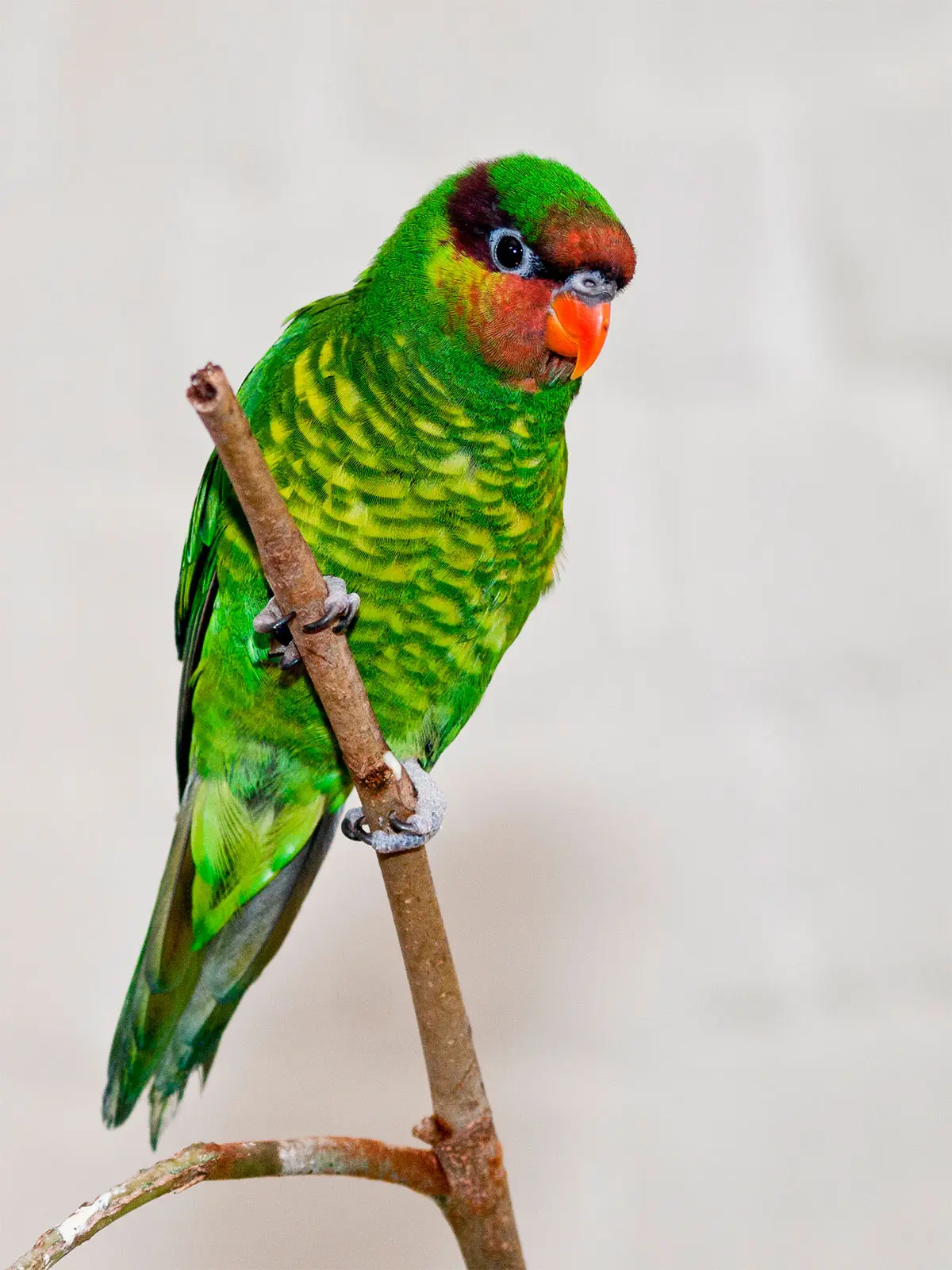
The plumage of the Mindanao Lorikeet (Trichoglossus johnstoniae) is usually Green. The facial area It is red with a tendency to pink. The band that goes from the eye until the part back from the neck it is dark purple.

The underparts are yellow, scalloped with green resembling scales. They have the Underwing coverts and subcaudales yellowish green. The band less of them wings is yellow. Its bill is reddish orange, the legs grayscale and the eye ring dark gray. The eyes orange-red.

The birds immatures have less red on the face. Instead of the band dark purple in adults, young birds have an off color lilac and a Brown stain behind the eye. The rings of the eyes are of color grey white. The eyes They are brown.

There are no significant differences between males and females.

  • Sound of the Mindanao Lorikeet.

Habitat:

Found of 1.000 to 2.500 m in the Mount Apo and 1.000 1,700 m in the Mount Malindang.

The Mindanao Lorikeet they prefer mossy forests, but also you can see them along the edge of the forest and in degraded areas.

Usually noisy during the flight, but when they feed on, remain calm. They migrate daily between different altitudes in the morning looking for food in the Highlands and in the evening return to their resting places in the lower areas.

They move higher during the day, in flocks of up to 50 birds, to feed on trees with flowers and shrubs. At sunset, they return to the lower slopes to rest.

Reproduction:

Little is known about the ecology of reproduction.. Probably it breeding is performed between months of March and may.

Captive breeding records indicate that the laying tends to be of two eggs, the incubation of some three weeks and that the young leave the nest between three weeks and a month more afternoon.

Food:

With feeds nectar, flowers, fruits, pollen and insects.

Distribution:

Size of the area of distribution (reproduction / resident): 8.700 km2

Endemic to the mountains of Mindanao (Philippines)

Conservation:


Near-threatened

• Current IUCN Red List category: Near threatened

• Population trend: Decreasing

Its habitat favorite is relatively unlikely that is affected by human activities in the medium term, but logging and capture should remain concerns.

The world population apparently not been quantified formally, but the species is described as very rare and there are those who think that there are less than 10.000 individuals.

"Mindanao Lorikeet" in captivity:

Very rare in captivity.

Due to its decreasing trend in terms of its population, any specimen that can not be returned to their natural habitat (natural range) should preferably be placed in a well-managed breeding program to ensure the survival of the species.

Alternative names:

– Mindanao Lorikeet, Apo Lorikeet, Johnstone’s Lorikeet (ingles).
– Loriquet de Johnstone (French).
– Mindanaolori, Mindanao-Lori (German).
– Loris johnstoniae (Portuguese).
– Lori de Mindanao, Tricogloso de Mindano (español).

scientific classification:

– Order: Psittaciformes
– Family: Psittaculidae
– Genus: Trichoglossus
– Scientific name: Trichoglossus johnstoniae
– Citation: Hartert, 1903
– Protonimo: Trichoglossus johnstoniae

“Mindanao Lory” Images:

————————————————————————————————

«Lori de Mindanao» (Trichoglossus johnstoniae)


Sources:

– Avibase
– Parrots of the World – Forshaw Joseph M
– Parrots A Guide to the Parrots of the World – Tony Juniper & Mike Parr
– BirdLife.org

– Photos:

1 – «Trichoglossus johnstoniae - London Zoo, England-8a» by William Warby from London, England – Unknown-Tropical BirdUploaded by Snowmanradio. Licensed under CC BY 2.0 via Wikimedia Commons.
2 – «Mindanao Lorikeet (Trichoglossus johnstoniae)-3c» by Mindanao_Lorikeet_(Trichoglossus johnstoniae).jpg: Elizabeth Ellisderivative work: Snowmanradio (talk) – originally posted to Flickr as lovebird and uploaded to commons at Mindanao_Lorikeet_(Trichoglossus johnstoniae).jpg. Licensed under CC BY-SA 2.0 via Wikimedia Commons.
3 – by Jonathan Beilby – IBC.lynxeds.co
4 – zoochat.com
5 – papageien.org

– Sounds: Kennedy, Robert S. – © 2014 Cornell University

▷ The world of Pets: Dogs, cats, birds, reptiles, amphibians

Olive headed Lorikeet
Trichoglossus euteles

Olive headed Lorikeet

Content

Description

Its length is about 25 cm. and weigh between 80 and 85 gr.

The Olive headed Lorikeet (Trichoglossus euteles) show, in general, a green shade.
The head color is olive with waves pale mustard and yellow stripes over the entire surface of the top.
The neck and its part rear are surrounded by a collar of color green brilliant that continues until the throat.

The underparts below the throat are entirely greenish-yellow.
The bill is red-orange. The irises they are red, and legs grey.

The youth they are more muted than adults. Its head is slightly greenish with streaks pale. The bill is brown. The irises They are brown. The species is considered monotype.

Habitat:

They frequent humid subtropical forests., secondary forests and wooded meadows. Adapt quite well to cultivated land and the gardens in cities.

In Timor, they are relatively abundant between 1.000 and 2.300 meters above sea level, apparently, substitute to the Coconut Lorikeet in these heights. Also they can be observed at sea level in the island of Timor. In the rest of the Islands it frequents lowland areas.

The Olive headed Lorikeet they live in small groups. They are especially visible when they are in flight because they emit continuously shouts. On the other hand, when feeding or resting in trees, they are very difficult to observe because of their green plumage mixed with the color of the foliage.

They are birds territorial, capable of showing great aggressiveness if the limits of their area of ​​influence are violated.

Usually disperse in search of their food, forming large groups when resources are abundant.

Outside the breeding season they form large roaming flocks of a hundred or more individuals.. Move in flying fast and slightly wavy.

In Timor, during the season, dry, These birds seem to descend below 1.000 meters and are scattered in coastal areas.

Reproduction:

The anidacio seasonn would take place perhaps between September and October, but this information needs to be confirmed.

In captivity, the Olive headed Lorikeet put 3 white eggs that parents are in charge of incubate for a few 23 days. As in the majority of the Lori, the nesting cycle is particularly long.

Food:

Feed primarily of nectar and fruit. They forage in trees in flower and shrubs.

Distribution:

Size of the area of distribution (reproduction / resident): 38.100 km2

Timor and Lesser Sunda Islands, from the East of Lembata until Nila and Babar.

Conservation:


minor concern


• Current IUCN Red List category: Least concern

• Population trend: Stable


The population size This species has not been quantified. Suspected that the population is stable in the absence of evidence of any reduction or substantial threats.

Like most brightly plumaged parrots, the Olive headed Lorikeet It victim of trade bird cage or Aviary.


"Olive headed Lorikeet" in captivity:

Pretty common. They can be housed with others of its kind.

Alternative names:

– Olive headed Lorikeet, Olive-headed Lorikeet, Perfect Lorikeet (ingles).
– Loriquet eutèle (French).
– Gelbkopflori (German).
– Lóris-de-cabeça-amarilla (Portuguese).
– Lori Humilde, Tricogloso Humilde (español).

scientific classification:

– Order: Psittaciformes
– Family: Psittaculidae
– Genus: Trichoglossus
– Scientific name: Trichoglossus euteles
– Citation: (Temminck, 1835)
– Protonimo: Psittacus euteles

Images "Humned Lori":

Videos "Olive headed Lorikeet"

———————————————————————————————–

"Lori humilde» (Trichoglossus euteles)


Sources:

– Avibase
– Parrots of the World – Joseph Forshaw M
– Parrots-A Guide to the Parrots of the World by Tony Juniper & Mike Parr
– BirdLife.org

– Photos:

1 – Photo by and (C)2007 Derek Ramsey (Ram-Man) – Self-photographed – Wikipedia
2 – By James Eaton – IBC.lynxeds.com
3 – «Trichoglossus euteles-captive-8a-ec» by Trichoglossus_euteles_-captive-8a.jpg: Ruth Rogersderivative work: Snowmanradio (talk) – originally posted to Flickr as P8120395 and uploaded to commons at Trichoglossus_euteles_-captive-8a.jpg. Licensed under CC BY 2.0 via Wikimedia Commons.
4 – "Scaly-breasted Lorikeet Kobble Dec06" von Aviceda – Eigenes Werk. Lizenziert unter CC BY-SA 3.0 über Wikimedia Commons.
5 – By Marcella (Picasa Web Albums) [CC-BY-SA-3.0], via Wikimedia Commons

– Sounds: Colin Trainor (Xeno-canto)

▷ The world of Pets: Dogs, cats, birds, reptiles, amphibians

Shawl-collared Lorikeet
Trichoglossus rosenbergii

Shawl-collared Lorikeet

Content


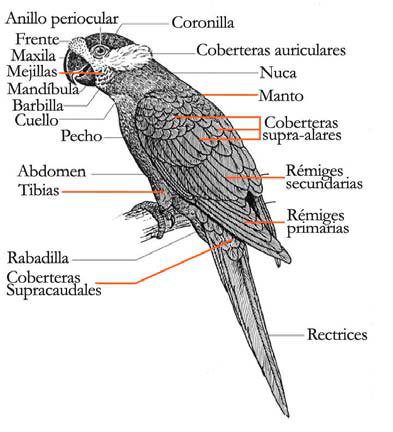
Anatomy-parrots

Description (1)

26 cm.. length and a weight between 132 and 150 gr.

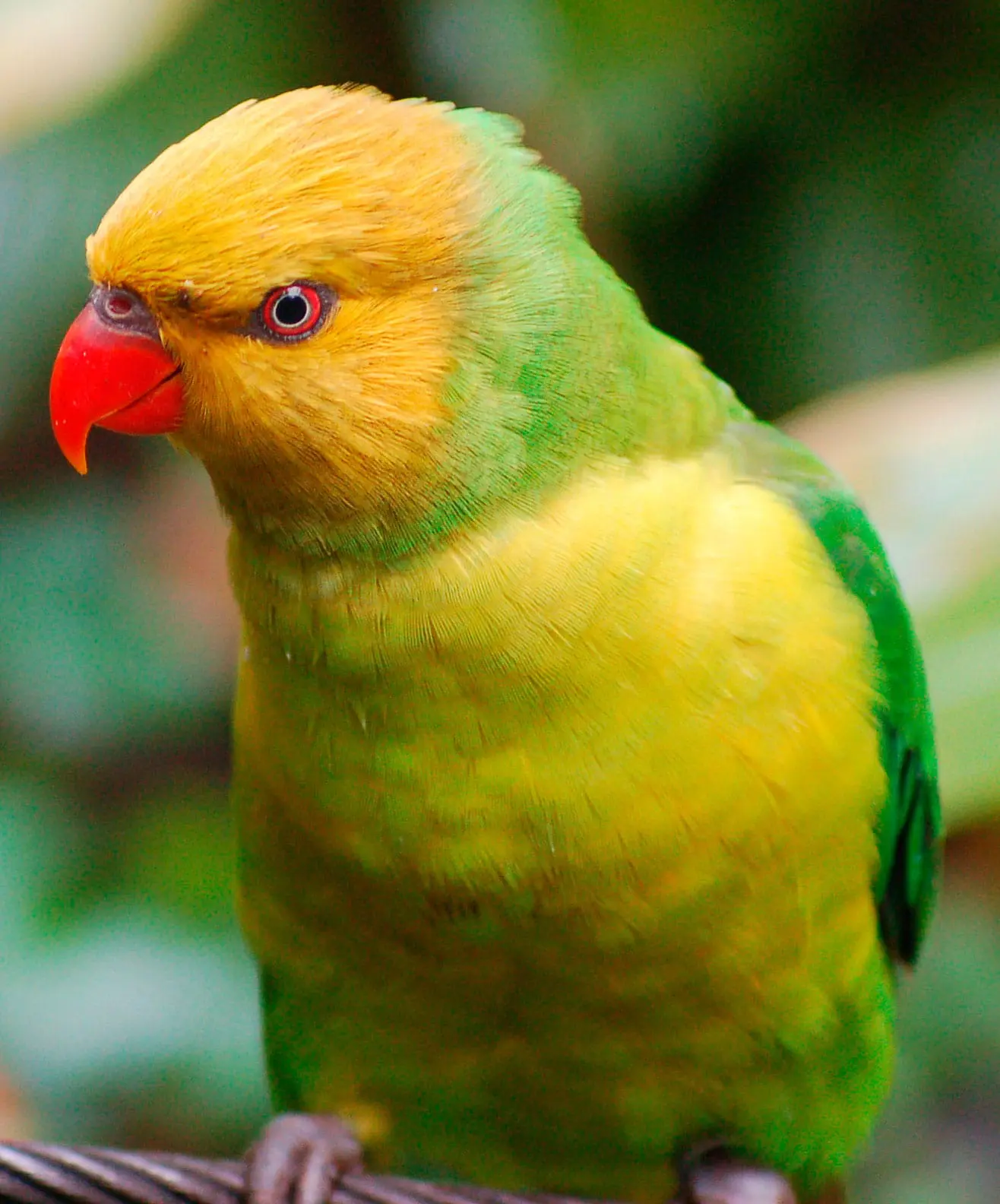
The Shawl-collared Lorikeet (Trichoglossus rosenbergii) is very similar to the Trichoglossus haematodus, but with a stronger blue in the head.

The edges of the breast feathers they are much wider, It has a broad yellow stripe on the neck, ending at the highest point with a red band narrow, their abdomen Violet is blue also has a wide orange stripe inside the flight feather.

The bill is red-orange. The irises They are orange-red and legs grey.

Variation of the nominal (Trichoglossus Haematodus).

Habitat:

They are in a wide range of habitats, including settlements in forests, coconut plantations, savannahs and mangroves.

In their natural habitats, They form small groups noisy that feed on the upper canopy. Often they are seen in mixed flocks with other species of parrots. At night, Community are hundreds of birds.

Son pollinators important species coconut.

Reproduction:

Within its natural range, usually they begin breeding between September and October – although breeding has been recorded in most months.

The average clutch it consists of 2 to 3 eggs. The female incubated eggs for about 24 to 27 days and the young become independent when they are about 80 days old.

Food:

Its diet natural It consists mainly nectar and pollen, but also it includes fruits like figs, citrus, papaya and mangoes open fruit bats. They may also feed on moth pupae and insects.

Distribution:

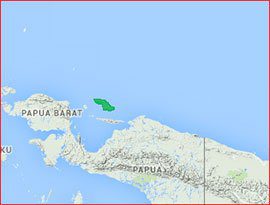
Distribucion-Lori-de-Biak
The reflection of both in the province of Papua, Indonesian.

Conservation:


Vulnerable

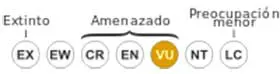
The Shawl-collared Lorikeet has a single small population, that can be seen to be decreasing as a result of the loss and degradation of forests, by agriculture and logging subsistence and perhaps also for the capture for trade. So, is qualified as Vulnerable.

The bird population is assumed that can range from 3000-4000 birds.

Alternative names:

– Shawl-collared Lorikeet, Biak Lorikeet, Rainbow Lorikeet (Biak) (ingles).
– Loriquet de Biak (French).
– Biaklori (German).
– Loris Arco-Íris Rosenbergii (Portuguese).
– Lori de Biak (español).

scientific classification:

– Order: Psittaciformes
– Family: Psittaculidae
– Scientific name: Trichoglossus rosenbergii
– Citation: Schlegel, 1871
– Protonimo: Trichoglossus Rosenbergii

Images "Shawl-collared Lorikeet"

————————————————————————————————

    (1) – Subspecies Coconut Lorikeet (Trichoglossus haematodus)

————————————————————————————————

"Both Lori" (Trichoglossus rosenbergii)


Sources:

– Avibase
– BirdLife.org

– Photos: Rosenberg’s Lorikeet – animalphotos.me

▷ The world of Pets: Dogs, cats, birds, reptiles, amphibians

Eastern Rosella
Platycercus eximius


Eastern Rosella

Content


Anatomy-parrots

Description

30 cm.. length between 95 and 120 g. of weight.

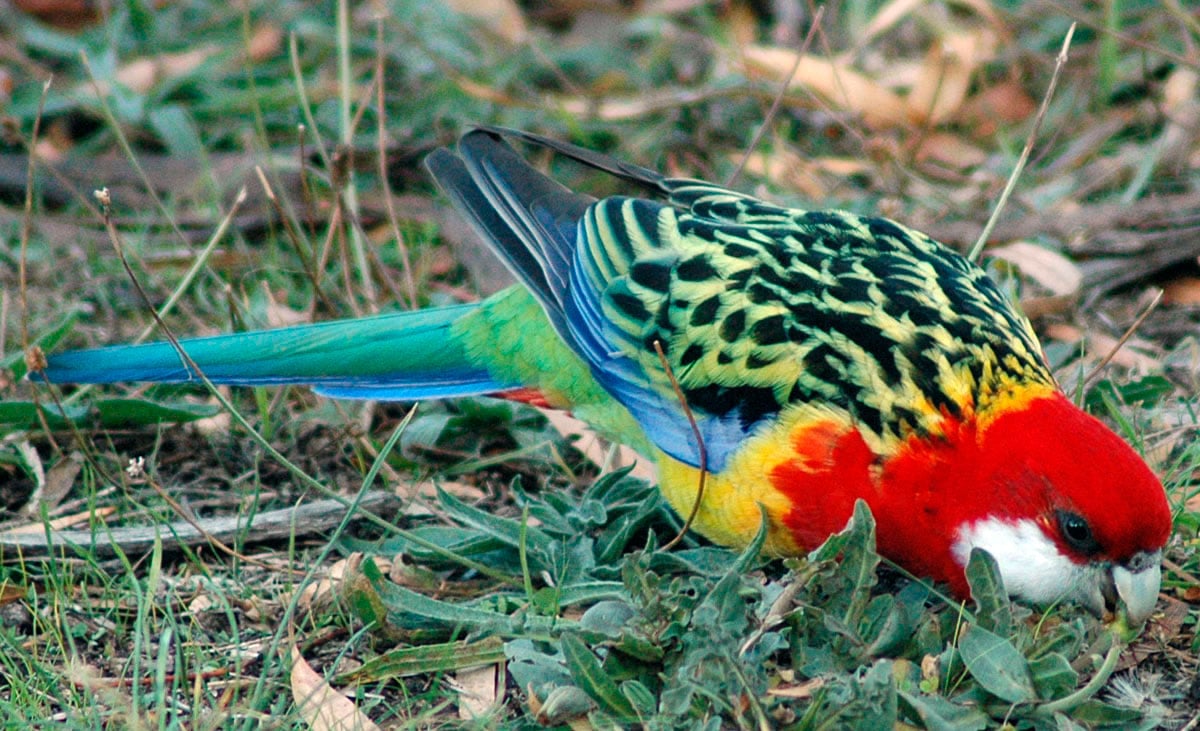
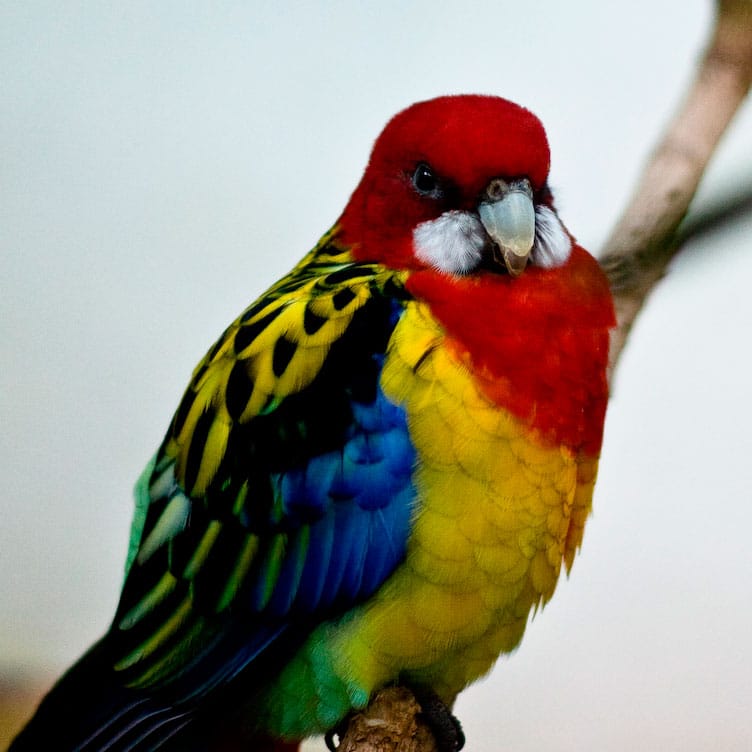
The males of the Eastern Rosella (Platycercus eximius), has bill white. The lower area of the cheeks and chin are white, that contrasts sharply with the rest of the head and the chest that are of color red glossy. Upper abdomen shows a beautiful color yellow that is again gradually of color green pale in its part lower. The coats are of color red. The the mantle feathers, the back and scapulars are of color black with a broad edge yellow, giving these regions a highly scaled appearance. The median are black. The blankets, out of them coverts secondary and flight feather are bluish grey. The rump is bright green. The central feathers of the tail are green bottle, While the outer feathers of the tail are bluish grey with white tips.

The irises They are brown, legs grey.

The female looks like your partner, but the Red of the head and the chest is less bright.

The underparts has a thin white stripe.

The youth they are a copy in Pale tones of the female. They have a little bit of green on the back of the head.

Subspecies description:

  • Platycercus eximius diemenensis

    (North 1911) – Of 30 cm.. length. Head and chest color much more dark and white cheek much more large. Female as the nominal species.


  • Platycercus eximius elecica

    (Schodde & Short 1989) – Of 33 cm.. length. It is something more than the nominal species, the red and the chest and the head is slightly more dark, the black feathers of the neck, back and shoulders have a very broad bright yellow bordered. Area of the rump and coverts bluish-green supracaduales. Female with back and neck with hints. Your obispillo is bluish green


  • Platycercus eximius eximius

    (Shaw 1792) – The nominal.

Habitat:

The Eastern Rosella they tend to be fairly common in all habitats of open forests, including agricultural land, urban parks and gardens. They are usually in little populated wooded areas, rows of trees along streams, shrub and scrub savannahs «Mallee«.

They are common in cultivated areas and can invade orchards where you can cause severe damage.

In many areas, It is the most widespread species of parrot, You can even nest in the trees lining the streets of towns and cities. Wherever possible, they avoid dense forests and mountainous areas, where is replaced by the Crimson Rosella. The habitat of the Eastern Rosella usually less to 1.250 m above sea level.

Breeding pairs are sedentary in their territories, While young and immature form bands of up to 25 birds that roam the area. very commonly, the multicolored parrot can be seen perched on power lines or poles lining the sides of the roads in the outskirts of cities.

On the floor were fed more frequently than other types of rosella Parrot. In flight, they are quite noisy and therefore very easy to detect. But, When they are on the ground, they are not always easy to observe.

They feed on, sometimes, in the company of Red-rumped Parrot (Psephotus haematonotus) but never be with them organized mixed flocks.

Reproduction:

The Eastern Rosella They nest in the months from August to February, but also from time to time in April and may.

Pairs mate for life and is the female which chooses the nest site, usually in a hole or cavity of a eucalyptus branch. Sometimes the place to start may be an old stump, an any fence post, a fallen log, a rabbit hole, the nest of a Rainbow Bee-eater. Optionally, the Eastern Rosella also used the abandoned nest of the Blue-winged Kookaburra, some termite mound, ferns in facades of houses, rock walls, old buildings and an old nest of pomatostome.

The bottom of the nest is filled with sawdust or small wood shavings..

Spawning includes 4-9 eggs (generally 5) which are incubated during 19 days. The female is solely in charge of incubation and her partner is responsible for supplying. The chicks stay lasts a few 35 days.

Food:

The Eastern Rosella has a mainly vegetarian diet. Consumed mainly eucalyptus and acacia seeds, Although also seeds of a variety of greenery bushes. Berries, leaves and sprouts are also part of its menu.

During the summer, eats some insects and their larvae. Take the seeds that are dispersed in fields and roads. It penetrates into the orchards where causes some damage.

Distribution:

The Eastern Rosella lives confined to the southeast of Australia where is spread around Gympie, Bribie Island and the Darling Downs district in the extreme southeast of Queensland, in the South through New South Wales, coming towards the inside of Moree, Parkes, Griffith and There is a, and reaching Victoria where is it absent only in the Northwest region, and West up to Edenhope.

In the southeast of South Australia the species is largely limited to the area between Bordertown and Salt Creek, but a population caused by birds in captivity is also distributed by the Lofty Mountains.

In Tasmania, the species is widespread, Although barely wide and sparsely distributed, and have been faced with the King Island in the bass strait.

There are small introduced populations in the South Island of New Zealand, concentrated around Dunedin (includes some Crimson Rosella mixed with oriental hybrids) and in the Banks Peninsula, and a larger population in the North Island, that extends from the northern end of the island, along the West Coast through Raglan, New Plymouth and the interior of Pirongia and Taupo. They can also be found Eastern Rosella in the districts of Wellington and Lower Hutt, in the Tararua mountains, about Gisborne and along the Coromandel Peninsula, but are rare in the South of Auckland.

The world population is more of 500.000 birds, and stable or increasing.

There is some competition with nesting places with the Common Starling (Sturnus vulgaris) in Tasmania.

Moderate multicolored parrot in captivity.

The species has benefited before the spread of agriculture, and although protected by law, they can be killed under license.

Subspecies distribution:

  • Platycercus eximius diemenensis

    (North 1911) – Own East of Tasmania.


  • Platycercus eximius elecica

    (Schodde & Short 1989) – Present in the northeast of New South Wales and the southeast of Queensland.


  • Platycercus eximius eximius

    (Shaw 1792) – The nominal.

Conservation:


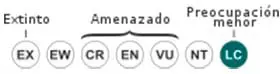
minor concern


• Current category of the Red List of the UICN: Least concern

• Population Trend: Growing

The size of the world's population has not been quantified, Although it is estimated above 500.000 birds.

Throughout its distribution area, except Tasmania, the Eastern Rosella East are very common birds. Unlike in the Crimson Rosella, that like dense forests, the Eastern Rosella they have benefited from deforestation that took place for the establishment of new pastures or areas of cereals.

"Eastern Rosella" in captivity:

Very common in captivity, It is probably the most popular of the Rosellas.

The Eastern Rosella they are coveted because of the beautiful colors of plumage.

They are intelligent birds and can be trained to whistle a large repertoire of melodies., and you can even learn how to pronounce some words.

These parakeets can make good pet birds but require a great deal of care and attention., In addition to devices and toys to keep them mentally stimulated. They are wild birds which are not always adapted to live as a family pet, and even the hand reared parrots are never fully domesticated. They generally do not tolerate caresses or cuddling and tend to react by stinging when you try to handle them like this.. Many breeders believe that the best way to keep this type of bird is in great aviaries where can fly freely, in pairs to meet their social needs and with minimal human interaction. Although they tend to be aggressive with other species Bird by should not be treated so integrate them to mixed aviaries.

Its diet poultry includes seeds, fruits like Apple, PEAR and grape, and vegetables such as lettuce, grass, and silver beet.

A sample of Eastern Rosella lived 27,4 years in captivity. In captivity, these animals have been able to play, approximately, to the 2 years of age..

Alternative names:

– Eastern Rosella, White-cheeked Rosella (ingles).
– Perruche omnicolore (French).
– Rosella, Buntsittich (German).
– Rosela-multicolorida (Portuguese).
– Perico Multicolor, Rosela Común (español).

scientific classification:

– Order: Psittaciformes
– Family: Psittaculidae
– Genus: Platycercus
– Scientific name: Platycercus eximius
– Citation: (Shaw, 1792)
– Protonimo: Psittacus eximius

Images «Multicolored Parakeet»:

Videos "Eastern Rosella"

————————————————————————————————

«Multicolored Parakeet» (Platycercus eximius)


Sources:

– Avibase
– Parrots of the World – Forshaw Joseph M
– Parrots A Guide to the Parrots of the World – Tony Juniper & Mike Parr
– Wikipedia
– AnAge: The Animal Ageing and Longevity Database – Anagé entry for Platycercus eximius
– Birdlife

– Photos:

(1) – Eastern Rosella (Platycercus eximius), male, Queen’s Domain, Hobart, Tasmania, Australia By JJ Harrison (jjharrison89@facebook.com) (Own work) [CC BY-SA 3.0], via Wikimedia Commons
(2) – Eastern Rosella (Platycercus eximius), female, Queen’s Domain, Hobart, Tasmania, Australia By JJ Harrison (jjharrison89@facebook.com) (Own work) [CC BY-SA 3.0], via Wikimedia Commons
(3) – Eastern Rosella (Platycercus eximius) at Woodland Park Zoo, Seattle, USA By Platycercus_eximius_-Woodland_Park_Zoo-6. jpg: Nickderivative work: Snowmanradio [CC BY 2.0], via Wikimedia Commons
(4) – Eastern Rosella at Hobart Domain, Tasmania (grazing) By KeresH (Own work) [GFDL, CC-BY-SA-3.0 or CC BY-SA 2.5], via Wikimedia Commons
(5) – Eastern Rosella (Platycercus eximius diemenensis), The Queen’s Domain, Hobart, Tasmania, Australia By JJ Harrison (jjharrison89@facebook.com) (Own work) [GFDL 1.2 or CC BY-SA 3.0], via Wikimedia Commons

– Sounds: Peter Woodall (Xeno-canto)