โ–ท The world of Pets: Dogs, cats, birds, reptiles, amphibians

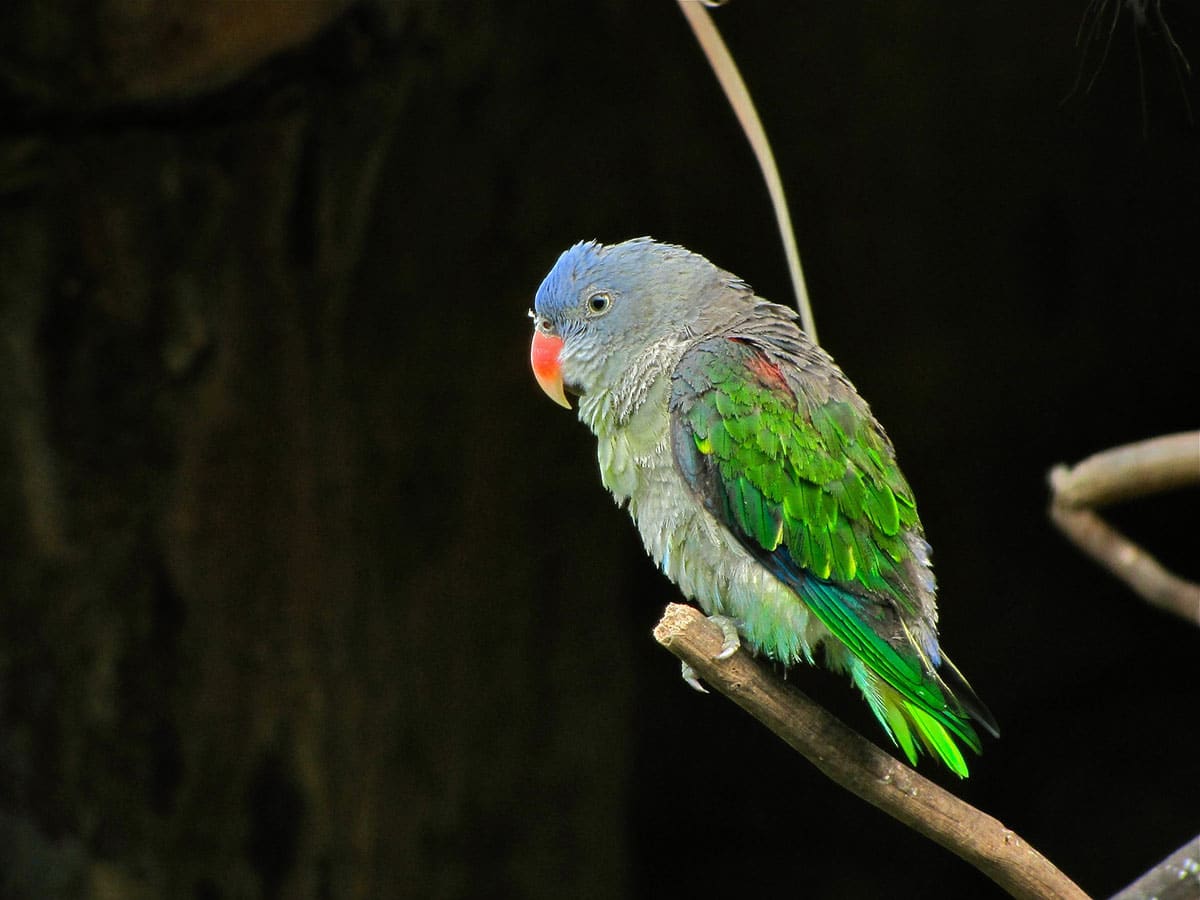
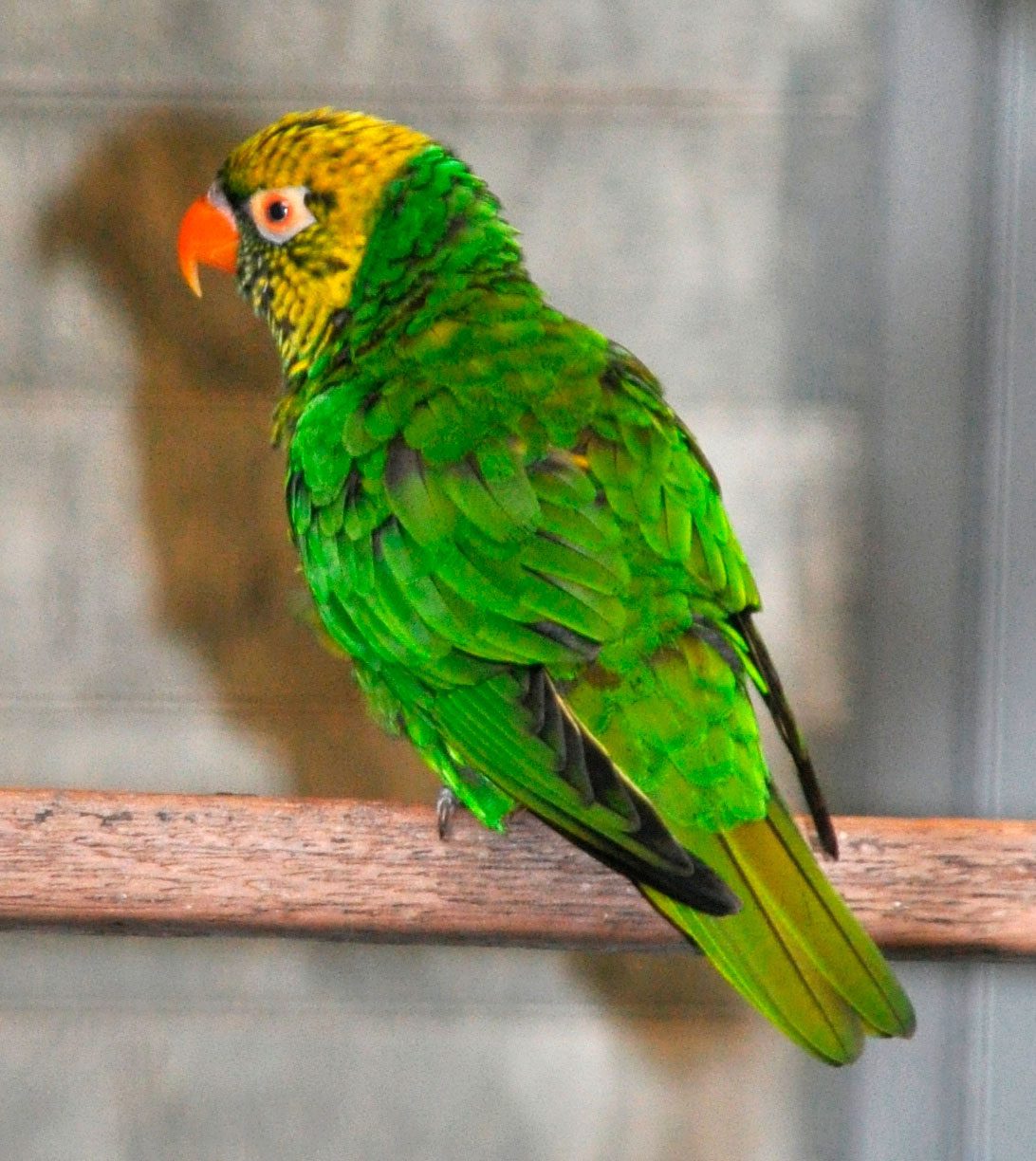
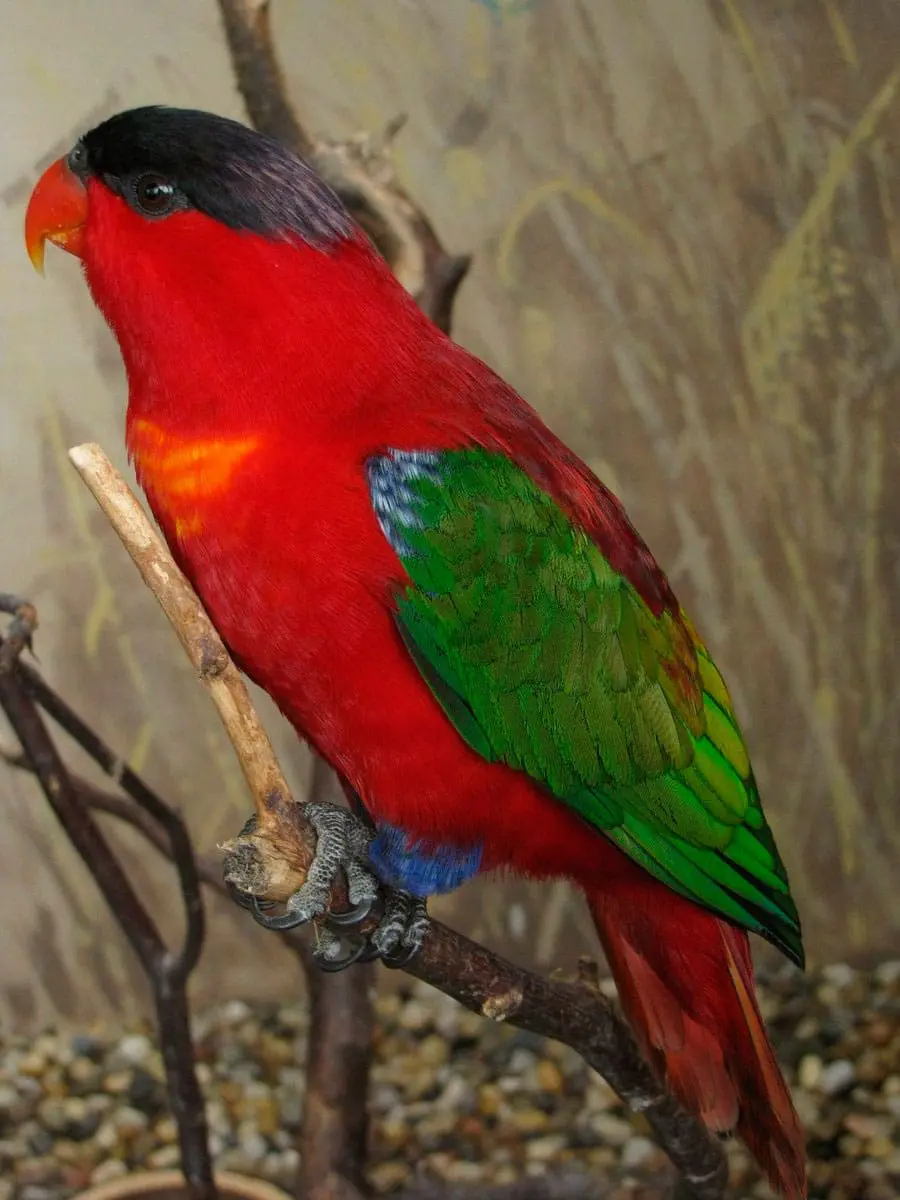
Ceylon Hanging-Parrot
Loriculus beryllinus


Ceylon hanging

Content

Description

13 cm.. length.

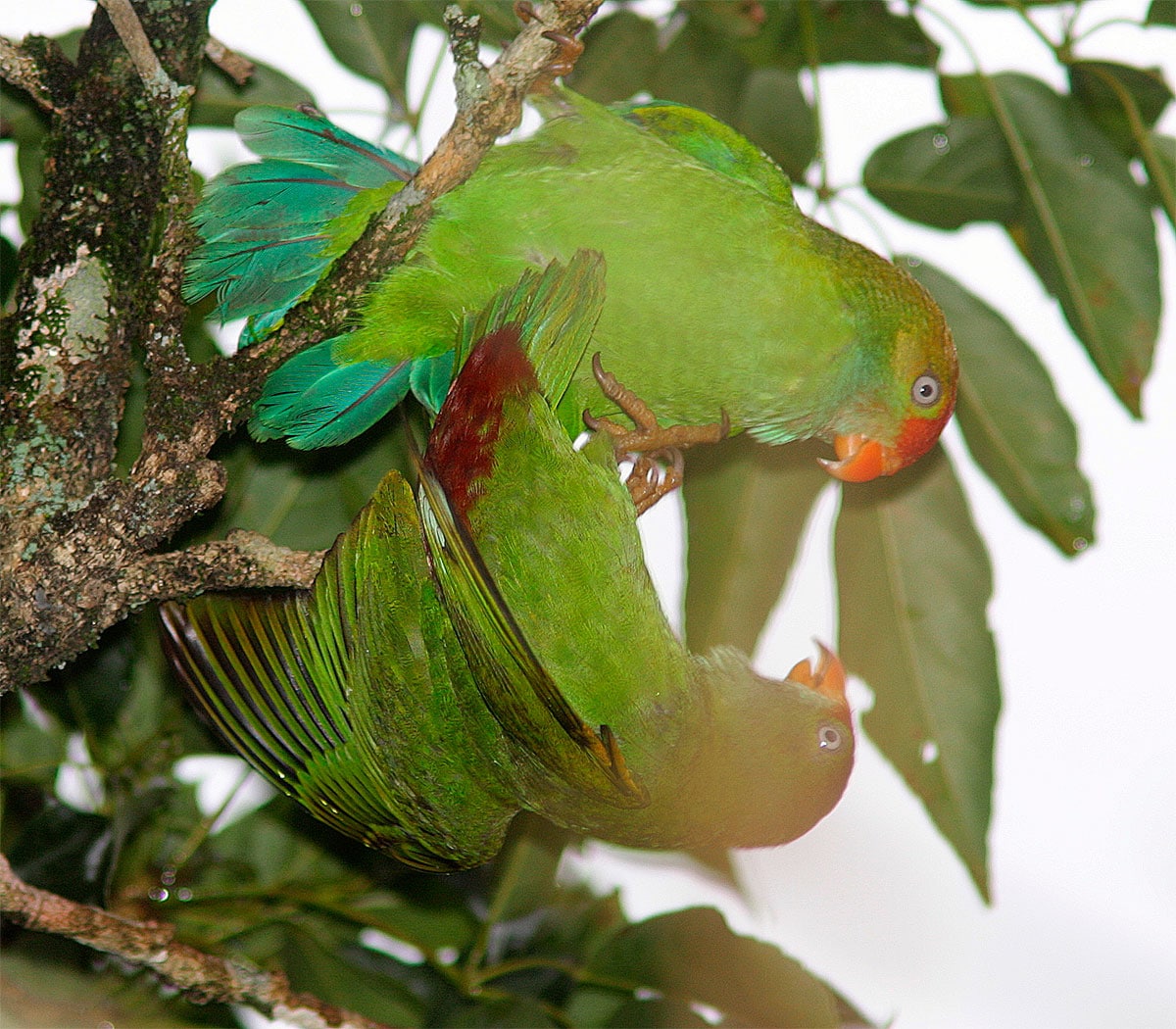
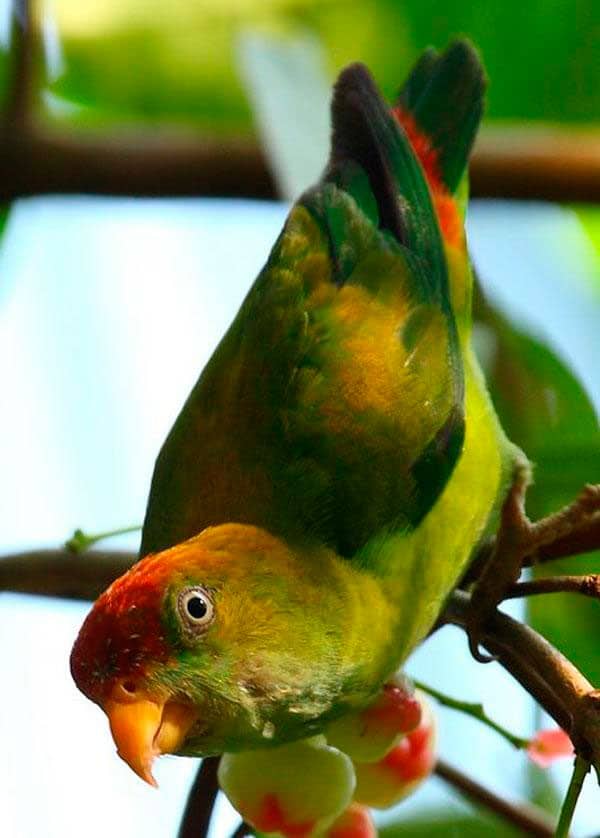
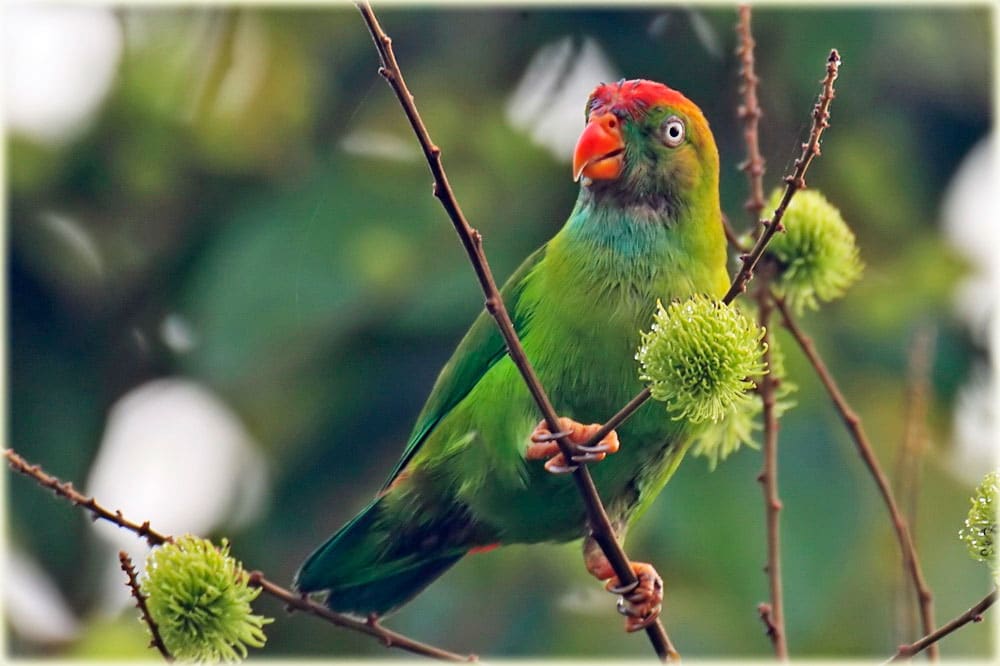
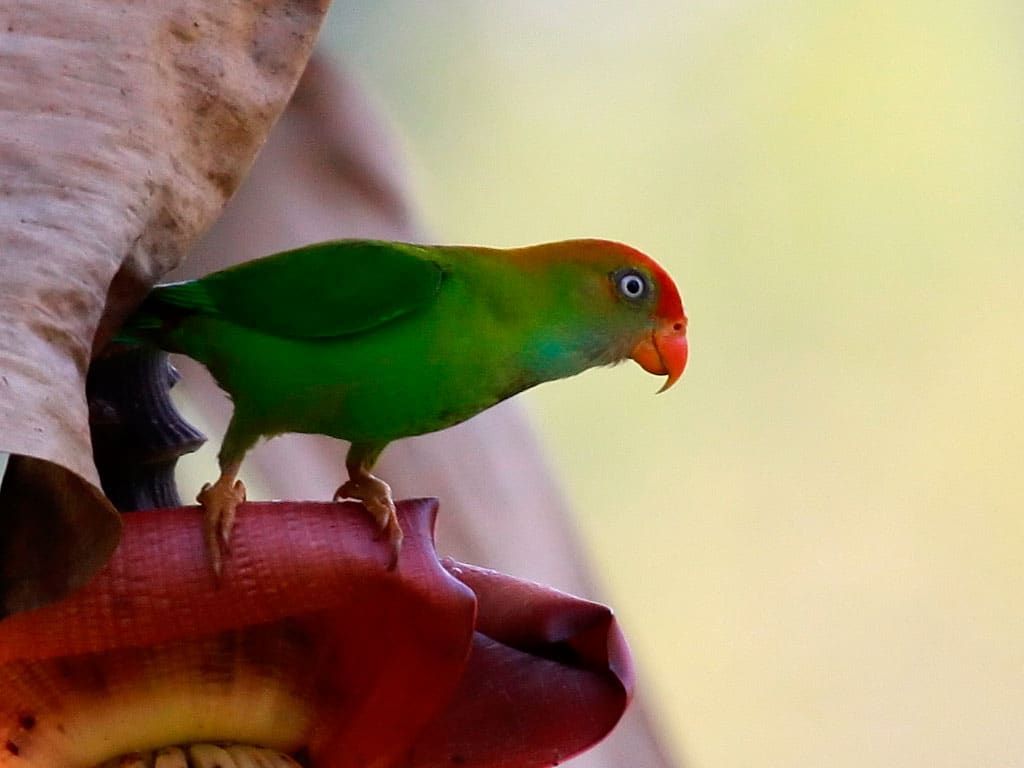
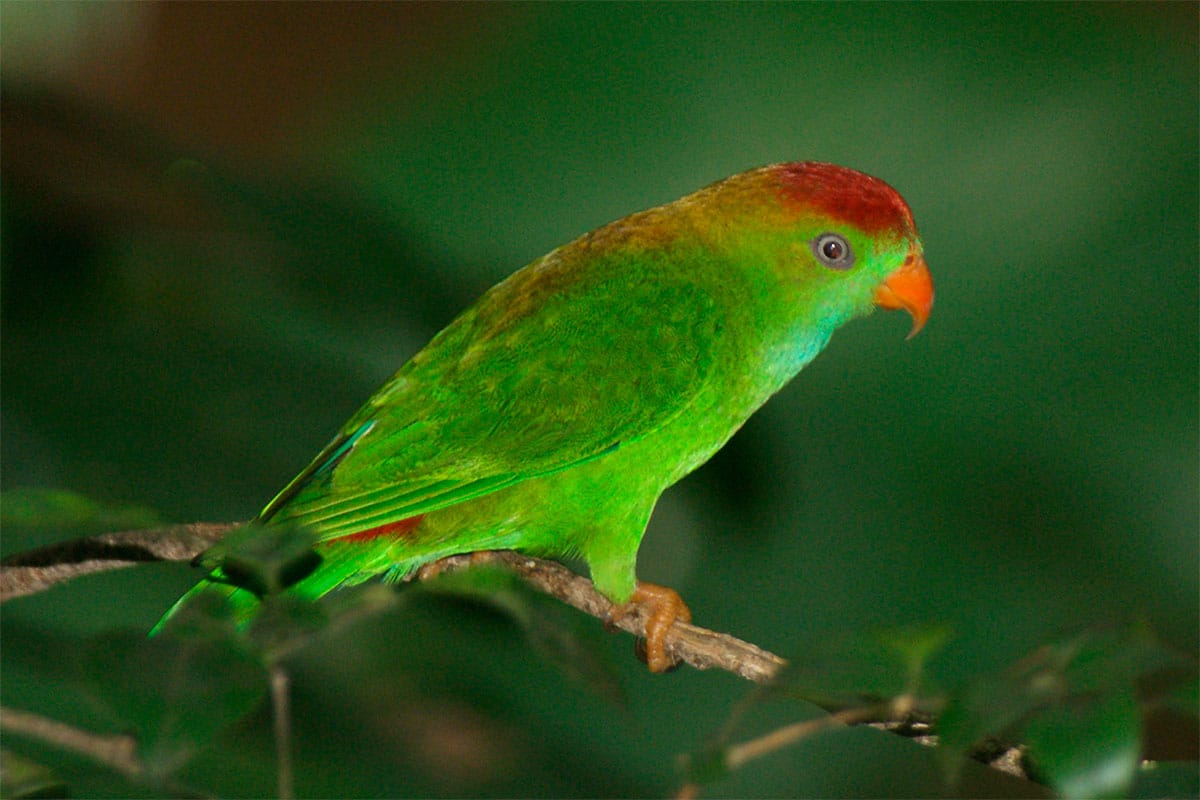
The Ceylon Hanging-Parrot (Loriculus beryllinus) has the crown red, merging into orange-yellow in the area of the nape; eyebrows, lores and the area in front of the eyes light green (lightly bathed in pale blue); sides of the front of the crown red. Mantle green, Baรฑado de slightly reddish and yellowish orange color in the Center; back green; rump and uppertail-coverts, red. Wings green up, with the exception of vane inner of the blackish flight feathers ; undertail, the wings bright turquoise color with the exception of coats and axillary green. The underparts bright green, paler and more yellowish which the upperparts and light blue marking in the throat. above the tail green color; Turquoise below.

Bill orange red, paler at the tip; irises off-white; legs dark yellow.

Female as the male, but most off and only a trace of blue in the throat.

The young birds they are even duller, the crown reddish-tinged, the patch blue of the throat absent, the rump with some green feathers, the bill paler, the iris and the legs brown; the face nude in the fledglings.

Habitat:

Seen in a range of habitats, from sea level to 1.600 m, reaching the highest areas according to seasonal conditions. The species is found in forests of coconut trees, Evergreen and deciduous forests, semicultivadas areas, open woodland and around the dwellings.

birds are not shy, and is usually found in pairs or family groups, although outside the breeding season larger flocks congregate high up in flowering trees. They are active and acrobatic feeding.

Reproduction:

Observations, they have registered the male approaching his partner upright, with the high peak, swollen throat, extended tail and rump feathers erect, while emitting a screeching chirp. Wiggles head in courtship period have also been observed.

The breeding begins in January and although the main nesting period is between March and May, a second litter is, sometimes, until September. The nest is located in a hollow branch filled with fragments of vegetation that the female carefully cuts with her beak and carries to the nesting sites tucked between her rump feathers.. Only two to four white eggs she incubates, sitting firmly, screeching and creating a 'thumping' sound’ Yes is the annoying. The young Chick has the face exposed, presumably to avoid getting dirty by liquid food.

Food:

Feed on fruits such as Ficus figs and guava (Psidium guajava); berries; flowers, including Erythrina, Salmalia and eucalyptus; seeds, including Casuarina. Poisonings have been reported after drinking Palm wine collected pots attached to the trunks of the trees.

Distribution:

Endemic to Sri Lanka, where most records come from the South, Although there have been North of Trincomalee and should be observed in suitable habitats throughout the country. Records include proximities of Colombo, around Kandy, Yala and National parks Gal Oya, the district Welimada, and to the South of Galle and Hambantota, on the coast.

Conservation:
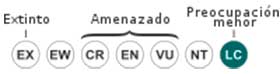

minor concern


โ€ข Current IUCN Red List category: Least concern

โ€ข Population trend: Stable

The size of the world's population has not been quantified, Although it is estimated at 10.000 specimens. The species is qualified as widespread and abundant in the South-West and almost absent in the North of its distribution area (pit et to the. 1997).

The population is suspected to be stable in the absence of evidence of any reduction or substantial threats, However, the bird trade is judged as a potential threat.

"Ceylon Hanging-Parrot" in captivity:

Rare.

Alternative names:

Ceylon Hanging-Parrot, Ceylon Hanging Parrot, Ceylon Lorikeet, Sri Lanka Hanging Parrot, Sri Lanka Hanging-Parrot, Sri Lankan Hanging Parrot (ingles).
Coryllis de Ceylan, Coryllis du Sri Lanka (French).
Ceylonpapageichen, Ceylon Papageichen (German).
Loriculus beryllinus (Portuguese).
Lorรญculo de Ceilรกn, Lorรญculode Ceilรกn (espaรฑol).

scientific classification:

Order: Psittaciformes
Family: Psittaculidae
Scientific name: Loriculus beryllinus
Genus: Loriculus
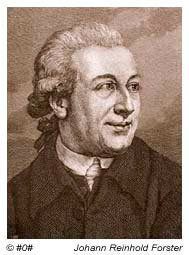
Citation: (Forster,JR, 1781)
Protonimo: Psittacus beryllinus

ยซCeylon loricleยป images:

Video of the "Ceylon Hanging-Parrot"

————————————————————————————————

ยซCeylon loricleยป (Loriculus beryllinus)


Sources:

Avibase
– Parrots of the World โ€“ Forshaw Joseph M
– Parrots A Guide to the Parrots of the World – Tony Juniper & Mike Parr
– Birdlife

Photos:

(1) – ยซLoriculus beryllinus-Sri Lanka-adult-8ยป by Hafiz Issadeen – originally posted to Flickr as Sri Lanka Hanging Parrot. Licensed under CC BY 2.0 via Wikimedia Commons.
(2) – ยซThimindu 2010 03 06 Sinharaja Sri Lanka Hangling Parrot 1ยป by ThiminduOwn work. Licensed under CC BY-SA 3.0 via Wikimedia Commons.
(3) – Perched in a tree by John A Thompson – lynx
(4) – Birds-pet-wallpapers/Parrot-birds – link
(5) – A fight by Guy Poisson – lynx

Sounds: Tero Linjama (Xeno-canto)

โ–ท The world of Pets: Dogs, cats, birds, reptiles, amphibians

Madarasz's Tiger-Parrot
Psittacella madaraszi

Madarasz's Tiger-Parrot

Content

Description

14 cm. length between 34 and 44 g. of weight.

The Madarasz's Tiger-Parrot (Psittacella madaraszi) is very similar to the Modest Tiger-Parrot.

Head brown, slightly paler in the cheeks and ear-coverts because of the light streaks; crown strongly mottled in color yellow, the throat It also shows some pale yellow stains. Mantle and back green, with good dark edges to the feathers; rump with alternation of yellow-green and black. Wings green, marked in blue in curve and along the leading edge; flight feather Blackish with vane Green external, showing a thin yellow margin. Wing feathers light green, underside of flight feather with broadcasting yellow in vane inner. Throat and top of the chest grey-brown; rest of the underparts slightly yellowish-green, paler than upper parts, with the exception of uppertail-coverts red. Upper, the tail green, by down blackish.

Bill grey-blue, White at the tip; irises reddish brown; legs grey.

The female has the head green with front of the crown bluish and heavily barred black and orange pink nape. The rest of them upperparts are slightly more barred that in the male, and underparts are of color green uniform, lack of the colour brown of the throat and the top of chest.

The young birds they are similar to females.

Subspecies

  • Psittacella madaraszi major

    (Rothschild, 1936) – Of approximately 15 cm.. length. The only difference is that it is slightly larger.. The same as the nominal species female.

  • Psittacella madaraszi hallstromi

    (Mayr and Gilliard, 1951) – Of approximately 14,5 cm.. length. Usually more dark and yellow paths from the back of the head and neck more narrow. Females with the black Crown and broad green bordered Orange will be making them by the back of the head.

  • Psittacella madaraszi huonensis

    (Mayr and Rand, 1935) – Of 14 cm.. length. It has the Crown of yellowish-brown. Females have the Crown, neck and back green.

Habitat:

The Madarasz's Tiger-Parrot, usually lives below the Modest Tiger-Parrot. The two two species overlap, usually in the Strip between 1.200 and 2.500 m, Although less numerous the of Madarasz.

It inhabits forests, in secondary vegetation and occasionally cleared areas, being particularly fond of the forest of beech Nothofagus.

It is a quiet species, slow and inconspicuous. You are often seen sitting in pairs on the lower floors of forests, making rash calls at sunset.

Reproduction:

Little is known of their reproductive ecology., but they have been observed in breeding conditions in the month of June.

Food:

It feeds on seeds, fruit, tough berries and leaves pulp, eat alone or in pairs at different levels within the forest. Have you noticed them is, feeding, in the company of Painted Tiger-Parrot.

Distribution:

Size of the area of distribution (reproduction / resident): 193.000 km2

New Guinea from the mountains in the center of Irian Jaya, Indonesian, through the central mountains of Papua New Guinea, up to the mountain ranges to the South-East, with an isolated population in the Highlands of the Huon Peninsula. The world's population is considered to be more of 50.000 specimens.

Subspecies distribution:

  • Psittacella madaraszi major

    (Rothschild, 1936) – present in the West of its range mountains;

  • Psittacella madaraszi hallstromi

    (Mayr and Gilliard, 1951) – occupies the central mountains of New Guinea;

  • Psittacella madaraszi huonensis

    (Mayr and Rand, 1935) – is located in the northeast of New Guinea (mountains of the huon peninsula).

Conservation:


minor concern


โ€ข Current category of the Red List of the UICN: Least concern

โ€ข Population trend: Stable

The size of the world's population has not been quantified, It is estimated in more than 50.000 specimens. The species, according to sources, It very rare in its area of distribution (pit et to the. 1997).

The population suspected to be stable in the absence of evidence of any reduction or substantial threats.


"Madarasz's Tiger-Parrot" in captivity:

Not found in captivity.

Alternative names:

Madarasz’s Tiger-Parrot, Madarasz’s Parrot, Madarasz’s Tiger Parrot, Madarรกsz’s Tiger Parrot, Maderasz’s Parrot, Plain-breasted Little Parrot, Plain-breasted Little Tiger-Parrot (ingles).
Perruche de Madarasz (French).
Madaraszpapagei, Madarasz Papagei, Maderaszpapagei, Schuppenkopfpapagei (German).
Psittacella madaraszi (Portuguese).
Lorito de Madarasz, Lorito tigre de Madarasz, Lorito-tigre de Madarasz (espaรฑol).

scientific classification:

Its scientific and common names commemorate the Hungarian ornithologist Gyula von Madarasz

Order: Psittaciformes
Family: Psittaculidae
Genus: Psittacella
Scientific name: Psittacella madaraszi
Citation: Meyer,AB, 1886
Protonimo: Birding tiger parrot

Videos "Madarasz's Tiger-Parrot"

————————————————————————————————

โ€œLorito tiger of Madaraszยป (Psittacella madaraszi)

Sources:

Avibase
– Parrots of the World โ€“ Forshaw Joseph M
– Parrots A Guide to the Parrots of the World – Tony Juniper & Mike Parr
Wikipedia
– Birdlife
– Loromania

Photos:

(1) – Photo by ยฉ Nancy Bell

โ–ท The world of Pets: Dogs, cats, birds, reptiles, amphibians

Kea
Nestor notabilis


Kea

Content


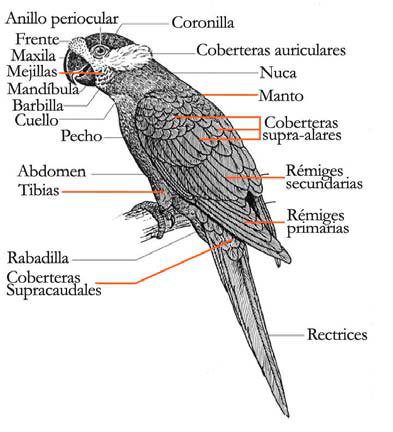
Anatomy-parrots

Kea description

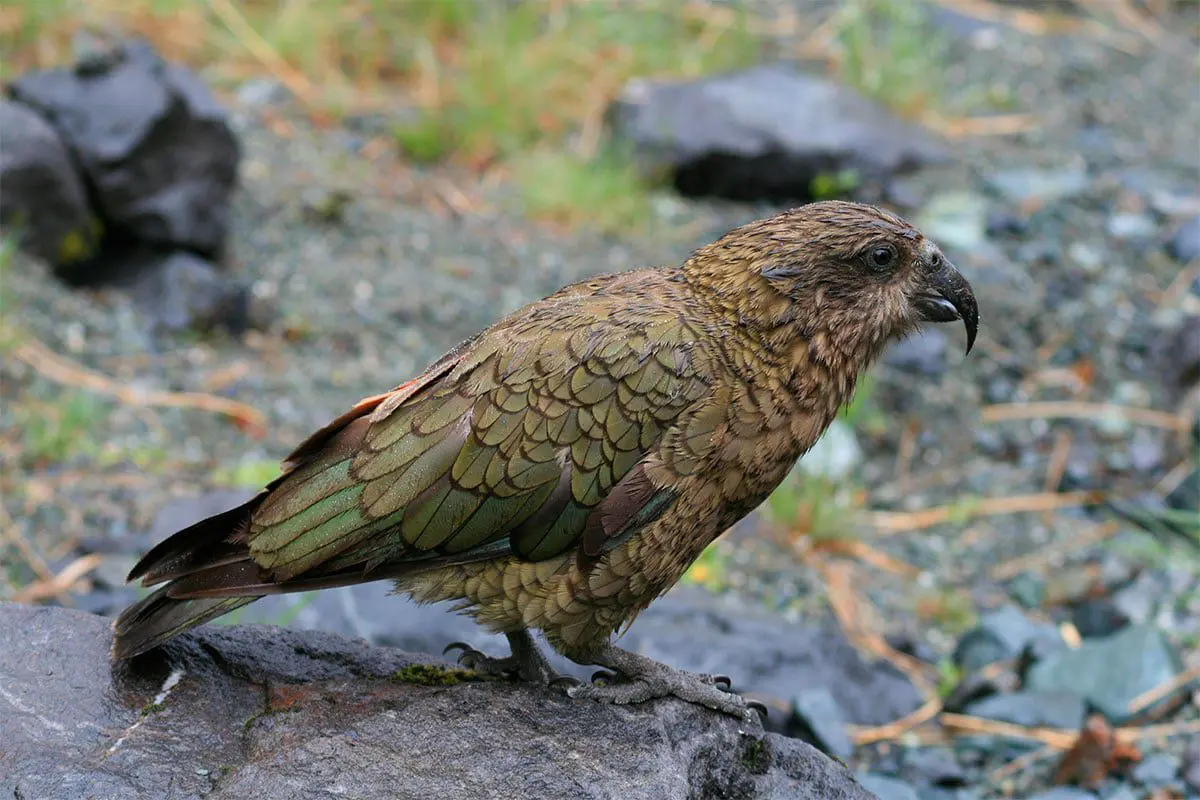
The Kea (Nestor notabilis) It is a bird of the family Strigopidae of 48 cm.. length and an average weight of 922 g..

Its head is olive brown color; narrow feathers of the crown with a few finely marbled black stripes; ear-coverts and lores more uniform dark brown; feathers of the neck slightly yellowish, with stripes and edges of brownish black color . Mantle and uppertail-coverts Green bronze with black stripes and Crescent-shaped rims; back and rump orange-red, with stripes and Tips blackish.

Flight feathers, primaries and greater coverts, drenched strongly with blue turquoise in them vane outer (more green in high schools); vane internal primaries, excluding the color lemon yellow. Wing feathers and axillary reddish color; underparts of the flight feather brown, with yellow bars in the vane internal primaries, excluding the orange color in the vane the secondary internal internal.

Their underparts feathers Brown olive light, with a ridge of dark brown. Upper, the tail, bathed in a bluish green tone, with bars in the vane internal orange yellow color and a blackish subterminal band with Tips lighter; undertail, the tail, olive-yellow color, with a dark subterminal band; the tips of the stripes of the tail feathers extend slightly beyond the network.

The bill brown-black color; cere dark brown; irises dark brown; legs blackish gray.

The males they are larger and have upper jaws longer than females (an average of 12 to 14% more).

The young birds they have the rump greener, yellow the Ceres, with rings perioftalmicos yellow, a pale base in the lower jaw, and legs pale yellow.

The nude parties yellow are lost after two years after three in the male and female.

  • Sound of the Kea.

Habitat of "Kea":

The Kea (Nestor notabilis) they live at an altitude between 600-2400 m.

They are commonly found near tourist attractions. But, its main habitat is in the tree line between 950 and 1.400 m.

They mark a certain preference for deep canyons whose walls are covered in forests of beeches (Nothofagus cliffortioides). At higher altitudes, that is it can be observed in subalpine Shrublands. The species It is considered as monotype.

It is a bird family and curious. He likes to live close to the houses and feel the human presence. His mischievous behavior and his sharp intelligence earned him the title of ยซclown of the mountainsยซ.

It's a joy for tourists, that compensates for, in part, the wrong bad reputation that had in the past.

During the period of nesting, the pair is the basic social unit, but for the rest of the year, It is a species very gregarious they live in family groups, feeding in flocks of 30-40 birds, often in landfill sites.

The males are polygamous, each can have a harem of some 4 females. Dominant males are not necessarily the oldest.

Establishing a hierarchy is tricky. Adults often dominate subadults but it can also happen that a young dominates an adult.

The Kea established territories that are resizable. These can be overlaid on the periphery, but the nucleus or the central part situated, near the nest, It has an inviolable space that is defended with aggression.

During the nesting season, breeding birds are sedentary, and never will they move away to more than one kilometre from the nest. On the other hand, the non-breeding birds are very mobile, and some have been seen more of 60 km of where they were ringed.

Reproduction of "Kea":

The strong conjugal bonds and fidelity to the nesting site are the two basic rules of the Kea, that is manifested by the fact that the nest often takes several years to be completed. But, unpaired males can visit the nests and try to mesh with females.

The breeding season extends July-January. The female lays 2 to 4 white eggs in a burrow or cavity covered with some sticks, leaves and MOSS. The site is often found at the base of a cornice, but they also use stone blocks placed above the tree line.

The eggs are deposited a few days apart and only the female incubates for a period that varies between 21 and 28 days. In the meantime, the male stands guard nearby and is responsible for feeding his partner. Initially, bring enough food to also supply the calf, but after a few weeks, the female leaves the nest, in order to help you in your task.

The chicks, covered with a white marker, they leave the nest after 13 to 14 weeks. They continue to be fed by the parents during 1 month to 6 weeks. In January and February, immediately after the nesting season, the Kea they tend to congregate in large flocks which can contain 50 or more individuals.

Food of "Kea":

During the summer, the Kea they can be active even during the night. In winter they are reduced to more modest altitudes below the elevation of snow. Some groups choose to stay in the mountains near ski resorts.

The Kea feed of carrion, in particular sheep. Contrary to its reputation, they never attack healthy sheep. have a diet mainly vegetarian and they fed both in trees and on the ground. Your menu includes leaves, outbreaks, estate, seeds, berries, flowers, nectar and insects. In summer they also eat beetles, worms, lobsters and land snails.

The dominant males they are known to find its food in campsites and parking areas.

Distribution:

Size of the area of distribution (reproduction / resident): 63.300 km2

endemic to the South Island of New Zealand (Although vagrants have been recorded in the North Island, for example, in the Tararua mountains), finding, mainly, between 950 m and 1.400 m above sea level in forests and subalpine scrub.

Its distribution extends from the South West of Southland (for example Wilmot Pass), to the North by the Fiordland National Park (for example, about Te Anau, Homer Tunnel), Westland district and The Southern Alps (for example, Westland National Park, Fox and glaciers Franz Josef, Aoraki/Mount Cook National Park), Arthur Pass National Park and Graigieburn Forest Park. Nelson Lakes National Park and Big Bush State Forest, the Seaward Kaikoura Range (for example, the Mount Manakau), the region of Marlborough, the Richmond range, finally reaching the Highlands around Mount Cobb, at its Northwest end.

Conservation:


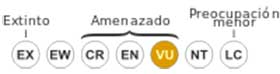
Vulnerable

โ€ข Current Red List of UICN: Vulnerable

โ€ข Population trend: Decreasing

The populations of the Kea they appear as stable and they can range between 1000 and 5000 specimens.

The concentration of birds around tourist spots leaves a false impression, giving the impression of being a fairly ordinary parakeet.

Due to the false reputation he had for attacking sheep, This bird was hunted by farmers and thousands of birds were exterminated between 1860 and 1970.

Since 1988, the Kea is fully protected, What does not prevent, sometimes, their capture and sale as a pet.

The "Kea" parrot in captivity:

Very rare in captivity.

As indicated sources, a captive male for Kea was still alive after 47 years in the Antwerp Zoo. It showed signs of old age. Other Kea in the bristol zoo, of at least, 43 years of age showed no signs of aging.

In captivity, These birds can be raised from the 4 years of age

Alternative names:

Kea (English).
Kรฉa, Nestor kรฉa (French).
Kea (German).
Papagaio-da-nova-zelรขndia (Portuguese).
Kea (espaรฑol).

Kuhl, Heinrich
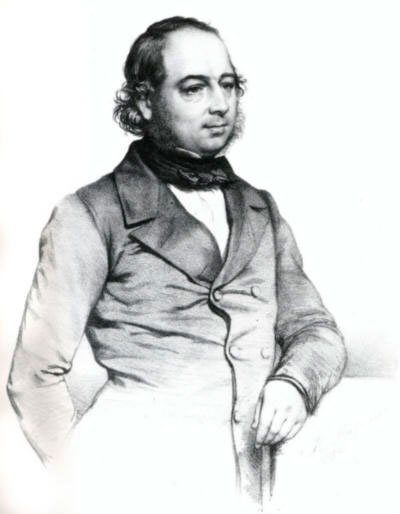
John Gould

Scientific classification of the Kea:

Order: Psittaciformes
Family: Strigopidae
Genus: Nestor
Scientific name: Nestor notabilis
Citation: Gould, 1856
Protonimo: Nestor notabilis

"Kea" images:


Videos "Kea"

Kea [Nestor Notable]

————————————————————————————————


Sources:

Avibase
– Parrots of the World โ€“ Forshaw Joseph M
– Parrots A Guide to the Parrots of the World – Tony Juniper & Mike Parr
– Birdlife

Photos:

(1) – An adult Kea in Fiordland, New Zealand by Mark Whatmough – Wikipedia
(2) – Kea at Twycross Zoo, England. Close up of head and neck By Paul Reynolds from UK (IMG_7147_080227_40DUploaded by snowmanradio) [CC BY 2.0], via Wikimedia Commons
(3) – A Kea at Mount Aspiring National Park, New Zealand By Rosino (scary keaUploaded by Snowmanradio) [CC BY-SA 2.0], via Wikimedia Commons
(4) – Male Kea (Nestor notabilis) on road to Milford Sound, New Zealand By User:Velela [Public domain], via Wikimedia Commons
(5) – Nestor notabilis By Aidan Wojtas from Wellington, New Zealand (Running KeaUploaded by snowmanradio) [CC BY-SA 2.0], via Wikimedia Commons

Sounds: nick talbot (Xeno-canto)

โ–ท The world of Pets: Dogs, cats, birds, reptiles, amphibians

Blue-rumped Parrot
Psittinus cyanurus


Lorito Dorsiazul

Content

Ilustraciรณn Lorito Dorsiazul

Description:

Of 18 cm.. of length and a weight of 85 g..

The Blue-rumped Parrot (Psittinus cyanurus) is a small Parrot, robust and with a tail very short.

Since the crown up to the nape is a bluish grey, glossy on the front of the crown; the lower cheeks and chin grayish brown; the nape sharply demarcated from the the mantle black, with a strongly mottled grey; the low back and rump Blue light violet, brighter than the blue of the head. The patch in the shoulders reddish brown; upperwing-coverts medium Green, the edges of yellowish-green, especially in internal and great stockings coverts; primary coverts blue; flight feather green, with the primaries finely lined with yellow along the inner edges; carpal edge Blue and yellow. Lower parts of the wings dark, with bright red feathers on the underwing-coverts and axillary.

Underparts grayish brown, becoming a blue-green shutdown, with yellow marks in the vent. Uppertail greenish blue in the Center, inner featherss of yellow light with vane outer greener; undertail-coverts yellow

A long bill with red notches in the upper jaw, lower jaw duller; irises yellowish white; legs bluish grey.

The female has the head and upper jaw brown; lacks black on the back and shows just a little blue in the rump; the underparts are light green, Gray as in the male Brown not.

The youth are like females, but with the head green.

Subspecies description

Subspecies description:
  • Psittinus cyanurus abbotti

    (Richmond, 1902) – Males with green spread at the front of the crown, the back of neck black, Green mantle and the rump green (marked with turquoise), the underparts greenish. Female with the head green. Larger than the subspecies Psittinus cyanurus pontius.


  • Psittinus cyanurus cyanurus

    (Forster,JR, 1795) – The species nominal


  • Psittinus cyanurus pontius

    (Oberholser, 1912) – As well as the species nominal but larger.

Habitat:

There is some evidence of possible regular movements in the North of its distribution area, with a view to passing birds above Fraser Hill in Malaysia, 1,300 m.

The Blue-rumped Parrot is also seasonal in parts of the South visitor of Burma.

They are distributed in lowland forests (usually below 700 m) and related habitats, including open forests, secondary growth, huertas, mangroves, dry forests, swamp forest, cultivated areas, including oil palm plantations (Elaeis guineensis), near forests (where post-breeding concentrations are considered pests in some areas), dense thickets and groves of coconut (Cocoa nuts).

The Blue-rumped Parrot they are not shy, and can be found in groups of up to 20 birds, whether eating in silence at the canopy level, quickly flying above the forest, or above the tops of the trees hacuendo calls continuously.

Reproduction:

The breeding season of the Blue-rumped Parrot extends from February to may in Malaysia, and from June to September in Borneo, Although some birds have been seen inspecting possible nesting cavities at other times of the year.

During the courtship grooming each other is common; the male jumps by placing both feet on the back of the female during mating. The implementation is up to three eggs, which are deposited in a hole in the top of a tree, little more is known about the reproductive cycle.

Food:

The diet of the Blue-rumped Parrot is composed of seeds, fruits and flowers.

Distribution:

Its distribution varies from around 11ยฐN in Peninsular Thailand and South of Tenasserim, Burma, across the peninsula Malaysia, Singapore, Sumatra and Borneo (Kalimantan, Sarawak, Sabah and Brunei). They are also found in the Riau (including Bintan) and groups of Lingga Islands to the North of the South of Sumatra, in Bangka, and, in West Sumatra, in Simeulue and the group Mentawai including Siberut, Sipura, Pagai Utara and Pagai Selatan.

It is only locally common and less abundant than other sympatric species of Psittaculas in most of its range.

Subspecies distribution

Subspecies distribution:

Conservation:


Near-threatened


โ€ข Current Red List of UICN: Near threatened

โ€ข Population trend: Decreasing

The size of the world population Blue-rumped Parrot He has not formally quantified, but it is believed that they are more than 100.000 individuals (Juniper and Parr 1998), and the species is described as common in primary habitats and uncommon in secondary habitats and plantations (pit et to the. 1997).

In general, the loss of the forest cover between 2000 and 2010 It has been estimated in 23,7% in the case of Sumatra, the 12,0% in Borneo and the 8,2% for Peninsular Malaysia (Miettinen et to the. 2011).

In Sumatra, It has been estimated that you close to of the 36% primary forest cover in 1990, lost in 2010 (including degraded primary forest) (Margono et to the. 2012).

Descents are compounded by the pressure of the capture; But, the Blue-rumped Parrot uses of forest fragments, forest exploitation, secondary vegetation, other modified habitats and habitats at elevations, What has prevented a faster decrease in its population. But, many lowland forests have been logged.. So, suspected of may be suffering a decrease in the moderately rapid population.

Conservation Actions Underway:

"Blue-rumped Parrot" in captivity:

Pretty rare in captivity.

The Blue-rumped Parrot It is not a bird which like to interact with humans, nor is it a particularly playful bird. Are described as docile who love to sing on rainy days. Due to its melodic voice, they are often alone as songbirds. But, not all of them are born as birds cantadoras, in fact, Some are dumb.

It is recommended to buy the younger, since they are more likely to sing. But, in general it's parrots very quiet with occasional whistles and high-pitched vocation, that it can be irritating when held captive in an apartment.

They have very limited ability to speak. Some of them learn to speak – but most never do.

Unfortunately, they are easy to catch, since they remain immobile when frightened. Hunters have only to shoot into the air or make some noise on turning the birds when they are resting so that they can be easily caught. This has led to its State endangered extincion ..

With regard to its longevity, according to sources, a Blue-backed Parrot was still alive after 10,2 years in captivity. Taking into account the longevity of the similar species, maximum longevity is probably underestimated in this species.

The Blue-rumped Parrot It is a beautiful bird when it is in its natural habitat, its potential as a pet it is said that it is limited. Usually do better in an environment of Aviary, with plenty of space so that you can explore the surrounding area. Better yet is protect their natural habitat and let them enjoy freedom.

Alternative names:

Blue-rumped Parrot, Blue rumped Parrot (English).
Perruche ร  croupion bleu, Perroquet ร  croupion bleu (French).
Rotachselpapagei, Rotachsel-Papagei (German).
Papagaio-de-rabadilha-azul (Portuguese).
Lorito de Lomo Azul, Lorito Dorsiazul (espaรฑol).


scientific classification:

Johann Reinhold Forster

Order: Psittaciformes
Family: Psittaculidae
Genus: Psittinus
Scientific name: Psittinus cyanurus
Citation: (Forster, JR, 1795)
Protonimo: Psittacus cyanurus


Images "Lorito Dorsiazul":

Videos "Blue-rumped Parrot"

ยซLorito Dorsiazulยป (Psittinus cyanurus)


Sources:

Avibase
Parrots of the World โ€“ Forshaw Joseph M
Parrots A Guide to the Parrots of the World – Tony Juniper & Mike Parr
Birdlife

Photos:

(1) – Blue-rumped Parrot Psittinus cyanurus. Bird Park Kuala Lumpur by Bernard DUPONT – Flickr
(2) – Bird Park Kuala Lumpur By Bernard DUPONT from FRANCE (Blue-rumped Parrots Psittinus cyanurus) [CC BY-SA 2.0], via Wikimedia Commons
(3) – Blue-rumped Parrot in a cage By TJ Lin (originally posted to Flickr as DSC01255) [CC BY-SA 2.0], via Wikimedia Commons
(4) – Male blue-rumped parrot (Psittinus cyanurus) by Chlidonias – zoochat
(5) – Female blue-rumped parrot (Psittinus cyanurus) by Chlidonias – zoochat
(6) – Psittacus Malaccensis. (Latham, not Gmellin) Blue-rumped Parrot By William Swainson, F.R.S., F.L.S. (Zoological Illustrations, Volume III.) [Public domain], via Wikimedia Commons

Sounds: Martjan Lammertink (Xeno-canto)

โ–ท The world of Pets: Dogs, cats, birds, reptiles, amphibians

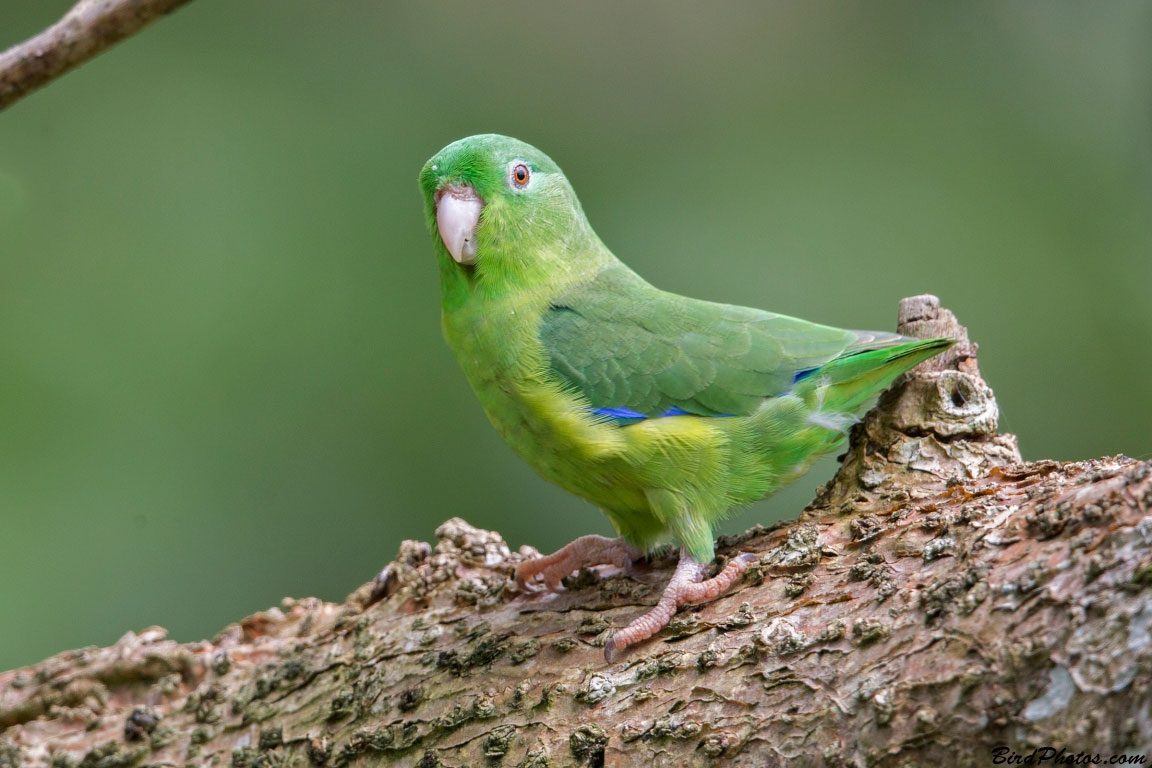
Large-billed Parrotlet
Forpus crassirostris

Large-billed Parrotlet

Content

Description:

12 to 13 cm.. height.

The Large-billed Parrotlet (Forpus crassirostris) has the crown, back of the neck and ear-coverts, green; the forecrown, cheeks, eye area and lores, emerald green.

Upperparts and wings, green, except the part inferior of the back, rump and greater coverts, are cobalt blue and blue color toward the base of the secondaries. Primary coverts pale grayish violet color which contrasts with the darker coverts They are cobalt blue. flight feathers Matte metallic blue. The underparts green with yellow hues. Upper, the tail green; undertail, pale green.

Bill and cere Pink with gray base up to the mandible top, laterally compressed in the Center; bare periophthalmic pale grey: irises dark brown: legs Gris-Rosado pale.
Female all green with belly yellowish green without blue color wing-coverts visible in the male.
Immature like adult respective, but with the blue of young males mixed with green.

Taxonomic note:

some authors (for example, Meyer de Schauensee 1966, Forshaw, 1973, Monroe y Sibley, 1993) They have used the name Forpus xanthopterygius, while other authors (Stotz et to the., 1996, Collar 1997) They have followed Pinto (1945) and used the name Forpus crassirostris to define this species.

  • Sound of the Large-billed Parrotlet.

Habitat:

They inhabit in forest edges, clear, riparian forests, parks and gardens in urban areas.

Reproduction:

They build their nests in tree cavities or exploit abandoned nests common hornero (Furnarius rufus); lining the nesting chamber with grass and the female lays 3 to 7 eggs White. The incubation, lasts approximately 18 days, It is carried out by the female and during this period the male is in charge of feeding her.

Food:

They compose your diet seeds, fruit, plants and flowers herbaceous. They are feeding both the ground and in trees and shrubs. Among the fruits they are highly appreciated by the Large-billed Parrotlet, palm, Trumpet trees (Cecropia spp), as well as seeds and shoots of Paineiras (Ceiba speciosa).

Melo et al, 2009, reported mass consumption flowers of Handroanthus serratifolius (Fam. Bignoniaceae), in particular its nectar, what it appears to be an important power source especially during the dry season, where scarce fruits.

Distribution:

Size of its range (players / residents) 1.312.215 kmยฒ

Southeast of Colombia to the East of Ecuador, North of Peru and West Brazil.

Conservation:


minor concern


โ€ข Current category of the Red List of the UICN: Least concern.

โ€ข Population trend: Stable.

Justification of the population

The size of the world's population of the Blue-winged Parrotlet It has not been quantified, but this species is described as ยซcommonยป (Stotz et to the., 1996).

Justification of trend

Suspected that the population is stable in absence of evidence of any decline or threatens substantial.

"Large-billed Parrotlet" in captivity:

In captivity they are not very frequent. They are birds enable you require a large cage. Quiet and something Shy. Not is easy to accommodate them with other parrots.
Can be prone to it Obesity.

Alternative names:

Blue-winged Parrotlet (crassirostris), Large-billed Parrotlet (English).
Toui ร  gros bec, Toui de Spix (crassirostris) (French).
Large-billed Parrotlet (German).
Tuim, Large-billed Parrotlet (Portuguese).
Catita enana, Lorito Aliazul, Periquito Azulejo, Cotorrita aliazul, Lorito de alas azules (espaรฑol).

Wladyslaw Taczanowski


scientific classification:


Order: Psittaciformes
Family: Psittacidae
Genus: Forpus
Scientific name: Forpus crassirostris
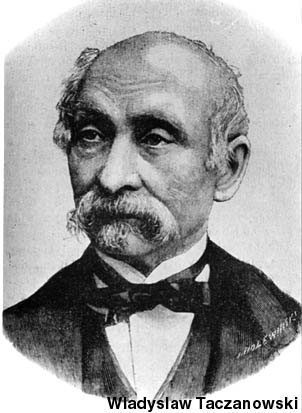
Citation: (By Taczanowsk, 1883)
Protonimo: Psittacula crassirostris

Images "Large-billed Parrotlet"

————————————————————————————————

"Lorito Aliazul" (Forpus crassirostris)


Sources:

Avibase
– Parrots of the World โ€“ Forshaw Joseph M
– Parrots A Guide to the Parrots of the World – Tony Juniper & Mike Parr

Photos:

(1) – Large-billed Parrotlet (Forpus crassirostris) Male – Photo by Tom Friedel – Puerto Nariรฑo, amazon, Colombia – birdphotos.com

Sounds: John V. Moore, XC257657. accessible www.xeno-canto.org/257657

โ–ท The world of Pets: Dogs, cats, birds, reptiles, amphibians

Brown Lory
Chalcopsitta duivenbodei


Lori Pardo

Content

Description

31 cm.. length and a weight between 200 and 230 gr.

The bottom of the wings of the Brown Lory (Chalcopsitta duivenbodei) are bright yellow narcissus.

Two other features of its plumage that powerfully attract attention are, seen head-on , the yellow that completely surrounds the bill and forecrown and also the contrast of color violet or blue deep in it low back, the thighs and feathers of the tail.

The feathers of the chest have pointed yellow, giving a scaly appearance to the area.

The bill is black, as the eye ring and the skin bare at the base of the bill. The irises are orange-red, the legs are grey.

There is no sexual dimorphism, females are identical to males.

The youth they have more muted colors, with less yellow.

To the Brown Lory may be mistaken for it is a very similar species, the Dusky lory (Pseudeos fuscata). The latter, However, can be distinguished by their underparts predominantly orange or yellow, rump white, their bill Orange and its smaller size.

It is a bird of extraordinary beauty.

Subspecies description

  • Chalcopsitta Duivenbodei Syringanuchalis

    (Neumann, 1915) – 31 cm approx.. Brown is more dark by the area of the head and back. Many specimens with dark violet hue.


  • Chalcopsitta Duivenbodei Duivenbodei

    (Dubois, 1884) – The nominal

Habitat:

They frequent the primary and secondary forests with large mature trees.
They seem to especially appreciate the edges of wooded areas. They are also found in the partially open forests. They seem to be able to adapt to areas that have suffered more or less significant damage.

The Brown Lory It is a bird of lowland, It is usually present below the 200 m.

There is little information about the habits of this species. Often live in pairs or in small groups in that often is associated with other species of parrots dining rooms of nectar or near those trees in flower.

They usually seek food the canopy of the forest and vegetation at ground level. Their activity seems to have no end. At night they retire to dormitories in the branches.

When moving, they have a very characteristic flight made with very accentuated flapping at the tips of the wings.
Their flight is much slower than the Coconut Lorikeet (Trichoglossus hamatodus). Yellow-orange color under the wings are very obvious.

Reproduction:

The breeding season is produced in April. In captivity, the females usually lay two eggs, which hatch in approximately 24 days. The total duration of the nesting is very long. 11 weeks from the construction of the nest to the full autonomy of the young. We don't have more information.

Food:

We don't have many details about their menu. One thing is certain, their diet is almost exclusively vegetarian. It feeds on fruits, seeds and sprouts. Given the fact that spends most of its time in shrubs or flowering trees, pollen and nectar should be an essential resource in your diet.

Distribution:

This species has a patchy distribution along the lowlands of the North coast of New Guinea, since the Cenderawasih Bay between papua and West Papua (Indonesian) to the Astrolabe Bay in Papua New Guinea. In general they are rare (Coates 1985, Beehler et to the., 1986), but it is quite common locally in locations such as the southern zone of Vanimo Puwani River and in the area of the wapoga river (A. Mack in lit. . 1999, KD Bishop in litt. 1999, B. Beehler in litt., 2000).

Subspecies distribution

  • Chalcopsitta Duivenbodei Syringanuchalis

    (Neumann, 1915) – Cenderawasih Bay between Papua and West Papua and Astrolabe Bay, in Papua New Guinea.


  • Chalcopsitta Duivenbodei Duivenbodei

    (Dubois, 1884) – The nominal

Conservation:


minor concern


โ€ข Current IUCN Red List category: Least concern.

โ€ข Population trend: Stable.

The species has a population global estimated at more of 50.000 individuals.
Forests throughout its area of distribution is threatened by commercial logging, but the abundance of the species in secondary forest suggests that it is not threatened.

The fact that are able to adapt to them areas forest exploited or degraded, It is an encouraging sign and the mark of the relative health of the species.

"Brown Lory" in captivity:

It is of a bird rare in captivity, but its breeding is easy.

Information in BeautyofBirds

Alternative names:

Brown Lory, Duyvenbode’s Lory (ingles).
Lori de Duyvenbode (French).
Braunlori (German).
Lรณris-castanho (Portuguese).
(espaรฑol).

scientific classification:

Order: Psittaciformes
Family: Psittaculidae
Genus: Chalcopsitta
Scientific name: Chalcopsitta duivenbodei
Citation: (Dubois, 1884)
Protonimo: Chalcopsittacus Duivenbodei

ยซLori Pardoยป images:

Videos "Brown Lory"

—————————————————————————————————

ยซLori Pardoยป (Chalcopsitta duivenbodei)


Sources:
Avibase, Birdlife International, Oiseaux.NET

Photos: bob|P-&-S (Flickr), Wikimedia, J. Brubaker (IBC.lynxeds.com), iggino (IBC.lynxeds.com), animalphotos.me

Sounds: BAS van Balen (Xeno-canto)

โ–ท The world of Pets: Dogs, cats, birds, reptiles, amphibians

Yellow-and-green Lorikeet
Trichoglossus flavoviridis

Yellow-and-green Lorikeet

Content

Yellow-and-green Lorikeet

Description

20 cm.. length and a weight between 80 and 95 gr.

Very similar to the Scaly breasted Lorikeet by appearance scaly on underparts, but differs from it by color low wing and brands that adorn their head.

The adults of the Yellow-and-green Lorikeet (Trichoglossus flavoviridis) they have the upperparts plumage of a beautiful green.

The forecrown and top They are are greenish brown. The throat and the chest to abdomen It is yellow with dark green flakes. Area of sides up to the coverts and the bottom of the wings It shows a beautiful yellow-green.

The bill is orange. The irises is orange-yellow, the legs grey.

It has no sexual dimorphism.

In the youth, all the yellow markings are derived more green. The bill is brown, while the bare parts of the face are white. The irises is brown.

Description 2 subspecies

  • Trichoglossus flavoviridis flavoviridis

    (Wallace, 1863) – Nominal. Overall plumage It is olive green. The forecrown and crown yellow. The back of the neck brown. the yellow throat and the chest to abdomen, with the scalloped dark green.


  • Trichoglossus flavoviridis meyeri

    (Walden, 1871) – Shown in upperparts a darker shade of green; the underparts They are less scaly. The back of the top, the occiput and nape are greenish-Brown. The cheeks and throat They are yellow with dark green stripes. This subspecies is much smaller, between 40 and 50 gr.

Habitat:

The Yellow-and-green Lorikeet they are distributed with greater diligence between primary forest and mature secondary forest than their close relatives, the Ornate Lory. But, This does not prevent them from entering the open lands to feed from the ceibos in flower (coral trees).

Throughout its area, these birds are considered fairly common. In Celebes, are common in the mountainous areas where have been supplanted to a large extent to the Ornate Lory. In the Sula Islands, they are common in almost all altitudes.

They live in small flocks of noisy and sometimes mingle with the Ornate Lory When looking for food in the trees in flower at the edge of forests.

These birds are relatively Shy and they tend to stay inside the dense forest foliage, where their cryptic plumage makes them virtually invisible. When they feel threatened, leave the foliage uttering cries penetrating and powerful. They are easier to fly above the treetops on quick flights or the circulating a flight above the trees, just before landing in the branches more high.

Reproduction:

There is little information reproduction in the natural environment. The only one nest we have discovered so far was in a mossy forest, about 2.400 meters above the sea level. It was located high above the ground in a dead tree.

In captivity, the implementation is, usually, two white eggs that incubate for a few parents will be 23 days. As with all the Lori, the reproductive cycle It is particularly long and hard about 65 days.

Food:

The Yellow-and-green Lorikeet is above all vegetarian. Their language is particularly suitable for crop pollen and the nectar from the flowers. It is equipped with long buds that allows you to easily reach their favorite food. They have a predilection for the trees of the genus Euphorbia and Erythrina.

Distribution:

Size of its range (reproduction / resident): 6.300 km2

The Yellow-and-green Lorikeet They are endemic to the islands east of Indonesian. They are exclusively on the Sula Islands (Taliabu, Mangole, Sanana) and especially in the area of Celebes island.

Description 2 subspecies

Conservation:


minor concern


โ€ข IUCN Classification: Least concern.

โ€ข No threats at present.

The species is not threatened. In Taliabu, is very common in altitude zones, but it is also quite common in degraded areas bordering the coast. It is estimated one world population above the 100.000 specimens.

Justification of trend

They suspected that the population is stable in absence of evidence of any decline or threatens substantial.

"Yellow-and-green Lorikeet" in captivity:

Pretty common in captivity.

Take it easy, Nice trill. Sensitive to cold temperatures and somewhat susceptible to disease. He will join his caregiver over time although initially shy.

Alternative names:

Yellow-and-green Lorikeet, Citrine Lorikeet, Yellow & Green Lorikeet, Yellow and Green Lorikeet, Yellow&green lorikeet, Yellow-and- Green Lorikeet, Yellow-green Lorikeet (ingles).
Loriquet jaune et vert (French).
Celebeslori (German).
Lori flavoviridis (Portuguese).
Lori Verdigualdo, Tricogloso Verde y Amarillo (espaรฑol).

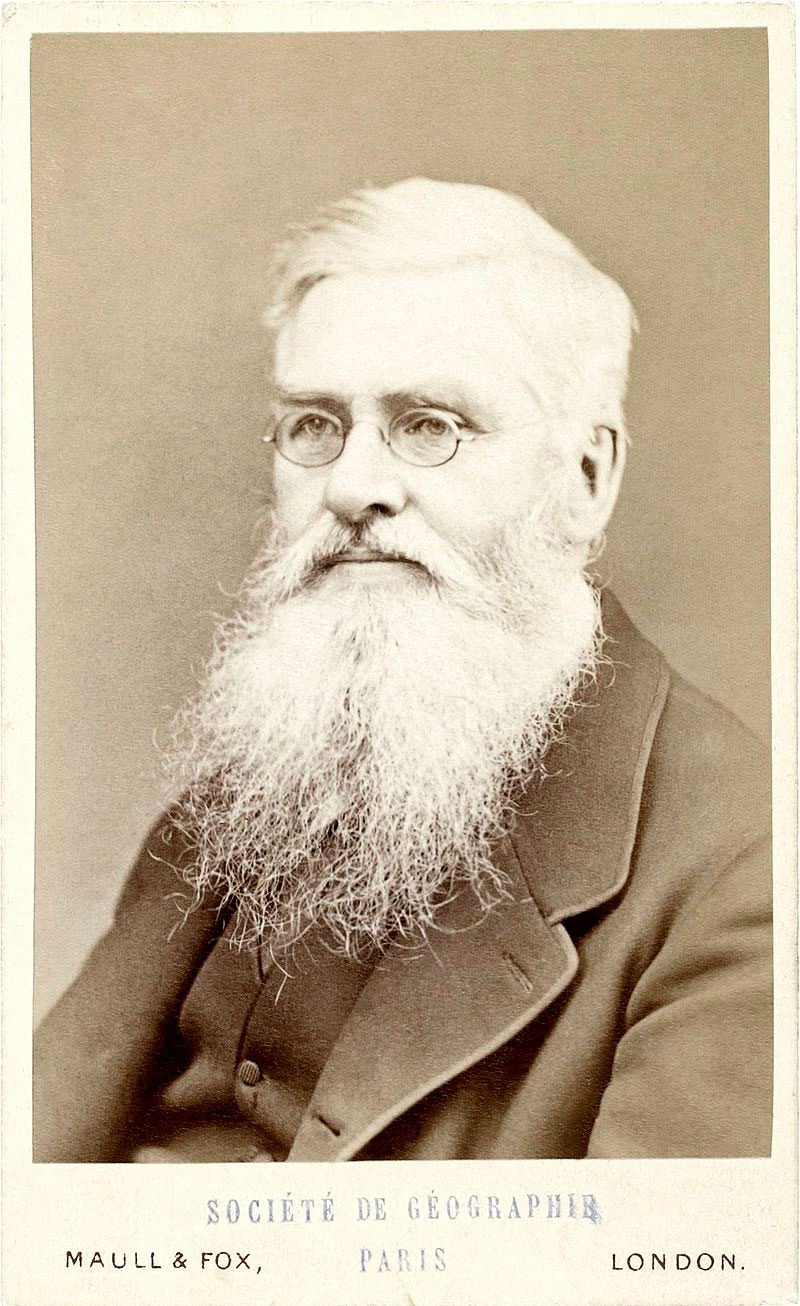
Alfred Russel Wallace

scientific classification:


Order: Psittaciformes
Family: Psittaculidae
Genus: Trichoglossus
Scientific name: Trichoglossus flavoviridis
Citation: Wallace, 1863
Protonimo: Trichoglossus flavoviridis


Images ยซLori Verdigualdoยป:

Videos "Yellow-and-green Lorikeet"

————————————————————————————————

"Lori Verdigualaldo" " (Trichoglossus flavoviridis)


Sources:

Avibase
– Parrots of the World – Joseph Forshaw M
– Parrots-A Guide to the Parrots of the World by Tony Juniper & Mike Parr
Birdlife

Photos:

(1) – Yellow and Green Lorikeet (Trichoglossus flavoviridis) in the Walsrode Bird Park, Germany By Quartl (Own work) [CC BY-SA 3.0], via Wikimedia Commons
(2) – Trichoglossus flavoviridis Proceedings of the Zoological Society of London 1862 by Joseph Wolf [Public domain], via Wikimedia Commons

Sounds: Frank Lambert (Xeno-canto)

โ–ท The world of Pets: Dogs, cats, birds, reptiles, amphibians

Purple-naped Lory
Lorius domicella

Purple-naped Lory

Content

Lori damsel drawing

Description

The Purple-naped Lory (Lorius domicella) has a length of 28 cm.. and an approximate weight of 235 g..

The forecrown, crown and nape black, with variable purple spots on the back of the top. The cheeks, lores and ear-coverts red. Upperparts red, darker in the center of the the mantle. Upper wing Green with white and purple patch in the shoulder. Color bronze in all the upper inner coverts, the most marked inside opaque red. the flight feather Blackish with area central in the interior of color yellow. Underwing-coverts Violet Blue impregnated white. Underwing coverts black; blue purple in them axillary. Parts low Red with band yellow, variable at the top of the chest; Violet Blue the the thighs, slightly impregnated in green. Tail red, reddish brown tipped. Bill orange; irises reddish brown; dark grey the legs.

Males and females are equal.
Immature with yellow stripe in the chest more extensive and more diffuse. Bill Brown in very young birds.

There is no geographic variation

Habitat:

In Seram the Purple-naped Lory found in montane and submontane forests, both primary and secondary, a altitude between 400 and 1.050 m; also in the jungle in the this of the island and in the areas cultivated. They move in pairs, rarely in groups and can be territorial. reproductive ecology of the species in the wild is unknown. Forshaw gives details of an instance of poultry farming in which two eggs were laid., hatching around the 25 days; the young are independent only three months more afternoon.

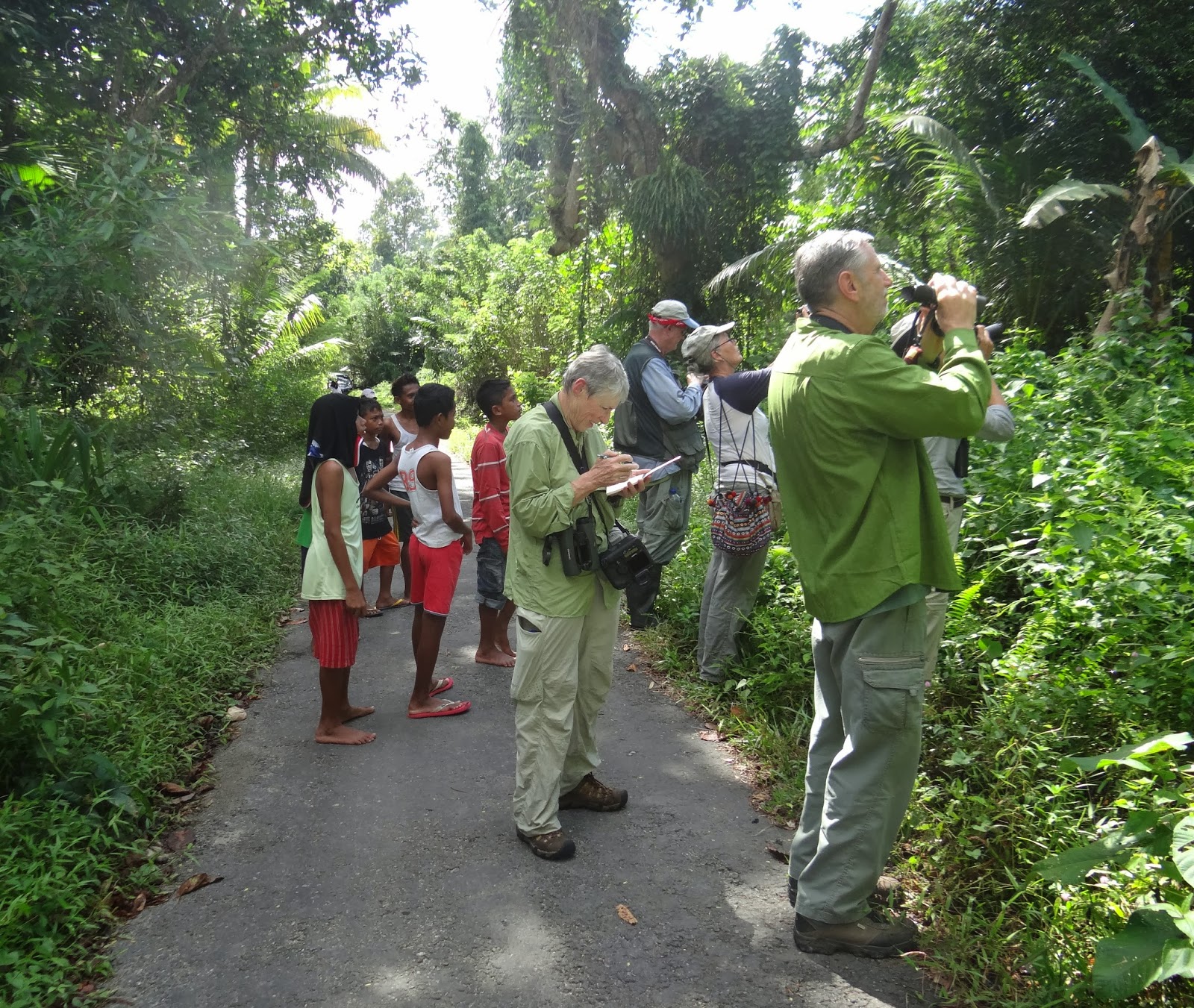
A group birding in Ambon

Reproduction:

The reproduction of the species in the wild is unknown. Details of breeding in poultry farming establish a clutch of two eggs, incubation in a few 25 days, and the young three months after independence.

Food:

Feed on fruits of Pandanus scattered.

Distribution:

Size of the area of distribution (reproduction / resident): 6.300 km2

endemic to the Seram Islands and Ambon (has also been seen in Buru: probably an escaped bird), in Indonesian. There are no recent records of Ambon or Buru. The current records come from the Manusela National Park (uncommon) and the center of Seram and WAE Fufa (locally common).

In 1987 Bowler and Taylor they found a rate of 0,7 birds per hour in Kineke, in the Manusela National Park; But during nearly two months of observations in 1990, they only saw 10 individuals.

The species is a bird people of cage in Seram and throughout the province of Maluku and the expansion of foreign trade could pose a threat to their survival.

The population worldwide is estimated at less than 20.000 individuals in 1991, but currently, the population, is considered on the rise. VULNERABLE.

Conservation:


Endangered

โ€ข Current IUCN Red List category: Danger.

โ€ข Population trend: Decreasing.

This species has been upgraded to In danger Since its population It is suspected that has fallen below 2.500 individuals mature, with more than 250 in any subpopulation mature individuals.

Capture unsustainable for local and national trade, as well as the loss of forests due to logging, oil extraction and hydroelectric power combinations.

These facts, It is suspected, they are causing an downhill fast and constant in the species.

"Purple-naped Lory" in captivity:

Very rare.

Alternative names:

Purple-naped Lory, Purple naped Lory (ingles).
Lori des dames (French).
Erzlori (German).
Loris-de-nuca-roxa (Portuguese).
Lori Damisela, Lori Domicela (espaรฑol).

scientific classification:

Order: Psittaciformes
Family: Psittaculidae
Genus: Lorius
Scientific name: Lorius domicella
Citation: (Linnaeus, 1758)
Protonimo: Psittacus Domicella

โ€œDamsel Loriโ€ Images:

Videos "Purple-naped Lory"

————————————————————————————————

ยซLori Damiselaยป (Lorius domicella)


Sources:

Avibase
– Parrots of the World โ€“ Forshaw Joseph M
– Parrots A Guide to the Parrots of the World – Tony Juniper & Mike Parr
Birdlife

Photos:

1 – Zoolรณgico de Praga: Pรบrpura-naped Lory – animalphotos
2 – ยซLorius domicella-Artis Zoo-Netherlands-8aยป by Arjan Haverkamp – originally posted to Flickr as Img_4196e. Licensed under CC BY 2.0 via Wikimedia Commons.
3 – ยซLorius domicella-Banda Islands-Indonesia-upper body-8ยป by Henri – originally posted to Flickr as Lory = green-tailed lory. Licensed under CC BY 2.0 via Wikimedia Commons.
4 – Birds-pet-wallpapers – link
5 – ยซLorius domicella-Jurong Bird Park, Singapore-8a-tocยป by Lorius domicella-Jurong Bird Park,_Singapore-8a.jpg: kwang chongderivative work: Snowmanradio (talk) – originally posted to Picasa Web Albums as Picasa Web Albums and uploaded to Commons as Lorius domicella-Jurong Bird Park,_Singapore-8a.jpg. Licensed under CC BY-SA 3.0 via Wikimedia Commons.
6 – Illustrations ยฉ2010 by Frank Knight

Sounds: George Wagner (Xeno-canto)