โ–ท The world of Pets: Dogs, cats, birds, reptiles, amphibians

Fairy Lorikeet
Charmosyna pulchella


Fairy Lorikeet

Content

Description

18 cm.. length and a weight between 24 and 34 g..

The head of the Fairy Lorikeet (Charmosyna pulchella) is dark red with the back of the crown Black extending from above and behind the eyes up to the nape. Mantle Green with a black area below the nape and collar of color red dark at the height of the shoulders; under the back It shows a patch of dark violet interspersed with some green feathers on the ends; rump and tail coverts view from above of color green.

Wings Green with extremes of color black in them flight feather and in the internal parts of the coats. below the wings Red with coverts marginal green; flight feather blackish.

The underparts Red with stripes of pale yellow in the center of the chest, the thighs purple with yellow stripes. The tail view from the top of green at the top with a black shaft in the Center and the rest of red and yellow at the tip; view from below, the tail is yellow, bathed in red and green ends.

The bill is orange with gray tip; irises yellow red; legs oranges.

The female shows a color green beige, not red, on the sides and a yellow patch in the flanks that extends to the sides of the rump.

The female of the subspecies Rothschildi also shows more green in the underparts males and a green mottling on the upper part of the chest.

The Immature They show the yellow patch of the flanks more defined than the females. The lower part of the back, mainly green with some blue-violet. Top of the chest Green mottled without clearly defined yellow stripes adult. Crown Red with black patch restricted to the nape and mixed with the green of the upper mantle. Lack of the Red of the part back from neck clearly defined in adults. Yellow area at the bottom of the flight feather. Iris brown. Beak and feet grayish brown.

Subspecies description

There are two subspecies including the nominal. A third, Charmosyna pulchella beautiful, described by Devis (1900), is considered here as Charmosyna pulchella pulchella.

  • Charmosyna pulchella pulchella

    : (Gray,GR, 1859) – The nominal


  • Charmosyna pulchella rothschildi

    : (Hartert, 1930) – The patch of the crown descends to find is with them eye; Green fusion behind the yellow lines of the chest, and green fusion in the flanks and the thighs (that can also show some yellow stripes); without the Red of the neck and much less defined the violet patch in the lower part of the back.

Habitat:

Nomads. They are mainly distributed in montane forests, at the edges of forests and secondary growth forests. Its preferred habitat are the mountains between 500 and 1.800 m, but also found in lowlands up to the level of the sea and in the mountains up to 2.300 m.

Found in pairs or flocks of 15 or more members, uniting in the tops of trees in flower with others Charmosyna lorikeets, including the Josephine's Lorikeet.

Reproduction:

In captivity it nests continuously, with incubation of 25 days shared by both parents. Usually, It lays two eggs in a hole in the base of one epiphyte. In nature it is intended that nests between January and April (Pratt picked up breeding males in March).

Food:

It feeds on pollen and nectar.

Distribution:

The Fairy Lorikeet is distributed between New Guinea in Irian Java (Indonesian) and Papua New Guinea, from the East of Vogelkop to the peninsula of Huon. Owen Stanley mountains and southeastern intervals.

Subspecies distribution:

  • Charmosyna pulchella pulchella

    : The nominal


  • Charmosyna pulchella rothschildi

    : The mountains Cyclops and the slope North of the mountains on the idenburg river (Irian Java).

Conservation:


minor concern


โ€ข Current IUCN Red List category: Least concern.

โ€ข Population trend: Stable.

The world's population has not been quantified, It is thought that it surpasses the 500.000 birds. the species, according to information, is abundant in some areas, but few in others due to the trade (pit et to the., 1997). Suspected that the population is stable in the absence of evidence of any reduction or substantial threats.

"Fairy Lorikeet" in captivity:

A small number of captivity.

Alternative names:

Fairy Lorikeet, Little Red Lorikeet, Little Red Lory (ingles).
Lori fรฉรฉrique, Lori ร  croupion noir, Lori fรฉerique, Loriquet ร  croupion noir (French).
Goldstrichellori (German).
Lori Lindo (espaรฑol).

scientific classification:

Order: Psittaciformes
Family: Psittaculidae
Scientific name: Charmosyna pulchella
Citation: Gray,GR, 1859
Protonimo: Charmosyna pulchella

ยซCute Loriยป Images:

————————————————————————————————

ยซLori Lindoยป (Charmosyna pulchella)


Sources:

Avibase
– Parrots of the World โ€“ Forshaw Joseph M
– Parrots A Guide to the Parrots of the World – Tony Juniper & Mike Parr
– Birdlife

Photos:

1 – animalphotos.me
2 – by W. Voit – koppiekrauw
3 – animalphotos.me
4 – Author iggino in Vogelpark Walsrode, Walsrode, Lower Saxony, Germany – lynx
5 – in Neues vom Loro-Parque – koelle-zoo

โ–ท The world of Pets: Dogs, cats, birds, reptiles, amphibians

Colasisi
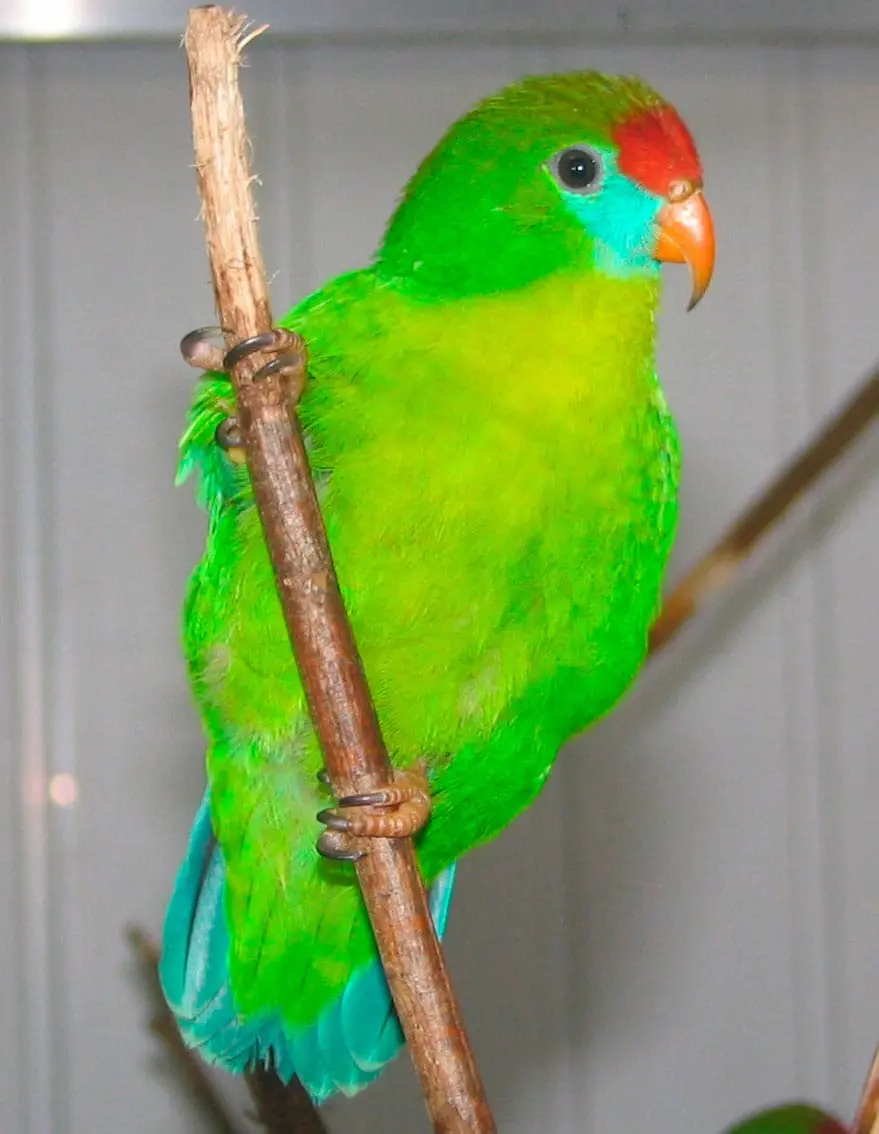
Loriculus philippensis


Loriculo Filipino

Content


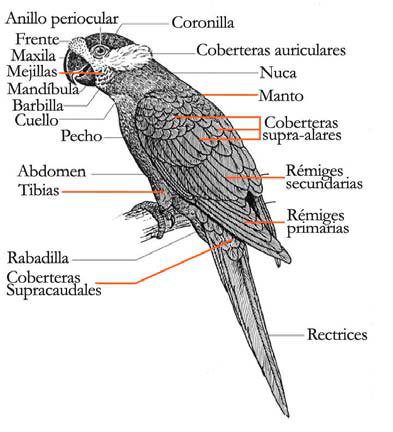
Anatomy-parrots

Description

14 cm.. length and a weight between 31 and 40 g..

The head of the Colasisi (Loriculus philippensis) is bright green with a patch of narrow Scarlet color on the front of the Crown, bordered orange-red color on the back edge; yellowish-green Chin: narrow collar on the back of the Orange and red neck, with a wash light yellowish in the neck.

Bright green upperparts with dark crimson rump and uppertail coverts (lower sides of light blue). Bright green wings with vane internal to the darker flight feathers. Under, the wings of turquoise-blue with the exception of the outermost coverts which are green. Bright red throat Center, merging to red-orange in the center of the chest (yellow on the bases of feathers); rest of the lower region of bright green, lighter and more yellow than the upper region. Upper, the green tail; Blue below.

Coral red beak; dark brown irises; dark orange legs.

The female has a face marked in blue and does not have the Red bib, that is replaced by a greenish yellow colour wash. The female Crown is washed in yellow-orange (stronger than in the male).

Young birds have a more off Crown and paler beak.

Subspecies description
Subspecies
  • Loriculus philippensis apicalis

    (Souance 1856): Two aberrant samples previously attributed to theLoriculus salvadorii. They are larger, with less red on the Crown, more blue on the tail, and darker green colour. All the Crown of this subspecies is Scarlet, merging in Orange on the back of the neck and orange on the mantle in both sexes (duller in females). Bright red in the hip and more orange on the top.

  • Loriculus (philippensis) bonapartei

    (Souance 18563): You have the back of the head with pronunciation orange hue, Pico black and grey legs.

  • Loriculus philippensis bournsi

    (McGregor 1905): The male with red only in the front and light yellow area in the center of the Crown (female much less yellow on the Crown), upper part of the Crown of the male less yellow shows that the L. p. Regulus. Orange line on the nape of the male is less clear in the female. Female with less blue in the face that the nominal species.

  • Loriculus philippensis chrysonotus

    (Sclater, PL 1872): Frontal area and rest of the crown bright red that extends in golden yellow color on the mantle, and showing a fine reddish collar on the back of the neck. Male with more orange in the lower part of the throat patch. The female Crown similar but less marked.

  • Loriculus philippensis dohertyi

    (Hartert 1906): Maybe more orange in the mantle, but hardly different to the L. p. apicalis.

  • Loriculus philippensis mindorensis

    (Steere 1890): Orange-yellow on the neck line. Crown Green. More extensive turquoise patch on both sides of the rump.

  • Loriculus philippensis philippensis

    (Statius Mรผller 1776): Nominal

  • Loriculus philippensis regulus

    (Souance 1856): Similar to the L. p. bournsi but male with much more yellow on the Crown (female shows a more subdued yellow broadcast, but more than in the previous race). Nape line weaker than in the bournsi. Male with more Scarlet patch.

  • Loriculus philippensis siquijorensis

    (Steere 1890): Male with less red bib and the red spot of the largest Crown than in the nominal species. Back of the Green Crown. Falata neck mark. Female with more blue in the face.

  • Loriculus philippensis worcesteri

    (Steere 1890): Male Scarlet throat patch smaller than that in the L. p. chrysonotus. Both sexes show a more extensive Crown of orange-red in the rear margin. There is a small patch on the back of the neck of orange color and a light reddish color in the mantle of diffusion.

  • Loriculus (philippensis) camiguinensis

    (Tello, JG 2006): has mainly green plumage, with throat, front side of the face and thighs of azure-blue; the front, the pileus, the obispillo and the top of the red tail, While the rest of the tail is blue. Males and females are identical in appearance, What is unusual in others Philippine parrots, Since only males of other species have red forehead.

Habitat:

The species is found along the edges of the forest, secondary growth, Bamboo forests, areas cultivated near villages, orchards and plantations of coconut. The birds are alone, in pairs or in family groups, sometimes in small flocks, sometimes with other birds.

Reproduction:

The breeding season has been recorded from April to August.. Three eggs are deposited and incubated by the female during 20 days, the young leave the nest in five weeks.

Food:

They feed in the upper levels of flowering plants or fruit trees, sometimes at lower levels, flower, nectar, fruit (including figs) and seeds, sometimes intoxicated by consumption of fermented coconut nectar (coconuts).

Distribution:

Limited to the Philippines (less the Sulu archipelago), where are widespread and resident except in Palawan. Its abundance varies according to the subspecies.. In general, the species is locally common up to 1000 meters above sea level, but have been recorded at altitudes of up to 2.500 m (Mount Apo, Mindanao).

Subspecies distribution
Subspecies

Conservation:


minor concern


– Current IUCN Red List category: Least concern

– The population trend: Decreasing

The world population is considered to be above the 20,000 exemplary but decreasing due to loss of habitat. The subspecies Mindoro is considered as threatened, and both subspecies of Cebu as Siquijor, are nearly extinct the loss of habitat (as these birds are commonly caged and traded between islands, contemporary records of birds from Siquijor they require confirmation to determine whether they refer to the breeds).

The combined population of Mindoro, Sibuyan, Blacks, Surigao del Sur, Tables, Romblon, Masbate, Ticao, Cuimaras and Basilan (subspecies L. p. mindorensis, L. p. bournsi, L. p. Regulus and L. p. dohertyi) probably add in total not more than 5.000 birds.

"Colasisi" in captivity:

Very rare.

Alternative names:

Colasisi, Philippine Hanging-parrot (ingles).
Coryllis des Philippines (French).
Philippinenpapageichen (German).
Loriculus philippensis (Portuguese).
Lorรญculo Filipino (espaรฑol).

scientific classification:

Order: Psittaciformes
Family: Psittaculidae
Scientific name: Loriculus philippensis
Genus: Loriculus
Citation: (Statius Mรผller, 1776)
Protonimo: Psittacus philippensis

Images ยซFilipino Loriculusยป:

Videos "Colasisi"

————————————————————————————————

ยซPhilippine Lorikeetยป (Loriculus philippensis)


Sources:

Avibase
– Parrots of the World โ€“ Forshaw Joseph M
– Parrots A Guide to the Parrots of the World – Tony Juniper & Mike Parr
– Birdlife

Photos:

(1) – a female perched. by iggino – lynx
(2) – Birds-pet-wallpapers – link
(3) – Loriculus philippensis camiguinensis (Author AlexKant) – Crocolandia Foundation – ZooChat
(4) – Loriculus p. apicalis, male, By iggino – lynx
(5) – tapety-papousci

Sounds: David Edwards (Xeno-canto)

โ–ท The world of Pets: Dogs, cats, birds, reptiles, amphibians

Painted Tiger-Parrot
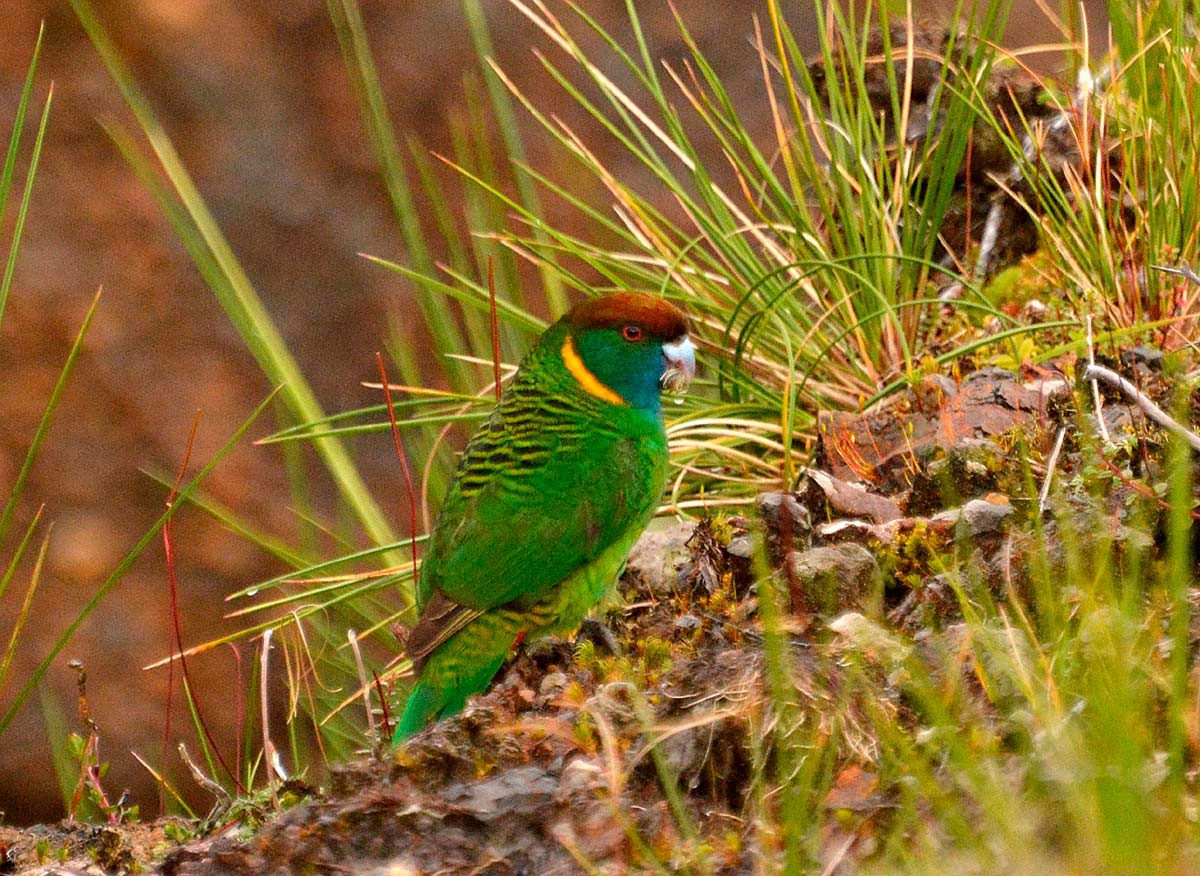
Psittacella picta

Painted Tiger-Parrot

Content

Description

19 cm.. length and a weight between 48 and 60 g..

In adults of the Painted Tiger-Parrot (Psittacus erithacus), the head is predominantly Brown, but the colors of the top they are bright and warm, While the cheeks they are more off and more grey. One collar Yellow Strait decorates the neck. The plumage is green with black stripes. Rump and uppertail-coverts red. The wings They show a green with yellow stripes on the external threads and the flight feather. The underparts is yellowish-green.

The chin is brown, the upper part of the chest It has a central patch of blue. The coverts are orange-red. The rest of them underparts are a green medium, slightly clearer that the upperparts. The upper part of the tail is dark green. The bottom of the tail is blackish grey.

The bill is light grey and blue color with a white tip. The irises are reddish orange, the legs dark gray.

The collar Yellow is absent in the female. The cheeks they are dyed blue. The chest black and yellow colors absent. In the upperparts abounds over the scratched.

The immature they are similar to females.

Distribution 3 subspecies

  • Psittacella picta picta

    (Rothschild, 1896) – Nominal.


  • Psittacella picta lorentzi

    – (Victoria, 1910) Adults as the nominal species but the crown and the surroundings are color marron-oliva; cheeks teal, with a green darker in ear-coverts; rump and uppertail-coverts greenish yellow striped with black.


  • Psittacella picta excelsa

    – (Mayr & Gilliard, 1951) Males as the nominal, but the Crown is colored bright marron-oliva. The female is like the female of the nominal species but with the head color glossy marron-oliva; the throat and cheeks heavily washed in blue.

Habitat:

The Painted Tiger-Parrot they live in the mountains, in forest areas where can be seen especially at edges and clearings. They are also found in the moss-covered forests, the secondary forest, and in the thickets of Alpine and subalpine areas. These birds can be downloaded at 1.370 m. In the southeast of its distribution area, they tend to be distributed at lower altitudes than in other places. But, their preferred Habitat is between the 2.400 and 4.000 m, just above the Brehm's Tiger-Parrot (Psittacella brehmii).

The birds are generally quiet, but not shy, and move individually, in pairs or in groups of up to six members; It has been observed feeding on groups, mixed with the Madarasz's Tiger-Parrot. They often feed in low bushes or on the ground.

Reproduction:

Little is known about the ecology of the species and the only information on reproductive behavior is that birds in breeding conditions have been observed in the months of June and August..

Food:

The diet It includes seeds, berries and the fruit of conifers Dacrydium.

Distribution:

Endemic to the central band of the mountain of New Guinea. Restricted to the high montane forests, from the West of the Maoke through the central mountains, including the Tari region, about Kandep, Mount Hagen, Monte, Kubor up to the Owen Stanley mountain range in the Southeast. The world's population is believed to be superior to the 100.000 specimens.

Distribution 3 subspecies:

  • Psittacella picta picta

    (Rothschild, 1896) – Nominal.


  • Psittacella picta lorentzi

    – It is located on the westernmost stretch (Sudirman mountains).


  • Psittacella picta excelsa

    – Occupied the mountains Central of Papua New Guinea.

Conservation:

โ€ข Current IUCN Red List category: Unrecognized

According to "The World Parrot Trustยซ, in accordance with Tony Juniper, the world's population is superior to 100 000 individuals.

According to the Manual, This species, Although relatively dispersed, may be locally common. Despite its small extension, It is classified as ยซleast concernยปFor the different ornithological organizations.

"Painted Tiger-Parrot" in captivity:

Not found in poultry.

Alternative names:

Painted Tiger-Parrot, Painted Parrot, Painted Tiger Parrot, Timberline Parrot, Timberline Tiger-Parrot (ingles).
Perruche peinte (French).
Braunscheitelpapagei, Braunscheitel-Papagei (German).
Psittacella picta (Portuguese).
Lorito Pintado, Lorito tigre Pintado, Lorito-tigre Pintado (espaรฑol).

scientific classification:

Order: Psittaciformes
Family: Psittaculidae
Genus: Psittacella
Scientific name: Psittacella picta
Citation: Rothschild, 1896
Protonimo: Psittacella picta

Images "Painted Tiger-Parrot"

Videos "Painted Tiger-Parrot"

————————————————————————————————

ยซLorito-tigre paintedยป (Psittacella picta)

Sources:

Avibase
– Parrots of the World โ€“ Forshaw Joseph M
– Parrots A Guide to the Parrots of the World – Tony Juniper & Mike Parr
Wikipedia

Photos:

(1) – Psittacella picta near Lake Habbema – BIRDING AROUND THE WORLD

Sounds: Hans Matheve (Xeno-canto)

โ–ท The world of Pets: Dogs, cats, birds, reptiles, amphibians

Eclectus Parrot
Eclectus roratus


Eclectus Parrot

Content

Description


Anatomy-parrots

35 to 42 cm.. length and a weight between 355 and 615 g..

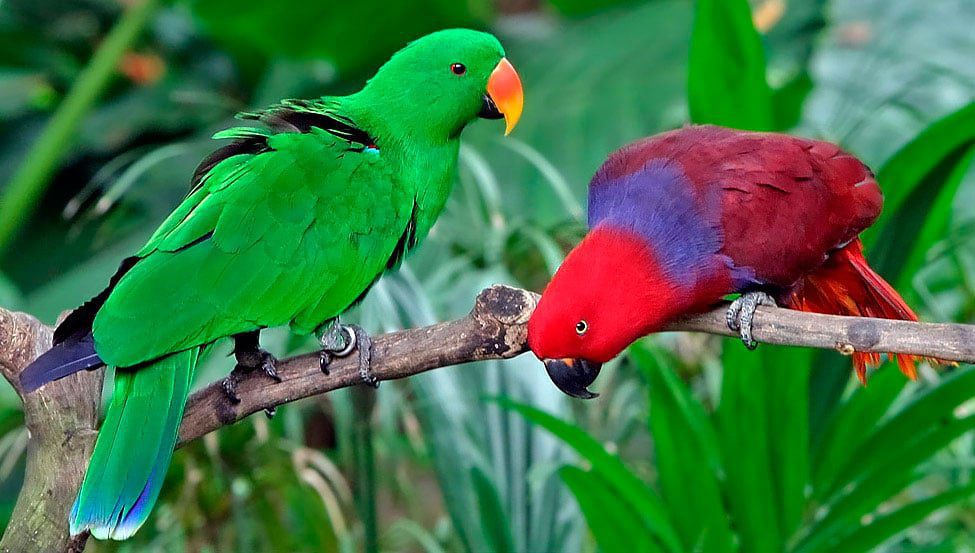
The Eclectus Parrot (Eclectus roratus) It has the head and upper parts of bright green. green wing coverts; curve of the wing and the carpal edge blue; primary coverts dark blue. Feathers of flying with vane very dark blue external, vane internal black on the edge inside. Wing of bright red feathers; bottom of the black flight feathers. Green underparts with flanks and axillary Red. Upper, the Green tail with narrow pale yellow tips, drenched side of blue and yellow-tipped feathers (more external with more blue); undertail, tail black with yellow tips.

Yellow-tipped red Bill, black lower jaw, iris orange, greyish Brown legs.

In all the eclectus sexual differences machos-hembras are so large that at the beginning he qualified them as different species. The female of the Eclectus Parrot it is bright red with a purple ruff across the top of the mantle, with bluish black in flight feathers, purple blue wing feathers, purple diffusion over the chest, dull purple-blue on lower chest and belly, coverts yellowish-tipped red infracaudales, and a tail of red with yellow tips (Feather darker bases). The beak is black and the iris is usually yellow (variable).

The young birds they move directly the adult plumage but they have brown peaks.

  • Sound of the Eclectus Parrot.

Subspecies

List of subspecies Eclectus roratus
  • Eclectus roratus vosmaeri

    (Rothschild, 1922) – Larger than the nominal. Male with bright green plumage, more red on the flanks, broader yellow tail ends. Female with the red light, broader yellow tail and yellow in the coverts infracaudales ends.

  • Eclectus roratus roratus

    (Statius Mรผller, 1776) –

  • Eclectus roratus cornelia

    (Bonaparte, 1850) – Larger than the nominal. Male with more blue in the queue, the upper parts of lighter green color. Female completely red except for the edges of the Carpus, wing feathers and flight feathers, that are blue. Narrow yellow tip to the tail.

  • Eclectus roratus westermani

    (Bonaparte, 1850) – (Known only from a few copies of populations in captivity; the origin is unknown). Smaller than the nominal. The male It has no visible red flanks when wings are closed and shows foreign banks of green to flight feathers. Female with the darker red color with broad yellow tip to tail. The possibility that the few copies are abnormal individuals of the subspecies E. r. flushed It has not ruled out.

  • Eclectus roratus riedeli

    (A.B. Meyer, 1882) – Smaller than the nominal. Male with wide yellow tips on the tail (25 mm). Female as E. r. Cornelia, but it shows bright yellow on the coverts infracaudales.

  • Eclectus roratus aruensis

    (G.R. Gray, 1858) – Males as the subspecies E. r. biaki, with a little more spacious yellow tips to the tail. Female Red clear, especially tail.

  • Eclectus roratus biaki

    (Hartert, 1932)- As the subspecies E. r. tortoiseshell but smaller. The female just like the female of the E. r. tortoiseshell but more bright red underparts and back of neck (dubiously distinct race).

  • Eclectus roratus polychloros

    (Scopoli, 1786) – Larger than the nominal. Male, Yellow tail more yellowish-green tips. Female with red chest and less violet blue in the bottom region restricted to belly, green in vane external primary. Narrow periophthalmic ring blue. Coverts red infracaudales.

  • Eclectus roratus solomonensis

    (Rothschild & Hartert, 1901) – Smaller that the E. Eclectus tortoiseshell and the male more yellowish green. Female Red clear. Size is reduced clinalmente from West to East

  • Eclectus roratus macgillivrayi

    (Mathews, 1913) – As the E. Eclectus tortoiseshell but larger.

Habitat:

The Eclectus Parrot It is distributed in a wide range of habitats, from second growth forests, Savannah, mangrove, coconut plantations and eucalyptus Woods, until 1.900 m.

The species is most common in lowland forests, around growing areas and coastal habitats.

The birds are alone, in pairs or in small groups, often composed of only males (presumably during playback).
They sometimes soar above the forest and draw attention with their shrill calls while flying over the canopy, or they perch on an exposed branch.

They are cautious, groups of foraging usually remain in the treetops, Although birds feeding on low-altitude or even on the ground have also been observed.

The Eclectus Parrot they are most active at dawn and at dusk, When traveling to and from their roosts in noisy groups of up to 80 birds.

Have been recorded roosting in Sumba where the Eclectus Parrot they share space with the Sulphur-crested cockatoo.

The species is considered an agricultural pest in some parts of New Guinea.

Reproduction:

Breeding can apparently occur at any time of the year in Papua New Guinea, While active nests observed in Australia It was between the months of February and July; There has been during the month November in Buru, During August in Seram, and between June and September in the Solomon Islands.

Up to eight birds have been registered by attending a nest. It is not clear if these are brood helpers., young from a previous litter still attached to the family group, or additional hens females.

In courtship, birds become involved with mutual grooming and Wiggles head.

The nest is a hollow in a tall tree, until 30 metres in height, sometimes exposed; The cavity may have around 6 depth meters.

Putting two eggs are deposited on a bed of wood dust, hatching in about 26 days, and taking ahead 12 weeks to breeding.

The female takes care of the incubation, leaving only the nest twice a day to be fed by the male; Also is fed by the male when the first eggs hatch, but then begins to feed if same.

Food:

The diet includes fruits, seeds, flowers, outbreaks, fruits and nectar: they are especially fond of (Pandanus) banana, corn, figs and Papaya.

Distribution:

Sumba in the Small Oriental Sunda Islands, Indonesian and Moluccan Islands including Buru, Seram, Ambon, Haruku, Saparua, the Gorong Islands (apparently introduced), OBI, Damar, Bacan, Halmahera, Mare. Ternate and Morotai, in the West of the papuan islands,including Waigeo, Batanta, Salawati and Misool; thence through the lowlands of New Guinea, and Tanimbar Islands, Kai and islas Aru, to the South of the Islands in the Cenderawasih Bay (Numfor, Biak, Yapen, My Num).

In the East, the Eclectus Parrot are distributed among archipelagos of D'Entrecasteaux and the Luisiadas, Papua New Guinea, including Goodenough and Normanby, and in the Trobriand Islands extending through the Bismarck Archipelago including Umboi, New Britain, the Witu Islands, Lolobau, Uatom, Duke of York, New Ireland, New Hanover, Tabar, Lihir, Thong and FeNi, reaching Manus and Rambutyo in the the Admiralty archipelago and Nissan in the South.

The species is also through of the Solomon Islands, including Buka and Bougainville (Papua New Guinea) to the East of San Cristรณbal and its satellites.

There is an isolated population in the North of the Cape York Peninsula, Australia, that goes from the Iron range National Park and the pascoe river, to the South of the McIlwraith range, regularly visiting smaller islands in the Torres Strait, in the continental part of New Guinea.

There is an introduced population of the Eclectus Parrot in Koror and some smaller islands in the archipelago of Palau In the pacific, but likely to be occasional escapes from Hawaii, where apparently cannot have been established. This is one of the parrots most common and most familiar throughout much of their range.

The world's population is estimated over of 300.000 birds. Local entrapments in Ambon, Saparua and Haruku It has apparently made the species becoming extinct in these three islands. The distinctive population in Sumba is in danger.

Subspecies

Distribution subspecies Eclectus roratus

Conservation:


minor concern


โ€ข Current category of the Red List of the UICN: Least concern

โ€ข Population trend: Decreasing

The size of the world's population has not been quantified, It is estimated over the 300,000 specimens. The species is described as common to rare.. The population in Sumba It is estimated in 1.900 individuals, although Sumba It represents a very small proportion of the global range of the species (pit et to the. 1997).

The population is suspected to be declining due to the destruction of habitat in course and unsustainable levels of exploitation.

"Eclectus Parrot" in captivity:

3 the common subspecies in aviculture: Eclectus roratus flushed, Eclectus roratus vosmaeri and Eclectus roratus tortoiseshell; other rare breeds.

Es a curious and intelligent with an acceptable language ability, they learn without difficulty to say words and phrases.

It happens to be fairly quiet and able to live without too much attention. Males can be somewhat distant while in females it must be emphasized the theme that in the case that have nest can not out of it. On the topic food tends to be accepted that the eclectus have a greater need for vitamin A than other parrots.

When considering the purchase of a new Eclectus, it would be wise to obtain a photo and request a consultation with an authority on Eclectus to verify that you are not purchasing a hybrid.

When to acquire housing for our Eclectus Parrot, one should consider your major and arrange them in a cage as large as possible; reasonable steps would be 4,4 m x 1,5 m x 2 m.

We should keep in mind that our parrots should spend at least one hour each day outside the cage during the game.

DIET:

The Eclectus diet consists mainly of vegetables, fruit, legumes and granulated meal. Given that our Eclectus Parrot do not eat many seeds in the nature, and since they are deficient in nutrients, we must consider that their intake should be the exception and not the rule in our house.

The Eclectus they require a diet high in vegetable protein and beta carotene. Their digestive system is longer than most other species., with a greater proventriculus and longer intestines, so fat intake should be limited to avoid fatty tumors. But this does not mean "fat-free.", especially for young people who are very active. It takes some fat to store fat-soluble vitamins A, E and D. It also, with all species, If the cholesterol is too high, the excess accumulates in the liver and, through the bloodstream, travels to the heart where it accumulates; a problem evidenced by fatigue, lack of breed, secondary nutrient deficiency problems (for example, Candida, hypocalcemia, hypoprotenia, etc.), fatty liver, plumage and discoloration-poor quality, bad state of health in general and the inability of the other nutrients to be used correctly.

Too much oil in the diet can cause black feathers on the male and female. They are easily distinguished from the black marks of stress or liver disease because the pattern is different.. Some diets based on pelleted food are high in sugar and can cause kidney problems or hyperactivity. Some are also high in colorants and flavors and can cause toxicity problems. There are some diets which in the market that are organic; But the lack of condoms can cause growth of unwanted yeast and bacteria if left in the cage for more than one hour.

Reproduction Eclectus Parrot:

The reproduction of the Eclectus Parrot It is not difficult as long as we have a compatible partner, Since a female in heat can be aggressive with the male and pursue him while he nears the trough.

Nesting box can have very different ways. The measures are 30 x 30 x 80 cm and inlet of 10 cm.. Diameter. The Z-shaped nest is highly recommended for breeding the Eclectus Parrot Since it allows the male to stay on the top platform in the event that the female is shown aggressive to protect the nest. Inside the box you can put some kind of material, as pine bark.

The incubation period is 28 to 30 days and can breed throughout the year. A sunset happens to another and is not interrupted even during the time of molt. However often the eggs are not fertile or parents do not feed the chicks. It is best to allow them only two released per year, so the nest will have to be removed or the male will have to be separated for a few days. The only drawback, If we choose to separate the male, It is called the female strident so your partner.

The implementation is usually two eggs, and occasionally three.

Alternative names:

Eclectus Parrot, Kalanga, King Parrot, Red-sided Eclectus Parrot, Red-sided Parrot (ingles).
Grand ร‰clectus, ร‰clectus, Grand Eclectus (French).
Edelpapagei, Salomonen Edelpapagei (German).
Papagaio-eclectus (Portuguese).
Loro Eclรฉctico, Loro Eclectus (espaรฑol).

scientific classification:

Order: Psittaciformes
Family: Psittaculidae
Genus: Eclectus
Scientific name: Eclectus roratus
Citation: (Statius Mรผller, 1776)
Protonimo: Psittacus roratus

ยซEclectic Parrotยป Images:

Videos "Eclectus Parrot"

ยซEclectic Parrotยป (Eclectus roratus)

Sources:

Avibase
– Parrots of the World โ€“ Forshaw Joseph M
– Parrots A Guide to the Parrots of the World – Tony Juniper & Mike Parr
– Birdlife
mundoexotics
– Birds N Ways

Photos:

(1) – ยซEclectus roratus-20030511ยป by Doug Janson – Licensed under CC BY-SA 3.0 via Wikimedia Commons.
(2) – ยซEclectus roratus-Malagos Garden Resort, Davao City, Philippines-male-8aยป by Raymund James BareFlickrUploaded by Snowmanradio. Licensed under CC BY 2.0 via Wikimedia Commons.
(3) – ยซEclectus Parrot (Eclectus roratus) -6-4cยป by derivative work: Snowmanradio (talk)Eclectus_parrot_(Eclectus roratus)_-6. jpg: Bear golden retriever – originally posted to Flickr as Img_4575. JPG and uploaded to commons as Eclectus_parrot_(Eclectus roratus)_-6. jpg. Licensed under CC BY 2.0 via Wikimedia Commons.
(4) – ยซEclectus roratus (male) -juvenile pet-atedยป by Peter Bรฉkรฉsi from Budapest, Hungary – Img_0983Uploaded by snowmanradio. Licensed under CC BY-SA 2.0 via Wikimedia Commons.
(5) – By J E Three from houston, usa (parrots eating hairUploaded by snowmanradio) [CC BY 2.0], via Wikimedia Commons

Sounds: Niels Krabbe (Xeno-canto)

โ–ท The world of Pets: Dogs, cats, birds, reptiles, amphibians

Red-bellied Parrot
Poicephalus rufiventris


Lorito Ventrirrojo

Content

Description:

22 cm.. length and an average weight of 130 g..

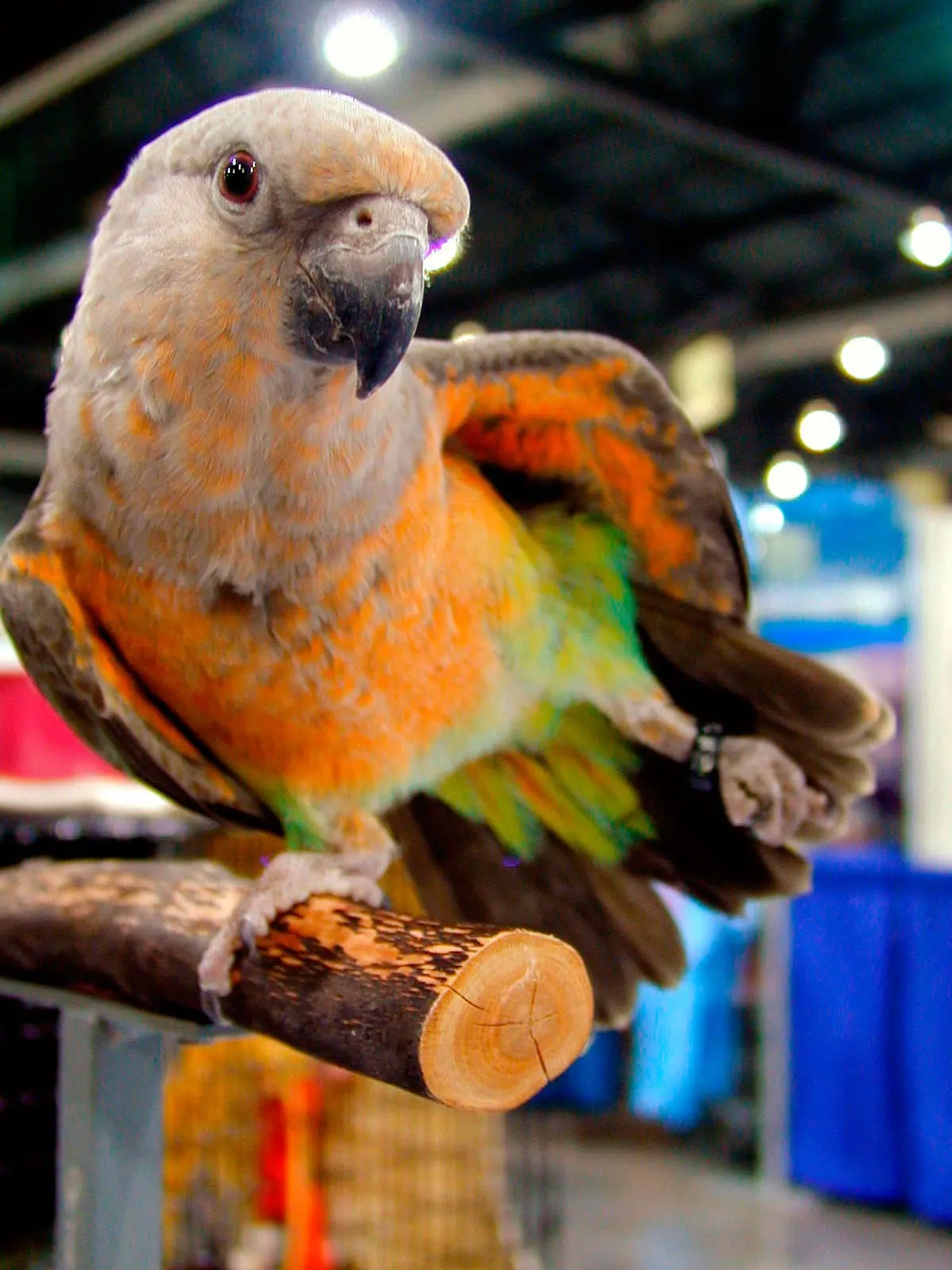
The Red-bellied Parrot (Poicephalus rufiventris) has the crown, nape and lores brown ash, the cheeks sometimes with orange tips; ear-coverts slightly paler. Mantle and scapulars brown ash; the back blue-black; rump iridescent pale blue or bluish green. Upper, the wings slightly darker than the head and back: the primaries brown. Under, the feathers of orange wings; underside of feathers Light brown flight. Throat and the chest ash brown with orange tint; top of the chest orange; belly up to undertail- coverts pale green sometimes shows Orange-tinged feathers. Tail dark brown ash.

Bill, cere and orbital skin black; irises orange-red; legs black.

The female You have the upper chest grey, the pale green underside sometimes dyed orange. The head paler and grayer than male. Feathers of the wings greyish.

Immature, generally, similar to females, but the young males have orange feathers Wings below and can show brown marks on the chest.

Description 2 subspecies:

  • Poicephalus rufiventris pallidus

    (Someren, 1922) – head of color Brown and throat clearer than the one of the species nominal..


  • Poicephalus rufiventris rufiventris

    (Ruppell, 1842) – The species nominal.

Habitat:

Usually associated with semiarid vegetation, including areas of dry scrub and forest steppe Acacia Commiphora. It tends to avoid the dense foliage and, often it perches on dead branches.

In the south of the range, He prefers savannas Adansonia.

Where it is sympatric with the Meyer's Parrot (West range) the Red-bellied Parrot riparian forests and avoid living in the most open savannas.

In Ethiopia They can be observed in areas of savannah Acacia-Chrysopogon, up to 2,000m. altitude.

In Somalia They are subject to seasonal altitudinal movements in relation to the food supply, moving in altitude of about 2,000m from July to September in search of wild figs Ficus. Otherwise, generally below 1,400m.

Usually, seen in pairs or in family groups 3-4 birds; rarely in larger flocks.

Reproduction:

Nest in cavities within terrestrial termite mounds, between 2 and 3 meters above ground or 10 meters or more, in some dead tree.

The female incubates the eggs while the male goes in search of food, these eggs hatch after a few 28 days and start flying to the 60 days after hatching.

A female was recorded under breeding conditions during the month of March (Tanzania) and feeding immature in July and October. Registered one laying in the months of May and June Ethiopia; In Somalia, between January and May; also recorded half-grown chicks in January. In Somalia in colonial times, with individual couples baobab, between 100 and 200 meters away. The implementation is of 1 to 2 eggs.

Food:

They feed on, besides the figs, seed (including Acacia), fruits of Egyptian balanites, Cordia ovation and Dalbergia melanoxylon, including the corn.

They drink frequently and often they can be found near the water.

Due to the limited food that is in their respective regions, the Red-bellied Parrot They reach the fields and harvest crops eaten, so they are often hunted by farmers.

Distribution:

Size of the area of distribution (reproduction / resident): 1.540.000 km2

endemic to eastern Africa, from the North-East of Tanzania, eastern and northern Kenya, in the horn of africa in the southern and eastern Ethiopia (included Rift Valley) and western and northern zone Somalia.

Usually common within its range. Absent in the coastal lowlands, mainly sedentary with seasonal movements in some areas.

Distribution 2 subspecies:

  • Poicephalus rufiventris pallidus

    (Someren, 1922) – It is found exclusively in eastern Ethiopia.


  • Poicephalus rufiventris rufiventris

    (Ruppell, 1842) – The species nominal.

Conservation:


minor concern


โ€ข Current Red List of UICN: Least concern

โ€ข Population trend: Stable

The Red-bellied Parrot It is included in the Appendix II according to CITES (The Convention on International Trade in Endangered Species of Wild Fauna and Flora) from 1981 and established as a lesser concern in the Red List of Threatened Species of the UICN since the population has fallen by more than 30% in the last 10 years. The Red-bellied Parrot it began exporting significant quantities primarily in Tanzania over the years 80. Years before it began to export to Great Britain in very small quantities.

"Red-bellied Parrot" in captivity:

In captivity is rare, although Spain Some important breeding centers have managed to bring them up without difficulty. This parrot can be purchased directly from a specialized breeding.

What pet They are very cheerful, Playful, Intelligent and affectionate, a generally peaceful nature.

They are not very noisy. He likes to climb and climb, great need to crack and it is always advisable a regular supply of fresh branches. They like to bathe.

With regard to its longevity, according to sources, a specimen lived 33,4 years in captivity.

Alternative names:

Red-bellied Parrot, African Orange-bellied Parrot, Orange-bellied Parrot, Red bellied Parrot (English).
Perroquet ร  ventre rouge (French).
Rotbauch-Mohrenkopf (German).
Papagaio-de-ventre-vermelho (Portuguese).
Lorito de Vientre Rojo, Lorito Ventrirrojo, Loro Abisinio (espaรฑol).

scientific classification:

Order: Psittaciformes
Family: Psittacidae
Genus: Poicephalus
Scientific name: Poicephalus rufiventris
Citation: (Rรผppell, 1842)
Protonimo: Pionus rufiventris

Images "Red Ventriloid Lori":

Videos "Red-bellied Parrot"

"Red Ventriloid Lori" (Poicephalus rufiventris)

Sources:

  • Avibase
  • Parrots of the World โ€“ Forshaw Joseph M
  • Parrots A Guide to the Parrots of the World – Tony Juniper & Mike Parr
  • Birdlife
  • Wikipedia
  • Loromania

  • Photos:

(1) – Red-bellied Parrot; a male juvenile pet parrot on a wooden perch stretching By Ruth Rogers [CC BY 2.0], via Wikimedia Commons
(2) – Mature breeding pair of Red-Bellied Parrots (Poicephalus rufiventris) on a perch in a cage. Picture taken by user:Fruitwerks at home By Fruitwerks at English Wikipedia(Original text: User:Fruitwerks on en wiki) (Transferred from en.wikipedia to Commons.) [Public domain], via Wikimedia Commons
(3) – A adult male pet Red-bellied Parrot perching on a bright red perch. Photography: one SB-600, diffused, hand held to the left and below Joey, fired with CLS, on TTL with no Compensation. By Bram Cymet [CC BY 2.0], via Wikimedia Commons
(4) – Red-bellied Parrot; a juvenile male pet parrot on a wooden perch. Shows back By Ruth Rogers [CC BY 2.0], via Wikimedia Commons
(5) – A Red-bellied Parrot at San Antonio Zoo, USA. In the male the abdomen is red-orange and in the female the abdomen is green, but the abdomen is not visible making it difficult to sex this parrot from the view shown By Zach Welty (originally posted to Flickr as Parrot 2) [CC BY-SA 2.0], via Wikimedia Commons

โ–ท The world of Pets: Dogs, cats, birds, reptiles, amphibians

White-crowned Parrot
Pionus senilis

White-crowned Parrot

Content


Anatomy-parrots

Description:

24 cm.. length and a weight between 193-229 g..

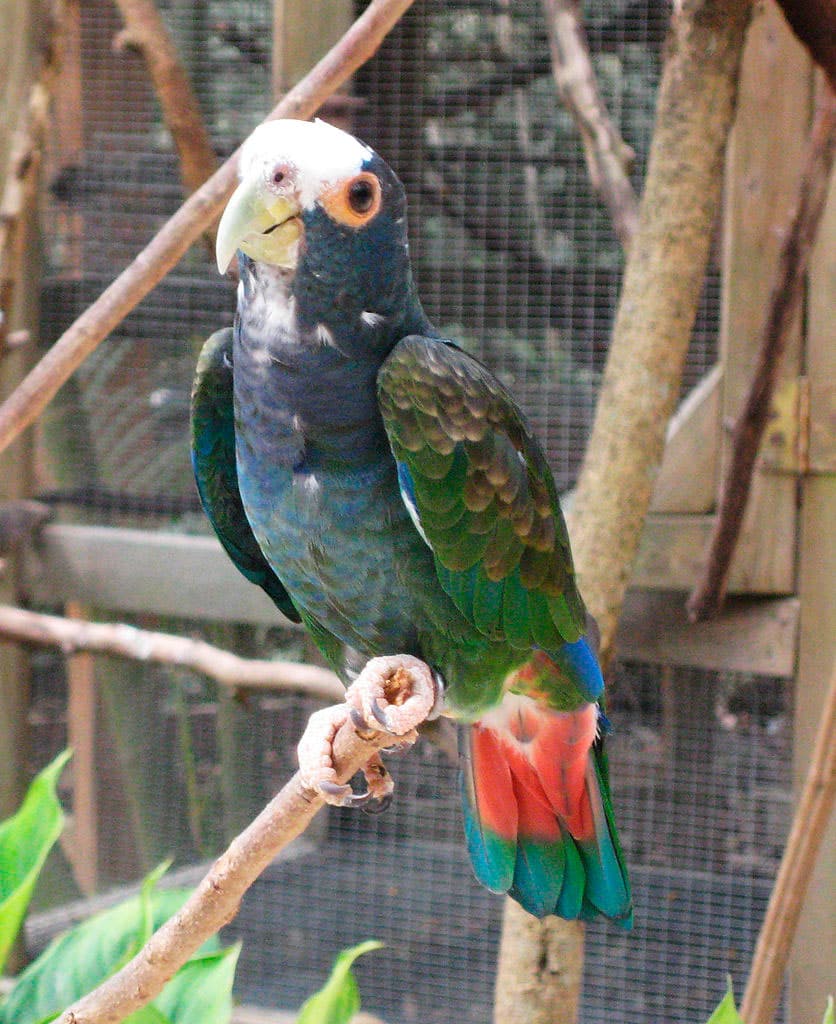
The White-crowned Parrot (Pionus senilis) has the forecrown, crown and lores, white. The feathers of the cheeks, sides head, behind eyes, and rear of the neck, basically pale bluish green with green or blue violet and blue subterminal band darker margins, giving the whole a intricate scaly appearance.

Mantle and back, green with copper plating shine; rump and uppertail-coverts, brighter green; scapulars basically colored green with coppery bronze in the points and outerweb. Lesser coverts and median, bronze with paler tips coppery, giving a mottled appearance; primary coverts, violet blue; greater coverts green. Primaries and secondaries outer, violet blue with green tips to outerweb of the primaries and inner secondary.

Under, the wings pale bluish green. Patch in chin and top of the throat, white; feathers of the chest, green at the base (mostly hidden part) tipped dark blue or violet-blue and blue band paler, giving the whole a scalloped effect; undertail-coverts red. Tail green in the center, outer feathers blue with red at base. Bill pale yellow color with light green tint; eye ring Pink; irises dark brown: legs yellowish gray.

Both sexes are similar. The immature has the head, the back of the neck and the chest, green, pale yellow with margins in the cheeks and crown, giving a pale mottling.

Note:

The subspecies decoloratus, which was distributed from yucatan peninsula to western Panama, previously recognized on the basis of their throat more purple (less blue) and your chest and wings, more blue. But, There is not much geographic variation in the species Pionus senilis and the aforementioned characters are not consistent on the proposed range.

  • Sound of the White-crowned Parrot.

Habitat:

The habitat of the Senile Parrot is mainly the humid forest (including tropical rain forest), but locally it can be found in forests of oak pine, and low mountain forest. Birds have been reported in forest edges, cultivated areas and grassland areas with scattered trees, plantations, secondary forest with emergent trees, woodlands and streams in Costa Rica, on the edge of urban areas.

Lives mainly in lowlands, but they are distributed locally 2.300 meters in Guatemala and near 1.600 meters in Costa Rica 1.800 meters in Panama. gregarious, mostly in pairs or out of breeding season, in small herds; sometimes in larger meetings of up to several hundred birds.

Reproduction:

Build your nests in tree cavities or hollow trunks of palm trees. The reproduction period occurs between February to May; in March in Mexico; in January-April Costa Rica; February to May in Honduras. The incubation comprises of 26-28 days, Followed by 54-68 pup growth days. It has been difficult to breed the species in captivity and there is little information on its reproduction in the wild..

The size of clutch is of 3 to 5 eggs

Food:

It feeds mainly on the tops of the trees seeds mature Inga and Erythrina and fruits Palm; sometimes cultures corn and Sorghum.

Distribution and status:

Size of its range (breeding/resident ): 1.290.000 km2

Endemic to Central America, from Mexico until Panama.

The White-crowned Parrot It is found in the humid tropics of eastern Mexico on the Caribbean side of Tamaulipas and to the East of San Luis Potosi eastward through yucatan peninsula, in Campeche and Quintana Roo, the borders of Belice and the northern lowlands and highlands of eastern Guatemala. It is found throughout the Caribbean slope of Honduras, mainly below 1.100 m (Occasionally highest altitudes) and in Roatan in the Bay islands, and on the Caribbean side of Nicaragua (possibly also on the side of peaceful) until Costa Rica, where it remains mainly in the lowlands and foothills of the Caribbean slope, becoming less and less numerous south of Lemon; also observed in the slope of peaceful in the South of Costa Rica and on both sides West Panama, to the West of Chiriqui and to the West of Bull's mouths.

Some local migrations (also apparently vertical) occur (for example, in parts of Oaxaca, Mexico and parts of Costa Rica). The species is widespread, but abundance varies from rare to very common depending on locality; It is perhaps the largest parrot in Costa Rica.

current distribution: No data where the current distribution of specified White-crowned Parrot. This species of psittacine still has a presence throughout its range, although there are regions where it has been extirpated, as the West's Quintana Roo and Gulf Coast (INE 2000).

Despite being frequently eaten by native peoples (at least once), persecuted as a pest of crops, caught in low numbers for the live bird trade and severely deforesting parts of their range, It has not detected a serious overall decline in population.

Conservation:


minor concern


โ€ข Current category of the Red List of the UICN: Least concern.

โ€ข Population trend: decreasing.

sheltered Mexico by the Official Mexican Standard (NOMโ€“059โ€“SEMARNATโ€“2001โ€“2010) under the category of Threatened.

Rationale for the Red List category

This species has a very large range and therefore it is not close to the thresholds for Vulnerable under the criterion of size range (Extension Occurrence <20,000 km2 combinada con un tamaรฑo de rango decreciente o fluctuante, extensiรณn / calidad de hรกbitat o tamaรฑo de poblaciรณn y un pequeรฑo nรบmero De lugares o fragmentaciรณn severa). A pesar de que la tendencia de la poblaciรณn parece estar disminuyendo, no se cree que la disminuciรณn sea suficientemente rรกpida para acercarse a los umbrales de Vulnerables bajo el criterio de tendencia poblacional (> 30% decline in ten years or three generations). The population size is very large and, therefore, not approaching the thresholds for vulnerable under the criterion of population size (<10.000 individuos maduros con una disminuciรณn continua estimada en> 10% in ten years or three generations or with a specific population structure). For these reasons the species is evaluated as the least concern.

Justification of the population

Partners in Flight estimates the total population of 50.000-499.999 individuals (A. Panjabi in a bit., 2008).

Justification of trend

It is suspected that the population is declining due to continuous habitat destruction.

"White-crowned Parrot" in captivity:

(CITES) It included in the Appendix II (It includes species not necessarily threatened with extinction, but in which trade must be controlled to avoid utilization incompatible with their survival.)

The species ranked first in the 80's among the most traded parrot species in Mexico (Iรฑigo Elias and Ramos 1992). Currently, there marketing of the species in the national and international market.

Valued as a pet or ornamental bird by its feathers, ability to imitate sounds and its tendency to form bonds with people.

Alternative names:

White-crowned Parrot, White crowned Parrot, White-capped Parrot (English).
Pione ร  couronne blanche, Pione givrรฉe, Pionus ร  front blanc, Pionus ร  front blanche (French).
Glatzenkopfpapagei, Glatzenkopf, Glatzenkopf-Papagei, WeiรŸkappenpapagei (German).
Curica-de-testa-branca (Portuguese).
Lora coroniblanca, Loro Corona Blanca, loro corona-blanca, Loro Coroniblanco, Loro de Corona Blanca, Loro Gorgiblanco, Loro Senil (espaรฑol).
Loro coroniblanco (Costa Rica).
Lora coroniblanca (Honduras).
loro corona blanca, loro corona-blanca, Loro Coroniblanco (Mexico).
Loro Gorgiblanco (Nicaragua).


scientific classification:

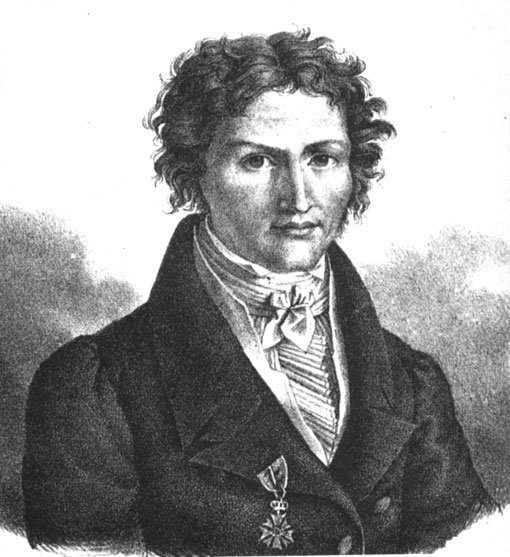
Johann Baptist von Spix

Order: Psittaciformes
Family: Psittacidae
Genus: Pionus
Scientific name: Pionus senilis
Citation: (von Spix, 1824)
Protonimo: Psittacus senilis


Images "Loro Senile":

Videos "White-crowned Parrot"

————————————————————————————————

"Their Senil" (Pionus senilis)


Sources:

Avibase
– Parrots of the World โ€“ Forshaw Joseph M
– Parrots A Guide to the Parrots of the World – Tony Juniper & Mike Parr
– Birdlife

Photos:

(1) – A White-crowned Parrot (also known as White-crowned Pionus) at Macaw Mountain Bird Park, Honduras By Pionus_senilis_-Macaw_Mountain_Bird_Park,_Honduras-8a.jpg: Sarah and Jasonderivative work: Snowmanradio [CC BY-SA 2.0], via Wikimedia Commons
(2) – A White-crowned Parrot (also known as White-crowned Pionus) at Macaw Mountain Bird Park, Honduras By nakashi (Flickr: P1100396) [CC BY-SA 2.0], via Wikimedia Commons
(3) – A White-crowned Parrot (also known as White-crowned Pionus) at Macaw Mountain Bird Park, Honduras By nakashi (Flickr: P1100397) [CC BY-SA 2.0], via Wikimedia Commons
(4) – (Pionus Senilis). White-crowned Parrot , Guatemala By Virgilrm at English Wikipedia (Transferred from en.wikipedia to Commons.) [Public domain], via Wikimedia Commons
(5) – A White-crowned Parrot (also known as White-crowned Pionus) at Macaw Mountain Bird Park, Honduras By nakashi (Flickr: P1100398) [CC BY-SA 2.0], via Wikimedia Commons
(6) – White-crowned Parrot (also known as the White-crowned Pionus); close up of upper body By Brian Gratwicke [CC BY 2.0], via Wikimedia Commons
(7) – A White-crowned Parrot at Cape May Zoo, New Jersey, USA By Jim Capaldi (Flickr: Parrot) [CC BY 2.0], via Wikimedia Commons
(8) – (Pionus Senilis) White-crowned Parrot in a tree By Virgilrm at English Wikipedia (Transferred from en.wikipedia to Commons.) [Public domain], via Wikimedia Commons
(9) – White-crowned Parrot (Pionus senilis), also known as White-crowned Pionus, at the aviary Birds of Eden in South Africa By SandyCole (mailto:sandyc@dicksandy.org) (Own work) [CC BY-SA 3.0 or GFDL], via Wikimedia Commons

Sounds:

โ–ท The world of Pets: Dogs, cats, birds, reptiles, amphibians

Vernal hanging parrot
Loriculus vernalis

Vernal hanging

Content

Description

Solo 14 cm.. length and 28 g. of weight.

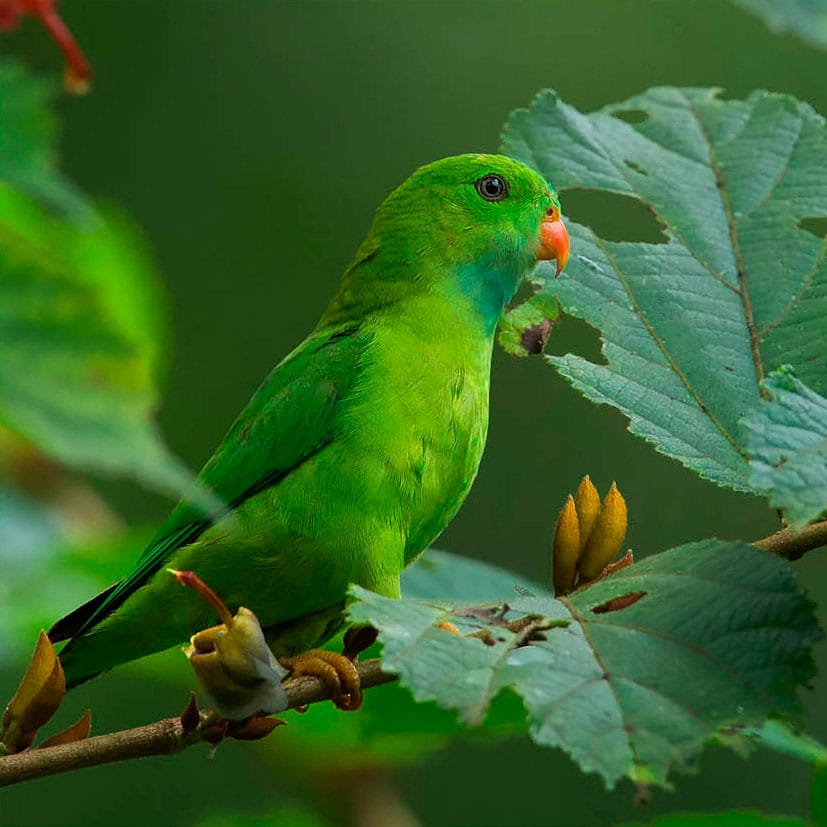
The head of the Vernal hanging parrot (Loriculus vernalis) is bright green, lighter and more yellowish in the chin. Rest of the upper region green, with the bottom of the back, rump and upper coverts bright crimson. Wing coverts a little darker than the the mantle green. Primaries bright green with vane inner blackish and a light blue-green diffusion in the feathers of the vane outer; secondaries Black with exterior bands of green and a bit of green in vane inner. Under the wing a brilliant turquoise blue, except coverts and axillary, that are pale green. The underparts more greenish-yellow that the upperparts, with a patch light blue in the throat. Upper, the tail green; Turquoise Blue below.

Bill coral red with yellow tip: irises Brown to yellowish-white; the legs they pale brown to yellowish Orange.

The females they are slightly more off than males and have a patch blue in the throat less extensive.

The young birds lack of the patch blue in the throat and have a bill paler, the rump narrow and green feathers of the tail and legs brown.

The young birds they need at least a year to mature.

  • Sound of the Vernal hanging parrot.
[audio:HTTPS://www.mascotarios.org/wp-content/themes/generatepress_child/sonidos/Loriculo Vernal.mp3]

Habitat:

Some movements, possibly related to seasonal rains, have been observed, but they require further study. The species is found in a variety of habitats, including Evergreen deciduous forests and, next to clear forest, secondary growth, bamboo thickets, orchards and too grown crops, up to approximately 2.000 m.

The birds are found in pairs, family nuclei, loose herds of up to 50 individuals or groups mixed with other birds. Their size and coloration make it a discrete ave, but they are not shy and can be found feeding in the canopy, Sometimes the attention of an observer with short flights and circular around the tops of the trees.

Jump between the branches and climb swiftly using both beak and legs, sometimes form 'spirals'’ to ascend. Lie, They groom and sleep strung upside down one or both legs, Although juveniles may remain in vertical position, scratching your head over the wing.

Reproduction:

Like the Lovebirds, cut small strips of bark, leaves and other plant materials, they put them in the contour feathers and carried them to the nest as an overlay. The breeding occurs between January and April; between two and four whites, often spotted brown eggs, they are deposited in the cavity of a rotten trunk. The narrow entrance is sometimes enlarged by birds, and the deep hole can extend below the ground level in exceptional cases.

The incubation, that lasts around 22 days, It is carried out by the female. The male helps feed the chicks as they mature over a five-week period..

Food:

They feed on acrobatic form of nectar in the trees in flower (for example, trees of Coral Erythrina) and in fruit trees especially figs Ficus or guava (Psidium guajava), as well as various berries and plant species such as bamboo and casuarina. Also consume collected potted Palm wine, and they can then take, and damage to orchards.

Distribution:

Size of its range (reproduction / resident): 6.460.000 km2

widespread, from the West coast of the India some 19 ยฐ Norte, through at least Maharashtra, Madhya Pradesh, Karnataka, Kerala, Tamil Nadu, Andhra Pradesh, Orissa, West Bengal, Assam, Nagaland, Manipur and Tripura, and is also distributed in the Andaman and Nicobar Islands. In Nepal is distributed in small amounts in the lowlands of the Terai , and also have been in the area of Chitwan.
Observed in Bhutan; Southwest of Sichuan through Yunnan, and possibly in Kwangtung, in China; Sylhet, Quotation mark and Chittagong in Bangladesh; Myanmar including the Mergui archipelago: Thailand Around South of 10 ยฐ Norte (also observed to the South, on Phuket Island); Laos; Cambodia; and Viet Nam. The species has not been recorded in Sikkim, Hong Kong and Malaysia.

Conservation:

โ€ข Current IUCN Red List category: Least concern

โ€ข Population trend: Stable

The size of the world's population has not been quantified, It is thought that it may be above the 1.000.000 of copies. The species according to information, is very rare in China, in general, common elsewhere (pit et to the. 1997).

The population is suspected to be stable in the absence of evidence of any reduction or substantial threats.

"Vernal hanging parrot" in captivity:

Limited number in captivity

Alternative names:

Vernal Hanging-Parrot, Indian Hanging Parrot, Indian Hanging-Parrot, Indian Lorikeet, Vernal Hanging Parrot (ingles).
Coryllis vernal, Coryllis d’Inde, Loricule vernal (French).
Frรผhlingspapageichen, Frรผhlings-Papageichen (German).
Lรณris-indiano (Portuguese).
Lorรญculo Vernal (espaรฑol).

scientific classification:

Order: Psittaciformes
Family: Psittaculidae
Genus: Loriculus
Scientific name: Loriculus vernalis
Citation: (Sparrman, 1787)
Protonimo: Psittacus vernalis

Vernal Parrot Images:

————————————————————————————————

Vernal hanging parrot (Loriculus vernalis)


Sources:

Avibase
– Parrots of the World โ€“ Forshaw Joseph M
– Parrots A Guide to the Parrots of the World – Tony Juniper & Mike Parr
– Birdlife

Photos:

(1) – ยซLoriculus vernalis-Ganeshgudi, Karnataka, India-male-8-1cยป by Loriculus vernalis-Ganeshgudi,_Karnataka,_India_-male-8. jpg: viwakederivative work: Snowmanradio – This file was derived from:Loriculus vernalis-Ganeshgudi,_Karnataka,_India_-male-8. jpg . Licensed under CC BY-SA 2.0 via Wikimedia Commons.
(2) – ยซVernal Hanging Parrotยป by Jason ThompsonFlickr: Vernal Hanging Parrot. Licensed under CC BY 2.0 via Wikimedia Commons.
(3) – By viwake [CC BY-SA 2.0], via Wikimedia Commons
(4) – A male bird – Author vasanthan.p.j – lynx
(5) – ยซLoriculus vernalis-Prague Zoo, Czech Republic-male-8aยป by Jozef MurgaลกZOO Praha 34Uploaded by snowmanradio. Licensed under CC BY-SA 2.0 via Wikimedia Commons.

Sounds: Mathias Ritschard (Xeno-canto)

โ–ท The world of Pets: Dogs, cats, birds, reptiles, amphibians

Short tailed Parrot
Graydidascalus brachyurus

Short tailed Parrot

Content

Short tailed Parrot

Description:

23 to 24 cm.. height and between 188 and 233 g. weight.

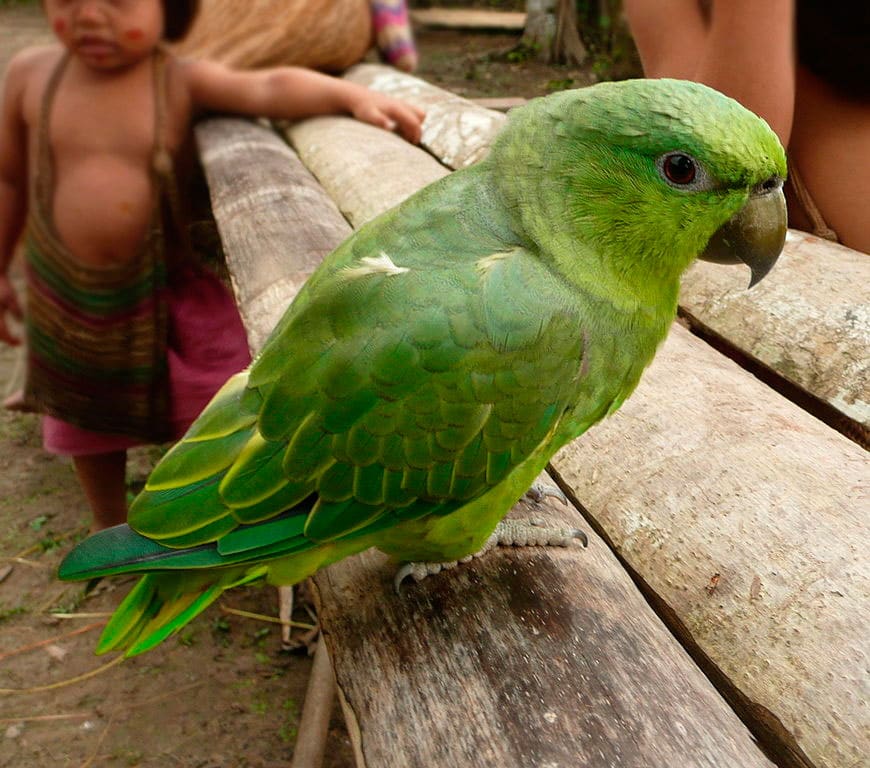
The short tail Short tailed Parrot (Graydidascalus brachyurus) It is the most distinctive, although it is also known the eyes red orange.
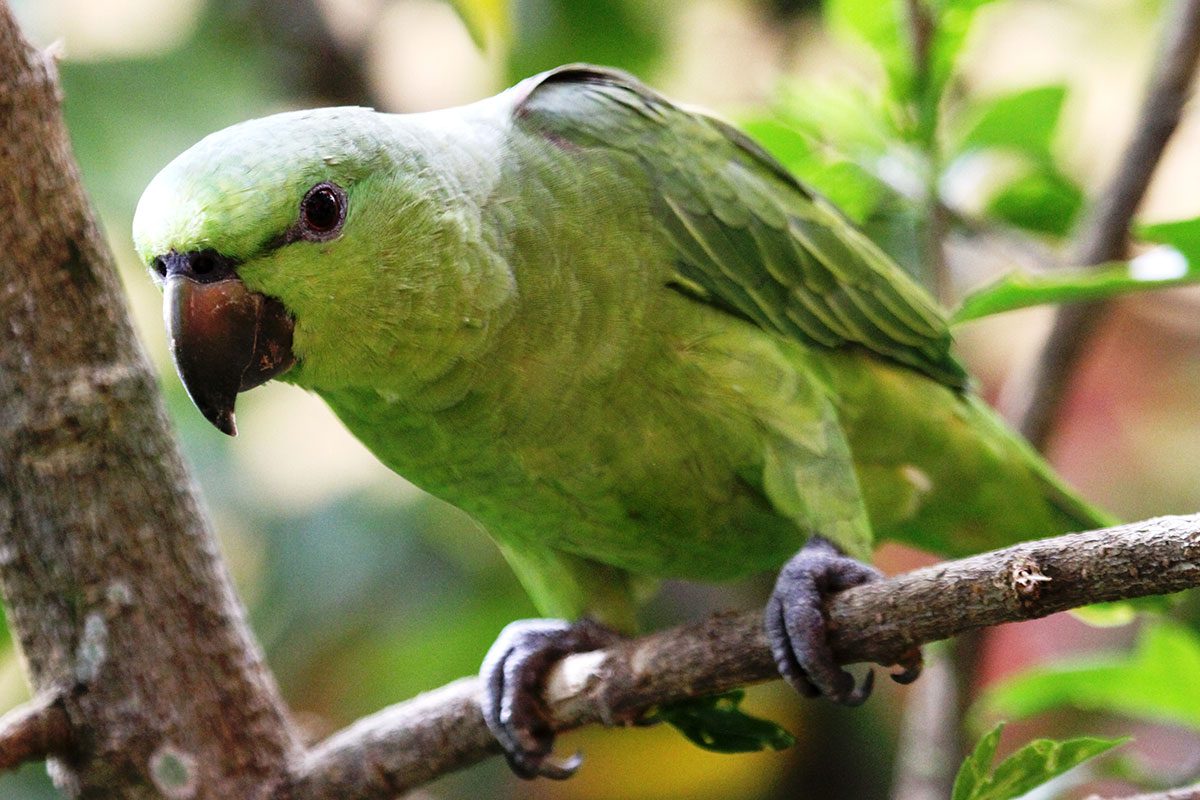
generally green, somewhat yellowish on wing and the belly; Flying red noted in the base of the outer feathers tail and a small upper portion of wing towards the armpit.

The beak is greenish gray, large.
The sexual dimorphism in this species it is absent.

This species, the only one of the genre Graydidascalus, is related with the Yellow-faced Parrot (Alipiopsitta xanthops), own kind of Bolivia and Brazil.

Habitat:

It inhabits in swampy forests, intervenidas, River Islands, borders of humid and semi-humid forest, until the 400 m, associated with river banks.

Fly quickly in large groups of up to 50 individuals, is very noisy and visit populated places. They are very social outside the breeding season. It will associate with other species of parrots in the wild.

Reproduction:

With plays during the last quarter of the year.
Successes captive breeding have not yet been registered; although several females put one or two eggs, but no chicks. In its natural habitat, the clutch average consists of 3 to 4 eggs. The period of incubation is of 24 to 25 days.

Food:

Consume large variety of fruits (very fond of guava), tubers and possibly berries, seeds, sprouts and flowers. Foraging in the treetops.

Distribution:

Size of the area of distribution (reproduction / resident): 3.870.000 km2

Its population is distributed among the rivers of the southeast of Colombia, east of Ecuador, northeastern Peru and northern Brazil, on Basin Amazon.

Conservation:


minor concern


โ€ข Current category of the Red List of the UICN: Least concern.

โ€ข Population trend: Decreasing.

Justification of the population

The population size World has not been quantified, but this species is described as ยซquite commonยป (Stotz et to the., 1996).

Justification of trend

It is suspected that this species has lost 19.1-20.4% of habitat within its distribution over three generations (15 years) based on a model of Amazon deforestation (Soares-Filho et to the., 2006, Bird et to the., 2011). Given the susceptibility of the species to hunting and / or capture, you suspect your decrease in population <25% over the next three generations.

"Short tailed Parrot" in captivity:

Rare in captivity. Young people are susceptible to stress and disease.

Alternative names:

Short-tailed Parrot, Short tailed Parrot (English).
Caรฏque ร  queue courte, Perroquet ร  queue courte, Perroquet nain de Panama (French).
Kurzschwanzpapagei, Kurzschwangenpapagei (German).
curica-verde, curica-pequena, curiquinha, papagainho-verde (Portuguese).
Cotorra Colicorta, Cotorrita Cabezona, Lorito Colicorto (espaรฑol).
Cotorra Colicorta (Colombia).
Loro de Cola Corta (Peru).

scientific classification:

Order: Psittaciformes
Family: Psittacidae
Genus: Graydidascalus
Scientific name: Graydidascalus brachyurus
Citation: (Temminck & Kuhl, 1820)
Protonimo: Psittacus brachyurus

Images ยซLorito Colicortoยป:

Short tailed Parrot
Peruvian Indians with Short-tailed Parrot (Graydidascalus brachyurus)

Videos "Short tailed Parrot"

"Lorito Colicorto" (Graydidascalus brachyurus)


Sources:

  • Avibase
  • Parrots of the World โ€“ Forshaw Joseph M
  • Parrots A Guide to the Parrots of the World – Tony Juniper & Mike Parr
  • Birdlife
  • Parrot Book, Parrots and macaws Neotropical

  • Photos:

(1) – IBC.lynxeds.com
(2) – Peruvian Indians with Short-tailed Parrot (Graydidascalus brachyurus) By derivative work: Snowmanradio (talk)Peruvian_Indians_with_Short-tailed_Parrot-6.jpg: Shea Hazarian [CC BY 2.0], via Wikimedia Commons
(3) – Plate 155. Psittacus viridissimus. Green Parrot. Modern accepted name (2012) is Graydidascalus brachyurusBy William Swainson, F.R.S., F.L.S. (Zoological Illustrations, Volume III.) [Public domain], via Wikimedia Commons