โ–ท The world of Pets: Dogs, cats, birds, reptiles, amphibians

Plum-faced Lorikeet
Oreopsittacus arfaki

Plum-faced Lorikeet

Content

Description

15 cm.. length between 16 and 23 g. of weight.
Plum-faced Lorikeet

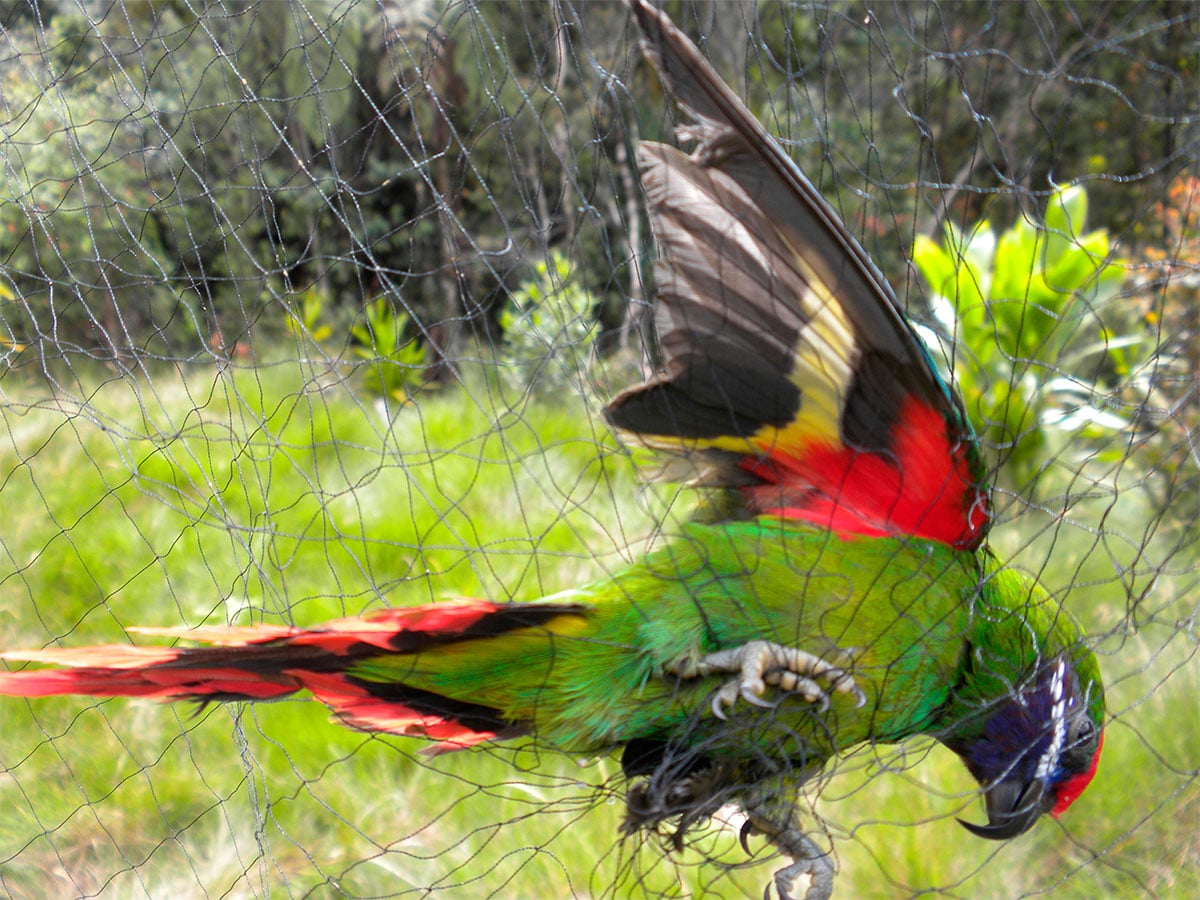
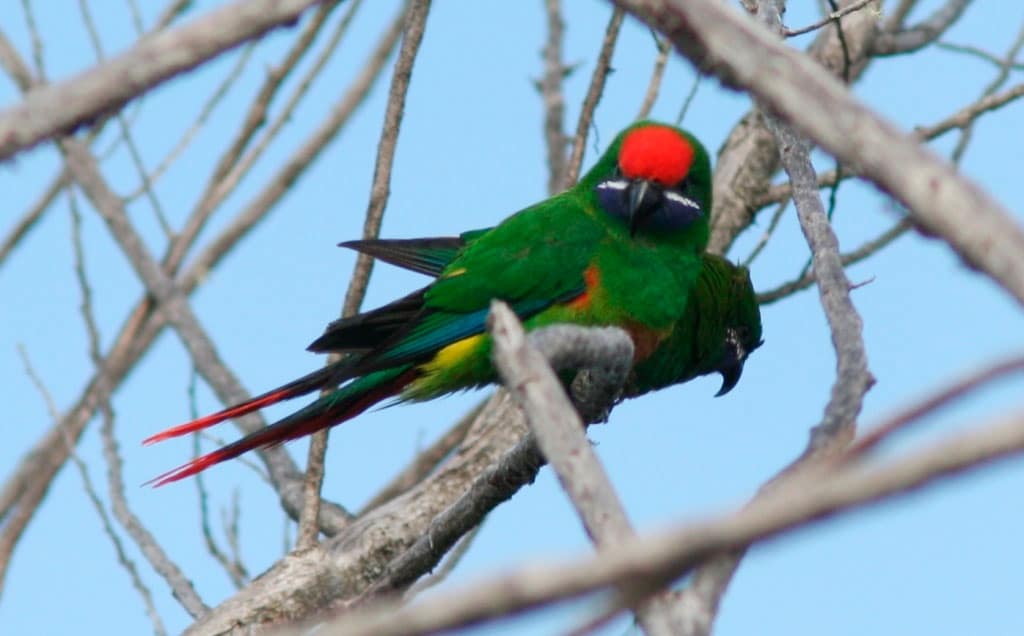
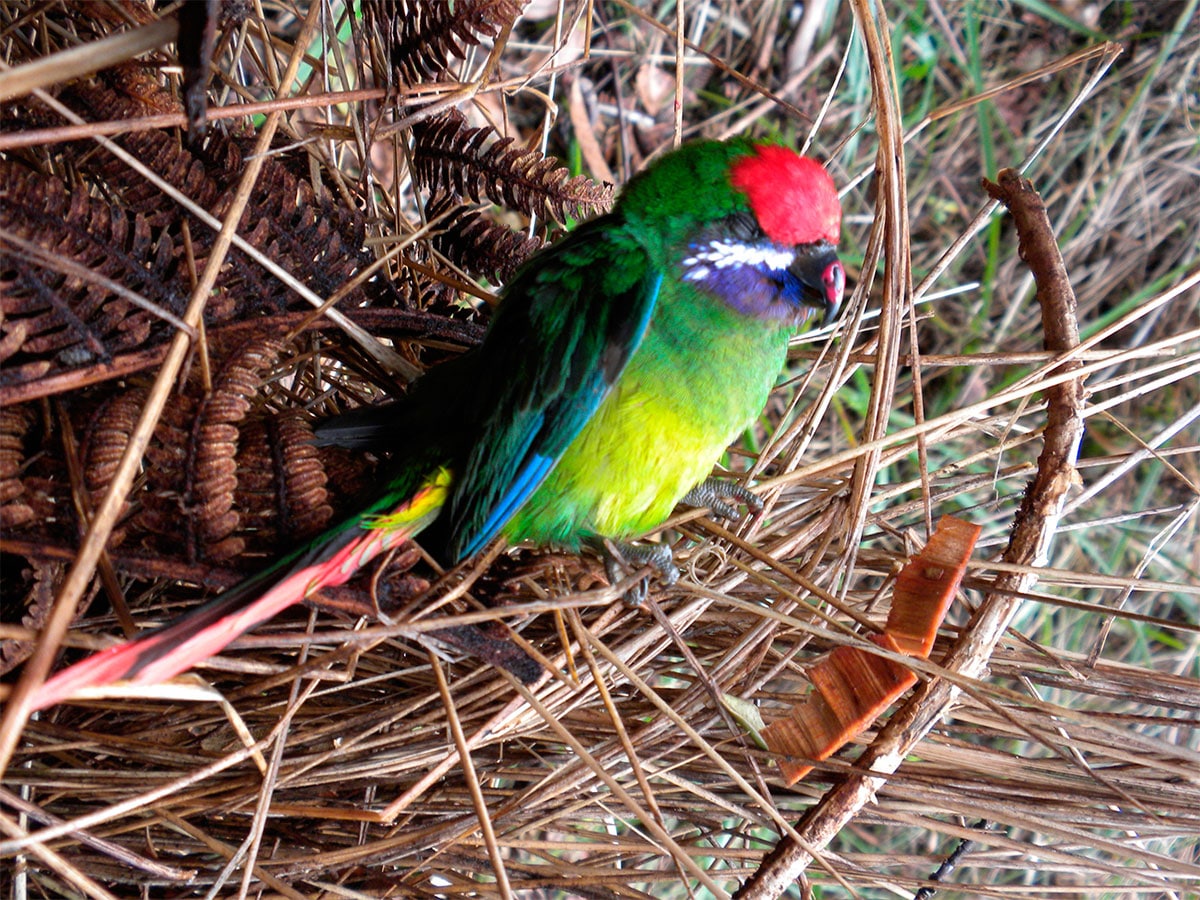
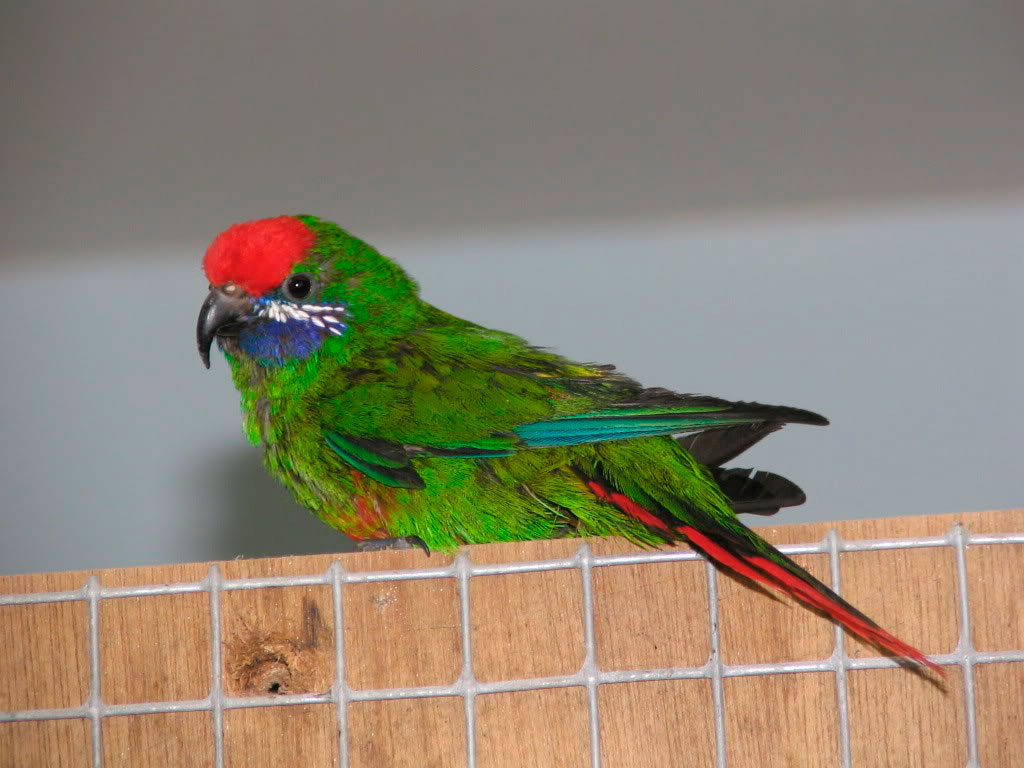
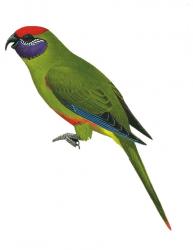
The hood of the Plum-faced Lorikeet (Oreopsittacus arfaki), from the top of bill up to the crown rear, is Scarlet Red ; chin and Spada color plum (with bluish Sheen), broken by two rows of thin stripes.

Upperparts of color green uniform with a light spread of olive in the the mantle. Wings, views from the top are green; vane internal to the flight feather, blackish in color and vane external to the primaries outermost, bluish green. Underwing-coverts and axillary, red (Outer secondaries slightly marked with yellow); flight feather Blackish with yellow central band. The mauve of it chin be extended slightly in the throat; top of the chest green, center of chest and belly bathed in orange-red; under belly green; undertail-coverts green, lightly bathed in yellow on sides. Uppertail green, merging to blackish and ending in pinkish-Red, in the tip lighter fusion: below, the tail is red with marked with black side feathers.

The bill black; irises blackish brown; legs grey.

Female lack of top red (but you can show a bit of red on the part rear of the Crown).

Immature male with only red on the back of the crown. The young birds have a slightly 'scaly' appearance; also off the tip of orange-yellow color of the tail.

Description 3 subspecies

  • Oreopsittacus arfaki arfaki

    (Meyer,AB, 1874) – The nominal.


  • Oreopsittacus arfaki grandis

    : (Ogilvie-Grant, 1895) – Greater than the nominal. Lack of the flanks redorange and markings of the belly of the other two subspecies.


  • Oreopsittacus arfaki major

    : (Ogilvie-Grant, 1914) – Larger that the nominal and more red-tipped in the tail.

Habitat:

The distribution of the Plum-faced Lorikeet is more or less continuous in the extension of the moss forests; the species is mainly found among the 2.000 and 3,750 m, but can observe is to 1.000 m occasionally. Be found with greater frequency in pairs or small flocks very vocal. They feed acrobatically in the canopy; They also feed on plants, especially in the flowers of epiphytes, often in the company of other flower aficionados such as the lories of the genus Neopsittacus.

Reproduction:

Habits of nesting unknown, birds in reproductive attitudes they have been observed in August and October. The display of marks under the wings have been observed in pairs and can be linked to courtship, as well as by the male head rolling.

Food:

It feeds on pollen, nectar, possibly, flowers, fruit (especially Schefflera) and berries.

Distribution:

Size of the area of distribution (reproduction / resident): 108.000 km2

New Guinea in Irian Java (Indonesian) and Papua New Guinea, ranging from the East ofVogelkop to the Huon Peninsula and ranges from the Southeast. A small number of captivity

Distribution 3 subspecies:

  • Oreopsittacus arfaki arfaki

    (Meyer,AB, 1874) – The nominal.


  • Oreopsittacus arfaki grandis

    : (Ogilvie-Grant, 1895) – Mountains of the Central and East of Papua New Guineto, including, those in the southeast of the region of the Huon Peninsula and Sepik, extending to the West of Victor Emanuel Range


  • Oreopsittacus arfaki major

    : (Ogilvie-Grant, 1914) – Snow Mountains (Papua New Guinea)

Conservation:


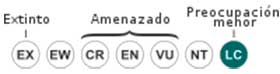
minor concern

โ€ข Current IUCN Red List category: Least concern

โ€ข Population trend: Stable

The world population It has not been quantified, Although it is thought of more than 300.000 specimens. The species is reported to be quite common (pit et to the. 1997).

The population suspected to be stable in the absence of evidence of any reduction or substantial threats.

"Plum-faced Lorikeet" in captivity:

The Plum-faced Lorikeet is a bird quiet and at times active. Young birds are susceptible to stress and disease during the acclimatization; can die suddenly without apparent cause. They become much more resistant and less timid after acclimatization.. You can be accommodated with members of their own species in a system of colony.

It is very rare in captivity.

Alternative names:

– Plum-faced Lorikeet, Plum faced Lorikeet, Plum-faced Mountain Lory, Plum-faced Mountain-Lory, Whiskered Lorikeet (ingles).
– Lori bridรฉ (French).
– Arfaklori, Arfakalori (German).
– Lori Bigotudo, Lori de Bigotes (espaรฑol).

scientific classification:

– Order: Psittaciformes
– Family: Psittaculidae
– Genus: Oreopsittacus
– Scientific name: Oreopsittacus arfaki
– Citation: (Meyer,AB, 1874)
– Protonimo: Trichoglossus (Charmosyna) Arfaki

ยซWhiskered Loryยป Images:

Videos "Plum-faced Lorikeet"

————————————————————————————————

ยซOn Bigotryยป (Oreopsittacus arfaki)


Sources:

– Avibase
– Parrots of the World โ€“ Forshaw Joseph M
– Parrots A Guide to the Parrots of the World – Tony Juniper & Mike Parr
– Birdlife

– Photos:

(1) – Dansk Lori Klub
(2) – arfak lori man oreopsittacus arfaki – photobucket
(3) – By Katerina Tvardikova – pngbirds.myspecies.info
(4) – By Guy Dutson – lynx
(5) – By Katerina Tvardikova – pngbirds.myspecies.info
(6) – Illustration – HBW.com

– Sounds: Patrik ร…berg (Xeno-canto(

โ–ท The world of Pets: Dogs, cats, birds, reptiles, amphibians

Camiguin Hanging Parrot
Loriculus camiguinensis


Loriculo the Camiguin

Content

Description

14 cm.. length.

The Camiguin Hanging Parrot (Loriculus camiguinensis) has the plumage mostly green, with the throat, front side of the face and the thighs light blue; the forecrown, the pyleus, the obispillo and the top of the tail red, While the rest of the tail It is also blue. Underwing coverts blue. Band of orange-red in the nape, that varies from bird to bird.

Bill orange. Iris grayish brown.

The males and females they have a similar appearance, the female has less blue on the cheeks.

The youth they are similar to the adult female but with only a slight tinge of blue in the cheeks and red on the forehead minimal or absent. Bill a pale.

In 2006 described as a separate species to the loricles who lived on the island of Camiguin, to the North of Mindanao, Since then it was considered a subspecies of the Philippine loricle in the.

Habitat:

Probably sedentary. Found between the 300 and 1350 meters in montane forests, secondary forests, at the edges of the forest near the settlements, in plantations in the areas planted with shrubs and coconut.

Usually seen individually, in pairs, mixed flocks or small families. Feeds in trees or shrubs; difficult to detect. Itร‚ยดs shy and cautious.

Reproduction:

Breeding season probably between the months of September to November. Nest placed in the hole of a dead arbol-helecho. No other information.

Food:

It is said that they feed on nectar, seeds, especially wild banana (Musa), also soft fruit, berries and flowers.

Distribution:

Endemic in the Philippine island of Camiguin, off the North coast of Mindanao.

Conservation:


minor concern


This species is threatened by its limited range, the natural habitat destruction and capture for the wild bird trade.

"Camiguin Hanging Parrot" in captivity:

Probably not remain outside the island of Camiguin.

Alternative names:

– Camiguin Hanging-parrot, Camiguin Hanging Parrot (ingles).
– Coryllis de Camiguin (French).
– Camiguin-Fledermauspapagei, Camiguinpapageichen (German).
– Loriculus camiguinensis (Portuguese).
– Lorรญculo de Camiguin (espaรฑol).

scientific classification:

– Order: Psittaciformes
– Family: Psittaculidae
– Genus: Loriculus
– Scientific name: Loriculus camiguinensis
– Citation: Tello, Degner, Bates,JM & Willard, 2006

Images "Camiguin Hanging Parrot"

Videos "Camiguin Hanging Parrot"

————————————————————————————————

"Camiguin Loricle" (Loriculus camiguinensis)


Sources:

– Avibase
– Parrots of the World โ€“ Forshaw Joseph M
– Parrots A Guide to the Parrots of the World – Tony Juniper & Mike Parr
– Wikipedia

– Photos:

(1) – By Alexkant – zoochat

– Sounds: George Wagner (Xeno-canto)

โ–ท The world of Pets: Dogs, cats, birds, reptiles, amphibians

Golden-mantled Racquet-tail
Prioniturus platurus


Golden-mantled Racquet-tail

Content

Golden-mantled Racquet-tail

Description

28 cm.. length and a weight between 200 and 225 g..

The head of the Golden-mantled Racquet-tail (Prioniturus platurus) is light green. The crown Violet gray with a red spot on the front edge; rear of the neck Ocre-Naranja. Mantle light grey, changing to green (marked in grey) on the back; rump and uppertail-coverts green. Wing coverts green, strongly impregnated with pale grey (more green in the coverts more internal); primaries Greens with vane Dark internal; secondary internal green with yellow line in the margins; bend of wing grey violet, carpal edge yellow. Wing feathers green; underside of flight feather marked in blue. Underparts brighter yellowish green, more green in the upper part of the chest, and yellow in the undertail-coverts. Upper, the tail green in the center, dotted in bluish black on the sides; undertail, the tail pale blue; spatulas blackish.

Bill pale grey, with the lower jaw and the tip of the bill darker; irises dark brown; legs grey.

The female lacks the color red and blue marks from the crown and of the collar back orange; underparts washed in less differentiated grey; rackets shorter tail.

Immature without rackets the tail.

Subspecies:

  • Prioniturus platurus platurus

    – The nominal.


  • Prioniturus platurus talautensis

    – (Hartert, E, 1898) Paler in general males; less grey on the mantle and the upper wing coverts; stain clear reddish pink on the back of the Crown with most blue patch.
    The female as the nominal species but green with paler
    Juveniles as the nominal species but also with the Green pale


  • Prioniturus platurus sinerubris

    – (Forshaw, 1971) Males with reddish pink spot away from the back of the Crown; mantle and upper wing coverts, green, slightly washed with grey; curve of wing and lesser coverts bathed in purple; smaller.

Habitat:

The Golden-mantled Racquet-tail inhabits the edges of humid forests, forests, orchards and forests of the lowlands Moss, to 2.000 m (most common above 1.000 m). The birds are seen generally in small noisy groups of 5-10 Member, flying over the forest, or during daily movements between the feeding and rest areas.

Reproduction:

A female in breeding condition was observed in October and the nest was in a hollow tree; nothing more is known about the reproductive behavior of the species.

Food:

Have been seen feeding on fruiting mango (Mangifera indica), and the diet includes fruits, seeds and flowers.

Distribution:

Size of the distribution (reproduction / resident): 186.000 km2

Restricted to Sulawesi and nearby islands, including Talaud, Siau, Lembeh, Togian, Group Banggai, Ambon, Muna and Button. Usually, the species is common and the world population is considered to be above 10.000 exemplary and stable: Nominal race numbers are calculated to be above the 10.000 birds and stable, the subspecies talautensis It is less numerous with a population of about of 5.000 specimens, and the sinerubris It is thought that it may be around 10.000 exemplary and probably stable.

Subspecies distribution:

  • Prioniturus platurus platurus

    – The nominal.


  • Prioniturus platurus talautensis

    – (Hartert, E, 1898) Is distributed in the Talaud Islands.


  • Prioniturus platurus sinerubris

    – (Forshaw, 1971) Is distributed in Taliabu and Mangole in the Sula Islands

One of the places where you can see this bird is the Gunung Ambang nature reserve in Sulawesi.

Conservation:


minor concern


โ€ข Current category of the Red List of the UICN: Least concern

โ€ข Population trend: Stable


The size of the world population It has not been quantified, Although it is estimated that it may be between 10,000 and 20,000 specimens. The species is described as common (pit et to the. 1997).

The population is suspected to be stable in the absence of evidence of any reduction or substantial threats.


"Golden-mantled Racquet-tail" in captivity:

Susceptible to fungal infections.
Rare in captivity.

Alternative names:

– Golden-mantled Racquet-tail, Gold-backed Racquet-tail, Gold-backed Racquet-tailed Parrot, Golden Mantled Racket-tailed Parrot, Golden mantled Racquet tail, Golden-mantled Racket-tail, Golden-mantled Racket-tailed Parrot, Golden-mantled Racquet-tail Parrot, Golden-mantled Racquet-tailed Parrot, Gold-mantled Racket-tail, Gold-mantled Racket-tailed Parrot, Gold-mantled Racquet-tailed Parrot (ingles).
– Palette ร  manteau d’or, Perroquet ร  raquette ร  manteau d’or (French).
– Goldmantelpapagei (German).
– Prioniturus platurus (Portuguese).
– Lorito Momoto Dorado, Lorito momoto Dorsidorado, Lorito-momoto Dorsidorado (espaรฑol).

scientific classification:

– Order: Psittaciformes
– Family: Psittaculidae
– Genus: Prioniturus
– Scientific name: Prioniturus platurus
– Citation: (Vieillot, 1818)
– Protonimo: parrot platurus

Images "Golden-mantled Racquet-tail"

Videos "Golden-mantled Racquet-tail"

————————————————————————————————

ยซLorito momoto dorsidoradoยป (Prioniturus platurus)

Sources:

– Avibase
– Parrots of the World โ€“ Forshaw Joseph M
– Parrots A Guide to the Parrots of the World – Tony Juniper & Mike Parr
– Wikipedia
– Birdlife

– Photos:

(1) – Prioniturus platurus golden mantled racquet tail – Parrot-birds
(2) – ยซPrioniturus platurusยป by John Gould – Gould, John, 1804-1881; Sharpe, Richard Bowdler, 1847-1909: Birds of Asia., Volume 6, London, [2]. Licensed under Public Domain via Wikimedia Commons.

– Sounds: Frank Lambert (Xeno-canto)

โ–ท The world of Pets: Dogs, cats, birds, reptiles, amphibians

Kakapo
Strigops habroptila


Kakapo

Content

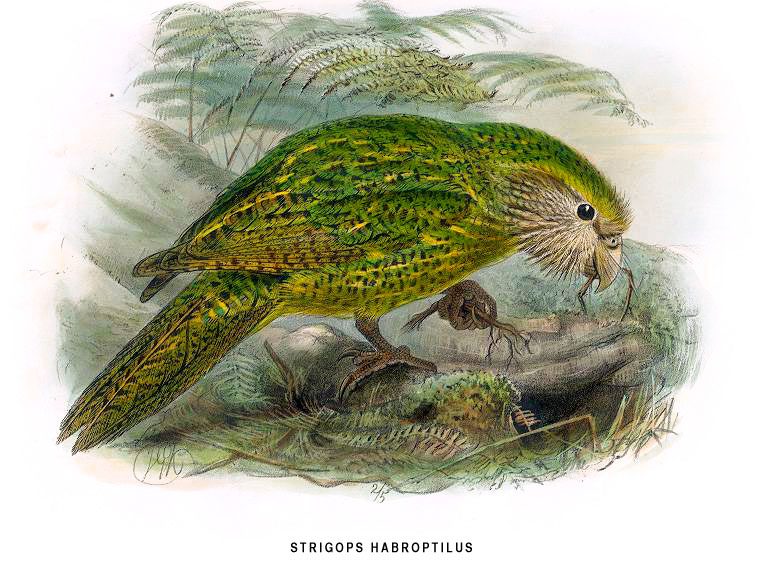
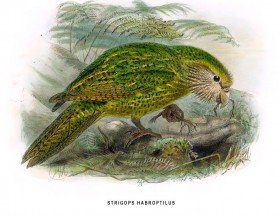
Illustration Kakapo

Description

Males can reach up to 60 cm. and weigh between 3 and 4 kg.

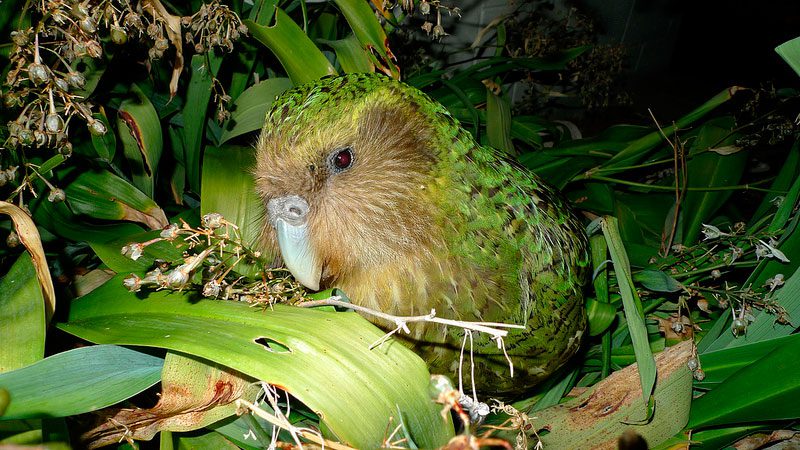
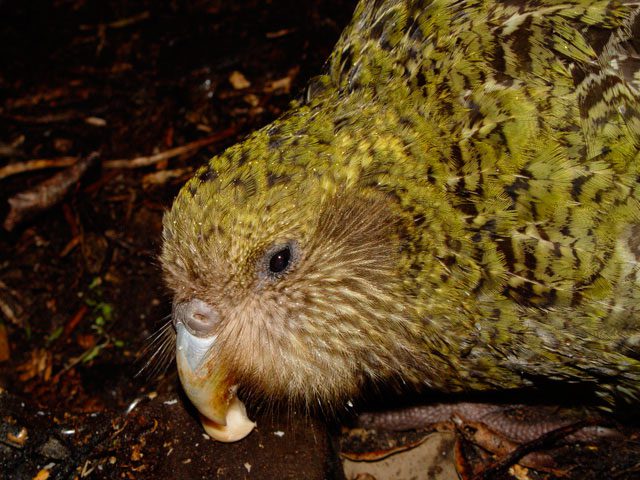
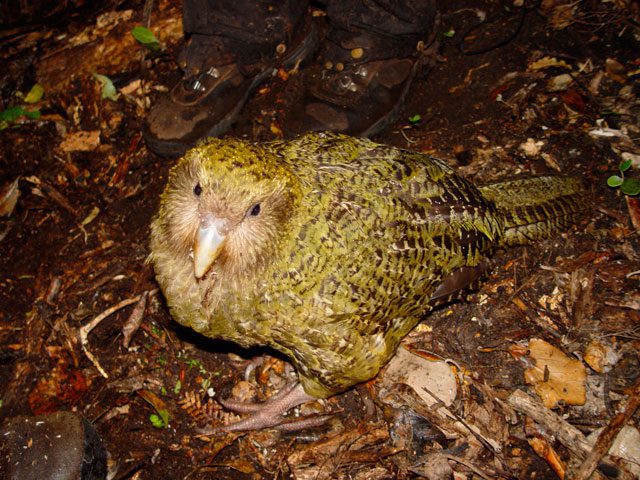
The Kakapo (Strigops habroptila) It is a robust and stocky bird with wings short in relation to the rest of the body.

grown ups, on upperpartsr, are MOSS Green, pulling a beige. All his upperparts they are spotted black and brownish gray, What gives them an excellent camouflage in its environment. The chest and flanks are yellowish green with streaks of yellow. The abdomen, under the tail, the neck and face are yellow, mostly streaked with pale green and imperceptible gray-brown spots.

Their feathers they are surprisingly soft, since they do not need the strength and the necessary stiffness for flying birds.

The Kakapo shows a composite facial disc of feathers fine, giving it the appearance of an owl.

Its bill it is surrounded by fine whiskers that are very useful for testing the ground when moving through the undergrowth.

The mandible it is mostly ivory color, but with a bit of blue-gray in the upper jaw.

Their eyes are dark brown. Their long and scaly legs they have long claws which serve to climb.

The end of the feathers of the tail It tends to end up worn down by the continuous friction with the ground.

The females they are very different from your partner. Its head is narrow and has a crown less rounded. Their peaks they are narrow and elongated. Less muscular legs, a grayish pink. Its tail is more elongated. Though their plumage is hardly different from males, appears less mottled beige.

The nesting females they are also distinguished by the cushion of bare skin that develops on the abdomen during the incubation period.

Habitat:

Before the humans arrived to New Zealand, the Kakapo lived in a wide variety of habitats, pastures with clumps of grass, scrub and coastal regions.

They were also the primary forests, including those who were dominated by lush podocarp and false have the gender Nothofagus. In the region of Fiordland, to the southwest of South Island, the Kakapo they frequented areas of avalanches and landslides, small regenerated trees or vegetation with abundant fruit.

These regions contained among other plants, Japanese raspberry wine (Rubus phoenicolasius), Shrubby Veronica (genus Scrophulariaceae) and Coprosmas. It was known as "kakapo gardensยป

Given its inability to fly, the Kakapo It, mainly, a terrestrial bird. This is also a excellent climber able to reach the tops of the tallest trees. They leave the foliage practicing a "parachute" descent, spreading their wings in all their amplitude.

When the Kakapo is threatened, simply is still trying to pass unnoticed in the vegetation, with which is camouflaged. This was a great strategy to avoid his great enemy, the gigantic Haast's Eagle, but does not protect against introduced mammals.

Son nocturnal birds. They sit during the day and roam their territory during the night period.. Having lost the ability to fly, the Kakapo they have developed remarkable skills for their long haul. His powerful legs allow them to make long distances at night to feed or during the time of nesting that it takes place from October to January.

During courtship, the males they abandon their traditional territories and walk many kilometers to reach the top of the hills or a crest to establish their mating area, competing in the place to try to conquer the location that appears most advantageous to them. Conflicts often lead to serious injury and are sometimes fatal for the belligerents.

To appeal to the females, the males they emit a kind of explosions that produce dilating a bag in the area of the chest. After a series of 20 explosions, is right and take a break. Then lower the head again to issue a new series of explosions. Inside its cavity, move to make sounds in all directions. on clear days, These explosions can be heard more than one kilometre away. The males get involved in this type of sample for nearly eight hours at night. Each male produces thousands of explosions during 3 or 4 months. During this time, males sometimes lost half of their body mass.

Reproduction:

During the time of reproduction, the Kakapo They use a system ofLekยซ. He "Lekยป is the space dedicated to the parade within which males gather in loose groups in an attempt to attract and seduce females. Females are very attentive spectator and choose your partner according to the quality of your display. Females are not persecuted openly by males.

It is not set no marital bond. He "Lekยป is just a meeting place that serves only for mating. The space for processions They consist of one or more small depressions of 10 cm of depth and 50 cm in diameter dug into the soil. The holes are usually do about faces of rocks, banks, or tree trunks, to help the sound bounce. The holes of each male are connected. The various depressions are interconnected by a network of small roads that cleaned thoroughly of all plant debris.

As soon as the male's cry is heard, the female embarks on a long journey to reach the area Lek. As soon as it enters the lek mating area, the male begins its rituals. It sways from side to side emitting clicks with the peak. He turns his back on his future partner, It spreads its wings and walk back towards her. Once mating has occurred, The female returns to her area of โ€‹โ€‹origin to lay her eggs and raise her young.. The male stays in place of courtship for try to seduce a new female.

The Kakapo they usually put 3 eggs per season. The nest placed on the ground under vegetation cover or in a hollow of a tree. The female incubated during 30 days, but you must leave the nest at night to feed, leaving the door open to many predators. After the eggs have hatched, She It feeds the chicks for three months, these will still remain in the company of their mother for a few more months. Since they have a life relatively long, the Kakapo have a fairly prolonged adolescence. Males do not begin courting until the age of 5 years and females do not respond to the calls of the males until they have reached the age of 9 or 11 years.

Food:

The peak of the Kakapo It is especially suitable for grinding food finely. For this reason, they have a gizzard less developed than most birds of its size.

The Kakapo they have a menu that is mostly herbivore. They used native plants, seeds, fruit, pollen and even the SAP flowing from the trees.

In a study of 1984, 25 different types of plants have been identified as part of your diet. Is particularly fond of the fruit of the rimu tree, and they feed on it exclusively during seasons when it is abundant. The Kakapo He has a habit of distinctive grab a leaf or frond with a foot and stripping the nutritious parts of the plant with its beak, leaving a non-digestible fiber ball. These small groups of vegetable fibers are a distinctive sign of the presence of the bird.

Distribution:

In the past, the Kakapo they were in the Islands North Island and South Island of New Zealand.

The species has suffered a sharp decline since the European colonization, and now it is one of the rarest birds in the world.
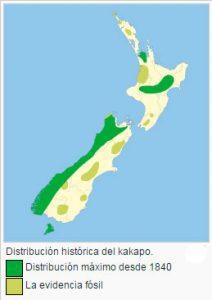
map-kakapo

Despite the fact that it disappeared from most of its original range following human colonization, the species remained abundant in Fiordland and some other places of great rainfall was scarce in the inhabited areas of South Island until the beginning of the 20th century. In 1976, However, the known population had been reduced to 18 birds, all males, all in Fiordland.

In 1977, found to be a rapid decline in the population of birds, about 150, on Stewart Island. Among 1980 and 1992, the 61 other birds of the Stewart Island they were transferred to the islands of the coast, and are currently in Codfish and Anchor island. The last accepted records were in North Island in 1927, three males reported in South Island, in Fiordland in 1987, and the last record in the Stewart Island of a female found and transferred to the Codfish Island in 1997.

In 2009, a male of the transferred four of Stewart Island to Isla Codfish in 1987, It was rediscovered after having been missing for 21 years.

It is likely that it is extinct in its natural distribution area, but, from November of 2005, birds are still present on four islands: Isla Codfish, Chalky, Anchor and Maud island.

In 1999, 26 females and 36 males survived, which includes 50 individuals in reproductive age, six subadults and six juveniles.

The population was stabilized, and has started to increase slowly following the application of intensive management. In the 2005, the population of the Kakapo stood in 86 specimens, of which 52 they were of reproductive age (21 females and 31 males) and 34 they were underage; a productive breeding year in the 2009 He saw the increase of the population up to 124 specimens, and it was known of the existence of 126 birds at the beginning of 2012, including 78 adult players.

Conservation:


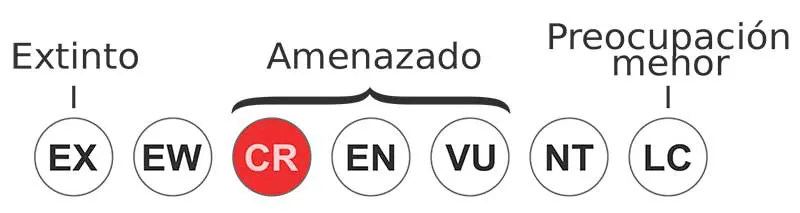
critical hazard

โ€ข Current Red List of UICN: critically endangered

โ€ข Population trend: Increasing

In the Stewart Island, more than the 50% of adults monitored died, each year, attacked by cats (CLOUT and Merton 1998).

An abnormal low fertility and low natural rates of reproduction and mating are the main concerns.

In 2004, three young people died of septicaemia caused by bacteria Erysipelothrix rhusiopathiae (erysipelas), a disease that had not been previously reported in this species (P. Jansen in litt. 2004)

They are subject to a plan of support by the authorities of New Zealand. Their number is currently estimated at little more than one hundred of copies, increases slowly with the plan.

At the beginning of 2012 there was 126 specimens, among them 78 adult players (RJ Moorhouse in litt. 2012).

"Kakapo" in captivity:

The only birds in captivity are those bred in the Recovery program of the Kakapo.

In terms of their longevity, debido a su largo ciclo de vida y la ausencia de depredadores naturales, es posible que el Kakapo viva mรกs de 60 years.

Alternative names:

– Kakapo, Owl Parrot (English).
– Strigops kakapo, Kakapo, Perroquet hibou (French).
– Kakapo, Eulenpapagei (German).
– Kakapo (Portuguese).
– Kakapo (espaรฑol).

scientific classification:

– Order: Psittaciformes
– Family: Strigopidae
– Genus: Habroptilus
– Scientific name: Strigops habroptila
– Citation: Gray, GR, 1845
– Protonimo: Strigops habroptilus

Images "Kakapo":

Videos "Kakapo"

————————————————————————————————

"Kakapo" (Strigops habroptila)


Sources:

– Avibase
– Parrots of the World โ€“ Forshaw Joseph M
– Parrots A Guide to the Parrots of the World – Tony Juniper & Mike Parr
– Birdlife
– Wikipedia

– Photos:

(1) – Pura, a 1-year-old Kakapo (Strigops habroptila) on Codfish Island By Mnolf [GFDL, CC-BY-SA-3.0 or CC BY-SA 2.0], via Wikimedia Commons
(2) – Kakapo Pura on Codfish Island By Mnolf [GFDL, CC-BY-SA-3.0 or CC BY-SA 2.0], via Wikimedia Commons
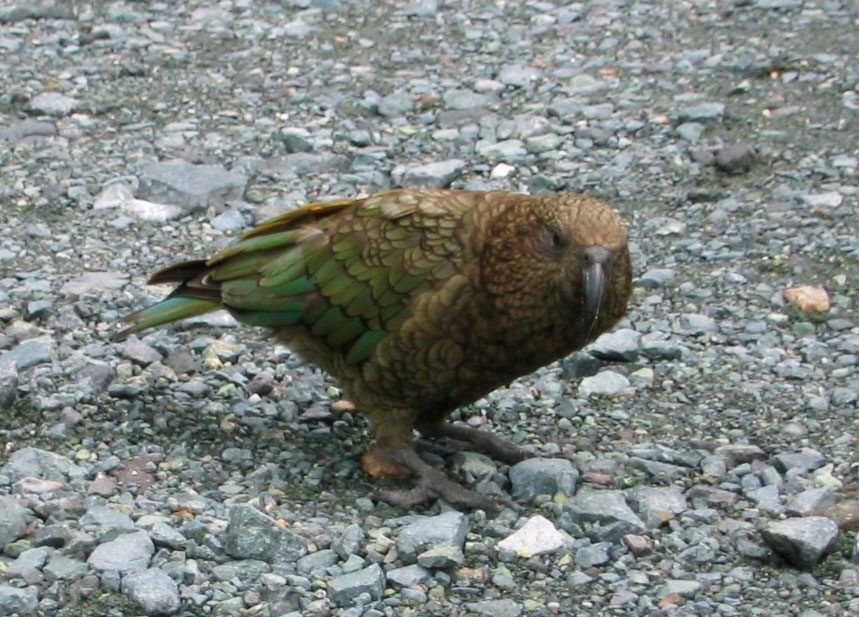
(3) – Kea, on the road to Milford Sound Uploaded by The Rambling Man – Wikipedia
(4) – Kakapo Sirocco amongst the renga renga lillies. Maud Island. Photo: Chris Birmingham, 2012 – Flickr
(5) – Kakapo by jidanchaomian – Flickr
(6) – Birds of New Zealand 1st edition, by Walter Lawry Buller, published in 1873 By John G. Keulemans. Minor edits have been made to the original by User:Msikma; I release these changes into the public domain as well. [Public domain], via Wikimedia Commons
โ–ท The world of Pets: Dogs, cats, birds, reptiles, amphibians

Indigo-winged Parrot
Hapalopsittaca fuertesi


Indigo-winged Parrot

Content

Description:

23-24 cm.. height.

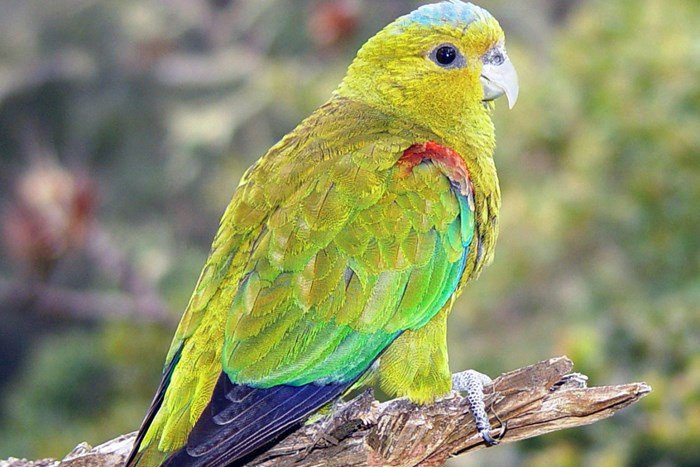
In 2002 It was the rediscovery of the the Indigo-winged Parrot (Hapalopsittaca fuertesi), an enigmatic parrot that had been lost to the world for more than 90 years and continues being one of the birds more rare of the Earth. It has a plumage mainly yellowish-green and is highlighted by the blue of the crown and olive yellow tone of the forecrown (except a strip), cheeks and sides of the eyes, narrow strip in the forecrown, under abdomen and shoulders red. End of the wing blue violet dark, tail Blue with red base.

The bill Horn colored with blue color, Grey at the base of the upper jaw. Iris Green-yellow.

The immature It has less yellow streaks and more off face.

Habitat:

Is a kind of range restricted, very rare and difficult to observe. It inhabits high Andean forests and frequent cloud subparamos, between 2600 and 3800 m on the level of the sea, being the majority of the records between 2.900 and 3.150 m. With guavas, encenillo and laurels where he eats fruits of thematapaloโ€, and with Oak (Quercus humboldtii).

Observed in fairly open forests, and possibly disturbed, with small Palm trees and tree ferns.

Fly in flocks of 6 to 25 individuals.

Reproduction:

It believes that the nests they make them in cavities of tall, mature trees.

The nesting period takes place from January to may. The average size clutch is three eggs. The incubation is performed only by the female, Although the attention back to the hatching is biparental (Dรญaz 2006).

Food:

The ecology of breeding and feeding of the Indigo-winged Parrot is practically unknown, but it has been observed the birds feeding of berries, and is likely to show a preference for the berries of mistletoe.

Distribution:

Size distribution (reproduction / resident): 100 km2

Restricted to a small strip on the western slope of the Andes Central of Colombia, near the border of the Quindio, Risaralda and Tolima.

Conservation:


critical hazard


โ€ข Current category of the Red List of the UICN: critically endangered.

โ€ข Population trend: Decreasing.

According to the categories of UICN is considered in Critical Hazard (CR), due to the accelerated process of deforestation in the Andean forests.

Since ago 90 years it was thought that the bird was extinct until it was rediscovered in 2002, When a few biologists of the ProAves Foundation in the montane forest of the municipality of Genoa, department of Quindรญo, where the group more large observed consisted of 25 birds and the total population was of approximately 60 individuals.

Currently there are some 300 mature free individuals.
Thanks to the efforts made by different project is have retrieved data of them fluctuations in the abundances of them individuals during the year associated to its reproduction. Is very likely that the offer of the artificial nests This already having a positive impact that the length of the project It has observed an increase in the size population.

"Indigo-winged Parrot" in captivity:

They do not exist in captivity.

Alternative names:

– Indigo-winged Parrot, Fuerte’s Parrot, Fuertes’s Parrot, Indigo winged Parrot (English).
– Caรฏque de Fuertes, Caรฏque de Colombie (French).
– Fuertespapagei, Chapmans Zwergamazone, Zwergamazone (German).
– Indigo-winged Parrot (Portuguese).
– Cotorra Aliazul, Lorito de Fuertes (espaรฑol).
– Cotorra Aliazul, Loro coroniazul (Colombia).


scientific classification:

Frank Chapman
Frank Chapman

– Order: Psittaciformes
– Family: Psittacidae
– Genus: Hapalopsittaca
– Scientific name: Hapalopsittaca fuertesi
– Citation: (Chapman, 1912)
– Protonimo: Pionopsitta fuertesi


Images "Indigo-winged Parrot"

Video of the "Indigo-winged Parrot"

————————————————————————————————

ยซLorito de Fuertesยป (Hapalopsittaca fuertesi)


Sources:

– Avibase
– Parrots of the World โ€“ Forshaw Joseph M
– Parrots A Guide to the Parrots of the World – Tony Juniper & Mike Parr
– Birdlife
– proaves.org
– Parrot Book, Parrots and macaws Neotropical

– Photos:

(1) – Conservationbirding.org

– Sounds: controles-canto.org

โ–ท The world of Pets: Dogs, cats, birds, reptiles, amphibians

Mascarene parrot โ€ 
Mascarinus mascarin

Mascarene Parrot

Content


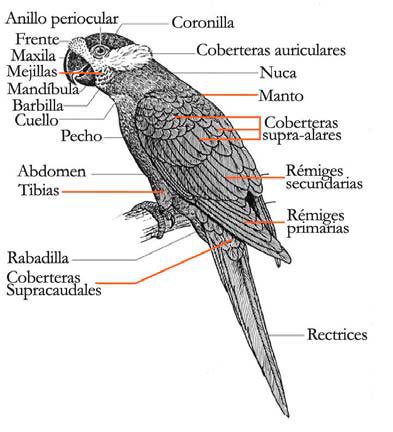
Anatomy-parrots

Description:

Of 35 cm.. height and a weight between 400 and 500 g..

The Mascarene parrot โ€  (Mascarinus mascarin) It was a bird dark grayish brown on top, lighter at the bottom; the the tail feathers They were brown with white bases; head lavender gray; lores and area around the bill black. had the bill bright red. The legs They were reddish brown and eyes red.

taxonomy:

A genetic study of 2011 He placed the Mascarene Parrot of Meeting between subspecies of Black Parrot (Coracopsis nigra) of Madagascar and nearby islands, and therefore would not be related to the parrots of Psittacula as believed. It was found that the lineage of Mascarene Parrot It separated made between 4,6 and 9 millions of years, before the formation of the isla Meeting, indicating that it must have happened somewhere else

Habitat:

Nothing is known, although it is likely to be distributed in uninhabited forests where feed on fruits and nuts.

Reproduction:

No data.

Food:

Probably fruits and nuts.

Distribution:

The Mascarene Parrot It was described by many early travelers to Reunion Island (in France), with several captive birds sent to France at the end of the 18th century.

The last accounts of wild birds were from the 1980s. 1770, and the birds were not mentioned by Bory a 1804, so the species may well have been extinct in the wild by then. captive birds in Paris they would also have died at that time, but one bird survived in the collection of birds king Bavaria at least 1834 (checks 1987). Two specimens survive today (Forshaw and Cooper 1989)

Conservation:

โ€ข Current category of the Red List of the UICN: Extinct.

โ€ข Population size : There are none.

Rationale for the Red List category

This species was known from the Rรฉunion, but it has been extinguished by the hunting pressure. The last record of wild birds dates from 1775, and none was observed on a visit in 1804.

Justification of the population

There are none.

Threats

It is likely to have been hunted to extinction.

"Mascarene parrot โ€ " in captivity:

Several captive birds sent to France at the end of the 18th century.

Alternative names:

– Mascarene Parrot, Mascarine Parrot (English).
– Mascarin de la Rรฉunion, Mascarin malgache (French).
– Maskarenenpapagei, Maskarenen-Papagei (German).
– Papagaio-das-mascarenas (Portuguese).
– Loro de las Mascareรฑas, Loro Mascarรญn (espaรฑol).


scientific classification:

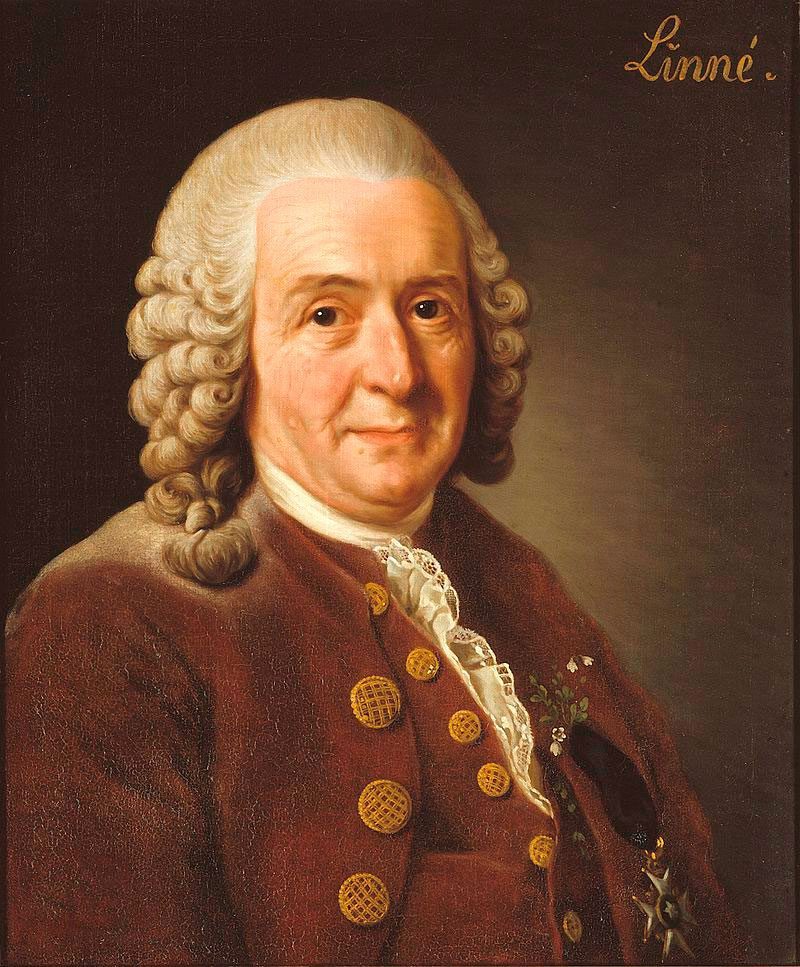
Carlos-Linnaeus
Carl Linnaeus

– Order: Psittaciformes
– Family: Psittaculidae
– Genus: Mascarinus
– Scientific name: Mascarinus mascarin
– Citation: (Linnaeus, 1771)
– Protonimo: Psittacus mascarin.

"Loro of the Masks" โ€  (Mascarinus mascarin)

Sources:

Avibase
Parrots of the World โ€“ Forshaw Joseph M
Parrots A Guide to the Parrots of the World – Tony Juniper & Mike Parr
Birdlife
Wikipedia

Photos:

(1) – The Mascarene Parrot (Mascarinus mascarinus) by John Gerrard Keulemans [Public domain], via Wikimedia Commons
โ–ท The world of Pets: Dogs, cats, birds, reptiles, amphibians

Brown-hooded Parrot
Pyrilia haematotis


Lorito Encapuchado

Content

Description:

21 cm.. height and weight around 165 g.

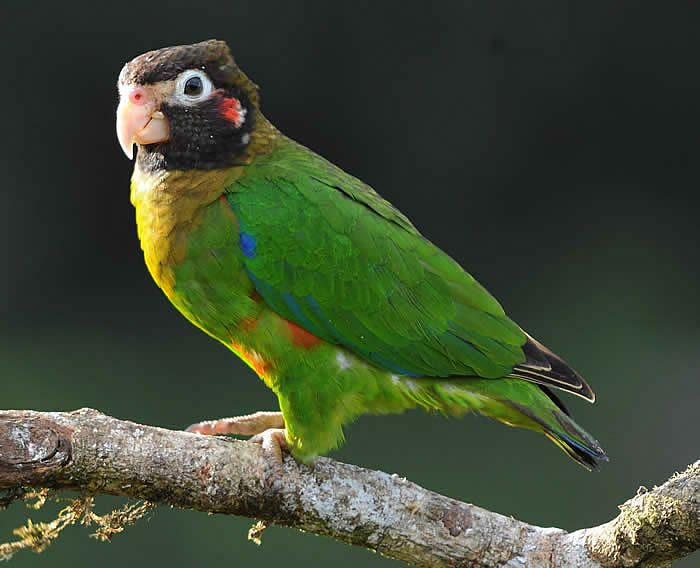
It more distinguishable from the Brown-hooded Parrot (Pyrilia haematotis) is your head, with forecrown White and the eye ring naked white also; ear with red feathers or oranges, crown grayish coffee, chest and nape Green yellowish.

The rest of the body usually green with it armpit red (easily view on the fly), contrasting with the blue-green of the wings and the green of the tail. The latter with light blue at the tip of the central feathers.

The bill is pale brown with yellow tinge. The irises they are red and the legs grayish brown.

The immature they are similar to adults, but more pale, off and without the color red in the head. Their irises is dark.

Subspecies description:

  • Pyrilia haematotis coccinicollaris

    (Lawrence, 1862) – With red marks on the bottom of the rear of the neck and in the part superior of the chest, often forming a band in the male, more weakly in the females.


  • Pyrilia haematotis haematotis

    (Sclater,PL & Salvin, 1860) – The nominal.

Habitat:

It inhabits mainly in the canopy of humid forests with a deciduous tendency, until the 1500 m. Their flocks are not numerous and are quiet at the time of feeding.
In Colombia is considered species very rare.

Reproduction:

It nests in hollow of trees and seems to share them with Blue-headed Parrot (Pionus menstruus).

Breeding season in February in Yucatan; May-July in Guatemala; August in Panama.

Food:

Feeds of fruits and seeds of trees in areas forested, as well as plants epiphytes and leaves green of some types of mistletoe.

Distribution:

Are you can observe in freedom from the Centre-South of Mexico to northwest of Colombia.
You can socialize with other parrots and toucans.

Subspecies distribution:

  • Pyrilia haematotis coccinicollaris

    (Lawrence, 1862) – It is from Panama and Northwest of Colombia.


  • Pyrilia haematotis haematotis

    (Sclater,PL & Salvin, 1860) – The nominal.

Conservation:


minor concern


โ€ข Red List category of the UICN current: Least concern

โ€ข Population trend: Stable

Justification of the population:

Partners in Flight estimates the population at fewer than 50.000 individuals (A. Panjabi in litt., 2008), by what is placed in the band 20,000-49,999 individuals here.

Justification trend:

The population of the Parrot Encapuchad suspected to be stable in the absence of evidence of any reduction or substantial threats.

"Brown-hooded Parrot" in captivity:

Extremely susceptible to stress and diseases during the acclimatization, sudden deaths occur without warning. These are reasons why the they are seldom seen in captivity.

Alternative names:

– Brown hooded Parrot, Brown-hooded Parrot, Red-eared Parrot (English).
– Caรฏque ร  capuchon (French).
– Grauwangenpapagei, Grauwangen-Papagei (German).
– Brown-hooded Parrot (Portuguese).
– Cotorra Cabeciparda, Lora cabeciparda, Lorito Abigarrada, Lorito Encapuchado, Loro Cabecipardo, Loro Cabeza Oscura, loro cabeza-oscura, Loro Orejirrojo (espaรฑol).
– Cotorra Cabeciparda (Colombia).
– Loro cabecipardo (Costa Rica).
– Lora cabeciparda (Honduras).
– loro cabeza oscura, loro cabeza-oscura, Loro Orejirrojo (Mexico).
– Loro Cabecipardo (Nicaragua).

scientific classification:

– Order: Psittaciformes
– Family: Psittacidae
– Genus: Pyrilia
– Scientific name: Pyrilia haematotis
– Citation: (Sclater,PL & Salvin, 1860)
– Protonimo: Pionus haematotis

Images "Brown-hooded Parrot"

Videos "Brown-hooded Parrot"

"Hooded Parrot" (Pyrilia haematotis)


Sources:

  • Avibase
  • Parrots of the World โ€“ Forshaw Joseph M
  • Parrots A Guide to the Parrots of the World – Tony Juniper & Mike Parr
  • Birdlife
  • parrots.org

  • Photos:

(1) – avconline

  • Sounds: controles-canto.org – Doug Knapp

โ–ท The world of Pets: Dogs, cats, birds, reptiles, amphibians

Dusky lory
Pseudeos fuscata

Lori Sombrรญo

Content

Description

23-28 cm.. height and a weight between 140 and 190 gr.

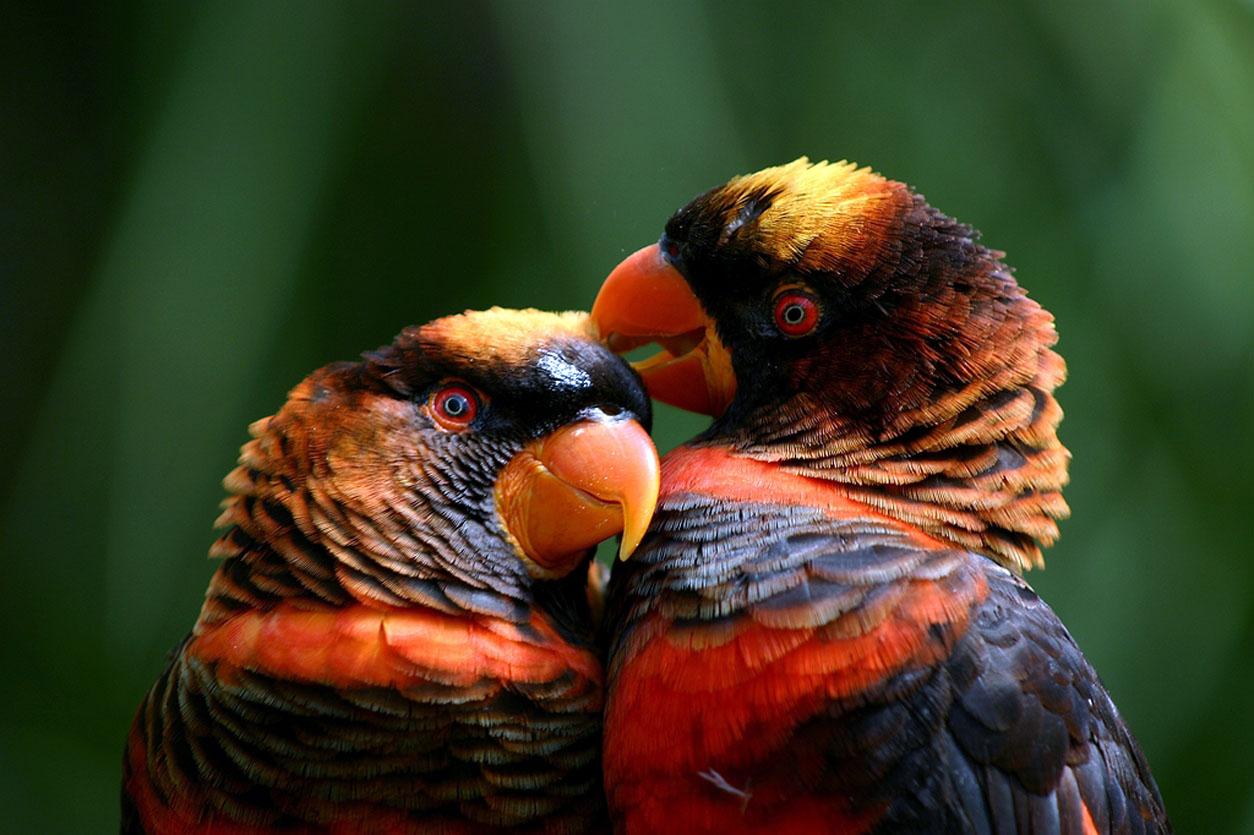
The plumage of the Dusky lory (Pseudeos fuscata) It is difficult to describe since there are many differences in tonality between one and the other specimens.. Some are of a very dark brown color, almost black and others have a much lighter shade. In addition the same happens with the two bands that cross you the chest Since the species goes through three phases: red, Orange and yellow, according to age, gender and the place of origin.

Characteristic of this species is the area of โ€‹โ€‹bare skin under the lower jaw until the birth of the throat. The lower wing coverts are orange and the lower flows dark blue. The obispillo is a silvery-white the bill is bright orange. The irises is orange and the legs dark.

There is no sexual dimorphism and the only way to differentiate male and female will be through DNA, Although some authors (Tomas Arndt) they are running that adult females lack the white feathers of the obispillo.

Habitat:

The Dusky lory they are quite widespread and locally common in primary forests , that is to say, those who have not undergone any transformation. But they are also found in wooded areas, up to an altitude of 2.400 m, During regeneration, especially those with large mature trees.

They are also distributed among residual tree beds during their flowering period., including those located in the parks and gardens in cities.

They are occasionally present in the lightly wooded Savannah or plantations of teak and coconut trees.

They normally reside in the landscape of hills or slopes steep slightly from low and middle mountain.

Itร‚ยดs gregarious and when flies or are fed in the cup of them trees full of flowers it makes in groups of 20 to 100 individuals or more.

Reproduction:

The nesting season It is very different depending on the region: It extends from November to April in the mountainous areas of East, While in Irian Jaya, the Indonesian part, they do in July.

The Dusky lory they prefer to nest in tall trees in the mountain area, the choice of a hole at high altitude on Earth probably do to protect itself against potential predators.

If the site is of your liking, reuse it for many years consecutively. Male and female participate in the work, the enlargement of the entrance or the cavity itself. Even if the nest has been used in the past, There are always minor changes to be carried out.

Although this species is quite common, We really know very little about its reproduction in the wild. In captivity, the female lays two eggs which are incubated for approximately 24 days. As in most New Guinea lories, the reproductive cycle is very long, about 70 days.

Food:

Consumes mainly nectar and perhaps the pollen it accumulates in plants of the genus schleffera or tree Rudraksha (Elaeocarpus sphaericus). Also consume flowers and fruits. It can be seen in large flocks in mango plantations and other cultivated trees. Feeds, occasionally, teak moth (Hyblaea puera).

Distribution:

The Dusky lory It has its area of distribution largely of New Guinea, except the mountains more high of the interior and the peaks more high of the mountains of Parotia.

They are present in Salawati on the Western Islands of papua and further to the East in the Yapen island on Cenderawasih Bay.

Conservation:


minor concern


– Current IUCN Red List category: Least concern

– The population trend: Stable

The species are not threatened. Common and very sociable, It often forms bedrooms that can reach thousand of birds.

A wild population estimated above 100.000 individuals.

In some parts of the southeast of New Guinea, its density may be superior to 30 birds per square kilometer.

"Dusky lory" in captivity:

Are birds enough prolific and sociable you adapt easily to captivity.

Contrary to other parrots that eat mainly seeds and nuts; The loris require a greater percentage of fruits, outbreaks, nectar and pollen in your diet. In fact, in the nature, they can feed a maximum of 640 flowers in a day. They also feed on seeds.

It is usually aggressive with other species of lory. Easy to startle with strangers.

Alternative names:

– Dusky Lory, Dusk-orange Lory, Dusky-Orange Lory, White-rumped Lory (ingles).
– Lori sombre, Lori ร  dos blanc (French).
– WeiรŸbรผrzellori (German).
– Lรณris-dusky (Portuguese).
– Lori Sombrรญo, Lorito crepuscular (espaรฑol).

scientific classification:

– Order: Psittaciformes
– Family: Psittaculidae
– Scientific name: Pseudeos fuscata
– Genus: Dusky
– Citation: (Blyth, 1858)
– Protonimo: those darkened

Images "Lori Mson":


"Lori bleak" (Pseudeos fuscata)


Sources:

Avibase, mundoexotics, Oiseaux.NET

Photos: Wikimedia, birdsville.NET.au, Dick Daniels – Tampaโ€™s Lowry Park Zoo, Dusky Lory – Woburn Safari Park (Wikimedia),

Sounds: BAS van Balen (Xeno-canto)