46 cm. length and a weight between 680 and 800 g..
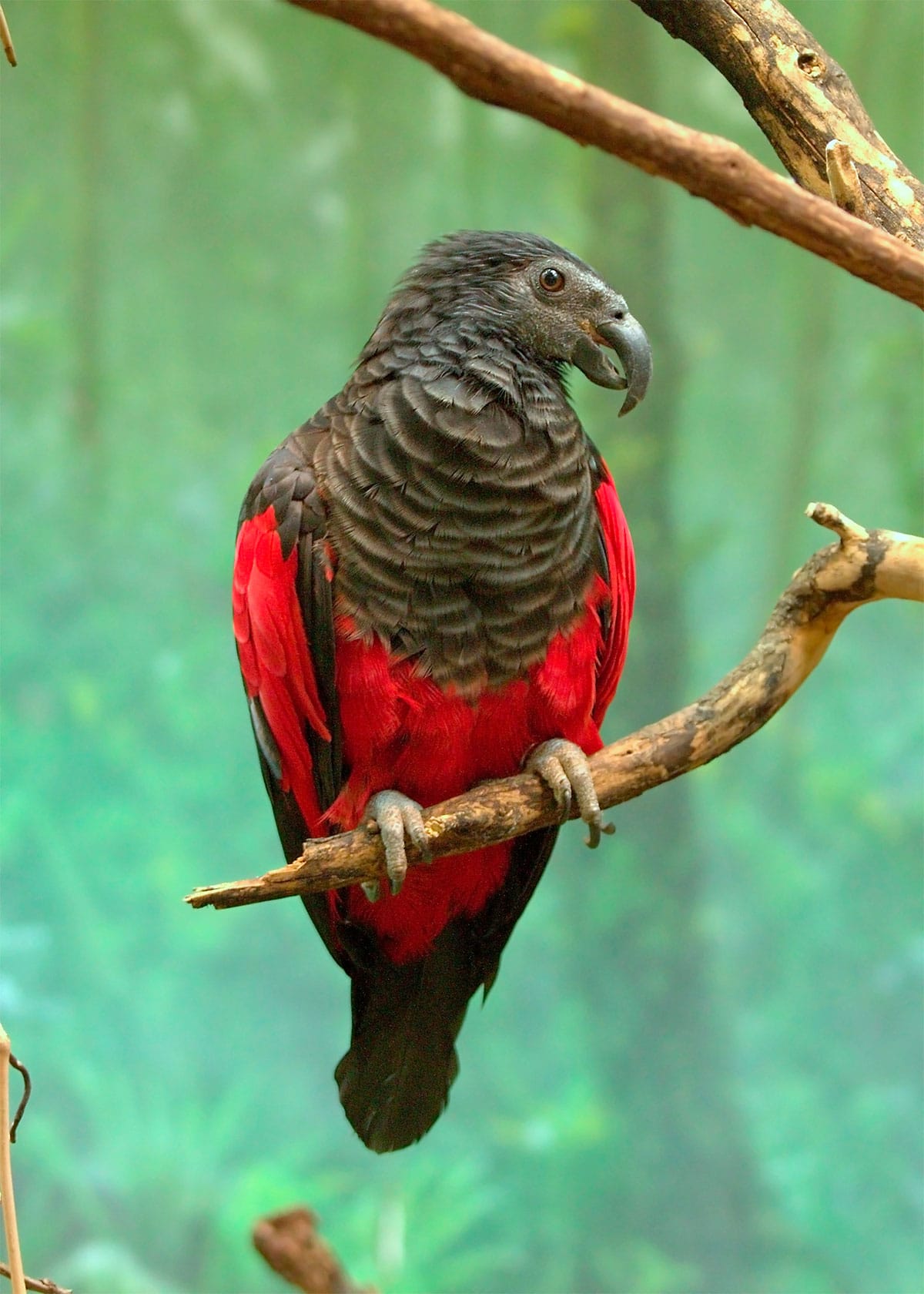
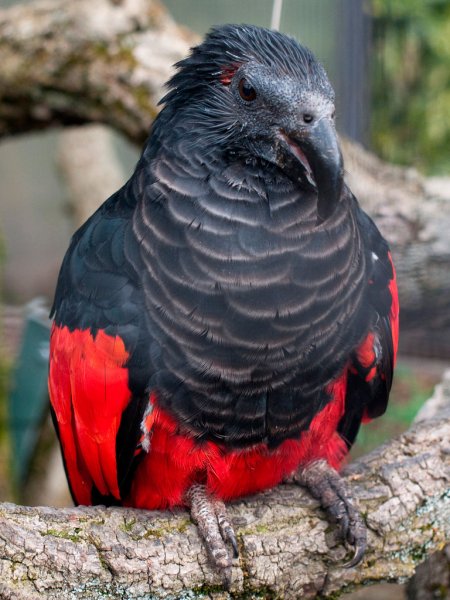
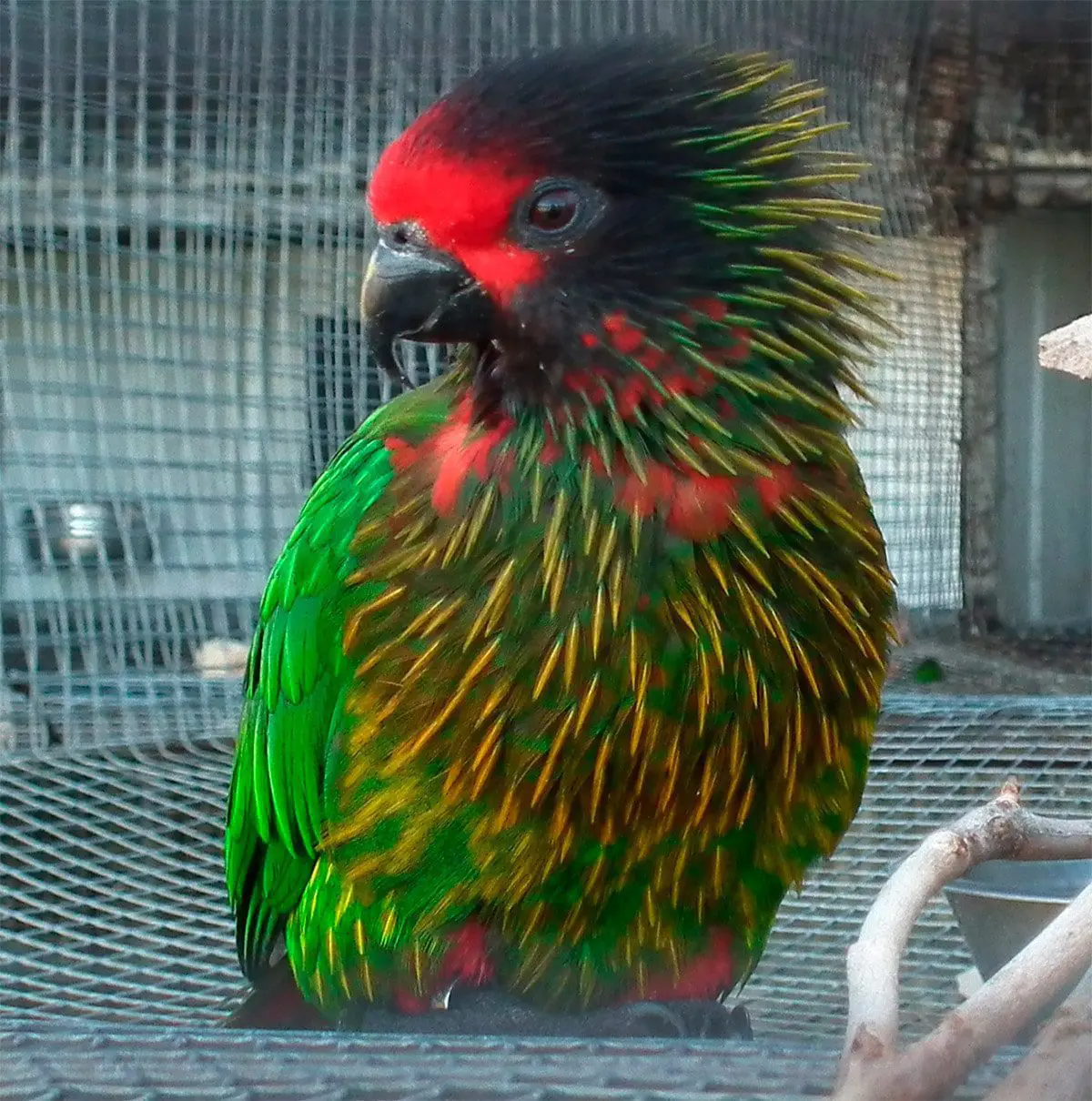
The head of the Pesquet's Parrot(Psittrichas fulgidus) is black, front without feathers, may be covered with small ruffled black feathers with a patch of stiff red feathers on the front of the legs ear-coverts. Nape, the mantle, back and tail blackish brown with fine pale edges.
Uppertail Red with black bases. Upper, black flight feathers, with large and medium-sized external coverts (except the innermost) and vane external Central flight feathers, red; Black primary coverts. Under, Black tail with red in the lower and medium coverts. More Brown on the top breast than in the rest, with a wavy effect to pale fringes to the feathers; belly, flanks and coverts red infracaudales. Upper, the black tail.
black beak; black skin of the face; dark brown irises; Blackish grey legs.
The female It lacks the red patch on the side of the head and is slightly smaller on average.
The Pesquet's Parrot are found mainly in the primary and secondary montane rain forest at an altitude between 600 and 1.200 m. However there are to the 2.000 m, and are occasional at altitudes as low as 50 m.
The species is thought, generally, they have a low density of population, finding the highest concentrations in forest areas relatively calm, where the birds are free from persecution.
These large and showy parrots, They are commonly found in pairs or in groups of up to 20 individuals, perched, usually, at the top of the exposed trees, or loud flying through or above the canopy.
Jump nervously around the Bush with quick flapping, and they can stay in the tops of emergent trees during a rain. It has been flying to settle on a solitary tree in the midst of the darkness.
Reproduction:
Reproductive habits in nature are unknown, but birds in breeding conditions have been observed in the months of February to May. In captivity a pair was observed to courting; There was a two-egg-laying, which were incubated by the female during 31 days, and the only chick, yellowish white, was fed by both parents.
During their feeding, the base of the beak can become covered with fruit pulp, and it is likely that extension of the exposed facial skin has evolved to avoid that feathers absorb from food scraps.
Distribution:
Size of the area of distribution (reproduction / resident): 278.000 km2
The species is unevenly distributed in montane forests, and is considered uncommon in most areas. World population is thought to be in decline, mainly due to hunting for food and feathers (that are more appreciated even than the feathers of the bird of paradise Paradisaeidae).
The introduction of weapons has significantly increased the pressure of the species in more densely populated areas. Live bird trade and habitat loss, It is also thought that they represent potential threats. There are a small number in captivity.
Conservation:
• Current category of the Red List of the UICN: Vulnerable
• Population trend: Decreasing
It is estimated that their population may be setting to the 42,000 birds.
This species is under severe pressure from the hunt for obtaining their colorful feathers, and to one degree lower for trade and meat. Hunting for feathers has increased with population growth and the increasing number of tourists. As a whole, These factors are suspected of being leading to a rapid and continuous reduction of the population of this species.
Conservation Actions Proposed:
– Conduct surveys to improve the accuracy of the estimate of the population.
– Investigation of the basic ecology of the species, especially any of their food.
– Investigate the trade in feathers.
– Monitor numbers at surveyed sites, as the crater of the mountain and Kikori.
– Numbers of monitors marketed domestically and internationally.
– Transport Control of threatened species in domestic flights.
– Run an education program to discourage tourists from buying feathers and artifacts.
– Investigate adequacy of a program to replace artificial or dyed feathers (Mack and Wright 1998) .
"Pesquet's Parrot" in captivity:
extremely rare.
Birds, even bred hand, may be difficult and aggressive with their caregiver; they can be a bit uncomfortable mainly due to their diet of fruit.
Alternative names:
– Pesquet’s Parrot, Vulturine Parrot (ingles).
– Psittrichas de Pesquet, Perroquet de Pesquet (French).
– Borstenkopf (German).
– Papagaio-de-pesquet (Portuguese).
– Loro Aguileño (español).
Of 25 cm.. length and a weight between 130 and 150 g..
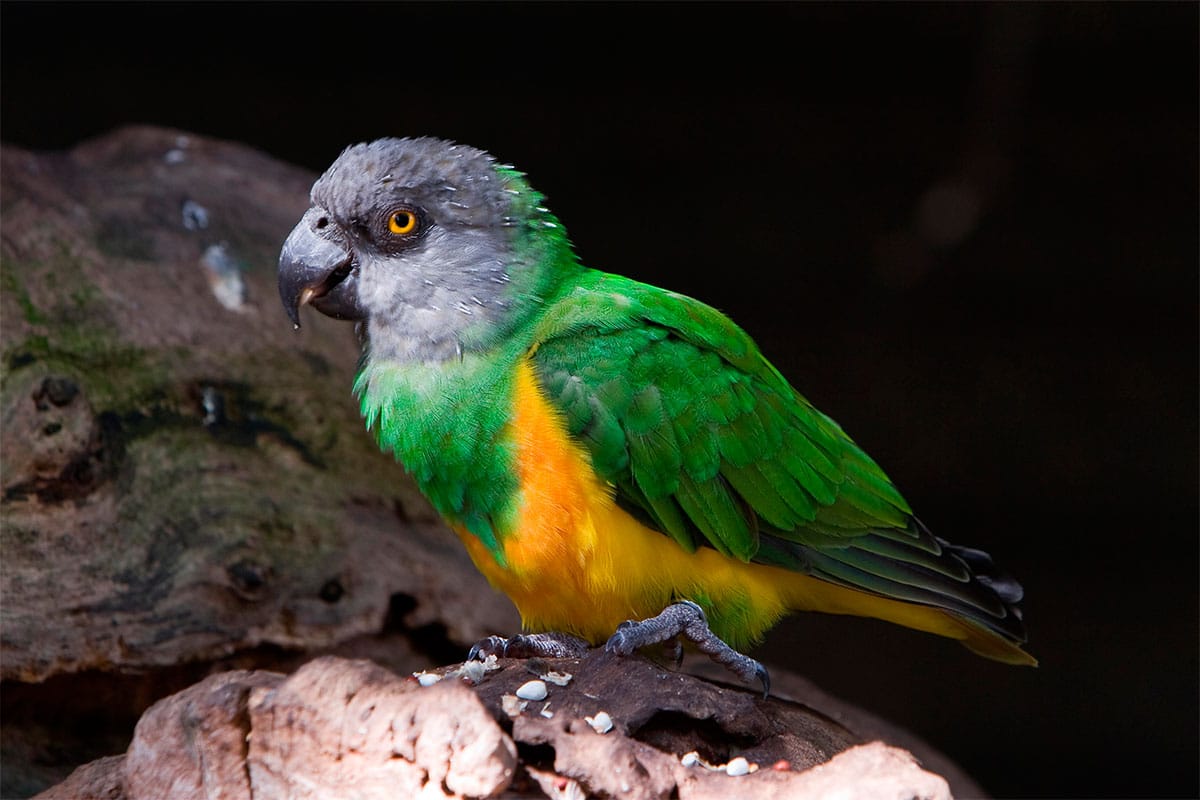
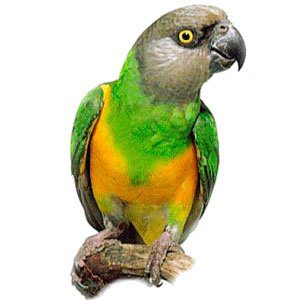
The Senegal Parrot(Poicephalus senegalus) has the forecrown, crown, lores and nape dark slate gray; clear the chin and cheeks; ear-coverts Silver. Mantle, scapulars and back bright green; rump and uppertail-coverts lighter with yellowish tint. Upper, the wing-coverts bright green ; secondaries and primaries of color Brown dark with edges green to them vane outer. Under, the wing-coverts Yellow. Throat grey, merging with the chest green (green lighter on the upper parts); low area chest and belly bright yellow with orange dye plant; the thighs green, undertail- coverts bright yellow. Tail greenish brown.
Bill grey: irises yellow with bare periophthalmic black; Chere blackish: Legs dark brown.
Sexes similar in plumage.
Immature generally paler than the adult with the head in brown tone off, has the ear-coverts Silver; sometimes extends the green on the bottoms shaped yellow patches on the flanks. Iris dark brown.
(Reichenow, 1910) – Similar to the species nominal, but with the green plumage paler and green color chest It is extending into the abdomen, the abdomen It is orange.
(Finsch, 1863) – Similar to the species nominal but the green color the mantle and wings is darker; the lower regions of chest and the abdomen are yellow orange to red in the middle of the abdomen.
Habitat:
The Senegal Parrot They are found in a variety of forest habitats ranging from open field with scattered and palm trees to the dense forests closed.
They are probably just below 1.000 meters above sea level.
Gregarious, at least outside the breeding period.
Usually they are seen in couples or groups of up to 20 birds, Larger groups can meet locally to exploit abundant food areas.
They perform diurnal movements and of longer duration in relation to the food supply;. Consequently, of the pobalación Senegal Parrot fluctuates widely in some areas.
Reproduction:
The Senegal Parrot usually they build a nest in the cavity of a tree branch (of Adansonia or Parkia), at a height of 10 m, sometimes more.
The breeding season It seems to vary depending on location. In the wetter areas, breeding season can be prolonged. In the region of Gambia and the rio Senegal, they have been egg production in the months of April, may, August and september, also from November to February. In drier areas (as Mali) the breeding season is probably limited by the rainy season (May to October).
They put of 2 to 4 eggs on alternate days and the period of incubation is of 25 to 28 days, female being fed by the male until hatching. The juveniles to leave the nest 9 weeks of age.
Food:
The diet of the Senegal Parrot It is composed of a variety of fruits, seeds and sprouts leaves.
Size of the area of distribution (reproduction / resident): 3.590.000 km2
The Senegal Parrot they are endemic in West Africa. Since Guinea (including the The islands), Senegal, Gambia, South of Mauritania and South of Mali through forest-savanna mosaic of Ivory Coast. Burkina Faso, South of Niger, Ghana (also on the coast). Benin and Togo until Nigeria, Cameroon and Southwest Chad.
Partially sedentary but seasonal visitors in some areas (especially further north), for example, some birds move south on the niger river in Mali with the onset of the driest periods. In the rainy season visitantan Southern Mauritania and some movements Nigeria, with the driest north unemployed, off wet season.
Subspecies distribution:
Poicephalus senegalus mesotypus
(Reichenow, 1910) – East and Northeast Nigeria, South of Niger, North of Cameroon, southwest end Chad and possibly the extreme northwest Central African Republic.
The size of the world population Senegal Parrot It has not been quantified, but the species, according to sources, It is often abundant (pit et to the. 1997).
The population is suspected to be stable and may even benefit from the widespread loss of closed canopy forests in the West Africa.
This species has been heavily traded: 1994-2003, more than 410,000 wild individuals were exported from the range States (Trade Database, in October of 2005 UNEP-WCMC CITES). It is one of the most popular pet birds, since it is regarded as a quiet little bird in captivity. Due to the large amount of this kind traded, It was the subject of a review of significant trade of the CITES, in which it was classified as «possible concern» (Inskipp et al. 1988). However, and despite international exports of a large number of birds, trade seems to have not seriously affected this species in general, without significant decreases in reported national population.
EXPORTS:
• Guinea exported in the dates between 1994 and 2003 a few 164.817 specimens.
• Mali exported in the dates between 1994 and 2003 a few 60.742 specimens.
• Senegal exported in the dates between 1994 and 2003 a few 173.794 specimens.
• Liberia not considered diffusion area, however it is known that among 1999 and 2003 some were exported 4.860 specimens, thus becoming the fourth country with the most exports made of Africa.
"Senegal Parrot" in captivity:
The Senegal Parrot It, after the Grey Parrot(Psittacus erithacus), African parrot most traded and raised in captivity. You might say whole sentences and whistle songs. Thanks to its size it is considered a quiet pet and very manageable when it's raised hand (papillero). They are not noisy and create a very emotional bond with family members.
Imported adult birds are always reserved even when they spend a lot of time with their caretaker. Young, on the other hand, They are docile and affectionate, and then adapt to the people.
With regard to its longevity, according to sources, a specimen lived 40 years in captivity.
– Avibase
– Parrots of the World – Forshaw Joseph M
– Parrots A Guide to the Parrots of the World – Tony Juniper & Mike Parr
– Birdlife
– Wikipedia
– Photos:
(1) – An adult Senegal Parrot at Artis Zoo, Amsterdam, Netherlands. The extent of yellow tends to indicate that it is probably a male By Arjan Haverkamp [CC BY 2.0], via Wikimedia Commons
(2) – An adult Senegal Parrot in Maspalomas, Gran Canaria, Canary Islands, By Juan Emilio Spain from Las Palmas, Spain [CC BY-SA 2.0], via Wikimedia Commons
(3) – Poicephalus senegalus senegalus, the Senegal Parrot By Charlesjsharp (Own work) [CC BY-SA 3.0 or GFDL], via Wikimedia Commons
(4) – A pair of Senegal Parrots in a tree. One parrot (probably the male) is feeding the other (probably the female). Thomas J. Haslam, http://www.flickr.com/photos/tjhaslam/ On 24 February 2007, I took the photos for this montage at the birding site Technopole in Dakar, Senegal. Licensed to Wikipedia under CC-BY 2.5 and GFDL. Published to my Flickr account under the same license.
(5) – A juvenile Senegal Parrot By Brian Holsclaw (originally posted to Flickr as IMG_2807) [CC BY 2.0], via Wikimedia Commons
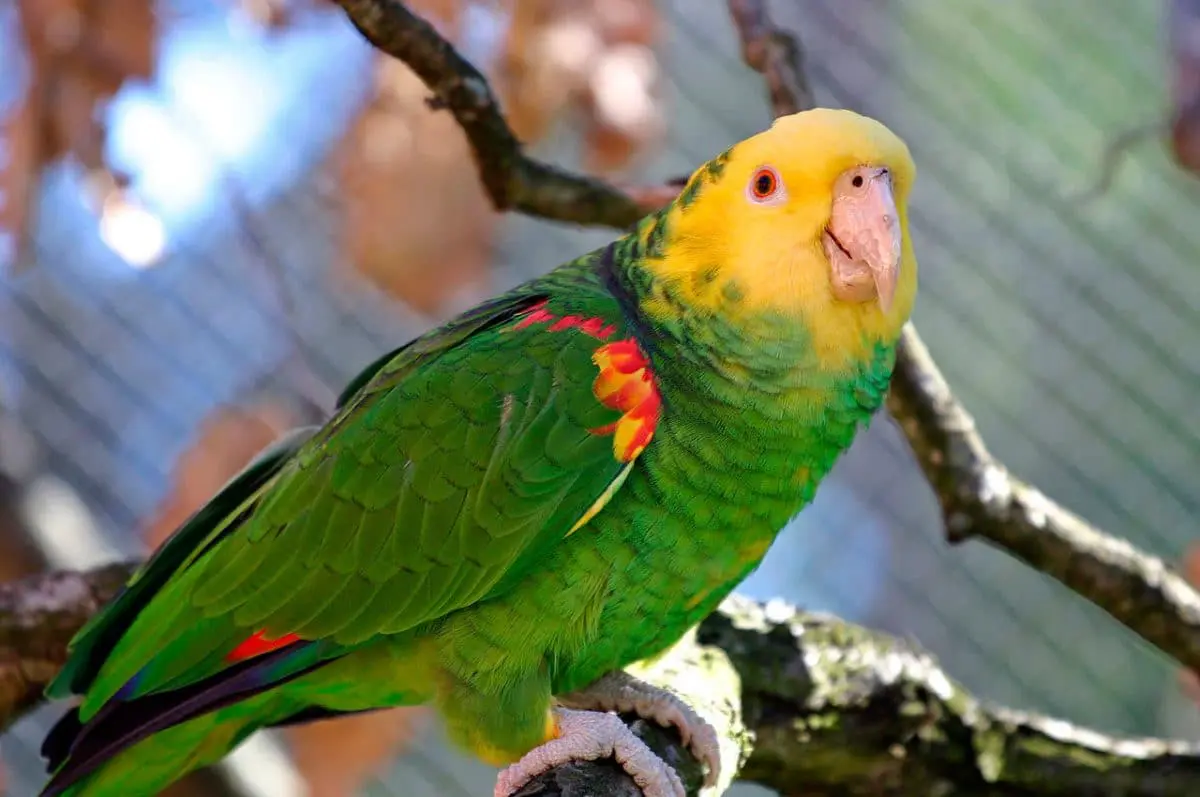
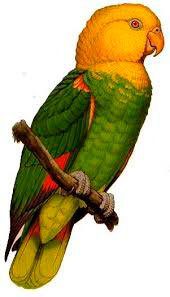
The Yellow-headed Parrot(Amazona oratrix) has head and nape bright yellow; sides neck sometimes with scattered green feathers.
Upperparts green grass with ends of darker green in some feathers; uppertail-coverts paler. Wing coverts green, sometimes with paler yellow margins on some feathers; edge front of the wing
and carpal area with red marks and / or yellow variables. Primaries and secondaries green at the base (more emerald than coverts), blue at the tips; five base outer secondaries bright red, forming a speculum. Under wings green. The chin is bright yellow, the throat variable green and dark blue suffusion margins in the feathers of some birds; chest and belly green with yellowish suffusion in some birds, bluish suffusion in other; the thighs with yellow feathers in some birds. Tail green with red tips yellow and green at the base of the innerwebs of the lateral feathers. Bill gray horn; bare periophthalmic whitish; irises orange; legs grey.
Both sexes are similar.
Immature It is very green part with little or no yellow in the head without red and yellow in the wings.
Sound of the Yellow-headed Parrot.
Geographic Variation:
All birds puerto Barios at the East end of Guatemala show yellow concentrate lores and crown. While it described as near the subspecies belizensis, the birds of puerto Barios at the northwest end of Honduras They may represent another subspecies of oratrix (not yet formally described) provisionally named guatemalensis (see belizensis below). The hondurensis, described below, It was widely regarded as a subspecies of undescribed Yellow-crowned Parrot (Amazona ochrocephala), but now treated at the southern end as a cline (gradual change of phenotypic traits of the same species due to environmental influences and conditions) Yellow decreasing in head Group of birds yellowhead.
Description 3 subspecies:
Amazona oratrix belizensis
Monroe,BL Jr & Howell,TR, 1966) – Less yellow in the head that the nominal species, without yellow on the throat. Cheeks green, bare periophthalmic grayish-white and probably on average smaller. Fowl Guatemala, to the Northwest of Honduras, sometimes show yellow in head as a patch wide in front of the crown and around eyes, and perhaps they represent a species not yet described (known as guatemalensis); although some birds also show yellow feathers on nape (see geographic variation in Yellow-naped Parrot (Amazona auropalliata).
Amazona oratrix hondurensis
(Lousada & Howell,SNG, 1997) – Yellow on head limited to forecrown and in front of the crown, some birds show patch yellow in nape. One bill paler and more extensive yellow on the nape and the head subspecies caribea of the Yellow-naped Parrot. The patch Yellow crown It is also rounded or triangular, against a narrowband subspecies caribea. The subspecies panamensis of the Yellow-crowned Parrot has a bill darker and lacks the patch yellow in nape.
The Yellow-headed Parrot frequent savannas, Bosques Tropicales deciduous (including clear), dense forests of thorns, marshy forests peaceful, flood forest evergreen, dense gallery forest, forests Pinus caribea (Belice) and cultivated land with trees, mainly in lowlands below 500 m.
Mainly observed in pairs or in large groups in communal roosts and feeding areas favorites. They snuggle into pine-covered ridges in Belice, moving to nearby humid forests to feed. Apparently, only flocks form in Tamaulipas.
Reproduction:
The Yellow-headed Parrot put their nests in cavities of trees 6-15 meters and in the holes of the palmeras Roystonea. Along the Pacific coast of Michoacán in Mexico, the Yellow-headed Parrot nests in trees Astronium graveolens, Brosimum allicastrum and at least five other species of trees (T. Monterrubio-Rico et al., In 2007)
In Belice, preferred pines nest. Breeding season in the months of February to May in the south, to June in the north (for example in Tamaulipas). Clutch, usually 2-3 eggs, they are incubated between 27 and 28 days. The young leave the nest at eight weeks.. On average, only 1.2 hatchlings reach adulthood in each clutch.
They can cause damage to crops, including corn, mango and green bananas.
Distribution and status:
Size of its range (breeding/resident ): 1.020.000 km2
The Yellow-headed Parrot It is confined to Central America in Mexico, Belice, the east end Guatemala and the Northwest corner of Honduras. They are distributed by the slope of peaceful of Mexico in Colima, Michoacán, Warrior, Oaxaca (two disjunct populations on the slopes of peaceful and of the Gulf on Isthmus region) and Chiapas. also observed in the shed Gulf from the central and southern Tamaulipas, to the East of San Luis Potosi, Puebla, Veracruz, Tabasco and Campeche, as well as in Belice and around puerto Barios at the East end of Guatemala to the northwest corner of Honduras in the Sula Valley.
Distribution in the east of its range poorly documented, with dubious appearances Campeche and in the region of Petén in the North of Guatemala, confirmed only 1993.
Reports Yellow-headed Parrot outside the normal range Mexico (for example, City of Mexico) probably involving leaks. Wild populations Miami (Florida) and Puerto Rico.
local residents, and rare sparsely distributed along most of its distribution (perhaps locally common in parts of Belice) with diminished by the loss of habitat populations and their capture for live bird markets.
The population of Sula Valley survives as remainder. marketed widely both within and outside the species range, being one of the most searched Neotropical parrots pet (reputedly one of the best talkers). The most drastic falls have probably been in the northeast of Mexico, where habitat loss has been more rapid and severe. The wild population is probably less than 7.000 individuals (1994).
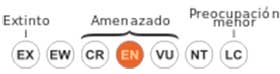
• Current category of the Red List of the UICN: In danger of extinction.
• Population trend: Decreasing.
• Population size: 4700
Rationale for the Red List category
This species qualifies as in danger of extinction due to demographic decline very fast. The population is now so small that it is likely to fall (but still very significant) rates decrease in the future (Collar et al., 1992).
Justification of the population
The population It was estimated 7.000 copies in 1994. This is roughly equivalent to 4.700 mature individuals.
Justification of trend
It is estimated that the population of the species is declining very fast, due to the loss and degradation of habitat and the levels of capture and persecution. On the coast of Michoacán, Mexico, it is estimated that the species occupies the 45.6% its estimated historical distribution (Monterrubio-Rico et al ., 2007 ). Throughout all Pacific coast of Mexico, its historical range has contracted by a 79% (Monterrubio-Rico et al ., 2010). The population of Punta de Manabique It decreased by 30% between 1994 and 2001 mainly due to the Poaching of nests (our man 2003 , Eisermann in a bit., 2007).
Threats
• The habitat loss It has been extensive, with the 80% lowlands of Tamaulipas cleared for agriculture and pasture, and growing settlements along the Autopista del Oeste in Belice (Somerville 1997).
• In Belice, where much of the suitable habitat is outside the sistema national protected area, the regions occupied by species remain under heavy development pressure (B. Miller in a little ., 2007).
• Las palm savannas at the only known breeding site in Guatemala They are used for no intensive cattle grazing (our man 2003), who is still a threat here (Fundary et al ., 2006).
• Many thousands of Individuals of this species are exported illegally from Mexico and some from Belice each year, and it is popular in domestic markets (Low 1995b, Miller and Miller 1997, Somerville 1997).
• The illegal internal traffic is intense in Mexico and may represent the 38% of recent species loss distributive (T. Monterrubio-Rico et al., In 2007).
• In the Mexican states of Michoacán, Warrior and Oaxaca, They are mainly pups those taken to the pet trade (T. Monterrubio-Rico et al., In 2007).
• In Guatemala, It is reported that Local military authorities are complicit in the illegal trade of this species, and poachers frequent nest nesting site of the species (our man 2003, Eisermann in some). It also, has reported its hunting for food from local fishermen in Guatemala (our man 2003, Eisermann in some ., 2007).
• In Belice, It is hunted and persecuted by damage to crops (SNG Howell in some 1998) and it remains a victim of the illegal pet trade, whose capture involves logging nesting (B. Miller in a little ., 2007).
• It is estimated that its extension around the coast of Michoacán It has decreased 1.507 km2 , of which 576 km2 can not be attributed to habitat loss and, therefore, They may be due to the poaching for trade (Monterrubio-Rico et al., 2007).
Conservation Actions Underway
• CITES Appendix I.
• In Mexico It is distributed in nine protected areas (T. Monterrubio-Rico et al., In 2007).
• The only one breeding population known in Guatemala It was declared Wildlife Refuge in 2005, but effective protection is difficult due to organized crime in the area (Eisermann in some ., 2007).
• There are several awareness campaigns nationally in Mexico (Roberson y Carratello, 1997).
• It is bred in captivity, but the reintroduction of captive bred birds is unfeasible (Baja 1995b).
Conservation Actions Proposed
• Carry out surveys for an updated estimate of population size.
• Monitor rates of habitat loss and degradation.
• Monitor hunting levels, catch and trade.
• Apply the trade restrictions.
• To protect effectively as key sites Las Colorados Ranch, Soto La Marina / Fishing, Tamaulipas, orange river, focused on Las Abritas (San Luis Potosi) and Punta de Manabique.
• Survey to identify other important sites.
• Investigate habitat use and local movements.
• Continue zooming awareness campaigns.
• Develop structured captive breeding programs and investigate the possibility of future release.
"Yellow-headed Parrot" in captivity:
The Yellow-headed Parrot are popular in domestic markets.
protected by CITES Appendix I (Species that are endangered. Prohibited international trade of specimens of those species, except when the import is non-commercial purposes).
In Mexico It is listed as endangered in both the NAME-059-SEMARNAT-2001, as in the NAME-059-SEMARNAT-2010, and by the Article 60 Bis of the General Law on Wildlife removal of specimens from the environment is prohibited, marketing, tenure, import, export, use of any of its parts. They are up 9 years in prison and fines very high who are surprised by the Profepa with specimens of this species in their possession and do not have papers proving their legal provenance.
Should be avoided in all cases buy this or any of the protected species by different appendices CITES.
Alternative names:
– Yellow-headed Amazon, Yellow-headed Parrot, Yellow-headed Parrot (Mainland) (English).
– Amazone à tête jaune, Amazone à tête jaune (continentale), Amazone à tête jaune (forme continentale) (French).
– Gelbkopfamazone (German).
– papagaio-de-cabeça-amarela (Portuguese).
– Loro Cabeza Amarilla, Amazona cabecigualda (español).
– Avibase
– Parrots of the World – Forshaw Joseph M
– Parrots A Guide to the Parrots of the World – Tony Juniper & Mike Parr
– Birdlife
– Photos:
(1) – A Yellow-headed Amazon (also known as the Double Yellow-headed Amazon) in an aviary By Ernst Vikne (IMG_4451.JPG) [CC BY-SA 2.0], via Wikimedia Commons
(2) – Yellow-headed Amazon at Baltimore Aquarium, USA By Christine Schmidt from Laurel, USA (Parrot pair) [CC BY 2.0], via Wikimedia Commons
(3) – Yellow-headed Amazon, also known as the Yellow-headed Parrot or Double Yellow-headed Amazon, at Lion Country Safari, West Palm Beach, Florida, USA. Photograph is a close up of head By Duncan Rawlinson from Vancouver, BC (Parrot) [CC BY 2.0], via Wikimedia Commons
(4) – Yellow-headed Amazon (Amazona oratrix) playing on his cage by Mbtskysurfer at English Wikipedia [GFDL or CC BY 3.0], via Wikimedia Commons
(5) – Yellow-headed Amazon (Amazona oratrix) also known as the Yellow-headed Parrot, Double Yellow-headed Amazon. Two parrots on a perch By Gary Denness (originally posted to Flickr as Parrot Portrait) [CC BY-SA 2.0], via Wikimedia Commons
(6) – Yellow-headed Amazon (also known as the Yellow-headed Parrot and the Double Yellow-headed Amazon) at Vancouver Aquarium, Canada By Lizzy Foulkes (originally posted to Flickr as Hello, Goregous) [CC BY-SA 2.0], via Wikimedia Commons
(7) – A Yellow-headed Amazon at Palmitos Park, Gran Canaria, Canary islands, Spain By William Warby (Flickr: Parrot) [CC BY 2.0], via Wikimedia Commons
(8) – A Yellow-headed Amazon in Jungle Island, Miami, Florida, USA By Humberto Moreno (Parrot Jungle, Miami) [CC BY 2.0], via Wikimedia Commons
(9) – Yellow-headed Amazon (also known as the Yellow-headed Parrot and the Double Yellow-headed Amazon) at Dallas World Aquarium, USA By texas_mustang (Dallas Aquarium 2008 with Meredith) [CC BY 2.0], via Wikimedia Commons
Measured between 30 to 31 cm.. and a weight between 180 and 245 gr.
The adults of the species Yellow-streaked Lory(Chalcopsitta scintillata) have plumage dark green, pale green veins in head and the abdomen, and bright yellow bands in the chest and in the the mantle.
Chalcopsitta sintillata rubrifrons
The forecrown, cheeks and the thighs are bright red. The sides of the chest with large red infiltrations.
The under wing
It is crossed by a thick yellow band. The bill is black. Bare skin eye and at the base of bill is dark gray. The irises are orange-red, the legs grey.
There is no sexual dimorphism, but in the female, the front spot It is less pronounced.
The immature They resemble adults, but have less red in the forecrown. The basis of the bill It is less stained yellow. The irises They are brown.
They are particularly visible in the early hours of the day, When the bands fly over canopy, sometimes very large heights.
They have a direct flight with rapid wing beats. In spite of this, they give the impression of moving slowly, almost in a hesitant way. Its neck tense and the tail feathers widely deployed gives them a vision in flight that is very characteristic. Couples often engage in stunts, with many screams.
(Salvadori, 1876) – Adults of this subspecies differ little from those of the nominal species. But, they differ from the latter by the narrower stripes on the plumage. The bottom of your wings They are green or green with red markings.
Chalcopsitta scintillata rubrifrons
(Gray,GR, 1858) – In this subspecies, both adults and juveniles, they are identical to the nominal species, but the veins of body plumage They are more spacious and orange-yellow.
common in the lowlands, in the Savanna They are covering the hills, in plantations cocoteros and in the mangroves.
They are also in the primary forest and secondary adjacent, even in narrow bands of gallery forests bordering rivers in open country.
Occasionally, the Yellow-streaked Lory They sit near or inside Gardens in local villages.
They can fly to 800 m above sea level.
Reproduction:
Typically install their nests in treeholes high. There is not much information about the reproduction in the center of nature.
In captivity, the implementation is of 2 eggs which both parents incubate alternately during 26 days. At hatching, hatchlings weigh 7 u 8 g.. Duration reproductive cycle It is very long and can overcome 80 days. Despite this, There may be a second clutch in the season.
Food:
They feed in the trees.
consume nectar, pollen and fruit. Are said to some insects complete this predominantly vegetarian diet.
Distribution:
Size of its range (breeding/resident): 586.000 km2
These birds are endemic to the Islas Aru and South of Papua New Guinea.
Distribution 3 subspecies
Chalcopsitta scintillata chloroptera
(Salvadori, 1876) – High of the fly river to Southeast Papua New Guinea.
It is not an endangered species. In a study in Southeast New Guinea, its density was estimated at 20 birds per square kilometer.
Its world population approaches the 100.000 birds.
The population suspected to be stable in the absence of evidence of any reduction or substantial threats.
"Yellow-streaked Lory" in captivity:
Pretty common.
They are birds very noisy People who like to let their loud cries are heard. They are playful, they have no fear and they can easily become meek in the hands of your caregiver. They are not only extremely aggressive against other Yellow-streaked Lory, also as with other species.
Alternative names:
– Yellow-streaked Lory, Greater Streaked Lory, Streaked Lory, Yellow streaked Lory, Yellowish-streaked Lory (ingles).
– Lori flamméché, Lori à front jaune, Lori à front rouge, Lori strié (French).
– Schimmerlori (German).
– Lóris-listrado-amarelo (Portuguese).
– Lori Chispeado (español).
Its length is about 25 cm. and weigh between 80 and 85 gr.
The Olive headed Lorikeet(Trichoglossus euteles) show, in general, a green shade.
The head color is olive with waves pale mustard and yellow stripes over the entire surface of the top.
The neck and its part rear are surrounded by a collar of color green brilliant that continues until the throat.
The underparts below the throat are entirely greenish-yellow.
The bill is red-orange. The irises they are red, and legs grey.
The youth they are more muted than adults. Its head is slightly greenish with streaks pale. The bill is brown. The irises They are brown. The species is considered monotype.
They frequent humid subtropical forests., secondary forests and wooded meadows. Adapt quite well to cultivated land and the gardens in cities.
In Timor, they are relatively abundant between 1.000 and 2.300 meters above sea level, apparently, substitute to the Coconut Lorikeet in these heights. Also they can be observed at sea level in the island of Timor. In the rest of the Islands it frequents lowland areas.
The Olive headed Lorikeet they live in small groups. They are especially visible when they are in flight because they emit continuously shouts. On the other hand, when feeding or resting in trees, they are very difficult to observe because of their green plumage mixed with the color of the foliage.
They are birds territorial, capable of showing great aggressiveness if the limits of their area of influence are violated.
Usually disperse in search of their food, forming large groups when resources are abundant.
Outside the breeding season they form large roaming flocks of a hundred or more individuals.. Move in flying fast and slightly wavy.
In Timor, during the season, dry, These birds seem to descend below 1.000 meters and are scattered in coastal areas.
Reproduction:
The anidacio seasonn would take place perhaps between September and October, but this information needs to be confirmed.
In captivity, the Olive headed Lorikeet put 3 white eggs that parents are in charge of incubate for a few 23 days. As in the majority of the Lori, the nesting cycle is particularly long.
Food:
Feed primarily of nectar and fruit. They forage in trees in flower and shrubs.
Distribution:
Size of the area of distribution (reproduction / resident): 38.100 km2
The population size This species has not been quantified. Suspected that the population is stable in the absence of evidence of any reduction or substantial threats.
Like most brightly plumaged parrots, the Olive headed Lorikeet It victim of trade bird cage or Aviary.
"Olive headed Lorikeet" in captivity:
Pretty common. They can be housed with others of its kind.
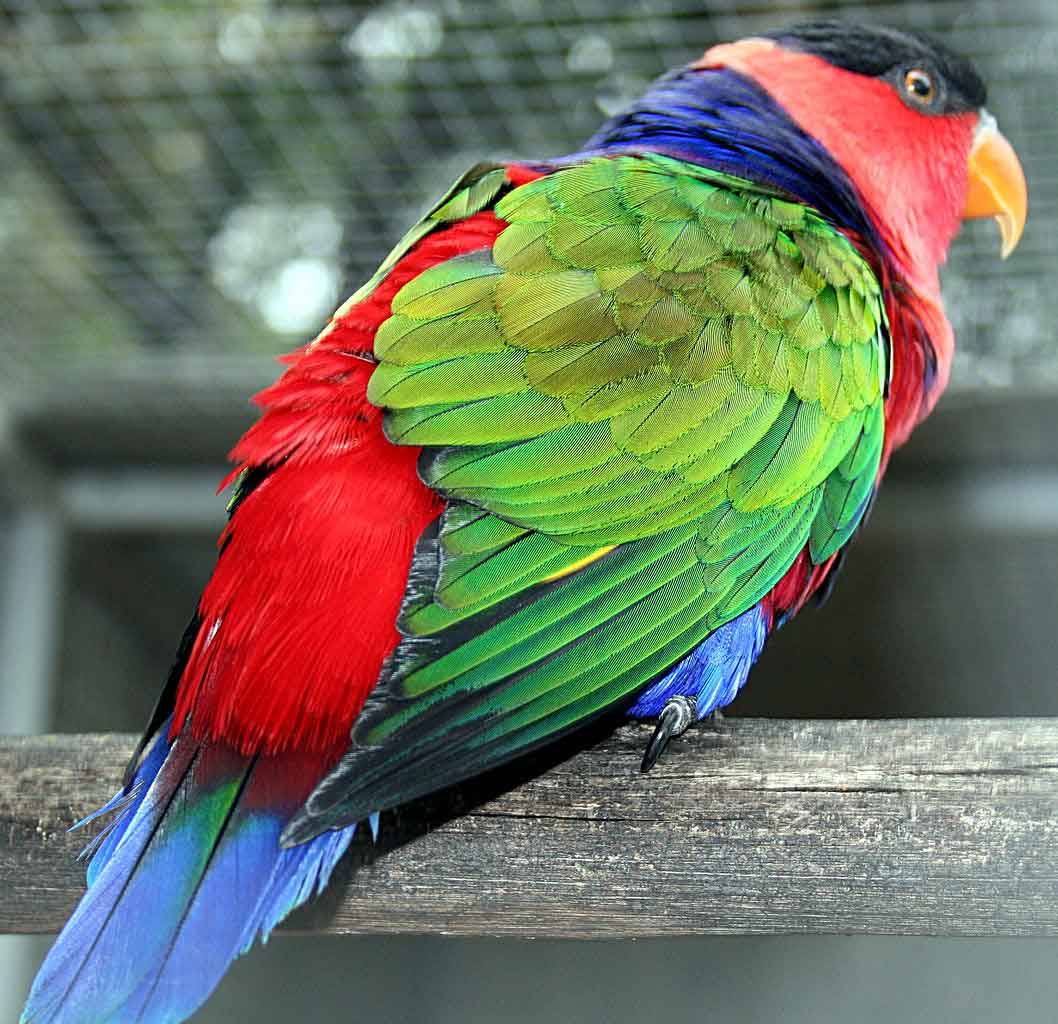
The Black-capped Lory(Lorius lory) has an approximate length of 31 cm.. and a weight between 200 and 260 g..
Black hood extends above the peak to the nape of the neck, where a few blue spots appear; rest of the head is bright red. The black hood is separated from the rear mantle red pink (sometimes mottled red), by a fine necklace of dark purple blue; back, the upper coverts bright red tail and rump.
Upper parts of green color with slight shine bronze wing, more visible on the coverts and secondary more internal.
Flight feathers of black on the inside and marked with yellow in the middle part, forming the group a tricolour in the Underwing. Red Wing coverts.
Throat and upper part of the chest of Red; Blue mantle extends around the sides of the chest, dark blue in the abdomen that is slightly brighter in thighs and coverts; flanks with varying amounts of Red ranging upward and around the curve of the wing.
Dark bluish black on the upper tail feathers, Green slightly sieved in the Centre and Red at the base (It shows only dark blue at rest); Yellow undertail dark Olive with red hidden base.
Orange peak; Cere and grey-black periophthalmic ring; orange-yellow IRIS; grey to black legs.
Males and females they are the same. Immature with less extensive blue underparts and the upper part of the chest of color red wine. Fine blue collar around throat. Underwing coverts blue and yellow with a black tip, not red as in adults. Brownish beak.
Subspecies vary considerably in color:
Lorius lory lory: It is the nominal
Lorius lory erythrothorax: Neck and central area of blue belly. Yellow in the wings. Blue mantle in two bands. Red Underwing coverts.
Lorius lory SOMU: Red neck, blue belly.
Lorius lory salvadorii: As the erythrothorax but with blue-black Underwing coverts.
Lorius lory viridicrissalis: As the salvadorii but the blue darker everywhere.
Lorius lory jobiensis: As the salvadorii but top of the paler breast and mantle bands.
Lorius lory cyanuchen: Black on the top with blue on the nape of the neck.
The Black-capped Lory he prefers the primary forests and edges of these, They also reported in secondary forests well grown, in some partially cleared areas and swamp forest. It is not known to occur in the monsoon forest, planted forests or plantations of coconut trees. The Black-capped Lory is mainly distributed in the lowlands up to 1.000 m, but there have been examples to 1.750 m.
They are mainly found in pairs and usually smaller than other groups parrots sympatric, but it may happen that they get together in groups of ten or more to feed in trees in flower.
Reproduction:
Little is known of its breeding ecology in the wild., Although there is a history of a couple digging a pit to make the nest in a dead tree. Apparently the nesting occurs from the month of may until October.
In captivity, the setting is two eggs with 26 incubation days; emancipation occurs between 57 and 70 days after hatching.
Food:
The diet includes pollen, nectar, flowers, fruits and insects. The birds prefer to feed in the canopy or half-height where they remain quiet and discrete. Unlike in the Coconut Lorikeet and the Dusky lory, It reached generally similar maximum altitudes, This species has been able to adapt to secondary habitats in high levels in the East of New Guinea.
The world's population has not been quantified, but the species has been observed that it is, usually, common, but not abundant throughout its area of distribution.
Suspected that the population is stable in the absence of evidence of any reduction or substantial threats.
"Black-capped Lory" in captivity:
It has attractive voice and can learn to imitate. Playful and curious; It can be noisy at times.
Common up to the decade of 1960 When exports began to cease.
Alternative names:
– Black-capped Lory, Black capped Lory, Tricolored Lory, Tricoloured Lory, Western Black-capped Lory (ingles).
– Lori tricolore, Lori à calotte noire (French).
– Frauenlori (German).
– Lóris-bailarino (Portuguese).
– Lori Tricolor, Tricogloso Tricolor (español).
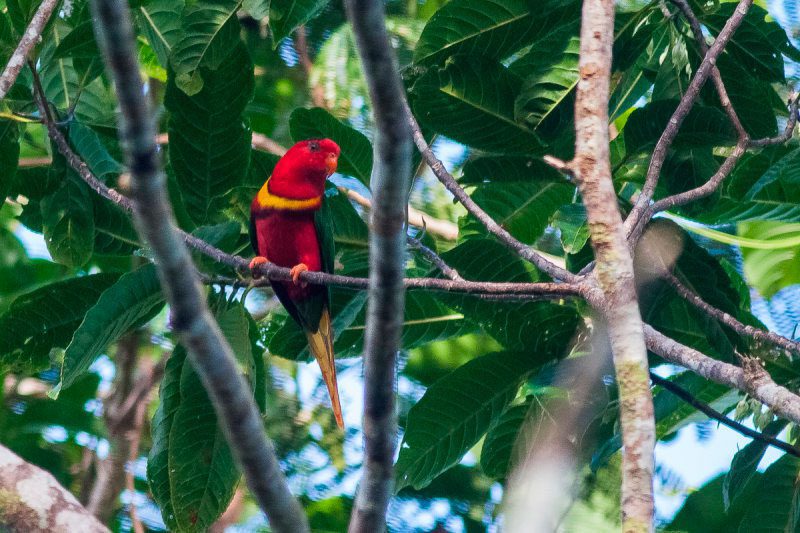
The head of the Duchess Lorikeet(Charmosyna margarethae), is red except for the back of the crown that is black and extends from the top of the eye up to the nape.
Large collar Red on the back of the neck, bordered below by a thin purplish-black line and a broader yellow-orange stripe: the mantle and scapulars green; rump Green with trademark red on the side; tail coverts, view from above, green. The wings green. Under the wing
, coverts marginal green, the coats under the wing
red, and the bottom of the flight feather Black with a panel of yellow color that goes from the center of the flight feather passing by the secondaries.
The underparts, basically, are red with a yellow stripe on the chest, narrow edged purple-black above, a thin red margin and a broader and more diffuse below purple edge; from below, the tail coats are green. From above, the tail It is red with black borders and the sharp tip of yellow; from below, the tail is yellowish-brown, Yellow-tipped.
The bill is orange; irises yellow to orange; legs oranges.
The male and the female are very similar.
Immature they lack the Black Hat and black and orange margin on the back of the neck. The chest belt is a yellow shutdown. The bill orange, the irises Yellow-grey and the legs gray.
It inhabits in the forests and wooded areas, at the edges of forests and tall secondary growth forests, mostly mountains and hills, Although you can also see in coconut plantations and coastal villages; above all between 100 and 1.350 meters above sea level.
Often feeds in noisy groups of 10 to 40 birds in the trees in flower and epiphytes with others Loris (including (Cardinal Lory). They feed acrobatically, mainly in the forest canopy.
Reproduction:
Nesting and breeding habits unknown, although a male was seen in a breeding attitude during the month of January.
Food:
Apart from pollen and nectar, observed feeding on fruits of Schefflera.
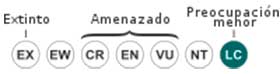
• Current IUCN Red List category: Near threatened.
• Population trend: Decreasing.
Much of the lowland forests, within the area of distribution of the Duchess Lorikeet, He has been or is scheduled to be connected, but this species is probably safe in the Highlands.
There is an export license fee for 60 birds, the funds will be used to finance conservation programs (JR van Oosten in litt. 1999); However, this species could be threatened by any large-scale trade (T. Leary in litt. 2000). In 2002, 200 birds were imported to Singapore with permissions CITES (UNEP-WCMC CITES Trade Database, January 2005).
The world population It is considered of less than 50.000 birds, but stable.
"Duchess Lorikeet" in captivity:
Very rare in captivity.
Alternative names:
– Duchess Lorikeet, Dutchess Lorikeet (ingles).
– Lori de Margaret (French).
– Margarethenlori, Margaretenlori (German).
– Lori de Margarita (español).
– Duchess Lorikeet (Portuguese).
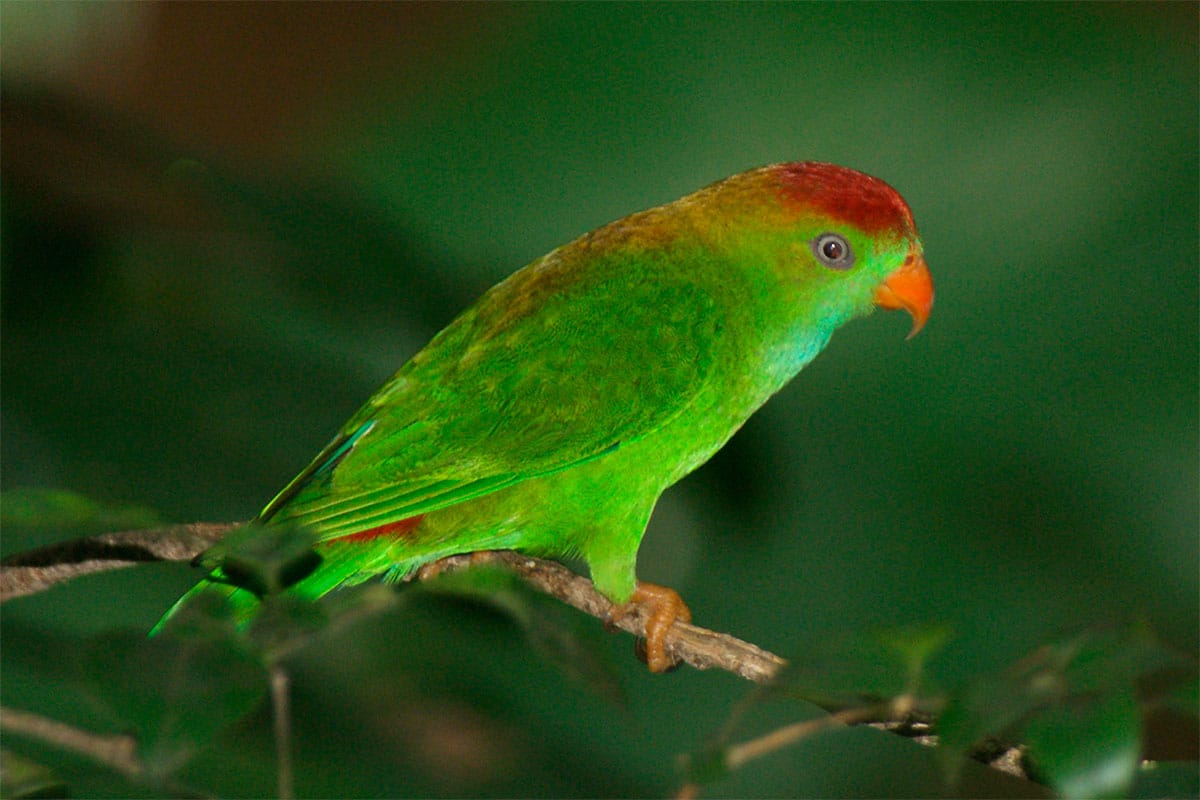
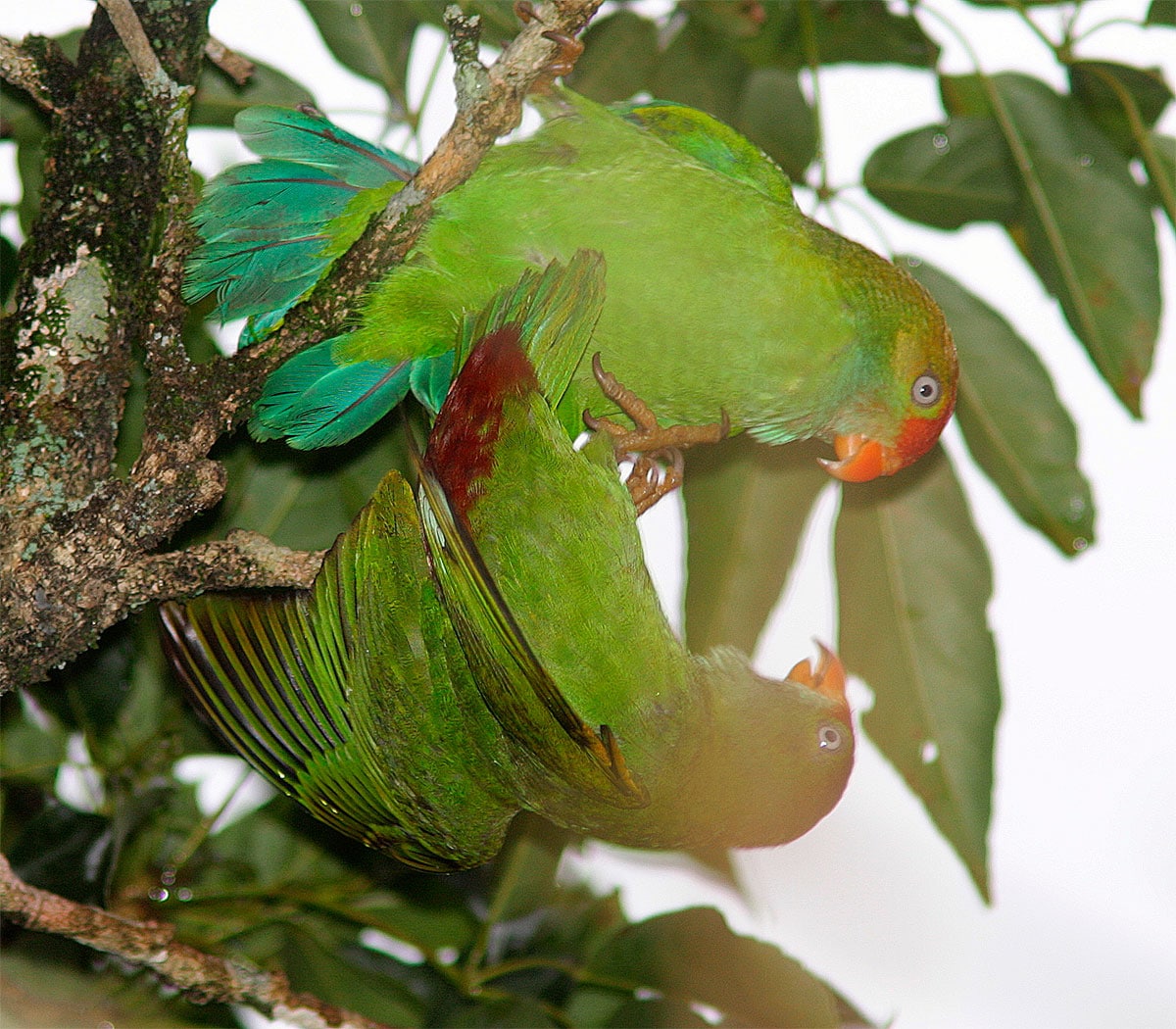
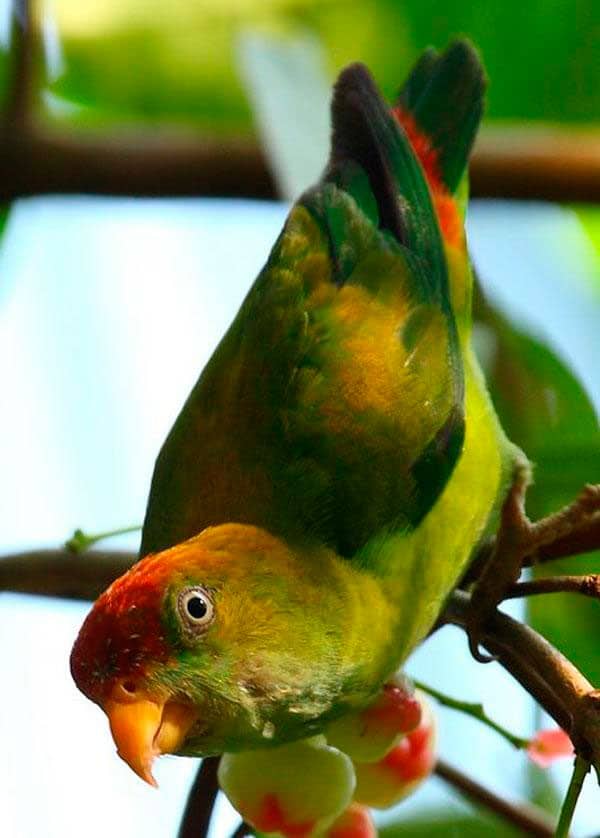
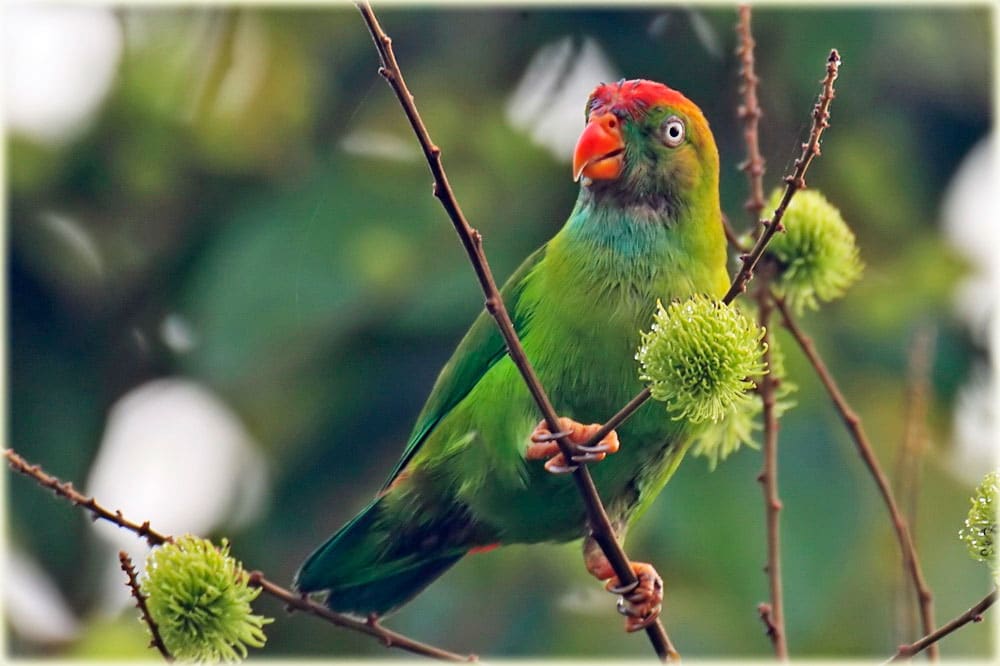
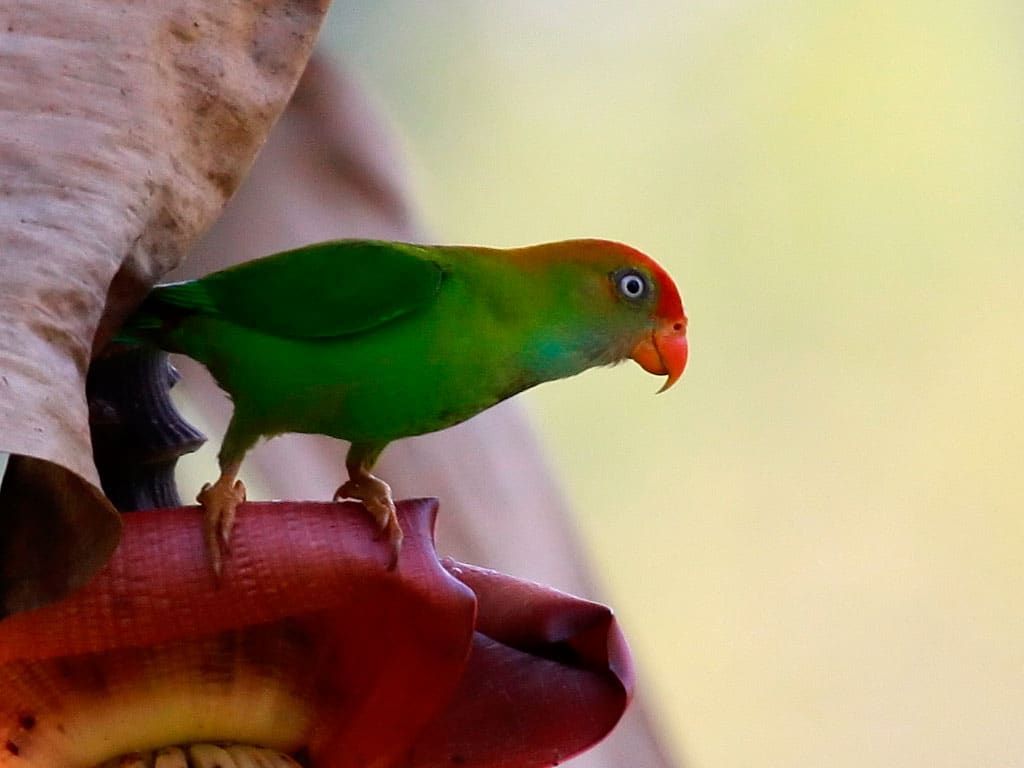
The Ceylon Hanging-Parrot(Loriculus beryllinus) has the crown red, merging into orange-yellow in the area of the nape; eyebrows, lores and the area in front of the eyes light green (lightly bathed in pale blue); sides of the front of the crown red. Mantle green, Bañado de slightly reddish and yellowish orange color in the Center; back green; rump and uppertail-coverts, red. Wings green up, with the exception of vane inner of the blackish flight feathers ; undertail, the wings bright turquoise color with the exception of coats and axillary green. The underparts bright green, paler and more yellowish which the upperparts and light blue marking in the throat. above the tail green color; Turquoise below.
Bill orange red, paler at the tip; irises off-white; legs dark yellow.
Female as the male, but most off and only a trace of blue in the throat.
The young birds they are even duller, the crown reddish-tinged, the patch blue of the throat absent, the rump with some green feathers, the bill paler, the iris and the legs brown; the face nude in the fledglings.
Seen in a range of habitats, from sea level to 1.600 m, reaching the highest areas according to seasonal conditions. The species is found in forests of coconut trees, Evergreen and deciduous forests, semicultivadas areas, open woodland and around the dwellings.
birds are not shy, and is usually found in pairs or family groups, although outside the breeding season larger flocks congregate high up in flowering trees. They are active and acrobatic feeding.
Reproduction:
Observations, they have registered the male approaching his partner upright, with the high peak, swollen throat, extended tail and rump feathers erect, while emitting a screeching chirp. Wiggles head in courtship period have also been observed.
The breeding begins in January and although the main nesting period is between March and May, a second litter is, sometimes, until September. The nest is located in a hollow branch filled with fragments of vegetation that the female carefully cuts with her beak and carries to the nesting sites tucked between her rump feathers.. Only two to four white eggs she incubates, sitting firmly, screeching and creating a 'thumping' sound’ Yes is the annoying. The young Chick has the face exposed, presumably to avoid getting dirty by liquid food.
Food:
Feed on fruits such as Ficus figs and guava (Psidium guajava); berries; flowers, including Erythrina, Salmalia and eucalyptus; seeds, including Casuarina. Poisonings have been reported after drinking Palm wine collected pots attached to the trunks of the trees.
Distribution:
Endemic to Sri Lanka, where most records come from the South, Although there have been North of Trincomalee and should be observed in suitable habitats throughout the country. Records include proximities of Colombo, around Kandy, Yala and National parks Gal Oya, the district Welimada, and to the South of Galle and Hambantota, on the coast.
Conservation:
• Current IUCN Red List category: Least concern
• Population trend: Stable
The size of the world's population has not been quantified, Although it is estimated at 10.000 specimens. The species is qualified as widespread and abundant in the South-West and almost absent in the North of its distribution area (pit et to the. 1997).
The population is suspected to be stable in the absence of evidence of any reduction or substantial threats, However, the bird trade is judged as a potential threat.
"Ceylon Hanging-Parrot" in captivity:
Rare.
Alternative names:
– Ceylon Hanging-Parrot, Ceylon Hanging Parrot, Ceylon Lorikeet, Sri Lanka Hanging Parrot, Sri Lanka Hanging-Parrot, Sri Lankan Hanging Parrot (ingles).
– Coryllis de Ceylan, Coryllis du Sri Lanka (French).
– Ceylonpapageichen, Ceylon Papageichen (German).
– Loriculus beryllinus (Portuguese).
– Lorículo de Ceilán, Lorículode Ceilán (español).
















_-pet-8a.jpg)


_pet_on_perch.jpg)
_-_2_on_perch.jpg)

.jpg)


5.jpg)


