โ–ท The world of Pets: Dogs, cats, birds, reptiles, amphibians

Masked Shining-Parrot
Prosopeia personata

Masked Shining-Parrot

Content


Anatomy-parrots

Description

47 cm of length and weight approximate of 322 g..

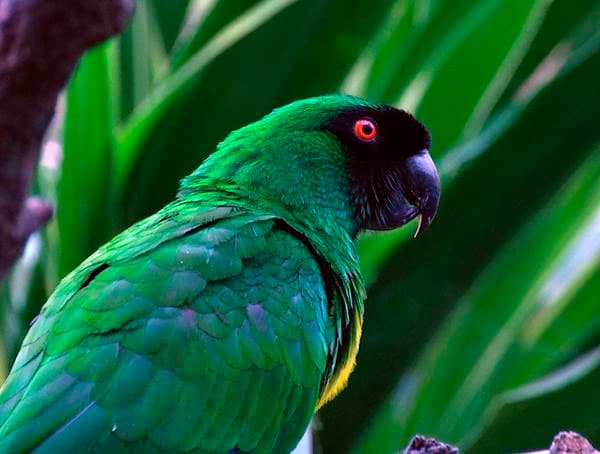
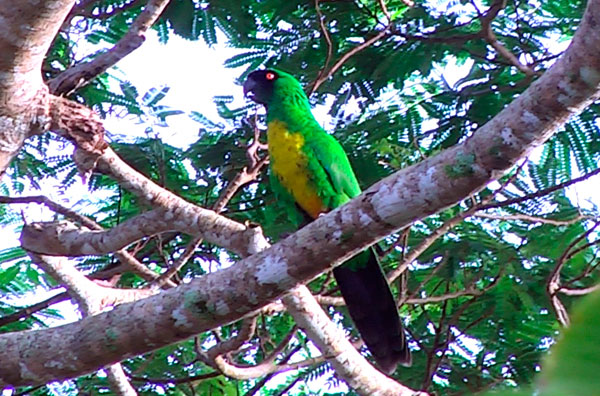
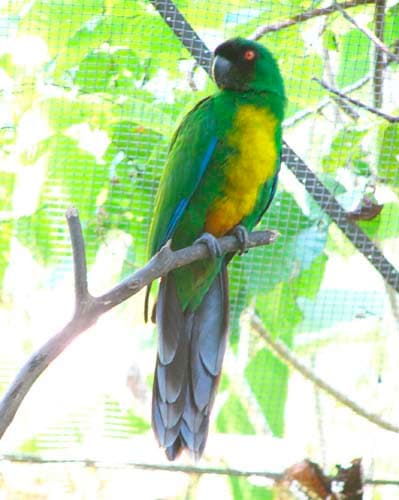
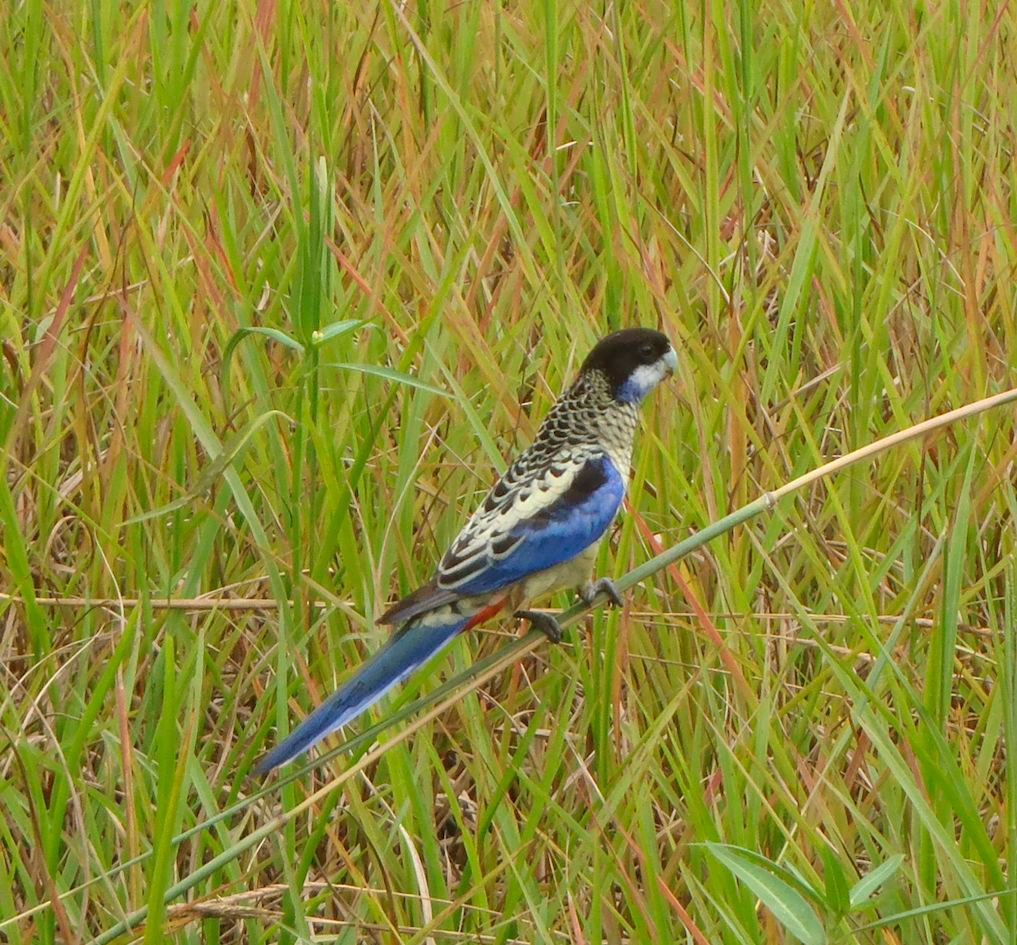
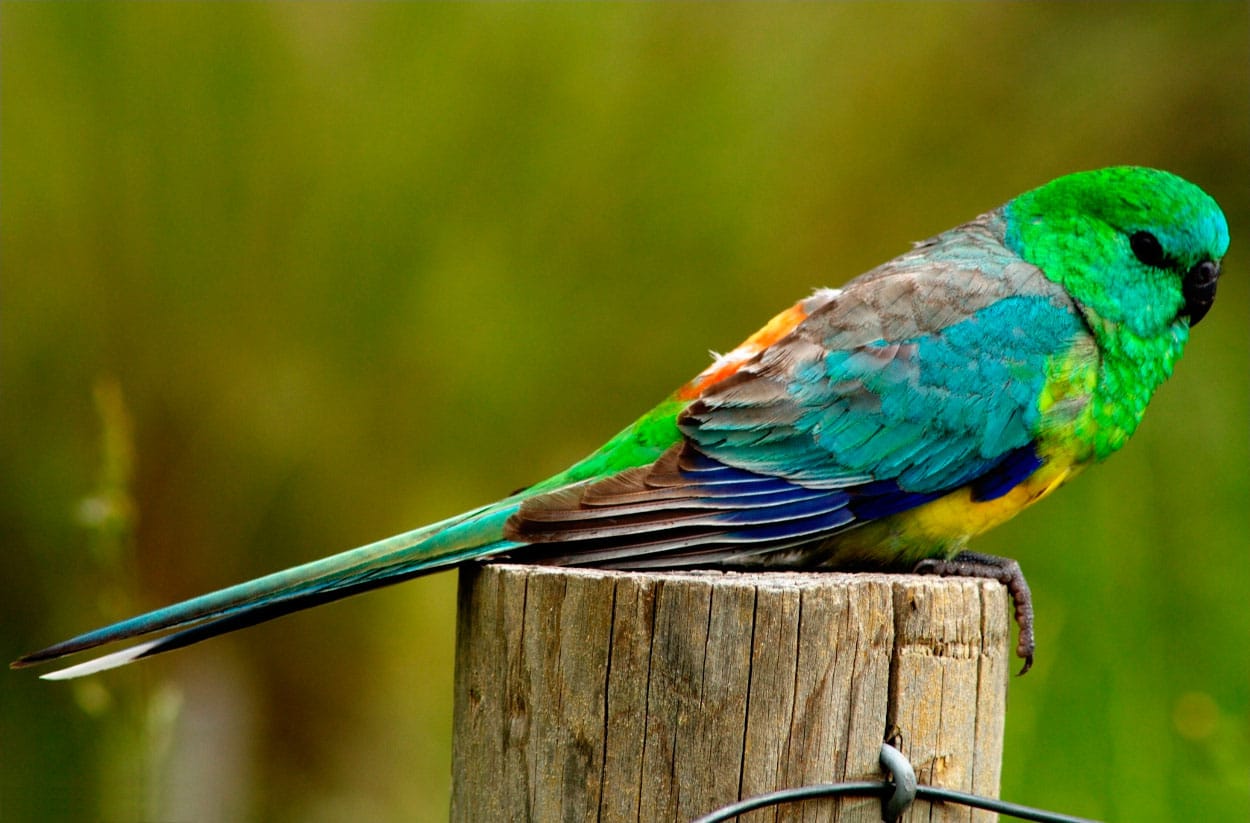
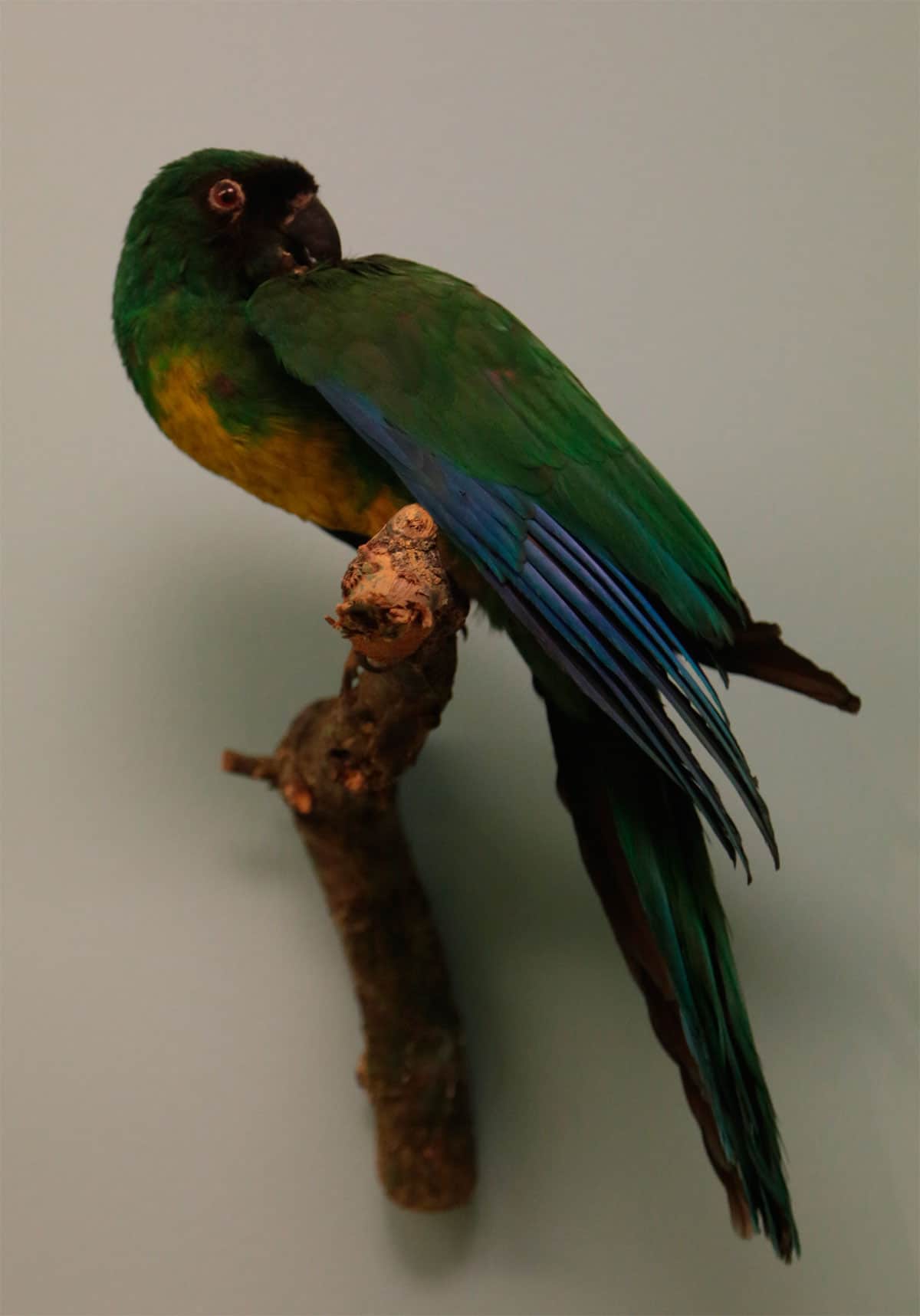
The colorful Masked Shining-Parrot (Prosopeia personata), has a plumage green over most of its body, the front of the crown, lores, cheeks and chin, are black.

The upperparts are bright pale green (with a brighter sheen on the Crown and nape). Large external coverts, primary coverts and primaries are blue with vane inner dark. Wing feathers green. Throat, top of the chest, flanks, and undertail- coverts green; center of chest and the belly bright yellow, a few feathers with the Green Tip, yellow shading in the Orange patch It is located in the lower part of the belly. Upper, the tail green; black for the part below.

The bill black; irises orange-red; legs blackish gray.

The male has the head and the bill larger that the female. The young birds have, peaks paler, less black in the face and irises brown.

El Papagayo Enmascarado (Prosopeia personata) is a large parrot, long tail which is only on an island, in Fiji.

Habitat:

Masked Shining-Parrot

They are distributed Since the sea level, until the 1.200 m altitude, in the forest reacor and secondary growth of the Windward areas and intermediate vegetation, You can also find them in orchards of villages, agricultural fields and mangroves; Often observed along forest edges near agricultural land and in trees bordering forest watercourses.

The Masked Shining-Parrot they are usually sociable and finds them alone, in pairs, or outside the breeding season in herds up to 40 birds.

Birds are sometimes interviews flying rapidly through the forest or wandering above the canopy. Son noisy birds and they are often heard before to be seen; similar to the Red Shining-Parrot, often make calls at the first sign of a human intruder, and they are generally shy and difficult to approach when they are perched on a branch.

Reproduction:

The breeding season occurs between July and September. The nest It is a hole or crack in a tree, or a cavity at the top of a stump. Two or more eggs White deposited inside a hollow form the implementation; the hole is expanded by making use of its powerful beak. Birds emit a strong odor.

Food:

The Masked Shining-Parrot they tend to rest the high parts of the trees, but descend to lower floors to feed on berries, and pick up the fruits of the soil; they can also attack fields.

The diet includes mainly fruit, for example, Mango (Mangifera indica), guava (Psidium guajava), Ficus figs and bananas, Although they can also be powered from flowers, insects, seeds and berries, as well as the cultivated grain.

When feed, They manipulate food with their legs using their beaks to catch small branches. They are powerful and it has been flying with a Mango between its claws.

Distribution:

Size of the area of distribution (reproduction / resident): 10,500 km2

The Masked Shining-Parrot they are endemic in Fiji, distributed only on the island of Viti Levu (Although the species also has been recorded in the nearby island of Ovalau in the past). In Viti Levu, It is not uncommon to see them on the inside of forests, including the surroundings of Nadarivatu and in the North of the Mount Tomanivi. In the center of Nadrau and to the East of the district Vunidawa.

The world population considered that it may be on the 5.000 specimens, but in decline due to habitat loss.

Required large trees for nesting are being felled., and tracts of mature forest are fragmented now in many areas.

The possible detrimental effect of inter-specific competition of the introduced Crimson Shining-Parrot remains study.

Conservation:


Near-threatened


โ€ข Current Red List of UICN: Near threatened

โ€ข Population trend: Decreasing

The most serious threat affecting the Masked Shining-Parrot It is the decline of forests in which inhabits, with less than the 50 per cent of the forests of Viti Levu remaining. This deforestation has led to the fragmentation of remaining forest areas. The huge trees felled during the deforestation are required by the Masked Shining-Parrot nest.

Other potential threats to this species include potential competition with the introduced Crimson Shining-Parrot (Prosopeia splendens). The Masked Shining-Parrot It can also be trafficked for the pet trade, Although the related species, as the Crimson Shining-Parrot It is believed that they are most popular).

Conservation of the โ€œMasked Parrotโ€.

The Masked Shining-Parrot is protected by the law of Fiji. But, current legislation for the capture of wild parrots is difficult to enforce. This Parrot also appears in the Appendix II of the Convention on international trade in endangered species (CITES), which means that international trade in the species must be carefully monitored.

The Masked Shining-Parrot It lives in several reserves and parks, where can you get some protection against deforestation. It has been proposed that community forest reserves must be encouraged in Viti Levu, to prevent further deforestation, and that the population figures of the Masked Shining-Parrot in these protected areas should be monitored. But, None of these measures has been put into action

"Masked Shining-Parrot" in captivity:

Rarely found in captivity.

According to sources, It is known that one as a specimen of this species lived 11,8 years in captivity.

Alternative names:

– Masked Shining-Parrot, Masked Parrot, Masked Shining Parrot, Yellow-breasted Musk Parrot, Yellow-breasted Shining-Parrot (ingles).
– Perruche masquรฉe, Perruche masquรฉe masquรฉe (French).
– Maskensittich, Masken-Sittich (German).
– Prosopeia personata (Portuguese).
– Papagayo Enmascarado (espaรฑol).

scientific classification:

– Order: Psittaciformes
– Family: Psittaculidae
– Genus: Prosopeia
– Scientific name: Prosopeia personata
– Citation: (Gray, GR, 1848)
– Protonimo: Coracopsis ? personata

Images ยซMasked Parrotยป:

Videos "Masked Shining-Parrot"

————————————————————————————————

ยซMasked Parrotยป (Prosopeia personata)


Sources:

– Avibase
– Parrots of the World โ€“ Forshaw Joseph M
– Parrots A Guide to the Parrots of the World – Tony Juniper & Mike Parr
– Birdlife
– ARKive.org

– Photos:

(1) – Masked Shining Parrot , Birds Gallery, Natural History Museum, London By John Cummings (Own work) [CC BY-SA 3.0], via Wikimedia Commons
(2) – By Benjamin Waterhouse Hawkins [Public domain], via Wikimedia Commons
(3) – Masked Shining Parrot Prosopeia personata Kula Eco Park – Viti Levu, Fiji ยฉ 2007 Sarah – The Online Zoo
(4) – Masked Shining Parrot Prosopeia personata Kula Eco Park – Viti Levu, Fiji ยฉ 2007 Sarah – The Online Zoo
(5) – A bird resting in a tree by Josep del Hoyo – Lynx
(6) – A close-up of the head of one bird by Josep del Hoyo – Lynx

– Sounds: Matthias Feuersenger (Xeno-canto)

โ–ท The world of Pets: Dogs, cats, birds, reptiles, amphibians

Norfolk Island Parakeet
Cyanoramphus cookii

Norfolk Island Parakeet

Content


Anatomy-parrots

Description:

30 cm.. length and 100 g. of weight.

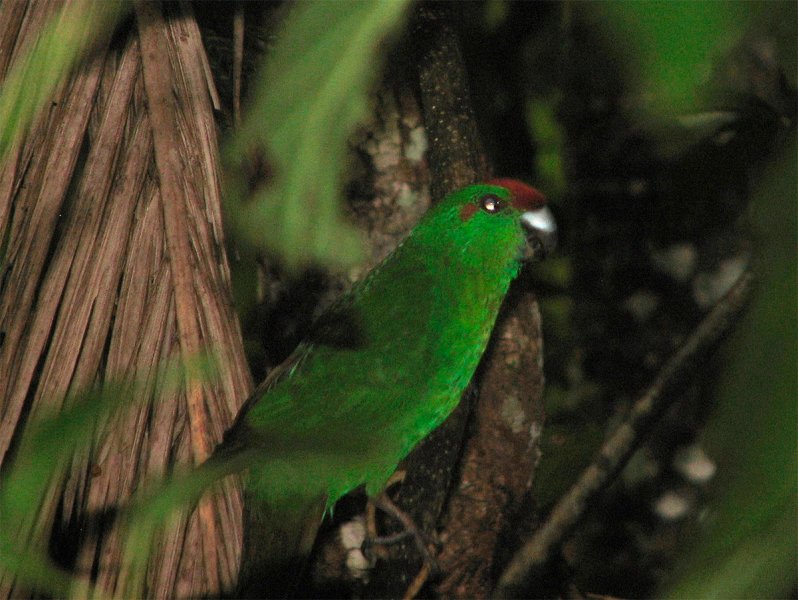
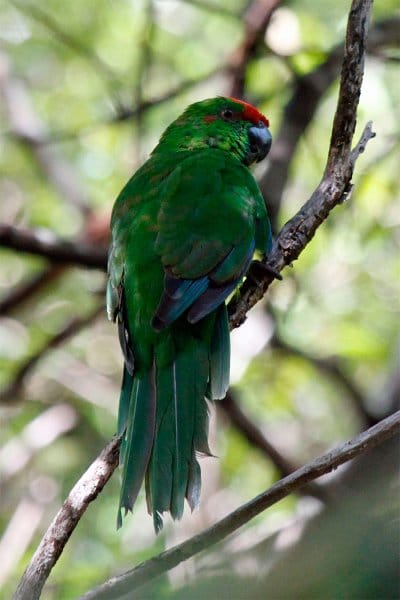
The Norfolk Island Parakeet (Cyanoramphus cookii) has a plumage bright green with reddish front, one red band extending through each eye; and light blue region in the leading edge of each wing . Upperwing-coverts green. Primary coverts and outerweb of primaries violet blue. Underwing-coverts yellow-green. red spot on each side of the rump. Above, the tail dark green with yellow edges, under dark gray. Eyes red.

The sexes are similar in appearance. The females They are distinguished by their smaller size, less red in the forecrown, stains on the front of the crown, and bill smaller and narrower. The pups hatched are coated with a thin gray background.

The youth They are similar in appearance to adults, but the red is less extensive (Forshaw 1981; Higgins 1999). Juveniles have a bill distinctive color meat during the first 4 to 6 weeks after the flight (Forshaw 1981).

Taxonomic status:

This taxon is considered a subspecies of Cyanoramphus [novaezelandiae, erythrotis, subflavescens, hochstetteri, saisseti or cookii] (sensu lato) by some authors

  • Sound of the Norfolk Island Parakeet.

Habitat:

The Norfolk Island Parakeet It is found mainly in the rainforest remainder, although it can also be seen in other areas of the island (Garnett & Crowley 2000; Hicks & Greenwood 1989; Higgins 1999; J. Hicks pers. comm. quoted in Hill 2002).

It is considered sedentary (Higgins 1999). The species moves from the National Park Norfolk Island to orchards and gardens when fruit available (Hicks & Greenwood 1989; Higgins 1999). Most of the sightings of the Norfolk Island Parakeet outside the National Park Norfolk Island They are recorded in December and January (Lane et al., 1998).

Foraging occurs in all strata of vegetation (Higgins 1999), including in the forest canopy, on the floor, in disturbed habitats and habitats modified depending on food availability (Forshaw & Cooper 1989; Higgins 1999). It has been observed to Perico Norfolk, including youth, feeding on the ground during winter, eating fallen seeds and fruits of African olive, Pine Norfolk Island and red guava (Garnett & Crowley 2000; Higgins 1999; Lane et al., 1998; Ortiz-Catedral 2013).

The Norfolk Island Parakeet It gregarious, usually they are seen in pairs or in family groups (Higgins 1999) and flocks (C. Jones pers. comm. 2016). The species occurs as a single contiguous breeding population (Garnett et to the., 2011).

Reproduction:

The Norfolk Island Parakeet usually nest less than two meters above the ground, usually in a recess or cavity in the branch, trunk or stump living or dead trees, especially in larger native trees. This includes Nestegis apetala (ironwood), Blood Wood (Corymbia spp. / Eucalyptus spp.), Cordyline spp. and Araucaria heterophylla (Norfolk Island Pine) (Garnett et to the., 2011; Hicks & Greenwood 1989; Higgins 1999; Lane et al., 1998). The species has occasionally been observed nesting in holes in the ground created by rotting pine roots. (C. Jones pers. comm. 2016).
Usually it perches in hidden areas with thick vegetation, including treeholes, epiphytes, tussocks, sedges and ferns. The species often perches on nesting sites (Higgins 1999). Inexperienced chicks often roost in exposed sites (Higgins 1999).

The reproduction It occurs throughout the year, peaking from December to March (Greenwood et al., 1989; Hicks & Preece 1991). The females. hatch eggs and are very reluctant to leave their nests during this time (P. Stevenson com. pers. quoted in Hill 2002). The incubation hard 21 days (Hicks & Preece 1991). When the chicks reach about two weeks old, the female can leave to start a new nest (Greenwood 1993). Norfolk Parakeets can have multiple clutches and give birth successfully up to four times a year., with males and females sharing the care of the young (R. Ward com. pers. quoted in Hill 2002). They prefer to use a fresh nest site for each clutch (Hill 2002). The chicks leave the nest six to seven. weeks after hatching and depend on their parents to feed three to seven weeks (Davidson 1997; Forshaw 1981; Hicks & Greenwood 1989; Hicks & Preece 1991). The clutch is large (1-8) (Hicks & Greenwood 1989). the age of first reproduction is unknown, but it may be soon after independence (Greene 1990).

Food:

Adults eat mainly seeds, fruit, flowers, bark and leaves of native and introduced trees, and shrubs, including Pine Norfolk Island, ironwood, Rhopalostylis Bauer (Palm Norfolk Island), Blood Wood, Cordyline, Lagunaria (White Oak), Elaeodendron curtipendulum (silvestre) arce), wild snuff (Solanum mauritianum), red guava (Psidium spp.), African olive (Olea europaea subsp. cuspidate), peach (Prunus persica) and lantana (Lantana camara) (Forshaw & Cooper 1978; Garnett & Crowley 2000; Higgins 1999; Lane et al., 1998).

Distribution:

The Norfolk Island Parakeet (Cyanoramphus cookii) is endemic of the Norfolk island. Before the European establishment it spread throughout the island, but now it is mainly in the region Mt Pitt de Norfolk. (460 has) and in the Botanical Gardens Norfolk Island (5,5 has) (Director of National Parks 2010; Garnett et to the., 2011). The Norfolk Island Parakeet also they are seen in wooded areas outside the national park and botanical gardens, and they are observed throughout the island in small amounts (Director of National Parks 2010).

The breeding of Norfolk Island Parakeet It is largely confined to a suitable habitat within the range of Norfolk Island National Park (Hill 2002), although there are reports playback on adjacent private property to the National Park Norfolk Island (C. Rowston press. comm. cited in Garnett et al., 2011).

In 2013, One study estimated that its population on Norfolk Island It was only 46-92 individuals (Ortiz-Catedral 2013).

Conservation:


critical hazard


โ€ข Law on Environmental Protection and Biodiversity Conservation 1999 (Cwlth) (EPBC Law): Critically Endangered.

โ€ข Population trend: Decreasing.

โ€ข Population size : 50-100 mature individuals.

The Norfolk Island Parakeet (Cyanoramphus cookii) It is classified as In danger under the Law on Environmental Protection and Biodiversity Conservation 1999 (Cwlth) (EPBC Law). The species is eligible for inclusion on the list since before the start of the EPBC Act, It was included as endangered under Annexed 1 of the Law on Protection of Endangered Species 1992.

Garnett et to the (2011) They reviewed the state of conservation Norfolk Island Parakeet and they considered in Critical Hazard. The Scientific Committee of Threatened Species You are using the findings of Garnett et al. (2011) to consider whether the reassessment of the conservation status of each of the threatened birds listed in the EPBC Law It is mandatory.

The main factors causing the species to be eligible for inclusion in the List of Endangered Species are are very restricted area of รขโ‚ฌโ€นรขโ‚ฌโ€นoccupancy (< 10 km2).) and a population small (< 250 mature individuals) (Garnett et to the., 2011).

Threats

Extensive vegetation clearing for agriculture and logging of large trees destroyed nesting sites most suitable in Norfolk island (Hicks & Greenwood 1989).

A change in the structure of forests in the Norfolk island, as a result of the invasion of weeds, there may also be reduced available habitat area. (Garnett et to the., 2011).

Introduced the Crimson Rosella (Platycercus elegans), European starlings (Sturnus vulgaris), and occasionally European honey bees (Apis mellifera) competing for residues treeholes (Hicks & Preece 1991; Hill 2002).

Predation by black rats (Rattus rattus) has resulted in most nest failures and an imbalance in the sex ratio in the nest population. Norfolk Island Parakeet, as rats often surprise female incubating (Hicks & Preece 1991; Hill 2002).

The cats (Felis catus) They are also significant predators (Garnett et to the., 2011).

The illness psitacina circoviral It is present in the population and can cause mortality in individuals stressed (Hicks & Preece 1991).

Window collisions also cause a small number of deaths annually. (Hill 2002).

conservation actions

Conservation and management priorities Invasive species

or Maintaining a control program black rat in the National Park Norfolk Island using baits to reduce the number of black rats.

or Maintaining a control program cats in the National Park Norfolk Island using trapping methods to reduce the number of cats.

or Maintaining a control program Crimson Rosella (Platycercus elegans) in the National Park Norfolk Island using shooting methods to reduce their number.

Continue implementing and maintaining or protecting trees tin nesting sites (predator-proof) inside of the National Park Norfolk Island, And Botanical gardens adjacent private lands where appropriate.

Continue removing or European starlings and nesting material for nest sites.

or continue destroying the hives of european honey bees nesting sites if necessary.

o Perform intensive control weed in the National Park Norfolk Island, appropriate methods, focusing on improving habitat areas suitable playback.

Lost, disturbance and habitat modifications

o Perform habitat restoration within the National Park Norfolk Island by revegetation. appropriate areas with native plants, in conjunction with the weed control program. Breeding, reproduction and other measures ex situ

o Maintain nest sites to support breeding pairs by adding suitable nesting material and repairing nests as necessary.

or establish a wild population Phillip Island by methods translocation, when you consider that the source population is large enough to support the reduction of individuals.

Participation of stakeholders

or engage with the local community to provide information on the species and the importance of conservation actions.

o Engage with the public about Norfolk Island green parrots through conservation. and environmental interpretation center National Park Norfolk Island.

Priorities and follow-up survey

Keeping monitoring or rats and black cats within the National Park Norfolk Island to determine its relative density within the park and report management actions.

Monitor or nesting sites known to detect the presence of Crimson Rosella (Platycercus elegans), European starlings and European honey bees to determine the ongoing impact of competition from these species and the Norfolk Island Parakeet and reporting on management actions.

o Conduct population studies to assess more accurately the size of the population, reproduction and breeding of these birds, success and demographic trends.

or to perform monitoring for the presence of disease psitacina circoviral in population Norfolk Island Parakeet.

o Monitor the progress of conservation actions, including the effectiveness of management actions and adapt them if necessary to contribute to the recovery of the species.

Priorities for research and information

o Investigate options to improve the current population.

or investigate conservation benefits to establish a wild population in Lord Howe Island.

or investigate the effectiveness and cost-benefit methods for controlling predators and competitors introduced nest.

or investigate the effectiveness and cost-benefit methods for weed control.

"Norfolk Island Parakeet" in captivity:

More than 600 pups of Norfolk Island Parakeet They were banded between 1985 and 2007, most of which were bred in the national park's assisted wild breeding program.

Alternative names:

– Cook’s Parakeet, Norfolk Island Green Parrot, Norfolk Island Parakeet, Norfolk Island Parrot, Norfolk Parakeet, Tasman Parakeet (English).
– Perruche australe, Perruche de Norfolk (French).
– Norfolkziegensittich, Ziegensittich (German).
– Periquito de Norfolk (Portuguese).
– Perico de Norfolk (espaรฑol).

scientific classification:

– Order: Psittaciformes
– Family: Psittaculidae
– Gender: Cyanoramphus
– Scientific name: Cyanoramphus cookii
– Subpoena: (Gray, GR, 1859)
– Protonimo: Platycercus Cookii

Images ยซNorfolk Parakeetยป:

Videos "Norfolk Island Parakeet"

Sources:

โ€ข Avibase
โ€ข Parrots of the World โ€“ Forshaw Joseph M
โ€ข Parrots A Guide to the Parrots of the World – Tony Juniper & Mike Parr
โ€ข THREATENED SPECIES SCIENTIFIC COMMITTEE ยฉ Commonwealth of Australia
โ€ข Perico de Norfolk cheating extinction with a little help from their human friends – abc.net.au

Photos:

(1) – Norfolk Island Parakeet (Cyanoramphus cookii) by David Cook – Flickr
(2) – Norfolk Parakeet (Cyanoramphus cookii), 2011 Norfolk Island National Park by Duncan Watson [CC BY-SA 4.0], from Wikimedia Commons
(3) – A Norfolk Parakeet (also called Tasman Parakeet, Norfolk Island Green Parrot or Norfolk Island Red-crowned Parakeet) in Palm Glen, Norfolk Island, Australia by Paul Gear [CC BY-SA 3.0], via Wikimedia Commons
(4) – A juvenile Norfolk Parakeet (also called Tasman Parakeet, Norfolk Island Green Parrot or Norfolk Island Red-crowned Parakeet) in Palm Glen, Norfolk Island, Australia. by Paul Gear [CC BY-SA 3.0], via Wikimedia Commons
(5) – Norfolk Island Parakeet (Cyanoramphus cookii) by David Cook – Flickr

โ–ท The world of Pets: Dogs, cats, birds, reptiles, amphibians

Moluccan King-Parrot
Alisterus amboinensis

Moluccan King-Parrot

Content


Anatomy-parrots

Description

35 to 40 cm.. length between 145 and 163 g. of weight.

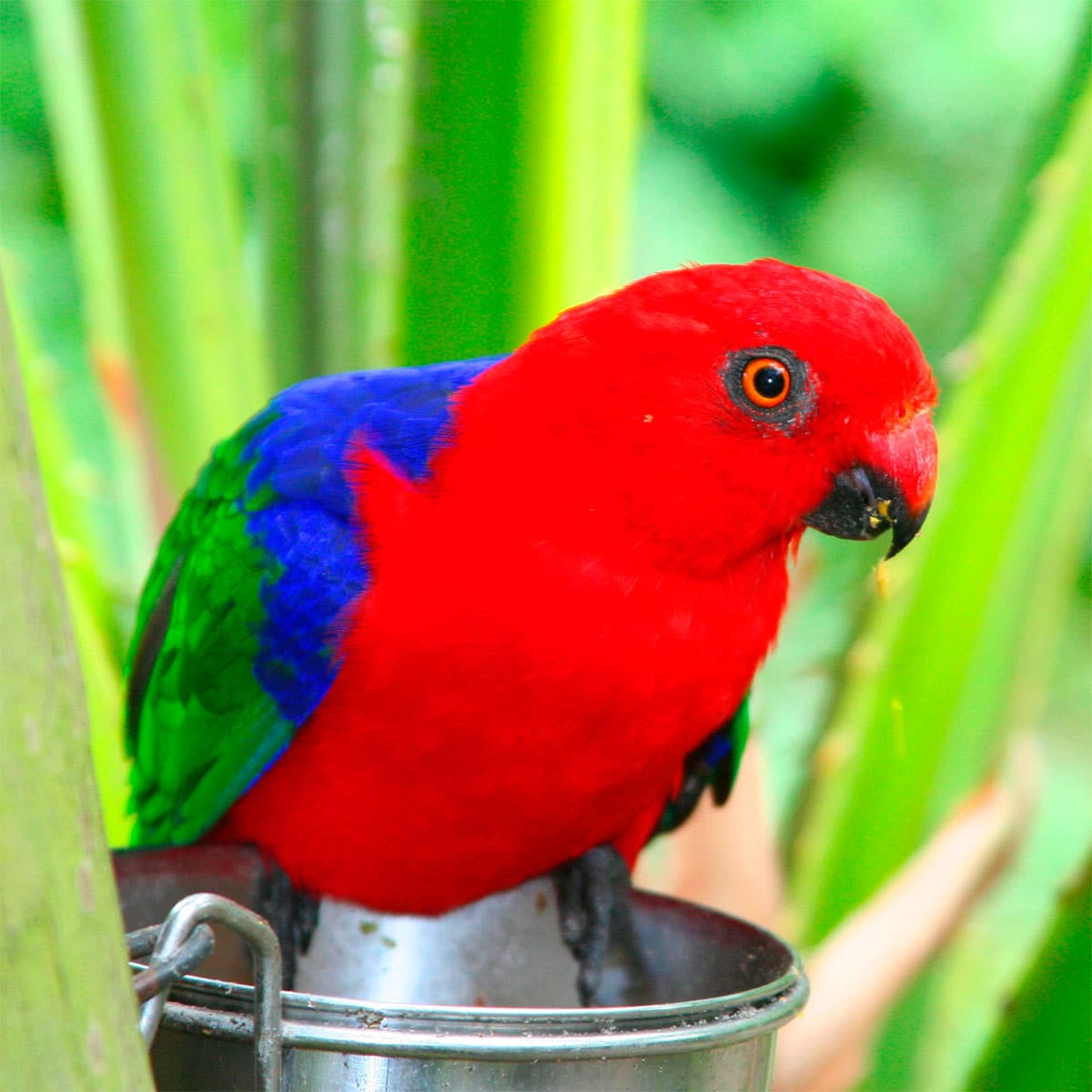
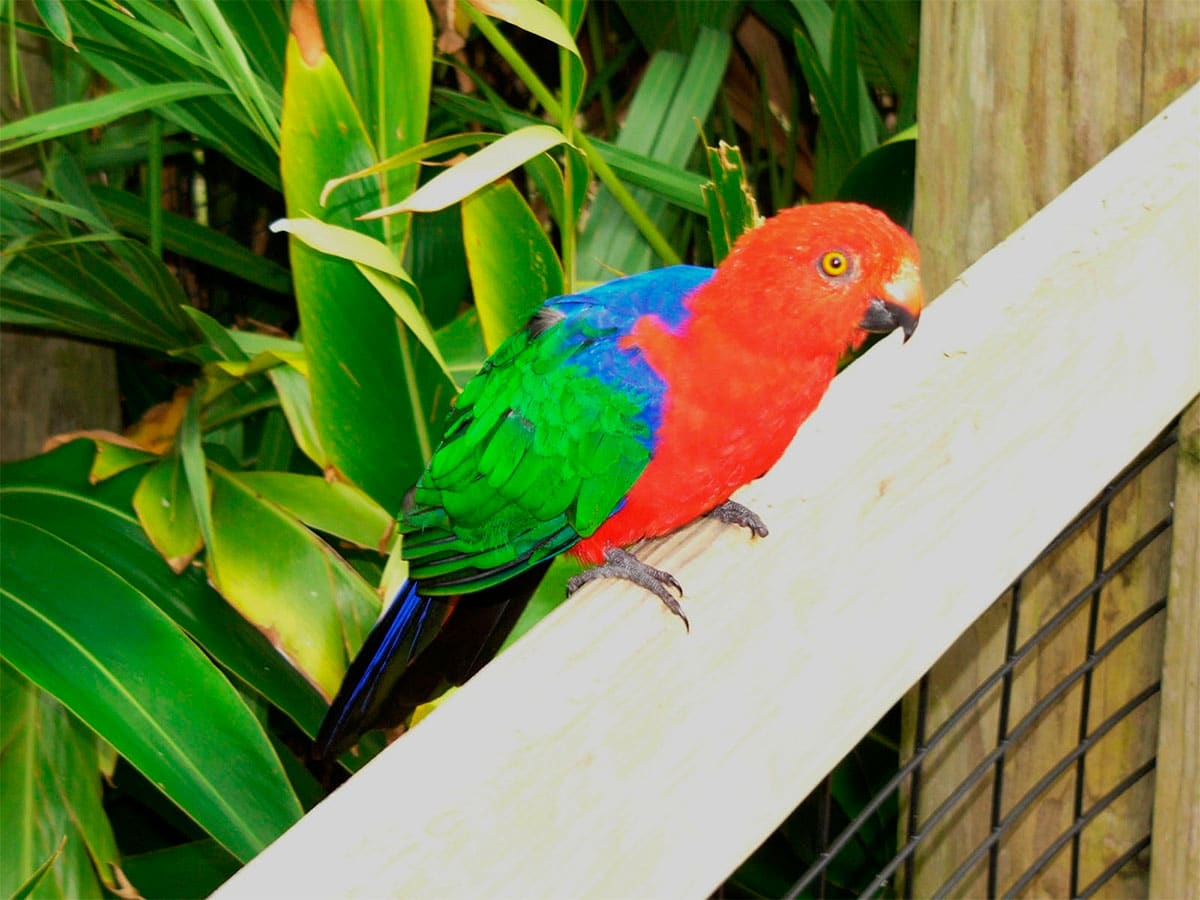
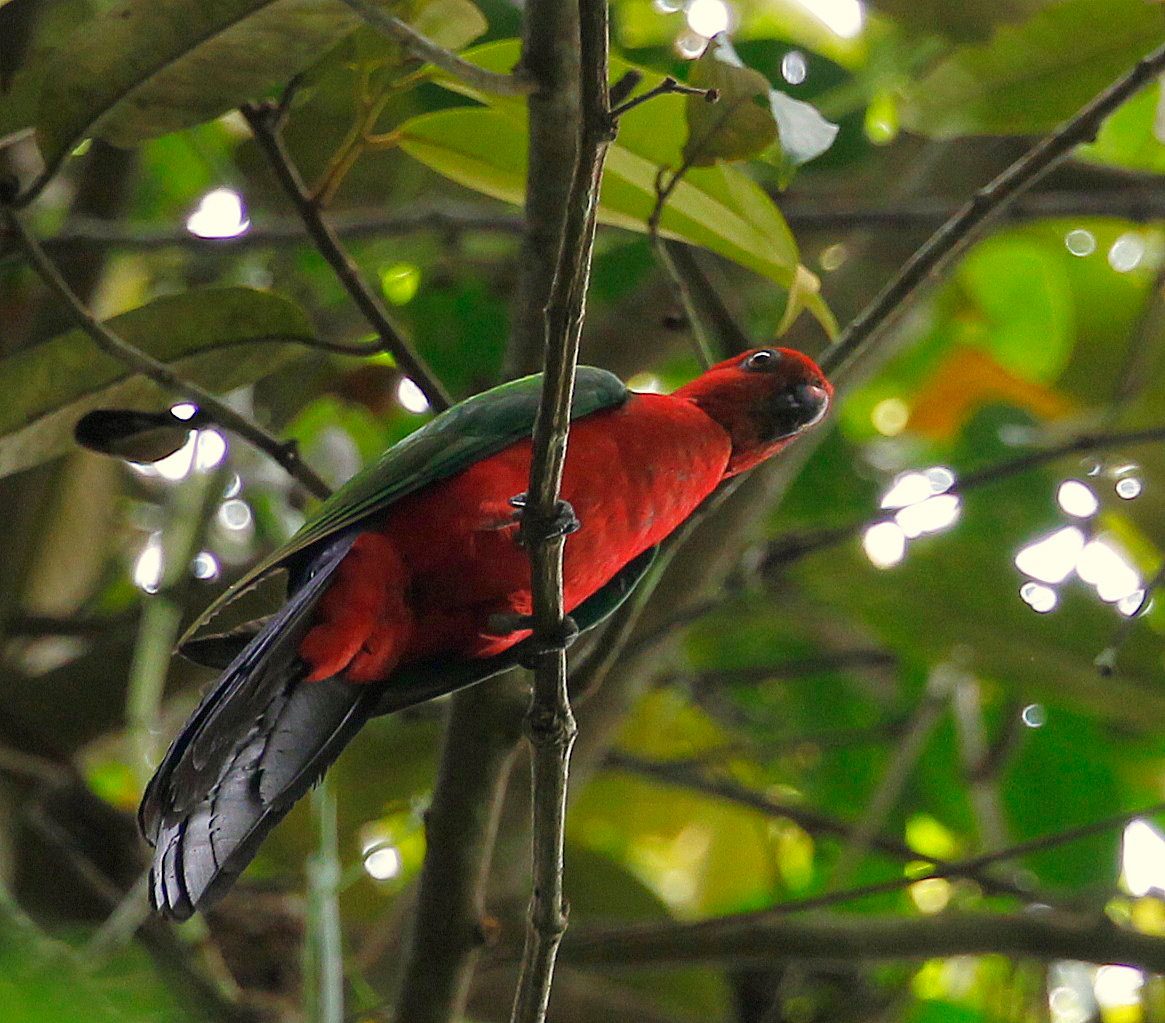
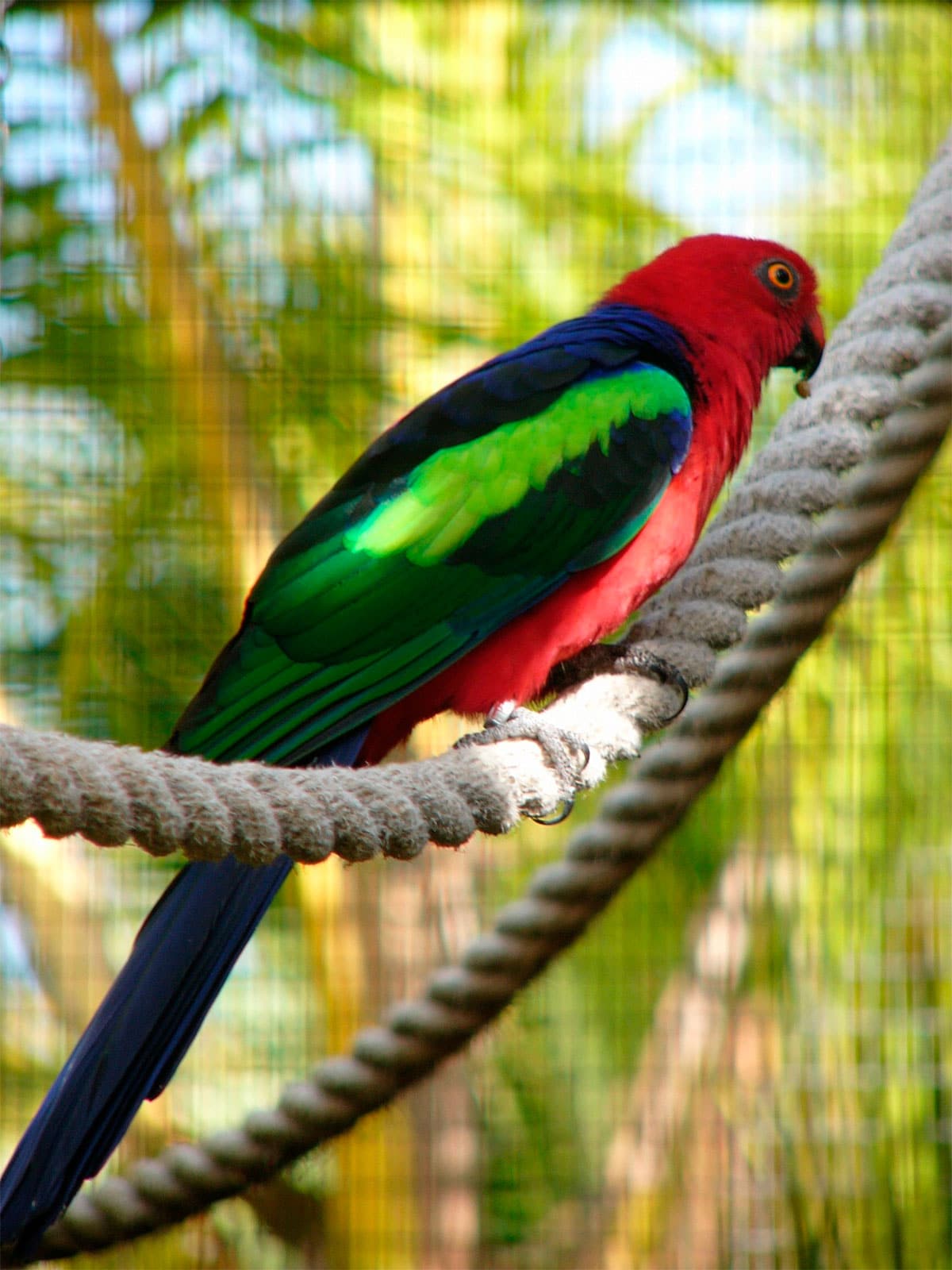
The Moluccan King-Parrot (Alisterus amboinensis) has a head, neck, the nape of the neck and the upper mantle of bright red, with strong demarcation to dark blue-violet in the lower mantle, back, buttocks and supracaudales coverts. Green wings with the exception of the blue in the small inner coverts and carpal edge. Under, black wings with blue-violet coverts. Bright red bottoms, with mauve bases to coverts infracaudales, sometimes visible; flanks with a little blue. Upper, the very dark blue colal; below black grey color wide-margin rose to the side feathers.

Bill with an orange-red base on the upper mandible, Blackish lower; Orange iris; black grey legs.

The two sexes, somatic sexual dimorphism is not presented..

Immature with more green in the back; Brown-Black beaks; pale eye-ring and darker than the adults of iris. Dotted pink on the outer tail feathers. Mature in one year.

Subspecies

Description subspecies Alisterus amboinensis
  • Alisterus amboinensis amboinensis<

    (Linnaeus, 1766) – The nominal

  • Alisterus amboinensis buruensis

    (Salvadori, 1876) – As the subspecies sulaensis but with more feathers in the tail with pink edges. Blackish grey peak in both sexes

  • Alisterus amboinensis dorsalis

    (Quoy & Gaimard, 1830) – As the nominal but the rose of the absent tail feathers; Red slightly darker on the head and underparts.

  • Alisterus amboinensis hypophonius

    (S. Muller, 1843) – As the nominal, but the wings and the deep blue wing coverts; the rose in the absent tail feathers

  • Alisterus amboinensis sulaensis

    (Reichenow, 1881) – As the nominal, but with a green stripe across the upper mantle; No rim with pink in the tail feathers.

  • Alisterus amboinensis versicolor

    (Neumann, 1939) – Unlike the subspecies sulaensis by having a uniform blue mantle; smaller in size than the nominal.

Habitat:

Moluccan King-Parrot

The Moluccan Parrot is distributed through the dense primary and secondary humid forests, and from time to time in the adjacent plantations, farmland and gardens, from the lowlands up to around the 2.100 meters above sea level.

The birds are usually found in pairs or in small groups, and they are very calm while feeding and shy at all times, hiding in the thick foliage and flying amid shrill calls at the first sign of an intruder.

Reproduction:

Just nothing is known of the cycle of reproduction in the wild, although according to sources, nesting takes place between the months of February and April.

Two young birds nests have been found on two occasions in hollow trees.

One instance of captive breeding gave data for incubation of 19 days, with the emerging young in nine weeks.
The courtship was observed during feeding, and two eggs were deposited.

Food:

The diet includes acorns Lithocarpus, as well as hard fruits, outbreaks and other forest tree berries.

Distribution:

Size of the area of distribution (reproduction / resident): 149.000 km2

Is distributed from Peleng and Sula Islands eastward through the Moluccas, including Halmahera, Buru, Ambon and Seram. Also found in the Western Islands of papua, including Waigeo, Batanta and Salawati.

In New Guinea is from Vogelkop and East of the Bomberai Peninsula some 135 ยฐ E.

Usually Rare due to habitat loss and trade in birds.

Subspecies

Distribution subspecies Alisterus amboinensis
  • Alisterus amboinensis amboinensis

    (Linnaeus, 1766) – The nominal

  • Alisterus amboinensis buruensis

    (Salvadori, 1876) – Is located in Buru in the center of the Moluccas.

  • Alisterus amboinensis dorsalis

    (Quoy & Gaimard, 1830) – Is located in West Papua.

  • Alisterus amboinensis hypophonius

    (S. Muller, 1843) – Endemic to Halmahera in the North of the Moluccas.

  • Alisterus amboinensis sulaensis

    (Reichenow, 1881) – Is located in the Sula Islands

  • Alisterus amboinensis versicolor

    (Neumann, 1939) – It is endemic in the Peleng island of the Islas Banggai

Conservation:


minor concern


โ€ข Current category of the Red List of the UICN: Least concern

โ€ข Population trend: Decreasing

The size of the world's population has not been quantified, but the species is described as generally common, Although rare in Halmahera.

The nominal subspecies population is estimated at 70.000 specimens (pit et to the. 1997).

The population is suspected to be declining due to the destruction of habitat in course.

"Moluccan King-Parrot" in captivity:

Occasionally available.

Nervous, is a bird a pet bird.

In captivity will have failed to reproduce.

In the Zoological Garden of Loro Parque, Tenerife, on Canary Islands, biologists Dr. Burkard and Dr. Gerlach they have made so large colonies, but since 1972 they have succeeded until now non.

More information on loromania

Alternative names:

– Moluccan King-Parrot, Amboina King Parrot, Amboina King-Parrot, Ambon King-Parrot, Moluccan King Parrot (ingles).
– Perruche tricolore, Perruche royale d’Amboine (French).
– Amboinasittich (German).
– Periquito-rei-amboina (Portuguese).
– Papagayo Moluqueรฑo, Papagayo Real de Amboina (espaรฑol).

scientific classification:

– Order: Psittaciformes
– Family: Psittaculidae
– Genus: Alisterus
– Scientific name: Alisterus amboinensis
– Citation: (Linnaeus, 1766)
– Protonimo: Psittacus amboinensis

Images ยซMolucan Parrotยป:

Videos "Moluccan King-Parrot"

————————————————————————————————

ยซMolucan Parrotยป (Alisterus amboinensis)

Sources:

– Avibase
– Parrots of the World โ€“ Forshaw Joseph M
– Parrots A Guide to the Parrots of the World – Tony Juniper & Mike Parr
– Birdlife
– World Parrot Trust – parrots.org

– Photos:

(1) – ยซAlisterus amboinensis-Brevard Zoo-8a-ecยป by Alisterus_amboinensis_-brevard_zoo-8a.jpg: Malinderivative work: Snowmanradio (talk) – originally posted to Flickr as Puuuuuuuuuuuurdy Birdy and uploaded to commons at Alisterus_amboinensis_-brevard_zoo-8a.jpg. Licensed under CC BY-SA 2.0 via Wikimedia Commons.
(2) – By richard broderick (T0010716uploaded by Snowmanradio) [CC BY-SA 2.0], via Wikimedia Commons
(3) – Brevard Zoo – Melbourne, FL, USA ยฉ 2004 Jeff Whitlock – The Online Zoo
(4) – Brevard Zoo – Melbourne, FL, USA ยฉ 2004 Jeff Whitlock – The Online Zoo
(5) – Vogelpark, Alphen Aan Den Rijn – ZOOTOGRAFIANDO
(6) – ยซSwainson king parakeetยป by William John Swainson – Transferred from en.Wikipedia. Licensed under Public Domain via Wikimedia Commons.

– Sounds: Frank Lambert (Xeno-canto)

โ–ท The world of Pets: Dogs, cats, birds, reptiles, amphibians

Northern Rosella
Platycercus venustus

Northern Rosella

Content


Anatomy-parrots

Description

28 cm.. length between 85 and 100 g. of weight.

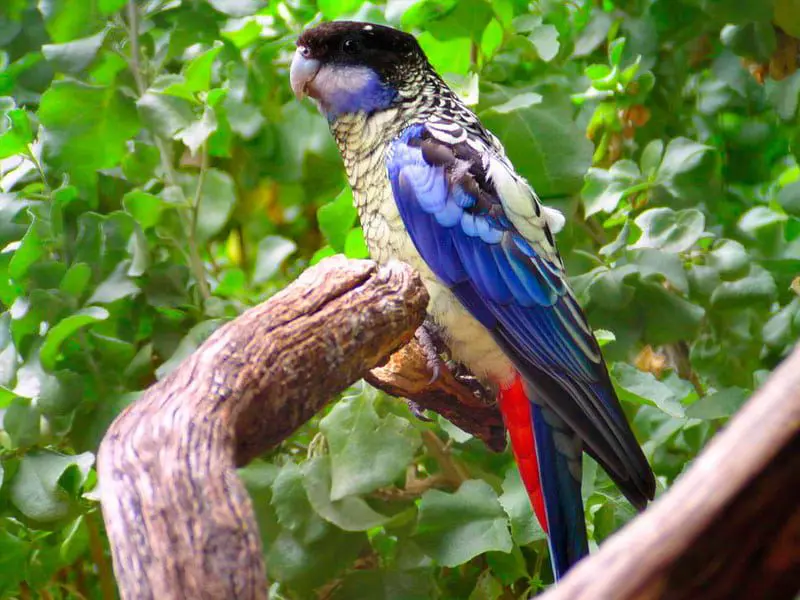
The Northern Rosella (Platycercus venustus) they have a whitish beaks, black head, except the bottom of the cheeks and Chin that show a cream color. Their underparts feathers, lower back and rump, are pale yellow with black trim, giving these areas a look slightly flaky.

The curves of the wings are blue.

The subcaudales coverts are bright red. Nape, mantle and scapulars are black with broad yellow edges, forming an effect of shoulder straps. Blankets are black. The medium-sized coverts are bluish grey. The rest of the wing coverts are black with edges of yellow or blue grey. Deployed primaries are black. The Central tail feathers are verde-bronce while the outer feathers are dark blue with clear or white edges.

The females they are slightly smaller than the male, with the narrower peak.

The youth they are more turned off, with red markings on the head, and with more green and short tail feathers. Reaches it adult plumage in 12 months.

Subspecies description

  • Platycercus venustus hilli

    (Mathews 1910) – Adults are similar to the nominal species but with bottoms scalloped with a sweeping black and the bottom of the cheeks of violet blue colour.

  • Platycercus venustus venustus

    (Kuhl 1820) – The nominal.

Habitat:

Northern Rosella

The Northern Rosella they are unusual or are irregularly distributed in the mixed forests of eucalyptus and Melaleuca. They are generally found in open areas along rivers but are absent in floodplains along major rivers.. They are also present in the monsoon forests bordering open forests. From time to time, the Northern Rosella visit mangroves, parks and gardens in the vicinity of Darwin.

The Northern Rosella they live in pairs or in small groups ranging between 6 and 8 specimens. You rarely see them in flocks. They are usually very cautious and discreet, except in national parks where they are accustomed to human presence. They are more arboreal than other parrots of the genus habits Rosella. Funny Parrots are difficult to observe, whether on land or hidden in the foliage in the trees. They are most active in the morning and at the end of the afternoon. They show great caution when they come to drink at water points. When moving, their flight is fast, but unpredictable and less undulating than most parakeets.

Reproduction:

The nesting season extends from June to September, Sometimes a little earlier. The Northern Rosella install their nests in hole of a branch or the trunk of a tree cavity, generally in eucalyptus trees located a short distance from a stream. Implementation usually includes between 2 and 4 eggs that are incubated during 19 days. The female is solely in charge of incubation and is fed in the nest by her partner.. The chicks stay is relatively long and may last up to 7 weeks.

Food:

The Northern Rosella feed mainly on seeds of eucalyptus, acacia and Melaleuca Although they despise the of the blue cypress (Callitris intratropica). The seeds of green areas and nectar are also on their menu. The birds that live in the forests near the coast sometimes feed on the coast and along the banks of small streams.

Distribution:

Size of the area of distribution (reproduction / resident): 785.000 km2

Scattered through the coastal areas of the region of Kimberley, Western Australia, stretches of the North of the Northern Territory, and spreading over the border of Queensland at its eastern end.

The species is distributed from around Napier Ranges, in the Western region of Kimberley, to the East across the plateau of Kimberley and reaching the inside of Springvale. Next, crosses the border of the Northern Territory, extending with its southern limit along the victory river, inside, about Katherine, and along the McArthur river. It is also found throughout the nicholson river at the border of Queensland, and are distributed by a series of Islands on the coast including Koolan, Augusto, Coronation, Bathurst and Melville. Is occasionally in the suburbs of Darwin.

The species is generally rare throughout its range. The world's population is less of 50.000, and may that declining. A small number of captivity.

Fully protected by law.

Subspecies distribution

Conservation:


minor concern


โ€ข Current category of the Red List of the UICN: Least concern

โ€ข Population Trend: Stable

The Northern Rosella they have a very unequal distribution. At most, they can be considered locally common, but in any part of their range they are evaluated as abundant.

Despite the studies that have been carried out since the 19th century, it is not possible to discern if the numbers are increasing or decreasing. It is possible that its population has always been limited, given the difficulty of finding refuge during the dry season.

Its population, according to some sources, It is estimated at around 50.000 specimens.

"Northern Rosella" in captivity:

Quite calm and shy. Incompatible con otras aves.

Not common in captivity, incluso en la avicultura de Australia

In terms of their longevity, una muestra, according to sources, lived 19,1 years in captivity

Alternative names:

– Northern Rosella, Brown’s Parakeet, Brown’s Rosella, Smutty Parakeet, Smutty Parrot, Smutty Rosella, White-cheeked Rosella (ingles).
– Perruche gracieuse, Perruche de Brown (French).
– Brownsittich, Brown Sittich, Brown-Sittich, Schwarzkopfsittich (German).
– Rosela-do-norte (Portuguese).
– Perico Gracioso, Rosela del Norte (espaรฑol).

scientific classification:

– Order: Psittaciformes
– Family: Psittaculidae
– Genus: Platycercus
– Scientific name: Platycercus venustus
– Citation: (Kuhl, 1820)
– Protonimo: parrot charming

ยซFunny Parakeetยป Images:

Videos "Northern Rosella"

————————————————————————————————

ยซFunny Parakeetยป (Platycercus venustus)


Sources:

– Avibase
– Parrots of the World โ€“ Forshaw Joseph M
– Parrots A Guide to the Parrots of the World – Tony Juniper & Mike Parr
– Birdlife
– AnAge: The Animal Ageing and Longevity Database – An Age entry for Platycercus venustus

– Photos:

(1) – Platycercus – loros tipo Rosella – popugaychiki
(2) – Northern rosella taken in Litchfield National Park – A BRIEF DIGRESSION ON PARROTS
(3) – Alan Marshallโ€™s Pictures of Northern Rosella (Platycercus venustus) in the NT (Northern Territory) of Australia
(4) – Alan Marshallโ€™s Pictures of Northern Rosella (Platycercus venustus) in the NT (Northern Territory) of Australia
(5) – By TJ Lin from Taiwan (DSCN8954Uploaded by Snowmanradio) [CC BY-SA 2.0], via Wikimedia Commons
(6) – Rosellas, Northern – Princenton University Press

โ–ท The world of Pets: Dogs, cats, birds, reptiles, amphibians

Red Shining-Parrot
Prosopeia tabuensis

Red Shining-Parrot

Content


Anatomy-parrots

Description

45 cm. of length and weight approximate of 280 g..

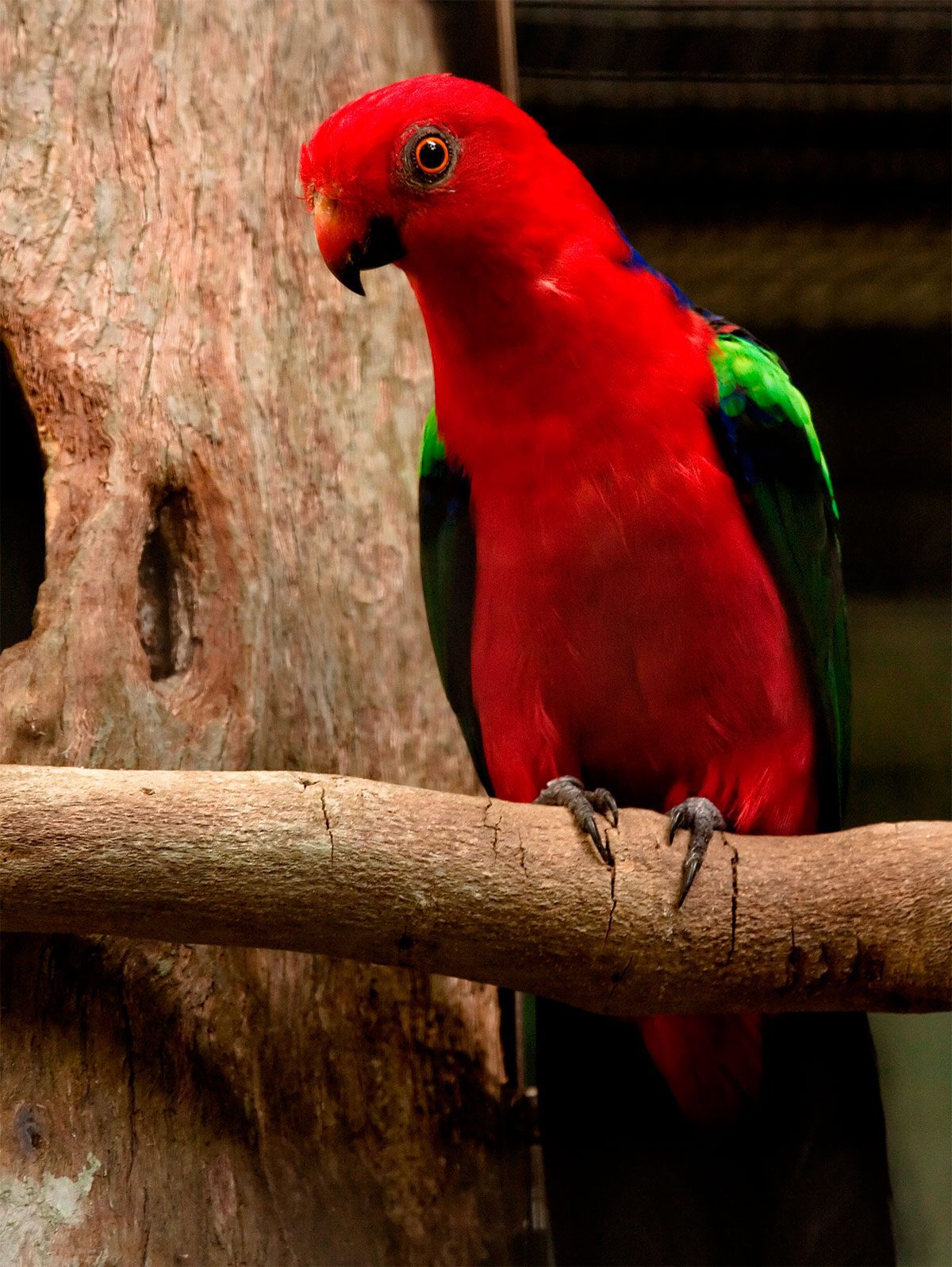
The Red Shining-Parrot (Prosopeia tabuensis) It is the most distinctive of the colorful parrots of Fiji. It is a large parrot.

Their coloration are distinguished from the other two species. Its head, neck and underparts a brilliant scarlet hues with a blue collar extending behind the neck; the back and tail are a bright green. The flight feather and tail they are green, strongly impregnated with blue.

The bill and legs are black, and irises are orange.

The males and females they are similar, However, the bill the male is larger and the head It has a more square than the females form.

Description 2 subspecies:

  • Prosopeia tabuensis tabuensis

    (Gmelin) 1788 – The species nominal


  • Prosopeia tabuensis taviunensis

    (Layard,THE) 1876 – 40 cm.. length approximately; more small that it nominal species, without the band blue on the nape, the feathers of the abdomen with a tone more blue and with the face less blackish.

Habitat:

Red Shining-Parrot

The Red Shining-Parrot are distributed in the mature forests and through a variety of associated habitats, including the of secondary growth, wooded ravines (nest), coconut plantations, Gardens of villages, agricultural fields, mangroves and scrub.

There has been starting from the 100 meters of altitude until the 1.750, but they are most common between the 400 and 1.000 m.

The Red Shining-Parrot they are suspicious, curious and You can see them individually, in pairs or in flocks of up to 40 individuals outside the breeding season. they are not shy, and loud groups tend to meet in their favotitos places to eat.

They tend to rest on the tops of the trees.

Reproduction:

The Red Shining-Parrot perch upright and turn head rhythmically back and forth, probably showing a form of courtship.

The breeding is in the months from July to October, in trees dead or broken, the female feeds the young.

Of 2-3 eggs that is hatch during 23-24 days.

The juveniles they can fly to the 8 weeks.

Food:

Feeding of the fruits and seeds a variety of trees, for example, Myristica hypargyraea, that is of particular importance in 'USA. They also feed on Mango Mangifera indica, papaya Carica papaya, guava Psidium guajava and bananas. Son agile climbers and move in search of food using their beaks to rely on small branches. Sujentan foods with their claws, since they bite with its powerful beak, and they chew the wood to remove insect larvae.

They feed mainly in the upper canopy, but sometimes also attack the cornfields.

Distribution:

Size of the area of distribution (reproduction / resident): 6.200 km2

The Red Shining-Parrot they are distributed in a natural way in the islands of the Group Fiji including Vanua Levu, KIOA, Taveuni, Qamea, Laucala, Koro and Gau (probably introduced). In Tonga, the species was introduced in Tongatapu prior to contact with the European and where it has already extinct due to habitat loss, and in 'USA where it is still quite common, especially in the forests of the East, North and South-West (with a population estimated between 700- 1.000 birds in 1988).

The species benefits, in part, Thanks to agriculture, but they depend largely on its nest in mature trees of the forest, trees that are being cleared in most of its extension. The species is also threatened by trade, and it is also hunted for its feathers and as food.

Many juveniles are caught to be raised locally as pets, Since they learn to talk easily.

Its population is believed that it may be above the 20.000 specimens, but of the subspecies prosopeia remaining, probably, less than 5.000 birds and its status is of concern.

There has been a sharp decline in the population of the Red Shining-Parrot in some areas due to habitat loss, although the species remains locally common at lower elevations on most of its islands.

Distribution 2 subspecies:

  • Prosopeia tabuensis tabuensis

    (Gmelin) 1788 – The nominal species


  • Prosopeia tabuensis taviunensis

    (Layard,THE) 1876 – Taveuni, Ngamea (Qamea) and Laucala, in the North of Fiji.

Conservation:


minor concern


โ€ข Current Red List of UICN: Least concern.

โ€ข Population trend: Decreasing.

The size of the world population It has not been quantified, but the species is described as common and visible throughout its area of distribution (Watling 2001).

The population It is suspected that it may be in decline due to ongoing habitat destruction.

"Red Shining-Parrot" in captivity:

Very rare in captivity.

According to sources, one specimen was still alive after 6,8 years in captivity. Taking into account the longevity of the similar species, the maximum longevity in these animals could be underestimated. Es un hecho que estos animales pueden vivir hasta 23.7 years in captivity, aunque en esta especie no ha sido verificado.

Alternative names:

– Red Shining-Parrot, Maroon Shining Parrot, Maroon Shining-parrot, Red Shining Parrot, Red-breasted Musk Parrot, Red-breasted Musk-Parrot, Red-breasted Shining-Parrot (ingles).
– Perruche pompadour, Perruche masquรฉe pompadour (French).
– Pompadoursittich, Pompadour Sittich (German).
– Prosopeia tabuensis (Portuguese).
– Papagayo Carmรญn, Papagayo Granate (espaรฑol).

scientific classification:

Gmelin Johann Friedrich

– Order: Psittaciformes
– Family: Psittaculidae
– Genus: Prosopeia
– Scientific name: Prosopeia tabuensis
– Citation: (Gmelin, JF, 1788)
– Protonimo: Psittacus tabuensis

ยซMaroon Parrotยป Images:

Videos "Red Shining-Parrot"

ยซMaroon Parrotยป (Prosopeia tabuensis)

    Sources:

    – Avibase
    – Parrots of the World โ€“ Forshaw Joseph M
    – Parrots A Guide to the Parrots of the World – Tony Juniper & Mike Parr
    – Birdlife

    – Photos:

    (1) – Red Shining-parrot Prosopeia tabuensis in captivity, Fafa Island, Tonga By Duncan Wright (Own work) [GFDL or CC BY-SA 3.0], via Wikimedia Commons
    (2) – A painting of a Maroon Shining Parrot by Edward Lear 1812-1888 Edward Lear [Public domain], via Wikimedia Commons
    (3) – Red Shining-parrot (Prosopeia tabuensis) De Voeux Peak, Taveuni, Fiji Islands By Aviceda (Own work) [CC BY-SA 3.0], via Wikimedia Commons
    (4) – Maroon Shining Parrot Prosopeia tabuensis Kula Eco Park – Viti Levu, Fiji ยฉ 2007 Sarah P. Otto – The Online Zoo
    (5) – A bird foraging on the ground by Josep del Hoyo – Lynx
    (6) – A bird perched in a tree by Josep del Hoyo – Lynx

    – Sounds: Matthias Feuersenger (Xeno-canto)
โ–ท The world of Pets: Dogs, cats, birds, reptiles, amphibians

Lord Howe parakeet โ€ 
Cyanoramphus subflavescens

Lord Howe Island Parakeet

Content

Lord Howe Island Parakeet

Description:

21-27 cm.. of length and a weight of 80 g..

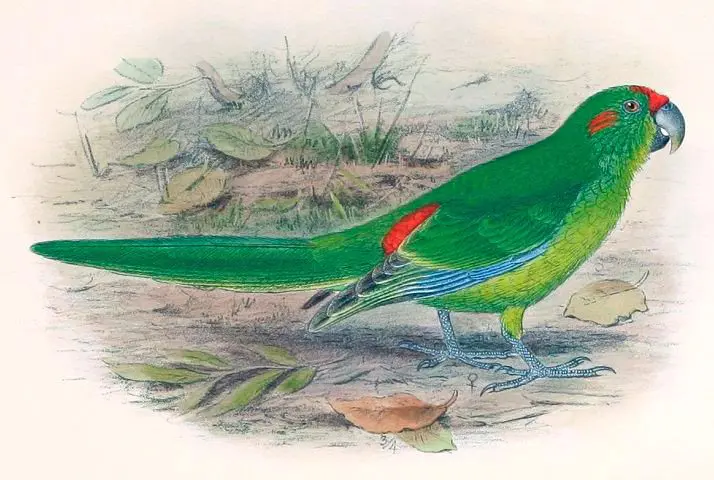
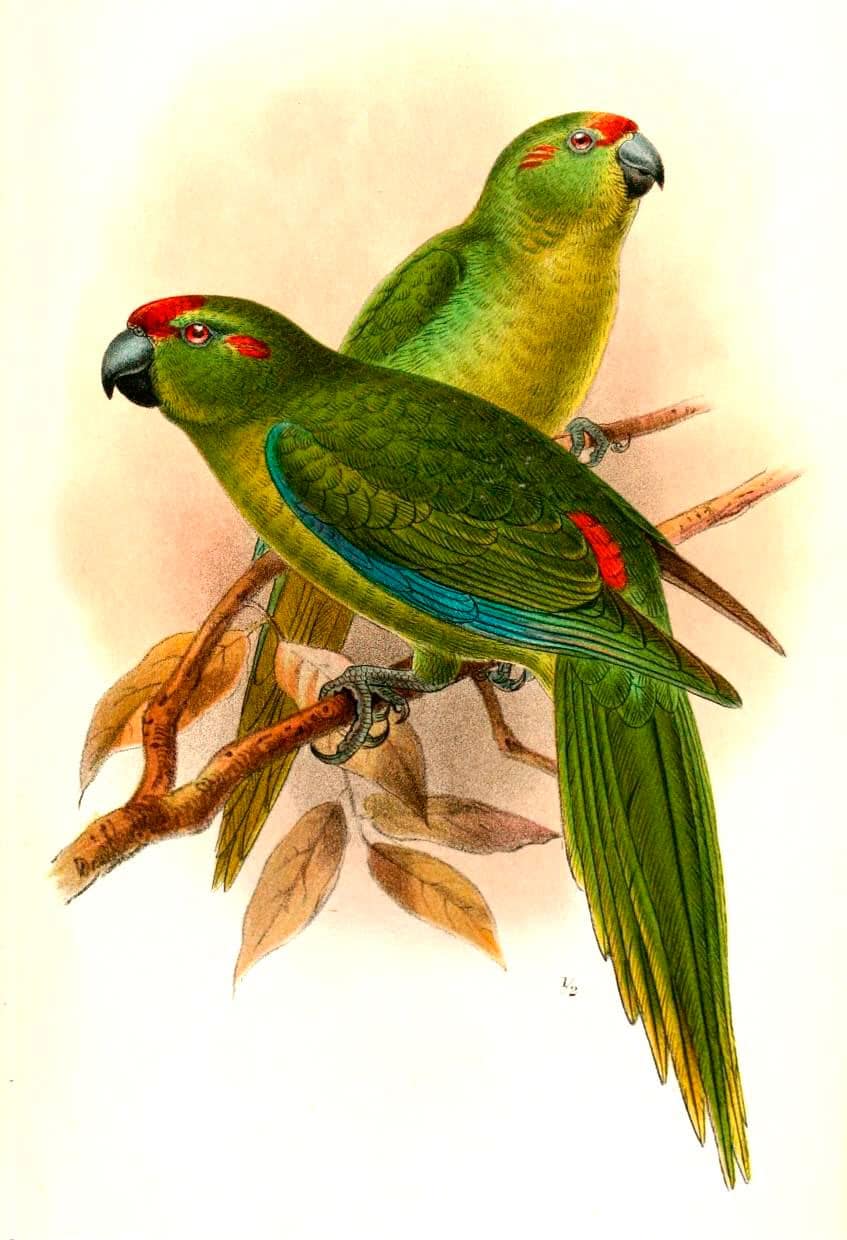
The Lord Howe Island Parakeet (Cyanoramphus subflavescens) was a medium-sized green parrot with a head bright green, the crown crimson red in color and a stripe on the eyes; the eyes were red and bill grey. The upperparts They were bright green with a dark red spot on each side of the rump (usually they are hidden by the wings when resting) and a blue border in wings; the underparts were yellowish green.

Both sexes looked similar, but the female It was smaller.

Taxonomic status:

This taxon is considered a subspecies of Cyanoramphus [novaezelandiae or subflavescens] (sensu lato) by some authors.

In 2012, World Bird List of IOC recognized him as a species [IOC world birdnames Archived 2012-08-06 at the Wayback Machine.].

Habitat:

The Lord Howe Island Parakeet It was occasionally observed in flocks. There is little information on their habitats, They probably lived in inhabited forests and cultivated areas of the Lord Howe Island. No information on the use of different habitats for different activities.

Reproduction:

Nothing is known of sexual maturity, life expectancy and natural mortality of this extinct species. But, It has been estimated that the useful life of the Lord Howe Island Parakeet should be similar to the Norfolk Island Parakeet (Cyanoramphus cookii), About three years. the age of sexual maturity is also known populations of this species, although a juvenile female was seen mating with a male just a week after achieving independence, and captive birds are said to have bred when they were less than a year old.

Little else is known of the breeding of the Lord Howe Island Parakeet, probably reproduced in response to weather conditions and food availability, nesting in tree holes or hollow pipes, in crevices between rocks or cliffs.

Food:

Meal Lord Howe Island Parakeet probably consisted of plant material, as seeds, fruit, buds and leaves of native trees and shrubs. Other extant populations ate mainly seeds, fruits and berries, egg yolks, sprouts and flowers, as well as, occasionally, a small number of invertebrates.

Distribution:

endemic to the isla Lord Howe in the Sea of รขโ‚ฌโ€นรขโ‚ฌโ€นTasmania, part of New South Wales, Australia.

Conservation:

โ€ข The last record of this species dates from 1869. EXTINCT.

The population declines were mainly due to habitat modification, hunting, poisoning, and the introduction of predators (especially cats and rats).
But, the main threat to the Lord Howe Island Parakeet was the hunting and its capture by settlers. Formerly he abounded in the Lord Howe Island and it was said to be a plague, since it destroyed the crops and orchards of the inhabitants of the island.

There are only two copies of Lord Howe Island Parakeet. From the collection John Gould, taken by John MacGillivray in September of 1853 on tour HMS Herald, and are in the Museum of Natural History [Schodde, R.; & Mason, I.J. (1997). Birds (Columbidae to Coraciidae). In Houston, W.W.K. & Wells, A. (eds) Zoological Catalogue of Australia. Vol. 37.2. CSIRO Publishing: Melbourne. ISBN 0-643-06456-7 p.147.].

Alternative names:

– Lord Howe Island Parakeet, Lord Howe Island red-crowned parakeet, Lord Howe Parakeet, Red-Fronted Parakeet (English).
– Perruche de Lord Howe (French).
– Lord Howe-Laufsittich (German).
– Periquito de Lord Howe (Portuguese).
– Perico de Lord Howe (espaรฑol).

scientific classification:

Salvadori-Thomas
Salvadori Tommaso

– Order: Psittaciformes
– Family: Psittaculidae
– Gender: Cyanoramphus
– Scientific name: Cyanoramphus subflavescens
– Subpoena: Salvadori, 1891
– Protonimo: Cyanorhamphus subflavescens

Sources:

โ€ข Avibase
โ€ข Parrots of the World โ€“ Forshaw Joseph M
โ€ข Parrots A Guide to the Parrots of the World – Tony Juniper & Mike Parr
โ€ข Red-crowned Parakeet (Lord Howe Is. subsp.) – profile | NSW Environment & Heritage

Photos:

(1) – Cyanorhamphus subflavescens (Catalogue of the Birds in the British Museum. Volume 20) by John Gerrard Keulemans [Public domain] (2) – Hand coloured lithograph (circa 1928) showing (Cyanorhamphus subflavescens) Which is now a synonym of the Lord Howe Island Red-fronted Parakeet (Gray novaezelandiae subflavescens) From The Birds of Australia (1910-28) by Gregory Macalister Mathews (1876-1949) Artwork by Henrik Gronvold (1858โ€“1940) a Danish bird illustrator. by Henrik Grรถnvold [Public domain]

โ–ท The world of Pets: Dogs, cats, birds, reptiles, amphibians

Papuan king parrot
Alisterus chloropterus

Papuan king parrot

Content


Anatomy-parrots

Description

36 cm.. length between 138 and 190 g. of weight.

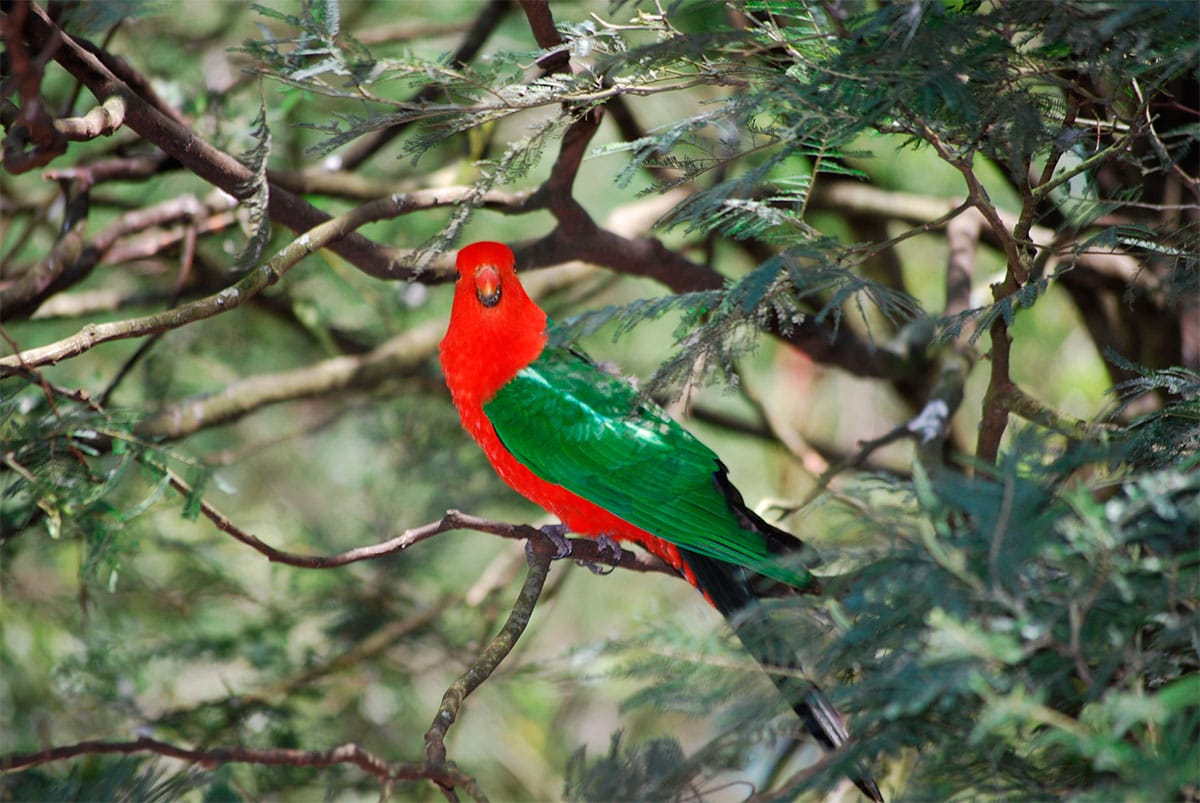
The Papuan king parrot (Alisterus chloropterus) It has a bright red head, wide rear collar of blue stretching at the nape to the back of the Crown and sides of the upper part of the chest. Blackish green mantle, apparently black in the field; lower part of the back, buttocks and supracaudales coverts Dark Violet.

Dark green wings with large patch of yellowish-green through the lower, internal medium and more large inner coverts; Green flight feathers, with vane Dark internal. Under, the wing coverts blue-violet. Bright red bottoms, with hidden dark bases to the coverts infracaudales. Upper, tail bluish black; Black down.

Black bill with red base to upper mandible; Orange iris; feet of color grey blackish.

The female of color green for over, devoid of the pale in wings patch, with a dark blue rump and blackish tail. Head and upper part of the chest of green (reddish mottled), and the rest of of the Red bottoms. Under, the Green wing coverts. Coverts with dark centers infracaudales, but this is less evident in the Australian females. Base with more brown on upper mandible than in males.

Young as females, but with tips to the tail feathers pink, a greener chest, and a peak and iris darker.

Subspecies description

  • Alisterus chloropterus chloropterus

    (Ramsay, EP 1879), the nominal subspecies.


  • Alisterus chloropterus callopterus

    (Albertis & Salvadori 1879) – Male with blue band narrow through the mantle, It does not extend to the rear of the Crown. More green in the mantle.


  • Alisterus chloropterus moszkowskii

    (Reichenow 1911) – Sexes generally similar. Male has no or only shows a blue light in the back of the neck band, and it has the mantle and signs on the sides of the chest of green. Male with violet that extends more down in the back that the nominal species. Both sexes can display tips pink tail feathers. Immature with narrower and more off the wings patch. Green marks on the chest.

Habitat:

They are distributed in the dense forests from close to sea level until the 2.800 m. The birds are also sometimes found in cultivated areas, at higher altitudes, in more open habitats with casuarinas, and in areas of secondary growth. Papagayo Papuans are heard more often than they are seen, and are more frequently asked vislumbrados flying between the trees through breaks in the forest.

Bird alone, couples or groups of up to ten copies, they feed on silently and discreetly in the lower floors and half-height of the forests, and they can be addressed a short distance when they deliberately leave in search of fruits, seeds, berries and nuts; When resent, they usually only fly within walking distance.

Reproduction:

Little-known cycle of reproduction, but nesting, according to sources, begins in the month of March with two or three eggs in the implementation. The period of incubation is of 21 days, and the incipient takes 35 days. Young people reach the independence in 50 days.

Food:

Fruits, seeds, berries and nuts

Distribution:

Size of the area of distribution (reproduction / resident): 324.000 km2

The Papuan king parrot extends from North of Cenderawasih Bay, to the East, about Aitape on the North Coast. Although locally common, the species is probably suffering due to the trade of birds. The world population is estimated at around 70.000 birds.

Subspecies distribution:

Conservation:


minor concern


โ€ข Current category of the Red List of the UICN: Least concern

โ€ข Population trend: Stable

The size of the world's population has not been quantified, Although it is estimated at around 70,000 specimens.

The species is reported as locally common (pit et to the. 1997).

The population is suspected to be stable in the absence of evidence of any reduction or substantial threats.

"Papuan king parrot" in captivity:

active parrot; need extra space because of the tendency that has to turn into an apathetic or lethargic in a small cage bird. It is not very loud. The dietary changes must occur slowly. It has a tendency to internal parasites.

Very rare in captivity.

Alternative names:

– Papuan King-Parrot, Green-winged King Parrot, Green-winged King-Parrot, Papuan King Parrot (ingles).
– Perruche ร  ailes vertes, Perruche royale ร  ailes vertes, Perruche royale de Papouasie (French).
– Papuasittich (German).
– Periquito-rei-de-asa-verde (Portuguese).
– Papagayo Papรบ, Papagayo Real de Alas Verdes (espaรฑol).

scientific classification:

– Order: Psittaciformes
– Family: Psittaculidae
– Genus: Alisterus
– Scientific name: Alisterus chloropterus
– Citation: (Ramsay, EP, 1879)
– Protonimo: Aprosmictus chloropterus

โ€œPapuana Parrotโ€ images:

————————————————————————————————

ยซPapuan Parrotยป (Alisterus chloropterus)

Sources:

– Avibase
– Parrots of the World โ€“ Forshaw Joseph M
– Parrots A Guide to the Parrots of the World – Tony Juniper & Mike Parr
– Wikipedia
– Birdlife

– Photos:

(1) – ยซAlisterus chloropterus-Jurong Bird Park-male-8aยป by Peter Tan – originally posted to Flickr as Australian King Parrot. Licensed under CC BY 2.0 via Wikimedia Commons.
(2) – ยซAlisterus chloropterus -Grantโ€™s picnic ground -in tree-8ยป by Jade Craven – originally posted to Flickr as King Parrot at Grants Picnic Ground. Licensed under CC BY 2.0 via Wikimedia Commons.
(3) – Birds and Birds – Parrocchetto reale aliverdi
(4) – Bottom view of a male perched on a branch by Carmelo Lรณpez – Lynx
(5) – franz.kulman

– Sounds: Sam Woods (Xeno-canto)
โ–ท The world of Pets: Dogs, cats, birds, reptiles, amphibians

Red-rumped Parrot
Psephotus haematonotus

Red-rumped Parrot

Content


Anatomy-parrots

Description

27 to 30 cm. length between 55 and 85 g. of weight.

The Red-rumped Parrot (Psephotus haematonotus) It has a bright pale green head, slightly iridescent, with the front of the crown Blue pale and diffusion in the throat. Mantle Green grey with stripes dark fine; floor area of the back and Hip, Scarlet pale; uppertail-coverts bright green. Curve of the wing blue-violet shiny; carpal edge dark blue; small coverts bluish green, the external medium yellow, the inner of a pale blue-green; greater coverts, bluish green, clearer internal; primary coverts dark blue. Flight feathers Blackish with vane external edges and dark blue yellowish; tertiarys grey-green with vane Dark internal. Wing feathers dark blue. Green light the chest with a broadcasting slightly yellow, belly bright yellow, feathers of the chest and belly with stripes more dark very fine; the thighs, vent and undertail- coverts off-white, sometimes blur of yellowish-green. Upper, the tail Green feathered side of greenish-blue with white tips; by down whitish appearance when it is closed.
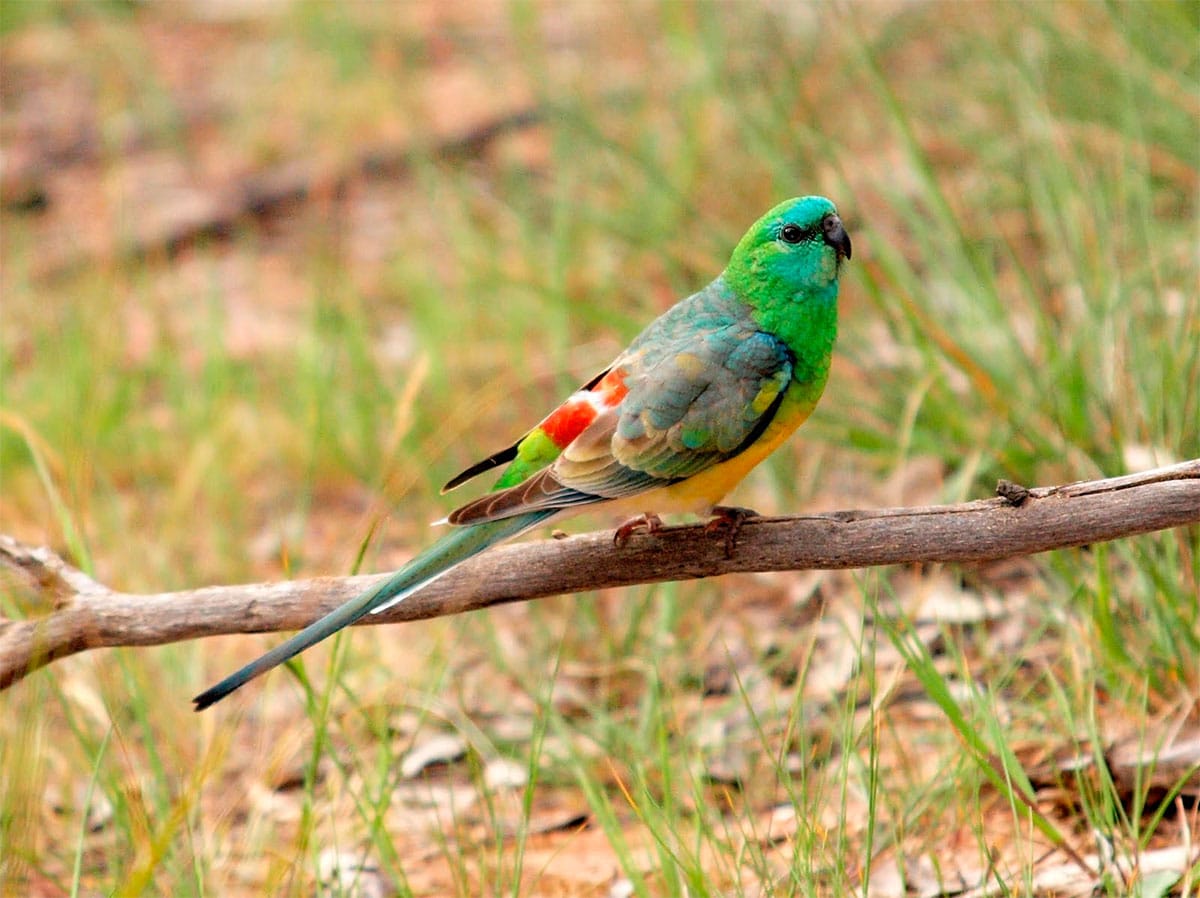
Bill black; irises brown; legs grey.

The female It is much more off than the male, usually greyish green. With white spots on the ear-coverts, the upper part of the chest is grey olive clear with fringed slightly more dark and the belly whitish with a blue-green light diffusion. The wing-coverts are of a gray olive more uniform that it's the male (medium-sized coverts pale blue). The vane outside of the flight feather they are more muted and more greenish, with the tail green. The bill and the irises are more pale, with some brands shaped pale wing bar.

The immature They also have a pale bar on the wings. Males are darker, with more olive than females and a rump with a narrow margin of Red; The feathers greenish blue begin to show in the head, the chest and wing-coverts first.

The adult plumage was purchased in two or three months, the male young retain the bar of wing and have it rump more off for another year.

Description 2 subspecies

  • Psephotus haematonotus caeruleus

    (Condon 1941) – Adults of both sexes are more pale in color, the male is a shade more blue, the Central undertail feathers they have more nuances blue and red of the rump is more pale; the nape and the the mantle of the female are more grayish Green


  • Psephotus haematonotus haematonotus

    (Gould 1838) – The nominal.

Habitat:

The Red-rumped Parrot usually sedentary, but some movements of flocks with breeding sites have been recorded at the edges of their range.

They prefer open terrain and trees of ribera, grasslands and croplands until 1.000 meters above sea level, where the annual precipitation is inferior to 800 mm. They are also found in suburban areas, having canevale for golf courses, roadsides and parks, and locally in the mangroves.

They are generally replaced by Bluebonnet and Mulga Parrot in wetter areas.

They are usually in pairs or small groups, but they are not uncommon flocks of 100 specimens or more during the post-breeding season. In these groups the pair bond is maintained and mutual grooming is common.. The Red-rumped Parrot are sociable, and to retire to the roosts are constantly called.

Reproduction:

The breeding season of the Red-rumped Parrot extends from July to January, Although you can rely more on the rains in the North than elsewhere. The courtship the male consists of head and tail Wiggles, as well as the drooping-wings pose.

The nesting they tend to occur in small colonies, often resulting in disputes between couples. The nest usually in a hollow tree, in different heights, often in a eucalyptus, it can also be located on a tree stump or even the eaves of a building can provide a suitable place. Between two and eight eggs (usually four to five) they form the laying. The female incubates alone for around 20 days, regularly fed by the male.

The pricipio, males remain in small groups, but as the chicks grow, These groups begin to disperse and males joined young people directly in the moments of eating. Young people take to abandon the nest between four to six weeks.

Food:

The Red-rumped Parrot they tend to feed on the ground, but it is also common to see them feeding in trees and shrubs.

The diet comprises a mixture of grasses and herbs, also seed sprouts, leaves, flowers and grain. They rest during the heat of the day and can remain hidden, unless you disturb them.

Distribution:

Size of the area of distribution (reproduction / resident): 1.930.000 km2

The Red-rumped Parrot are confined to the southeast of Australia, from the north of the Peninsula Eyre and Yorke, in the South of Australia, until the Montes Flinders, the basin of the Lake Eyre and Innamincka in the Northeast. The species expands eastward through Victoria, having come up to Melbourne in the middle of the Decade of 1970.

In the news, the species is still scarce in the eastern end of the State. But, in New South Wales can be found around Sydney and along the coast towards the North, extending inward across the fullest part of New South Wales (largely absent in the Northwest of the darling river,).

In Queensland reaches Windorah, in the West and the surrounding area of Charleville, Chinchilla and Brisbane, in the East.

Its population is common and growing in the north and towards the south coast of Queensland, to the South of New South Wales, benefiting from the expansion of agriculture.

The world population is more of 200.000 specimens and the species is protected by law.

Distribution 2 subspecies

Conservation:


minor concern


โ€ข Current category of the Red List of the UICN: Least concern

โ€ข Population Trend: Crecent

The size of the world population It has not been quantified, It is estimated over the 200.000 specimens.

Considered as a bird common to abundant in some parts of its area of distribution, do not believe that the Red-rumped Parrot is in danger of extinction, although there is some evidence that the numbers they may be decreasing slightly. The reasons for this are not clear.

As the Red-rumped Parrot It is immersed in the pet trade, This species is included in the Appendix II the Convention on international trade in endangered species (CITES), which means that all international trade in this species should be carefully controlled.

"Red-rumped Parrot" in captivity:

You have a nice voice. He is active and not especially shy. It can be kept with other parrots outside the breeding season..

The Red-rumped Parrot (Psephotus h. Psephotus) It is one of the species of breeding parakeets more common in captivity. The first imports of Australia they arrived in the middle of the 19TH century. In 1857, the Zoo's London announced the first reproduction successful with this species. Other reproductive successes would follow in Germany and Netherlands, already in 1860.

It's a tough species recommended for novice breeders. The Red-rumped Parrot It is very tolerant of our climate and prefers an Aviary in the open air all year round.

You can play from the age of one year; being two years total maturity age. Playing at the end of the winter, early spring. Usually has two to three young.

The El Perico shrike is also used as a foster parent. Breeders have used their good reproductive dispositions for the breeding of more delicate species such as the Australian King-Parrot (Alisterus scapuleris), the Red-winged Parrot (Apromictus erytropterus) or other species of Polytelis.

The first mutation mentioned back in the middle of the Decade of 1930. This mutation of Australian origin was named as Yellow before later being renamed as Green cake. They are currently known as cinnamon.

Other mutations emerged later as the panache, blue, lutino, opaline, etc … In the news, this species is very common in aviaries. Observations show an unrecognized majority of mutated subjects and a worrying decline in wild-type phenotypes.. Reasonably, it is likely that genetically pure wild type phenotypes are extremely rare today.

According to sources, a sample lived 12,2 years in captivity.

Alternative names:

– Red-rumped Parrot, Grass Parrot, Grassie, Green Leek, Ground Parrot, Red rumped Parrot, Red-backed Parakeet, Red-backed Parrot, Redrump, Red-rumped Grass Parakeet, Red-rumped Parakeet (ingles).
– Perruche ร  croupion rouge (French).
– Singsittich (German).
– Periquito-dorso-vermelho (Portuguese).
– Perico de Dorso Rojo, Perico Dorsirrojo, Periquito de Rabadilla Roja, Cotorra de rabadilla roja, Espalda roja, Periquito cantor (espaรฑol).

scientific classification:

– Order: Psittaciformes
– Family: Psittaculidae
– Genus: Psephotus
– Scientific name: Psephotus haematonotus
– Citation: (Gould, 1838)
– Protonimo: Platycercus haematonotus

Images ยซRed-backed Parakeetยป:

Videos "Red-rumped Parrot"

————————————————————————————————

ยซRed-backed Parakeetยป (Psephotus haematonotus)


Sources:

– Avibase
– Parrots of the World โ€“ Forshaw Joseph M
– Parrots A Guide to the Parrots of the World – Tony Juniper & Mike Parr
– AnAge: The Animal Ageing and Longevity Database – Anagรฉ entry for Psephotus haematonotus
– Birdlife

– Photos:

(1) – A male Red-rumped Parrot by Yarra River, Victoria, Australia By Andrea (originally posted to Flickr as rainbow parrot) [CC BY 2.0], via Wikimedia Commons
(2) – A male Red-rumped Parrot near Lake Ginninderra, Canberra, Australia By Duncan McCaskill (Picasa Web Albums) [CC BY 3.0], via Wikimedia Commons
(3) – Red-rumped Parrot in Capertee Valley, Blue Mountains, NSW, Australia. The red rump is seen only in male By Lip Kee Yap from Singapore, Republic of Singapore [CC BY-SA 2.0], via Wikimedia Commons
(4) – Red-rumped Parrot male (Psephotus haematonotus) – Flickr by Patrick_K59
(5) – Red-rumped Parrot (Psephotus haematonotus) Photographed @ Yarra Bend Park, Melbourne, Australia – Flickr

– Sounds: Peter Woodall (Xeno-canto)