โ–ท The world of Pets: Dogs, cats, birds, reptiles, amphibians

White-naped Lory
Lorius albidinucha

Content

Description

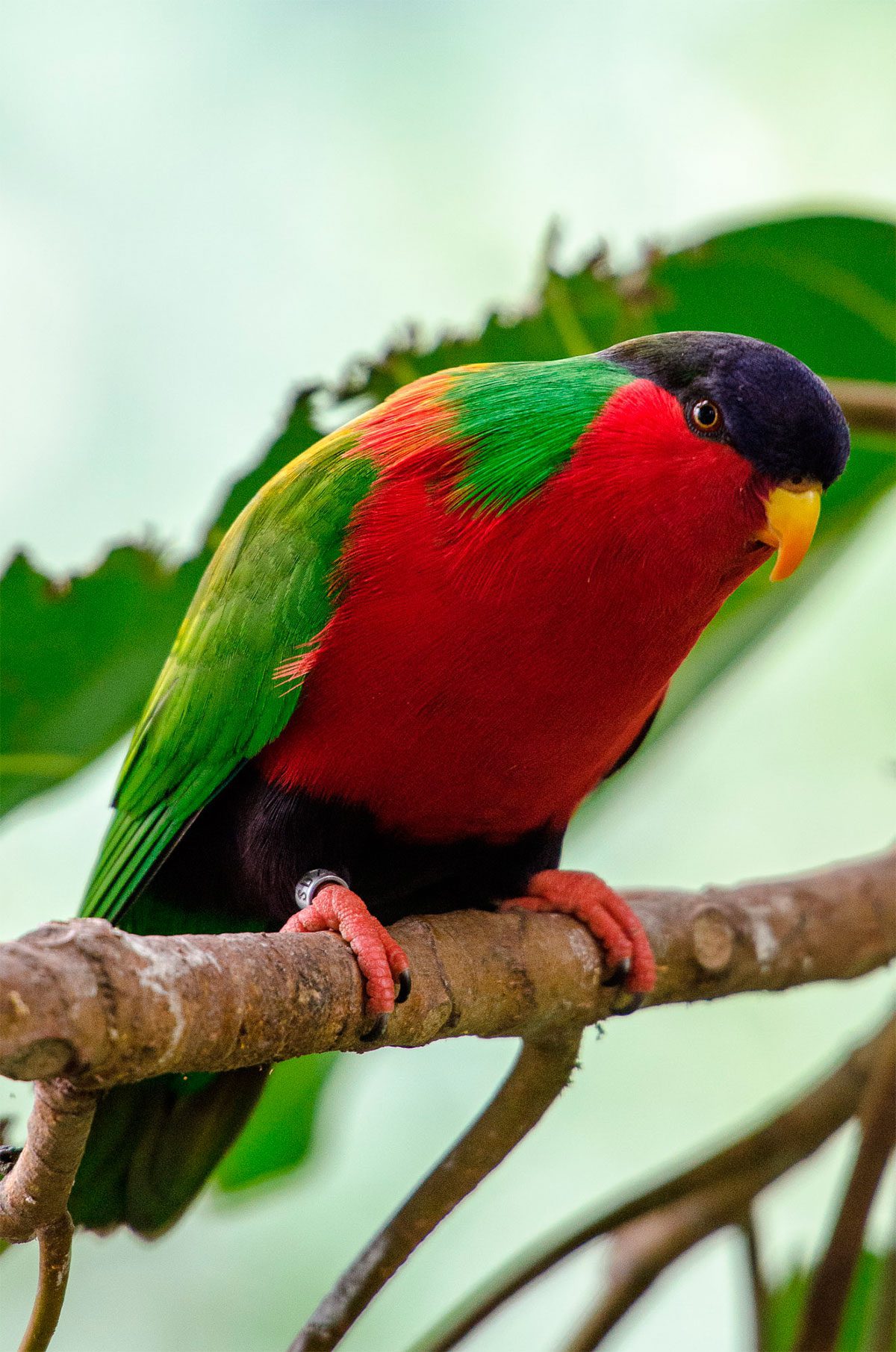
The White-naped Lory (Lorius albidinucha) has a length of 26 cm.. and a weight between 152 and 164 g..

White-naped Lory

Similar to the Purple-bellied Lory with which sympathy between 500 and 750 meters in the South of New Ireland.

The White-naped Lory It has a distinctive patch white in nape. The underparts They are entirely red except yellow markings on the sides of chest. It lacks dark violet broadcast belly and of the undertail-coverts, If shown by the Purple-bellied Lory. Seen at close quarters, the cere Dark also separates this species from the Purple-bellied Lory, what does he have cere white.

Lori Nuquiblanco illustration

The White-naped Lory It is also less Beefy that the Purple-bellied Lory and has a whistle call which differs considerably with the distinctive snore nasal call of the Purple-bellied Lory.
Has the crown black, violet slightly marked by the white patch nape; rest of head bright red. The upperparts red. The wings They are green with a yellow band on the lower part and violet with white spots on the curvature. The upperparts They are red with yellow markings on the sides of the chest and blue marks on the the thighs. Tail red on the outside and yellow on the inside part. Bill orange with dark base in the upper jaw; cere black; irises yellow to reddish brown; legs greyish black.

Habitat:

Known only in the mountains south of New Ireland between 500 and 2.000 m, mainly on 1.000 m.
Normally found in pairs while feed on fruits or wild flowers "oil palm". Been seen feeding on the same tree as the Purple-bellied Lory without harming it.

Reproduction:

No data reproduction in its natural habitat.

Food:

Feeds of fruit and flowers of the oil palm plantations.

Distribution:

Distinctive species, little known and restricted to the forests of the hills of New Ireland in the Bismarck Archipelago (Papua New Guinea).

Conservation:


Near-threatened


โ€ข Current IUCN Red List category: Near-threatened.

โ€ข Population trend: Decreasing.

Quite common at all limits within its altitude range. The world population probably it is lower to the 10.000 specimens.
No information on population trends; But, the species is suspected falling slowly, as a result of logging.

The conservation actions proposals:

โ€ข Effectively protect hill forests.
โ€ข Determine the tolerance of forests exploited at different altitudes.
โ€ข Monitor populations at key sites.

"White-naped Lory" in captivity:

None known.

Alternative names:

White-naped Lory, White naped Lory (ingles).
Lori ร  nuque blanche (French).
WeiรŸnackenlori (German).
Lorius albidinucha (Portuguese).
Lori Nuquiblanco, Tricogloso de Nuca Blanca (espaรฑol).

scientific classification:

Order: Psittaciformes
Family: Psittaculidae
Genus: Lorius
Scientific name: Lorius albidinucha
Citation: (Rothschild & Hartert, 1924)
Protonimo: Domicella albidinucha

————————————————————————————————

ยซLori Nuquiblancoยป (Lorius albidinucha)


Sources:

Avibase
– Parrots of the World โ€“ Forshaw Joseph M
– Parrots A Guide to the Parrots of the World – Tony Juniper & Mike Parr
– Birdlife

Photos:

1 – lorihaven.dk – link
2 – Illustration: HBW.com

โ–ท The world of Pets: Dogs, cats, birds, reptiles, amphibians

Plum-faced Lorikeet
Oreopsittacus arfaki

Plum-faced Lorikeet

Content

Description

15 cm.. length between 16 and 23 g. of weight.
Plum-faced Lorikeet

The hood of the Plum-faced Lorikeet (Oreopsittacus arfaki), from the top of bill up to the crown rear, is Scarlet Red ; chin and Spada color plum (with bluish Sheen), broken by two rows of thin stripes.

Upperparts of color green uniform with a light spread of olive in the the mantle. Wings, views from the top are green; vane internal to the flight feather, blackish in color and vane external to the primaries outermost, bluish green. Underwing-coverts and axillary, red (Outer secondaries slightly marked with yellow); flight feather Blackish with yellow central band. The mauve of it chin be extended slightly in the throat; top of the chest green, center of chest and belly bathed in orange-red; under belly green; undertail-coverts green, lightly bathed in yellow on sides. Uppertail green, merging to blackish and ending in pinkish-Red, in the tip lighter fusion: below, the tail is red with marked with black side feathers.

The bill black; irises blackish brown; legs grey.

Female lack of top red (but you can show a bit of red on the part rear of the Crown).

Immature male with only red on the back of the crown. The young birds have a slightly 'scaly' appearance; also off the tip of orange-yellow color of the tail.

Description 3 subspecies

  • Oreopsittacus arfaki arfaki

    (Meyer,AB, 1874) – The nominal.


  • Oreopsittacus arfaki grandis

    : (Ogilvie-Grant, 1895) – Greater than the nominal. Lack of the flanks redorange and markings of the belly of the other two subspecies.


  • Oreopsittacus arfaki major

    : (Ogilvie-Grant, 1914) – Larger that the nominal and more red-tipped in the tail.

Habitat:

The distribution of the Plum-faced Lorikeet is more or less continuous in the extension of the moss forests; the species is mainly found among the 2.000 and 3,750 m, but can observe is to 1.000 m occasionally. Be found with greater frequency in pairs or small flocks very vocal. They feed acrobatically in the canopy; They also feed on plants, especially in the flowers of epiphytes, often in the company of other flower aficionados such as the lories of the genus Neopsittacus.

Reproduction:

Habits of nesting unknown, birds in reproductive attitudes they have been observed in August and October. The display of marks under the wings have been observed in pairs and can be linked to courtship, as well as by the male head rolling.

Food:

It feeds on pollen, nectar, possibly, flowers, fruit (especially Schefflera) and berries.

Distribution:

Size of the area of distribution (reproduction / resident): 108.000 km2

New Guinea in Irian Java (Indonesian) and Papua New Guinea, ranging from the East ofVogelkop to the Huon Peninsula and ranges from the Southeast. A small number of captivity

Distribution 3 subspecies:

  • Oreopsittacus arfaki arfaki

    (Meyer,AB, 1874) – The nominal.


  • Oreopsittacus arfaki grandis

    : (Ogilvie-Grant, 1895) – Mountains of the Central and East of Papua New Guineto, including, those in the southeast of the region of the Huon Peninsula and Sepik, extending to the West of Victor Emanuel Range


  • Oreopsittacus arfaki major

    : (Ogilvie-Grant, 1914) – Snow Mountains (Papua New Guinea)

Conservation:


minor concern

โ€ข Current IUCN Red List category: Least concern

โ€ข Population trend: Stable

The world population It has not been quantified, Although it is thought of more than 300.000 specimens. The species is reported to be quite common (pit et to the. 1997).

The population suspected to be stable in the absence of evidence of any reduction or substantial threats.

"Plum-faced Lorikeet" in captivity:

The Plum-faced Lorikeet is a bird quiet and at times active. Young birds are susceptible to stress and disease during the acclimatization; can die suddenly without apparent cause. They become much more resistant and less timid after acclimatization.. You can be accommodated with members of their own species in a system of colony.

It is very rare in captivity.

Alternative names:

Plum-faced Lorikeet, Plum faced Lorikeet, Plum-faced Mountain Lory, Plum-faced Mountain-Lory, Whiskered Lorikeet (ingles).
Lori bridรฉ (French).
Arfaklori, Arfakalori (German).
Lori Bigotudo, Lori de Bigotes (espaรฑol).

scientific classification:

Order: Psittaciformes
Family: Psittaculidae
Genus: Oreopsittacus
Scientific name: Oreopsittacus arfaki
Citation: (Meyer,AB, 1874)
Protonimo: Trichoglossus (Charmosyna) Arfaki

ยซWhiskered Loryยป Images:

Videos "Plum-faced Lorikeet"

————————————————————————————————

ยซOn Bigotryยป (Oreopsittacus arfaki)


Sources:

Avibase
– Parrots of the World โ€“ Forshaw Joseph M
– Parrots A Guide to the Parrots of the World – Tony Juniper & Mike Parr
– Birdlife

Photos:

(1) – Dansk Lori Klub
(2) – arfak lori man oreopsittacus arfaki – photobucket
(3) – By Katerina Tvardikova – pngbirds.myspecies.info
(4) – By Guy Dutson – lynx
(5) – By Katerina Tvardikova – pngbirds.myspecies.info
(6) – Illustration – HBW.com

Sounds: Patrik ร…berg (Xeno-canto(

โ–ท The world of Pets: Dogs, cats, birds, reptiles, amphibians

Black-billed Hanging Parrot (2)
Loriculus philippensis bonapartei

Content

Description

Black-billed Hanging Parrot
14 cm.. length.

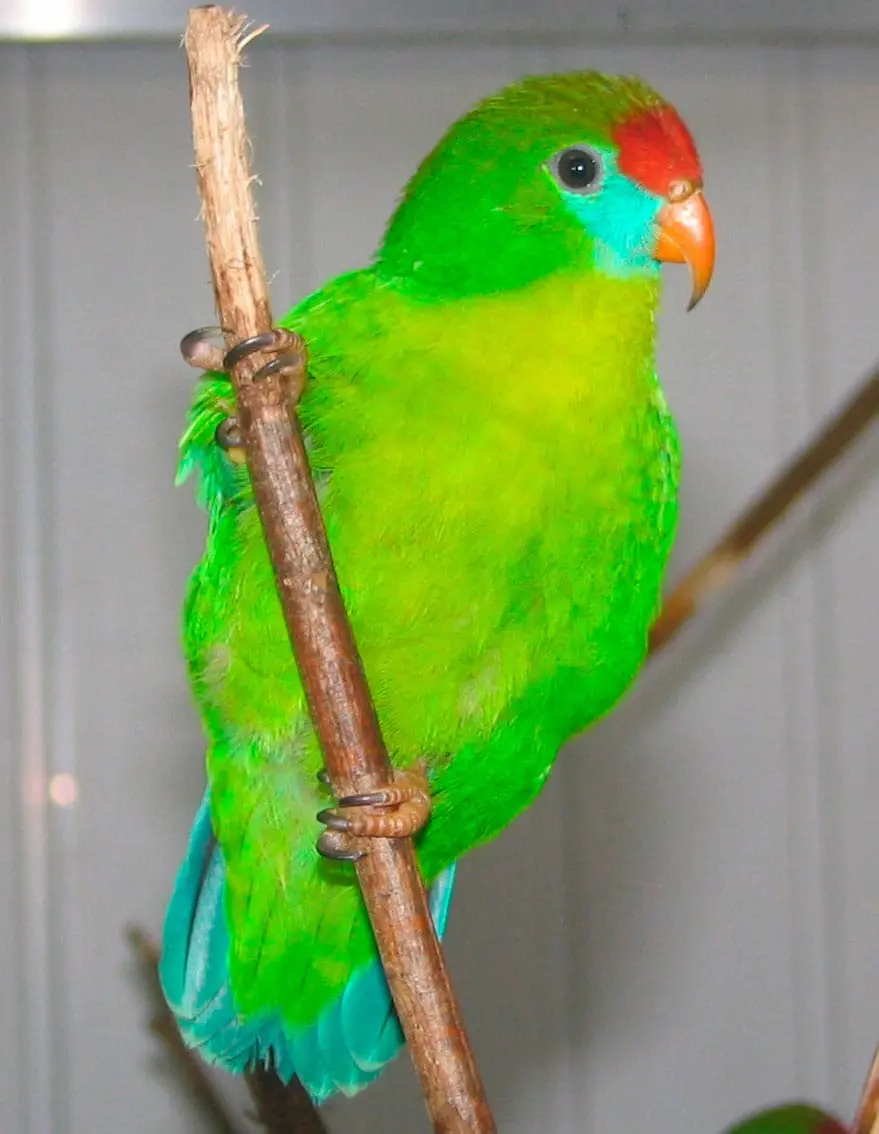
The Black-billed Hanging Parrot (2) is a subspecies of the Colasisi (Loriculus philippensis) being the only member of the genus, in the Sulu archipelago. The combination of the Red Crown on front, merging Orange gold neckband, and the black Bill are the brand identity of the Black-billed Hanging Parrot for both sexes. Aside from lacking these features, the most similar species within the subspecies of Loriculus philippensis, the L. p. apicalis and L. p. dohertyi, they have the necks much more of orange-red color and a strong orange color shawl in broadcast.

The female of the Ceylon Hanging-Parrot has the Red Crown, reddish diffusion in the mantle, peak red and a whitish iris (males do not have the Red bib of birds of Sulu).

The front of the Crown of the Black-billed Hanging Parrot is red, shading back in Orange and yellow in the back of the Crown, with a clear line of demarcation of the green mantle; bright green cheeks and Lores. Orange robe loosely washed in the Center; rump and tail coverts bright crimson (Blue Suffusion on sides of rump). Wings green brilliant with vane internal to blackish flight feathers. Feathers of the wings of Turquoise Green: below, the wings of blue. The Chin and throat bright Scarlet; rest of the underparts of bright green. Upper, the Green tail; Blue below. the black beak; Brown irises; Orange to greyish legs.

Habitat:

The species is little known, but their habits and ecology are presumably similar to those of the Colasisi. Commonly found in front of coconut groves on the coast, inside you have registered in forests, as well as in partially cleared areas. Observed feeding on flowers of Palm and flying between the trees.

Reproduction:

The breeding season starts around February and may continue until may. An average clutch can coasts of 2 to 4 eggs. Parents make their nests on top of the cavities of the trees.

Food:

Their natural diet consists of nectar, seeds, red fruits (especially wild figs), berries and flowers

Distribution:

Loriculus-bonapartei-Distribucion
Restricted to islands in the Sulu archipelago. Philippines, among them: Sibutu, Bongao, Sanga Sanga, Manuk Manka, Tawitawi, Siasi and Jolo.

Conservation:

There is no data

"Black-billed Hanging Parrot (2)" in captivity:

Captive breeding of this species has rarely been achieved.; It has however occurred in communal aviaries.

Alternative names:

Black-billed Hanging Parrot, Black-billed Hanging-Parrot (ingles).
Coryllis de Bonaparte, Coryllis ร  bec noir (French).

scientific classification:

Order: Psittaciformes
Family: Psittaculidae
Scientific name: Black-billed Hanging Parrot
Citation: Souance, 1856
Protonimo: Loriculus Bonaparte

————————————————————————————————

ยซLoriculus bonaparteiยป (Black-billed Hanging Parrot)


Sources:

– Avibase
– Parrots of the World โ€“ Forshaw Joseph M
– Parrots A Guide to the Parrots of the World – Tony Juniper & Mike Parr

โ–ท The world of Pets: Dogs, cats, birds, reptiles, amphibians

Brehm's Tiger-Parrot
Psittacella brehmii


Brehm's Tiger-Parrot

Content

Description

24 cm. length and a weight between 94 and 120 g..

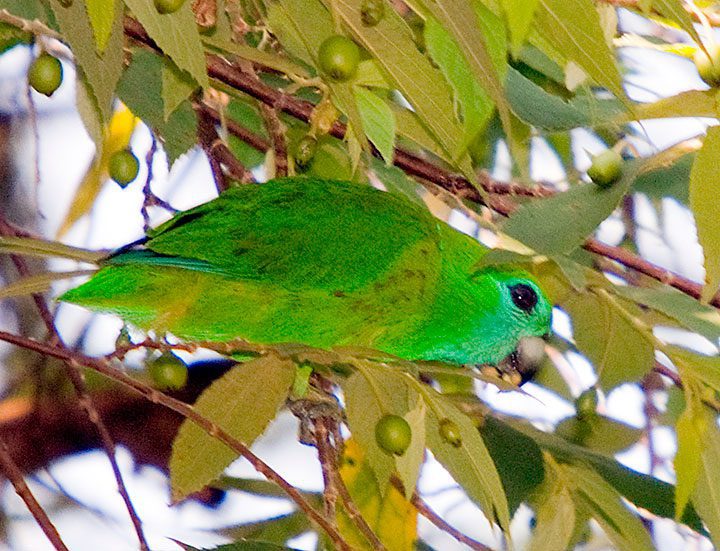
The head of the Brehm's Tiger-Parrot (Psittacella brehmii) is marron-oliva. The neck It is colored with black and green bars. The front and sides of the neck they are surrounded by a bright yellow stripe. The chest It is slightly striped in green and black colors.

The center of the back is very green and it integrates perfectly, with yellow and black striped, the area of the rump. Black fusion is absent from yellowish green to the extent lumbar and Hip. Wings they are a dark green color with dark edges in the covered medium-sized. The flight feather are blackish with vane a thin border beige and green external. The curvature of the wing is Bluestone. Wing feathers green.

The underparts are green, totally opaque, except the undertail-coverts that are of color red Scarlet. The bottom of the tail is green, greyish black down.

The bill It is brownish grey with lighter edges and a white tip. The irises is reddish orange. The legs are grey green.

The female lacks the yellow Crescent on the front of the neck. The chest listed in green and black.

Youth with the colors green and yellow absent from the chest area. Coverts of the tail of color orange tinged with tips yellow. The bill pale.

Subspecies description

  • Psittacella brehmii brehmii

    : The nominal.


  • Psittacella brehmii intermixta

    : Its underparts and back listing are more yellowish green tones, and larger.


  • Psittacella brehmii pallida

    : As the nominal but with narrower peak.


  • Psittacella brehmii harterti

    : It is clearer and less yellowish green head. Is smaller.

Habitat:

Are observed in the montane forest, including Podocarpus, beech forests of Nothofagus and edge of forests, mainly from 1.500 metres to the 2.600 m, ends in 1.100 and 3.800 m.

The Brehm's Tiger-Parrot is distributed primarily at altitudes below the habitat of the Painted Tiger-Parrot, but there is a zone in which they find sympathy latitudinally, and is between 2.500 and 3.000 m. Birds are often found individually or in small groups and allow an approximation.

You spend much time below the canopy or even close plants feeding on seeds and berries (including conifers and Podocarpus), Although also found in levels higher in the forest. Move slowly, often using his beak to balance and sometimes you can stay still. They only make short flights, never flying above the canopy.

Reproduction:

Little is known of nesting behavior, but two nestlings were observed in a nest during the month of June.

Food:

Diet includes seeds, coniferous berries and Podocarpus.

Distribution:

The Brehm's Tiger-Parrot they are endemic in New Guinea, where often live almost exclusively in mountain areas. Its range is divided into three isolated populations, an in Vogelkop, West Papua, the second in all the central and South-Eastern Highlands of New Guinea and the third in the mountains of the Huon Peninsula (the Painted Tiger-Parrot is absent and the Parrot Brehm Tiger is observed at altitudes higher than usual). The species is widespread, but generally uncommon; the world's population is believed to be superior to 100.000 specimens.

Distribution Subspecies

  • Psittacella brehmii brehmii

    : The nominal.


  • Psittacella brehmii intermixta

    : Is located in the central mountains of New Guinea.


  • Psittacella brehmii pallida

    : Of the mountains of the southeast of New Guinea.


  • Psittacella brehmii harterti

    : Occupies the Huon Peninsula (to the northeast of New Guinea).

Conservation:


minor concern


โ€ข Current category of the Red List of the UICN: Least concern

โ€ข Population trend: Stable

The size of the world's population has not been quantified, It is believed that it is superior to 100.000 specimens.

The species, according to sources, it is quite common and widespread (pit et to the. 1997).

The population is suspected to be stable in the absence of evidence of any reduction or substantial threats.

"Brehm's Tiger-Parrot" in captivity:

It is not a bird for the lovers of the aviaries since their mortality rate in captivity is very high.

Alternative names:

Brehm’s Tiger-Parrot, Brehm’s Parrot, Brehm’s Tiger Parrot (ingles).
Perruche de Brehm (French).
Brehmpapagei, Brehm Papagei, Brehm-Papagei (German).
Psittacella brehmii (Portuguese).
Lorito de Brehm, Lorito tigre de Brehm, Lorito-tigre de Brehm (espaรฑol).

scientific classification:

Order: Psittaciformes
Family: Psittaculidae
Genus: Psittacella
Scientific name: Psittacella brehmii
Citation: Schlegel, 1871
Protonimo: Psittacella brehmii

Images "Brehm's Tiger Parrot":

Videos "Brehm's Tiger-Parrot"

————————————————————————————————

"Brehm's Tiger Parrot" (Psittacella brehmii)

Sources:

Avibase
– Parrots of the World โ€“ Forshaw Joseph M
– Parrots A Guide to the Parrots of the World – Tony Juniper & Mike Parr
Wikipedia
– Birdlife

Photos:

(1) – By Jerry Oldenettel, on Flickr – Flickr
(2) – ยซPsittacella brehmiiยป by markaharper1 – Brehmโ€™s Tiger-Parrot. Licensed under CC BY-SA 2.0 via Wikimedia Commons.
(3) – Lateral view of a male perched near the feeding table by Mikko Pyhรคlรค – Mikko Pyhรคlรค – Lynx
(4) – Male feeding at the bird feeder by David Cook Wildlife Photography – Lynx
(5) – By ยฉ Jerry Oldenettel – inaturalist

Sounds: Marc Anderson (Xeno-canto)

โ–ท The world of Pets: Dogs, cats, birds, reptiles, amphibians

Eclectus Parrot
Eclectus roratus


Eclectus Parrot

Content

Description


Anatomy-parrots

35 to 42 cm.. length and a weight between 355 and 615 g..

The Eclectus Parrot (Eclectus roratus) It has the head and upper parts of bright green. green wing coverts; curve of the wing and the carpal edge blue; primary coverts dark blue. Feathers of flying with vane very dark blue external, vane internal black on the edge inside. Wing of bright red feathers; bottom of the black flight feathers. Green underparts with flanks and axillary Red. Upper, the Green tail with narrow pale yellow tips, drenched side of blue and yellow-tipped feathers (more external with more blue); undertail, tail black with yellow tips.

Yellow-tipped red Bill, black lower jaw, iris orange, greyish Brown legs.

In all the eclectus sexual differences machos-hembras are so large that at the beginning he qualified them as different species. The female of the Eclectus Parrot it is bright red with a purple ruff across the top of the mantle, with bluish black in flight feathers, purple blue wing feathers, purple diffusion over the chest, dull purple-blue on lower chest and belly, coverts yellowish-tipped red infracaudales, and a tail of red with yellow tips (Feather darker bases). The beak is black and the iris is usually yellow (variable).

The young birds they move directly the adult plumage but they have brown peaks.

  • Sound of the Eclectus Parrot.

Subspecies

List of subspecies Eclectus roratus
  • Eclectus roratus vosmaeri

    (Rothschild, 1922) – Larger than the nominal. Male with bright green plumage, more red on the flanks, broader yellow tail ends. Female with the red light, broader yellow tail and yellow in the coverts infracaudales ends.

  • Eclectus roratus roratus

    (Statius Mรผller, 1776) –

  • Eclectus roratus cornelia

    (Bonaparte, 1850) – Larger than the nominal. Male with more blue in the queue, the upper parts of lighter green color. Female completely red except for the edges of the Carpus, wing feathers and flight feathers, that are blue. Narrow yellow tip to the tail.

  • Eclectus roratus westermani

    (Bonaparte, 1850) – (Known only from a few copies of populations in captivity; the origin is unknown). Smaller than the nominal. The male It has no visible red flanks when wings are closed and shows foreign banks of green to flight feathers. Female with the darker red color with broad yellow tip to tail. The possibility that the few copies are abnormal individuals of the subspecies E. r. flushed It has not ruled out.

  • Eclectus roratus riedeli

    (A.B. Meyer, 1882) – Smaller than the nominal. Male with wide yellow tips on the tail (25 mm). Female as E. r. Cornelia, but it shows bright yellow on the coverts infracaudales.

  • Eclectus roratus aruensis

    (G.R. Gray, 1858) – Males as the subspecies E. r. biaki, with a little more spacious yellow tips to the tail. Female Red clear, especially tail.

  • Eclectus roratus biaki

    (Hartert, 1932)- As the subspecies E. r. tortoiseshell but smaller. The female just like the female of the E. r. tortoiseshell but more bright red underparts and back of neck (dubiously distinct race).

  • Eclectus roratus polychloros

    (Scopoli, 1786) – Larger than the nominal. Male, Yellow tail more yellowish-green tips. Female with red chest and less violet blue in the bottom region restricted to belly, green in vane external primary. Narrow periophthalmic ring blue. Coverts red infracaudales.

  • Eclectus roratus solomonensis

    (Rothschild & Hartert, 1901) – Smaller that the E. Eclectus tortoiseshell and the male more yellowish green. Female Red clear. Size is reduced clinalmente from West to East

  • Eclectus roratus macgillivrayi

    (Mathews, 1913) – As the E. Eclectus tortoiseshell but larger.

Habitat:

The Eclectus Parrot It is distributed in a wide range of habitats, from second growth forests, Savannah, mangrove, coconut plantations and eucalyptus Woods, until 1.900 m.

The species is most common in lowland forests, around growing areas and coastal habitats.

The birds are alone, in pairs or in small groups, often composed of only males (presumably during playback).
They sometimes soar above the forest and draw attention with their shrill calls while flying over the canopy, or they perch on an exposed branch.

They are cautious, groups of foraging usually remain in the treetops, Although birds feeding on low-altitude or even on the ground have also been observed.

The Eclectus Parrot they are most active at dawn and at dusk, When traveling to and from their roosts in noisy groups of up to 80 birds.

Have been recorded roosting in Sumba where the Eclectus Parrot they share space with the Sulphur-crested cockatoo.

The species is considered an agricultural pest in some parts of New Guinea.

Reproduction:

Breeding can apparently occur at any time of the year in Papua New Guinea, While active nests observed in Australia It was between the months of February and July; There has been during the month November in Buru, During August in Seram, and between June and September in the Solomon Islands.

Up to eight birds have been registered by attending a nest. It is not clear if these are brood helpers., young from a previous litter still attached to the family group, or additional hens females.

In courtship, birds become involved with mutual grooming and Wiggles head.

The nest is a hollow in a tall tree, until 30 metres in height, sometimes exposed; The cavity may have around 6 depth meters.

Putting two eggs are deposited on a bed of wood dust, hatching in about 26 days, and taking ahead 12 weeks to breeding.

The female takes care of the incubation, leaving only the nest twice a day to be fed by the male; Also is fed by the male when the first eggs hatch, but then begins to feed if same.

Food:

The diet includes fruits, seeds, flowers, outbreaks, fruits and nectar: they are especially fond of (Pandanus) banana, corn, figs and Papaya.

Distribution:

Sumba in the Small Oriental Sunda Islands, Indonesian and Moluccan Islands including Buru, Seram, Ambon, Haruku, Saparua, the Gorong Islands (apparently introduced), OBI, Damar, Bacan, Halmahera, Mare. Ternate and Morotai, in the West of the papuan islands,including Waigeo, Batanta, Salawati and Misool; thence through the lowlands of New Guinea, and Tanimbar Islands, Kai and islas Aru, to the South of the Islands in the Cenderawasih Bay (Numfor, Biak, Yapen, My Num).

In the East, the Eclectus Parrot are distributed among archipelagos of D'Entrecasteaux and the Luisiadas, Papua New Guinea, including Goodenough and Normanby, and in the Trobriand Islands extending through the Bismarck Archipelago including Umboi, New Britain, the Witu Islands, Lolobau, Uatom, Duke of York, New Ireland, New Hanover, Tabar, Lihir, Thong and FeNi, reaching Manus and Rambutyo in the the Admiralty archipelago and Nissan in the South.

The species is also through of the Solomon Islands, including Buka and Bougainville (Papua New Guinea) to the East of San Cristรณbal and its satellites.

There is an isolated population in the North of the Cape York Peninsula, Australia, that goes from the Iron range National Park and the pascoe river, to the South of the McIlwraith range, regularly visiting smaller islands in the Torres Strait, in the continental part of New Guinea.

There is an introduced population of the Eclectus Parrot in Koror and some smaller islands in the archipelago of Palau In the pacific, but likely to be occasional escapes from Hawaii, where apparently cannot have been established. This is one of the parrots most common and most familiar throughout much of their range.

The world's population is estimated over of 300.000 birds. Local entrapments in Ambon, Saparua and Haruku It has apparently made the species becoming extinct in these three islands. The distinctive population in Sumba is in danger.

Subspecies

Distribution subspecies Eclectus roratus

Conservation:


minor concern


โ€ข Current category of the Red List of the UICN: Least concern

โ€ข Population trend: Decreasing

The size of the world's population has not been quantified, It is estimated over the 300,000 specimens. The species is described as common to rare.. The population in Sumba It is estimated in 1.900 individuals, although Sumba It represents a very small proportion of the global range of the species (pit et to the. 1997).

The population is suspected to be declining due to the destruction of habitat in course and unsustainable levels of exploitation.

"Eclectus Parrot" in captivity:

3 the common subspecies in aviculture: Eclectus roratus flushed, Eclectus roratus vosmaeri and Eclectus roratus tortoiseshell; other rare breeds.

Es a curious and intelligent with an acceptable language ability, they learn without difficulty to say words and phrases.

It happens to be fairly quiet and able to live without too much attention. Males can be somewhat distant while in females it must be emphasized the theme that in the case that have nest can not out of it. On the topic food tends to be accepted that the eclectus have a greater need for vitamin A than other parrots.

When considering the purchase of a new Eclectus, it would be wise to obtain a photo and request a consultation with an authority on Eclectus to verify that you are not purchasing a hybrid.

When to acquire housing for our Eclectus Parrot, one should consider your major and arrange them in a cage as large as possible; reasonable steps would be 4,4 m x 1,5 m x 2 m.

We should keep in mind that our parrots should spend at least one hour each day outside the cage during the game.

DIET:

The Eclectus diet consists mainly of vegetables, fruit, legumes and granulated meal. Given that our Eclectus Parrot do not eat many seeds in the nature, and since they are deficient in nutrients, we must consider that their intake should be the exception and not the rule in our house.

The Eclectus they require a diet high in vegetable protein and beta carotene. Their digestive system is longer than most other species., with a greater proventriculus and longer intestines, so fat intake should be limited to avoid fatty tumors. But this does not mean "fat-free.", especially for young people who are very active. It takes some fat to store fat-soluble vitamins A, E and D. It also, with all species, If the cholesterol is too high, the excess accumulates in the liver and, through the bloodstream, travels to the heart where it accumulates; a problem evidenced by fatigue, lack of breed, secondary nutrient deficiency problems (for example, Candida, hypocalcemia, hypoprotenia, etc.), fatty liver, plumage and discoloration-poor quality, bad state of health in general and the inability of the other nutrients to be used correctly.

Too much oil in the diet can cause black feathers on the male and female. They are easily distinguished from the black marks of stress or liver disease because the pattern is different.. Some diets based on pelleted food are high in sugar and can cause kidney problems or hyperactivity. Some are also high in colorants and flavors and can cause toxicity problems. There are some diets which in the market that are organic; But the lack of condoms can cause growth of unwanted yeast and bacteria if left in the cage for more than one hour.

Reproduction Eclectus Parrot:

The reproduction of the Eclectus Parrot It is not difficult as long as we have a compatible partner, Since a female in heat can be aggressive with the male and pursue him while he nears the trough.

Nesting box can have very different ways. The measures are 30 x 30 x 80 cm and inlet of 10 cm.. Diameter. The Z-shaped nest is highly recommended for breeding the Eclectus Parrot Since it allows the male to stay on the top platform in the event that the female is shown aggressive to protect the nest. Inside the box you can put some kind of material, as pine bark.

The incubation period is 28 to 30 days and can breed throughout the year. A sunset happens to another and is not interrupted even during the time of molt. However often the eggs are not fertile or parents do not feed the chicks. It is best to allow them only two released per year, so the nest will have to be removed or the male will have to be separated for a few days. The only drawback, If we choose to separate the male, It is called the female strident so your partner.

The implementation is usually two eggs, and occasionally three.

Alternative names:

Eclectus Parrot, Kalanga, King Parrot, Red-sided Eclectus Parrot, Red-sided Parrot (ingles).
Grand ร‰clectus, ร‰clectus, Grand Eclectus (French).
Edelpapagei, Salomonen Edelpapagei (German).
Papagaio-eclectus (Portuguese).
Loro Eclรฉctico, Loro Eclectus (espaรฑol).

scientific classification:

Order: Psittaciformes
Family: Psittaculidae
Genus: Eclectus
Scientific name: Eclectus roratus
Citation: (Statius Mรผller, 1776)
Protonimo: Psittacus roratus

ยซEclectic Parrotยป Images:

Videos "Eclectus Parrot"

ยซEclectic Parrotยป (Eclectus roratus)

Sources:

Avibase
– Parrots of the World โ€“ Forshaw Joseph M
– Parrots A Guide to the Parrots of the World – Tony Juniper & Mike Parr
– Birdlife
mundoexotics
– Birds N Ways

Photos:

(1) – ยซEclectus roratus-20030511ยป by Doug Janson – Licensed under CC BY-SA 3.0 via Wikimedia Commons.
(2) – ยซEclectus roratus-Malagos Garden Resort, Davao City, Philippines-male-8aยป by Raymund James BareFlickrUploaded by Snowmanradio. Licensed under CC BY 2.0 via Wikimedia Commons.
(3) – ยซEclectus Parrot (Eclectus roratus) -6-4cยป by derivative work: Snowmanradio (talk)Eclectus_parrot_(Eclectus roratus)_-6. jpg: Bear golden retriever – originally posted to Flickr as Img_4575. JPG and uploaded to commons as Eclectus_parrot_(Eclectus roratus)_-6. jpg. Licensed under CC BY 2.0 via Wikimedia Commons.
(4) – ยซEclectus roratus (male) -juvenile pet-atedยป by Peter Bรฉkรฉsi from Budapest, Hungary – Img_0983Uploaded by snowmanradio. Licensed under CC BY-SA 2.0 via Wikimedia Commons.
(5) – By J E Three from houston, usa (parrots eating hairUploaded by snowmanradio) [CC BY 2.0], via Wikimedia Commons

Sounds: Niels Krabbe (Xeno-canto)
โ–ท The world of Pets: Dogs, cats, birds, reptiles, amphibians

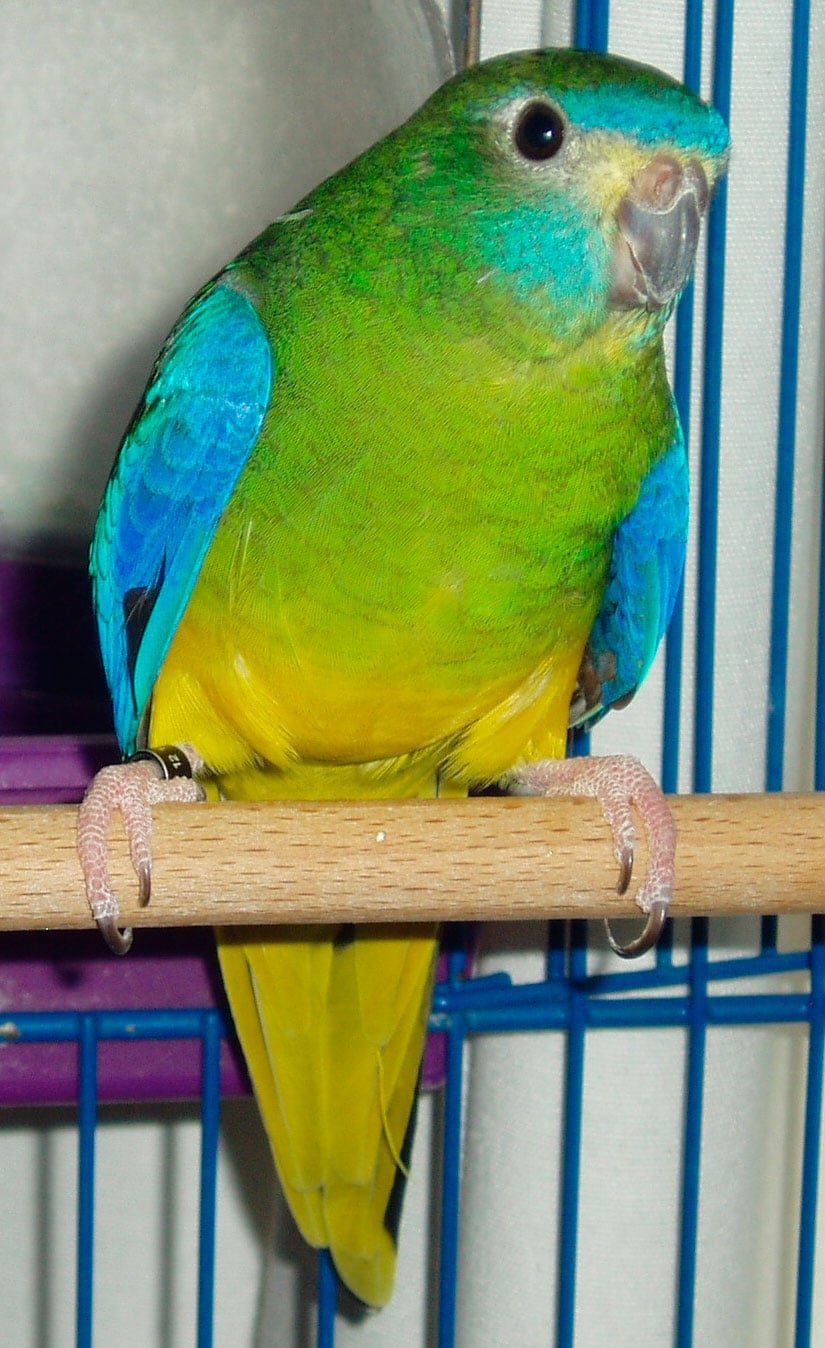
Pale-headed Rosella
Platycercus adscitus

Perico pale

Content


Anatomy-parrots

Description

30 cm.. length and a weight between 100 and 175 g..

The adult male of the Pale-headed Rosella (Platycercus adscitus), It has a pale yellow "head". The part superior of the cheeks is whitish in contrast with the part below that is of color blue light. Upper chest is yellow, the lower part of the chest and the abdomen are blue. The coverts They show a beautiful red hue. The the mantle, the back and scapulars are black with broad yellow edges, these areas giving a scaly appearance.

The tail is of color yellow uniform. The external coverts are dark blue. The central feathers of the tail are dark blue, but the outer feathers are more pale with thin white edges. The bottom has no stripe.

The bill is white. The irises They are brown, legs grey.

The female is different from the male, its color is more off and has a strip at the bottom of the wings.

The immature they have grayish feathers ending in yellow or orange-red at the top of the crown and the neck. The red feathers lose them about three months. The bottom of the wings is scratched. They acquire adult plumage in about 16 months.

Description 2 subspecies:

  • Platycercus adscitus adscitus

    (Latham 1790) – The nominal


  • Platycercus adscitus palliceps

    (Lear 1832) – 32 cm.. length. It is something most large that the nominal species. The white color of the face is more extensive, coming up to the neck. Crown, nape and ear-coverts are pale yellow. The blue of the chest presents tonalities yellowishwhite and the feathers of the chest they have a thin lined black. The shoulders with wide verdosa-amarilla blue staining. bottom of the flight feather white.

Habitat:

Pale-headed Rosella

The Pale-headed Rosella they are common in all types of habitats of open forests, either scrub, scattered forests with logging, the rows of trees along rivers or swamps. They are also found in the wooded heaths which surround the coast and which are dominated by trees of the genus Banksia.

Avoid plunging into the thick forests, giving preference to the clear, meadows at the edges or directly border the plots. They also penetrate the surrounding farmland to feed.

They are birds of the lower regions, rarely rising above 700 meters and voluntarily leaving altitudes to the Crimson Rosella in dense forests and semi-montanosas areas.

Reproduction:

In the North, the Pale-headed Rosella They nest in the months of February to June, with some variations depending on the frequency of rains.

In the South, the breeding season are produced starting from September until the month of December.

These birds build their nests in deep a sick or healthy tree cavity, preferably a eucalyptus located near a river.
Other places that tend to choose are: a hole in a stump or a hole in a fence post.

The spawning generally includes between 3 and 5 eggs. The female incubates alone during 19 days, but as soon as the eggs are incubated, It receives assistance from the male that helps feed the young.

The chicks leave the nest after 5 weeks.

Food:

The Pale-headed Rosella they are mostly vegetarian. They consume a lot of plants, We have identified about 50 plant species. Similar to the Eastern Rosella, the Pale-headed Rosella It feeds mainly in the trees. The seeds of eucalyptus, acacias, Melaleuca, Black Cypress of Australia, acanthus and spiny Thistles, they are your favorite foods. The flowers and fruits some species also form part of their diet.

The Pale-headed Rosella they are often real pests for gardens and cornfields.

Distribution:

Size of the area of distribution (reproduction / resident): 1.470.000 km2

Confined to the East of Australia, where is dispersed through of the Cape York Peninsula, coming to the South up to the Gilbert River in the West, and extending to the South along the coast East of Queensland to the North of New South Wales.

In Queensland its inner boundary runs approximately through Croydon, Richmond, Lomgreach, Charleville and Bingara.

Are also distributed by the Fraser Island and around Brisbane, as well as in other coastal districts.

In New South Wales, the population is limited to the Northeast, extending toward the interior of Bourke and to the South up to around Coffs Harbour, on the coast.

Escapes have been recorded in Sydney and Melbourne, and there was an introduction without success in Hawaii at the beginning of this century.

The species coexists in the same altitude with the Eastern Rosella in the southeast of Queensland.

Common in suitable habitat within its range.

The world's population is above the 100.000 specimens.

Moderate numbers in captivity.

Fully protected.

Distribution 2 subspecies:

Conservation:


minor concern


โ€ข Current category of the Red List of the UICN: Least concern

โ€ข Population Trend: Growing

The size of the world population It has not been quantified, It is estimated at around 100,000 specimens.

The species according to reports, It is abundant in much of their range (pit et to the. 1997).

They have benefited from the clearing of the forests and the development of fruit tree crops and agricultural fields.. But, an important limitation is that of its acquisition as a popular pet bird, marketed as Blue cheek parakeet. Each year, hundreds of birds are illegally captured in the wild.

"Pale-headed Rosella" in captivity:

common in Europe, not so much in the United States.

Active and moderately loud. Aggressive with other birds. A little susceptible to stress and disease.

Alternative names:

Pale-headed Rosella, Blue Rosella, Blue-cheeked Parakeet, Blue-cheeked Rosella, Mealy Parakeet, Mealy Rosella, Moreton Bay Parakeet, Moreton Bay Rosella, Pale headed Rosella, White-cheeked Rosella, White-headed Rosella (ingles).
Perruche ร  tรชte pรขle, Perruche palliceps (French).
Blasskopfrosella (German).
Rosela-pรกlida (Portuguese).
Perico Pรกlido, Rosela de Cabeza Pรกlida (espaรฑol).

scientific classification:

Order: Psittaciformes
Family: Psittaculidae
Genus: Platycercus
Scientific name: Platycercus adscitus
Citation: (Latham, 1790)
Protonimo: Trained parrot

ยซPale Parakeetยป Images:

Videos "Pale-headed Rosella"

————————————————————————————————

ยซPale Parakeetยป (Platycercus adscitus)


Sources:

Avibase
– Parrots of the World โ€“ Forshaw Joseph M
– Parrots A Guide to the Parrots of the World – Tony Juniper & Mike Parr
– Loromania
– Birdlife

Photos:

(1) – A Pale-headed Rosella in Brisbane, Queensland, Australia By Paul Gear (Picasa Web Albums) [CC BY-SA 3.0], via Wikimedia Commons
(2) – Pale-headed Rosella (Platycercus adscitus) Kobble Creek, SE Queensland, Australia By Pale-headed_Rosella_kob02. JPG: Avicedaderivative work: Snowmanradio [CC BY-SA 3.0], via Wikimedia Commons
(3) – A Pale-headed Rosella in Herberton, Far North Queensland, Australia By Peter Shanks (originally posted to Flickr as pale headed rosella) [CC BY 2.0], via Wikimedia Commons
(4) – A Pale-headed Rosella in Brisbane, Queensland, Australia By Paul Gear (Picasa Web Albums) [CC BY-SA 3.0], via Wikimedia Commons
(5) – Pale-headed Rosella, Platycercus adscitus By Glen Fergus (Own work, Brisbane, Australia) [CC BY-SA 2.5], via Wikimedia Commons
(6) – A painting of a Pale-headed Rosella(originally captioned ยซPlatycercus palliceps. Paleheaded Parakeet. In the pofsefsion of Mr. Leadbeater.ยป) by Edward Lear 1812-1888 Edward Lear [Public domain], via Wikimedia Commons

Sounds: Judith Lattaway (Xeno-canto)

โ–ท The world of Pets: Dogs, cats, birds, reptiles, amphibians

Night Parrot
Pezoporus occidentalis

Night Parrot

Content


Anatomy-parrots

Description

22 to 25 cm.. length

The Night Parrot (Pezoporus occidentalis) It is one of the most elusive and mysterious world of birds.

They have a bill plane, similar to the of the Kakapo (Strigops habroptila), without the apparent hook of the upper jaw. They have feathers around the cere. The tail is short. The legs are relatively elongated, indicating its good predispositions to walk.

The male and female they are similar.

In adults, the upperparts they are generally yellowish-green with dark brown cryptic spots, black and yellow. The front of the neck is greenish yellow. The chest and flanks they have discreet black and yellow stripes. Belly and coats are bright yellow. The flight feather are pale yellow, forming a thin stripe on the lower part of the wing. The central tail feathers are green with a strong yellowish brown shade. The bill is grey-brown, black eyes. Legs long claws dark grey.

In the wild, the Night Parrot It can be confused with the kakapo Parrot, If not we are looking too details which differentiates them.

Habitat:

The Night Parrot It attends a wide variety of habitats in arid or semi-arid land. They are mainly in places where the herbs grow in clumps on rocky peaks, also in the steppes composed of thickets of quenopodios. They also feel a great attraction for the Rock Samphire (A maritime rhythm), plants that are highly resistant to drought and salt.

They are known to flee to the interior areas of Muehlenbeckia, which have a dense foliage. The most recent reports do not come from the areas of Spinifex. It seems that new techniques of fire used to create firewall, They allow you to create favourable conditions for this parakeet.

The night Parrot almost never fly, except when looking for sources of water. To observe them, What has become extremely rare, We must look to the ground, in areas which consists almost exclusively of grasses of the genus Spinifex.

after dark, They fly a short distance until they find a fresh water pond. Once he has satisfied his thirst, they return to the infeed zone.

There is no certainty about the movements of this parakeet. It can be nomadic, Perhaps sedentary. No doubt depend on the climate and territory who attends them. Formerly, when the number of Night Parrot were still substantial, stocks were fluctuating seasonally.

At the end of the 19th century, in Southern Australia, groups of fifteen individuals were local irruptions, a signal that were sensitive to the favorable climatic conditions or were found in the alternative storage sites whose resources were relatively abundant.

All these considerations must be taken with great moderation for the following reason: the well-established notion that birds move through the Plains Spinifex in the direction of places full of thickets of quenopodios according to seasons and seed resources, not always been confirmed in recent reports.

Reproduction:

We know very little about the reproductive habits of this bird. The season of nesting is in July or August. The nest It is a kind of platform built with pieces of wood, on the ground or at low altitude. It is placed in a cavity that has been enlarged and which is accessed by a tunnel whose entrance is in a tuft of grass.. Its diameter is of some 8 centimeters. According to the previous data, the spawning usually contains 4 or 5 eggs. The time of incubation It is unknown.

Food:

The Night Parrot mainly consumed seeds of Spinifex (Triodia). Recent and circumstantial reports, indicate also the absorption of deciduous plants family leaves Poaceae as Enneapogon purpurascens.

Distribution:

Size of the area of distribution (reproduction / resident): 26.300 km2

The Night Parrot (Pezoporus occidentalis) are confined in the arid interior of Australia. Samples or reports come from all Australian States, especially in the Center and North of Western Australia (Mount Farmer, Nichol Spring, to the North of Glenayle, South of Kimberleys and to the West of the cue district), Southern Australia (Lake Eyre, to the South of Oodnadatta, Gawler Ranges, the Eyre Peninsula and Coopers Creek), Northern Territory South-Central and North-Western (Mac Donnell Ranges, Tanami desert), and to the southwest of Queensland (Lake Muncoonie and the surrounding areas of Boulia).

There is a report of 1913 that places them around Murrayville and Cowangie, Victoria, and another around of Ross Springs between 1954 and 1959. There is also a register of 1.897 that placed them in District of Oxleand, New South Wales.

The species has never been common, but it was more frequently toward the end of the last century (for example, 16 sightings in the region of the Lake Eyre, Southern Australia, in the decade of 1870). Due to marauding habits, many sightings remain unconfirmed, and this makes it difficult to assess its true condition. Even so, It seems certain that the population is declining. The cause of this is unknown, but it may be related to the introduction of predators such as cats, Rats, dogs or foxes. Changes in fire regimes, as well as the introduction of camels, they have also influenced its decline.

Night Parrot
The Night Parrot seen only as museum specimens for 25 are not extinct. To cat-killed Night Parrot was recovered recently in western Queensland, Australia. (South Australian Museum)

There have been reports in every decade since its discovery, and all states in recent years, except Victoria (the last record was in 1950). The most notable recent sighting was of four birds in the eastern side of the cooper river, to 8 km to the East of the Lake Perigundi, Northeast of Southern Australia, in June of 1979. The birds were arrebolados in tangled shrubs, Sclerolaena intricata and flew away before perederse in the dense forests of Muehlenbeckia florulenta. In 1990 a long dead individual, It was the first specimen in a Museum from the Decade of 1880, was collected in the southwest of Queensland,to 36 km to the North of Boulia. A more recent record of these birds (between March of 1992 and June of 1993) He was picked up in the South of Cloncurry, about 150 km to the North of the area where the dead bird was found, which confirms the local persistence of this species.

The global population is unknown, but it can be very small and is likely to be declining. There are none in captivity.

The Night Parrot has been the subject of a legal protection in Australia since 1937.

Conservation:


Endangered


โ€ข Current category of the Red List of the UICN: Danger

โ€ข Population trend: Decreasing

After no record is confirmed from 1990, despite several exhaustive searches and publicity campaigns, This species was rediscovered in 2005 in the region of Pilbara in Western Australia, and a dead juvenile was found in the Diamantina National Park, Queensland in 2006.

It is likely that they have decreased as a result of a series of threats, and the remaining population can be very small and possibly subject to extreme fluctuations.

Based on the records of 2005 and 2006, and because of the shortage of sightings, a Committee of experts concluded that the species was in danger of extinction.

The population of the Night Parrot is supposed to be very small, and is estimated at less of 50 mature individuals based on the scarcity of records. In 2010 a Committee of experts re-evaluรณ given records of Western Australia in 2005 and Queensland in 2006, and estimated that there could be 50 to 250 birds in total (Garnett et to the. 2011). Therefore, the number of mature individuals is placed in the band of 50-249, but it can become something bigger.

The population It is suspected that it may be in decline due to a combination of threats, including predation by invasive exotic predators.

If a population can be located, the following measures could be introduced:

    โ€ข a research and monitoring program
    โ€ข control of wild animals in and around the place where the population of the Night Parrot
    โ€ข patch burning to limit the possibility, or to prevent the occurrence of fire in the place of the population until better understanding of the situation and the ecological needs of the population
    โ€ข minimize disturbance to the population site, which could include leaking information to the public, and the establishment of agreements with landowners and land managers.
    โ€ข establish a captive breeding program (Blyth 1996; Garnett and Crowley 2000).

"Night Parrot" in captivity:

There are no records of this bird in captivity.

Alternative names:

Night Parrot (ingles).
Perruche nocturne (French).
Hรถhlensittich (German).
Periquito-de-barriga-laranja (Portuguese).
Perico Nocturno (espaรฑol).

scientific classification:

John Gould
John Gould

Order: Psittaciformes
Family: Psittaculidae
Genus: Pezoporus
Scientific name: Pezoporus occidentalis
Citation: (Gould, 1861)
Protonimo: Geopsittacus occidentalis

Images "Night Parrot"

"Night parakeet" (Pezoporus occidentalis)

Sources:

  • Avibase
  • Parrots of the World โ€“ Forshaw Joseph M
  • Parrots A Guide to the Parrots of the World – Tony Juniper & Mike Parr
  • Birdlife

  • Night parakeet photos:

(1) – 1971 painting of a night parrot by William Cooper – Enlace
(2) – The Night Parrot seen only as museum specimens for 25 are not extinct. To cat-killed Night Parrot was recovered recently in western Queensland, Australia. (South Australian Museum) – Top Birding Tours

โ–ท The world of Pets: Dogs, cats, birds, reptiles, amphibians

Red-fronted Parrot
Poicephalus gulielmi


Lorito Frentirrojo

Content

Description:

28 cm. length and an average weight of 220 g..

The Red-fronted Parrot (Poicephalus gulielmi)has the forecrown and crown bright red; the lores and chin blackish; cheeks, back of the crown and nape dark green with scattered feathers showing blackish centers.

The mantle feathers and scapulars Black with large green edges that give scalloped appearance; rump and uppertail-coverts bright yellowish green .

Wing coverts black with a dark green margin; leading edge of the wings from joints carpal to the base of the primaries bright red. The primaries and secondaries black. Under, the wing feathers dark green and black.

Underparts dark green with scattered feathers showing a black central band; the thighs bright red. The tail black.

Top of the mandible grey, Blackish towards the tip with pale base stains, lower jawBlackish r; Orange the irises; legs dark grey to black.

Both sexes similar.

The youth lack of red color in the forecrown, the edge of the wings and the thighs; Green in a little paler than the adults plumage. Young birds sometimes show red color in the feathers of the wings. The irises is dark brown.

Description 3 subspecies:

  • Poicephalus gulielmi fantiensis

    (Neumann, 1908) – Smaller that the species nominal. Forehead, leading edge of the wings and the thighs Orange or orange-red (but not red) and more extensive, in some birds. Underparts paler green with fewer black markings.


  • Poicephalus gulielmi gulielmi

    (Jardine, 1849) – Nominal species


  • Poicephalus gulielmi massaicus

    (Fischer & Reichenow, 1884) – Restricted red in the forecrown. Paler than the species nominal, with few or no black marks on the underparts.

Habitat:

The Red-fronted Parrot They inhabit montane forests of Juniperus and Podocarpus in Kenya and Tanzania, between 1,800 and 3,250 meters above sea level, where may depend on the primary vegetation.

Confined in the lowlands the rest of the population rainforest (below 700 metres in West Africa), but are not limited to the primary formations, There are records of the Red-fronted Parrot perched on tall trees of shade coffee plantations in Angola and in secondary forests of Ghana.

Usually stays in the tree tops, While they feed or rest.

In general, seen in groups of up to 10 birds, forming large flocks where abundant food. Large congregations, sometimes, in places.

In Kenya, the Red-fronted Parrot they make long daytime journeys of foraging (60km) along gallery forests, or crossing the savanna forest dominated by Acacia.

Reproduction:

The Red-fronted Parrot they breed solitary.

During the mating, males sway rhythmically, without moving the wings, while standing behind the female's back.

The nest is located in a cavity between 3 and 12 meters above the ground.

In the Mount Meru (Tanzania), nests have been recorded in living trees of the genus Hagenia, Podocarpus and Juniperus.

The egg laying It has been recorded in November to January in Tanzania, September in Zaire and March, June and from September to November in Kenya. The implementation is of between 2 and 4 eggs bright white.

Food:

Its diet It is believed that it is composed of a variety of seeds, fruits, flowers and insects. The seeds of Spathodea, oil palm nuts (Elaeis guineensis), fruits of the Podocarpus flowers and seeds of Grevillea robusta. Probably some insects are also part of their diet.

Sometimes associated with the African Olive-Pigeon (Columba arquatrix) and Sharpe's Starling (Pholia sharpii) when feeding in the Olea capensis.

Distribution:

Size of the area of distribution (reproduction / resident): 5.380.000 km2

Several apparently separated distributions.

In West Africa are distributed to the East of Liberia until Ivory Coast and South of Ghana.
In the Center-West of Africa, South of Cameroon to the Northwest of Angola. A seemingly separate population extends to the North of Zaire and South of the Central African Republic to the southwest of Uganda and Rwanda. Also found in the Highlands of Kenya and North of Tanzania.

Sedentary with local movements. Locally common to abundant in many localities in part of its eastern range, apparently, the decrease in other areas is possibly due to deforestation.

Distribution 3 subspecies:

Conservation:


minor concern


โ€ข Current Red List of UICN: Least concern

โ€ข Population trend: Decreasing

Keep a Red-fronted Parrot as a pet it has steadily increased in popularity in recent years, and as a result, the species has been the subject of intense trade on the market of wild birds. His capture may represent a significant threat to the species, in particular for the population around the Mount Kilimanjaro in Tanzania, fact that could lead to the local extinction of the species in that area.

The Red-fronted Parrot is also at risk from the deforestation in parts of its area of distribution. But, the species is still distributed over a wide area and is not currently considered globally threatened, even though global population trends have yet to be quantified.

The Red-fronted Parrot is located in several protected areas, including the Lope-Okanda National Park in Gabon, World Heritage site, the Korup National Park in Cameroon and the Bia National Park in Ghana.

The species is included in the Appendix II the Convention on international trade in endangered species (CITES), that means that the international trade of the Red-fronted Parrot It must be carefully checked. But, a key problem in many areas is the lack of adequate legislation, and the lack of compliance with the legislation in which it does exist.

The wild trade in this bird and the destruction of their forest habitat may have a better follow-up to ensure that populations of the Red-fronted Parrot not to suffer future decreases.

"Red-fronted Parrot" in captivity:

Probably the first hatchlings of Red-fronted Parrot born in in captivity were achieved in 1978, in Switzerland and England Although already in advance, in the middle of the 90, specimens had arrived at zoos in London and Hamburg.

The Red-fronted Parrot is little known in Spain, but in other countries it is very common as a pet thanks to its size, its great intelligence, its capacity for imitation and its character quiet and loving, but at the same time playful and naughty.

It is soft and musical, and their cry is quite bearable. In general, is a bird bit noisy, which can be an asset to a future owner who lives in an apartment.

They are very destructive, or both must provide them with abundant branches and non-toxic toys for chopping and shredding.

In terms of their longevity, according to sources, one specimen was still alive after 21 years in captivity.

Alternative names:

Red-fronted Parrot, Jardine’s Parrot, Red fronted Parrot, Red-crowned Parrot, Red-headed Parrot, William’s Fig Parrot (English).
Perroquet ร  calotte rouge, Perroquet ร  front rouge, Perroquet de Jardine, Perroquet vert ร  calotte rouge (French).
Kongopapagei, Kongo Papagei (German).
Papagaio-de-jardine (Portuguese).
Lorito de Jardine, Lorito Frentirrojo, Loro Jardinero (espaรฑol).


scientific classification:

William Jardine
William Jardine

Order: Psittaciformes
Family: Psittacidae
Genus: Poicephalus
Scientific name: Poicephalus gulielmi
Citation: (Jardine, 1849)
Protonimo: Parrot gulielmi


Images "Lorito Frentirrojo":

————————————————————————————————

"Lorito Red Front" (Poicephalus gulielmi)


Sources:

Avibase
– Parrots of the World โ€“ Forshaw Joseph M
– Parrots A Guide to the Parrots of the World – Tony Juniper & Mike Parr
– Birdlife
– Arkive

Photos:

(1) – A Red-fronted Parrot at Birds of Eden, South Africa By Dick Daniels (http://carolinabirds.org /) (Own work) [CC BY-SA 3.0 or GFDL], via Wikimedia Commons
(2) – Photograph of a couple of Poicephalus gulielmi By derivative work: Snowmanradio (talk)Poicephalus_gulielmi_pareja_reproductora. JPG: Juan Caparrรณs (Poicephalus_gulielmi_pareja_reproductora. JPG) [CC BY-SA 3.0 or GFDL], via Wikimedia Commons
(3) – P. g. fantiensis at Birds of Eden, South Africa By Poicephalus_gulielmi_-Birds_of_Eden_-South_Africa-8a.jpg: Grahamderivative work: Snowmanradio [CC BY-SA 2.0], via Wikimedia Commons
(4) – A juvenile pet Red-fronted Parrot (also known as Jardineโ€™s Parrot) By Bram Cymet (originally posted to Flickr as Amazon) [CC BY 2.0], via Wikimedia Commons
(5) – Fledgeling Lesser Jardines Parrot eating vegetables By Kofiwannacracker (Own work) [Public domain], via Wikimedia Commons