โ–ท The world of Pets: Dogs, cats, birds, reptiles, amphibians

Chattering Lory
Lorius garrulus


Chattering Lory

Content

Description

30 cm.. length and a weight between 180 and 250 g..

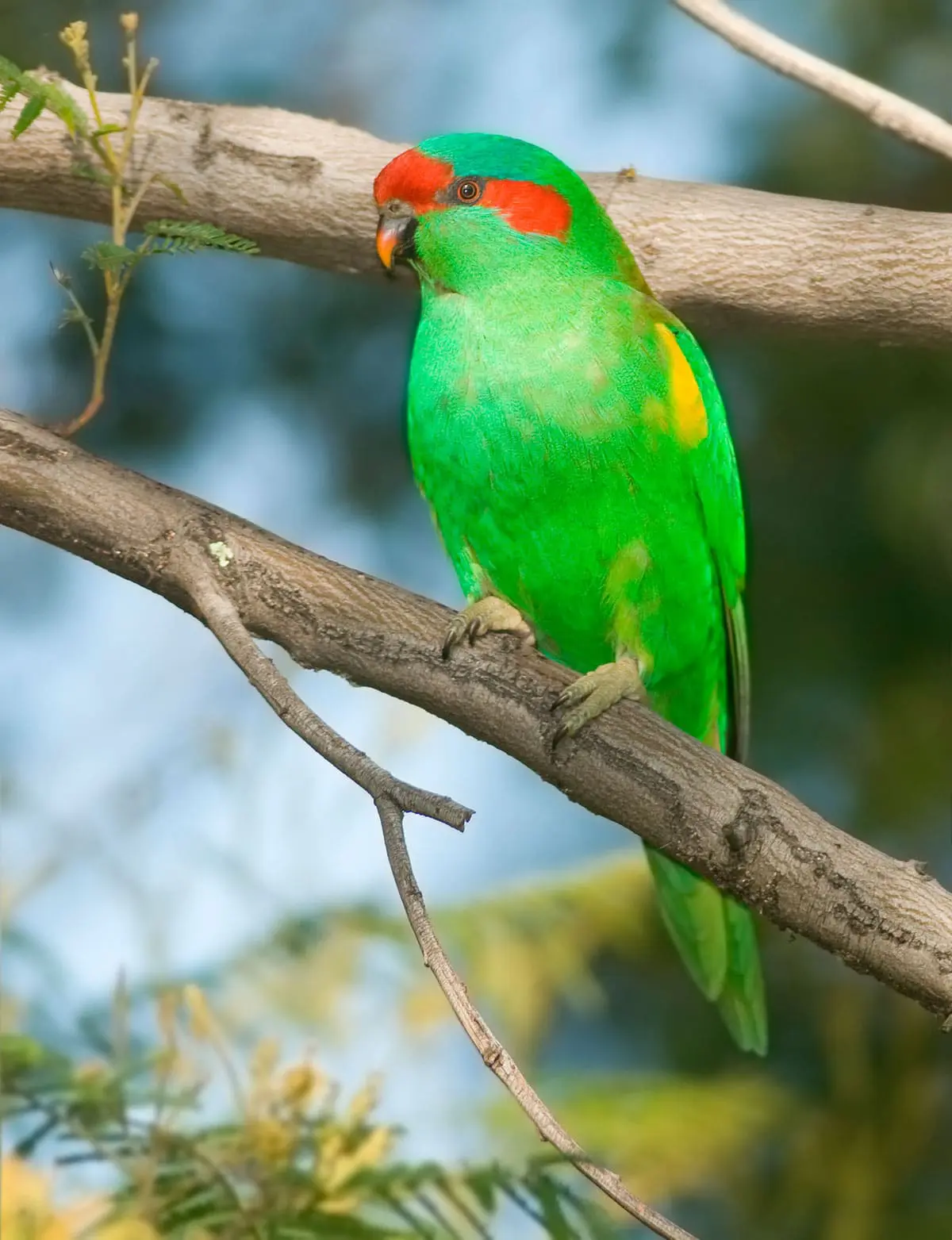
The Chattering Lory (Lorius garrulus) has the head, the nape and the the mantle top of color Scarlet bright. Great stain yellow in the center of the the mantle surrounded above and below a light spread of green opaque; scapulars Scarlet, a little darker than the the mantle; rump and top of the tail, bright Scarlet.

the flight feathers green up; coverts a little more pale and with a vague diffusion in bronze. The great coverts a dark gray at their ends; the alula Blackish green with yellow spot in the bend of wing and along the edge of the carpus.

Lori White ilustracion

The bottom of the flight feather of color black with band broadband of color tints in the Center, the coverts yellowish green. Underparts bright Scarlet; green thighs. The feathers of the tail red, with the black end fade Green. The bill orange; irises Orange to yellowish brown; legs grisaceo-negro color.

Both sexes are equal.

Immature with the bill brown, and the irises dark brown.

Description and distribution of subspecies

  • Lorius garrulus garrulus

    (Linnaeus, 1758) – (Halmahera, the Widi Islands and Ternate) The nominal


  • Lorius garrulus flavopalliatus

    (Salvadori, 1877) – (Bacan and OBI) Large yellow patch in the the mantle with much less greenish broadcasting.


  • Lorius garrulus morotaianus

    (Bemmel, 1940) – (Morotai and Riau) Small yellow patch in the mantle of green-dyed.

  • Sound of the Chattering Lory
[audio:HTTPS://www.mascotarios.org/wp-content/themes/generatepress_child/sonidos/Lori Garrulo.mp3]

Habitat:

Though White and Bruce they say the species is common in coastal lowlands with coconut palms, recent observations seem to point to forested areas of high land as their main habitat. It is unclear if the capture is responsible for the apparent absence of their previously preferred habitat. Seasonal movements or nomadic behavior could also be factors for this absence from the coastal lowlands.. The Chattering Lory they occur more often in mature primary and secondary forests, far from human settlements from the lowlands up to 1.300 m.

They are usually in pairs, and are noisy and visible in flight but, like many other parrots, can become difficult to spot when feeding quietly in the forest canopy.

Reproduction:

Little is known about the reproduction of the species in the wild. A couple was seen building a nest in June, other records include the observation of a calf feeding during October and November, and a couple occupying a nest high in a dead tree, also during October.

In captivity, the laying is of two eggs and the abandonment of the nest of the young at 76 days.

Food:

The primary food of the Chattering Lory It is believed to be the nectar and pollen, with local reports of feeding on the flowers of coconut along the coast, although fruits and corn are also included in their diet.

Distribution:

Endemic to the North of the Moluccan Islands, Indonesian, from Morotai, Riau, Halmahera, Ternate, Bacan, OBI and, possibly, Kasiruta and Obilatau. The Chattering Lory has also been released in Sangihe, to the North of Sulawesi.

Locally common, but around human settlements have apparently been reduced by means of traps. It is very popular in the trade because of its imitative abilities.

Conservation:


Vulnerable


โ€ข Current IUCN Red List category: Vulnerable.

โ€ข Population trend: Decreasing.

The main threat comes from the capture for the cage bird trade. This is the most popular bird exported from the East of Indonesian, largely due to his large imitative abilities. Thousands of copies were legally caught each year in your environment during the Decade of 1980 and principles of 1990, but the real value is probably much higher.

The legal trade was reduced at the end of the Decade of 1990 and ceased in 2003; But, illegal trade continues: in 2007 about 2.800 birds were recorded as looted and in the 2008, 60 were recorded for trade in the markets of birds of Java.

Forests within its area of distribution are largely intact since the beginning of the Decade of 1990, but the exploitation by timber companies has become intensive. Important nesting trees are felled because of its large size, and logging roads greatly facilitating access for trappers, create the perfect combination to bring to the Chattering Lory as threatened species.

Ongoing conservation actions –> Ver and Birdlife

"Chattering Lory" in captivity:

Previously it was very common, now not so much.

Smart, playful and good imitators. The Chattering Lory, However, is very aggressive with other birds. Also messy mainly due to the liquid in his diet.

Alternative names:

Chattering Lory (ingles).
Lori noira, Lori des Moluques, Lori noir (French).
Prachtlori, Gelbmantelllori (German).
Lรณris-amor-amor (Portuguese).
Lori Gรกrrulo, Tricogloso Gรกrrulo (espaรฑol).

scientific classification:

Order: Psittaciformes
Family: Psittaculidae
Scientific name: Lorius garrulus
Genus: Lorius
Citation: (Linnaeus, 1758)
Protonimo: Psittacus garrulus

Images ยซLori Gรกrruloยป:

Videos "Chattering Lory"

————————————————————————————————

ยซOn the garrisonยป (Lorius garrulus)


Sources:

Avibase
– Parrots of the World โ€“ Forshaw Joseph M
– Parrots A Guide to the Parrots of the World – Tony Juniper & Mike Parr
– Birdlife

Photos:

1 – By Benjamint444 (Own work) [GFDL 1.2], via Wikimedia Commons
2 – Birds-pet-wallpapers – link
3 – by Alexkant in Israel. Kiryat Motzkin – zoochat
4 – Photos Zoochat – link
5 – by Josep de el Hoyo – lynx
6 – riscosapenas – link

Sounds: Marc Thibault (Xeno-canto)

โ–ท The world of Pets: Dogs, cats, birds, reptiles, amphibians

Orange-billed Lorikeet
Neopsittacus pullicauda

Orange-billed Lorikeet

Content

Description

18 cm.. length and a weight between 28 and 40 g..

The head of the Orange-billed Lorikeet (Neopsittacus pullicauda) is green, the nape lightly brown tinged with yellow stripes; ear-coverts dark green, showing some streaks of greenish-yellow; chin dark green. Upperparts green. The wings, at the top, green, with vane internal to coverts blackish. Under the wings, the coats red; flight feather Blackish with wide red central stripe. Throat green; top of the chest, Scarlet Red, extending to the belly and ending above the the thighs; flanks green; undertail-coverts brighter yellowish green. Uppertail green; retrizes penas lower color olive brown, marked in red in vane inner.

Bill orange red: irises red; legs grey.

The sexes alike.

Immature more off than adults with much less red (or orange) on the chest and a Brown peak.

Subspecies description

  • Neopsittacus pullicauda pullicauda

    The nominal.


  • Neopsittacus pullicauda alpinus

    It differs from the nominal by the chest Orange which contrasts with the Red of the belly and upperparts darker.


  • Neopsittacus pullicauda socialis

    Similar to the nominal, but darker and showing less Brown at the nape.

Habitat:

Lives in the forests of MOSS and areas surrounding partially cleared, mainly between 2.100 and 3.800 m, with a limit not below 1,600 meters except for some occasionalLori found to 800 m. Normally found at higher altitudes than the Yellow-billed Lorikeet, but there is considerable overlap in lower altitudes to 2.500 m. where the two meet, often feeding in friendly company.

Pretty common and often found in pairs, small groups or groups of up to 30 birds in the trees in flower.

Travel in noisy groups, and it can fly very high above the canopy to and from the feeding areas. Not only feeds in the canopy, but also at low altitude of plants and even at the lowest levels near the ground. Assets and meek.

Reproduction:

Habits of nesting not described, Although it is said that they nest in holes of tall trees and lay two eggs. A male in breeding conditions was observed in October.

Food:

It feeds on pollen, nectar, flowers, fruits and seeds, Although he believes that they are less dependent on seeds as part regular your diet than the Yellow-billed Lorikeet.

Distribution:

Size of the area of distribution (reproduction / resident): 113.000 km2

New Guinea in Irian Jaya (Indonesian) and Papua New Guineto. The range runs from the East of Snow Mountains far reaches the Huon Peninsula e intervals to the Southeast. A small number of captivity.

Subspecies distribution:

  • Neopsittacus pullicauda pullicauda

    The nominal.


  • Neopsittacus pullicauda alpinus

    Snow Mountains, Irian Jaya, to the East with the upper region of the fly river, West of Papua New Guinea


  • >Neopsittacus pullicauda socialis

    Herzog mountains and mountains of the Huon Peninsula, North of Papua New Guinea.

Conservation:


minor concern


โ€ข Current IUCN Red List category: Least concern.

โ€ข Population trend: Stable.


The world population It has not been quantified, Although it is thought that it may be superior to the 30.000 birds. The species according to sources is common (pit et to the. 1997).

The population suspected to be stable in the absence of evidence of any reduction or substantial threats.


"Orange-billed Lorikeet" in captivity:

Uncommon in captivity.

Shy until getting used to the owner, It is best in coexistence with other loris, playful, they need stimulation to avoid boredom. You can learn to imitate. They are messy due to liquid diet.

Alternative names:

Orange-billed Lorikeet, Emerald Lorikeet, Orange billed Lorikeet, Orange-billed Mountain Lory (ingles).
Lori รฉmeraude, Lori รฉmรฉraude (French).
Orangeschnabel-Berglori, Orangeschnabelberglori (German).
Lori Montano Chico, Lori Moteado Chico (espaรฑol).

scientific classification:

Order: Psittaciformes
Family: Psittaculidae
Genus: Neopsittacus
Scientific name: Neopsittacus pullicauda
Citation: Hartert, 1896
Protonimo: Neopsittacus pullicauda

ยซLori Montano Chicoยป images:

Videos "Orange-billed Lorikeet"

————————————————————————————————

ยซLori Montano Chicoยป (Neopsittacus pullicauda)


Sources:

Avibase
– Parrots of the World โ€“ Forshaw Joseph M
– Parrots A Guide to the Parrots of the World – Tony Juniper & Mike Parr
– Birdlife

Photos:

(1) – Birds-pet-wallpapers – link
(2) – Birds-pet-wallpapers – link
(3) – Author iggino – lynx
(4) – Animal Photos – link
(5) – Animal Photos – link

Sounds: Hans Matheve (Xeno-canto)
โ–ท The world of Pets: Dogs, cats, birds, reptiles, amphibians

Yellow-capped Pygmy-Parrot
Micropsitta keiensis

Yellow-capped Pygmy-Parrot

Content


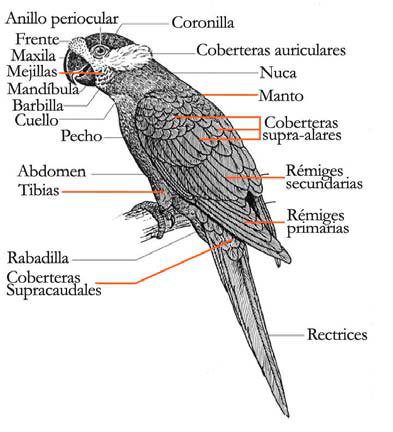
Anatomy-parrots

Description

9,5 cm. length between 11 and 14 g. of weight.

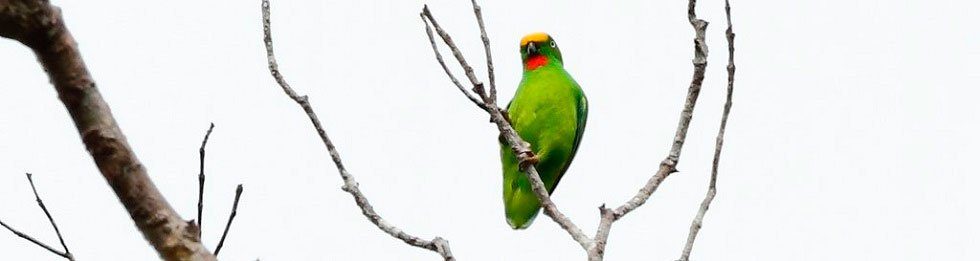
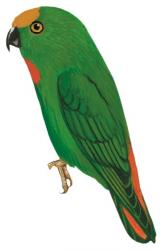
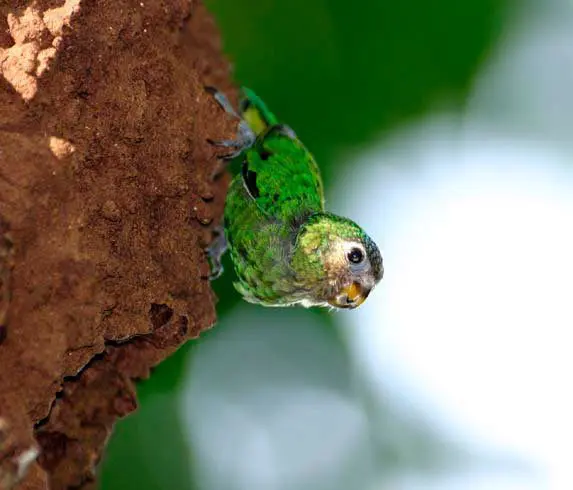
The crown of the Yellow-capped Pygmy-Parrot (Micropsitta keiensis) is yellow ocher, with a warm brown in forecrown; lores, chin and area under the eyes, brown; coverts outpus, dark green, tending to lighter green on cheeks and throat.

Upperparts, dark green with center at wing-coverts and feathers of black color with a black colored margin extrecho; flight feather black with vane Green external; feathers wings green. The underparts are yellowish-green, with fine dark stripes; undertail-coverts yellow and green. Upper, the tail It is iridescent, slightly greenish blue in the Center, Foreign feathers blackish with yellow spot on the ends. Under, the tail dark blue and yellow.

Bill dark grey; irises brown; legs dark gray.

Both sexes similar.
Immature like females but with bill pale yellow.

Description 3 subspecies

  • Micropsitta keiensis keiensis

    (Salvadori, 1876) – the subspecies nominal.


  • Micropsitta keiensis viridipectus

    (Rothschild, 1911) – Similar a nominal, but darker.


  • Micropsitta keiensis chloroxantha

    (Oberholser, 1917) – The mature more muted. The underparts with red markings male, dyed yellowish in female.

Habitat:

Yellow-capped Pygmy-Parrot

It inhabits in the forests of lowlands, in secondary growth and, sometimes around inhabited areas and coconut trees. The ecology species is similar to that of the Buff-faced Pygmy-Parrot. The birds are alone, in pairs or in small groups, and they can be distributed by undergrowth to some 20 meters above the ground. They climb on trunks and branches, and they can go down head, in inverted position, sometimes.

Reproduction:

Nest and roost Termites in tree cavities, they excavate the cavity by themselves; tunnel passageways go up and may bend before reaching nest-chamber. up the laying two white eggs deposited in a cavity unlined (dimensions around 20 cm x 15 cm.), and they can be occupied by other adults roost (up to four) during the breeding season. The exact role of these visiting birds is unknown, It is thought that they can help with the tasks of nest. nesting It has been recorded from October to March

Food:

With feed lichen, fungi, seeds, fruits and insects. Most of the lichen is collected directly from the surface of the bark of trees..

Distribution:

Size of its range (breeding/resident): 763.000 km2

The Yellow-capped Pygmy-Parrot is distributed among the papuan islands, in the West area, including Waigeo, give, Kofiau, Salawati and Misool; through Vogelkop and Onin Peninsula (Province of West Papua); in the Kai and islas Aru, and in the South of New Guinea between Mimika and the fly river. The species is common to local scale.

Distribution 3 subspecies:

Conservation:


minor concern


โ€ข Current IUCN Red List category: Least concern

โ€ข Population trend: Stable

The size of the world population It has not been quantified, It is estimated over the 100,000 specimens.

The species, according to sources, It is considered very common within its range (pit et to the. 1997).

The population suspected to be stable in the absence of evidence of any reduction or substantial threats.

"Yellow-capped Pygmy-Parrot" in captivity:

Not usually survive in captivity.

Alternative names:

Yellow-capped Pygmy-Parrot, Yellow capped Pygmy Parrot, Yellow-capped Pygmy Parrot (ingles).
Micropsitte pygmรฉe (French).
Gelbkappen-Spechtpapagei (German).
Micropsitta keiensis (Portuguese).
Microloro de Kai, Microloro de las Kai (espaรฑol).

scientific classification:

Order: Psittaciformes
Family: Psittaculidae
Scientific name: Micropsitta keiensis
Citation: (Salvadori, 1876)
Protonimo: Nasiterna keiensis

Images "Microlyro of the Kai":

Videos "Microloro de las Kai":

————————————————————————————————

Yellow-capped Pygmy-Parrot (Micropsitta keiensis)


Sources:

Avibase
– Parrots of the World โ€“ Forshaw Joseph M
– Parrots A Guide to the Parrots of the World – Tony Juniper & Mike Parr
– Birdlife

Photos:

(1) – Parrot-birds – link
(2) – ยซโ€ฏNasiternaPygmaeaFKeulemansโ€ฏยป par John Gerrard Keulemans โ€” Ornithological Miscellany. Volume 1. Licensed public via domain Wikimedia Commons.

Sounds: Hans Matheve (Xeno-canto)
โ–ท The world of Pets: Dogs, cats, birds, reptiles, amphibians

Modest Tiger-Parrot
Psittacella modesta

Parrot-Tiger-modest

Content

Description

14 cm.. length between 42 and 43 g. of weight.

The Modest Tiger-Parrot (Psittacella modesta) has the head Brown olive, with indistinct centers yellow to the feathers of the crown and nape. Mantle dark green, with slightly darker edges to feathers; rump with indistinct greenish-yellow and black mix. Uppertail green, with fringe darker. Wings of color green dark marked in blue on the curve.

Yellow wing feathers. Of flight outer feathers blackish edged green in the bases and with fine yellow margins the vane internal and external. Top of the chest Gris-Oliva below the bend of wing, belly paler, opaque green; undertail-coverts red. Upper, the tail dark green; by down blackish.

The bill grey-blue, whitish tip; irises orange; legs bluish grey.

Female alternating the Brown dark and the pink in the chest, flanks alternating the Green and yellow-green.

Subspecies

  • Psittacella modesta modesta

    (Schlegel, 1871) – Nominal.


  • Psittacella modesta subcollaris

    (Rand, 1941) – Something more dark in General, the collar yellow on the back of the neck is more brilliant and variable, head brown / dark grey.
    The females with the head darker and some with a slight yellow colouring.


  • Psittacella modesta collaris

    (Ogilvie-Grant, 1914) – The neck yellow, irregularly present. Darker hue at the sides of the head.
    The females have mild brands yellow in the part back from the head.

Habitat:

It is found in the humid mountain forests, forest Moss, edges of secondary vegetation and forests, a altitude between 1.200 and 4.000 m (mostly between 1,700-2,800 Metro).

The Modest Tiger-Parrot is a bird quiet, discreet, quite docile and difficult to observe. It tends to prefer medium or lower forest and seeks its food crawling or jumping slowly at ground level. They only fly short distances when bother them.

Birds are found alone or in pairs, and they feed on seeds and small fruits.

The young birds as females.

Reproduction:

There is no information on the breeding ecology, but a male State of reproduction was observed during the month of June.

Food:

Observed feeding is of small fruits; seeds and pieces of berries DURAS were found in their stomachs.

Distribution:

Size of the area of distribution (reproduction / resident): 65.100 km2

New Guinea in Irian Jaya, Indonesian and Papua New Guinea. Scattered through the uplands, observed in the Vogelkop mountains (isolated population), and after all latitude 136ยบE, through the central mountain belt, in the central mountain ranges, including the Tari area, the range of Victor Emanuel and the District of Mount Hagen, reaching around of 145 ยฐE. The range overlaps with the species Madarasz's Tiger-Parrot at a length of 1,200 kilometers along the Cordillera central and where the two species overlap. The Modest Tiger-Parrot is usually found in slightly higher altitudes than the Madarasz's Tiger-Parrot. The world's population is thought to be greater of 50.000 specimens. The species is locally common.

Subspecies distribution:

  • Psittacella modesta modesta

    (Schlegel, 1871) – Nominal.


  • Psittacella modesta subcollaris

    (Rand, 1941) – extends from North of the Maoke mountains to the Montes Hindenburg;


  • Psittacella modesta collaris

    (Ogilvie-Grant, 1914) – is located to the South of the Maoke mountains.

Conservation:


minor concern


โ€ข Current category of the Red List of the UICN: Least concern

โ€ข Population trend: Stable

The size of the world population It has not been quantified, Although deemed superior to the 50.000 specimens. The species is reported as locally common (pit et to the. 1997).

The population is suspected to be stable in the absence of evidence of any reduction or substantial threats.


"Modest Tiger-Parrot" in captivity:

Not found in poultry.

Alternative names:

Modest Tiger-Parrot, Barred Little Parrot, Barred Little Tiger-Parrot, Modest Parrot, Modest Tiger Parrot (ingles).
Perruche modeste, Perruche olive (French).
Olivpapagei, Oliv-Papagei (German).
Psittacella modesta (Portuguese).
Lorito Modesto, Lorito tigre Modesto, Lorito-tigre Modesto (espaรฑol).

scientific classification:

Order: Psittaciformes
Family: Psittaculidae
Genus: Psittacella
Scientific name: Psittacella modesta
Citation: Schlegel, 1871
Protonimo: Psitacella [sic] modest

Images "Modest Tiger-Parrot"

Videos "Modest Tiger-Parrot"

————————————————————————————————

"Modest tiger parrot" (Psittacella modesta)

Sources:

Avibase
– Parrots of the World โ€“ Forshaw Joseph M
– Parrots A Guide to the Parrots of the World – Tony Juniper & Mike Parr
– Birdlife
Wikipedia
– Loromania

Photos:

(1) – By ยฉ Wong Tsu Shi – Sooty-headed bulbul

Sounds: Patrik ร…berg (Xeno-canto)
โ–ท The world of Pets: Dogs, cats, birds, reptiles, amphibians

Moluccan King-Parrot
Alisterus amboinensis

Moluccan King-Parrot

Content


Anatomy-parrots

Description

35 to 40 cm.. length between 145 and 163 g. of weight.

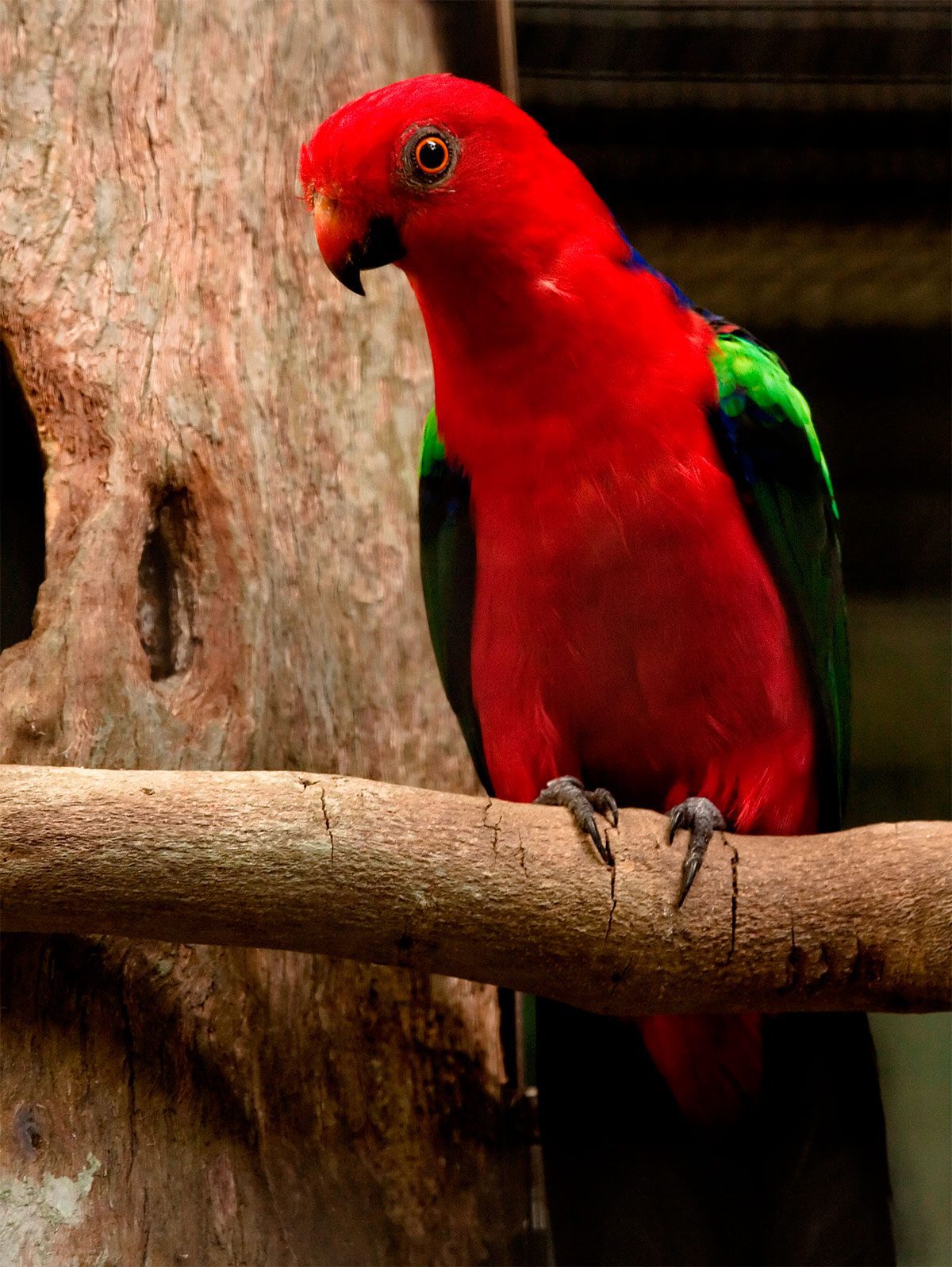
The Moluccan King-Parrot (Alisterus amboinensis) has a head, neck, the nape of the neck and the upper mantle of bright red, with strong demarcation to dark blue-violet in the lower mantle, back, buttocks and supracaudales coverts. Green wings with the exception of the blue in the small inner coverts and carpal edge. Under, black wings with blue-violet coverts. Bright red bottoms, with mauve bases to coverts infracaudales, sometimes visible; flanks with a little blue. Upper, the very dark blue colal; below black grey color wide-margin rose to the side feathers.

Bill with an orange-red base on the upper mandible, Blackish lower; Orange iris; black grey legs.

The two sexes, somatic sexual dimorphism is not presented..

Immature with more green in the back; Brown-Black beaks; pale eye-ring and darker than the adults of iris. Dotted pink on the outer tail feathers. Mature in one year.

Subspecies

Description subspecies Alisterus amboinensis
  • Alisterus amboinensis amboinensis<

    (Linnaeus, 1766) – The nominal

  • Alisterus amboinensis buruensis

    (Salvadori, 1876) – As the subspecies sulaensis but with more feathers in the tail with pink edges. Blackish grey peak in both sexes

  • Alisterus amboinensis dorsalis

    (Quoy & Gaimard, 1830) – As the nominal but the rose of the absent tail feathers; Red slightly darker on the head and underparts.

  • Alisterus amboinensis hypophonius

    (S. Muller, 1843) – As the nominal, but the wings and the deep blue wing coverts; the rose in the absent tail feathers

  • Alisterus amboinensis sulaensis

    (Reichenow, 1881) – As the nominal, but with a green stripe across the upper mantle; No rim with pink in the tail feathers.

  • Alisterus amboinensis versicolor

    (Neumann, 1939) – Unlike the subspecies sulaensis by having a uniform blue mantle; smaller in size than the nominal.

Habitat:

Moluccan King-Parrot

The Moluccan Parrot is distributed through the dense primary and secondary humid forests, and from time to time in the adjacent plantations, farmland and gardens, from the lowlands up to around the 2.100 meters above sea level.

The birds are usually found in pairs or in small groups, and they are very calm while feeding and shy at all times, hiding in the thick foliage and flying amid shrill calls at the first sign of an intruder.

Reproduction:

Just nothing is known of the cycle of reproduction in the wild, although according to sources, nesting takes place between the months of February and April.

Two young birds nests have been found on two occasions in hollow trees.

One instance of captive breeding gave data for incubation of 19 days, with the emerging young in nine weeks.
The courtship was observed during feeding, and two eggs were deposited.

Food:

The diet includes acorns Lithocarpus, as well as hard fruits, outbreaks and other forest tree berries.

Distribution:

Size of the area of distribution (reproduction / resident): 149.000 km2

Is distributed from Peleng and Sula Islands eastward through the Moluccas, including Halmahera, Buru, Ambon and Seram. Also found in the Western Islands of papua, including Waigeo, Batanta and Salawati.

In New Guinea is from Vogelkop and East of the Bomberai Peninsula some 135 ยฐ E.

Usually Rare due to habitat loss and trade in birds.

Subspecies

Distribution subspecies Alisterus amboinensis
  • Alisterus amboinensis amboinensis

    (Linnaeus, 1766) – The nominal

  • Alisterus amboinensis buruensis

    (Salvadori, 1876) – Is located in Buru in the center of the Moluccas.

  • Alisterus amboinensis dorsalis

    (Quoy & Gaimard, 1830) – Is located in West Papua.

  • Alisterus amboinensis hypophonius

    (S. Muller, 1843) – Endemic to Halmahera in the North of the Moluccas.

  • Alisterus amboinensis sulaensis

    (Reichenow, 1881) – Is located in the Sula Islands

  • Alisterus amboinensis versicolor

    (Neumann, 1939) – It is endemic in the Peleng island of the Islas Banggai

Conservation:


minor concern


โ€ข Current category of the Red List of the UICN: Least concern

โ€ข Population trend: Decreasing

The size of the world's population has not been quantified, but the species is described as generally common, Although rare in Halmahera.

The nominal subspecies population is estimated at 70.000 specimens (pit et to the. 1997).

The population is suspected to be declining due to the destruction of habitat in course.

"Moluccan King-Parrot" in captivity:

Occasionally available.

Nervous, is a bird a pet bird.

In captivity will have failed to reproduce.

In the Zoological Garden of Loro Parque, Tenerife, on Canary Islands, biologists Dr. Burkard and Dr. Gerlach they have made so large colonies, but since 1972 they have succeeded until now non.

More information on loromania

Alternative names:

Moluccan King-Parrot, Amboina King Parrot, Amboina King-Parrot, Ambon King-Parrot, Moluccan King Parrot (ingles).
Perruche tricolore, Perruche royale d’Amboine (French).
Amboinasittich (German).
Periquito-rei-amboina (Portuguese).
Papagayo Moluqueรฑo, Papagayo Real de Amboina (espaรฑol).

scientific classification:

Order: Psittaciformes
Family: Psittaculidae
Genus: Alisterus
Scientific name: Alisterus amboinensis
Citation: (Linnaeus, 1766)
Protonimo: Psittacus amboinensis

Images ยซMolucan Parrotยป:

Videos "Moluccan King-Parrot"

————————————————————————————————

ยซMolucan Parrotยป (Alisterus amboinensis)

Sources:

Avibase
– Parrots of the World โ€“ Forshaw Joseph M
– Parrots A Guide to the Parrots of the World – Tony Juniper & Mike Parr
– Birdlife
– World Parrot Trust – parrots.org

Photos:

(1) – ยซAlisterus amboinensis-Brevard Zoo-8a-ecยป by Alisterus_amboinensis_-brevard_zoo-8a.jpg: Malinderivative work: Snowmanradio (talk) – originally posted to Flickr as Puuuuuuuuuuuurdy Birdy and uploaded to commons at Alisterus_amboinensis_-brevard_zoo-8a.jpg. Licensed under CC BY-SA 2.0 via Wikimedia Commons.
(2) – By richard broderick (T0010716uploaded by Snowmanradio) [CC BY-SA 2.0], via Wikimedia Commons
(3) – Brevard Zoo – Melbourne, FL, USA ยฉ 2004 Jeff Whitlock – The Online Zoo
(4) – Brevard Zoo – Melbourne, FL, USA ยฉ 2004 Jeff Whitlock – The Online Zoo
(5) – Vogelpark, Alphen Aan Den Rijn – ZOOTOGRAFIANDO
(6) – ยซSwainson king parakeetยป by William John Swainson – Transferred from en.Wikipedia. Licensed under Public Domain via Wikimedia Commons.

Sounds: Frank Lambert (Xeno-canto)
โ–ท The world of Pets: Dogs, cats, birds, reptiles, amphibians

Northern Rosella
Platycercus venustus

Northern Rosella

Content


Anatomy-parrots

Description

28 cm.. length between 85 and 100 g. of weight.

The Northern Rosella (Platycercus venustus) they have a whitish beaks, black head, except the bottom of the cheeks and Chin that show a cream color. Their underparts feathers, lower back and rump, are pale yellow with black trim, giving these areas a look slightly flaky.

The curves of the wings are blue.

The subcaudales coverts are bright red. Nape, mantle and scapulars are black with broad yellow edges, forming an effect of shoulder straps. Blankets are black. The medium-sized coverts are bluish grey. The rest of the wing coverts are black with edges of yellow or blue grey. Deployed primaries are black. The Central tail feathers are verde-bronce while the outer feathers are dark blue with clear or white edges.

The females they are slightly smaller than the male, with the narrower peak.

The youth they are more turned off, with red markings on the head, and with more green and short tail feathers. Reaches it adult plumage in 12 months.

Subspecies description

  • Platycercus venustus hilli

    (Mathews 1910) – Adults are similar to the nominal species but with bottoms scalloped with a sweeping black and the bottom of the cheeks of violet blue colour.

  • Platycercus venustus venustus

    (Kuhl 1820) – The nominal.

Habitat:

Northern Rosella

The Northern Rosella they are unusual or are irregularly distributed in the mixed forests of eucalyptus and Melaleuca. They are generally found in open areas along rivers but are absent in floodplains along major rivers.. They are also present in the monsoon forests bordering open forests. From time to time, the Northern Rosella visit mangroves, parks and gardens in the vicinity of Darwin.

The Northern Rosella they live in pairs or in small groups ranging between 6 and 8 specimens. You rarely see them in flocks. They are usually very cautious and discreet, except in national parks where they are accustomed to human presence. They are more arboreal than other parrots of the genus habits Rosella. Funny Parrots are difficult to observe, whether on land or hidden in the foliage in the trees. They are most active in the morning and at the end of the afternoon. They show great caution when they come to drink at water points. When moving, their flight is fast, but unpredictable and less undulating than most parakeets.

Reproduction:

The nesting season extends from June to September, Sometimes a little earlier. The Northern Rosella install their nests in hole of a branch or the trunk of a tree cavity, generally in eucalyptus trees located a short distance from a stream. Implementation usually includes between 2 and 4 eggs that are incubated during 19 days. The female is solely in charge of incubation and is fed in the nest by her partner.. The chicks stay is relatively long and may last up to 7 weeks.

Food:

The Northern Rosella feed mainly on seeds of eucalyptus, acacia and Melaleuca Although they despise the of the blue cypress (Callitris intratropica). The seeds of green areas and nectar are also on their menu. The birds that live in the forests near the coast sometimes feed on the coast and along the banks of small streams.

Distribution:

Size of the area of distribution (reproduction / resident): 785.000 km2

Scattered through the coastal areas of the region of Kimberley, Western Australia, stretches of the North of the Northern Territory, and spreading over the border of Queensland at its eastern end.

The species is distributed from around Napier Ranges, in the Western region of Kimberley, to the East across the plateau of Kimberley and reaching the inside of Springvale. Next, crosses the border of the Northern Territory, extending with its southern limit along the victory river, inside, about Katherine, and along the McArthur river. It is also found throughout the nicholson river at the border of Queensland, and are distributed by a series of Islands on the coast including Koolan, Augusto, Coronation, Bathurst and Melville. Is occasionally in the suburbs of Darwin.

The species is generally rare throughout its range. The world's population is less of 50.000, and may that declining. A small number of captivity.

Fully protected by law.

Subspecies distribution

Conservation:


minor concern


โ€ข Current category of the Red List of the UICN: Least concern

โ€ข Population Trend: Stable

The Northern Rosella they have a very unequal distribution. At most, they can be considered locally common, but in any part of their range they are evaluated as abundant.

Despite the studies that have been carried out since the 19th century, it is not possible to discern if the numbers are increasing or decreasing. It is possible that its population has always been limited, given the difficulty of finding refuge during the dry season.

Its population, according to some sources, It is estimated at around 50.000 specimens.

"Northern Rosella" in captivity:

Quite calm and shy. Incompatible con otras aves.

Not common in captivity, incluso en la avicultura de Australia

In terms of their longevity, una muestra, according to sources, lived 19,1 years in captivity

Alternative names:

Northern Rosella, Brown’s Parakeet, Brown’s Rosella, Smutty Parakeet, Smutty Parrot, Smutty Rosella, White-cheeked Rosella (ingles).
Perruche gracieuse, Perruche de Brown (French).
Brownsittich, Brown Sittich, Brown-Sittich, Schwarzkopfsittich (German).
Rosela-do-norte (Portuguese).
Perico Gracioso, Rosela del Norte (espaรฑol).

scientific classification:

Order: Psittaciformes
Family: Psittaculidae
Genus: Platycercus
Scientific name: Platycercus venustus
Citation: (Kuhl, 1820)
Protonimo: parrot charming

ยซFunny Parakeetยป Images:

Videos "Northern Rosella"

————————————————————————————————

ยซFunny Parakeetยป (Platycercus venustus)


Sources:

Avibase
– Parrots of the World โ€“ Forshaw Joseph M
– Parrots A Guide to the Parrots of the World – Tony Juniper & Mike Parr
– Birdlife
– AnAge: The Animal Ageing and Longevity Database – An Age entry for Platycercus venustus

Photos:

(1) – Platycercus – loros tipo Rosella – popugaychiki
(2) – Northern rosella taken in Litchfield National Park – A BRIEF DIGRESSION ON PARROTS
(3) – Alan Marshallโ€™s Pictures of Northern Rosella (Platycercus venustus) in the NT (Northern Territory) of Australia
(4) – Alan Marshallโ€™s Pictures of Northern Rosella (Platycercus venustus) in the NT (Northern Territory) of Australia
(5) – By TJ Lin from Taiwan (DSCN8954Uploaded by Snowmanradio) [CC BY-SA 2.0], via Wikimedia Commons
(6) – Rosellas, Northern – Princenton University Press

โ–ท The world of Pets: Dogs, cats, birds, reptiles, amphibians

Red Shining-Parrot
Prosopeia tabuensis

Red Shining-Parrot

Content


Anatomy-parrots

Description

45 cm. of length and weight approximate of 280 g..

The Red Shining-Parrot (Prosopeia tabuensis) It is the most distinctive of the colorful parrots of Fiji. It is a large parrot.

Their coloration are distinguished from the other two species. Its head, neck and underparts a brilliant scarlet hues with a blue collar extending behind the neck; the back and tail are a bright green. The flight feather and tail they are green, strongly impregnated with blue.

The bill and legs are black, and irises are orange.

The males and females they are similar, However, the bill the male is larger and the head It has a more square than the females form.

Description 2 subspecies:

  • Prosopeia tabuensis tabuensis

    (Gmelin) 1788 – The species nominal


  • Prosopeia tabuensis taviunensis

    (Layard,THE) 1876 – 40 cm.. length approximately; more small that it nominal species, without the band blue on the nape, the feathers of the abdomen with a tone more blue and with the face less blackish.

Habitat:

Red Shining-Parrot

The Red Shining-Parrot are distributed in the mature forests and through a variety of associated habitats, including the of secondary growth, wooded ravines (nest), coconut plantations, Gardens of villages, agricultural fields, mangroves and scrub.

There has been starting from the 100 meters of altitude until the 1.750, but they are most common between the 400 and 1.000 m.

The Red Shining-Parrot they are suspicious, curious and You can see them individually, in pairs or in flocks of up to 40 individuals outside the breeding season. they are not shy, and loud groups tend to meet in their favotitos places to eat.

They tend to rest on the tops of the trees.

Reproduction:

The Red Shining-Parrot perch upright and turn head rhythmically back and forth, probably showing a form of courtship.

The breeding is in the months from July to October, in trees dead or broken, the female feeds the young.

Of 2-3 eggs that is hatch during 23-24 days.

The juveniles they can fly to the 8 weeks.

Food:

Feeding of the fruits and seeds a variety of trees, for example, Myristica hypargyraea, that is of particular importance in 'USA. They also feed on Mango Mangifera indica, papaya Carica papaya, guava Psidium guajava and bananas. Son agile climbers and move in search of food using their beaks to rely on small branches. Sujentan foods with their claws, since they bite with its powerful beak, and they chew the wood to remove insect larvae.

They feed mainly in the upper canopy, but sometimes also attack the cornfields.

Distribution:

Size of the area of distribution (reproduction / resident): 6.200 km2

The Red Shining-Parrot they are distributed in a natural way in the islands of the Group Fiji including Vanua Levu, KIOA, Taveuni, Qamea, Laucala, Koro and Gau (probably introduced). In Tonga, the species was introduced in Tongatapu prior to contact with the European and where it has already extinct due to habitat loss, and in 'USA where it is still quite common, especially in the forests of the East, North and South-West (with a population estimated between 700- 1.000 birds in 1988).

The species benefits, in part, Thanks to agriculture, but they depend largely on its nest in mature trees of the forest, trees that are being cleared in most of its extension. The species is also threatened by trade, and it is also hunted for its feathers and as food.

Many juveniles are caught to be raised locally as pets, Since they learn to talk easily.

Its population is believed that it may be above the 20.000 specimens, but of the subspecies prosopeia remaining, probably, less than 5.000 birds and its status is of concern.

There has been a sharp decline in the population of the Red Shining-Parrot in some areas due to habitat loss, although the species remains locally common at lower elevations on most of its islands.

Distribution 2 subspecies:

  • Prosopeia tabuensis tabuensis

    (Gmelin) 1788 – The nominal species


  • Prosopeia tabuensis taviunensis

    (Layard,THE) 1876 – Taveuni, Ngamea (Qamea) and Laucala, in the North of Fiji.

Conservation:


minor concern


โ€ข Current Red List of UICN: Least concern.

โ€ข Population trend: Decreasing.

The size of the world population It has not been quantified, but the species is described as common and visible throughout its area of distribution (Watling 2001).

The population It is suspected that it may be in decline due to ongoing habitat destruction.

"Red Shining-Parrot" in captivity:

Very rare in captivity.

According to sources, one specimen was still alive after 6,8 years in captivity. Taking into account the longevity of the similar species, the maximum longevity in these animals could be underestimated. Es un hecho que estos animales pueden vivir hasta 23.7 years in captivity, aunque en esta especie no ha sido verificado.

Alternative names:

Red Shining-Parrot, Maroon Shining Parrot, Maroon Shining-parrot, Red Shining Parrot, Red-breasted Musk Parrot, Red-breasted Musk-Parrot, Red-breasted Shining-Parrot (ingles).
Perruche pompadour, Perruche masquรฉe pompadour (French).
Pompadoursittich, Pompadour Sittich (German).
Prosopeia tabuensis (Portuguese).
Papagayo Carmรญn, Papagayo Granate (espaรฑol).

scientific classification:

Gmelin Johann Friedrich

Order: Psittaciformes
Family: Psittaculidae
Genus: Prosopeia
Scientific name: Prosopeia tabuensis
Citation: (Gmelin, JF, 1788)
Protonimo: Psittacus tabuensis

ยซMaroon Parrotยป Images:

Videos "Red Shining-Parrot"

ยซMaroon Parrotยป (Prosopeia tabuensis)

    Sources:

    Avibase
    – Parrots of the World โ€“ Forshaw Joseph M
    – Parrots A Guide to the Parrots of the World – Tony Juniper & Mike Parr
    – Birdlife

    Photos:

    (1) – Red Shining-parrot Prosopeia tabuensis in captivity, Fafa Island, Tonga By Duncan Wright (Own work) [GFDL or CC BY-SA 3.0], via Wikimedia Commons
    (2) – A painting of a Maroon Shining Parrot by Edward Lear 1812-1888 Edward Lear [Public domain], via Wikimedia Commons
    (3) – Red Shining-parrot (Prosopeia tabuensis) De Voeux Peak, Taveuni, Fiji Islands By Aviceda (Own work) [CC BY-SA 3.0], via Wikimedia Commons
    (4) – Maroon Shining Parrot Prosopeia tabuensis Kula Eco Park – Viti Levu, Fiji ยฉ 2007 Sarah P. Otto – The Online Zoo
    (5) – A bird foraging on the ground by Josep del Hoyo – Lynx
    (6) – A bird perched in a tree by Josep del Hoyo – Lynx

    Sounds: Matthias Feuersenger (Xeno-canto)

โ–ท The world of Pets: Dogs, cats, birds, reptiles, amphibians

Brown-headed Parrot
Poicephalus cryptoxanthus


Lorito Cabecipardo

Content

Description:

Of 22 cm.. length and a weight between 120 and 156 g..

The Brown-headed Parrot (Poicephalus cryptoxanthus) has the head, including the nape, the chin and throat brown; ear-coverts paler. Mantle brown, but more to the tail; scapulars dark green-edged Brown; rump and uppertail-coverts bright green. Upper, the wing-coverts green, sometimes with a small yellow spot on the curve of the wing folded; wing feathers yellow. Primaries brown with vane Blue-Green external; the secondaries brown.

The feathers in the upper area of the chest brown with a narrow green edge at the bottom; the rest of the underparts green, but darker bases of the feathers, giving a mottled look.

Tail dark brown with green washing and dark green tip.

The upper jaw and cere grey-black (darker towards tip), lower pale, almost white; irises yellow-green light; periophthalmic ring and legs dark grey to black.

Both sexes similar.

Immature generally more muted than adults and with the irises brown.

Subspecies description:

  • Poicephalus cryptoxanthus cryptoxanthus (Peters,W, 1854) – Nominal species

  • Poicephalus cryptoxanthus tanganyikae (Bowen, 1930) – As the nominal but more pale species; more green and less Brown. Green mantle and underparts brighter. Bib of brown feathers on the throat and upper of the much smaller chest than in the nominal species; the head more color olive brown.

Habitat:

Is located in almost all the forests: riparian forests, in the interior of the savannah forests and in the dry forests of southeastern Africa, but it seems to avoid the miombo woodland and prefers areas with baobabs.

Registered in coconut plantations, riparian forest, the edges of small farms and mangroves.

Confined in lowlands (below the 1.200 metres above sea level in Tanzania and 1.000 metres in Malawi).

Gregarious; usually seen them is in small flocks of about 12 birds, but can meet up to 50 in places of power. Sometimes it is associated with the Cape Parrot and also observed feeding in the company of the Madagascar Green-Pigeon.

Reproduction:

Normally nest in hollows of old trees of woodpeckers, between 4 and 10 meters above the ground. Often has to compete with the Cape Parrot, Meyer's Parrot, squirrels and Crowned Hornbill the nesting sites.

Season of laying egg is April-May in the South of its range.

The laying is of 2 to 4 eggs, which are incubated solely by the female during 26-30 days, While the male feeds her on the nest.

The chicks they remain in the nest during 50-54 days Before leaving for the "breeding area", which is usually an area of โ€‹โ€‹dense broadleaf trees with a nearby water supply. During this time the chicks are silent and largely immobile, becoming fully independent a few 28 days later.

Food:

Diet includes figs, berries cultivation of cassava Manihot esculenta, seeds of Adansonia, coconut palm flowers, new shoots of trees, fruits of Pseudocadia zambesica, pods of Acacia nigrescens and Albizia gummifera, immature seeds of Erythrina and nectar from flowers of Aloe and African Kigelia; also takes millet and corn and in some areas considered a pest.

They forage, with slow and deliberate movements, climbing and often holding the food between the claws. They drink daily, around midday.

Distribution:

The Brown-headed Parrot are distributed by the southeast of Africa. From the North-East of South Africa (Swaziland, Zululand and Transvaal) through the southeast of Zimbabwe, Mozambique and South of Malawi to the East of Tanzania (including the island of Pemba and southern end of Zanzibar) and southeastern edge of Kenya.

There are also in Wasini island.

Apparently sedentary. In some places, the Brown-headed Parrot, are a species common, especially close to the coast and in the South of its range, but in some other areas are scarce or rather local; in Zanzibar possibly extinct.

Distribution Subspecies:

  • Poicephalus cryptoxanthus cryptoxanthus (Peters,W, 1854) – Nominal species

  • Poicephalus cryptoxanthus tanganyikae (Bowen, 1930) – Mozambique, to the North of the Save River across the South of Malawi and this from Tanzania to the coastal part of Kenya.

Conservation:


minor concern


โ€ข Current Red List of UICN: Least concern

โ€ข Population trend: Stable

It is not threatened, although its distribution has contracted since 1990, to a large extent due to the capture illegal for the industry of cage birds.

More and more vulnerable due to the loss and fragmentation of their habitat.

Largely confined to protected areas in Zululand and East of Transvaal.

"Brown-headed Parrot" in captivity:

The only data we have on this bird, according to sources, is that one specimen was still alive after 32,1 years in captivity.

Alternative names:

Brown-headed Parrot, Brown headed Parrot, Brownheaded Parrot (English).
Perroquet ร  tรชte brune (French).
Braunkopfpapagei, Braunkopf-Papagei (German).
Papagaio-de-cabeรงa-castanha (Portuguese).
Lorito Cabecipardo, Lorito de Cabeza Parda (espaรฑol).


scientific classification:

Peters Wilhelm
Peters Wilhelm

Order: Psittaciformes
Family: Psittacidae
Genus: Poicephalus
Scientific name: Poicephalus cryptoxanthus
Citation: (Peters, W, 1854)
Protonimo: Psittacus (Poiocephalus) [sic] cryptoxanthus

Images "Lorito Caecipardoยป:

Videos "Brown-headed Parrot"

————————————————————————————————

โ€œLorito Caecipardoยป (Poicephalus cryptoxanthus)


Sources:

Avibase
– Parrots of the World โ€“ Forshaw Joseph M
– Parrots A Guide to the Parrots of the World – Tony Juniper & Mike Parr
– Birdlife

Photos:

(1) – A Brown-headed Parrot at Kruger National Park, South Africa Henry Flower at en.Wikipedia [CC BY-SA 3.0 or GFDL], from Wikimedia Commons
(2) – Bungalow Nยฐ51, Mopani Camp, Kruger NP, SOUTH AFRICA By Bernard DUPONT from FRANCE (Brown-headed Parrot (Poicephalus cryptoxanthus)) [CC BY-SA 2.0], via Wikimedia Commons
(3) – A Brown-headed Parrot in KwaZulu-Natal, South Africa By New Jersey Birds (Brown-headed ParrotUploaded by snowmanradio) [CC BY-SA 2.0], via Wikimedia Commons
(4) – Bungalow Nยฐ51, Mopani Camp, Kruger NP, SOUTH AFRICA By Bernard DUPONT from FRANCE (Brown-headed Parrot (Poicephalus cryptoxanthus)) [CC BY-SA 2.0], via Wikimedia Commons
(5) – Lower Sabie Camp, Kruger NP, SOUTH AFRICA By Bernard DUPONT from FRANCE (Brown-headed Parrot (Poicephalus cryptoxanthus)) [CC BY-SA 2.0], via Wikimedia Commons

Sounds: Peter Boesman (Xeno-canto)