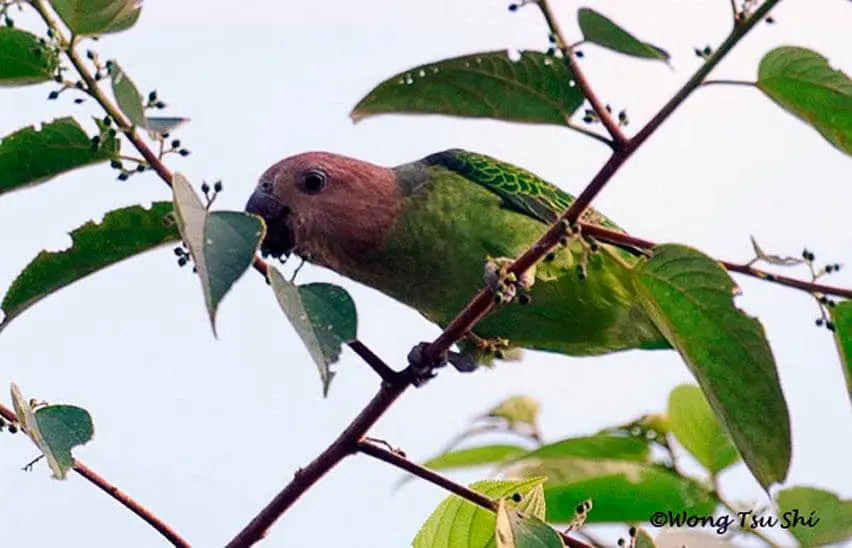
The Green Racquet-tail(Prioniturus luconensis) has the head of color green light, impregnated of green yellowish around them lores and the base of the bill. Mantle light green, slightly yellowish. Wings green; vane outer, the first three primaries green, impregnated blue; vane Dark internal, the more internal with pale inner edge. Wing feathers greenish yellow, underside of flight feather impregnated of blue dark. The underparts brighter yellowish green, more yellow in the undertail-coverts. Upper, the tail green, lateral feathers strongly impregnated dark bluish-green and dark-tipped; undertail, the tail bluish.
Bill grey bluish pale ; irises dark brown; legs grey.
Previously reported in the strata media of the land low of forest primary, and in the nearby cornfields, mostly below 700 m. Recent records are from small groups of a maximum of seven birds that live most degraded or selectively, in exploited forests outside of settlements.
Reproduction:
Young have been observed in Luzon during the month of may. The nest It , apparently, a hollow tree. Little more is known about the habits of this rare Parrot.
Food:
The diet includes fruit, Tender corn, rice, seeds and flowers.
Distribution:
Size of the area of distribution (reproduction / resident): 93.500 km2
Endemic to Luzon and Marinduque, North of Philippines. Although the species was considered quite common at the end of the last century in the center of Luzon, seems to have suffered a rapid decline in recent years. Has not been registered in the Cordillera Central in this century, and now you can have their stronghold in the Sierra Madre, where it was reported to be generally rare or uncommon in the decade of 1990. It is rare in all currently considered Luzon except perhaps in the Subic Bay Naval Reserve Forest (Bataan, to the East of Manila). There are no recent records of Marinduque.
Conservation:
• Current category of the Red List of the UICN: Danger
• Population trend: Decreasing
The population is in the band of 1,000 to 2,499 mature individuals.
The threats by the tala generalized and their captures to the trade of birds of cage, suggest that this species is experiencing a downhill fast in the population.
The head of the Yellowish-breasted Racquet-tail(Prioniturus flavicans) is bright green, brighter around the lores and the base of the bill.
The front of the crown is green, rest of bright blue with red spot in the center crown. Mantle ocher yellow, well delimited from the blue nape the green of the wings and back; Back and rump green. Wings green, with vane Dark internal to the flight feather and blue to primaries longer. green's Underwing coverts; underside of primaries marked dark blue.
Underparts brighter yellowish green, ocher yellow in the chest. Upper, the outer feathers of the tail green with black and turquoise tips on vane outside of the outer feathers; below, the tail dark colored, bathed in blue at the edges of the vane inner; spatulas blackish.
Bill horn; the dark brown irises; the gray legs.
Female less blue, no red dot on the crown, the underparts and the mantle, greener and rackets (a thin extension of the central tail feathers, almost as hair, It is ending with a more oval-shaped racket) shorter.
Found in the primary forest usually below the 1,000 m. But times may vary up to the 1.900 m. They are also observed in trees in cultivated areas.
Reproduction:
Little is known of their reproductive habits.
Food:
The birds they feed on the ground, among the plants of lowland and Hill forests, flocking often in fruit trees. They feed slowly along with other frugivorous birds..
Distribution:
Size of its range (breeding/resident ): 66.700 km2
Are distributed in the North of Sulawesi, Indonesian and on the Islands around, including Bangka, Lembeh and Togian. The species also, possibly, It is distributed in groups of Islands Sangir and Banggai. Although its population may be declining due to habitat loss and trade in birds, It is not considered threatened and is still, relatively, common on reserve Dumoga-Bone. It overlaps, although it is less common, with the Golden-mantled Racquet-tail.
Conservation:
• Current category of the Red List of the UICN: Near threatened
• Population trend: Decreasing
The population It has been estimated in the order of 45.000 individuals (Walker and Cahill 2000).
It is suspected that this species has diminished recently at a moderately fast pace, due to the continuing loss of forests.
Conservation Actions Proposed:
– Evaluate the threats to this species. Calculate loss of forests in the lowlands of the North of Sulawesi.
– Investigate the level of dependency of the forest habitats of the species.
– Protect effectively important tracts of forest right in key places, both in strict protection areas and in multiple use areas.
The Modest Tiger-Parrot(Psittacella modesta) has the head Brown olive, with indistinct centers yellow to the feathers of the crown and nape. Mantle dark green, with slightly darker edges to feathers; rump with indistinct greenish-yellow and black mix. Uppertail green, with fringe darker. Wings of color green dark marked in blue on the curve.
Yellow wing feathers. Of flight outer feathers blackish edged green in the bases and with fine yellow margins the vane internal and external. Top of the chest Gris-Oliva below the bend of wing, belly paler, opaque green; undertail-coverts red. Upper, the tail dark green; by down blackish.
The bill grey-blue, whitish tip; irises orange; legs bluish grey.
Female alternating the Brown dark and the pink in the chest, flanks alternating the Green and yellow-green.
(Rand, 1941) – Something more dark in General, the collar yellow on the back of the neck is more brilliant and variable, head brown / dark grey.
The females with the head darker and some with a slight yellow colouring.
Psittacella modesta collaris
(Ogilvie-Grant, 1914) – The neck yellow, irregularly present. Darker hue at the sides of the head.
The females have mild brands yellow in the part back from the head.
Habitat:
It is found in the humid mountain forests, forest Moss, edges of secondary vegetation and forests, a altitude between 1.200 and 4.000 m (mostly between 1,700-2,800 Metro).
The Modest Tiger-Parrot is a bird quiet, discreet, quite docile and difficult to observe. It tends to prefer medium or lower forest and seeks its food crawling or jumping slowly at ground level. They only fly short distances when bother them.
Birds are found alone or in pairs, and they feed on seeds and small fruits.
The young birds as females.
Reproduction:
There is no information on the breeding ecology, but a male State of reproduction was observed during the month of June.
Food:
Observed feeding is of small fruits; seeds and pieces of berries DURAS were found in their stomachs.
Distribution:
Size of the area of distribution (reproduction / resident): 65.100 km2
New Guinea in Irian Jaya, Indonesian and Papua New Guinea. Scattered through the uplands, observed in the Vogelkop mountains (isolated population), and after all latitude 136ºE, through the central mountain belt, in the central mountain ranges, including the Tari area, the range of Victor Emanuel and the District of Mount Hagen, reaching around of 145 °E. The range overlaps with the species Madarasz's Tiger-Parrot at a length of 1,200 kilometers along the Cordillera central and where the two species overlap. The Modest Tiger-Parrot is usually found in slightly higher altitudes than the Madarasz's Tiger-Parrot. The world's population is thought to be greater of 50.000 specimens. The species is locally common.
(Ogilvie-Grant, 1914) – is located to the South of the Maoke mountains.
Conservation:
• Current category of the Red List of the UICN: Least concern
• Population trend: Stable
The size of the world population It has not been quantified, Although deemed superior to the 50.000 specimens. The species is reported as locally common (pit et to the. 1997).
The population is suspected to be stable in the absence of evidence of any reduction or substantial threats.
– Avibase
– Parrots of the World – Forshaw Joseph M
– Parrots A Guide to the Parrots of the World – Tony Juniper & Mike Parr
– Birdlife
– Wikipedia
– Loromania
21 to 27 cm. length and a weight between 130 and 180 g..
The face of the Red-checked Parrot(Geoffroyus geoffroyi) is of color rojo-rosaceo up to just above the eyes, more pink in the ear-coverts; front of the crown of color rojo-rosaceo. Half of the crown to the nape mauve-blue. Upperparts green. Wings with patch red in them Middle coverts interiors.
Flight feathers with vane Dark internal and external Green. Edge of yellow to vane internal of greater coverts and secondaries. Wing feathers and axillary, bright blue; below, the rest of the wings, blackish. The underparts green, more yellowish in them lower flanks. Upper, the feathers of the tail of color green, drenched sides of yellow; below, brighter yellowish green.
The bill red orange in upper jaw, the lower jaw in color black; irises yellow; legs grey.
Female with head Brown and upper jaw black.
Youth they have the head green, irises dark and bill pale. The male juveniles go through a plumage «female stage» before they begin to acquire masculine characters (bird takes over one year to mature). The birds young also lack of the brand red on them small coverts.
(Müller, 1841) – The darker male in general that the nominal; purple blue crown comes to the part back from the neck; neck light blue; Marron-bronce washing variable on the mantle and top of the back; Green bluish in the part superior of the chest and zone inferior of the abdomen ; brown reddish of them coats internal of the wings absent; Blue more dark in them Underwing coverts. Larger in size.
The female with the head more dark that the nominal; purple diffusion in the crown; nape blue, reaching the neck with color blue light.
Geoffroyus geoffroyi obiensis
(Finsch, 1868) – Adults as the subspecies cyanicollis but collar Blue in the part back from the neck more comprehensive, reaching almost up to the eyes; blue-purple in the male or brown in the female does not reach the lower part of the occiput; reddish brown in the bottom of the back to rear.
Geoffroyus geoffroyi rhodops
(Schlegel), 1864) – Similar to the subspecies males floresianus, but darker in general; marks of the coats internal of the wings of color brown reddish dark; crown Blue separate with red in the face; Underwing coverts Blue more dark. Larger in size.
The female with the crown castano-oscuro color.
Geoffroyus geoffroyi explorator
(Hartert, 1901) – Synonymous with Geoffroyus geoffroyi rhodops
Geoffroyus geoffroyi keyensis
(Finsch, 1868) – The male resembles the subspecies floresianus, but in general more greenish-yellow, in particular in the tail; cheeks Pink and ear-coverts washed with Blue Lilac; Yellow greenish pale in the neck through the part back from the neck and a strip Green, darker, in the early part of the neck; Underwing coverts pale blue. Larger in size.
The female chestnut brown on the head.
Geoffroyus geoffroyi floresianus
(Salvadori, 1891) – The male is like the nominal, but darker in general; the purple blue of the crown It's darker and reached to the nape; coats internal of the wings dark reddish brown; Blue more dark them Underwing coverts. Larger in size. Largest peak. Female with the crown darker brown, coming up to the nape.
(Meyer, 1884) – The subspecies resemble adults Kei, but smaller.
Geoffroyus geoffroyi pucherani
(Souancé, 1856) – Adults and juveniles with bronze-colored marking of the parts internal of the wings, minimal or absent; the mantle have less marron-bronce washing; Brown more pale in the part low of it back; the buttocks with less red; coats dark blue low the wings.
Geoffroyus geoffroyi minor
(Neumann, 1922) – Male adults are as the subspecies aruensis, but with reddish brown under the back to rear; face darker red; washing Marron-bronce in the the mantle; brands in the coats internal of the wings minimal or absent.
The female as the subspecies aruensis, but with the head of brown slightly more dark.
Geoffroyus geoffroyi jobiensis
(Meyer, 1874) – Adults and juveniles but with Underwing coverts pale blue; bright red in the lower part of the back to the rear; in males, the red in the forecrown back to the front of the crown.
Geoffroyus geoffroyi mysoriensis
(Meyer, 1874) – Males as juveniles, but with the crown blue-purple, down on the back of the neck, and red in the face, coming up to the throat; washing marron-bronce absent in the the mantle; extensive reddish brown marks in inner median coverts; Underwing coverts dark blue; dark brown in the bottom of the back to rear.
The female as juveniles, but the color brown in the crown comes to the part back from the neck.
Geoffroyus geoffroyi orientalis
(Meyer, 1891) – Hardly differs from the subspecies aruensis; Crown of the male is slightly more pale.
Geoffroyus geoffroyi sudestiensis
(Estimate, 1890) – The adult male is similar to the subspecies aruensis, but with the underparts darker; the trademark brown reddish of them coats internal, absent.
The crown and nape of the female, is dark green.
Geoffroyus geoffroyi cyanicarpus
(Hartert, 1899) – The adult male is similar to the subspecies aruensis, but with azul-lila wash in them cheeks and ear-coverts; bend of wing has edge blue.
The female is as the subspecies aruensis, but the crown and nape They are brown, with light green dye; edge blue in the part outside of the wing
as in the male.
Geoffroyus geoffroyi aruensis
(Gray, 1858) – Similar to the species males nominal, but darker purple blue from the crown up to the nape; inner coverts a reddish brown marked darker; Blue more dark in them Underwing coverts.
The female Brown darker from the crown even the nape.
Geoffroyus geoffroyi maclennani
(W. D. K. Macgillivray, 1913) – The male is similar to the subspecies aruensis, but darker in general; the Red of the face is darker and more uniform; Underwing coverts paler blue. Female similar to the female of subspecies aruensis, but darker in general; head dark brown; Underwing coverts paler blue.
* The varieties sumbavensis and tjindanae proposed as subspecies are synonymous of floresianus; rhodops stresemanni; explorator It is also synonymous of rhodops.
Habitat:
Distributed by primary and secondary forests, tree savannas, plantations, Open forests, mangrove forests and farmland, a altitude of 1.400 m. Usually replaced by the Blue-collared Parrot at higher altitudes. Exclusive tropical jungle in the North of Australia. View the birds, generally, flying high above the trees, making calls to cries.
Groups of birds in the North of Australia, many still in family units, they have been observed leaving their roosts early, to feed into the dense jungle; in their flights to areas of foraging, We have seen some of these birds perched in the upper branches of the trees, by calling aloud for a few minutes and dithered wings before continuing. The reason for this unknown behavior can be a way of requesting food due to early maturation.
During the day the birds are less visible, they can draw attention by discarded food falling from their food trees.
They are usually in couples, in small groups or assembled in groups in fruit trees.
Reproduction:
The nest It is a hole that the birds excavate in a rotten limb of a tree from the forest, sometimes also in a knot in the trunk; probably only the female excavates. The entrance to the nest is of 80 to 90 mm. wide, and the tunnel, that it can twist in order to hide the eggs, You can have a length of 42 cm.. Includes the implementation of 2 to 4 eggs. The female alone incubates and is fed by the male during this time. In the West, the breeding season It takes place between April and September at least, month in which a live nest was found in Seram.
In New Guinea, the nesting is been registered during several months more, including February in the North and between the months of April to December in other places.
In Australia, in where the season seems to extend is from August to December, little information about the cycle reproductive is available.
It is known that the species It has never been raised successfully in captivity.
Food:
The diet It includes seeds, fruits and flowers. The birds tend to hang acrobaticamente to reach their food.
Distribution:
Size of the area of distribution (reproduction / resident): 793.000 km2
Generalized from the West of Lombok, through the Moluccas, the lowlands of New Guinea, and observed in the groups of associated Islands, to the East of Rossel in the Louisiade archipelago.
The species can also be observed in the northeast of the Cape York Peninsula, Australia, at its southern end, and North ranges up to Morotai in the North of the Moluccas. In many areas, throughout its distribution area, is the most abundant Parrot (rarer over the 800 meters above sea level), even around inhabited areas. Despite this, It may be extinct in Ambon.
The size of the world population It has not been quantified, Although it is estimated above 1.000.000 of copies. The species according to sources, is of common to abundant much of its area of distribution (pit et to the. 1997).
The population suspected to be stable in the absence of evidence of any reduction or substantial threats, Although you can that its population is affected by the capture in various parts of its area of distribution.
"Red-checked Parrot" in captivity:
Very rare or impossible to see in poultry.
Passive Parrot. Extremely susceptible to stress and disease; they may die suddenly without apparent reason. Few times you live long in captivity
Alternative names:
– Red-checked Parrot, Red cheeked Parrot, Red-cheeked Parrot (ingles).
– Perruche de Geoffroy, Eclectus de Geoffroy, Éclectus de Geoffroy (francés).
– Rotkopfpapagei (alemán).
– Papagaio de bochechas vermelhas (portugués).
– Lorito Carirrojo, Lorito de Mejillas Rojas (español).
– Avibase
– Parrots of the World – Forshaw Joseph M
– Parrots A Guide to the Parrots of the World – Tony Juniper & Mike Parr
– Wikipedia
– Birdlife
– parrots.org
– Photos:
(1) – By Ron Knight (Flickr: Red-cheeked Parrot) [CC BY 2.0], via Wikimedia Commons
(2) – By Nick Athanas/Tropical Birding – Birds-pet-wallpapers
(3) – A male perched in a tree by Josep del Hoyo – Lynx
(4) – A male and a female looking for a suitable nest by mehdhalaouate – Lynx
(5) – By markharper1 [CC BY-SA 2.0], via Wikimedia Commons
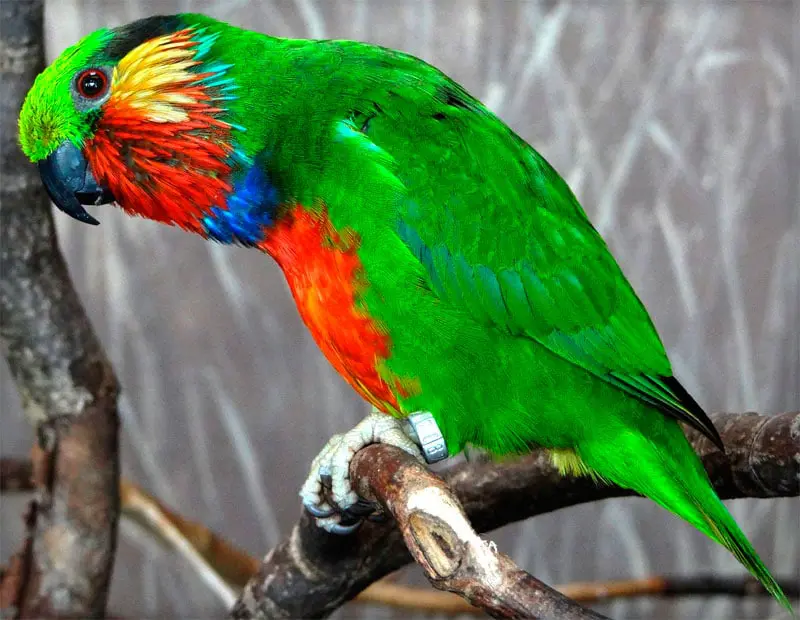
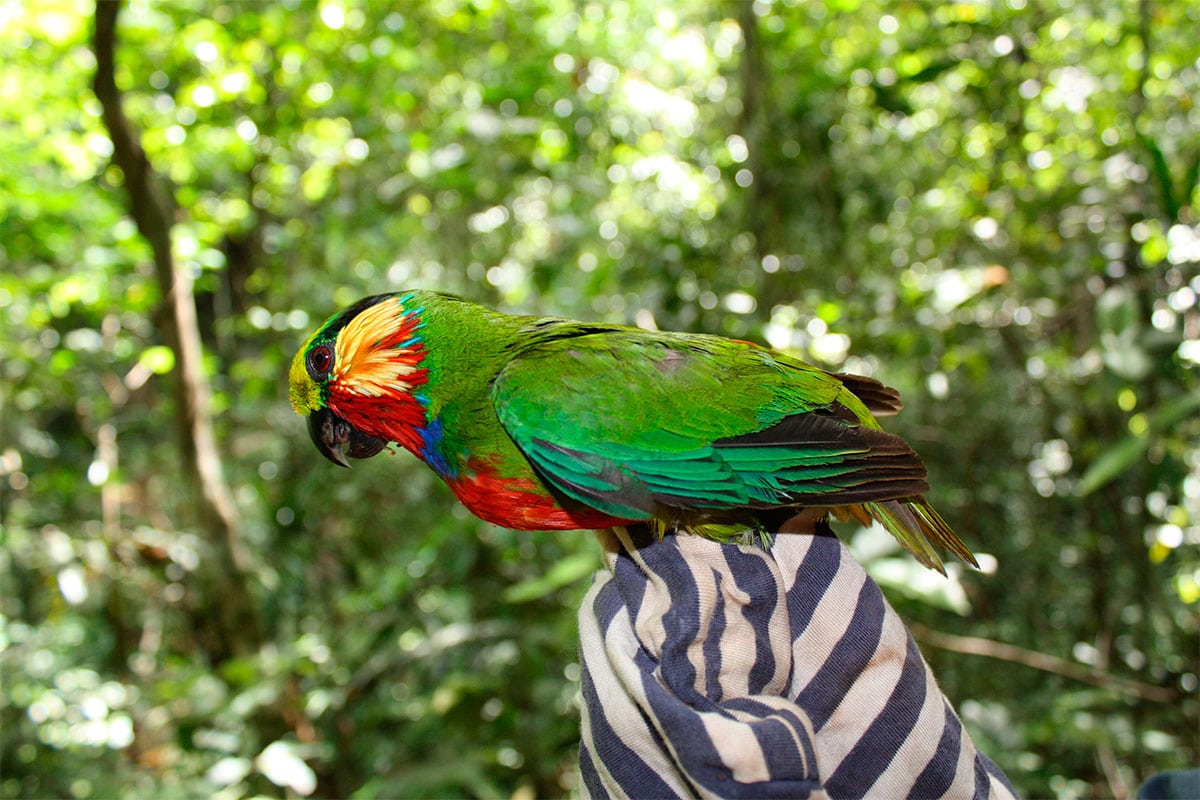
The Edwards' Fig-Parrot(Psittaculirostris edwardsii) you have the front and a bright yellowish-green Crown, with a green stripe on the back; neck greyish-Brown band above the band of gris-negruzco color that extends into the eye; area before and just behind the eyes, green. Elongated lower headset feathers and orange-red fire Gorge, with some green basal feathers interspersed and ends the headphone rear (also elongated) golden yellow with orange.
Dark green back: curve of the wing marked in blue. Black flight feathers marked with green in vane outer (except the primary outer) and with vane internal yellow, forming a set of bars under her wings; marked inner coverts reddish-orange. The wings of blue-green feathers, the longest with yellow tip. Purple-blue ruff with some lighter green feathers; Centre of the breast and upper belly of a showy orange-red; flanks, supracaudales yellowish-green coverts and thighs. Upper, the Green tail; undertail, opaque yellow olive.
the black beak; reddish brown to Brown irises; light grey legs.
The female of the Edwards' Fig-Parrot It lacks the heart of red on the chest and upper abdomen, and has a broader purple-blue band on the chest, inset below with red.
Immatures resemble females, but with the headphones coverts greenish yellow.
Habitat:
The Edwards' Fig-Parrot (Psittaculirostris edwardsii) are distributed among the humid lowland forests, partially cleared areas, wooded edges, as well as near rural areas, up to about 800 meters above sea level.
The birds are usually found in pairs or small noisy flocks, Although groups have been found for up to 400 birds collected in the canopy of fruit trees.
Rapid movements are, and usually they hang you upside down to reach food.
Has been in mixed flocks with the Double-eyed Fig-Parrot.
Reproduction:
Nesting behavior of the Edwards' Fig-Parrot they have been observed since January through may. In October he was seen a male rubbing its peak with the female and hovering above its perch. The nest is in a hole, at the top of a tree in the forest.
Food:
The diet consists of fruit, including the Ficus figs and casuarinas, nectar and probably insects
Distribution:
Endemic to the lowlands of the North of New Guinea in Irian Jaya and Papua New Guinea. It is commonly distributed in the northeast of all Jayapura along the coastal lowlands and inland to around of Pagwi, Chamhri Lake and the jimi river. Observed in the region of the Sepik River, extending eastward to the lowlands of the Huon Peninsula and the markham river. The world's population is believed to be in excess of 100.000.
Conservation:
• Current IUCN Red List category: Least concern
• Population trend: Stable
The size of the world population Edwards' Fig-Parrot It has not been quantified, It is estimated around the 100,000 specimens. The species according to sources, it is common to very frequent, at the local level (pit et to the. 1997).
The population is suspected to be stable in the absence of evidence of any reduction or substantial threats.
"Edwards' Fig-Parrot" in captivity:
active parrot, need space to exercise. It has nice voice, harmless. Initially shy and nervous, It is customary to the caregiver with the time. You can die suddenly without apparent reason.
11 to 13 cm.. length and a weight between 27 and 34 g..
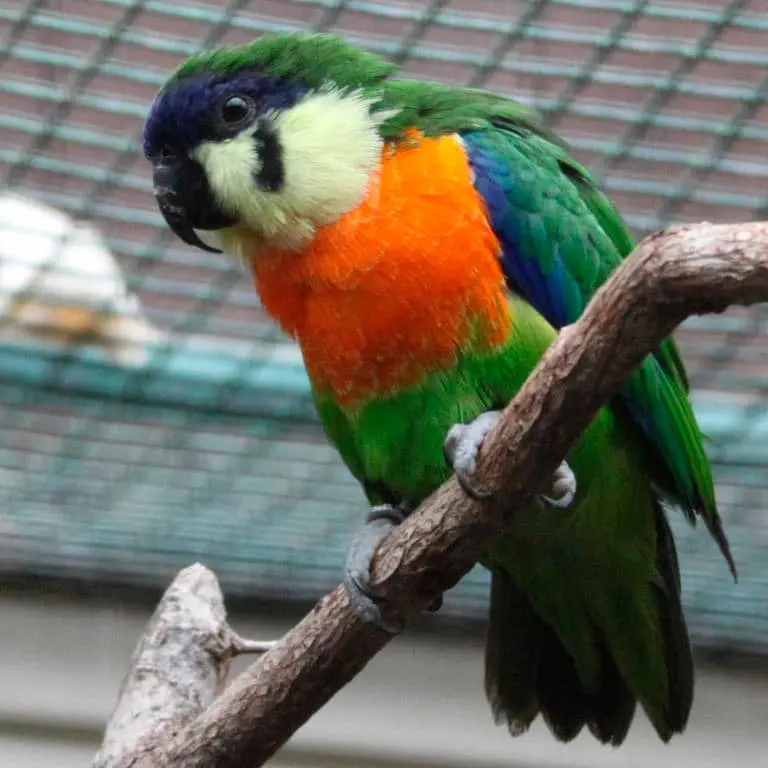
The forecrown of the Orange-breasted Fig-Parrot(Cyclopsitta gulielmitertii), back of the crown and area behind the eyes are a deep blue; pale yellow the lores, throat and both sides of the head; black spot on the back of the cheek; Orange the top part of the abdomen; the interior of the wing-coverts Yellow-edged; wide bands of pale yellow under the wings. Bill blackish gray. The eyes dark brown.
The female similar to the male, but pale yellow on the front of the cheeks black and white on the back. Frontal of the cheeks bordered below green with blue stripe; the ear-coverts on both sides of neck, orange; underparts green.
The immature as females, but orange, Since the ear-coverts and sides neck to the area below, faced with the cheeks; chest male washed with orange-brown.
(Reichenow, 1891) – 13 cm.. length. Area of the forecrown, crown and behind the eye, black. Female without chest Neither abdomen orange, cheeks white-yellowish color bordered by a blackish band. back of the cheeks and headphones feathers bright orange. Under black band greenish blue. The youth they are equal to adults.
Cyclopsitta gulielmitertii ramuensis
(Neumann, 1915) – It is more small, of about 11 cm.., with the area of the forecrown, crown and behind the eye Black interspersed with dark blue, cheeks and headphones feathers whitish in colour. Breast
and abdomen cream color. females as males but behind the eye and cheeks with a broad black patch interspersed with dark blue. Breast
whitish interspersed with orange feathers. Abdomen brighter yellowish green. The youth equal to adults.
Cyclopsitta gulielmitertii amabilis
(Reichenow, 1891) – It is more small, a few 11 cm..Forehead, crown and rear of the eye matte black. Cheeks Black interspersed with dark blue. females similar to the males but with the patch from behind the eye Black interspersed with dark blue matte. Headphones feathers whitish. The juveniles as in adult females but with the upper part of the chest greener
Cyclopsitta gulielmitertii suavissima
(Salvadori, 1876) – Smaller, a few 11 cm.., area of the forecrown, crown and behind the eye blue color, great patch on cheek black. Headphones feathers and cheeks white-yellowish color and chest and top of the abdomen reddish orange. The female It has a hue of different reddish orange and black spot of the cheek is Matt and interspersed with dark blue color. The youth adult females are, but marks of the head they are more off.
Cyclopsitta gulielmitertii fuscifrons
(Salvadori, 1876) – As the diophthalma gulielmitertii suavissima but the area of the forecrown, crown and back of the eye, blackish brown. The females similar to the Cyclopsitta gulielmitertii suavissima but back of the cheeks, front and behind the eyes blackish brown. The youth as adult females.
Cyclopsitta gulielmitertii melanogenia
(Rosenberg,HKB, 1866) – Of 11 cm.. length. The male is as the diophthalma gulielmitertii suavissima, the female also with the fused in light green Orange tones in the abdomen. The youth are like adults.
Habitat:
It is distributed in the rainforest, swamp forest, forest of Melaleuca , dense sheets and partially cleared areas from sea level to a 300 meters above sea level, rarely recorded in higher altitudes to the 800 m, the largest known altitude is 1.100 m.
They are usually in small groups assets of 6 to 10 individuals, whether it is flying above the treetops, or congregate where can feed on figs and other fruits in the canopy or plants at lower levels.
Bird feeding can be hard to spot, since they climb around the silent tree trunks, although they can pivot upside down as they feed, sometimes dropping food.
Reproduction:
The nests of the Orange-breasted Fig-Parrot found in arboreal termite, at the top of the trees of the forest. Up to three holes can be dug., and nesting they can be community. The nests also found at the base of a complex of epiphytes. There is little information available upon the breeding season, activity in apparent nests have been observed between the months of September and June. These sites can, However also, have been used to settle, and a record in January of a male regurgitating food near an entrance hole probably indicates breeding during that month at least..
Food:
The diet includes seeds of figs and other fruits, as well as small whole figs, nectar flower e insects occasional.
Distribution:
Widely distributed, abundant and easily observable in the lowland tropical rainforest, throughout much of New Guinea. The Orange-breasted Fig-Parrot most Western they are isolated, only seen in Salawati in the West of the islands of papua, and in the lowlands of theDoberai Peninsula, West Papua.
In other parts of New Guinea the range is continuous through the lowlands of the North of the eastern edge of Yellowfinch Bay around the memberamo river, throughout the region of the Sepik River and the lowlands of the Huon Peninsula, to Milne Bay, at the eastern end.
The range continues west through the southern lowlands of New Guinea through the Purari and Fly River regions to the southeastern lowlands of West Papua, on the 138 ° E; also in the islas Aru.
The Orange-breasted Fig-Parrot seems to be more common in southern New Guinea in the North.
Subspecies distribution
Distribution of the 7 subspecies
Cyclopsitta gulielmitertii gulielmitertii
: The nominal
Cyclopsitta gulielmitertii nigrifrons
: North of New Guinea between Mamberamo and Sepik Rivers.
Cyclopsitta gulielmitertii ramuensis
: District Ramu River, North of Papua New Guinea; It is thought that it may be a cross between the nigrifrons and the amabilis, therefore, probably not a valid subspecies.
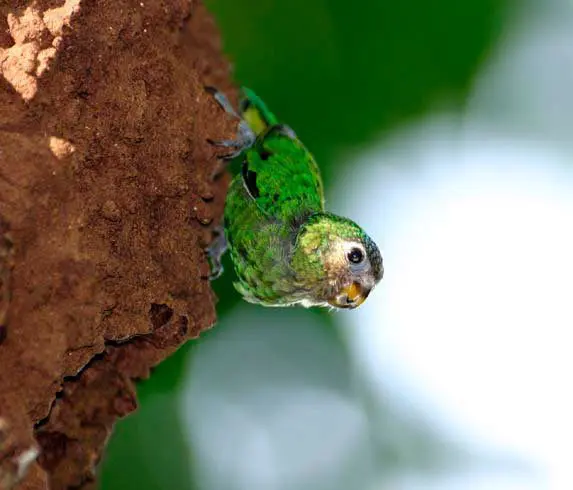
The Geelvink Pygmy-Parrot(Micropsitta geelvinkiana) has 9 cm.. length between 13 and 17 g. of weight.
The coverts headphones are of color brown with fusion to blue-green in the part rear; crown purple-blue; Upperparts green, Middle coverts with centers of color blackish. The flight feather Black with narrow green borders in vane outer. The underparts Green Center of chest and belly ocher-yellow, more warm towards the part superior of the chest. Uppertail Yellow. Central feathers of the tail blue, Green Tips with yellow spots and black exterior.
The bill grey; irises of color red or brown orange; legs grey.
Female with less blue of the crown and underparts greenish yellow.
Immature with the bill mostly yellow in color and gray tipped.
: (Salvadori, 1876) – The male has the head Brown marks on the belly yellow and orange. Female with the crown blue and underparts greenish.
Habitat:
With distributes in lowland, secondary growth, cultivated areas with isolated trees, and around native gardens, until 300 meters or higher altitudes. The birds are found in groups of 4-5. and is them has seen associate it with other birds in them trees low of berries that accrued in the forest. very shy.
Reproduction:
They dig caves in termite tree in which to lay their eggs (also used for rest cavities at night), often close to the ground. The nesting It was observed from mid-June to August. Arndt He found two young in a nest which were visited by the female every two hours. The chamber was filled with dust from the termite mound and contained some broken egg shell and feathers.
Food:
Probably Lichen and fungi from the bark of the trees. As in other Meeki, crushed seeds were found in the stomach of a bird collected.
Distribution:
Size distribution (reproduction / resident): 2,500 km2
Are observed only in Numfor and Biak island, (Indonesian), up to about 300 meters above sea level. In 1991 It was thought that the global population was around of 10.000 and stable, but in 1997 searches for the species over a period of 12 days suggested that it was either rare or easily missed, with observations of a single day, sometimes only with sound contacts.
The size of the world population It has not been quantified; in 1991 It was estimated in approximately 10,000 specimens. The species is described as well distributed in good numbers in lowland primary and secondary forests. (pit et to the. 1997).
There are no data on population trends, but the species is suspected that it is decreasing at a rate of slow to moderate, due to loss of habitat.
"Geelvink Pygmy-Parrot" in captivity:
Not found in poultry farming.
Alternative names:
– Geelvink Pygmy-Parrot, Geelvink Bay Pygmy Parrot, Geelvink Pygmy Parrot (ingles).
– Micropsitte de Geelvink (French).
– Geelvinkspechtpapagei, Geelvink-Spechtpapagei (German).
– Micropsitta geelvinkiana (Portuguese).
– Microloro de Geelvink (español).
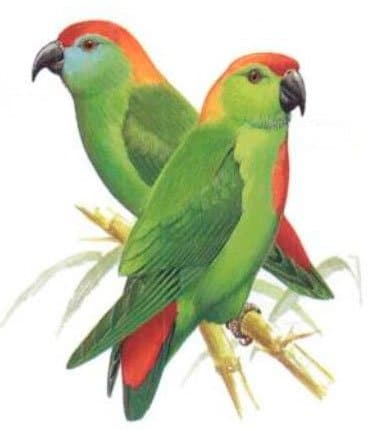
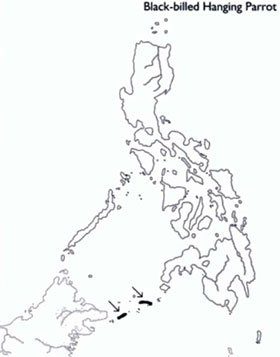
The Black-billed Hanging Parrot (2) is a subspecies of the Colasisi (Loriculus philippensis) being the only member of the genus, in the Sulu archipelago. The combination of the Red Crown on front, merging Orange gold neckband, and the black Bill are the brand identity of the Black-billed Hanging Parrot for both sexes. Aside from lacking these features, the most similar species within the subspecies of Loriculus philippensis, the L. p. apicalis and L. p. dohertyi, they have the necks much more of orange-red color and a strong orange color shawl in broadcast.
The female of the Ceylon Hanging-Parrot has the Red Crown, reddish diffusion in the mantle, peak red and a whitish iris (males do not have the Red bib of birds of Sulu).
The front of the Crown of the Black-billed Hanging Parrot is red, shading back in Orange and yellow in the back of the Crown, with a clear line of demarcation of the green mantle; bright green cheeks and Lores. Orange robe loosely washed in the Center; rump and tail coverts bright crimson (Blue Suffusion on sides of rump). Wings green brilliant with vane internal to blackish flight feathers. Feathers of the wings of Turquoise Green: below, the wings of blue. The Chin and throat bright Scarlet; rest of the underparts of bright green. Upper, the Green tail; Blue below. the black beak; Brown irises; Orange to greyish legs.
Habitat:
The species is little known, but their habits and ecology are presumably similar to those of the Colasisi. Commonly found in front of coconut groves on the coast, inside you have registered in forests, as well as in partially cleared areas. Observed feeding on flowers of Palm and flying between the trees.
Reproduction:
The breeding season starts around February and may continue until may. An average clutch can coasts of 2 to 4 eggs. Parents make their nests on top of the cavities of the trees.
Food:
Their natural diet consists of nectar, seeds, red fruits (especially wild figs), berries and flowers