â–· The world of Pets: Dogs, cats, birds, reptiles, amphibians

Finsch's Pygmy-Parrot
Micropsitta finschii

Finsch's Pygmy-Parrot

Content


Anatomy-parrots

Description

9,5 cm. length between 12 and 18 g. of weight.

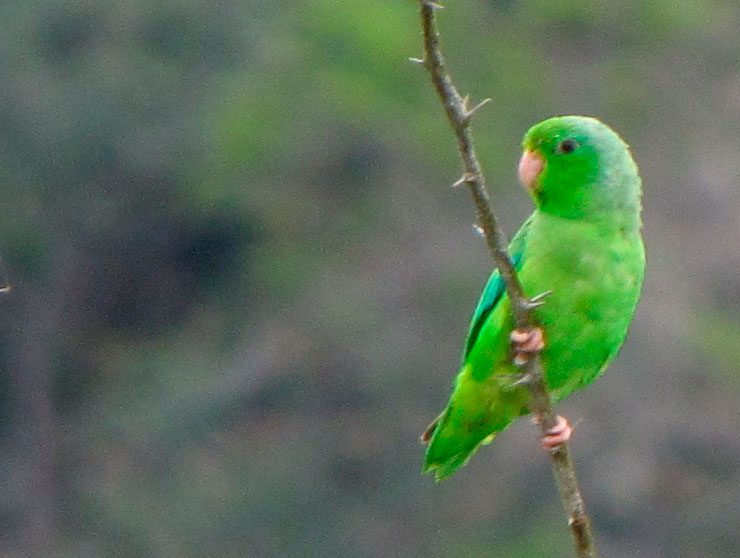
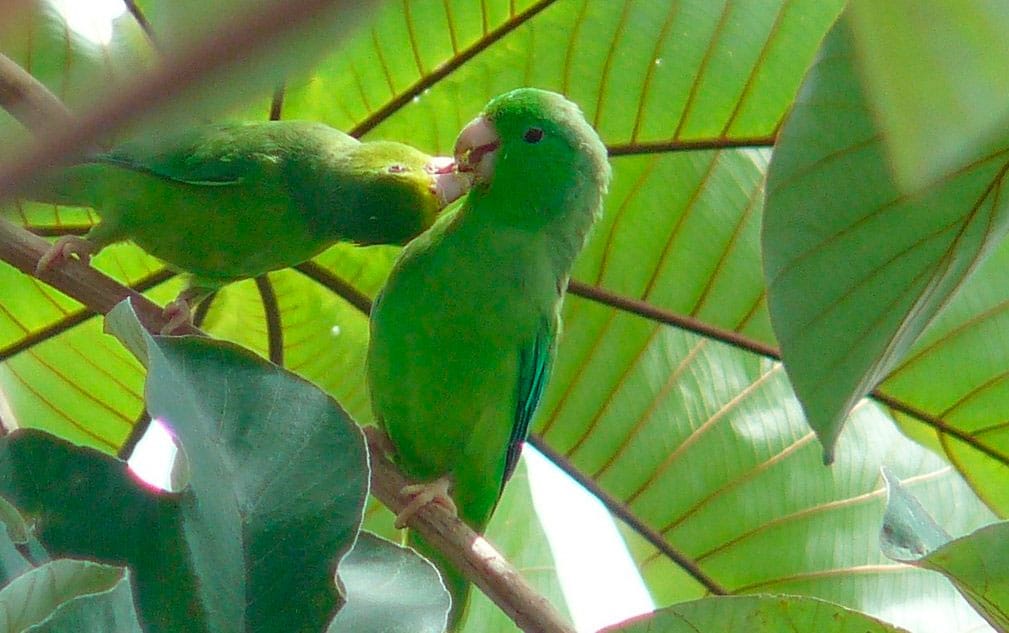
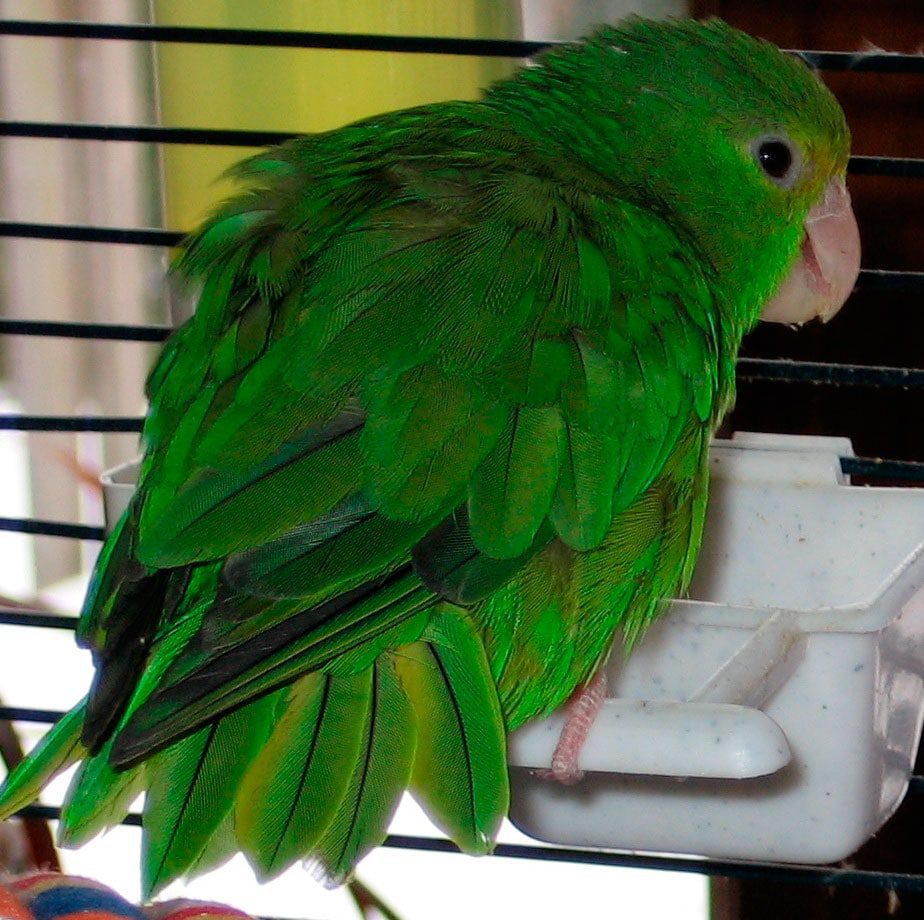
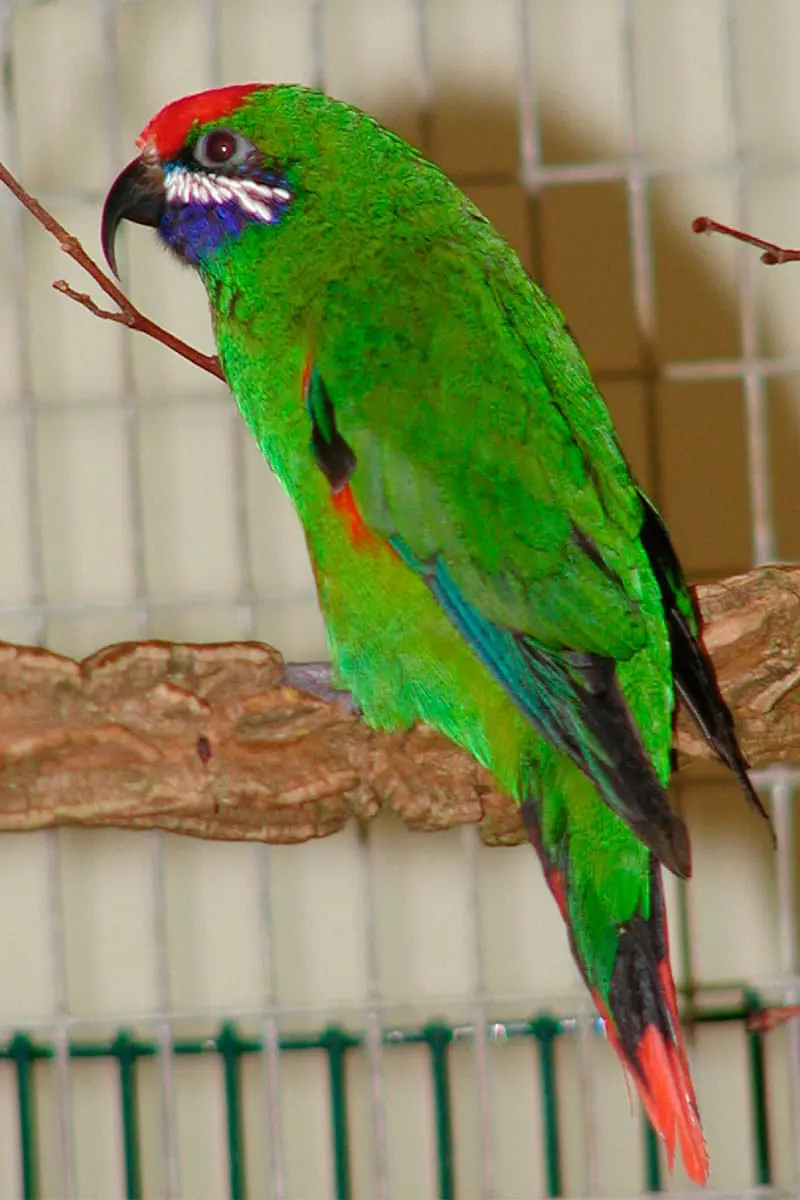
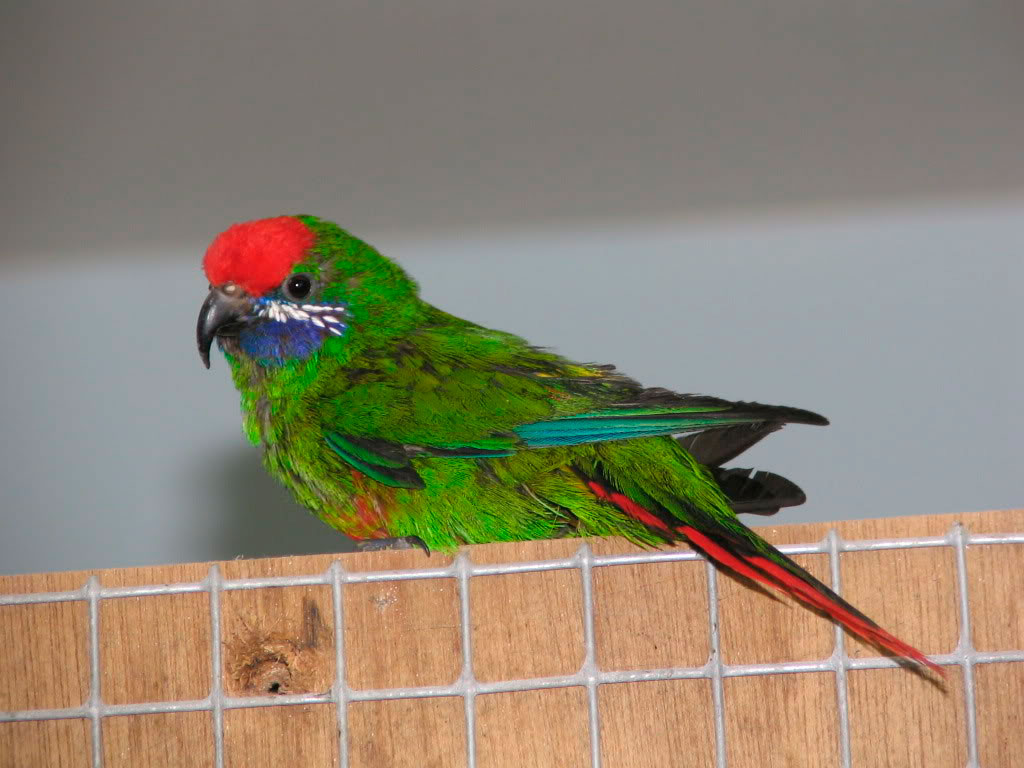
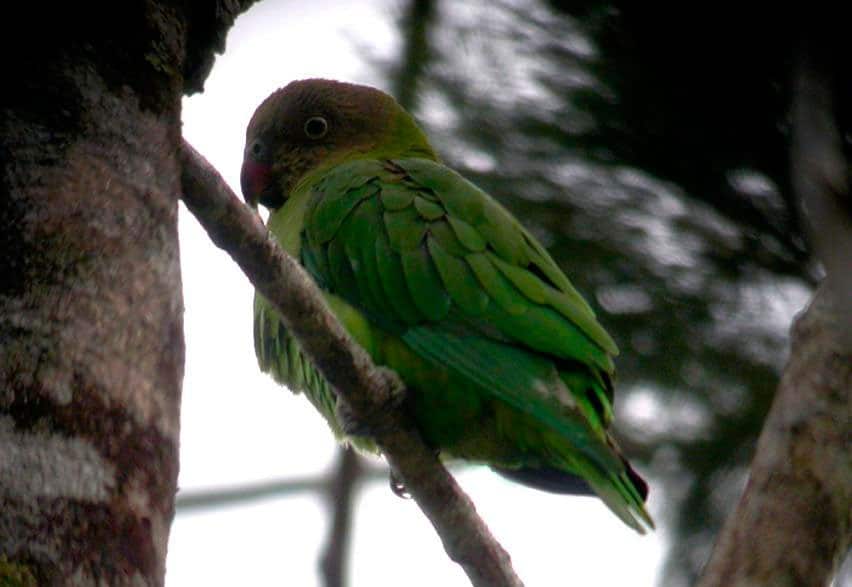
The head of the Finsch's Pygmy-Parrot (Micropsitta finschii) is bright green, slightly yellowish, dotted with pale blue in the chin and throat. Upperparts bright green, with fine darker stripes. The flight feather they are black with fine green edges; wing feathers greenish yellow. The underparts pale yellowish green with fine darker stripes and feather in the center of the belly orange-red; uppertail-coverts yellow, the longest with bluish-green tips. Upper, the tail is off blue, Black in the Center and sides with blue and yellow tips; below, the tail is black with yellow tips.

Bill blackish; cere Pink ; irises orange red; legs grey.

Cere rose in the male, grey in the female. The females they lack the red marks in the underparts and they have pink feathers, not blue, on chin.

Immature with bill grayish and reddish brown, not orange-red, the irises.

In the juvenile birds the cere is greyish in both sexes. Males immature of the species nominal lack of the chin Blue and red markings in the abdomen.

Subspecies description

Description 5 subspecies
  • Micropsitta finschii finschii

    (EP Ramsay, 1881) – The nominal.


  • Micropsitta finschii nanina

    (Tristram, 1891) – The adults have a stain blue in the part superior of the crown.


  • Micropsitta finschii viridifrons

    (Rothschild & ECTION Hartert, 1899) – Adults have a large blue spot at the top of the crown and blue tones to the sides of the face.


  • Micropsitta finschii tristami

    (Rothschild & ECTION Hartert, 1902) – Adults do not have blue spots and orange


  • Micropsitta finschii aolae

    (Ogilvie-Grant, 1888) – adults have the upperparts darker and have a blue spot on the top of the crown.

Habitat:

Finsch's Pygmy-Parrot

Most common in lowland primary forest at mid-altitude, are observed to the 900 meters above sea level (lower boundary of cloud forests where they are replaced by the Red-breasted Pygmy-Parrot, but they are distributed in a variety of habitats, including weed gardens, casuarinas, secondary growth, areas of open scrubland and occasionally coconut (Cocoa nuts). It's a vociferous and active species, difficult to observe. They are alone, in pairs or in groups of 3 to 6 birds. They feed on acrobatic form, down with your head upside down and using their tails as support on the bark of the trees.

Reproduction:

One to two eggs are deposited by the female in an excavated cavity over a period of several weeks in an active tree termite nest. (that is also used for the rest). Adults were observed with young in January 1995 in the South of New Ireland. The breeding period It speculates that may be between March and Mayo.

Food:

Peck the trunks and branches of the tree tops and medium height plants to glean lichens and fungi, also noticed them is feeding of seeds of casuarina.

Distribution:

Are found in the Bismarck Archipelago including New Hanover, Tabar, Lihir and New Ireland, through Bougainville in the Solomon Islands in Choiseul, Santa Isabel, Malaita, Vella Lavella, Gizo, Kolombangara, New Georgia, Rendova, the Russell Islands, the Islands of Florida, Nggela Sule, Guadalcanal, Uki and San Cristóbal.

Subspecies distribution:

Distribution 5 subspecies

Conservation:


minor concern


• Current IUCN Red List category: Least concern

• Population trend: Stable

The size of the world population It has not been quantified, supposedly above 100.000 specimens. The species according to sources, It is abundant within its range (pit et to the. 1997).

The population is suspected to be stable in the absence of evidence of any reduction or substantial threats.


In captivity:

Not found in captivity.
This species has only been kept alive for short periods in captivity.; new birds may refuse foods completely.

Alternative names:

– Finsch’s Pygmy-Parrot, Emerald Pygmy Parrot, Finsch’s Pygmy Parrot, Green Pygmy Parrot, Green Pygmy-Parrot (ingles).
– Micropsitte de Finsch (francés).
– Salomonenspechtpapagei, Salomonen-Spechtpapagei (alemán).
– Micropsitta finschii (portugués).
– Microloro de Finsch (español).

scientific classification:

– Order: Psittaciformes
– Family: Psittaculidae
– Scientific name: Micropsitta finschii
– Genus: Meeki
– Citation: (Ramsay,EP, 1881)
– Protonimo: Nasiterna Finschii

Images "Finsch's Pygmy-Parrot"

Videos "Finsch's Pygmy-Parrot"

————————————————————————————————

«Finsch microlore» (Micropsitta finschii)


Sources:

– Avibase
– Parrots of the World – Forshaw Joseph M
– Parrots A Guide to the Parrots of the World – Tony Juniper & Mike Parr
– Birdlife
– Wikipedia

– Photos:

(1) – A bird foraging on a trunk by Josep del Hoyo – lynx
(2) – Parrots of the World – Forshaw Joseph M

– Sounds: Mark Todd (Xeno-canto)
â–· The world of Pets: Dogs, cats, birds, reptiles, amphibians

Yellow-capped Pygmy-Parrot
Micropsitta keiensis

Yellow-capped Pygmy-Parrot

Content


Anatomy-parrots

Description

9,5 cm. length between 11 and 14 g. of weight.

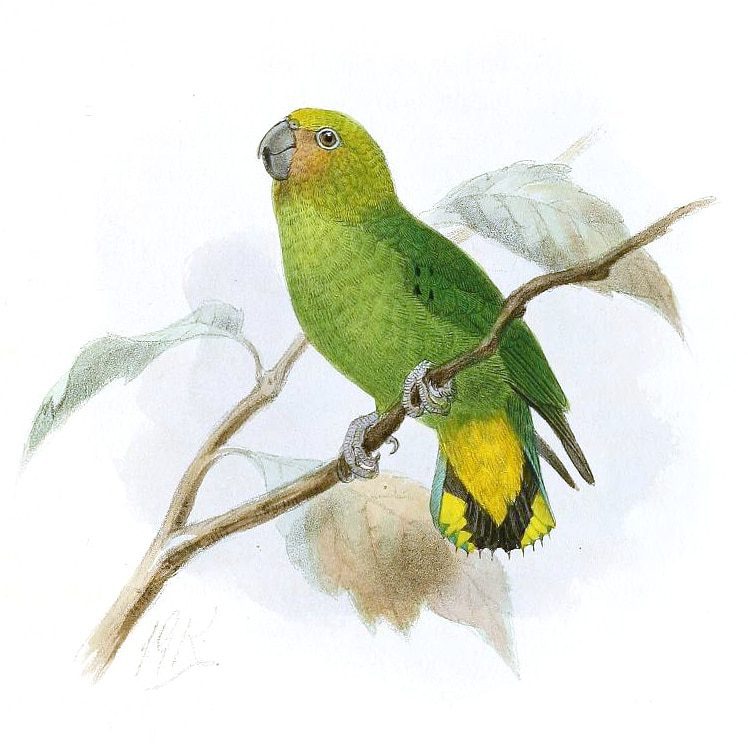
The crown of the Yellow-capped Pygmy-Parrot (Micropsitta keiensis) is yellow ocher, with a warm brown in forecrown; lores, chin and area under the eyes, brown; coverts outpus, dark green, tending to lighter green on cheeks and throat.

Upperparts, dark green with center at wing-coverts and feathers of black color with a black colored margin extrecho; flight feather black with vane Green external; feathers wings green. The underparts are yellowish-green, with fine dark stripes; undertail-coverts yellow and green. Upper, the tail It is iridescent, slightly greenish blue in the Center, Foreign feathers blackish with yellow spot on the ends. Under, the tail dark blue and yellow.

Bill dark grey; irises brown; legs dark gray.

Both sexes similar.
Immature like females but with bill pale yellow.

Description 3 subspecies

  • Micropsitta keiensis keiensis

    (Salvadori, 1876) – the subspecies nominal.


  • Micropsitta keiensis viridipectus

    (Rothschild, 1911) – Similar a nominal, but darker.


  • Micropsitta keiensis chloroxantha

    (Oberholser, 1917) – The mature more muted. The underparts with red markings male, dyed yellowish in female.

Habitat:

Yellow-capped Pygmy-Parrot

It inhabits in the forests of lowlands, in secondary growth and, sometimes around inhabited areas and coconut trees. The ecology species is similar to that of the Buff-faced Pygmy-Parrot. The birds are alone, in pairs or in small groups, and they can be distributed by undergrowth to some 20 meters above the ground. They climb on trunks and branches, and they can go down head, in inverted position, sometimes.

Reproduction:

Nest and roost Termites in tree cavities, they excavate the cavity by themselves; tunnel passageways go up and may bend before reaching nest-chamber. up the laying two white eggs deposited in a cavity unlined (dimensions around 20 cm x 15 cm.), and they can be occupied by other adults roost (up to four) during the breeding season. The exact role of these visiting birds is unknown, It is thought that they can help with the tasks of nest. nesting It has been recorded from October to March

Food:

With feed lichen, fungi, seeds, fruits and insects. Most of the lichen is collected directly from the surface of the bark of trees..

Distribution:

Size of its range (breeding/resident): 763.000 km2

The Yellow-capped Pygmy-Parrot is distributed among the papuan islands, in the West area, including Waigeo, give, Kofiau, Salawati and Misool; through Vogelkop and Onin Peninsula (Province of West Papua); in the Kai and islas Aru, and in the South of New Guinea between Mimika and the fly river. The species is common to local scale.

Distribution 3 subspecies:

Conservation:


minor concern


• Current IUCN Red List category: Least concern

• Population trend: Stable

The size of the world population It has not been quantified, It is estimated over the 100,000 specimens.

The species, according to sources, It is considered very common within its range (pit et to the. 1997).

The population suspected to be stable in the absence of evidence of any reduction or substantial threats.

"Yellow-capped Pygmy-Parrot" in captivity:

Not usually survive in captivity.

Alternative names:

– Yellow-capped Pygmy-Parrot, Yellow capped Pygmy Parrot, Yellow-capped Pygmy Parrot (ingles).
– Micropsitte pygmée (French).
– Gelbkappen-Spechtpapagei (German).
– Micropsitta keiensis (Portuguese).
– Microloro de Kai, Microloro de las Kai (español).

scientific classification:

– Order: Psittaciformes
– Family: Psittaculidae
– Scientific name: Micropsitta keiensis
– Citation: (Salvadori, 1876)
– Protonimo: Nasiterna keiensis

Images "Microlyro of the Kai":

Videos "Microloro de las Kai":

————————————————————————————————

Yellow-capped Pygmy-Parrot (Micropsitta keiensis)


Sources:

– Avibase
– Parrots of the World – Forshaw Joseph M
– Parrots A Guide to the Parrots of the World – Tony Juniper & Mike Parr
– Birdlife

– Photos:

(1) – Parrot-birds – link
(2) – « NasiternaPygmaeaFKeulemans » par John Gerrard Keulemans — Ornithological Miscellany. Volume 1. Licensed public via domain Wikimedia Commons.

– Sounds: Hans Matheve (Xeno-canto)

â–· The world of Pets: Dogs, cats, birds, reptiles, amphibians

Camiguin Hanging Parrot
Loriculus camiguinensis


Loriculo the Camiguin

Content

Description

14 cm.. length.

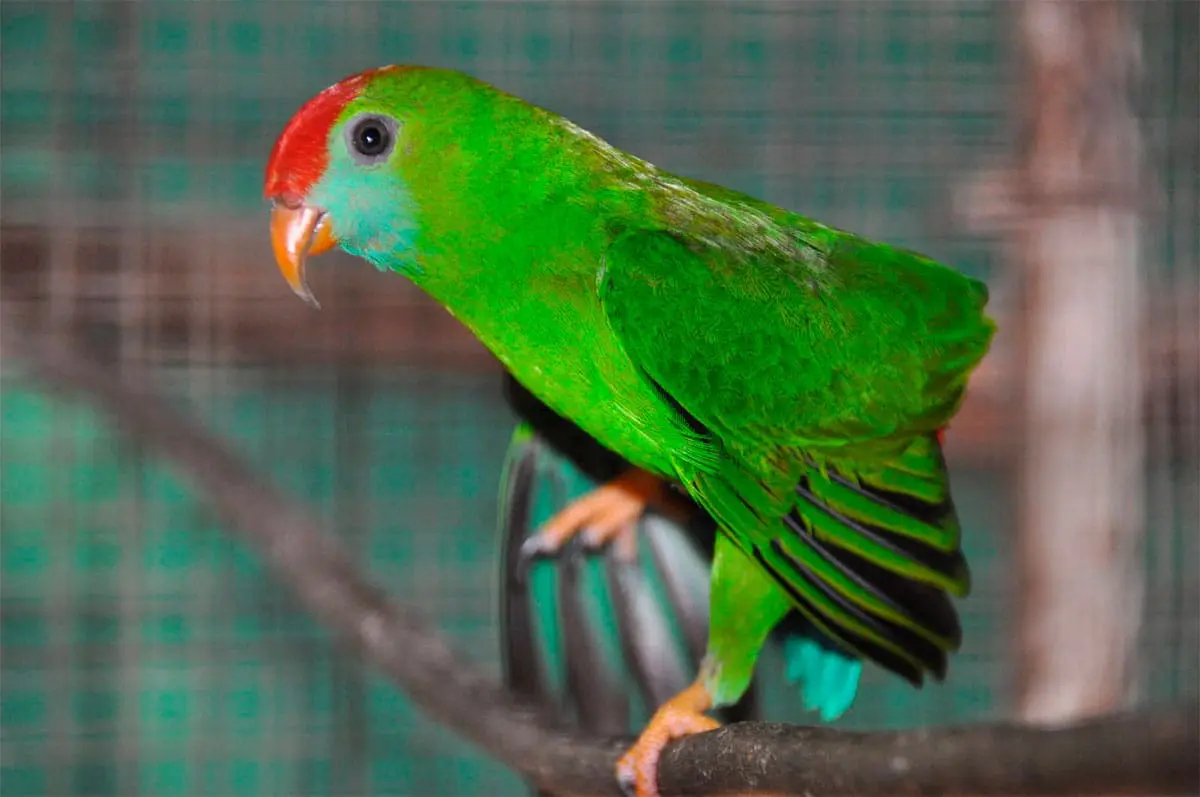
The Camiguin Hanging Parrot (Loriculus camiguinensis) has the plumage mostly green, with the throat, front side of the face and the thighs light blue; the forecrown, the pyleus, the obispillo and the top of the tail red, While the rest of the tail It is also blue. Underwing coverts blue. Band of orange-red in the nape, that varies from bird to bird.

Bill orange. Iris grayish brown.

The males and females they have a similar appearance, the female has less blue on the cheeks.

The youth they are similar to the adult female but with only a slight tinge of blue in the cheeks and red on the forehead minimal or absent. Bill a pale.

In 2006 described as a separate species to the loricles who lived on the island of Camiguin, to the North of Mindanao, Since then it was considered a subspecies of the Philippine loricle in the.

Habitat:

Probably sedentary. Found between the 300 and 1350 meters in montane forests, secondary forests, at the edges of the forest near the settlements, in plantations in the areas planted with shrubs and coconut.

Usually seen individually, in pairs, mixed flocks or small families. Feeds in trees or shrubs; difficult to detect. It´s shy and cautious.

Reproduction:

Breeding season probably between the months of September to November. Nest placed in the hole of a dead arbol-helecho. No other information.

Food:

It is said that they feed on nectar, seeds, especially wild banana (Musa), also soft fruit, berries and flowers.

Distribution:

Endemic in the Philippine island of Camiguin, off the North coast of Mindanao.

Conservation:


minor concern


This species is threatened by its limited range, the natural habitat destruction and capture for the wild bird trade.

"Camiguin Hanging Parrot" in captivity:

Probably not remain outside the island of Camiguin.

Alternative names:

– Camiguin Hanging-parrot, Camiguin Hanging Parrot (ingles).
– Coryllis de Camiguin (French).
– Camiguin-Fledermauspapagei, Camiguinpapageichen (German).
– Loriculus camiguinensis (Portuguese).
– Lorículo de Camiguin (español).

scientific classification:

– Order: Psittaciformes
– Family: Psittaculidae
– Genus: Loriculus
– Scientific name: Loriculus camiguinensis
– Citation: Tello, Degner, Bates,JM & Willard, 2006

Images "Camiguin Hanging Parrot"

Videos "Camiguin Hanging Parrot"

————————————————————————————————

"Camiguin Loricle" (Loriculus camiguinensis)


Sources:

– Avibase
– Parrots of the World – Forshaw Joseph M
– Parrots A Guide to the Parrots of the World – Tony Juniper & Mike Parr
– Wikipedia

– Photos:

(1) – By Alexkant – zoochat

– Sounds: George Wagner (Xeno-canto)

â–· The world of Pets: Dogs, cats, birds, reptiles, amphibians

Sangihe hanging parrot
Loriculus catamene

Sangihe hanging parrot

Content


Anatomy-parrots

Description

12 to 13,5 cm.. length.

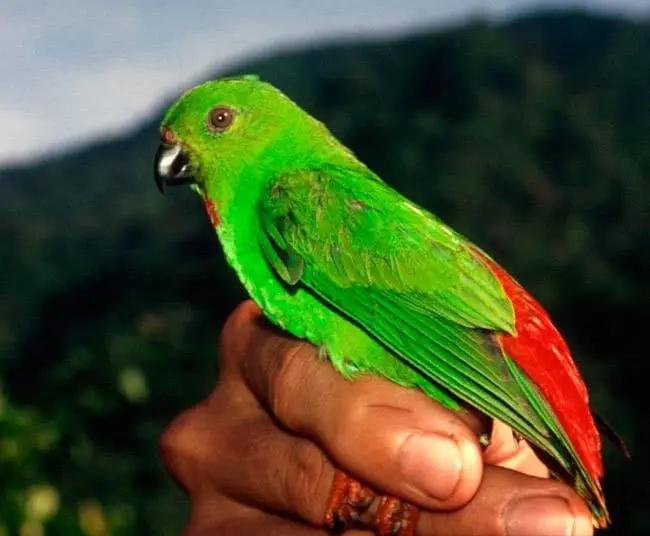
The Sangihe hanging parrot (Loriculus catamene) has the head Green with the front of the crown and the bib red. Upperparts Green with light wash of color orange in the the mantle; rump and long tail coverts red. Wings green, slightly dark; carpal edge brighter yellowish green. The flight feather blue with green coverts.

The underparts Green with the belly Beige and tail coverts of color red marked in green. Upper, the tail of color green with lips Red; Blue below. The bill black; irises brown; legs orange.

The female not have the Red of the crown; the Red of the bib reduced to a few points, and green the coverts infracaudales.

The immature with carpal edge yellow, lack of crown red, But if the bib red.

Habitat:

Found in pairs or in small groups on them flowers of coconut and shrub in flower, and groups of up to four birds found with greater frequency in plantations mixed. The species is has adapted to habitats side and their main source of food seems to be the nectar of coconut. One roost of 17 birds is the largest group reported.

Reproduction:

One nest with two eggs is noted in 1985, little more is known of the habits reproductive of this species.

Food:

Their main source of food is the nectar of coconut.

Distribution:

Size of the area of distribution (reproduction / resident): 700 km2

endemic to the Sangir Islands. Most of the original vegetation in Sangir, It has now been replaced by plantations of coconut and nutmeg, and secondary vegetation of the abandoned gardens. Observations during mid of 1980 showed that it is quite common in coconut forests, and two pairs were observed in the steep volcanic slopes covered with trees in 1986. In 1995, the species was recorded of all forest habitats on the island from sea level up to around the 900 m (also be meeting around Tahuna). The birds are observed more frequently in fragments of forest and coconut plantations.

Conservation:


Near-threatened


• Current IUCN Red List category: Near threatened

• Population trend: Decreasing

There are few data on recent trends, but not there is evidence of a continuous decrease and given your apparent tolerance to different secondary habitats, the declines in their population may have been insignificant.

The population of the Sangihe hanging parrot It is estimated between 10.000 and 46.000 specimens.

The original forest in Sangihe It has been almost completely replaced by the crop, but the species appears to be tolerant to degraded habitats and cultivated areas and there is no evidence of a continuous decrease. Other potential threats include the widespread settlement of large trees in the Decade of 1980, the escaped parrots-borne disease and the volcanic activity in the future (Riley 2002).

"Sangihe hanging parrot" in captivity:

Is not usual.

Alternative names:

– Sangihe Hanging-Parrot, Sangihe Hanging Parrot, Sangir Hanging Parrot (ingles).
– Coryllis des Sangi, Coryllis de Sangihe (francés).
– Rotsteisspapageichen (alemán).
– Loriculus catamene (portugués).
– Lorículo de la Sangihe, Lorículo de Sangihe (español).

scientific classification:

– Order: Psittaciformes
– Family: Psittaculidae
– Genus: Loriculus
– Scientific name: Loriculus catamene
– Citation: Schlegel, 1871
– Protonimo: Loriculus catamene

Images "Sangihe hanging parrot"

————————————————————————————————

«Sangihe Loricle» (Loriculus catamene)


Sources:

– Avibase
– Parrots of the World – Forshaw Joseph M
– Parrots A Guide to the Parrots of the World – Tony Juniper & Mike Parr
– Birdlife

– Photos:

(1) – Photographer: © Jon Riley – Oriental Bird Images

– Sounds: Hanom Bashari (Xeno-canto)

â–· The world of Pets: Dogs, cats, birds, reptiles, amphibians

Great hanging parrot
Loriculus stigmatus

Great hanging parrot

Content

Description

15 cm.. length between 28 and 35 g. of weight.

The head of the Great hanging parrot (Loriculus stigmatus) is bright green, with bright red crown ending in a clear line across the rear of the crown not extending over the nape.

Green upperparts, lightly impregnated with yellowish-orange in the mantle; rump and uppertail coverts dark crimson. green wings; edge of the carpal bones with small red mark. The underwings of turquoise blue with small green coverts. The lower parts of bright green with red stripe below the Chin and throat Center. Upper, the Green tail; light blue below.

the black beak; pale-yellow IRIS; Pink-Orange legs.

Females lack Red Crown and has a narrow red bib; Iris can be darker.

Young birds lack the Red Crown, It has a bib less clear and more yellowish, yellow edges of the Carpus, and in general a duller Green.

Subspecies

Slight differences in the degree of the orange-yellow colour in the mantle of some populations of the island are not considered sufficient to differentiate them.

    • Loriculus stigmatus stigmatus : The nominal.

    • Loriculus stigmatus croconotus

    • Loriculus stigmatus quadricolor

Habitat:

Little is known about the ecology of the species.. Possible seasonal movements have been observed. According to reports, not found in old-growth forest and most common along forest edges, in the open field, and sometimes around urban centers, until 1.000 meters above sea level. Birds move usually alone or in pairs, whether it is flying above or feeding on the trees in flower. Nest-holes in thick bamboo have been recorded.

Reproduction:

Reproductive activity has been reported in February, from April to June, and in August and October
The Great hanging parrot nests in cavities. It usually lays three eggs. The female incubates the egg during 20 days and after hatching the chicks take time to develop 33 more days

Food:

The diet includes fruits and nectar.

Distribution:

common in Sulawesi, since the minahassa peninsula in the North, including Bangka and Islands Lembeh, to the South, also where in Muma and Button on the high seas. They are also found in the Togian Islands.

Of the three subspecies, including the nominal:

    • Loriculus stigmatus stigmatus – Müller, S, 1843 – Celebes

    • Loriculus stigmatus croconotus – Jany, 1955 – Buton Islands and Muna

    • Loriculus stigmatus quadricolor – Walden, 1872 – Togian Islands.

Conservation:


minor concern


– Current IUCN Red List category: Least concern
– The population trend: Stable

The size of the world's population has not been quantified, Although it is estimated above 100.000 specimens. The species is reportedly common and widespread in most of its range. (pit et to the. 1997).

The population is suspected to be stable in the absence of evidence of any reduction or substantial threats.

"Great hanging parrot" in captivity:

Rare.

Alternative names:

– Sulawesi Hanging-Parrot, Black-billed Hanging-Parrot, Celebes Hanging Parrot, Celebes Hanging-Parrot, Celebes Spotted Hanging-Parrot, Great Hanging Parrot, Maroon-rumped Hanging-Parrot, Red-capped Hanging-Parrot, Sulawesi Hanging Parrot (ingles).
– Coryllis des Célèbes (French).
– Rotplättchen, Rotlättchen (German).
– Lorículo do Célebes (Portuguese).
– Lorículo Celebiano, Lorículo de Célebes (español).

scientific classification:

– Order: Psittaciformes
– Family: Psittaculidae
– Scientific name: Loriculus stigmatus
– Citation: (Muller,S, 1843)
– Protonimo: Psittacus (Psittacula) stigmatus

Images "Celebes Lorcle":

Videos "Great hanging parrot"

————————————————————————————————

Sources:

– Avibase
– Parrots of the World – Forshaw Joseph M
– Parrots A Guide to the Parrots of the World – Tony Juniper & Mike Parr
– Birdlife

– Photos:

(1) – By Lip Kee Yap [CC BY-SA 2.0], via Wikimedia Commons
(2) – male perched. by iggino – lynx
(3) – Birds-pet-wallpapers – link
(4) – male hanging by iggino – lynx
(5) – By F. Schulter – papageien.org

– Sounds: Frank Lambert (Xeno-canto)

â–· The world of Pets: Dogs, cats, birds, reptiles, amphibians

Bismarck hanging parrot
Loriculus tener


Bismarck hanging parrot

Content

Description

Measured around 10 cm.. length and approximately 12 g. of weight.

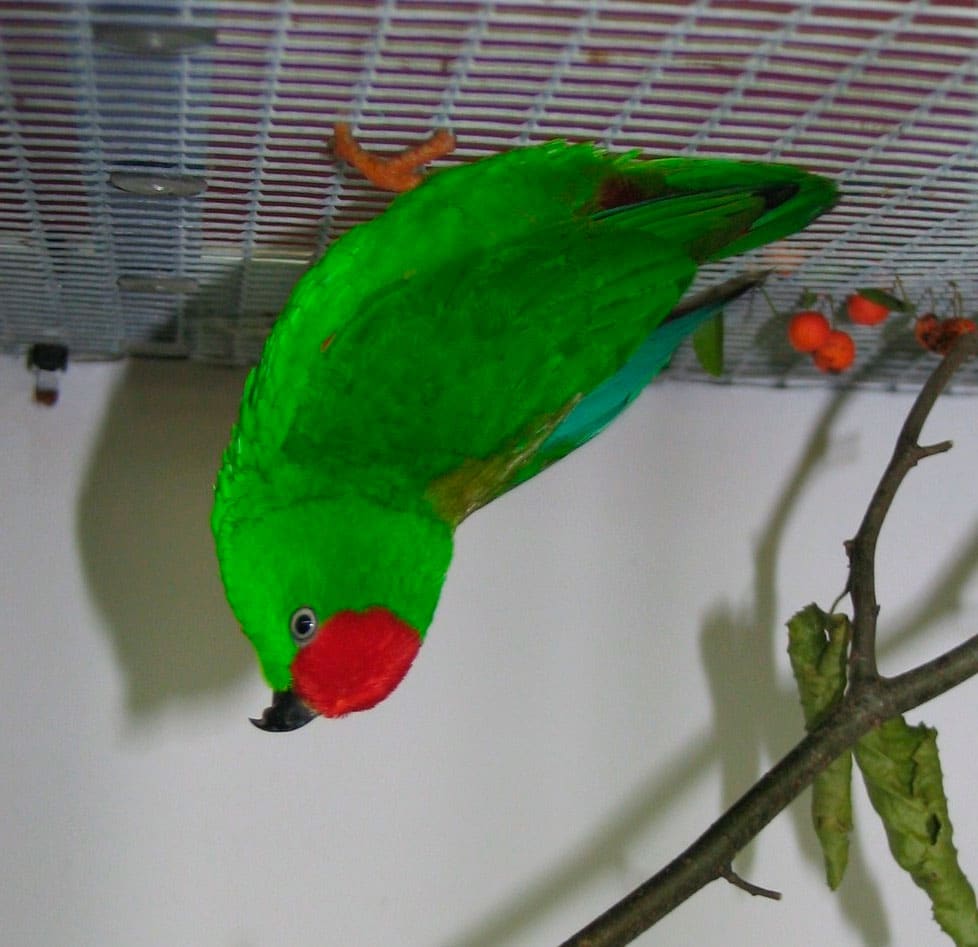
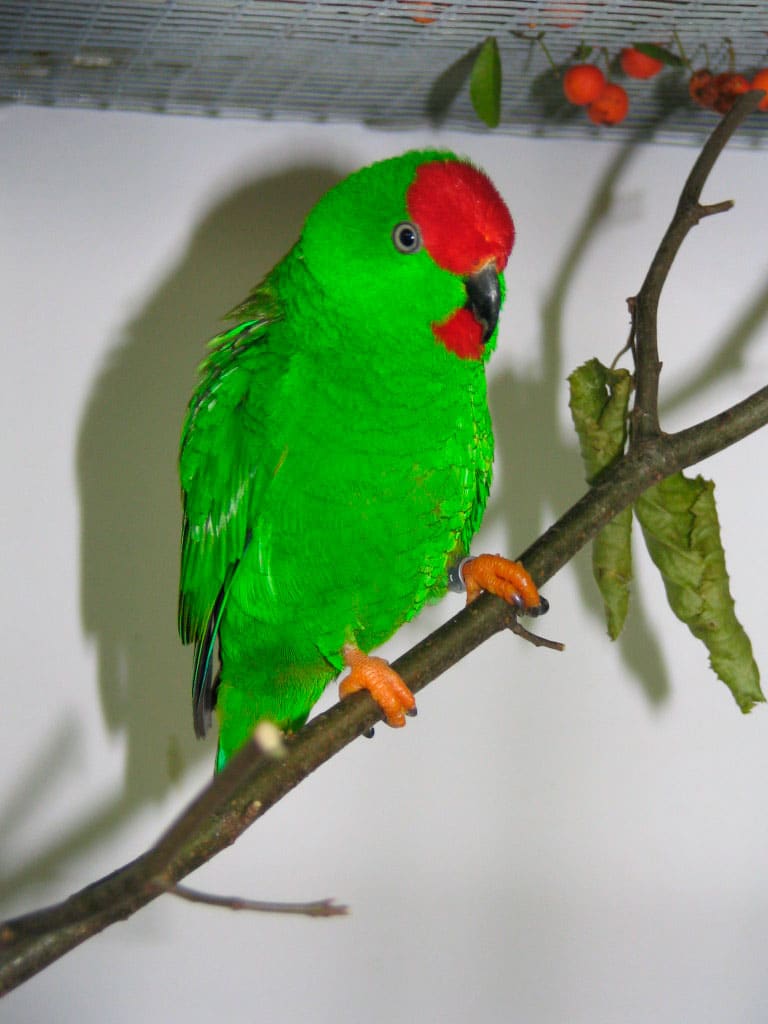
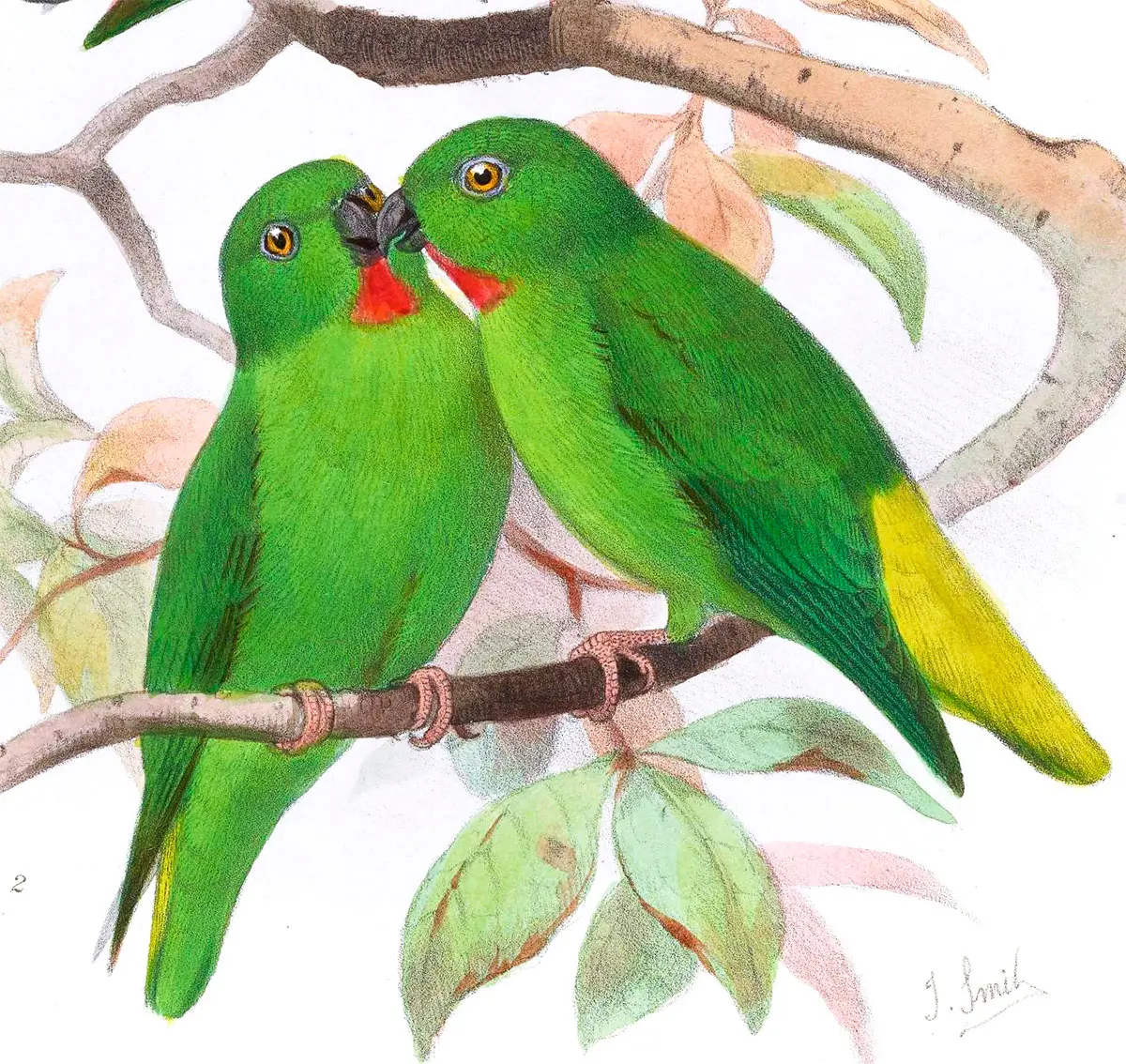
The head of the Bismarck hanging parrot (Loriculus tener)(Loriculus tener) is green. Upperparts Green except for the rump and upper coverts of the tail that are yellowish-green. The wings they are green with vane internal darker towards the flight feather.

Under, the wings blue with Feather coverts green. Chin red orange; rest of the underparts green. Upper, the tail green, pale blue view from below.

The bill black; irises yellowish white; legs yellowish brown.

The female have the front part of the crown and face blue.

The young birds they lack the orange patch of the throat and your bill is pale-brown.

Habitat:

A species very little known. Has been recorded along of the edge of forests and partially cleared from the lowlands up to the low hills areas.

Reproduction:

There is practically no information. Only a nest found, in the stump of one areca palm.

Food:

There is practically no information, but it is suspected that they feed on flowers and small fruit, usually, alone or in pairs, and often hung upside down.

Distribution:

Size of the area of distribution (reproduction / resident): 26.300 km2

Endemic to the Islands in the Bismarck Archipelago, registered in New Britain, New Ireland, Duke of York and New Hanover.

Conservation:


Near-threatened


• Current IUCN Red List category: Near threatened

• Population trend: Decreasing

This little known species is classified as Near-threatened, Since it is believed that it has a moderately low population that is limited to the lower forests. These areas are developing rapidly in oil palm plantations and therefore the population is undoubtedly decreasing.

In New England, clearing of lowland forests for conversion to oil palm plantations has been intense in recent decades.

The population size is between the 10.000 and 19.999 mature individuals.

"Bismarck hanging parrot" in captivity:

Usually they are not in captivity.

Alternative names:

– Green-fronted Hanging Parrot, Bismarck Hanging Parrot, Bismarck Hanging-parrot, Green fronted Hanging Parrot, Green-fronted Hanging-Parrot (ingles).
– Coryllis des Bismarck, Coryllis à front vert, Coryllis des Bismark (French).
– Bismarckpapageichen, Goldstirnpapageichen, Zartpapageichen (German).
– Lorículo de las Bismarck (español).

scientific classification:

– Order: Psittaciformes
– Family: Psittaculidae
– Genus: Loriculus
– Scientific name: Loriculus tener
– Citation: Sclater,PL, 1877
– Protonimo: Loriculus tener

Images «Bismarck's Parrot»:

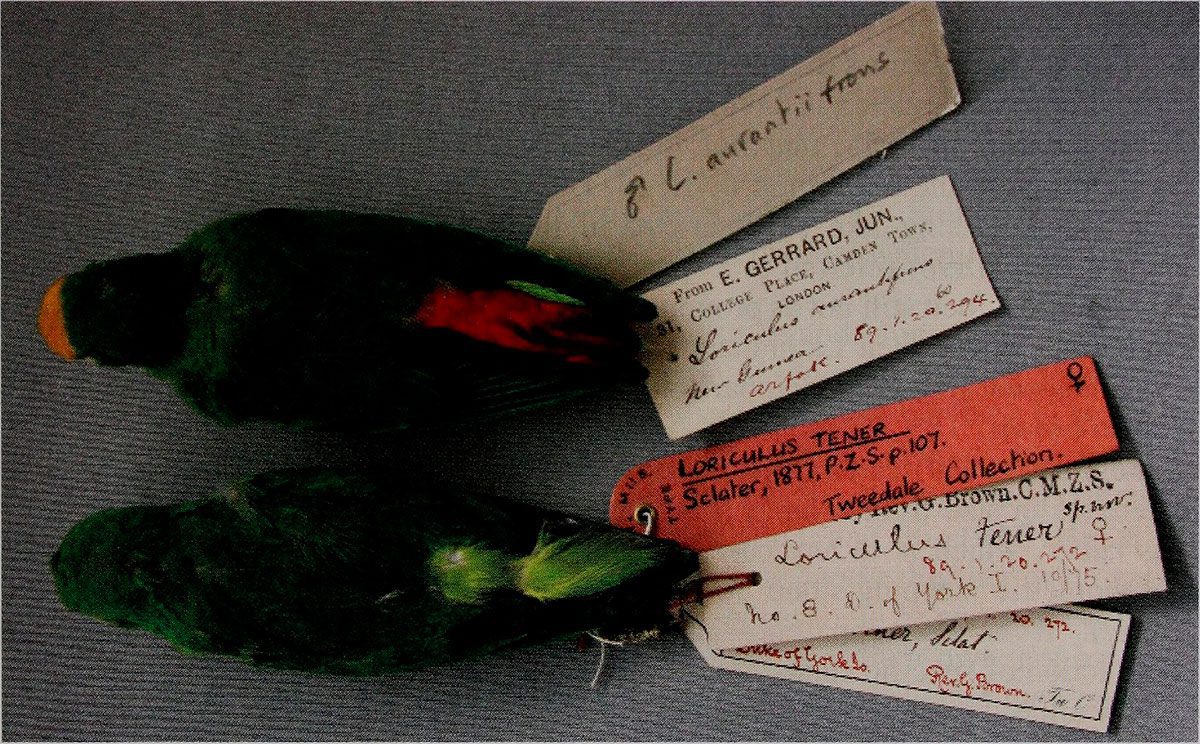
Loriculus tener. Image from page 18 of "Bulletin of the British Ornithologists' Club" (2007) - (N. J. Collar © Natural History Museum)
Loriculus tener. Image from page 18 of «Bulletin of the British Ornithologists’ Club» (2007) – (N. J. Collar © Natural History Museum)

————————————————————————————————

"Bismarck's Parrot" (Loriculus tener)


Sources:

– Avibase
– Parrots of the World – Forshaw Joseph M
– Parrots A Guide to the Parrots of the World – Tony Juniper & Mike Parr
– Birdlife

– Photos:

(1) – «Loriculus tener Smit» by Joseph Smit – Ornithological Miscellany. Volume 2. Licensed under Public Domain via Wikimedia Commons – http://Commons.wikimedia.org/wiki/file:Loriculus_tener_smit.jpg#mediaviewer/file:Loriculus_tener_smit.jpg

â–· The world of Pets: Dogs, cats, birds, reptiles, amphibians

Green-rumped Parrotlet
Forpus passerinus


Green-rumped Parrotlet

Content

Description:

Green-rumped Parrotlet

13-14 cm.. height.

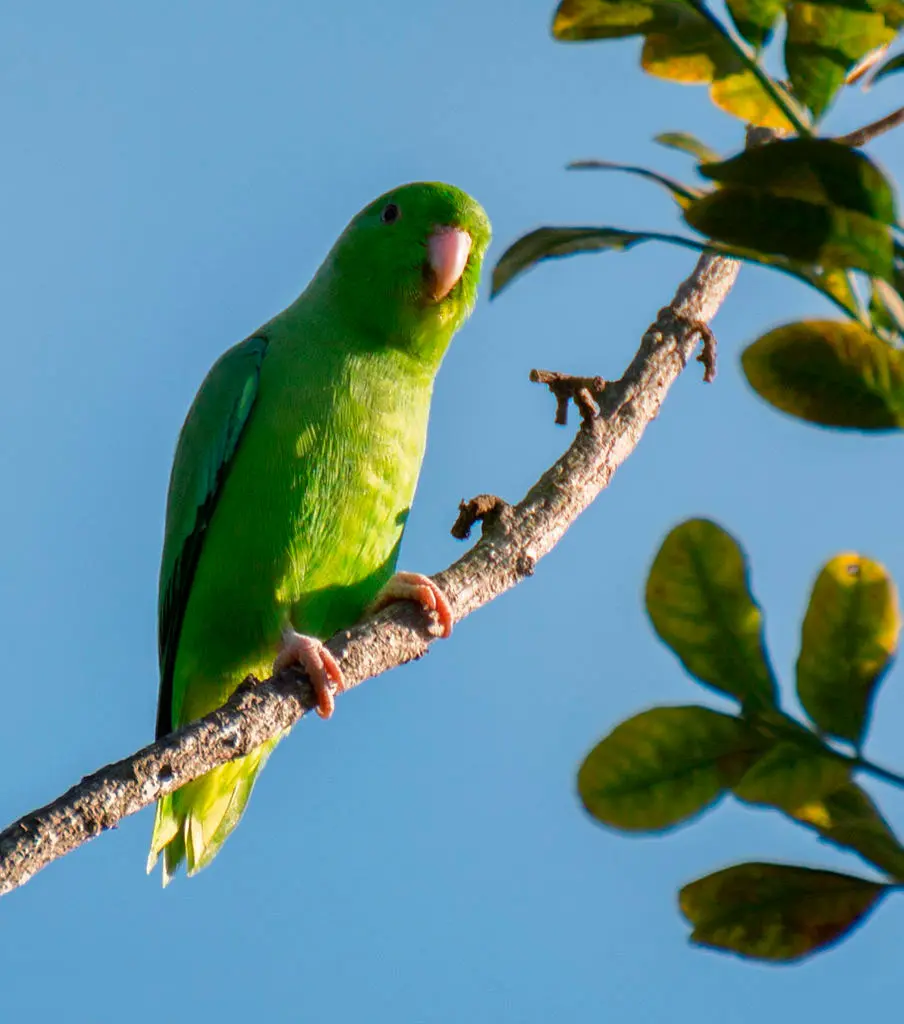
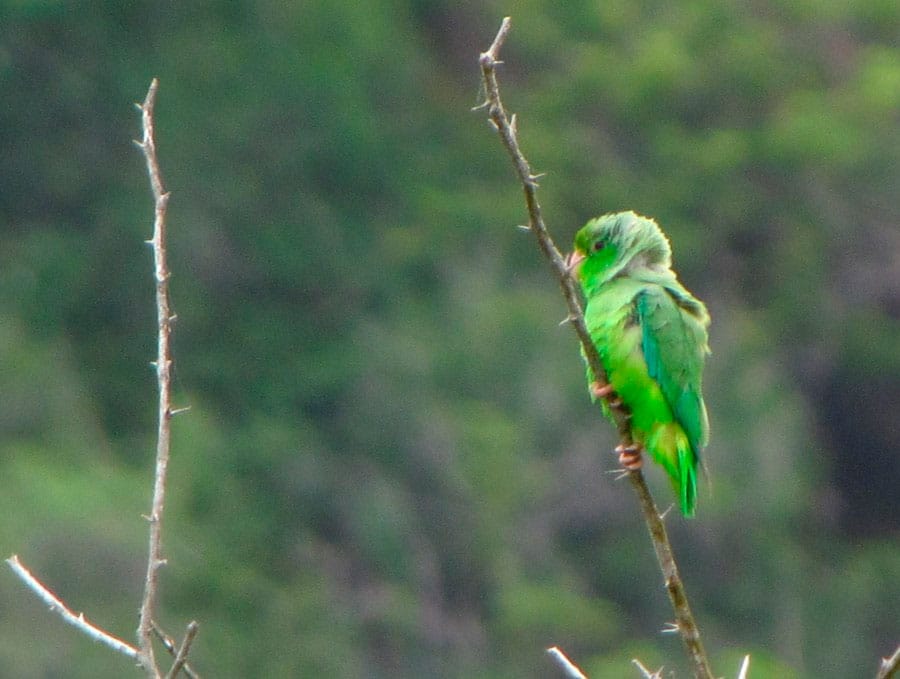
The Green-rumped Parrotlet (Forpus passerinus) is the psittacine smaller that can be found on the American continent. It is distinguished by being green, with a brighter green in the front, cheeks, lower part of the body and behind the neck; the rump bright green in the two sexes, wing with one Strip Turquoise Blue followed by another greenish-blue in males; belly lighter than the back, tail with yellow border.

Female with rump greenish-yellow and wings without blue. It is possible to have dyes more yellowish forehead.

Subspecies description:
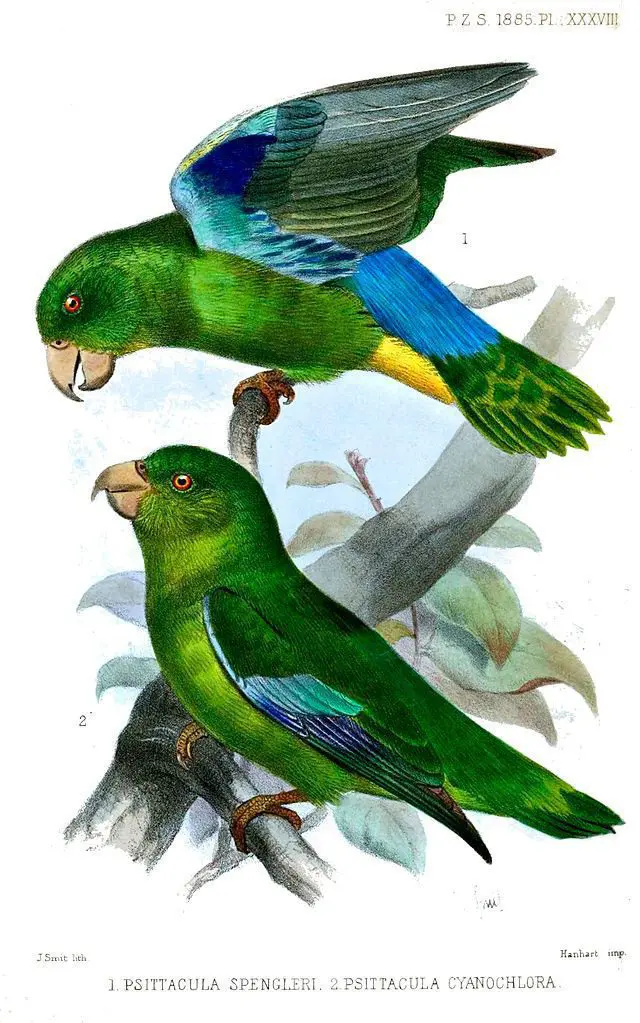
  • Forpus passerinus cyanochlorus

    (Schlegel, 1864) – Also known as Parrotlet Schlegel. Similar to the subspecies Forpus passerinus passerinus, but the feathers of the tail of the female they are more green in the bottom. Also it has more yellow along the forecrown .


  • Forpus passerinus cyanophanes

    (Todd, 1915) – Show more blue with the wing closed in the other subspecies.


  • Forpus passerinus deliciosus

    (Ridgway, 1888) – The male has the rear area Emerald green with blue and pale blue tint at the edge of the the greater wing coverts. Female has more yellow in all the facial area.


  • Forpus passerinus passerinus

    (Linnaeus, 1758) – The nominal.


  • Forpus passerinus viridissimus

    (Lafresnaye, 1848) – Also known as Venezuela green parakeet. The plumage is green in males; in females varies considerably according to the region they inhabit.

Habitat:

It is found in dry forest, semi-open areas, crops, among others, until the 500 m. In flocks of more of 100 individuals. You can perform altitudinal migrations.

Reproduction:

It nests in abandoned nests of woodpeckers or in other holes, from May to November.

Food:

They feed on seeds, including the of the grasses.

Distribution:

Size of the area of distribution (reproduction / resident): 1.060.000 km2

This is a very widespread and common. They are distributed in the northeast of Colombia, North of Venezuela, Guyanas to the northeast of Brazil, also in Curacao, Trinidad and the West Indies.

Subspecies distribution:
  • Forpus passerinus cyanochlorus

    (Schlegel, 1864) – Is located in Roraima, Brazil.


  • Forpus passerinus cyanophanes

    (Todd, 1915) – Are found in the areas around the North of Colombia.


  • Forpus passerinus deliciosus

    (Ridgway, 1888) – Is located in the lower basin of the amazon, in Brazil.


  • Forpus passerinus passerinus

    (Linnaeus, 1758) – The nominal. Found in the Guianas.


  • Forpus passerinus viridissimus

    (Lafresnaye, 1848) – Found in the North of Venezuela, Trindad and Tobago.

Conservation:

State of conservation ⓘ


minor concern Minor Concern ⓘ (UICN)ⓘ

• Current category of the Red List of the UICN: Least concern.
• Population trend: Decreasing.

Justification of the population

The size of the world population It has not been quantified, but this species is described as «common» (Stotz et to the., 1996).

Justification of trend

It is suspected that this species has lost 19,2-21% of habitat within its distribution in three generations (12 years) based on a model of Amazon deforestation (Soares-Filho et to the., 2006, Bird et to the., 2011). Given the susceptibility of the species to hunt or capture, It is suspected that it will fall in <25% durante tres generaciones.

"Green-rumped Parrotlet" in captivity:

It´s common bird cage. In captivity they are sweet and playful. It might be possessive with toys and people.

Alternative names:

– Blue-winged Parrotlet, Common Parrotlet, Green rumped Parrotlet, Guiana Parrotlet, Guianan Parrotlet, Passerine Parrotlet (English).
– Toui été, Perruche-moineau de Guyane (French).
– Grünbürzel-Sperlingspapagei (German).
– tuim-santo, periquitinho, periquito-do-espírito-santo, periquito-santo, periquito-tabacú, periquito-vassoura (Portuguese).
– Catita Enana de Lomo Verde, Cotorrita Culiverde, Periquito Coliverde (español).
– Periquito Coliverde (Colombia).
– Periquito Mastrantero (Venezuela).


scientific classification:

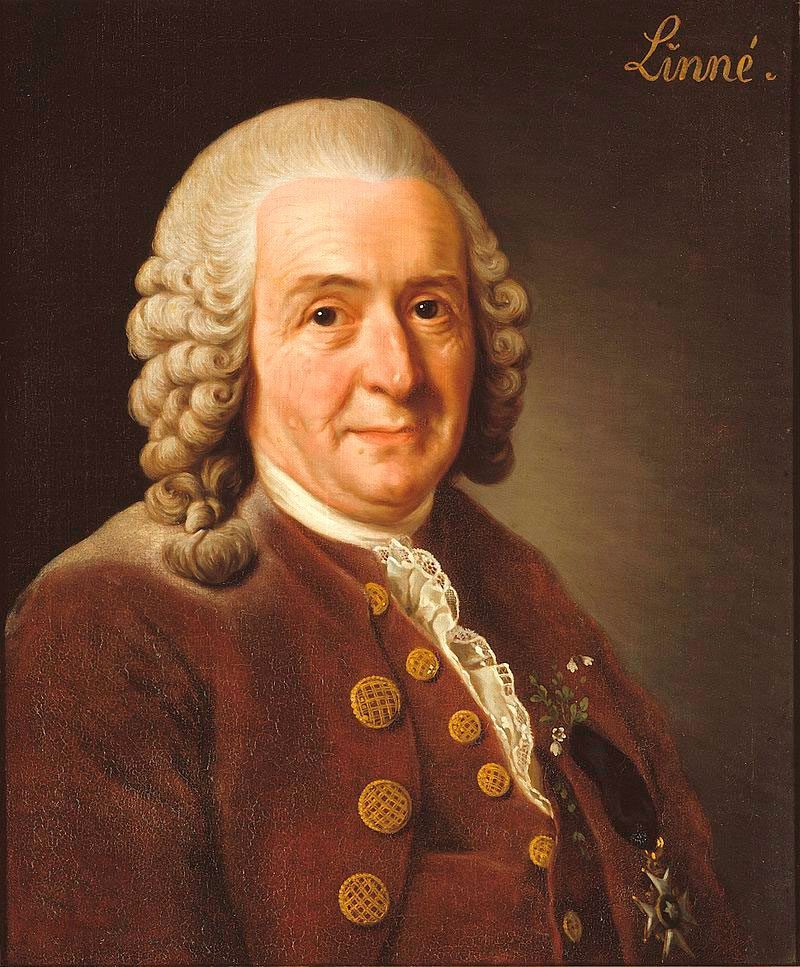
Carl Linnaeus
Carl Linnaeus

– Order: Psittaciformes
– Family: Psittacidae
– Genus: Forpus
– Scientific name: Forpus passerinus
– Citation: (Linnaeus, 1758)
– Protonimo: Psittacus passerinus


Images Green-rumped Parrotlet:

Videos of the "Green-rumped Parrotlet"


Species of the genus Forpus

Green-rumped Parrotlet (Forpus passerinus)


Sources:

– Avibase
– Parrots of the World – Forshaw Joseph M
– Parrots A Guide to the Parrots of the World – Tony Juniper & Mike Parr
– Birdlife
– Parrot Book, Parrots and macaws Neotropical

– Photos:

(1) – Forpus passerinus in Trinidad 2014, Caribbean By Jam.mohd (Own work) [CC BY-SA 4.0], via Wikimedia Commons
(2) – Photograph of pet Green-rumped Parrotlet (Forpus passerinus) By self (Own work) [Public domain], via Wikimedia Commons
(3) – Green-rumped Parrotlet, (Forpus passerinus), a pair, male (right) and female (left), in Venezuela By kulyka on flickr (Flickr) [CC BY 2.0], via Wikimedia Commons
(4) – Periquito mastrantero [Green-rumped Parrotlet] (Forpus passerinus viridissimus) by Cristóbal Alvarado Minic – Flickr
(5) – Periquito mastrantero [Green-rumped Parrotlet] (Forpus passerinus viridissimus) by Cristóbal Alvarado Minic – Flickr
(6) – Blue-winged Parrotlet, adult male (above); Green-rumped Parrotlet, young(?) male (below) Joseph Smit [Public domain], via Wikimedia Commons

– Sounds: (Xeno-canto)

â–· The world of Pets: Dogs, cats, birds, reptiles, amphibians

Plum-faced Lorikeet
Oreopsittacus arfaki

Plum-faced Lorikeet

Content

Description

15 cm.. length between 16 and 23 g. of weight.
Plum-faced Lorikeet

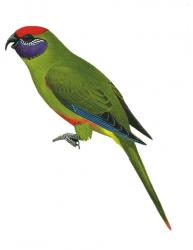
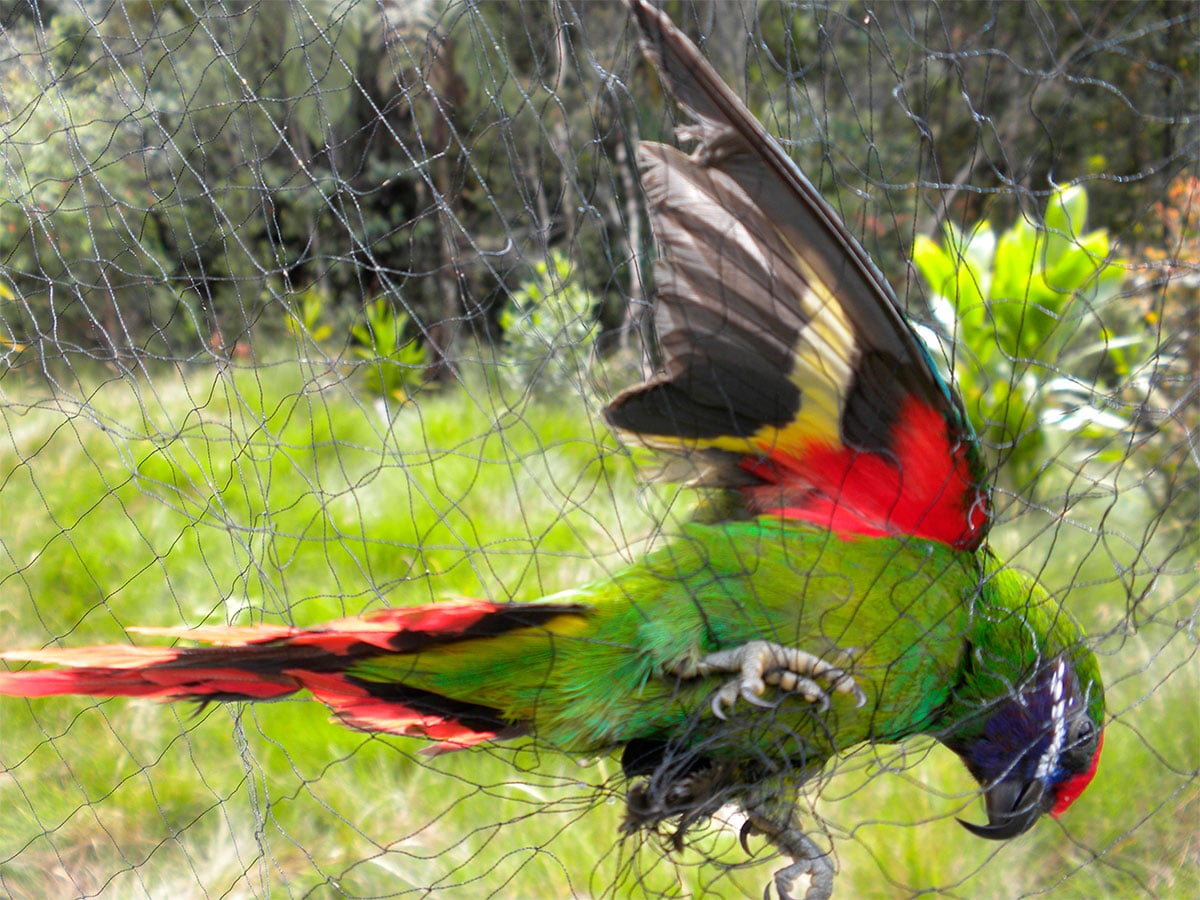
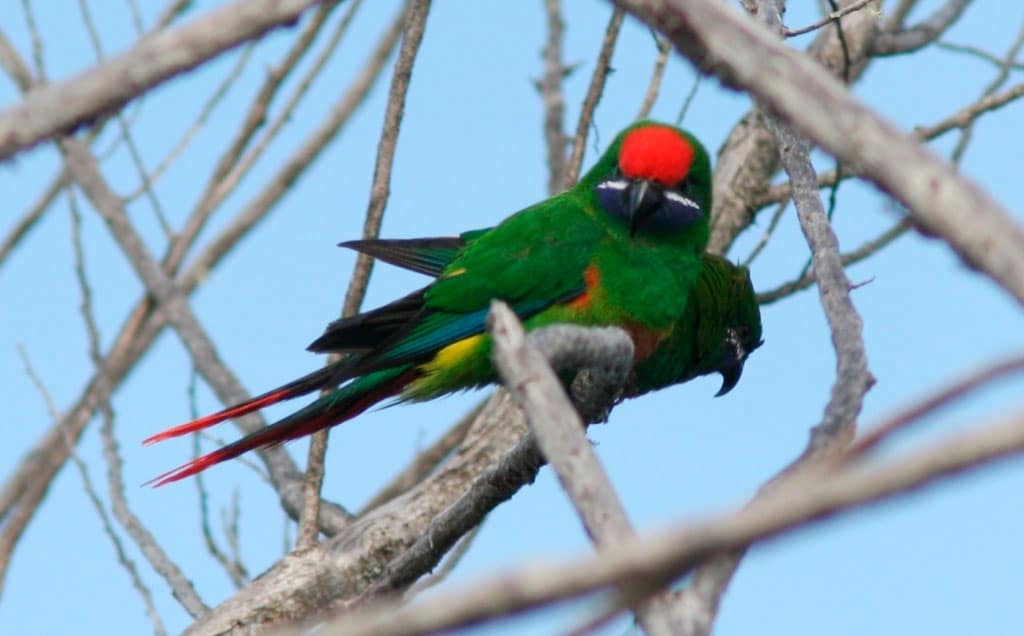
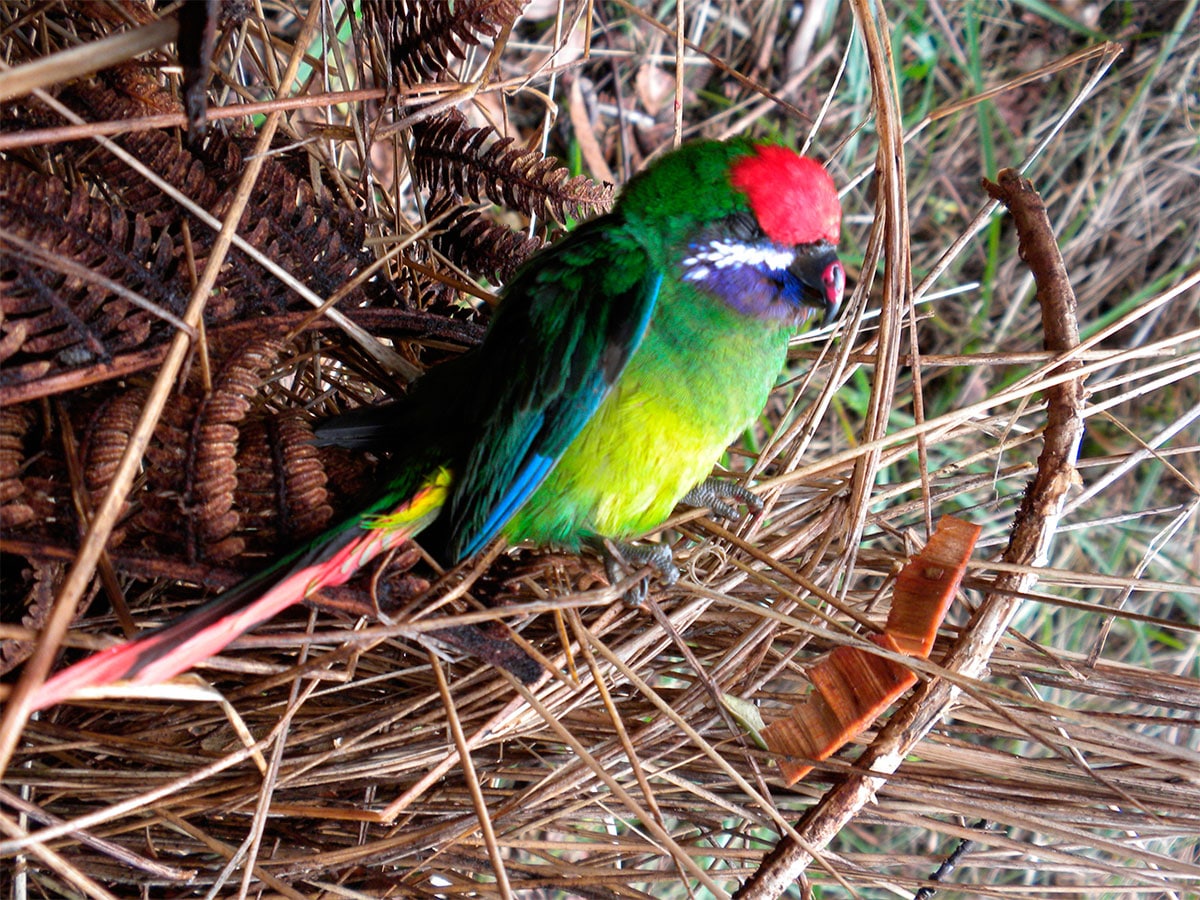
The hood of the Plum-faced Lorikeet (Oreopsittacus arfaki), from the top of bill up to the crown rear, is Scarlet Red ; chin and Spada color plum (with bluish Sheen), broken by two rows of thin stripes.

Upperparts of color green uniform with a light spread of olive in the the mantle. Wings, views from the top are green; vane internal to the flight feather, blackish in color and vane external to the primaries outermost, bluish green. Underwing-coverts and axillary, red (Outer secondaries slightly marked with yellow); flight feather Blackish with yellow central band. The mauve of it chin be extended slightly in the throat; top of the chest green, center of chest and belly bathed in orange-red; under belly green; undertail-coverts green, lightly bathed in yellow on sides. Uppertail green, merging to blackish and ending in pinkish-Red, in the tip lighter fusion: below, the tail is red with marked with black side feathers.

The bill black; irises blackish brown; legs grey.

Female lack of top red (but you can show a bit of red on the part rear of the Crown).

Immature male with only red on the back of the crown. The young birds have a slightly 'scaly' appearance; also off the tip of orange-yellow color of the tail.

Description 3 subspecies

  • Oreopsittacus arfaki arfaki

    (Meyer,AB, 1874) – The nominal.


  • Oreopsittacus arfaki grandis

    : (Ogilvie-Grant, 1895) – Greater than the nominal. Lack of the flanks redorange and markings of the belly of the other two subspecies.


  • Oreopsittacus arfaki major

    : (Ogilvie-Grant, 1914) – Larger that the nominal and more red-tipped in the tail.

Habitat:

The distribution of the Plum-faced Lorikeet is more or less continuous in the extension of the moss forests; the species is mainly found among the 2.000 and 3,750 m, but can observe is to 1.000 m occasionally. Be found with greater frequency in pairs or small flocks very vocal. They feed acrobatically in the canopy; They also feed on plants, especially in the flowers of epiphytes, often in the company of other flower aficionados such as the lories of the genus Neopsittacus.

Reproduction:

Habits of nesting unknown, birds in reproductive attitudes they have been observed in August and October. The display of marks under the wings have been observed in pairs and can be linked to courtship, as well as by the male head rolling.

Food:

It feeds on pollen, nectar, possibly, flowers, fruit (especially Schefflera) and berries.

Distribution:

Size of the area of distribution (reproduction / resident): 108.000 km2

New Guinea in Irian Java (Indonesian) and Papua New Guinea, ranging from the East ofVogelkop to the Huon Peninsula and ranges from the Southeast. A small number of captivity

Distribution 3 subspecies:

  • Oreopsittacus arfaki arfaki

    (Meyer,AB, 1874) – The nominal.


  • Oreopsittacus arfaki grandis

    : (Ogilvie-Grant, 1895) – Mountains of the Central and East of Papua New Guineto, including, those in the southeast of the region of the Huon Peninsula and Sepik, extending to the West of Victor Emanuel Range


  • Oreopsittacus arfaki major

    : (Ogilvie-Grant, 1914) – Snow Mountains (Papua New Guinea)

Conservation:


minor concern

• Current IUCN Red List category: Least concern

• Population trend: Stable

The world population It has not been quantified, Although it is thought of more than 300.000 specimens. The species is reported to be quite common (pit et to the. 1997).

The population suspected to be stable in the absence of evidence of any reduction or substantial threats.

"Plum-faced Lorikeet" in captivity:

The Plum-faced Lorikeet is a bird quiet and at times active. Young birds are susceptible to stress and disease during the acclimatization; can die suddenly without apparent cause. They become much more resistant and less timid after acclimatization.. You can be accommodated with members of their own species in a system of colony.

It is very rare in captivity.

Alternative names:

– Plum-faced Lorikeet, Plum faced Lorikeet, Plum-faced Mountain Lory, Plum-faced Mountain-Lory, Whiskered Lorikeet (ingles).
– Lori bridé (French).
– Arfaklori, Arfakalori (German).
– Lori Bigotudo, Lori de Bigotes (español).

scientific classification:

– Order: Psittaciformes
– Family: Psittaculidae
– Genus: Oreopsittacus
– Scientific name: Oreopsittacus arfaki
– Citation: (Meyer,AB, 1874)
– Protonimo: Trichoglossus (Charmosyna) Arfaki

«Whiskered Lory» Images:

Videos "Plum-faced Lorikeet"

————————————————————————————————

«On Bigotry» (Oreopsittacus arfaki)


Sources:

– Avibase
– Parrots of the World – Forshaw Joseph M
– Parrots A Guide to the Parrots of the World – Tony Juniper & Mike Parr
– Birdlife

– Photos:

(1) – Dansk Lori Klub
(2) – arfak lori man oreopsittacus arfaki – photobucket
(3) – By Katerina Tvardikova – pngbirds.myspecies.info
(4) – By Guy Dutson – lynx
(5) – By Katerina Tvardikova – pngbirds.myspecies.info
(6) – Illustration – HBW.com

– Sounds: Patrik Ã…berg (Xeno-canto(