Of 16 cm in length and a weight between 49 and 66 g..
The Black-winged Lovebird(Agapornis taranta) has the forecrown, lores and feathers eye ring, red; rest of the head and nape green dyed brown. Mantle and green scapulars, rump and uppertail-coverts brighter green. Upper, the wing-coverts green with the exception of coverts outer primaries that they are black. Primaries blackish brown with a narrow green margin towards the vane outer; secondaries black. Under, the wing-coverts black. Chin and throat pale green tinged brown; rest of the underparts pale green. Central feathers of the tail green with toes in black, the green side with yellow in vane inner, subterminal black bar with green tips.
Bill red; irises dark brown; legs grey.
The female no red in the head, and feathers sometimes under the wings marked in green.
The immature are like females, with the bill yellowish. The Immature males show the color black feathers under the wings with red feathers scattered on the forehead.
Partially sympatric and very similar to Red-headed Lovebird (Agapornis pullarius) with which it has an throat red or orange (no verde) and rump blue (no verde). Usually found in small flocks on the tops of tall trees, where the plumage It blends well with the foliage. Its flight It is fast and direct.
Proposal subspecies Agapornis Taranta nanus (Southwest of Ethiopia) supposedly in bill smaller and wings shorter, but generally not accepted. Birds at higher altitudes are larger, but not subspecifically recognized. monotypic.
The Black-winged Lovebird, at high altitudes (1.800-3.800 m), They are linked, normally, mountain forests dominated Podocarpus, Juniperus, Hagenia and Hypericum; below , on the 1.400 m, They found in grassy savannas and forests Acacia, Combretum and Euphorbia; also frequent cultivated areas and peripheries of urban areas Addis Ababa.
gregarious, at least out of breeding season, when usually they found in small flocks (8-20) on the tops of the tallest trees, gathering in greater numbers when food is locally plentiful.
Used communal roosts in tree cavities (often old nests woodpeckers or bearded ethiopian).
The Black-winged Lovebird nest in tree cavities, in holes in walls and even in nests of some Baglafecht Weaver.
In captivity, female leads Nesting material (small pieces of branches, leaves and grass) put in almost any part of their plumage.
The Black-winged Lovebird it's the only one Lovebirds using their own pens to build nest.
The breeding season, according to sources, It between March and November. It is not clear if the egg laying is synchronized with the rainy season. Normally, starting up five eggs, but they can reach eight captive.
Inseparable Power Abyssinian:
The diet release of the Black-winged Lovebird It consists mainly fruit, including Ficus figs and berries juniper.
Perform seasonal movements in relation to food availability.
The Black-winged Lovebird It is not globally threatened, although it is included in Appendix II (Anexo B) of the CITES Convention.
It has a very small distribution area, so you have a greater risk of extinction because if their habitat is destroyed or uncontrolled catches are made can lead to extinction.
considered as crop pest in some areas, though not of great importance, they can become the object of chemical fumigations to avoid their attacks.
However they are more frequent since 1989, perhaps due to reduced sales of this species for the pet trade.
In the news they are not considered endangered, but we must not fail to protect them and avoid both habitat destruction and illegal capture.
The Inseparable Abyssinian in captivity:
Although not as common as other species of Lovebirds (Rosy-faced Lovebird or the Yellow-collared Lovebird), this handsome Lovebirds It has a very pleasant disposition.
They are more tolerant with others Lovebirds, provided they have enough space, and they are one of the least noisy species.
Dwelling, on freedom, high mountain areas, It is not surprising that the Black-winged Lovebird I can tolerate ambient outdoor aviary, as long as they stay out of drafts and temperatures are not too extreme.
birds are relatively resistant, similar to Fischer's Lovebird or the Yellow-collared Lovebird, although they are not as much as Rosy-faced Lovebird.
typical in all Lovebirds, the Black-winged Lovebird is very sociable and loves the companionship. Their natural behavior is to live closely with a partner / a.
Despite being a very sociable pet and tender, they will need a lot of attention if kept separate. The majority They are kept in pairs to satisfy his great need for constant companionship, acicalamiento mortgage, and socialization.
For reproduce in captivity You need tranquility and a spacious and equipped cage at least two nest boxes.
With regard to its longevity, according to sources, a living specimen 14,6 years in captivity. In captivity, these animals are known to breed, approximately, to the 2 years of age.
Alternative names:
– Black-winged Lovebird, Abyssinian Lovebird, Black winged Lovebird (English).
– Inséparable d’Abyssinie, Inséparable à ailes noires, Inséparable taranta (French).
– Tarantapapagei (German).
– Inseparável-de-asa-preta (Portuguese).
– Inseparable Abisinio, Inseparable de Frente Roja, Agapornis Taranta (español).
– Avibase
– Parrots of the World – Forshaw Joseph M
– Parrots A Guide to the Parrots of the World – Tony Juniper & Mike Parr
– Birdlife
– Photos:
(1) – Agapornis taranta – Black-winged Lovebird in the San Diego Wild Animal Park, California By Carlos Urdiales [CC BY-SA 2.0], via Wikimedia Commons
(2) – A male Black-winged Lovebird in a guava tree (eating semiripe) guavas, in Bahir Dar, Ethiopia By Veli Pohjonen (Own photographing in Bahir Dar, Ethiopia) [Public domain], via Wikimedia Commons
(3) – A female Black-winged Lovebird in Ethiopia By Alastair Rae from London, United Kingdom (Black-winged Lovebird) [CC BY-SA 2.0], via Wikimedia Commons
(4) – Inseparable from Abyssinia by avicue
(5) – Black-winged lovebird by mundoexotics
(6) – A painting of a male Black-winged Lovebird (also known as Abyssinian Lovebird) (originally captioned «Psittacula taranta. Abyssinian parrakeet») by Edward Lear 1812-1888 [Public domain], via Wikimedia Commons
Origin: Bolivia, Brazil, Colombia, Ecuador, Guyana, French Guiana, Panama, Peru, Suriname, Venezuela
Character: Intelligent and social
Life expectancy: 40 years
Height: 46 cm..
Content
Description:
46 cm.. length and a weight between 285 and 387 g..
The Chestnut-fronted Macaw(Ara severus) It is a medium-sized Parrot with a plumage predominantly Green.
The male and female are almost identical and juveniles are hardly different from adults.
In the male adult, the feathers of the crown and the neck they are heavily infiltrated blue. The forecrown, chin and the area of the cheeks bordering with the bare skin of the face are brown. The curvature of the wing, carpal edge and small lower coverts are bright red. The bottom of the flight feather shows a dark red-orange color.
The tail is reddish brown with a blue tip. The bill greyish black. The bare skin of the face it is creamy white with fine lines of small black feathers. The irises is yellow, the legs grey.
The youth they are like the of adults, but have the tail shorter and the irises is grey.
The Chestnut-fronted Macaw may be confused with two species: the Blue-winged Macaw, Although this has a frontal band and stain abdominal Red and the Red-bellied Macaw Although it differs by having the facial skin yellow, and the abdomen red. On the other hand, These parrots are smaller and have a yellow color under the wings.
While they are sometimes in clearings or on the edge of this habitat, the Chestnut-fronted Macaw, in general, avoid the great forests never invaded by water. They prefer areas that are periodically flooded, secondary forests, galleries of trees that border the watercourses, oil palm plantations, meadows and pastures where there are still some scattered stands of trees.
It depends on the region, These birds live in very different elevations of up 1000 metres in Colombia, 1500 meters in the South of Ecuador, and only 350 metres in Venezuela.
The Chestnut-fronted Macaw, usually, they live in pairs or in small groups. However they can form large gatherings when dorms are set or when food resources are abundant.
The Chestnut-fronted Macaw, sometimes, they feed in the company of the Red-bellied Macaw (Ara manilata).
During the day, they are essentially arboreal, preferring to remain at the top of the trees and in the canopy, where they remain well hidden in thick foliage. They are best observed at dawn and dusk, as they follow regular routes between their places of rest and feeding sites.
They fly directly, with fast rhythms revealing red underneath his wings stain.
They are birds sedentary. In some mountain areas, However, undertake altitudinal migrations.
Reproduction:
Given the large size of its distribution area and large variation in latitude, nesting takes place at different times depending on the region, from March to may in Colombia, February-March in Panama, and from September to December in Suriname.
These macaws usually They nest in cavities of dead Palm trees, often just above the water, but they can also lay their eggs in a rock crevice.
The spawning usually includes 2 or 3 eggs. There is little information of this bird in the wild, but it is known that in captivity the period of incubation lasts a few 28 days. The reproductive cycle is particularly long, The chicks remain in the nest for a minimum of 9 weeks.
Food:
The Chestnut-fronted Macaw they are exclusively vegetarian. Its diet includes seeds of Hura crepitans, Sapium aureum, Cedrela odorata and Cupania cinerea, the pulp and the seeds of Inga laterifolia, Micropholis melinoneana, Euterpe precatoria and Gulielma, and fruits of Ficus, Cecropia feulla, Caraniana, as well as fruit of different types of fig trees or palms (especially species with small fruits); also flowers of, for example, Ferruleand Erythrina.
The birds are fed into silence in the canopy where they can be difficult to detect.
Distribution:
The Chestnut-fronted Macaw are distributed to the East of Panama and by South America reaching the center of Bolivia.
In East Panama they are in the tropical zone (records in the West to the North of the Canal area they are probably due to leaks), on the slope of the peaceful from the South of the Andes to the South of Ecuador (of Guayas to Pichincha) and in the Northern lowlands of Colombia, South to the upper area of the Valley of Sinu River, extending into the foothills of the Colombian Andes, in the valleys of the Cauca and Magdalena until Antioquia.
To the East of the Andes they occupy the Amazonian lowlands of Colombia, Ecuador, Peru and Bolivia in Peace, Beni, Cochabamba and Santa Cruz, going east of the foothills of the Andes through the West and South of the amazon (Although they are not known in the North of Brazil, for example, in Manaus or along the rivers Negro and Branco).
Propagate through the tropical zone of Venezuela in Zulia and from the West of Apure until Aragua, Northwest of Bolívar and the Amazonas along the Orinoco, reaching the Guianas and Amapá, Brazil.
To the South of the amazon is extended by the Mato Grosso, Brazil. A record to the South of Bahia is not confirmed.
Resident with seasonal movements of altitude in some areas (for example, West of Ecuador and North of Venezuela).
Pretty common throughout much of its range, and while the deterioration of habitat has caused serious decreases in population at the local level (for example, in the Valle del Cauca, Colombia and West of Ecuador), moderate deforestation has resulted in increases in other areas.
Although there are no reports in Guyana Since the beginning of the 19th century, the Chestnut-fronted Macaw they are still common in Suriname, especially in some coastal areas.
The species is kept in captivity, but the demand is not very big.
Conservation:
• Red List category of the UICN current: Least concern
• Population trend: Stable
The Chestnut-fronted Macaw they are quite common throughout much of its range birds. Apparently, they are able to survive to the selective deforestation and even capitalize.
In Venezuela it is a species with high rates of being traded as a pet due to its beauty and sociable behavior. The Ye'kwana on the Caura forest reserve in the State Bolívar, They include this species in his list of game birds, for its power and ornaments, but it is not the most hunted. In the State Carabobo is marketed as a pet according to data from the Regional Directorate for the Ecosocialism and waters-Carabobo.
On the part of the National Government is protected by the wildlife and its regulations protection law. Several of their populations are found in the national parks: Waraira Repano, Henri Pittier,The Caura forest reserve, San Esteban, Canaima. Currently the National office of biological diversity, Ministry of the Popular power for the environment He is working on defining the criteria to develop the official books of endangered species of the Bolivarian Republic of Venezuela.
In Bolivia, international trade in psittacines had caused significant problems for this species in the past, but since the beginning of 1980, their trade is prohibited.
"Chestnut-fronted Macaw" in captivity:
Recently, the Chestnut-fronted Macaw have joined the ranks of other birds kept in captivity. For a time, most of the breeding birds of this species were acquired through the importation of wild specimens. Today this has changed, and most of these macaws today come from generations bred in captivity. Being recent its breeding in captivity, most of These parrots will retain much of their natural behaviors.
These small macaws are popular due to their friendly disposal and most likely will continue to grow in popularity in the future.
While they have not had hundreds of years of selection to tame their personalities, These macaws can be a fantastic pets if they are fed by hand and are well socialized from a young age.
They are creatures very curious, so they need a lot of mental stimulation to be healthy and happy. They should have on hand, games, toys, and daily interaction with your caregiver to make sure that you do not bored.
Most of the Chestnut-fronted Macaw they form links monogamous and they need to live with more birds in order to be able to form a family. Won't these birds well if they are isolated from family and some even become neurotic if their mental needs are not met.
A future buyer of a Chestnut-fronted Macaw You should plan on integrating this beautiful bird in his life to ensure the achievement of all the emotional and cognitive needs.
In general, to most of the Chestnut-fronted Macaw do not like being touched in excess, Although all birds are different and have their own personality. Assess your bird to see what what works best. These birds enjoying caresses next to the back of the neck, along their beaks, or around your eyes. They can be happy on the shoulders of its owner. Jewelry or shiny objects amaze quickly to this curious Parrot. For this reason, All chains, earrings, watches, bracelets , etc … they should stay away from our Macaw, since it could break if the bird decides to play with them.
Although these parrots fall into the category of small macaws, they maintain a high level of noise. It is not an ideal pet for apartments. If you decide to buy one and you live in an apartment, It may be a good reason to argue with your neighbors, Since these birds are noisy. Loud high-pitched sounds can easily be heard a few floors below and are to be expected during the early morning hours., at noon, and before the sunset. This is what they do in their natural habitat.
Yes a Chestnut-fronted Macaw It is continuously shouting for the attention of their owner, These calls should be ignored.. The bird is reacting the only way it knows how to get your attention. The best thing is to give attention during moments of tranquility that is account that this works best.
Unfortunately, many times a homeowner will come to the incessant screams of your Macaw in order to calm the neighbors below; But, This attention usually works in opposite way and the bird will continue to making noise because you know it will work.
Under no circumstances, the owner should be snapping the beak of the bird, spray it with water, or shout it when is making excessive noise. Such tactics only make the problem worse and parrots do not understand this type of punishment. On the other hand, owners should focus on something more positive for the bird and reward it in some way when it is quiet. With the time, the bird will recognize that this positive behavior works much better.
Despite these parrots can be noisy, in general, they are those who speak better of all macaws. One Chestnut-fronted Macaw You can speak with clarity and memorize a lot of words and phrases. They are possessors of some sharp voices that are a delight to listen. It must be said that the purchase of a parrot for his ability to speak is not the best idea, Since some parrots can never learn to talk and its owner can feel extremely disappointed. In its place, the best is to opt for a bird by its adorable and nice personality, If she starts to talk, then it will be an added advantage.
REPRODUCTION:
The breeding of Chestnut-fronted Macaw it's not very hard. While it is true there is time for the union of these birds, not much effort is needed to achieve that they reproduce successfully. It is always recommended do not use domestic birds in a breeding program, since once domesticated, they usually do not reproduce successfully.
The best candidates are those who have been exposed to other severe macaws and have lived within a Aviary.
When approaching the season of reproduction in spring and early summer, a bonded pair will be more vocal. During this time a female will look for a nesting site to raise their future pigeon. In most cases, This is usually a vertical wooden nest box or metal placed in a corner of the cage. Inside the box must have a ladder to be sure that the female can be up and down without damaging their eggs. The bottom of the box should also have some kind of soft base such as wood chips that are non-toxic to the parrot.; But, some female birds choose to remove wood chips. If this occurs, the owner must again enter a handful of chips in the nest box until you put the first egg since this keeps the egg and prevents it from moving around and damage to. The box should also be placed so that the owner has easy access to the eggs and chicks. Most boxes are suspended outside the cage with doors that open on the side of the box or the top..
The egg laying it's every other day until your clutch is complete. On average, a typical clutch will consist of between 2 to 4 white eggs. The female incubates eggs during 27 to 28 days. Just before hatching, the chickens will make a small hole from the inside of the egg in order to be able to breathe. This will alert the mother of arrival. Some mothers eat the shell to help recover the calcium that is lost while it incubated, However, others completely ignore it.
Once the chicks are hatching, the mother is left with the chick for several weeks until they can produce their own body heat and increased demand for food of baby birds. Until then, the male work tirelessly to ensure the young, the female, and himself, food. This moment of hard tension until that all babies are weaned; approximately 70 days.
FEEDING:
In the wild these birds feed on all kinds of food and it is important that we try to imitate their natural diet. This makes it a healthier bird. From time to time, We must provide palm nuts their beaks are designed to eat the fleshy external parts of these fruits. These dried fruits contain oils and enzymes you require our birds. A base diet of Pellet and seeds also must provide.
They have to be powered also with fresh fruit and vegetables on a daily basis. fruits like oranges, Kiwis, handles, apples, grapes, peaches and Plums they are great accessories for the bird. Many of these fruits can be cut into squares and presented as a skewer of a our Macaw, Since he likes to play with fruit and the sampling of all flavors.
The vegetables as the pumpkin, corn, Carrot, Kale, Spinach, celery and are generally a joy to most parrots. These vegetables can be cut during the dinner and were placed in the refrigerator during the future feed. In this way you will save time. Other healthy items are beans and legumes; although, beans and vegetables always must be cooked before feeding your bird. If a severe Macaw is cared for properly, and feeds with a variety of different foods that are healthy, It can live up to the 45 or 50 years.
Alternative names:
– Chestnut-fronted Macaw, Brazilian Green Macaw, Chestnut fronted Macaw, Severa Macaw, Severe Macaw (English).
– Ara vert, Ara à front châtain, Ara sévère (French).
– Rotbugara (German).
– Maracanã-guacu, anacã, ararica, ararinha, ararinha-de-fronte-castanha, maracanã, maracanã-açu, maracanã-guaçu (Portuguese).
– Guacamaya Cariseca, Guacamayo Severo, Maracaná Grande (español).
– Guacamaya cariseca, Cheja cariseca (Colombia).
– Maracaná (Venezuela).
– Loro arara, Guacamayo frenticastaño (Ecuador).
– Tereche grande, Parabachi, maracaná grande (Bolivia).
– Shivaí (Chimane).
– Maracana Guasu (Guarani).
– Avensó (Embera).
– E-ara (Piaroa).
– Avibase
– Parrots of the World – Forshaw Joseph M
– Parrots A Guide to the Parrots of the World – Tony Juniper & Mike Parr
– Birdlife
– Venezuelan of information on biological diversity system – Macaw Maracanã (Ara severus)
– Photos:
(1) – Cheatnut-fronted Macaw (Ara severus) at Jungle Island of Miami By DickDaniels (http://carolinabirds.org /) (Own work) [GFDL or CC BY-SA 4.0-3.0-2.5-2.0-1.0], via Wikimedia Commons
(2) – A Chestnut-fronted Macaw stretching leg and wing By Sandysphotos2009 (20100123_187Uploaded by Snowmanradio) [CC BY 2.0], via Wikimedia Commons
(3) – Chestnut-fronted Macaw or Severe Macaw in south Columbia By anthrotect (originally posted to Flickr as [1]) [CC BY 2.0], via Wikimedia Commons
(4) – A Chestnut-fronted Macaw at Santa Fe Zoo, Medellín, Colombia By Steven (Quueee?Uploaded by Snowmanradio) [CC BY-SA 2.0], via Wikimedia Commons
(5) – A Chestnut-fronted Macaw at World Parrot Refuge, Coombs, British Columbia, Canada By Herb Neufeld (P1120046Uploaded by snowmanradio) [CC BY 2.0], via Wikimedia Commons
(6) – A Chestnut-fronted Macaw at Niabi Zoo, Coal Valley, Illinois, USA By Bill & Vicki Tracey from Rochelle, Illinois, usa (At the ZooUploaded by snowmanradio) [CC BY 2.0], via Wikimedia Commons
(7) – Chestnut-fronted Macaw (also known as Severe Macaw) at at World Parrot Refuge Center, Vancouver Island, British Columbia, Canada By Darlee Byron (Well.. Hello!Uploaded by Snowmanradio) [CC BY 2.0], via Wikimedia Commons
(8) – Chestnut-fronted Macaw | Maracanã (Ara severus) by Fernando Flores – Flickr
(9) – A Chestnut-fronted Macaw in Miami, Florida, USA. It is probably feral By Don Faulkner (Chestnut-fronted MacawUploaded by snowmanradio) [CC BY-SA 2.0], via Wikimedia Commons
(10) – Ilustración Parrots A Guide to the Parrots of the World – Tony Juniper & Mike Parr
Among 15 and 18 cm in length and a weight between 43 and 63 g..
The Rosy-faced Lovebird(Agapornis roseicollis) has the upperparts green, except in the rump and uppertail-coverts they are bright blue. The tail is green, but the side feathers are black base, orange-red edges and subterminal band black. The flight feather They have black tips.
The underparts They are pale green from the bottom of the chest up to the undertail-coverts. The feathers of the tail and flight feather son negruzcas.
The head, the forecrown and the part behind eyes They are red, while the face, the chin, the throat and the top chest They are pink.
The bill It is white with greenish-gray tint. The eyes are dark brown, surrounded by a eye ring white. The legs are grey.
Both sexes are similar.
The youth They are duller with forecrown green tinged with red rose. The face is pale pink to the top chest. The bill It has a black base.
Agapornis roseicollis catumbella (Hall,BP 1952) – Brighter colors, with the front of the crown a dark red and the cheeks Bright color.
Agapornis roseicollis roseicollis (Vieillot, 1818) – The species nominal
Habitat Rosy-faced Lovebird
The Rosy-faced Lovebird frequents dry woodlands fields altitudes up to 1.500 m. Sub-desert steppes observed, wooded savannah with scattered forest cover, forest belts along rivers and farmland; often near standing water.
Usually, in flocks of 5 to 20 birds, although sometimes as many as several hundred may gather in areas where grass seeds ripen or near water sources.
They are very sociable and noisy, but also pretty tame. When resent, They fly to the nearest tree or vegetation, before returning quickly to the food source.
They used as roosts, nests Sociable Weaver (Philetairus socius) and the White-browed Sparrow-Weaver (Plocepasser mahali). Birds huddle in small groups in branches when the weather is rather cool.
Reproduction Rosy-faced Lovebird
The Rosy-faced Lovebird can pair off from two months of age. The male wait until the female accepts him before approaching. She adopts a "ruffled" position when she is ready.. The male It provides food, while balancing the head to get his attention. Also head scratching, especially around peak. When the male tries his approach, gently slides his hand. You can try out the other side if female It is shown aggressive.
The Rosy-faced Lovebird they are monogamous.
Nest in rock crevices, human constructions, bridges or communal nests Sociable Weaver (Philetairus socius) and the White-browed Sparrow-Weaver (Plocepasser mahali). The nest It is made of straw and branches, as well as some other materials such as pieces of bark, leaves and herbs, carried by the female rump feathers. The nest of the weavers carries no additional material added. The nests are communal.
The breeding season It has been recorded in the months Feb-Mar, April and October; most clutches seem to take place in the months of February-May.
The female lays 4-6 eggs. The incubation lasts a few 23 days, What does the female do alone?. It is fed by the male during this period.. The chicks are fed by regurgitation female, but it is the male who carries food. The period in the nest It is close to the 5-6 weeks, during which both parents feed the young. Flying around the age of 43 days.
Food Inseparable de Namibi
The Rosy-faced Lovebird they feed on, mainly, seed, sometimes taken directly from the soil, including grasses, Albizia and Acacia; usually they do visits to gardens to feed on sunflower seeds to cropland for him millet and the corn.
Sean is not considered a serious pest for crops because agriculture is scarce in the inhabited regions. They also eat flowers Albizia and other foliage plants, such as leaves of the genus Euphorbia. You can drink several times a day.
Distribution:
Size of the area of distribution (reproduction / resident): 774.000 km2
The Rosy-faced Lovebird They are endemic areas southwestern africa. In Angola, where the range of Rosy-faced Lovebird It is little known, The species is found in the region Sumba (perhaps further north) to the south, in parallel to the shore area through Namibia north of Cape, South Africa, extending from the east to the north. In Namibia to Lago Me, Botswana, although there are no recent records of the species there.
A sighting 1992 in Victoria Falls, Zimbabwe, suggests little-known eastern limits or nomadic behavior.
The main population Rosy-faced Lovebird It is within 400 km of Atlantic coastline. Records in the ancient province of Transvaal They are considered leaks. There is a wild population in the sector Fish Hoek of the Cape Peninsula, South Africa.
Subspecies description:
Agapornis roseicollis catumbella (Hall,BP 1952) – Southwest Angola, with a population in the wild Kissama National Park Northwest of Angola.
Agapornis roseicollis roseicollis (Vieillot, 1818) – The species nominal
The size of the world population Rosy-faced Lovebird It has not been quantified, but the species is described as locally common or even abundant in the vicinity of areas where water is abundant.
However it is suspected that the population of the Rosy-faced Lovebird can be in decline due to unsustainable levels of exploitation.
There has been a historic decline due to the capture and export of thousands of birds from Angola, This has contributed, to a large extent, a significant reduction in the population Rosy-faced Lovebird in the south of that country.
The Rosy-faced Lovebird in captivity:
The small Rosy-faced Lovebird It is a brilliant bird, joyful, Robust and gregarious. It is one of the most common parrots in captivity, along with the Budgerigar and Cockatiel, because of its ease of maintenance and reproduction.
Birds are considered easy, ideal for people who want to start breeding small parrots. The Rosy-faced Lovebird They can live in a large aviary cage outdoors, including winter. But, they will need to have a frost shelter to shelter in when it gets too cold outside.
Son active birds they like to fly. If they have to live in a cage, this will have to be wide and longer than high (birds are not helicopters). Ideally, the bird should be able to leave its cage for a while in order to be able to fly greater distances..
Contrary to popular belief, the Lovebirds They can perfectly live without a partner. Why do sellers try to sell both?, It is a purely financial maneuver. One Lovebirds only, will not die.
Similarly, when we say that a Lovebirds He will die of sadness when you lose your partner, It is once again a commercial argument. The bird can pass through a period of mourning during which try to call your partner / yy shouts, even more so when the other members of the aviary belong to another species.
All parrots are aves gregarias and they depend on the group to survive. A widow bird accept another partner, previous adaptation before sharing the same cage. It is possible however, two birds never understand (which it is rare, with the Lovebirds).
To end this belief, the "couples" of Lovebirds They not necessarily have to be of the opposite sex. Homosexual couples are common among Lovebirds.
His behavior with birds of their own species is quite good or very good, It is not the same for their behavior with other species: the Rosy-faced Lovebird are restless and vengeful birds. Coexistence with other species is totally discouraged by the vast majority of poultry farmers: the peak of a lovebird can easily cut your finger or injure another bird, smaller and more peaceful.
In general, the Rosy-faced Lovebird they are birds, relatively, easy to educate, provided that taken from young. Son tame birds, loving, playful, sleepers, large pet birds. The bite related to its small peak is still very painful, especially in the soft fingers of children.
It is permissible to say that males are better pet birds than females. The breeding females are often within their hormonal period, making them very territorial. A sweet female domesticated before sexual maturity can be very aggressive to the point of not being manipulated when in hormonal period. Once again, this does not affect all birds, because there are always exceptions.
In general, to the Lovebirds, They are not considered good speakers.
Not recommended for people with incompatible squeals.
No sexual dimorphism in this species. The only way to know the sex of the bird is to carry out a DNA test using a blood or feather sample..
It is not known much about the longevity of the Rosy-faced Lovebird. according to some sources They can live up to 34.1 years in captivity, It is plausible, but it has not been confirmed. Age of sexual maturity of 2 months to almost a year.
Due to the depletion of stocks, in poultry in the early 20th century, It will be started hybridize with other species, but thanks to some breeders are you has been able to preserve in its pure State.
Mutations Agapornis roseicollis
Mutations
Mutations.
There are over 500 mutations or combinations of different colored. Mutations in genes lead to changes in the pigments that give color pens, such as psittacin (red, yellow or orange) or eumelanin (black, brown) or variations on feather structure. They may be sex-linked recessive mutations (They depend on the sex of birds) or autosomal recessive and dominant (irrespective of gender). Among the sex-linked mutations have: ino (known the lutino. There have eumelanin), cinnamon (produce eumelanin brown instead of black), Balls (quantitative reduction of melanin 60 %) andopaline (red psittacine of the mask has spread from the back of the head, the rump is the same color as the body). Also shows some combinations as are the pallidino (Only males, -pallid gene on one X chromosome and ino gene on the other X chromosome) and canela-ino (It is given by crosslinking between cinnamon and ino on the same chromosome and can be male and female). In all these mutations, females never carry the mutation. Years ago, the cinnamon cinnamones were called Americans and Australians palids cinamones or Isabelas.
Consider several crossings (to better understand the sex-linked mutations):
Crossing 1: Green x lutino male female = green and lutino male carrying female lutinas
Crossing 2: Green male x female = green Lutina carriers lutino males and green females
Crossing 3: Green male carrying female green x lutino = green and green lutino male carriers, Green and females lutinas
Crossing 4: Green male carrying female lutino Lutina x = green and lutino male carriers lutinos, Green and females lutinas
Crossing 5: Lutina x lutino male female = male and female lutinas
As autosomal recessive mutations have:
aqua (reducing a yellow psittacine 50 %)
turquoise (reducing a yellow psittacine 80-90 %)
aquaturquesa (combination thereof)
edged dilute (reduction of eumelanin 50 % in the body, in the center of the back and wing feathers eumelanin it is lower than in the edge, it seems that feathers are trimmed)
dilute (reduction of eumelanin 80-90 %, having a green veil over the whole body)
bronze fallow (It presents grayish brown eumelanin and red eyes)
pale fallow (greyish brown eumelanin sparingly, light green eyes and red veil in the abdomen)
recessive harlequin (reduction of eumelanin 95 %, smaller mask)
orange face (psittacin mask and tail is orange rather than red)
In these mutations, both males and females can be carriers. To be transmitted, or both are carriers or join a carrier with a mutated. Years ago, to dilute edged was called golden cherry and if it was combined with aqua, aquaturquesa or turquoise, silver cherry o plata.
As we autosomal dominant mutations:
dominant harlequin (reduction eumelanin and randomly scattered throughout the body)
pale headed (psittacine of the mask and the tail is light orange pink. Hay SF,factor simple y DF, double factor, ie more or less mask dark)
dark factor (a change occurs in the structure of the pen, in the spongy zone, so they look darker. There SF and DF, naming as a factor D and DD for two)
purple (a change occurs in the structure of the pen, in the spongy zone. We have SF and DF. The ideal is to combine a dark factor)
As discussed above, both headed as pale as dark violet factor are dominant incomplete, so we say what the single and double factors. In these mutations is mutated or not is, no carriers and being transmitted need only one parent to the present.
Is a type of harlequin which it is transmitted to different recessive and dominant form, is the progressive harlequin or mottle. The harlequin is increasing as the bird will be more adult, as it is getting older.
The mutation bee does not exist in the A. roseicollis. We have the combination of turquoise with ino, if they go selecting, we can get a completely white bird with red eyes, what would look like albino.
Apart from all these mutations, There is a variety called Long Feathered, of larger size and colors sharper the ancestral. It was obtained through years of selection, according to some or emerged spontaneously in some aviary, according to others and from there they began to work with them. Something similar happened with mandarins (Poephila guttata), Giant calling mandarins. So the variety would call if they have achieved by selection and mutation if they have arisen spontaneously.
Once you view the different mutations must say that several cases can occur, that make possible the multiple existing color combinations. They may have a recessive mutation with a dominant (edged dilute violeta), two or more mutations at the same time (turquesa edged dilute violeta arlequin DD), and it can even happen to have two different mutations and make the other not appreciated (normal and lutino lutino D or DD are exactly the same visually).
Source: The bird aviary
Alternative names:
– Rosy-faced Lovebird, Peach-faced Lovebird, Rosy faced Lovebird, Rosyfaced Lovebird (English).
– Inséparable rosegorge, Inséparable à face rose, Inséparable roseicollis (French).
– Rosenköpfchen, Rosenpapagei (German).
– Inseparável-de-faces-rosadas (Portuguese).
– Inseparable de Cuello Rojo, Inseparable de Namibia, Agapornis Roseicollis, Inseparable de Cara Melocotón (español).
– Avibase
– Parrots of the World – Forshaw Joseph M
– Parrots A Guide to the Parrots of the World – Tony Juniper & Mike Parr
– Birdlife
– Photos:
(1) – Peach-faced Lovebird in Namibia, Africa By Alastair Rae from London, United Kingdom (Rosy-faced Lovebird) [CC BY-SA 2.0], via Wikimedia Commons
(2) – Picture taken in the zoo of Wrocław (Poland) By Nicolas Guérin (messages) (Own work) [GFDL or CC BY-SA 3.0], via Wikimedia Commons
(3) – A pet chick By Toumoto:http://opi.toumoto.net (Self-photographed) [GFDL or CC-BY-SA-3.0], via Wikimedia Commons
(4) – Rosy-faced Lovebirds at Etosha National Park, Namibia By Brian Taylor from U.S.A (Rosy-faced Lovebirds) [CC BY 2.0], via Wikimedia Commons
(5) – Peach-faced Lovebirds (also known as the Rosy-faced Lovebird) eating seeds from a seed-block garden bird feeder in a garden in Scottsdale, Arizona, US By D. Patrick Lewis [CC BY 2.0], via Wikimedia Commons
(6) – Mutation in roseicollis : opaline double dark factor By Roseicollis (Own work) [GFDL or CC BY-SA 3.0], via Wikimedia Commons
(7) – Turquoise mutation By Sergi Bio (Own work) [Public domain], via Wikimedia Commons
(8) – Mutations in Agapornis roseicollis yellow machine-readable By No author provided. Ajit S.~commonswiki assumed (based on copyright claims). [Public domain], via Wikimedia Commons
(9) – Peach-faced Lovebird (Agapornis roseicollis). Pet on a perch. Shows blue rump feathers By Peter Békési (Flickr) [CC BY 2.0], via Wikimedia Commons
Of 41 cm.. in length and a weight that varies between 207 and 294 g..
The rare and beautiful Blue-headed Macaw(Primolius couloni), with its striking and vivid plumage green and blue, Unfortunately, now hardly seen in nature.
As its common name indicates, the head is blue, the forecrown with a narrow band of black color that will fade in blue on the area of the crown; the ear-coverts and both sides of the neck are blue, fading to green in the area of the nape. Upperparts olive green with light tint in the tail and in the uppertail-coverts. Small, large and medium-sized coverts green interiors; the large coverts Blue exterior. The flight feather are blue top (with a bit of green in high schools), by below, Yellow olive. Underparts green, slightly more yellow than the upper. The upper part of the tail is an intense Brown, while the underparts is yellowish-green.
The bill is black, Ivory at the end; the bare skin of the lores and the top of the cheeks it is gray with a bluish tint and crossed in front by very small lines of black feathers: the irises yellow; legs grayish pink.
Both sexes are similar, the male, possibly, largest average.
The immature with the irises dark. The bill is completely black and the legs more grey. The skin of the face and lores (area between the beak and eyes) is white. Depending on your age, have queues shorter.
NOTE:
In close relationship with the Yellow-collared Macaw (Primolius auricollis) and the Blue-winged Macaw (Primolius maracana); it has sometimes been considered congeneric with the latter. monotypic.
The Blue-headed Macaw distributed by humid tropical forests, at altitudes between 150 and 1,550 m. They prefer habitats altered or partially open, mainly in forest edges along rivers, in the clearings and in partially wooded areas surrounding; There are also records of these macaws in marshy areas of forest with Mauritia Palms.
This species prefers possibly the wooded foothills of lowlands.
He is not very sociable: The flocks with the largest number of individuals appear between June and October, usually traveling in pairs or groups of three individuals; apparently, not associated with the Chestnut-fronted Macaw.
Reproduction:
Known that the reproduction of these birds is correlated with the period of greatest abundance of food due to the breeding of pigeons (before and after leaving the nest) It requires a lot of energy expenditure.
There are no records of their reproductive period, However there has been during the months of April to June shown to the parents with their chicks and that in Peru, species Mauritia flexuosa "guaje" and Dipterix odorata "odorata" are key to its reproduction.
In captivity they reproduce couples chosen by them and have of two to three eggs, two chicks being generally viable.
Food:
The Blue-headed Macaw they feed mainly on seeds, mature and immature fruit, and flowers, occasionally supplemented with bark and other inputs.
Unlike many other birds, the parrots of the New world They seem to not be able to modify your diet to predominately insectivorous, reason why they are intimately linked to the patterns of flowering and fruit production (Brightsmith et to the, 2008). They have a strong dependency of the colpas clay.
Distribution:
Distributed by the Western basin of the amazon at the West end of Brazil (in Acre, from time to time), Peru Eastern and in the Northwest corner of Bolivia.
In Bolivia have been found in Peace and perhaps in the South of Beni with indications that the birds are distributed regularly to the South, in the Eastern foothills of the Andes to the South of Bolivia.
Local and erratic in its distribution, but apparently quite common in some places. Perhaps the enlargement of its range is fairly limited in the southwest of the Amazonia due to the degradation of forests.
Rare in captivity.
Conservation:
• Red List category of the UICN current: Vulnerable
• Population trend: Decreasing
Until recently it was considered quite common., but a review in 2006 by BirdLife International suggested that it was rare, with a decrease in the total population to the 1.000-2.500 individuals. Thus, has been placed in the category in danger of extinction in the 2007 (Red list of the UICN).
Parts of the distribution of this species are still little known, but Tobias and Brightsmith (2007) It has been suggested that the previous estimates were too low, with the most probable real number of 9.200 to 46.000 mature individuals. It is suggested that vulnerable could be a more appropriate category for this species.
The Blue-headed Macaw It is commonly found in the markets of Brazil, still valuable, prices above the 12.000 $, and in high demand due to their rarity.
OBJECTIVES:
Information about the actual state of conservation of the species. It also, This project, that is being conducted under a partnership with the Government of Peru, includes other project, in this case for the conservation of the Grey-cheeked Parakeet, classified as "endangered".
STRATEGIES:
The two projects include the definition of methods for determining the density of populations in key places, the evaluation of the level of the illegal trade in birds, and the promotion of the local social consciousness in relation to the illicit traffic of these species.
ACTIONS:
The field team is carrying out assessments of populations and habitat analysis, and at the same time they updated the assessment of the threats weighing on the two species. The general population trend of the Blue-headed Macaw is one very gradual decrease, but it seems that the species can withstand certain levels of their forest habitat change. By censuses in consecutive years, the population of the Grey-cheeked Parakeet It has not undergone further decline despite the severe fragmentation of the preferred dry forest.
"Blue-headed Macaw" in captivity:
Very rare in captivity.
Couples are formed according to the preferences of the copies, couples chosen by the breeder will not work. The diet is based on the seasonal fruits and vitamin supplements.
The Parque de las Leyendas Zoo in Peru, captive breeding, It has no objective reproduction but the exhibition of animals that are twelve in total. Births have been but manualâ studies have not been performed. In the month of March to April of the 2010, This project through the SERNANP with scientific staff of the aforementioned zoo, he carried out the biometric studies of this species and established the protocols for the reproduction studies.
Are no data about your longevity, Although similar species such as the Blue-winged Macaw have records having lived 31 years in captivity and having raised from the 6 years of age.
The illegal traffic This species is a serious problem that affects their conservation.
Alternative names:
– Blue-headed Macaw, Blue headed Macaw, Coulon’s Macaw (English).
– Ara de Coulon (French).
– Blaukopfara (German).
– maracanã-de-cabeça-azul (Portuguese).
– Guacamayo Cabeciazul, Maracaná de Cabeza Azul, Guacamaya cabeza azul (español).
– Parabachi cabeza azul (Colombia).
– Guacamayo de Cabeza Azúl (Peru).
– Avibase
– Parrots of the World – Forshaw Joseph M
– Parrots A Guide to the Parrots of the World – Tony Juniper & Mike Parr
– Birdlife
– Photos:
(1) – Blue-headed Macaw in the Walsrode Bird Park, Germany By Quartl (Own work) [CC BY-SA 3.0], via Wikimedia Commons
(2) – Blue-headed Macaw (also known as Coulon’s Macaw) in captivity at Walsrode Bird Park, Germany By Robert01 (Self-photographed) [CC BY-SA 3.0 of], via Wikimedia Commons
(3) – Blue-headed Macaw (Primolius couloni) at Jungle Island of Miami By DickDaniels (http://carolinabirds.org /) (Own work) [GFDL or CC BY-SA 4.0-3.0-2.5-2.0-1.0], via Wikimedia Commons
(4) – Moscow Zoo. Blue-headed Macaw (Ara couloni, syn. Primolius couloni) By Andrey Korzun (Kor!An) (Own work) [GFDL or CC BY-SA 3.0], via Wikimedia Commons
(5) – Ara couloni – Wikipedia
Among 13 and 15 cm.. length and a weight between 43 and 47 g., the Yellow-collared Lovebird(Agapornis personatus) They are surprisingly beautiful.
They have head, the throat and the top of the nape blackish brown, merging into yellow at the bottom of the nape and top of the the mantle, forming a distintivo collar. The remaining the mantle, scapulars and rump, are green; uppertail-coverts blue. Upper, the wing-coverts green; primaries green, darker in vane inner; vane outside of secondaries green, the vane internal black.
Under, wing-coverts green; underside of flight feather grey-black. Top of the chest bright lemon yellow; belly and undertail- coverts pale green. Tail mostly green, but all feathers, except the central pair, labeled orange opaque; subterminal band negruzca.
Bill coral red, white at the base of the upper jaw; cere white; irises brown; eye ring white (2mm wide); legs pale grey.
Both sexes are similar.
Immature and adults, but the head it is less dark and bright; neck yellow duller; black markings, sometimes at the base of the upper jaw.
The Yellow-collared Lovebird They are distributed in well wooded pastures, including the cultivated areas, with Acacia, Commiphora and, above all, Adansonia, at altitudes between 1,100-1,800 m. Avoid miombo woodland.
Usually observed in small flocks of 4-5 birds but sometimes they can meet up to a hundred.
Reproduction "Inseparable Cabecinegro":
The nests of the Yellow-collared Lovebird they find, normally, in tree cavities, with a strong preference for Adansonia. They can also use free domed nests of other species. In Dar-es-Salaam, the nest, sometimes, They build it in the cavity of a building or in a free nest Little Swift (Apus ajffinis).
The nest is a complex domed structure built from long stems and strips of bark, carried by the female at the peak. The Eggs are laid in the dry season (March-April and June-July). The laying is of 3-8 in captivity. The egg incubation hard 23 days. During the first six weeks after hatching, the females they feed the young. Then, Once the young birds leave the nest, the males They take care of feeding pigeons During two weeks, or until young birds achieve independence.
"Inseparable head":
The Yellow-collared Lovebird feed of grass seeds, the millet and the sorghum, Also seed Cassia. They require regular access to water and can drink several times a day.
Distribution:
Size of its range (breeding/resident): 224.000 km2
Except track in southwest Kenya (in Taveta), the Yellow-collared Lovebird appear to be limited to the plateau in eastern and southern Tanzania, from northern, Mount Meru south to Morogoro and west on Región de Rukwa and Mbeya Region.
In Kenya, there are considerable feral populations in Naivasha, Nairobi and Mombasa; smaller in some highlands and the coastal towns (6.000 birds in 1.986.); in Tanzania, in Dar-es-Salaam and Thong.
Sedentary, in general, common and sometimes abundant. Wild population probably in decline due to the large scale capture for the bird trade. One large number in captivity.
Until this year (2007) It was included in Appendix II (o anexo B) convention C.I.T.E.S.. Not globally threatened, but still vulnerable by presenting a reduced distribution area. Importation is no longer necessary to be a sufficient number in captivity.
The population size World has not been quantified, but the species according to sources is locally quite common.
The "inseparable head" in captivity:
The Yellow-collared Lovebird It, next to the Rosy-faced Lovebird and the Fischer's Lovebird, one of the most Lovebird bred in captivity.
The Yellow-collared Lovebird (Agapornis personatus) It is a bird very sociable with his kind and can live in a group.
Its aggressiveness does not reach the limit of being able to kill a fellow, as if they would Rosy-faced Lovebird.
Very common, available in all pet stores. A bit less noisy some other Lovebirds, their cry is less annoying. Like all Lovebirds, the Yellow-collared Lovebird they are very agile, Dynamic, good climbers and skilled in all kinds of acrobatics. After the breeding period, Some couples prefer to be alone if they spent this time with other couples of their species.
The Lovebirds rarely talk, but there is the possibility that learn to imitate human speech if they are taught since very young. It is important to remember that you should never have the expectation that a bird can speak.
With regard to its feeding, We provide our Yellow-collared Lovebird a set of seeds, such as millet, mixture of canary, sunflower and hemp. Alternatively, we can provide insect, ears of corn and an abundance of fruit, vegetables.
Give them opportunity to bathe and change the water regularly.
The Yellow-collared Lovebird are very easy to play, at humidity 70%. Three nidadas by year. The female tends to lead twigs on his rump to decorate your nest.
A cage of 80 x 40 x 40 cm.. It is suitable for these Lovebirds. The nest It must be a horizontal box height 25cm, 18cm wide and 18cm deep. The laying is of 3 to 6 eggs. The time of incubation of these eggs is 23 days and the chicks leave the nest 4 to 5 weeks after hatching.
Mutations Agapornis personatus
No sex-linked mutations present, All are autosomal. They can be recessive, dominant and incomplete dominant. They are recessive: blue, pastel, ino, albino, recessive harlequin, DEC, dilute, bronze fallow y pale fallow. The only dominant as such they are dominant harlequin and slaty. Incomplete dominant They are dark factor, purple, misty y edged.
One type of harlequin which it is transmitted to different recessive and dominant form, is the progressive harlequin o mottle. The harlequin is increasing as the bird will be more adult, as it is getting older.
This species has been used to "pass" its mutations to other species such as A. fischeri and A. nigrigenis. This step is called transmutation (type hybridization). In fact, personatus lutino comes from the transmutations with A. lilianae, species which came first. This whole process is possible to be fertile birds resulting from joining any of these 4 species including. With the A. roseicollis sterile individuals out. For all that we have seen, Finding Agapornis Persatus "pure" is a difficult task.
Avibase
Parrots of the World – Forshaw Joseph M
Parrots A Guide to the Parrots of the World – Tony Juniper & Mike Parr
Birdlife Wikipedia
Photos:
(1) – Masked Lovebird (Agapornis personata) at Auckland Zoo By Chris Gin (originally posted to Flickr as Masked Lovebird 2) [CC BY 2.0], via Wikimedia Commons
(2) – A Yellow-collared Lovebird in Serengeti, Tanzania By Demetrius John Kessy from Arusha, Tanzania (Serengeti(Fisher Love Bird)) [CC BY 2.0], via Wikimedia Commons
(3) – The blue colour mutant of the Masked Lovebird, at Častolovice Castle, Czech Republic By Mistvan (Own work) [CC BY-SA 3.0 or GFDL], via Wikimedia Commons
(4) – Several Yellow-collared Lovebirds at Kansas City Zoo, Missouri, USA By KCZooFan from Olathe, KS, U.S.A (Black-masked Lovebirds) [CC BY-SA 2.0], via Wikimedia Commons
(5) – A Yellow-collared Lovebird at Pukekura Park, New Plymouth, Taranaki, New Zealand By Virginia McMillan from Wellington, New Zealand (yellow breasted bird) [CC BY 2.0], via Wikimedia Commons
(6) – A Yellow-collared Lovebird at Honolulu Zoo, Hawaii, USA. It is perching by the entrance to a nestbox By Daniel Ramirez from Oakland, USA (Masked Love Bird) [CC BY 2.0], via Wikimedia Commons
(7) – A pet Yellow-collared Lovebird in a cage with toys By Mike Fernwood from Santa Cruz, California, United States (Laura’s prisoner) [CC BY-SA 2.0], via Wikimedia Commons
(8) – Lovebird hybrids (Fischer’s Lovebird x Masked Lovebird) in a back garden near Bangkok, Thailand By krisprachant [CC BY 2.0], via Wikimedia Commons
(9) – The blue mutant of the Masked Lovebird Agapornis personata. This variety is called blue Masked Lovebird By Autor: norasuered [CC BY-SA 2.0], via Wikimedia Commons
The Blue-winged Macaw(Primolius maracana) It is increasingly rare and exotic.
This small Macaw has the forecrown marked with a narrow band of black color that fades into blue in the area of the crown; the ear-coverts and both sides of the neck are blue, becoming green in the area of the nape.
Upperparts olive green with light tint in the rump and in the uppertail-coverts. Small, large and medium-sized inner coverts are green; the large external coverts blue.
The flight feather blue color above, (a bit of green in high schools), of yellow olive color below. The underparts green, slightly more yellow than the upper. Upper, the tail mostly blue, but the green central feathers, Red opaque in the Center, and with blue tips; undertail, the tail opaque yellow olive.
The bill horn, Black base; bare skin of the lores and cheeks upperparts gray with a bluish tint and crossed in front by lines of small black feathers: the irises yellow; legs grayish pink.
Both sexes similar; female possibly smaller and duller plumage compared to males.
The immature they have a paler plumage and less red coloration in the forecrown. The red spots in the abdomen and back they are stained yellow. Edges of color Horn in its bill. The tail is short and the eyes brown.
They inhabit in tropical and subtropical forests of Evergreen and deciduous forests (including the rainforest of the Atlantic and the Savannah of the Cerrado) with apparent preference for forest edges or forests near water.
At the north end of Bay, Brazil, inhabits tree-lined galleries Tabebuia caraiba in the area caatinga next to the Spix's Macaw, where the birds avoid flying over open field, preferring to remain among the trees.
There are reports of these birds to 1.000 meters above sea level. Usually in small flocks, except when playing.
Reproduction:
Evidence of breeding in December (Brazil) and February (Argentina). Nest in the cavity of a tree. The average size of the clutch is three to five eggs and the period of incubation is of 25 days.
Food:
Observed birds take the seeds of Melia azedarach introduced in the northeast of Brazil; no more details about the diet, although it is known that they also forage in the fields of cereals and corn, which leads to his persecution by farmers.
Distribution:
Distributed by East of South America from south amazon.
Scarce in Paraguay, where it seems to persist in small fragmented populations; previously common in Argentina, now apparently extinct. A small number in captivity.
They are distributed in several protected areas, at least in small quantities. Legally protected in all the States of the area.
Conservation:
• Red List category of the UICN current: Near Threatened
• Population trend: Decreasing
The population of the Blue-winged Macaw It is estimated that it may be in the band of 2,500-9,999 individuals in total, which is equivalent to a strip between 1,667-6,666 mature individuals.
A population decline moderately rapid and permanent is suspected it may be due to the habitat loss, the capture for the cage bird trade and the persecution as a pest of crops.
Its decline It is only partly explained by the deforestation, Since it has disappeared from areas where have apparently disappeared suitable habitats (Juniper and Parr 1998).
They suffer from the capture for the bird trade cage. 183 individuals came to the EE.UU. from Paraguay between 1977 and 1979 (Chebez 1994).
At least in Argentina his downfall could have been caused in large part by the persecution of the Blue-winged Macaw consider them a pests for crops (Et Bodrati to the., 2006).
Conservation Actions Underway:
– CITES Appendix I and II.
– Has been recorded in numerous protected areas in Brazil, but Serra do Cachimbo is unprotected and the Serra Negra biological reserve is to only 10 km (Wege and Long 1995, Clay et to the., 1998).
– Twenty birds have been released in Bahia, Brazil, with the intention of correlate differences in the ability to survive in nature with differences of history in captivity (Waugh, 1997).
Conservation Actions Proposed:
– Collate data from the latest specimen records to provide an enhanced assessment of the distribution and status of the Blue-winged Macaw.
– Monitor known populations to assess trends.
– Investigate the impact of the trade.
– Protect habitat in areas known to host high concentrations of the species and develop captive breeding programs to further extend this.
"Blue-winged Macaw" in captivity:
During the 1970s and 1980s, the Blue-winged Macaw It was considered quite uncommon in captivity in United States and in other countries. The Busch Gardens of Florida were one of the first successful breeding facilities and is probably responsible for this species being so common in aviaries across the country today. The fact is that the Blue-winged Macaw It has become very common and is currently also in the pet market while it is considered vulnerable in the wild.
Evidence shows that the Blue-winged Macaw It adapts well to captivity. Despite the apparent inbreeding, this species remains prolific in captivity, and have obtained a minimum of three (or possibly more) generations in Aviary everything United States.
Today several generations of this species are produced in captivity.. As this species is very rare in nature, they are increasing the quantities in captivity. This species would be a perfect candidate for future release programs.
They have reports an exemplary live after 31 years in captivity. In captivity, these animals can be raised from the 6 years of age
Mutations in captivity:
There are rumors in Europe the existence of a variety of Lutino. although there is no evidence of the fact through any photograph of it or other forms of documentation. No other mutation has not been documented.
– Avibase
– Parrots of the World – Forshaw Joseph M
– Parrots A Guide to the Parrots of the World – Tony Juniper & Mike Parr
– Birdlife
– Macaws. A Complete Guide by Rick Jordan
– Photos:
(1) – Blue-winged Macaw (also known as Illiger’s Macaw) at Palmitos Park, Gran Canaria, Spain By Teijo Hakala from Jyväskylä, Finland (PapukaijaUploaded by Snowmanradio) [CC BY-SA 2.0], via Wikimedia Commons
(2) – Blue-winged Macaw (also known as Illiger’s Macaw). Two captive By TJ Lin (originally posted to Flickr as illiger’s macaw) [CC BY-SA 2.0], via Wikimedia Commons
(3) – Blue-winged Macaw (also known as Illiger’s Macaw). Two captive By TJ Lin (originally posted to Flickr as illiger’s macaw) [CC BY-SA 2.0], via Wikimedia Commons
(4) – Illiger’s Macaw also called Blue-winged Macaw (Primolius maracana) at Iguaçu Bird Park, Foz do Iguaçu, Brazil By Arthur Chapman [CC BY 2.0], via Wikimedia Commons
(5) – Blue-winged Macaw (also known as Illiger’s Macaw Mount), Two in a tree hole in Alegre, For, Brazil By Sidnei Dantas (originally posted to Flickr as Primolius maracana) [CC BY 2.0], via Wikimedia Commons
Of 12,7 to 15 cm in length and a weight between 42 and 58 g..
The Fischer's Lovebird(Agapornis fischeri) has a frontal band, the lores and cheeks bright red with an orange shaded in red chin and throat. Upper chest is orange-yellow; crown and nape They are brown. Width collar adjacent yellowish brown and yellowish orange band at the top of chest.
The the mantle, scapulars and front of the rump, are green; the back of the rump and uppertail-coverts dark blue. Upper, the wing-coverts green; primaries and secondaries blackish brown with green edges to the vane outer. Under, the wing-coverts green; underside of flight feather grey-black. The low area chest up to the undertail- coverts pale yellowish green.
Tail bluish green, tipped yellow and bordered by a black line.
The bill is red, whitish towards the base of the upper jaw; cere white; irises brown; periophthalmic ring white of a 2 mm; legs pale grey.
Both sexes similar, indeed there no sexual dimorphism Between both.
One method that is very effective in distinguishing the sex of our Fischer's Lovebird It is the bone of the pelvis, being more open in females than in males.
The immature They have reduced the blue in the uppertail-coverts and they are both duller than adults, particularly on neck, the head and the chest; black markings, sometimes at the base of the upper jaw.
The Fischer's Lovebird They inhabit wooded grasslands with acacias, Commiphora; especially in the west, also in more open grasslands with Adansonia and cultivated areas. More common in sheets with different types of acacias and trees of the genus Egyptian balanites; also in terrestrial flora zones including Penisetum, Digitaria, Themeda and pastures Eustachys.
In the south of its range They are present in the forest with palm trees Borassus aethiopum.
usually in altitude between 1,100-2.000 m. Often near water, especially in hot weather.
Gregarious, at least outside the breeding season , and generally in small flocks. Sometimes more important meetings form, for example, where abundant food.
In Tanzania They meet roosting nests leveraging Rufous-tailed Weaver (Histurgops ruficauda).
The main known predators Fischer's Lovebird they are the Borni Falcon (Falco biarmicus).
Reproduction Fischer's Lovebird:
The Fischer's Lovebird They breed in colonies.
The breeding It takes place from January to April and in June and July, coinciding with the dry season; the exact timing depends on the locality.
Most of the nests They are located 2.15 meters above the ground, at the base of leaves overhead palm, in the holes and cracks of dead trees or dead branches and live trees, sometimes nest on cliffs.
The nest It comprises grass stalks and peel strips carried by the female in his beak.
The Clutch size in captivity is three to eight eggs, with a period of incubation of 23 days and period incipient of 38 days.
Food Fischer's Lovebird:
The diet of the Fischer's Lovebird is mainly granivorous. It feeds on seeds such as Pennisetum mezianum, also it feeds millet and corn, although the species does not come to be considered a serious pest for crops; Also they take seeds Acacia directly from trees, grass Achyranths asper, fallen berries and fruit Ficus, Rhus shaggy and Commiphora.
They need to drink daily.
Distribution:
The Fischer's Lovebird They are endemic to the north and northwest Tanzania from Kondoa in the South-East, Serengeti National Park, in the north and the Lago Manyara in the East; possibly closer to the border Kenya in some areas.
In Rwanda and Burundi the species is either a recent natural settler, or I asilvestrado from 1970, or an irruptive visitor in response to drought.
Probably some Local movements in the dry season with irruptions in drought years. Within its tiny range, is a common bird, with large flocks in some areas, scarce and seemingly in decline, especially outside protected areas where low density is attributed to the capture for trade.
There is a self-sustaining wild population derived from escapes from captivity in Southeast France, where Yellow-collared Lovebird (Agapornis personatus) also they escaped, along with hybrids also observed.
The population of the Fischer's Lovebird release has been estimated to range between 290.205 and 1.002.210 birds.
There has been a significant population decline Since the Decade of 1970, mainly because of widespread trapping for the wild bird trade.
The Fischer's Lovebird wild bird was the most traded in the world 1987 and was the most popular wild parrot imported into the then European economic community, representing about 80% exports of parrots in Tanzania (RSPB 1991).
The legal collection for export has been stopped, but the population remains much lower than it was, and trade could start again (Moyer 1995).
The species hybridized with the Yellow-collared Lovebird (Agapornis personatus) in the nature, but not within the natural range of the species (there is a range of overlap but the Fischer's Lovebird It appears to be a non-breeding visitor habitat Yellow-collared Lovebird [N. Baker a slightly. 1999, Morton y Bhatia 1992]) so this is unlikely to pose a threat.
Conservation Actions Proposed
– Conduct surveys to obtain an estimate of the population-date.
– Monitor population trends through regular surveys.
– It prevent capture for export to start again. Investigate the extent of hybridization with the Yellow-collared Lovebird (Agapornis personatus).
The Fischer's Lovebird in captivity
The Fischer's Lovebird They have been kept as pets from, approximately, mid-sixteenth century. They became part of the trade in live birds 1926. The first successful captive breeding of Agapornis fischeri It was documented 11 in January of 1928. For the year 1931, the berlin zoo (Germany) they had raised 68 copies successfully in captivity. Today they are bred and sold as pets, mainly in the United States and Europe. In 1987 was the most traded bird species in the world.
The Fischer's Lovebird they are difficult birds to keep healthy in captivity. Son active birds they need a lot of space. When you are confined in a cage, health tends to deteriorate. Instead of being active and vocal, often they sit on the floor of the cage in a corner. physical problems such as negative young and the overweight also they shortened their longevity.
Being very active birds and require wide cage (a minimum of 50 x 50 x 75 cm. to a bird and 65 x 65 x 75 cm for a couple.). It is appropriate to give a little spot inside the cage to hide in when they feel insecure.
Surprisingly, they don't seem to have much trouble acclimatizing to cold weather even though their original habitat is tropical. If they kept away from drafts, they can withstand the long winters on other continents.
If allowed out of his cage must be very careful not to have utensils close that they can damage or may damage, they are avid chewers, they have strong beaks and can quickly cause damage.
They are very vocal birds and their shrill noise can be a nuisance.
.
Of all species of Lovebirds, the Fischer's Lovebird He is known to be the most acrobatic.
With regard to its longevity, a demographic study suggested that these birds are aging rapidly with maximum longevity 7,7 years. An exemplary, as indicated sources, lived 12.6 years in captivity. Maximum longevity could be underestimated; More studies are needed. It has also been informed by other sources that these animals can live up 32,2 years in captivity, but this has not been verified.
– Avibase
– Parrots of the World – Forshaw Joseph M
– Parrots A Guide to the Parrots of the World – Tony Juniper & Mike Parr
– Birdlife
– Photos:
(1) – Fischer’s Lovebird, (Agapornis fischeri); side view of a pet on a perch By Peter Békési (Flickr) [CC BY 2.0], via Wikimedia Commons
(2) – Two Fischer’s Lovebirds, (Agapornis fischeri). Pets on a perch By Peter Békési from Budapest, Hungary (IMG_2303) [CC BY 2.0], via Wikimedia Commons
(3) – Three Fischer’s Lovebirds at Ueno Zoo, Japan By Agapornis_fischeri_-Ueno_Zoo,_Japan_-three-8a.jpg: Takashi Hososhima from Tokyo, Japanderivative work: Snowmanradio [CC BY-SA 2.0], via Wikimedia Commons
(4) – Fischer’s Lovebirds, Agapornis fischeri, social grooming By Peter Békési (originally posted to Flickr as IMG_0692) [CC BY-SA 2.0], via Wikimedia Commons
(5) – Fischer’s Lovebird perching on a branch in captivity By Françoise Walthéry from Bruxelles, Belgium (8_Buiten_reeks_8) [CC BY-SA 2.0], via Wikimedia Commons
(6) – Fischer’s Lovebirds at World of Birds Wildlife Sanctuary and Monkey Park in Cape Town, South Africa By Mara 1 (originally posted to Flickr as I Love You !) [CC BY 2.0], via Wikimedia Commons
(7) – Fischer’s Lovebird (Agapornis fischeri). Two on a branch By Lucia Smit (originally posted to Flickr as Sonny & Cher) [CC BY 2.0], via Wikimedia Commons
(8) – Fischer’s Lovebirds, Agapornis fischeri By Peter Békési (originally posted to Flickr as IMG_0736) [CC BY-SA 2.0], via Wikimedia Commons
(9) – A group of Fischer’s Lovebirds feeding at Ueno Zoo, Japan By kanegen (originally posted to Flickr as Ueno Zoo) [CC BY 2.0], via Wikimedia Commons
(10) – Fischer’s Lovebird, (Agapornis fischeri) perching on a box By Peter Békési (Flickr) [CC BY-SA 2.0], via Wikimedia Commons
Of 37 to 45 cm. length and a weight between 240 and 250 g..
The Yellow-collared Macaw(Primolius auricollis) already it was described by American ornithologist John Cassin in 1853.
Similar to the Blue-headed Macaw, differs by a characteristic Yellow collar dorado, most notable in the area of the nape. This thin yellow line of feathers surrounding the back of the neck, It is that gives this species its name.
Previously it was considered within the genre «ARA» for having a face bare of feathers and was also known scientifically as «propyrrhura Macaw»
It is a small Macaw; has the forecrown, the feathered portion of the cheeks and the front of the crown dull blackish-brown color, becoming a blue-green shade at the rear of the crown and both sides of the neck. The neck is covered with a large golden yellow necklace. All upperparts are green with blue markings in some feathers.
The small and medium-sized coverts are green. The alula and primary coverts they are completely blue. The primaries are blue, the secondaries are green with a strong blue tint in the vane outer. The underwing-coverts are, in its entirety, olive yellow, with the exception of the lower part of the flight feather It is yellowish.
The underparts are green. Upper, the central tail feathers are reddish brown at the base, in the middle of green and blue at the tip. The outer tail feathers they are mostly blue. The bottom of the tail is opaque yellow.
The bill is blackish with a tone slate finish. The bare skin about lores and cheeks It is white with a straw tone clear. The irises are orange, legs pink meat.
Both sexes similar.
The youth they resemble their parents. But, they have a bill grey with a white Peak; irises grayscale and the legs pale grey. The immature you have the collar area of the nape reddish.
The Yellow-collared Macaw they attend a wide variety of habitats from forests. They are found in the humid tropical forests that cover the foothills of the Andes, but also in dry areas of deciduous and grasslands with scattered trees. They are also present in the tree edges and savannas.
Unlike most parrot species, the Yellow-collared Macaw support very well the profound changes occurring in their habitat.
They are relatively common in the waste groves situated in the middle of farmland and around major urban centres.
Mainly noted below 600 m, to 1.700 metres above sea level in the Northwest of Argentina.
Usually they live in pairs or in small groups, even outside the breeding season. Larger meetings may have place when food is abundant or when gather in the dormitories at night. Within these large herds, the matched pairs are less visible than other species of macaws.
They feed on trees and shrubs, Although they occasionally do on land
Reproduction:
The season of nesting is in December in Argentina. The nest It tends to be located in the cavity of a tree, sometimes up to 20 meters above the ground. The spawning usually included in 2 to 4 eggs.
In captivity, the incubation lasts a few 23 days. The reproductive cycle is particularly long, since the young leave the nest at 7 weeks, after the hatching.
Size of its range (breeding/resident ): 1.950.000 km2
Endemic to the center of South America. The distribution of the Yellow-collared Macaw includes the Northwest of Argentina, in the East of Jujuy and North of Salta (reports of Missions and Formosa they are not correct) going northward through the East and North of Bolivia, in the departments of Santa Cruz, Beni and Tarija, is also distributed by the North of Paraguay, mainly to the West of the Paraguay River, but largely absent in the drier areas of the Chaco.
Extend across the southwest of Mato Grosso and Mato Grosso from the South, in Brazil, where its northern and eastern limits are unclear; They are also distributed (possibly different) in West Goiás, Northeast of Mato Grosso and Southeast end of For, where there are reports of birds in and around the The Bananal island.
Mostly residents, Although apparently, seasonal movements in some areas.
In general is a common macaw and he persists in areas where significant habitat modification has taken place. Scarcer at the edge of its range in Paraguay.
They have been the subject of international trade, but its population does not seem to be affected by the capture.
Conservation:
State of conservation ⓘ
Minor Concern ⓘ(UICN)ⓘ
• Red List category of the UICN current: Least concern
• Population trend: Growing
The species is not threatened at the global level. Global population size has not been quantified, but this species is described as «quite common»
At the beginning of the Decade of 1980, in Bolivia, the capture of birds for aviaries reached the alarming figure of over of 3.200 birds per year. Fortunately, the traffic is prohibited from 1984.
It is considered rather low, the population of this species in Paraguay and North of Argentina, But in recent years the trend has reversed., and the species has colonized new areas.
"Yellow-collared Macaw" in captivity:
Quite common, above all in the EE.UU, less frequent in other parts.
Charming, clever, and comedian, These small macaws offer all the personality of a great green Macaw in a smaller size, being more affordable and easier to take care of. It is an extremely Intelligent and easy to train.
Many Yellow-collared Macaw are gifted talkers, and they are able to say several words and phrases. Some owners have pointed out that this little Macaw is able to speak more clearly than other larger species. Even so, our Macaw should not be purchased only by his ability to speak; that ability is never a guarantee.
Reproduce well in captivity. The breeding season It is usually in the spring and early summer, Although some couples are played almost throughout the year. The implementation size It is usually of two to four eggs, but sometimes more. The incubation period is of 23 to 27 days. Some additional high fat seeds, as the Sunflower seed, should be added to the diet during the breeding season to stimulate reproduction.
Marriage bonds are strong, but not necessarily for life.
Alternative names:
– Yellow-collared Macaw, Cassin’s Macaw, Golden-collared Macaw, Golden-naped Macaw, Yellow collared Macaw, Yellow-naped Macaw (English).
– Ara à collier jaune, Ara à nuque d’or (French).
– Halsbandara (German).
– ararinha, Maracanã-de-colar (Portuguese).
– G. Acollarado, Guacamayo Acollarado, Maracaná cuello dorado, Maracaná de Cuello Dorado (español).
– Parabachi de cuello amarillo, Maracaná de cuello dorado (Bolivia).
– Marakana (Guarani).
– Maracaná cuello dorado (Paraguay).
– Avibase
– Parrots of the World – Forshaw Joseph M
– Parrots A Guide to the Parrots of the World – Tony Juniper & Mike Parr
– Birdlife
– Photos:
(1) – A Golden-collared Macaw at Kakegawa Kacho-en, Kakegawa, Shizuoka, Japan By Takashi Hososhima from Tokyo, Japan (A bird of dexterityUploaded by snowmanradio) [CC BY-SA 2.0], via Wikimedia Commons
(2) – Two Golden-collared Macaws (also known as Yellow-collared Macaws) at the Pana’ewa Rainforest Zoo, Hawaii, USA By Pat McGrath from Lihue, U.S.A. [CC BY-SA 2.0], via Wikimedia Commons
(3) – Golden-collared Macaw (also known as the Yellow-collared Macaw). A pet parrot By rebeccakoconnor [CC BY 2.0], via Wikimedia Commons
(4) – Golden-collared Macaw (also called Yellow-collared Macaw) parents with a juvenile By Benutzer:Robert01 on German wiki (Bild:Goldnackenaras on German wiki.) [CC BY-SA 3.0 of], via Wikimedia Commons
(5) – Golden-collared Macaw (also known as the Yellow-collared Macaw); two captive By TJ Lin [CC BY-SA 2.0], via Wikimedia Commons
(6) – Ara primoli = Primolius auricollis (copy of Gray's Heritage Library (France) by Francis de Laporte de Castelnau [Public domain], via Wikimedia Commons

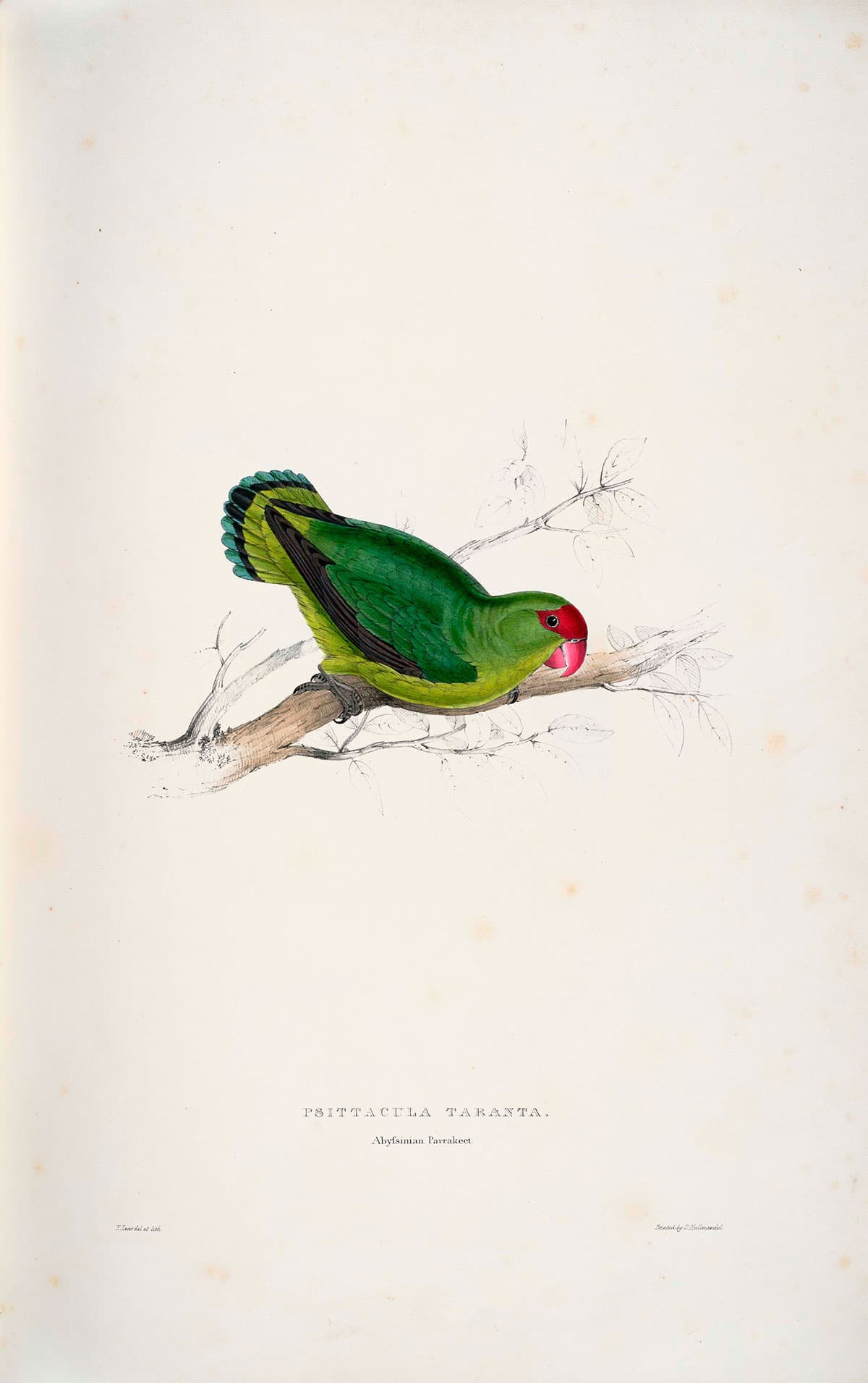


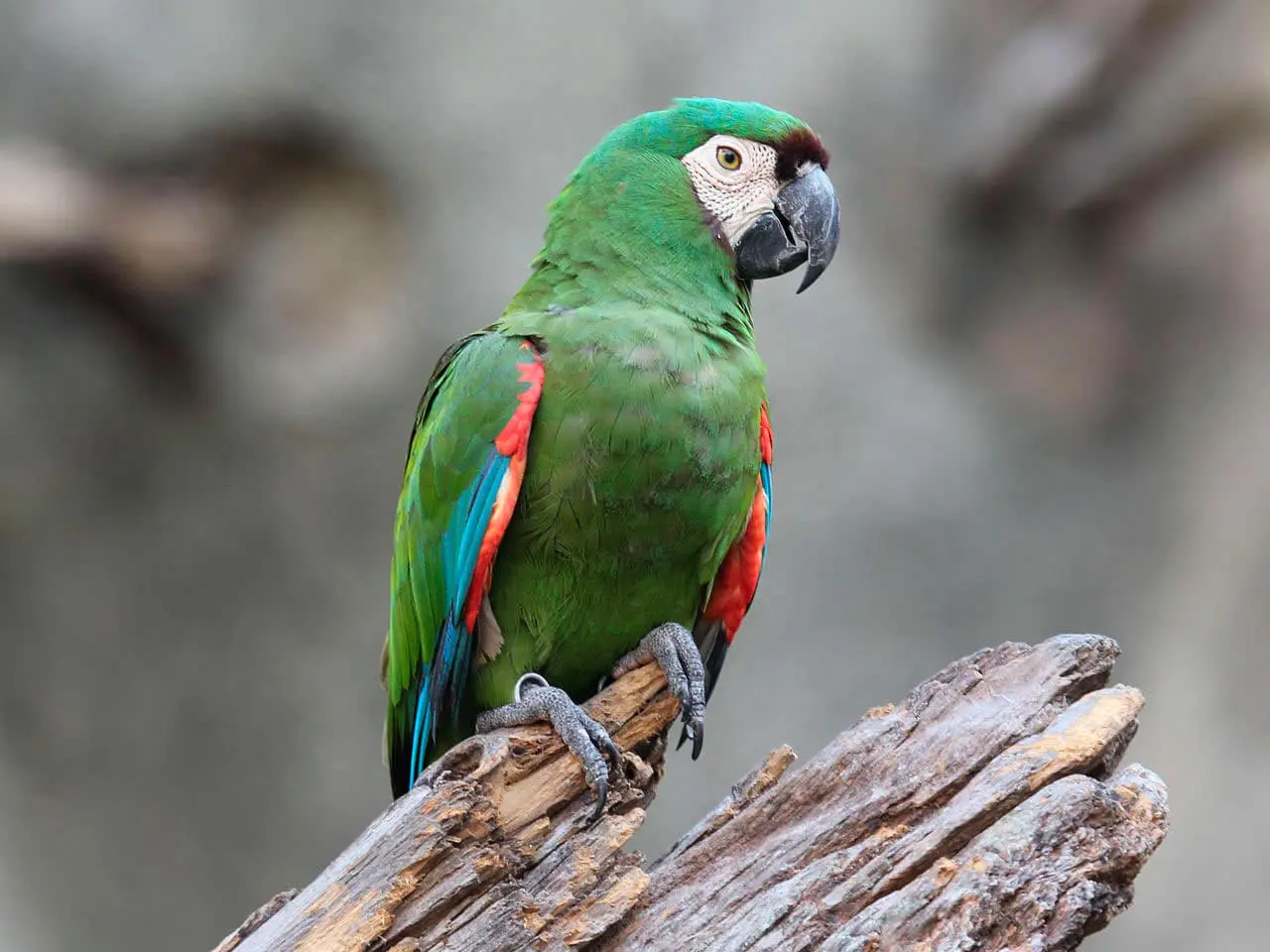
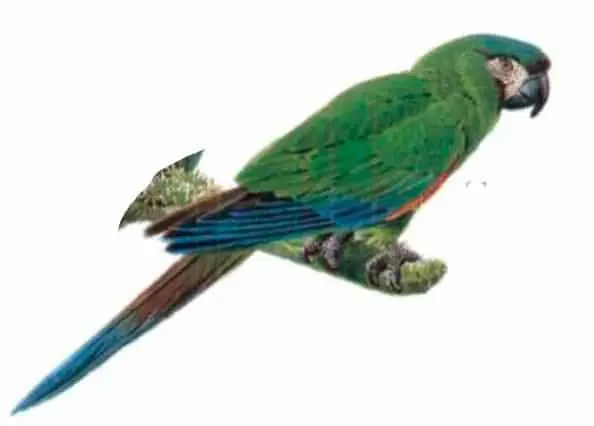


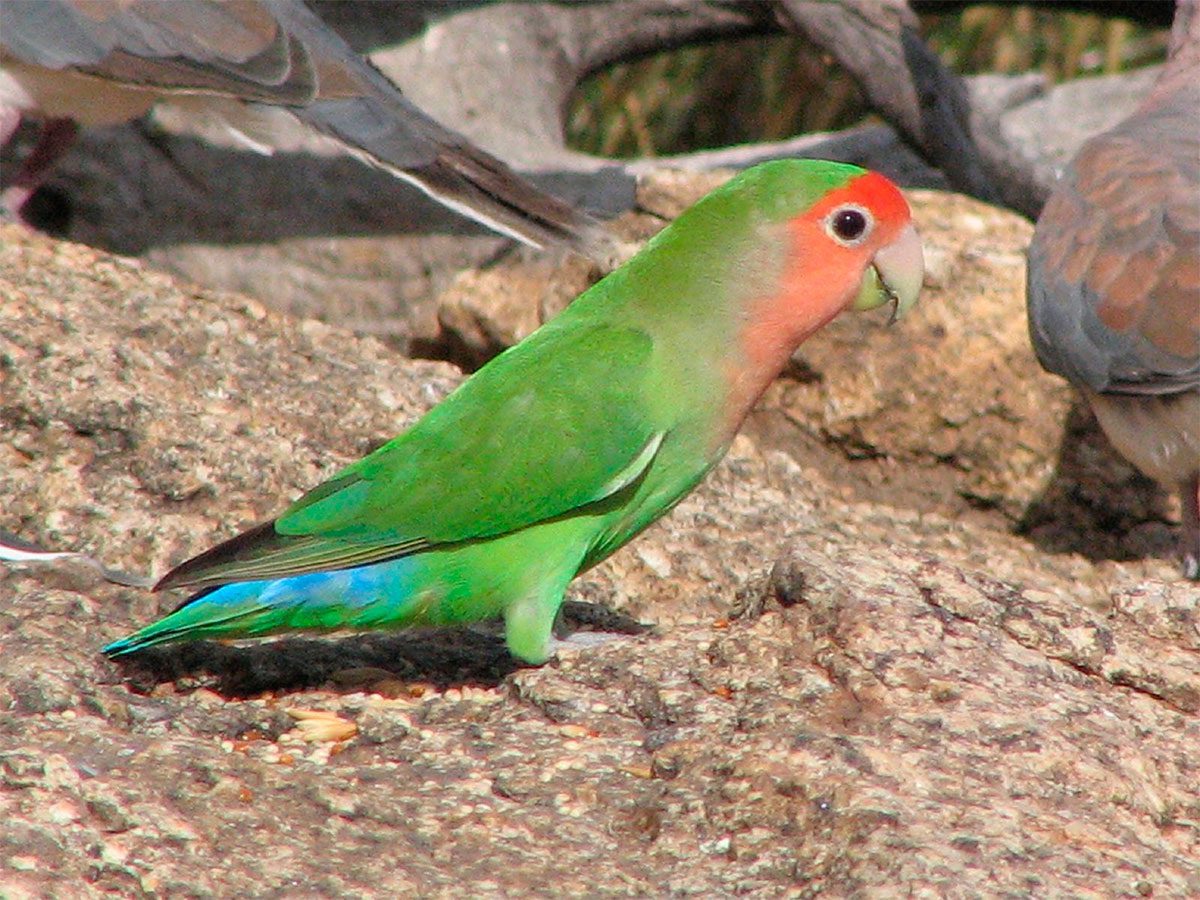
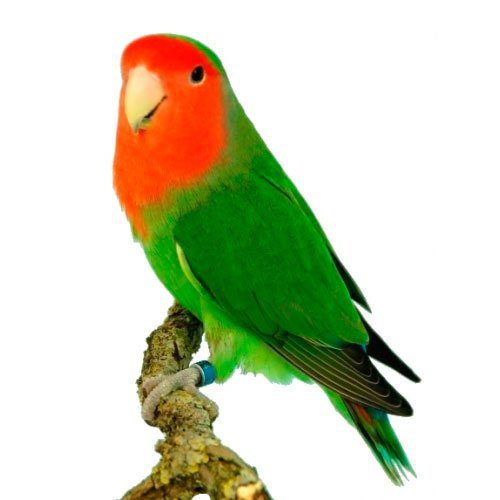


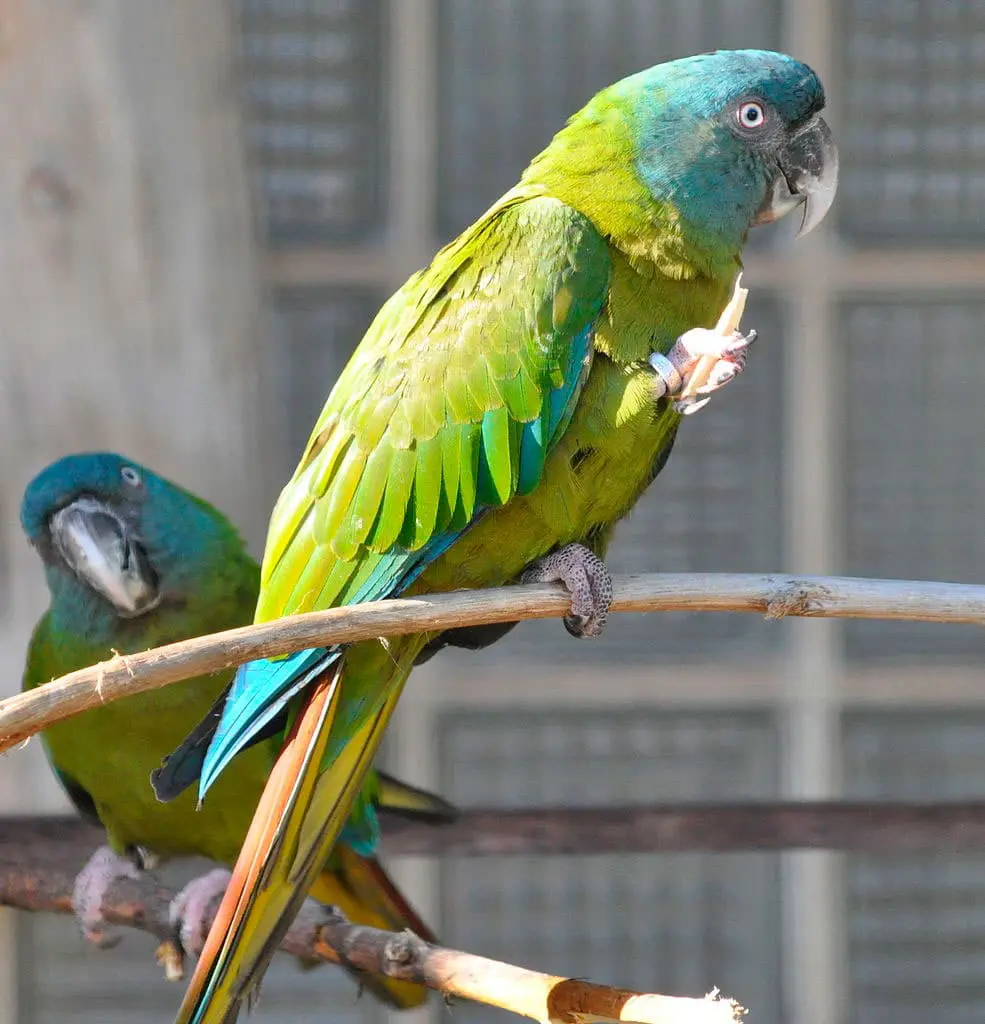
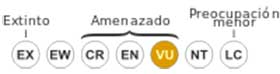


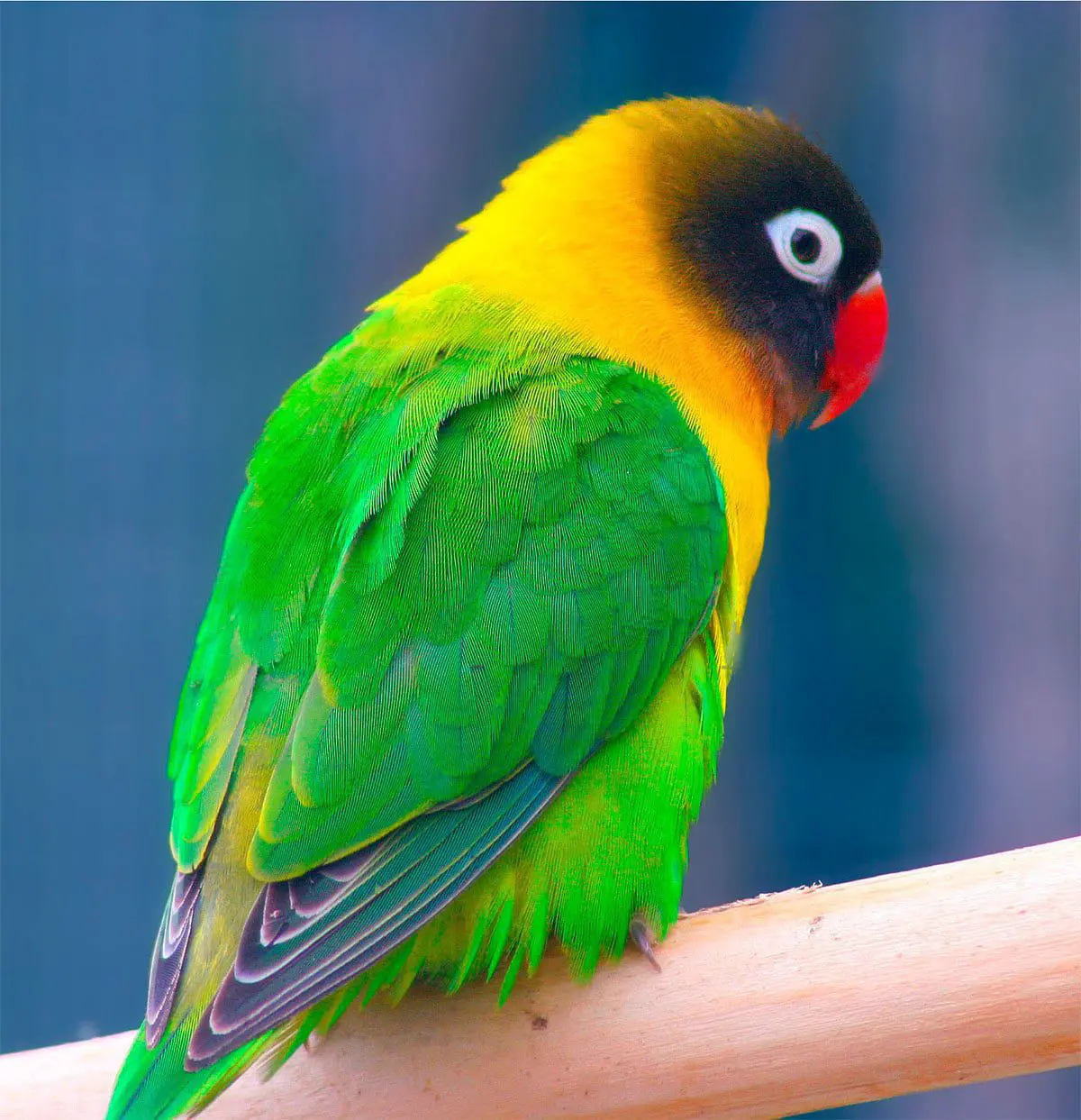
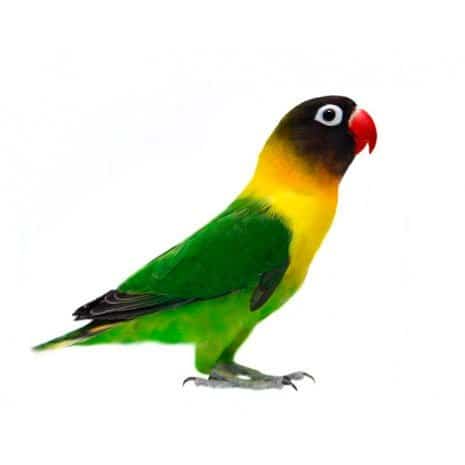


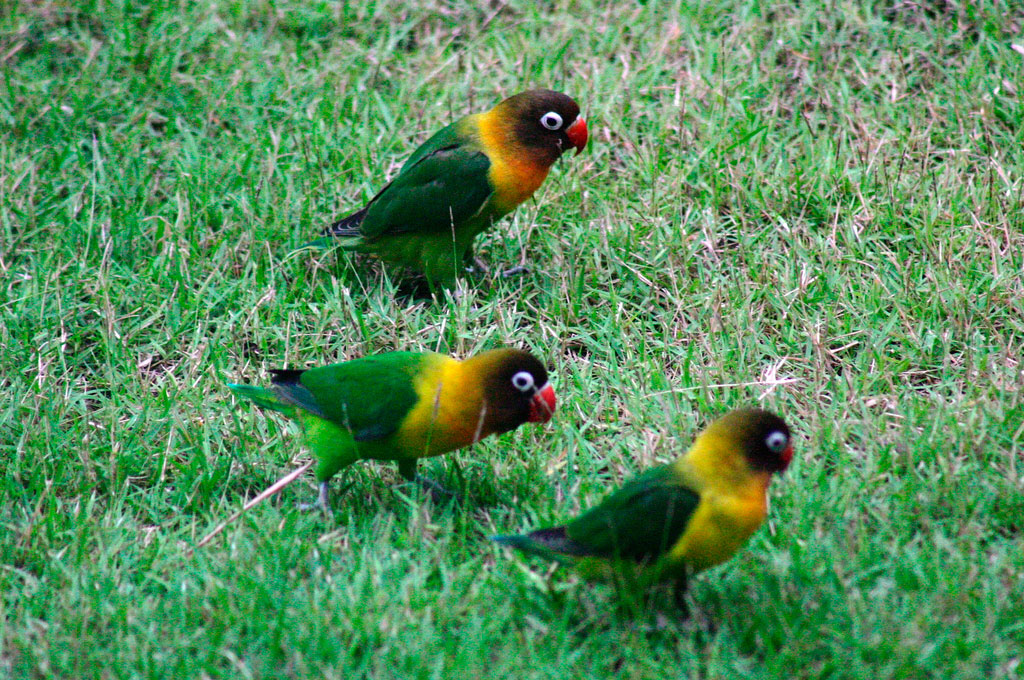
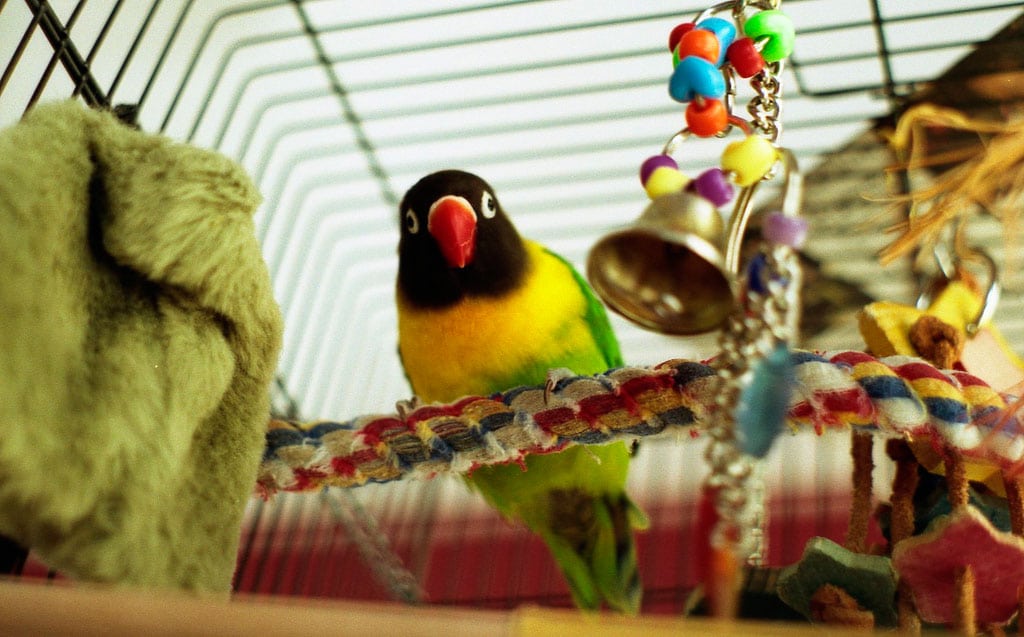


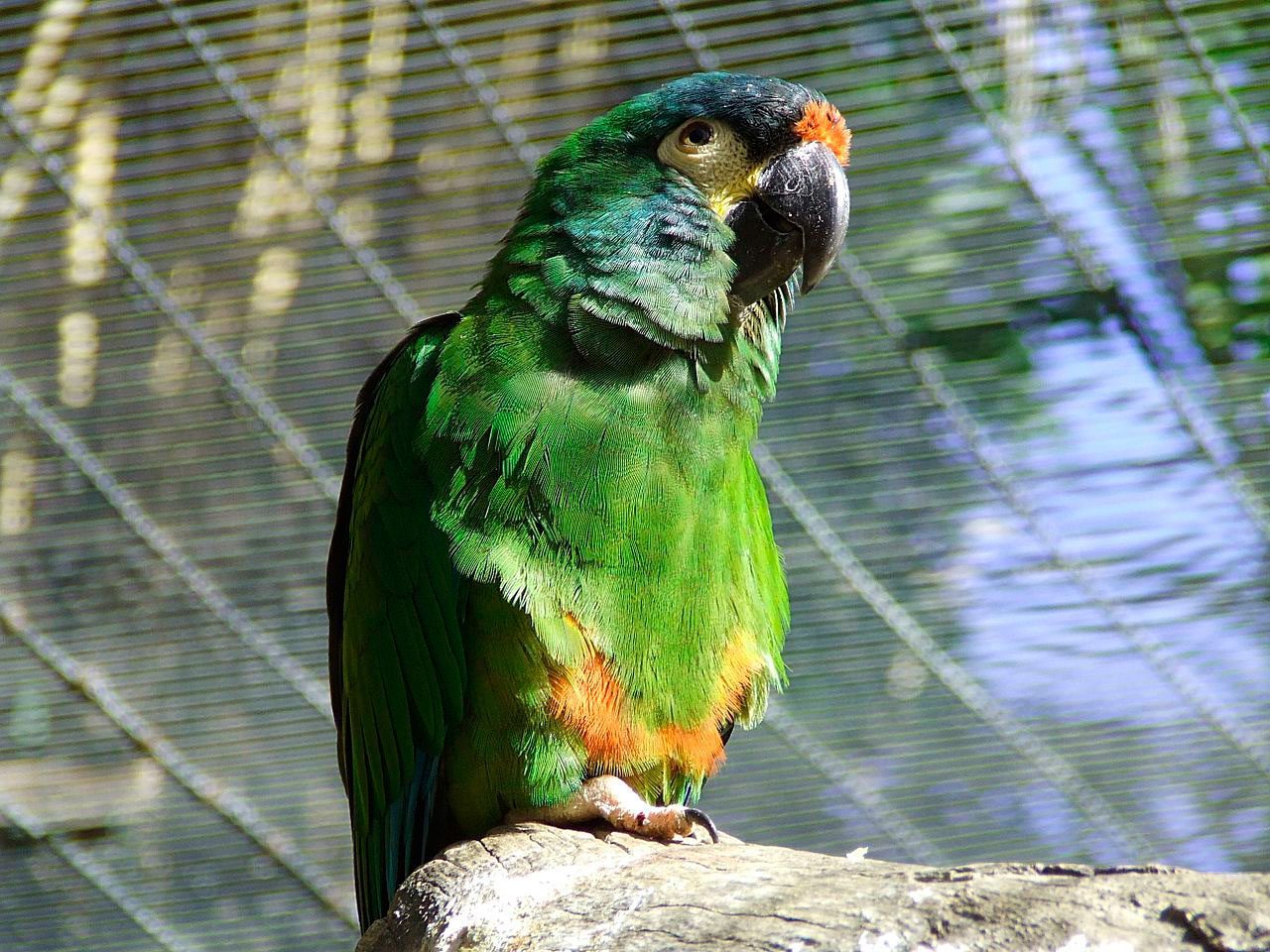


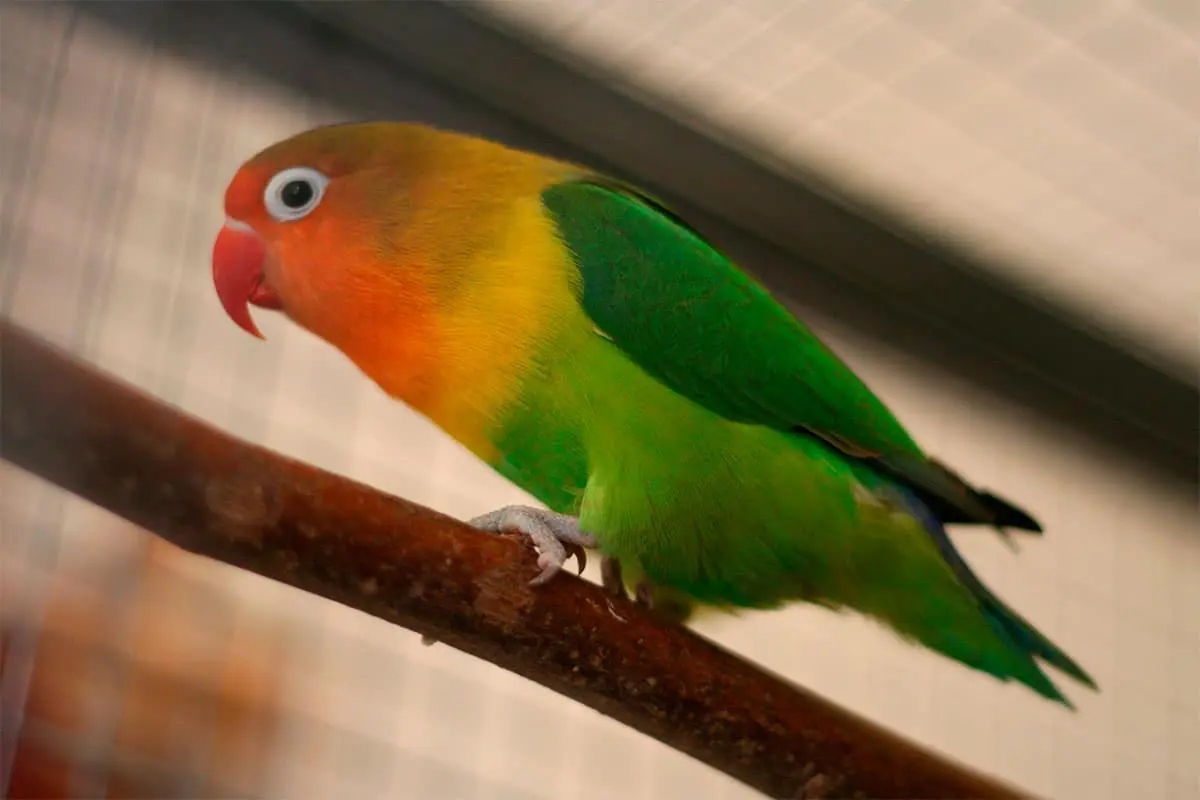
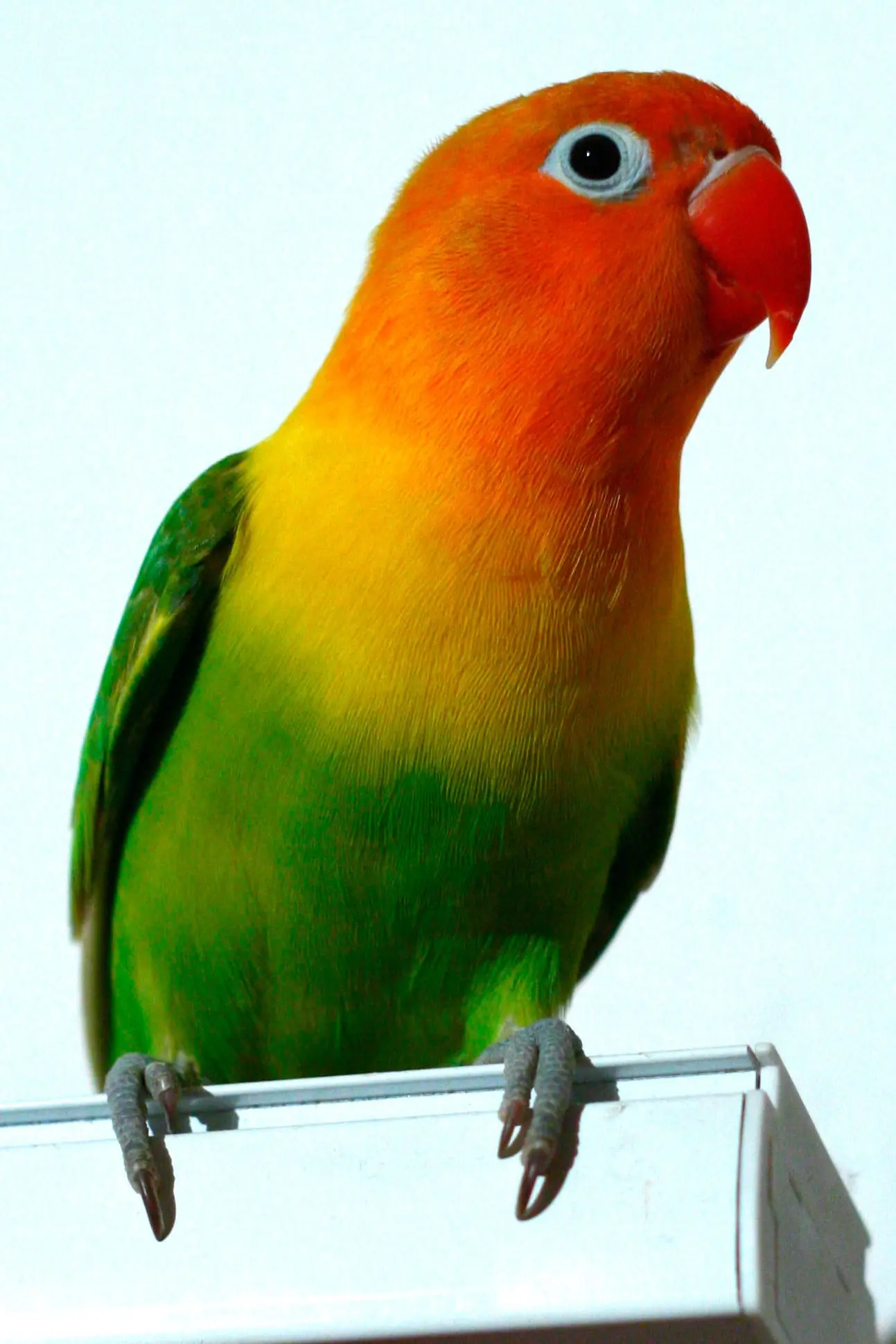


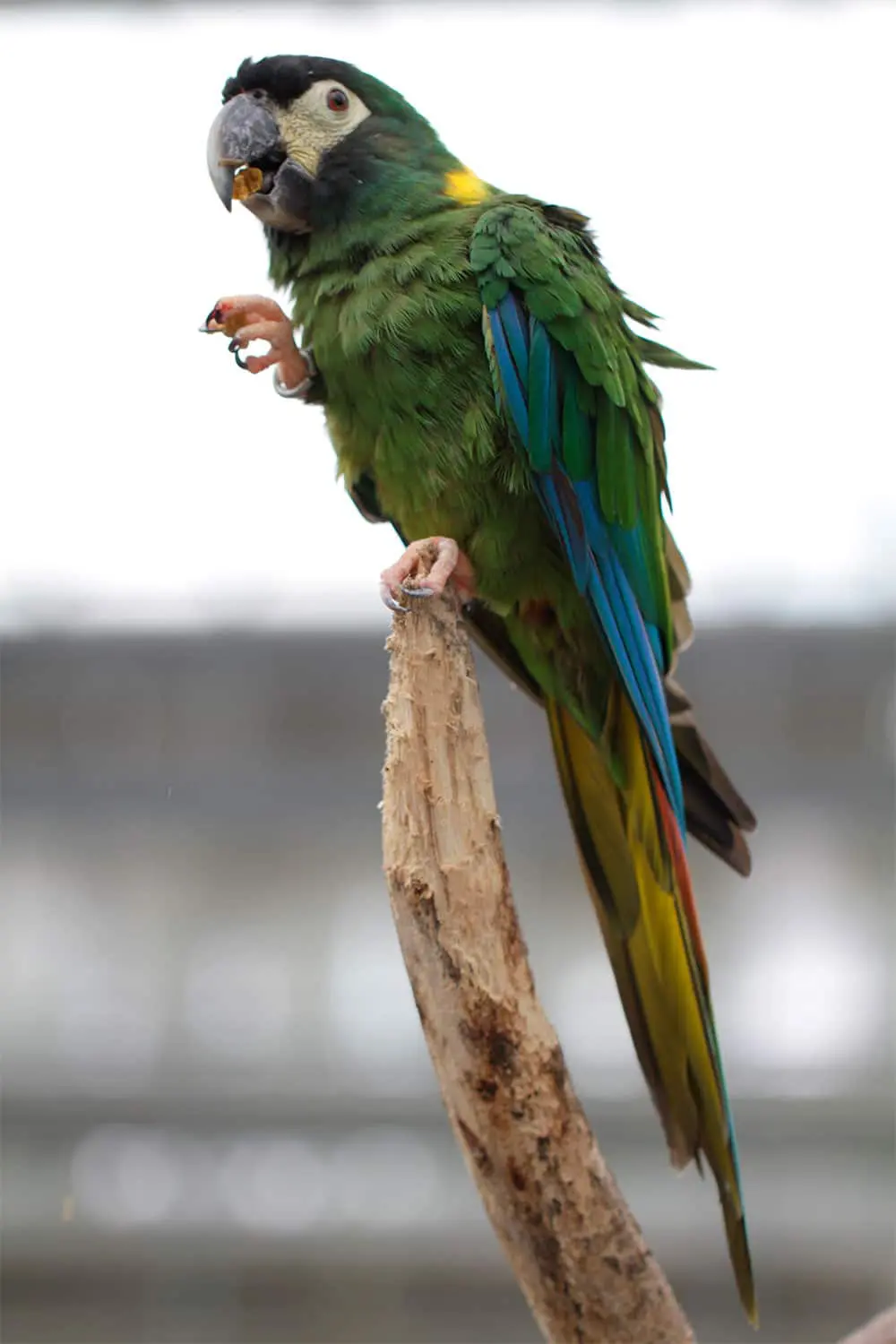
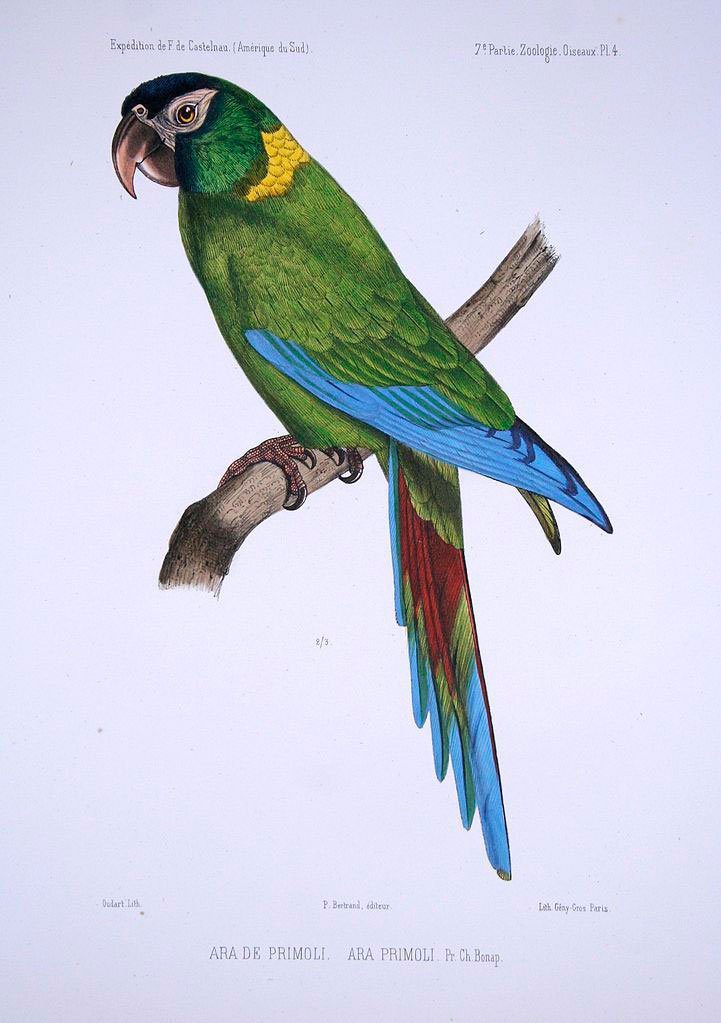




-2.JPG)


_-Auckland_Zoo.jpg)


.jpg)


.jpg)


%3B_side_view_of_pet_IMG_2309.jpg)


_perching_on_a_box.jpg)


