โ–ท The world of Pets: Dogs, cats, birds, reptiles, amphibians

Blue-collared Parrot
Geoffroyus simplex


Blue-collared Parrot

Content

Description

23-25 cm.. length and around 161 g. of weight.

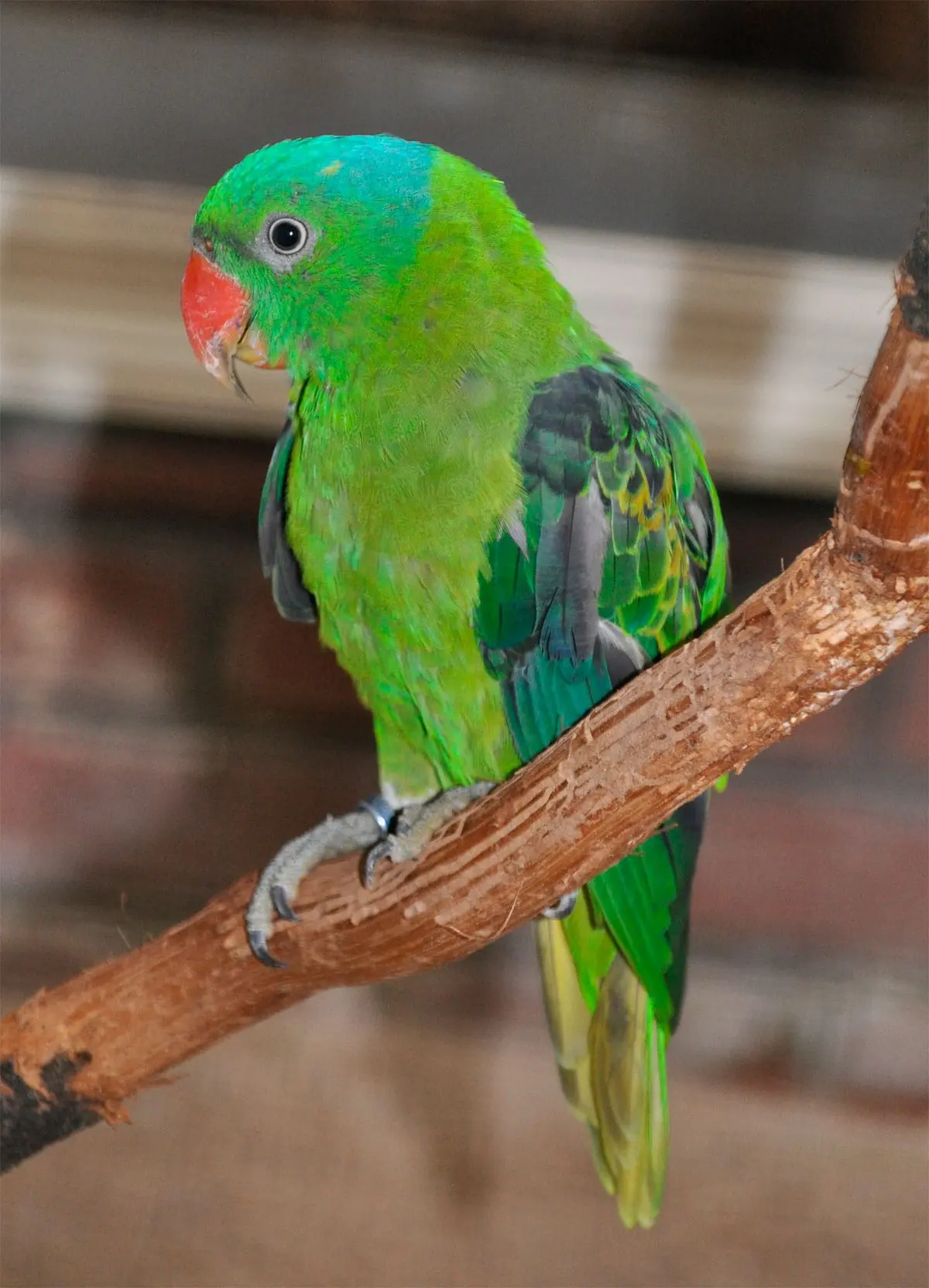
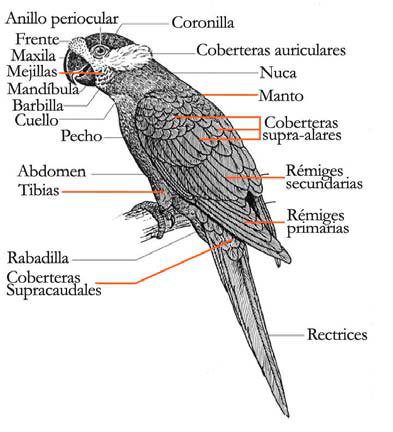
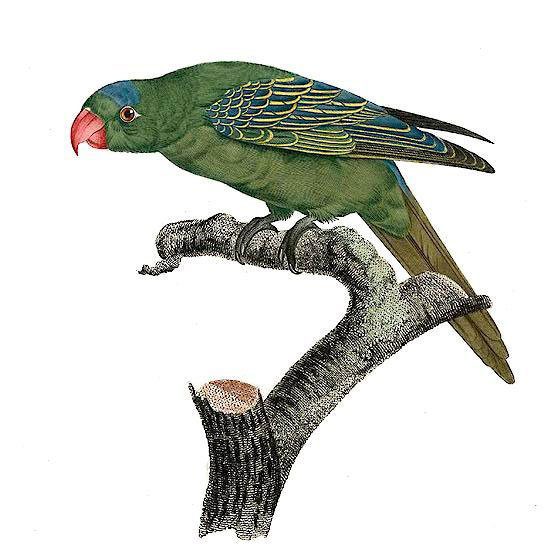
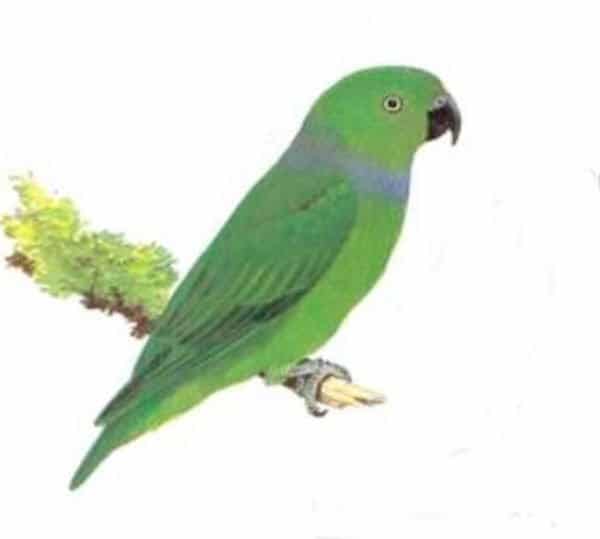
The Blue-collared Parrot (Geoffroyus simplex), they have the head green, more pale and more yellowish in the chin and lower cheeks, with a collar weak but clearly identified blue across the top of the chest and rear of the neck. The upperparts are blackish Green. Curve of the wings yellow; patch Brown in medium-sized inner cover; greater coverts with yellowish green trim; flight feather Black with green in the vane outer; pale line along the inner edge of the tips of the wings closed, formed by yellow tipping in the vane inmates of the flight feather. Underwing coverts and axillary, blue. Ventral pale, more yellowish green than the upper parts. Upper, the tail green; undertail, yellowish.

Bill greyish black; Iris White pale yellowish; legs gray-green.

The females they lack the collar Blue males but have a little blue on the back of the crown.

Subspecies

  • Geoffroyus simplex simplex (Meyer, AB, 1874): The nominal.
  • Geoffroyus simplex buergersi (Neumann, 1922): It measures each 25 cm in length and has purplish blue collar more extensive. Coverts of the wings with Violet Blue. Females have Violet Blue Underwing.

Habitat:

The species is distributed mainly between humid hills and medium-montane forests., along its edges and areas of secondary growth between 500 and 2.500 meters above sea level, being more frequent among the 800 and 1.900 m. Variations in food supply can lead to birds at elevations lower than normal (even at altitudes near sea level).

The Blue-collared Parrot they are shy and hard to spot when perched in trees. Large flocks of birds, of up 200 specimens, can be seen and heard flying above the treetops.

The species tends to form large groups with the Red-checked Parrot, Although sometimes single birds are, in pairs or in small groups.

Reproduction:

Little is known of the breeding ecology. A nest dug with three young was found in mid-January to nine metres in height, close to the top of a stump. The entrance was of 80 mm in diameter, and the gap between 200 mm and 400 mm deep. Nesting is also reported in October.

Food:

The Parrot Acollarado quietly feed in the canopy of seeds, fruit, berries and nectar. They are particularly fond of the seeds of (Castanopis and Oaks Lithocarpus).

Distribution:

New Guinea, Indonesian and Papua New Guinea, with an isolated population in the Doberai Peninsula, from Tamrau to Mountains Parotia. The main population is distributed through the central highlands, absent from the higher central areas, But coming to the Owen Stanley mountain range at the end of this. generally common, but the difficulty of detection makes these less abundant parecezcan birds.

Distribution of the subspecies:

  • Geoffroyus simplex simplex (Meyer, AB, 1874): The nominal.
  • Geoffroyus simplex buergersi (Neumann, 1922): Mountains of New Guinea, except Penรญnsula Bird's Head.

Conservation:


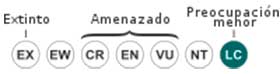
minor concern


โ€ข Current IUCN Red List category: Least concern.

โ€ขPopulation trend: Stable.

The size of the world's population has not been quantified, Although estimated at more of 50.000 specimens. The species, according to sources, is generally rather rare to fairly common (pit et to the. 1997).

The population is suspected to be stable in the absence of evidence of any reduction or substantial threats.

"Blue-collared Parrot" in captivity:

Rare.

Alternative names:

Blue-collared Parrot, Blue collared Parrot, Lilac-Collared Parrot, Simple Parrot (ingles).
Perruche ร  col bleu, Eclectus ร  col bleu, ร‰clectus ร  col bleu (French).
Blauhalspapagei (German).
Geoffroyus simplex (Portuguese).
Lorito Acollarado, Lorito Acollorado, Lorito de Collar (espaรฑol).

scientific classification:

Order: Psittaciformes
Family: Psittaculidae
Genus: Geoffroyus
Scientific name: Geoffroyus simplex
Citation: (Meyer,AB, 1874)
Protonimo: Pionias simplex

Images "Blue-collared Parrot"

————————————————————————————————

ยซLorito acolladoยป (Geoffroyus simplex)


Sources:

Avibase
– Parrots of the World โ€“ Forshaw Joseph M
– Parrots A Guide to the Parrots of the World – Tony Juniper & Mike Parr
– Birdlife

Sounds: Phil Gregory (Xeno-canto)

โ–ท The world of Pets: Dogs, cats, birds, reptiles, amphibians

Blue-naped Parrot
Tanygnathus lucionensis


Blue-naped Parrot

Content


Anatomy-parrots

Description

31 cm.. length between 148 and 231 g. of weight.

The Blue-naped Parrot (Tanygnathus lucionensis) has the head bright green with a clear bright blue diffusion through the back of the crown and nape.

Upperparts yellowish-green with pale blue illuminated on the back low and the tail; upper tail coverts brighter yellowish green.

Scapulars blue, with green edges; shoulder Black with small coverts Black bordered of blue-green and orange Green; median black and pale blue, large edges of opaque orange brown; greater coverts Blue-Green lined with orange-yellow in the feathers interiors.

Secondary Green with yellow and narrow margins; primaries Greens with vane blackish internal.

Wing feathers green, underside of primaries blackish.

Upper, the tail green, narrow edge and yellowish tip laterally; undertail, the tail yellowish brown opaque.

Bill red, paler at the tip and the lower jaw; irises yellow; legs grey.

Both sexes are equal.

Immature with less blue in the crown and more off the brands of the wings.

Subspecies:

  • Tanygnathus lucionensis lucionensis

    : The nominal.


  • Tanygnathus lucionensis hybridus

    : It has the most extended head blue, with violet tone. Their wings are greener.


  • Tanygnathus lucionensis talautensis

    : No blue in the obispillo and their plumage is less yellowish.


  • Tanygnathus lucionensis [salvadorii u horrisonus]:

Habitat:

Blue-naped Parrot

It is a bird of forests closed and open, including secondary growth, coconut plantations, patches of mangrove and banana to the 1.000 meters above sea level; and not so strongly linked to coastal habitats as the Great-billed Parrot. Is usually found in flocks of up to 12 individuals who sit in community and make regular flights at dawn and in the evening between the feeding and resting areas. Feeds on fruit trees.

Reproduction:

The breeding It has been observed in the months of April to June. Registered a nest the natural cavity or abandoned Woodpecker hole, often a clear. There is no data on the size of the laying.

Food:

Fruits and seeds of forest trees, Palm fruit, young coconuts, the banana and papaya.

Distribution:

The population of the Blue-naped Parrot distributes lengthwise of the Philippines and Talaud Islands, (Indonesian). Specific records found on the islands of Balut, Bantavan, Basilan, Biliran, Bohol, Bongao, Cagayan Islands, Calamian Islands, Caluya, Cebu, Cuimaras, Jolo, Leyte, Luzon, Maestre de Campo, Malanipa, Manuk Manka, Marinduque, Masbate, Mindanao, Mindoro, Blacks, Palawan, Surigao del Sur, Polillo Islands, Romblon, Samar, Sanga Sanga, Sarangani Islands, Samal, Sibay, Sibutu, Sibuyan, Siquijor, Tables, Tawitawi, Ticao, Tumindao and Verde (Philippines); Karakelong and Salibabu (Talaud).

Apparently, small groups of birds in Mantanani Kiss (Northwest Sabah), and SI-Amil (until 100 birds present in 1962) and Maratua off the northeast coast of Borneo; The existence of a wild population was also reported around Kota Kinabalu, (Sabah).

Occasional leaks occur in other parts, including the Sangir Islands.

The species was described as common in Salibabu in the Group of Talaud in 1978 (more numerous there than the Azure-rumped parrot) and they are still regularly seen there and in the nearby Karakelong during observations in 1995 (Numerous in a last record in 1997).

In other areas the species is rare. Recent records in Philippines they come mainly from Mindoro and Palawan, places that seem to be the bastion of the species.

Subspecies:

  • Tanygnathus lucionensis lucionensis

    : The nominal.

  • Tanygnathus lucionensis hybridus

    : (Salomonsen, 1952) – Present in Polillo island, to the North of Philippines.

  • Tanygnathus lucionensis talautensis

    : (AB Meyer & Wiglesworth, 1895) – Talaud Islands (North Moluccas).

  • Tanygnathus lucionensis [salvadorii u horrisonus]:

    (Ogilvie-Grant, 1896) – Philippines, (except North), but it can be rare or extinct on many islands. Also in some small islands off Northwest and northeast of Borneo (If Amil, Mantanani), where it was possibly introduced, especially on this last island.

Conservation:


Near-threatened


โ€ข Current category of the Red List of the UICN: Near threatened

โ€ข Population trend: Decreasing

The total population is provisionally estimated to be below the 10,000 specimens in 1993 (Lambert et to the. 1993).

The population is suspected to be in decline due to capture for the bird trade and habitat degradation from expansion and logging due to agricultural pressures..

Conservation Actions Proposed Palawan:

– Determine the impact of trade on the population of the species.
– Revise its estimate of the world population.
– Estimate the rates of decline based on the rates of deforestation within its range.
– Protect effectively important extensions of high forest with trees suitable to nest in key places throughout its distribution area, both in the areas of strict protection, such as multi-use areas.

"Blue-naped Parrot" in captivity:

pretty calm.
Occasionally available.

Alternative names:

Blue-naped Parrot, Blue naped Parrot (ingles).
Perruche de Luรงon, Perroquet ร  couronne (French).
Blaunackenpapagei, Blaunacken-Papagei (German).
Papagaio-de-nuca-azul (Portuguese).
Loro de Nuca Azul, Loro Nuquiazul (espaรฑol).

scientific classification:

Order: Psittaciformes
Family: Psittaculidae
Genus: Tanygnathus
Scientific name: Tanygnathus lucionensis
Citation: (Linnaeus, 1766)
Protonimo: Psittacus lucionensis

โ€œBlue-naped Parrotโ€ images:

Videos "Blue-naped Parrot"

————————————————————————————————

ยซLoro Nuquiazulยป (Tanygnathus lucionensis)

Sources:

Avibase
– Parrots of the World โ€“ Forshaw Joseph M
– Parrots A Guide to the Parrots of the World – Tony Juniper & Mike Parr
Wikipedia
– Birdlife

Photos:

(1) – By Quartl (Own work) [CC BY-SA 3.0], via Wikimedia Commons
(2) – By Joelle Rene Hughes (originally posted to Flickr as jr_parrot10) [CC BY 2.0], via Wikimedia Commons
(3) – WILD BIRDS of the PHILIPPINES – Subic rainforest, Bataan, December 5, 2007 by Romy Ocon
(4) – By TJ Lin [CC BY-SA 2.0], via Wikimedia Commons
(5) – ยซTanygnathus lucionensis qtl2ยป by QuartlOwn work. Licensed under CC BY-SA 3.0 via Wikimedia Commons.
(6) – ยซโ€ฏTanygnathus lucionensis – Barrabandโ€ฏยป. Licensed public via domain Wikimedia Commons.

Sounds: Arend Wassink (Xeno-canto)
โ–ท The world of Pets: Dogs, cats, birds, reptiles, amphibians

Niam-Niam Parrot
Poicephalus crassus

Content


Description:

25 cm.. length.

The Niam-Niam Parrot (Poicephalus crassus) has the head and nape Brown olive; the ear-coverts Silver. feathers of the the mantle and tertiary Brown with dark green margin; back, uppertail-coverts and bright green.

Lorito nianiam

Upper, wing-coverts dark green; secondary more internal dark green; rest of the flight feather brown with vane dark green external. Throat and top of the chest Brown olive opaque; bottom of the chest, the belly, the the thighs and undertail- coverts green.

Feathers of the tail dark brown tipped with dark green margins.

Bill yellowish, upper jaw darker than black-tipped; irises yellow; legs blackish.

Both sexes similar.

Hood grayish brown of the immature It shows strong brands of color yellow olive; the the mantle is greener. Underparts paler and more yellowish in adults. Secondary internal lined with yellow. More pale the upper jaw the adults and with grey tip.

It was thought that the Niam-Niam Parrot (Poicephalus crassus) could form a species within the group of the Poicephalus meyeri, Poicephalus rueppellii and Poicephalus cryptoxanthus, and possibly other. In the past, treated as species Poicephalus cryptoxanthus, that is morphologically very close.

Habitat:

Frequents wooded areas of Savannah, forest-savanna mosaic, wet sheets and Syzygium-Adina forests in the savanna to the 1.000 m.

Common in areas near water. Observed in pairs or in small groups. Regular daily movements take place even in the mountainous areas where the Niam-Niam Parrot visit tall trees to feed.

Reproduction:

Few details about reproductive biology, but believes that nest between August-September during the rainy season.

Courtship and implementation not described.

Food:

Its diet It is little known but includes a wide variety of seeds; reported foods include millet, and beans.

Distribution:

Size of the area of distribution (reproduction / resident): 343.000 km2

North of Central Africa to the South of the Sahara. Believed to inhabit also in Cameroon Eastern (where is the status unclear) through the Center and South of the Central African Republic, South-West end of Chad and the north end of the upper area of the Democratic Republic of the Congoto the southwest of Sudan (Bahr-el-Ghazal).

Sedentary with local movements. Little-known state, but think it's generally common, Although most scarce in the southwest of Sudan.

Conservation:


minor concern


โ€ข Current Red List of UICN: Least concern

โ€ข Population trend: Stable

The size of the world's population has not been quantified. This species is one of the lesser known African parrots, but it is assumed that it is common in its area of distribution.

The population is suspected to be stable in the absence of evidence of any reduction or substantial threats.

"Niam-Niam Parrot" in captivity:

Very rare in captivity.

It is a parrot of middle voice, shy and suspicious. Young birds are more accustomed to the caregiver.
New birds susceptible to the stress or illness.

Is necessary for their well-being a regular supply of fresh wood; susceptible during the acclimatization period; resistant once acclimated.

Alternative names:

Niam-Niam Parrot, Niam niam Parrot (English).
Perroquet des Niam-niams, Perroquet des niam-niam (French).
Niamniampapagei, Niamniam Papagei (German).
Papagaio Crassus (Portuguese).
Lorito Niam niam, Lorito Niam-niam, Lorito nianiam (espaรฑol).


scientific classification:

Richard Bowdler Sharpe

Order: Psittaciformes
Family: Psittacidae
Genus: Poicephalus
Scientific name: Poicephalus crassus
Citation: (Sharpe, 1884)
Protonimo: Pionias fat

————————————————————————————————

"Lorito naianiam" (Poicephalus crassus)


Sources:

Avibase
– Parrots of the World โ€“ Forshaw Joseph M
– Parrots A Guide to the Parrots of the World – Tony Juniper & Mike Parr
– Birdlife

Photos:

(1) – Photography: Caijin Wen – link

โ–ท The world of Pets: Dogs, cats, birds, reptiles, amphibians

Blue-bellied Parrot
Triclaria malachitacea

Blue-bellied Parrot

Content


Anatomy-parrots

Description:

28 cm.. length between 110-155 g. of weight.

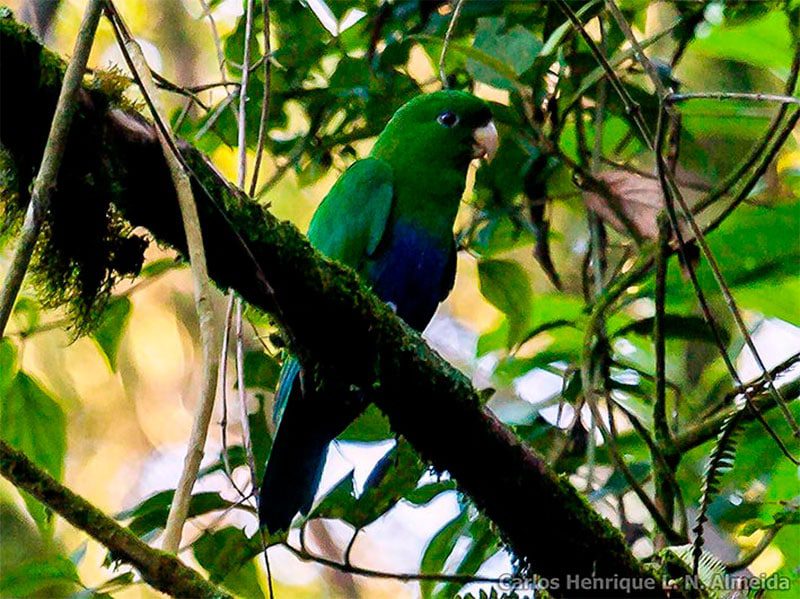
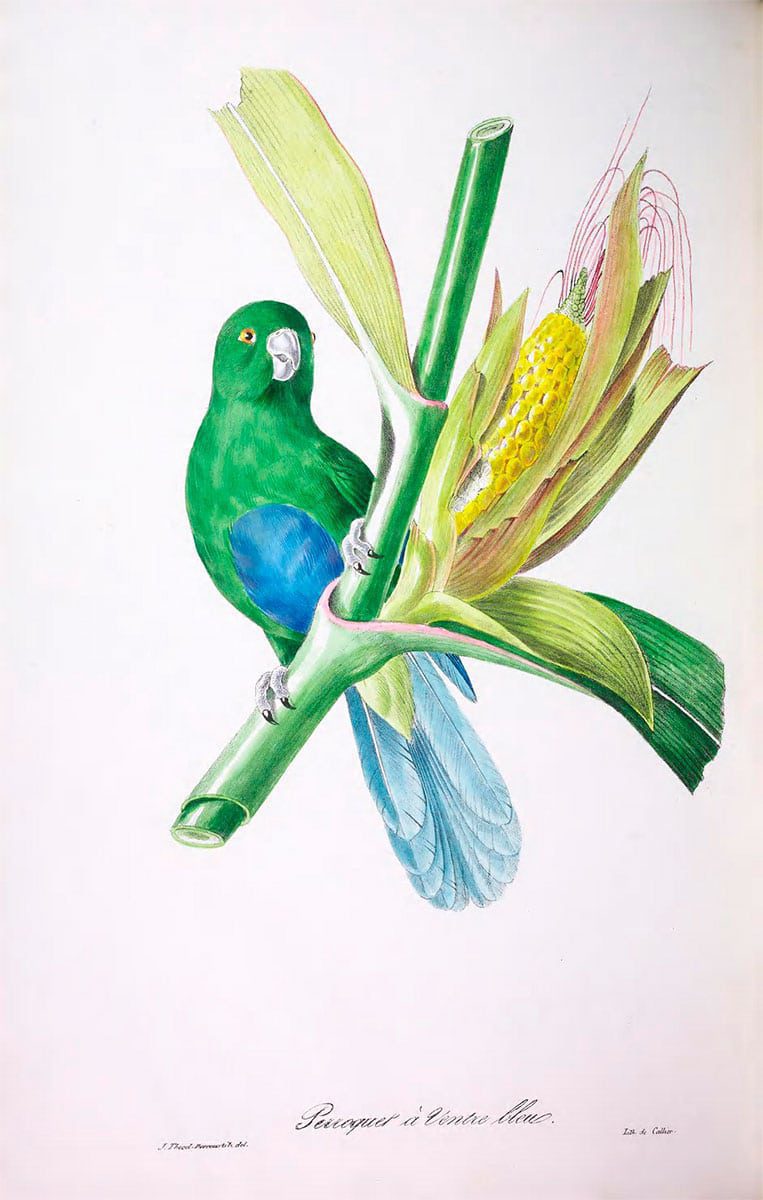
The Blue-bellied Parrot (Triclaria malachitacea) has the head, neck and all the "upper parts" and wing-coverts, grass-green.

Flight feathers grass-green with narrow blue tips to primaries, except the outermost, with a narrow pale blue margin to outerweb. Under, the wings with coverts green, and flight feather, bluish green. The underparts mainly green with large purplish-blue patch on centre of chest and the belly. Upper, the tail It is green with blue tips to central feathers; undertail, bluish green. Bill pink white: cere Pink; brown the irises; legs grey.

The female lacks the patch in the belly blue violet. The immature is as the adult but the respective young male has less blue purple in the underparts.

  • Sound of the Blue-bellied Parrot.

Its singing It is similar to a Thrush (Molothrus).

Habitat:

Blue-bellied Parrot

The Blue-bellied Parrot They live in the humid forests of the low mountains., generally preferring the canopy and the upper floors of tall forest, rich in bromeliads, along watercourses in the valleys. Visit cultivated areas with orchards and plantations and sometimes wooded suburban areas (for example in Sรฃo Paulo).

Mainly observed at altitudes of 300-700 m, perhaps 1,000 meters in some places, but also they inhabit lowlands at sea level. The sporadic nature of reports, with apparent absence of apparently suitable areas, suggests some critical aspects of its little-understood ecology.

Reproduction:

Observed nests in cavities of large trees or stumps of palm. Strongly territorial, at least during breeding, with separation until nests 2 km. The breeding season It covers the months of September to January, maybe a little earlier or later.

Food:

Its diet it's formed, mainly, by fruit, seeds, outbreaks and nectar, some insects and their larvae (looking birds seen flying insects); specific foods include Pachystroma, Actinostemon, Sebastian, Eugenia, Campomanesia and Euterpe edulis, also occasionally Cortex, and citrus plantations.

Distribution and status:

Size of its range (breeding/resident): 361.000 km2

This rare species is endemic Atlantic forests of Southeast Brazil, mainly in Rio de Janeiro, Sao Paulo and Rio Grande do Sul, in the southeast of Brazil. There are additional records South Bahia (none since 1833), Minas Gerais, Brazil (some dubious records), Holy Spirit (four or five sites), Paranรก (three modern records) and Santa Catarina (Mesorregion of the Itajaรญ Valley, Valle de Tijucas and the region of Serra do Mar, in upstate [Rosario 1996, G. Kohler in some. 2011]).

The species is quite common in large forest fragments in the Itajai Valley (G. Kohler in some ., 2011). Due to changes in habitat in the lowlands Santa Catarina, the most recent records in that state come from montane forests (G. Kohler in some ., 2011). Two records in Missions, Argentina, require confirmation. The population was estimated previously less than 5.000 individuals (Lambert et to the ., 1993), But Bencke (1996) suggested that there may be 10.000 in Rio Grande do Sul and significant numbers on the eastern slope of the Serra do Mar; But, the apparent rarity of the species suggests that these figures may be an overestimation (J. Gilardi in litt., 2010). In general, it is suspected that the population is declining, although in the State Park Tres Picos, Rio de Janeiro, It seems to have been stable since 2003 (A. Foster in a bit).

Population little known due to camouflage habits. Perhaps more numerous in the many facing slopes east of the Serra do Mar in Rio de Janeiro and Sรฃo Paulo; habitat loss on a large scale has certainly caused a serious decline in its population, as well as the fragmentation of its distribution area. Although humid upland forests remain in substantial quantities in Serra do Mar, replacement of forests in valleys and on lower slopes with banana plantations could lead to further declines.

Captured for local LBMs and traded in small numbers internationally. There are records of several protected areas, but most of them may be insufficient to support populations of this species due to their low density.

Conservation:


Near-threatened


โ€ข Current category of the Red List of the UICN: Near-threatened.

โ€ข Population trend: decreasing.

Rationale for the Red List category

This species is classified as near threatened because they suspect is in a moderately rapid decline due to loss of habitat and, perhaps to a lesser extent, to the capture for trade bird cage.

Justification of the population

The size of the world's population has not been quantified, but this species is generally described as "rareยป (Stotz et to the ., 1996), although it is locally common in some places.

Justification of trend

Se sospecha una decrease moderate and continuous of the population depending on rates of habitat loss and perhaps, to a lesser extent, capture for the bird trade. The decline is not thought to be faster because the species occurs in montane areas where deforestation is typically less severe., It seems to tolerate mature secondary forests and anecdotal observations suggest that is locally stable, for example in the State Park Tres Picos, Rio de Janeiro. (A. Foster in a bit ., 2013).

The ecology and conservation of the Blue-bellied Parrot in remaining forest fragments in Rio Grande do Sul

This project aims to collect basic information on population, the distribution and ecology of the Blue-bellied Parrot in the center of Rio Grande do Sul, where a large population of the species is rapidly declining due to habitat fragmentation. The use of the radiotelemetry technique will make it possible to determine the area of โ€‹โ€‹use of the species and to evaluate their dispersal capacities.. Biology studies of this species is the objective to determine the elements that make up its diet and collect information on behavior and reproduction.. Through this information, It is intended to outline a regional plan for conservation Blue-bellied Parrot and their habitat, together with local actors. (AU)

Conservation status:

UICN: Vulnerable (with + 2c, d, Cl, Q2a). Previously in danger of extinction (Q2a: see Collar et al., 1994). CITES: Appendix II.

State of national protection: Protected by federal law and included in the list IBAMA of Brazilian species threatened with extinction (Bernardes et al 1990).

"Blue-bellied Parrot" in captivity:

unknown in captivity.

Alternative names:

Blue-bellied Parrot, Blue bellied Parrot, Purple-bellied Parrot (English).
Crick ร  ventre bleu, Caรฏque ร  ventre bleu (French).
Blaubauchpapagei, Blaubauch, Blaubauch-Papagei (German).
Papagaio-de-peito-roxo, araรงoiaba, araรงuaiava, cica, sabiรก-ci, sabiรก-cica (Portuguese).
Loro de vientre azul, Loro Sabiรก-cicรก, Loro Ventriazul (espaรฑol).
araรงoiaba, araรงuaiava, cica, sabiรก-ci, Sabiรก-cica (Brazil).


scientific classification:

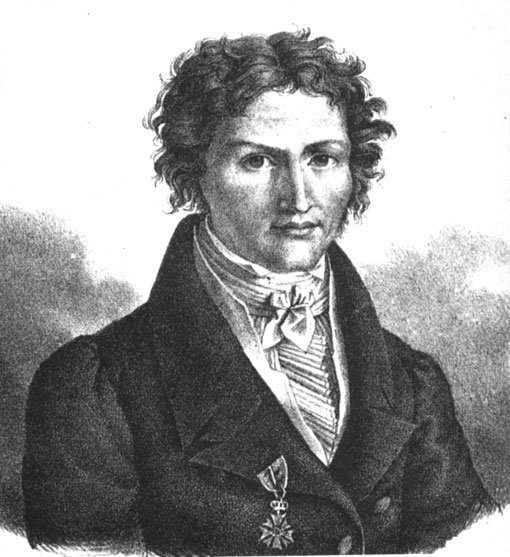
Johann Baptist von Spix

Order: Psittaciformes
Family: Psittacidae
Genus: Triclaria
Scientific name: Triclaria malachitacea
Citation: (von Spix, 1824)
Protonimo: Psittacus malachitaceus


Images ยซBlue-bellied Parrotยป:

Videos "Blue-bellied Parrot"

————————————————————————————————

ยซThem Ventriazulยป (Triclaria malachitacea)


Sources:

Avibase
– Parrots of the World โ€“ Forshaw Joseph M
– Parrots A Guide to the Parrots of the World – Tony Juniper & Mike Parr
– Birdlife

Photos:

(1) – Triclaria malachitacea – Paranapiacaba – Santo Andrรฉ by Carlos HenriqueFlickr
(2) – Blue-bellied Parrot (also known as the Purple-bellied Parrot); two in a cage with a nestbox By TJ Lin [CC BY-SA 2.0], via Wikimedia Commons
(3) – A female Blue-bellied Parrot (also known as Purple-bellied Parrot) at Walsrode Bird Park, Germany By ipfreaks [CC BY-SA 2.0], via Wikimedia Commons
(4) – Rufous-conic (Triclaria malachitacea) – female by Clรกudio Dias TimmFlickr
(5) – Rufous-CICA (Blue-berried Parrot) – Guide to Birds in ePUB by Mรกrcio DuarteFlickr
(6) – Psittacus cyanogaster or Blue-Bellied Parrakeet by Biodiversity Heritage LibraryFlickr

โ–ท The world of Pets: Dogs, cats, birds, reptiles, amphibians

Bronze winged Parrot
Pionus chalcopterus


Bronze winged Parrot

Content

Description:

28 to 30 cm.. tall and around 210 weight g.

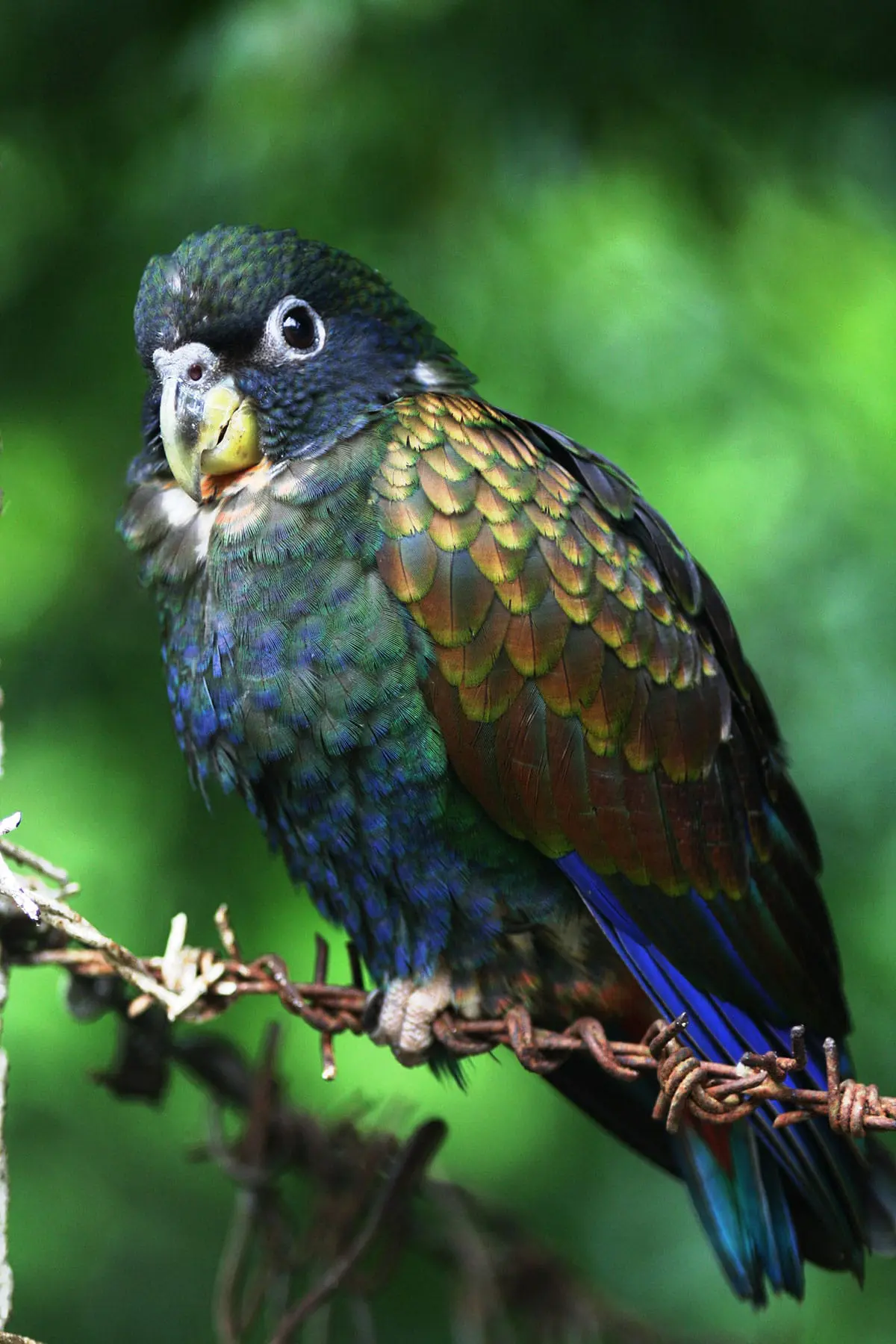
The Bronze winged Parrot (Pionus chalcopterus) has the general Brown, darker in head, neck, chest and flanks, This plumage with blue-violet edge.

The throat whitish and pink; wings bronze green.

Flight is evident violet blue at the top of the wing the Green bottom, that contrasts with the Red of the lower abdomen. Dorsally Violet Blue is notorious in the rump, shoulder and tail. The feathers of the tail are dark blue with a shade of red at the base.

The bill is of color beige, area of naked skin surrounding the eyes of pink. The legs They are pink.

Habitat:

It inhabits in humid jungle, semi-humid, crops and forest edge between 120 and 2800 m.

They are birds gregarious and noisy. Every tomorrow is mobilized in flocks in search of food. Within the flocks are can observe to the couples, that form of life, and who interact with a variety of contact behaviors that reaffirm the marital bond.

Reproduction:

Prefer for their nests broken rods, hollow of logs and palm trees. They nest in the months of October-may. The female often put in two to four eggs they are incubated during three weeks approximately, after which are born them chicks naked or just covered with down. The chicks remain with their parents until the next reproductive shekel.

Food:

Will congregate in cornfields in groups up to of 40 individuals, feeding is of pulp and seeds many fruits and other material ingredients as nectar and flower petals, complementing occasionally its diet with insects.

Distribution:

Its population is distributed by the mountain range of the Andes, from Colombia, Northwest of Venezuela; to the South, by the mountains to the Northwest of Peru.

Conservation:


minor concern


โ€ข Red List category of the UICN current: Least concern

โ€ข Population trend: Decreasing

The size of the population World of the Bronze winged Parrot It has not been quantified, but this species is described as ‘rare‘ (Stotz et to the., 1996).

The population was suspected of being in decline due to ongoing habitat destruction.

This species is characterized be decreasing in Colombia and West Ecuador, due to the logging of forest subtropical, which has been severe and quick on the slopes of the Andes (Juniper and Parr 1998).

The evident anecdotal, based on the frequency of sightings, suggests that the species has declined in Pineapples, South of Ecuador, in recent years c.15-20 (M. By D Sanchez. Dรญaz in litt. 2011). Also is says that has been extirpated from areas previously occupied as the slopes of them Andes and valleys of the Cauca and the Magdalena river in Colombia, again due to loss of habitat (Juniper and Parr 1998).

In Venezuela the species is scarce and local, limited, to a large extent, to the slope West of them Andes in Mรฉrida and Sierra de Perija, with occasional records in Tรกchira (CJ Sharpe in litt. 2011). These areas have experienced rapid deforestation for at least the last few 24 years for cultivation and livestock.

Surveys conducted in the Northwest of Peru in the decade of 1990 they appeared to detect a sharp decrease in population from 1993 (Rosales et to the., 2007), although this species is known to be nomadic and its local numbers can fluctuate.

"Bronze winged Parrot" in captivity:

Rare in captivity, It is not a main target of poachers (CJ Sharpe in litt. 2011, R. Clay in litt. 2011), although it is still present in the illegal trade of Peru (F. Angle in litt. 2011)

Intelligent, playful and curious. You can be nervous, loving with your caregiver and aggressive with other people. It has a tendency to obesity.

It requires a spacious cage unless the bird pass periods of time outside of it. Not must keep is to open air where the temperatures fall below them 5 ยฐC.

With feed a wide variety of seeds, fruits and berries.

It is a relatively healthy bird, While it may be more susceptible to infection aspergillosis that other species.

In captivity they lay two eggs the incubation takes 26 days.

Alternative names:

Bronze winged Parrot, Bronze-winged Parrot (English).
Pione noire, Pionus noir (French).
Glanzflรผgelpapagei, Glanzflรผgel-Papagei (German).
Curica-asa-de-bronze (Portuguese).
Cotorra Oscura (Colombia).
Cotorra Negra (Venezuela).
Cotorra Oscura, Loro Alibronceado, Loro de Alas Bronceadas, Cheja alibronceada (espaรฑol).

scientific classification:

Order: Psittaciformes
Family: Psittacidae
Genus: Pionus
Scientific name: Pionus chalcopterus
Citation: (Fraser, 1841)
Protonimo: Psittacus chalcopterus

Images "Bronze winged Parrot"

Videos "Bronze winged Parrot"

ยซLoro Alibronceadoยป (Pionus chalcopterus)

Sources:

  • Avibase
  • Parrots of the World โ€“ Forshaw Joseph M
  • Parrots A Guide to the Parrots of the World – Tony Juniper & Mike Parr
  • Birdlife

  • Photos:

(1) – IBC.lynxeds.com
(2) –
(3) –
(4) –
(5) –

โ–ท The world of Pets: Dogs, cats, birds, reptiles, amphibians

Coconut Lorikeet (massena)
T. haematodus massena


Coconut Lorikeet (massena)

Content

Description (1)

25 cm.. length.

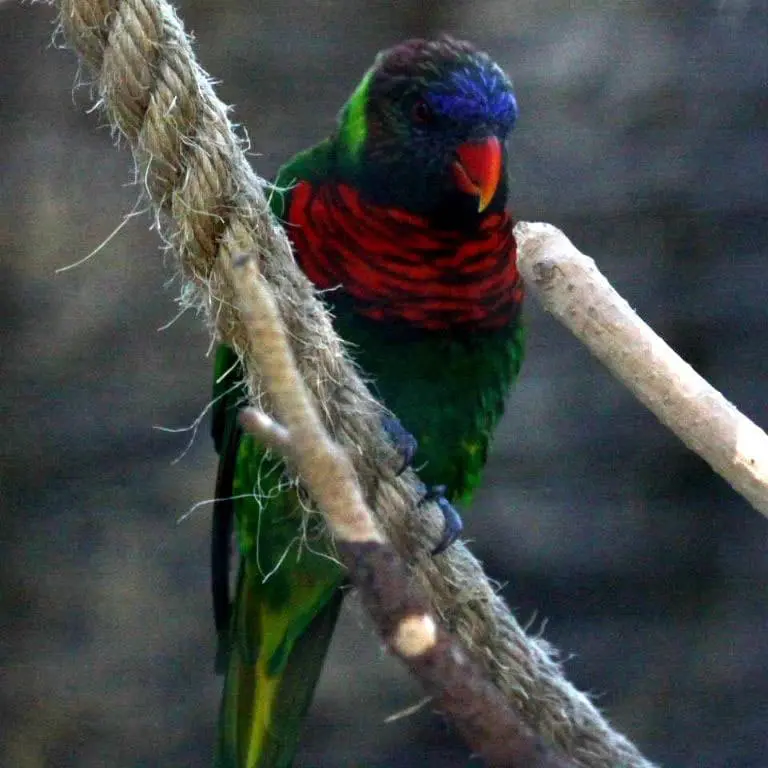
The Coconut Lorikeet (massena) (Trichoglossus haematodus massena) is a variation of the nominal (Trichoglossus Haematodus).

The plumage is similar to the of the Ornate Lory except that it is usually paler. The head is blue, ending at the nape with dark brown feathers interspersed with more Brown clear. The chest is reddish color with a narrow dark blue edging. In some cases, You can see some yellow zones in chest plumage. The abdomen is green; but there may be some kind of marking on the lower abdomen blue-violet.

The eyes are orange brown in juveniles and adult. The beak is orange-red.

Distribution:

Bismarck Archipelago, Solomon Islands and Vanuatu.

Conservation:

This species is endangered due to habitat loss and capture for the pet trade.

Alternative names:

Coconut Lorikeet (massena) (ingles).
Loriquet ร  tรชte bleue (massena) (French).
Allfarblori (massena) (German).
Lรณris-arco-รญris (massena) (Portuguese).
Lori Arcoiris Massena, Tricogloso de Pecho Rojo (massena) (espaรฑol).

scientific classification:

Order: Psittaciformes
Family: Psittaculidae
Scientific name: Trichoglossus haematodus massena
Genus: Trichoglossus
Citation: Bonaparte, 1854
Protonimo: Trichoglossus massena

————————————————————————————————

    (1) – Subspecies Coconut Lorikeet (Trichoglossus haematodus)

————————————————————————————————

ยซLori Arcoiris Massenaยป (Trichoglossus haematodus massena)


Sources:

Avibase

Photos: animalphotos.me

โ–ท The world of Pets: Dogs, cats, birds, reptiles, amphibians

Ultramarine Lorikeet
Vini ultramarina

Ultramarine Lorikeet

Content

Description

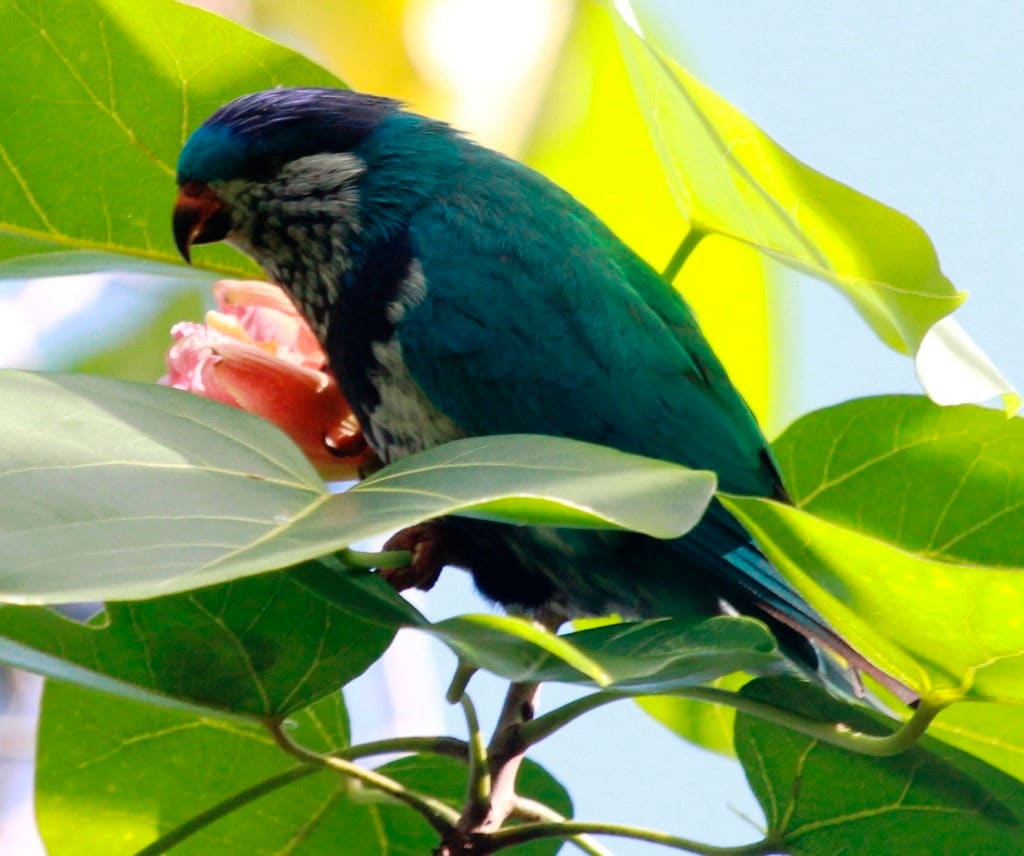
The Ultramarine Lorikeet (Vini ultramarina) has a length of 18 cm.. and an approximate weight of 35 g..

Forehead bright navy blue iridescent; crown and nape Mallow dark blue with streaks of light blue; lores and spots on ear-coverts, white (bases of ear-coverts, purple and blue color). Mantle and covert wing, Navy blue; rump and tail coverts, dark blue light. The flight feather, light blue, blackish internal. Blue off the Underwing coverts. Throat dark blue with white speckles; in the band chest mauve blue with รกrea subterminal pale blue feathers. Belly blank slate bases in feathers, giving a mottled appearance; the thighs dark blue malva; coverts, Turquoise.

The uppertail-coverts, whitish blue with navy blue light diffuse in the outer margins;
undertail coverts whitish merged with navy and some irregular gray markings.

Bill yellow orange, upper jaw, blackish brown at the base; irises brownish yellow; the orange legs.

Both sexes are equal but the female It is slightly smaller.

The immature adult differ by the absence of white on underparts, they are uniformly blackish. Also by bill black, irises Dark Brown and legs orange-brown.

Habitat:

In the Decade of 1970 in Nuku Hiva, these parrots were found only in pristine forests (that they have not been touched and that it is in its original condition) on the 700 m.

There is a similar habitat preferences in UA Pu, where are located mainly in montane forests between 700 and 1.000 m. Populations have also been of Ultramarine Lorikeet in banana plantations, coconut and mango (Mangifera indica), in coastal areas.

The species seems to have a wider range of habitat preferences in UA Pu., being found at altitudes ranging from the coast to wooded crests.

They feed in trees with flowers, especially coconut trees and Erythrina.

Loud and lively; the birds move freely between the canopy and lower floors, allowing the human approach. They usually travel in pairs or groups of up to a dozen of individuals. Most of its flights are made below the level of the trees, but for longer distances they rise spiral up to considerable heights.

Extremely Active, rarely long they stay in a tree and feeds using the peak acrobaticamente support.

Reproduction:

The nesting of these birds is from June to August.

It nests in hollow trees, preferring Artocarpus altilis, Pometia, Pandanus tectorius and Hibiscus tileacus. Sometimes they use the old nest of another species. They lay two white eggs.

A captive breeding record gives the chick eight weeks to become independent.

Food:

It feeds on a great variety of trees in flower, nectar and pollen. Within your preferences are the flowers of the coconut palm, the native tree and banana Hibiscus tileaceus.

It also feeds on fruits, especially mango and insects.

Distribution:

Size of its range (reproduction / resident): 100 km2

The Ultramarine Lorikeet is endemic of the Marquesas Islands, of Nuku Hiva, UA Pu and UA Huka, Although fossil remains show that previously most widely spread.

In UA Pu the population was estimated at 250-300 couples in 1975. But in 1988 had shrunk around the 60%, probably due to the spread of rats Rattus rattus, and a hurricane in 1988, Although its effects on the population of birds are uncertain.

In Nuku Hiva the small population of around of 70 birds that inhabited the high valleys and ridges in the northwestern part of the island, between 700 and 1.000 d., You can that they are now extinct.

The majority of the population, to this day, remains in UA Huka, where the species was introduced in 1940. This population would have grown from 200 to 250 couples in the late 1970s and was considered abundant in 1990 at altitudes environment to the 500 d., with a population estimated between 1.000 and 1.500 birds. The main threat to the species, here, is the potential arrival of rats, and between 1993 and 1994, 14 Ultramarine Lorikeet they were moved to Fatu Hiva in an attempt to keep them safe from rats; But, habitat deterioration by grazing mammals and avian malaria, also they have been and are still potential factors to increase the vulnerability of this species.

Conservation:


Endangered


โ€ข Current IUCN Red List category: Danger.

โ€ข Population trend: Decreasing.

CITES Appendix I. in danger of extinction.

The entire population is located on an island where the species is stable, in other islands recently has been extinguished. The general trend is suspected to be a slow and continuous decrease. If the black rats come to UA Huka the decrease will be quick and severe.

Other threats included are logging in some sectors of the habitat of the Ultramarine Lorikeet to plant crops, fruit trees, and use the trunks for woodcarvings for tourism.

"Ultramarine Lorikeet" in captivity:

Extremely rare.

Alternative names:

Ultramarine Lorikeet, Marquesas Lorikeet, Ultramarine Lory (ingles).
Lori ultramarin, Lori de Goupil, Lori des Marquises (French).
Ultramarinlori (German).
Loris Vini Ultramarine (Portuguese).
Lori Ultramar, Lori Ultramarino (espaรฑol).

scientific classification:

Order: Psittaciformes
Family: Psittaculidae
Scientific name: Vini ultramarina
Citation: (Kuhl, 1820)
Protonimo: Psittacus ultramarinus

Images ยซOverseas Loryยป:

Videos "Ultramarine Lorikeet"

————————————————————————————————

ยซLori Ultramarยป (Vini ultramarina)


Sources:

Avibase
– Parrots of the World โ€“ Forshaw Joseph M
– Parrots A Guide to the Parrots of the World – Tony Juniper & Mike Parr
– Birdlife

Photos:

1 – Miles to the wild – link
2 – Miles to the wild – link
3 – Miles to the wild – link
4 โ€“ An adult bird perched on a palm tree – Author Josep del Hoyo – IBC.lynxeds.com
5- A juvenile bird feeding in a tree. – Author Josep del Hoyo – IBC.lynxeds.com

Sounds: Mark Todd (Xeno-canto)
โ–ท The world of Pets: Dogs, cats, birds, reptiles, amphibians

Red-throated Lorikeet
Charmosyna amabilis

Red-throated Lorikeet

Content

Description

18 cm.. length.

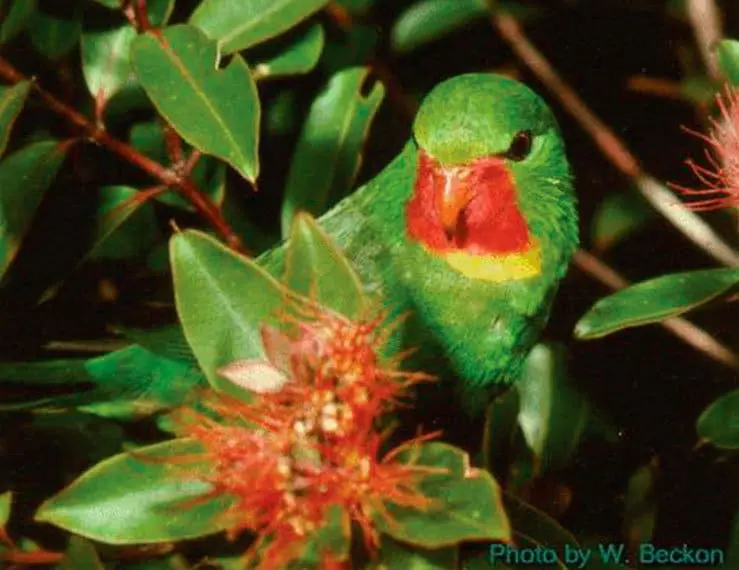
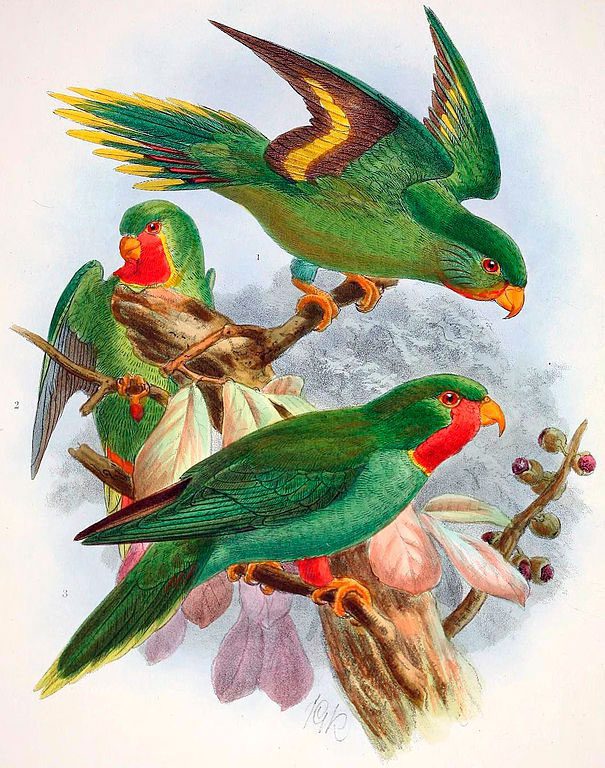
The head of the Red-throated Lorikeet (Charmosyna amabilis) is green with lores and chin red. Upperparts green. Wings internal and ends with green feathers flight feather color black. Throat red, bordered below by a narrow yellow collar; rest of the underparts with a yellowish green that upperparts, particularly in the center of belly; the thighs red. The tail above green a little darker than the rump, with yellow ends; undertail yellow. Bill orange; irises yellow; legs orange-red.

Male and female are equal.

Immature generally duller. The the thighs dull purple. The yellow band throat much weaker than in adults and the red facial and marks throat more restricted.

Habitat:

Move by tropical forests, mainly over the 500 m. Son nomads and fly in pairs or small flocks of 5-8 birds in search of flowering trees, uniting to feed on flowers, nectar and pollen. They prefer to feed in the canopy, and although it is apparently ejected away from the areas of power by the aggressive Collared Lory, Holyoak He found two species feeding on the same tree during his remarks in 1973.

Reproduction:

Breeding and nesting habits unknown.

Food:

They feed actively, to often hung upside down to get to flores.

Distribution:

Size of the area of distribution (reproduction / resident): 37.100 km2

endemic to the Fiji Islands where it is rare and usually only moves above 500 meters and below 1.000 m. Is distributed between in Viti Levu, Ovalau (where it may now be extinct), Vanua Levu and Taveuni. In 1973 Holyoak found at a Red-throated Lorikeet on a wooded Ridge around 250 metres in Viti Levu, species you saw or heard on five different days while exploring Taveuni thinking that the species was widespread in the rainy forests at an altitude between 550 and 1,000 m. The species was also recorded in rainforests between 120 meters and 980 feet by Martyn L. Gorman (1975), but it is said that they are rare. These records are among the few documented sightings of this century. The world's population is believed to be of less than 10.000 specimens. Despite its apparent rarity, This species may be overlooked due to their unobtrusive plumage and behavior.

Conservation:


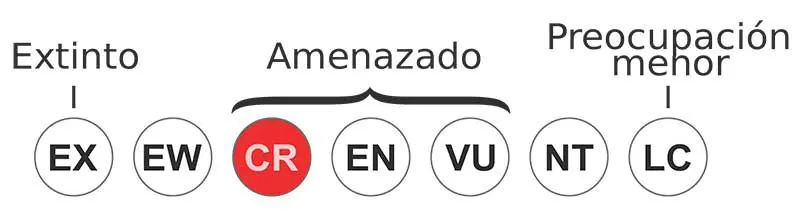
critical hazard


โ€ข Current IUCN Red List category: Critical Hazard

โ€ข Population trend: Decreasing

Threats to the lowlands and hills of the forest is slowly being erased much of Fiji. But, the rarity and assumed decline of this species is probably largely the result of predation by introduced mammals, especially Black Rat (Rattus rattus) , as it is the case with the closely related New Caledonian Lorikeet (Charmosyna diadema).

Increases in course in the logging and the expansion of the road network, especially around the Highlands of Monasavu and Serua in Viti Levu, It is likely that you have caused an increase of the density of these rats (Watling 2000, G. Dutson in litt. 2005). The Indian Brown Mongoose (Herpestes fuscus) introduced, is also present in the areas of distribution of the Red-throated Lorikeet and it can be a threat (V. Masibalavu in litt. 2012).

Agricultural expansion is encroaching on primary forest in Taveuni. Have a distribution in mountains close to the maximum altitude within its distribution area, It also makes this potentially susceptible species to climate change (BirdLife International).

Is species is protected by the laws of Fiji. In Viti Levu, dwells within the Tomaniivi nature reserve, but this is not large enough to maintain a resident population and, Despite the creation of the extension Wabu proposal to make a reservation of adequate size, this would not provide better protection against rats if the reserve is kept unmanaged (D. Watling in litt. 2000)

"Red-throated Lorikeet" in captivity:

Unknown in captivity.

Alternative names:

Red-throated Lorikeet, Red throated Lorikeet (ingles).
Lori ร  gorge rouge (French).
Rothรถschen (German).
Lori de Garganta Roja, Lori Gorgirrojo (espaรฑol).

scientific classification:

Order: Psittaciformes
Family: Psittaculidae
Scientific name: Charmosyna amabilis
Citation: (Ramsay, 1875)
Protonimo: Trichoglossus (Glossopsitta) amabilis

————————————————————————————————

ยซOn Gorgirroยป (Charmosyna amabilis)


Sources:

Avibase
– Parrots of the World โ€“ Forshaw Joseph M
– Parrots A Guide to the Parrots of the World – Tony Juniper & Mike Parr
– Birdlife

Photos:

1 – (Photo by Bill Beckon, 1973)
2 – Charmosyna amabilis By Artwork by John Gerard Keulemans (1842-1912). [Public domain], via Wikimedia Commons