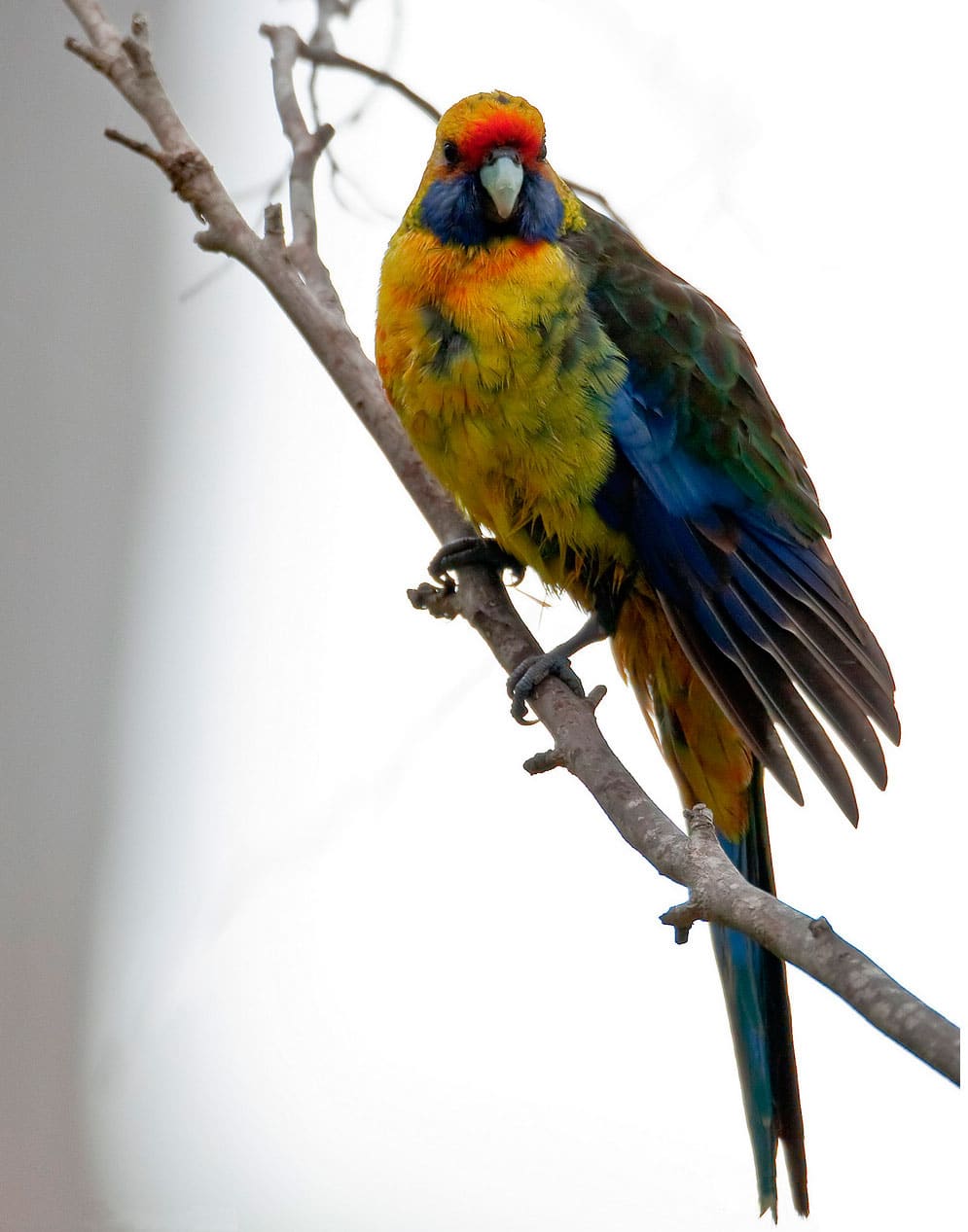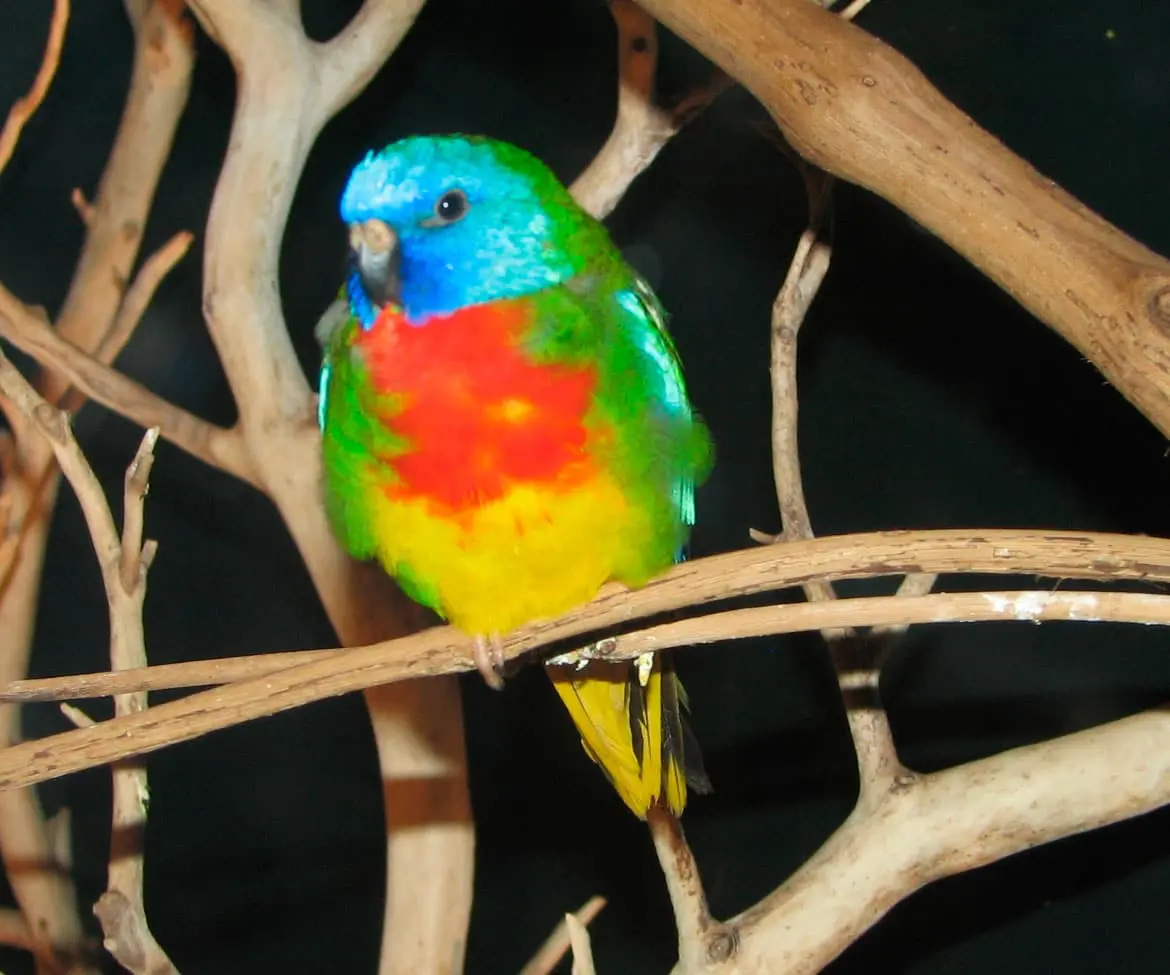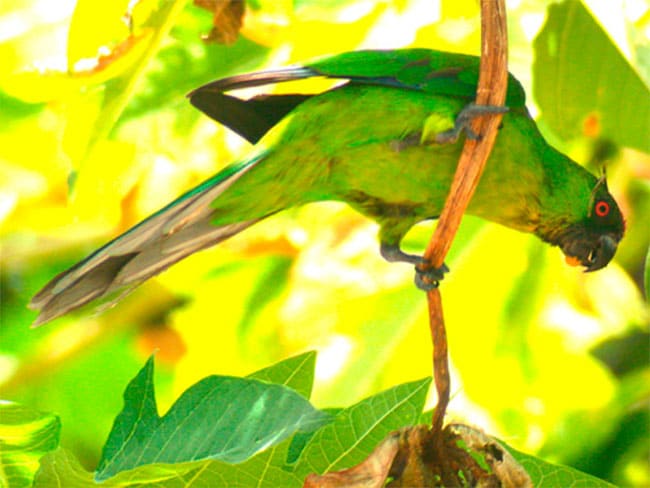
โ–ท The world of Pets: Dogs, cats, birds, reptiles, amphibians

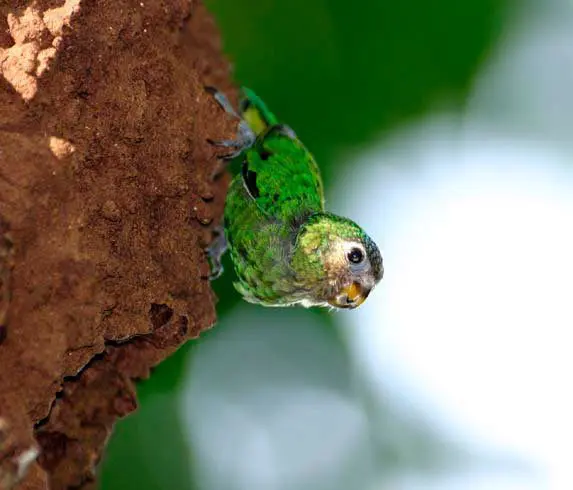
Blue-winged Parrot
Neophema chrysostoma


Parakeet Crisostomo

Content


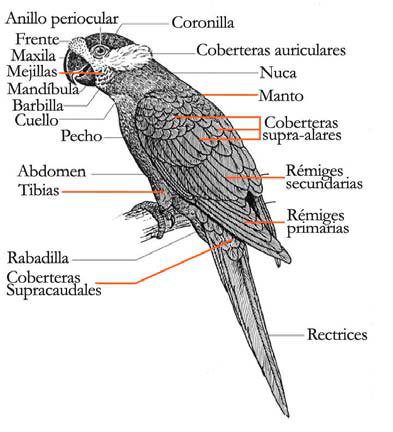
Anatomy-parrots

Description

20 to 21 cm. length and a weight between 44 and 61 g..

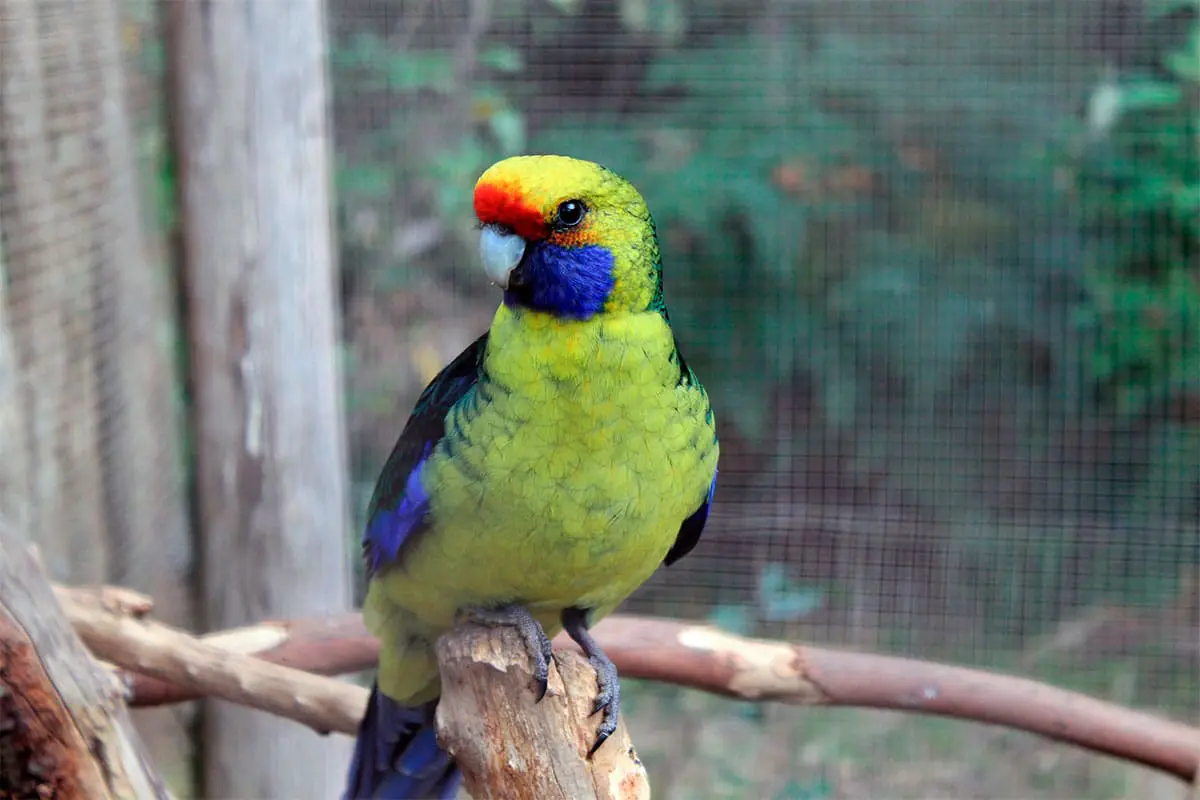
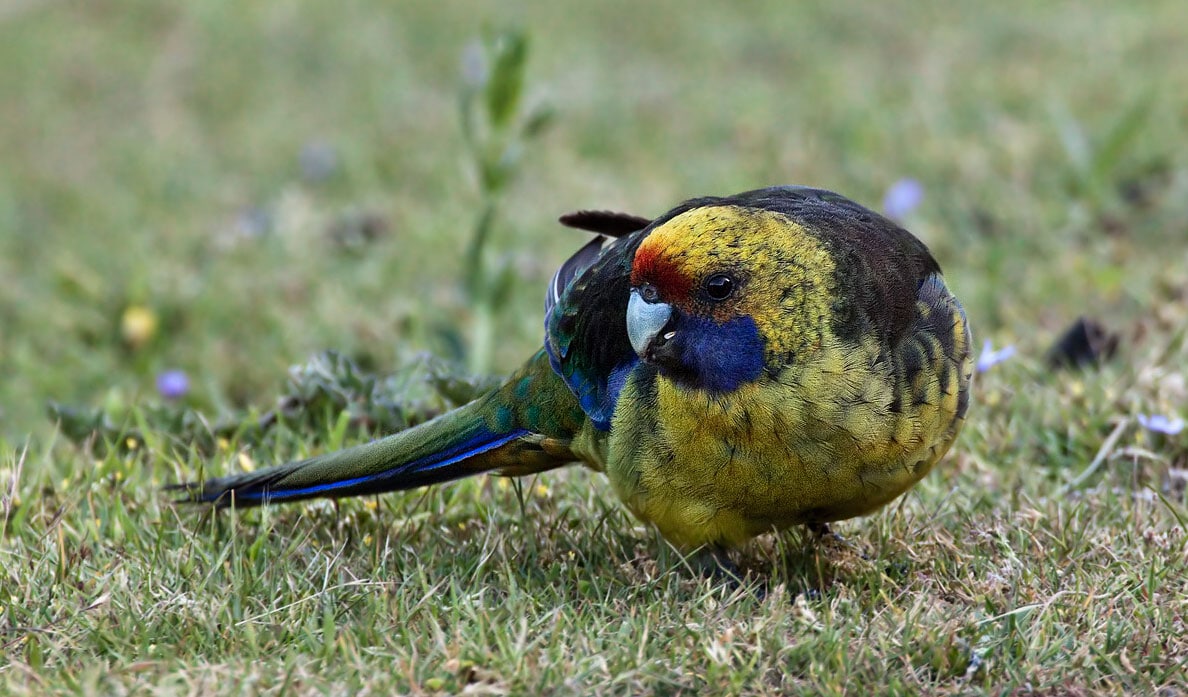
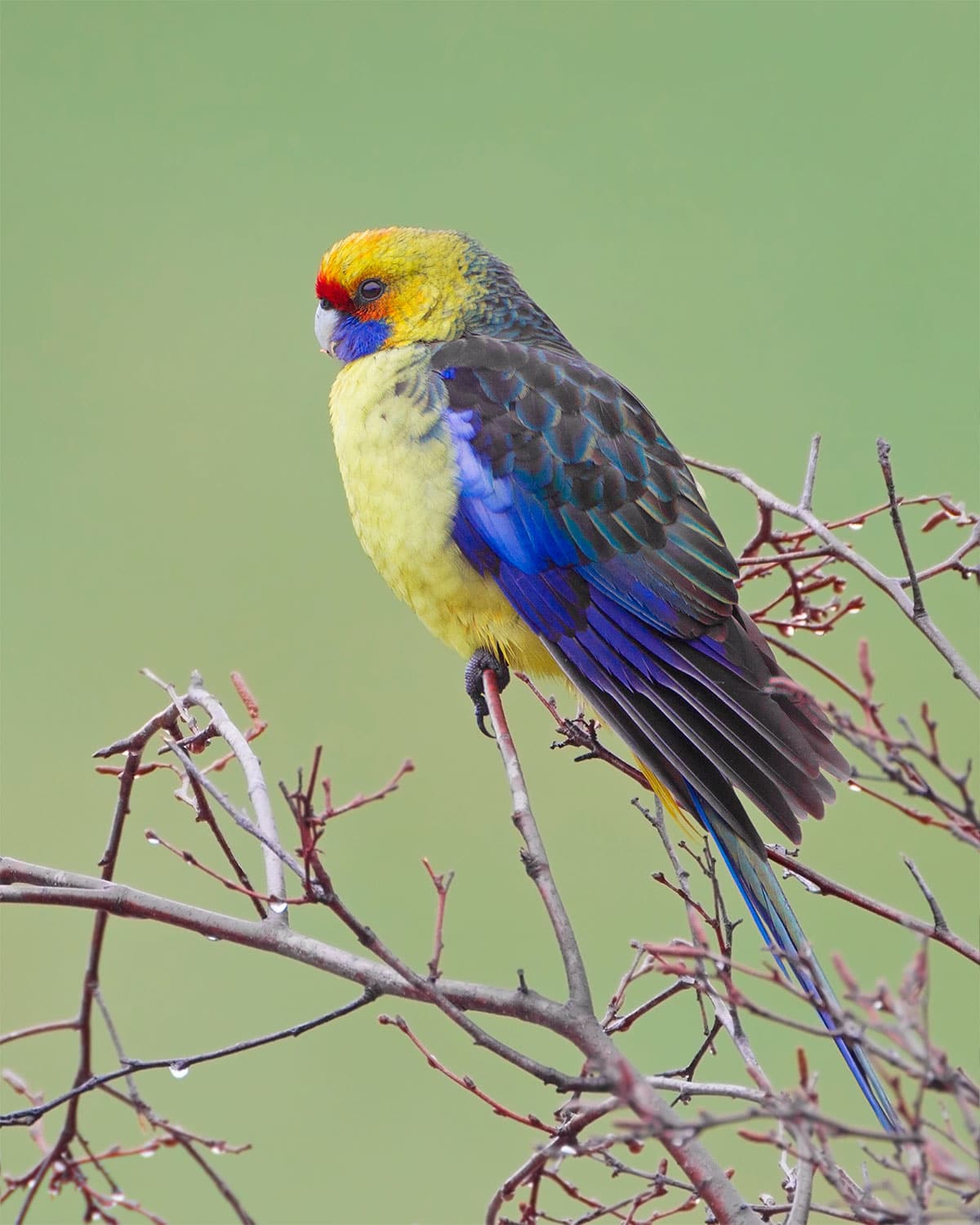
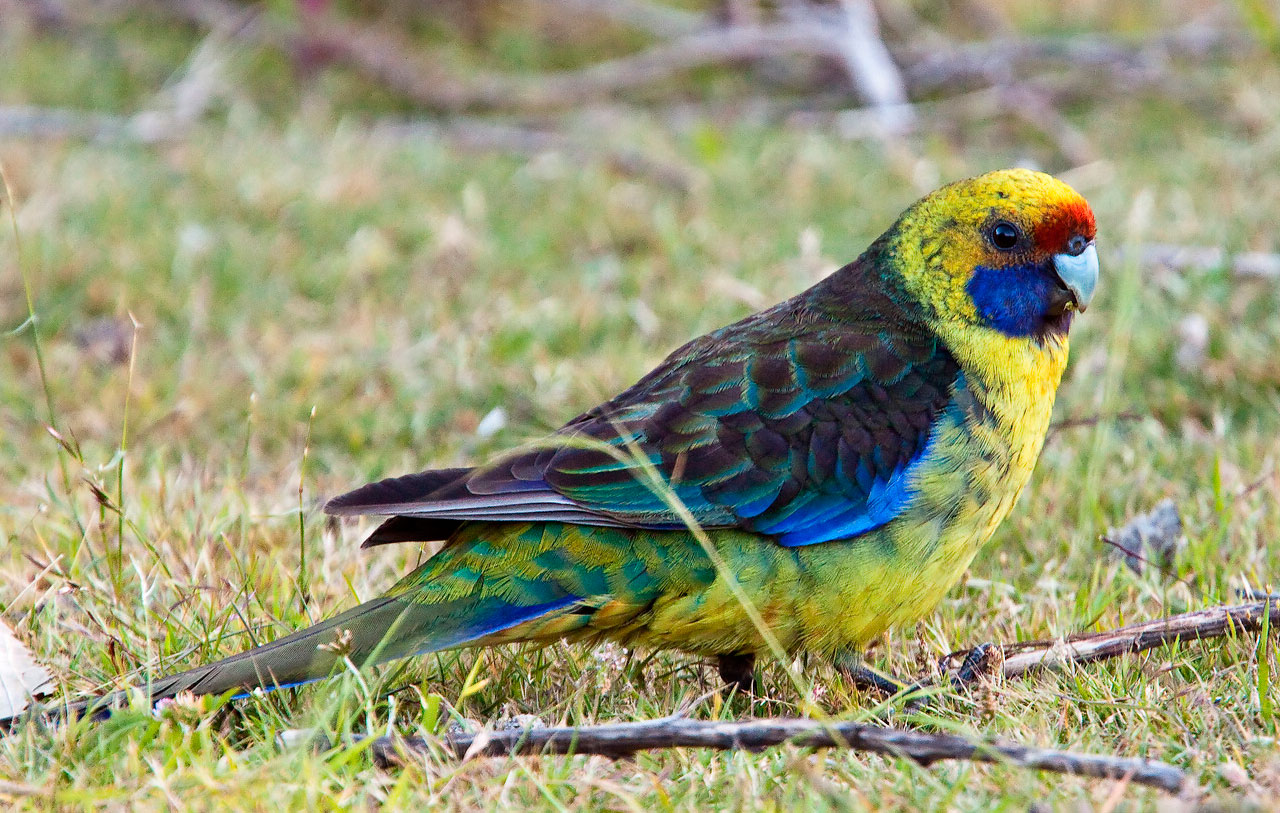
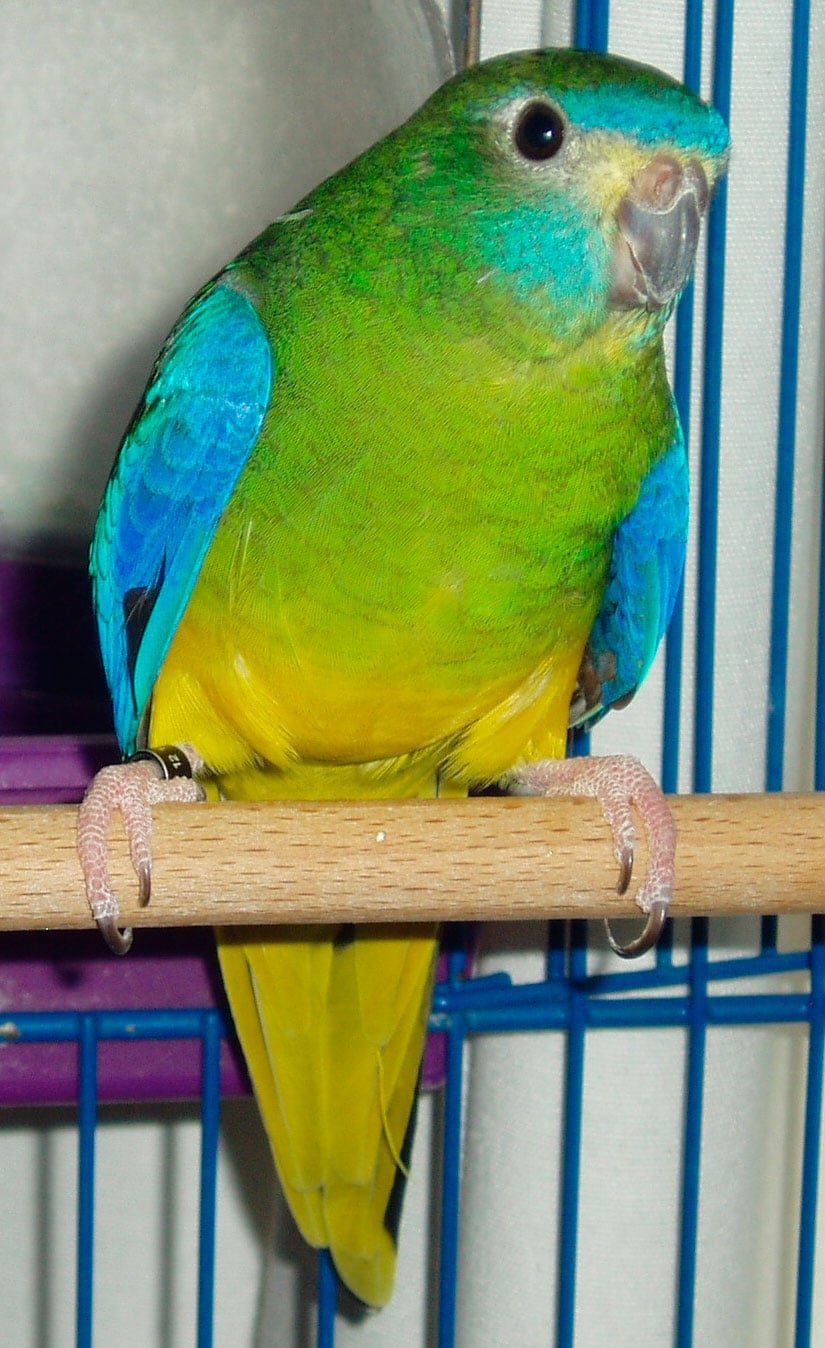
The Blue-winged Parrot (Neophema chrysostoma) has the crown olive green color with a yellow front wallwashing; blue front band (clearer on the back edge), arriving from the front towards the eyes (but not beyond); Lords bright yellow; coverts outpus and face Gris-Oliva. Upperparts olive green color without brightness.

Wing coverts blue, clearer in some feathers of the greater coverts Interior. Primaries black, with blue-violet edges in vane thin yellow margin and external; secondary internal with vane Green external, secondary average with blue in vane outer; tertiary olive green. Wing feathers blue. Top of the chest light green with yellow shading in the area of the belly and undertail- coverts. Upper, the tail is bluish grey, with the exception of the tips of the outer tail feathers, that are yellow.

The bill It is greyish-black with a pinkish lower jaw and the upper jaw with sharp edges.; irises dark brown; legs gris-rosado color.

The female it is duller than the male with the line that adorns the forecrown less developed.
It has the top of the crown olive green. The underparts they are tinged with pale green.

The young birds they lack the frontal band and most show a wing bar; the bill It is orange in very young birds.

Habitat:

During the nesting season, the Blue-winged Parrot frequent eucalyptus plots.

starting winter, These birds change the habitat type, visiting the clear, orchards or similar locations. In addition to these common locations, they tend to move into thickets of acacia and lightly wooded grasslands. At this time of the year, the Blue-winged Parrot They also feel attracted by the arid plains with Salt plants (Atriplex) and for the coast and mountain Moors.

These colorful birds occasionally visit swamps, sand dunes along the coast and wetlands.

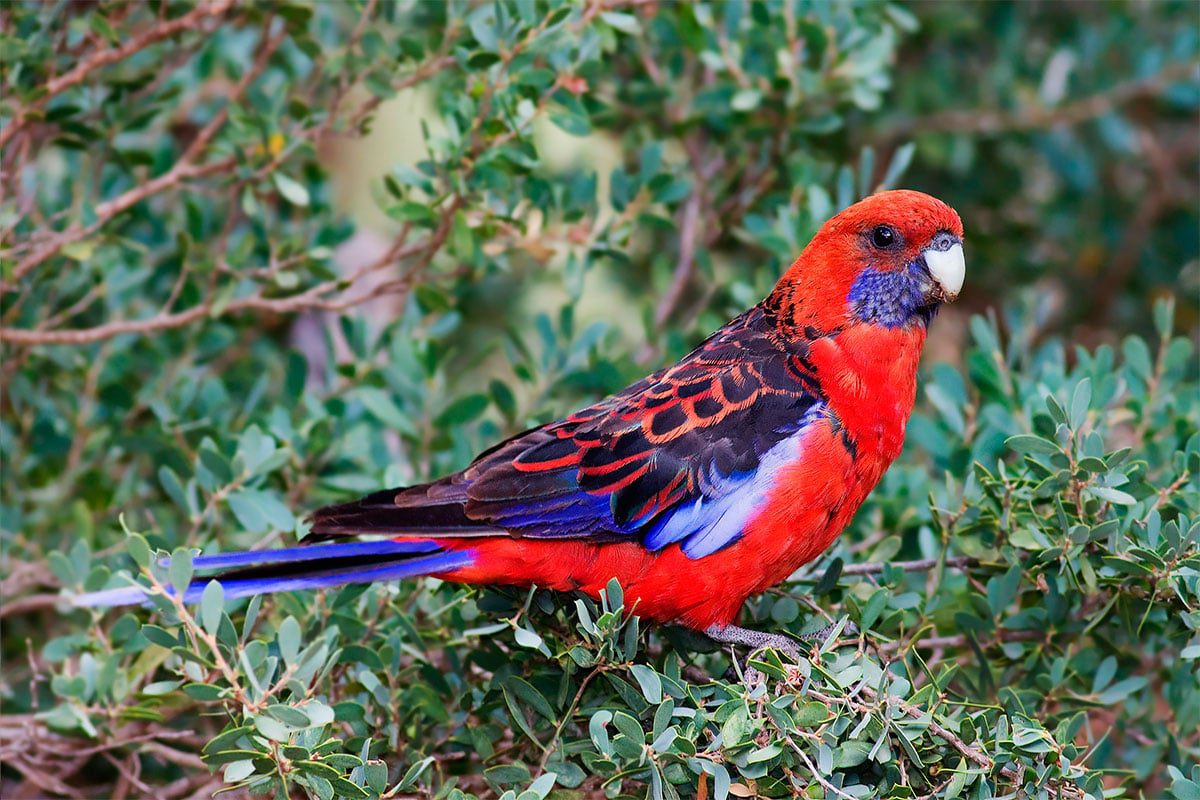
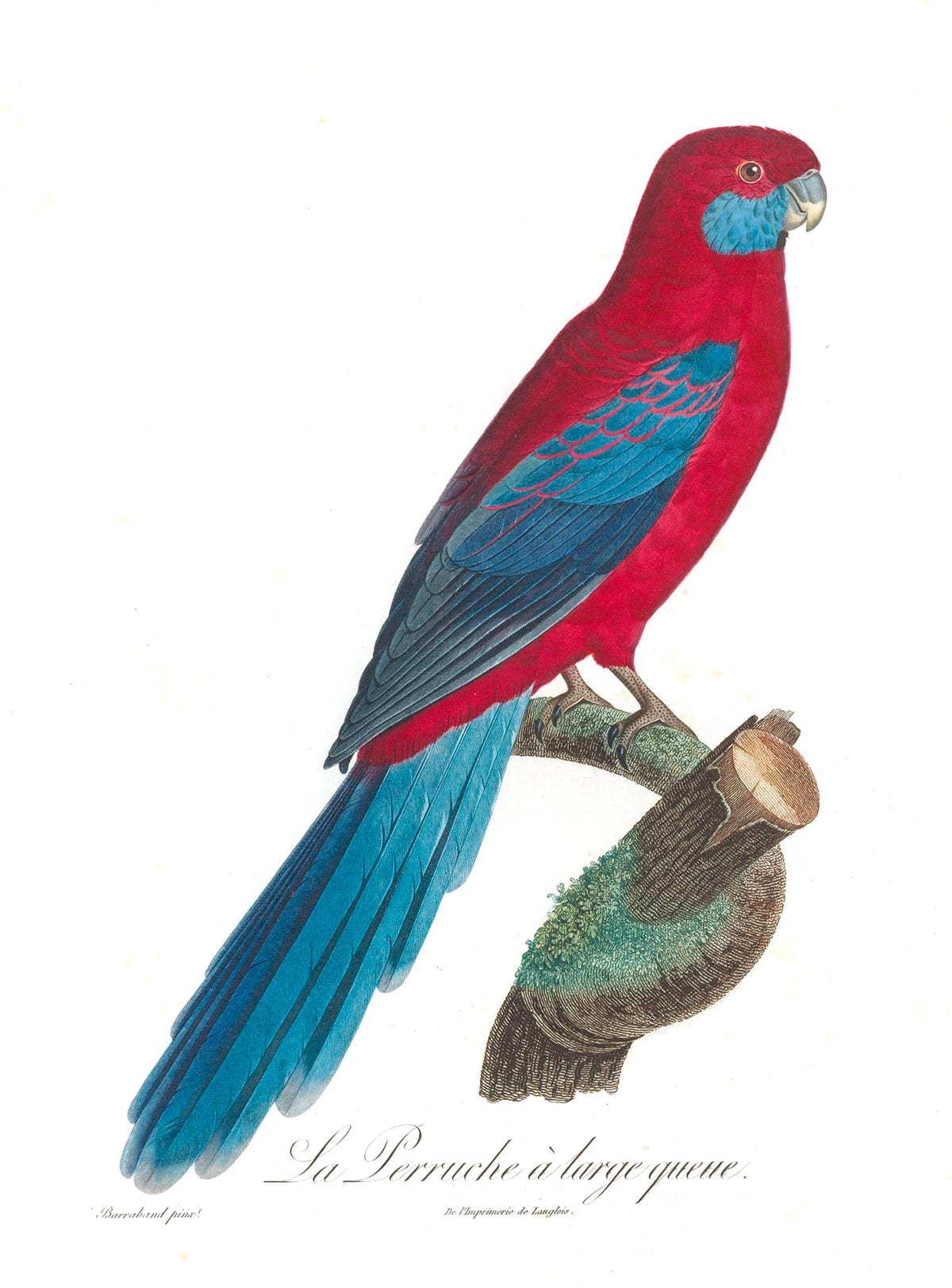
To the Blue-winged Parrot You can see them in pairs or in small groups, but in the off-season, form large meetings in the regions south of the coast, in partnership with the Crimson Rosella or more rarely with the Orange-bellied Parrot.

When feed, they are relatively accessible, flying into a nearby tree when bother them.

During the courtship, the male drops his wings, moves the head and regurgitates food for your future partner. By now, not explained clearly the migration. We know that birds from the south of the continent head north after breeding and the northern limit of this movement is in the south of Queensland. On the other hand, It is unclear whether all the population of the island of Tasmania It has to do with the migration that it crosses the bass strait.

Reproduction:

The nesting season extends from October to January. The nest It is usually a natural cavity in a large eucalyptus. Sometimes, However, found in a stump on a fence post or fallen log.

The female always makes the choice of the site. The Blue-winged Parrot They nest in colonies, sometimes several pairs are established in the same tree. The site can be used for several consecutive years.

The setting contains of 4 to 6 eggs, which are incubated for a period of 18 to 20 days. At birth, the chicks are altricial, and leave their place of birth to the 30 days after hatching. But, they stay with their parents for a short time before becoming independent.

Food:

The Blue-winged Parrot they feed mainly on grass seeds, and especially Danthonia What are the grass family? Poaceae. But, they often enter fields, where to dig the ground with their beaks to retrieve newly sown seeds.

Insects and invertebrates are probably part of their diet. Fruits and flowers represent a significant part of its menu.

Distribution:

During the breeding season (September to January) the birds are found below in 36 ยฐ S, concentrating in the wetter parts of the southeast of Southern Australia, South of Victoria, and in Tasmania.

In winter they are, to a large extent, absent of Tasmania and are distributed much more North, in the southeast of Australia, reaching the South of Queensland (some 26 ยฐ S, for example Thargomindah, Cunnamulla, Chinchilla), and extending westward to the East of Southern Australia, coming to the South of the eyre peninsula and spreading northward around the border of Queensland; They also extend to the East, to the Western parts of New South Wales (as well, from time to time, to the South of the coastal districts in summer).

It is not known if the continental population of the South is resident and birds of Tasmania they are migrant, flying over the Mainland farms to winter over North, or if the entire population moved northward in winter.

There are relatively few records of the King Islands and Flinders, which suggests that, Unlike in the Orange-bellied Parrot, most birds fly over Bass Strait directly to the mainland.

The Blue-winged Parrot are generally common in most open field types and are, probably, the most common parrot in Tasmania. where are reproduced to the South of Macquarie Harbour, on the West Coast and are found in the central region, provided that their habitat is suitable.

Flocks of up to 2.000 young birds they can form in the Northwest of Tasmania before the autumn migration.

The world's population is above the 20.000 birds.

Conservation:


minor concern


โ€ข Current category of the Red List of the UICN: Least concern

โ€ข Population Trend: Stable

According to the Manual of the birds of the world (HBW), This species is not threatened globally. It is even common in the region of Melbourne and Tasmania.

The population is suspected to be stable in the apparent absence of any reduction or substantial threats.

According to Barry Talor, the world population would exceed 20.000 individuals.

"Blue-winged Parrot" in captivity:

The Blue-winged Parrot It, in general, less popular in aviculture as the Crimson Rosella, the Turquoise Parrot, the Scarlet-chested Parrot and the Bourke's Parrot, it's not really weird though.

Their behavior is relatively quiet with few movement needs. It is a bird that is easy to maintain, even for beginners. Your need to crack is almost non-existent and their need for bathroom depends on the individual. It is resistant to the European climate and, certainly, is not inferior to other species of neophemas. But, is susceptible to fog and cold damp, as we know it here in the fall and winter seasons.

The Blue-winged Parrot they seek food by digging in the Earth and are therefore vulnerable to parasitic infections.

According to sources, a Blue-winged Parrot lived during 21 years in captivity. In captivity, these animals have been able to play at the age of 2 years.

Alternative names:

Blue-winged Parrot, Blue winged Parrot, Blue-banded Grass-Parakeet, Blue-banded Grass-Parrot, Blue-banded Parrot, Blue-winged Grass-Parakeet, Grass Parrot, Hobart Grass-Parrot (ingles).
Perruche ร  bouche d’or, Perruche ร  ailes bleues, Vรฉnuste ร  ailes bleues (French).
Feinsittich (German).
Periquito-de-asa-azul (Portuguese).
Papagayo de Alas Azules, Periquito Crisรณstomo (espaรฑol).

scientific classification:

Order: Psittaciformes
Family: Psittaculidae
Genus: Neophema
Scientific name: Neophema chrysostoma
Citation: (Kuhl, 1820)
Protonimo: Psittacus chrysostomus

Images ยซChrysostom Parakeetยป:

Videos "Blue-winged Parrot"

————————————————————————————————

ยซChrysostom Parakeetยป (Neophema chrysostoma)


Sources:

Avibase
– Parrots of the World โ€“ Forshaw Joseph M
– Parrots A Guide to the Parrots of the World – Tony Juniper & Mike Parr
– Birdlife

Photos:

(1) – Blue-winged Parrot, Tasmania. Neophema Chrysostom By KeresH (Own work) [GFDL, CC-BY-SA-3.0 or CC BY-SA 2.5-2.0-1.0], via Wikimedia Commons
(2) – Blue-winged Parrot (Neophema chrysostoma), Mortimer Bay, Tasmania, Australia By JJ Harrison (jjharrison89@facebook.com) (Own work) [CC BY-SA 3.0], via Wikimedia Commons
(3) – Blue-winged Parrot (Neophema chrysostoma), Flagstaff Gully, Hobart, Tasmania, Australia By JJ Harrison (jjharrison89@facebook.com) (Own work) [CC BY-SA 3.0], via Wikimedia Commons
(4) – Blue-winged Parrot (Neophema chrysostoma) by Ron Knight – Flickr
(5) – Blue-winged Parrot, Tasmania. Neophema Chrysostom By KeresH (Own work) [GFDL, CC-BY-SA-3.0 or CC BY-SA 2.5-2.0-1.0], via Wikimedia Commons

Sounds: nick talbot (Xeno-canto)

โ–ท The world of Pets: Dogs, cats, birds, reptiles, amphibians

Pacific parakeet
Psittacara strenuus


Periquito Pacรญfico

Content


Anatomy-parrots

Description ยซPacific Parakeetยป:

Of 33 cm.. length.

The Pacific parakeet (Psittacara strenuus) has most of its plumage bright green. The underparts are yellowish. Some birds may have some feathers Orange at neck and throat in variable patterns. blue dye in primary coverts and vane outer of the flight feather. Underwing-coverts off yellowish green. The lower feathers of the wings they are yellowish metal.

The bill color horn. Eye ring bare greyish Brown. Iris orange. The legs greyish pale.

The immature they are similar to the adults but with the irises brown.

Note:

The Pacific parakeet (Psittacara strenuus) for a long time it was considered a subspecies of Psittacara holochlorus

Habitat of the โ€œPacific Parakeetโ€:

The Pacific parakeet It is in a wide variety of forest types, including wetlands, semi-Bosque, open scrub forests, plantations and farmland with scattered groves.

In Mexico, they live in semi-deciduous forests, riparian vegetation and in the form of patches of semi-deciduous medium and perennial trees of Manilkara zapota, Ceiba petandra, Cedrela odorata, Enterolobyum ciclocarpum, Cordia allidora, Bursera simaruba, Brosimum alicastrum.

Sedentary, but it probably makes local movements in response to food availability.

Outside the breeding season can be seen in large flocks noisy, often in groups of up to 200 birds or more, especially where is food abundant.

In El Salvador, occupy the suburbs of La Sultana, Antiguo Cuscatlรกn, which it provided an opportunity to estimate the population in the roost, to assess seasonal variations and changes over one year (October 2003 – September 2004). the resting places were also observed in this area and found that these places are used by other parrots as Brotogeris jugularis, Psittacara rubritorquis and other species that probably escaped from captivity.

Reproduction:

Nest in tree cavities, on the walls of rocky cliffs or in termite colonies. Other details about their reproductive behavior remain unknown. The size of the implementation tends to be of 4 eggs.

A colony of the Pacific parakeet (Psittacara strenuus) was studied in the Masaya Volcano National Park in Nicaragua from 1993 until 1994.

The parakeets nested in two craters of the Nindirรญ volcano. They dug their nests in the soft Earth of the wall of the volcano and began to settle on the volcano at the end of the dry season. They nested Once a year, in the rainy season, and they gradually abandoned the volcano toward the end of that season, when their young could fend for themselves. All parakeets left the volcano during the morning and it was a count in the course of the afternoon, When they return from their feeding grounds.

Food:

Little is known about of its diet. They feed on fruits and seeds, they sometimes attack cereal crops.

Distribution of the ยซPacific Parakeetยป:

Endemic to the Pacific slope of the Isthmus of Central America, of Oaxaca up to the middle of Nicaragua, mountainous areas of Guatemala to 2.100 meters and El Salvador, where it is a common permanent resident inhabiting forested or semi-forested regions at altitudes of 1.350 m.

Distribution in Mexico: Pacific slope from the east of Oaxaca until Chiapas. In areas in Chiapas and Oaxaca they have disappeared from tropical forests

Conservation:

The Pacific parakeet is not threatened globally. It is considered one threatened species in Mexican legislation. Threatened on NAME-059-ECOL-2001. CITES Appendix II. This species should be classified as in Danger of extinction by their reduced distribution, deforestation of its Habitat and illegal trafficking.

However,They show a high adaptability to changes in natural ecosystems caused by the human.

There are no programs for the conservation of the species.

The "Pacific Parakeet" in captivity:

Rare in captivity.

Its marketing is prohibited in Mexico.

The illegal trade in parrots and macaws is held thanks to demand from consumers. If the demand for these wild species is reduced, then the offer would be reduced and therefore the illegal capture.

If you create an international demand of these captive-bred parrots, there will be unscrupulous traffickers who will try to meet the demand with illegally captured specimens, which will only serve to undermine more wild populations.

Alternative names:

Pacific Parakeet, Pacific Conure (English).
Conure de Ridgway, Perruche du Pacifique (French).
Mexikosittich, Mexicosittich (German).
Periquito-do-pacรญfico (Portuguese).
Aratinga del Pacรญfico, Perico Centroamericano, Perico Gorgirrojo, Perico Verde Centroamericano, Periquito del Pacรญfico, Periquito Pacรญfico, Perico Chocoyo, Barranqueรฑo (espaรฑol).
Periquito del Pacรญfico (Honduras).
perico centroamericano, Perico Verde Centroamericano, Periquito pacรญfico (Mexico).
Perico Gorgirrojo (Nicaragua).

scientific classification:

Robert Ridgway
Robert Ridgway

Order: Psittaciformes
Family: Psittacidae
Genus: Psittacara
Scientific name: Psittacara strenuus
Citation: (Ridgway, 1915)
Protonimo: Conurus vigorous holochlorus

Images "Pacific parakeet"

Videos "Pacific parakeet"

————————————————————————————————

Sources:

Avibase
– Parrots of the World โ€“ Forshaw Joseph M
– Parrots A Guide to the Parrots of the World – Tony Juniper & Mike Parr
– Colony breeding of the Pacific Parakeet Aratinga strenua Ridgway 1915 in the Masaya Volcano National Park, Nicaragua – researchgate
– pericosmexico
academia.edu

Photos:

(1) – Psittacara strenuus (Chocoyo) on the cruise, Nicaragua By SergioTorresC (Own work) [CC BY-SA 4.0], via Wikimedia Commons

Sounds: Frank Lambert (Xeno-canto)

โ–ท The world of Pets: Dogs, cats, birds, reptiles, amphibians

Budgerigar
Melopsittacus undulatus


Common Budgie

Content

Description

18 cm. length and a weight between 22 and 32 g..

Periquito-Comun

In the Budgerigar (Melopsittacus undulatus) of adults, the cere Blue contrasts with the frontal zone; the front of the face and throat are pale yellow. The latter is covered by a line of black dots. The area which is located below the cheeks it's purple.

The central part of the pileum extending from the rear of the eyes to neck It is covered with alternating thin black bands and bands of pale yellow. These bars are expanded on the the mantle and wing-coverts, forming a scaly effect.

The underparts, the area beneath the wings, the lower part of the back and rump create a beautiful pale green together. The tail is opaque blue tones with a central yellow stripe on the side feathers.

The female has a Brown wax.

The immature they are more turned off with bars on the front. The black spots on the throat they are absent.

Habitat:

The Budgerigar they are distributed by a wide variety of open habitats, including open forests, lightly wooded grasslands and savannas. Also appreciate the areas of Mallee, farmland, vegetation that grows along rivers, drought-adapted scrub and open plains. They come fitted with desert areas of Mulga (Acacia aneura). Although they are able to survive several days without water, These birds are never far from a water source.

In areas where fruit production is constant and in others where it is stable for very long periods, the movements of the Budgerigar they are easily predictable.

In the South end, Pilgrimages exist only in cases of prolonged drought and wandering parakeets return to their territory with the first rains and recolonize when river levels return to normal.

Reproduction:

The Budgerigar they build their nests of June to September in the North its area of distribution. They reproduce between August and January in the South. Nests can be installed at any time of the year after the rains fall. They establish a second brood as soon as conditions are favorable.

These parakeets usually nest in colonial way. The nest is located in a natural cavity in a tree, in a strain, an any fence post, or on a big fallen branch.

The female lays from 4 to 6 eggs and incubation lasts a few 18 days. The chicks remain in place of birth during 30 days before flying.

Food:

The Budgerigar It vegetarian, they eat herbs and seeds of quenopodios. Plants vary in categories and in proportions, according to which regions and times.

The East inside of Australia, These birds feed exclusively on seeds that are on the ground, While in the middle of the continent, There is more variety of plants to select. In the first case, grain size barely exceeds the 2 mm diameter and the second, more than 40 plant varieties make up the diet of these parakeets.

From time to time, the Budgerigar, they come in growing areas and take advantage of the ripe fruits.

Distribution:

The Budgerigar are distributed widely throughout the Interior of Australia, Although they are rare in the coastal districts of the This and the end South-West (absent of Tasmania, Arnhem Land and Cape York Peninsula).

The species may be of common to very abundant, but they are nomadic, and may change from year to year areas.

These parakeets, frequently, they burst from the arid zones to the more humid zones and there are temporary movements towards the south during the summer, but these changes may be affected by annual rainfall patterns.

We have introduced, without success, in a number of places around the world (or they have escaped from captivity and could not be) including South Africa, United Kingdom, Japan, Hong Kong, Puerto Rico, Brazil, Switzerland, Colombia, the Society Islands, New Zealand and Oman.

In the EE.UU. the species has managed to colonize Hawai and California (leaks also occur regularly in the city of New York City). In Florida a population was originally registered in the area of St. Petersburg, in the decade of 1950 and now has more of 3.000 individuals; These birds are mobile and have been recorded along the coast This of all the South from Jacksonville to Miami, and in the West everything Hudson to South of Fort Myers, from time to time go towards the North in Gainsville.

Parakeets, occasionally escaped, they may appear in Tasmania.

The world population is estimated at around 5.000,000 copies.

Conservation:


minor concern


โ€ข Current category of the Red List of the UICN: Least concern

โ€ข Population Trend: Growing

This species is not threatened at all, even they are abundant, and in some places where resources are good, countless flocks darken the sky, to cause branches to break from 4 centimeters in diameter, When large number of birds used them as support for their breaks.

Populations fluctuate widely depending on weather conditions.

Livestock living on farms in central Australia have caused Budgerigar they will benefit from new water supplies. Like this, the number of parakeets are constantly increasing.

These parakeets are the most well known psittacidas in the world.

"Budgerigar" in captivity:

This parakeet was discovered in 1805 and since then it has become the most popular captive bird in the world. While it is considered as domestic fowl, However, is a gregarious and instinctive animal, with the same needs that the parrots who freely roam the lands of Australia.

The Budgerigar It dynamic, curious, melodious and because of its small size, the beauty of their plumage and their entertaining behaviour, truly charming. This is what makes it a coveted bird. But, It is still a bird that needs to fly, play and socialize with their peers. Like any bird, It is sensitive to the social and environmental context. In fact, their real needs are too often overlooked, many parakeets suffer neglect or even abuse.

In captivity, the Budgerigar It is larger than its counterpart in nature. Measures of 20 to 25 cm. from head to tail and weighs between 30 and 45 g.. In addition to the colour of your coat, wild type, There are numerous mutations (other coat colors) associated with the increase in crossings and selections in certain genes, that translates into more spontaneous mutations.

The Budgerigar has two silent by year average, and the first moult occurs between the fourth and sixth month. The molt is complete renovation of the plumage of the bird. Pens fall to others push, includes your tube of keratin that parakeets will open with their beaks to release pen and relieve the irritation that engenders the same thrust. It can be more or less painful and intense. Some plucking is so fast that the bird may experience some difficulties during the flight.

Check the intensity of the change of the parakeet through black head tubes, tiredness and especially the number of feathers on the ground.

The feeding of the Budgerigar is based on the millet and the birdseed, Although it must be complemented with other seeds or vegetables (as the lettuce, Spinach, pepper, Carrot, corn). The fruits are also a good dietary supplement for these birds. Occasionally it can provide a little bread or biscuit, but always with caution that not give them anything very sweet. The avocado, the chocolate and the parsley they are deadly toxic for the Australian parakeets.

The the parakeet cage must be protected from the cold, a temperature between the 20-25 C. It must be of one sufficient size so you have freedom of movement and can exercise. The balusters must be arranged horizontally so that they can climb up them. The cage must be washed at least once a month with a disinfectant, change the water daily and clean the shells of the food. A cat litter tray can be placed to make their needs.
It is also important to let the parakeet out occasionally and fly freely around the room. Windows must be closed and curtains, because you can hit them.
Son very sociable birds and it is better to live with other parakeet. The best couple is formed by a male and a female. This will try to kill its companion if it is of the same gender.

With regard to its longevity, according to sources, these animals can come to live until 21 years in captivity. The same sources indicate that these parakeets suffer from a high incidence with respect to ovarian cancer.

Alternative names:

Budgerigar, Budgerygah, Budgie, Canary Parrot, Grass-Parakeet, Lovebird, Scalloped Parrot, Shell Parakeet, Shell Parrot, Undulated Parrot, Warbling Grass-Parrot, Zebra Parrot (ingles).
Perruche ondulรฉe (French).
Wellensittich (German).
Periquito-australiano (Portuguese).
Periquito Australiano, Periquito Comรบn, Cotorra Australiana, Cata Australiana (espaรฑol).

scientific classification:

George Shaw


Order: Psittaciformes
Family: Psittaculidae
Genus: Budgerigar
Scientific name: Melopsittacus undulatus
Citation: (Shaw, 1805)
Protonimo: Psittacus undulatus

ยซCommon Parakeetยป Images:

Videos "Budgerigar"

————————————————————————————————

ยซCommon Parakeetยป (Melopsittacus undulatus)


Sources:

Avibase
– Parrots of the World โ€“ Forshaw Joseph M
– Parrots A Guide to the Parrots of the World – Tony Juniper & Mike Parr
– Birdlife

Photos:

(1) – Budgerigar at Zoo Atlanta, USA By TheSussman (Mike) (originally posted to Flickr as Parakeet) [CC BY 2.0], via Wikimedia Commons
(2) – Two budgerigar at Henry Doorly Zoo, USA By Jeff Coffman (originally posted to Flickr as DSC_1265) [CC BY 2.0], via Wikimedia Commons
(3) – male budgerigar. taken near Cameronโ€™s Corner, Qld By Benjamint444 (Own work) [GFDL 1.2], via Wikimedia Commons
(4) – Detail shot of budgerigars head By Kirk (Own work) [CC BY-SA 3.0 or GFDL], via Wikimedia Commons
(5) – Melopsittacus undulatus flock, Karratha, Pilbara region, Western Australia By Jim Bendon from Karratha, Australia (budgies_4) [CC BY-SA 2.0], via Wikimedia Commons
(6) – By User Magnus Manske on en.wikipedia [Public domain], via Wikimedia Commons
(7) – Exterior diagram of a green budgerigar By ZooFari [CC BY-SA 3.0], via Wikimedia Commons

Sounds: Marc Anderson (Xeno-canto)
โ–ท The world of Pets: Dogs, cats, birds, reptiles, amphibians

Alexandra's Parrot
Polytelis alexandrae

Alexandra's Parrot

Content


Anatomy-parrots

Description

45 cm. length, including its long, narrow tail, and around 92 g. of weight.

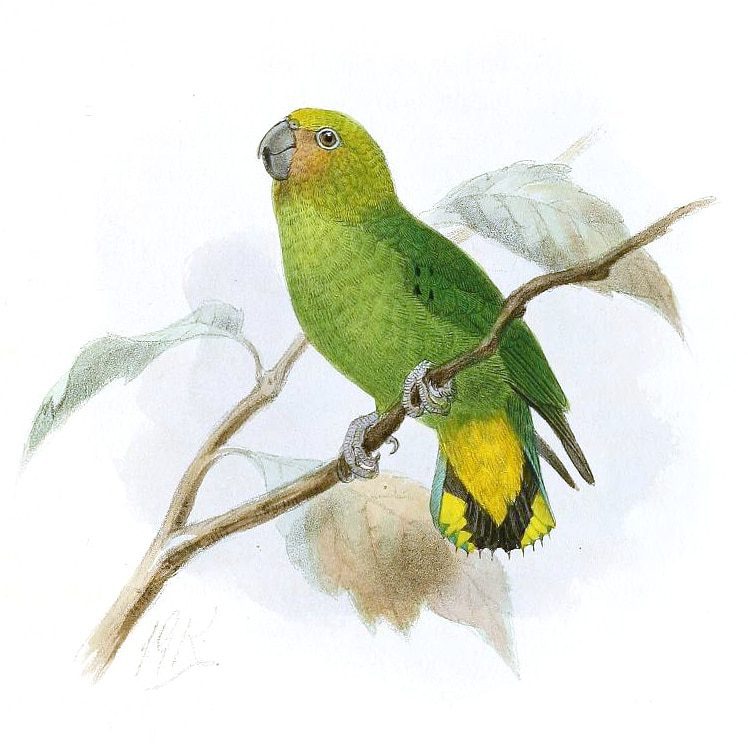
The head of the Alexandra's Parrot (Polytelis alexandrae) is light olive brown color, heavily washed in blue pastel in the Crown area, the nape of the neck, and slightly below the eyes; the Chin and throat pale pink.

Mantle and scapulars Brown olive-tinged greenish and fine dark stripes; back and rump, color pastel blue; upper coverts greenish-gray tail. Upper coverts bright yellowish green wings, with a few more green feathers around the curve of the wing; Dark greenish blue primary coverts; primary blue-green with yellowish-brown, and dark brown margin leading edge for the vane inner (the third rรฉmige primary has the tip spatula-shaped. ); secondary of pale blue-green with a yellowish margin (more pronounced in vane outer); greenish grey tertials with vane more obscure internal. Wing of bright green feathers, more yellow towards leading edge; undertail, wings greyish Brown with large pale yellow inner margin to the vane inner. Usually gray olive underparts pale, with the pink color of the throat which runs on top of the chest; belly and flanks washed clear bluish green; thighs and lower flanks with increase in pink; coverts yellow olive color infracaudales. Upper, tail Brown olive green near the axis and blue toward tip-washed, lateral feathers bluish grey and pink-tipped; undertail, Black tail with tips and margins of pink.

The beak is red with a grey periophthalmic ring; orange-yellow irises; grey legs.

Female has a shorter tail (average of 6 cm.. less than the male) and it lacks of spatula in the third tip rรฉmige primary. The wing coverts are greener and more off. And the mantle shows less green Suffusion. Crown, back and rump are less blue.

Immature similar to females and males acquire the adult plumage in about 14 to 18 months.

Habitat:

Highly nomadic and little known in the wild.

Inhabits the deserts of sand from the arid Center of Australia, often far from water. Birds can reach an area which have been absent for many years, reproduce, and quickly exit again.

They are found in mound grasslands, dry forests of coastal eucalyptus, thickets of acacia, mulga (Acacia aneura) and deserts with scattered Oaks (Allocasuarina decaisneana).

The birds are alone, in pairs or in small groups of up to 15 Member. There are also some earlier records of larger breeding colonies.

Reproduction:

The breeding season has been recorded from September to January, Although the nesting can be irregular and probably depend on the rainfall of rain and is also sometimes colonial.

During courtship, the male raises some feathers on its Crown and extends its wings and tail.

Favorite nesting place is a large hole in a Red eucalyptus (Eucalyptus camaldulensis) lined with a pile of rotting wood dust (the desert oak It has also been used).

Of four to six white eggs make up the implementation, incubated by the female for a few 21 days. While the female is incubating, the male takes care of your power. The young are fed during 5-6 weeks and become independent from three to five weeks after leaving the nest.

Food:

The birds feed on the ground and can be very meek. The diet includes seeds of Spinifex (Triodia mitchelli) and Herb mulga (Bipartite Danthonia). As well, according to sources, they can feed on nectar.

Distribution:

The Alexandra's Parrot are confined to the interior of Australia, where usually are very rare and few records. The species is an irregular visitor, It may not appear in parts of its distribution area for two decades or more.

Are distributed in Western Australia, from the North of the Great sandy desert to the West of the fitzroy river, about Wiluna, Sandstone, Menzies and Coolgardie and East through the deserts Gibson and Great victory.

Occurs in the Northern Territory to the North of the area of Newcastle Waters and Stuart Plains, and to the South up to around Alice Springs.

In Queensland, It is very rare in the South-western end, but there is a recent breeding record around Cloncurry.

In South Australia, extends to the East, about Oodnadatta, and there is a record of 1986 in the Great Victoria desert some 25 kilometers to the North of the Nurrari Lakes.

There is disagreement about its conservation status. The recent lack of records of large groups of reproduction, He cited as a possible indication of population decline, but there is little real information, and it suggests that the world's population can be estimated between 1.000 and 20.000 birds. A recent study suggests the species could be irruptive rather than nomadic, and that a population nucleus may be resident in the area around the Tobin Lake, Western Australia.

Trade, fires, changing land use regimes and predation, they have been cited as potential threats.

Protected by law.

A large number in captivity.

VULNERABLE

Conservation:


Near-threatened


โ€ข Current category of the Red List of the UICN: Near threatened

โ€ข Population trend: Stable

The population of the Alexandra's Parrot It is estimated, with low reliability, in 5 000 birds breeding (Garnett and Crowley 2000).

There is no firm evidence to determine the general trend of the number of Princess Parrot that exist. But, the rate appears to have decreased (Garnett and Crowley 2000), and recent sightings (in different places of Tobin Lake in the Great sandy desert) they have only been small batches (Garnett 1993; Garnett and Crowley 2000). On the other hand, historical records include reports of large flocks and large breeding colonies (Forshaw and Cooper 2002; North 1912; Parker 1971; Whitlock 1924).

The Alexandra's Parrot It has not been registered crossed with other species in nature. It is unlikely that any interbreeding occurs because the other two members of the genus Polytelis, the Superb parrot (Polytelis swainsonii) and the Regent Parrot (Polytelis anthopeplus), they usually do not occur in the same places as the Princess Parrot (Higgins 1999).

Remote areas occupied by species, its irregular presence in most places, and the lack of information about their movements, make it difficult to accurately estimate population size (Higgins 1999).

Conservation Actions Proposed

โ€ข Study the ecology of species, about the Tobin Lake or the Great Victoria desert to determine the likely constraints on population size.

โ€ข Monitoring of sightings to characterize the habitat and habitat models to verify the needs and historical responses to fire and precipitation throughout the distribution of the species.

โ€ข Use research information to develop a management strategy.

โ€ข Protect the areas where the species breeds..

"Alexandra's Parrot" in captivity:

Not too noisy, good whistling, and friendly disposition. It is a robust bird able to tolerate reasonable temperatures. Susceptible to infections in the eyes.

According to records, a female lived 23,9 years in captivity.

common in captivity.

Pure birds, with colors typical of their species are increasingly difficult to find.

The Alexandra's Parrot they can be accommodated in a wide variety of sizes of aviaries. It is best to raise them as couples, They seem to play better if they can see or listen to another pair of the same species. An Aviary of 4 meters long is considered the minimum to adequately house these birds.

Have brought successfully as a colony of 3-5 couples in a large aviary.

Non-toxic hardwood branches can be placed in the Aviary of birds so that they can chew them. This entertains our parakeets, helping to minimize boredom and providing them with a little exercise for supico. Natural branches of different diameters, and placed in different angles, they can be used for hangers. These natural hangers can be chewed by birds and may need to be replaced periodically. Birds can chew the flowers and fruiting bodies on the branches.

Its diet It requires a mixture of quality of food for parrots and a variety of fruits, such as the Apple and orange, as well as a variety of vegetables – corn, chard, usually providing green food and green leafy vegetables. Sowing grasses, If they are available. Soaked or sprouted seeds if they are available.

Commercial dry pellets can be part of a balanced diet.

Some birds will eat insects, as mealworms, especially around the breeding season. The insects will provide adult and young birds with a good source of easily digestible protein.. Insects can serve food to these birds on your daily diet.

The breeding season These parrots begins in March; the implementation is of 3 to 7 eggs, and incubation lasts approximately 20 days; the young become independent to the 50 days; occasionally breeding occurs 2 times a year. It is frequent that the female sexually mature in the first year, the male after the second year; couples can stay in adjacent aviaries each other separated by double metal fabric.

Alternative names:

Alexandra’s Parrot, Gould princess parrot, Pilpul, Princess Alexandra’s Parrot, Princess Parrot (ingles).
Perruche d’Alexandra, Perruche, Perruche ร  calotte bleue, Perruche Princesse-de-Galles, Princesse-de-Galle (French).
Alexandrasittich, Alexandra-Sittich, Blaukappensittich, Grosser Alexandersittich (German).
Periquito-princesa (Portuguese).
Perico Princesa, Periquito Princesa de Gales (espaรฑol).

scientific classification:

Order: Psittaciformes
Family: Psittaculidae
Genus: Polytelis
Scientific name: Polytelis alexandrae
Citation: Gould, 1863
Protonimo: Polyteles alexandrae

ยซPrincess Parakeetยป Images:

————————————————————————————————

ยซPrincess Parakeetยป (Polytelis alexandrae)

Sources:

Avibase
– Parrots of the World โ€“ Forshaw Joseph M
– Parrots A Guide to the Parrots of the World – Tony Juniper & Mike Parr
– Birdlife
– AnAge: The Animal Ageing and Longevity Database – Genomics.senescence.info

Photos:

(1) – Pet Info Club – petinfoclub.com
(2) – Princess Parrot at Cincinnati Zoo, USA By Ted (originally posted to Flickr as DSC_0026) [CC BY-SA 2.0], via Wikimedia Commons
(3) – Princess Parrot at Cincinnati Zoo, USA By Ted (originally posted to Flickr as DSC_0063) [CC BY-SA 2.0], via Wikimedia Commons
(4) – A blue mutant Princess Parrot at Flying High Bird Sanctuary, Australia By paulgear (Picasa Web Albums) [CC BY-SA 3.0], via Wikimedia Commons
(5) – ยฉ2013 Simon J.. Tonge – calphotos

Sounds: Nigel Jackett (Xeno-canto)

โ–ท The world of Pets: Dogs, cats, birds, reptiles, amphibians

Elegant Parrot
Neophema elegans


Elegant Parrot

Content


Anatomy-parrots

Description ยซElegant Parakeetยป

21 to 24 cm.. length between 40 and 51 g. of weight.

The Elegant Parrot (Neophema elegans) is very similar to the Blue-winged Parrot (Neophema chrysostoma), but its plumage It is brighter and more yellowish especially in the chest.

The crown is olive-green with a front band in dark blue tone and a distinctive and fine light blue on the rear margin. Lords bright yellow; the face Yellow olive.

The the mantle and back are olive green, staining in yellow tones in the area of the rump. The bend of wing they are blue. The wing-coverts more internal are olive green, the median pale blue tips, the large coverts with edge them in blue malva; the primary coverts in blackish shades with margins of violet-blue. The primaries black, with edges in blue violet dark; the secondaries greenish-yellow colour with external margins of blue color in the outermost zone.

The wing feathers blue-violet color. Throat and chest of yellowish-green, becoming bright yellow in the belly and in the undertail- coverts, sometimes with orange patches among the legs. Upper, the tail greyish blue, darker towards tip, Yellow lateral feathers with darker bases.

The bill black; irises dark brown; legs grey.

The plumage of the female is olive green opaque.

Immature females they are similar, except the line forecrown It is barely visible.

The adult plumage WINS in three or four months.

  • Sound of the Elegant Parrot.

โ€œElegant Parakeetโ€ Habitat:

The Elegant Parrot It is a nocturnal migratory bird. It is the least specialized of its kind. It attends the nearshore or coastal dunes, wooded grasslands and Shrublands, areas of Mallee that have the appearance of large shrubs and plots of eucalyptus.

You can also see in the shrubs of Acacia, in areas of low altitude provided Acacias (Acacia caesiella) or fitted with bushes of the salt Plains Saltbush Atriplex. They especially appreciate the groups of trees that are cleared up areas.

outside the breeding season, the Elegant Parrot they form large flocks, often in association with the Blue-winged Parrot, in the Southeast. They gather in grasslands and brushy areas to feed on native or imported seeds or grasses..

These parakeets are partially nomadic, above the outer limits of its range. Local low-intensity movements can also occur. These birds nest in Kangaroo Island, from November to April. after this last month, they move to the Mainland to form their winter quarters.

Reproduction ยซElegant Parakeetยป:

The Elegant Parrot They nest from August to November. Usually install their nest in a cavity in a tree at high altitude. They often use the highest branches of isolated trees. Spawning is composed of 4 or 5 eggs incubation lasts a few 18 days. The chicks are altricial and they leave the nest after one month.

โ€œElegant Parakeetโ€ Feeding:

The Elegant Parrot they are almost exclusively vegetarian. Their menu consists of clover or sunflower seeds and other plants of the type Helianthus, Trifolium and paspalum. Also appreciate the Berberis (Jeffersonia diphylla) and barberry (Berberis vulgaris).

ยซElegant Parakeetยป Distribution:

There is a two morphologically identical populations but well separated, although the species is nomadic so the birds can appear outside the normal range sometimes.

In the Southwest the species occurs west of a line from the environs of Esperance on the southern coast of the North of Western Australia through Merredin until Moora on the Northwest Coast.

They have spread through the wheat belt of the drier areas of the northeast and are now in the vicinity of Perth, as well as sometimes north of Point Cloates and the fortescue river.

In the Southeast are distributed in the South of Southern Australia, on eyre peninsula, on Kangaroo Island (present in summer), and in the districts of South, about Port Augusta, Port Wakefield and about adelaide, in the Lofty Mountains, reaching northward in the northern most part of the Montes Flinders.

The species is irregular East of 140 ยฐ E, with few records from New South Wales, North of Riverina to paroo river; is also irregular in the Northwest of Victoria.

The population of the Southwest It is growing, While in the Southeast believed to be stable although the species is generally less common and its historical range is not easy to determine due to possible confusion with the Blue-winged Parrot.

The world population is estimated over of 30.000 individuals.

โ€œElegant Parakeetโ€ Conservation:


minor concern


โ€ข Current category of the Red List of the UICN: Least concern

โ€ข Population Trend: Growing

According to the Manual of the birds of the world (HBW), This species is not threatened globally. It is common, especially in the southwest of Australia.

Until the Decade of 1930, It grew, After the use of clover in pastures.

The size of the world's population has not been quantified, but the species, according to sources, it is common. (pit et to the. 1997). It is estimated that it may be around the 30,000 specimens.

"Elegant Parrot" in captivity:

The Elegant Parrot they belong to a species that are obtained very good results in reproduction. They are also suitable for fans of parrots.

They are peaceful birds that do very low noise. They are a little shy, but they become confident with time. They are easy to maintain but they have the need to crack, a little bigger, than other species of neophemas, without the destruction of your Aviary. Your bathroom need depends on the individual. Son heat-resistant, but they are very sensitive to cold and wet fog.

To the Elegant Parrot He loves to dig the ground and is therefore susceptible to infection by worms. They are also sensitive to eye infections.

Alternative names:

Elegant Parrot, Elegant Grass-Parakeet, Grass Parakeet, Grass Parrot, Yellow Lowry (ingles).
Perruche รฉlรฉgante (French).
Schmucksittich (German).
Periquito-elegante (Portuguese).
Papagayo Elegante, Periquito Elegante (espaรฑol).

scientific classification:

Order: Psittaciformes
Family: Psittaculidae
Genus: Neophema
Scientific name: Neophema elegans
Citation: (Gould, 1837)
Protonimo: Nanodes elegans

ยซElegant Parakeetยป Images:

Videos "Elegant Parrot"

————————————————————————————————

ยซElegant Parakeetยป (Neophema elegans)


Sources:

Avibase
– Parrots of the World โ€“ Forshaw Joseph M
– Parrots A Guide to the Parrots of the World – Tony Juniper & Mike Parr
– Birdlife

Photos:

(1) – Elegant Parrot in the Walsrode Bird Park, Germany By Quartl (Own work) [CC BY-SA 3.0], via Wikimedia Commons
(2) – By Goura – Elegant parrot Perth, WA, Australia – ZooChat
(3) – Elegant Parrot Neophema elegans – animalphotos
(4) – Elegant Parakeet (Neophema elegans) at Walsrode 2007 by Maguari – ZooChat
(5) – Stirling Range Retreat, Stirling Range National Park, Western Australia, Australia (Monotypic species) by Clive Nealon – Lynx

Sounds: Mark Harper (Xeno-canto)
โ–ท The world of Pets: Dogs, cats, birds, reptiles, amphibians

Maroon-tailed Parakeet
Pyrrhura melanura


Maroon-tailed Parakeet

Content


Anatomy-parrots

Description:

26-28 cm.. height.

The Maroon-tailed Parakeet (Pyrrhura melanura) is distinguishable mainly by the tail and wings blackish (visible in flight); has the lores, the forecrown, the crown and the rear area of the neck, brownish, with paler reddish brown tips on the crown, forming altogether a speckled pattern; cheeks, ear-coverts and area behind the eyes, green; Brown in the shadows at the back of the crown Green in the nape.

Upperparts Green with tinge of olive in some feathers. Primary coverts Red with yellow tips; Front edge of the wing , red; upperwing-coverts of color green with dye olive. Primaries Dark greenish blue with dark tips. Underwing-coverts green; underside of flight feather blackish. Throat and feathers of the upper part of the chest, Green or greyish green with pale margins, giving a scaly striking effect; pale edges that become less clear on the sides of the neck; the belly and undertail-coverts Green with dye olive dark. Upper, the tail dark brown with green outer feathers; undertail, the tail shiny black.

Bill pale grey; bare periophthalmic naked, whitish: irises dark brown; legs grey.

Both sexes similar. The immature has less red (greener) in the primary coverts.

Subspecies description

Subspecies description
  • Pyrrhura melanura berlepschi

    (Salvadori, 1891) – Similar to the Pyrrhura melanura souancei, but with even broader and paler margins on the breast feathers (Some birds of Ecuador with almost entirely white breasts), less red on the front edge of the wing and more pronounced brown patch in the belly. Cheeks dyed with color olive, Red uniform at the edge of the carpus; abdomen more uniform brown/red color.

  • Pyrrhura melanura chapmani

    (Bond & Meyer de Schauensee, 1940) – With suspiciously in the chest more width, No yellow in the wing ; yellowish in the area of the ear and the green of the tail darker.

  • Pyrrhura melanura melanura

    (Spix, 1824) – Nominal.

  • Pyrrhura melanura pacifica

    (Chapman, 1915) – More dark, No yellow in the wing , grey around the eye, tail more short and reddish.

  • Pyrrhura melanura souancei

    (Verreaux,J, 1858) – With the edge top of the wing Red and not yellow; Green in the base of the tail more extensive and chest with scaled a little more width.

Habitat:

Maroon-tailed Parakeet

The Maroon-tailed Parakeet It occupies the temperate tropical formations, including forests of vรกrzea, forests of land low and pre-montanos rainforests and forests cloud, often in areas partially cleared and edges of secondary forests; 150 - 300m in Venezuela (nominal), to 3,200 m in the slopes Andean Eastern (souancei), 1.600-2.800m on the slope of the Andes central (chapmani), at 1,700 m in Nariรฑo (Pacifica), at 1500m (berlepschi). Usually in flocks of 6-12 individuals, staying in them cups of them trees to rest but moving is toward the branches more low for forage.

Reproduction:

Little information about breeding, observed during the months of April-June, headers of the Napo River, Ecuador. Copulation observed in January (Colombia). Clutch four eggs in captivity.

Food:

Few details about the diet, with foods known, including fruits of Miconia tkeaezans (Top of the Magdalena valley). Fagara tachuelo and tree bark (Amazonia).

Distribution:

Size of the area of distribution (reproduction / resident): 1.510.000 km2

The distribution of the Maroon-tailed Parakeet is discontinuous. Northwest of South America in the Western Amazon basin, southern portion of the the Orinoco basin and slope of the peaceful of the Andes, in the southwest of Colombia and West Ecuador.

In Venezuela the species is found in the Centre of the South of Bolรญvar along the upper Western Amazon basin of Brazil between the rivers Negro and Solimรตes. They are also distributed in Andes Central of Colombia, at the top of the Magdalena valley, from the South of Tolima until Huila and separated to the East from the Andes (in lowlands and up to 500 m in foothills) Since the Macarena mountains, southward through eastern lowlands Ecuador and Northeast and East of Peru.

A separate population is distributed to the West of the Andes, in the Northwest of the South of Ecuador, to the North of The rivers, with a single log in nose, to the southwest of Colombia.

Mainly resident Although the apparent absence during some seasons in some parts of Colombia suggests regular movements.

Unevenly distributed, in some areas very common, being the Parrot more numerous in some parts of the range such as high Magdalena valley and perhaps parts of Esmeraldas in the Northwest of Ecuador.

Alleged decrease in some areas (for example, Pacific slope of Ecuador) due to loss of habitat. Little known in the East of Peru. Not a locally popular cage bird if it has been traded internationally in significant numbers in late 1980 and fairly well known in captivity outside of its area of distribution.

Subspecies distribution

Subspecies distribution
  • Pyrrhura melanura berlepschi

    (Salvadori, 1891) – Valley of Huallaga, is of Peru and Southeast of Ecuador on Cutucรบ mountain range. A specimen with characteristics of this species was observed at the head of the Magdalena valley suggesting their distribution in Colombia.

  • Pyrrhura melanura chapmani

    (Bond & Meyer de Schauensee, 1940) – Hillside East of the top of the Magdalena valley in the center of the Andes from the South of Tolima until Huila at altitudes of 1600-2, 800 m

  • Pyrrhura melanura melanura

    (Spix, 1824) – Nominal.

  • Pyrrhura melanura pacifica

    (Chapman, 1915) – Northwest of Ecuador and southwest of Colombia.

  • Pyrrhura melanura souancei

    (Verreaux,J, 1858) – It is from Colombia since the Sierra de la Macarena Southwest, until Putumayo through the East of Ecuador, possibly up to the north end of Peru. Probably bordered on the eastern slopes of the Andes and mostly replaced by the nominal species in lowlands.

Conservation:


minor concern


โ€ข Current category of the Red List of the UICN: Least concern.

โ€ข Population trend: Decreasing.

Justification of the population

The population size world has not been quantified, but this species is described as ยซquite commonยป (Stotz et to the., 1996).

Justification of trend

This species is suspected that he has been able to lose 6,95 to 7,1% of a habitat within its distribution over three generations (18 years) based on a deforestation model of the Amazon (Soares-Filho et to the., 2006, Bird et to the. 2011). Given the susceptibility of the species to the cazay and/or the capture, It is suspected that will decrease in <25% durante tres generaciones.

"Maroon-tailed Parakeet" in captivity:

Ave shy and quiet, get used to people over time. Colonies in large birdcages are possible.

Alternative names:

Maroon-tailed Parakeet, Magdalena Parakeet, Maroon tailed Parakeet, Maroon-tailed Conure, Black-tailed Conure (English).
Conure de Souancรฉ, Perriche de Souancรฉ, Perruche de Souancรฉ (French).
Braunschwanzsittich, Braunschwanz-Sittich (German).
tiriba-fura-mata (Portuguese).
Cotorra Colinegra, Perico de Cola Negra, Periquito Colirrojo (espaรฑol).
Periquito Colirrojo (Colombia).
Periquito Colirrojo (Peru).
Perico Cola Negra (Venezuela).


scientific classification:


Johann Baptist von Spix

Order: Psittaciformes
Family: Psittacidae
Genus: Pyrrhura
Scientific name: Pyrrhura melanura
Citation: (von Spix, 1824)
Protonimo: Aratinga melanurus

Images "Maroon-tailed Parakeet"

Videos "Maroon-tailed Parakeet"

————————————————————————————————

"Black tail parakeet" (Pyrrhura melanura)


Sources:

Avibase
– Parrots of the World โ€“ Forshaw Joseph M
– Parrots A Guide to the Parrots of the World – Tony Juniper & Mike Parr
Birdlife

Photos:

(1) – pyrrhura.cz.
(2) – Maroon-tailed parakeet pyrrhura berlepschi = berlepschi, Maroon-tailed Parakeet ssp. by John Gerrard Keulemans [Public domain], via Wikimedia Commons

Sounds: (Xeno-canto)

โ–ท The world of Pets: Dogs, cats, birds, reptiles, amphibians

Cobalt-winged Parakeet
Brotogeris cyanoptera


Periquito Aliazul

Content

Description:

The Cobalt-winged Parakeet (Brotogeris cyanoptera) measured 15-21 cm.. in height and weighs around 67 g. Distinguishable on the fly by the cobalt blue of the the flight feathers; forecrown yellow and crown with blue dye; chin orange.

Has the tail short and acute. Its bill opaque beige es

Subspecies description:

  • Brotogeris cyanoptera beniensis

    (Gyldenstolpe, 1941) – It has lighter green in all the body and yellow plumage edges in the wing .


  • Brotogeris cyanoptera cyanoptera

    (Pelzeln, 1870) – The nominal


  • Brotogeris cyanoptera gustavi

    (Berlepsch, 1889) – Has the forecrown light green, shoulder yellow and only a patch blue in half of the wing .

Habitat:

Very common. It is found in secondary forest, riparian, edges and savanna, until the 600 m (occasional over of 1000 m). Fly in small flocks of 10 to 20 individuals (rare in couples), feed in the canopy.

Reproduction:

It nests in hollow and termite mounds on tree.

Food:

Its diet probably the same as for most species Brotogeris: fruit nectar, figs, berries and seeds.

Distribution:

Periquito Aliazul

Its population is distributed between the East of Colombia, Southwest of Venezuela to the North of Bolivia and Brazilian Amazon.

Subspecies distribution:

  • Brotogeris cyanoptera beniensis

    (Gyldenstolpe, 1941) – Bolivia.


  • Brotogeris cyanoptera cyanoptera

    (Pelzeln, 1870) – The nominal


  • Brotogeris cyanoptera gustavi

    (Berlepsch, 1889) – Peru.

Conservation:


minor concern


  • Its population has been estimated at more of one million copies
  • .

  • Not considered in any of the threat categories.

"Cobalt-winged Parakeet" in captivity:

Rare in captivity, due to the limited success in reproduction.

Alternative names:

Cobalt-winged Parakeet, Blue-winged Parakeet, Cobalt winged Parakeet (English).
Toui de Deville, Perruche ร  ailes de cobalt (French).
Kobaltflรผgelsittich (German).
Periquito-de-asa-azul, Periquito-de-asa-azul, tuipara-de-asa-azul (Portuguese).
Catita Aliazul, Periquito Aliazul, Periquito de Alas Azules (espaรฑol).

scientific classification:

Order: Psittaciformes
Family: Psittacidae
Genus: Brotogeris
Scientific name: Brotogeris cyanoptera
Citation: (of Pelzeln, 1870)
Protonimo: Sittace cyanoptera

Images "Cobalt-winged Parakeet"

Videos "Cobalt-winged Parakeet"

————————————————————————————————

Cobalt-winged Parakeet (Brotogeris cyanoptera)


Sources:

Avibase
– Parrots of the World โ€“ Forshaw Joseph M
– Parrots A Guide to the Parrots of the World – Tony Juniper & Mike Parr
– Birdlife

โ–ท The world of Pets: Dogs, cats, birds, reptiles, amphibians

Australian Ringneck
Barnardius zonarius

Australian Ringneck

Content


Anatomy-parrots

Description

Among 32 to 44 cm.. length and a weight between 121 and 200 g..

Two species were traditionally recognized in the genus Barnardius, Barnardius zonarius and Barnardius barnardi, but both hibridaban in the contact area and are currently considered a single species.
The Australian Ringneck (Barnardius zonarius) It has the head of blackish brown with cheeks, both sides of the throat and underside of the headset coverts densely dotted with dark blue (You can display a few red spots on the front of the Crown); the back of the neck of bright yellow.
Middle of the mantle of dark green with thin dark stripes; slightly more bright green rump; a little more off than the rump supracaudales coverts.

External Middle coverts slightly greenish-yellow color, Green the inner coverts, the large green with blue-green and pale inner margins coverts green outer margins in the outermost feathers; curve of the wing of Turquoise, It extends slightly towards small coverts; primary coverts dark brown with vane dark blue external; blackish flight feathers, strongly marginalized in foreign feathers, showing fusion from the blue color in the vane external to the blue gray of the tips.

Under, with turquoise coverts blackish flight feathers. Dark green chest with fine dark stripes; upper part of the abdomen of bright yellow, Green the lower belly area, slightly impregnated yellow; subcaudales coverts greenish-yellow. Central tail feathers of dark green merging to dark blue, the external of pale blue with dark bases and white tips. Under, pale blue tail.

The greyish white Peak: the Brown irises; legs grey

The female It has peak and smaller head, the slightly Browner head, and you can display a mark in the form of bar at the bottom of the wings.

The immature, they are a brand of pale bar on the wings (disappearing earlier in males than in females); they are more turned off, with a head of Brown and dissemination of greyish-Brown mantle and upper chest area; the tail is green above. Adult plumage is reached between 12 and 15 months.

Subspecies Barnardius zonarius

  • Barnardius zonarius semitorquatus

    (Quoy and Gaimard, 1830) – Of 40 cm.. length approximately. It is more than nominal, but with the red front, abdomen green more off, Pico mas grande. Female plumage more pale and head color more Brown, the Red coloration of the forehead is narrower in some absentee.

  • Barnardius zonarius zonarius

    (Shaw, 1805) – Equal to the Barnardius zonarius collared, but with a yellow abdomen and without the prominent crimson red stripe on the forehead, that if you have the subspecies collared.

  • Barnardius zonarius macgillivrayi

    (North, 1900) – Cloncurry Ringneck – Crown and nape of an intense green color and some reddish tones on the cheeks. Is lighter green shades, No red frontal band, and with a broad band uniform across your abdomen. Not recognized by all experts.

  • Barnardius zonarius barnardi

    (Vigors and Horsfield, 1827) – It has an intense green crown and nape and certain reddish tones on the cheeks.. Their underparts are Turquoise green with an irregular band yellow orange across the abdomen. Your back and mantle are blackish blue and also this subspecies has a red band on the forehead.
    Presumably either the nominal race.

Habitat:

Australian Ringneck

The Australian Ringneck is mainly sedentary, with occasional movements during extreme weather conditions. The species occupies a range of habitats, including eucalyptus red zones (Eucalyptus camaldulensis), along water courses, acacia scrub and mallee (Eucalyptus gracilis), eucalyptus open woodlands, agricultural fields, desert shrubland and suburban areas.

In general has adapted better to the effects produced by settlements that the Mallee Ringneck, and it has been particularly successful in the South-West wheat belt, in where the birds are observed while they eat at road verges. The subspecies collared has a more specific habitat, preferring the high forests of coastal eucalyptus, particularly marri (Eucalyptus calophylla).

The Australian Ringneck form strong pair bonds and, normally, is found in small family parties or groups of up to eight birds. They are usually visible, loud and inquisitive, being more active during the morning and evening. They tend to remain silent while they feed on the ground, but they chatter loudly when feeding in the canopy and when gathering to sleep after drinking, remaining assets after the sunset.

Reproduction:

The time of nesting is from June to February, starting earliest in the North.

The birds are territorial around the nest, and there are many fights at the beginning of the breeding season. In courtship, the male drops his wings, WAGs tail producing a buzzing sound, He chatters loudly and shakes head. Courtship feeding is also common. The nest is built at different heights, usually in the natural hollow of a tree based on decomposition of waste wood inside.

Between four and seven (normally five) white eggs are laid during the implementation, sometimes producing two offspring. The female incubates during 19 days and leaves the nest only to feed herself or be fed by the male. At the beginning, She feeds the chicks alone, but a week after hatching, the male joins food tasks. The young leave the nest about four weeks after. Family groups remain together for some time after the chicks have fled the nest..

Food:

The diet consists of nectar, flowers, seeds, fruit, insects and their larvae (that sometimes stripping the bark of lso trees). The cereal crops and orchards are often attacked by the Australian Ringneck, registering birds digging up onion bulbs (Romulea longifolia).

The more arboreal southwestern subspecies has preference by the ripe fruits of eucalyptus, especially those of marri.

Distribution:

The Australian Ringneck they are in the West, Central and South of Australia. Is distributed from Port Augusta, the Eyre Peninsula and Cordillera Gawler, to the North, through the center of Southern Australia in the Northern Territory, where stretches through of the MacDonnell Ranges and lies to the North of Newcastle Waters and Winnecke Creek.

Birds may also go more towards the East, sometimes up to the border of Queensland, and an off-eastern boundary record comes from Pine Creek in New South Wales.

In Western Australia, the species is increasing in the South West which concentrates around King George Sound, in the South, to murchison river, in the North, reaching inside for Kalgoorlie and Wiluna the east. Further north, is scattered through the Northwest corner, and extends eastward to the upper part of the Grey River system.

There is a small isolated population, probably, at the East end of Western Australia in the Gardiner Range region. Escapes have been recorded in the District of Port Wakefield, about Melbourne, Canberra, Sydney, Darwin and Hobart, in Tasmania.

A population of probable leak in the Lofty Mountains It was destroyed to prevent cross-breeding with the Mallee Ringneck, but there is a zone of hybridization with the Mallee Ringneck in the Montes Flinders. The two species are found and hybridize in other places also.

The world's population is piobablemente well above the current estimate of 100.000 specimens given by Lambert (1993).

A moderate number of captive.

The birds can be low temperatures under permit in some districts to prevent damage in orchards.

Subspecies B distribution. zonarius

Conservation:


minor concern


โ€ข Current category of the Red List of the UICN: Least concern

โ€ข Population trend: Growing
The size of the world's population has not been quantified, It is estimated over 100 000 specimens. The species, according to sources, is the most common species of birds in the wheat belt of Australia (pit et to the. 1997).

The population is suspected that it may be increasing. To mitigate the effects of the degradation of the habitat, new areas of suitable habitat are being created.

In the East, numbers are affected by scrub clearing Mallee and forests for agriculture. The Australian Ringneck they were considered vermin in Western Australia and in the seasons of hunting by be considered pests of orchards. Fugadas birds in aviaries are seen around the urban areas in the East.

"Australian Ringneck" in captivity:

Son aggressive toward other birds, especially during the breeding season, and it is better to accommodate them with a couple by Aviary.

Although friendly, they are not as sociable with people like other parrots. They are formidable chewing and require a heavy duty cage. You can learn to imitate.

Una muestra viviรณ 17,9 years in captivity. According to some sources, these animals can live up to 31,6 years in captivity, but this has not been verified.

Common in Europe, less in the United Kingdom and United States. UU.

Alternative names:

Australian Ringneck, Banded Parakeet, Banded Parrot, Barnard’s Parakeet, Barnard’s Parrot, Bauer’s Parakeet, Buln Buln, Buln-buln Parakeet, Buln-buln Parrot, Cloncurry Buln-buln, Cloncurry Parrot, Eastern Ringneck, Mallee Parrot, Mallee Ringneck, Mallee Ringneck-Parrot, Mrs Morgan’s Parrot, North Parakeet, Northern Buln-buln, North’s Parrot, Port Lincoln Parrot, Port Lincoln Ringneck, Port Lincoln Ringnecked Parrot, Ringneck, Ring-necked Parrot, Scrub Parrot, Twenty-eight Parakeet, Twenty-eight Parrot, Western Banded Parakeet, Western Ringneck, Yellow-banded Parrot, Yellow-collared Parakeet, Yellow-collared Parrot, Yellow-naped Parakeet, Yellow-naped Parrot (ingles).
Perruche ร  collier jaune, Perruche de Bauer, Perruche de Port Lincoln (French).
Ringsittich (German).
Periquito-port-lincoln (Portuguese).
Perico de Port Lincoln (espaรฑol).

scientific classification:

Order: Psittaciformes
Family: Psittaculidae
Genus: Barnardius
Scientific name: Barnardius zonarius
Citation: (Shaw, 1805)
Protonimo: Psittacus zonarius

Images ยซPort Lincoln Parakeetยป:

Videos "Australian Ringneck"

————————————————————————————————

ยซPerico de Port Lincolnยป (Barnardius zonarius)

Sources:

Avibase
– Parrots of the World โ€“ Forshaw Joseph M
– Parrots A Guide to the Parrots of the World – Tony Juniper & Mike Parr
– Parromania
Wikipedia
– AnAge: The Animal Ageing and Longevity Database – Genomics.senescence.info
– Birdlife

Photos:

(1) – An Australian Ringneck in Perth, Western Australia, Australia By Luke Durkin (Img_9967 (3)Uploaded by snowmanradio) [CC BY 2.0], via Wikimedia Commons
(2) – An Australian Ringneck at Gloucester National Park, Western Australia, Australia By Ken & Nyetta (Ring Necked CocatooUploaded by Snowmanradio) [CC BY 2.0], via Wikimedia Commons
(3) – A Australian Ringneck in Karratha, Pilbara, Western Australia, Australia By Jim Benton from Karratha, Australia (ring necked parrot_1Uploaded by snowmanradio) [CC BY-SA 2.0], via Wikimedia Commons
(4) – Twenty Eight Parrot (Barnardius zonarius collared) at Mundaring Weir picnic reserve. It is eating by holding food in is left foot By Casliber (Own work) [CC BY-SA 3.0 or GFDL], via Wikimedia Commons
(5) – ยซBarnardius zonarius macgillivrayi – Buffalo Zooยป by Dave PapeOwn work. Licensed under Public Domain via Wikimedia Commons.
(6) – A painting of an jpg Australian Ringneck (originally captioned ยซPlatycercus baueri. Bauerโ€™s Parrakeet.ยป by Edward Lear 1812-1888. – Edward Lear [Public domain], via Wikimedia Commons

Sounds: Patrik ร…berg (Xeno-canto)