โ–ท The world of Pets: Dogs, cats, birds, reptiles, amphibians

Cape Parrot
Poicephalus robustus


Lorito Robusto

Content

Description:

32 cm. medium length and a weight between 300 and 400 g..

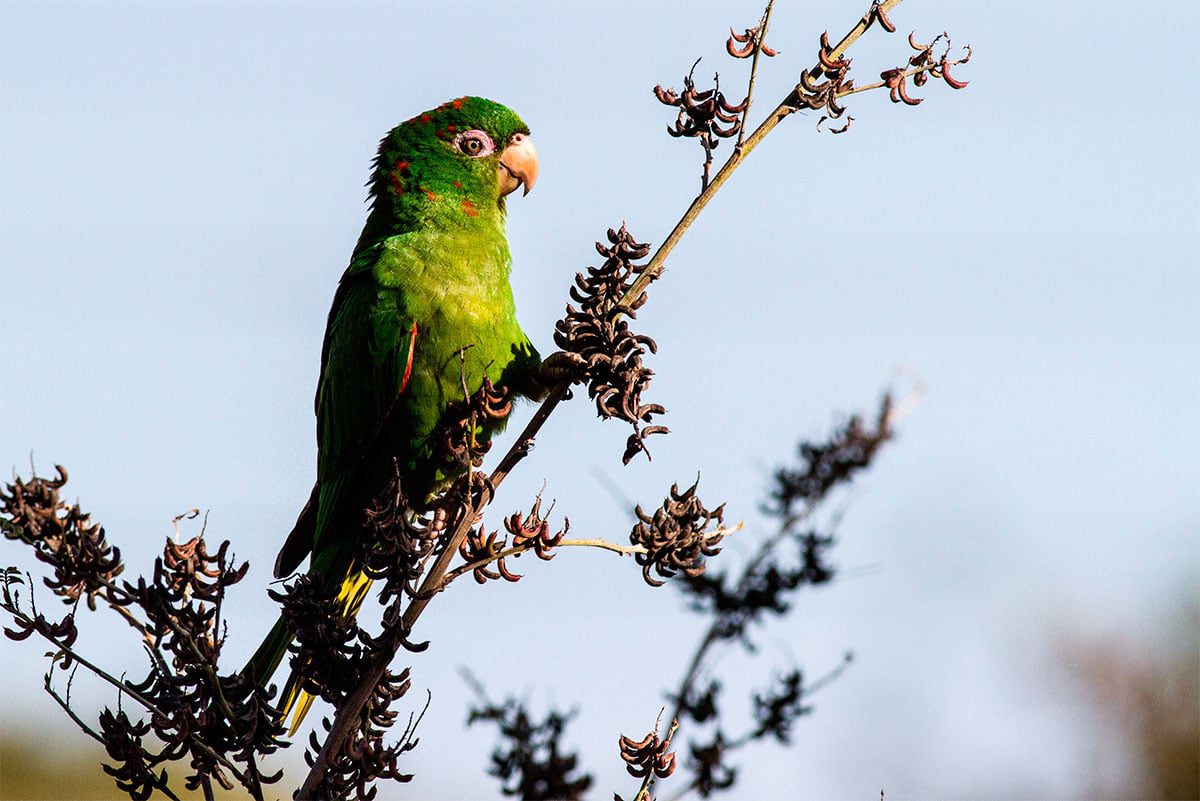
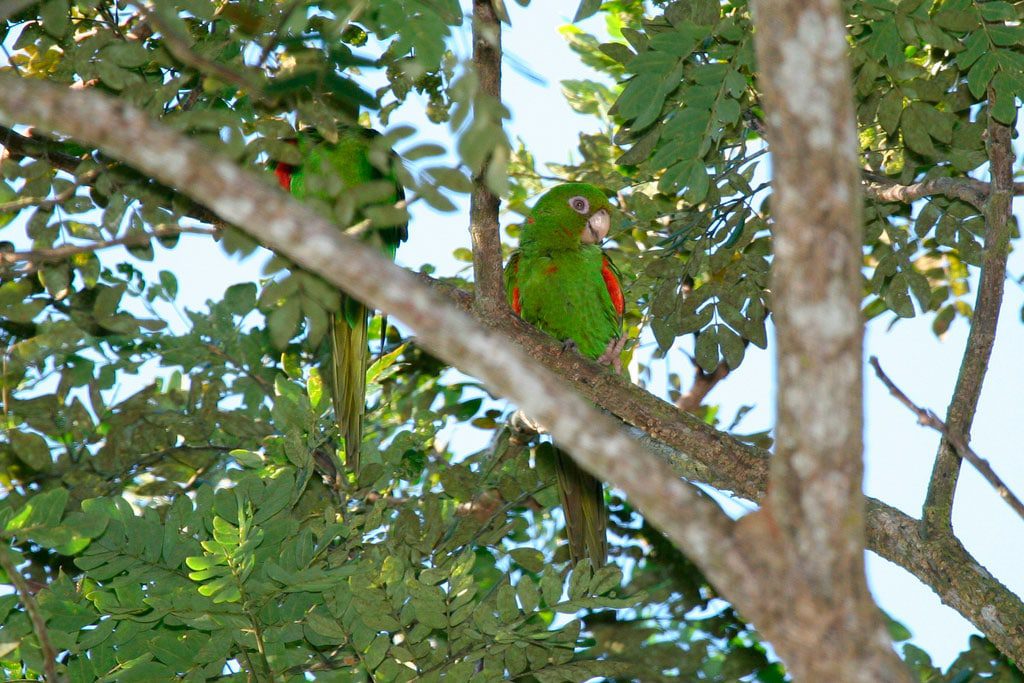
The Cape Parrot (Poicephalus robustus) has the head, neck and throat between olive brown and olive yellow, with darker spots (almost black in some birds), especially in the crown; lores and cheeks blackish; pale red frontal band, is present, occasionally, in males (generally evident in females).

The mantle feathers and scapulars dark green opaque, bright green-edged; rump bright green.

Coverts on the leading edges of the wings, Since the carpal joints at the base of the primaries, bright orange red; upper wing coverts, dark green to black, with lighter green edges; below, the feathers of the wings blackish and green. The primaries and secondaries black top, dark brown below. High area of the chest, stomach and vent, bright green; the thighs orange red glossy. Upper, the tail black; undertail, dark brown.

Some birds (around the 10%) have feathers yellow in the plumage spread.

Bill color horn; irises dark brown to reddish brown; legs bluish grey.

The females, generally (Although not always), they have well defined orange red frontal band.

The youth lack of color marks orange red envelope the wing-coverts and the thighs, but tend to show a bit of red in the forecrown.

Subspecies description:

Taxonomic status:

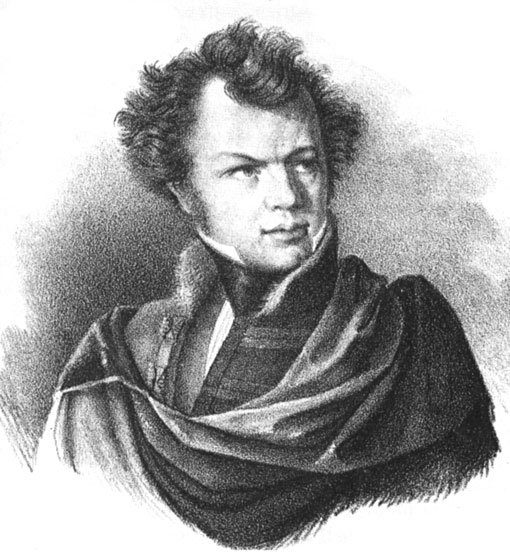
In a study initiated in 1992, the taxonomic status of Lorito was revised Robusto (Poicephalus robustus) (Gmelin), and two species were proposed; Poicephalus robustus, restricted to montane forests of southern Africa, Poicephalus fuscicollis suahelicus, with wider distribution in wooded areas, and Poicephalus fuscicollis fuscicollis, similar to the Poicephalus fuscicollis suahelicus ostensibly, but with discontinuous, restricted to a narrow range of forests and West Africa.

Subspecies Poicephalus robustus

  • Poicephalus robustus robustus

    (Gmelin, 1788) – The nominal species


  • Poicephalus robustus suahelicus

    (Reichenow, 1898) – Of larger size the species nominal, the male has the head and the neck a silvery gray and lacks the reddish frontal band. The female has orange colouring in the the thighs and in the shoulders and in the cere, while the male not. Blue tint in the rump.


  • Poicephalus robustus fuscicollis

    (Kuhl, 1820) – The smaller subspecies. With more blue tones, especially in rump and bottom of the back.

Habitat:

They live in a variety of forest types, including Red Mangroves (Rhizophora mangle) (for example, in Gambia), riparian forests (for example in Ghana, Zimbabwe), Savanna Woods (for example, Nigeria, Ivory Coast), in montane forests at altitudes of 3,750m (for example, east of Zaire), in lowland forests (for example, South Zaire).

The birds of the Southern Africa they have favoritism by the Acacia mearnsii and Podocarpus forests at altitudes between 1.000 and 1,700 m, separating attitudinally and ecologically in the subspecies suahelicus, It occurs in lowland forests.

The birds of the Southern Africa (also perhaps other species) they form communal roosts before spreading to power remote areas (until 90 km) in small flocks.

Sometimes seen separately but more usually found in groups of up to 20 birds (sometimes 50). It forms mixed flocks with peers.

Reproduction:

The nest in hollow trees (including in Brachystegia, Adansonia or Podocarpus) between 6 and 12 meters above the ground.

The season of breeding varies with locality. In Gambia, reportedly, breeding takes place between the months of February and April, While in Zimbabwe It is estimated to be between the months of March to June, and between October and November. In South Africa, breeding takes place in June and between August and October.

The laying tends to be of 3 to 4 eggs.

During the courtship the male feeds the female making exaggerated turns his head and dropping their wings to form a kind of layer around the lower half of your body. The pair shows a strong union ties and they spend much time grooming each other.

Food:

In Zimbabwe, In addition to daily trips in search of food, seasonal movements are performed in search of Uapaca and fruits of Sysygium.

They feed on fruits of ficus, Olea capensis, Mimusops caffra, Acacia molissima, Melia azecdarach, Terminalia, Calodendron capense and Commiphora, the consumption of seeds has also been recorded from the acacia mearnsii, Monotes glaber and the fruits of the Parinari curatellifolia. But, they may prefer the pulp of fruit, discarding the seeds and grains of the seeds.

Has been feeding of millet in Zimbabwe and Malawi, of peanuts harvested in Gambia and, occasionally, visiting gardens of Apple trees, but numerous enough to be considered a plague serious nowhere.

The birds of the Southern Africa feed almost exclusively on fruit of the Podocarpus, long as they are available.

Use the peak to climb between the branches when they feed in the trees; They also feed on the ground. The Cape Parrot make daily trips to secret locations for drinking water.

Distribution:

Probably occupy three zones separated, in the West, South-Central and South of Africa.

In West Africa, are from Gambia and South of Senegal to the East of Ghana and Togo.

In the Center-South of Africa, from the southwest of Congo, South and East of Zaire, Southwest of Uganda, Rwanda and from the center of Tanzania to the North of Namibia, North of Botswana, Zambia and Zimbabwe.

In South Africa from the North-East of Transvaal to the Province Eastern Cape.

Flocks of foraging roam unpredictably and can remain away from traditional sites for weeks. Sometimes they make seasonal movements in relation to the availability of food, for example, in the northern savannas of Ghana.

Local and mostly uncommon across the range, Although more numerous and frequent in Ghana.

Subspecies distribution:

  • Poicephalus robustus robustus

    (Gmelin, 1788) – The nominal species


  • Poicephalus robustus suahelicus

    (Reichenow, 1898) – Are distributed by the center of Angola; Southeast of the Democratic Republic of the Congo, Rwanda and South of Tanzania until Zimbabwe, North of Mozambique, and far northeast of South Africa; in populations along the lower Congo River the three subspecies can mix.


  • Poicephalus robustus fuscicollis

    (Kuhl, 1820) – Are distributed from the South of the Senegal and Gambia to the North of Ghana

Conservation:


minor concern


โ€ข Current Red List of UICN: Least concern

โ€ข Population trend: Decreasing

In 1988 included for the first time in the red list of threatened species by the IUCN as least concern species.

The size of its current population is estimated at less than 1.600 birds in their natural habitat.

Why not join this parrot species in critical hazard is due to the subspecies of this they comprise an area of diffusion much greater than that of the nominal species, whereupon, This leads to a growth in the population of subspecies and the decrease of the nominal species. The subspecies occupy all the Central Africa and Western, while the Poicephalus robustus only lives in some provinces of South Africa as they are Eastern Cape, KwaZulu-Natal and Limpopo.

Over time the Poicephalus robustus, they have drastically dropped its population due to the uncontrolled felling of the forests of Sandalwood to manufacture furniture. Thus reaching that there is only two percent of the forest of Sandalwood.

Diffusion area of Poicephalus fuscicollis and Poicephalus robustus

In captive the Cape Parrot it is found in small quantities by several countries of Europe and without many successful breeding advances, so the first objective to preserve the nominal species is to control the logging of forests, Since the Cape Parrot they have to travel many miles to feed, as there is no food have to descend to feed from the crop fields where many die because they are hunted by the owners of the fields. Forests are also needed in the life of the Poicephalus robustus since they nest in cavities of the trees, they feed on.

The legal and illegal trade It is another point to be highlighted in the conservation of this species. Since 1998 the countries with the most legal exports have been Tanzania, Guinea-Bissau, Guinea, Democratic Republic of the Congo and Ivory Coast. What makes think that the nominal species It has been the least affected in the terms of trade while the subspecies they have been the most affected and the most marketed. This can be known by looking at the area of diffusion of the subspecies and the countries with the most exports made..

The diseases they are also a major threat, above all in the nominal species. The disease of PBFD or beak and feather disease (Psittacine Beak and Feather Disease virus) is that more deaths has caused to the Poicephalus robustus.

"Cape Parrot" in captivity:

It is very similar in nature to the Grey Parrot.
Its capacity for imitation is still little known since, for years, has been very difficult to get in poultry farming.

Not advisable to keep mixed aviaries. Son quiet and depending on their way of breeding (natural or by hand) and previous experiences, they can be quite confident and curious, even without being hand reared do not usually take to commit themselves. As pets they are very Welcome to, Smart and affectionate, with a very good character.

Captive breeding of this species may be the last hope of saving it from total extinction.. The number of specimens in captivity is low, but enough, If handled properly to strengthen the species.

In terms of their longevity, according to sources, a Cape Parrot lived 29,7 years in captivity. In captivity, These birds can be raised from the 5 years of age.

Alternative names:

Cape Parrot, Brown necked Parrot, Brown-necked Parrot, Cape or Brown-necked Parrot, Gray-headed Parrot, Grey-headed Parrot (English).
Perroquet ร  cou brun, Perroquet du Cap, Perroquet du Cap ou P. ร  cou brun, Perroquet robuste (French).
Graukopfpapage, Kap Papagei, Kappapagei (German).
Papagaio-de-bico-grosso (Portuguese).
Lorito Robusto, Loro de El Cabo, Lorito del Cabo (espaรฑol).


scientific classification:

Gmelin Johann Friedrich

Order: Psittaciformes
Family: Psittacidae
Genus: Poicephalus
Scientific name: Poicephalus robustus
Citation: (Gmelin, JF, 1788)
Protonimo: Psittacus robustus

Images "Lorito Robusto":

————————————————————————————————

Cape Parrot (Poicephalus robustus)


Sources:

Avibase
– Parrots of the World โ€“ Forshaw Joseph M
– Parrots A Guide to the Parrots of the World – Tony Juniper & Mike Parr
– Birdlife
Wikipedia
– Loromania
Mundoexotics

Photos:

(1) – To Brown-necked Parrot at Jurong Bird Park, Singapore By Peter so [CC BY 2.0], via Wikimedia Commons
(2) – Cape Parrot en Benvie, Karkloof, KwaZulu-Natal, South Africa By Alan Manson [CC BY-SA 2.0], via Wikimedia Commons
(3) – Youth, captive, friendly Poicephalus robustus fuscicollis by Bob Corrigan – Flickr
(4) – Male Cape parrot (Poicephalus robustus). Image credit: Cyril Laubscher – SCI-news.com
(5) – Cape parrot flying low over to wild plum tree. Africa's most endangered parrot like never before... (Rodnick Biljon) – nationalgeographic
(6) – Diffusion area of Poicephalus fuscicollis and Poicephalus robustus By Juan Caparrรณs (Own work) [GFDL or CC BY-SA 4.0-3.0-2.5-2.0-1.0], via Wikimedia Commons

Sounds: Daniel Danckwert (Xeno-canto)

โ–ท The world of Pets: Dogs, cats, birds, reptiles, amphibians

Chestnut-fronted Macaw
Ara severus


Guacamayo Severo

Content

Description:

Ilustraciรณn Guacamayo Severo

46 cm.. length and a weight between 285 and 387 g..

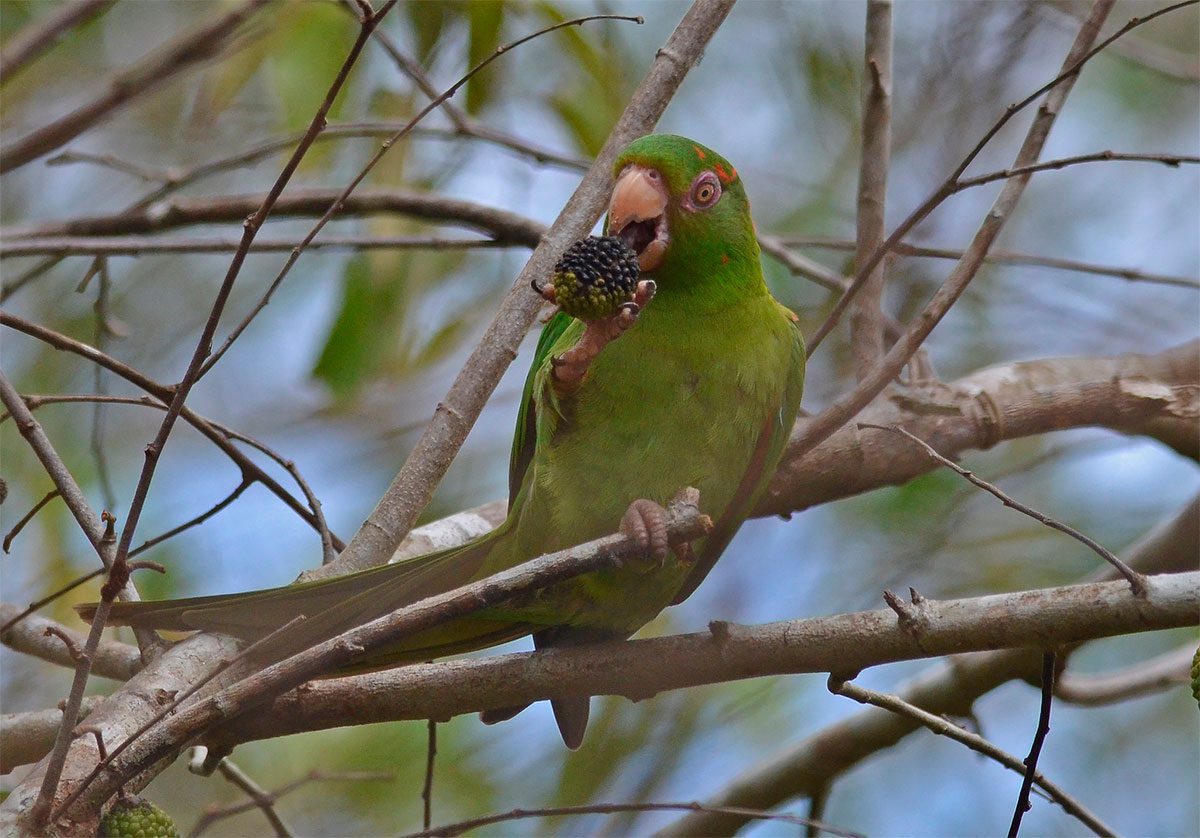
The Chestnut-fronted Macaw (Ara severus) It is a medium-sized Parrot with a plumage predominantly Green.

The male and female are almost identical and juveniles are hardly different from adults.

In the male adult, the feathers of the crown and the neck they are heavily infiltrated blue. The forecrown, chin and the area of the cheeks bordering with the bare skin of the face are brown. The curvature of the wing, carpal edge and small lower coverts are bright red. The bottom of the flight feather shows a dark red-orange color.

The tail is reddish brown with a blue tip. The bill greyish black. The bare skin of the face it is creamy white with fine lines of small black feathers. The irises is yellow, the legs grey.

The youth they are like the of adults, but have the tail shorter and the irises is grey.

The Chestnut-fronted Macaw may be confused with two species: the Blue-winged Macaw, Although this has a frontal band and stain abdominal Red and the Red-bellied Macaw Although it differs by having the facial skin yellow, and the abdomen red. On the other hand, These parrots are smaller and have a yellow color under the wings.

Habitat:

While they are sometimes in clearings or on the edge of this habitat, the Chestnut-fronted Macaw, in general, avoid the great forests never invaded by water. They prefer areas that are periodically flooded, secondary forests, galleries of trees that border the watercourses, oil palm plantations, meadows and pastures where there are still some scattered stands of trees.

It depends on the region, These birds live in very different elevations of up 1000 metres in Colombia, 1500 meters in the South of Ecuador, and only 350 metres in Venezuela.

The Chestnut-fronted Macaw, usually, they live in pairs or in small groups. However they can form large gatherings when dorms are set or when food resources are abundant.

The Chestnut-fronted Macaw, sometimes, they feed in the company of the Red-bellied Macaw (Ara manilata).

During the day, they are essentially arboreal, preferring to remain at the top of the trees and in the canopy, where they remain well hidden in thick foliage. They are best observed at dawn and dusk, as they follow regular routes between their places of rest and feeding sites.

They fly directly, with fast rhythms revealing red underneath his wings stain.

They are birds sedentary. In some mountain areas, However, undertake altitudinal migrations.

Reproduction:

Given the large size of its distribution area and large variation in latitude, nesting takes place at different times depending on the region, from March to may in Colombia, February-March in Panama, and from September to December in Suriname.

These macaws usually They nest in cavities of dead Palm trees, often just above the water, but they can also lay their eggs in a rock crevice.

The spawning usually includes 2 or 3 eggs. There is little information of this bird in the wild, but it is known that in captivity the period of incubation lasts a few 28 days. The reproductive cycle is particularly long, The chicks remain in the nest for a minimum of 9 weeks.

Food:

The Chestnut-fronted Macaw they are exclusively vegetarian. Its diet includes seeds of Hura crepitans, Sapium aureum, Cedrela odorata and Cupania cinerea, the pulp and the seeds of Inga laterifolia, Micropholis melinoneana, Euterpe precatoria and Gulielma, and fruits of Ficus, Cecropia feulla, Caraniana, as well as fruit of different types of fig trees or palms (especially species with small fruits); also flowers of, for example, Ferrule and Erythrina.

The birds are fed into silence in the canopy where they can be difficult to detect.

Distribution:

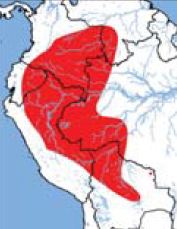
The Chestnut-fronted Macaw are distributed to the East of Panama and by South America reaching the center of Bolivia.

In East Panama they are in the tropical zone (records in the West to the North of the Canal area they are probably due to leaks), on the slope of the peaceful from the South of the Andes to the South of Ecuador (of Guayas to Pichincha) and in the Northern lowlands of Colombia, South to the upper area of the Valley of Sinu River, extending into the foothills of the Colombian Andes, in the valleys of the Cauca and Magdalena until Antioquia.

To the East of the Andes they occupy the Amazonian lowlands of Colombia, Ecuador, Peru and Bolivia in Peace, Beni, Cochabamba and Santa Cruz, going east of the foothills of the Andes through the West and South of the amazon (Although they are not known in the North of Brazil, for example, in Manaus or along the rivers Negro and Branco).

Propagate through the tropical zone of Venezuela in Zulia and from the West of Apure until Aragua, Northwest of Bolรญvar and the Amazonas along the Orinoco, reaching the Guianas and Amapรก, Brazil.

To the South of the amazon is extended by the Mato Grosso, Brazil. A record to the South of Bahia is not confirmed.

Resident with seasonal movements of altitude in some areas (for example, West of Ecuador and North of Venezuela).

Pretty common throughout much of its range, and while the deterioration of habitat has caused serious decreases in population at the local level (for example, in the Valle del Cauca, Colombia and West of Ecuador), moderate deforestation has resulted in increases in other areas.

Although there are no reports in Guyana Since the beginning of the 19th century, the Chestnut-fronted Macaw they are still common in Suriname, especially in some coastal areas.

The species is kept in captivity, but the demand is not very big.

Conservation:


minor concern

โ€ข Red List category of the UICN current: Least concern

โ€ข Population trend: Stable

The Chestnut-fronted Macaw they are quite common throughout much of its range birds. Apparently, they are able to survive to the selective deforestation and even capitalize.

In Venezuela it is a species with high rates of being traded as a pet due to its beauty and sociable behavior. The Ye'kwana on the Caura forest reserve in the State Bolรญvar, They include this species in his list of game birds, for its power and ornaments, but it is not the most hunted. In the State Carabobo is marketed as a pet according to data from the Regional Directorate for the Ecosocialism and waters-Carabobo.
On the part of the National Government is protected by the wildlife and its regulations protection law. Several of their populations are found in the national parks: Waraira Repano, Henri Pittier, The Caura forest reserve, San Esteban, Canaima. Currently the National office of biological diversity, Ministry of the Popular power for the environment He is working on defining the criteria to develop the official books of endangered species of the Bolivarian Republic of Venezuela.

In Bolivia, international trade in psittacines had caused significant problems for this species in the past, but since the beginning of 1980, their trade is prohibited.

"Chestnut-fronted Macaw" in captivity:

Recently, the Chestnut-fronted Macaw have joined the ranks of other birds kept in captivity. For a time, most of the breeding birds of this species were acquired through the importation of wild specimens. Today this has changed, and most of these macaws today come from generations bred in captivity. Being recent its breeding in captivity, most of These parrots will retain much of their natural behaviors.

These small macaws are popular due to their friendly disposal and most likely will continue to grow in popularity in the future.

While they have not had hundreds of years of selection to tame their personalities, These macaws can be a fantastic pets if they are fed by hand and are well socialized from a young age.

They are creatures very curious, so they need a lot of mental stimulation to be healthy and happy. They should have on hand, games, toys, and daily interaction with your caregiver to make sure that you do not bored.

Most of the Chestnut-fronted Macaw they form links monogamous and they need to live with more birds in order to be able to form a family. Won't these birds well if they are isolated from family and some even become neurotic if their mental needs are not met.

A future buyer of a Chestnut-fronted Macaw You should plan on integrating this beautiful bird in his life to ensure the achievement of all the emotional and cognitive needs.

In general, to most of the Chestnut-fronted Macaw do not like being touched in excess, Although all birds are different and have their own personality. Assess your bird to see what what works best. These birds enjoying caresses next to the back of the neck, along their beaks, or around your eyes. They can be happy on the shoulders of its owner. Jewelry or shiny objects amaze quickly to this curious Parrot. For this reason, All chains, earrings, watches, bracelets , etc … they should stay away from our Macaw, since it could break if the bird decides to play with them.

Although these parrots fall into the category of small macaws, they maintain a high level of noise. It is not an ideal pet for apartments. If you decide to buy one and you live in an apartment, It may be a good reason to argue with your neighbors, Since these birds are noisy. Loud high-pitched sounds can easily be heard a few floors below and are to be expected during the early morning hours., at noon, and before the sunset. This is what they do in their natural habitat.

Yes a Chestnut-fronted Macaw It is continuously shouting for the attention of their owner, These calls should be ignored.. The bird is reacting the only way it knows how to get your attention. The best thing is to give attention during moments of tranquility that is account that this works best.

Unfortunately, many times a homeowner will come to the incessant screams of your Macaw in order to calm the neighbors below; But, This attention usually works in opposite way and the bird will continue to making noise because you know it will work.

Under no circumstances, the owner should be snapping the beak of the bird, spray it with water, or shout it when is making excessive noise. Such tactics only make the problem worse and parrots do not understand this type of punishment. On the other hand, owners should focus on something more positive for the bird and reward it in some way when it is quiet. With the time, the bird will recognize that this positive behavior works much better.

Despite these parrots can be noisy, in general, they are those who speak better of all macaws. One Chestnut-fronted Macaw You can speak with clarity and memorize a lot of words and phrases. They are possessors of some sharp voices that are a delight to listen. It must be said that the purchase of a parrot for his ability to speak is not the best idea, Since some parrots can never learn to talk and its owner can feel extremely disappointed. In its place, the best is to opt for a bird by its adorable and nice personality, If she starts to talk, then it will be an added advantage.

REPRODUCTION:

The breeding of Chestnut-fronted Macaw it's not very hard. While it is true there is time for the union of these birds, not much effort is needed to achieve that they reproduce successfully. It is always recommended do not use domestic birds in a breeding program, since once domesticated, they usually do not reproduce successfully.
The best candidates are those who have been exposed to other severe macaws and have lived within a Aviary.

When approaching the season of reproduction in spring and early summer, a bonded pair will be more vocal. During this time a female will look for a nesting site to raise their future pigeon. In most cases, This is usually a vertical wooden nest box or metal placed in a corner of the cage. Inside the box must have a ladder to be sure that the female can be up and down without damaging their eggs. The bottom of the box should also have some kind of soft base such as wood chips that are non-toxic to the parrot.; But, some female birds choose to remove wood chips. If this occurs, the owner must again enter a handful of chips in the nest box until you put the first egg since this keeps the egg and prevents it from moving around and damage to. The box should also be placed so that the owner has easy access to the eggs and chicks. Most boxes are suspended outside the cage with doors that open on the side of the box or the top..

The egg laying it's every other day until your clutch is complete. On average, a typical clutch will consist of between 2 to 4 white eggs. The female incubates eggs during 27 to 28 days. Just before hatching, the chickens will make a small hole from the inside of the egg in order to be able to breathe. This will alert the mother of arrival. Some mothers eat the shell to help recover the calcium that is lost while it incubated, However, others completely ignore it.

Once the chicks are hatching, the mother is left with the chick for several weeks until they can produce their own body heat and increased demand for food of baby birds. Until then, the male work tirelessly to ensure the young, the female, and himself, food. This moment of hard tension until that all babies are weaned; approximately 70 days.

FEEDING:

In the wild these birds feed on all kinds of food and it is important that we try to imitate their natural diet. This makes it a healthier bird. From time to time, We must provide palm nuts their beaks are designed to eat the fleshy external parts of these fruits. These dried fruits contain oils and enzymes you require our birds. A base diet of Pellet and seeds also must provide.

They have to be powered also with fresh fruit and vegetables on a daily basis. fruits like oranges, Kiwis, handles, apples, grapes, peaches and Plums they are great accessories for the bird. Many of these fruits can be cut into squares and presented as a skewer of a our Macaw, Since he likes to play with fruit and the sampling of all flavors.

The vegetables as the pumpkin, corn, Carrot, Kale, Spinach, celery and are generally a joy to most parrots. These vegetables can be cut during the dinner and were placed in the refrigerator during the future feed. In this way you will save time. Other healthy items are beans and legumes; although, beans and vegetables always must be cooked before feeding your bird. If a severe Macaw is cared for properly, and feeds with a variety of different foods that are healthy, It can live up to the 45 or 50 years.

Alternative names:

Chestnut-fronted Macaw, Brazilian Green Macaw, Chestnut fronted Macaw, Severa Macaw, Severe Macaw (English).
Ara vert, Ara ร  front chรขtain, Ara sรฉvรจre (French).
Rotbugara (German).
Maracanรฃ-guacu, anacรฃ, ararica, ararinha, ararinha-de-fronte-castanha, maracanรฃ, maracanรฃ-aรงu, maracanรฃ-guaรงu (Portuguese).
Guacamaya Cariseca, Guacamayo Severo, Maracanรก Grande (espaรฑol).
Guacamaya cariseca, Cheja cariseca (Colombia).
Maracanรก (Venezuela).
Loro arara, Guacamayo frenticastaรฑo (Ecuador).
Tereche grande, Parabachi, maracanรก grande (Bolivia).
Shivaรญ (Chimane).
Maracana Guasu (Guarani).
Avensรณ (Embera).
E-ara (Piaroa).

Carl Linnaeus
Carl Linnaeus

scientific classification:


Order: Psittaciformes
Family: Psittacidae
Genus: ARA
Scientific name: Ara severus
Citation: (Linnaeus, 1758)
Protonimo: Psittacus severus


Images Chestnut-fronted Macaw:

Videos "Chestnut-fronted Macaw"


Species of the genus Ara


ยซSevere Macawยป (Ara severus)


Sources:

Avibase
– Parrots of the World โ€“ Forshaw Joseph M
– Parrots A Guide to the Parrots of the World – Tony Juniper & Mike Parr
– Birdlife
– Venezuelan of information on biological diversity system – Macaw Maracanรฃ (Ara severus)

Photos:

(1) – Cheatnut-fronted Macaw (Ara severus) at Jungle Island of Miami By DickDaniels (http://carolinabirds.org /) (Own work) [GFDL or CC BY-SA 4.0-3.0-2.5-2.0-1.0], via Wikimedia Commons
(2) – A Chestnut-fronted Macaw stretching leg and wing By Sandysphotos2009 (20100123_187Uploaded by Snowmanradio) [CC BY 2.0], via Wikimedia Commons
(3) – Chestnut-fronted Macaw or Severe Macaw in south Columbia By anthrotect (originally posted to Flickr as [1]) [CC BY 2.0], via Wikimedia Commons
(4) – A Chestnut-fronted Macaw at Santa Fe Zoo, Medellรญn, Colombia By Steven (Quueee?Uploaded by Snowmanradio) [CC BY-SA 2.0], via Wikimedia Commons
(5) – A Chestnut-fronted Macaw at World Parrot Refuge, Coombs, British Columbia, Canada By Herb Neufeld (P1120046Uploaded by snowmanradio) [CC BY 2.0], via Wikimedia Commons
(6) – A Chestnut-fronted Macaw at Niabi Zoo, Coal Valley, Illinois, USA By Bill & Vicki Tracey from Rochelle, Illinois, usa (At the ZooUploaded by snowmanradio) [CC BY 2.0], via Wikimedia Commons
(7) – Chestnut-fronted Macaw (also known as Severe Macaw) at at World Parrot Refuge Center, Vancouver Island, British Columbia, Canada By Darlee Byron (Well.. Hello!Uploaded by Snowmanradio) [CC BY 2.0], via Wikimedia Commons
(8) – Chestnut-fronted Macaw | Maracanรฃ (Ara severus) by Fernando Flores – Flickr
(9) – A Chestnut-fronted Macaw in Miami, Florida, USA. It is probably feral By Don Faulkner (Chestnut-fronted MacawUploaded by snowmanradio) [CC BY-SA 2.0], via Wikimedia Commons
(10) – Ilustraciรณn Parrots A Guide to the Parrots of the World โ€“ Tony Juniper & Mike Parr

Sounds: (Xeno-canto)