Origin: Colombia, Peru, Brazil, Guyana, Puerto Rico, United States
Character: Affectionate and fun
Life expectancy: 10 to 12 years
Height: 24 to 25 cm.
Content
Description:
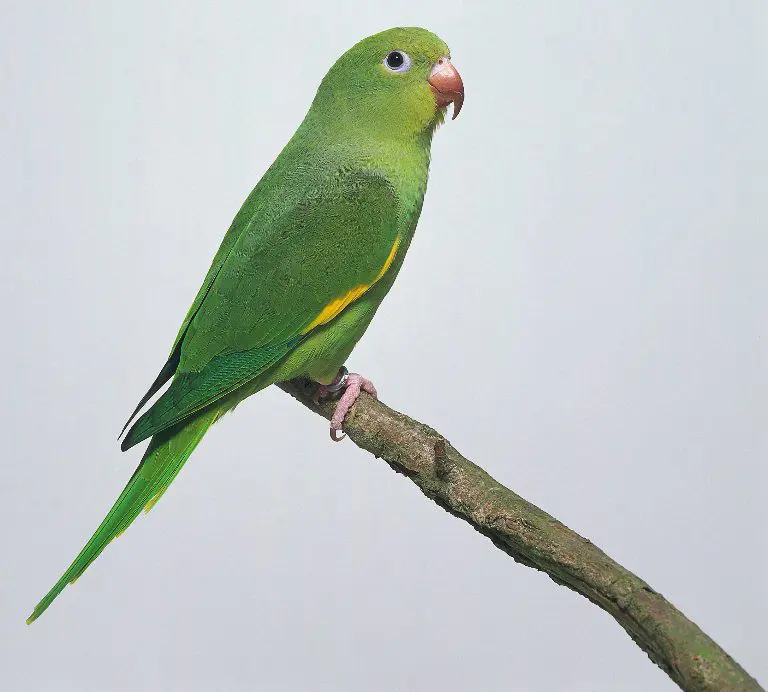
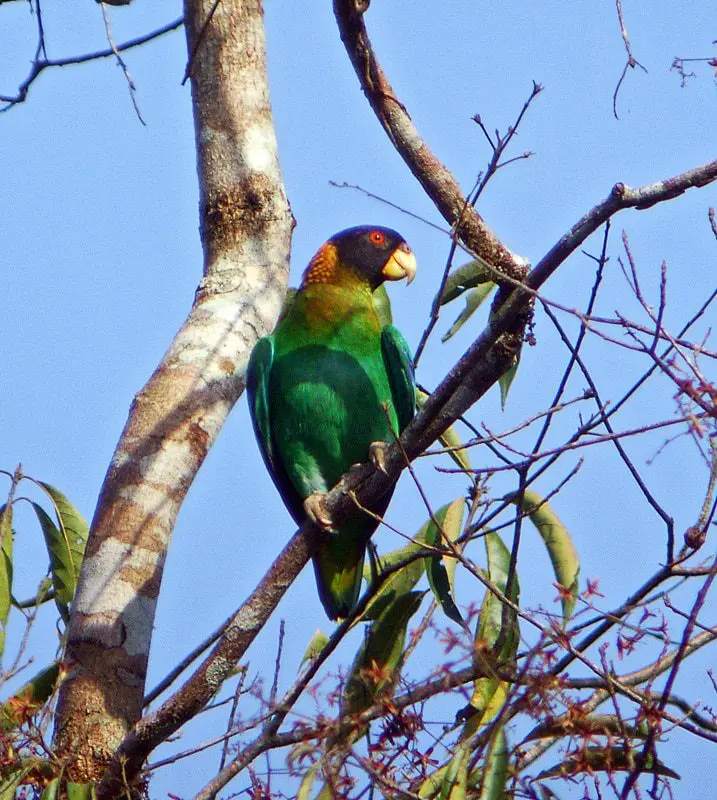
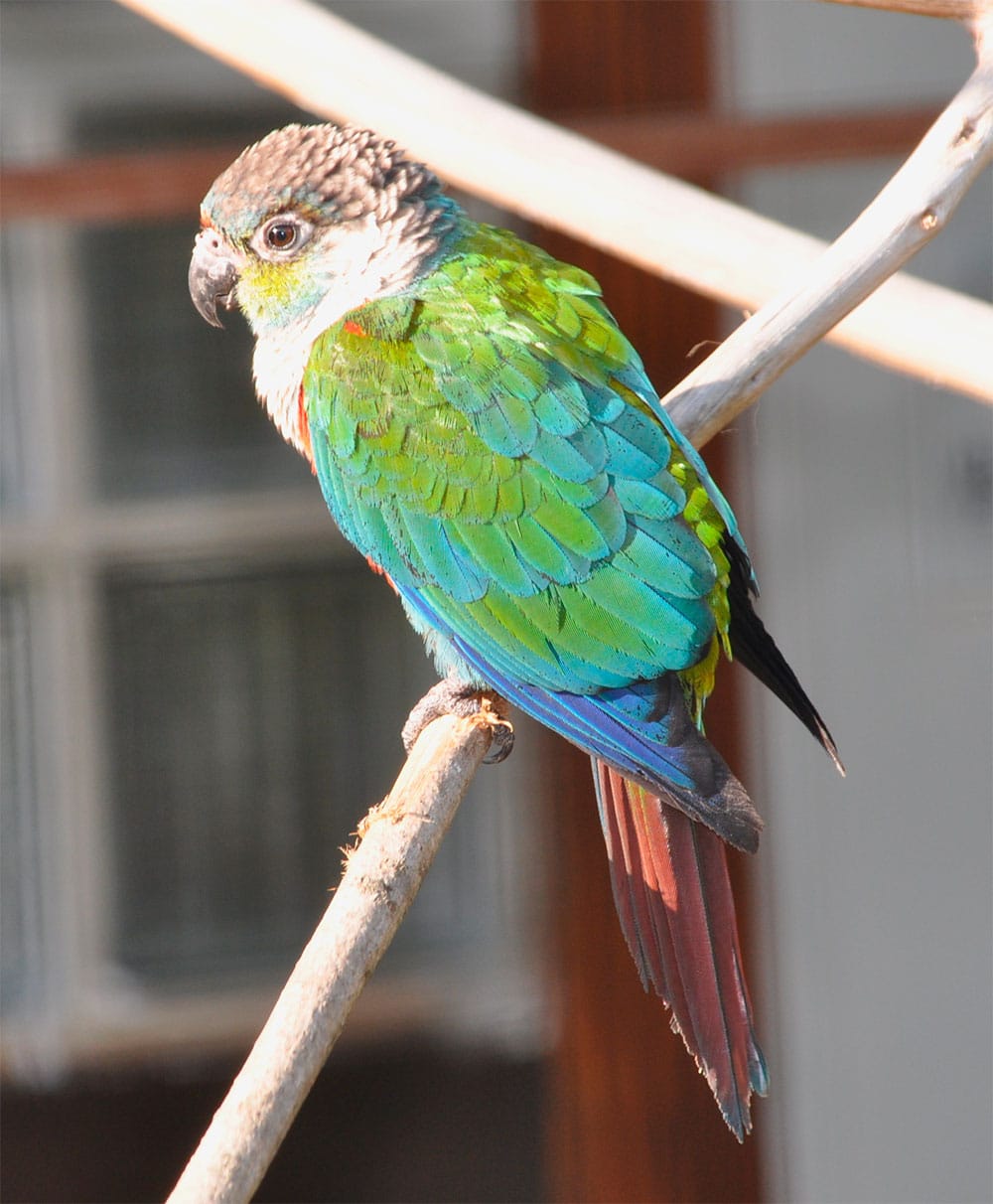
The Canary-winged Parakeet(Brotogeris versicolurus) measured between 24 and 25 height cm. Single parakeet with yellow and white patch and blue tip on the wing
, tail green, long and acute (noticeable in flight).
Of overall green coloration, with belly opaque, front and sides of the head grey. It has no sexual dimorphism.
It is found in variety of habitats, humid forest, riparian, edges, stubble, open and urban areas, until 300 m (in Bolivia comes up to the 2700 m).
Abundant trees in cities and towns. They fly high, in pairs or small flocks to large.
Reproduction:
The breeding season includes the months between January and July in South America. The female places of 4 to 5 white eggs. The incubation hard of 23 to 26 days. Usually, the male can stay in the nest at night, but the incubation is main task of females.
It nests in tree hollows and decaying fruit capsules.
Food:
In their natural habitats, the Canary-winged Parakeet, feeds mainly on worms, flowers, seeds and fruit.
Distribution:
Its population is discontinuous. All the banks of the Amazon River, from the East of Ecuador to the South of the French Guiana.
You can also see them out of these places due to its introduction by release of pet; places such as Lima, California, Florida and Puerto Rico.
Conservation:
State of conservation ⓘ
Minor Concern ⓘ(UICN)ⓘ
It is not considered in any of the threat categories, its trade has decreased in recent decades.
Justification of the population:
The size of the world population Canary-winged Parakeet It has not been quantified, but this species is described as «common» (Stotz et to the. (1996).
Justification trend:
The population suspected to be stable in the absence of evidence of any reduction or substantial threats.
"Canary-winged Parakeet" in captivity:
Years ago it was a very common bird in captivity, at the present time is less.
RECALLS: NEVER COMMAND A PARAKEET IN THE CITY OR IN THE FIELD
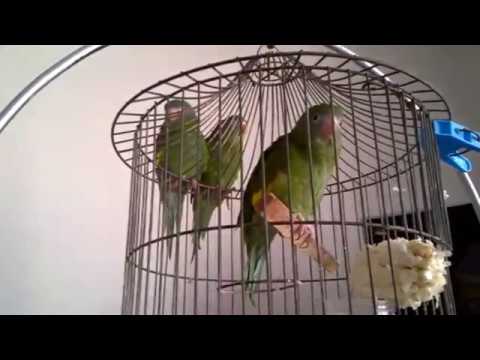
aggressive with other bird species. However, It is possible to keep a group of birds of this species together in a large enough space. Easy of tame If it is manipulated from small. Communicates with their owners, making different sounds, for example, to greet us when we see, When you want food, etc.
They are not usually very noisy. Like to climb by what shall provide elements so you can make this activity. In hot season, supplied with a tray of water so that you can bathe.
Alternative names:
– Canary-winged Parakeet, White-winged Parakeet, Yellow-winged Parakeet (English).
– Toui à ailes variées, Conure à ailes blanches, Perruche à ailes blanches, Perruche à ailes jaunes, Toui à ailes jaunes (French).
– Weissflügelsittich (German).
– Periquito-de-asa-branca, periquito-castanha, periquito-da-asa-amarela, periquito-da-campina, periquito-das-ilhas, periquito-de-asas-amarelas, periquito-estrela (Portuguese).
– Catita Chirirí, Catita de patas amarillas, Catita Versicolor, Periquito Aliamarillo, Periquito Aliblanco, Periquito de Alas Blancas, Periquito Versicolor (español).
– Catita Chirirí, Catita de patas amarillas (Argentina).
– Periqquito aliblanco, Periquito Aliblanco (Colombia).
– Periquito Aliamarillo (Dominican Republic).
– Perico de Ala Amarilla (Peru).
Origin: Australia, Indonesian, New Caledonia, Papua New Guinea, Solomon Islands, Timor-Leste, Vanuatu
Character: Active
Life expectancy: 25 years
Height: 26 cm..
Content
Description:
26 cm.. of length and weight 100-157 g.
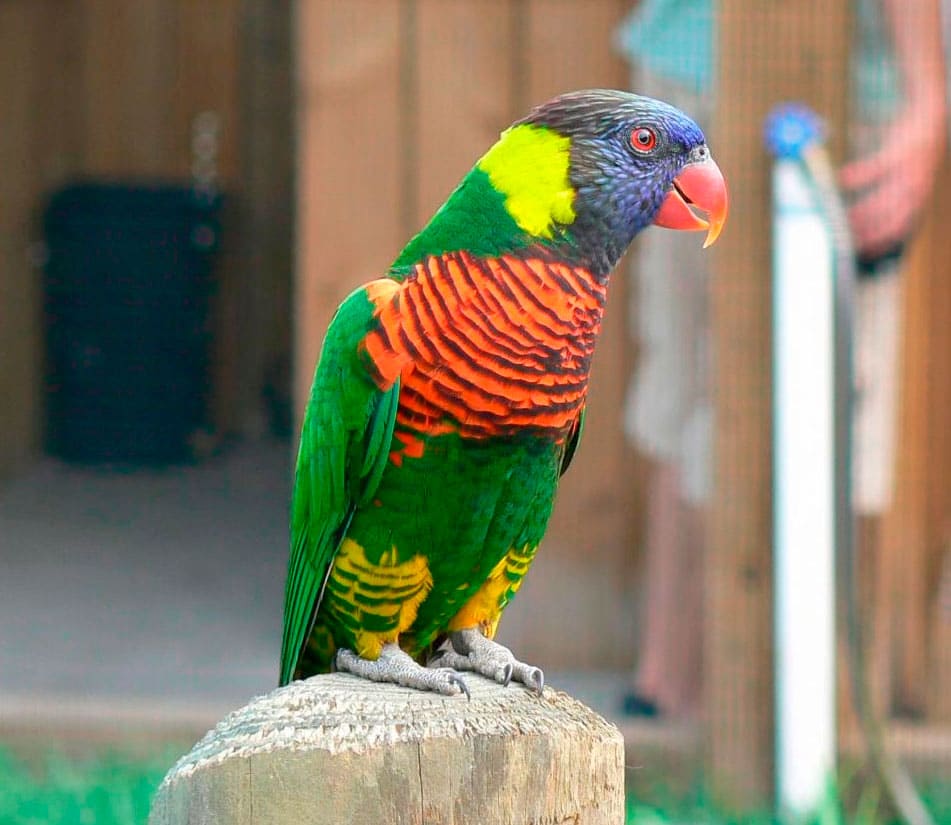
The Coconut Lorikeet(Trichoglossus haematodus) are colourful birds that find us almost all the colours of the Rainbow in their plumage.
Have the front of the crown, face and throat Dark bluish mauve, with violet stripes on the front of the crown, ear-coverts and part low of them cheeks; the rest of the head is dark blue with the bases of feathers brown-black color, especially around the rear of the crown and throat, and with greenish stripes at the rear of the crown.
The upperparts are of color green brilliant with specks of color reddish in the center of the the mantle (bases of feathers), and collar back brighter yellowish green.
The primaries with the tips blackish; a patch bright yellow in the innerwebs of the flight feather, that tends to orange in the secondaries; outerweb of the primaries and under wing-coverts, green. Underwing-coverts orange-red; the flight feather dark gray in tips.
The Breast
, the upper part of the abdomen and flanks bright reddish orange top, barred dark blue, tending to green at the bottom of the chest; abdomen with brands of color green in the Center, sometimes forming a discrete patch or interspersed with reddish orange; abdomen and the thighs with a beaming green and yellow with bases of color yellow; undertail-coverts of color yellow with tips of color green glossy. Upper, the tail of color green with them innerwebs of the lateral feathers yellowish: undertail, the tail greyish green in the outerweb, yellow in the innerwebs.
The bill orange red: the irises orange-red; legs gray or greenish gray.
Both sexes are very similar.
The immature they are more muted than adults, with the bill and the irises dark brown and tail more pointed.
Sound of the Coconut Lorikeet.
Description of subspecies of Trichoglossus haematodus
Trichoglossus haematodus caeruleiceps
(Albertis & Salvadori, 1879) – The blue of the head is more pale, Red is orange-red with the lined in very narrow and dark blue. Abdomen Blackish and band of the neck yellow.
Trichoglossus haematodus deplanchii
(Verreaux,J & Des Murs, 1860) – 26 cm.. of length and a weight of 140 gr.
The Coconut Lorikeet (deplanchii)(Trichoglossus haematodus deplanchii) is a variation of the nominal (Trichoglossus Haematodus)
Similar to the nominal Haematodus, but plumage slightly paler. The head has a very bright blue. Reddish orange on the chest, similar to the Trichoglossus haematodus massena, only that more alive. The abdomen is of color green beige and is extends to the part back from the neck. The the thighs and the feathers under the tail yellow and the upper part of the tail olive green.
Trichoglossus haematodus flavicans
(Cabanis & Reichenow, 1876) – Something bigger, 27 cm approximately in length. Its plumage varies from green to olive green and yellow opaque. Breast
and neck reddish colour with fine dark edges. Forehead and contour of eyes violet blue.
(Rothschild & Hartert, 1901) – 26 cm approximately in length. The blue of the head extends slightly less. The neck is yellow and the abdomen dark green.
The Coconut Lorikeet (massena) (Trichoglossus haematodus massena) is a variation of the nominal (Trichoglossus Haematodus).
The plumage is similar to the of the Ornate Lory except that it is usually paler. The head is blue, ending at the nape with dark brown feathers interspersed with more Brown clear. The chest is of color reddish with a narrow edging blue dark. In some cases, You can see some areas yellow in the plumage of the chest. The abdomen is green; but there may be some kind of mark on the bottom of the abdomen blue-violet.
The eyes are of color orange in the adult and Brown in the youth. The bill is red orange.
Trichoglossus haematodus micropteryx
(Stresemann, 1922) – Somewhat smaller, 25 cm approximately in length. The plumage is something more pale, the chest reddish orange with narrow edging of dark blue. Abdomen dark green. Band of the neck greenish yellow.
Trichoglossus haematodus nesophilus
(Neumann, 1929) – 26 cm approximately. Very similar to the Trichoglossus Haematodus Flavicans but with feathers underneath of the tail are green.
Trichoglossus haematodus nigrogularis
(Gray,GR, 1858) – Something bigger, 28 cm., approximately, length. Is similar to the Trichoglossus Haematodus Caeruliceps, but the blue of the head It is more dark and often have more red feathers on the neck.
Habitat:
The Coconut Lorikeet they are parrots of the Plains and Highlands. They are distributed by a wide variety of habitats such as mangrove forests, Moors and heathland near the coast, wooded meadows, tree galleries, reforestation during regeneration and rainforests.
In all cases, they need places with abundant flowers.
The Coconut Lorikeet they have also colonized habitats formed by man: coconut plantations, orchards and gardens on the outskirts of cities. They mark a greater preference for edges and clearings inside the dense jungles. Gladly tolerate the areas with degraded vegetation and plantations of small size in the small atolls.
They are birds sedentary, that does not prevent to do short trips looking for trees in flower. Because of these movements, populations appear to vary locally. Very gregarious, they live in pairs or in bands that can vary from a few birds to several hundred, Depending on the availability of food resources.
These birds are very active and noisy, flying a bit randomly above the tops of the trees or climbing up the branches in search of flowers or fruits.
during their search for food, the Coconut Lorikeet they usually share the space with other species of frugivores.
When they are hidden among the leaves, their cries of call reveal their presence.
They adopt a flight very quick and direct.
Son monogamous. During courtship, the couple is side-by-side, swaying, the neck forward and the pupil dilated. They wave irregularly wings to reveal the clear band that crosses its sub-wing.
Reproduction:
The breeding season performed at different times depending on the distribution area.
The species nominal eat your laying between September and December. Both members of the couple set up their nests in a tree cavity, usually a eucalyptus. Several nests, two or three may be in the same tree, but the entrance of the nest will fiercely defend against any intrusion.
In the the Admiralty Islands, the Coconut Lorikeet Sometimes they nest in the ground. The female normally lays 2 eggs on a bed of wood rotting chips. She incubated alone for a few 25 days.
The young chicks are altricial and need to 8 weeks to fend for if same. As soon as they are autonomous, they bind to the bedrooms and common bands.
Food:
The Coconut Lorikeet they have a bill acute equipped with a language composed of some structures similar to hairs tiny called papilla it help excavate the pollen and the nectar from the flowers.
Also eat fruits, berries, seeds, outbreaks and insect larvae.
In Australia, they forage primarily in eucalyptus trees and trees of the genus Banksia, in particular, coastal Banksia(Banksia integrifolia) and river banksia (seminuda), trees that often exceed the 15 metres in height.
They are also found in farmland, since they are particularly cultivated fruits and seeds Milky enthusiasts.
Easily entering gardens to steal fruit and not disdain approaching feeders
Distribution:
Size of its range (breeding/resident ): 5,310,000km 2
Endemics Oceania, at the edge of the Asian continent.
Can be found in Australia, in the East of Indonesian, Papua New Guinea, New Caledonia, the Solomon Islands and Vanuatu.
In Australia, mostly found on the coast, to the North of Queensland in the South of Australia and Tasmania.
Distribution of subspecies Trichoglossus haematodus
• Red List category of the UICN current: Least concern
• Population trend: Decreasing
The species has undergone intense trade: from 1981 When it began trading in CITES Appendix II and through the year 2005, 100.388 individuals were captured in the wild and reported in the international trade.
In some places of Australia, It is hunted for food and feathers are later used in ritual ceremonies
– Coconut Lorikeet, Rainbow Lorikeet (Coconut) (English).
– Loriquet à tête bleue (French).
– Allfarblori (German).
– Lóris-arco-íris (Portuguese).
– Lori Arcoiris, Lori de cocotero, Tricogloso de Pecho Rojo (español).
– Avibase
– Parrots of the World – Forshaw Joseph M
– Parrots A Guide to the Parrots of the World – Tony Juniper & Mike Parr
– Birdlife
– Oiseaux.NET
– Photos:
(1) – Rainbow Lorikeet perching on a wooden post at Tanganyika Wildlife Park, Kansas, USA. by Snowmanradio – Wikipedia
(2) – A Green-naped Lorikeet, T. h. haematodus, a sub-species of Rainbow Lorikeet, Trichoglossus haematodus at Jurong Bird Park, Singapore. by Benjamint444 – Wikipedia
(3) – A Rainbow Lorikeet (Trichoglossus haematodus moluccanus) in Melbourne, Australia. by Alfred Sin – Wikimedia
(4) – Lorikeets feeding on the flowering tree, Corymbia ‘Summer Beauty’ (cultivar). Photographed in suburban Brisbane, Australia. by Tatiana Gerus – Wikimedia
(5) – Two birds preening each other. Jervis Bay, New South Wales, Australia by Arnie Hollyman – ibc.lynxeds.com
The head of the Caica Parrot(Pyrilia caica) totally black is it more distinguishable from this species, together with a collar Golden cafesoso that extends up to the chest.
The rest of the body usually Green, more clear in the belly and the inside of the tail; wing
with blue stain and dark ends, Tip of the tail black.
Bill color bone; ring eyepiece bare of color grey pale; Orange irises.
The youth with crown green, face Dark greenish yellow, and collar not very notorious gold in neck and almost absent in chest.
Sound of the Caica Parrot.
Habitat:
Inhabits little disturbed humid forests, firm ground, in Tepuis, from the 50 to the 1100 m. gregarious, They walk in small groups. They feed in the canopy of the forest.
Reproduction:
Currently with little information about the reproduction.
Food:
In the wild, It believes that its diet consists mainly of eucalyptus flowers, fruit, nectar and pollen.
Distribution:
Can be observed in the South-East of Venezuela, Guyanas and northeast of the brazilian amazon.
Conservation:
• Red List category of the UICN current: Near-threatened
• Population trend: Stable
Justification of the population:
The size of the world population Caica Parrot It has not been quantified, although this species is described as 'rare’ (Stotz et to the., 1996).
Justification trend :
This species is suspected that it may lose 13,6-17,2% of habitat within its distribution over three generations (21 years) based on a model of deforestation of the Amazonia (Soares-Filho et to the., 2006, Bird et to the. 2011).
Given the susceptibility of this species to the hunting and/or entrapment, It is suspected that its population will decrease at a rate close to the 30% in three generations.
"Caica Parrot" in captivity:
They adult acclimatised quite easily to a new environment and are very resistant … Conversational skills (in comparison with other species).
They are very quiet in an Aviary, with a personality friendly and Gentile. They are very sociable and it should be with a partner or in a group environment. In any way, It is not easy to see to the Caica Parrot in captivity.
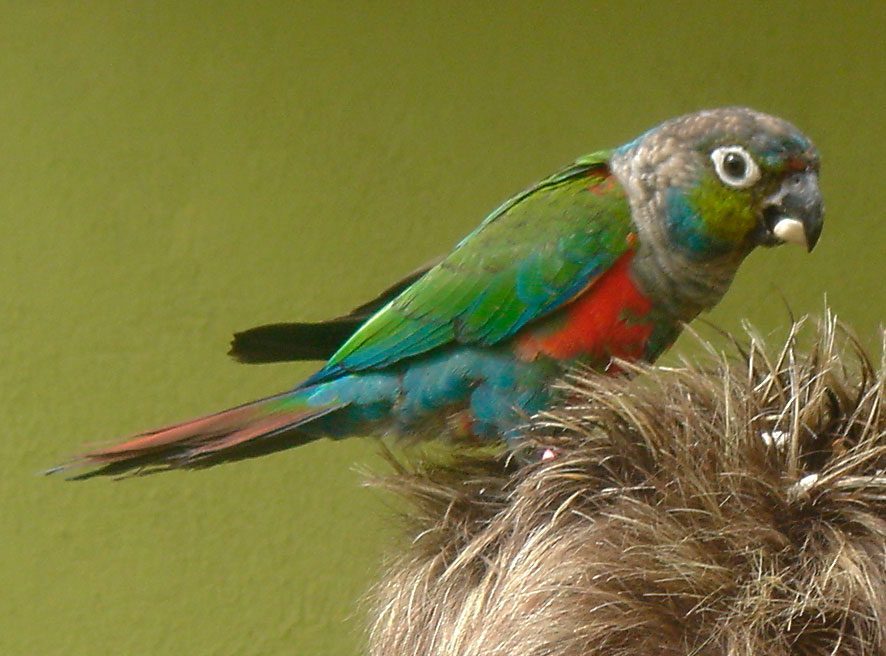
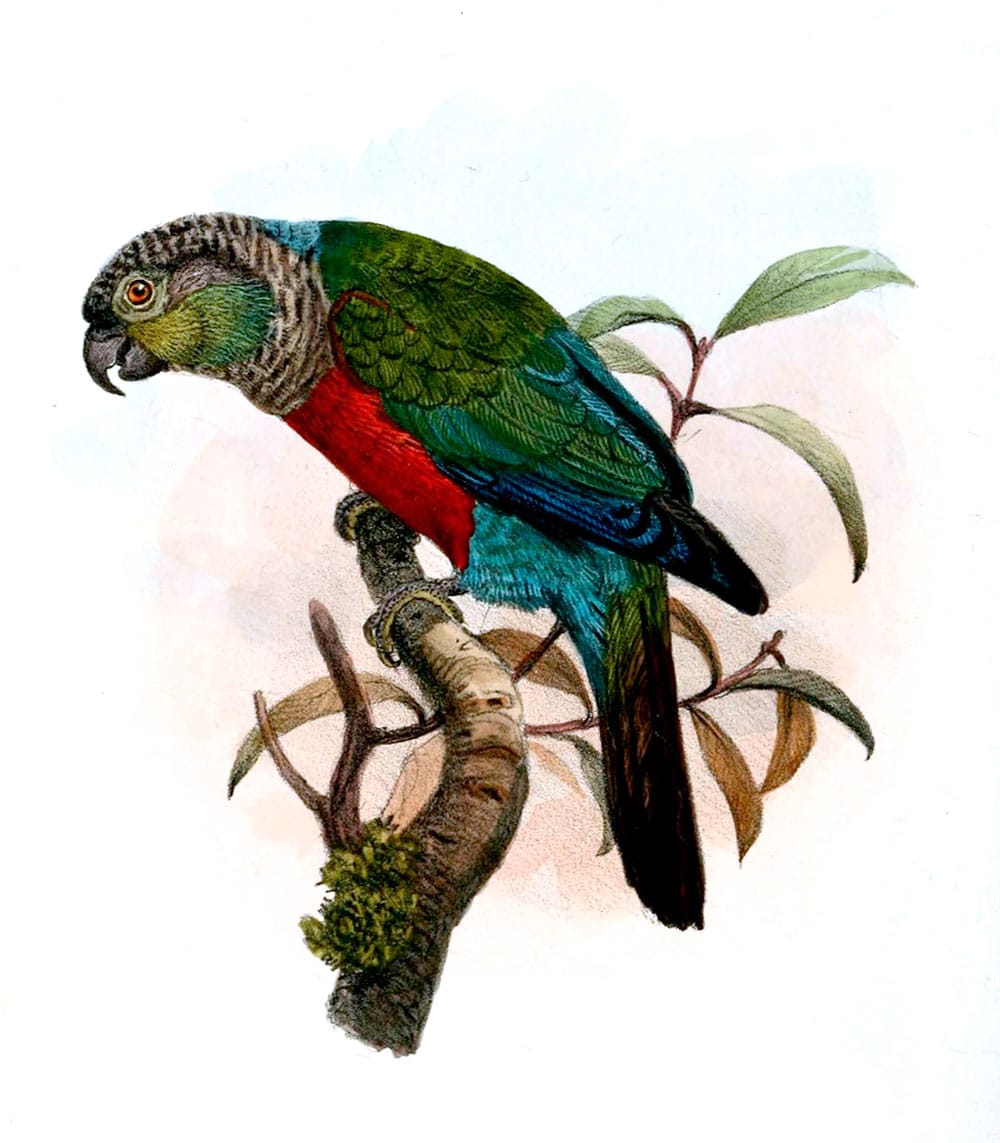
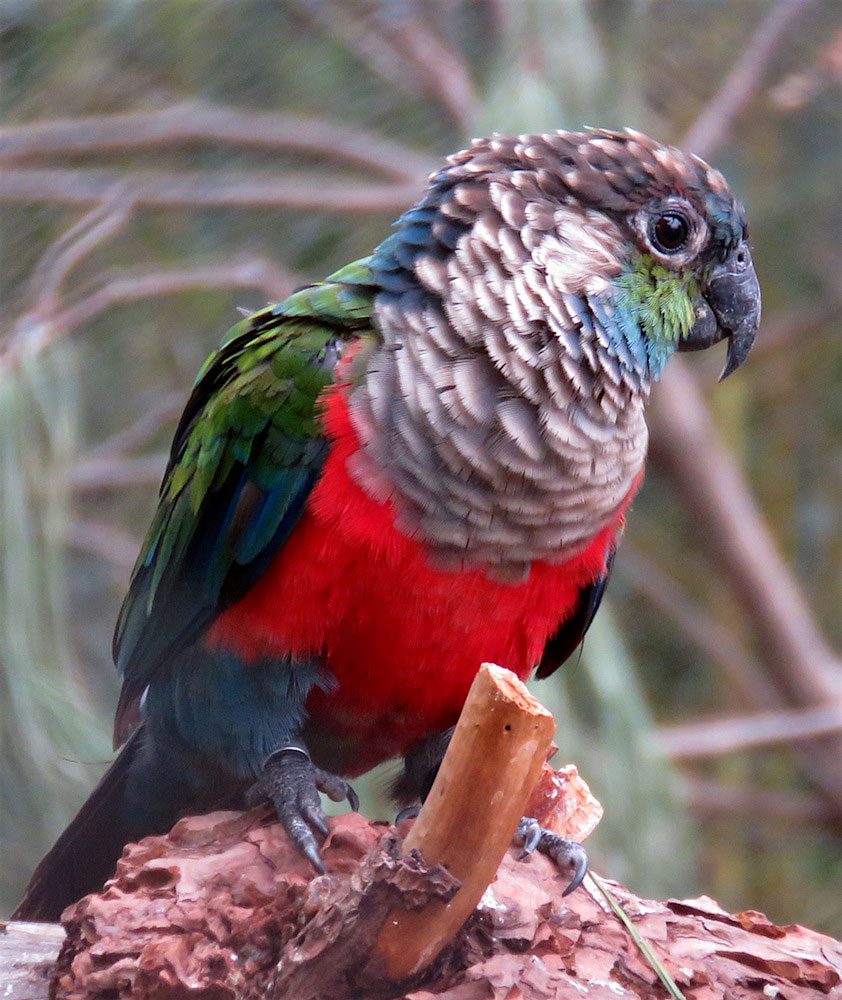
The Crimson-bellied Parakeet(Pyrrhura perlata) has the lores and cheeks of color yellowish-olive with dye Brown; The forecrown, the crown and back neck Dark Slate with velvety probes, giving a mottled appearance, especially in parts where increases the blue at the bases of the feathers.
The upper mantle is blue; robe bottom up to the uppertail-coverts green. Scapulars green at the base, blue down; the lesser wing coverts, olive green; the medium-sized and large coverts, with a predominance of the color blue. The flight feather, blue top, secondaries with green in the outerweb; slate grey dark below.
Underwing-coverts bright red. Sides of the neck, the throat and the top of the chest, with a predominance of brown color, with some brands blue and tips velvety, giving a scaly appearance; The under chest and most of the belly bright crimson; Flanks, the thighs and undertail-coverts, Blue with greenish tint. Upper, the tail, with predominance of color Brown, shades of green and some blue feathers; below, the tail, dark gray.
The bill brown-black color; eye ring whitish grey; Iris dark brown; legs black slate.
Both sexes similar.
Immature they lack the bright crimson color on the underparts; Sometimes with dark margins in the scapulars.
The Pyrrhura perlata was formerly known as Pyrrhura rhodogaster.
They generally inhabit humid forests on dry land., clear forest, secondary and probably drier formations in the North of Mato Grosso and have been registered also dominated by fig trees in eastern forests of Bolivia.
Usually views in small flocks and, sometimes in mixed groups with the Golden-winged Parakeet and Painted Parakeet. Larger family groups have been reported previously. They have often been seen descending into rivers and streams to bathe and drink..
Reproduction:
With reproduce between August and November, probably in April and June, They nest in tree cavities. Incubation period: 24-25 days.
The put in captivity is of 3-9 eggs, being 5 the average.
They can be found in Brazil, in the area of the great South-Central amazon basin, in West For and in the western area of amazon, in the river basins Madeira and South of the Tapajós, to the extreme north of Mato Grosso, Rivers Roosevelt and Aripuanã.
Observed in adjacent parts of Bolivia and probably widely distributed east of Rio Mamoré in hand me and Santa Cruz.
In general common, but perhaps decreasing due to the loss of forests in some parts of its area of distribution (for example, along the river JI-Paraná in Rondà´nia, Brazil).
Conservation:
State of conservation ⓘ
Vulnerable ⓘ(UICN)ⓘ
• Current category of the Red List of the UICN: Vulnerable
• Population trend: Stable
Justification of the population:
The size of the world's population has not been quantified, but this species is described as "quite common» (Stotz et to the., 1996).
Justification of trend:
It is suspected that this species has lost 23-30.3% of habitat within its distribution area for three generations (18 years), based on a model of Amazon deforestation (Soares-Filho et to the., 2006, Bird et to the., 2011). Given the susceptibility of species the hunting and capture, they suspected that the population of Crimson-bellied Parakeet will decrease by ≥ 30% during three generations.
"Crimson-bellied Parakeet" in captivity:
Not very common in captivity. Its diet ideal would be based on fruits such as: apples, Pears, oranges, bananas, grenades, cactus fruits , which form the 30 percent of their food, vegetables, such as: carrots, celery, green beans, pea in the pod, fresh corn, green leaves, such as: chard, lettuce, dandelion, chickweed, healer, millet; a mixture of seeds as such: Canary Islands, small amounts of wheat and millet, oats, safflower and hemp, Sunflower, cooked beans and legumes and cooked corn.
Es una ave muy playful a la que le encanta bañarse, so toys and a shallow bowl of water should be provided. Moderate voice, but when are they excited can be somewhat noisy. It is not aggressive with other species.
Price per couple: 500-600 EUR
Alternative names:
– Crimson-bellied Parakeet, Crimson bellied Parakeet, Crimson-bellied Conure, Pearly Conure, Pearly Parakeet, Rose-bellied Conure, Rose-breasted Conure, Rose-breasted Parakeet (English).
– Conure à ventre rouge, Conure perlée, Perriche à ventre rouge, Perruche à poitrine cramoise, Perruche à ventre rouge (French).
– Rotbauchsittich, Blausteißsittich, Blausteiss-Sittich, Rotbauch-Sittich (German).
– Tiriba-de-barriga-vermelha (Portuguese).
– Catita cola granate, Cotorra Ventirroja, Cotorra Ventrirroja, Perico de Pecho Rojo, Perico Perla (español).
– Catita cola granate (Paraguay).
– Avibase
– Parrots of the World – Forshaw Joseph M
– Parrots A Guide to the Parrots of the World – Tony Juniper & Mike Parr
– Birdlife
– Photos:
(1) – Crimson-bellied Parakeet (Pyrrhura perlata) also called the Crimson-Bellied Conure By derivative work: Snowmanradio (talk)Juan_Caparrós_cabeza. JPG: Juan Caparrós [CC BY-SA 3.0 or GFDL], via Wikimedia Commons
(2) – A Crimson-bellied Parakeet (also known as the Crimson-bellied Conure) captive by Pyrrhura_perlata_-captive-8a.jpg: Nori Almeidaderivative work: Snowmanradio [CC BY 2.0], via Wikimedia Commons
(3) – Crimson-bellied Conure in the Walsrode Bird Park, Germany By Quartl (Own work) [CC BY-SA 3.0], via Wikimedia Commons
(4) – Parrot by pixabay Crimson
(5) – Pyrrhura perlata by Florin Feneru – Flickr
(6) – Conurus rhodogaster=Pyrrhura perlata by Joseph Wolf [Public domain], via Wikimedia Commons
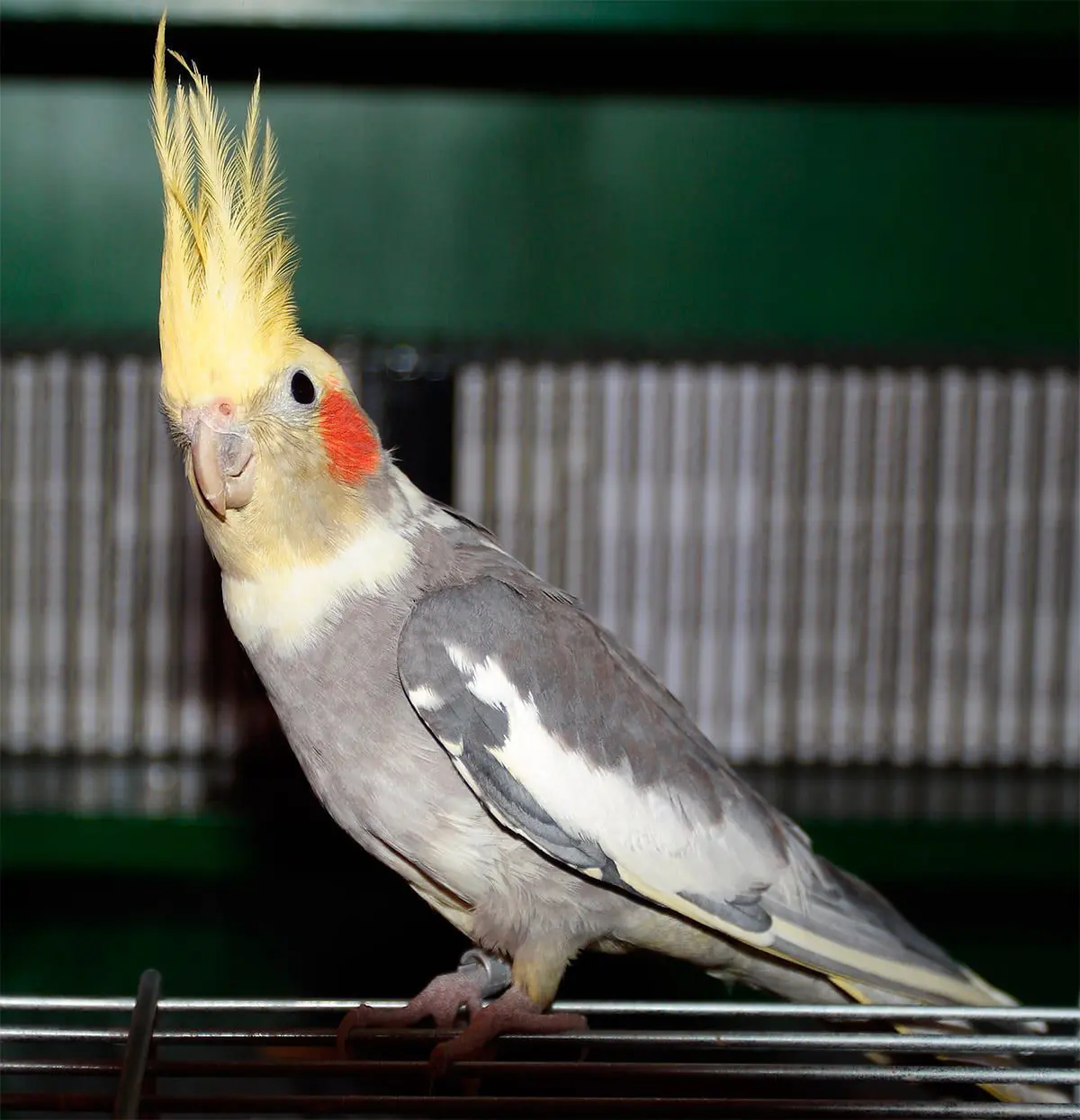
25-33 cm.. length and a weight between 80 and 100 grams approximately.
This small cockatoo is no doubt an of the bird's cage more common in the world.
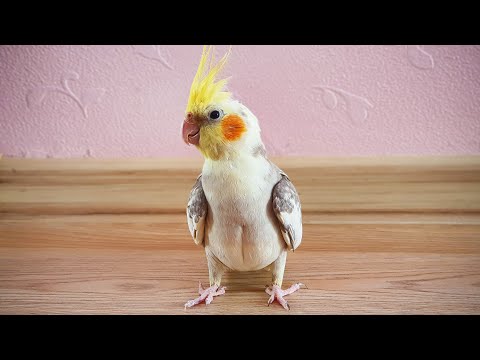
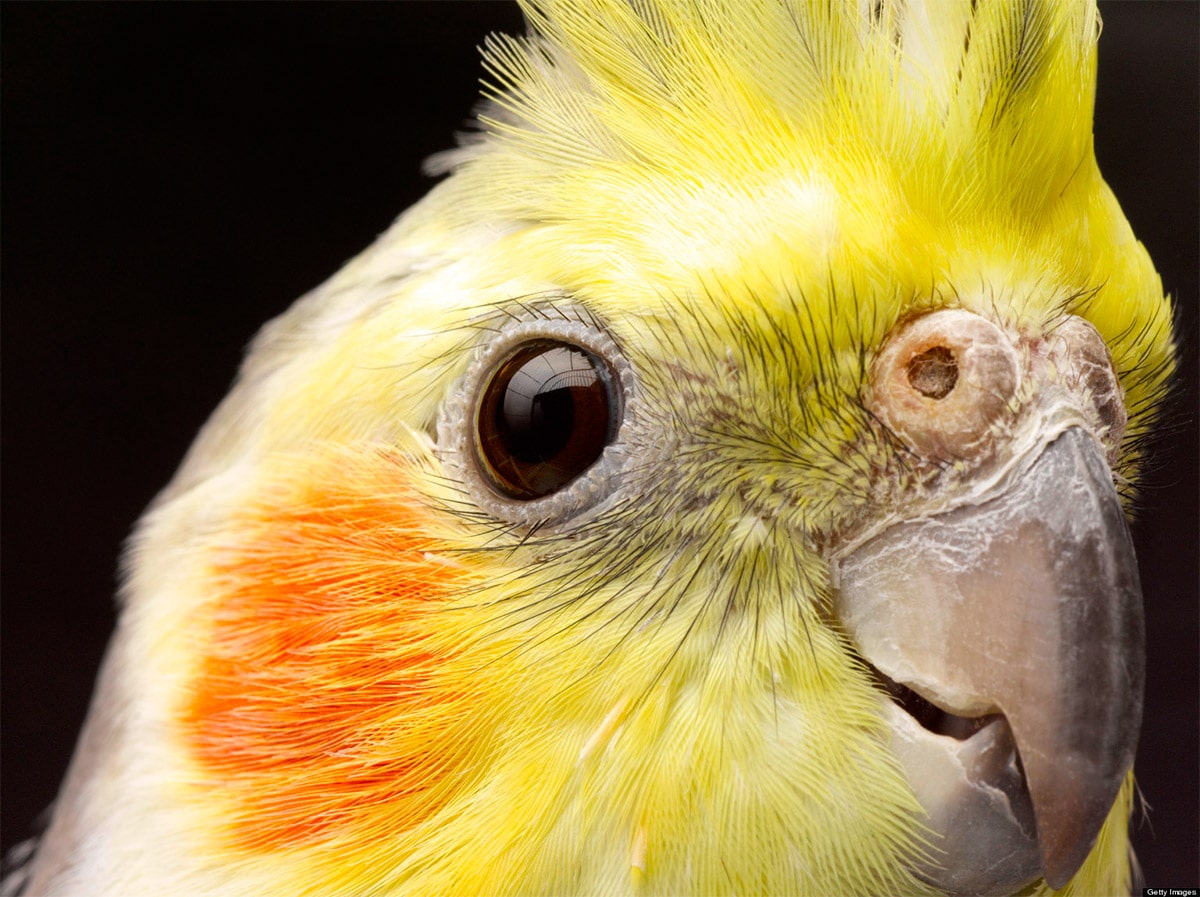
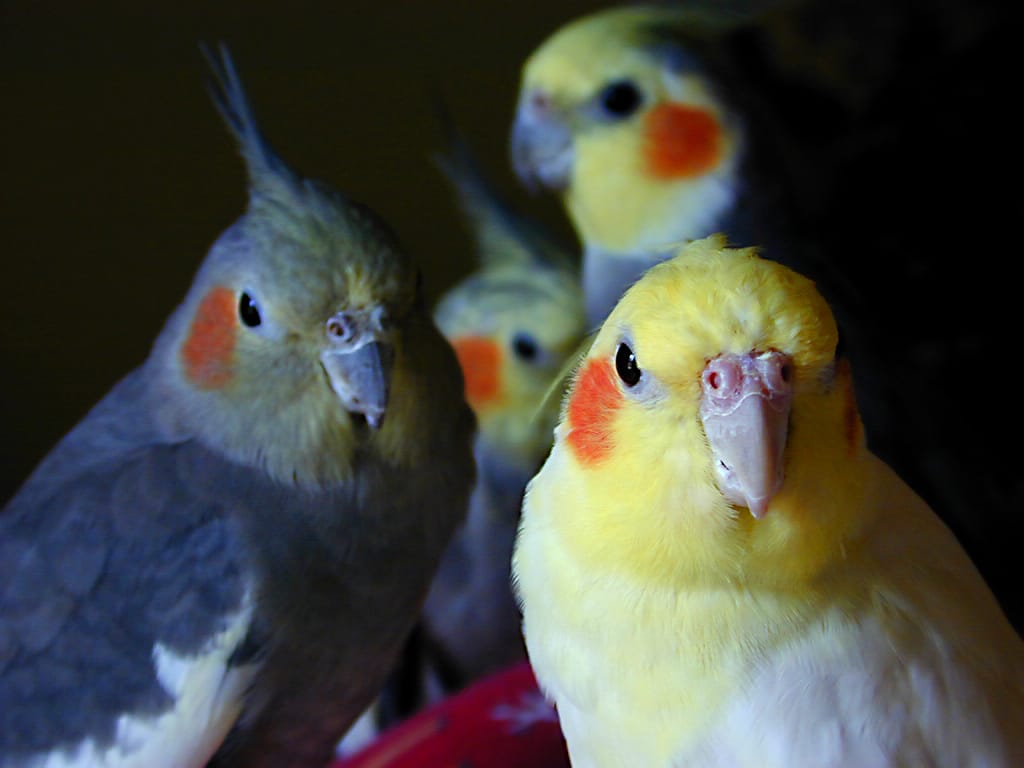
The Cockatiel(Nymphicus hollandicus) adult has the head and the basis of the crest yellow.
Stain handset is orange, paler on the back.
The neck and the long crest feathers are grey.
The upperparts are of color grey Pearl dark.
The wings are grey, but exhibit a white color in the covered and sides.
The underparts are a grey clear.
The tail varies from medium gray to dark gray, the base of the tail is paler.
The bill is grey, the irises dark brown.
The legs are grey-brown.
The female presents the stain handset duller, the tuft is less developed, In addition instead of the yellow, the head presents a yellowish grey with yellow dirty envelope the forecrown and a vaguely colorless gray general staining and staining is generally less intense.
The immature are much similar to the females, but have the tail shorter.
We find Pearl specimens in captivity, White, Gray and lutinos.
The cockatoo Nymph they live in a wide variety of habitats, including open forests, small acacia forests that line the rivers and even stretches of Spinifex (Triodia) they are perennial and grow in semi-arid regions.
Also found in farmland, in the stubble and the orchards, as well as on the plains and along the roads.
In dry areas are observed in pairs or in groups of up to 100 individuals.
When feed, the groups contain an average of 27 Member. But, We have already seen demonstrations of almost 1.000 birds near landfills containing vegetable remainders of the rice milling.
Near the points of water, the cockatoo Nymph are often associated with the Budgerigar(Melopsittacus undulatus).
Estas Cockatoos eat twice a day: In the morning, shortly after the Sun, consuming around 2,72 grams of plant material. At night, about an hour and a half before the night, eating around a mass of 4,25 g., It is almost 7 grams for the whole day.
Son great travellers.
Outside of the nesting season, they form large gatherings around the planting of cereals.
As they feed on seeds, these birds need water and in times of drought, sometimes bands come to the coast.
All these movements are quite unpredictable, since they are related to the weather conditions and the State of the food resources. But, in the South of the continent, migrations are more regular: the birds come to nest during the austral spring and usually go away early in the new year.
Son gregarious and very social, so they need a wide repertoire of calls to communicate or express their feelings. They have a great power to imitate other birds.
Reproduction:
In the North, the reproduction is carried out between April and July, While in the South occurs in general from August to December.
The nest is located in a tree hollow whose bottom is padded with sawdust shavings. Most of the time, the nesting site is placed near a source of water in which poultry cooled daily.
The spawning has between 3 and 7 eggs they are incubated alternately by both parents for a few 20 days. 4 eggs are a normal litter. There will be several broods during the season. At birth, the chicks have a thick down comforter yellow. They receive their food mainly in the morning and in the evening.
Chicks they leave the nest after 3 to 4 weeks, but they remain within the family group, Depending on their parents for 1 month. After this time, they join large flocks that roam in search of food.
Food:
Consume a wide variety of small seeds He collected soil, including the cultivated fields of sorghum and sunflower. When they are abundant, local seed varieties are generally preferred to the seeds that come from crops.
Distribution:
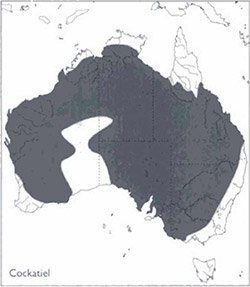
Endemic to Australia. Its range covers a vast majority of the continent, except wet coastal areas. Also absent from the Cape York Peninsula, districts located more to the South in winter and areas located more to the North in the summer.
After heavy rainfall, large meetings can be set up in the center of the country where they are, usually, absent.
Conservation:
State of conservation ⓘ
Minor Concern ⓘ(UICN)ⓘ
– Current IUCN Red List category: Least concern.
– The population trend: Stable
This bird is very common and extended throughout the area. Probably its population grows, It has benefited from the facilities and artificial reservoirs for the development of agriculture.
Its population It is estimated in around a million of birds. The birds that sought to be introduced in the United States they have failed in their attempts to establish themselves in the wild.
In Australia, these small cockatoos are often persecuted for considering them pests for agriculture.
"Cockatiel" in captivity:
The Nymphs or Carolinas they are highly prized birds as pets by its docile nature and for being less demanding than the larger parrots. The nymphs they are perfectly suited to life in the home, they are easy to care for and if you homeschool them from small become companions adorable and very affectionate.
They generally live in pairs or in colonies, that is why it is very common to mate them, to be able to enjoy the birth of the offspring and their development.
They usually enjoy sharing their time with people and rather stick to their owners, Each bird has its personality, so you don't like all that take them into your hands. Males can sing and learn to mimic a few words, but they are much better to imitating sounds, as melodies, sirens or other birds singing. Females vocalize much less but tend to also be more caring.
The nymphs are birds Smart, of friendly character and practically does not present problems of behaviour. They are easily adapted to family life and learn to interact and communicate with people who love. If you've decided to adopt one of these cute birds, make sure you dedicate time to your training to get to have a great pet. This will help you create a strong emotional bond between you and you will also keep it entertaining, mentally active, healthy and happy.
26-28 cm.. length and a weight between 120 and 140 g..
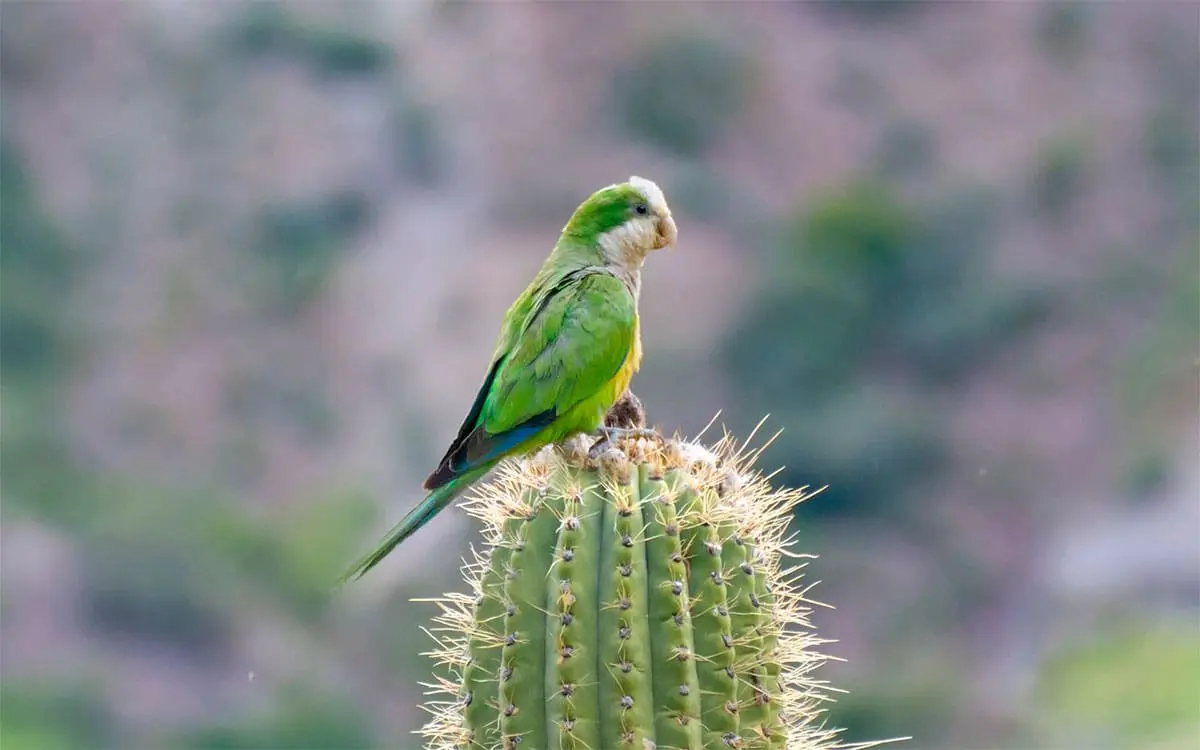
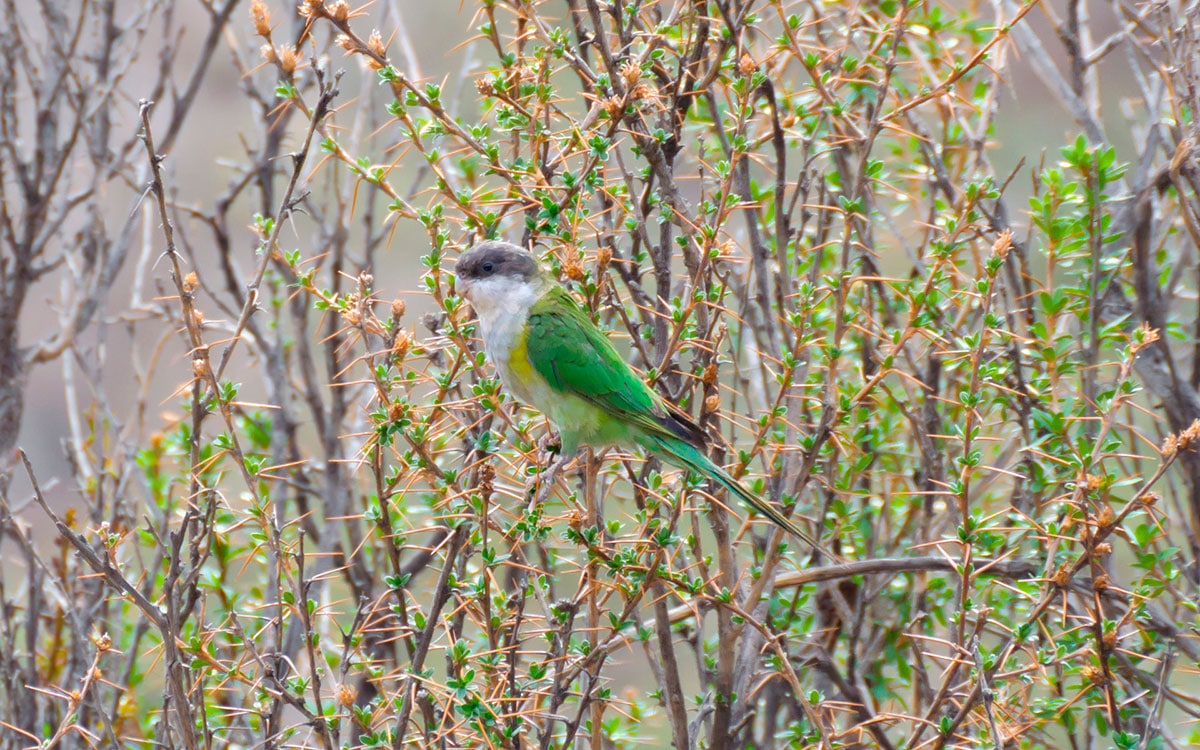
The Cliff Parakeet(Myiopsitta luchsi) It has a medium size and is mainly green; the front of the crown, lower face and the chest, They are whitish, becoming bright yellow on the lower chest and the belly; the primaries and tail (medium-sized long), They are bright metallic blue.
Similar Monk Parakeet has less extensive white color crown, pale yellow instead of bright yellow in the belly and the pale gray chest It has a scaling effect that give centers feathers dark.
Bill color horn.
The immature They are similar to adults but with forecrown gray tinged with green.
This species was described in 1868 by Finsch as Bolborhynchus luchsi, with specimens from Bolivia. Later, the species was transferred to the genus Myiopsitta and the name Myiopsitta luchsi It was used apparently to 1918 by Cory. From 1943, Bond & de Schauensee and they treat it as a subspecies of monachus(Myiopsitta monachus luchsi), approach that has been followed by all modern authors, but Necklace (1997) finally he considers that the morphological characters and their way of nesting are sufficient to raise again species level.
Habitat:
Video – "Cliff Parakeet" (Myiopsitta luchsi)
It shares the same habitat with another endemic parrot, the Red-fronted Macaw(Ara rubrogenys), although both species do not compete because they feed on different plants.
They found in dry woodland or open fields including fields with trees gallery woods, isolated groups of trees, Palm trees, forests, savannah and scrubland thorny cactus. It is also found in cultivated areas. Visitors from some urban areas. Until 3000 m.
Reproduction:
The breeding season occurs between December and March in crevices in cliffs, constructing a bulky nest branches. Unlike Monk Parakeet(Myiopsitta monachus), the Cliff Parakeet does not nest commonly, but often the nests are placed immediately adjacent to each other. The female is in charge of making this nest, as well as its maintenance.
Couples are for life. The laying is of 5 to 8 eggs per clutch, and incubation lasts a few 26 days. At six weeks old chicks can now leave their nest.
Food:
It feeds on seeds of various fruits, including those of fruits cactus Neocardenasia herzogiana and seeds of the Acacia furcatispina; It is also known to feed on cultivated corn.
Distribution:
Size of its range (breeding/resident): 148.000 km2
Restricted to xerophytic vegetation, near cliffs in intermountain valleys of eastern Andes of Bolivia, from the southeast of Peace, South of Cochabamba and West Santa Cruz, to the North of Chuquisaca and possibly other areas.
• Current category of the Red List of the UICN: Least concern.
• Population trend: Unknown.
Justification of the population
The size of the population has not been estimated, but the species has been described as «quite common» (pit et to the., 1997) and "possibly quite rare" (Juniper and Parr 1998).
Justification of trend
Population trends are difficult to determine due to uncertainty about the extent and severity of threats to the species..
However, like many parrots, They face the traffic of wildlife and wild captivity. Also they suffer direct and immediate consequences of the destruction of their habitat by deforestation and the advance of the agricultural frontier.
Conservation Actions Underway
The species is listed on Appendix II of CITES.
"Cliff Parakeet" in captivity:
Quite common. Very sociable, but shy with the human being.
It is able to vocalize or imitate words, although this quality is far from possessing the capabilities of some genera of the same family.
Alternative names:
– Cliff Parakeet, Bolivean monk parakeet, monk parakeet, Monk Parakeet (Cliff) (English).
– Perriche des falaises, Conure de Luchs, Conure des falaises, Conure des rochers (French).
– Luchssittich, Bolivien Mönchsittich, Bolivien-Mönchsittich (German).
– Cliff Parakeet (Portuguese).
– Cotorra Boliviana (español).
– Avibase
– Parrots of the World – Forshaw Joseph M
– Parrots A Guide to the Parrots of the World – Tony Juniper & Mike Parr
– Birdlife
– FAUNA – Psittacidae
– Photos:
(1) – Bolivian Parrot, Bolivia, Sud Chichas, Churquipampa by giorgetta.ch
(2) – Bolivian Parrot, Bolivia, Sud Chichas, Cerro Elefante by giorgetta.ch
(3) – Bolivian Parrot, Bolivia, Sud Chichas, Churquipampa by giorgetta.ch
(4) – A couple of Bolivian parrots in their nest located in the chalky wall of Churquipampa where its waters fall almost freely 330 meters to the creek. The female is arranging the main entrance of the nest while the male takes delight in watching her work by giorgetta.ch
(5) – Bolivian Parrot, Bolivia, Sud Chichas, Churquipampa by giorgetta.ch
(6) – Myopsittacus luchsi = Myiopsitta (monachus) luchsi, Cliff Parakeet, sometimes treated as a subspecies of the Monk Parakeet by John Gerrard Keulemans [Public domain], via Wikimedia Commons
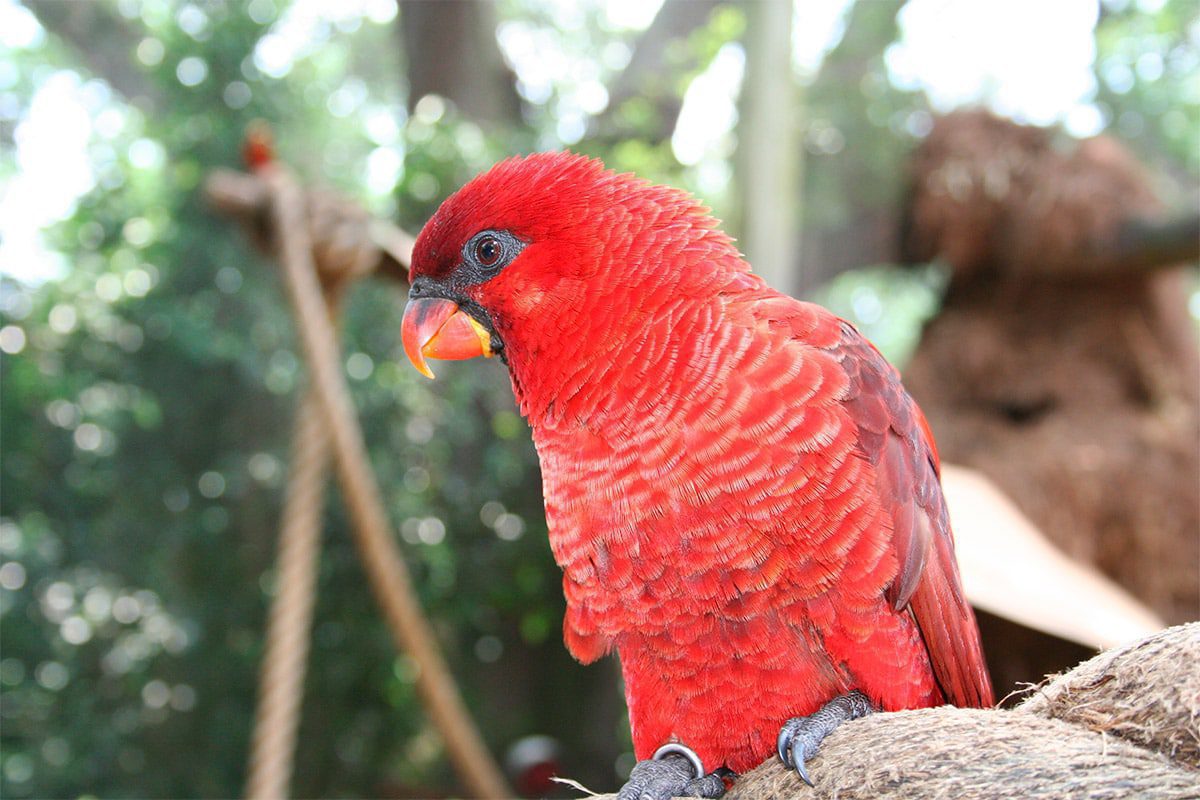
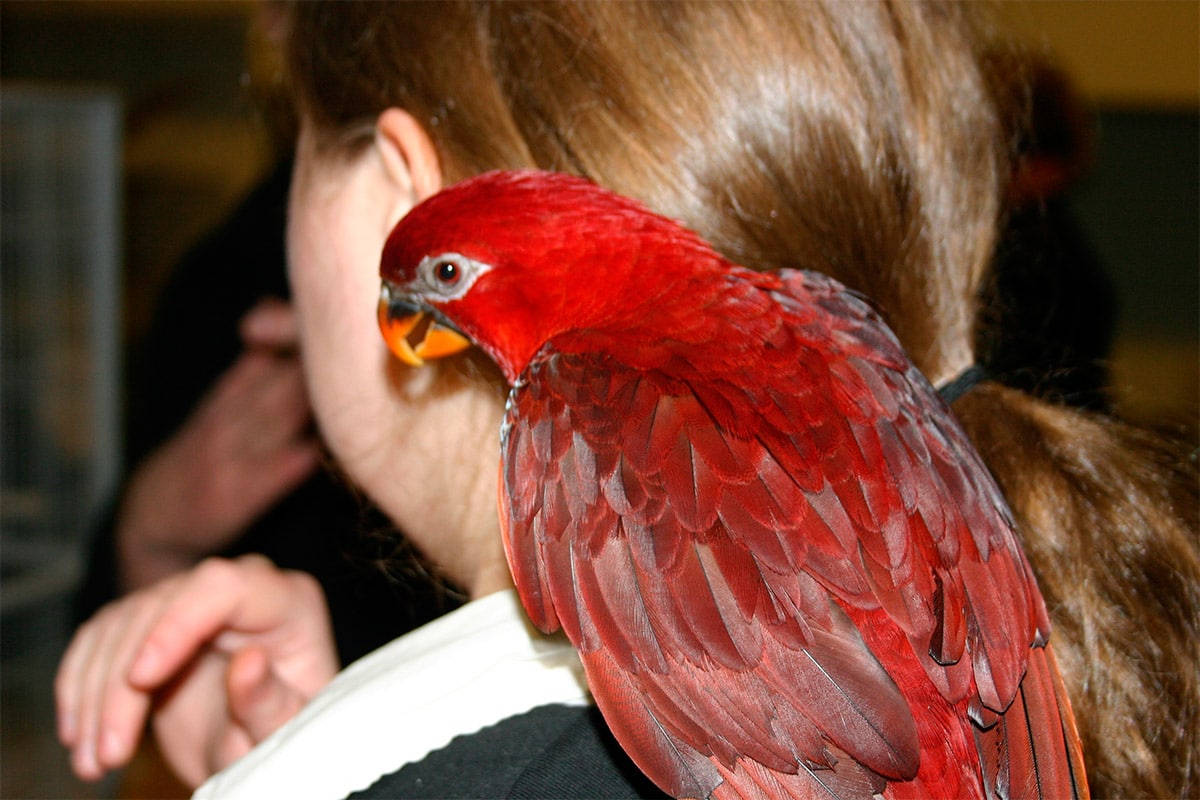
The Cardinal Lory(Pseudeos cardinalis) has a characteristic shape due to its relatively long tail.
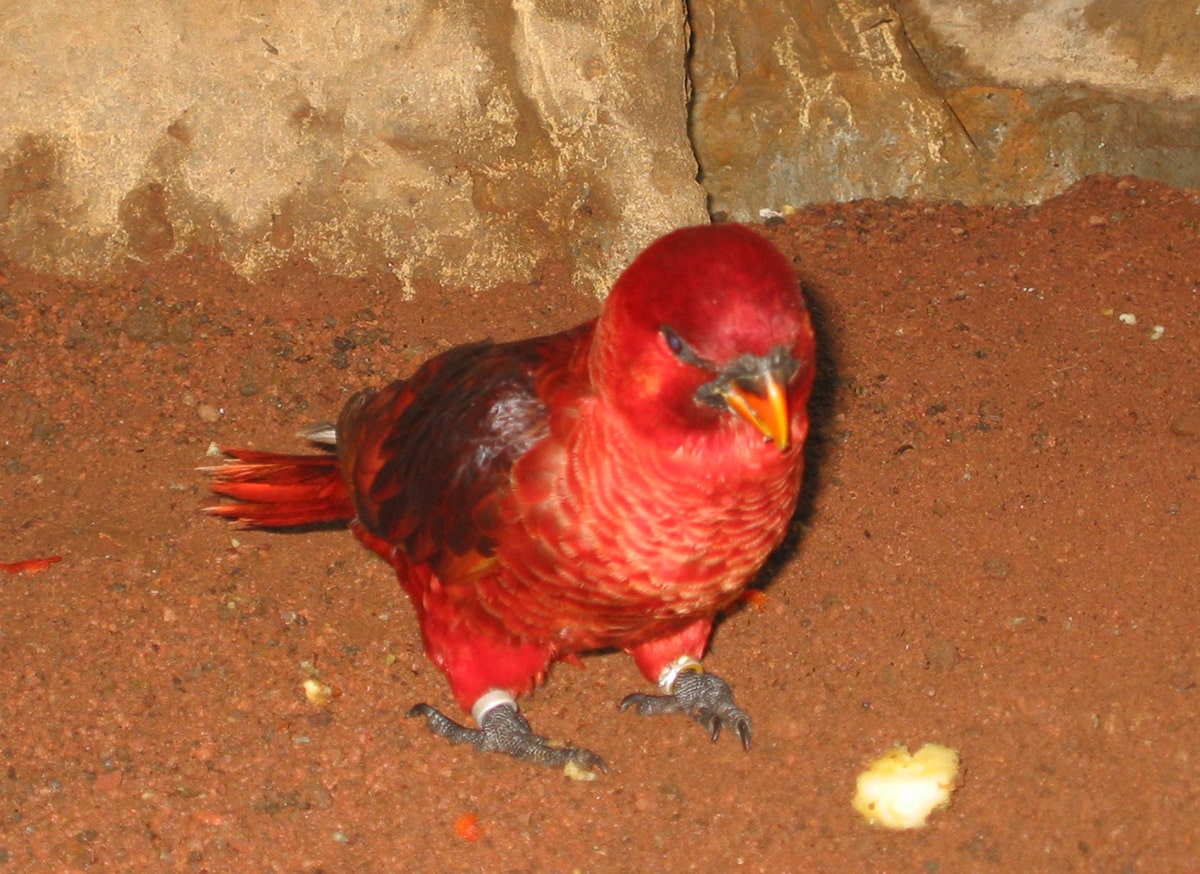
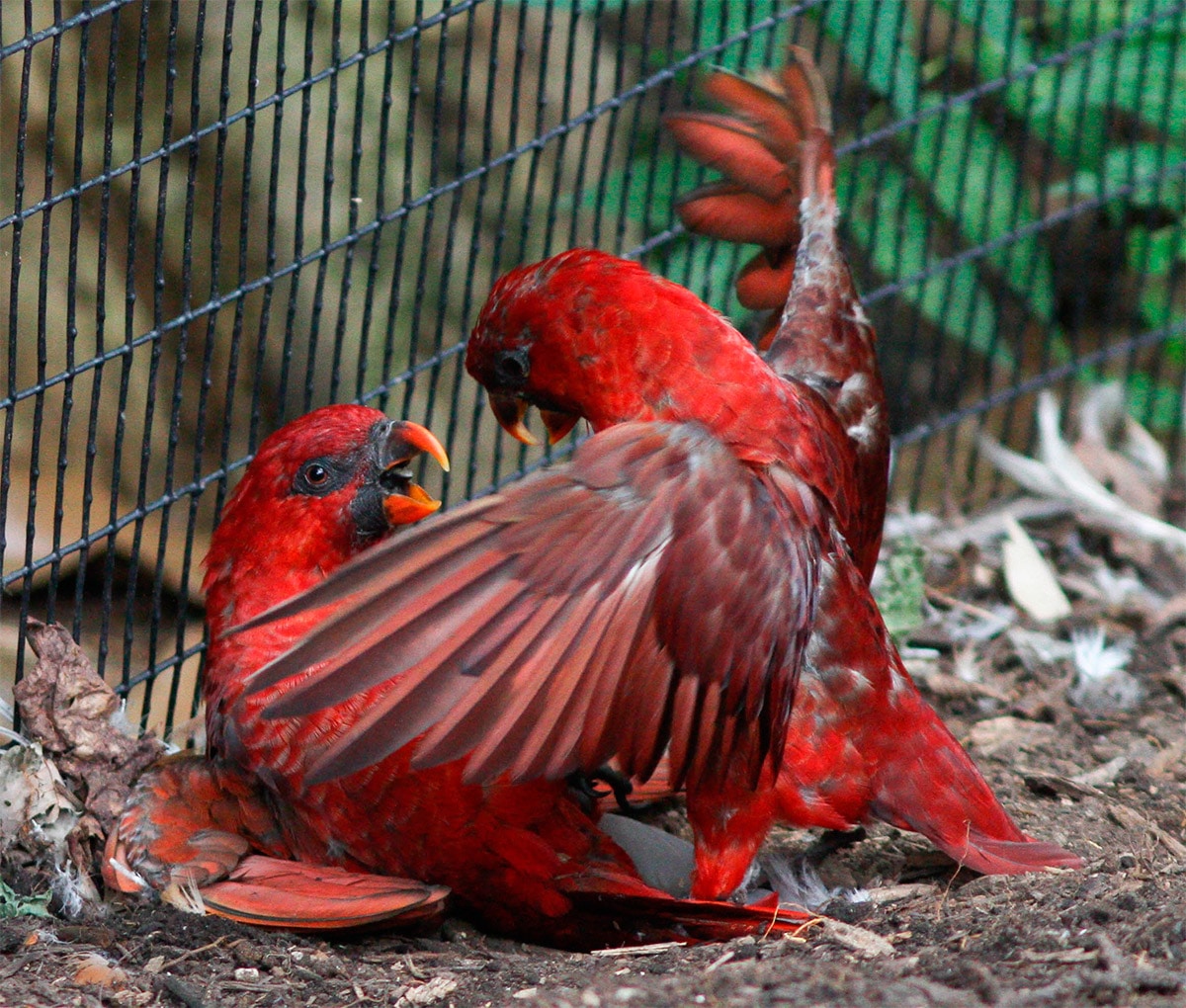
Among adults, There is no sexual dimorphism, the plumage is completely brilliant red, but the upperparts and wings They seem to be darker.
The bill is orange-red with a black color in the base area.
The bare orbital skin is black.
The feathers the lower parts have small yellowish features, What gives a vaguely scaly appearance.
The legs are grey.
The irises is red-orange.
The immature has the back and blankets of Red Wings clear. Its bill It is pale orange with small black marks. Its orbital skin is whitish grey. Their irises are pale yellow.
It is a kind forest. It is very widespread and is locally abundant in primary and secondary forests. It is also in the forests in regeneration in coconut plantations and mangroves where there are trees in flower.
Can rise to 1.200 m above sea level, Although in the Bougainville Island (Papua New Guinea), does not exceed of the 800 m.
It is a bird loud that does not happen easily unnoticed.
It is usually in small flocks of up to 20 birds flying high above the canopy. Also gets into branches higher trees in flower which is notable for its continuous shrieks and its beautiful bright colors.
It is often found in the company of the Coconut Lorikeet(Trichoglossus haematodus) and they particularly appreciate red flowers.
This bird moves constantly in the day, flying from one island to another.
Reproduction:
The breeding season probably starts in June. There are reports of links in August and stops extending to September.
To date, We have found a nest in a high tree cavity, at low altitude above the ground. This is the only information we have about the natural environment.
In captivity, the Cardinal Lory puts two white eggs. Both parents incubate and care for young people.
The incubation period is 24 days.
When out of the shell, chicks weigh in 6 to 7 g.. They are covered with a white quilt, long and dense.
As with all the Loris type Chalcopsitta y Pseudeos the nest is especially long and hard between 65 and 80 days.
Food:
The Cardinal Lory is exclusively vegetarian. Feeds in the canopy and fruit Palms, small berries, flowers, outbreaks, also pollen and nectar.
This Parrot seems to mark a clear preference for the flowers and red fruits.
Distribution:
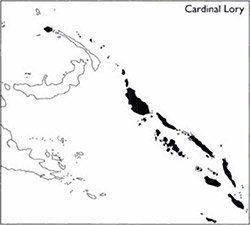
The Cardinal Lory It is endemic to the Islands to the East of New Guinea. Its area of distribution covers New Hanover and the islands surrounding (Tabar, Lihir, Thong, FeNi and Nissan). Extends to Buka and Bougainville. In the Solomon Islands occupies a territory that extends to the South of San Cristóbal.
Conservation:
– Current IUCN Red List category: Least concern
– The population trend: Stable
The world population It has not been quantified, but the species is described as abundant (pit et to the. 1997). Sources estimate that the total population in nature exceeds the 100 thousand copies.
The population is suspected to be stable in the absence of evidence of any reduction or substantial threats.
But, is classified by the UICN as a species "in restricted area", which means that it has a territory whose surface is less to 50 000 km, therefore, potential danger.
"Cardinal Lory" in captivity:
Very rare.
In 1989, the Solomon Island allowed that a few Cardinal Lory were exported to the EE.UU.. But, because of the Law on the conservation of wild birds in 1992 The export of the Lori of Solomon Islands to the United States. UU. they banned except that is for authorized reproduction.
Alternative names:
– Cardinal Lory (ingles).
– Lori cardinal (French).
– Kardinallori (German).
– Lóris-cardinal (Portuguese).
– Lori Cardenal (español).
28-33 cm.. length and 260-301 g. of weight.
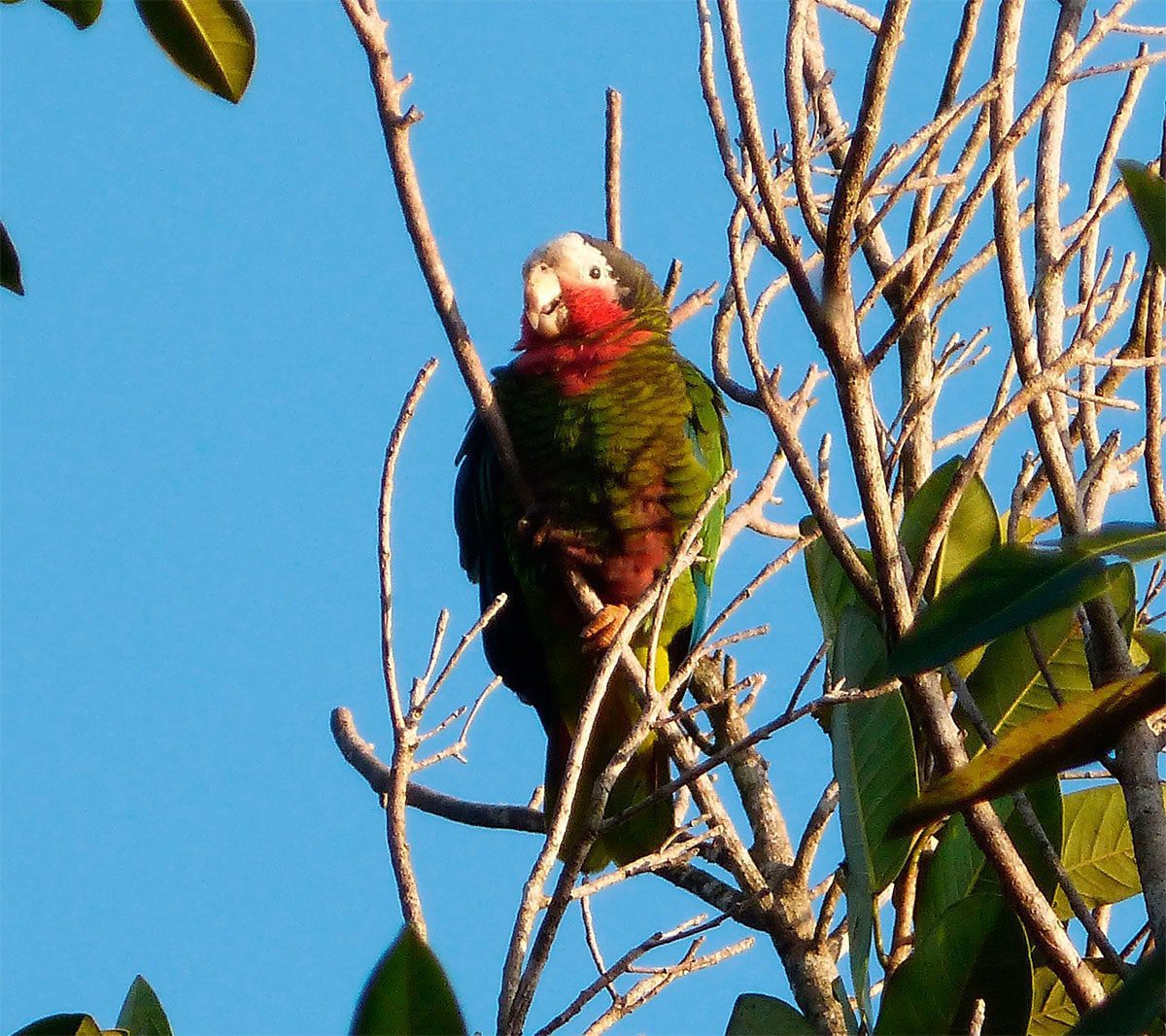
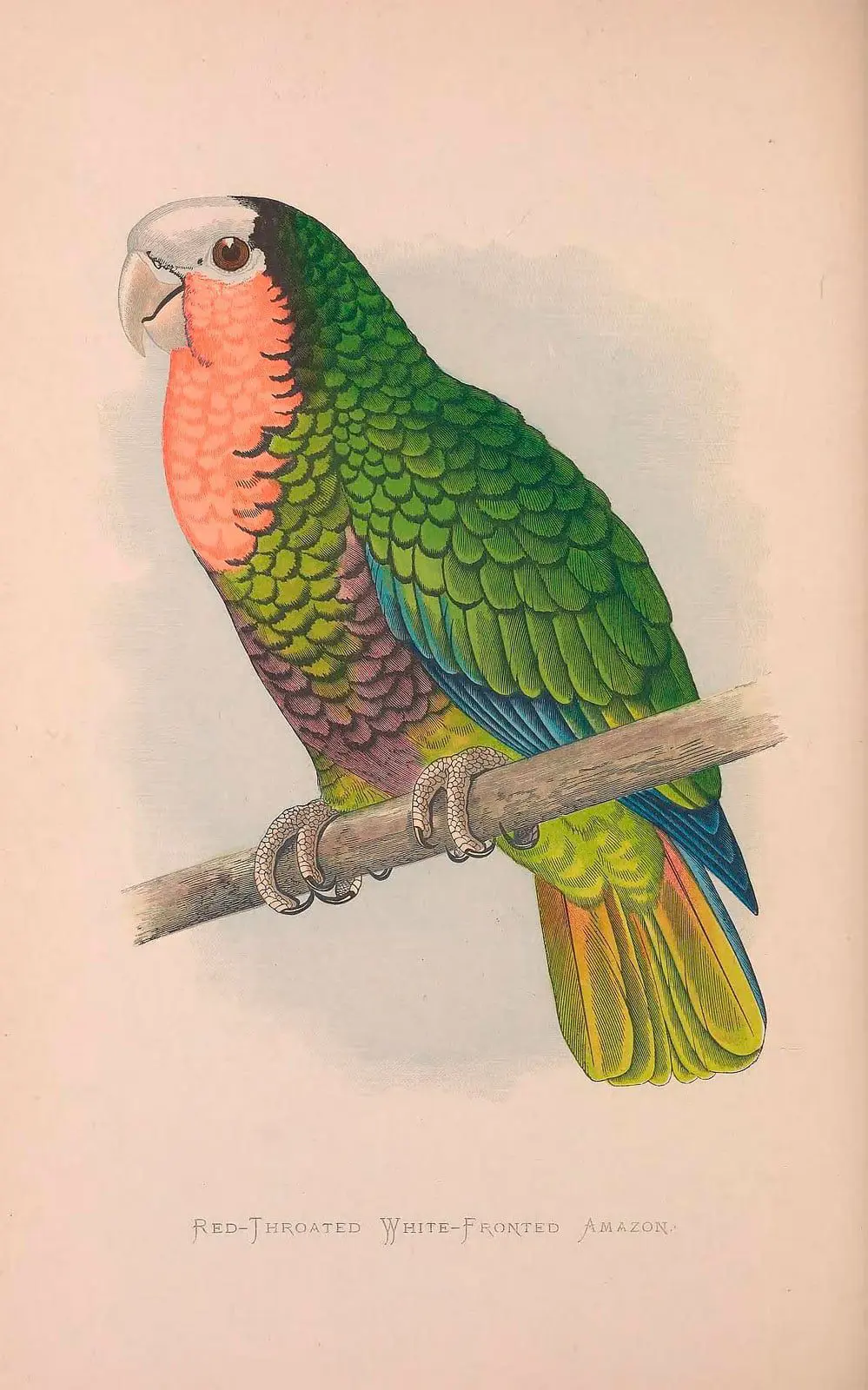
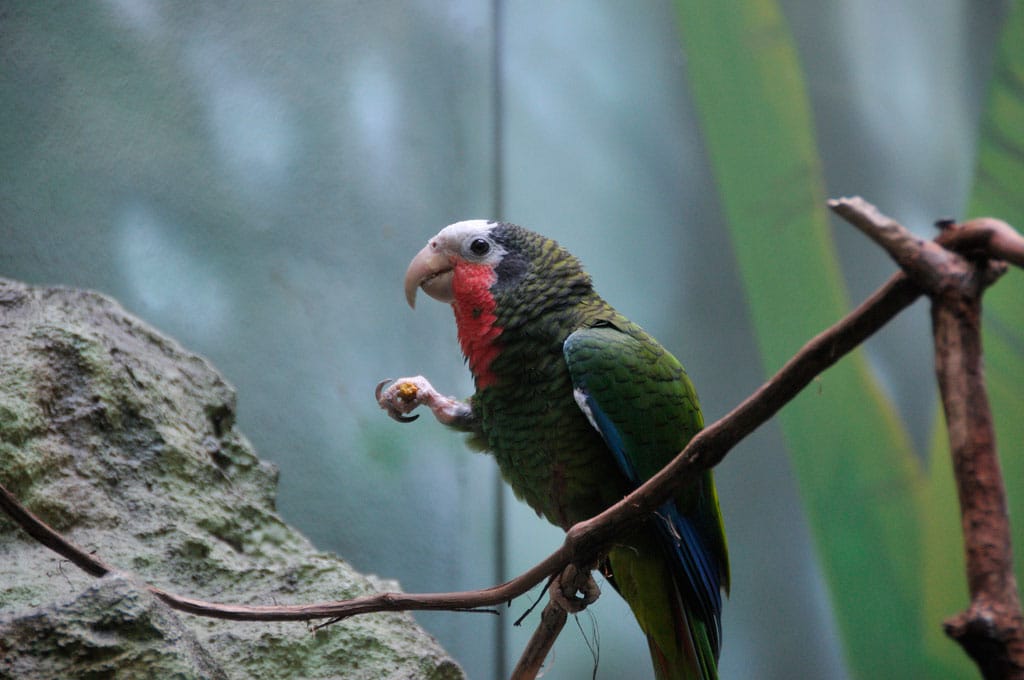
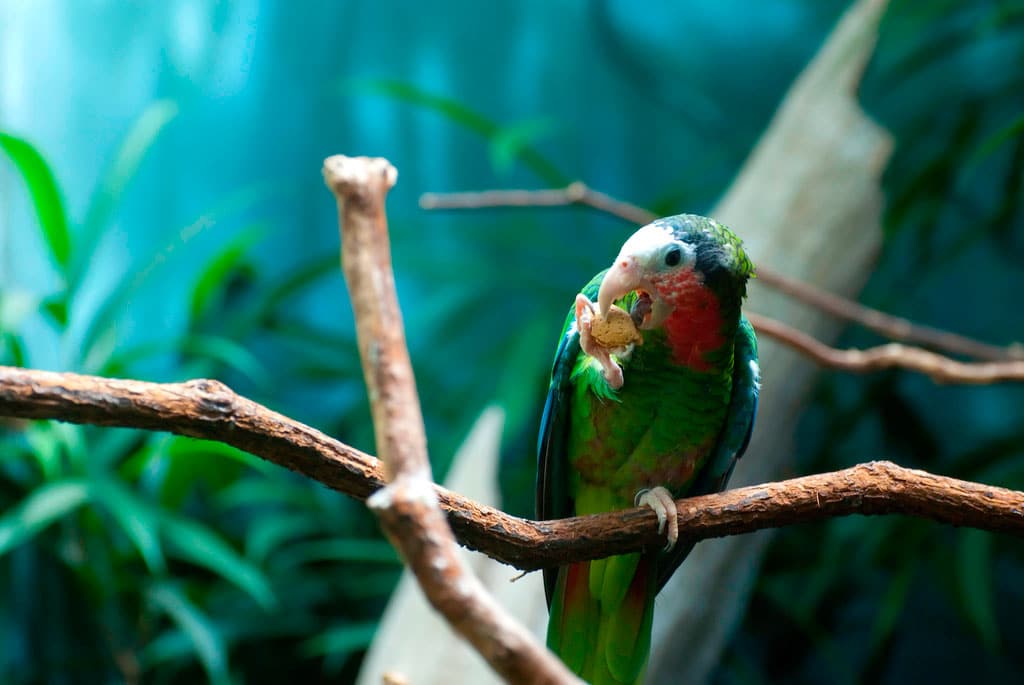
The Cuban Parrot(Amazona leucocephala) has a plumage rather variable, a main color ranging from bright green to olive color,, some birds feathers yellow dispersed in wings and in the back.
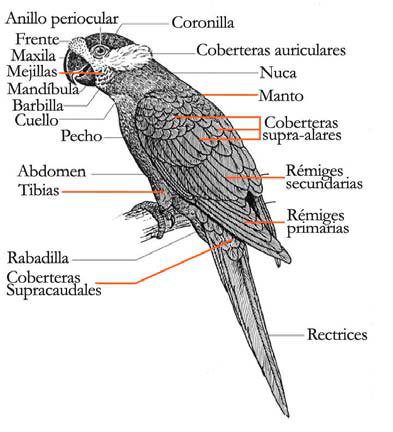
Forehead, fore crown, lores and area around eyes, white; lower cheeks and throat, red-pink; feathers the back of the crown and nape, bluish-green with black margins, giving the whole a heavy barred effect; similar pattern on the sides of neck but with the bluish tint absent; ear-coverts charcoal grey. Feathers of the back and the mantle, green with black distal margins but less intense than in the nape and head; rump and uppertail-coverts, dark green with weak margins to some feathers rump.
Alula, greater coverts and flight feather, blue on the outerweb, gray on inner; remaining coberteras green with dark margins, showing most distinct barring on lesser coverts. Under the wings, green with dark margins, flight feather grey. Breast
green with dark margins to most feathers; feathers on belly with vinaceous base showing green at margins forming a patch variable-sized, barely noticeable in some birds, striking in other; the thighs green or with some vinaceous feathers; undertail-coverts green. feathers tail green with red at base. Bill yellow-horn: irises reddish brown; legs yellowish brown.
Both sexes are alike, but males of the subspecies caymanenis reportedly larger and brighter than females. Usually, the immature show less black borders on the body feathers and less red wine in the belly.
Sound of the Cuban Parrot.
Description 4 subspecies:
Amazona leucocephala bahamensis
(Bryant,H, 1867) – Larger that the nominal species, with slate blue on the back of the crown and more extensive white color head. Pens red wine in the belly, reduced or absent and red at the bottom of the tail less extensive.
Amazona leucocephala caymanensis
(Cory, 1886) – It differs from other subspecies by the turquoise dye in the chest and in the rump and rosacea suffusion (sometimes yellowish) in white feathers head. Plumage Barred yellower and less thick than the nominal species (especially below and on upperwing-coverts), with less white in the head and much less pronounced the patch red wine belly.
Amazona leucocephala hesterna
(Bangs, 1916) – Smaller and darker than the nominal species and that the subspecies caymanensis, most individuals with the red color confined to a point under the eye and patch smaller target in the crown, it lacks the rosy tint of the subspecies caymanensis. Patch red wine in the larger belly than the subspecies caymanensis.
The Cuban ParrotThey inhabit in different habitats in different islands. In Cuba They inhabit dense forests; in the Bahamas, in native broadleaf forests and pine forests, and in the Cayman Islands, in dry forests in the plateau ridge and on nearby farmland (Bond 1979, King 1981, Sibley y Monroe 1990). Usually in small groups but forages while forming larger groups in places where food is plentiful; couples or family groups in flocks discernable. More usually in pairs during breeding. They sleep communally outside the breeding season.
Reproduction:
The Cuban Parrot make their nests in cavities or palm tree hollows created by termites or woodpeckers. The population of Abaco It is particularly interesting because nests in natural holes in substrate limestone in the soil (O'Brien et al., 2006); over there, chicks and adults are completely isolated from the frequent fires in the pine forests They are forming their habitat. Breeding March until mid-summer Cuba and Abaco. The laying usually it comprises between 2 and 4 eggs, the incubation period hard of 26 to 28 days and the chicks remain in the nest between 56 and 60 days.
Size of its range (breeding/resident): 590.000 km2
The Cuban Parrot live in Cuba, Island Pines, Bahamas and Cayman Islands. Formerly observed throughout the island Cuba but now it is difficult to see or is extinct in much of the island. They are still locally distributed throughout the provinces but they are still only common in a few redoubts, including the peninsulas of Zapata and Guanahacabibes and in Sierra de sewage.
You can see in the Isle of Pines (Isle of youth) which dropped dramatically in the twentieth century, especially during the sixties, with most of the population surviving on Lanier Swamp National Park.
Formerly distributed by all the major islands of the Bahamas, but currently extinct, Except in Gran Inagua (spread south, east and north) and Abaco (especially in the southern third). You can visit Little Inagua from Great Inagua.
Mainly in the central and eastern parts of Grand Cayman where habitat loss is less severe. A residual population persists Cayman Brac but it became extinct in little Cayman about 1932.
Mainly resident, but with some seasonal movements, for example in the Isle of youth, where birds possibly (at least once) moved to the coast from the dry interior in the non-breeding season.
The decline across the range is due to the habitat destruction and capture of birds Vivas (for use as pets locally and for export).
Poor breeding success in Grand Cayman in the seventies it was due to mosquito attacks against the pups. Birds that nest on the ground in Abaco attacked by wild cats. The hurricanes They can cause shortages of food and nesting sites. It is likely that Bahamas are stable, but generally decreasing. You can not be considered safe in most of its range.
Distribution 4 subspecies:
Amazona leucocephala bahamensis
(Bryant,H, 1867) – Abaco and Gran Inagua, Bahamas, previously in several other islands, but now extinct.
The Cuban Parrot It is classified as near threatened because it is suspected to have suffered a reduction in population in Cuba, which has not ceased, mainly due to the capture and destruction of nesting sites.
• Current category of the Red List of the UICN: Near-threatened.
• Population trend: Decreasing.
• Population size : 13600-23000
Justification of the population
Population estimates for Bahamas and Cayman Islands they are as follows: 2.000 in Gran Cayman in 1995 (Bradley 2000), about 450 in Cayman Brac in 2013 (Marsden, 2013), 8.000-13.000 in Great Inagua, 3.000-5.000 in Abaco and around 10 individuals in new Providence (Bahamas National Trust 2016, S. Cant-Woodside in a bit., 2016). It is estimated that the population of Cuba amounts of 7.000 to 14.000 copies based on estimates recorded population density and the fact that it is likely that only a proportion of the estimated extent of occurrence deal. So, the total population It is estimated in 20.460-34.460 individuals, which is equivalent to 13.640-22.973 mature individuals, rounded here to 13.600-23.000 mature individuals.
Justification of trend
It is considered that the species is declining mainly due to the capture and destruction of nesting sites. It is considered that the population of the Bahamas It has remained stable or increased. The population of the Cayman Islands It has increased since the species was protected in 1989 (Bradley 20000). It is believed that the Cuban population has decreased in recent years, mainly due to the poaching (Canizares 2012, M. Canizares in a bit., 2016). Although there is no data on the extent of this decline, the species has been classified as Vulnerable in Cuba (Canizares 2012). So, It is suspected that the total population has decreased 10-20% over three generations.
Conservation Actions Underway
• CITES Appendix 1.
• Protected in the Bahamas under the Wild birds Protection Act (Protection).
• Rightfully protected in the Cayman Islands from 1989.
• Los artificial nests a variety of designs are in use in several locations Cuba and they have been used by more than 1.300 birds (Waugh 2006). The facts of artificial materials have proved more durable (Waugh 2006).
• Los volunteers counts in the center of Cuba They have been conducted twice a year since 2009 and more than 1.500 local people are involved in the activity.
• Important plant species are used for parrot feeding for reforestation and forest enrichment..
Conservation Actions Proposed
• Discourage the taking of birds from the wild through public education campaigns.
• Promote better bird-keeping practices to increase the longevity of captive birds and reduce the demand for wild populations.
• In Abaco, protect vital areas of broadleaf forests.
• In Cuba, make and erect more artificial nests.
• Monitor the population trends across its range.
Cuban Parrot in captivity:
Currently international trade Cuban Parrot It is legally prohibited; However, at regional level, the illegal traffic This species is one of the most worrying in Cuba.
Each captive specimen of this species which is capable of reproducing, must be placed in a well-managed captive breeding program and not sold as a pet, in order to ensure its long-term survival.
Alternative names:
– bahaman parrot, Caribbean Amazon, Caribbean Parrot, Cuban Amazon, Cuban Parrot, Rose-throated Parrot, White-headed Amazon, White-headed Parrot (English).
– Amazone à face rouge, Amazone à tête blanche, Amazone de Cuba (French).
– Kubaamazone (German).
– Papagaio-de-cuba (Portuguese).
– Amazona Cubana, Cotorra (español).
 Minor Concern ⓘ
(UICN)ⓘ
Minor Concern ⓘ
(UICN)ⓘ
















.JPG)